Native

16 finalists emerge for Initiators Fellowship

16 finalists emerge for Initiators Fellowship

LITTLE FALLS — Sixteen social entrepreneurs were chosen from a pool of nearly 90 applicants to move to the next stage of the 2024-2025 Initiators Fellowship selection process.

The finalists represent 53 counties and six Native nations in Central, Northwest, Southwest and West Central Minnesota.

On Tuesday, Oct. 24, the 16 finalists will participate in selection day in St. Cloud. From the field of 16, eight Fellows will be selected for the 2024-2025 Initiators Fellowship cohort. The Fellows will experience comprehensive programming, executive-level mentoring, leadership training, ongoing entrepreneurial education, and support from dedicated staff members to advance their mission-driven businesses or nonprofit endeavors. Each Fellow also will receive an annual $30,000 stipend during the two-year program.

“We were blown away by the many folks doing important social enterprise work throughout Greater Minnesota,” said Brian Voerding, Initiative Foundation vice president of inclusive entrepreneurship, in a news release. “We had a tough job narrowing the pool, and we look forward to selection day when we can meet the finalists and learn even more about their work.”

The Initiators Fellowship

originated with the Little Falls-based Initiative Foundation

in 2017 to help aspiring social entrepreneurs fast-track their ideas, grow their social and professional networks, and develop their business and community leadership skills. Eleven Fellows graduated from the program since inception. In December, seven Fellows will graduate from the 2022-2023 cohort.

ADVERTISEMENT

The 2024-2025 finalists represent a diverse range of interests — from an entrepreneur with a goal to engage and support Native artists on the White Earth Reservation to a mother launching a center for supervised parental visits and education opportunities.

A closer look at the finalists

Staci Allmaras, Pelican Rapids, youth empowerment

Staci-Allmaras.png

Staci Allmaras

Contributed

Allmaras loves to quote Paul Wellstone: “We all do better when we all do better.” She wants to use her experience working in schools to build up The Youths_PR, a Pelican Rapids youth organization, to offer communal space and income-generating opportunities. Allmaras would use the time in the Fellowship to pursue nonprofit status and expand the organization’s work to empower even more youth.

Alex Blondeau, Fergus Falls, prairie restoration

Alex Blondeau

Alex Blondeau

Contributed

Blondeau wants to connect with the land and help others experience, grow and enhance native prairie reconstructions, the Foundation reported. Through Windflower Natives, launched during spring 2023, Blondeau grows and sells plants in-person and online. “He hopes to use his venture to heal indigenous ecosystems through education, art and prairie restoration initiatives.”

Ben Cahill, Bemidji, LGBTQ2S+ resources

Ben Cahill

Ben Cahill

Contributed

As a community health worker, Cahill learned a lot about the health barriers facing those in the LGBTQ2S+ community. In Native cultures, two-spirit people (2S+) are male, female, and sometimes intersexed individuals who combine activities of both men and women with traits unique to their status as two-spirit people. In many tribes, they occupy a distinct, alternative gender status. His social enterprise will offer community health services, events, advocacy and more to those in the LGBTQ2S+ community. Learn more:

www.pridesupportnetwork.org

.

Lisa Finck, Verndale, specialized head coverings for epileptics

ADVERTISEMENT

Lisa Finck

Lisa Finck

Contributed

Finck launched Rainbow Hair Hats in late 2022 to make life less scary for her daughter and others who have tuberous sclerosis complex, the leading genetic cause of epilepsy. Those with epilepsy often are hooked up to electroencephalogram wires, which can look scary to an onlooker. Finck wants to use Rainbow Hair Hats to make life better for those with epilepsy and to heighten awareness of the disorder, the Initiative Foundation reported.

Dawn Finn, Pelican Rapids, mental health services

Dawn Finn

Dawn Finn

Contributed

Finn believes in serving others and breaking barriers, the Foundation reported. Through Community & Life Services, a nonprofit she launched to serve Otter Tail and Becker County residents, Finn and her staff are working to address addiction and mental health challenges while offering education on parenting, personal finances and much more. Her goal for the social enterprise venture is to help people achieve long-term positive change.

Chrystal Fischer, South Haven, supervised visitation 

Chrystal Fischer

Chrystal Fischer

Contributed

While driving her 2-year-old daughter four hours round trip for supervised visits with her father, Fischer dreamed of making life easier for families in similar situations. She started Parenting with Grace to create a safe, comfortable and accessible space in Wright County for supervised visits. Through her social enterprise, she also plans to offer parent education, seminars and support groups.

Jill Greendeer, St. Michael, tribal data sovereignty

Jill Greendeer

Jill Greendeer

Contributed

Greendeer wants to give voice to indigenous people by advocating for sovereign authority to administer the collection, ownership, and application of their own data, the Foundation reported. Greendeer’s social enterprise would guide the constraints of research on tribal lands through independent review boards for Native research that include protocols, ethical and diverse community considerations as well as training for researchers. Greendeer has a doctorate in nursing from the University of Minnesota.

Lynn Kotrba, Moorhead, teaching farm

ADVERTISEMENT

Lynn Kotrba

Lynn Kotrba

Contributed

Kotrba launched Harvest Hope Farm to share knowledge on sustainable agriculture and environmental stewardship. Kotrba plans to introduce agri-tourism to her venture to better help children and adults connect with nature and food sources. She’s also contributing to science: The sheep on her farm are used for research to find a cure for Huntington’s disease.

Jean Kruft, Pine Point, Native career training 

Jean Kruft

Jean Kruft

Contributed

Kruft launched Creator’s Place, LLC (Bam’idizowigamig), to help her Native friends and neighbors put an end to intergenerational poverty. This on-the-job training and work center on the White Earth Reservation employs 20 people. Workers make Ojibwe crafts, create wood-crafted items and package wild rice mixes. Learn more at

www.creatorsplace.org

.

Tara Mason, Naytahwaush, Native art support and supplies

Tara Mason

Tara Mason

Contributed

Mason’s social enterprise ventures — 1867 Supply Trade and White Earth Artist Co-op — are designed to support Native artists on the White Earth Reservation. Through her projects, Native people can earn a living and see themselves reflected in their art: 1867 Supply Trade will market supplies for powwow regalia while White Earth Artist Co-op will be a place for artists to support one another in selling their art.

Muhayadin Mohamed, St. Cloud, Islamic-approved financing

Mohayadin Mohamed

Mohayadin Mohamed

Contributed

Islamic rules related to interest collected on loans can create a barrier for Muslim people to get the financing they need to build their businesses. Mohamed wants to create an enterprise to offer Islamic-acceptable financing and to assist with financial literacy, the Foundation reported. “He hopes to use his business to help his Muslim neighbors launch businesses and achieve financial independence.”

Shannon Murray, Bemidji, youth development

ADVERTISEMENT

Shannon Murray

Shannon Murray

Contributed

Murray wants all people with intellectual and developmental disabilities to find meaningful, inclusive employment, the Foundation reported. Her aspiration is to launch a social enterprise that helps young leaders with intellectual and developmental disabilities access continuing education, advocacy support, professional development, job-skills training, and community-building activities.

Suree Sompamitwong, Worthington, art and healing space

Suree Sompamitwong

Suree Sompamitwong

Contributed

Creative Healing Space in Worthington is a place for people to create and spend time together. Sompamitwong built this nonprofit after being inspired by her own healing journey. She wants to continue her work at Creative Healing Space to engage more local people and to provide more opportunities to create and connect, the Foundation reported.

Wanetta Thompson, Hinckley, cultural arts programming

Wanetta Thompson

Wanetta Thompson

Contributed

Thompson wants to use Bear Paws Cultural Arts to reclaim cultural identity and build understanding with her friends and neighbors, both Native and non-Native, through art, the Foundation reported. The organization offers contemporary and traditional Native American art classes free of charge to the community. “Ultimately, she wants to use art to bring people together.”

Funwi Tita, Buffalo, African vegetable farm

Funwi V Tita

Funwi V Tita

Contributed

Better Greens LLC became a business for Tita when necessity met passion. Today, the small-scale agri-business supplies fresh and frozen African greens and vegetables to support the dietary needs and wants of African communities in Minnesota and around the country. Tita’s vision for his social enterprise is to introduce more people to traditional African vegetables and to help people make meals like they had growing up. Visit

www.bettergreensllc.com

to learn more.

Tanya Vacek, Glencoe, community kitchen, incubator

ADVERTISEMENT

Tanya Vacek

Tanya Vacek

Contributed

Raising her family on a homestead farm, Vacek understands how food can bring people together. She wants to support and encourage people to connect over food by launching a community kitchen and incubator space in Glencoe, the Foundation reported. “Vacek hopes to inspire culinary enthusiasts of all ages, to foster connections, and to champion local, sustainable agriculture.”

We were blown away by the many folks doing important social enterprise work throughout Greater Minnesota.

Brian Voerding, Initiative Foundation vice president of inclusive entrepreneurship

About the Initiators Fellowship

The Initiators Fellowship is a collaborative program of the Initiative Foundation, Northwest Minnesota Foundation, Southwest Initiative Foundation, and West Central Initiative. The Fellowship is made possible by generous funders, including Granite Partners, an original founding funder and partner, along with the Bush Foundation, McKnight Foundation and Sourcewell.

The Initiative Foundation supports a 14-county service area that includes Benton, Cass, Chisago, Crow Wing, Isanti, Kanabec, Mille Lacs, Morrison, Pine, Sherburne, Stearns, Todd, Wadena and Wright counties and portions of the Native nations of the Leech Lake and Mille Lacs Bands of Ojibwe. Based in Little Falls, the Foundation exists to improve the quality of life and to build stronger communities in Central Minnesota by offering business loans, nonprofit grants, leadership training and donor services through its Partner Funds programs. Since 1986, the Initiative Foundation and its Partner Funds have invested multiple millions in the region through targeted grants and business financing investments. Visit

www.ifound.org

to learn more.

Marquette City Commission approves indigenous public art installation

Marquette City Commission approves indigenous public art installation

MARQUETTE, Mich. (WLUC) – The Marquette City Commission unanimously approved a contract for an indigenous, public art installation at Tuesday’s meeting.

The Marquette public art commission chose Michigan Native and Saginaw Chippewa Indian Tribe Member Jason Quigno to create the art piece.

The work will have seven stone sculptures in a circle around a bench, which is based on the seven grandfather teachings of the Anishinaabe tribe.

The art installation will sit at the entrance of the renovated Founder’s Landing pier, along Marquette’s upcoming cultural trail.

Marquette City Manager Karen Kovacs said this sculpture is meant to highlight Upper Michigan’s indigenous culture and history.

“What this is going to be is really supporting that cultural trail but then also really touching on the historic parts of what our community is founded on,” Kovacs explained. “It’s going to be something that is state-of-the-art but then also really unique to our area.”

The project will cost $70,000. The city said $40,000 of the cost will be paid for with a grant from the Native American Heritage Fund and the National Endowment for the Arts.

An Old Town Scottsdale art gallery is hosting a women’s art expo featuring live painting

An Old Town Scottsdale art gallery is hosting a women’s art expo featuring live painting

Jessica Garrett

Jessica Garrett is one of the featured artists at AWAE: A Women’s Art Expo in Old Town Scottsdale Oct. 12-13, 2023.

The Marshall Gallery in Old Town Scottsdale is hosting a two-day event featuring 10 acclaimed female painters. It’s called, “AWAE: A Women’s Art Exposition.”

Gallery co-owner DeeAn Gillespie Strub said attendees will be able to see past works by the artists and also witness them in action.

“Not all of them are regularly represented by the gallery,” she said. “It’s an invitational, and they will be there in person, painting. It’s a lovely experience to be able to come and see art being created.”

Strub also believes the event encourages a rediscovery of perspective.

“In resplendent Italy, the darkness of the Middle Ages reluctantly gave way to the beauties of the Renaissance – largely due to the discovery, or rediscovery, of perspective. AWAE offers our own rediscovery of perspective: the kindly, gentle, discerning women’s perspective,” she said in a separate release.

The free shows run Thursday, October 12, from 5-9 p.m. and Friday, October 13, from 11 a.m. to 3 p.m. 

Featured artists

Carol Estes – Carol’s art reflects her inner buoyancy and progressive optimism. She developed her style in the avant-garde, Deep Ellum bohemian music and arts district in Dallas, Texas.

Jessica Garrett – Jessica Garrett is inspired by her life in the Southwest to showcase a fresh approach to color and an illusion of light that does justice to nature. She has learned how vital color is in recreating the feeling of light and explores color as her ultimate inspiration.

Elena Golberg – After moving to the United States in 2004 from Barnaul, an industrial city in the Siberian part of Russia, Elena Golberg became fascinated with Native American culture and has found Saguaro cacti to be the primary subject of her portraits.

Harper Henry – Harper Henry is an award-winning artist who creates unique, abstract-realistic paintings focused mainly on horses, animals, and the American West. She received a Bachelor of Fine Arts Degree in Illustration and had a successful 30-year career as a Designer and Art Director until 2016 when she decided to pursue painting full-time.

Shari Lyon – Shari Lyon is skilled in the ancient encaustic process of painting with a hot melted mixture of beeswax and damar resin. The labor-intensive process yields dreamy, ethereal images with texture and appeal unlike any other art form.

Krystii Melaine – Wildlife, horses, cowboys, and Native Americans have been the focus of Australian-born Krystii Melaine’s realistic oil paintings for 23 years. Krystii began to explore abstract art, which opened her imagination to modern concepts and a wider range of expressive ideas. Now, the abstracts have begun to work their way into her realism paintings as backgrounds, sometimes weaving through and over the animals and people too.

Becky Pashia – Becky Pashia “suggests” a subject in her art and focuses on light and color to evoke feelings and trigger memories. Her oil technique includes slipping and spreading paint across a surface with large spatulas and brushes, trying to keep the paint loose and raw in order to resemble watercolors.

Daniela Pasqualini – By breaking down elements of flora and fauna, Daniela Pasqualini, an innovative Italian painter, transforms her observations of nature onto the canvas, bringing rhythm to splashes of vibrant color and creating texture through form.

Leah Rei – Leah Rei weaves transparent layers together to create abstract representations of our natural surroundings. Her main goal is to create scenes of nature that can evoke a deep sense of calm and wonder.

Danene Taysom – Danene Taysom creates colorful landscape and still-life oil paintings.  The love of light and color is what ultimately drove her to become a professional artist. She also enjoys teaching art classes in her studio and providing painting workshops throughout the year.

City Celebrates Indigenous Peoples Day

City Celebrates Indigenous Peoples Day

The City of Albuquerque was one of the first in the nation to adopt Indigenous Peoples’ Day as a city holiday and continues to be a model for meaningful Indigenous relations. Under Mayor Keller, the Office of Native American Affairs was established, and the city honors its commitments to tribal sovereignty and Indigenous rights through the Commission on American Indian and Alaskan Native Affairs.

“It is important that we continue to acknowledge how meaningful it is to honor and celebrate Indigenous Peoples Day in our city” said Mayor Tim Keller. “We recognize the powerful contributions of Native people in our community, and the important role they played, and continue to play, in making Albuquerque what it is today.”

The City celebrated Indigenous Peoples Day with the Native community at Tiguex Park. The City’s Office of Native American Affairs supported community organization, Americans for Indian Opportunity (AIO) for the Indigenous Peoples’ Day celebration. This event garnered dozens of people who had the opportunity to participate in youth activities, browse various resource vendors, win raffle prizes, and even register to vote. The event also featured a meet and greet with popular Indigenous Tik Tok creators, and live musical performances by Indigenous artists Sage Bond and Emmet Yepa. 

“This event allows us to brings Albuquerque’s Natives together so we can all celebrate in community with one another” said Kyle Tapaha, Commission on American Indian Alaskan Native Affairs Chair and AIO Urban Indigenous Organizer. “Indigenous people are still here, and it is through honoring days that we recognize that.”

Mural honoring Dakota people unveiled in Red Wing

Mural honoring Dakota people unveiled in Red Wing

A community gathering Monday in Red Wing celebrated the unveiling of a large-scale outdoor mural honoring the Dakota people and Chief Red Wing.

“It matters that we know our history so we know where we want to go and where we want to go together,” Lt. Gov. Peggy Flanagan said at the unveiling in downtown Red Wing, held on Indigenous Peoples Day.

“And this mural is a prime example of what that can look like when we tell the truth, when we embrace each other, when we work together across lines of difference — because that is what we are called to do as people who simply exist in this space and in this world together.”

The mural — 60 feet long and 18 feet high — is on the side of a city building at the corner of West Third and Bluff streets, overlooked by the landmark bluff He Mni Can.

MPR News is supported by Members. Gifts from individuals power everything you find here. Make a gift of any amount today to become a Member!

Men take part in a drum circle

Men take part in a drum circle during a mural unveiling ceremony on Indigenous People’s Day in Red Wing on Monday.

Tim Evans/MPR News

It was painted in September by Colorado-based Native artists Jeremy Fields and Collins Provost-Fields of Thrive Unltd, who were picked by the Prairie Island Indian Community.

“Each mural section depicts local Indigenous relatives in their natural environments. The sections are divided by a sweetgrass braid and a red willow twist with local native wildflowers and medicines intertwined,” organizers said in a news release ahead of the unveiling.

Cole Redhorse Taylor, a Mdewakanton Dakota artist and a Prairie Island member, contributed designs to the painting.

The mural is part of the Honoring Dakota Project, “a process of community conversations and events that provide education to discover shared stories, bridge the communities, and create a space for healing.” Partners in the project include the Prairie Island Indian Community, Red Wing Arts, the City of Red Wing and Goodhue County.

“In the beginning, we all came together to bring a mural to the Red Wing landscape that would create space and honor the Dakota Indigenous relatives of the area. As we began unraveling the context and purpose of the mural, we realized collectively, the importance of relationship and the necessity of community,” Fields said in the news release.

“This project has come to embody shared experiences, family and tribal lineages, collective healing and much more. It has grown far beyond brush strokes and paint. We are creating a community legacy, of which the effects will continue to ripple for generations to come.”
Organizers of the project said the mural provides the first public portrayal honoring Chief Red Wing in the city that carries his name.

María Magdalena Campos-Pons and Raven Chacon Are Among the Artists Who Won the 2023 MacArthur ‘Genius’ Grants

María Magdalena Campos-Pons and Raven Chacon Are Among the Artists Who Won the 2023 MacArthur ‘Genius’ Grants

Among the 20 winners of this year’s MacArthur “genius” fellowships, each receiving an $800,000 grant over the course of five years, are four artists: María Magdalena Campos-Pons, Raven Chacon, Carolyn Lazard, and Dyani White Hawk.

Even before the announcement of this prestigious honor—recipients don’t apply, but are anonymously nominated by their peers, and only find out they were under consideration once they win—the quartet already boasted an impressive list of accolades.

In 2022, Chacon won the Pulitzer Prize for music, the first Native American so honored. Working with themes of the violent colonial history of the United States, the Diné-American composer and artist creates experimental music, performances, and sound installations, as well as drawings and video work. His work was included in “Quiet as Its Kept,” the 2022 Whitney Biennial in New York.

White Hawk, who is also an Indigenous artist, of Lakota descent, was featured in last year’s Whitney Biennial as well. There, Artnet News national art critic Ben Davis called her “beautifully beaded shimmering geometry” a standout work in the show that “is intimately engaged with Lakota craft traditions but also explicitly presented as a reminder of how the heavies of mid-century Abstract Expressionism took inspiration from Native American art.”

Raven Chacon. Photo courtesy of the MacArthur Foundation.

Raven Chacon. Photo courtesy of the MacArthur Foundation.

In receiving the award, White Hawk acknowledged the many people who have helped her in her career, including assisting with the labor-intensive beadwork on monumental pieces that look like large-scale murals. “I just feel like it’s generations worth of sacrifice, love, prayer and work,” she told the Star Tribune. “And I’m grateful for it all.”

Currently, both Chacon and White Hawk have work in “Indian Theater: Native Performance, Art, and Self-Determination Since 1969,” on view at the Hessel Museum of Art at Bard College in Annandale-on-Hudson, New York, through November 26, 2023.

Lazard, meanwhile, whose work ranges from installation to sculpture to drawing, among other media, could be spotted at the 2022 Venice Biennale’s international exhibition, “The Milk of Dreams.” One of her works from the show, Crip Time (2018), a video in which a set of hands fills a weekly medicine organizer with pills, is now in the collection of New York’s Museum of Modern Art.

[embedded content]

Campos-Pons, whose first major New York solo exhibition, “Behold,” opened last month at the Brooklyn Museum, is a feminist artist drawing on Afro-Caribbean religion and culture in response not only to her own family origins, but of the global history of colonialism. Working in large format Polaroid as wells a performance, sculpture, and painting, the Cuban native also a veteran of major group shows such as Documenta 14 and the Sharjah Biennial.

“When I left the town of La Vega [Cuba] to go to art school [as a young girl], I was wearing pants and a top that my mother made me using the fabric from a used mattress cover. All I had was my luggage and a little piece of brown paper that had the address of where I was going. And I knew that I never was going to return to the town until I had a lot of good news to share. So now I am going back to La Vega—as a MacArthur Genius,” Campos-Pons told NPR.
María Magdalena Campos-Pons. Photo courtesy of the MacArthur Foundation.

María Magdalena Campos-Pons. Photo courtesy of the MacArthur Foundation.

“Behold” is set to travel to the Nasher Museum of Art in Durham, North Carolina, and the Frist Art Museum in Nashville, and features loans from institutions including MoMA; the Smithsonian American Art Museum in Washington, D.C.; the Detroit Institute of Arts; and the Speed Art Museum in Louisville, Kentucky.

The four new genius grant recipients join a long line of artists recognized by the MacArthur Foundation, including Paul Chan and Tavares Strachan in 2022 and Jordan Casteel and Daniel Lind-Ramos in 2021.

More Trending Stories:  

An Elderly Couple Sold a ‘Worthless’ African Mask for $157. Now They Are Suing the Buyer Who Auctioned It for $4.4 Million 

A Norwegian Man Stumbled Upon a Trove of Gold Dating to the Early Middle Ages, Including a Rare Pendant Depicting the Norse God Odin 

A Top Antiquities Sleuth Has Called Out the Manhattan D.A. For Continually Passing His Work Off As Its Own 

Emerging Artist Li Hei Di Calls Her London Studio a ‘Parallel Universe,’ Where Hong Kong’s Cinematic Heroines and Mystical Abstraction Meet 

After Its Team-Up With Pokémon, Scalpers Swarm the Van Gogh Museum to Snap Up Merch and ‘Pick the Gift Shop Clean’ 

An Enigmatic Still-Life Picasso, Made During His Now-Celebrated ‘Wonder Year’ of 1932, Will Hit the Auction Block This Fall 

Get a Closer Look at Lagos-Based Artist Nengi Omuku’s Intricate Textile Paintings—Made on Traditional Nigerian Cloth 

A Mexican Journalist Went Viral After He Presented ‘Alien Bodies’ to Congress. Now He Is Accused of Plundering Them From Ancient Sites 

Follow Artnet News on Facebook:
Want to stay ahead of the art world? Subscribe to our newsletter to get the breaking news, eye-opening interviews, and incisive critical takes that drive the conversation forward.

Indigenous people remember the reason they celebrate Native American Day

Indigenous people remember the reason they celebrate Native American Day

RAPID CITY, S.D. (KEVN) – In 1990, South Dakota became the first state to establish Native American Day.

Today, 17 states recognize Indigenous Peoples’ Day as a day used to remember Native American heritage.
In 1937, President Franklin D. Roosevelt established Columbus Day as a national holiday. However, in 1990, South Dakota Governor George S. Mickelson made the decision to rename the holiday Native American Day, as a way to honor native culture and seek reconciliation between indigenous and white people after having historically bad relations. Monday, NDN hosted a march to honor the Native American Culture

“It’s important because, I think a lot of people might not understand what being indigenous is, what that means to us, it’s how we exist, it’s how we live our lives. Our lives are rooted in culture and language and it’s just neat to be able to share that and hopefully educate others in the community about that so they have an understanding, or begin to get an understanding about what that means,” said Murray Lee, director of community engagement for NDN Collective.

To some, being able to celebrate this day is a way to reclaim their cultural identities, as well as keep their history alive.

“I think that for a long time that because of colonization and genocide, we were forced on to a culture that was not of our own. This is us, abundantly who we are and celebrating our attire, our activism, our culture, our foods, our songs. I think it’s incredibly important, it’s about the re-identification and reclamation of our cultural identities,” said Kim Tilsen-Brave Heart.

Rebekah Jarvey, a Native American fashion designer, was one of only seven designers to participate in the Cannes Indigenous Fashion Festival in France. She says her designs are a way for people to connect and preserve their way of life.

“Its very important. It became a very contemporary way to do self preservation through our clothes and the stories. Its a very contemporary way like I said, but it is a new way, and its a way that our youth could connect and identify with and still preserve our culture and our way of life,” continued Jarvey.

The NDN march and activities lasted throughout the day. Attendees were able to enjoy Teepee demonstrations and traditional Native American dances and music. The gathering also featured Indigenous artists selling artwork and jewelry.

Eiteljorg Museum celebrates Indigenous Peoples’ Day

Eiteljorg Museum celebrates Indigenous Peoples’ Day

Over the weekend, the Eiteljorg had cultural presentations, art demonstrations and different activities to celebrate the holiday.

INDIANAPOLIS — When going through the Expressions of Life: Native Art in North America at Eiteljorg Museum, people get the opportunity to see the artwork from many Native American tribes. But one Indianapolis resident got to show her work through the Indigenous Peoples’ Day celebrations.

“Once you really kind of peak or you’re realizing your goals is when you have your pieces of your art acquired,” Monica Raphael said.

Raphael was a 2022 Artist in Residence at the museum and is the Curator of Great Lakes Native Cultures and Community Engagement. She also has some of her artwork displayed in the exhibit. Recently, her grandson was able to share his work as well.

“Most museums somebody else tells your story, but here at Eiteljorg, they’ve really worked hard for us to tell that story,” she said. 

Over the weekend, the Eiteljorg Museum had cultural presentations, art demonstrations and different activities to celebrate the holiday. Monday was free admission day and visitors were able to see the artwork of Kandi McGilton and David Boxley. This let people immerse themselves into the cultures and see some things history textbooks don’t cover.

“What’s really the most important is that they understand that there are different cultures,” Annita Corburn, a mother at the exhibit said. “People perceive the world differently, they hear the world differently.”

Raphael hopes that when people left the exhibit and after Indigenous Peoples’ Day is over,  they remember what the holiday is about and continue to share these cultures. 

“We have a lot of things wrong in the world, and whenever we can share our knowledge, no matter what color person you are, share what knowledge you have,” Raphael said.

The Expressions of Life: Native Art in North America will still be open after Monday and on October 21, when the Day of the Dead celebrations kick off.

RELATED: Here’s how you can celebrate Indigenous Peoples’ Day in Indianapolis

[embedded content]

An anti-World’s Fair makes its case: give land back to Native Americans

An anti-World’s Fair makes its case: give land back to Native Americans

From the elevated platform of the 7 train in Queens, New York, a formerly-empty lot now looks like a carnival. There’s lights and colorful posters and — wait. Is that a giant, talking beaver?

Yes. Yes, it is.

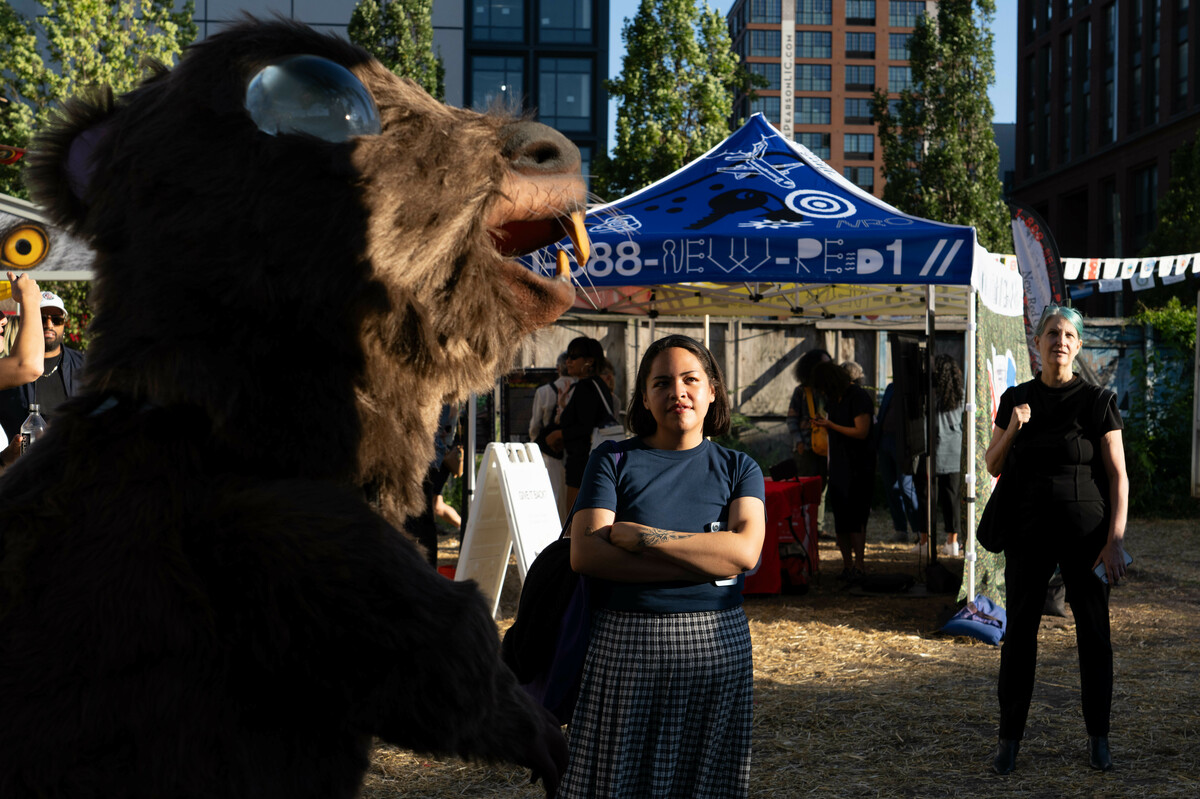
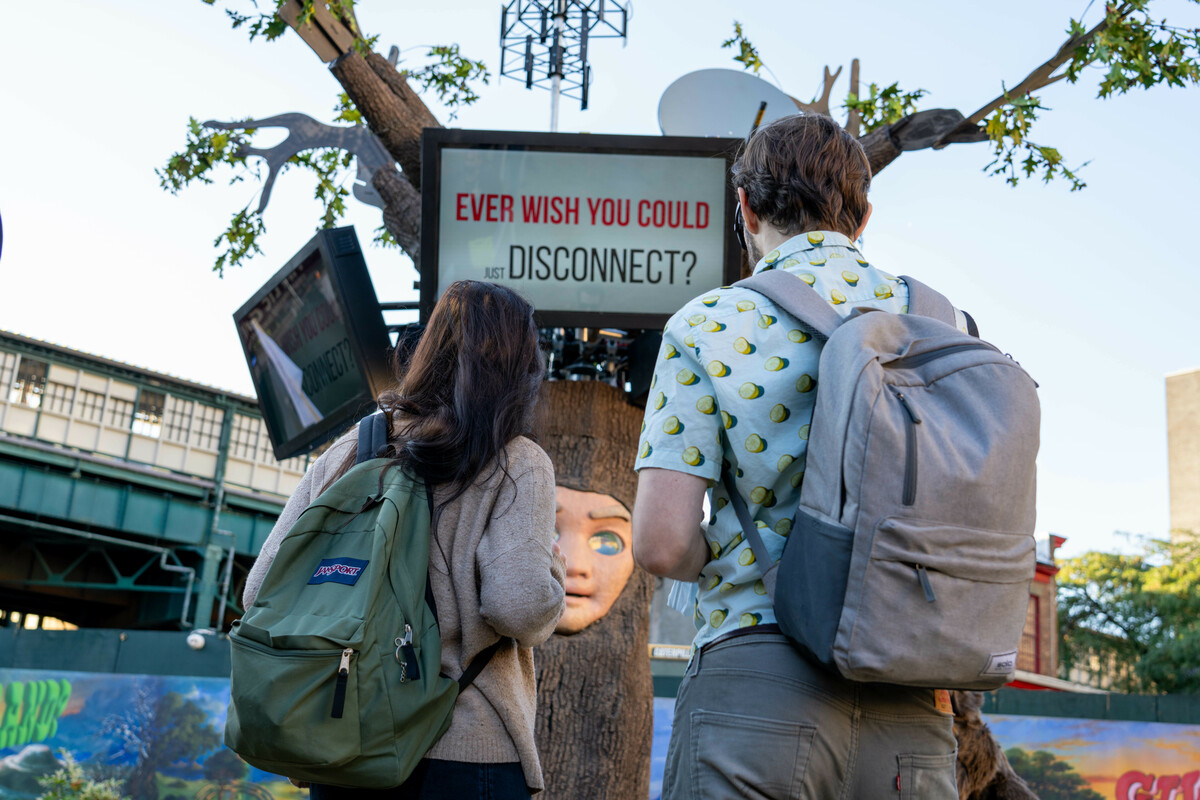
Bruno is an animatronic beaver — think Disney World — and is talking to Ash, a life-sized, animatronic tree. But their conversation is nothing you’d hear at that theme park in Orlando. Instead, it’s in part about the clash between the philosophy underpinning the European understanding of land and the Native American understanding.

“Can you believe [the settlers] actually think that freedom is private property?” the tree exclaims, his face appalled.

People watch Dexter and Sinister (2023), a talking animatronic tree and beaver chat about the historical differences between how European settlers and Indigenous people see land and private property.

/ Keren Carrión/NPR

/

Keren Carrión/NPR

People watch Dexter and Sinister (2023), a talking animatronic tree and beaver chat about the historical differences between how European settlers and Indigenous people see land and private property.

/ Keren Carrión/NPR

/

Keren Carrión/NPR

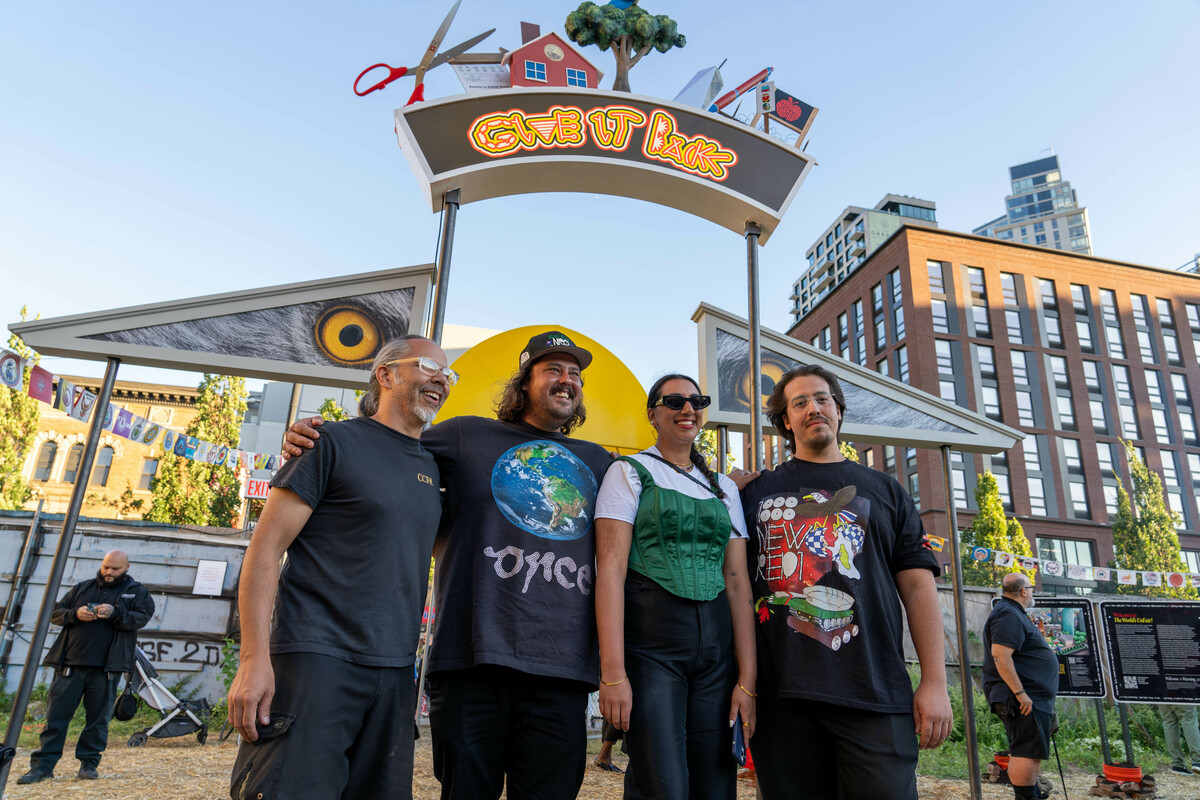
The World’s UnFair, an art installation in Long Island City, Queens, calls for the audience to join the New Red Order as “accomplices” to assist in getting people to give land to indigenous peoples.

The beaver and tree are part of a festive, tongue-in-cheek art installation by New Red Order and commissioned by Creative Time called “The World’s UnFair” that has one goal: to convince people to give public and private land back to the people who once occupied it.

“I would just encourage people, if they have the means and ability, to give it back and if they don’t, maybe help Indigenous people take it back,” said Adam Khalil, a filmmaker and one of the three Indigenous artists behind the exhibit. It runs through mid-October.

Kalil and his brother Zack Khalil, both Chippewa, are two-thirds of what they call the New Red Order, a “public secret society.” They are originally from Sault Ste. Marie, Mich… though they currently live in New York City. The third artist, Jackson Polys, is Tlingit and splits his time between Alaska and New York.

Giving land back to Indigenous peoples may….seem unimaginable. But the artists say that helping people imagine the unimaginable is one of the purposes of art.

“What we’re interested in here is presenting an Indigenous perspective on what’s possible for the future,” Zack Khalil said.

/ Keren Carrión/NPR

/

Keren Carrión/NPR

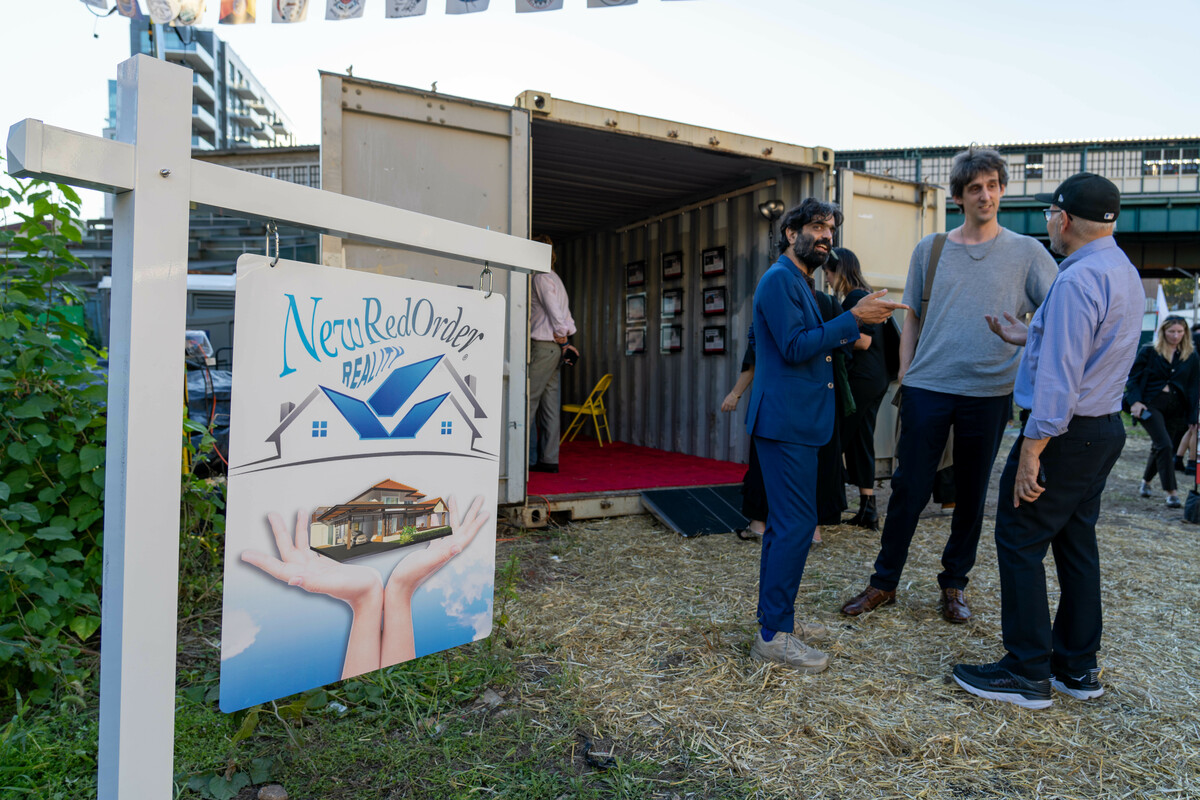
The “New Red Order Realty” office showcases a film of testimonials from people and municipalities who deeded land back to indigenous groups. “I’m so proud of our city, that we were able to make a small amends by returning an island where a massacre, horrible massacre happened,” said Eureka mayor Kim Bergel.

A crowd of people at The World's UnFair is reflected in the glass eye of the animatronic talking tree.

/ Keren Carrión/NPR

/

Keren Carrión/NPR

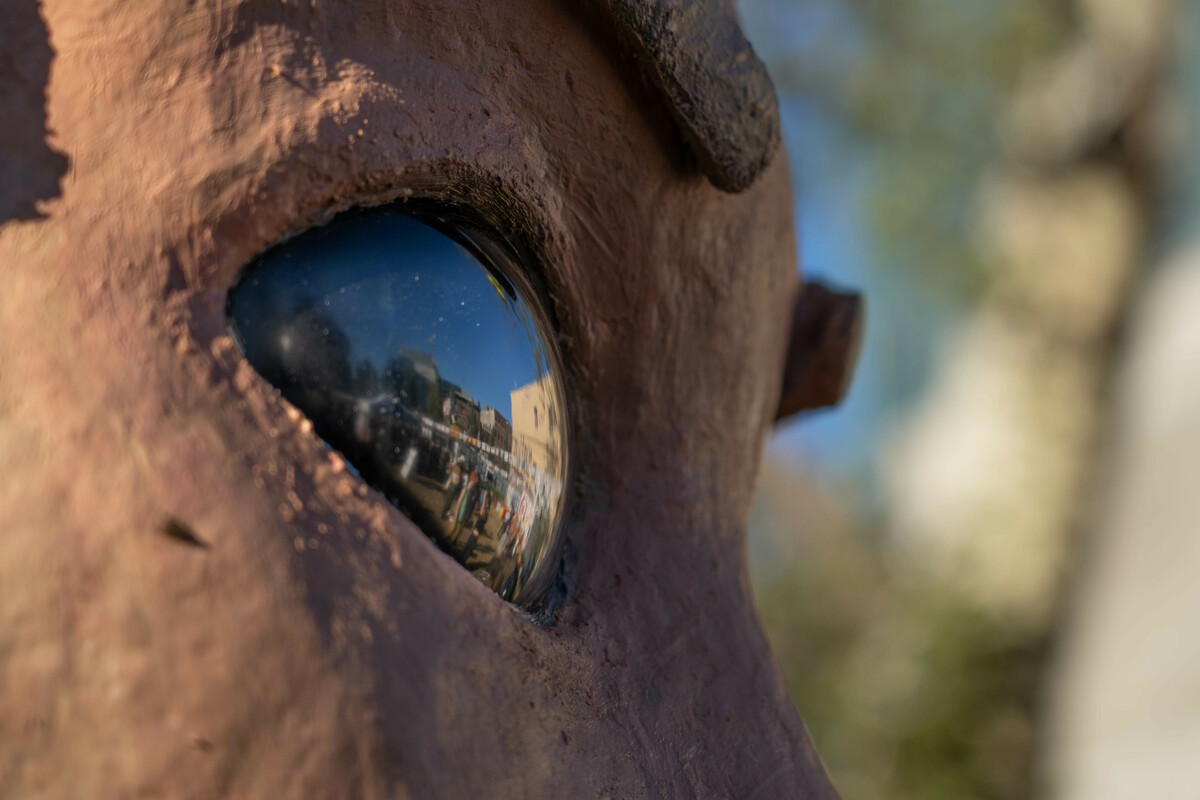
A crowd of people at The World’s UnFair is reflected in the glass eye of the animatronic talking tree.

The artists hope that the carnival-like atmosphere will draw non-Native people in. A clutch of documentaries — and mockumentaries — make their case. One, situated behind a folding table, is basically a recruitment video for the New Red Order. There’s a phone number. There’s a website. It calls on “accomplices” to join together with Indigenous people to help reclaim their land.

Another, which plays in a shipping container called the “real estate office,” showcases real stories of people, groups and municipalities already doing this. The city of Eureka, Ore., gave over a small island to the Wiyot people. Oakland, Calif., gave about five acres of a park to the Sogorea Te’ Land Trust and the Confederated Villages of Lisjan Nation.

/ Keren Carrión/NPR

/

Keren Carrión/NPR

People watch a talking animatronic tree and beaver chat about land and private property, along with a tongue-in-cheek video. The various documentaries and mockumentaries have slogans like, “Never settle!” and “Give It Back!”

The many testimonials (real and fictional ones) do what they are meant to: make the ideas behind it seem reasonable, even a foregone conclusion.

“It’s a spectacle, and it’s playing with these ideas of Worlds Fairs and fairgrounds and festivals, [but] it is deeply earnest and real,” said Diya Vij, who curated the installation for Creative Time. “The ideas are not fiction. It’s an invitation to enter, to join, to seek, to take in, to learn, to listen.”

Copyright 2023 NPR. To see more, visit https://www.npr.org.

An anti-World’s Fair makes its case: give land back to Native Americans

An anti-World’s Fair makes its case: give land back to Native Americans

The artists, brothers Adam and Zack Khalil and Jackson Polys, are part of the collective the New Red Order. They call it a “public secret society.” Here they are with Creative Time curator Diya Vij.

Keren Carrión/NPR

Keren Carrión/NPR

From the elevated platform of the 7 train in Queens, New York, a formerly-empty lot now looks like a carnival. There’s lights and colorful posters and — wait. Is that a giant, talking beaver?

Yes. Yes, it is.

Bruno is an animatronic beaver — think Disney World — and is talking to Ash, a life-sized, animatronic tree. But their conversation is nothing you’d hear at that theme park in Orlando. Instead, it’s in part about the clash between the philosophy underpinning the European understanding of land and the Native American understanding.

“Can you believe [the settlers] actually think that freedom is private property?” the tree exclaims, his face appalled.

People watch Dexter and Sinister (2023), a talking animatronic tree and beaver chat about the historical differences between how European settlers and Indigenous people see land and private property.

Keren Carrión/NPR

Keren Carrión/NPR

The World’s UnFair, an art installation in Long Island City, Queens, calls for the audience to join the New Red Order as “accomplices” to assist in getting people to give land to indigenous peoples.

Keren Carrión/NPR

Keren Carrión/NPR

The beaver and tree are part of a festive, tongue-in-cheek art installation by New Red Order and commissioned by Creative Time called “The World’s UnFair” that has one goal: to convince people to give public and private land back to the people who once occupied it.

“I would just encourage people, if they have the means and ability, to give it back and if they don’t, maybe help Indigenous people take it back,” said Adam Khalil, a filmmaker and one of the three Indigenous artists behind the exhibit. It runs through mid-October.

Kalil and his brother Zack Khalil, both Chippewa, are two-thirds of what they call the New Red Order, a “public secret society.” They are originally from Sault Ste. Marie, Mich… though they currently live in New York City. The third artist, Jackson Polys, is Tlingit and splits his time between Alaska and New York.

Giving land back to Indigenous peoples may….seem unimaginable. But the artists say that helping people imagine the unimaginable is one of the purposes of art.

“What we’re interested in here is presenting an Indigenous perspective on what’s possible for the future,” Zack Khalil said.

The “New Red Order Realty” office showcases a film of testimonials from people and municipalities who deeded land back to indigenous groups. “I’m so proud of our city, that we were able to make a small amends by returning an island where a massacre, horrible massacre happened,” said Eureka mayor Kim Bergel.

Keren Carrión/NPR

Keren Carrión/NPR

A crowd of people at The World’s UnFair is reflected in the glass eye of the animatronic talking tree.

Keren Carrión/NPR

Keren Carrión/NPR

The artists hope that the carnival-like atmosphere will draw non-Native people in. A clutch of documentaries — and mockumentaries — make their case. One, situated behind a folding table, is basically a recruitment video for the New Red Order. There’s a phone number. There’s a website. It calls on “accomplices” to join together with Indigenous people to help reclaim their land.

Another, which plays in a shipping container called the “real estate office,” showcases real stories of people, groups and municipalities already doing this. The city of Eureka, Ore., gave over a small island to the Wiyot people. Oakland, Calif., gave about five acres of a park to the Sogorea Te’ Land Trust and the Confederated Villages of Lisjan Nation.

People watch a talking animatronic tree and beaver chat about land and private property, along with a tongue-in-cheek video. The various documentaries and mockumentaries have slogans like, “Never settle!” and “Give It Back!”

Keren Carrión/NPR

Keren Carrión/NPR

The many testimonials (real and fictional ones) do what they are meant to: make the ideas behind it seem reasonable, even a foregone conclusion.

“It’s a spectacle, and it’s playing with these ideas of Worlds Fairs and fairgrounds and festivals, [but] it is deeply earnest and real,” said Diya Vij, who curated the installation for Creative Time. “The ideas are not fiction. It’s an invitation to enter, to join, to seek, to take in, to learn, to listen.”