Celebration of arts
Celebration of arts

Celebration of arts

Elizabeth Guheen had no idea if the plan she and the Bair Family Trust had set in motion would work. But as the hammer struck and the bid of $350,000 was accepted on Lot 126 at the Coeur d’Alene Art Auction last weekend in Reno, her phone started dinging with text messages. “The Young Chief,” painted in 1905 by Joseph Henry Sharp, would return home.
“The elation I felt when it happened, it’s hard for me to find words for,” said Guheen, director and chief curator for the Bair Family Museum in Martinsdale. “We kept it in Montana — that was our goal.”
Soon, visitors to the museum in central Montana will be able to see a signature painting of an Apsáalooke family at their encampment by the renowned western artist, painted during the time Sharp lived on the Crow Reservation, reports the Montana Free Press.
The painting was purchased from Sharp in 1915 by his close friend Charles M. Bair, a prominent Montana businessman, sheep rancher and philanthropist, who donated the painting to the Billings Commercial Club — the predecessor to the Billings Chamber of Commerce — as a thank you for hosting a show of Sharp’s work. Sharp was a prolific painter who documented the life of many tribes in the region, painting with precision and intimacy gained by living among Native people, including the Puebloan people in Taos in the late 1800s and with the Apsáalooke on the Crow Reservation in the early 1900s.
Billings Chamber leadership had been interested in selling “The Young Chief” for many years, and in 2008 they received a $1 million offer for the painting, said John Brewer, Billings Chamber president, when interviewed by the Billings Gazette that fall. At the time, Brewer also identified two art auction houses that valued the piece between $500,000 and $800,000. “When it hit that level, the board began discussing how we could put that money to use,” he told the Gazette.
RELATED: Billings Chamber defends decision to auction historic painting
The Bair Family Trust expressed interest in the painting in 2008, but its desire to have “The Young Chief” traces back to 1963 when Bair’s daughter, Alberta (a philanthropist herself and namesake for the Alberta Bair Theater in Billings) wrote to the Billings Chamber expressing her and her sister Marguerite’s desire to have the painting returned to the family and to replace it “with another painting of equal value and beautifully framed,” Alberta wrote. “The reason we want the painting [is that] Mr. Sharp was a personal friend of ours and we would like to have it to place with our Indian collection.”

The response, signed by George M. Washington, president of the Billings Chamber of Commerce at the time, said returning the painting would “indicate a lack of appreciation for us to dispose of the painting in any manner.”
“I believe that the chamber’s response was very sincere, but these things don’t last,” Guheen told Montana Free Press after this weekend’s auction. “New generations come on and rewrite history.”

The economic downturn in 2009 paused the chamber’s intent to sell the painting until this year when its board unanimously voted to sell the painting at the Coeur d’Alene Art Auction. It wasn’t until MTFP in June published an article regarding the possible sale of the painting that the Bair trustees learned that the painting would be auctioned.
A HOMECOMING
Sharp, who was born in Ohio and studied in Europe, spent nearly 80 years painting and observing Plains Indian life. His portraits of Indigenous people were collected by entities such as the Smithsonian because of their detailed depiction of Native American clothing and culture. “The Young Chief,” which features an Apsáalooke family in golden light outside a teepee, is a touted example of such a style and represented a departure from Sharp’s contemporaries, who were painting the more violent clashes in the American West. Sharp painted from within, portraying everyday life and ceremony.
Sharp came to know the Bair family while living at Crow Agency. Bair, who ranched and had a lease on the Crow reservation for raising sheep, befriended the painter and became a loyal patron. After Bair died in 1943, his daughters kept in touch with Sharp, and it is their affinity for him that could be the reason Alberta wrote to the Billings Chamber in the 1960s, requesting the painting back. That request was refused, and while the conversation was rekindled in 2008 there has been no movement since then to return the painting, according to Guheen.
“The chamber has made no effort to reach out to the Bair Family Museum Board of Advisors or to ensure that this painting, a cherished part of Montana’s history, remains in the state and be enjoyed by the public,” Guheen said.
Brewer, Billings Chamber’s president, when contacted this week by MTFP, wrote in an email that the chamber received about a dozen emails asking the organization to reconsider the sale.
“There was considerable misunderstanding as to who the ‘Chamber’ is,” Brewer said, adding that the nonprofit polled its 1,100 members several years ago “and nearly 75% directed the Chamber board to sell.”
After learning of the sale, Guheen said, there was no doubt among the Bair trust’s board members how to proceed.
“It was because of the letter,” Guheen said. “That was the linchpin. It was like, ‘Now’s your chance, Alberta. We are trying to get it for you.’”
The board invited Thomas Minckler, a Billings historian and art buyer who initially raised concerns about the sale of the painting, to recommend a course of action and represent the organization at the auction. A limit was set by the board on what it would bid — an amount not disclosed to MTFP — that also factored in the 21% fee to the auction house on top of the winning bid. The board has a fiduciary responsibility to the trust, Guheen said, “and you have to follow it rigidly, and they are careful about that.” Minckler, acting on behalf of the Bair Family Trust, made the highest bid at $350,000 and purchased “The Young Chief” for a final price of $423,500.
“I felt at peace and a relief knowing that we had saved that piece of Montana’s history,” Minckler told MTFP. “Charlie Bair and Alberta would be very happy knowing that the painting is coming home.”
A ‘SOFT’ MARKET
This year’s Coeur d’Alene Art Auction featured 317 works, and sales totaled $21 million. Among the sculptures of cowboys being thrown from horses, portraits of warriors, oracles, culture bearers and scenes portraying Indigenous culture, 14 paintings by Sharp were on the auction block last Saturday.
“Young Chief” had the highest starting bid at $280,000 and was valued between $300,000 and $500,000, according to the auction catalog. However, many Sharp paintings sold at or undervalue, and four failed to meet the minimum bid and were not sold.
“The market right now for Joseph Henry Sharp and other Taos artists is soft,” Minckler said. “They sold for the low end of the estimate. Usually at the Coeur d’Alene auction, art goes above the asking price.”
The Billings Chamber sold three works of art at the auction – the Sharp, a Warren Rollings oil painting featuring a Native American man smoking a pipe, and a charcoal sketch titled “Indian Head” by LeRoy Greene. The Rollings sold for $12,000 and the Green for $600, and the trio of paintings netted $362,600. Brewer indicated the proceeds will be gifted to the newly formed Chamber Foundation, and interest from the funds will be used to “support leadership development, education, talent attraction and retention, and community development initiatives.”
“They were setting up a nonprofit foundation by selling a piece of Montana’s heritage,” Guheen said. “They didn’t see anything wrong with that.”
The driving forces for the trust and the board of advisors to purchase “The Young Chief” were its artistic value and the value and the history to the Bair family, said Gerry Fagan, president of the board of advisers of the Charles M. Bair Family Trust.
“We are happy that we were able to obtain the painting and keep it where the public can see it,” Fagan said. “We really did like the idea of keeping this in Montana because of its Montana roots. Speaking for myself, I didn’t want to see it go into a private collection where Montanans would never see it again.”
The Bair Family Museum is in the old ranch house in Martinsdale where the family’s art collection, Native American artifacts and weavings, collections of photographs, and furnishings from Europe are displayed. The museum even has Alberta’s characteristic red hats and the sisters’ clothing and other personal items.
The sisters had no heirs, and Alberta was the last family member to die in 1993. Three years before her death, she created a nonprofit charitable organization that maintains the museum and ranchlands, funds scholarships each year for eight students living in Meagher or Sweet Grass counties where the family ranch operated and grants money to Meagher, Sweet Grass and Yellowstone counties.
“Charlie Bair was very influential here and in other counties too, and so was Alberta – she really led a fascinating life and to create the trust that she did upon her death was an amazing sacrifice, and it is paying dividends today with its trust and charitable contributions,” Fagan said.
The Bair Family Museum is open daily in the summer through Labor Day; it’s closed on Mondays and Tuesdays the rest of the year. Guheen has already picked out a spot for the painting in the museum’s entry.
“If we were fortunate enough to keep in Montana,” she said, “I want people to be able to see it right away.”

The small 1970 painting that provides the title of Robert Houle’s retrospective at the National Museum of the American Indian, “Red Is Beautiful,” is a hard-edge geometric abstraction with two mirrored forms in four shades of red. The picture is indebted to the styles of such European-born, 20th-century formalists as Piet Mondrian and Josef Albers. But Houle is a First Nations Canadian (Saulteaux Anishinaabe, Sandy Bay), so for him, red is more than just a color. It’s a symbol of the proud if beleaguered heritage addressed throughout this multilayered show.
Much of this exhibition of works made between 1970 and 2021, organized by the Art Gallery of Ontario, is devoted to canvases such as “Red Is Beautiful.” These tweak color-field painting with references to First Nations history and culture. That’s not the 76-year-old, Manitoba-born artist’s only strategy, however, as can be seen from the two large pictures hung in the hallway outside the show’s entrance.
Both are variations on Benjamin West’s 1770 historical painting, “The Death of General Wolfe.” The epic vignette depicts the aftermath of the 1759 Battle of Quebec, in which British forces defeated their French adversaries but lost their commander. West’s fanciful treatment of the scene includes a Native warrior who gazes thoughtfully at the dying Wolfe.
In one of Houle’s remakes, all the colors have faded to beige, save for the Native man’s clothing and headgear. In the other, the Indigenous man takes the same pose, but he’s alone and looking at the Bay of Montreal, with no Europeans in sight. The first of these versions is bracketed by two color blocks, one blue and the other red; these refer to color-field painting but also to the uniforms of the French and British, respectively. Houle titled the picture “Kanata,” the Huron-Iroquois word for village and the likely origin of the name Canada.
Another history lesson is contained in “Paris/Ojibwa,” a three-dimensional tableau that includes four portraits on an array of wooden panels that simulate two walls and the floor of an ornate, French-style drawing room. The 2010 installation memorializes 11 Ontario Natives who toured Europe in the 1840s. The setting appears elegant, except for one ominous design motif: Under each painting are renderings of the smallpox virus that took the lives of six of the transatlantic visitors.
Beyond this imposing piece are several galleries of color-oriented pictures that initially appear coolly abstract, yet are freighted with meaning. A set of 13 collage paintings that incorporate porcupine quills represent Jesus and his disciples and are keyed to verses from the Gospel of John. In a series of monochrome canvases, each is paired with text from British or Canadian laws, treaties or proclamations related to First Nations people. Eight vertical canvases, each coated entirely with a different shade of green, represent the British forts captured during Pontiac’s War in 1763.
Most of Houle’s works are serene and meticulous, even when they incorporate talismanic natural objects or address such outrages as the British army’s alleged distribution of smallpox-infected blankets to Native Americans. (A 1763 letter from a British officer endorses the idea, but historians disagree on whether it was put into practice.) Paintings based on First Nations designs or beadwork also emulate the orderliness of Germany’s Bauhaus school and the Netherlands’ de Stijl movement.
The composure that characterizes most of Houle’s art vanishes when the subject turns autobiographical. Like many Indigenous Canadians, the artist was sent as a child to a boarding school designed to erase his traditional culture. Suppressed memories of the abuse he suffered there ultimately surfaced in powerful expressionist drawings made with oil stick. The loose, impassioned renderings of shadowy predators are balanced by ones of “dream shamans” conjured to protect him.
The show’s newest entry is “Transforming Blue Thunder,” a picture of the thunderbird, which embodies thunder and lightning in Native American lore. “Blue Thunder” is Houle’s spirit name, and so this is a symbolic self-portrait. In no small part, “Red Is Beautiful” is a journey through Houle’s ancestry and influences to a place of self-understanding.
National Museum of the American Indian, Fourth Street and Independence Avenue SW. americanindian.si.edu.
Dates: Through June 2.
Prices: Free.

In recent months, state legislatures across the nation have introduced hundreds of laws targeting Two Spirit, Lesbian, Gay, Bisexual, Transgender, Queer or Questioning plus communities, including several bills in Arizona.
Laws introduced directly impact the lives of 2SLGBTQ+ people in various ways, from their freedom of expression and health care to public accommodations and civil rights.
This year’s legislative session in Arizona — with Republicans maintaining a narrow majority in both the House and Senate — was full of discriminatory bills toward the 2SLGBTQ+ community, including measures to restrict drag shows, wipe out a student’s preferred pronoun use and limit school bathroom access.
Overall, lawmakers introduced 11 bills, and six passed the legislative process and made it all the way to Democratic Gov. Katie Hobbs’s desk, where all six were swiftly vetoed.
If these bills were signed into law, they would apply to the majority of the state, but that would not include the 22 Tribal Nations in Arizona, since they are sovereign, with their own laws and regulations for their communities.
Seeing the influx of discriminatory legislation that could impact the 2SLGBTQ+ community was not surprising for Diné Drag Artist Lady Shug, because growing up on the Navajo Nation, they know what it’s like to have their rights limited as a 2SLGBTQ+ person.
“It’s not just the U.S. government; it’s also our tribal government,” Lady Shug said, pointing out that the Navajo Nation has no laws protecting its 2SLGBTQ+ people from hate crimes or discrimination or ensuring their right to marriage.
“It’s something that I’m kind of used to,” Lady Shug said because, within their community, they have to fight to be included.
Lady Shug said that existing as a 2SLGBTQ+ person is a form of resistance, and they hope that Indigenous 2SLGBTQ+ people always remember that.
“You existing as a brown, beautiful, Indigenous, queer, trans, two-spirit person is your form of resistance, and nobody can ever take that away from you,” Lady Shug added.
The Navajo Nation has no laws devoted to anti-discrimination or hate crimes concerning Navajo 2SLGBTQ+ people living on Tribal lands.
The Navajo Nation Human Rights Commission reported in 2016 that the Navajo Bill of Rights guarantees the rights of all Navajo citizens regardless of sex, and any entities that receive federal or state funding on the Navajo Nation must follow the anti-discrimination mandates.
The commission recommended that Navajo Nation leaders enact laws and policies to protect people regardless of sex, gender identity and sexual orientation.
In 2005, the Navajo Nation implemented the Diné Marriage Act, which prohibits same-sex marriage.
“For the Navajo Nation, there is no protection for same-sex couples,” Lady Shug said, and if they were to get married and live on the Navajo Nation, they would not be valued the same way as heterosexual marriages.
“Your marriage is not valid on our Tribal land,” Lady Shug said. “There’s no protection for us.”
Navajo Nation Council Delegate Seth Damon recently introduced Legislation 0139-23 that would repeal Title 9 of the Navajo Nation Code so that same-sex marriages are recognized within the Navajo Nation. Damon’s efforts come after previous attempts to repeal the act failed over the years, most recently in 2022.
“The prohibition against same-sex marriages does not uniformly welcome or support the well-being of all Diné,” Damon said in a news release. “The purpose of the legislation I’m sponsoring is to ensure that all Diné are welcome within the four sacred mountains and to recognize all marriages within the Navajo Nation.”
The legislation would also amend provisions within the Navajo Nation Code to conform with this repeal. Still, the traditional Navajo wedding ceremony method, involving a man and woman, would remain unchanged.
Damon signed the legislation on June 23, which will make its way through four committees before being heard before the Navajo Nation Council, which has ultimate authority on the bill.
At a state level, Hobbs has made it clear that her administration will not tolerate any legislation that attacks the 2SLGBTQ+ community.
The Democrat has been a stalwart critic of anti-LGBTQ sentiment and has repeatedly vowed to act as a bulwark against discriminatory legislation. That commitment was reasserted on July 8 at an event hosted by civil rights and LGBTQ advocacy organizations to celebrate Hobbs’ actions.
“As long as I’m governor, the LGBTQ+ community in Arizona will be protected,” she announced to enthusiastic cheering and applause. “I will continue to use my veto pen as many times as I need to.”
Navi Ho has been a Diné drag performer for years, and they’ve performed at shows across the Phoenix area. They also make it a point to perform at drag shows hosted by Tribal Nations and in shows that feature Indigenous drag performers because they did not see Indigenous representation when they started out.
“There’s not many of us,” Navi Ho said of Indigenous drag performers. “But we are out there, and we are proud of what we’re doing.”
Navi Ho said they had seen an increase in Indigenous drag performers coming from different Tribal Nations, and they’re happy to see it because Indigenous representation within the 2SLGBTQ+ world is still minimal.
“It’s definitely inspiring people to be their authentic Native selves,” Navi Ho added.
Navi Ho grew up in the Phoenix area, but their family is from Tuba City, Arizona, on the Navajo Nation. Growing up, Navi Ho never thought they’d see drag performers showcased on the Navajo Nation the way they have been in recent years.
“It’s a wonderful thing to see the growth,” Navi Ho said, and they’ve been invited back to the Navajo Nation as a performer multiple times, including in Tuba City.
“It’s definitely a growth from when I grew up,” Navi Ho said.
“I think it’s beautiful,” they said.
SUPPORT NEWS YOU TRUST.
When Navi Ho heard about the anti-drag bills introduced and passed in Arizona, they thought it ridiculous because that type of legislation was unnecessary.
“I think that the decision to make such a bill was based off of hate,” they said.
Hobbs recently vetoed two anti-drag laws, Senate Bill 1028 and Senate Bill 1030, which were approved by the Republican majority.
SB1028 bars adult cabaret performances, such as strip shows, from being held on public property or anywhere a minor may view them, punishing violations with up to a class 6 felony.
SB1030 mandates that city zoning officials issue permits and zoning regulations for establishments that conduct sexually explicit performances — which is already allowed under state law but not required.
Both bills were authored by Glendale Republican Anthony Kern, who called drag shows evil in previous debates and accused performers in family-friendly events of pedophilia.
The wording used to describe drag performances within the legislation is not something that Navi Ho is familiar with because it doesn’t portray their experience when performing in drag. Instead, they focus on building a connection with the people in the audience.
Navi Ho said they connect in a special way, and that makes them, as performers, feel better about who they are. That’s something lawmakers who create anti-drag laws will never understand, they added.
As part of their drag aesthetic, Navi Ho said they bring their culture and traditional wear to their performances. They don a wig that is put up in a Tsiiyéél, a traditional hairstyle where the hair is wrapped with wool into a bun.
Navi Ho said they incorporate their culture into their drag performances because it’s part of who they are. People recognize and understand when they perform on the Navajo Nation and other Indigenous communities.
When people see Navi Ho perform, they recognize that Navi Ho is celebrating Indigenous women.
“It’s like a wow effect,” Navi Ho said, making the experience amazing and beautiful.
Navi Ho said they’ve always gotten a positive response from the audience, including from elders and young people. This is why they don’t understand when lawmakers who don’t understand drag culture talk about it as something that is wrong or unacceptable.
“I don’t think that lawmakers understand what goes on in a drag person’s life,” they added.
Lady Shug is working to help more Indigenous drag performers showcase their art on a larger stage. They launched a drag show with an all-Indigenous cast called “La La Land Back,” and they’re currently on tour visiting different cities.
Lady Shug said they launched the tour this year alongside Two-Spirit Chickasaw performer Landa Lakes. The tour was featured at New York City Pride and the Smithsonian Museum in June, making them the first show to feature an all Indigenous drag cast at those venues.
“What we’re trying to do is trying to open doors, normalize Indigenous drag-ness,” Lady Shug said because Indigenous people are often forgotten when it comes to the LGBTQ+ community. They’re rarely included in pride events or even mentioned in conversations surrounding the LGBTQ+ community.
“How is it that the first people of this nation are not a part of this conversation or invited to these festivals?” Lady Shug asked. Through this tour, Lady Shug said they’re trying to hold space for Indigenous communities within the 2SLGBTQ+ community.
Lady Shug said they wanted to be able to create this type of drag performance because they know what it’s like traveling three to four hours away from home to be able to perform in larger cities. They hope the “La La Land Back” tour will visit as many places as possible, including Tribal Nations.
“I want to bring drag to my people,” Lady Shug said, because for Indigenous people, especially elders and the youth, to see drag culture, it must be performed within their own community. If not, they would have to travel to surrounding cities off of tribal land.
With drag culture getting a lot of attention in mainstream media, Lady Shug said now is the time to show people what Indigenous drag performers are capable of.
Whether the tour is brought to a city or hosted on Tribal Land, Lady Shug said they make it a point to hire local Indigenous artists to perform — keeping the cast entirely Indigenous and local.
“This is our time to show our power and our strength through Native drag,” they added.
Lady Shug has always advocated for having the 2SLGBTQ+ community included in more events hosted within Indigenous communities. They said more often than not, organizers forget to include their 2SLGBTQ+ relatives when it comes to festivals, fairs or powwows.
“I’m trying to navigate it where it’s normalized that we’re included,” Lady Shug said, adding that people can’t say they’re Indigenous and traditional yet forget to include their 2SLGBTQ+ relatives.
“We existed before colonization, and we’ve always had roles,” Lady Shug said, and Tribal Nations have always had different meanings for 2SLGBTQ+ people in their communities.

For local artists like Daniel Kauwila Mahi, printmaking is a way to pass on knowledge.
The 30-year-old artist has been creating images of activism and political movements since he was 16. His recent piece focused on antimilitarism and the decolonization of Hawaiʻi.
Mahi is a digital printmaker, which is a newer form of printmaking. He took quotes from newspapers and transferred them onto sugarcane paper, symbolizing the “Big Five,” the corporate elite companies that played a part in overthrowing the Hawaiian monarchy.
Daniel Mahi
/
“Kanaka found so many ways to express their voice in many different types of print culture, but nūpepa (newspaper) is one that we excelled in sharing our moʻolelo (stories) and especially using it as an organizing tool.”
Mahi isn’t the only printmaker creating art to bring awareness and promote change. Several artists in Hawaiʻi created images through printmaking highlighting racial disparities, police brutality and activism.
Printmaking is an art form in which artists transfer images from a template to a flat surface. It has several techniques, such as woodcut, etching, engraving and lithography. It’s an older method of printing newspapers.
The power of printmaking is that it’s reproducible, according to Denise Karabinus, an executive director at Honolulu Printmakers.
“It’s considered a democratic form of art,” Karabinus said.
Printmaking started in Germany in the 1400s. The Gutenberg Press, created by Johannes Gutenberg, used lithography stones — weighing about 120 pounds — to transfer the images onto paper.
That art method was used by Rep. Sonny Ganaden, who has been printmaking for nearly 20 years.
Located in his office at the Capitol is a 4×5 image of Joseph Kahahawai, a Native Hawaiian boxer who was accused of raping Thalia Massie. Massie’s husband and friends murdered him.
Ganaden said he was working with a group of kids in Kalihi who were doing a project when they became interested in Kahahawai’s story.
“A lot of the boys gravitated toward this story of, essentially, racism and injustice from nearly a century ago in the city,” Ganaden said. “They saw themselves in his experiences and the experiences of his friends. It felt natural to make an image of this.”
Ganaden said he doesn’t count the hours it took him to create his piece, but it involved several techniques and layering. He said the most challenging part is using four pieces of paper to line it into one big piece.
But the theme of social justice remains the same.
“It’s a narrative with a two-dimensional image. You get it all at once,” Ganaden said. “So you’re hoping that the viewer’s eyes move around to different parts of it.”
He said many printmakers have dedicated their art to social justice, naming Dietrich Varez and John Charlot.
Krista Rados
/
HPR
Printmakers have used the art form to turn simple images into messages to the public.
“Printmaking is the medium of the oppressed and the people that are challenging power structures,” said Mari Matsuda, an activist and law professor at the University of Hawaiʻi.
Her art highlighted people who put themselves on the front lines. Her most recent work illustrates the Super Ferry standoff in the early 2000s and a banner she made when Donald Trump was elected president in 2016.
She said the history of the printing press has been tied to protests.
Matsuda said many images have helped people show what they couldn’t access without modern technology.
She explained that printmakers in the 1930s and 1940s were part of the proletarian art movement, which opposed fascism worldwide.
For Mahi, printmaking is a way to generate a conversation of social change.
“If we start with the cultural foundation, which is what I’ve been trying to do in my printmaking — looking at moʻolelo and how they addressed change, and trying to integrate those sayings or those words and those visuals into printmaking — then people can at least have a conversation about who they are without the American government and the colony,” he said.
“And people can really get into the hard part about cultural knowledge and passing down cultural knowledge, which is: Who do I want to be tomorrow if I want to be a good ancestor?”

BUTTE — Model Shayne Hall of the Blackfeet Tribe walked across the stage in a red dress with white hand prints, a symbol for Missing and Murdered Indigenous Women in the state, and put her fist up in the air to applause from the crowd.
“It was a spiritual experience,” Hall said following the fashion show.
Hall was one of more than a dozen models walking in the First Peoples’ Fashion Show at the Montana Folk Festival in Butte on Saturday. Four Native American designers, — who have shown around the world — all said their work was rooted and inspired by their heritage or traditional techniques, with their own twist.
The fashion show was brought to life in part by Rep. Donavon Hawk, D-Butte, who first had the idea years ago and helped orchestrate the first Indigenous Fashion Show at the festival last year. On Saturday, Hawk shuttled models and designers from the staging area at the Hotel Finlen up the hill to the stage on Copper Street.
Hawk said he was emotional when he saw all the designers’ work. The show took place on a raised platform in a large tent with an estimated hundred people in attendance.
“It’s amazing to bring this to my hometown and show Butte and all of Montana our tribes, all our tribes and our culture has to offer,” he said.
Yolanda Old Dwarf, owner of Sweet Sage Woman and of the Crow Tribe, designed the dress Hall wore, along with other designs in collections titled “I am fearless,” “Centered” and the latest, “Patience.” Old Dwarf told the crowd she started her business after going through postpartum depression after having her son, who was on stage with her.
“I know I’m not the only one,” she said, to applause from the crowd. “Part of my purpose in life and in my businesses is to encourage and help people.”
Old Dwarf’s mother, Julie Kreitzberg, was emotional as she said it was “beyond words” seeing her daughter keep traditions alive “so they don’t get lost.”
“It makes me well up with so much pride,” Kreitzberg said.
Della BigHair-Stump of the Crow Tribe has shown her work at Paris Fashion Week, with one of the dresses in the show Saturday recently returned from being displayed in the Smithsonian Museum, but BigHair-Stump said she loved showing her work in Montana.
“Montana’s home,” she said.
BigHair-Stump, of Designs by Della, said she went from watching her grandparents beading as she was growing up to incorporating those techniques into her work today, with ribbon work and beading predominantly featured in the designs in the collection shown Saturday.
Rebekah Jarvey, a Chippewa Cree designer fresh off of a collaboration with Nike, showed designs in Saturday’s show that were recently featured at a fashion show at the Cannes Indigenous Fashion Festival earlier this year.
Jarvey described the “Love and Fashion” collection shown Saturday as fun and vibrant, saying her color palette is neon, with the clothes predominantly featuring neon green and pink.
“I think everyone should wear neon at least once in their life,” she said. “Get brave!”
The collection is also more price-friendly and ready-to-wear as opposed to her more pricey luxury lines.
“I’m happy that the Butte Folk Festival was able to give us Indigenous designers this platform to show and share our culture,” Jarvey told the Daily Montanan. “The Indigenous fashion industry is really brand new, and it’s just beginning, and we’re building it.”
She said there was no Indigenous fashion industry when she was growing up in Rocky Boy’s Reservation, with the industry focused on Euro-centric standards, but things are starting to change. She said this will be her seventh year running an Indigenous fashion show in Rocky Boy’s Reservation. Jarvey was also featured by Vogue as one of “15 Indigenous Artists to Know” from the annual Santa Fe Indian Market, something Jarvey said was a career highlight.
Jarvey said something she wanted to communicate was not to compare Indigenous designers.
“Every designer is unique with their own brand and their own aesthetic,” she said.
A model in Carrie Moran McCleary’s show wore a cobalt blue top hat featuring a beaded design, a piece that caught many eyes at her vendor tent at the First Peoples’ Market.
Sitting at McCleary’s vendor booth for her brand Plains Soul Designs prior to the show, multiple festival goers oohed and aahed at that piece in particular.
McCleary, who is Little Shell and Chippewa Cree but lives on the Crow Reservation, said her work is centered around the theme, “We’re still here.”
“Our tribes are still here. We’re still functioning. We’re still honoring our traditions and our value systems,” McCleary said. “And fashion shows are a really great way for us to be visibly seen by the larger Montana community, or wherever we’re showing.”
“We’re showing modern clothing because we’re modern people, and that’s what we wear,” she said. “We still know how to make clothing that honors our original designs – how we sewed, how we beaded, (and) that includes the colors and shapes and the authenticity.”

Moving to Chicago, for this native New Yorker, was confusing at times. How come the trains stop running at 1am? Why is the pizza so thick? Must we call them speed “humps”? But when the warm weather finally came along, these vexing questions promptly disappeared. Chicago, I would argue, is the best American city during summer. A cool plunge in the lake is never far away and people put trash in alleyways instead of piling it on steamy sidewalks. Best of all, the galleries stay open throughout August, and the museums and nonprofit art spaces deliver some of their best exhibitions of the year. Don’t believe me? Take a look at the galvanizing shows below.

Squint your eyes in the gloaming and the world begins to shapeshift. Solid slabs of concrete metamorphose into languorous folds of flesh. Or maybe that’s just what happens in the latest show from Lucas Simões, who must practice some kind of alchemical seduction to make steel and cement bend into lush folds recalling body parts, petals, and waves. The show, titled “Twilight” in Portuguese, would be stunning in any season, but the sensuality of these works best suits the steamy days and long nights of summer.
Patron Gallery (patrongallery.com)
1612 West Chicago Avenue, Chicago
Through August 19

Don’t let the glitter and day-glo palette of the works on display fool you, this exhibition is spiked with sterner stuff. The eight artists on view — members of Rupture, a database of Chicago-based artists of color founded by the exhibition’s curator, Roland Santana — give form to experiences of loss as well as joy. “If I grind my teeth every night for 22 years, how much longer will I have them? How many things can I explain to you before they’re gone?” reads the text in a beaded work by Sophia Karina English. The silhouette of a hanging human body composed of shattered CDs appears on a household door in a sculptural piece by Derek Holland. A longing to communicate, as well as the transcendent pleasures of true connection, pervade the motley works.
Public Works (publicworksgallery.com)
2141 West North Avenue, Chicago
Through August 19

Like a perfect summer picnic, this exhibition will leave you feeling energized and lighter than before. The five ceramics artists featured here expertly pair dashes of humor with more serious food for thought. Nadira Husain paints intricate orgies and leafy gardens on vessels that double as jaunty bodies with arms and breasts. Irreverent details, like the poofs of acrylic hair on Leena Similu’s diminutive abstract works, ground more sober reflections on identity that pervade the show. Zizipho Poswa draws from her Xhosa heritage and experiences in the Eastern Cape Town province of South Africa to create works with allusions to Bantu knots and the bundles women in rural areas bear on their heads. The works range in style, but all these artists understand the power of being thoughtful without slipping into self-seriousness. Even rarer, they know how to be funny without being flippant.
Mariane Ibrahim (marianeibrahim.com)
437 North Paulina Street, Chicago
Through August 26

For Georges Seurat, painting was a scientific endeavor, and from 1882 to 1890, the northwestern suburbs of Paris became his laboratory. There, Seurat experimented with placing dabs of complementary colors side by side to create optical dazzle in the eyes of viewers, a technique known as Pointillism. These semi-industrial villages on the banks of the Seine also attracted Vincent van Gogh, Paul Signac, Émile Bernard, and Charles Angrand, who produced luminous views of factories and gas containers, as well as more bucolic subjects like fields in full bloom and sailboats gliding on the river. After soaking in the show, go for a sun-drenched stroll along the harbor behind the museum for a seamless transition between art and life.
Art Institute of Chicago (artic.edu)
111 South Michigan Avenue, Chicago
Through September 4

The COVID-19 pandemic threw structural injustices into stark relief in countless contexts across the country, but the experiences of incarcerated people provided some of the most devastating evidence that our system does not value all lives equally. Social distancing was impossible in overcrowded facilities and personal protective gear was rarely available, resulting in rampant infection. Michelle Daniel Jones — a scholar, activist, and artist focused on the carceral system who campaigned in Indiana for the emergency release of sick and elderly inmates, as well as those serving brief sentences — has gathered 61 works by 50 presently or formerly incarcerated artists who created art about or during the pandemic. Hanging from the ceiling are compelling quilted portraits of incarcerated survivors of police violence by artist and “quiltivist” Dorothy Burge, as well as textile memorials to Albert Woodfox, who endured more than four decades of solitary confinement and torture, and two Black trans women killed in Chicago last year.
Logan Center Gallery (uchicago.edu)
Reva and David Logan Center for the Arts
915 East 60th Street, Chicago
Through September 10

A member of the Turtle Clan of the Seneca Nation, Marie Watt laces abstract sculptures with Indigenous meanings. The musical works in this exhibition — pendulous, many-lobed forms that hang from the ceiling — are festooned with conical curls of tin called “jingles.” These works reference a Seneca creation myth, in which a woman falls from the sky (the artist calls them “jingle clouds”), as well as Indigenous medicine traditions, in which healers wearing dresses adorned with jingles dance to cure patients with the silvery, rain-like sound. Visitors become participants simply by stepping inside the exhibition — we pass through a waterfall of jingle cones, bringing the work melodiously to life with our movement.
Kavi Gupta Gallery (kavigupta.com)
835 West Washington Boulevard, Floor 1, Chicago
Through September 30

“I’ve always had quite a rebellious and contrary attitude,” Mona Hatoum once said. “The more I feel I am being pushed into a mold, the more I feel like going in the opposite direction.” As a Palestinian woman who found herself stranded in London when the 1975 civil war broke out in Lebanon, where she was born and raised, Hatoum refused to produce the tidy reflections on exile and Arab womanhood expected of her. Instead, she spent the 1980s crafting the raw, defiantly messy performances and videos in this bracing exhibition. Some pieces, like “Roadworks” (1985), in which Hatoum walks barefoot through Brixton dragging boots tied to her ankles, are cryptic. Others, like “The Negotiating Table” (1983), in which the artist lies bound, drenched in animal blood and viscera inside a plastic bag while recordings of Western leaders discussing peace in the Middle East play overhead, are more stridently political. For fans more familiar with Hatoum’s recent sculptures — elegant and disquieting distortions of everyday objects — these fierce and urgent early works will be a revelation.
Museum of Contemporary Art Chicago (mcachicago.org)
220 East Chicago Avenue, Chicago
Through October 22

For more than a decade, the Chicago-based printmaker William Estrada has pushed a cart through the city and its suburbs with a simple goal: to get strangers to make art with him. The cart, inspired partly by those of Mexican ice cream vendors, unfolds into an impressive sidewalk studio where passersby can join free screen-printing workshops, discuss community issues, and make political posters expressing their concerns. Estrada’s commitment to grassroots organizing, increasing public access to art, and questioning the status quo through creative work fuels his wide-ranging practice. This solo exhibition, the artist’s first, brings together prints, photography, and documentation of public projects, as well as works by students and collaborators.
Hyde Park Art Center (hydeparkart.org)
5020 South Cornell Avenue, Chicago
July 22–October 29

The ancient Greeks were onto something when they assigned different terms to different types of love. How is it that, in English, we have just one word for such a mercurial, unruly force that shapeshifts every time it’s felt? The photographers assembled here capture some of love’s many guises: Jorian Charlton seeks out moments of everyday tenderness, private and profound, while Mous Lamrabat stages a theatrical search for love in a desert landscape. Others hint at the inevitable loss waiting in the wings of any relationship. A photo of two candles burning side by side by Jess T. Dugan reminds us that even the longest and happiest flames are necessarily fleeting.
Museum of Contemporary Photography (mocp.org)
600 South Michigan Avenue, Chicago
August 17–December 22

Bodies appear in pieces and surreal states of limbo in the five-dozen paintings, photographs, prints, sculptures, works on paper, and videos comprising this eclectic and enigmatic show. There’s an oversized pair of legs made of scented wax by Iris Bernblum that appear to emerge, upside-down, from the floor; headless figures that parade across a piece of embroidery by Elnaz Javani; and the artificial eye staring at a length of barbed wire in a photograph by Nathan Lerner. The show, which aims to examine “the processes and materials that structure and subtend life,” offers an eerie cabinet of curiosities in which established artists including Michael Rakowitz, Laurel Nakadate, and Charles Gaines, appear alongside more obscure talent.
DePaul Art Museum (depaul.edu)
935 West Fullerton Avenue, Chicago
September 7–February 11, 2024

The family of Japanese American artist Chiura Obata (1885–1975) recently made a gift of seven artworks to the Petrie Institute of Western American Art at the Denver Art Museum.
Obata, one of the most significant artists working on the West Coast during the last century, trained in Japan in both modern and traditional art styles including nihonga (painting that uses mineral pigments, organic pigments, and sometimes ink applied to silk or paper using brushes) and sumi-e (ink painting). After emigrating to the United States in 1903, he applied these techniques to his representations of what he called Great Nature, thereby paying homage to the landscapes that inspired him.
Obata’s decades-long tenure as an art professor at the University of California, Berkeley (1932–54) was interrupted from 1942–45 during World War II when he and his family, along with thousands of other people of Japanese heritage living on the West Coast, were forcibly relocated to incarceration camps constructed in remote locations across the American West. First sent to a relocation center in Tanforan, California, Obata was then moved to the camp at Topaz, Utah. At Tanforan and Topaz, Obata helped found art schools that, according to scholar ShiPu Wang, “educated, inspired, and comforted generations of Japanese Americans” during a time of trauma.
Three artworks now in the Denver Art Museum’s collection stem from the artist’s time at Topaz. In Landscape Near Topaz, rendered in black ink and painted in 1943, a small house in the right foreground underscores the monumentality of this landscape. This may reflect both Obata’s impressions of the grandeur of the space as well as the overwhelming experience of being forcibly incarcerated.
In Clouds Over Water Tower, dated January 29, 1943, the Topaz camp water tower rises above a sere landscape. Small figures rendered in black ink emphasize the scale of this structure. Gray clouds punctured by patches of blue sky create a chilling winter backdrop to a scene that is both impressive and oppressive. Water Tower Sketch is the preparatory pen sketch for the watercolor.
While forced incarceration during World War II is an important chapter in Japanese American history, it is crucial to acknowledge the richness of the Japanese American experience before and after this trauma. Obata’s elegant watercolor Flower Arrangement, painted on May 2, 1934, provides a glimpse into his pre-war life in California. His wife Haruko Kohashi (1892–1989) created this ikebana, or flower arrangement. In her 1940 book An Illustrated Handbook of Japanese Flower Arrangement, Haruko wrote about this centuries-old Japanese art tradition that “The essence of flower arrangement is the molding of natural beauty into art.” Her husband provided illustrations for her book, underscoring their mutual artistic respect.
Obata’s post-war watercolor Jemez Spring (painted in 1949) animates this New Mexico location through calligraphic washes of vivid colors. In two undated watercolors featuring Native American dancers from the Southwest, Obata’s application of pigment and dynamic line reinforce a sense of movement.
As a group, these artworks attest to the time Obata spent traveling the United States observing its landscapes and cultures. They help us tell the challenging story of Japanese American incarceration and demonstrate Obata’s belief that “at least in the world of art there shouldn’t be any walls between the East and the West.”

An Indigenous artist experiencing homelessness in Kelowna proves that beauty can be found anywhere.
Clint Williams, from the Gitxsan (K’san) Nation was sitting on Leon Avenue, in Kelowna, surrounded by his possessions, some snacks and a canvas featuring the beginnings of a new piece of art, when Capital News sat down beside him for an interview.
He was one of approximately 20 people who had spent the night sleeping outdoors on the street. While speaking with Capital News, Williams continued to quietly work on his art, as he does every day amidst the bustle and noise of living without shelter. The interview was cut short when RCMP officers clearing the area told Williams that he had to get up and move to a different location.
Williams is soft-spoken and when asked about his past, he explained that he was formally trained at the K’San Art School, in northern B.C. After completing the four-year program, Williams worked as an instructor at an Elementary school on Gitsugukla First Nation in the north of the province.

Clint Williams and his partner working pictured while he works on a new piece of art in downtown Kelowna. (Jacqueline Gelineau/Capital News)
Williams’ ability to express himself and his medium of choice has changed and developed alongside his life experiences.
These days, Williams honours his heritage by creating traditional Indigenous pieces of art using a freehand technique. He tells stories through his work and draws inspiration from nature and his past.
Williams typically uses the technique of freehand drawing and painting on large sheets of thick paper or canvas.
His work can be found at Hambleton Galleries in Kelowna. All proceeds from the sales of his work are given to Williams by the gallery.
To learn more about Williams, the Hambleton Galleries or to buy artwork, visit hambletongalleries.com.
READ MORE: Okanagan film industry champions massive growth over the past three years
@Rangers_mom
Jacqueline.Gelineau@kelownacapnews.com
Like us on Facebook and follow us on Twitter and subscribe to our daily and subscribe to our daily newsletter.
ArtartistCity of KelownaHomelessHomelessnessIndigenous

Oak Cliff native Patricia Rodriguez’s solo art show “HOMEGROWN” will take place through August 15 at The Kessler Theater. The show is free to attend and open to all ages.
#mc_embed_signup{background:#fff; clear:left; font:14px Helvetica,Arial,sans-serif; width:100%;}
#mc_embed_signup .indicates-required {display: none;}
#mc_embed_signup .mc-field-group {clear: none; width: 75%; padding-bottom: 0%;padding-top: 1.5%;}
#mc_embed_signup form {margin: 0px 20px;}
#mc_embed_signup {border: 1px solid #e6e6e6; max-width: 750px; margin: 0px auto;}
The show’s opening was on June 29. Dozens of Oak Cliff residents came out to support the local artists and art, including members of the Oak Cliff Ladies Club.
Rodriguez has been creating art for over twenty years. According to her website, “she is currently freelancing as a painter and muralist and draws a major part of her inspiration for her work from Nature.”
Her approach to each painting is “subconscious and organic,” meaning that it is never sketched or pre-planned. Some pieces are a reminder of the temporary nature of life and that “everyone has a season of growing, blooming, and then dying,” said Rodriguez. Other pieces dissect technology’s impact in today’s word, driven by color and movement.
“[The show] is a call to the viewer to look more closely at their natural surroundings in a hyper digital age of cell phones and computer screens,” Rodriguez said.
Rodriguez said her show is meant to focus on acceptance of these aspects rather than the gloom one might feel.
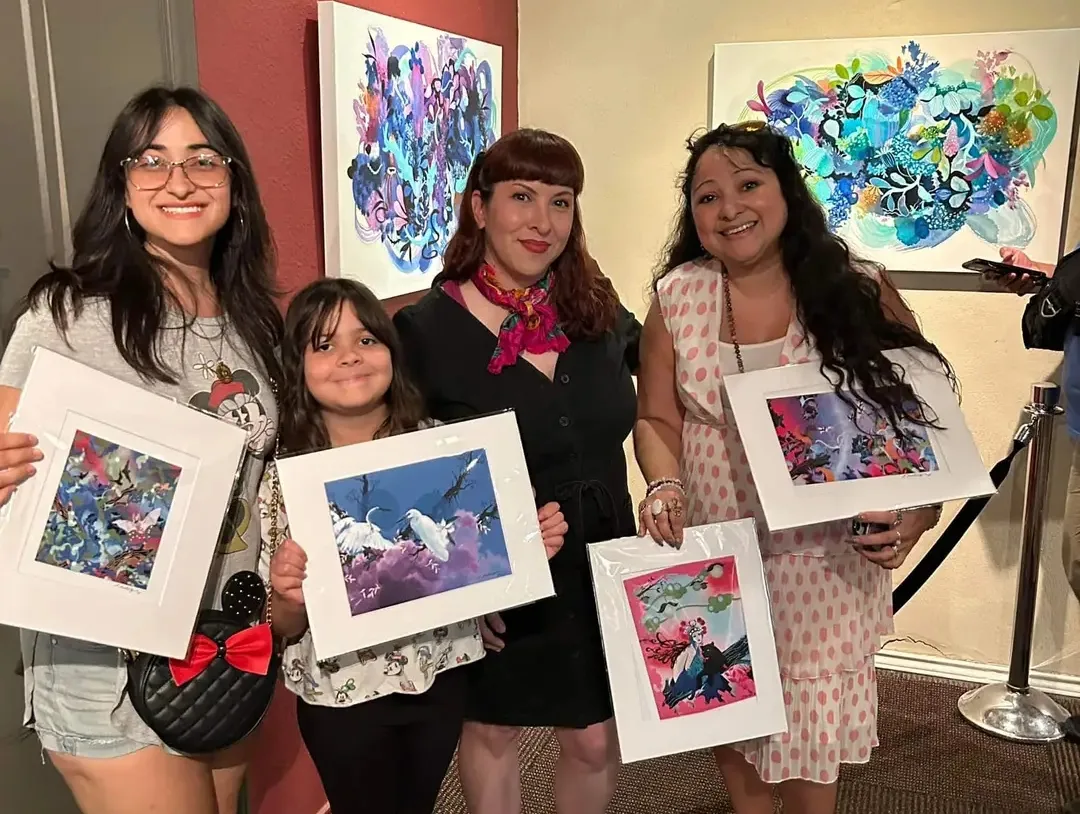
Patricia Rodriguez, middle, with attendees on opening night. Photo courtesy of Patricia Rodriguez.
In her home studio on Edgefield Ave., Rodriguez’s born-and-raised Oak Cliff background contributed to her identity and art. The pieces took about two months to finish after Rodriguez got confirmation from The Kessler.
“This is my home and [the show] is my gift to my neighborhood,” she said. “I’ve been able to watch [Oak Cliff] transform into many things. Spotlighting a native who has been here and seen it all come and go and how I’ve interpreted everything visually- was very much an honor to me.”
Rodriguez’s art communicates that chaos and elegance can co-exist in the same way nature’s plants take on different arrangements.
“Things are being created and growing in little secret gardens all around you if you look and pay attention,” Rodriguez said.







