Native

Look Behind the Scenes at the Parrish Art Museum’s Latest Exhibit, Where Artists Become Curators

Look Behind the Scenes at the Parrish Art Museum’s Latest Exhibit, Where Artists Become Curators
sam-moyer-artist
Portrait of Sam Moyer by Jenny Gorman. All images courtesy of the Parrish Art Museum.

The Parrish Art Museum, a keystone of the East End’s art institutions, marks its 125th anniversary this year, and to celebrate, it is mounting a sweeping exhibition in three parts, which will run through February 2024. “Artists Choose Parrish” features works drawn from the museum’s collection of 3,600 objects, from the 19th century to today. These pieces have been picked out by 41 esteemed contemporary artists with local roots, whose work is shown alongside their selections.

“What is it that has attracted artists here? The light, the nature, the community. I think it’s really important to highlight that,” explains Corinne Erni, deputy director of Curatorial Affairs and senior curator of ArtsReach and Special Projects at the museum. “Today there remains an incredible multigenerational group of artists living or working in the region. I thought, Wouldn’t it be great to have that dialogue of living artists and past artists who obviously made the East End their home—or at least their artistic home?

Part one of the show, which opened in April and will be on view through the summer, represents the largest portion of the multi-part exhibition, with more than 200 works, chosen by 20 artists, spanning the entirety of the museum. Here, artists Sam Moyer and Nina Yankowitz share their thoughts on the works they selected from the museum’s collection for the first chapter of “Artists Choose Parrish.”

nina-yankowitz-artist-parrish-art-museum
Nina Yankowitz with works by Jackie Black, Tara Donovan, and her own Cantilevered Wing Tongue and Ghost Dress. Photography by Jenny Gorman. 

Nina Yankowitz

New Jersey native and longtime East End resident Nina Yankowitz has spent the last six decades making work outside the mainstream, whether it be founding the radical feminist group Heresies or pushing the limits of the art-viewing experience, as she did for this latest Parrish exhibition.

“To create a renewed dialogue between the Parrish’s past and future, I wanted to offer different viewing perspectives to experience the art that I chose from the museum’s collection. I made scenario stories for each of the walls and floor to reflect our current unstable world conditions.

The artworks can be experienced in two ways. Viewers can look upward from two adjustable reclining lounges. They can also climb up stairs to a platform to look up, down, and around the gallery to view the walls and a floor story.

The floor story comprises two torn rugs addressing walls, and sound notation scores spreading along the floor for using eyes to hear the room’s stories. A cacophony of audio sounds acts like an abstract symphonic backdrop. Some artworks are installed slightly angled, tilted, on the wall, in a visual conversation with the museum’s architecture.”

sam-moyer-artist-choose-parrish-painting
Sam Moyer with two of her paintings at “Artists Choose Parrish, Part I A.” Photography by Jenny Gorman.

Sam Moyer

Brooklyn-based artist Sam Moyer is fluent in the mechanics of abstract painting, a proficiency that allows her to both examine and deconstruct the art form. In this Parrish exhibition, she takes the audience back through some of her early inspirations.

“Lynda Benglis was one of the first female sculptors I discovered as a teenager. I remember watching a video of her making one of her bow pieces and thinking, She just does it—she lets the material do what it wants, while knowing what she wants it to do. 

When I was in art school, I had two very informative and supportive studio visits with Benglis, after which she hired me to work as her assistant. The first task assigned to me required a drive from New Haven through the North Fork to the Hamptons to maintain one of her sculptures. I had never been to Long Island before, and I was blown away by the beauty of the landscape.

Not long after that drive, I began living part-time with my family on the North Fork, a place that continues to inform my work to this day. Benglis’s work is at the root of two essential components that run throughout my own practice: it introduced me to a landscape that has literally infused my work, and it provided me with a visual guide to cultivating my own collaborative relationship with material.”

Sign Up for the Cultured Newsletter

Sure, we can be close friends. Unfiltered access awaits.

The Hamptons Craze Has Taken a Toll on the Indigenous Community. These Locals Are Fighting Back

The Hamptons Craze Has Taken a Toll on the Indigenous Community. These Locals Are Fighting Back
jeremy-dennis
Image courtesy of Jeremy Dennis.

CULTURED: Both of you have deep roots in the community here. Jeremy, you were born and raised in Southampton, on the Shinnecock Reservation, and you founded Ma’s House in 2020. Jess, you spent your childhood summers out East, have lived here full-time for nearly 20 years, and direct The Arts Center at Duck Creek. What changes in the community have either of you witnessed recently?

Jess Frost: It’s gotten a lot more diverse, and there’s a broader demographic. I feel like there’s a sort of middle-class that’s developed, and the community has become a lot more colorful. Would you agree, Jeremy?

Jeremy Dennis: There’s definitely more of a year-round community, especially after the pandemic hit, which was when Ma’s House was just getting going. People are invested, and they want to see more programming and community gatherings. There has been such a rich art community here historically, and today there’s a need for new spaces that follow new models.

Frost: I think that organizations with ethical systems like Jeremy’s or Duck Creek’s thrived in that moment [of the pandemic] because our goals are not necessarily to make money. We’re trying to support the community.

CULTURED: Jeremy, do you find that by having a greater platform like Ma’s House, you are bringing more awareness to the Indigenous people of this region and others who are not as well represented?

Dennis: Oh, absolutely. Outside of the Shinnecock Indian Powwow—the largest powwow on the East Coast—there are so few opportunities for us to communicate more broadly. The powwow is the only time in the year when all the artists sell their work to support their families, but it only lasts four days. We’re trying to bring in more support for our community and other artists of color year-round.

CULTURED: Beyond the many places bearing the Shinnecock name in town, how else is the Nation represented locally?

Dennis: In Southampton—which is our closest town, just a five-minute drive [from the reservation]—there’s almost no Native or Shinnecock representation, aside from this old illustration featuring a Shinnecock person and a colonist meeting on the beach, and I think those images are only visible as stickers on garbage cans in town.

There’s so much more that we, the Shinnecock Nation and businesses, can potentially do, but prices are so prohibitive for us to have, for example, a Shinnecock storefront or community space. We are the original stewards of Southampton, so I find it strange that there’s no kind of acknowledgment by the town, or most of its residents, of our historic friendship contributions and peaceful coexistence with those who reside in the Hamptons today. It’s almost as if we were intentionally being erased or made invisible by our neighbors.

CULTURED: Do you feel that way?

Dennis: That’s a whole bigger conversation. But we do have a lot of clashes over land usage with the town. Of course the biggest industry out here is real estate, and the town gets a lot of the tax revenue from selling and developing our ancestral and sacred burial sites.

jess-frost
Image courtesy of Jess Frost.

Frost: It is an interesting microcosm of what’s happening across the country. There should be more in the towns that introduce people to what we all value the most about this place, which is the land and the history of the land. The reservation is a really important part of our history, and I have to say, I really do see so many more people digging into that. Jeremy’s done land acknowledgments for several organizations out here, including Duck Creek.

CULTURED: What is the significance of land acknowledgments, Jeremy, especially since there are still “clashes” over land usage, as you noted earlier?

Dennis: Land acknowledgments are reasonable first steps to establish better relations between institutions and local Indigenous communities. They provide education and context for the land on which they operate, and state the displacement of Indigenous communities in that area.

After understanding, hopefully action can follow—this includes programming, educational opportunities, and fundraising for Indigenous causes, all the way up to considering land-back initiatives. And this is why Ma’s House exists, why Duck Creek exists. We want to build community, bring together people who have historically never been able to come together and celebrate differences—and the things that make us similar. There’s so much still to be done.

Sign Up for the Cultured Newsletter

Sure, we can be close friends. Unfiltered access awaits.

Jane Birkin: An Adventurous Artist Made in England, Forged in France

Jane Birkin: An Adventurous Artist Made in England, Forged in France
image

Birkin had a thriving career as a singer and an actress, in both communicating a seemingly nonchalant demeanor that camouflaged a melancholy core.

For most of her life, Jane Birkin, who died Sunday at 76, acted as a bridge — an elegant one, with an affectless grace that never betrayed the strains of load bearing. She connected her native Britain and her adopted France, two countries physically close but often at odds. She never lost her English accent when she spoke, somehow joining the two languages into her own Birkin-ese, “the improbable French that added to her charm,” as Le Monde put it. She floated among song, cinema and theater, and she could reach large, varied audiences while also connecting with France’s auteur culture.

Her career did not go in a straight line. She made the most of her unassuming, breathy voice in her recordings, and while her unconventional glamour stood out onscreen, she was never afraid to veer off in unexpected directions when choosing roles. She let herself be guided by adventurousness.

After a small role in Michelangelo Antonioni’s ode to Swinging London, “Blow-Up,” Birkin left England in 1968 to make a French movie, Pierre Grimblat’s “Slogan.” On the set, she met Serge Gainsbourg, the brilliant, tortured musician, who was in the cast and wrote the film’s score.

They fell in love and soon became an It couple, impossibly stylish and cool. Crucially, she also became one of the leading interpreters of his songs, starting with their erotically charged duet “Je t’aime … moi non plus,” and continuing through six solo Birkin albums, released from 1973 to 1990. The poppiest and catchiest is “Ex fan des sixties” (1978); the poignant “Baby Alone in Babylone” (1983) largely deals with the couple’s separation.

Birkin left Gainsbourg in 1980, fed up with his drinking and temper, but their personal and professional partnership outlasted the breakup. And despite a reductive media habit of describing Birkin merely as Gainsbourg’s muse, it enriched both of them.

Birkin remained loyal to the Gainsbourg songbook throughout her life. Five years after his death, she released an album of Gainsbourg covers, “Versions Jane” (1996); followed by “Arabesque” (2002), an album of Gainsbourg songs arranged by the Algerian violinist Djamel Benyelles; and “Birkin/Gainsbourg: Le Symphonique” (2017), backed by a symphony orchestra.

But she also escaped Gainsbourg’s shadow, working with younger musicians and producers, and eventually writing or co-writing the lyrics on her albums “Enfants d’hiver” (2008) and “Oh! Pardon tu dormais …” (2020), both largely drawing from her life.

That last record is a good illustration of the way Birkin hopscotched among artistic fields, one feeding into another: “Oh! Pardon tu dormais …” has the same title as, and was inspired by, a made-for-TV movie Birkin directed in 1992 and a 1999 play she wrote and appeared in.

Birkin performing in 2001. As a singer, she made the most of her unassuming, breathy voice.Jean-Loup Gautreau/Agence France-Presse — Getty Images

Beyond her success as a singer — not blockbuster by any means, but attracting a loyal fan base around the world — Birkin had a thriving career as an actress, communicating a similar vibe onscreen as she did in music: a natural, unadorned beauty; a seemingly nonchalant demeanor, camouflaging a melancholy core.

In 1969, the year that “Slogan” came out, Birkin had a supporting role in Jacques Deray’s scorching, now cult thriller “La Piscine” alongside Alain Delon and Romy Schneider. With “La Piscine,” and popular comedies like “La Moutarde Me Monte au Nez!” (1974) and “La Course à l’Échalote” (1975), she could have continued to mine her gamine charm and cute accent for a comfortable if predictable acting career. But in typical Birkin fashion, she made an abrupt stylistic U-turn by starring in Gainsbourg’s provocative debut feature “Je T’Aime Moi Non Plus” (1976), in which she portrayed an androgynous waitress who has a rather complicated relationship with a gay man played by Joe Dallesandro, the Andy Warhol and Paul Morrissey regular.

For much of the 1970s and early ’80s, Birkin alternated between making Gainsbourg records and appearing in mainstream movies, including “Death on the Nile” (1978), which featured the kind of international star buffet that blockbuster movies of the time ate up: Her co-stars included Peter Ustinov, Bette Davis, David Niven, Mia Farrow and Angela Lansbury.

Throwing yet another twist into her career is that after Gainsbourg, Birkin was in a relationship with the uncompromising filmmaker Jacques Doillon. In 1984, she starred in his brutally intense, fever-pitch movie “La Pirate” as Alma, who is torn between her husband (played by Birkin’s own brother, Andrew) and a woman (Maruschka Detmers). It felt like a new Jane Birkin, inhabiting her physicality in a way that was almost dangerously unrestrained — and it earned her the first of three César Award nominations.

The next year, she appeared in a Marivaux play directed by the influential Patrice Chéreau at his Nanterre theater. Despite her trepidation, her performance was a success, and Birkin continued to appear onstage, alternating, as was her wont, between boulevard fare and Euripides.

Another consequential encounter in the 1980s was with the director Agnès Varda, who made the gloriously unconventional film “Jane B. par Agnès V.” (1988), in which, as Glenn Kenny noted in The New York Times, Birkin “retains a slightly breathy girlishness that complements her largely cheery, open personality and her intrepid intelligence” — words that neatly capture Birkin’s enduring appeal. Varda encouraged Birkin to write, and the two collaborated on the script of Varda’s “Kung-Fu Master!” (1988). Birkin went on to direct an autobiographical film, “Boxes” (2007).

For Birkin boundaries were porous: between public and private, high and low, art and life. In his tribute to her, President Emmanuel Macron called Birkin “a French icon.” Of that there is no doubt.

Lawrence community members gather to celebrate Indigenous artists’ works on bus shelters

Lawrence community members gather to celebrate Indigenous artists’ works on bus shelters
Share this post or save for later

Community members gathered at Haskell LIGHT student center and campus ministry Sunday to celebrate six local Indigenous artists and their works decorating 10 Lawrence bus stop shelters.

This project was begun in collaboration with the Indigenous Community Center (ICC) and Lawrence Transit in late 2021, after receiving funding from the Douglas County Community Foundation. 

Advertisement

For the artists, the illustrations are more than visual; they are spiritually connected, too. 

Full-time artist Mona Cliff, Gros Ventre tribe of Montana, illustrated the “Dear Deer” and “Baker Wetlands” pieces at Haskell Indian Nations University and 23rd Street and Haskell Avenue, respectively. These illustrations were personal to Cliff because of her spiritual connection with deer.

“‘Deer’ was one of my names given to me at 12 years old and so I have a special connection to them,” Cliff said. “Because we used them so much to survive a long time ago, they sacrifice their lives for people so that we can feed ourselves.”

August Rudisell/Lawrence Times Mona Cliff speaks to community members at the ribbon cutting on Sunday, July 16, 2023 at Haskell LIGHT.

Cliff expressed the importance behind community representation through public art. 

“After doing public art and seeing the importance and how it brings the community together, it’s really become important to be able to represent the Native community so they can see themselves in our city,” Cliff said. “It’s become an important part of my artist practice.”

Included in the community she hopes to represent is her 13-year-old daughter, Maecyka Beason, an Indigenous artist herself. 

“I feel really proud of her for doing all of this,” Maecyka said. “I think it’s really cool that a Native woman is doing art [displayed] around town, because we aren’t really represented and she represents a lot of Native people in our culture.”

August Rudisell/Lawrence Times Artists Mona Cliff (left), Odessa Star Comes Out and Tokeya Waci U (Comes Dancing First) Richardson

Another artist, Odessa Star Comes Out, Oglala Lakota tribe of South Dakota, illustrated “Sunkawakan (Horses),” at 33rd and Iowa streets, and “Wogligleya (Design)” at Sixth Street and Monterey Way.

Apart from inclusivity and representation of Indigenous culture, she hopes for this experience to encourage younger Indigenous artists to “never give up, just keep doing your art no matter what.”

Advertisement

The ICC and Lawrence Transit both hope to increase representation of Indigenous art and history throughout Lawrence.

Felice Lavergne, city transit planner II, said after an initial experiment with bus stop art, Lawrence Transit wanted to facilitate the display of Indigenous art throughout the community. 

August Rudisell/Lawrence Times Felice Lavergne, transit planner II, speaks during the celebration.

“We really want them to see themselves reflected,” Lavergne said. “The [Indigenous community] are an integral part of Lawrence and we want everyone to see themselves here.”

Adam Weigel, parking and transit manager, also explained the role of the department as facilitators in this project. 

August Rudisell/Lawrence Times Mayor Lisa Larsen (left) speaks with Adam Weigel, parking and transit manager.

“We’re just fortunate to have something of a platform for expression. With the buses, bus stops, we are fortunate to have a lot of infrastructure that can be unique or modified,” Weigel said. “Our role was making the invitation: asking if people want to be included and then seeing what comes from it … We’re here to try to facilitate people showing what they want to see.”

Rep. Christina Haswood, Diné, was also in attendance at the ceremony. Haswood emphasized the value of displaying Indigenous art not only throughout Lawrence, but through the state of Kansas. 

“Seeing the artwork at these bus stops can really add that value and comfort to a city and embrace the Indigenous identity. [It’s] telling that story and that history without having to sit down and give an hourlong presentation,” Haswood said. “You can just look out your window at a red light and you’ll see that Indigenous art.”

August Rudisell/Lawrence Times Rep. Christina Haswood

Haswood hopes for these projects to help increase representation of Indigenous culture outside of the Haskell area. 

“There’s always this feeling that the Native American community is only in this area of town,” Haswood said. “We want to expand that and invite the public and invite the Indigenous community to break down those barriers.”

If community coverage like this matters to you, please support The Lawrence Times.
Click here to subscribe.

According to Weigel and Lavergne, Lawrence Transit is open to more collaborations in the future. 

“I think we’re really open to the ideas that come from this and get brought to us,” Lavergne said. “We want it to be what the community wants and that’s pretty exciting.”

Weigel echoed that message and added that a new addition to Lawrence Transit could open more doors.

“With the new Central Station opening, that’s a space that can fit a lot of physical art events, ways for people to make connections with each other,” Weigel said. “It makes me excited about the future. There’s a lot of things we could do.”

Advertisement
August Rudisell/Lawrence Times Artist Tokeya Waci U (Comes Dancing First) Richardson speaks to the crowd.
August Rudisell/Lawrence Times Robert Hicks, a leader of Lawrence’s Indigenous Community Center, speaks to the crowd at the celebration.
If our local journalism matters to you, please help us keep doing this work.
Don’t miss a beat … Click here to sign up for our email newsletters

Natasha Torkzaban (she/her), a contributor to The Lawrence Times, is a current senior at Lawrence High School. She was an editor-in-chief of The Free Press at Free State High School before becoming an editor-in-chief for The Budget at Lawrence High School for 2023-24. Read her work for the Times here.

Latest Lawrence news:


Molly Adams/Lawrence Times

Share this post or save for later

More than 24 hours after storms wrecked numerous trees and power lines in Lawrence, some folks were still without electricity. Severe weather is possible again on Sunday.


Tom Harper/Contributed photo

Share this post or save for later

Someone is stripping the Wishing Bench of its wishes, and the people responsible for the bench are mystified.
It’s ”like someone stealing flowers off of graves,” one community member says.


Share this post or save for later

A man was charged Friday afternoon in Douglas County District Court with second-degree murder in connection with the death of David Sullivan, 62, of Lawrence.

MORE …

#support::before { content: “Support The Lawrence Times”;
font-family: Helvetica, sans-serif;
text-transform: uppercase;
font-size: 9pt; }

New collectors drive Indian art market surge, says Christie’s

New collectors drive Indian art market surge, says Christie’s

Although Christie’s discontinued its India auctions business a few years ago, the British art auction house remains positive about collector interest from the Indian subcontinent. Having sold artworks worth 400 crore in these previous auctions, Christie’s believes that India will continue to be a significant market for the auction house in the years to come.

Sonal Singh, managing director of Christie’s Indian department, emphasized its focus on modernist and contemporary art, which has played a prominent role in its Indian sales. In a global auction in March, a remarkable 60% of the bidding activity came from India.

“The market has changed a huge amount. It is a really good time to sell since the market is strong. There is a huge appetite for material that has not been seen before, and people are selling them. When there is high-quality material, people will step out to buy, in spite of what the economic situation may be,” Singh said. The auction house saw record sales of $8.4 billion in the year following the pandemic.

Christie’s acquires artworks from both India and outside, including private collections. This approach provides opportunities to find previously undiscovered artworks by esteemed artists such as V.S. Gaitonde, M.F. Husain, and H.S. Raza.

The auction house expects to see more contemporary art in Indian auctions and believes that overlooked artists will gain greater recognition. Additionally, it expects categories such as 18th or 19th-century paintings and miniature art to find their place in the market.

Singh has a positive outlook for the Indian market and highlighted the upcoming launch of two new art fairs and the emergence of private museums, such as the Kiran Nadar Museum of Art, within the next five years.

“We are trying to do more in India now and want to do an exhibition of some kind. I am very optimistic about the market. It has a huge potential for growth. The economics are clear to indicate that people are getting wealthier, and there is more to spend on art and luxury collectables, and we want to be a part of that. In five years, spending may even double. Numbers have changed drastically since the pandemic in the last three years, so I really don’t see why this trend would not continue,” she said.

Interestingly, Christie’s has observed a shift in collecting habits, with individuals expanding their interests to include other art forms such as maps and luxury products like handbags, watches, wine, and old master paintings. While historically focused on Indian art, Christie’s has seen these alternative categories contribute to 20% of its business from Indian buyers. Notably, the older cities in India have produced many art collectors.

The global market for luxury collectables has been growing, with demand for jewellery, handbags, and watches driven by cities outside the major metros. “Watches and some types of bags have become multi-million-dollar objects. That is why Rolex, Patek Philippe, and Hermes bags do so well at auctions because you cannot go into the store and buy them,” she said.

During the pandemic, Christie’s witnessed an influx of new online art buyers who engaged seriously in collecting. This opened doors to new art forms like NFTs (non-fungible tokens), and although the initial surge in interest has tapered, interest in online art remains strong.

The art market has also seen increased engagement from younger buyers, with millennials accounting for 31% of all buyers this year. About 38% of all new buyers were millennials or even younger, reflecting a growing interest in art among the younger generation.

“There is so much interest in art in cities other than Delhi and Mumbai and the other metros. About 10 years ago, we started auctions in India. We also saw a lot of interest from collectors in tier-two cities such as Ahmedabad, Pune, and Nagpur. We are now seeing some collectors from Bengaluru and Hyderabad too, which are newer markets for us,” she added.

Collectors in these emerging markets are also seeking guidance from advisers to navigate international art purchases, which they subsequently acquire domestically.

The robust activity in the Indian art market reflects growing enthusiasm for art and luxury collectables. As collectors diversify their interests and younger buyers participate in the market, the future looks promising for both established and emerging artists, as well as auction houses like Christie’s. Christie’s competes with Sotheby’s and SaffronArt in India.

Related Premium Stories

Catch all the Business News, Market News, Breaking News Events and Latest News Updates on Live Mint.
Download The Mint News App to get Daily Market Updates.

More
Less

Updated: 17 Jul 2023, 12:40 AM IST

News & Notes: A new curator at the art museum, a get-together with Lillian Pitt

News & Notes: A new curator at the art museum, a get-together with Lillian Pitt

Left: Erin Grant, new assistant curator of Native American art at PAM. Photo courtesy Portland Art Museum. Right: Artist Lillian Pitt, with “She Who Watches” mask. Photo: Dennis Maxwell.

The Portland Art Museum has hired Erin Grant as its new assistant curator of Native American art. And Lillian Pitt, one of the Pacific Northwest’s most revered contemporary Native artists, is getting ready for an evening of a little bit of talking, a little bit of showing, and a little bit of meeting and greeting at the Fort Vancouver Visitor Center in Vancouver, Wash.

Grant, a member of the Colorado River Indian Tribes with family at Hopi, the Gila River, and Phoenix, Arizona, has worked at the Portland museum since February 2022. Her assistant curator position is new to the museum, and will provide a boost to oversight of one of PAM’s most complex and important collections.

“This new position is a game-changer,” Kathleen Ash-Milby, curator of Native American art, said in a museum release. “We will now be able to focus on necessary work in our collections as well as exhibitions and more public-facing work. Both are needed as we continue to build our relationships with Native communities in the region and beyond.”

The new curatorship was made possible in part by a grant from the Leadership in Art Museums initiative, which is designed to help museums increase racial equity in leadership positions and is funded by the Alice L. Walton Foundation, Ford Foundation, Mellon Foundation, and Pilot House Philanthropy.

In her new role, Grant will focus initially on museum compliance with the National Graves Protection and Repatriation Act, an important role internationally in assessing museums’ holdings, how objects were come by, and whether other groups or individuals — often Indigenous — have a legitimate claim to ownership. In June 2022 PAM returned nine Tlingit objects to the Native community in Wrangell, Alaska, from which they’d been taken before the Portland museum acquired them as part of the 800-piece Axel Rasmussen collection in 1948.

Grant will also concentrate on planning for the museum’s current major redesign and eventual reinstallation of the Native American galleries.

Grant has a bachelor’s degree in history from Seattle University and is a 2019 graduate of the History of Design & Curatorial Studies master’s program through The New School and the Smithsonian Design Museum. She’s completed internships at the New York Historical Society, American Federation of Arts, Metropolitan Museum of Art, and the Indian Arts Research Center (School for Advanced Research). In her 17 months at PAM before joining the curatorial team she concentrated on programming and outreach to Native communities for the exhibitions “Dakota Modern: The Art of Oscar Howe” and “Jeffrey Gibson: They Come from Fire.”

The new position is particularly important considering curator Ash-Milby’s commitment to connecting the museum with contemporary tribal members and emphasizing that Indigenous art is both historical and contemporary: The work of many contemporary Native artists is in the museum’s Northwest galleries.

“As an Indigenous scholar and museum professional, I have always strived to be the bridge connecting institutions and their audiences to the worlds and cultures they reflect,” Grant said in the museum release. “I am guided by community collaboration and outreach methodologies. As I seek more growth opportunities, I am eager to continue my work in the prioritization of Native voices and to contribute my voice on a bigger scale at the Portland Art Museum.”

“An Artist’s Journey” with Lillian Pitt

Some of Lillian Pitt’s artwork that will be on view at the Fort Vancouver Visitor Center.

Meanwhile, the Friends of Fort Vancouver and the National Park Service are getting ready to host an evening with Lillian Pitt, the mutidisciplinary traditional and contemporary Columbia River artist who for decades has been a key part of the glue that holds Northwest Indigenous artists together and helps keep them in the public eye.

The evening, called “An Artists Journey,” will be from 5 to 7 p.m. Thursday, July 20, at the Fort Vancouver Visitor Center, 1501 East Evergreen Blvd. in Vancouver, and if you’d like to be there (it’s free) you can register here by scrolling down to “Events.”

Pitt, whose family roots are Wasco, Yakama, and Warm Springs, will talk about her artistic journey, her exploration of traditional art forms and the ways she’s learned to carry them into contemporary times, of artists she’s mentored and been mentored by, and of techniques she’s learned in forms as varied as glass, metal sculpture, mask-making, pottery, jewelry, and printmaking. A selection of her work will be on view, some of which will be for sale.

Sponsor

Chamber Music Northwest Summer Festival Poetry in Music Portland Oregon

The Portland Art Museum has about a dozen works by Pitt in its permanent collections and has shown exhibitions of her work, but her influence ranges far beyond museum collections. Among other things, she’s been central to spreading the historical and cultural significance of Tsagaglalal, or She Who Watches, the ancient rock image that sits in Columbia Hills State Park on the Washington side of the Columbia River, on Washington Highway 14 between Lyle and Maryhill.

You can listen here to Lillian Pitt: 10,000 Years through Art, Dmae Lo Roberts’ Stage & Studio April 2021 podcast interview with Pitt on ArtsWatch, on the occasion of the artist’s solo exhibition Ancestors Known and Unknown at the Columbia Center for the Arts in Hood River.

Indian artist Sri Prabha’s exhibition wows at Boca Raton Museum in Florida

Indian artist Sri Prabha’s exhibition wows at Boca Raton Museum in Florida

Sri Prabha’s exhibition is a great opportunity to witness the brilliance of an Indian-born artist who has made his mark in the United States. With a powerful vision and a deep connection to nature, his art has the potential to inspire change and ignite a passion for environmental preservation.

Acclaimed artist Sri Prabha, originally from India and now based in South Florida, is showcasing his captivating solo exhibition, “Sri Prabha: Resonator-Reanimator,” at the renowned Boca Raton Museum of Art in Florida. Running until October 22, this exhibition takes center stage in the museum’s main gallery, a prestigious honor for any artist.

Born in Hyderabad, India, in 1969, Sri Prabha has been living in the United States since 1978. His artistry brings together the essence of Eastern philosophy and Western science, creating a unique exploration of our connection to the natural world. The exhibit is a vibrant journey filled with vivid colors and innovative art forms that promise to leave a lasting impression on visitors.

Curated by Kelli Bodle, the Associate Curator of the Boca Raton Museum of Art, this exhibition exemplifies Sri Prabha’s deep passion for the environment and the human-nature relationship. Through his multi-disciplinary approach, he has crafted awe-inspiring site-specific installations that engage all the senses. Visitors can walk through mesmerising mixed media, watch captivating videos, immerse themselves in ambient sounds, and interact with thought-provoking structures.

Sri Prabha’s artistry goes beyond traditional boundaries as he ingeniously incorporates elements like traditional Indian sari fabrics, abstract paintings, digital print collages, and assemblages. His works have garnered significant attention and are proudly displayed in private collections across major cities like Chicago, Seattle, Miami, New York, Washington, DC, and even internationally in Copenhagen.

At the heart of his art lies a powerful message of interconnectedness, urging viewers to reevaluate their relationship with nature and each other. Through Resonator-Reanimator, Sri Prabha invites us to reflect on the shared origins of life and to embrace collaboration in safeguarding our planet for future generations.

“The idea is for people to go through a portal and realise we are more similar than different, that all of these elements floating around space came together and created us,” says Sri Prabha.

“We are all interconnected, and we can change our behavior to work together and collaborate. As civilizations, we like to think that we are different from each other, but we are really not. Our technology is changing rapidly, but our behavior has not kept up.”

Founded by artists in 1950, the Boca Raton Museum of Art has since flourished into a cultural landmark in South Florida. Alongside the Museum, it houses an Art School and Sculpture Garden, offering an enriching experience for art enthusiasts and visitors from all walks of life.

Sri Prabha’s exhibition is a great opportunity to witness the brilliance of an Indian-born artist who has made his mark in the United States. With a powerful vision and a deep connection to nature, his art has the potential to inspire change and ignite a passion for environmental preservation.

Garden artists creating ephemeral beauty with transient foraged materials

Garden artists creating ephemeral beauty with transient foraged materials

A leaf that doubles as a dog’s ear, stems that make for insect legs and a twig that becomes a baby. Garden artists are using nature’s bounty to unleash their creativity.

Foraging for materials including petals, seeds and acorns, nature lovers – many of whom are gardening enthusiasts – from all over the globe create both portraits and abstract art. These are then photographed for posterity, while the original work is recycled or left for the wind to carry away. The overarching aim of so-called Earth art is to create something of ephemeral beauty, even if it’s transient.

“Nature is an infinite well of inspiration, so naturally I gravitate towards it,” says Canadian artist and photographer Raku Inoue, who makes colourful portraits using flowers, twigs, leaves, seeds and stems placed on white paper, which he then photographs.

His creations also include orangutans, llamas, colourful birds, fish and butterflies, and even dinosaurs. He uses freshly cut flowers to create portraits of insects, from delicate beetles to vibrant ladybirds, using stems to artfully form legs.

Given the nature of his work, Inoue’s palette shifts with the seasons as leaves and petals change colour. He also digitally manipulates the arrangements using different angles to make a montage.

Fellow garden artist Subhashini Chandramani, who lives in Bengaluru, India, uses discarded petals, leaves and seeds to make portraits of anything from the Hindu deity Krishna, complete with a flute, to Audrey Hepburn, flamenco dancers and birds, using poinsettia leaves. For Earth Day in April, Chandramani created a stunning world map using the petals of different flowers on a black backdrop.

“The materials I use originate primarily from my own garden. Even when I am out in parks, I am always on the lookout for unique leaves, flowers, seeds and even vegetables that can inspire my next piece of art,” says Chandramani. “The process of creating each piece is a dance with time and nature, and a little like assembling a puzzle. For example, I’ve transformed the leaf of Leea rubra into a Native American’s eyes, and a crepe jasmine leaf into a sky filled with birds.”

In Chicago, artist Vicki Rawlins and her daughter Brooke spend much of their time outdoors foraging for materials that Rawlins then uses in her whimsical art.

Vicki Rawlins forages for materials in her garden and neighbourhood. Photo: Julie M Gile

“I work with foliage that I forage from walks in my yard and neighbourhood and build detailed scenes and portraits with no glue or tape, just 100 per cent Mother Nature,” says Rawlins. “Sometimes I’ll buy flowers from a local shop if I can’t find what I need in my own backyard.

“My pieces aren’t permanent. After I take photos of what I create, I put the foliage back outside in the compost pile for a new life,” adds Rawlins, whose Instagram feed is filled with landscapes and portraits, including one of Frida Kahlo with a head full of flowers.

“If I like what I’ve done I’ll turn the photos into fine art prints and greeting cards,” she says.

British painter and photographer Hannah Bullen-Ryner is garden artist who assembles works not on paper, but rather on woodland floors. She describes herself as “a land artist and woodland pixie in love with the natural world”, and makes portraits of hummingbirds and owls using wildflowers, berries, leaves, seeds, twigs and petals.

She arranges various elements, such as leaves to form the feathers of a bird, such that they resemble artistic brush strokes before she leaves them to be reclaimed by nature.

Ryner also creates images of white tigers and chimpanzees drawn using chalk and water, then filled with foraged materials. She sells prints of her creations on Etsy.

Bridget Beth Collins, from Seattle, has been creating floral art for 15 years. “It started when I was walking through my garden one day and saw a ‘goldfish’ in my orange poppies. I brought the poppy inside and painted a body on a piece of paper, then used the petals as fins. Since that day I have made different animals, landscapes and books with flowers,” says Collins.

An arrangement by Bridget Beth Collins. Photo: @flora.forager

Her love of nature has been fostered by backpacking trips and time spent in mountain meadows in the state of Washington. Her Instagram feed is filled with eclectic images of everything from gnomes and turtles to bicycles and even the Eiffel Tower made out of petals, leaves and seeds.

“I forage for wildflowers from meadows and parks, and also grow my own flowers or buy bouquets at the market to create my botanical art. Many of my friends give me flowers from their gardens knowing I will create with them,” says Collins, who sells prints of her work at Floraforager.com.

In Singapore, fashion illustrator Grace Ciao uses petals and leaves to create “bloom belles”.

These are illustrations of women in stylish dresses, with full skirts and glamorous gowns made with the petals of daisies, gerberas and roses. Sometimes Ciao will use a whole flower to form a garment.

Unlike many other garden artists, Ciao draws and paints an entire picture before adding petals or leaves as embellishments.

Also differing from the norm is London artist Chris Kenny, whose nature portraits use just one material: twigs.

Chris Kenny uses only twigs to create his portraits. Photo: Chris Kenny

Kenny makes everything from detailed dancing figures and babies to abstract portraits by joining together the twigs he forages.

“Twigs provide naturally rhythmic, characterful and unpredictable lines,” says Kenny. “They reveal connections between plant limbs and human limbs with an exuberance inherent to life.”

Updated: July 16, 2023, 2:01 PM

Stolen culture: Ilya Repin, the Kharkiv Cossack Devoted to Ukraine

Stolen culture: Ilya Repin, the Kharkiv Cossack Devoted to Ukraine

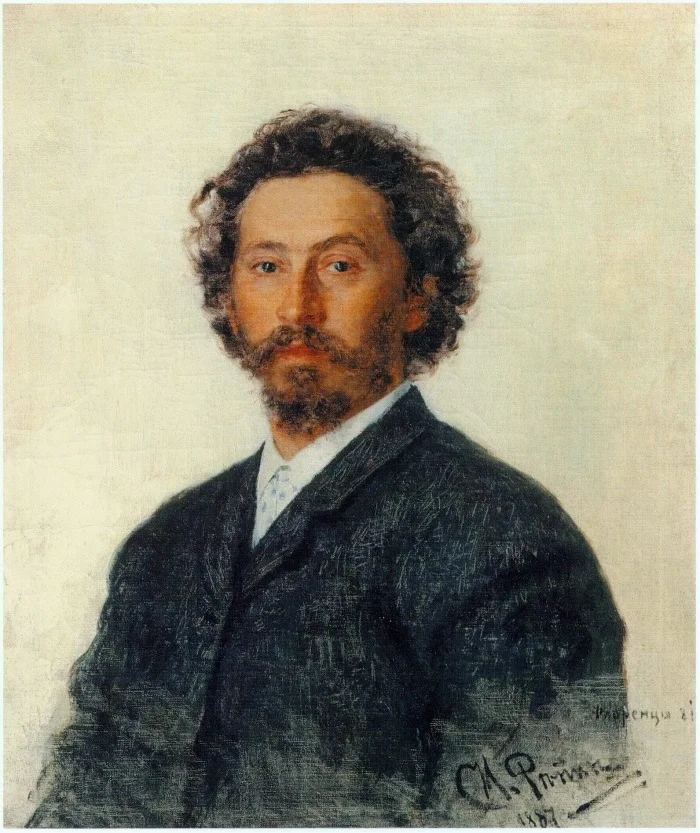
Ilya Repin has long been considered one of the masters of Europe’s late-19th-century Realist painting tradition. Yet he did not merely copy what he saw. Rather, he reincarnated the scene with an almost expressionistic flair, suffusing the atmosphere with his deeply rooted sense of being Ukrainian.

Unfortunately, like so many Ukrainian artists and cultural figures, the world-renowned painter has been classified as a “Russian” and is invariable referred to as a “one of the key figures of Russian Realism.”

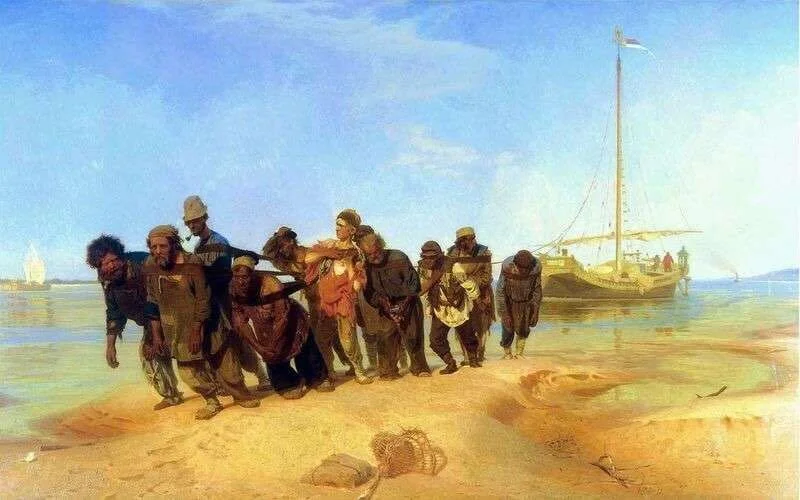
Russian art critic Vladimir Stasov called Repin’s work an “encyclopedia of post-reform Russia.” In his works, Repin managed to cover all aspects of modernity, touch on topics that concern the public, and react to the spirit of the day.

Repin’s life is closely connected with the Kharkiv region, where he was born; and Repin’s Cossack roots strongly influenced his work.

In his works, he depicted human figures in motion, giving them a rich plasticity with brilliant colors. Some works are also influenced by Impressionism and Symbolism.

image

Cossack origins

The future artist was born on July 24, 1844, in the city of Chuhuiv, now in Ukraine’s Kharkiv region. His paternal grandfather, Vasily Repin, was a Cossack engaged in trade. The original Cossack name, Ripa, was later Russified.

From the age of 11, the artist was sent to a school for topographers. Two years later, he began working in the icon workshop of the artist Ivan Bunakov. There the visitors heard about the talented young master.

Already at the age of 16, Repin left the workshop and his parents’ house to work in an icon painting cooperative, where he was paid 25 rubles a month. In the summer of 1863, he went to another art cooperative in Voronezh province, near the city of Ostrohozhsk. From there, Repin was inspired to go to St. Petersburg in the fall.

Once in St. Petersburg, he obtained the right to stay abroad for six years as an academic at public expense after his painting Christ Raises the Daughter of Jairus received a prestigious award.

But Repin only went abroad for three years, from 1873 to 1876, a period during which he exhibited his works at the Paris Salon.

Ukrainian motifs

From the 1870s to the 1880s, the artist traveled extensively throughout Ukraine and Russia, where he got new inspiration. The periods of his work can be divided into Ukrainian and Russian.

However, it was with Ukraine that the artist from Kharkiv region was most deeply connected not – not just geographically, but also sensually. In his paintings, he depicted Ukrainian nature, people and folklore.

His works include such well-known Ukrainian-themed canvases, such as Ukrainian Peasant Woman (1886), Portrait of Taras Shevchenko (1888), and Cossacks on the Black Sea (1908).

image

“Cossacks on the Black Sea”

Through his work, Repin raised important issues for society, in particular the problems of the 1876 Ems Ukaz, the decree by which Russian Emperor Alexander II banned the Ukrainian language in many spheres of life.

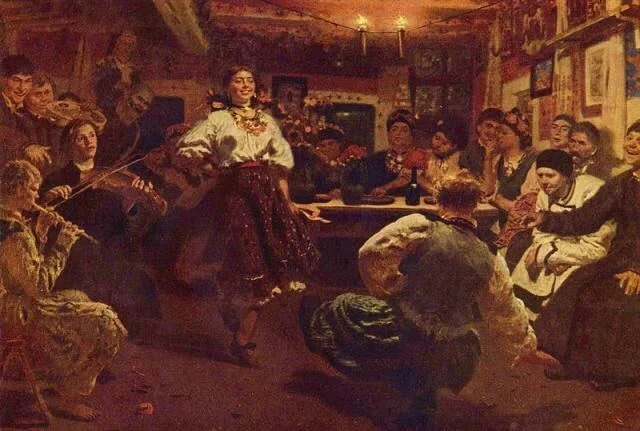
As a reaction, the descendant of Cossacks painted Vechornytsi in 1881, on which he signed his name in Ukrainian. The gallerist Pavel Tretyakov bought the painting and hung it in his renowned gallery under a virtually forbidden name. The entire Russian press submitted this name in Ukrainian.

image

“Vechornytsi” (1881)

One of Repin’s best-known paintings is Reply of the Zaporozhian Cossacks, which has become a symbol of the Cossack spirit. The artist began it in 1880 and finished only 11 years later. Before writing, he carefully studied Cossack weapons and clothing. He also constantly consulted with the Ukrainian historian Dmytro Yavornytsky, who posed as the writer of the letter.

During his travels, Repin personally communicated with other Cossack descendants . “An amazing people. Nobody in the whole world felt so deeply about freedom, equality and brotherhood! Throughout their existence the Zaporozhtsi remained free, they surrendered to nobody!” Repin wrote.

The painting was admired by the Russian Emperor Alexander III, and he bought it for 35,000 rubles, which was a huge sum for those times.

Ivan the Terrible kills his son

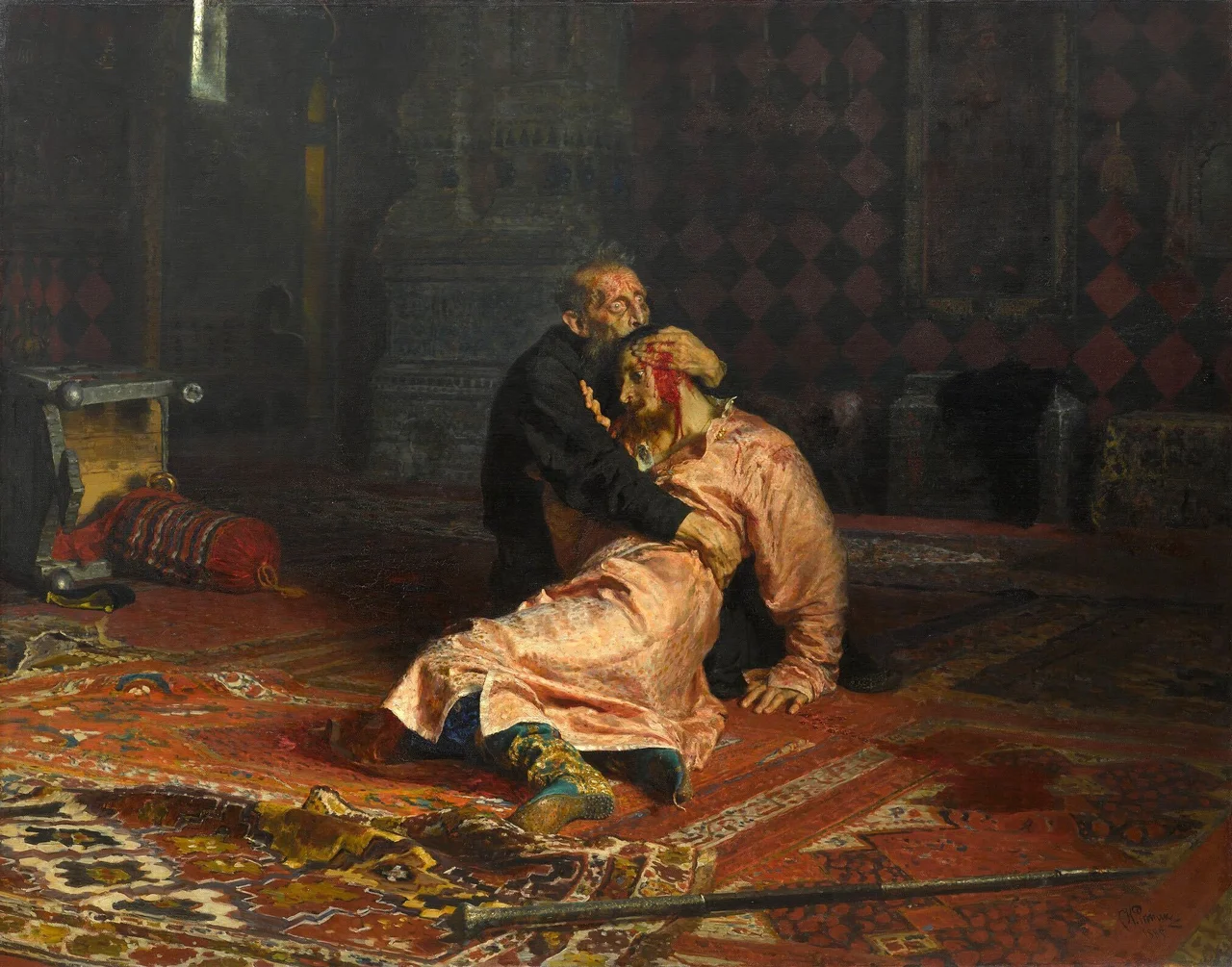
The next of Repin’s most memorable paintings is Ivan the Terrible and His Son Ivan on 16 November 1581. The picture, depicting a significant historical drama, was painted in 1885 and has the unofficial title “Ivan Grozny Kills His Son.”

image

“Ivan Grozny Kills His Son” (1885)

After completion, the painting was shown at the exhibition. But this interpretation of the historical plot caused dissatisfaction with Emperor Alexander III. So he forbade the painting from being exhibited. Many cultural figures defended the canvas. Thanks to their efforts, as well as those of the artist Alexey Bogolyubov, the ban was lifted.

Refusal to return to the USSR and nostalgia for Ukraine

At the initiative of Grand Duke Sergei Alexandrovich, Repin accepted an offer to work at the Imperial Academy for the sake of reforming the educational institution. His workshop at that time was the most popular among students.

But after Finland gained independence from Russia, the artist did not want to return. In 1919, he presented the Finnish Society of artists with 23 paintings by Russian artists who did not support the Bolshevik coup. Thus, the famous Athenaeum collection was founded, showing the works of European artists.

But the Soviet government made at least three attempts to bring Repin back from Finland. Eventually, Stalin issued a resolution: “Allow Repin to return to the USSR.”

In 1925, Korney Chukovsky came to visit Repin. He was supposed to make the artist an offer to move to the USSR, but in fact had secretly persuaded Repin not to return. A year later, a delegation of artists led by Isaac Brodsky arrived again to persuade him to return.

In November 1926, Repin received a letter from people’s commissar Kliment Voroshilov. Repin’s son Yuri was involved in the negotiations. But to no avail – the artist remained in Finland.

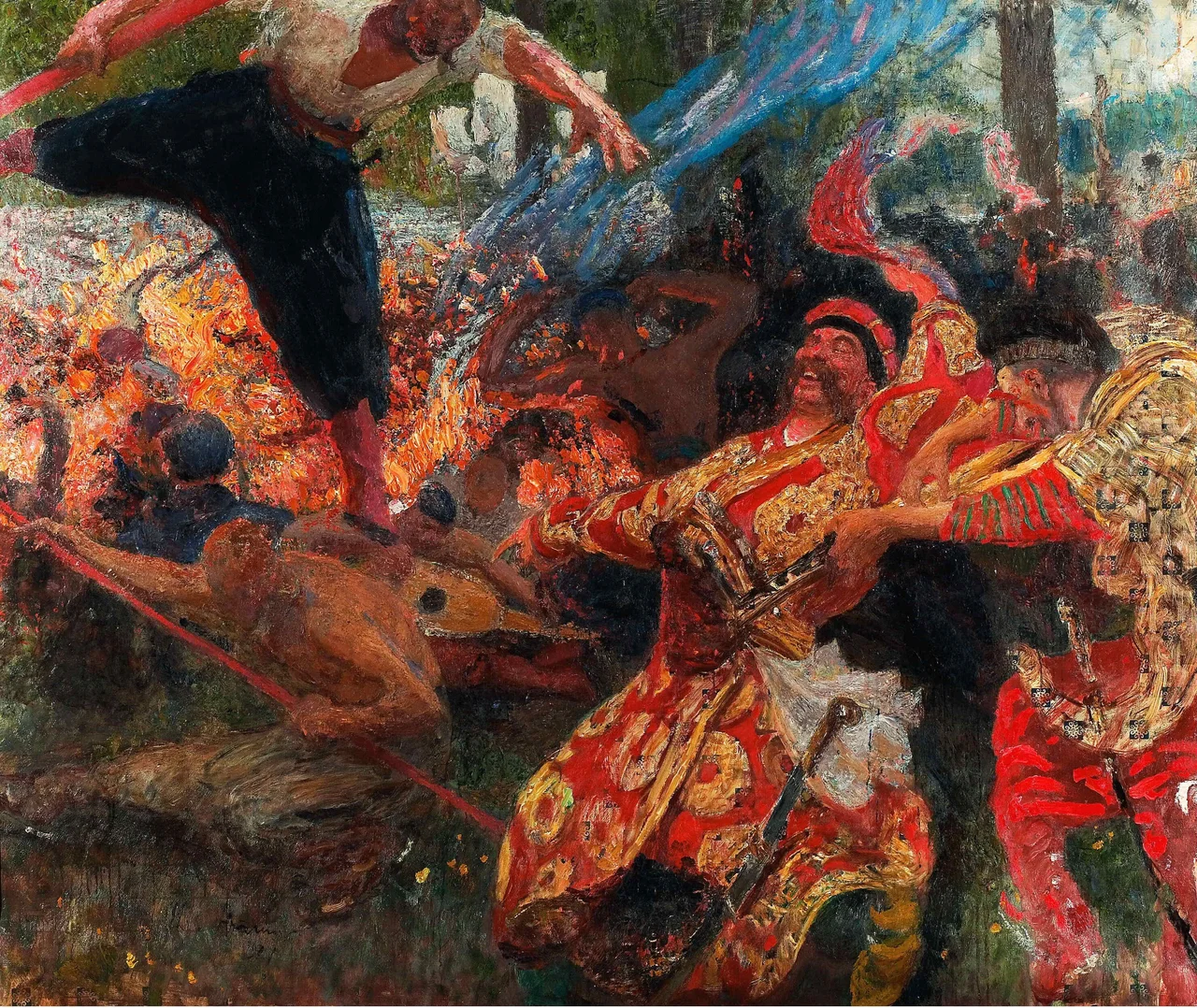
If Repin wanted to return, it was only to Ukraine. But the Bolsheviks blocked his way. Even his last major painting, Hopak, is directly related to Ukraine and its tradition of wild acrobatic dancing. He conceived it in 1926. But it was already physically difficult for him to execute it due to the paralysis of his right arm.

image

“Hopak” (1927)

Ilya Repin died on Sept. 29, 1930 in the small Finnish village of Kuokkala. In his will, he insisted that his body be buried in his native Chuhuiv. However, due to problems with the Bolshevik authorities in eastern Ukraine, the artist’s widow decided to bury her husband in a park near the house and the hill that Repin called Chuhuiv Hill. She buried him without a coffin, and planted a tree on the grave, as the creator asked.