Native

How We Perceive and Are Perceived: Memory Map, the Art of Jaune Quick-to-See Smith

How We Perceive and Are Perceived: Memory Map, the Art of Jaune Quick-to-See Smith
Coyote Sees the World Clearly. Charcoal drawing by QTS Smith, 1996. Photo by the author

Jaune Quick-to-See Smith is an Indigenous artist and a member of the Salish and Kootenai Nations in Montana. Her rich art shows a wide range of subject matter, inclusive of joy and lightheartedness, as well as the dark depths of suffering, historical and ongoing. Her work is complex visually and politically, and yet as the viewer I felt drawn in, never alienated. I wanted to understand more about her experience, her vision in relation to the natural world, ancestors, cultural traditions, and our modern society. I found her work to be paradoxical, heartbreaking, yet full of hope and potential. Throughout her many decades as an artist, Smith has also been an art teacher and an activist. She influences younger and older generations in vital ways. Even now, in her 80s, she continues to impress and is quite prolific in her creation of artwork.

Her work is currently on display at the Whitney Museum of American Art in New York City, offering an impressive recognition for her work, long overdue. She recently said that she could only ever imagine partaking in the group show Venice Biennale, never imagining she would one day have a solo retrospective. Having just encountered her artwork, I felt a great sense of joy for Smith, and for me to be exposed to such meaningful activist art. As the artist states of her younger days:

While working as a full-time artist, I also consistently organized and curated exhibitions for Native artists for over 30 years. One of my most memorable was the first touring Native women’s exhibit: Women of Sweetgrass, Cedar and Sage. After receiving the catalog, one woman wrote me that she laid the catalog against her cheek and cried. She had no idea there were so many Native women artists out there and she no longer felt alone.

(Brooklyn Museum)

Detail of a large quadriptych painting by QTS Smith. Photo by the author

As an engaged Buddhist, I find it imperative to interact with artists and works that explore what it means to be fully human and alive today. Addressing such conundrums as the “meaning of life,” how humans hurt one another, and what awareness is; how awareness includes both ultimate and relative levels, intertwined, is one facet of the arts. Art has the power to transcend these two levels and interweave them, leaving the viewer or experiencer to absorb and metabolize what they will. This is a form of meditation in action and compassionate activity—to listen, to observe, or to hold space for dialogue with viewpoints familiar or foreign to us, holding them in positive regard. It is a way of looking both backward and forward in a linear timeline held within the mandala of timeless time.

If the path of meditation is to transcend or liberate all from suffering, it is not a practice we engage merely for our own benefit. Engaging with the arts as a maker, viewer, listener, or participant is a form of meditation in action, where compassion for oneself, others, and our cultural systems are embraced in our bodhisattva vow. This encompasses all possible human emotions—anger and confusion, joy and sorrow—giving us a tangible path to walk in communicating our needs and desires, our hopes and failings. As we wish to know others better through their expressive means, we strive to understand and therefore care for them—and all relations, i.e., sentient beings—in ever more skillful ways.

Three drawings by the Artist, 2022. Photos by the author

As the exhibition materials state:

Smith’s work persistently draws attention to the fact that indigenous peoples exist and flourish in the United States, despite centuries of attempted erasure by waves of European invaders, subsequent generations of white settlers, and the policies of the federal government. She feels strongly that her works should, in her words, “leave an imprint on the land that says we are here. We have been here, and these are our stories. These are my stories, every picture, every drawing is telling a story. I create memory maps.”

(Whitney Museum of American Art)

Going Forward/Looking Back, mixed media, 1996. Still from exhibition video. From youtube.com

Much of Smiths artwork combines painting, collage, lithographs, and mixed media to convey the interrelationships of her people with the land, the elements, animals, and the experiences her people and the Earth continue to face under cultural repression and brutality. The way Smith incorporates humor, satire, and multi-layered meanings, as well as forms, imagery, and colors, give her work a truly unique and expressive style. Smith’s “driving concerns [are]: ecological disaster, the misreading of history and the genocide of Native Americans, but also the restorative power of kinship and education. Rejecting a strict chronology, the exhibition instead offers moments to discover the linkages between Smith’s images and ideas across time.” (Whitney Museum of American Art)

I have traveled extensively in the world and seen art in many places. But one thing I almost never do is take part in a guided tour of a museum exhibition or gallery. I suppose Ive always thought that I would rather let the works speak for themselves, to make their impression upon my heart, mind, and visual senses without someone elses’s commentary. However, in Smith’s show, there was a tour underway, and I overheard the guide giving extensive and fascinating commentary on the works.

He—and, in fact, all the guides—had obviously been educated directly by the artist about what she wanted verbally conveyed about her work. I was riveted by the talk. As we moved through the gallery, the guide spoke at length about four different works of art, encouraging questions from the group, engendering a lively and deep conversation. This was yet another opportunity for me to learn something about my own learning style and my preset notions. In the future, I will pay more attention to the option of an excellent guided tour. It feels liberating to cut through one’s own limiting beliefs!

No Comment. Drawing by the artist, 2002. Photo by the author

Employing satire and humor, Smith’s art tells stories that flip commonly held conceptions of historical narratives and illuminate absurdities in the formation of dominant culture. Smith’s approach importantly blurs categories and questions why certain visual languages attain recognition, historical privilege, and value.

(Whitney Museum of American Art)

After viewing about 80 per cent of the exhibition, far more than I predicted, I descended in the elevator to the lobby, ready to leave the museum. One of the docents asked me if I would do an exit survey. I was happy to oblige. She asked many questions about my experience at the museum and of the Smith exhibition, which was the only one I saw. There were several other compelling exhibitions, but I could not add anything more to my emotional or mental palates. And in fact, I did not want to disturb the mood I had been left in through experiencing Smith’s moving and impactful work.

The artist in her studio. From whitney.org

It was, and remains, an emotional journey, delving into her experience even a little bit and letting it penetrate through the layers of my ignorance and tenderness around the issues of genocide, cultural erasure, and the dominance of one culture over another. Since I belong to the typically dominant white culture, it takes effort to engage with such bodies of work that bring up a painful collective past. Although I am committed to, and deeply interested in, the Indigenous activist arts, it takes energy to engage with challenging material. Thus, self-care and replenishment are required. I did not want to mix up my mind with any other artists or viewings that day, but simply to rest in the deepened awareness and appreciation for Indigenous voices and creativity. This prolific and impactful artist Jaune Quick-to-See Smith, with her very apt name, is an artist to seek out. Educational art such as hers stands out as a much-needed antidote to the nonsense pervading US political culture today in terms of further erasure of vital voices, Indigenous among them, who ought to be seen, heard, recognized, and appreciated for their unique human being-ness.

Two mixed-media works by QTS Smith. Photos by the author.

See more

Jaune Quick-to-See Smith (Brooklyn Museum)
Jaune Quick-to-See Smith: Memory Map Apr 19–Aug 13, 2023 (Whitney Museum of American Art)
Jaune Quick-to-See Smith: Memory Map (YouTube)
Exhibition Tour | Jaune Quick-to-See Smith: Memory Map at the Whitney Museum of American Art (YouTube)

Related features from BDG

Indigenous Art Matters – The Bold, Contemporary Work of Artist Gregg Deal
Still Standing: Resistance and Resilience of the Standing Rock Sioux Nation
Restoration and Justice: An Interview with Dr. Natalie Avalos on Indigenous Spirituality and Buddhist Allies
Buddhistdoor View: Indigenous Relations – Restoration and Restitution

More from Creativity and Contemplation by Sarah C. Beasley

Kansas man, 58, dies after car turns in front motorcycle along Kansas highway

Kansas man, 58, dies after car turns in front motorcycle along Kansas highway

Updated June 11, 2023 at 3:09 PM
Wichita Eagle file photo

A motorcyclist is dead after a collision with a car Saturday afternoon in eastern Kansas.

The motorcyclist was identified as 58-year-old Ryan Simpson of Hutchinson, Kansas Highway Patrol crash logs show.

The incident was reported around 3:46 p.m. along U.S. 54 at S. 100 Road in Bourbon County. Simpson was westbound on U.S. 54 in a 2015 Harley Davidson Road Glide. Another driver, 60-year-old Daniel Blake of Fort Scott, was heading east on U.S. 54 in a 1998 Mercury Grand Marquis, the crash log read.

Blake failed to yield and turned in front Simpson, resulting in Simpson overturning and striking the car, according to the report.

Simpson was taken to Via Christi where he died from his injuries. His passenger, 58-year-old Cynthia Simpson of Hutchinson, was taken to Freeman Hospital in Joplin, Missouri, with suspected serious injuries, the crash log said.

Blake and his passenger, 75-year-old Martha Knackstedt of Fort Scott, were not injured in the crash.

Originally published June 11, 2023 at 12:41 PM

This couple has been sharing their love of art for 50 years — and they are not done yet

This couple has been sharing their love of art for 50 years — and they are not done yet

Published June 11, 2023 at 7:00 AM
Travis Heying/The Wichita Eagle

Les and Courtney Ruthven collected student art as something of a hobby when they were younger. Later, they collected from professional artists as well.

“We had given our children what we could, and we had filled our house,” Courtney Ruthven said. “Our banker said, ‘Look, you’ve either gotta stop buying or start selling.’”

The couple opted to sell, launching a local collection by the name of Mid-America Fine Arts.

This year, Mid-America Fine Arts celebrates its 50th anniversary.

When asked if they ever thought Mid-America Fine Arts would be around for 50 years, Les Ruthven replied, “Well, we figured if we made it to 50.” Courtney Ruthven simply said, “We weren’t thinking.”

The Ruthvens now sell their collected artwork out of Mid-America Fine Arts’ gallery space, near the intersection of Central and Grove.

“It’s like picking out your best child,” Les Ruthven said when asked about his favorite piece in the gallery. “You can’t get overly attached. Then, if you do, you price them out.”

Mid-America Fine Arts’ owners met when they were both attending college in Tennessee. Courtney Ruthven, whose mother was an amateur painter, and Les Ruthven, whose father was the same, grew up surrounded by art.

“My father was a Sunday painter,” he said. “We would go to Central Park and he would paint. That’s how I was exposed to art.”

The Ruthvens moved to Wichita from Charleston, South Carolina, in 1965. Here, the couple worked as psychologists in a private practice.

“We started out when we came here buying student art, and then as we accumulated a little disposable income, then we graduated,” Les Ruthven said. “We decided that we would have some great works for a short period of time rather than permanently.”

In the beginning, they ran Mid-America Fine Arts as private dealers without their selling space. Eventually, they were able to set up shop in a more permanent gallery to showcase their art.

Mid-America Fine Arts now houses roughly 300 pieces from Kansas artists, as well as a variety of works from other American artists and two from European artists.

“We specialize more in traditional art than modern, of the 20th century, less so abstract,” Les Ruthven said. “I like art to take us to a place or a person or a time period. It’s an extra feeling. It’s more (…) connected to one’s life.”

The Ruthvens said they never saw Mid-America Fine Arts as a job; rather, they viewed showing people through their gallery as more of a respite.

“This was a break from our professional career,” Les Ruthven said. “Sometimes, there’s more in life than a particular job.”

To this day, the couple, now retired, work at Mid-America Fine Arts Monday through Friday from 8 a.m. to 2 p.m. People can additionally make appointments outside these hours or shop online.

“It’s something that we have enjoyed doing first of all because we wanted to share our art, but also we just love to show it,” Courtney Ruthven said. “We really enjoy it.”

The couple at one point had plans to sell the business, according to a 2015 Eagle story. Now they run the collection space with their son-in-law Greg Moore, who will be transferred ownership of the building eventually.

“It’s not a matter of money, you know what I mean?” Moore said. “A lot of people, they come in here and they say, ‘I had no idea how much art you have in this building. … This is like a hidden gem of Wichita.’”

Despite Moore’s assistance, Les Ruthven said they don’t plan to retire from Mid-America Fine Arts “as long as we can get around.”

“I think they’re just looking forward to the next 50 years,” Moore said.

Local artists selected for logo design project

Local artists selected for logo design project

After an exhaustive selection process involving more than 20 artists, the Eureka Cultural Arts District has selected two local designers to work on the creation of a logo and supporting basic style guide for the district.

The lead designer for the project is local muralist Mir de Silva, who has made multiple contributions to the city’s lively public art scene through her participation in the annual Street Art Festival. Apprenticing with Mir on the logo project will be fellow Eureka resident Tori McConnell who, in addition to being an accomplished artist herself, was recently named Miss Indian World 2023.

Tori McConnell is an accomplished artist and was recently named Miss Indian World 2023. (Submitted)

“I am excited to be a part of a project that is reinvigorating community participation in local art,” said de
Silva. “This will be a wonderful opportunity to work with another local artist and learn about their
unique perspective. I feel that art is central to the identity of the community of Eureka and I hope
together we can create something that reflects the unique nature of our local arts and cultures.”

McConnell will also be using experience and skills gained in this project to create imagery for the
upcoming Festival of Dreams taking place within the Cultural Arts District in August.

Cultural Arts District lead Leslie Castellano said, “We believe the combined efforts of these two artists
will deliver a strong visual identity that can be used to market the district. We hope to unveil the
finished design before the end of June.”

de Silva is an artist based in Eureka. Her work often depicts native flora and fauna experiencing human life. de Silva graduated from Humboldt State University (now Cal Poly Humboldt) in 2020 with bachelor degrees in art education and studio art with an emphasis on large format painting. Her work is inspired by and created for the community, and often includes youth and community members in the art-making
process.

McConnell belongs to the Yurok and Karuk peoples and is an enrolled member of the Yurok Tribe.
She is a graduate of the Native American Studies program at UC Davis and was recently accepted into
the graduate program in Community and Environment at Cal Poly Humboldt, where she’s planning a
course of study on traditional tattooing techniques.

The Eureka Cultural Arts District, which runs from Blue Ox Millworks in the East to the outer reach of the
Eureka Slough in the West and from Waterfront Drive in the North to Seventh Street in the South, is one
of 14 state-recognized Cultural Arts Districts. Eureka’s District is intended to act as a focal point for all
cultural and artistic activities within the district’s boundaries while encouraging economic development,
tourism, equity and inclusion, community engagement, arts programming, support of artists and
cultural and historic preservation. It’s a place for dynamic engagement with a diverse and multi-ethnic
population of artists, culture bearers, innovators and creatives as they come together to celebrate the
many expressions of Jaroujiji (Eureka) and Wigi (Humboldt Bay), honoring the interweaving of traditions
and lifeways. The district envisions an inclusive future nourished by culture, art, food, performance and
storytelling. Learn more about Eureka’s Cultural Arts District at www.eurekaculturaldistrict.org.

Exhibit looks at ’12 New Mexico Artists to Know Now’

Exhibit looks at ’12 New Mexico Artists to Know Now’
“Toiyabi-kahinu (Towards the mountains),” Karma Henry. (Courtesy of 516 Arts)

Karma Henry’s landscape reclaims New Mexico terrain for her Indigenous heritage.

Zuyva Sevilla’s work merges techniques of digital prints inside a light box to contemplate the cosmic.

Jennifer Thoreson’s “Portrait of Caspian” honors a young boy with bowers of flowers.

Open at 516 Arts and sponsored by Southwest Contemporary, “12 New Mexico Artists to Know Now” showcases the juried works of both emerging and established artists across the state. Artists flooded jurors with 382 submissions they pared down to 12.

They engaged with the subtleties of the world, from sound to microscopic to the ephemeral, working in everything from acrylic paint on canvas to mixed-media, digital imagery and found objects. These artists have multiple distinct but overlapping concerns.

Henry’s “Toiyabi-kahinu (Towards the mountains)” pairs the sweep of the local landscape with the symbols and designs of her Paiute heritage, foregrounding Native culture into consciousness, said Lauren Tresp, Southwest Contemporary publisher and editor.

“My current body of work encompasses the ideas of place, perception and pattern,” stated Henry (Paiute/Italian/Portuguese). “Reflections of simple forms and shapes (from basketry designs, architectural elements and geometrical forms) have now become overlays for landscape/skyscape imagery.

12 New Mexico Artists to Know Now
“Hyperlux 38,” Zuyva Sevilla.(Courtesy of 516 Arts)

Pattern is brought to the forefront, literally, of my pieces.”

Sevilla is building an interactive piece with heat sensors to visualize the heat of people in the room through metal panels, Tresp said.

“Through a combination of sculpture, video and digital media, I seek to create new interpretations of the chaos of the universe, while also engaging with concerns around consumption,” Sevilla stated. “My sculptural work dissects the movement of light and heat into active choreographies, often through site-specific installations that activate presentation spaces.”

Thoreson’s portrait is a tribute to a young New Mexico boy suffering from seizures.

In 2021, she created a social media campaign asking people of all faiths and beliefs to contribute one pair of gloves to a collaborative work of art exploring the act of prayer.

“Their task was to sit with a pair of cotton gloves, wear them and mark them with red ink as they form a prayer or an affirmation for one recipient: Caspian, a 5-year-old boy living in New Mexico who suffers from severe seizures,” Thoreson wrote. “Their mark-making process is like a moving meditation.”

Her recent work contemplates acts of communal prayer and ritual, considering how beliefs can forge more empathetic connections.

Benjamin Winans created “Communion” as a commentary on his North Carolina upbringing.

12 New Mexico Artists to Know Now
“Communion,” Benjamin Winans. (Courtesy of 516 Arts)

“A lot of his work is engaged in evangelical Christianity,” Tresp said, “and the intersection between Christian nationalism and a toxic strain of that.”

Winans deconstructs and questions the corrosive impact and its ties to warfare and violence through a found church pew, wood, blood, wine, an LCD screen and one-channel video.

Artist Robin Jones combines portraits with environmental themes, adding a golden touch

Artist Robin Jones combines portraits with environmental themes, adding a golden touch
Artist Robin Jones poses in her Lamy studio near Santa Fe. (Chancey Bush/Journal)

Robin Jones took refuge in oil and canvas when Hurricane Ike devastated Houston.

A career actor, she had been working in theater across the U.S., with the Texas city her latest stop.

“The whole city was shut down,” she said in a telephone interview from her home in Lamy. “I just kept painting. That’s when I decided I’m going to make this shift.”

The sun-splashed results of that career change can be seen in her current work at Santa Fe’s Blue Rain Gallery.

Although she has taken an occasional drawing class, Jones is largely self-taught. She favors portraits of women and girls paired with environmental themes, highlighted by 24-karat gold leaf.

Jones spent her childhood near Toledo, Ohio after spending her first four years of life in Frankfurt, Germany. Although she drew and painted as a child, she felt drawn to the theater, doing her graduate work at the University of Delaware.

“I was really lucky,” she said. “I got to work with some of the greatest directors in the English-speaking theater.”

Robin Jones paints a portrait in her Lamy studio. (Chancey Bush/Journal)

But she continued to create art, turning a Santa Monica apartment garage into a studio.

“I was thinking, ‘I wish I could do this for a living,’ ” she said. Although she enjoyed the sense of community and collaboration inherent in acting, she longed for independence.

“The artistic control was part of it,” she said. “And the desire to say more. With painting, I had complete control. I can tell the story I wanted to tell with no interference.”

So she read books and traveled to galleries and museums.

Much of her work focuses on Indigenous women and girls, as well as endangered species.

“For many years I painted every single day,” Jones said. “I had a day job as a wine rep.”

She moved to Seattle, where she met her partner and showed her work in restaurants and cafés. But the darkness of the Pacific Northwest weighed on her and she thought of New Mexico.

“I’ve always loved New Mexico,” she said. “I started coming here when I was 4 years old. My parents took me to Taos Pueblo. Part of it was Georgia O’Keeffe and the Native influence, so I’ve always come back.”

She moved to Lamy in 2020, just weeks before the pandemic shutdown.

“It really postponed getting to know the community,” she said. “It was really lovely to get into my favorite gallery on my first try.”

Jones paints from her own or someone else’s photographs, sketching her ideas on the canvas first. One the design is set, she adds 24-karat gold leaf highlights.

That inspiration came from the Austrian symbolist painter Gustav Klimt, as well as the Renaissance artists.

“Actually, it makes the figures pop a little bit,” Jones said.

“The Warrior Whispers Back ‘I AM the Storm,’ ” Robin Jones. (Courtesy of Blue Rain Gallery)

“I’ll Meet You There,” her painting of a girl facing an enlarged, highly-detailed bee, encapsulates her ecological passions. Bees are losing habitat to urban sprawl, the plowing up of grasslands and prairies for agriculture and the changing climate, as well as pesticides.

“I have a number of paintings I started with bees,” she said, “just magnifying them so you could see them. And also, symbolically, to express their outsized importance.”

Similarly, “We Are Just Visitors to this Time, This Place” captures an Aboriginal girl with a red-tailed black cockatoo.

“She’s in ceremonial makeup,” Jones said. The birds are “critically endangered in the southern part of Australia. The symbol around her is an Aboriginal symbol.

“I started doing a lot of Indian girls and women,” she continued. “They’re so tied to the land and the knowledge of the land. They know how to care for it and farm it sustainably.”

Other paintings pair women and girls with tigers. According to the zodiac, 2022 was the Year of the Tiger. “Like Burning a Renaissance Painting” show an Amazon woman carrying coffee beans as a tree looms in the background. It’s an ode, or maybe an elegy, to the disappearing rain forests.

“The Amazon is the lungs of the planet, but unprecedented destruction of the Amazon has been happening in the last year.”

“I’ll Meet You There,” Robin Jones, oil and 24k gold leaf on aluminum panel. (Courtesy of Blue Rain Gallery)

Jones says she was born an artist.

“It was just the need to create,” she said. “It’s a need to do it; you don’t have a choice. I need to make stuff.”

Her next Blue Rain solo show is slated for October.

Editor’s note: The Journal continues the once-a-month series “From the Studio” with Kathaleen Roberts, as she takes an up-close look at an artist.

When Worlds Collide

When Worlds Collide

“All maps state an argument…”
—J. B. Harley, 1989

There’s a popular poster of the world composed of satellite images, with continents arrayed horizontally like the Mercator wall map we knew in grade school. While in a store once, I laughed at a sign that touted this poster as “The Most Accurate Map of Earth.” Putting aside the distortions of a flat map, surveyors know that claims of accuracy depend on context and purpose. This is not the map you’d want in your glove compartment to find a route to Decatur.

LOC Iiif Service Gdc Gdcwdl Wd L  19 99 4 Wdl 19994 Ayer

Woodcut map of Tenochtitlán, Second Letter of Cortés. Nuremberg: 1524. NEWBERRY LIBRARY

That sign in the store seemed almost reverential that photos from space promise something true and unbiased. But the poster plainly perpetuates our traditional frame of East and West since the Americas could just as accurately be on the right-hand side or the entire thing upside down. As for truth, consider the choice to view the world from such a distance, without borders or place names, where green, brown, deep blue and icy white surely obscure all traces of civilization, along with the harm humans have done.

M2021 125 3 20210826 Access 2000x1486

Facsimile by Tlaoli Ramírez Téllez, 2021, of Map of Zolipa Misantla, Veracruz, 1573. Original at Archivo General de la Nación (AGN) Mapoteca no. 1535. COURTESY LACMA

The nonverbal messages enfolded in maps figured prominently in three compelling Los Angeles art exhibitions in 2022. Broadly, they dealt with colonial rule following the Spanish conquest of Mexico and its lasting reverberations, and they expanded the usual narrative of that often violent clash of worldviews. Through selections of historic and contemporary maps, the exhibitions highlighted Indigenous perspectives, revealing a surprising interplay of cultures and a resilient people who never ceased expressing themselves through art.

Mixpantli

The ancient fire god of the Mexica (pronounced mə·shee·ka)—the nation we know as the Aztecs—stood watch over a gallery of colonial-era maps at the Los Angeles County Museum of Art (LACMA). The basalt statue was carved perhaps 700 years ago by Nahua artists, members of the Indigenous people of Mexico, and was among artifacts that provided a pre-Columbian lead-in for the exhibition, Mixpantli: Space, Time, and the Indigenous Origins of Mexico. The word Mixpantli describes a celestial comet, a portent of the 1519 Spanish invasion as set down by Nahua scribes.

Cuauhtinchan

Detail from Map of San Juan Cuauhtinchan, Puebla, 1704. AGN Mapoteca no. 655. ARCHIVO GENERAL DE LA NACIÓN

More than works of art, the maps in the exhibition tell a legal story that is part and parcel of colonial history. They belong to a corpus of Spanish land grants and court documents called the Ramo de Mercedes, housed in Mexico’s Archivo General de la Nación (National Archives). Spanish for mercy, merced refers to grants considered to have been graciously given “at the sovereign’s mercy” (Tyler, N.M. Hist. Rev., 1991). The king established the colony of New Spain across the subjugated Aztec empire and empowered his viceroy to grant title to land, predominantly for farming and ranching (Taylor, N.M. Hist. Rev., 2021).

Atapan

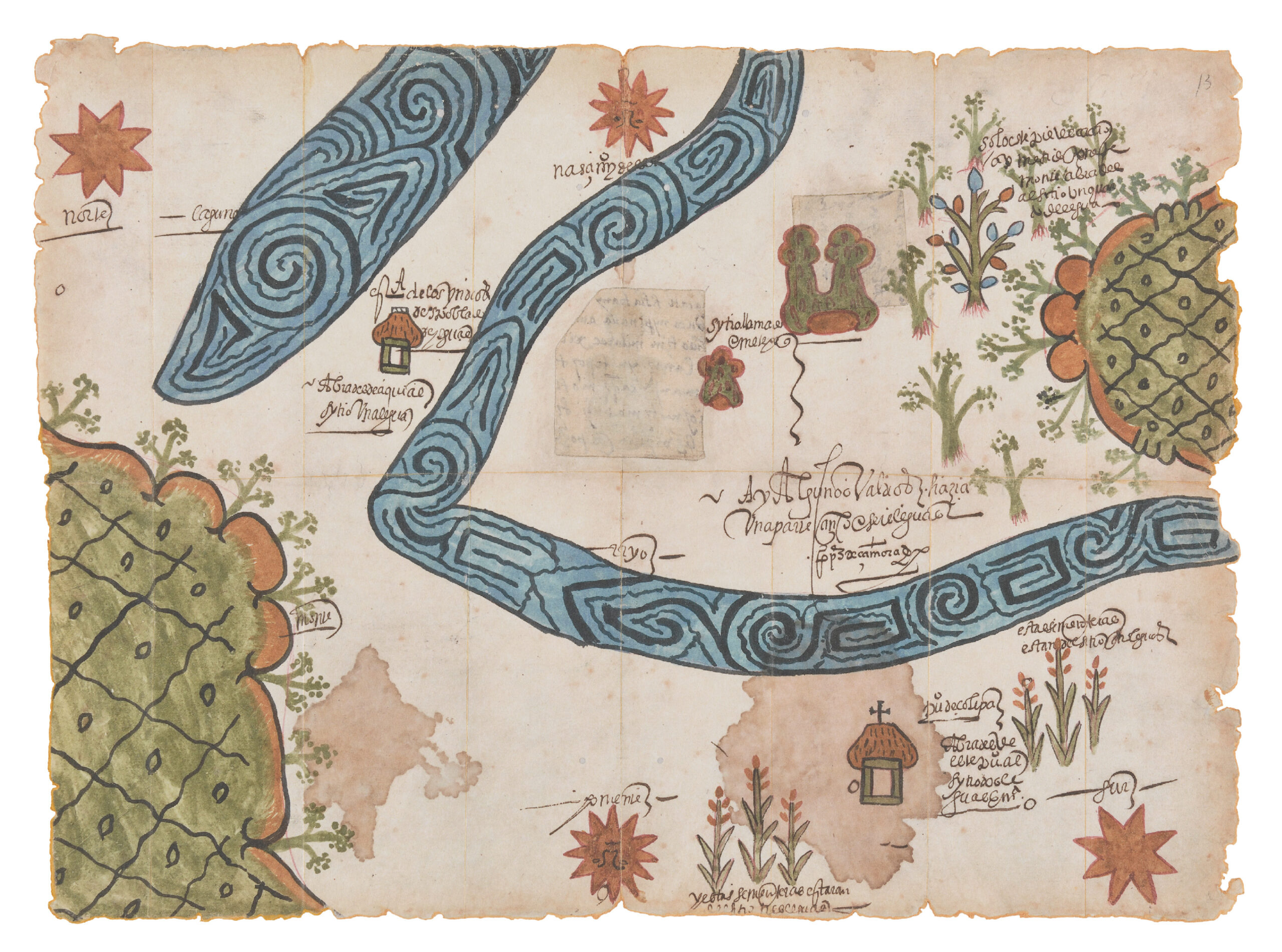
Map of Santiago Atapan, Michoacán, 1728. AGN Mapoteca no. 687. Sun denotes east and star denotes north. Roads with mojoneras (milestones) topped with crosses give distances in leagues to nearby pueblos. ARCHIVO GENERAL DE LA NACIÓN

Because the original maps remain in Mexico, Mexico City-based artist and designer Tlaoli Ramírez Téllez recreated them for LACMA. They are called facsimiles, but that label doesn’t do them justice. Meticulously drawn with acrylic, ink, and watercolor on paper, they replicate the originals’ signs of age in every detail, from water and wine stains to frayed edges, crumbling creases, and revealing palimpsests. These are skillful forgeries of official maps, authenticated with signatures and annotations scrawled by colonial functionaries.

Indigenous communities could and did use the land grant legal system to protect their own interests, sometimes to fight encroachments and dispute water rights with colonial estate holders, as was the purpose behind the map of Santiago Atapan (gorgeously fringed with golden fields), and to secure grants for preexistent pueblos (Museo Amparo). But more often, piece by piece, land grants were the means of transferring Indigenous-held territory into Spanish hands (Rull, 2020, pp. 14, 192).

Hybrid

The mapas de mercedes de tierras (land grant maps) were presented as key evidence in land cases before the viceroyalty courts. Although the legal system was imported, a rich tradition of mapmaking was local. We know from Spanish sources that conquistadors had been given Nahua maps to help them choose where to drop anchor and find their way in unfamiliar territory (Alva, Historia Chichimeca; Mundy, 1998).

02056F

Map of Ahuehuetitlán, Oaxaca, 1616. AGN Mapoteca no. 2056. At the pointing hand symbol it reads: “Here is the site …” ARCHIVO GENERAL DE LA NACIÓN (AGN)

The parties requesting and opposing land grants commissioned Indigenous artists to paint maps, whose great variation in style is attributable in part to the meeting of cultures. Artists raised in Mesoamerican traditions became trained in European techniques, and they integrated these different approaches with unique results (Hidalgo, 2019, Ch. 2; Rull, p. 50).

Indeed, the exhibition highlighted the “hybrid nature” of these artistic legal documents that emerged in a time of transformation. As artist Mariana Castillo Deball explains, although land grant maps were meant to serve the Spanish system, “we can still recognize the voice and ways of representing things by the Indigenous painters.”

For example, a 1704 map of San Juan Cuauhtinchan is characterized by rectilinear, church-centered blocks that conformed to the king’s decree to his land surveyors: “Let the city lots be regular from the start, so that once they are marked out the town will appear well ordered; … otherwise order will never be introduced” (A.E.J. Morris, 1994).

Even then, nearly two centuries after the Aztec defeat, the Nahua mapmaker incorporated an expression of defiance in his drawing: overlooking the village, atop a green hill of the Sierra de Amozoc, we see a raptor clutching a fawn in its talons and a snake in its beak. In Nahua iconography eagles symbolize elite warriors, and the captive snake recalls a legend of the founding of Tenochtitlán, the Aztec-Mexica capital—a scene that lives on at the heart of the Mexican flag.

Mexico’s hybrid culture is especially evident in the sixteenth-century Florentine Codex (the exhibition included UCLA’s reproduction). This monumental, illustrated, bilingual (Spanish and Náhuatl) primary source for Mexica history and culture represents the collaboration between a Franciscan friar and a team of Indigenous writers and artists. It is poignant that their work to preserve Nahua collective knowledge was pursued during a horrific epidemic that decimated the native population.

Contemporary Echoes

The second exhibition was LACMA’s companion show, Mixpantli: Contemporary Echoes, where the artworks connected past to present. Dominating the gallery floor was a map by artist Deball that visitors could physically walk upon. Its title, Vista de Ojos (lit., view from eyes), is a term borrowed from a land grant procedure that required visual confirmation by colonial officials of those locally drawn maps discussed above. This government review of the artist’s view of the land—placing in relationship the subduer and subdued—Deball poetically calls a “gaze on top of a gaze.”

Vista De Ojos Kurimanzutto 2014 10 2000x1329

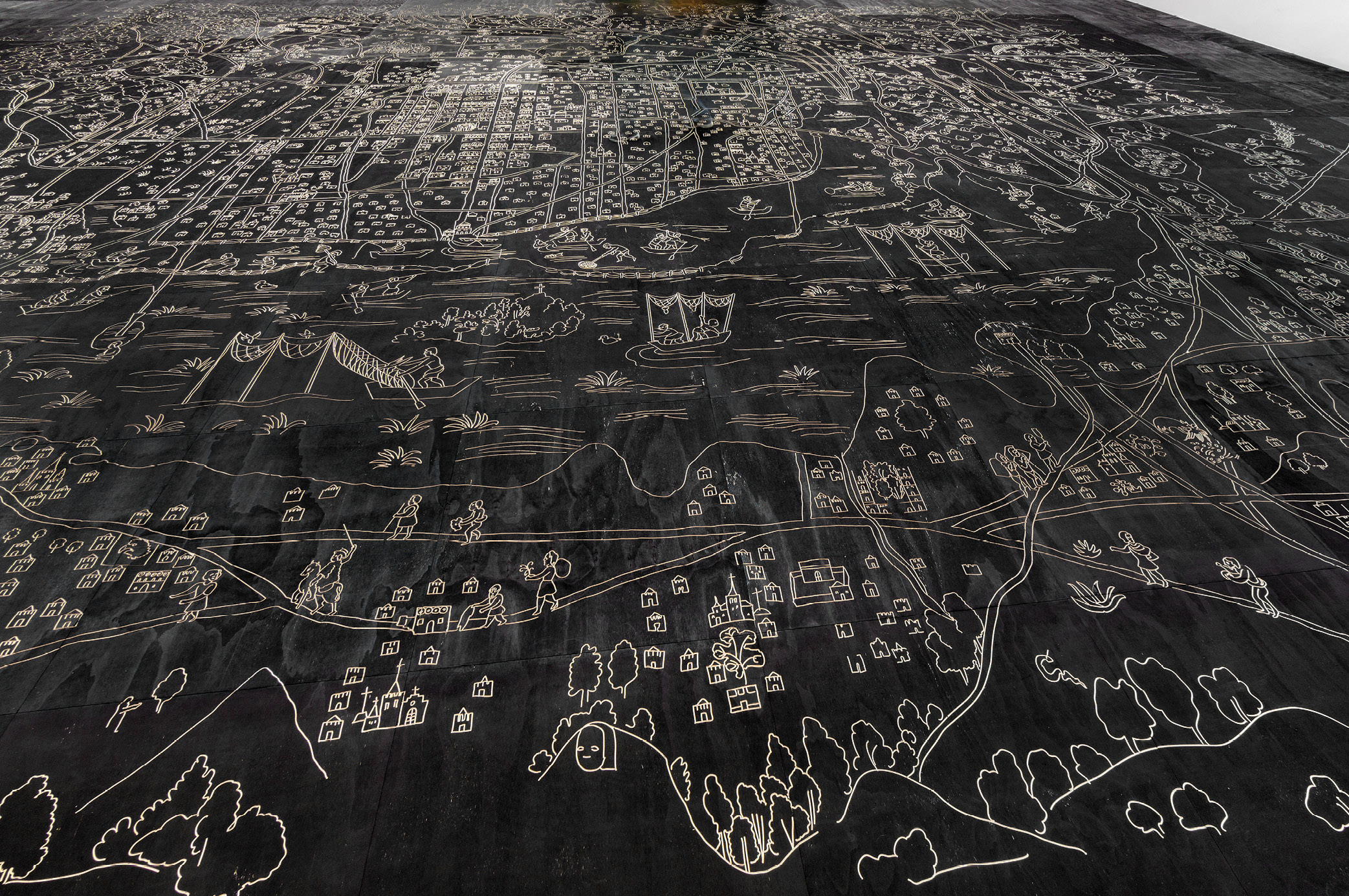
Mariana Castillo Deball. Installation view of Vista de Ojos, 2014. CNC engraved plywood floor. Kurimanzutto, Mexico City. PHOTO BY ESTUDIO MICHEL ZABÉ. Courtesy the artist

Measuring 19 by 13 meters (2,659 square feet), Deball’s incised plywood panel flooring is an enlarged rendition of the historic Santa Cruz Map of Tenochtitlán, by then renamed Mexico City. Produced only three decades after the Conquest, that map shows European-style buildings in place of Aztec temples, and uses animals, stars, and other symbols to identify Mexica place names. Based on what suggests an insider’s familiarity with the city, the mapmaker was likely “an Aztec with European schooling” (Lib. of Congress, CN 2021668313).

Deball, born in Mexico City, writes of the Santa Cruz Map, “On the outskirts one can see the Indigenous settlements and their inhabitants engaging in everyday activities,” such as fishing, canoeing, and bowhunting. She sees in these traditional lifeways a contrast between Indigenous and European maps in outlook and approach, which the other exhibition’s title, “Space, Time,” references. Whereas European maps focus on spatial information frozen in time, Indigenous maps are populated with people and stories, actions we imagine projecting into the past and future. Deball’s walkable installation (in LACMA’s permanent collection) invites visitors to set foot on the map and experience it with more than just a gaze.

Both the Santa Cruz Map and its modern rendering testify to Indigenous continuity, countering the misconception that Conquest meant obliteration. The “myth of native desolation” is what historian Matthew Restall terms the notion that those not readily destroyed through battle or disease soon surrendered their ethnic identities under the weight of Spanish colonizers, culture, and control. On the contrary, Restall elaborates on the resourcefulness of those Indigenous people to survive and adapt, as the maps in these exhibitions bear out.

Maya Blue

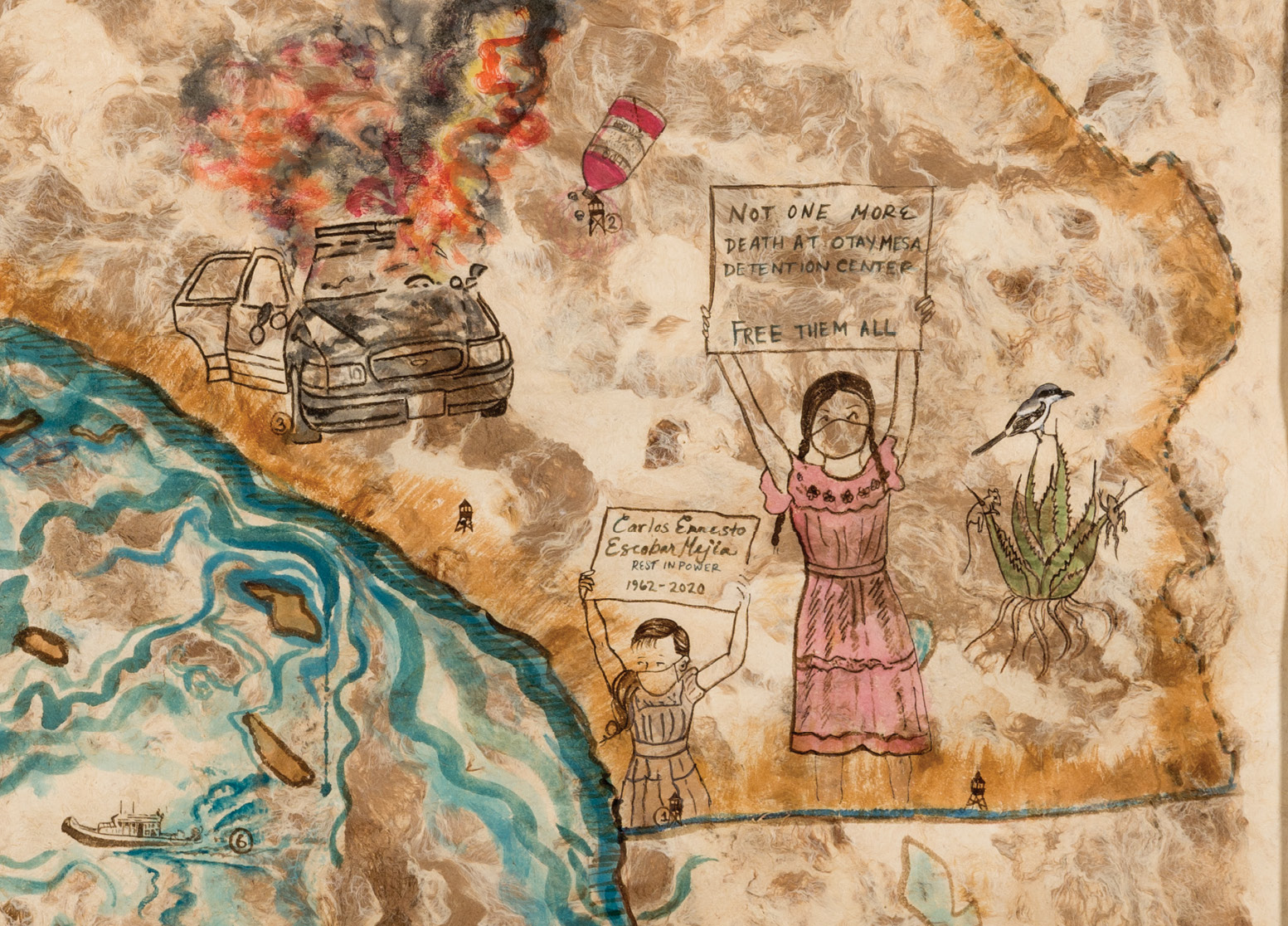
Contemporary Echoes also showcased paintings by Southern California artist Sandy Rodriguez that uncomfortably challenge us to see the through-line from the Spanish invasion to today’s news. Rodriguez describes herself as a Chicana who, owing to her family and proximity to the border, grew up in two worlds. Using amate paper and natural pigments (e.g. indigo leaf extract and clay to form Maya Blue), she draws from the palette and vocabulary of historic maps to link colonialism with national immigration policy.

Detail 1 Sandy Rodriguez Sandy Rodriguez Mapa De Los Senales Y Pronosticos  I.C.E. Raids De Califas 2018 400x226

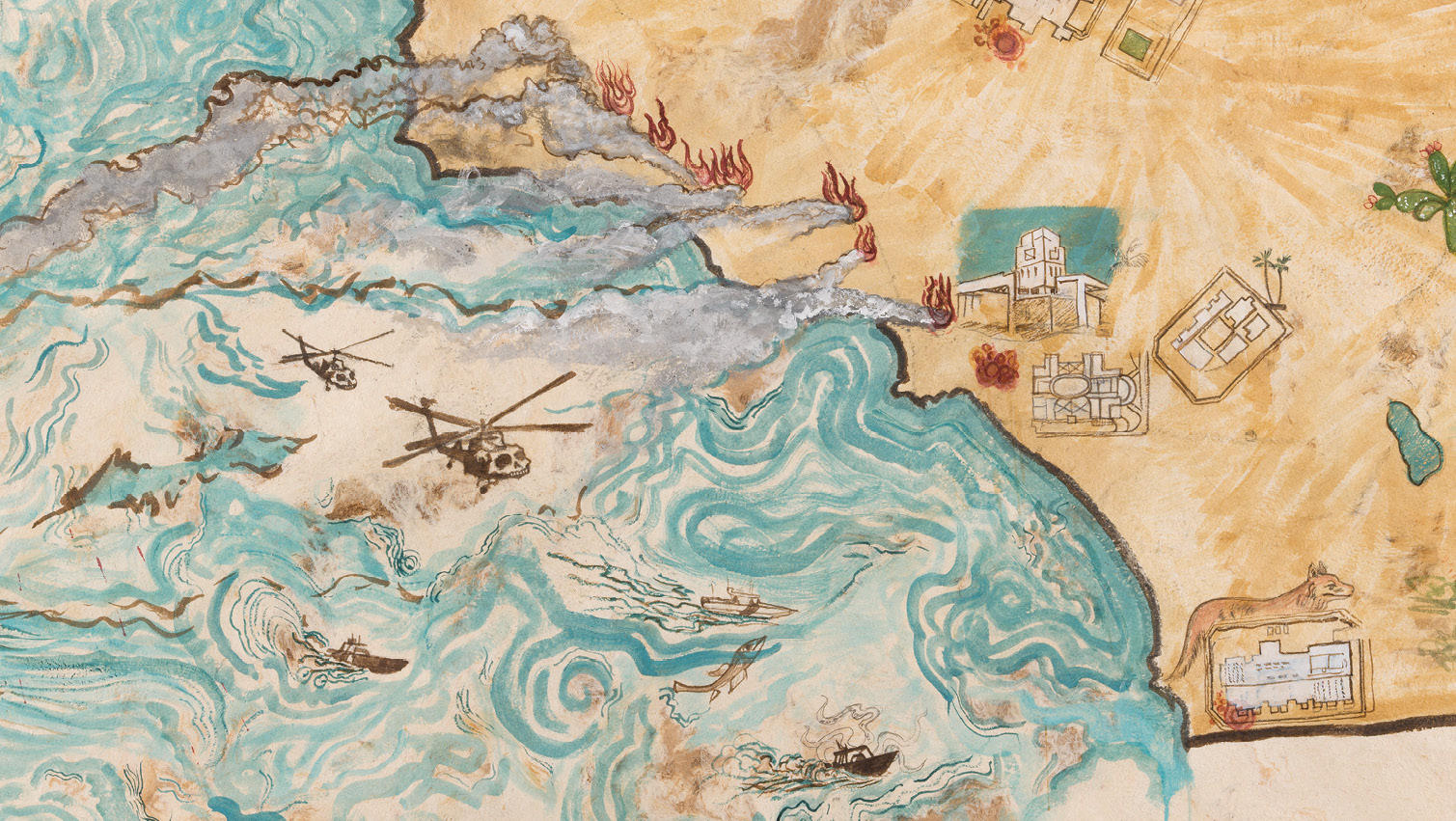
Sandy Rodriguez. Detail from De las Señales y Pronósticos & I.C.E. Raids de Califas, 2018. Hand processed watercolor on amate paper. Crystal Bridges Museum of American Art, Bentonville, AR. COURTESY THE ARTIST

Filled with Mesoamerican iconography, Rodriguez’s works confront the viewer with police violence and the incarceration of Latino immigrants. Her painting, De las Señales y Pronósticos and I.C.E. Raids de Califas (Of the Signs and Prophecies and I.C.E. Raids in California [slang]), presents a map of the state, with satellite views of detention centers plotted onto the desert borderlands. Rodriguez explains that her colors and style reference images of the Conquest in the Florentine Codex, in which Spanish galleons are upgraded to immigration enforcement helicopters sporting the menacing visages of calevaras (skulls).

Códice Maya

Although it’s not a map, the ancient Códice Maya is relevant to the topic of Indigenous culture, and its showing at the hilltop Getty Museum coincided with the third exhibition we will cover. This manuscript on bark paper tracks the movements of the planet Venus—the Morning Star—as recorded by Maya priests around the peak of Maya civilization, 400 years before Spanish contact and centuries before Tenochtitlán existed. On loan from Mexico, the codex employs pictorial symbols and imagery, like a graphic novel, and documents the sophistication of ancient astronomy and the Maya calendar.

Reinventing Americas 0211 400x285

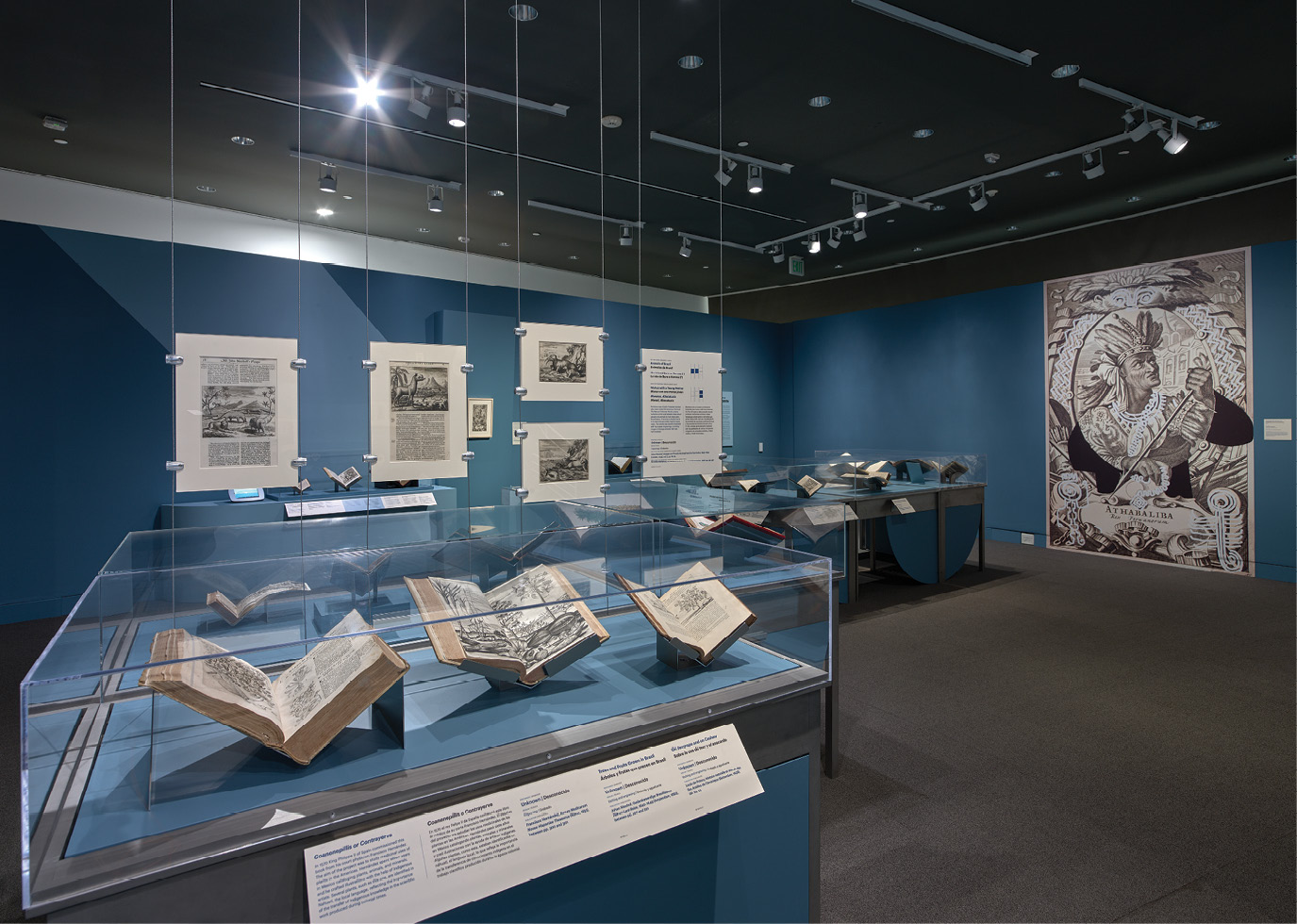
Installation view of Reinventing the Americas: Construct. Erase. Repeat. 2022, at Getty Research Institute. PHOTO BY JOHN KIFFE, © J. PAUL GETTY TRUST

Reinventing the Américas

We conclude with Reinventing the Américas: Construct. Erase. Repeat., at the Getty. There, a fine woodcut map of Tenochtitlán from 1524 displays the mix of styles seen in the Mixpantli exhibition. (See this magazine’s cover image.) Its label pointed out a motif that resembles the Aztec Náhuatl glyph, tepetl, representing a hill or mountain, while, markedly less subtle, this “map of conquest” flaunts the triumphal coat of arms of Charles V, then Holy Roman Emperor and King of Spain.

Detail 2 Sandy Rodriguez Mapa De Califas—Atrocities Isolation And Uprisings 2020 2021 400x287

Sandy Rodriguez. Detail from Mapa de Califas—Atrocities, Isolation and Uprisings, 2021. Hand processed watercolor on amate paper. COURTESY THE ARTIST

This exhibition began with the premise that America is more than a place on a map; it is an idea that, since Columbus, was defined by Europeans. To illustrate, a 1619 map of the Straits of Magellan by Flemish engraver Theodor de Bry features naked native figures as Adam and Eve, representing the New World as Eden, a blank slate waiting to be graced with knowledge and civilization. Such Eurocentric portrayals persisted for centuries, “fueling stereotypes and prejudices” against Indigenous peoples (Getty.edu). The purveyors of this view, it seems, were unacquainted with Maya astronomy.

Reinventing Americas 0351 2000x1026

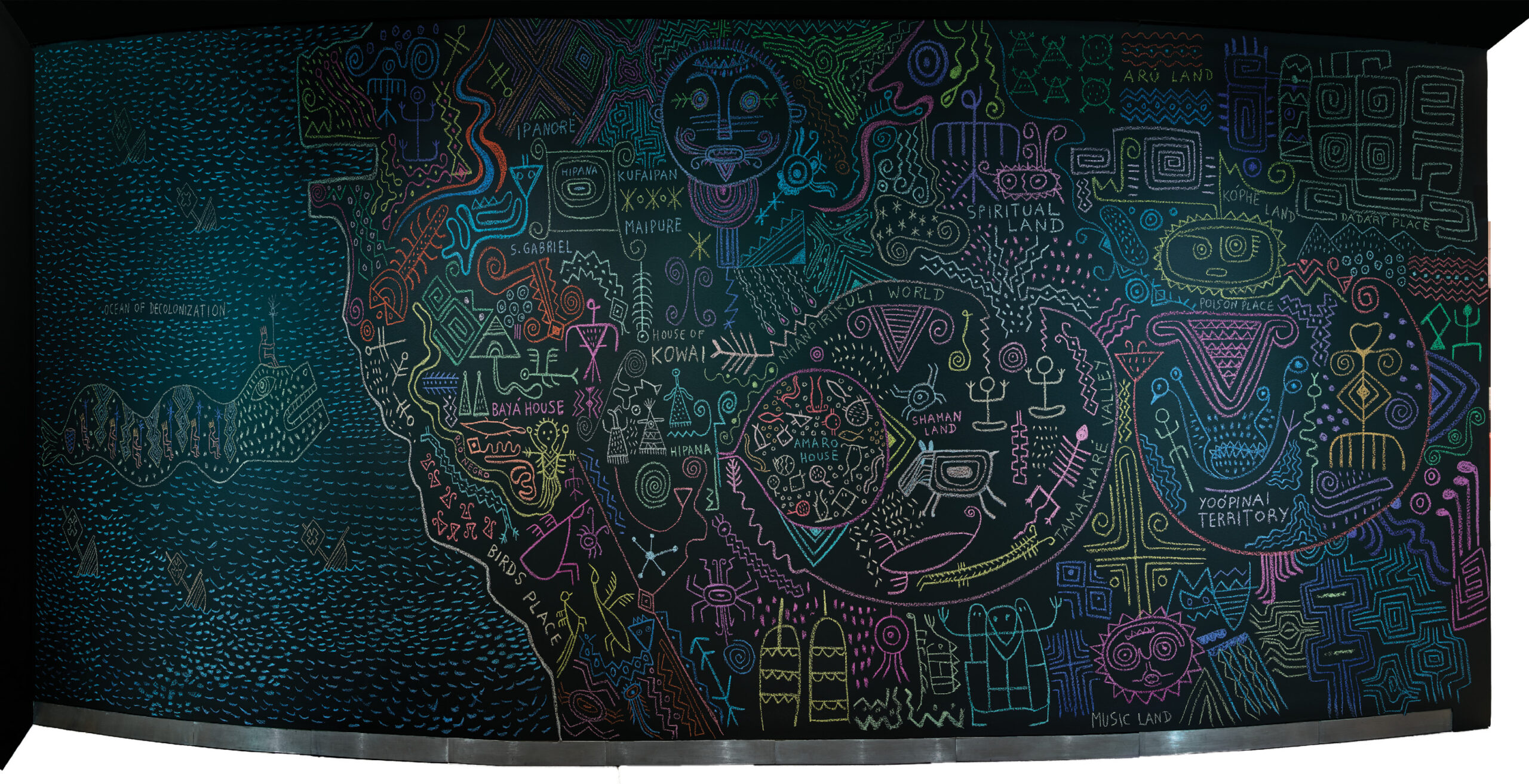
Denilson Baniwa. Untitled, 2022. Chalk mural, at Getty Research Institute. PHOTO BY JOHN KIFFE, © J. PAUL GETTY TRUST

In keeping with the theme of reinvention were contemporary works in a variety of mediums by Indigenous artist Denilson Baniwa. Originally from the Brazilian state of Amazonas, Baniwa describes his work as reflecting on both his home village and the outside world where he now lives and the “frictions that occur when these worlds collide,” including those caused by differing “understandings of the world,” its origins, and our place in it.

The exhibition included his videos, paintings, and “digital interventions”—in which copies of historic depictions of the New World appear altered or defaced. In a piece titled History of Violations, Baniwa blacked out, as if by Sharpie, the European-assigned place names on a renowned 1579 map of the Americas by Abraham Ortelius. And in a wall mural in chalk, Baniwa offered his own map, reclaiming history from an Indigenous point of view, if somewhat cryptically, in the style of ancient petroglyphs.

Contested Lands

Sandy Rodriguez refers to the subject of her map paintings as “contested lands.” One might say that all the maps in these exhibitions, from colonial to modern, in various ways pose the challenge: who belongs here? And just as land is often contested, so is history. Those elegant Spanish land grant maps are inescapably tied to a history of Indigenous communities dispossessed by way of an avaricious legal system. At the same time, because the mapmakers’ skills were highly valued by the conquerors, the maps impart to us a cultural legacy and the human spirit to survive.

EX8900 30

Xiuhtecuhtli, ca. 1250-1521, Mexica. Basalt stone (Ht. 80 cm). Museo Nacional de Antropología, Mexico City. INAH DIGITAL ARCHIVE

Survival was a recurring theme in these exhibitions, culminating in the vibrant expression of Indigenous experience in contemporary art. This theme is palpable in the Florentine Codex: amid staggering death and destruction, its Nahua authors and artists resisted their plight and affirmed their presence on the land. Five hundred years after the Conquest, their prefatory words still hold the power to move us: “We people here ….”

Bibliography

Alex Hidalgo, Trail of Footprints: A History of Indigenous Maps from Viceregal Mexico (Univ. of Texas Press, 2019).
Matthew Restall, Seven Myths of the Spanish Conquest (Oxford Univ. Press, 2021).
Ana Pulido Rull, Mapping Indigenous Land: Native Land Grants in Colonial New Spain (Univ. of Oklahoma Press, 2020).

On View

See related maps, art, and artifacts at these museums:

Latin American and Pre-Hispanic Art Collections at the Getty Center in Los Angeles.

Art of the Ancient Americas Collection at the Los Angeles County Museum of Art. Works by Mariana Castillo Deball and Sandy Rodriguez are in the museum’s permanent collection.

Paintings by Sandy Rodriguez are part of the installation, Borderlands, at the Huntington Library Art Museum in San Marino, CA. Her solo exhibition, Unfolding Histories: 200 Years of Resistance, is at University of California, Santa Barbara until March 3, 2024.

Colonial maps from the 2018 exhibition, In Tlilli, In Tlapalli. Images of the New Land: Indigenous Identity After the Conquest, at Museo Amparo in Puebla, Mexico, can be viewed on the museum’s website.

Indigenous Australian art bridges ancient and modern worlds in Paris exhibition

Indigenous Australian art bridges ancient and modern worlds in Paris exhibition

Indigenous communities around the world are faced with the challenge of preserving and transferring ancestral knowledge. A new exhibition at the Quai Branly Museum in Paris is an example of how indigenous Australian elders are finding innovative ways to protect the bridge between ancient and modern worlds.

Dalisa Pigram, a dancer and co-artistic director of the contemporary Australian dance company Marrugeku, has been invited to present a series of recitals as part of the “Songlines: Tracking the Seven Sisters” exhibition.

Her piece “Gudirr Gudirr” takes its name from the warning cry of the guwayi shorebird from Western Australia.

“Watch out,” it cries. “The tide is coming in, you might drown!” It could be interpreted as a universal alarm bell for society in general, but in particular for young indigenous people.

Pigram, who belongs to the Yawuru/Bardi people of Western Australia, created “Gudirr Gudirr” with the Belgian choreographer Koen Augustijnen ten years ago. It was a way to address the past and the present with all their contradictions, pain, anger, frustration and joy.

Using dance, video, music and text, Pigram explores the fallout of colonialism and the trauma of younger generations, lost between cultures. She broaches the topic of young people fighting each other for kicks, and the record high child suicides in the Kimberley region of Western Australia.

Even after several world tours, the urgency of the message has not changed.

The movements are robotic, hypnotic, blending martial arts with aerial acrobatics. The music is modern, punchy rock, sometimes with lyrics in Pigram’s native tongue.

She whirls around the stage using a fishing net suspended from the ceiling. It is an important symbol, representing both friend and foe. While it is a tool for survival to find food, it is also a trap.

“Dalisa told me a lot of stories,” Augustijnen told RFI, referring to their chance encounter many years ago. “Then she asked me to give her some ‘tasks’ or themes to prepare for the dance. This was new way of working for me.”

The cross-cultural partnership has enriched both their experiences on and off the stage, with Augustijnen hailing the recital’s ability to recount important historical events from a physical perspective.

“Our truth-telling hasn’t begun yet, telling both sides of the historical story,” Pigram told RFI after her performance on Thursday, adding she was thrilled to be part of the “Songlines” exhibition.

“The youth are still struggling with their place in the world and their connection to culture, their connection to who they are. Also the country is at risk every single day with the different policies, mining and loss of language, loss of elders and all of that. In the last ten years, nothing has changed,” she laments.

Decolonising minds

Born in the pearl industry town of Broome, Pigram recognises the wealth of her own mixed Asian and indigenous cultural heritage, and her attachment to the stories and traditions passed down from her elders.

“I can see people [in the audience] processing it. They ask me, ‘how did you manage to say all those hard things in a dance?’ They are surprised that dance and theatre has the ability to address complex issues.”

She says her piece poses questions: “How can we decolonise indigenous minds? Can the past hold keys to the future? And who will pass on that knowledge?”

This question of transfer is raised in the rest of the “Songlines” exhibition.

Passed down through the generations for thousands of years, these oral guidelines continue to provide a spiritual and practical map for the people of today.

They explain moral principles, rules of society, how to care for nature, and essential knowledge for survival in the desert.

The Quai Branly exhibition introduces one of the major pillars of the First Australians’ creation legends, known as the Seven Sisters songline.

An evil sorcerer is threatening the lives of seven sisters, who flee into the desert. Pursued relentlessly through what may seem an inhospitable environment, the women learn to survive thanks to their knowledge of the terrain and of nature, guided by the songlines. 

Their story, presented visually, takes place across three of the continent’s vast central and western deserts and provides the backbone of the exhibition.

Fragmented knowledge

The museum has gone to great lengths to present a fully immersive experience with nearly 200 works, including 20 multimedia pieces, on display in partnership with the National Museum of Australia.

Curator Margo Neale says that the process of gathering material began in 2010, with the close collaboration with a group of elders from the Aṉangu Pitjantjatjara Yankunytjatjara lands in central Australia and the Ngaanyatjarra and Martu in the West.

They expressed concern that many of their descendants no longer have a meaningful connection to their ancestral lands, nor do they have access to the language. The project provided a vehicle to preserve this fragmented knowledge before it was too late.

Recognising the fact that the digital age has changed the way people consume culture and knowledge, there has been a push to make the presentation as interactive as possible.

By following the lines on the ground of the gallery, visitors can listen to the songs and testimonies of the Aboriginal artists and elders as if they were standing there in person. The videos are part of what Neale calls “a living library”, assuring that the elders’ knowledge does not die out with them.

“They said to themselves that they too had to record their knowledge in digital form if they wanted to maintain a link with the younger generations,” she writes in the exhibition notes.

‘Everything is alive’

The landscape is described in extraordinary colourful dots, lines, shapes and patterns, all holding their own significance. Each artist has the responsibility to recount the legend, leaning on the ancestral knowledge passed down to them.

“For Aboriginal peoples,” Neale explains, “country is a multidimensional concept that includes everything. There is no distinction between animate and inanimate worlds.

“Everything is alive, everything has its place: people, animals, plants, earth, water and air.”

“Songlines: Tracking the Seven Sisters” is at the Quai Branly Museum in Paris until 2 July

Construction begins on a new home for Portland’s Artists Repertory Theatre

Construction begins on a new home for Portland’s Artists Repertory Theatre
A rendering of the exterior of Artists Repertory Theatre's new building. The building will serve as ART's new home beginning 2024.

A rendering of the exterior of Artists Repertory Theatre’s new building. The building will serve as ART’s new home beginning 2024.

Courtesy LEVER Architecture

Since its founding in 1982, performing arts company Artists Repertory Theatre has played a big part in highlighting theatrical productions by artists from underrepresented communities, such as Larissa FastHorse and her current Broadway hit “The Thanksgiving Play” and Hansol Jung’s “Wolf Play.”

THANKS TO OUR SPONSOR:

But over the last few years, due to construction delays caused by the COVID-19 pandemic, ART hasn’t had a home base to showcase the company’s work.

That’s all about to change.

Officials at ART announced in April that the company moved into the second phase of a $30 million building project that will house all of its future productions.

Through a rigorous funding campaign, ART Executive Director J.S. May said they raised $24.5 million as of April.

Construction crews broke ground for the project in 2019 at 1515 SW Morrison Street, just a few blocks from Providence Park.

As part of the first phase, crews tore down the Alder Street side of the old building to make way for the 21-story Alta ART Tower. They also reinforced the Morrison Street side of the building, stripped the interior and added seismic safety-upgrades.

Phase two currently consists of constructing a new lobby, which will initially serve as the performance space, and two additional theaters including a 178-seat main stage and 99-seat studio theater.

The inside of the lobby area of Artists Repertory Theatre's new building under construction. ART is in the middle of constructing a brand new building to house their future performances.

The inside of the lobby area of Artists Repertory Theatre’s new building under construction. ART is in the middle of constructing a brand new building to house their future performances.

Courtesy Howard S Wright Construction

Since 1997, ART has operated out of the same building on SW Morrison Street and bought the entire block from 15th to 16th avenues in 2004. But years of wear and tear finally caught up to the building, including leaky roofs and walls that were not up to seismic standards.

In 2018, ART received an anonymous donation of $7.5 million to do what they wished.

ART used the money to pay off the company’s debts and started planning for the new building.

THANKS TO OUR SPONSOR:

ART at the time was real estate rich, but cash poor, May said. So in 2019, they sold the north half of the block to development firm Wood Partners, who built Alta ART Tower.

“And that became the lead investment for redoing our half of the building,” May said.

May said he’s excited about finally having a building that meets the high standards of the productions ART has been known to have.

“ART has both a local and a national reputation of doing really high quality work that impacts the theater, and our building hasn’t supported that kind of process,” May said. “So this gives us the opportunity to have a facility that at least aspires to be as good as the work.”

Jeanette Harrison joined ART in 2022 as its first Indigenous Artistic Director and echoes May’s enthusiasm for a new building.

“I think our artists are just really feeling the hurt of isolation for so long. It’s been hard and it’s been exhausting and arts leaders are exhausted. Portland is really a first class art city, and this building is going to help us knit our community back together again,” she said.

While the new building is being constructed, ART is still putting on productions for the upcoming season.

Harrison said that ART will continue to put on productions through partnerships with other theater companies like Portland Center Stage and the University of Portland.

“One of the great things for Artists Rep from this partnership is not just the intergenerational theatre making, but also the fact that University of Portland is opening up some of their resources to us,” she said.

The 2023-24 season opens with the play “Pueblo Revolt” by Indigenous playwright Dillon Chitto. The comedy play follows two Indigenous brothers who live in 1860 New Mexico and plan a revolt against their Spanish colonizers. The play runs from Sept. 18 to Oct. 15.

“It is going to be performed and produced in partnership with the Native Arts and Cultures Foundation. So that play will be performing in what used to be the Yale Union Building,” Harrison said.

Harrison admits that navigating both the construction of the new building and the new season has been a challenge, but she relishes the opportunity to showcase new productions in interesting ways.

“We’re gonna go out into the community and we’re gonna be producing work all over Portland in the hopes that we’ll be building our audience back, and then we’ll be able to invite people to come back into our building and into our neighborhood when we’re ready,” she said.

May hopes the new building will inspire people to come back to ART and enjoy their new offerings of productions that challenge how we view the world.

“Creativity is a fundamental human impulse that helps define who we are,” he said. “What we want is for people to come to this building and get insight into what’s going on in the planet and how they can personally understand it better.”

THANKS TO OUR SPONSOR:

Essential Highlights Of International Women Artists’ Art Week

Essential Highlights Of International Women Artists’ Art Week

For one week every June, art galleries and institutions around the world commit to showing only female artists, with many offering special talks and events. Women Artists’ Art Week (WAAW) was co-founded in 2022 in London by artist Annya Sand and art patron Catherine Hunt as a not for profit initiative to encourage the art industry to be more inclusive towards female artists and to address the imbalance of representation of female artists. From London, the annual event has gathered momentum, showing there is clearly a need for an annual event to highlight female artists.

ADVERTISEMENT

This year’s event runs until 15 June, with 44 galleries in the U.K involved. WAAW has expanded quickly since launching and this year, seven overseas galleries are participating including the Rangi Gallery in Tanzania, the Leila Heller Gallery in the USA, three galleries in China, one in Uzbekistan and one in Singapore. A map on the WAAW website shows artlovers all of this year’s participating galleries and their exhibitions and events. It’s also useful for women artists to see which galleries are perhaps more encouraging of women artists.

Among the highlights of the female art shows this week in London is a tour on 14 June at 5pm of the Victoria & Albert Museum’s new Parasol Foundation for Women in Photography. The new gallery emphasises the museum’s commitment to supporting female practitioners and championing contemporary photography, through a dynamic series of events and exhibitions.

ADVERTISEMENT

Bowman Sculpture and Guerin Projects is presenting The Power of She – A Tribute to Women in the Arts (until 24 June), a group exhibition featuring 15 of the most important 18th and 19th century, Modern and Contemporary women artists. including: Camille Claudel, Elizabeth Frink and Barbara Hepworth, juxtaposed with leading contemporary artists Emily Young, Lily Lewis and Pauline Amos. A highlight is works by 19th-century artist Camille Claudel, who, while until recently was perhaps best known for her tragic love affair with Rodin, now has her own museum, the Camille Claudel Museum in Nogent-sur- Seine. Claudel is shown alongside one of the most striking pieces in the show, a beautiful sculpture by Emily Young, The Skies Daughter, carved from a piece of Lapis Lazuli mined in a high mountainous region of North Eastern Afghanistan. As a special event during the exhibition, at 4 pm on Monday 12 June, Prima Ballerina of the English National Ballet, Natascha Mair will perform The Dying Swan, accompanied by Austrian violinist and composer Yuri Revich, as well as a talk by New York gallerist, Hong Gyu Shin, on Carla Prina and Else-Fischer-Hansen, two 20th-century female artists, whose works feature in the exhibition.

ADVERTISEMENT

Another fantastic exhibition during WAAW is Tangle Teaser by Sarabande Foundation, established by Lee Alexander McQueen. The exhibition at the north London gallery, explores how artists use hair to examine themes of lineage, conditions, tradition, gender, sexuality, politics and liberation. Artists in the exhibition work in a variety of media including photography, sculpture, textiles, painting and performance.

JD Malat Gallery have an Artist Q&A 10 June, at 3pm by French-Vietnamese artist Sophie-Yen Bretez and the Gallery Director about Sophie’s painting show Powerful, despite it all (until 8 July 2023). The artist’s vibrant surrealist paintings elicit questions on self-expression and the social conformities imposed on women.

ADVERTISEMENT

Further afield, Leila Heller gallery in Dubai is showing Beirut based multimedia artist Katya A.Traboulsi’s solo show Perpetual Identities until 1 September. Katya’s show is based on the empty sleeve of a mortar shell that she received for her birthday in 1975. The object, which had blindly sown death where it fell, ended up in her room, raised to the status of a trophy celebrating the courage of fighters or the defeat of enemies. Her later reflections on the mortar shell inspired an installation project Perpetual Identities which sought to divert the weapon from its morbid destiny and make it serve Life. Forty six shells are on display from different countries, each one handmade, using different materials, including ceramics, porcelain, resin, wood, and iron. Each is titled with a country’s name; most are produced by their native artisans. The shell becomes like a ‘book’, an inventory of myths and traditions. The many cultures and societies involved in the project enrich the object with seemingly infinite meanings.

WAAW World has set its sights on helping the public to see and appreciate the art created by female artists that we have been missing for centuries. They’re also keen to show commercial galleries the talent of female artists and their commercial potential.