Native

Hot Lots: 5 Works That Shattered Expectations During New York’s 2023 Spring Sales

Hot Lots: 5 Works That Shattered Expectations During New York’s 2023 Spring Sales

While the mood this auction season was mixed, and overall sales volume tepid at best, there were nonetheless standouts throughout the auction calendar. Amid last-minute withdrawals and passed lots were works that defied assumptions—and an otherwise dreary market climate—particularly for market professionals ready to look outside of the primetime events.

We combed through hundreds of offerings from this season’s day sales at Christie’s, Sotheby’s, and Phillips in New York to bring you a range of hot lots.

Lynne Drexler (1928-1999)

Summer Blossom (1962)

Lynne Drexler, Summer Blossom (1962). Courtesy of Christie's Images, Ltd.

Lynne Drexler, Summer Blossom (1962). Courtesy of Christie’s Images, Ltd.

Auction: Christie’s, A Century of Art: The Gerald Fineberg Collection Part II

Estimate: $150,000 to $200,000

Sold for: $1.4 million

One of the last works acquired by Gerald Fineberg, who died in December 2022, this small canvas has a sumptuous palette and tight composition of cascading brushstrokes. The final price represented the second-highest result ever for the reclusive painter, whose oeuvre is being reexamined and whose market has been surging since the pandemic began.

Summer Blossom was the most expensive of the 14 lots by Drexler on the block in New York this month. Two years ago, the painting was included in Explosions of Color | Dimensions of Sound: The Art of Lynne Mapp Drexler at Jody Klotz Fine Art in Abilene, Texas. Printed on the cover of the show’s catalog, it had an asking price of just under $150,000, according to Klotz, who played an important role in Drexler’s recent market resurgence. She paid $75,000 for the artist’s Daffodil Gloucester in May 2021, the highest price for a Drexler piece at auction (it was estimated at $8,000 to $12,000).

Reluctant to sell the best works in her show, Klotz “decided to put prices that were unprecedented,” she said. “I had to scrape and search to make this show.” But she did end up selling the painting to an Italian collector, through a New York art adviser. Fineberg bought it about a year later; the painting was installed in his bathroom to brighten up his final days.

– Katya Kazakina

Fairfield Porter (1907 – 1975)

Girl in a Landscape (1965)

Fairfield Porter, Girl in a Landscape

Fairfield Porter, Girl in a Landscape (1965). Courtesy of Sotheby’s.

Auction: Sotheby’s Contemporary Day Auction, May 19, New York

Estimate: $500,000 to $700,000

Sold for: $2.8 million

The sale of Fairfield Porter’s 1965 painting Girl in a Landscape set a new auction record for the American artist, nearly $1 million higher than the previous high-water mark, set in 2018, according to Artnet Price Database. The work was on the auction block for the first time since it was acquired by the previous owner in 1980. Sotheby’s declined to reveal who the consignor was, merely saying that it was a private corporate collection, but an archival catalog entry found in the Smithsonian Portrait Gallery indicates that the owner was United Missouri Bank of Kansas City.

The market for Porter’s art appears to be steady over the years, with regular sales of his paintings, drawings, and lithographs. But Girl in a Landscape, which depicts the artist’s eldest daughter Katie, outperformed the presale expectations with a price of $2.8 million (including fees), achieving a price four times the high estimate (premium-free).

Charlotte Mitchell, a specialist in Sotheby’s American art department, said the market’s enthusiasm was a response to the quality of the work, which combines “two of Fairfield Porter’s most celebrated motifs—depictions of the Maine landscape and portraits of his family.” Another landscape oil on panel work by Porter, Great Spruce Head, was offered at the same sale. It sold for $279,400, more than double the high estimate excluding fees.

– Vivienne Chow

Jenna Gribbon (b. 1978)

Set List Focus (2020)

Jenna Gribbon, Set List Focus (2020). Image courtesy Christie's.

Jenna Gribbon, Set List Focus (2020). Image courtesy Christie’s.

Auction: Christie’s Postwar & Contemporary Art Day Sale

Estimate: $40,000  to $60,000

Sold for: $403,200

As an admitted fan of Jenna Gribbon, I’ve enjoyed seeing her signature dreamy portraits, which curator and broadcaster Katy Hessel described as “almost electrically-coloured canvases,” everywhere from the Armory Show last fall, to the Frick Madison (as part of the program pairing contemporary works with the collection’s famous Old Masters), and recently as part of the buzzed about “Rear View” show at LGDR’s new Upper East Side mansion gallery space. Gribbon’s work in that show is actually included in a “pendant” presentation in a single room, titled “Full Frontal” that features more explicit works.

So perhaps it’s not entirely surprising that Set List Focus (2020), soared so far above estimate and set a new auction record. It depicts a female musician sitting on the floor of a stage amid a tangle of black wires, set against a day glo pink canvas. She appears focused on a presumably imminent musical performance. The second highest price of $123,400, a third of the current high, was achieved at Christie’s last fall. To date a total of 23 works by Gribbon have come to the auction block.

The painting “vibrated with energy…[and] has everything going for it,” said Kathryn Widing, co-head of the Post-War and contemporary day sale. “Gribbon’s unabashedly daring brushwork, a scene simultaneously familiar and otherworldly, and the pink neon hue of the paint, created a halo around the canvas. It was a painting that I kept coming back to enjoy during our preview.”

—Eileen Kinsella

Jaune Quick-to-See-Smith (b. 1940)

Playground (1987)

imagePlayground (1987). Courtesy of Sotheby’s.” width=”864″ height=”1024″ srcset=”https://www.mecreates.com/story/news/wp-content/uploads/2023/05/Jaune-Quick-to-See-Smith-Playground-864×1024.jpg 864w, https://news.artnet.com/app/news-upload/2023/05/Jaune-Quick-to-See-Smith-Playground-253×300.jpg 253w, https://news.artnet.com/app/news-upload/2023/05/Jaune-Quick-to-See-Smith-Playground-1296×1536.jpg 1296w, https://news.artnet.com/app/news-upload/2023/05/Jaune-Quick-to-See-Smith-Playground-1728×2048.jpg 1728w, https://news.artnet.com/app/news-upload/2023/05/Jaune-Quick-to-See-Smith-Playground-42×50.jpg 42w, https://news.artnet.com/app/news-upload/2023/05/Jaune-Quick-to-See-Smith-Playground-1620×1920.jpg 1620w” sizes=”(max-width: 864px) 100vw, 864px”>

Jaune Quick-to-See Smith, Playground (1987). Courtesy of Sotheby’s.

Auction: Sotheby’s Contemporary Day Auction

Estimate: $100,000–$150,000

Sold for: $546,100

If you suspect that this propulsive result stems from April 2023, when Jaune Quick-to-See-Smith opened the first ever retrospective by a Native American artist at the Whitney Museum of American Art, your hunch is both correct and only one part of the story. Playground is, in fact, the tenth work by the artist to more than triple its high estimate (including fees) at auction since November 1, 2022, according to the Artnet Price Database. It’s also the seventh lot in that same span to sell for a premium-inclusive price of at least $337,500. Not bad for an artist whose auction apex was a mere $8,125 until December 2020.

The excitement around Quick-to-See-Smith’s practice undoubtedly has roots in her Whitney show, but that’s just one manifestation of the art establishment’s larger, late-breaking interest in contemporary artists hailing from Native American, First Nations, and Indigenous communities since roughly 2016. The succeeding years have seen Kwakwaka’wakw Northwest Coast artist Beau Dick’s work curated into Documenta 14 in 2017; Tlingit/Unangax̂ artist Nicholas Galanin featured in the 2019 Whitney Biennial; the Met commissioning murals by Canadian Cree artist Kent Monkman for the walls of its Great Hall that same year; and a selection of these and other Native American and First Nations artists appear in a variety of major art fairs over the past six-plus years, to name just a few examples.

It would be reductive (to say the least) to portray Quick-to-See-Smith’s recent success as strictly part of a macro-level trend. She has shown commercially with New York’s well-respected Garth Greenan Gallery since 2018, cultivated meaningful curatorial relationships for years, and developed a distinctive visual vocabulary with a combination of figuration and abstraction that fits the aesthetics of the moment. Sometimes personal vision, institutional recognition, and a broad shift in taste all coalesce.

—Tim Schneider

Maurice Sievan (b. 1898)

Zoogarluk (1960)

Maurice Sievan, Zoogarluk (1960). Courtesy of Phillips.

Auction: Phillips’s 20th Century and Contemporary Art Day Sale

Estimate: $15,000–$20,000

Sold for: $279,400

Typically, hot lots are associated with young, of-the-moment artists whose market is just beginning to pick up. But that’s not always the case, as proven by the runaway success of Maurice Sievan’s Zoogarluk (1960), which astounded at Phillips’s 20th Century and contemporary day sale when it netted $279,000, about thirteen times its high estimate of $20,000.

Sievan was a Russian painter who died in 1981 at the age of 82. His success came in the 1940’s, when he painted landscapes of the American suburbs, earning him the nickname “artist laureate of suburbia.” While his name isn’t often heard anymore, his work is in the permanent collections of the Queens Museum, the Brooklyn Museum, and the Hirshhorn.

What’s interesting about this piece’s success is that it’s a later, more abstract work, while Sievan’s practice is typically associated with a moodier, interpretive canvas. This was the artist’s auction debut. Other paintings of his are estimated to sell for just a few hundred dollars, according to the auction website Invaluable. To add to the mystery, Zoogarluk has no provenance, and was bought straight from the artist’s studio.

—Annie Armstrong

Follow Artnet News on Facebook:
Want to stay ahead of the art world? Subscribe to our newsletter to get the breaking news, eye-opening interviews, and incisive critical takes that drive the conversation forward.

Ground-breaking Native playwright opens new show Thursday

Ground-breaking Native playwright opens new show Thursday

.lee-gift-article .btn {
float: left;
margin-right: 20px;
font-weight: 500;
padding: 8px 20px 8px 15px;
font-size: 16px;
border-radius: 20px;
background-color: var(–lee-blox-masthead-color) !important;
border-color: var(–lee-blox-masthead-color) !important;
}
#lee-gift-btn svg {
height: 22px;
width: 22px;
fill: #fff;
float: left;
margin-right: 10px;
}
.gift-links svg { margin-right: 10px; color: #888; }
.gift-links div { padding: 8px 0; }
.gift-links div:first-child { border-bottom: 1px solid #ddd; margin-top: 5px; }
.gift-links a { color: var(–lee-blox-accent-color); font-weight: 500; cursor: pointer; }
.gift-copy-clip {
display: none;
position: absolute;
background-color: var(–lee-blox-accent-color-secondary);
color: #fff;
padding: 5px 10px;
font-size: 11px;
bottom: 0;
right: 0;
border-radius: 5px;
}
.gift-copy-clip svg { margin-right: 2px; color: #cae5b3; }
@media (max-width: 997px){
.lee-gift-article .btn {
float: none;
margin-left: -10px;
}
}
/*
@media (max-width: 768px){
.lee-gift-article .btn {
margin-left: -25px;
padding: 10px 15px 10px 10px;
font-size: 14px;
}
#lee-gift-btn svg {
height: 20px;
width: 20px;
}
}
*/

Share this article paywall-free.

Larissa FastHorse, the first Native American woman dramatist to have a play produced on Broadway, is premiering a new production Thursday in the Black Hills, with performances continuing through the weekend.


Larissa FastHorse trailer (copy)

Award-winning playwright Larissa FastHorse grew up in South Dakota. Her play “Wicoun” premieres Thursday at Black Hills Playhouse, with more performances scheduled this weekend in Rapid City. FastHorse is the first Native woman dramatist to have a play open on Broadway.


FastHorse’s satire, “The Thanksgiving Play,” opened on Broadway in April. In “The Thanksgiving Play,” four white performers struggle to present a school pageant that is culturally sensitive to Native people — without actually including any Native Americans in the pageant.

Meanwhile, FastHorse’s “Wicoun” is a heartfelt work that explores the strength, beauty, humor and perseverance of the Indigenous culture, language and identity of the Northern Plains. In “Wicoun,” a Lakota teen named Áya and their brother Kȟoškálaka are raising siblings and cousins and dealing with zombies on the prowl, all while trying to graduate from high school.

People are also reading…

After Áya summons a traditional superhero in a moment of bravery, Áya and Kȟoškálaka embark on a journey across the lands of the Oceti Sakowin to find answers in the old stories, within themselves and in the Black Hills.

FastHorse calls “Wicoun” the most meaningful play of her career because it is a chance to work on her Native land in collaboration with her own people, according to a press release announcing the upcoming performances. FastHorse is a member of the Sicangu Lakota Nation. She grew up in Winner and Pierre.

“Growing up as a Lakota woman in South Dakota, I believed that I had to leave to be a professional performing artist,” she said. “That is why doing this production at home is important to me. We are employing so many local Native American artists and production people. We are creating a model for touring both rural and urban tribal centers. We are showing my people as contemporary artists while still using our language and traditional concepts.”

The cast of “Wicoun” features six community actors from the Dakota, Nakota and Lakota tribes, along with two Cornerstone Theater Company ensemble members and dozens of puppets. Performed in Lakota, Dakota and English, the production was designed in collaboration with Oceti Sakowin artists — storyteller, scholar and translator, Jerome Kills Small; sound designer Talon Bazille Ducheneaux; designer Tosa Two Heart; and graffiti muralist Focus. Cornerstone Theater Company also commissioned Lakota recording artist Tiana Spotted Thunder to create a song for the opening and closing of the show.

“Wicoun” is the third in a series of collaborations between Cornerstone Theater Company, FastHorse and Indigenous people. The first production was “Urban Rez,” a story with and about Native people of the Los Angeles Basin. The second production, “Native Nation,” was a collaboration with representatives of more than 20 tribes in and from the Phoenix, Arizona area.

In 2022, FastHorse collaborated with Black Hills Community Theatre as its artist-in-residence. Her comedy, “Average Family,” opened BHCT’s 2022-23 season in Rapid City. The comedy focuses on the Roubidouxes, a typical technology-loving, city-dwelling family who have an Indigenous heritage. When the Roubidouxes are “randomly” chosen to compete on a reality TV show against the Monroes, a rustic working-class family, culture shock ensues.

In conjunction with her long-time director and collaborator, Cornerstone Theater Company’s artistic director Michael John Garcés, FastHorse’s playwriting strives to serve the stories and aspirations of a network of interrelated rural communities. FastHorse and Cornerstone Theater Company have visited cultural centers on eight of South Dakota’s nine reservations, including the Heritage Center at Red Cloud Indian School, the South Dakota Urban Indian Health in Sioux Falls, and the Oglala Lakota Artspace in Kyle.

FastHorse and Cornerstone Theater Company have taught workshops at the Lakota Nation Education Conference, the Cheyenne River Youth Project and the Waterlily Storytelling Institute, and they have led summer camp programs at Milks Camp with Lakota Youth Development, and the Cheyenne River Sioux Tribe Title One Program. Other partners include First Peoples Fund, Racing Magpie, Black Hills Playhouse, Black Hills Community Theatre, the City of Rapid City, Brave Heart Society in Lake Andes, and individual Lakota culture bearers.

‘Wicoun’ show times and locations

“Wicoun” premieres at 2 p.m. Thursday at Black Hills Playhouse in Custer State Park. “Wicoun” is an outdoor theatrical experience that will be performed near Haberman Hall at the Playhouse. Seating is non-ticketed and available on a first come, first served basis; admission is a free-will offering. Audiences are encouraged to bring their own chairs or blankets. The play runs for about 75 minutes.

Rapid City performances of “Wicoun” are scheduled Friday at 6 p.m. at Racing Magpie, 801 St. Andrew St., Saturday at 7 p.m. at Main Street Square, and June 3 at 5 p.m. at Memorial Park Bandshell.

“Wicoun” also will be performed June 5, with shows at 1 p.m. at Red Shirt School in Hermosa and at 7 p.m. at Little Wound School Auditorium. Additional performances are scheduled throughout the state through June 15.

You must be logged in to react.
Click any reaction to login.

#lee-rev-content { margin:0 -5px; }
#lee-rev-content h3 {
font-family: inherit!important;
font-weight: 700!important;
border-left: 8px solid var(–lee-blox-link-color);
text-indent: 7px;
font-size: 24px!important;
line-height: 24px;
}
#lee-rev-content .rc-provider {
font-family: inherit!important;
}
#lee-rev-content h4 {
line-height: 24px!important;
font-family: “serif-ds”,Times,”Times New Roman”,serif!important;
margin-top: 10px!important;
}
@media (max-width: 991px) {
#lee-rev-content h3 {
font-size: 18px!important;
line-height: 18px;
}
}

#pu-email-form-breaking-email-article {
clear: both;

background-color: #fff;

color: #222;

background-position: bottom;
background-repeat: no-repeat;
padding: 15px 0 20px;
margin-bottom: 40px;
border-top: 4px solid rgba(0,0,0,.8);
border-bottom: 1px solid rgba(0,0,0,.2);

display: none;

}
#pu-email-form-breaking-email-article,
#pu-email-form-breaking-email-article p {
font-family: -apple-system, BlinkMacSystemFont, “Segoe UI”, Helvetica, Arial, sans-serif, “Apple Color Emoji”, “Segoe UI Emoji”, “Segoe UI Symbol”;
}
#pu-email-form-breaking-email-article h2 {
font-size: 24px;
margin: 15px 0 5px 0;
font-family: “serif-ds”, Times, “Times New Roman”, serif;
}
#pu-email-form-breaking-email-article .lead {
margin-bottom: 5px;
}
#pu-email-form-breaking-email-article .email-desc {
font-size: 16px;
line-height: 20px;
margin-bottom: 5px;
opacity: 0.7;
}
#pu-email-form-breaking-email-article form {
padding: 10px 30px 5px 30px;
}
#pu-email-form-breaking-email-article .disclaimer {
opacity: 0.5;
margin-bottom: 0;
line-height: 100%;
}
#pu-email-form-breaking-email-article .disclaimer a {
color: #222;
text-decoration: underline;
}
#pu-email-form-breaking-email-article .email-hammer {

border-bottom: 3px solid #222;

opacity: .5;
display: inline-block;
padding: 0 10px 5px 10px;
margin-bottom: -5px;
font-size: 16px;
}
@media (max-width: 991px) {
#pu-email-form-breaking-email-article form {
padding: 10px 0 5px 0;
}
}
.grecaptcha-badge { visibility: hidden; }

Lummi artist puts finishing touches on story pole carving

Lummi artist puts finishing touches on story pole carving

Jason LaClair’s dream is to see Whatcom County filled with Coast Salish art honoring his ancestors and the land they once lived on. The Lummi Nation artist’s latest project — a ceremonial story pole he is carving at Hotel Leo — is one piece in that puzzle.  

When LaClair goes to the downtown hotel to work on the carving, he enters through an unassuming white door off the main lobby. At the center of the room, daylight from Cornwall Avenue streams through a large picture window onto the 25-foot red cedar log, and a fine layer of sawdust coats the floor. Here, LaClair places his hand on the log.  

Then, he prays.  

“It’s alive, you know, and I can’t have any kind of bad energy,” LaClair said. “So if I’m not feeling 100 percent, or angry, I won’t come anywhere near the pole.” 

Since the beginning of May, LaClair has been adding finishing touches to the pole, where members of the public have had a chance to watch his process. The project serves as the centerpiece to “QwotQwem,” an installation honoring local Native and Indigenous artists, presented by Children of the Setting Sun Productions as part of the Downtown Bellingham Partnership’s First Friday Art Walk. “QwotQwem” is the original Lummi word for Whatcom, meaning “noisy waters” in Xwlemi Chosen.  

photo  Jason LaClair chisels the story pole. (Finn Wendt/Cascadia Daily News)  

Much of the initial work on the story pole was done by Samuel Cagey, Jr., a carver and Lummi tribal elder. After that work came to a halt due to health complications from COVID-19, Cagey Jr. knew he wanted LaClair to carry out his vision and finish his story. 

“What we both see in Jason is his love for our stories, his love for the presentation of our Coast Salish stories,” said Darrell Hillaire, executive director of Children of the Setting Sun Productions.  

LaClair has lived in Coast Salish territory his entire life and grew up surrounded by master carvers. His own art, however, has manifested itself through other mediums — until now.  

LaClair began reading books about art at age 9, going on to do formline printmaking for 25 years. He created his first mural in 2020, but things really took off in September 2022, when he partnered with local artist Gretchen Leggitt to create the 750-foot “Salmon Run” mural for the City of Bellingham on North Forest Street. Now, his work can be seen around the city at the waterfront pump track, Bellingham Public Library and many other locations.  

photo  “Honoring the Salish Sea,” a collaborative project of Jason LaClair and three other artists, hangs from the Boardmill building. (Finn Wendt/Cascadia Daily News)  

The story pole — LaClair’s first-ever carving project — brings a new sense of weight to his work. 

“Samuel is one of our spiritual leaders, so seeing something like this through is huge for him,” LaClair said of his predecessor.  

Carvings on the pole reflect a connection with and respect for Mother Nature and all of her beings, LaClair said. From the bottom to the top of the log, Cagey Jr. carved a mermaid, serpent, birdman, wolf, bear, whale and eagle — each symbolizing different values.  

“It tells a story,” LaClair said. “It reminds us to pay attention to things going on around us, to be leaders and follow our hearts and to be respectful.” 

photo  Jason LaClair examines his first carving project, which he is finishing for Samuel Cagey, Jr., a carver and Lummi tribal elder. (Finn Wendt/Cascadia Daily News)  

LaClair said when he took over the project, Cagey Jr. had already brought it nearly to the finish line. His next steps were to begin sanding the carving and chiseling away any rot from the bottom of the log. In the coming weeks, he’ll consult with Cagey Jr. to draw designs on the log, paint it and seal it, likely finishing by later in the summer.  

While this work offers an opportunity to complete Cagey Jr.’s artistic vision, it’s also an opportunity to share their vision with others. For Hillaire, the story pole and accompanying Indigenous art at Hotel Leo fit perfectly with Children of the Setting Sun Productions’ mission to create, share and educate.  

“It really is the beginning of a dream to perhaps do an art gallery,” he said. “This opportunity for experiential learning is right there.” 

Last week, three different classes from local elementary schools came to watch LaClair in action, learning the story of the ceremonial carving and helping out with their own small pieces of sandpaper.  

That kind of learning, Hillaire said, touches people’s hearts, not just their minds. 

“It’s transformative, rather than just transactional,” Hillaire said.  

As LaClair looks ahead to the carving’s anticipated completion, he’s excited for it to be a starting point for telling the stories of the Coast Salish people. 

“People get to walk by and see it,” he said. “It connects us to our community. Sharing our culture and our art and our history, and being open about it, gives us a deeper connection to everybody around us.” 

photo  “Salmon Run” by Jason LaClair and Gretchen Leggitt lines 750 feet of wall space along Forest Street. (Finn Wendt/Cascadia Daily News)  

Those interested in seeing the story pole and accompanying art at the Hotel Leo can do so at the Downtown Bellingham Partnership’s First Friday Art Walk from 6–10 p.m. on Friday, June 2. Info: downtownbellingham.com/first-fridays.  

12 Things To Do Around DC This Memorial Day Weekend

12 Things To Do Around DC This Memorial Day Weekend
image

This website uses cookies so that we can provide you with the best user experience possible. Cookie information is stored in your browser and performs functions such as recognising you when you return to our website and helping our team to understand which sections of the website you find most interesting and useful.

Bunnell Street Arts Center’s collaboration with Alaska Native artists begins yearlong tour

Bunnell Street Arts Center’s collaboration with Alaska Native artists begins yearlong tour

Homer’s Bunnell Street Arts Center opened a national tour, “Protection: Adaptation and Resistance,” at the Native Arts and Cultures Foundation in Portland, Oregon, on Friday, May 19.

Several participating artists from Alaska joined curator Asia Freeman for the opening event. Artists visiting Portland included Lily Hope, Dimi Macheras, Holly Nordlum, Linda Starbard, Katelyn Stiles, Elli Tansy and Amber Webb. There are a total of 52 artists in the show.

Event details on the Native Arts and Cultures Foundation website provides more information on the attending artists. Lily Hope was born and raised in Juneau. She is Tlingit Indian, of the Raven moiety. Following her matrilineal line, she’s of her grandmother’s clan, the T’akdeintaan. Lily’s contemporary works in textile and paper collage weave together Ravenstail and Chilkat design. She is one of few designers of dancing blankets. She teaches both finger-twined styles extensively in person (and virtually since COVID-19), in the Yukon Territory, down the coast of Southeast Alaska, into Washington and Oregon.

Ahtna artist Dimi Macheras was raised in the Chickaloon Village Tribe, east of Anchorage. He wrote and illustrated the graphic novel and Alaska adventure series “Chickaloonies” in collaboration with Casey Silver. The graphic novel series is based on traditional Ahtna stories and mythology.

Yup’ik artist Amber Web is from Dillingham and was slated to lead a workshop on hood-making. In 2018, she was awarded a Rasmuson Foundation Individual Project Award for a 12-foot qaspeq to honor Missing and Murdered Indigenous Women (MMIW). The hooded garment was adorned with portraits of over 200 MMIW.

Katelyn Stiles from Sitka is an artist, scholar and PhD candidate in Native American and Indigenous Studies at the University of California, Davis. She studies herring relatives and interconnected ecosystems.

Holly Mititquq Nordlum will share her ongoing work to revitalize and document the tradition of Inuit tattoos in her Tupik Mi project with support from an Art Matters grant and a Humanities Forum grant.

Protection: Adaptation and Resistance will remain in Portland through the summer and then the exhibit will travel to Tulsa Living Arts in Tulsa, Oklahoma, in the fall; the International Folk Art Museum in Santa Fe, New Mexico, in the winter; and will conclude at the Alaska State Museum in Juneau from May until early October 2024.

Between the fall of 2019 and the winter of 2021-2022, Bunnell presented five workshops and four mentorships for Indigenous artist-mentors and learners. The projects included Herring Protector dance robes, cedar bark hats, birch bark baskets, seal oil stone lamps and graphic design.

The workshops and crafts created within them were supported by CARES funds through the Alaska Community Foundation and by the CIRI Foundation.

Native American market in Cedar City invites public to learn about culture

Native American market in Cedar City invites public to learn about culture

CEDAR CITY — As the season of outdoor farmer’s markets heats up in Southern Utah, Cedar City News recently stopped by one of the newer markets in town.

An artist shows her eagle design at the Native Goods Marketplace in Cedar City, Utah on Friday, April 28, 2023 | Photo by Haven Scott, St. George News

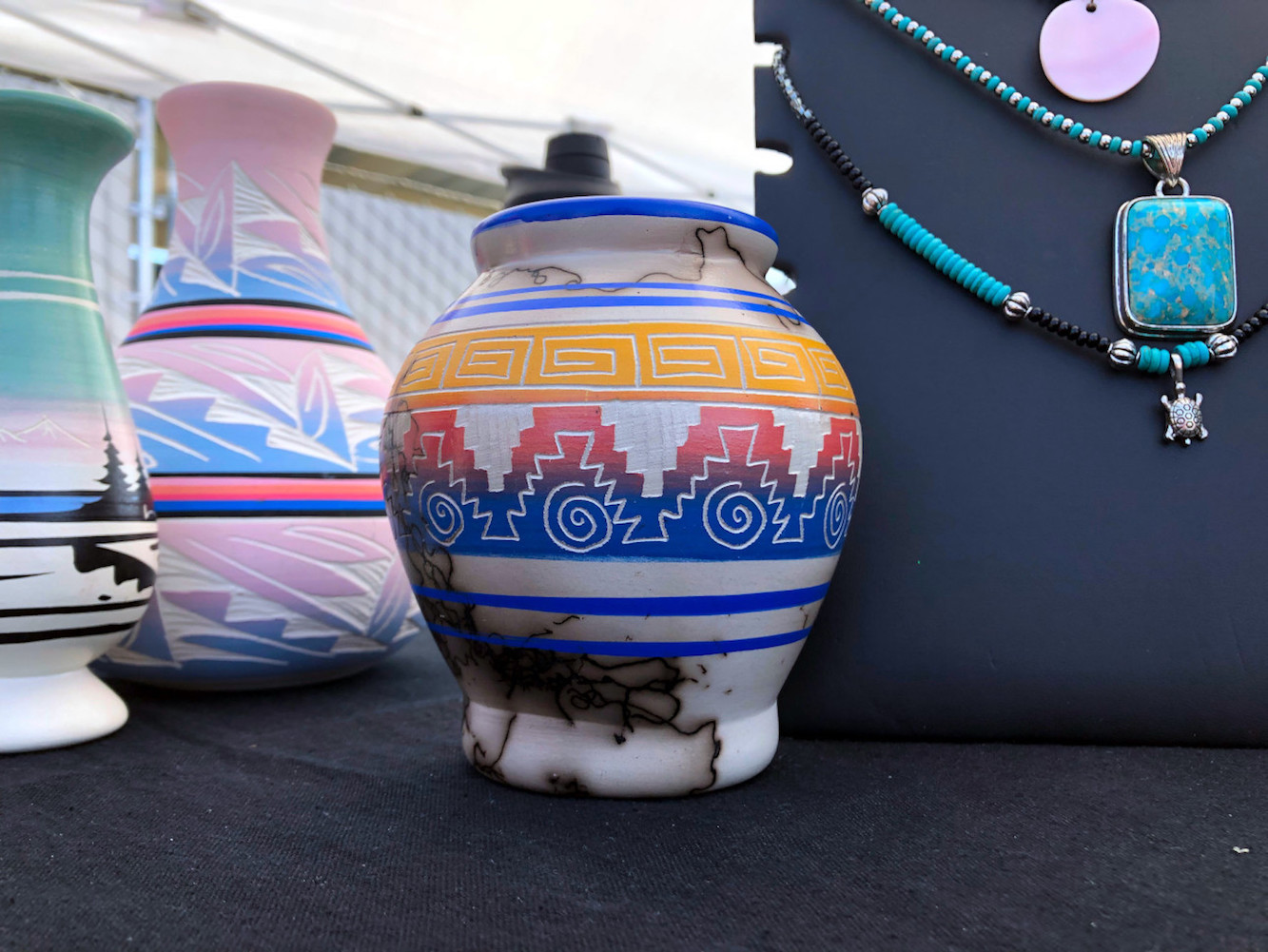
The Native Goods Marketplace, held on the grounds of the Utah Paiute Tribal Housing Authority, is a once-a-month opportunity to shop for locally produced Native American gifts and delicacies.

Jamee Vargas, resident opportunity and self-sufficiency, or ROSS coordinator at the tribal housing authority, said the market is showing success to start their second year. Native Americans can display their wares with no fee for booth rental, she added. A limited number of non-Native American vendors are also allowed each week.

“The marketplace gives the tribal members a chance to market their handmade goods and food,” Vargas said. “We have lots of jewelry, some baked goods, Indian tacos, lumpia — a variety of things.”

April Jimenez, who works with the housing authority human resources, said another goal of ROSS program events is to aid in the preservation of local culture, art, language and history.

“The marketplace also provides Southern Utah residents a chance to talk to the artists, ask about the products they make and experience the culture,” she said.

The housing authority’s ROSS program is funded by the United States Department of Housing and Urban Development.

Items on display at the Native Goods Marketplace in Cedar City, Utah on Friday, April 28, 2023 | Photo by Haven Scott, St. George News

And according to the department’s website, ROSS funds are awarded to successful grant applicants who design a well-planned program for public housing residents to provide supportive services, resident empowerment activities and tools to promote economic self-sufficiency.

“This program works to promote the development of local strategies to coordinate the use of assistance under the public housing program with public and private resources, for supportive services and resident empowerment activities,” the government website states.

The Paiute Indian Tribe of Utah, consisting of five bands — Cedar, Indian Peaks, Kanosh, Koosharem and Shivwits — was without government aid for more than a quarter century.

In 1954, the U.S. Congress passed the Termination of Federal Supervision over the Paiute Indians of Utah, Title 25, Sections 741–60.

As with similar tribal agreements during the time, the act provided for “termination of federal assistance and distribution of tribal lands to individuals or tribally organized entities,” according to the now revoked legislation.

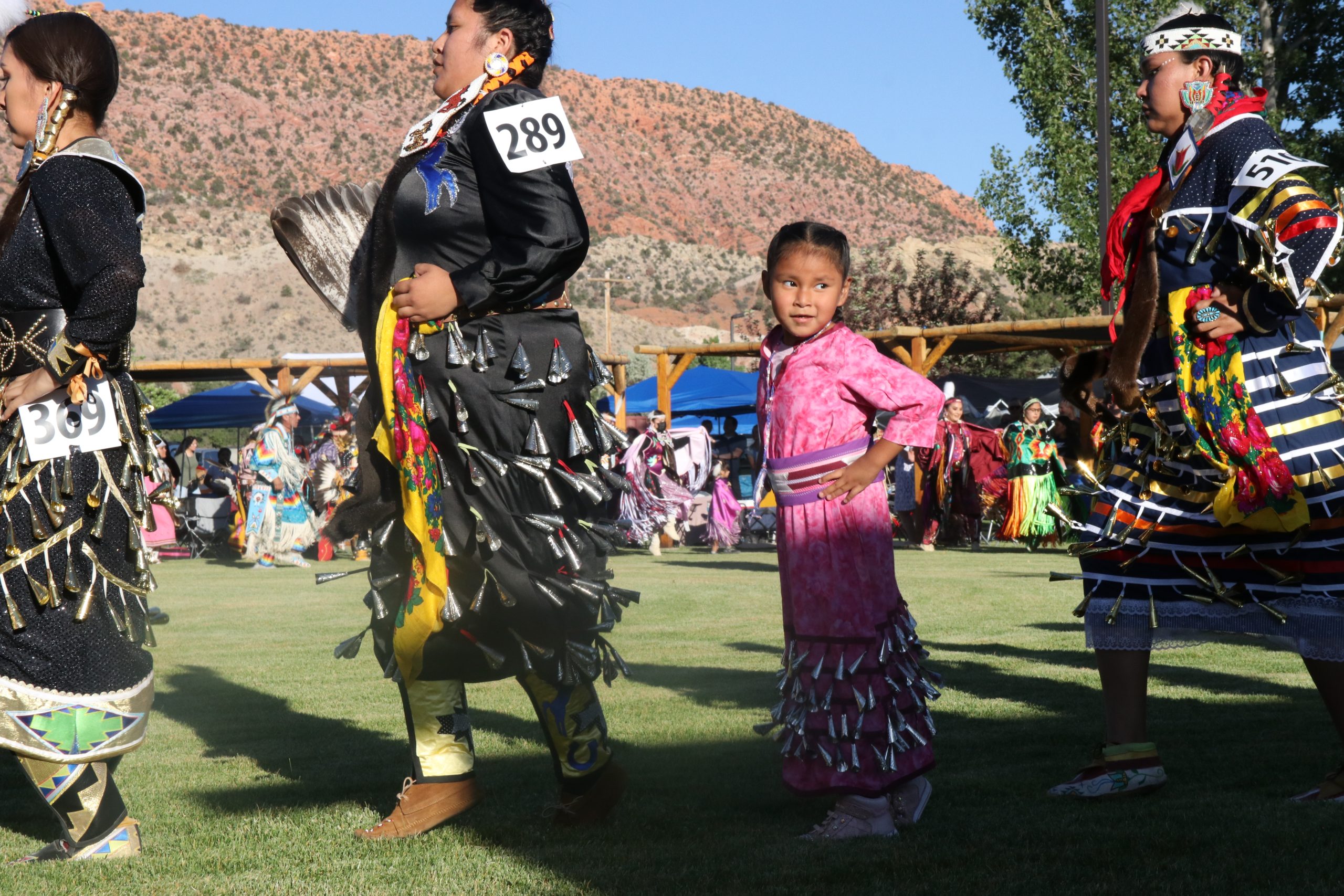
Dancers perform during the grand opening of the Paiute Indian Tribe of Utah’s 42nd annual Restoration Gathering Powwow, Cedar City, Utah, June 10, 2022 | Photo by Jeff Richards, St. George News / Cedar City News

The Paiute Indian Tribe of Utah’s recognition and assistance was officially restored by Congress in April 1980. The current reservation consists of 10 land parcels in four southwestern Utah counties.

The next Native Goods Marketplace will be held Friday, May 26, at 565 North 100 East, in Cedar City between the hours of 10 a.m. to 2 p.m. The community commerce continues at the same time on the last Friday of every month until colder weather prevails.

For information on becoming a vendor in future events, contact Vargas at this link.

Copyright St. George News, SaintGeorgeUtah.com LLC, 2023, all rights reserved.

Chief Hoskin, other tribal leaders hope to improve Indian Arts and Crafts Act

Chief Hoskin, other tribal leaders hope to improve Indian Arts and Crafts Act
image

WASHINGTON — Native American artists say they continue to struggle with the theft of their work, and tribal leaders are urging Congress to strengthen the Indian Arts and Crafts Act. 

IACA was passed in 1990 to prohibit any advertisement and all sales of counterfeit Indian arts and crafts. Choctaw Nation artist D.G. Smalling says the IACA must adapt to the new ways of buying and selling art through online sales.

“We have just a very different kind of engagement with intellectual property now,” Smalling said. “This is why my principal attorney is an expert in intellectual property. It is to defend what I create and to defend what is mine.”

Cherokee Nation Principal Chief Chuck Hoskin Jr. urged Congress to strengthen the IACA during the recent Cherokee Days in Washington D.C.

He is working with members of Congress on a proposed ARTIST Act of 2023 (Amendments to Respect Traditional Indigenous Skill and Talent).

“We haven’t engaged the delegation just yet,” Hoskin said. “We will be setting up some opportunities to visit with them. The Senate Committee on Indian Affairs is where this matter sits at the moment. The chair of that committee is Chairman (Brian) Schatz of Hawaii and he and ranking member Sen. (Lisa) Murkowski have asked for input on the ARTIST Act, so that is the particular forum through which we are channeling our advocacy.”

The proposed legislation would increase and expand protections on Indian arts and crafts, as well as enforce stricter punishments for those who are selling or making counterfeit goods which could lead to being arrested for the crimes. These counterfeit items are often recreated by non-Indian artists or printed off and seen on portraits, shirts, mugs, online shops and many other places throughout the world. 

“The law must be changed in order to protect actual Cherokee artists, artisans, and craftspeople  – those who are citizens of one of the three federally-recognized Cherokee tribes – and ensure their arts and crafts are the only works permitted to be presented as Cherokee,” Hoskin wrote in a March 29 letter to the Indian Affairs Committee. 

Smalling is supportive of Hoskin and other tribal leaders as they push for change.

“They are asking that the law and the act can be adapted for our time and we need to cover all things that are digital, all things that are traditional and analog and we need to have a much more robust set of laws that can then be used to act against those who are chronic violators who profit off of theft,” Smalling said. 

“I stand 100% with Chief Hoskin and the other tribal leaders who are seeking to defend our right to our own identity on our own terms.” 

Gaylord News is a reporting project of the University of Oklahoma Gaylord College of Journalism and Mass Communication.  For more stories by Gaylord News go to GaylordNews.net.

Artist who falsely claimed Native American heritage sentenced to 18 months’ probation

Artist who falsely claimed Native American heritage sentenced to 18 months’ probation

Jerry Chris Van Dyke, an artist who sold carvings in Seattle under the name Jerry Witten and claimed to be Native American, has been sentenced to 18 months of federal probation.

Van Dyke, who is not enrolled in any recognised tribe or nation and has no Indigenous heritage, violated the Indian Arts and Crafts Act (IACA), a federal truth-in-marketing law administered by the Indian Arts and Crafts Board to safeguard the rights and livelihoods of Native American artists. He pleaded guilty in March to misrepresenting Indian-produced goods and products, and had faced up to one year in prison.

The Indian Arts and Crafts Board (IACB) first received a tip that Van Dyke was selling his work while claiming to be a member of the federally recognised Nez Perce Tribe, whose lands are in present-day Idaho. Undercover agents of the US Fish and Wildlife Service then purchased works made by Van Dyke from a gallery in Seattle’s popular Pike Place Market, where his pieces were being advertised as the work of a Native American artist named Jerry Witten.

“Prosecuting cases of fraud in the art world is a unique responsibility and part of our work to support Tribal Nations,” Nick Brown, a US Attorney for the Western District of Washington, said in a statement. “I hope this case will make artists and gallery owners think twice about the consequences of falsely calling an artist Native and work Native-produced. They should consider the damage to reputation, the legal fees and ultimately a criminal record.” Van Dyke was originally charged in late 2021, along with another Washington-based artist, Lewis Anthony Rath.

Two artworks falsely advertised as Native American art by Jerry Chris Van Dyke US Attorney’s Office, Western District of Washington

Upon questioning, Van Dyke admitted that he had made the work, had no tribal affiliation and was aware of the IACA. Under the terms of a plea deal, he admitted that he had worked with the gallery for more than a decade, and that its owner had even supplied him with materials including antlers, bones, woolly mammoth ivory and fossilised walrus ivory. Van Dyke used these and other materials to make masks and pendants in the style of the Indigenous people of the Aleutian islands in northern Alaska and the Bering Sea.

Van Dyke allegedly sold more than $1,000 worth of fake Indigenous gallery through the Pike Place Market gallery, which was not named in the US Attorney’s Office announcement about the sentencing.

“The prosecution of Jerry Van Dyke under the Indian Arts and Crafts Act for counterfeiting Alaska Native art is another critically important step in protecting the economic livelihoods and rich cultural heritage of contemporary and traditional Indian artists, as well as preserving the vitality of the Indian art market in the Northwest and nationwide,” Meredith Stanton, the director of the IACB, said in a statement.

The IACA was signed into law by president George H.W. Bush in 1990 to prevent precisely the sort of marketing and sale of non-Indigenous artefacts that Van Dyke made and sold. In doing so, it aimed to safeguard the livelihoods of Native American artists and instil confidence in the market for Indigenous art in the US.

Brown added, “Fake Native art should be kept out of the marketplace because it harms the legitimate Native art community.”

Indigenous artists in Canada have been calling for the creation of similar legislation in that country, which currently has little means of regulating the market for objects that are marketed and sold as being the work of First Nations people.

Deep Ellum gets a new arts fair — marking 150 years of music, art and nightlife

Deep Ellum gets a new arts fair — marking 150 years of music, art and nightlife

It may be the first Deep Ellum Community Arts Fair, but it’s celebrating decades of the artistic ferment that has marked the neighborhood. This year is Deep Ellum’s sesquicentennial, and the new festival focuses on local visual artists and artisans.

“Most of the artists are hyper-local,” said Breonny Lee, president of the Deep Ellum Community Association. There are a handful of regional artists, she said, but 90% of those participating are from North Texas.

Close-up of artist painting a colorful picture.

Breonny Lee

/

Deep Ellum Community Association

North Texas artists represent 90% of participating artists at the new Deep Ellum Community Arts Fair.

She stresses this is a big difference between the new arts fair and the decades-long Deep Ellum Arts Festival that was canceled. Lee worked for many years with that festival, recruiting local artists and managing their booth sites.

The cancellation caused “an overwhelming response from the community,” she said. People told her “they wanted to do something, that they love that event, that they were going to miss that event.” But they wanted it to be “more locally driven” and “friendly to the neighborhood.”

Streets will be blocked off along Crowdus between Clover and Indiana Streets for pedestrian-friendly strolling past outdoor booths, two live-music stages and street performers. Many restaurants are creating custom menu items for the event, Lee said.

The block-long mural of Blues Alley, behind the Stack Building on Clover Street, features 16-foot-tall paintings celebrating the musical history of Deep Ellum.

[embedded content]

Blues Alley at The Stack Deep Ellum

Fair visitors also can get a look inside the new Deep Ellum Community Center before its grand opening in September. It’s a gift for the neighborhood’s 150th year, she said. The center will contain gallery space, plus space for studios and artists-in-residence.

Lee is a Dallas native and photographer and mixed media artist with a long-standing love of Deep Ellum. At age 13 in the 1990s, she said she visited the neighborhood for the first time for an open-artist studio event that exposed her to numerous styles of visual art.

“That’s a big part of my personal story and my impression of Deep Ellum,” she said.

Lee kept coming back.

“It felt to me like the first place that I’d ever really felt at home,” she said. “Not necessarily a place where you live, but the place where you belong.”

The interior of the new Deep Ellum Community Center with tables and chairs, and original art from local artists.

Jerome Weeks

/

KERA News

The new Deep Ellum Community Center will house artist-in-residence studios and gallery space. It opens officially in September, but you can get a look during the fair.

Local artists have been a significant part of Deep Ellum since the 1920s, when the area first gained a reputation for its music and nightlife. Starting in the 1980s, artists, theater companies and entrepreneurs revitalized the neighborhood — it had become rundown, filled with empty storefronts.

It is now a state-recognized cultural district.

“The live music and the visual art and theater — these kinds of things are so critical to the DNA of Deep Ellum,” Lee said. And the neighborhood continues to change.

“These different pieces throughout the decades of individuals and groups working together to make cool stuff happen in the neighborhood is the reason that we’re talking about Deep Ellum, that people in other countries are talking about Deep Ellum.”

This arts fair, she said, is part of that revitalization.

[embedded content]

Deep Ellum’s 150th Kickoff

Deep Ellum Community Arts Festival is May 27-29. Free. Hours: Saturday 11 a.m.-10 p.m., Sunday and Monday 11 a.m.-8 p.m.

www.deepellumfair.com

Center for the Arts welcomes series of Native American art exhibits in June

Center for the Arts welcomes series of Native American art exhibits in June

JACKSON, Wyo. — Grounded is a strategic and timely art exhibition organized by ArtSpirit, the arts initiative of the Episcopal Church in Wyoming, and CARAVAN, a global arts non-profit, from June 1 to July 23. This is just one stop on a multi-year international tour.

The exhibit at Center for the Arts includes three specific events held throughout June: 

Opening Reception for Gallery Show

The opening reception will take place June 1 at 7 p.m. at The Center Theater and Gallery.

Special guests and speakers will include participating Native American artists, an Indigenous drum circle and the cedaring of the artwork to which all are invited. The Grounded exhibit brings together 15 premier and emerging contemporary artists from Indigenous American tribes traditionally based in and around the Great Plains. It is an artistic exploration that seeks to inspire our imaginations about our need to be “grounded” in our relationship with all of creation: the earth and its wildlife, each other and ourselves. 

“The Art of Home”

The Jackson Film Premiere will take place June 7 at 7 p.m. at The Center Theater.

ArtSpirit, Episcopal Church in Wyoming and CARAVAN, sponsored by Wyoming Humanities, will bring the Jackson film premiere screening of the Emmy-nominated PBS film “The Art of Home: A Wind River Story,” which focuses on two indigenous contemporary artists from the Wind River Reservation reflecting artistically on their tribal homelands, on the role of art in reconciliation and on what it means to be a “native artist.” 

Special guests at the film screening include Emmy award-winning director Mat Hames, producer Jordan Dresser (Northern Arapaho) and featured Native artist and actor Sarah Ortegon (Eastern Shoshone), who will provide a “behind the scenes” perspective including historical context on the arts and crafts of their communities, passed down through the ages, as they encourage young artists to stay connected to their roots.

“An Evening with Joy Harjo”

The event with the U.S. Poet Laureate (2019-2022) and winner of the Pen USA Literary Award for Nonfiction will take place on June 16 at 7 p.m. at The Center Theater.

An Evening with Joy Harjo, 23rd United States Poet Laureate, will wrap up the month-long series of events. This will be an evening of poetry, music and reflection with Joy Harjo. A member of the Muscogee Nation, she is the first Native American to hold that honor. Harjo is an internationally renowned performer and writer, having authored nine books of poetry, several plays and children’s books and two memoirs. Harjo performs with her saxophone nationally and internationally.  

This is the only ticketed event of the series. Tickets are available on The Center’s website and are selling fast.

This final event is sponsored by ArtSpirit, CARAVAN, Center for the Arts, Wyoming Humanities, Wort Hotel and St. John’s Episcopal Church, in partnership with EcoTheo Collective.

More information on these events can be found on The Center’s website.

@media ( min-width: 320px ){.newspack_global_ad.sidebar_article-2{min-height: 50px;}}@media ( min-width: 728px ){.newspack_global_ad.sidebar_article-2{min-height: 90px;}}