Native

Review: ‘The Thanksgiving Play’ is more predictable appetizer than satiric meal

Review: ‘The Thanksgiving Play’ is more predictable appetizer than satiric meal
(L-R) D’Arcy Carden, Chris Sullivan, Katie Finneran and Scott Foley in “The Thanksgiving Play” on Broadway (Credit: Joan Marcus)

Satire is one of the American theater’s greatest tools. At its best, the genre is both an effective pedagogical tool for change and a sharply-aimed weapon for critical analysis. Larissa FastHorse’s “The Thanksgiving Play” only grazes both marks. Her dizzying spiral of a comedy, the first production of a work written by a Native American woman on Broadway, follows a group of four equally inane white people devising a high school theater piece about the origins of Thanksgiving. The irony of this group’s homogenous racial makeup is not lost on anyone, especially them. FastHorse’s attempt to have her characters bounce between extreme political correctness and overt ignorance results in a muddled theatrical experience that is not quite hilarious, not quite provocative and not quite informative, but has the aftertaste of all three. 

Surprisingly, “The Thanksgiving Play” does not begin with an Indigenous land acknowledgement. There is a short one scribbled in the show’s program, but one would think Logan — the play’s uber-progressive protagonist desperate to prove her white allyship — would require one. 

Logan is the high school drama teacher — riddled with nervous tics by standout actor Katie Finneran — directing the high school’s new, socially-conscious ode to Native American Heritage Month. It’s “far more than a Thanksgiving play” now that Logan has received a lineup of grants from race and equity justice organizations. Her partner in love, absurdity and awful, matching thrift-store scarves (simple costume design by Lux Haac) is Jaxton (Scott Foley). Never one to miss a predictable stereotype about white well-doers, FastHorse prescribes him to be a farmer’s market performer and a Buddhist yogi. And great news: Logan’s hired Native American actor Alicia (D’Arcy Carden) to join them. But we soon learn Alicia is not Native, she simply relies on ethnic-looking headshots to blur the lines. Though crushing to Logan and Jaxton, resident historian and aspiring playwright Caden (Chris Sullivan) is desperate to work with “professionals” and, therefore, less bothered by this.  

The quartet drones on about scene work once they realize that no Natives are present — an eerie metaphor for the erasure of Native bodies, voices and art across this entire nation. Should they represent people who are not present? 

FastHorse’s script takes annular laps to answer this impossible question, while interspersing sobering historical facts about the origins of Thanksgiving. But without fail, the ensemble’s nonsensical rambles about privilege swallow those harsh truths. Making a mockery of woke culture is an interesting foundation for a play, but FastHorse — who truly is one of our industry’s strongest champions of inclusion and has radically opened doors for Native people in the arts — is poking at race relationships here, where she ought to be stabbing. You feel the play inching towards greater implications about cultural genocide, but opting out — as if no one in the audience should sit too long with the reality of tragedy before hearing a joke about mason jars and soy cheese. 

Of course, no playwright, especially a non-white playwright, should have to wade in trauma if they don’t choose to, but I found myself longing for even a glimmer of FastHorse’s own disappointment, advice — even rage — to underscore all the derision. 

“The Thanksgiving Play” and all of its players are almost too aware of the jokes they are telling, so no aspect of the play feels real. Director Rachel Chavkin makes sure that Carden plays dumb. Foley plays hyper-diplomacy. Finneran plays earnestness. Sulllivan plays desperation. None are being human. And while that lack of depth is an example of FastHorse’s critique, it is also the source of my disinterest. 

What is interesting, however, is designer Riccardo Hernandez’s nostalgic delight of a classroom set adorned with a sprawling world map, cherubic headshots of students bordering the walls and a cluttered teacher’s desk with one of those old-school pencil sharpeners you have to crank by hand. My favorite detail is a poster on the back wall of “The Shipment” — an unsettling play, co-written by Young Jean Lee and her cast of five Black performers that challenges racial biases about Black people. Like FastHorse, Lee is a “first.” After decades of self-producing avant-garde work, Lee became the first female Asian American playwright on Broadway with “Straight White Men,” another satire produced by Second Stage featuring an all-white cast debating privilege. It hardly felt coincidental and, sure enough, when I looked back at FastHorse’s script, she mandates use of that poster in her stage directions. 

Like “Straight White Men,” “The Thanksgiving Play” feels like a reactionary work, a play that takes aim at an industry more willing to champion ideas about artists of color than artists of color themselves. FastHorse deserves more. Because she knows better than anyone that Native artists are here and ready to work. Just not in this play. 

“The Thanksgiving Play” opened at Second Stage’s Hayes Theater on April 20, 2023.

Review photo by Joan Marcus.

Creative: Written by Larissa FastHorse; Directed by Rachel Chavkin; Scenic design by Riccardo Hernández; Costume design by Lux Haac; Lighting design by Jeanette Oui-Suk Yew; Sound design by Mikaal Sulaiman; Projection and video design by David Bengali; Hair and makeup design by Brittany Hartman; Production stage management by John C. Moore; Casting by The Telsey Office, Will Cantler and Karyn Casl.

Produced by Second Stage Theater under artistic director Carole Rothman and interim executive director Lisa Lawer Post. 

Cast: D’Arcy Carden, Katie Finneran, Scott Foley, Chris Sullivan, Clea Alsip, Christopher Ryan Grant and Amy Staats with film appearances by Ishan De Silva, Mollie Fink, Atticus Scott-Williamson and Dasan Turner.

City Life Org – The Whitney Museum Announces Jaune Quick-to-See Smith to Deliver Walter Annenberg Lecture on May 18

City Life Org – The Whitney Museum Announces Jaune Quick-to-See Smith to Deliver Walter Annenberg Lecture on May 18
image

Jaune Quick-to-See Smith, Homeland, 2017. Oil and acrylic on canvas, 48 1/4 x 72 1/8 (122.6 x 183.2 cm). Buffalo AKG Art Museum, New York; bequest of John Mortimer Schiff by exchange 2018:12. © Jaune Quick-to-See Smith. Photograph by Tom Loonan and Brenda Bieger for Buffalo AKG Art Museum

The Whitney Museum of American Art announces that groundbreaking artist Jaune Quick-to-See Smith will present the 2023 Walter Annenberg Lecture on Thursday, May 18, at 6:30 pm in the Museum’s Susan and John Hess Family Theater and online. Smith, whose acclaimed career retrospective Memory Map is currently on view at the Museum through August 13, will be joined in conversation by Adam D. Weinberg, the Whitney’s Alice Pratt Brown Director.

For over five decades, Jaune Quick-to-See Smith, a citizen of the Confederated Salish and Kootenai Nation, has examined and interpreted life in America through Native ideology, focusing on pressing issues of land, racism, and cultural preservation. Her pointed and often humorous works employ a rich visual vocabulary inspired by modern art historical movements like Pop and Abstract Expressionism and potent symbols of her own culture and identity, such as horses, bison, and canoes, to challenge the mainstream narratives and visual languages of American culture. The lecture will explore Smith’s exceptional and unorthodox career as an artist, activist, curator, educator, and advocate.

This annual lecture is given in honor of the late Walter H. Annenberg, philanthropist, patron of the arts, and former ambassador. Past Annenberg Lecture participants include Dawoud Bey (2021), Julie Mehretu (2020 lecture, presented in Spring 2021), Jason Moran (2019), Kara Walker (2018), Catherine Opie (2017), Martha Rosler (2016), and Frank Stella (2015).

Audiences can register for the Zoom livestream on whitney.org.

On Friday, May 19, from 11 am–8 pm, the Museum will host a convening with an intergenerational group of Native American artists, curators, and scholars for conversations about the ongoing and overarching concerns in Smith’s work, including land, sovereignty, and Indigenous knowledge and identity. The program takes inspiration from Smith’s work as an artist and as an educator and curator by bringing together many communities that she has been in dialogue with throughout her career. For more information including a list of participating artists and scholars visit the museum’s website.

About Jaune Quick-to-See Smith

Jaune Quick-to-See Smith (b. 1940) is a citizen of the Confederated Salish and Kootenai Nation, Montana. Smith has been creating complex abstract paintings and prints since the 1970s. Combining appropriated imagery from commercial slogans and signage, art history, and personal narratives, she forges an intimate visual language to convey her insistent socio-political commentary with powerful clarity. Smith’s multifaceted work is grounded in themes of personal and political identity.

Smith received an AA degree from Olympic College in Bremerton, Washington, in 1960; a BA in art education from Framingham State College, Massachusetts, in 1976; and an MA in Visual Arts from the University of New Mexico in 1980.

Smith has received numerous awards, including the Academy of Arts and Letters Purchase Award (1987); Joan Mitchell Foundation Painters & Sculptors Grant (1996); Women’s Caucus for the Arts Lifetime Achievement Award (1997); College Art Association Women in the Arts Award (2002); New Mexico Governor’s Award for Excellence in the Arts (2005); ArtTable Artist Honoree (2011); Georgia O’Keeffe Museum Living Artist of Distinction Award (2012); Montana Governor’s Award (2018); New York Foundation for the Arts Murray Reich Distinguished Artist Award (2019); United States Artists Fellowship (2020); Anonymous Was A Woman Award (2022); and Barnard College’s Medal of Distinction (2022). Smith has been honored with honorary doctorates from the Minneapolis College of Art and Design (1992); Pennsylvania Academy of Fine Arts, Philadelphia (1998); Massachusetts College of Art and Design, Boston (2003); and the University of New Mexico, Albuquerque (2009).

Smith’s work is in the collections of the Albuquerque Museum; Brooklyn Museum, New York; Eiteljorg Museum, Indianapolis; Heard Museum, Phoenix; Metropolitan Museum of Art, New York; Missoula Art Museum, Montana; Museo de Arte Moderno, Quito, Ecuador; National Gallery of Art, Washington, DC; Smithsonian American Art Museum, Washington, DC; Walker Art Center, Minneapolis; Whitney Museum of American Art, New York; and Yellowstone Art Museum, Montana, among many others.

About Jaune Quick-to-See Smith: Memory Map

Jaune Quick-to-See Smith: Memory Map is a celebration of fifty years of work by a groundbreaking artist. A citizen of the Confederated Salish and Kootenai Nation, Smith has charted an exceptional and unorthodox career as an artist, activist, curator, educator, and advocate. The exhibition highlights how Smith uses her drawings, prints, paintings, and sculptures to tell stories that flip commonly held conceptions of historical narratives and illuminate absurdities in the formation of dominant culture. Memory Map is the largest and most comprehensive showcase of Smith’s career to date. Including more than 130 works, the exhibition offers a new framework to consider contemporary Native American art.

WALTER ANNENBERG LECTURE

In honor of the late Walter H. Annenberg—philanthropist, patron of the arts, and former ambassador—the Whitney Museum of American Art established the Walter Annenberg Annual Lecture to advance this country’s understanding of its art and culture. Support for this lecture and for public programs at the Whitney Museum is provided, in part, by GRoW @ Annenberg, a philanthropic initiative led by Gregory Annenberg Weingarten, Vice President and Director of the Annenberg Foundation, and by members of the Whitney’s Education Committee.

EXHIBITION SUPPORT

Generous support for Jaune Quick-to-See Smith: Memory Map is provided by Judy Hart Angelo; the Carl & Marilynn Thoma Foundation; Lise and Michael Evans; the Henry Luce Foundation; the Horace W. Goldsmith Foundation; Kevin and Rosemary McNeely, Manitou Fund; the Terra Foundation for American Art; and the Whitney’s National Committee.

Major support is provided by Forge Project, Garth Greenan Gallery, Sueyun and Gene Locks, and Susan and Larry Marx.

Significant support is provided by Chrissy Taylor and Lee Broughton, Stephanie and Tim Ingrassia, Ashley Leeds and Christopher Harland, Susan Hayden, John and Susan Horseman Collection/Horseman Foundation, The Keith Haring Foundation Exhibition Fund, the National Endowment for the Arts, Brooke Garber Neidich and Daniel M. Neidich, and Nancy and Fred Poses.

Additional support is provided by Furthermore: a program of the J. M. Kaplan Fund and Komal Shah and Gaurav Garg.

ABOUT THE WHITNEY

The Whitney Museum of American Art, founded in 1930 by the artist and philanthropist Gertrude Vanderbilt Whitney (1875–1942), houses the foremost collection of American art from the twentieth and twenty-first centuries. Mrs. Whitney, an early and ardent supporter of modern American art, nurtured groundbreaking artists when audiences were still largely preoccupied with the Old Masters. From her vision arose the Whitney Museum of American Art, which has been championing the most innovative art of the United States for ninety years. The core of the Whitney’s mission is to collect, preserve, interpret, and exhibit American art of our time and serve a wide variety of audiences in celebration of the complexity and diversity of art and culture in the United States. Through this mission and a steadfast commitment to artists, the Whitney has long been a powerful force in support of modern and contemporary art and continues to help define what is innovative and influential in American art today.

LAND ACKNOWLEDGEMENT

The Whitney is located in Lenapehoking, the ancestral homeland of the Lenape. The name Manhattan comes from their word Mannahatta, meaning “island of many hills.” The Museum’s current site is close to land that was a Lenape fishing and planting site called Sapponckanikan (“tobacco field”). The Whitney acknowledges the displacement of this region’s original inhabitants and the Lenape diaspora that exists today.

As a museum of American art in a city with vital and diverse communities of Indigenous people, the Whitney recognizes the historical exclusion of Indigenous artists from its collection and program. The Museum is committed to addressing these erasures and honoring the perspectives of Indigenous artists and communities as we work for a more equitable future. To read more about the Museum’s Land Acknowledgement, visit the Museum’s website.

VISITOR INFORMATION

The Whitney Museum of American Art is located at 99 Gansevoort Street between Washington and West Streets, New York City. Public hours are: Monday, Wednesday, and Thursday, 10:30 am–6 pm; Friday, 10:30 am–10 pm; and Saturday and Sunday, 10:30 am–6 pm. Closed Tuesday. Visitors eighteen years and under and Whitney members: FREE. Admission is pay-what-you-wish on Fridays, 7–10 pm. COVID-19 vaccination and face coverings are not required but strongly recommended. We encourage all visitors to wear face coverings that cover the nose and mouth throughout their visit.

Symposium: Native Americans look back at art to shape future

Symposium: Native Americans look back at art to shape future

#inform-video-player-1 .inform-embed { margin-top: 10px; margin-bottom: 20px; }

#inform-video-player-2 .inform-embed { margin-top: 10px; margin-bottom: 20px; }

TAHLEQUAH, Oklahoma – Indigenous artists of the past, and today’s artists, are helping mold the future, an expert on curating artwork told an audience during a recent event in the capital city of the country’s largest Native tribe.

Dr. Miranda Belarde-Lewis, assistant professor at the University of Washington and a curator, spoke during the 50th annual Symposium on the American Indian at Northeastern University.

“Relationality is something we have latched onto, how native communities continue to make our systems of knowledge visible,” she said.

Tribal relationships with the land, water, ceremonies and stories are the nouns in the vocabulary she used, resulting in the objects people can see in museums. The verbs are people’s actions — how indigenous people deliberately engage with the world, through their people, places and ideas. Proper curating of art work is imperative in reflecting indigenous people’s culture now and helping it create change in the future.

Belarde-Lewis showed the photo of a robe created by an artist in Sitka, AK. A school of herring, depicted in gold, swim across a burgundy background. The fish are plentiful on the back of the road, diminishing to a narrow group of fish and finally a single fish as they approach the wearer’s neck.

The robe was created to protest the path to extinction facing the herring because of overfishing.

“Commercial fishing — they just scoop up everything in their nets,” Belarde-Lewis said. “This is showing how the herring would swim everywhere, but now they are getting channel into this little area.”

The fish population has been depleted because of man’s activities — including pollution and overfishing. The robe depicts the situation in an effort to depict this depletion and encourage change.

Belarde-Lewis praised the work of several artists, including Cherokees Roy Boney Jr. and Jane Osti.

Boney has the skill to say things creatively on a regular basis with meaning in his Daily Sketches.

“Colonization is a system because it works every day. It doesn’t take a day off,” she said.

Osti, a renowned potter, creates clay vessels and paddles “showing how long our systems of technology are unique to us.” The pottery isn’t necessarily flashy but it depicts tradition and objects that have been useful to Cherokee cooks for centuries.

“All the people who Jane has worked with, who Jane is mentoring, they will continue that technology,” Belarde-Lewis said.

She also spoke of artist collectives, saying they were working toward a future where all indigenous creatures can thrive side by side.

Some people are put off by believing art musicians are snobby institutions not relevant to most people. But curating according to Belarde-Lewis’ philosophy encourages communication and discussing art as it is socially relevant.

“Sometimes it’s as simple as pulling up a chair and talking to people,” she said.

Among the contemporary curators she praised was America Meredith, a Cherokee and editor of First American Art magazine.

She and other renowned curators have the wealth of experience needed for cultural preservation, Belarde-Lewis said. They can walk into a gallery and tell if something just isn’t right. They can work correct the exhibit, to make it convey the message needed in today’s society.

“The artists are leading the way. The curators are holding it and the curators are presenting their work to our people and the world,” she said.

She quoted Dr. Jolene Rickard on how curating tribal art relates to sovereignty: “Sovereignty is the border that shifts indigenous experience from a victimized stance to a strategic one. The recognition of this puts brains in our heads and muscle in our bones.”

The curator’s knowledge and discretion are imperative, Belarde-Lewis said.

“The artists are leading the way. The curators are holding it and the curators are presenting their work to our people and the world,” she said.

“There are a lot of things that are out of our control, but our choices are our own.”

#inform-video-player-3 .inform-embed { margin-top: 10px; margin-bottom: 20px; }

Iconic artists, actors, musicians honored with plaque on Philadelphia Walk of Fame on Broad Street

Iconic artists, actors, musicians honored with plaque on Philadelphia Walk of Fame on Broad Street

PHILADELPHIA (WPVI) — From doo-wop musicians to Broadway legends and beyond, iconic artists that have made their mark in Philadelphia were honored on Thursday with a special tribute.

Their plaques were unveiled on the Philadelphia Walk of Fame on Broad Street.

“I’m happy to have this honor because it’s a long time coming,” said Norman E. Burnett with The Tymes.

The Tymes, a doo-wop group from the 50s, was among the inductees.

Also honored with a plaque were former Governer Ed Rendell, The Bacon Brothers, James DePreist, radio host John DiBella, and Patty Jackson, among others.

“To be on this walk with so many greats, and to be the first woman in radio, because I stand on the backs of many great women,” said Jackson, WDAS-FM radio host. “I am overjoyed.”

Jackson told 6abc she’s currently writing a book about her life in radio, empowering others, and overcoming a major health scare.

“Eight years ago I suffered a stroke. I lost my vision, I couldn’t walk, but I never lost my ability to talk, and getting back on my feet made me even more grateful,” she said.

Leslie Odom Jr., a Philadelphia native and a breakout star in Broadway’s hit show ‘Hamilton’, was also honored with a plaque.

SEE ALSO: East Oak Lane’s Leslie Odom Jr. among ‘Walk of Fame’ inductees

“I was already coming for Patty and then they added me to the list, and I was like ‘Amazing!'” he said.

The Tony, Emmy, and Grammy award-winner had a message for Philadelphia’s youth.

“Allow the resources of this city to support you as they’ve supported me. You can go as far as you dream,” said Odom.

First Americans Museum to Host Fashion Summit Showcasing Indigenous Designers

First Americans Museum to Host Fashion Summit Showcasing Indigenous Designers
Oklahoma City -– The First Americans Museum is set to host the Teton Trade Cloth by Lenape Fashion Summit at 7:30 p.m. on April 22, 2023, showcasing the best of Native American fashion.
This year event – the second annual summit — will bring together emerging and established Native American fashion designers, highlighting a mix of traditional and contemporary designs, and a range of materials and techniques.
According to advance promotional materials, sent to The City Sentinel, “The fashion show promises to be a celebration of indigenous fashion, reflecting the beauty and culture of Native America, and the importance of preserving and promoting Native American culture and traditions through fashion.”
The Teton Trade Cloth by Lenape Fashion Summit has already become a platform for showcasing the rich culture and diversity of Native American fashion.
Hosted at the First Americans Museum (FAM) on the Oklahoma River, it attracts designers and artists from across the United States at “the Crossroads of America” – where Interstates 35 and 40 intersect.
Featured designers at this year’s event include Designs by Della, Michelle Luna — Bitterwater for Redhouse, Sheel Designs, Marian Mike — Breezy Designs, Queena Ribbon Designs, Kathleen Tom Garcia, JG Indie, Stitched by Millie, Native Springflower Creations, Bonnie Woodie and Penny Singer. Accessory designers include Shude Victors – Big Smoke Maker Designs, Shaydee Snow Pretends Eagle – S.N.O. Inc and Amanda Wilson – Weryackwe Tie Co.
General admission seating is available on a first-come, first-served basis with a cash bar.
VIP seating options include second- and front-row seating, an exclusive lounge, swag bag, appetizers and cash bar.
Designers will have their own featured booths available for purchase of their work.
The booths will open tomorrow (Friday, April 21, from 10 a.m. to 5 p.m.) and re-open on Saturday, April 22, from 11 a.m. to 5 p.m.
The FAM promotional staff says: “Don’t miss out on the opportunity to experience this unique celebration of Native American fashion.”
Additional Information From this link:
Teton Trade Cloth By Lenape 2nd Annual Fashion Show returns — doors open 7 p.m. | Funway show begins 7:30 p.m. Three ticketing options are available: $25 General Admission: seating is first come first served, cash bar available… $50 2nd & 3rd Row VIP: secured seating, swag bag, VIP lounge, appetizers and cash bar available… $100 Front Row VIP: secured runway seating, VIP swag bag, VIP lounge, appetizers, and cash bar available. Fashion Show … Hall Of The People: Doors open for all ticket holders at 7 p.m. Fashion Show begins at 7:30 p.m., Dress codeDress to impress …
News of this event is spreading quickly – check back at the FAM website to see if anything changes or evolves further. …
Notes: The mission of First Americans Museum (FAM) is to educate the broader public about the unique cultures, diversity, history, and contributions of the 39 Tribal Nations in Oklahoma today. The 175,000 square foot facility showcases state-of-the-art exhibitions in history, culture, and art; live public and education programs; a full-service restaurant presenting unique Native inspired cuisine; and a museum store featuring one-of-a-kind hand-made items created by Oklahoma’s premier Native American artists. Pat McGuigan of The City Sentinel staff prepared this story for posting. Check the city-sentinel.com archives here: (https://www.city-sentinel.com/tribal/ ) for a decade’s worth stories, features and other information on Native American issues. 


Meet the first Native American woman to bring a show to Broadway

Meet the first Native American woman to bring a show to Broadway

When Larissa FastHorse was growing up in South Dakota, she was taught that Thanksgiving was a time for harvest and gratitude. The inaccurate portrayal of happy pilgrims and Indians that many students learn today was never part of story.

It’s part of the reason why FastHorse, 51, decided to write the satirical comedy “The Thanksgiving Play,” which tells the story of four woke, white theater makers who are writing a Thanksgiving play for students to perform. The liberal, well-meaning artists worry so much about not offending anyone and getting the story historically right, that things go very wrong.

“The Thanksgiving Play” stars Katie Finneran, Scott Foley, Chris Sullivan, and D’Arcy Carden.Joan Marcus / Joan Marcus

“[Growing up], I was aware that there was an Indigenous truth being left out of Thanksgiving, but even I was not fully aware of how fictionalized the national holiday story is until I did research from the play,” said FastHorse.

With the play’s opening this week, FastHorse is making history as the first Native American woman to bring a show on Broadway. It’s being directed by Tony Award-winning director Rachel Chavkin and stars Katie Finneran, Scott Foley, Chris Sullivan and D’Arcy Carden.

FastHorse recently chatted with Know Your Value about her new play, the importance of representation, her career pivot from ballet dancer to playwright and more. Below is the conversation, which has been edited for brevity and clarity.

Know Your Value: You grew up in South Dakota. What are your memories of Thanksgiving during your childhood, and how did it influence the story you tell in “The Thanksgiving Play”?

Larissa FastHorse: The play is based in a classroom. My childhood classroom experiences with Thanksgiving was not like the play. My experience was [that Thanksgiving is] entirely a harvest festival. The way Thanksgiving is taught in schools with plays and pageants depicting pilgrims and Indians was completely new to me. It’s been really big for me to realize what we have kids to learn about Thanksgiving, because my in my world, Thanksgiving is just about harvest, gratitude and thankfulness.

Larissa FastHorse’s “The Thanksgiving Play” opens on Broadway this week.John D. and Catherine T. MacArthur Foundation

Know Your Value: You have gotten a lot of attention for being the first Native American woman to bring a show on Broadway. What does that honor mean to you?

FastHorse: It’s huge. I go back and forth between being so excited and honored, and then feeling like a lot of pressure. The last Native American playwright that we know of was Lynn Riggs, and it was nearly 100 years ago. It’s taken a whole new century for us to have another Native American playwright… me. I do not want that to happen again. I have a lot of pressure to make sure things go well so that it isn’t another century before we have the many, many incredible Native writers we should have on Broadway.

Know Your Value: Tell us about the genesis of the play — and how you decided to weave a lot of humor into a story about America’s dark history.

FastHorse: I’m a comedy writer. Comedy is also in Native American culture. We say, “you have to laugh or cry,” so we choose to laugh … We deal with the dark history with humor and that’s how we persevere and we survive. Using comedy is natural for me, and it’s the indigenous way to deal with things.

Know Your Value: The play is being directed by Rachel Chavkin, best known as the Tony Award winning director of “Hadestown.” On the surface, this may seem like an unlikely pairing. Tell us about this decision and how you two decided to collaborate.

FastHorse: Rachel Chavkin and I have known each other for 10 years, at least. We always have admired each other’s work but this is the first project we’ve been able to work on together. Her sense of theatricality is incredible. She can take something very simple and make it large and beautiful and inviting. And she’s hilarious. She’s also our … secret weapon of understanding well-meaning, liberal white people. She does that role well for us because everyone else on the creative team is a person of color.

image
Aug. 5, 201905:06

Know Your Value: What do you hope viewers take away from the play— and America’s painful history of how they treated Native Americans?

FastHorse: First and foremost, I hope people have fun and can enjoy being together in the theater, at the play, as a comedy within a satire. But then I think also it should leave people asking themselves about what they were and were not taught: Why wasn’t I taught these things? Why didn’t I learn different history? Why is it so hard to find history about indigenous people and the lands we’re standing on? I want people to start to really question why Native American history is taught how it is, why there’s an access or lack of access to certain information, and why we haven’t sorted it out sooner and started to do better.

Know Your Value: Let’s talk about career pivots. You began your career as a ballet dancer and choreographer but left that dream behind when you were forced into early retirement due to an injury. What was the pivot to playwright like?

FastHorse: A career pivot is really hard… Suddenly you have to let go of what you know (in my case dancing) and find out what to do with the rest of your life. I was fortunate and found an organization called Career Transitions for Dancers. They give career counseling, training and education to the dancers both during and after their career to figure out what to do next. I really needed that at that time. They helped get me into writing.

I worked in film and TV writing first, 15 years ago. At the time, I was really disappointed in how Hollywood was depicting Native people and Native stories. It just wasn’t accurate, and I felt like I was fighting all the time to share true Native stories. Eventually theater found me through the Sundance Institute’s Indigenous Program. I really was excited about how theater wanted to do things right with storytelling. I’m now back in film and TV because things have changed in the past 15 years. And now, theater, film and TV are trying to do things right as

10 Ways to Have a Dope Time at the DAM

10 Ways to Have a Dope Time at the DAM

4. As you expand your mind, decolonize it. Many artworks in the galleries explore race, gender, identity, and other issues related to equity, diversity, and inclusion. As artist Wendy Red Star is quoted as saying in the renowned Indigenous arts of North America galleries on level 3 of the Martin Building:

A lot of people will say, ‘Well, that’s just Native history.’ No, that’s everybody’s history who lives on this continent. It’s about decolonizing the way people are seeing things.

5. Vibe with surreal Latin American art on level 4 of the Martin Building. Works by Leonora Carrington, Pedro Friedeberg, Gunther Gerzso, Bridget Bate Tichenor, and others will blow your mind!

6. On the same floor, you can learn about ancient origin stories in the art of the ancient Americas galleries. For example, you can learn how ancient Andean communities believed in dualism—the understanding that the world is made up of complementary pairs. The Inca described the world as kay pacha, the here-now earth. They believed that humans lived on the edge between the sky and the earth and between the past and the future.

7. Contemplate matters of the spirit with Buddhist, Hindu, and Islamic art on level 5 of the Martin Building. For example, you can see a Hayagriva mandala created at the DAM by three monks from Seraje Monastic University in southern India.

8. Enjoy the beauty. From the Monets and other Impressionist masterworks on level 2 of the Hamilton Building to the sweeping landscapes of the American west on level 7 of the Martin Building, the museum is filled with creations that will take your breath away.

9. Speaking of level 7, you can take in the views from the rooftop of the Martin Building. Also on this floor, you can see It’s Roundup Time in Heaven, in which a cowboy serenades squirrels in party hats while being blessed by the Great Acorn in the Sky. That’s right. Squirrels. In party hats. You’ll also be able to flip through a comic about legendary Black cowboy Nat Love and find many other cool and unexpected artworks in these galleries including a painting by Andy Warhol!

10. Awaken your own creativity. You’ll find something interactive in almost every gallery. In the Creative Hub on level 1 of the Martin Building (developed in collaboration with Moe Gram and Frankie Toan), spin the experimentation wheel to play with colors, textures, and patterns, and shred the expectations that might get in the way of your creativity. Get hands on with artists in the Landscape Studio on level 1 of the Hamilton Building, and on the weekends visit with one of the artists demonstrating their process.

Jaune Quick-to-See Smith, Shaped by the Land

Jaune Quick-to-See Smith, Shaped by the Land

Jaune Quick-to-See Smith was sitting on the shore of a lake in Montana when she had an epiphany. An artist and curator, Smith was visiting the Flathead Reservation — the home of the Confederated Salish and Kootenai Tribes, of which she is a citizen. She’d been born on the reservation in 1940 and later moved to Albuquerque. On this trip, in 1991, as she looked out at the landscape that had helped shape her, she realized that she needed to do a better job of communicating. “I’m making paintings and I know what they’re about but the viewer doesn’t,” she recalled in a recent interview.

Then came the light-bulb moment: Her works were about contemporary Native life, but they were more abstract, less direct in approach. “What if I cut articles out of the newspaper, glue them in, and paint on them, like Rauschenberg did?” she thought.

Smith liked Robert Rauschenberg’s process of incorporating cutouts into his works, building his famous collage aesthetic that placed a medley of objects and images on equal footing. “But if I do it,” Smith told herself, “I can make it so that it really says something.”

She started placing newspaper clippings on her canvases and painting around and over them. As the idea took hold, she made the layouts more purposeful: juxtaposing excerpts from The New York Times and the Flathead Reservation’s Char-Koosta News, as well as other printed snippets, that, when read together, became suggestive and rhythmic, creating what Smith calls her “rap.” She added found images, bits of fabric, and more expressive passages of paint, all of it simmering behind large, simply rendered icons, like a canoe. In 1992, she hung above one such canvas a series of objects featuring racist Native stereotypes, including a baseball cap from the Cleveland Indians. With a twist of dry humor, she titled her piece, which stretched 14 feet long, “Trade (Gifts for Trading Land With White People).”

A painting in red, green, with white newspaper collage and fabric on canvas with 31 found objects representing Native stereotypes, including a Cleveland Indians baseball cap, A viewer is at left at the Whitney Museum.
“Trade (Gifts for Trading Land with White People),” 1992, features a large canoe and a collage of oil, paper, newspaper and fabric on canvas. Above the artist hung 31 found objects on a chain. It is on view in “Jaune Quick-to-See Smith: Memory Map” at the Whitney Museum of American Art.Hiroko Masuike/The New York Times
Detail, “Trade (Gifts for Trading Land With White People).” Above the expressive passages of paint, she hung a series of objects featuring racist Native stereotypes.Hiroko Masuike/The New York Times

That monumental, still stunning artwork sits at the heart of “Jaune Quick-to-See Smith: Memory Map,” opening this week at the Whitney Museum of American Art. The exhibition includes some 130 pieces from over five decades, making it the artist’s largest survey. Smith’s is the first retrospective of a Native artist that the New York institution has itself organized, a fact that’s less surprising than it is vexing.

“It forces the question of, why not before? Why not more attention to contemporary Indigenous art?” said Laura Phipps, the Whitney’s assistant curator who organized the exhibition with Caitlin Chaisson, a curatorial project assistant. “We’re constantly questioning what ‘American’ means, but in a lot of those conversations, the idea of Native America has not been a part of that.”

Smith’s retrospective arrives as the map of the art world seems to be shifting: Contemporary Native artists have been more visible and sought after than ever before, in museum commissions and collections and in galleries. Smith, 83, also has a commission in Counterpublic, a new triennial in St. Louis, and is curating an exhibition featuring some 50 Native artists at the National Gallery of Art. The show, which will open in September, represents more overdue firsts: the first time an artist has ever curated an exhibition there and the first show of Native art at the NGA in 30 years.

A visitor inspects “Trade Canoe: Making Medicine, (2018), a collaboration by Jaune Quick-to-See Smith and Neal Ambrose-Smith. It is made of wood and filled with environmental detritus degrading the Native landscape. Back right, Quick-to-See Smith’s “McFlag” (1996) riffs on Jasper Johns’s flag paintingsHiroko Masuike/The New York Times
Prints from Quick-to-See Smith’s “Custer Series” (1993), a good example of the artist’s dark humor.Hiroko Masuike/The New York Times

But if the current wave of attention has opened up new possibilities for Indigenous artists, particularly younger ones, credit is due less to the institutions than to Smith and others of her generation for the tireless work they did to “break the buckskin ceiling,” in her words. The Whitney retrospective makes that clear. Although Smith’s curating and activism are represented only minimally, her paintings, prints and sculptures demonstrate how she took various modern and postmodern artistic languages, including collage, appropriation and Pop Art, and made them her own — or, as she would say, made them Native.

Take, for example, “Trade (Gifts for Trading Land With White People),” which, according to the Choctaw-Cherokee artist Jeffrey Gibson, “offers so much allowance and freedom for Native artists.” Gibson spoke of the challenges he has felt in trying to be a Native artist, activist, educator and parent simultaneously. “You need a unified model of how someone can be the same person in all those spaces,” he said. “Jaune has provided that for me.”

Smith has always occupied multiple roles. She and her sister were raised by their father, Arthur, after their mother, who gave birth to Smith as a teenager, left. Arthur was a horse trader, and while attending school, Smith worked with him — and in canneries and on farms — throughout her childhood. One of her favorite escapes was to hide in a tree and read books.

Smith didn’t get an advanced art degree until she was 40. In high school, a white adviser told her, “Indians don’t go to college,” so she did college prep. When an art teacher told her she drew better than the men, but that “women cannot be artists,” she got an art education degree. Along the way, she met her partner, Andy Ambrose, had children, and worked a variety of jobs to help support them. (Her son Neal Ambrose-Smith is also an artist; two of their collaborations are on view at the Whitney.)

“Indian Madonna Enthroned,” from 1974. which Quick-to-See Smith made while still in school for art education.Hiroko Masuike/The New York Times

In 1976, Smith moved to Albuquerque and started auditing art classes at the University of New Mexico, — it took three applications until the school admitted her. There, she and the Indigenous artists Larry Emerson, Conrad House, Felice Lucero, Emmi Whitehorse and Paul Willeto formed a collective called Grey Canyon. “She’s like a mother hen,” said Whitehorse, who is Navajo and was then an undergraduate at UNM. “She took it on herself to teach me the ropes.”

Grey Canyon provided emotional support, but Smith wanted their art to be taken seriously. She sought places for them to exhibit and in 1979 landed their first show, at New York’s American Indian Community House. At the time, she was making pastels that referred to places that were meaningful to her. They look like enigmatic maps, with floating pictographs and tracks — Smith’s response to professors who emphasized abstraction. But when Grey Canyon exhibited at the Wheelwright Museum of the American Indian in 1980, the members found that their modern paintings and abstract art clashed with some people’s stereotypical expectations of Native artists. Whitehorse recalled that white board members “hated it. They said, ‘What the heck are you doing? You should be at home, learning the craft your grandmothers are doing, making pottery and rugs.’”

Jaune Quick-to-See Smith working on a wood canoe with her son Neal Ambrose-Smith, Matthew Eaton and David Beams in Smith’s sculpture studio in Corrales, N.M. Brad Trone for The New York Times
Jaune Quick-to-See Smith’s sculpture studio with the artist’s wood canoes of various sizes made with her team of artists and two of Smith’s unfinished paintings and plaster sculptures of Tierra Madre figures.Brad Trone for The New York Times
In the artist’s studio are Mexican masks, unknown artists; an oil painting from 2022 by Patrick Dean Hubbell titled “They may run out of Natives to sit for these portraits.”Brad Trone for The New York Times

Smith’s approach to organizing the Grey Canyon shows — cold-calling anywhere she could think of — established how she would go about much of her activism and curating for the next two decades: in a mode between seat-of-the-pants and “when the spirit moves me,” as her father would say.

Her improvisational urgency has had remarkable results. Her projects include helping to save Albuquerque’s Petroglyph National Monument and Santa Fe’s Institute of American Indian Arts. She’s also organized over 30 exhibitions, including important group shows of contemporary Native American photographers and women artists, and two exhibitions that rebutted the 1992 quincentennial celebrations of Columbus’s arrival in the Americas.

Such work reflects her communal mind-set — how she has expanded the space for Indigenous people in art by inviting others to give talks, connecting them to resources, or just writing notes of encouragement. “When I come through the door, I bring a community with me,” Smith said. “I want there to be others after me.” She attributes this to her heritage. “I’m still doing my dad’s horse trading,” she told me, only now what’s being exchanged are ideas and support.

Jaune Quick-to-See Smith talking with her son Neal Ambrose-Smith and her friend Emmi Whitehorse, both artists; the painting, “House and Home” (1996), contrasts Native and non-Native ideas of home.Hiroko Masuike/The New York Times

Molly Donovan, the National Gallery’s curator of contemporary art, likened working with her to being “this lucky student in a pro seminar being taught by the pre-eminent voice on the subject. Jaune has a generous pedagogy; she freely shares her knowledge.”

Smith’s early solo gallery shows were in Santa Fe, then New York. She’s continued to exhibit regularly throughout her career, but has nonetheless felt relegated to the periphery: seen and heard but not always fully understood, her work written about but rarely in real depth.

“We’re marginalized,” she said, “and actually, there’s a certain comfort level in that. You don’t have to worry about bad PR, because nobody writes about it — nobody looks at it. So you can do whatever you want.”

In Smith’s case, that has meant honing her collage technique; introducing more icons, like the U.S. map and bison; and adjusting her colors and insistent strokes and drips of paint to better convey the clamorous contradictions of American Indian life. One potent painting, “Sovereign Nations” (2002), features three layered wingtip dresses decorated with American-flag stars (a nod to Jasper Johns’s “Three Flags” from 1958, hanging upstairs at the Whitney). They’re set against the text of the 1855 Treaty of Hellgate, which created the Flathead Reservation.

Jaune Quick-to-See Smith, “Sovereign Nations,” 2002. Part of what makes Smith’s practice fascinating is the tension it carries between her embrace of more Eurocentric, modernist methods and her pro-Indigenous, environmentalist messages.via Jaune Quick-to-See Smith and Garth Greenan Gallery, New York

Part of what makes Smith’s practice fascinating is the tension it carries between her embrace of more Eurocentric, modernist methods and her pro-Indigenous, environmentalist, anticapitalist messages. Those messages feel very contemporary and of a piece with art by Nicholas Galanin, Maria Hupfield, and New Red Order, yet these younger Indigenous artists’ work is more formally experimental and often more direct.

“I’m caught between two generations,” Smith told me: that of her father, whose childhood experiences of being beaten at an American Indian boarding school made him feel like he “couldn’t say anything,” and that of younger Native artists, who “can say things that maybe we felt like we couldn’t,” Smith reflected, “I don’t think I have that freedom.”

It’s difficult to walk through her retrospective and reconcile that sentiment with what’s on view. Her canoe piled with skulls and flag with Mickey Mouse ears suggest that despite limitations or fear, she has found ways to say what she needs to. In a recent painting, she took the U.S. map and flipped it sideways. The move dispels the map’s authority, making it look precarious and absurd. In the center, amid yellows, reds and oranges, Smith added a cutout phrase that could serve as a secondhand manifesto: “NDN humor Causes people To survive.”

Left: “Survival Map,” 2021; right, “Map to Heaven,” 2021. Hiroko Masuike/The New York Times

Jaune Quick-to-See Smith: Memory Map

Through Aug. 13, Whitney Museum of American Art, 99 Gansevoort Street, Meatpacking District; (212) 570-3600, whitney.org.

Two Fervent Exhibitions At The Whitney Re-Imagine Our ‘American’ Identities

Two Fervent Exhibitions At The Whitney Re-Imagine Our ‘American’ Identities

Painterly drips draw us into the monumental canvas, navigating our gaze across the map embellished with newspaper clips of ads promoting a community bank and gas-guzzling cars, comic strips, and messages of border Imperialism. The play of textures – two panels of oil, paper, newspaper, and fabric on canvas – enhance our experience wrangling the complex narrative of Indigenous identity and life in the United States.

Indian Map (1992) is among more than 130 provocative works revealing the depth and breadth of Jaune Quick-to-See Smith’s oeuvre as part of Memory Map, the artist’s largest and most comprehensive retrospective and the first showcasing an Indigenous artist organized by the Whitney Museum of American Art.

Smith, a citizen of the Confederated Salish and Kootenai Nation, Montana, takes us on an emotional voyage spanning Abstraction, Pop Art, and Neo-Expressionism, telling stories through her singular visual language punctuated with recurring imagery of flags, horses, bison, and canoes, and told with repurposed materials such as newspaper, fabric, and commercial objects. We can’t ignore her calls for awareness and action to address ecological devastation, historical lies, racisim, Imperialism, and the genocide of Native Americans, without alienating or offending her audience.

“Smith is not only a monumental artist but also a mentor, exemplar, and powerful influence to younger generations of Native American artists. She has brought exposure and offered encouragement to hundreds of Indigenous artists over her career. This exhibition encourages us to look at Smith and her peers anew, to be mindful of our prejudices, and to be vigilant and self-critical in our use of art historical labels and frameworks in our work moving forward,” said Adam D. Weinberg, the Whitney’s Alice Pratt Brown Director, who plans to step down at the end of his current contract, on October 31. Scott Rothkopf, the Whitney’s current Senior Deputy Director and Nancy and Steve Crown Family Chief Curator, will become the director on November 1, building on Weinberg’s three decades of high-level leadership positions at the museum.

Laura Phipps, Assistant Curator at the Whitney Museum of American Art, who organized the exhibition with Caitlin Chaisson, Curatorial Project Assistant, said “Learning from Jaune has been a perspective-shifting experience, and it is thrilling to have the opportunity to share her life’s work with our audiences at the Whitney.”

Installed thematically across the Whitney’s third and fifth floors, the exhibition opened yesterday alongside Josh Kline: Project for a New American Century on the fifth and eight floors, which delves deep into how climate change, automation, contagion, and politics shape work and life in twenty-first century America.

The simultaneous openings, featuring two distinctive artists, shock, empower, amuse, and enlighten us, rewriting art history from two revolutionary perspectives. We can’t look away from these visceral works which expose the injustices of everyday life in the U.S. Both shows are on view through August 13, offering a wide array of content in context that debunks myths and amplifies Others. Both artists present a broad range of powerful works across mediums and subjects that compel us to reconsider our preconceived notions, forcing us into uncomfortable dialogues that are too easily avoided in everyday life.

Kline’s Blue Collars (2014–2020) series of stand-alone sculptural portraits and video interviews of working people in the U.S. is especially disturbing and engrossing. Inspired by the Great Recession that lingered from late 2007 through 2009, Kline began investigating how folks without college degrees endure dehumanizing labor and service jobs that fail to provide a living wage.

Kline paid delivery people, restaurant servers, and hotel room cleaners for 3D scans of their heads, arms, and legs, so he could create full-color 3D-printed sculptures that will make your skin crawl. The same workers are interviewed on video about their jobs, ambitions, political views, and their feelings about life in general.

“Josh Kline has had the uncanny ability to hone in on the most important issues of the day and create art that is disturbingly urgent,” said Weinberg. “Watching the magnetic attraction of viewers to his work is astonishing: they are simultaneously enraptured, bewildered, and repulsed. Kline’s art is radical, uncompromising, and looks unblinkingly at the possible future.”

Christopher Y. Lew, former Nancy and Fred Poses Curator at the Whitney and current Chief Artistic Director at the Horizon Art Foundation and Outland Art, who organized the exhibition with McClain Groff, Curatorial Project Assistant, said “It has been thrilling to follow his practice over more than a decade and it’s a great privilege to organize his major mid-career survey at the Whitney Museum of American Art.”

Human precarity, whether it’s through slaughter and mistreatment of native peoples on their land or from not being able to pay rent or buy groceries, is too often dismissed. Smith and Kline don’t let us walk away ignorant. It’s only through such visceral or emotional art that we begin to learn empathy and identify with the marginalized, seeing ourselves in Others. Art isn’t always pretty pictures. The Whitney takes a brave stance by presenting two artists who make us confront the horrors of everyday life for too many people in the U.S. This is American art. This is highly-charged art that pushes us beyond our comfort zone in order to broaden our understanding of how Others live and how we fit into the big picture of human existence.

“The oldest art museum in New York was inaugurated sometime in the late 1800s, 150 years ago, and there are younger art museums approximately 90 years old, yet I am the first Native woman to have a major retrospective in New York City,” said Smith. “The Whitney has jumped off the cliff and shattered the status quo. Hallelujah for them making this risky move. For what is the risk worth? It offers us more Native artists, the Nation’s First Peoples, our Original Peoples, to become part of the mainstream art world. I am deeply grateful to the Whitney, as well as Garth Greenan Gallery, for their kind, supportive, diligent work over four years. We are making history; we are plowing new ground; we are opening a staid, closed, colonial door.”

Kline has lived and worked in New York for more than two decades, reacting to national and global events as a New Yorker, yet his work has rarely been displayed in the city.

“It means so much to show this work in the city where it was conceived, at this time, and at the Whitney Museum of American Art,” said Kline. “I can’t wait to bring it all home to NYC and to have a very intense conversation with the public about America’s past, present, and future.”

The sacred attempt

The sacred attempt
Courtesy Joshua Emerson

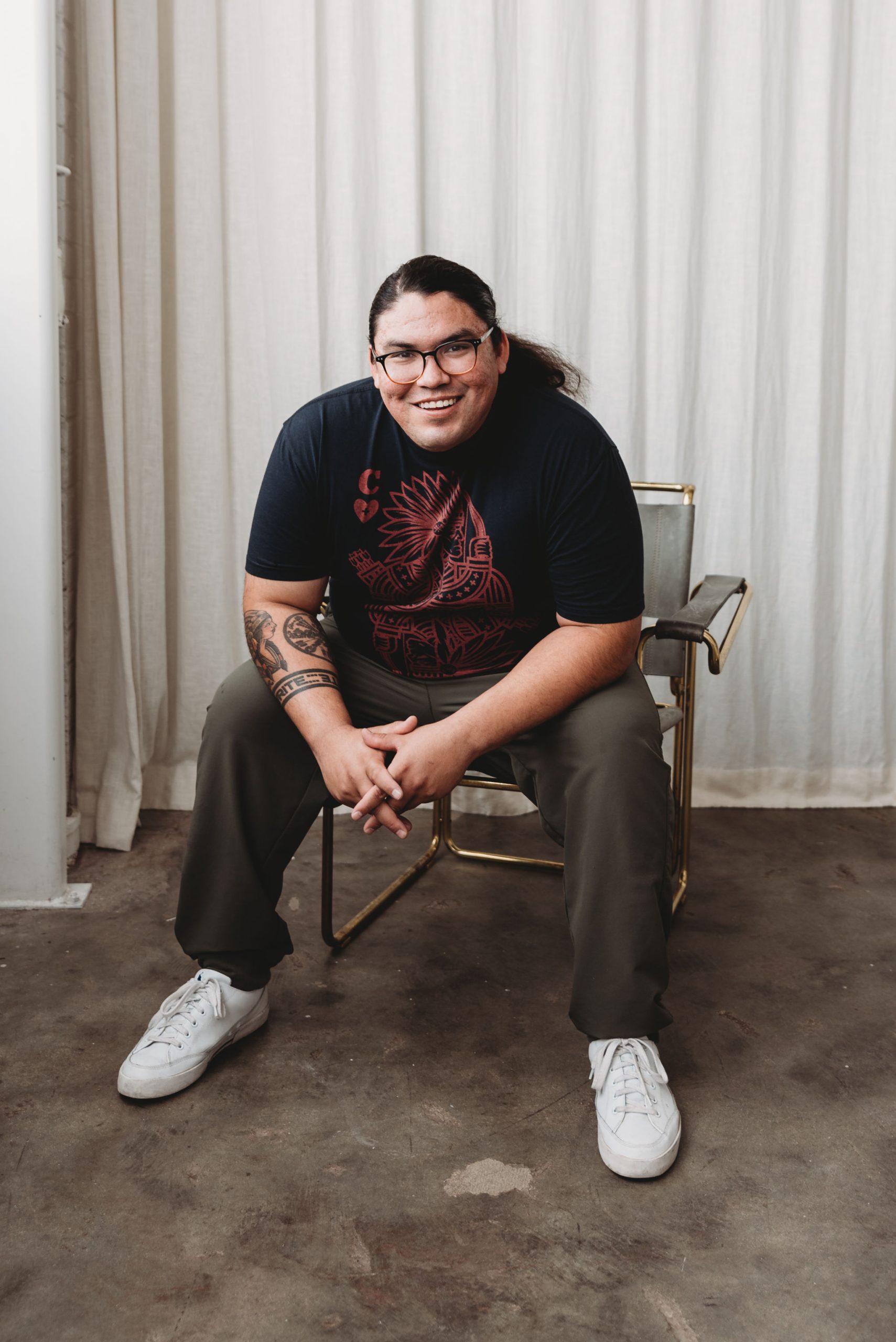
When Joshua Emerson’s mom died in the winter of 2019, he felt like a crucial part of himself had been severed. The Denver-based comedian, writer and actor was raised partly on the Navajo reservation in Arizona, and his mother’s passing sparked a difficult reckoning with his Native heritage. 

“There’s a sense that I lost a little of my Indigenousness when she died, because she was the one that was Navajo, and was from the reservation, and she spoke Navajo,” says Emerson, whose dad is white. “I don’t speak Navajo. There’s a sense that I have to learn how to come back to that as an adult … I feel orphaned culturally, and because of that, it’s made me want to do Native projects and be around Native people.”

Now 31, Emerson is co-chair of the Denver American Indian Commission, and puts on one of the only Native comedy showcases in the United States. He also just became managing director of Creative Nations Collective, a permanent onsite gallery for Indigenous artists at the Dairy Arts Center in Boulder. 

Emerson stays busy these days, performing comedy and helping various communities blossom — from the Colorado indie-comic circle to the world of local Indigenous artists. He’s also the co-founder of DeadRoom Comedy in Denver, a troupe and production company he started with friends Elliot Weber and Jacob Jonas after graduating from Fort Lewis College in Durango four years ago.  

Hosting nearly 200 events since its inception, including the Colorado Native comedy showcase, DeadRoom has become the perfect vehicle to combine Emerson’s industrious ambition with his passion for Indigenous issues. He sees comedy as a vehicle for Native people of various tribal backgrounds to connect and learn from each other.

“Comedy is unique in that it’s able to give voice to minority communities,” he says. “It helps us talk about difficult things and then relieve it through a punchline that just makes everybody laugh and brings [them] into community. When you can talk about difficult things, you’re able to be more honest.”

365702869050101 “If you’re going to talk about something that’s going to bring up trauma in people, you gotta have an exit for it,” says comedian Joshua Emerson. Photo courtesy the artist. 

‘You don’t know what’s funny until you try it’

With that uplift and honesty in mind, Emerson stresses that “Native Americans are not a monolith.” As the only Indigenous member of DeadRoom, which has expanded from its three founding members, he wants folks to know that understanding Native people takes more than catching up on the latest season of Reservation Dogs.

“When you’re talking to a Native you gotta ask, ‘So what tribe or community are you from?’ They [each] have their own history and backstory,” he says. “There’s a big difference between being Ojibwe and being Navajo — being Diné, which is what I am. But it’s cool; we have similar struggles; we see each other. There’s definitely, like, a head nod. There’s a community [that comes] from being Native.”

DeadRoom is now putting on roughly a dozen comedy events a month, according to Emerson, stretching across Colorado and into surrounding states. And as the collective’s footprint grows, Emerson waxes poignantly when asked whether there is any subject that shouldn’t be joked about.

“If you’re going to talk about something that’s going to bring up trauma in people, you gotta have an exit for it,” he explains. “Are you being irresponsible by making jokes that are gonna hurt people? And then there’s this other thing of, you don’t know what’s funny until you try it. So the attempt becomes sacred.”

When it comes to that “sacred” attempt, Emerson says there are few crowds tougher than those found here in Boulder. 

“I’d say Boulder is one of the hardest places to talk about race … even [harder than] Colorado Springs or Fort Collins. When you’re talking about race in those communities, their racism is out in the open, and they’re OK laughing about it,” he says. “You come up to Boulder, I think there’s less racism but the racism that is here is very inside — very hidden — and it’s very hard to reach. When you do bring it up it makes people uncomfortable, because they’ve compartmentalized it. It’s hard for them to find the funny in it. I don’t know if it’s that they’re ashamed, or if they’re aware they even have it stored away.”

But as Emerson continues to push audiences into uncomfortable territory while working to ensure “a seat at the table” for Native people through various organizations and events, the self-described comedy “lifer” returns to a simple but profound goal. 

“The best you can do is try to make it better, and hope that creates a lineage so that it’s easier for anyone that comes behind you.” 


ON STAGE: Underground Comedy Showcase feat. Joshua Emerson and Ben Roy. 7:30 p.m. April 27-29, License No. 1, 2115 13th St., Boulder. Tickets here.