Native

Contemporary native art exhibit

Contemporary native art exhibit
image

NEW BRITAIN — The New Britain Museum of American Art (NBMAA) will present a special exhibition, “The Land Carries Our Ancestors: Contemporary Art by Native Americans,” from April 19 through Sept. 12.

Artist Jaune Quick-to-See Smith, citizen of the Confederated Salish and Kootenai Nation, has curated the exhibition, which highlights artworks by nearly 50 living Native artists that powerfully visualize Indigenous knowledge of land, land base and landscape, the museum said.

Connections to the land: Native artist Amber Du Boise-Shepherd is featured on cover of fall 2023 Sierra Magazine

Connections to the land: Native artist Amber Du Boise-Shepherd is featured on cover of fall 2023 Sierra Magazine

Stan Bindell, Navajo-Hopi Observer

SHAWNEE, Okla. — Amber Du Boise-Shepherd’s illustrations made the cover of Sierra magazine’s fall edition and the illustrations also appear along with the story “Unraveling Manifest Destiny” as the article talks about how tribal nations are buying back their land one parcel at a time.

Du Boise-Shepherd, who is Navajo, Sac Fox and Prairie Band Potawatomi, said she was thrilled about the experience because it gave her a chance to mix her culture with her beliefs about protecting the environment.

“Sierra Magazine honored my style,” she said. “The article shows the tribes have connection to the land.”

She said the editor reached out to her after seeing her art because they were interested in her woodlands tribal art in Oklahoma.

“I have been exposed to all three tribal heritages,” she said. “My upbringing showed there is a connection between all native nations and Mother Earth. It is sacred and that is how we connect with everything including animals, the flowers and nature. We are all stewards of the land.”

DuBoise-Shepherd said when walking on the earth into a hogan on Navajo or a lodge home made of wood on Sac and Fox, a person can feel the connection to the earth.

This is the first major magazine that has carried her illustrations, but her story has been in several others. She said she is accustomed to showing her work in galleries, museums and exhibitions, with Santa Fe Indian Market among her favorites. She was recently part of the Oklahoma Hall of Fame art exhibit.

Born and raised in Shawnee, Oklahoma, DuBoise-Shepherd’s mother is Navajo. DuBoise-Shepherd recalls learning to weave, herding sheep and playing in the dirt on the Navajo Nation as a child She also learned silversmithing. She said she learned beadwork an shawl style from her Potawatomie side.

“I grew up in a home immersed in different Native crafts,” she said. “I would be sitting on my grandmother’s lap and watching her weave.”

DuBoise-Shepherd learned turquoise inlay jewelry making from her Navajo side, but she also dabbled in European art as she mixed the two cultural art forms. Her father played the Native American flute, while her mother also taught her the importance of academics.

DuBoise-Shepherd earned an associate’s degree from Seminole State College before obtaining a BFA with a minor in business from Oklahoma State University. The education paid off as DuBoise-Shepherd became education and outreach director at Mabbe Gerren Museum of Art and currently serves as assistant director at the University of Oklahoma School of Visual Arts.

“I like working with students, so I’m showing others that you can do both: art and administration,” she said.

DuBoise-Shepherd periodically gives lectures and leads art classes around Oklahoma with classes sizes of 50-80 participants.

She said she enjoys watching the transition of weather when she travels from Oklahoma to Arizona.

“I like the wooded areas of Shawnee, Oklahoma, but nothing compares with the mountains of Arizona and New Mexico,” she said. “Oklahoma has these huge beautiful storms.”

For more information visit DuBoise-Shepherd’s website or email her at aldthewoods@gmail.com.

Charles D’Oyly, the British opium agent who brought together Indian and European artists

Charles D’Oyly, the British opium agent who brought together Indian and European artists

In the year 1824 in the city of Patna, straddling the crossroads of rising European trade and a declining Mughal empire, an unlikely group of people met for an even more unlikely purpose. Under the stewardship of amateur English artist Charles D’Oyly, the group, made up of Europeans and Indians, decided on July 1 to form the Bihar School of Athens.

It was to be an art society for the “promotion of arts and sciences and for the circulation of fun and merriment of all descriptions”.

This Bihar School of Athens, also called the United Patna and Gaya Society, would meet at the Patna house of Raja Mitrajit Singh, the ruler of Tekari, known for his interest in poetry and history. Patna of that time was a city of mixed ethnicity with the factories of European trading companies and their bungalows alongside the lavish houses of Indian merchants and landlords interspersed with mosques and temples.

Glimpses of the bustling city with its crowded bazaar street and picturesque countryside were captured in the artwork produced by members of D’Oyly’s society. Patna of the early 19th century was also a leading centre for the collection of opium – and D’Oyly was Bihar’s opium collection agent. The lucrative crop was cultivated along the Ganga River, processed at the Gulzarbagh factory into balls of opium and shipped in crates to Calcutta.

With the expanding power of the British East India Company and Calcutta’s emergence as a distinct British India stronghold, it was Patna that retained its unique, cosmopolitan character. In a departure from solidifying racial divisions and norms, D’Oyly’s “Athenians” also included “native” Indians.

D’Oyly himself was disdainful of British high society. But it was this disdain that brought together like-minded artists rooted in the liberalism of 19th-century India, leaving behind a unique legacy of British Indian visual history.


A stacking room at an opium factory in Patna. Credit: Lithograph after W. S. Sherwill, c 1850, CC BY 4.0, via Wikimedia Commons

Past and present

As much as D’Oyly may have scorned British high society, he was very much a part of it, having been born into nobility and benefitted from influential connections. He was born in 1781 in Murshidabad where his father, Sir John Hadley D’Oyly, was a resident at the court of the Nawab of Bengal. D’Oyly was the godson of the wife of Governor-General of Bengal Warren Hastings.

D’Oyly’s parents moved back to England when he was four and he completed his education there. When D’Oyly turned 17, he received a recommendation from Hastings and joined the Bengal civil services as the Collector of the Customs at Calcutta.

The time during which D’Oyly grew up as a child in Bengal was that of Hastings’s orientalism that was defined by a keen interest in Indology and the free intermingling of British and Indians. But things had changed entirely by the time D’Oyly returned to serve as a member of the Bengal Civil Services under Charles Cornwallis as governor general.

Cornwallis had a contempt for inter-racial mingling and shunted the British in Calcutta who had married to Indians to the outskirts of the colonial capital. The British-Indian society of Calcutta, characterised by its Europeanness in architectural style and segregation of natives and British, did not appeal to D’Oyly.

D’Oyly was derisive of the British imperialists and the Indian babus in their service. His European in India, published in 1813, was a satirical take on the lives of the British in India as well as a racist mockery of the Indians who served them.

In 1785, Hastings was removed from Bengal and sent to London and would soon face trial for corruption. But D’Oyly had continued his correspondence with the influential British administrator, who suggested that the young Englishman turn to the countryside rather than political Calcutta for his postings.

Artistically, too, it seemed that D’Oyly was becoming inclined towards the Indian countryside. During his tenure in Dacca from 1808 to 1812, D’Oyly had met George Chinnery and later James Atkinson, two leading artists of the time. Chinnery’s lasting influence on D’Oyly’s style of art turned his attention to the picturesque countryside of Bihar and Bengal.

After serving as the Collector of Dacca and later as the Collector at Calcutta, D’Oyly became a commercial resident of Patna in 1820. A year later, he was appointed the city’s opium agent and worked in Patna till 1831, which were his most productive years as an artist.


The Summer Room in the Artist’s House at Patna. Credit: Sir Charles D’Oyly, 7th Baronet, CC0, via Wikimedia Commons.

Patna of the old and new

Unlike Calcutta, Patna was a decadent city reminiscent of the old aristocracy. Segregated due to ethnicity from the times of Cornwallis, it was art that brought literary and visual artists and patrons together in Patna. The creation of a distinct British-India in Calcutta had sidelined Anglo-Indians, many of whom were part of D’Oyly’s circle, or were close to his father and Warren Hastings’s family.

The Bihar School of Athens, thus, was a distinct outlier, becoming an artistic haven for British, Anglo-Indian and Indian artists and migrants.

The Asiatic Society of Bengal in Calcutta, for instance, which had been pursuing oriental research since 1784, admitted only European members until 1828. Similarly, the Indian Museum, established in Calcutta in 1814, did not have any Indian artists in its collection though it held the work of leading European artists of the time.

London, by then, had a history of founding art societies, the most prominent of which was the Royal Academy of Arts. The Academy had art schools that trained students through copying old masterpieces as well as drawing directly from nature.

D’Oyly, in many ways, was perhaps trying to establish a similar art movement in Patna and hoped to train local Indians to draw directly from nature, with accuracy.


A detail from a drawing of a European gentleman with his ‘munshee’ or teacher of native language, from ‘European in India’. Credit: Williamson, Thomas, Captain, The European in India, London: Published and sold by Edward Orme, 1813, via the Yale Center for British Art.

But unlike the Royal Academy, which did not admit amateurs – including D’Oyly – as its members, the Bihar School of Athens was a body of amateur artists interested in promoting art. The “Athenians” included George Chinnery as patron, D’Oyly as president and CW Smith, a bird painter and naturalist, as vice president.

Other “Athenians” were D’Oyly’s wife, Elizabeth Jane, an artist herself, and James Young, an officer of the Bengal Horse artillery and an amateur artist. John Elliot, son of Lord Minto, as well as Mary Fendall, the wife of Sir John Hadley O’Doyly II, were also members. Others such as Sarah Amherst, the wife of Lord Amherst and a botanist, and Robert Smith, an engineer were also part of the group.

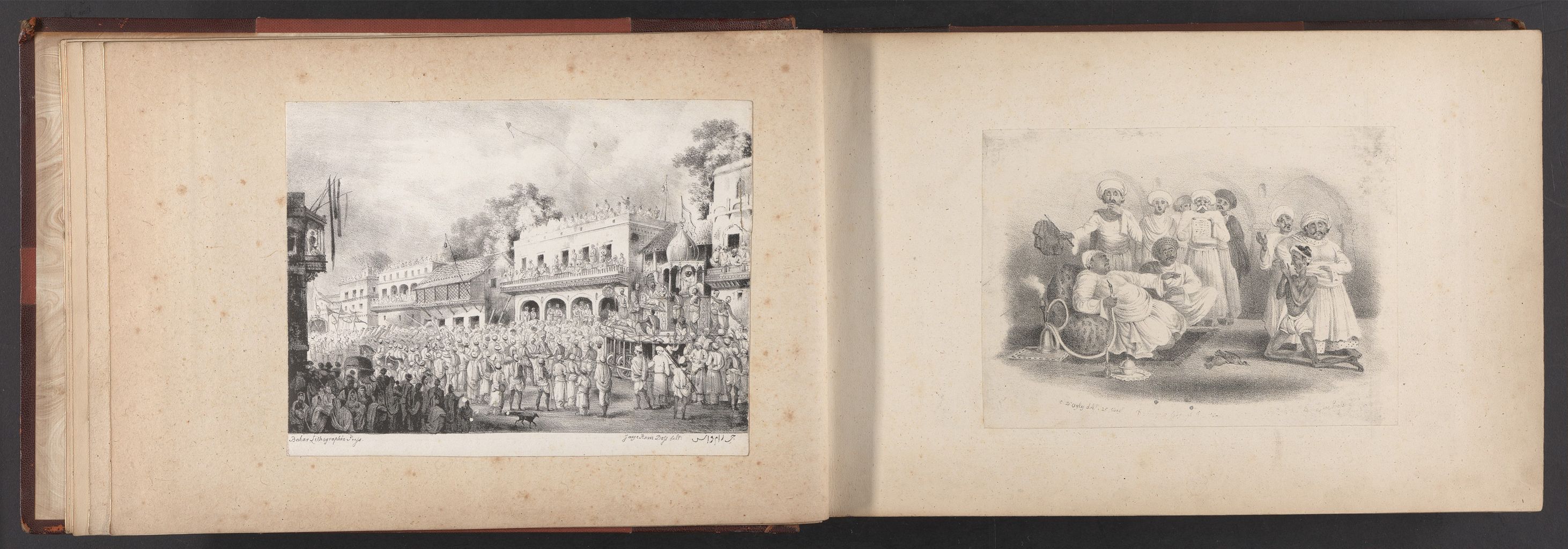
Between 1828-’32, D’Oyly set up the Behar Lithographic Press. The Behar Amateur Lithographic Scrapbooks, published between 1828 and 1830, comprise the work of several artists who were “Athenians”. The work of two Indian artists, Shiv Dayal and Jai Ram Das, can also be found among the pages of the scrapbook.


An illustration by Jai Ram Das from an edition of the Behar Amateur Lithographic Scrapbook. Credit: D’Oyly, Charles, 1781-1845, Behar amateur lithographic scrap book, Patna, India, 1830, Yale Center for British Art.

Das, who was D’Oyly’s assistant in the Behar Lithographic Press, was an artist of the Bihar School of Athens and made prints in stone of some of the artworks for D’Oyly. His cousin, Hulas Lal, had moved from Benares and come to Patna where he was hired as a draughtsman by the East India Company. He worked for Indian and European patrons and several of his works have been found dated 1816.

Nisar Mehdi was another artist who migrated from Murshidabad to Patna. He, too, produced artwork as part of the Bihar School of Athens. Mehdi worked about the same time as Sewak Ram, another famous artist who had also moved from Murshidabad to Patna. Mehdi came from a family of artists who had painted for the Mughals and later for the nawabs of Murshidabad.

Fakir Chand Lal, who had his atelier in Lodi Katra where he taught art, also made drawings for Christopher Webb and D’Oyly’s Oriental Ornithology, published by the Behar Lithographic Press in 1829.

During his Patna days, D’Oyly’s Behar Lithographic Press also published the Indian Sports (1829), a visual account of the hunting expeditions of Indians and British, Costumes of India (1830), Sketches of the New Road in Journey from Calcutta to Gyah (1830) and Featherhead Game of Hindostan (1828).


An illustration of the Large Indian Grouse, published by the Behar Lithographic press. Credit: Charles D’O’yly and CW Smith, ‘The Feathered Game of Hindostan’, 1828, Yale Center for British Art.

Art transcends divides

Away from the racial politics and opulence of British Calcutta, the Athenians focused on scenes from everyday life, landscapes and flora and fauna – the three artistic themes in vogue in the 19th century. D’Oyly gained a reputation in England as an amateur artist who had introduced the picturesque to native artists in Patna. But at the same time, D’Oyly was also influenced by the artists of Patna.

Although it is difficult to precisely point out who influenced whom, there are two ways of seeing D’Oyly’s approach: he was either liberal for his era and believed that Indians and the British could both be part of an art society, unlike the segregation in place in Calcutta. Or he felt that Indian artists lacked skills but could be taught in European style, which is symptomatic of the British civilising mission of Indians from the late 18th century onwards.

But there is another possible interpretation, the more likely one, which is that the Patna to which D’oyly had arrived in was already a centre of artistic production blending Mughal, Murshidabad and European styles. Patna was already a centre of artistic pursuit and artists sold their work to patrons on demand. D’Oyly and other European artists, may have been just as influenced by the ancient city and also introduced the European style in art.

The commingling of art with Patna’s other nerve centres was also where the “Patna Kalam” was born, a unique art style influenced by the Mughal era, Bengal’s Murshidabad – another great centre of art – and the Europeans. The Patna Kalam was characterised by its “kajli siayhi”, which literally translates to black ink, the outline

D’Oyly’s corpus of work is replete with the picturesque of the British aesthetic theory and later romanticism and realism. But the influence of the Patna Kalam is evident in the depictions of the everyday lives of people and the streets. It was the demand for artwork from Europeans and a growing Indian middle-class bureaucracy that the culture of consumption of artworks emerged from.

D’Oyly’s influence really lay in his zeal for the promotion of art and the Bihar School of Athens and the Behar Lithographic Press were his attempts to popularise art.

In promoting the free mingling of artists, regardless of ethnicity, and the opening up his residence and studio to anybody keen on art, at a time when racial segregation and pomp of the British headquarters in Calcutta were a norm, D’Oyly also made a political statement intertwined with his rich artistic legacy.

Sonal is an Assistant Professor at the Department of History, Shivaji College, University of Delhi.

Sundance announces indigenous fellowship winners

Sundance announces indigenous fellowship winners

Saturday, the Sundance Institute announced the filmmakers selected for the 2024 Merata Mita Fellowship and the inaugural Graton Fellowship for Artists from California-Based Tribes.

The Merata Mita Fellowship is an annual fellowship named in honor of the late Māori filmmaker Merata Mita (1942–2010) to support indigenous women-identified artists endeavoring to direct their first feature film.

This year’s Merata Mita Fellowship will go to Libby Hakaraia (Ngati Kapu, Ngati Raukawa au ki te tonga).


The recently announced Graton Fellowship, created to support indigenous artists from California-based tribes, both federally and non federally recognized, will go to Tazbah Rose Chavez (Dinè, Nüümü, San Carlos Apache).

Both fellows were recognized at the 2024 Sundance Film Festival Native Forum Celebration Presented by NBCUniversal Launch and Nia Tero at The Park in Park City..


“It feels incredibly meaningful to have Libby and Tazbah as the recipients for the Merata Mita and Graton Fellowships, respectively, this year. It’s also a bit of a spiritual homecoming too,” said Adam Piron, the director of the Sundance Institute Indigenous Program. “Both are established artists with deep ties to their communities, the histories that these fellowships are rooted in, and we’re thrilled  to be  supporting their upcoming projects with these incredible opportunities and I’d also like to thank Chairman Greg Sarris, the community of the Federated Indians of Graton Rancheria, and our donors for making this possible”

Libby Hakaraia 
Sundance Institute

Merata Mita fellow Libby Hakaraia is an indigenous storyteller with over 30 years of experience in the screen industry as a director, writer, and producer. She has worked on a wide range of projects, including current affairs, documentaries, entertainment series, and short and long-form dramas. Her work has have been recognized worldwide, with her short films being screened internationally.

She has produced two feature films, Cousins (2021) and Kōkā (2023, currently in post-production). In 2014, Hakaraia took the lead in establishing the Maoriland Film Festival in her tribal home of Ōtaki.

What began as a local event has grown into the largest annual indigenous festival in the Southern Hemisphere. She creatd a center of excellence in Māori Film and Creative Arts in 2016. This initiative has provided a platform for new Māori and indigenous filmmakers to showcase their work, including the International NATIVE Slam, which has resulted in 21 films produced by 60 international filmmakers.

In 2018, Hakaraia was honored with the Women in Film and Television Entrepreneur award, and in 2023 she received a New Zealand Order of Merit for outstanding services to media and film.

Hakaraia currently has a slate of film projects in development, including her directorial debut feature film.

“It is an honor to receive this award. It comes at an exciting time for me and the projects I have been developing whilst building the Māoriland Film Festival over the past decade. Merata Mita was an inspirational storyteller who challenged Indigenous filmmakers to strive for excellence in their craft. She remains a motivating force for me and for so many others and hence why I am humbled to be the recipient of this year’s Merata Mita Fellowship,” said Hakaraia. “With this support from the Sundance Institute, along with that of my mentors within the indigenous filmmaking community, I intend to be bold and aim for new heights in storytelling. This fellowship will enable me to strengthen my skills, extend my networks, and grow my confidence — and prepare to helm a large-scale genre feature in 2024.”

Merata Mita (Ngāi Te Rangi/Ngāti Pikiao) is known as the first Māori woman to solely write and direct a dramatic feature film. As an advisor and artistic director of the Sundance Institute Native Lab (2000–09), she uplifted the voices and encouraged the creative development of countless indigenous talents. To honor her legacy, Sundance Institute awards a fellowship in her name to an indigenous woman-identified filmmaker from a global applicant pool. The fellowship, now in its ninth year, includes yearlong support with activities, including attendance at the Sundance Film Festival, access to strategic and creative services offered by Sundance Institute’s artist programs, a cash grant and mentorship opportunities. 

The Sundance Institute Indigenous Program has selected Tazbah Rose Chavez as the inaugural Graton fellow and will provide support for a project in development or production, granting critical financial and creative support throughout 2024. The Graton fellow will receive a grant of $25,000, yearlong creative mentorship from Indigenous Program staff, access to creative and professional development opportunities, and support to attend the Sundance Film Festival. The Graton Fellowship is made possible as part of arecently announced $4 million endowment from the Federated Indians of Graton Rancheria, the largest endowment gift in the nonprofit’s history, which will also facilitate scholarships for Indigenous Californians.

Chavez (Dinè, Nüümü, San Carlos Apache) is a performance poet turned television writer and director from the Bishop Paiute Reservation. She is currently co-executive producer/episodic director on FX’s Reservation Dogs. She has worked on SyFy’s Resident Alien and Peacock’s Rutherford Falls, directed on Max’s The Sex Lives of College Girls, and is a writer-director on FOX’s new series Accused. Tazbah has written ads for Nike N7 and directed health and cultural preservation campaigns and PSAs for tribes throughout California. She has performed her poetry at the Smithsonian’s National Museum of the American Indian, Meow Wolf, and the Grand Performances Stage. She holds a degree in American Indian Studies from UCLA and is the former co-chair of the Writers Guild of America West Native American & Indigenous Writers Committee.

“I am honored to be the inaugural recipient of the Graton Fellowship, created to support California Indigenous filmmakers. As a citizen of the Bishop Paiute Tribe, I am grateful to Chairman Greg Sarris, Graton Rancheria, and Sundance Institute for investing in California Native artists and for their generous support of me and future recipients,” said Chavez. “This fellowship is vital because California is home to both the film industry and to the largest number of Tribal Nations in the country, and California Native perspectives are sorely missing from the cinematic landscape. The support from the Graton Fellowship comes at a fortuitous time, as I’m developing my first feature film. I began my journey with Sundance interning as a college student for the Native and Indigenous Program. It is a warm welcome home to have their support at this pivotal moment in my career. I am humbled by this recognition and look forward to bringing a native female-led comedy to cinema together.”

Tazbah Rose Chavez
Sundance Institute

The Native Forum Celebration honored the Sundance Institute Indigenous Program fellows, grantees, and alumni on Traditional Ute Nation Territory. The event featured an opening blessing by Bart Powakee and the Red Spirit Singers from the Ute Tribal Nation and remarks from Sundance Institute CEO Joana Vicente, Sundance Institute Board member Amy Redford, Nia Tero (represented by Tracy Rector), Jeanne Mau (NBCUniversal), and Indigenous Program Director Adam Piron (Kiowa and Mohawk). Piron also announced the five 2023 Native Lab fellows and acknowledged the seven Indigenous-made projects from around the world that are premiering at the 2024 Sundance Film Festival from Jan. 18–28.

Encouraging self-determination in storytelling for indigenous filmmakers and decolonizing the screen has been a goal at Sundance Institute since its inception. Native American filmmakers participated in the founding meetings of Sundance Institute and its first filmmaking lab in 1981.

The institute’s Feature Film Program, Documentary Film Program, and Sundance Film Festival conduct ongoing outreach to indigenous artists and collaborate with the Indigenous Program to identify artists for support across the globe.

Over the years, Sundance Institute has supported leading indigenous filmmakers such as  Sterlin Harjo (Seminole/Muskogee), Taika Waititi (Te Whānau-ā-Apanui), Sky Hopinka (Ho-Chunk, Pechanga), Fox Maxy (Mesa Grande Band of Mission Indians and Payómkawichum), Erica Tremblay (Seneca/Cayuga/Wyandotte Nations), Adam and Zack Khalil (Ojibwe), Billy Luther (Diné/Hopi/LagunaPueblo), Andrew Okpeaha MacLean (Iñupiaq), Aurora Guerrero (Xicana), Sydney Freeland (Diné), Ciara Leinaʻala Lacy (Kanaka Maoli), Lyle Mitchell Corbine, Jr. (Bad River Band of the Lake Superior Tribe of Chippewa Indians), and Shaandiin Tome (Diné).

Native artist form Montana break barriers and make waves in Hollywood

Native artist form Montana break barriers and make waves in Hollywood

CROW RESERVATION- Elias Jade Not Afraid is on top of the world, he’s working on himself and advancing his community.

“Its been a really good 2023,” Not Afraid said.

He’s become a household name in the fashion world but he’s incredibly humble.

“It kind of starts to hit, every once in a while,” Not Afraid said, “I don’t know I have always been taught not to be prideful and not to get to ahead of myself. 

He was born and raised on the Crow Reservation, but left for a bit—to work on his sobriety.

“I didn’t have anything going on in life… and I did the only thing I knew how to do which was beading,” Not Afraid said.

It turned his life around, he’s featured in magazines on the cover of, most recently “The Wrap,” magazine—and on the red carpet.

“It’s really new for me,” Not Afraid said.

He just did a project for Lily Gladstone who is also from Montana, the two have been friends on the Internet for many years, mutually supporting one another.

“With her—it was like if you need anything, earrings for a photo shoot… I can hook you up,” Not Afraid said.

She recently wore a pair of his earrings on the red carpet and she even said—everyone was obsessed!

“I was like .. we need to uplift, help and support all native artists in all mediums,” Not Afraid said.

His mission with this most recent project was to incorporate their tribal roots, incorporating both Crow and Blackfeet nods in the earrings. 

Gladstone wore the earrings to the Critics Choice Awards, they featured antique Russian blue trade beads and large shells historically used in headbands and hairbows.

“We want our people that are representing our people to look good,” Not Afraid said.

So with 2023 behind us, 2024 it’s already starting off on a high note for Not Afraid and Gladstone, two incredible people from Montana making waves representing their culture.

For Gladstone she’s using her voice to amplify and visually represent the community and for Not Afraid, with every bead stitched, and every photo taken—it’s Heritage protected.

“Its an art it’s a craft that our tribes have been doing for some time now… we need to keep it going,” Not Afraid said.

More from this section

Native artist from Montana break barriers and make waves in Hollywood

Native artist from Montana break barriers and make waves in Hollywood
image

CROW RESERVATION- Elias Jade Not Afraid is on top of the world, he’s working on himself and advancing his community.

“Its been a really good 2023,” Not Afraid said.

He’s become a household name in the fashion world but he’s incredibly humble.

“It kind of starts to hit, every once in a while,” Not Afraid said, “I don’t know I have always been taught not to be prideful and not to get to ahead of myself. 

He was born and raised on the Crow Reservation, but left for a bit—to work on his sobriety.

“I didn’t have anything going on in life… and I did the only thing I knew how to do which was beading,” Not Afraid said.

It turned his life around, he’s featured in magazines on the cover of, most recently “The Wrap,” magazine—and on the red carpet.

“It’s really new for me,” Not Afraid said.

He just did a project for Lily Gladstone who is also from Montana, the two have been friends on the Internet for many years, mutually supporting one another.

“With her—it was like if you need anything, earrings for a photo shoot… I can hook you up,” Not Afraid said.

She recently wore a pair of his earrings on the red carpet and she even said—everyone was obsessed!

“I was like .. we need to uplift, help and support all native artists in all mediums,” Not Afraid said.

His mission with this most recent project was to incorporate their tribal roots, incorporating both Crow and Blackfeet nods in the earrings. 

Gladstone wore the earrings to the Critics Choice Awards, they featured antique Russian blue trade beads and large shells historically used in headbands and hairbows.

“We want our people that are representing our people to look good,” Not Afraid said.

So with 2023 behind us, 2024 it’s already starting off on a high note for Not Afraid and Gladstone, two incredible people from Montana making waves representing their culture.

For Gladstone she’s using her voice to amplify and visually represent the community and for Not Afraid, with every bead stitched, and every photo taken—it’s Heritage protected.

“Its an art it’s a craft that our tribes have been doing for some time now… we need to keep it going,” Not Afraid said.

More from this section

Here’s What’s Going in Indian Country, January 19th-25th

Here’s What’s Going in Indian Country, January 19th-25th

This week in Indian Country, there are plenty of events for everyone to enjoy. From winter powwows to Native American markets and fashion shows, here is Native News Online’s weekly round-up of arts, culture, and entertainment offerings around Indian Country.

Snow Snake Workshop
Washington, CT
January 20, 2024

Join the Institute for American Indian Studies educator and wood crafter Susan Scherf for an afternoon of whittling good fun. Materials will be provided as well as some wood burning kits. Participants are welcome to bring a whittling knife. If weather permits, join in a friendly competition following the workshop.  

Native Art Market’s Outdoor Market
Scottsdale, AZ
January 20, 2024

Native Art Market’s Outdoor Market features over 40 Native small businesses and over 400 Native small businesses sharing the space. Native Art Market strives to provide a safe and affordable avenue for Indigenous families to generate significant profits through their art works.

Young Learners’ Series: Native American Jewelry
Florence, AL
January 20, 2024 

Join in for a short informational presentation on the art of Native American jewelry making past and present. After the presentation, students will have the opportunity to create their own beaded jewelry to take home or share as part of our youth education exhibit. 

Thunderbird American Indian Dancers Pow Wow
New York, NY
January 19-21, 2024

There will be dances, stories and traditional music from Native Peoples of the Northeast, Southwest and Great Plains regions. The event has become a treasured New York tradition for celebrating our diversity by honoring the culture of our first Americans. Throughout the performance, all elements are explained in depth through detailed introductions by the troupe’s Director and Emcee Louis Mofsie (Hopi/Winnebago).

Indigenous Fashion Show Fundraiser
Owasso, OK
January 20, 2024

Join in for a showcase of local Indigenous designers to support two Owasso Natives in their journey to RISE New York Fashion Week! Hosted by comedian Jordan Jayi  Makayla Bucktrot and Owasso graduate Kels Cooper are raising money to help cover the professional hair and makeup artists needed for their models, safe and gentle transport of garments, and quality materials from indigenous suppliers.  

Keith Secola Concert
Apache Junction, AZ
January 19, 2024

Join in for a special concert with Keith Secola, an icon and ambassador of Native American music. Secola is an accomplished artist, garnering awards and accolades as a musician, a singer, a songwriter, a composer and a producer. The Superstition Mountain Museum is hosting this concert as a fundraiser and an introduction to its 2024 Native American Arts Festival which opens January 20 at 9:00 a.m.

Caddo Artist Series Workshop: Comic Creation Basics
Alto, TX
January 20, 2024

Caddo Mounds presents the “Creating Comics Basics” workshop with artist Michael Sheyahshe, a Caddo sequential artist and author. Michael is an enrolled member of the Caddo Nation and the author of the book “Native Americans in Comic Books: A Critical Study.” Michael will offer a hands-on workshop in which you will learn to create comics as a form of self-expression starting at 10 am until 2 pm.  

Oyate Film: Human Rights and Environmental Justice
Santa Cruz, CA
January 20, 2024

Join in for the Oyate Film Screening: Human Rights and Environmental Justice, & Indigenous Activism. In 2016, the world turned its eyes to the people of Standing Rock as they formed a coalition of unprecedented magnitude to defend their land and water from the threat of the Dakota Access Pipeline. An inflection point for human rights and environmental justice, the #NoDAPL struggle became a rallying cry for Indigenous people everywhere to take a stand against the myriad injustices committed against them for centuries. 

Evening of Native American Flute: Al Striplen
Roseville, CA
January 20, 2024

Enjoy an evening filled with music, poetry, and story with author and musician Al Striplen. This event will highlight Al’s intuitive playing style of Native American flute and new artwork and poetry. Al will also explore the history of the flute in Native American culture. Doors open at 6:30 pm and the program starts at 7 pm. This is a free program.

4th Annual Bear Moon Pow Wow
Franklin, WI
January 27, 2024

All are welcome to attend the 4th Annual Bear Moon Pow Wow, which is a traditional pow wow held at the Indian Community School. Grand entries are 12 pm and 7 pm. Dance specials will take place during the evening session. Honorariums for dancers in full regalia who dance their exhibition. 

Opening Reception: Native American in Translation 
Chicago, IL
January 25, 2024

Come join for the opening reception for Native America: In Translation, which brings together the works of nine Native artists who explore aspects of community, heritage, and the legacy of colonialism on the North American continent. By posing challenging questions about land rights, identity, and the legacy of violence toward Native people perpetrated by settler governments, the artists probe the fraught history of photography in representing Indigenous populations.  

More Stories Like This

“Reservation Dogs” to be Specially Featured at South by Southwest® 2024
North American Indigenous Athletics Hall of Fame Announces 2024 Inductees, Banquet
Here’s What’s Going in Indian Country, January 12—18
New Book Illuminates the Untold Story of the Ho-Chunk Exile in Minnesota

Native Perspective.  Native Voices.  Native News. 

We launched Native News Online because the mainstream media often overlooks news that is important is Native people. We believe that everyone in Indian Country deserves equal access to news and commentary pertaining to them, their relatives and their communities. That’s why the story you’ve just finished was free — and we want to keep it that way, for all readers.  We hope you’ll consider making a donation to support our efforts so that we can continue publishing more stories that make a difference to Native people, whether they live on or off the reservation. Your donation will help us keep producing quality journalism and elevating Indigenous voices. Any contribution of any amount — big or small — gives us a better, stronger future and allows us to remain a force for change. Donate to Native News Online today and support independent Indigenous-centered journalism. Thank you.

About The Author
Kaili Berg
Author: Kaili BergEmail: This email address is being protected from spambots. You need JavaScript enabled to view it.
Staff Reporter
Kaili Berg (Aleut) is a member of the Alutiiq/Sugpiaq Nation, and a shareholder of Koniag, Inc. She is a staff reporter for Native News Online and Tribal Business News. Berg, who is based in Wisconsin, previously reported for the Ho-Chunk Nation newspaper, Hocak Worak. She went to school originally for nursing, but changed her major after finding her passion in communications at Western Technical College in Lacrosse, Wisconsin.


Indigenous artist’s exhibit explores the impacts of colonization

Indigenous artist’s exhibit explores the impacts of colonization

Before viewing Nicholas Galanin’s Interference Patterns, a sprawling SITE Santa Fe exhibition delving in part into the legacies and consequences of colonization, visitors might hear uncontrolled screaming and wonder if they’re about to see more explicit horrors than they’d imagined.

The first room featuring the Indigenous multidisciplinary artist’s work houses Neon American Anthem, an 11½-by-16-foot stark neon sign reading, “I’ve Composed a New National Anthem: Take a Knee and Scream Until You Can’t Breathe.” Fifteen mats are arranged in front of the buzzing red letters in what curator Brandee Caoba calls an invitation for catharsis.

“‘Take a knee’ was made popular through [former San Francisco 49ers quarterback] Colin Kaepernick in the NFL,” she says. “It’s at once a gesture of reverence but also defiance, and ‘scream until you can’t breathe’ is a reference to police brutality and the murders of George Floyd and Tyre Nichols and so many other people of color by police. There’s so much reverberating settler colonial violence and generational trauma in New Mexico. … There’s a lot to be screaming about right now.”

#placement_679661_0_i{width:100%;margin:0 auto;}


Holding pattern

Nicholas Galanin’s White Flag (2022), installation detail. Photo Zach Chambers/Courtesy SITE Santa Fe and the Gochman Family Collection 


Holding pattern

Nicholas Galanin; photo Merritt Johnson


Cleveland Museum of Art conceals Native American pieces on display due to updated federal law

Cleveland Museum of Art conceals Native American pieces on display due to updated federal law

CLEVELAND — Some museums have either covered or taken down Native American exhibits after an updated federal law about how Native American artifacts can be displayed.

The Cleveland Museum of art brings in people from far and wide, but today, not all artifacts are on display.

The museum said in a statement that concealing the Native American displays is in direct response to the updated 1990 Native American Graves Protection and Repatriation Act (NAGPRA).

“Out of respect for the native American tribes and NAGPRA, the CMA has covered the display cases that contain items that might fit the new NAGPRA definitions until the appropriate determinations can be made and, if necessary, consents obtained,” the statement reads, in part.

NAGPRA was created in 1990 to protect and return cultural items to the Native Americans; the provision now requires museums and federal agencies to obtain the consent of lineal descendants, Indian tribes, or native Hawaiian organizations to display cultural items.

“Basically, they’re putting a fire under some particular museums,” said Marie Toledo.

Toledo is a board member on Lake Erie’s Native American council and sits on the advisory board for the museum. She said she was pleased to see how they responded.

“It is enough right now. Yes, they’re following the guidelines. I think they’ve been proactive. There are many museums that have not even done that much,” said Toledo.

She added that it’s painful to see artifacts and pieces of Native American history on display, knowing how they were secured.

“When I go into a museum, and I maybe see a Cheyenne woman’s dress and you can see holes in it. Well, those holes can be bullet holes, and you know, the history of that dress,” Toledo said. “You know how that dress was gotten. It wasn’t just given, some Cheyenne woman didn’t make that dress and say here you go, you know, those were gotten in a really, really violent, genocidal manner.”

Philip Yenyo, with the American Indian Movement of Ohio, feels the same way.

“It hurts for me; I feel like our ancestors aren’t being respected. Our burial sites aren’t being respected,” said Yenyo.

Yenyo believes the museum could have done more.

“They should be consulting with the different native nations to begin with,” said Yenyo.

But Yenyo’s still happy to see they are moving in the right direction. He and Toledo just want their indigenous people to have a say in pieces of their history.

“I hope that it continues to evolve and that we continue to decolonize museums and listen to the people give the people their voice and, return our relatives and our items of significance, culturally and spiritually,” said Toledo.

The Cleveland Museum of Art added that they are going through their records to see if consent has already been obtained for some items.

The museum’s full statement can be read below:

The federal government recently issued new requirements related to the 1990 Native American Graves Protection Act (NAGPRA). These new requirements were issued on December 13, 2023, and went into effect January 12, 2024. A new provision requires museums to secure consent of lineal descendants, Indian Tribes, or Native Hawaiian organizations to display cultural items. The CMA has a few items that may be subject to the new regulations and is currently consulting the relevant parties to secure their consent to display those items. In some instances, the CMA may already have the required permissions based on historical discussions with Native American representatives. The CMA is currently reviewing archival records to determine if consent consistent with the regulations has been obtained and, in instances where there is no record of consent, determine which parties need to be consulted. The 30-day period between the time the new requirements were issued and when they went in effect did not provide adequate time to secure consent. Out of respect for the Native American Tribes and NAGRPA, the CMA has covered the display cases that contain items that might fit the new NAGPRA definitions until the appropriate determinations can be made and, if necessary, consents obtained. Three of the six display cases in our gallery of Native North American art have been covered, so that those items are protected from public view until appropriate consent is obtained.

We Follow Through
Want us to continue to follow through on a story? Let us know.

DAM & New NAGPRA Guidelines 

DAM & New NAGPRA Guidelines 

The Native Arts team and administration of the Denver Art Museum (DAM) have anticipated the new NAGPRA guidelines, which went into effect on January 12, since they were initially proposed. In preparation, members of our staff participated in a recent training conference and webinar on the revised law and new regulations through the Association on American Indian Affairs and National NAPGRA program. These new regulations require tribal consultation and approval from the affiliated Native communities before an institution can display human remains, associated funerary objects, unassociated funerary objects, objects of cultural patrimony and sacred objects (collectively called “cultural items” in the new regulations). The national NAPGRA program issued recommendations to museums on how to maintain compliance, which our staff has carefully reviewed. While we are continuing to do research, speak with our colleagues, and reach out to NAGPRA advisors and Tribal Historic Preservation Officers (THPOs), we have no specific concerns regarding the current displays of items in the DAM’s galleries.

The Denver Art Museum has been in compliance with NAGPRA since its launch and the team is committed to ensuring the museum remains in compliance. While we are confident in our internal processes, on January 12th, out of an abundance of caution, museum staff removed a case with Mississippian/Caddoan ceramics from view. More than 30 Indigenous tribes claim descent from these cultures, and while all descendant communities were notified of these holdings when we completed our original NAGPRA inventories, not all chose to conduct consultations. While the museum doesn’t believe that displaying these items puts its galleries out of compliance with new NAGPRA guidelines, we are reaching out to these communities to give them another opportunity to voice any concerns before displaying these items again.

As always, now and into the future, we will honor any additional display changes requested. The DAM has a long history of working closely with Indigenous communities and their leaders in its ongoing work collecting, conserving, and presenting important artworks by Native artists. Additionally, our actions have long been guided by an internal Policy on Collections Use and Repatriation of Culturally Sensitive Materials, written in collaboration with Walter Echo-Hawk (Pawnee) and Jhon Goes in Center (Oglala Lakota), and formally adopted by DAM’s board, in 1994. We support the spirit of the new regulations and the ongoing efforts of NAGPRA, which afford us a wonderful opportunity to connect and be in dialogue with Native communities. To this end, we continue to respect the wishes of Native community members as we work to incorporate the new NAGPRA requirements into our ongoing work.