Native

Acquisitions of the Month: November 2023

Acquisitions of the Month: November 2023

A round-up of the best works of art that have recently entered public collections

Bargello Museum, Florence
Madonna of via Pietrapiana (c. 1450–55), Donatello

After nearly two years of negotiations, the terracotta relief Madonna of via Pietrapiana (c. 1450–55) by Donatello has been acquired by the Italian Ministry of Culture for the Bargello National Museum. It is the only autographed work by the Florentine master to have remained in private hands and shows the expressiveness and detail typical of the artist. The sculpture, which was originally placed in a tabernacle on the facade of a building at 38 via Pietrapiana, will go on permanent display in the Bargello’s Salone di Donatello.

Madonna of via Pietrapiana (c. 1450–55), Donatello. Bargello National Museum, Florence

Van Gogh Museum, Amsterdam
Peasant Spreading Manure (1851), Jean-François Millet

As a young artist, Van Gogh collected reproductions of landscape paintings by Jean-François Millet; in later years, he drew on this collection when seeking inspiration for his own images of rural life. To illustrate how the French artist influenced his practice, the Van Gogh Museum in Amsterdam have purchased Peasant Spreading Manure (1851): the first work by Millet to enter its collection. The work depicts figures labouring in a field at twilight, painted in earthy tones that informed Van Gogh’s own palette in works such as The Potato Eaters (1885).

Peasant Spreading Manure (1851), Jean-François Millet. Van Gogh Museum, Amsterdam

Brooklyn Museum, New York
More than 300 works by Black and Asian American artists

As part of the Brooklyn Museum’s ongoing efforts to expand its holdings of work by Black and Asian American artists, the New York institution has announced the acquisition of some 300 works – many of which were given as gifts to the institution, and span many periods and genres. Highlights include Golden Gate, Yellowstone (1889) by Grafton Tyler Brown, the first Black artist to paint the landscapes of the Pacific Northwest and California, and Satoshi Studying (1945–54) by Hisako Hibi: the first work by a female Asian American painter to enter the American Art section of its permanent collection. The works are set to go on show in the newly rehung American Art galleries, which are due to open in October 2024.

Laro City (Village Scene) (1968), Twins Seven Seven. Brooklyn Museum, New York

National Gallery of Art, Washington D.C.
Gift of 15 artworks by modern and contemporary Haitian artists

The NGA in Washington D.C. has recieved the first works by Haitian artists to join its holdings, courtesy of two collecting couples, Kay and Roderick Heller and Beverly and John Fox Sullivan. The gifts comprise 13 paintings and two textiles, which date from the 1940s through to the early 2000s. Highlights include works by self-taught artists Philomé Obin, Rigaud Benoit and Wilson Bigaud, as well as beaded flags by the textile artist Myrlande Constant. The works will form the centrepiece of the exhibition dedicated to Haitian art currently titled Spirit and Strength, which opens in September 2024.

President Tiresias Sam entering Cap-Haitien (1958), Philomé Obin. Photo: Courtesy the National Gallery of Art, Washington, D.C.

Huntington Library, Art Museum, and Botanical Garden, Los Angeles
Portrait of José Antonio Caballero, Second Marqués de Caballero, Secretary of Grace and Justice (1807), Francisco José de Goya y Lucientes

Goya’s Portrait of José Antonio Caballero, Second Marqués de Caballero, Secretary of Grace and Justice (1807) has been purchased by the Huntington Library, Art Museum and Botanical Garden in Los Angeles with support from the Ahmanson Foundation. The work, which shows the secretary of state decorated with military regalia, exemplifies Goya’s early career as a portraitist in the years prior to the Napoleonic War. It is the first oil painting by the Spanish artist to enter the Huntington’s collections, where it joins a series of Goya’s etchings already within its holdings.

Portrait of José Antonio Caballero, Second Marqués de Caballero, Secretary of Grace and Justice (1807), Francisco José de Goya y Lucientes. Huntington Library, Art Museum, and Botanical Gardens

Saint Louis Art Museum
More than 100 works by 20th century Native American artists from the William P. Healey Collection

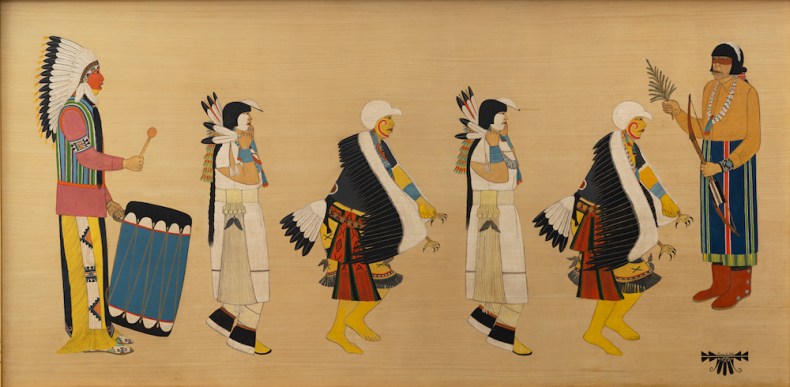
A gift of more than 100 drawings, paintings and sculptures from William P. Healey’s collection of Native American art has been donated to the Saint Louis Museum. The gift comprises work by some 62 Indigenous artists, 55 of whom were not previously represented in the collection, and features a particular focus on artists based in Oklahoma and New Mexico. A rare panel painting by Tonita Peña titled Eagle Dance (c. 1932–33) is among the earliest pieces to join the collection, while later works include the abstract Ephemeration (1962) by the painter George Morrison.

Eagle Dance (c. 1932–33), Tonita Peña. Photo: courtesy Saint Louis Art Museum; © estate of Tonita Peña

National Museums Scotland, Edinburgh
Silver-gilt ewer and basin, 16th century 

The National Museums Scotland has purchased two related pieces of 16th century silverware: a roughly 437-year old set known as the Panmure ewer and basin, which had previously been held in the collection of the Earls of Dalhousie. As most examples dating prior to 1600 were melted down – fewer than a dozen are still extant – this silver-gilded set decorated with dolphins, fish and assorted sealife is a rare survivor. They will now go on permanent display in the Art of Living gallery at the National Museum of Scotland.

The Panmure basin (16th century). Photo: © National Museums Scotland

Musée d’Orsay, Paris
La Verrerie (1900), Georges de Feure

A decorative panel that once adorned the exterior of a pavilion at the Universal Exhibition in Paris in 1900 has been added to the collection of the Musée d’Orsa. La Verrerie (1900) by the Art Nouveau painter Georges de Feure joins two other panels he created for the L’Art Nouveau Bing pavilion: a showcase organised by the dealer Siegfried Bing, who popularised the name for the then-new art movement. The three are the only such panels known to have survived. 

La Verrerie (1900), Georges de Feure. Photo: © Musée d’Orsay/Sophie Crépy

Acquisitions of the Month: November 2023

Acquisitions of the Month: November 2023

A round-up of the best works of art that have recently entered public collections

Bargello Museum, Florence
Madonna of via Pietrapiana (c. 1450–55), Donatello

After nearly two years of negotiations, the terracotta relief Madonna of via Pietrapiana (c. 1450–55) by Donatello has been acquired by the Italian Ministry of Culture for the Bargello National Museum. It is the only autographed work by the Florentine master to have remained in private hands and shows the expressiveness and detail typical of the artist. The sculpture, which was originally placed in a tabernacle on the facade of a building at 38 via Pietrapiana, will go on permanent display in the Bargello’s Salone di Donatello.

Madonna of via Pietrapiana (c. 1450–55), Donatello. Bargello National Museum, Florence

Van Gogh Museum, Amsterdam
Peasant Spreading Manure (1851), Jean-François Millet

As a young artist, Van Gogh collected reproductions of landscape paintings by Jean-François Millet; in later years, he drew on this collection when seeking inspiration for his own images of rural life. To illustrate how the French artist influenced his practice, the Van Gogh Museum in Amsterdam have purchased Peasant Spreading Manure (1851): the first work by Millet to enter its collection. The work depicts figures labouring in a field at twilight, painted in earthy tones that informed Van Gogh’s own palette in works such as The Potato Eaters (1885).

Peasant Spreading Manure (1851), Jean-François Millet. Van Gogh Museum, Amsterdam

Brooklyn Museum, New York
More than 300 works by Black and Asian American artists

As part of the Brooklyn Museum’s ongoing efforts to expand its holdings of work by Black and Asian American artists, the New York institution has announced the acquisition of some 300 works – many of which were given as gifts to the institution, and span many periods and genres. Highlights include Golden Gate, Yellowstone (1889) by Grafton Tyler Brown, the first Black artist to paint the landscapes of the Pacific Northwest and California, and Satoshi Studying (1945–54) by Hisako Hibi: the first work by a female Asian American painter to enter the American Art section of its permanent collection. The works are set to go on show in the newly rehung American Art galleries, which are due to open in October 2024.

Laro City (Village Scene) (1968), Twins Seven Seven. Brooklyn Museum, New York

National Gallery of Art, Washington D.C.
Gift of 15 artworks by modern and contemporary Haitian artists

The NGA in Washington D.C. has recieved the first works by Haitian artists to join its holdings, courtesy of two collecting couples, Kay and Roderick Heller and Beverly and John Fox Sullivan. The gifts comprise 13 paintings and two textiles, which date from the 1940s through to the early 2000s. Highlights include works by self-taught artists Philomé Obin, Rigaud Benoit and Wilson Bigaud, as well as beaded flags by the textile artist Myrlande Constant. The works will form the centrepiece of the exhibition dedicated to Haitian art currently titled Spirit and Strength, which opens in September 2024.

President Tiresias Sam entering Cap-Haitien (1958), Philomé Obin. Photo: Courtesy the National Gallery of Art, Washington, D.C.

Huntington Library, Art Museum, and Botanical Garden, Los Angeles
Portrait of José Antonio Caballero, Second Marqués de Caballero, Secretary of Grace and Justice (1807), Francisco José de Goya y Lucientes

Goya’s Portrait of José Antonio Caballero, Second Marqués de Caballero, Secretary of Grace and Justice (1807) has been purchased by the Huntington Library, Art Museum and Botanical Garden in Los Angeles with support from the Ahmanson Foundation. The work, which shows the secretary of state decorated with military regalia, exemplifies Goya’s early career as a portraitist in the years prior to the Napoleonic War. It is the first oil painting by the Spanish artist to enter the Huntington’s collections, where it joins a series of Goya’s etchings already within its holdings.

Portrait of José Antonio Caballero, Second Marqués de Caballero, Secretary of Grace and Justice (1807), Francisco José de Goya y Lucientes. Huntington Library, Art Museum, and Botanical Gardens

Saint Louis Art Museum
More than 100 works by 20th century Native American artists from the William P. Healey Collection

A gift of more than 100 drawings, paintings and sculptures from William P. Healey’s collection of Native American art has been donated to the Saint Louis Museum. The gift comprises work by some 62 Indigenous artists, 55 of whom were not previously represented in the collection, and features a particular focus on artists based in Oklahoma and New Mexico. A rare panel painting by Tonita Peña titled Eagle Dance (c. 1932–33) is among the earliest pieces to join the collection, while later works include the abstract Ephemeration (1962) by the painter George Morrison.

Eagle Dance (c. 1932–33), Tonita Peña. Photo: courtesy Saint Louis Art Museum; © estate of Tonita Peña

National Museums Scotland, Edinburgh
Silver-gilt ewer and basin, 16th century 

The National Museums Scotland has purchased two related pieces of 16th century silverware: a roughly 437-year old set known as the Panmure ewer and basin, which had previously been held in the collection of the Earls of Dalhousie. As most examples dating prior to 1600 were melted down – fewer than a dozen are still extant – this silver-gilded set decorated with dolphins, fish and assorted sealife is a rare survivor. They will now go on permanent display in the Art of Living gallery at the National Museum of Scotland.

The Panmure basin (16th century). Photo: © National Museums Scotland

Musée d’Orsay, Paris
La Verrerie (1900), Georges de Feure

A decorative panel that once adorned the exterior of a pavilion at the Universal Exhibition in Paris in 1900 has been added to the collection of the Musée d’Orsa. La Verrerie (1900) by the Art Nouveau painter Georges de Feure joins two other panels he created for the L’Art Nouveau Bing pavilion: a showcase organised by the dealer Siegfried Bing, who popularised the name for the then-new art movement. The three are the only such panels known to have survived. 

La Verrerie (1900), Georges de Feure. Photo: © Musée d’Orsay/Sophie Crépy

A new survey of the Aboriginal artist Emily Kam Kngwarray lets her community tell the story

A new survey of the Aboriginal artist Emily Kam Kngwarray lets her community tell the story

“She just painted her country, and all things that were significant to her,” says Kelli Cole, the co-curator of a major survey of the late Aboriginal artist Emily Kam Kngwarray at the National Gallery of Australia (NGA) in Canberra. “Kama, which is seed, the pencil yam, emu; awelye, the Anmatyerr word for ceremony; and Alhalker, which is her country—those [themes] are in every one of her works.”

The exhibition, which includes textiles, works on paper and paintings, has been assembled by Cole and fellow Indigenous curator Hetti Perkins, and will chart the career of an artist who, with no knowledge of international visual arts practice, managed to create a vast body of work comparable with the likes of Agnes Martin, Sol Lewitt and Ellsworth Kelly.

Kngwarray (1910-96) was from Utopia, an Aboriginal community 250km north-east of Alice Springs in Australia’s Northern Territory. Although she had produced textile designs on fabric since 1977, it was Kngwarray’s first work on canvas, Emu Woman (1988-89), made for a landmark group exhibition organised by Utopia’s art coordinator Rodney Gooch in 1988, that saw her receive widespread attention. Featuring distinctive gestural brushstrokes used in traditional women’s ceremony, and dots in white, yellow and reddish brown representing the underground seedpods of the pencil yam, Emu Woman demonstrated Kngwarray’s propensity to express her rich culture on canvas.

Kngwarray’s Seeds of Abundance (1990) uses a dot painting technique © The artist/Copyright Agency

From 1988 until her death eight years later, Kngwarray produced around 3,000 paintings—roughly one per day. During this period, demand for her work was so high that the gallerist Christopher Hodges regularly chartered a plane to drop off fresh canvases and whisk away finished paintings. Consequently “there wasn’t much story [about each work] that they could get from her”, Cole says. Kngwarray would simply say “untitled” or “awelye [ceremonial]” to Gooch, and “he thought she didn’t want to give much more information”, Cole explains.

When Kngwarray’s works went on show, alongside those of fellow Australian artists Yvonne Koolmatrie and Judy Watson at the Venice Biennale in 1997, many critics assumed she was an anomaly. But as Perkins, who also curated the Venice show, explained at the time: “The possibilities of Aboriginal art practice are infinite and can have relevance and resonance outside their immediate cultural context while maintaining the integrity of speaking from within that context.”

Kngwarray’s meteoric rise resulted in her being singled out from her community, but this show aims to “reposition Emily back into her community”, Cole says. “It was [her] story that she painted, but [the Anmatyerr] people are still painting that same story,” Cole adds. Now, through extensive consultation, Kngwarray’s descendants are telling her story and revealing new details about the artist’s work. The curator gives as an example a “couple of paintings that have this amazing, lush green that no one’s ever identified before” but when it was shown to the Anmatyerr women, the green was immediately recognised as the distinctive colour of emu eggs from a creation story. “Every single photograph, every painting, every quote, everything has been taken back to the community for her family descendants and the artists that we’ve worked with to approve,” Cole says.

Kngwarray’s Untitled (awely) (1994) © Emily Kam Kngwarray/Copyright Agency

Another change, following consultation with the community, has been the NGA’s adoption of the Anmatyerr spelling of Kngwarray’s name, in contrast to the previously widespread use of Emily Kame Kngwarreye.

The exhibition will include several important loans, such as early batiks, two recent NGA acquisitions, and Alhalkere—Old Man Emu with Babies (1989), acquired by the actor Steve Martin at the Sotheby’s New York Aboriginal art auction in May 2022. The show will not only be the most comprehensive survey of one of Australia’s most “significant artists”, Cole says, but it will also position Kngwarray “within her community that she never left—in a sense that was the biggest part of her life.”

Emily Kam Kngwarray, National Gallery of Australia, Canberra, 2 December-28 April 2024; Tate Modern, London, opening 2025

Alumna Monica Buckle explores all paths to discover her true calling

Alumna Monica Buckle explores all paths to discover her true calling
image

“At Lynn, I wasn’t just a number, I had relationships with faculty,” said Buckle. “The personal environment at Lynn made it possible for me to finish my degree on time. The small class sizes and my close relationship with my professors helped me get through those harsh times.”

Buckle moved back home to Connecticut and went to Hospital for Special Surgery in New York City, where she fortunately received life-changing care. It took three additional hip surgeries to correct the issues she encountered in her original operation.

Now came a crucial moment in Buckle’s life. A career in hospitality now seemed impossible—the extent of her injury did not allow her to keep up with the physical demands required by the job. Despite this adversity, Buckle stayed grounded and harked back to the experiences she garnered growing up with her family. She pivoted her focus to her love of art.

“I had always loved art. I took art history classes, I visited museums, galleries and art fairs,” said Buckle. “Even while I was a hospitality student at Lynn, I was doing all these things.”

What began as a hobby turned into a new career path. Buckle pursued her M.A. in art business from Sotheby’s Institute of Art in New York City.

“I now had a real-world approach to art. You must welcome the public into your space; you must anticipate social trends, what people appreciate and what appeals to them,” said Buckle. “That knowledge came from my hospitality background at Lynn.”

2023 Posthumous Dance Magazine Awards

2023 Posthumous Dance Magazine Awards

Founded in 1954, the Dance Magazine Awards have historically only been given to living artists. This year’s new posthumous honors were created to recognize some of the many artists active since 1954 who were not given awards during their lifetimes. The Dance Magazine Awards, which have a theme of education, will be presented at Buttenwieser Hall at The Arnhold Center, 92NY, in New York City on Monday, December 4, 2023.

Syvilla Fort

Later, her name would be associated with the brightest stars of Hollywood, Broadway, and concert dance—Marlon Brando, James Dean, Jane Fonda, Eartha Kitt, Chita Rivera, Geoffrey Holder, Alvin Ailey, Chuck Davis, Yvonne Rainer. Yes, dance educator Syvilla Fort taught them all and more. But her influential teaching career started more modestly while she was still a youth in her native Seattle.

4 dancers holding up their right hand and leaning towards the right
From left: Merce Cunningham, Syvilla Fort, Dorothy Herrmann, and Bonnie Bird in The Three Inventories of Casey Jones. Courtesy Cornish College of the Arts Archives.

Born in 1917, Fort learned early, as a Black girl eager for ballet, that race and class could be impediments to professional training and a career pathway. Local dance schools refused to admit her, and this bitter lesson inspired her to open her own door to marginalized students in her community. She started to teach at age 9, and her commitment to education and access held steady through a lifetime of accomplishments.

Offered a full scholarship to Seattle’s Cornish School of Allied Arts (now Cornish College of the Arts), Fort became its first Black student and created work in collaboration with avant-garde composer John Cage. She also danced for several years in the legendary company of Katherine Dunham, absorbing the breadth of Dunham’s knowledge of African and Afro-Atlantic culture and movement. After a knee injury cut her performing career short, she served as chief administrator and instructor in the Katherine Dunham School of Dance, later opening her own school and teaching at Teachers College, Columbia University.

When we note the lasting contributions of Black artists to ballet and postmodern dance, fields previously dominated by white bodies, we must also remember Syvilla Fort’s pioneering efforts and her outspoken advocacy for inclusion and social justice in dance.

Gregory Hines

A consummate artist and much-loved entertainer, Gregory Hines would have turned 77 this year had he survived the cancer that took him in August 2003.

a man tap dancing in a studio
Hines in the 1985 film White Nights. Photo by Anthony Crickmay, Courtesy DM Archives.

When artists master more than one skill, they are often called “double threats,” even “triple threats.” With Hines, you could lose count. Since toddlerhood, Hines steadily built his career in the arts, growing to light up the worlds of stage, film, and television as dancer, choreographer, actor, singer, musician, director, and teacher. His star blazed as the near-forgotten art of tap enjoyed its first major revival and newfound popularity. With his creative skill, irrepressible zest, and charisma, Hines served as a bridge between two great eras of tap dance—old-school veterans like Charles “Honi” Coles, Bunny Briggs, and Sandman Sims, and crusading innovators like Savion Glover and Jane Goldberg, followed by today’s superstars, like Ayodele Casel and Dormeshia. Hines was there to catch the torch and pass it on just as he said his friend, the multitalented and world-renowned Sammy Davis Jr., had passed it along to him.

Fans of tap thank Hines also for his advocacy in lobbying the U.S. Congress to create the annual National Tap Dance Day (May 25), which launched in 1989 and has since gone international. And, like one of many recent honors awarded to Ms. Casel, in 2019, Hines received the distinction of becoming the face of a United States Postal Service Forever Stamp.

An ambassador of tap, Hines continues to be cited, year after year, as a mentor, friend, and inspiration to many. By giving tap an elevated place among his many talents, Hines assured not only that historic and contemporary Black rhythm tap would get more exposure but that dance, overall, would reach more hearts across the U.S. and beyond.

Pearl Primus

A native of Trinidad, Pearl Primus built her long, distinguished career in choreography and education on immersive research into African and African-diasporic cultures. As she wrote in a 1979 statement, dance became her vehicle and language; her freedom and her world; her medicine and strength; her scream and fist; her teacher.

a black and white photo of a woman jumping up in the air
Primus in the 1946 Broadway revival of Show Boat. Photo by Gerda Peterich, Courtesy DM Archives.

In 1941, discouraged by racism in academia, Primus shifted from biology/premed studies and took up with the artist-activists of New York City’s New Dance Group, becoming its first Black student. The influence of Sierra Leone–born musician and dance artist Asadata Dafora helped this young scholarship recipient define her life’s work. Primus’ later anthropology field studies, choreography, and innovative staging of traditional dances would have significant impact on the world’s appreciation for the dances of Africa and the Caribbean and the experiences of Black people in the American South. Her work reached historic and illustrious concert stages—from her 1943 debut at 92nd Street Y to Carnegie Hall, Broadway, Jacob’s Pillow, and many international venues. Primus earned a doctorate in anthropology from New York University in 1978 and was awarded the National Medal of the Arts in 1991.

An electrifying performer, Primus was also notable for thrilling stagecraft. Rather than approach source cultures and communities in exploitive, extractive ways to merely entertain, Primus opened an intellectual and emotional gateway for audiences, rooting her work in authentic contexts, technical excellence, and political meaning.

Primus was not content to dream up dances in her studio. She sought to move hearts towards compassion and social justice. To develop Hard Time Blues (1945), for example, she labored alongside Southern sharecroppers, gaining direct understanding of their struggles. Some of her most notable works deal forthrightly with racist violence—lynchings (Strange Fruit, 1943) and the bombing of a Black church in Birmingham, Alabama (Michael, Row Your Boat Ashore, 1979). Her profound influence continues in the progressive, community-focused aims and methods of dancemakers today, such as Jawole Willa Jo Zollar, Zollar’s Urban Bush Women lineage of artists, and Orlando Zane Hunter, Jr. and Ricarrdo Valentine of Brother(hood) Dance!

Helen Tamiris

Helen Tamiris lived an exemplary New York story. Daughter of Russian Jewish immigrants on the Lower East Side—different sources give her birth year as 1902, 1903, or 1905—Helen Becker renamed herself Tamiris, aligning with the ancient warrior queen of a nomadic Persian people.

a black and white photo of a woman wearing a dress and gloves
Tamiris in the February 1938 issue of Dance Magazine. Courtesy DM Archives.

A brief, unhappy stint in the corps de ballet of the Metropolitan Opera’s ballet troupe followed early training in Isadora Duncan–inspired modern dance at the historic Henry Street Settlement Playhouse. In the 1930s, she discovered her own voice as a choreographer and educator, eventually partnering with Martha Graham, Doris Humphrey, and Charles Weidman to found and direct Dance Repertory Theatre, an early example of an artist cooperative in dance. She also launched the School of American Dance and her own first ensemble.

During the Great Depression, concerned about widespread unemployment in her field, Tamiris successfully lobbied the Works Progress Administration, part of FDR’s New Deal initiative, to build an employment program for dance artists, comparable to what the WPA offered the theater industry. The Dance Project ran for four years, with Tamiris as its chief dancemaker. In 1939, the WPA fell victim to growing political polarization, similar to what we face today, as fiscal and social conservatives cut further Congressional funding. In the 1940s, Tamiris moved on to Broadway, finding success making dance for musicals like Annie Get Your Gun and Touch and Go, for which she won a Tony.

Her courage in addressing poverty, discrimination, antisemitism, and war in her works and to train and employ Black dancers likely led her to be less celebrated than other giants of modern dance of her time. But we can consider Helen Tamiris a courageous progenitor of today’s dance artists grappling with similar issues of representation, culture, and conscience.

New Raclin Murphy Museum of Art opens Dec. 1

New Raclin Murphy Museum of Art opens Dec. 1
Raclin Murphy Building 600

A new gateway to the University of Notre Dame continues the University’s long legacy of commitment to the arts. Welcoming visitors from across the country, the new Raclin Murphy Museum of Art opens its doors to the public Friday (Dec. 1).

The new 70,000-square-foot building on the northeast corner of Eddy Street and Angela Boulevard is designed by the award-winning firm Robert A.M. Stern Architects (RAMSA). Recognized as a leader in classical-inspired architecture, RAMSA has designed an expanded home for the University’s robust art collections that honors both tradition and innovation. The building’s brick, cast stone and Indiana limestone exterior blends with other historic buildings on campus. The new museum, occupying a prominent intersection where the University’s campus meets the greater community, will anchor and function as a gateway to an expanding on-campus arts district.

Inside, the museum’s 23 historically thematic galleries unfold around a multilevel atrium that rises to a central skylight. Classical yet contemporary, the light-flooded atrium greets visitors with works from the Raclin Murphy collection and orients them to the building’s upper and lower floors, connected by two grand staircases. A bookstore is nestled in the central atrium alongside Ivan’s Cafe, named for the Croatian sculptor Ivan Meštrović, who taught and worked at Notre Dame from 1955 until his death in 1962.

“Since its founding, Notre Dame has valued the vital role the visual arts play as an expression of human creativity, religious experience and insight into the human condition,” said University President Rev. John I. Jenkins, C.S.C. “By bringing the collections currently in the Snite Museum of Art to new life in the Raclin Murphy Museum of Art, we will be able to share these treasures in all their richness with our University community, our neighbors in the region and the wider world.”

News Rmma Opening 1200

In addition to education spaces, a teaching gallery, an object study center and a chapel, the state-of-the-art galleries serve as a dramatic backdrop to works from the University’s art collection, which encompasses more than 30,000 objects. With origins that date to 1875, the collection has grown into one of the most significant and extensive collections of any academic museum in the country, with works representing many of the principal cultures and periods of world art history. The museum’s paintings, sculptures, ceramics, prints, drawings, textiles, baskets and decorative arts offer visitors a broad view of global proportions.

“The Raclin Murphy Museum of Art makes an essential contribution to Notre Dame’s strategy as a global Catholic research university for the 21st century,” said John T. McGreevy, the Charles and Jill Fischer Provost of Notre Dame. “The stunning exhibition spaces and the luminous works of art they contain will captivate us with their beauty, spark important conversations in the classroom and beyond and enable us to think in new ways about our past, present and future.”

“The permanent collection, which will celebrate its sesquicentennial in 2025, has been reinstalled with new life and vigor, giving visitors the opportunity to reconnect with and experience cherished artworks from a new perspective,” said Joseph Antenucci Becherer, director of the Raclin Murphy Museum of Art.

“Our search for knowledge is endless. It joins earth and sky.”

Newly commissioned works by globally renowned artists are integrated into the fabric of the building design, beginning with “Endless,” a 36-foot stainless steel sculpture by Jaume Plensa positioned outside of the museum entrance. Reflecting on his visits to the University and its mission, the artist noted, “Our search for knowledge is endless. It joins earth and sky.” The work of art features alphabets in eight languages and symbolizes Notre Dame’s commitment to diversity, internationalization, knowledge and global service.

A monumental carved text panel on the front facade of the building reads, “We are in the midst of reality responding with joy.” The meaningful work of art by Jenny Holzer welcomes visitors to the new Raclin Murphy Museum of Art and sets the tone for the renewed spaces inside, merging tradition and innovation in an effort to resonate with audiences from around the world.

Stepping into the atrium will reveal a circular terrazzo and bronze floor installation by Kiki Smith. “Sea of Stars,” one of the artist’s largest public projects to date, features 39 hand-drawn and cast stars inspired by celestial images frequently seen in medieval, Renaissance and Byzantine depictions of the Madonna as protectress and “Star of the Sea.” Also prominently mounted in the atrium is Maya Lin’s “St. Joseph (River) Watershed,” a reflection on our shared natural environment. The expansive relief with shimmering recycled silver honors the region’s Indigenous people and celebrates the unique geographic, sociological and environmental elements of the St. Joseph River and watershed.

Mimmo Paladino’s artistry adorns the museum’s Mary, Queen of Families chapel, a sacred space for contemplation and Masses. Paladino’s stained-glass window, incised wall frescoes and mosaic artwork on the ceiling are the result of extensive research of the University of Notre Dame, the Congregation of Holy Cross, Marian iconography and the Pokagon Band of Potawatomi. The large-scale commission will complement the medieval and Renaissance altarpieces in the chapel, offering a unique curatorial opportunity to consider the link between art history and the history of the Catholic Church.

The Raclin Murphy Museum will also unveil new acquisitions by Magdalena Abakanowicz, Zhang Huan, Dietrich Klinge, Julie Mehretu, David Ocelotl Garcia, Jamie Okuma, Yinka Shonibare, Ursula von Rydingsvard, Dana Warrington, Jason Wesaw and others. The recent acquisitions and newly commissioned art will elevate the museum’s holdings of global works and complement objects from the permanent collection, many of which underwent conservation or professional cleaning before being moved to the new building.

Located in the 9-acre Charles B. Hayes Family Sculpture Park, the museum’s location allows for the continued growth of its outdoor sculpture collection. The park installation will feature new acquisitions by Sir Anthony Caro, Dietrich Klinge, Clement Meadmore, Louise Nevelson, Beverly Pepper and Ursula von Rydingsvard among others and provide a new environment for works by Deborah Butterfield, Peter Randall-Page and George Rickey. The park’s landscape architect, Michael Van Valkenburgh, was retained for the horticultural design.

“Designed for both education and enjoyment, the Raclin Murphy Museum of Art is a place where campus and community can experience the richness of Notre Dame’s art and sculpture collections together,” said Melissa DelVecchio, partner at RAMSA.

The newly opened Raclin Murphy building is dedicated to exhibition and educational spaces. The larger vision for the museum includes additional galleries and spaces for teaching, a works-on-paper study center, administrative and curatorial offices and open collections storage. The timeline for these additional elements is to be determined.

“Along with my dedicated colleagues, we say welcome to what is and what can be. Nurturing an ongoing culture of learning through art, we’ve realized this new space to bring the campus and national community together. We have built a building and filled its spaces, but only together can we give the Raclin Murphy Museum of Art the soul it merits,” Becherer said.

The late Ernestine Raclin and her daughter and son-in-law Carmen and Chris Murphy are the lead benefactors of the Raclin Murphy Museum of Art. Admission to the Raclin Murphy Museum of Art is free. For more information, visit raclinmurphymuseum.nd.edu.

Artist of the Month: Katherine Hicks

Artist of the Month: Katherine Hicks

Article content

A native Albertan and home-grown artist, Katherine Hicks’ love for the arts began with “Pierre Trudeau with Rose” while still a budding teen. Not until later in life, however, did that love take on a more structured form.

Advertisement 2

Story continues below

This advertisement has not loaded yet, but your article continues below.

Article content

After many joy-filled hours of exploration and workshops with instructors such as Susan Woolgar, Frank Haddock, and Rory MacDonald, her portfolio filled up with oils, watercolours, acrylics, printmaking, mixed media, pastels, and face painting.

Article content

Although she enjoys the different mediums, an introduction to Encaustics (painting with molten wax and heated tools) plumbed the passion we are all born with, needing only a spark to come alive.  A sense of artist-self evolved through this luminous and intuitive art form which resonated deep in the Spirit.  This passion became life changing and birthed a desire to see more growth, not only as an artist, but also to share it.

More recently, she has favoured intuitive art, leaning to a more abstract realism form, loving the play with the different mediums which brings a joy to creating.

Advertisement 3

Story continues below

This advertisement has not loaded yet, but your article continues below.

Article content

 Katherine has been employed as a graphic artist, window painter for holidays and special events, contracted to the Town of Edson for adult and family art workshops, and children’s summer camps. She loves to hold art parties for life events, fundraisers, team building, or just a ‘something different’ for a night out.

When not painting, her spare time is filled with playing guitar with the Telford Strings for our Seniors around Leduc. She has plans to learn to play the mandolin.

“I joined the Leduc Art Club two years ago when we moved to Leduc as a way to join the community and met wonderful artists, enjoyed the workshops offered, and love the camaraderie in sharing skills. It is an exciting time, stretching and growing, finding different and unique ways to share creations of the heart,” said Hicks.

Advertisement 4

Story continues below

This advertisement has not loaded yet, but your article continues below.

Article content

You are invited to view Hicks’ artwork during the month of December, especially on December 8, for her Artist’s Reception at the Leduc Arts Foundry (LAF) in the Leduc Recreation Centre, from 7 to 9 p.m., to enjoy live entertainment and refreshments. 

The Leduc Art Club also present a monthly Members Gallery at the LAF, where on a rotation basis, members will show a sample of their artwork. The five December artists are Angela De Kort, Kristine Anderson, Kathleen Jackson, Rick Sluggett, and Jane Piercy. 

Being involved with the Leduc Art Club takes on many different forms such as the Leduc Arts Foundry Christmas Market on December 2, where you will have the pleasure of seeing the gathering of some of our local creatives. You will be sure to find something special.

Advertisement 5

Story continues below

This advertisement has not loaded yet, but your article continues below.

Article content

The Leduc Art Club is also involved with various projects in the Leduc community including the LAF’s free community drop-in every Tuesday, from 9 a.m. to 4 p.m. You are welcome to bring in your choice of creations, be it paint, fabric, beading, etc. or just come and be social. They also assist with the LAF’s free teen drop-in on Tuesdays, from 4 to 7 p.m.

Did you know that there is a wonderful variety of talent in Leduc? Bring your family to the Arts Foundry on Tuesday evenings, for musicians, poetry, spoken word, rap, stand-up comedy, improv, and more. You can see for yourself at the LAF Open Mic Night hosted by the Melisizwe Brothers every Tuesday at 7 p.m. You are welcome to either perform or come and enjoy the show. No need to book, just show up.

Would you like to roll up your sleeves and get painting — not on the four walls, but something to hang on them? With the new year around the corner, why not consider becoming a member or make a special request for a class or gift to someone who’s been wanting to try it out? Gift certificates are available.

For more information on our art related activities and upcoming events, please visit www.leducartclub.com.  There’s something for all ages and abilities. You don’t want to miss a thing!

Article content

Comments

Join the Conversation

This Week in Flyers

The wonders of the Aztec world

The wonders of the Aztec world

In 16th-century Tlatelolco, today part of Mexico City, a Spanish cleric and a small group of Indigenous elders, authors and artists created a manuscript documenting their rapidly changing world. As plague ravaged the population, these scholars, scribes and painters composed a document illustrated with some 2,500 images – what has been described as the first encyclopedia in the Americas. The manuscript, known as the Florentine Codex, documented Mexica culture and the Aztec Empire in brilliant detail, as well as the devastation that followed the Spanish invasion of Mexico in 1519, including the introduction of diseases to which the native population had little resistance.

The impetus for the project was practical: as part of their evangelization campaigns, Spanish mendicant friars needed to know the beliefs and traditions of the Nahua-speaking communities they hoped to convert to Catholicism. In the 1570s, the Franciscan friar Bernadino de Sahagún, in collaboration with a group of Nahua speakers including Antonio Valeriano, Alonso Vegerano, Martín Jacobita, Pedro de San Buenaventura, Diego de Grado, Bonifacio Maximiliano, Mateo Severino and others whose names are unknown to us created something far more expansive.

The Tlatelolcan warrior Tzilcatzin throwing stones at the invading Spaniards in Book 12 of the Florentine Codex (1577), Alonso Vegerano. Photo: courtesy the Biblioteca Medicea Laurenziana, Florence, and MiBACT

Following the model of European encyclopedias, especially Pliny the Elder’s Natural History, the codex is composed of twelve books with parallel texts in Nahuatl and Spanish recording the gods, ritual calendar, natural history, philosophy and other subjects of New Spain, including the events of the invasion itself. The manuscript, known as the Historia General de las Cosas de Nueva España (The Universal History of the Things of New Spain), resides in the Laurentian Library in Florence, but it is the Getty Research Institute in Los Angeles that has unlocked the wonders of this remarkable work. The newly unveiled Digital Florentine Codex reveals the magisterial scope of the endeavour. With a user-friendly interface, trilingual texts (Spanish, Nahuatl and English) and superb, high-resolution images, a reader can search for specific topics with ease.

Feather worker (amantecatl) in Book Nine of the Florentine Codex (1577), Alonso Vegerano. Photo: courtesy the Biblioteca Medicea Laurenziana, Florence, and MiBACT

A reader could, for example, search for ‘feather’ and discover in Book Nine the secrets of the amantecah, the artists skilled in feather-working – one of the most highly esteemed art forms in the Aztec Empire. One could learn which birds might have the appropriate plumage – grackle feathers were good for outlines, apparently – but also read, in great detail, how the feathers would be gathered and bound, sometimes affixed to a backing with an adhesive made from orchid bulbs. Iridescent feathers from hummingbirds, quetzals, roseate spoonbills and blue cotingas would be carefully placed so they ‘glowed and shimmered,’ in the resplendent finery donned by kings, warriors and priests.

A xicalpapalotl butterfly in Book 11 of the Florentine Codex (detail; 1577), Alonso Vegerano. Photo: courtesy of the Biblioteca Medicea Laurenziana, Florence, and MiBACT

European pigments were used to depict European subjects, while locally-sourced materials were reserved for subjects from the pre-Conquest period, as was revealed in a study by project co-head Diana Magaloni. Despite such important studies taking place over the past half century, the manuscript has remained unavailable to the public and often available only in partial form to scholars. The daunting size of the manuscript itself impeded a broader circulation of the work. The Digital Florentine Codex, a project helmed by Kim Richter and managed by Alicia Maria Houtrouw at the Getty Research Institute, has been enriched by the contributions of international scholars, including co-project directors Kevin Terraciano from UCLA and Jeanette Favrot Peterson from UCSB, linguists from the Instituto de Docencia e Investigación Etnológica de Zacatecas in Mexico, and a large team of specialists. The Digital Florentine Codex team has made this important manuscript not only accessible but inviting. The reader in search of one subject cannot help but stumble upon a fascinating description of another: merchants, for example, tried not to call attention to themselves, walking about ‘wearing only their miserable maguey fiber capes,’ or that men who were distinguished by their bravery were allowed to wear lip plugs. It is a project that rewards getting lost.

Merchants acquiring quetzal feathers in Book Nine of the Florentine Codex (detail; 1577), Alonso Vegerano. Photo: courtesy the Biblioteca Medicea Laurenziana, Florence, and MiBACT

The Digital Florentine Codex also underscores the complexities of translation in a broader sense, not just the evident and impressive labour behind the Getty Research Institute’s initiative, but how ideas are transmitted (or not) and transformed. The side-by-side translations (which include the first English translation of the Spanish text, by León García Garagarza) encourage us to go from one to the other – an exercise that reveals distinct interests and understandings. From Nahuatl to Spanish a reader can see how concepts are elided or softened; the translations of Nahuatl to English bring back some of the rich texture of Mexica worldviews, whereas the English translation of Spanish text reveals frequent ‘code-switching’ and the use of Nahuatl words, many of which have made their way into modern Spanish. The prologue to Book Two of the Florentine Codex notes that the manuscript ‘has been examined and revised by many, and for many years, and much effort and many misfortunes have been endured in order to render it in the state in which it is now found.’

It is unquestionably cause for celebration that, thanks to the Digital Florentine Codex project, this wondrous window has been opened on to otherwise unattainable information, both in text and illustration, that offers new paths to enrich scholars and the broader public.

View the Digital Florentine Codex: florentinecodex.getty.edu

Keeping ancestry vibrant: IVDM features Indigenous artists at an art exhibition

Keeping ancestry vibrant: IVDM features Indigenous artists at an art exhibition

OCOTILLO – From a deep reflection on Dia de los Muertos about her origins and background, Jessica Anguiano, who grew up in the Imperial Valley and had an Indigenous grandmother, wanted to dedicate time to honor her roots in her artwork.

Anguiano’s art piece to be placed at Imperial Valley Desert Museum, titled “In my Grandmother’s Skin,” emerged from the urge for ancestral connection and diving into her most profound origins.

The unique beauty of Indigenous art through its connection with nature, ancestral techniques and traditions will be reflected in the work of over 17 Indigenous artists from the Southern California and Northern Baja California area who will have their art displayed in a multidisciplinary art exhibition, which will feature Indigenous artists at the Imperial Valley Desert Museum in January 2024.

Although IVDM is an indigenous museum and its focus is to highlight and celebrate culture, IVDM Executive Director Kristin O’Lear said that what makes this exhibition unique is connecting with indigenous artists specifically and not just with the indigenous tribes, organizations and local reservations, which the museum has connected with in the past.

“While we do a really good job interpreting how ancient peoples of this region lived in antiquity, we don’t have as much as we should in terms of how they are continuing to live very vibrantly today and in modern times,” O’Lear said.

“As a way to bridge a small gap, it’s one step in the right direction to host the art exhibition and highlight how Indigenous artists and Indigenous peoples are currently moving to this space,” O’Lear said, “and how art aids them in that no matter what they see with their art, what they speak in their art, really highlights that the Indigenous peoples are still very much present and that they are vibrant.”

It’s an opportunity for Indigenous artists to showcase their traditional art pieces while rooting for ancestry techniques and adapting to modern audiences, O’Lear said.

“I’m always trying to touch my roots and trying to give meaning to my art,” Anguiano said of her pieces, which have deep ancestral meaning to her.

Matilde Pacheco Navejas, Anguiano’s grandmother and a native of Jalisco from the Sierra, was a “curandera” and a “partera” in the Mexican region. She passed away at the age of 86 when Anguiano was 6 years old.

Knowing that her grandmother was in touch with the healing process through natural medicine and techniques was essential for Anguiano’s artistic side, inspiring her to create an art piece totally dedicated to her grandmother.

“The little that she taught me got embedded in me,” Anguiano said, “so I try to base all my artwork on her.”

Anguiano also holds other Indigenous roots from her father’s side, who was of native Yaqui heritage, and was forced to hide it because of persecution. However, Anguiano has been a source of light to her family background through her artistic voice.

“I always felt I wasn’t part of something, like something was missing in my life,” Anguiano said. “Recently I started researching, talking to my dad and asking him questions about my origins. That’s what came up with my painting.”

Introducing the Imperial Valley to ongoing conversations about the Indigenous community in the Imperial Valley and surrounding areas while bringing a new sense and appreciation of where they live is one of the main takeaways the exhibition facilitators want the community to have, to “(bring awareness) of the space in which they move with having ties back to the tribal communities,” O’Lear said.

“We are acting only as a facilitator but the artists themselves are the ones raising awareness about issues they feel are important to them as part of this exhibition,” O’Lear said.

Art comes naturally for Olga Navarro, one of the Indigenous artists who will also have her art piece placed at the upcoming IVDM exhibition. Navarro has a rooted talent for artwork with “chaquira” – small plastic beads, traditionally from the “Cucapáh” Indigenous tribe which are used for handmade beadwork.

“It’s an Indigenous craftwork from many years ago from our ancestors,” Navarro said in Spanish about where her inspiration for her art came from. “This craftwork was previously made by sea shelves and then we developed to ‘chaquira,’” she said. “My parents taught me how to make these bracelets.”

Her art piece consists of three bracelets, each of which is embroidered with plastic beads braided to and by each of the bracelets. Each bracelet has a landscape related to her Indigenous tribe formed by the plastic beads.

“I want to promote the indigenous craftwork,” Navarro said. “I want people to get in touch with different frames, draws and ornamental pieces. I want people to spread our culture in the United States.”

Antonia Torres Gonzalez, Wendell Sakiestewa, Camaray Davalos, Thomas Ward, Gloria Crosthwaite, Yanet Salazar Carillo, Sandra Carmona, Stacy Garbani, Amy RedFeather, Angel Garcia, Josue Vasquez, Theresa Jackson, River Garza, Summer Herrera and Lanise Luna are other Indigenous artists that will showcase their work at the IVDM art exhibition.

“Being able to connect with the artistic community has been really exciting,” Ryan Pagett, the IVDM curatorial research fellow, said. “This is not going to be an exhibition but it’s hopefully going to be like a professional development opportunity for IVDM.”

“Even more importantly, for the artists themselves, it gives them the opportunity to get to show off their work to the surrounding community,” Pagett, who is originally from Georgia where there are any federally recognized tribes at the moment, said.

Celebrating Indigenous art and honoring their cultural heritage while making people connect with their pieces are some of the takeaways the participating artists want people to get from the exhibition.

“The best is the finishing touch,” Anguiano said, “and how it will reverberate on others and they will relate to it.”

Concert band celebrates Native American Heritage Month with the Burnurwurbskek Singers

Concert band celebrates Native American Heritage Month with the Burnurwurbskek Singers
Robeson Amory
DRUMMING IT UP: Attendees and concert band members join the Burnurwerbskek Singers in Smith Union. The band performed in Kanbar Auditorium before audience members migrated to Morrell Lounge for the Singers’ performance.

On Sunday, November 18, Studzinski Recital Hall’s Kanbar Auditorium and Smith Union’s Morrell Lounge came alive with percussion, brass, woodwinds and singing from the fall performance of the Bowdoin College Concert Band, followed by Maine’s own Burnurwurbskek Singers. The program was organized by Director of the Bowdoin Concert Band John P. Morneau in celebration of Native American Heritage Month.

The event featured pieces centered around moments in Native American history and a performance including both traditional and contemporary Native American songs by the Burnurwurbskek Singers, a Wabanaki group. This performance celebrating Indigenous heritage had been a long time in the making, according to Morneau.

“For years I’ve been wanting to do a program with [and] about Native Americans, and I just hadn’t found the right way to do it,” Morneau said.

After working with music publishers to identify various Native American composers and pieces, Morneau contacted the Maine Arts Commission, who put him in contact with the Burnurwurbskek Singers.

“I contacted [the Singers] and their leader Ronnie Bear, who is the principal person in the group, was very receptive to doing this kind of program,” Morneau said.

Morneau’s intention was to ensure that the performance faithfully conveyed Native stories. He shared readings with the band, familiarizing them with the histories surrounding the pieces that they played. The concert featured elements like the use of stones as percussion and the recitation of a poem upon which one of the pieces was based—all part of Morneau’s goal to convey emotion to the audience.

“One of the things that we discussed quite a bit in rehearsals is how are you going to tell the story without speaking?… [Telling the story] through an instrument is kind of like trying to do it with your hands tied behind your back because you can’t say anything,” Morneau said. “You have to tell the story musically because there’s a difference between playing and just performing with passion. And if you don’t perform with passion, the audience knows.”

Clarinetist Brady Nichols ’24 said that Morneau’s commitment added to the rehearsal process.

“We spent a lot of time in the rehearsal process talking about how to respectfully do the concert and how to tell the stories,” Nichols said. “John was very adamant in getting us to read the stories behind [the pieces] because he always said, ‘you can’t tell a story if you don’t know the story.’”

After the band’s performance ended, audience members migrated en masse into Smith Union for the second part of the concert featuring the Burnurwurbskek Singers. The group is made up of Ron Bear, his sons Nick Bear and Cree Neptune Bear, and Nyle Sockbeson. Later in their program they were accompanied by dancers, including Ron Bear’s daughter, Selena Neptune Bear.

The Wabanaki artists performed both traditional and modern songs, inviting audience participation during many numbers. They welcomed audience questions between songs and emphasized their group’s educational mission. Audience members jumped in with various questions about their traditions, practices, instruments and history.

The Burnurwurbskek Singers sat around their central drum, which Ron Bear said was acquired in the 1970s. The members played rhythms with decorated “beaters” and sang songs ranging from ancient pieces honoring their veterans, to the American Indian Movement (AIM) intertribal song, a product of the 70s.

They ended their performance with a circle dance, inviting everyone in the crowd to participate. They taught participants the steps and danced together in a ring in Morrell Lounge.

Audience member Ben Weintraub ’26 enjoyed the two-part program and how they played off of each other.

“I feel like they were complementary. The Concert Band provided a more ensemble-based approach to storytelling. You have so many different instruments providing a lot of different harmonic and melodic elements, whereas with [The Burnurwurbskek Singers], it’s very focused on the drums and on the voice,” he said.

Attendee Jodee Ristich said the themes that both Morneau and Bear discussed resonated deeply with her.

“Performances like this one are really nice for the community because it teaches and is so powerful,” Ristich said. “Information like this is so important to share because it bridges between people, and right now in this country we are very much not bridged.”