Native

11 Things To Do Around D.C. This Thanksgiving Week

11 Things To Do Around D.C. This Thanksgiving Week

This website uses cookies so that we can provide you with the best user experience possible. Cookie information is stored in your browser and performs functions such as recognising you when you return to our website and helping our team to understand which sections of the website you find most interesting and useful.

Junior Eurovision’s Language Rule: What The Artists Think – ESC Insight – Home of the Unofficial Eurovision Song Contest Podcast

Junior Eurovision’s Language Rule: What The Artists Think – ESC Insight – Home of the Unofficial Eurovision Song Contest Podcast
image

Junior Eurovision has one rule that is particularly odd, and, dare I say unique, in the world of music and songwriting. The rule I am referring to is the one governing the language our contestants must sing in.

Firstly, this rule sets out to restrict the freedoms of artists and songwriters. The rule restricts countries to sing in an official language of the competing broadcaster. This means that the Armenian act will need to sing in Armenian, the Estonian act in Estonian, the Dutch act in Dutch and so on.

However the rule isn’t completely restrictive, and singing in a different language to the national language is also allowed…for a small percentage of the song itself. Since 2017 this has been communicated as being 40 percent of a song, allowing acts to include both a verse and chorus in a different language. Poland’s subsequent Junior Eurovision winners maxed out this ability by opening both songs with the English language.

[embedded content]

[embedded content]

A large percentage of the acts use this option to switch into a different language. In the past ten years 63% of all the competing songs were sung in more than one language. Of those songs that switched languages part-way through, only two of them chose not to include English in them. Both of those cases were an attempt to appease the Parisian crowd with Français in 2021

Now I’ve previously made my thoughts on this issue very clear. I find this rule an artificial construct that encourages more English than otherwise, and forced, muddled English at that, far too often. It would be far better to have a free language rule, I argued in 2020, as fewer and fewer in today’s Eurovision environment need to have their arms twisted to share their native tongue on the continent’s biggest stages.

I also want my Junior Eurovision lyrics to have at least enough grammatical sense to them that the artists won’t cringe once they have completed a couple more years of English tuition at school. Memorably clunky lyrics such as “thing what we always need” and “we all are just the humans” are trying to share a deep message but miss the mark badly. There would be more conviction for many songs if they didn’t crowbar in a language change like Eurovision songs did to key changes 20-odd years ago.

[embedded content]

[embedded content]

But this isn’t about what a now 35-year-old thinks about the rules of Junior Eurovision. I’ve had my turn. This is about the young artists themselves. I wanted to know what the opinions were of the next generation coming through.

So I asked them.

The Question

We now head back to Yerevan, the host city of the 2022 Junior Eurovision Song Contest. On the day before the Junior Eurovision final two press conferences were held for the participating artists (there were simply too many to accommodate the whole class of 2022 on stage at the same time). I asked the same question at both press conferences, to all the acts that sang their 2022 entry in more than one language.

If you had to choose to sing in just one language, your national language, English, or another language, which one would you choose, and why?

[embedded content]

[embedded content]

My question pushed the young artists to take a side, not just on the song they are presenting but also on the image they would want to show of themselves to the wider world. Would they choose English to ensure their message can be understood from Lisadell to Latvia, or would they choose the native language to express their art in a way that would be unique to the country that they are representing?

I was impressed by the speed in which Mariam Bigvava from Georgia replied. Almost as soon as she grasped the microphone she expressed her opinion that she would prefer to sing her song in the Georgian language.

“I would choose my national language because I love my country and my language, it’s so beautiful for me.”

David Charlin, representing Kazakhstan, agreed, stating “I’d also like to choose my national language.” This was echoed by the competition’s eventual winner, Lissandro from France, who said, “I love singing and speaking in my language because my language is a part of my country and it is in my heart. For me, it’s the best language.”

“Of course, I will choose my language,” started Kejtlin from Albania, “but I want to speak and sing my song in English maybe, because I want everyone to know what is the message of my song, because my song is for peace, and to share the message with everyone I meet.”

[embedded content]

[embedded content]

Of the acts at the first press conference, Kejtlin was the only one to express any response in favour of singing in English, with the aim to reach a wider audience with her message.

The irony of course here is that the rules would have allowed Kejtlin a verse and chorus to sing in English, her 2022 entry was presented fully in Albanian.

The Twist At The Second Conference

I asked the same question to the acts taking part in the second press conference. However, the bunch of answers didn’t go as expected.

Lara Trpčeska, performing for North Macedonia started strong.

“First of all I’d like to start by saying all of these languages have something unique inside of them. Something unusual that no other language has. If I had to choose to sing in a different language I would choose the Spanish or the Italian one because I really like them, especially the sound of them and I have visited those countries a couple of times.”

Now her song was one of those bilingual entries in her native Macedonian and English, with not an utterance of Spanish or Italian in the mix. For whatever reason she decided to bring them into the equation of this question, and the other acts ran away with her tangent.

[embedded content]

[embedded content]

Zlata Dziunka from Ukraine also chose Spanish or Italian, simply because she “really likes them”. Nare, representing Armenia, chose the same two languages as well, as they were her “favourite countries”. Sophie Lennon from Ireland went for the trifecta of Spanish, Italian and Armenian, describing these languages as “unique.” Serbia’s Katarina Savić also made the popular choice in the press room of Armenian because “it’s beautiful and I love Armenia so much”, and Carlos Higes also added Armenian to his choice of “very romantic” French. Even Nicolas Alves, who was born in the United Kingdom and grew up there until age 10, chose Italian and French because of their “beautiful countries and cultures.”

From where we started to where we finished at this press conference was one long crazy game of Broken Telephone, missing the original dilemma my original question posed.

But you know what, it was all the better for it.

Despite Freya Skye sitting amongst the other acts, and despite her song being the televote-winning bop of the season, no one even came close in this group to uttering a desire to sing in English.

English In The Future

Nine of the competing entries at Junior Eurovision last year performed their song partly in English and partly in their native language. If you had a completely free language rule at Junior Eurovision, do you think reading this article that they would have all switched to 100% English for their JESC entries? I think not. Yes, being understood is important, but what is becoming more important in today’s world is the ability to express your true emotions and story, whatever language that is.

This next generation are growing up in a world where televote heroes including Måneskin, Go_A, Kalush Orchestra, and Käärijä. Their success offers plenty of evidence that one does not need the English language to be supported in today’s Europe and to get their emotions across.

[embedded content]

[embedded content]

One may fear that removing language restrictions will see a grammatically weak, English-language free-for-all at Junior Eurovision. I think in today’s climate the opposite would happen if we allowed for freedom to flourish. Junior Eurovision’s most arbitrary and unnatural rule becomes less and less needed each year we progress.

The way those artists spoke last year fills me with confidence that they would make the correct decisions.

Brooklyn Museum Adds Hundreds of Artworks by Black and Asian-American Artists to Its Collection

Brooklyn Museum Adds Hundreds of Artworks by Black and Asian-American Artists to Its Collection

The Brooklyn Museum has acquired more than 300 new works as part of its ongoing project to expand its representation of Black artists and fill gaps in the museum’s representation of Asian American history and identity.

The acquisitions span categories and mediums—from Dyani White Hawk‘s radiant painting Untitled (Pink and Blue) (2022) to María Magdalena Campos-Pons‘s Polaroid work Voyeurs and Beholders of… (2008) to Gim Jeong-hui’s calligraphic work Letter (1830). These new additions are bound for the museum’s American Art galleries, set to open in 2024.

Gim Jeong-hui, Letter (1830). Photo courtesy of Brooklyn Museum.

“Significantly, 2023 saw the acquisition of our very first artwork made by an Asian American woman–Hisako Hibi,” Stephanie Sparling Williams, the museum’s curator of American art, said in an email to Artnet News.

That work, Satoshi Studying (ca. 1945), was gifted by Ibuki Hibi Lee—the daughter of the artist and Matsusaburo Hibi. The artist was born in Fukui, Japan, and immigrated to San Francisco with her family in 1920 but was imprisoned in an internment camp in 1942. The work depicts her son, the brother to donor Ibuki Hibi Lee, reading at his desk above a busy street after the family moved to New York.

The Brooklyn Museum did not disclose a budget or prices for any new pieces it purchased. But Williams, the newest member to the American art team, briefly discussed its acquisitions strategy, highlighting that many of them came from gifts to the museum.

Esther Mahlangu, Untitled (2017). Photo courtesy of Brooklyn Museum.

“Direct partnership with artist estates and gifts of art have been a hugely impactful way to broaden the American Art collection to include works by Asian Americans, African Americans, and women, in particular,” Williams said, adding that the strategy of the American art department “expands and amplifies” its holdings in preparation for the October 2024 reinstallation of collection galleries.

That transformation was teased last year when the museum boasted the acquisition of 200 objects, focusing on indigenous textiles and art created by women. Full details for the renovation have not yet been detailed but the museum said the entire American Art wing will be reinstalled.

Brooklyn Museum 2023 acquisitions

Dyani White Hawk, Untitled (Pink and Blue) (2022). Photo courtesy of Brooklyn Museum.

The work Untitled (Pink and Blue) by White Hawk was acquired through the Marie Bernice Bitzer Fund and was called “an emblematic example” of her approach to abstraction and study of ancestral art forms. The artist blends Lakota beadwork and historic forms with European American canvas painting.

The 1889 painting Golden Gate, Yellowstone by Grafton Tyler Brown—the first Black artist to create landscapes of the Pacific Northwest and California, was given to the museum by Charlynn and Warren Goins, who also gifted two works by Black still-life painter Charles Ethan Porter and a watercolor by Laura Wheeler Waring of her Pennsylvania studio. The Goins are major donors to the museum, which celebrating them for helping establish “one of the strongest collections in the world” of Black artists.

Grafton Tyler Brown, Golden Gate, Yellowstone (1889). Photo courtesy of Brooklyn Museum.

Meanwhile, the design artist Sheila Bridges has donated her Wallpaper (Harlem Toile) (2005) and other pieces from her collaboration with renowned English manufacturer Wedgwood for the museum’s Decorative Arts and Design collection. The wallpaper specifically is critical of the “deeply prejudiced narratives” in design history.

“We are grateful for the generous support of our benefactors, who help us build a collection that sparks awe and wonder, bridges our humanity, and illuminates important historical stories,” museum director Anne Pasternak said in a statement. “It is a privilege to welcome these remarkable and meaningful contributions to our collection and to share them with our visitors.”

More Trending Stories:  

Conservators Find a ‘Monstrous Figure’ Hidden in an 18th-Century Joshua Reynolds Painting 

A First-Class Dinner Menu Salvaged From the Titanic Makes Waves at Auction 

The Louvre Seeks Donations to Stop an American Museum From Acquiring a French Masterpiece 

Meet the Woman Behind ‘Weird Medieval Guys,’ the Internet Hit Mining Odd Art From the Middle Ages 

A Golden Rothko Shines at Christie’s as Passion for Abstract Expressionism Endures 

Agnes Martin Is the Quiet Star of the New York Sales. Here’s Why $18.7 Million Is Still a Bargain 

Mega Collector Joseph Lau Shoots Down Rumors That His Wife Lost Him Billions in Bad Investments 

Follow Artnet News on Facebook:
Want to stay ahead of the art world? Subscribe to our newsletter to get the breaking news, eye-opening interviews, and incisive critical takes that drive the conversation forward.

ProChile Celebrated Indigenous Art in New York and Chicago November 2023

ProChile Celebrated Indigenous Art in New York and Chicago November 2023

The Aymara, a group of indigenous people in the Andes and Altiplano regions of South America, are dispersed over a vast area that contains a number of ecological and political sectors including the far north of Chile. In Chile, the community lives in the northernmost regions, including Arica, and they are known for their distinct traditions in colorful textiles and music that they’ve developed over thousands of years.

From November 5th to the 12th, a diverse group of artisans from the Aymara community visited New York and Chicago to connect with local artisans and businesses and promote the unique culture and art style of the Amyran Tribe. Their time in New York (Nov. 5th-7th) was centered around community, collaboration and education, and ProChile coordinated several appointments on behalf of the artisans to provide them with a multi-regional view of the US and expose them to the potential market for their products.

“This was a tremendous experience in negotiation, innovation and exclusive business prospecting for the creative industries of Arica,” said Artisan Ana María Nieto Farías. “The future collaboration of the US and Chile is in our hands, and it will be great and rewarding challenge.”

The trip culminated with the “Chilean Artisan Delegation in Chicago,” which included a multi-day itinerary (November 7th-10th) featuring art gallery exhibitions for 125+ attendees, receptions and panel discussions for local and international artisans and workshops. Sixteen artisans and small businesses were able to feature their work, highlighting four main cultural sectors:

Aymara textile: Artists are renowned for their superior technique and the high quality of their pieces, which are generally clothing designs or ceremonial accessories such as chuspas or the ritual tari and inkuña cloths. Textiles were used as trade goods but were also highly valued in Aymara society, some becoming treasured family heirlooms. The costumes are traditionally made by hand with ancient techniques, and the outfits are symbols of family distinctions. These textiles are all created with the goal of preserving history and cultural value.

Music & Instruments: More than just a form of entertainment, music plays a central role in religious rituals and ceremonies. Every Aymara man plays at least one instrument, while the women can sing and dance. These instruments are a fundamental part of the music and culture of these communities and their use dates back to ancient times, before the conquest of the Spanish colonists in America. The instruments can be anything from ocarinas, decorated güiro or pumpkin maracas to water sticks made of cacti & containing volcanic rock pebbles that produce rain sounds, panpipes or flutes.

Plastic arts, group, sculptures: Sculptures, large-sized dolls and masks are all traditional in the Aymara culture. Artists are often inspired by the vital elements of nature–earth, water, air and fire–and create art, usually made by hand, that represents the iconography of the community in the extreme north of Chile. Dolls and masks can be seen all throughout festivals and Andean dances that take place in the Chilean mountain range. These art styles bring fun and color to the traditional migratory integration festival of nomadic peoples from the culture of the communities in the city of Arica.

Multimedia (Games, Books, etc.): Multimedia is integral in educating the young children in the community about Andean culture, providing a worldwide view of the Chinchorro people (from the extreme North) and promoting the biodiversity of the Arica region. Artisans from the community keep traditions, heritage values, language, culture and history alive through various art mediums such as children’s books, virtual and interactive experiences, parlor games, and magazines. The artisans provide teaching materials to strengthen the narratives that recreate the worldview and importance of the divinities in nature that the Amyra tribe continues to have.

“I would like to thank the ProChile office in Chicago for the opportunity to have such a nice space to mount the exhibition, commitment, professionalism, willingness and commitment on your part,” said Fabiola Esther Vidal Martinez of Munay Andino. “All of the artists undoubtedly feel supported and are excited for the future partnerships with the US.”

This year, ProChile celebrates 200 years of diplomatic relations and 20 years of the Free Trade Agreement (FTA) with the United States. Chile has a lot to offer from food and wine to art and entertainmentment. For more information about ProChile or the Chicago activities, please contact Sylas Bailey-Kelly at [email protected].

About ProChile
ProChile is the Chilean Government Exports Promotion Bureau, an agency within the Ministry of Foreign Affairs, which aims to promote Chile’s exports of goods and services to the world. ProChile has a network of 56 international commercial offices to connect Chilean exporters with potential importers around the world. Prochile has US-based offices in Los Angeles, Miami, New York, Washington D.C., and Chicago.

ProChile supports the diversification of the country’s exports for the promotion of inclusive foreign trade that incorporates the gender perspective and focus on SME’s, the attraction of foreign investment and tourism, all of which contribute to and strengthen the country’s image.

Media Contact

Amanda Torres, Colangelo & Partners, 646-624-2885, [email protected], https://www.colangelopr.com/

SOURCE ProChile

Geisel School of Medicine Celebrates Artwork Honoring the Abenaki People

Geisel School of Medicine Celebrates Artwork Honoring the Abenaki People

On Tuesday, Nov. 14, Project HEAL, part of Geisel School of Medicine’s chapter of the Gold Humanism Honor Society (GHHS), unveiled a new work of art honoring the Abenaki people of the Upper Valley.

Welcoming everyone to this special community celebration, Geisel Dean Duane Compton, PhD, acknowledged the importance of the artwork in recognizing the Abenaki and Wabanaki, and thanked GHHS for their commitment to Project HEAL, Amal Cheema’24 and Arvind Suresh MED’23 for their leadership of this project, as well as Shawn O’Leary and members of the Abenaki Elder’s Council in attendance.

Before introducing the artist—Mateo Tlakuilkoatl Silva ’26, a Dartmouth undergraduate—Cheema expressed deep gratitude to those in attendance and explained that Project HEAL, health, education, art, and lives, was founded to promote anti-racism and critical self-reflection in both the Upper Valley and medical school through art, education, and advocacy.

This slideshow requires JavaScript.

Photos by Rob Strong

Last year, “when considering what artwork could spur critical self-reflection, our group readily identified the need for a sustained acknowledgment of Native and Indigenous peoples, including the Abenaki and Wabanaki,” Cheema said.

“It is my hope that Geisel students will look upon this painting and be reminded of how they could use the privilege of their education and social position to advocate for greater representation, learn with Native communities, address health inequities and disparities in both care and system, and practice medicine compassionately in respect for history, culture, and heritage.”

Prior to unveiling his artwork, Silva talked about his open relationship with Abenaki elders—seeking their guidance while ensuring respect for all those involved throughout the creative process. He thanked everyone for attending the unveiling celebration, for inviting him to be part of their story, and hopes it will inspire people to reflect on how they live their lives.

“This artwork portrays the Abenaki as a vibrant, contemporary community with enduring values and traditions,” Silva said. He also hopes the painting encourages introspection about the kind of community Geisel aspires to be. “Geisel’s focus on medical education aligns with the healing aspects of Indigenous culture and offers an opportunity for the school to lead in bridging Western and Indigenous medical knowledge,” he said.

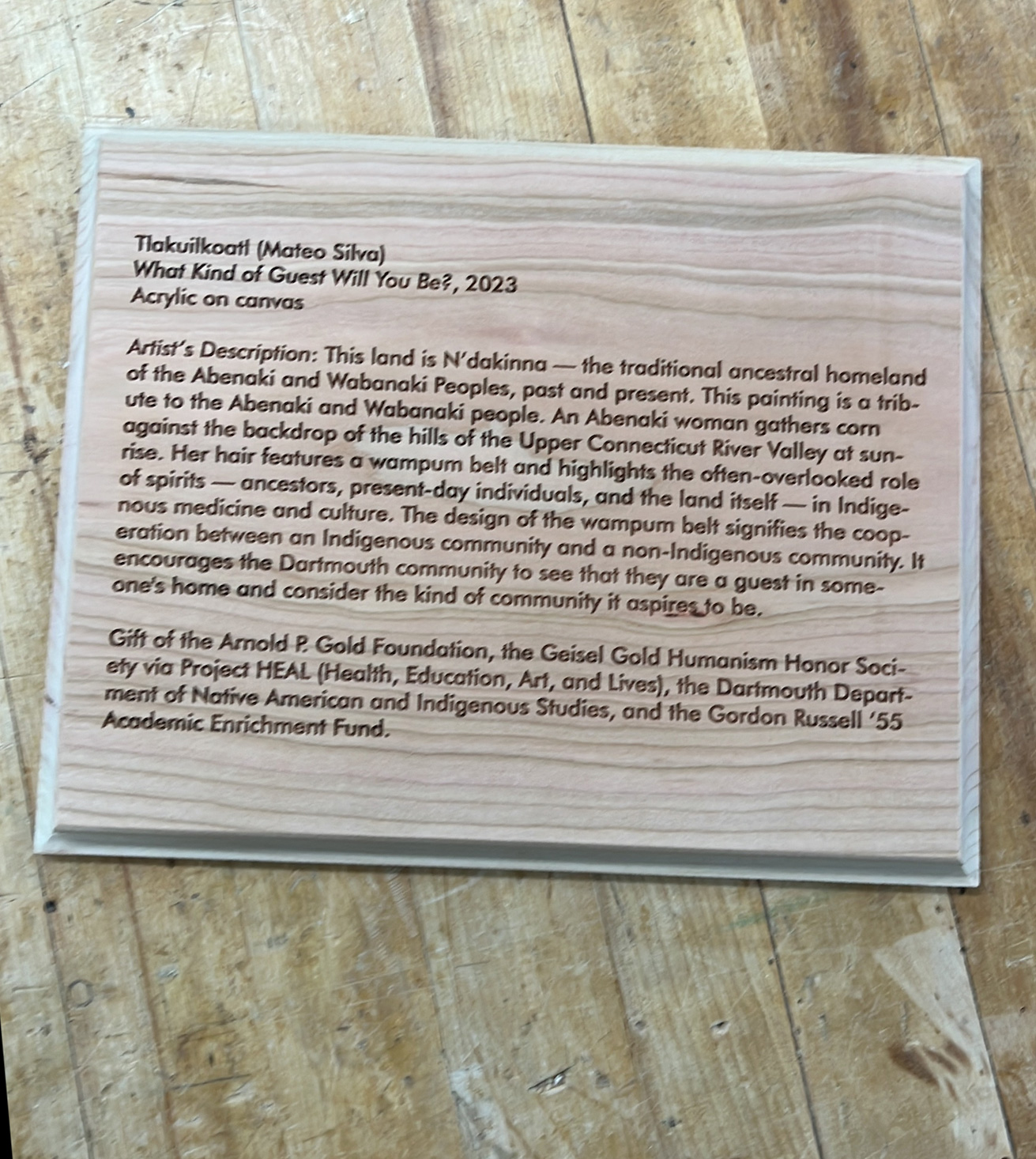
Amal Cheema plaque
Plaque made by Amal Cheema in Dartmouth’s woodshop

He also acknowledged not everyone will like the painting. “I hope this makes people think about how to live their lives, how to be stewards of this land, and how this land is taking care of us, which Indigenous people learn from birth. For Indigenous people medicine is community, music, art, family, and respect,” Silva said.

O’Leary, director of diversity, inclusive, and community engagement, said it was an honor and pleasure to work with Silva and appreciated his thoughtful approached to the artwork, which he described as powerful.

The artwork now hangs in Remsen 3 for all to see. Next to the work is a wooden plaque made by Cheema in Dartmouth’s woodworking shop.

NYU’s Center for Ballet and the Arts Announces Second Joint Fellowship with Juilliard

NYU’s Center for Ballet and the Arts Announces Second Joint Fellowship with Juilliard

New York University’s Center for Ballet and the Arts has selected Mio Ishikawa to be the second recipient of its collaborative fellowship with the Juilliard School. Launched last spring, the CBA-Juilliard Fellowship supports a developing artist and Juilliard alum by providing space and resources that allows the fellow to take risks and try new ideas.

The CBA-Juilliard Fellowship spans the academic year. Ishikawa will have access to CBA’s studio and office space, its network of artists, scholars, and alumni, and NYU’s extensive academic and cultural resources. Ishikawa also will join the CBA’s other fellows for seminars and programs.

Ishikawa is a movement artist based in New York City who has a deep interest in collaboration. A native of Tokyo, she graduated from the Juilliard School in 2019 with a BFA in dance. She appears in Sleep No More, an immersive work by the British theater group, Punchdrunk, and with Sidra Bell Dance New York. Ishikawa has worked with choreographers Stefanie Batten Bland, Alejandro Cerrudo, Maleek Washington, Kyle Abraham, Mariko Kakizaki, and Celia Rowlson-Hall. She is an associate artistic director of Bodysonnet, a collective of contemporary dance makers who work in non-traditional spaces.

During her fellowship, Ishikawa will explore the Japanese concept of “yohaku ma,” which means negative space, by creating what she describes as “dance-based landscapes” that focus on the textures and emotions found in the space between movements.

“The process will involve subtracting movements to create an intricate interplay between what is seen and what is imagined,” Ishikawa says. She plans to develop the concept into an installation piece.

About the Center for Ballet and the Arts

The Center for Ballet and the Arts at New York University (CBA) is an international research institute for scholars and artists of ballet and its related arts and sciences. It exists to inspire new ideas and new dances and to expand the way we think about the art form’s history, practice, and performance in the 21st century. The Center is made possible by founding support of the Mellon Foundation and ongoing support of NYU and CBA’s Center Circle.

About the Juilliard School 

Founded in 1905, the Juilliard School is a world leader in performing arts education. The school’s mission is to provide the highest caliber of artistic education for gifted musicians, dancers, and actors, composers, choreographers, and playwrights from around the world so that they may achieve their fullest potential as artists, leaders, and global citizens. Led by President Damian Woetzel since 2018, Juilliard is guided in all its work by the core values of excellence; creativity; and equity, diversity, inclusion and belonging (EDIB). Juilliard is committed to enrolling the most talented students regardless of their financial background.

Native youth theater finds home at Seattle’s King Street Station

Native youth theater finds home at Seattle’s King Street Station

The five youth-arts organizations that occupy Station Space — RES, Totem Star, The Rhapsody Project, Jackson Street Music Program and Whipsmart — are all part of the Office of Arts and Culture’s Creative Advantage program to increase student access to the arts. 

“We know that art saves lives,” said Olisa Enrico, executive director of CSA, in an interview with Crosscut. “And that starts in the most crucial point of youth.”

“Plus,” Erin Jorgensen, digital media specialist for ARTS, wrote in an email, “it’s just fun to walk in the building and hear theater vocal warm-ups or hear drum solos coming through the floorboards.”

Around 300 people attended the grand opening and ribbon-cutting event, including homegrown rapper Sir Mix-a-Lot as the keynote speaker. (Among his other remarks, he noted, “Sixty-year lease! Impressive.”) When Enrico introduced RES director Brooks, the audience cheered loudly. 

“RES as an organization has embodied the survival resiliency that our Native communities are legendary for,” Brooks said during the opening. “RES has never had a theater space of our own to call home,” he said. “To say that having this new black box-style theater workshop space in the heart of Seattle is one of the most significant events in our history would be an understatement.” 

Also at the opening day ceremony, RES youth performed the finale track from their original musical Dracula Spectacular. “Like an eagle soaring above, we move forward with love, always knowing the light will lead us home,” they sang. 

A creative outlet for Indigenous youth

Over its three decades, RES has worked with Indigenous youth from various tribes and backgrounds, presented almost 200 productions and performed on stages at ACT Theatre, Seattle Repertory Theatre, Intiman Theatre and The 5th Avenue Theatre. They’ve also worked closely with other local Indigenous organizations such as the Daybreak Star Indian Cultural Center.

Every year RES holds an intensive two-week summer camp that culminates in a performance. In the fall and winter, it hosts workshops — acting, filmmaking, playwriting — often led by local theater artists of Native heritage. The youth also put on a big spring production that’s free to the public (as are all of RES’s performances). The students’ age range is typically 10 to 19, with about 120 kids annually. 

The original stories that RES performs are rooted in the cultures of Indigenous peoples with an eye toward contemporary social relevance. Many originate from traditional stories passed down from tribal elders and others in the Native community. 

Created in-house, the plays are written by people in an RES alumni program called Yesterday, Today, Tomorrow: Urban Native Performing Artists. Youth also collaborate with the playwrights and directors to create the productions. 

Several of RES’s past shows have direct connections with the Pacific Northwest. In 2011, A Right to Justice (by local Native teaching artists Drew Hobson and Hannah Victoria Franklin) was a response to the police killing of John T. Williams (Nuu-chah-nulth) in Seattle the year before. The musical As Long as the Rivers Run (2013), by local writer and UW lecturer Roger Fernandes (Lower Elwha S’Klallam Tribe), focused on fishing rights and the importance of salmon to local tribes.

More recently, RES youth brought attention to the incidence of missing and murdered Indigenous women with the 2019 production MISSING, directed by local actor, director and producer Josephine Keefe (Nez Perce).

“Native people are the original artists and storytellers of this land and of this continent,” Brooks said. “Mainstream arts and theater are starting to notice that they need to catch up with what our Native communities have been doing.” 

This past year, RES performed the more lighthearted play-turned-musical Dracula Spectacular by alum and staff member Dylan Elwood (Turtle Mountain Chippewa) and jazz vocalist Julia Keefe (Nez Perce). Two RES students — 14-year-old twin sisters Sophia and Olivia Vann (Cherokee Nation of Oklahoma), who performed at the opening — described it affectionately as “campy.” 

“RES deserves this [space],” said Olivia Vann at the November 11 event. She and her sister are excited about the new location, and described the move as “reclaiming” and “decolonizing” Indigenous land.

Six small Front Range art shows with big ambitions

Six small Front Range art shows with big ambitions

“Aging Bodies, Myths and Heroines,” East Window Gallery, through Feb. 28.

Marissa Nicole Stewart’s portraits are part of “Aging Bodies, Myths and Heroines” at Boulder’s East Window Gallery, through Feb. 28. Image provided by East Window Gallery.

Boulder’s East Window Gallery has ensconced itself as a major player in the Front Range arts scene, not an easy task in a region full of established, and ambitious, gallerists and curators. But exhibitions like this are hard to ignore.

As its title boldly suggests, this group photography show looks at perceptions of human aging though a series of “playful, critical and tender images” created by 11 national artists, each with their own perspective on what it means to get older.

The checklist, put together by curator Todd Edward Herman, has names from near and far and includes Danielle SeeWalker, André Ramos-Woodard, Sherry Wiggins and Luís Filipe Branco, and others. There is also a list of promising coordinated events — talks, screenings, panel discussions — that deserve consideration.

Info: eastwindow.org. Free.

“Culture Cloth,” McNichols Building, through Jan. 14

This exhibit is one of the best surprises of the fall season, a collection of textiles from Asia, Africa and the Americas that show how cloth is central to the customs of different and diverse cultures around the globe. The work on display comes from the collection of Paul Ramsey, co-founder of Denver’s Shaver-Ramsey rugs, who has been traveling and acquiring textiles for decades.

Ramsey has an eye for both the beautiful and the functional, and the rugs, coats, dresses and other items on display come together to explain both the craft aspects of weaving and sewing and how they play their part in daily life. There are prayer cloths from Afghanistan, huipil shawls from Guatemala, Kente cloths from Ghana and kilim rugs from Turkey.

McNichols can be a challenging place to see art. There are lots of distractions from the other things that go on in the busy public building. But shows like this bring the community together in worthy ways. Shanna Shelby and Ramsey co-curated.

Info: mcnicholsbuilding.com. Free.

Julie Buffalohead and George Rodriguez, Visions West, through Dec. 22

Visions West closes out the year with combined solo shows from two of its most interesting artists. The better-known is Julie Buffalohead, whose show “Decolonize Indigenize” features a series of monotypes she made during a recent artist residency at Anderson Ranch. The visuals depict simple animal forms, referencing Native American stories and children’s books, which are used as a way of talking about social and political issues.

Rodriguez makes a unique brand of ceramic figures that are more complex than they appear on the surface. The forms in his show, “Embellished Creatures,” are familiar — bears, owls and snakes — but his techniques reference both social history and the diverse use of textiles and other artist media he has encountered within his own Texas/Mexican culture. The pieces, as the gallery’s statement promises, “pull the viewer into the world of magical realism, a place where animals talk and humans dream.”

Info: visionswestcontemporary.com. Free.

Through Flesh to Infinity, Union Hall, through Jan 6.

Vinni Alfonso shows at Union Hall through Jan. 6 Image provided by Union Hall.

Union Hall has been coming on strong as a nonprofit art gallery lately, with a series of well-curated exhibitions featuring regional artists who deserve wide attention.

The current show pairs painter Vinni Alfonso with 3-D object maker A Grix for a two-person exploration about the duality of the human experience and how opposing ideas of free spirit and confined physical existence work out their contradictions within all of us. It’s a complicated topic, murky and mysterious, and the objects in the lineup reflect that. Neither artist is known for making things that are easy to read but both indulge in creating works marked by both rich color and free-wheeling form that get the conversation going. Esther Hz curated.

Info: unionhalldenver.org. Free.

Five from the roster, Robischon Gallery, through Dec. 30.

This sort of high-level group outing is exactly the reason Robischon continues to be Colorado’s most dependable commercial gallery for art fans. It’s full of treasures pulled from Robischon’s deep roster of talent.

Kim Dickey, a veteran ceramics maker, takes the lead with a new series of large-scale ceramic and cast metal sculptures that combine both landscape and figurative portraiture to show how wildlife, birds in particular, have long been used to evaluate the health of the environment. (More to come on this exhibition later).

Kiki Smith is back with her large-scale Jacquard tapestries that blend images and materials for a look at the natural world. Stephen Batura, known for his wide-angle historical paintings, gets up close and personal on the topic of chandeliers. There is a lot to see here.

Info: robischongallery.com. Free.

“Amoako Boafo: Soul of Black Folks,” Denver Art Museum, through Feb. 19

A portrait of Bella Sontez, painted by Amoako Boafo. Image provided by the Denver Art Museum.

Ghanaian artist Amoako Boafo is just 39 and already emerging as a significant figure in international art. This show offers a deep look at his perspective on Black identity, displaying 30 works he has created over the last seven years.

Boafo is a portraitist mainly with a liberal idea of how color and texture can come together in an attempt, as this exhibition’s title suggests, to revel in the “soul” of humans living in a complicated, contemporary world. His subjects come in different shapes, shades and dispositions, but they share a way of gazing at the viewer that invites long looks and genuine curiosity. Larry Ossei-Mensah curated.

There is a bonus at this show, a music playlist created by Boafo featuring some of the pop tunes that inspire his work. You can download it via DAM’s website using Spotify and listen while you wander the exhibition.

Info: denverartmuseum.org.

Ray Mark Rinaldi is a Denver freelance writer specializing in fine arts. 

Subscribe to our weekly newsletter, In The Know, to get entertainment news sent straight to your inbox.

South Indian Artists Body Condemns Mansoor Ali Khan For His Controversial Speech

South Indian Artists Body Condemns Mansoor Ali Khan For His Controversial Speech
Actor Mansoor Ali Khan's misogynistic comments on actress Trisha have taken the internet by storm.

Actor Mansoor Ali Khan’s misogynistic comments on actress Trisha have taken the internet by storm.

The South Indian Artists Association demanded a public apology from Mansoor Ali Khan for his sexist remarks.

Actor Mansoor Ali Khan has been receiving immense criticism since his derogatory comments on actress Trisha. Condemning Mansoor’s repugnant comments, the South Indian Artists Association (SIAA), popularly known as Nadigar Sangam, issued a strong condemnation on Sunday. The actors’ bodies demanded a public apology from Mansoor Ali Khan for his sexist remarks, considering the potential suspension of his membership until he complied.

Meanwhile, PR and Event Manager RIAZ K AHMED shared a post that stated, “It was shocking to see a senior actor like Mansoor Ali Khan make such derogatory comments about his female colleagues. It’s depressing to read remarks about actresses who are conquering significant challenges in their careers because the film industry remains a challenging one for women to pursue and excel in. We disapprove of Mr. Mansoor Ali Khan’s remarks about fellow actresses. It is deeply disappointing to see an actor, director, and producer behave irresponsibly,” read the statement.

“Due to this shameful act, Nadigar Sangam is thinking of temporarily banning Mansoor till he acknowledges his mistake and makes a public apology because of this disgraceful deed. We also implore other actors to talk to the public with care and prudence,” the letter continued. Take a look at the post:

Actor Mansoor Ali Khan’s misogynistic and distasteful comments on actress Trisha have taken the internet by storm. Trisha also shared a post on her official Twitter handle that read, “A recent video has come to my attention where Mr Mansoor Ali Khan has spoken about me in a vile manner. I strongly condemn this and find it sexist, disrespectful, misogynistic, repulsive, and in bad taste. He can keep wishing, but I am grateful never to have shared screen space with someone as pathetic as him, and I will make sure it never happens for the rest of my film career as well. People like him bring a bad name to mankind.”

The post went viral in no time. Seeing the post, a handful of film fraternity members, including director Lokesh, director Karthik Subbaraj, singer Chinmayi Sripada, actor-politician Khushbu Sundar, and actor Malavika Mohanan, voiced their support for Trisha and condemned Mansoor for his vile statements.