Photography Artist-In-Residence Workshare


Eye on America: Photographer John Fielder reflects on life’s work, conserving D.C.’s honeybees – CBS News
Watch CBS News
Be the first to know
Get browser notifications for breaking news, live events, and exclusive reporting.

We all want to be better photographers, but the path to getting there is not always readily apparent. If you are feeling a little stalled out in your progress but looking to grow, check out this helpful video tutorial that features an experienced photographer sharing 10 useful tips that will put you on the path to improvement.
Coming to you from Peter Forsgard, this excellent video tutorial discusses 10 tips for improving as a photographer. A common theme worth noticing through the collection of tips is the regular practice of photography. If you are a hobbyist who has a job other than photography, it can be easy to go in spurts, starting and stopping as you have time. However, consistent practice will often be far more beneficial than bursts. If you can carve out even just 15 minutes a day, it will do a lot of good for keeping your skills sharp, and by maintaining a higher baseline, you will be better able to advance creatively and technically when you do have that time to invest in deeper exploration and practice, as you will not be working just to re-familiarize yourself with things you already know. Check out the video above for the full rundown.

… as I was going through image folders tonight, I came across quite a few photos that I had totally forgotten about ,,, and they were nice so at the top of this letter is one I especially like. There was an afternoon storm at the airport, and it was completely overcast … the clouds were pervasive, but a small hole opened up and the sun poured through giving us a rainbow and spotlighting the rocks to the east of the airport. Magic does happen here and frequently!
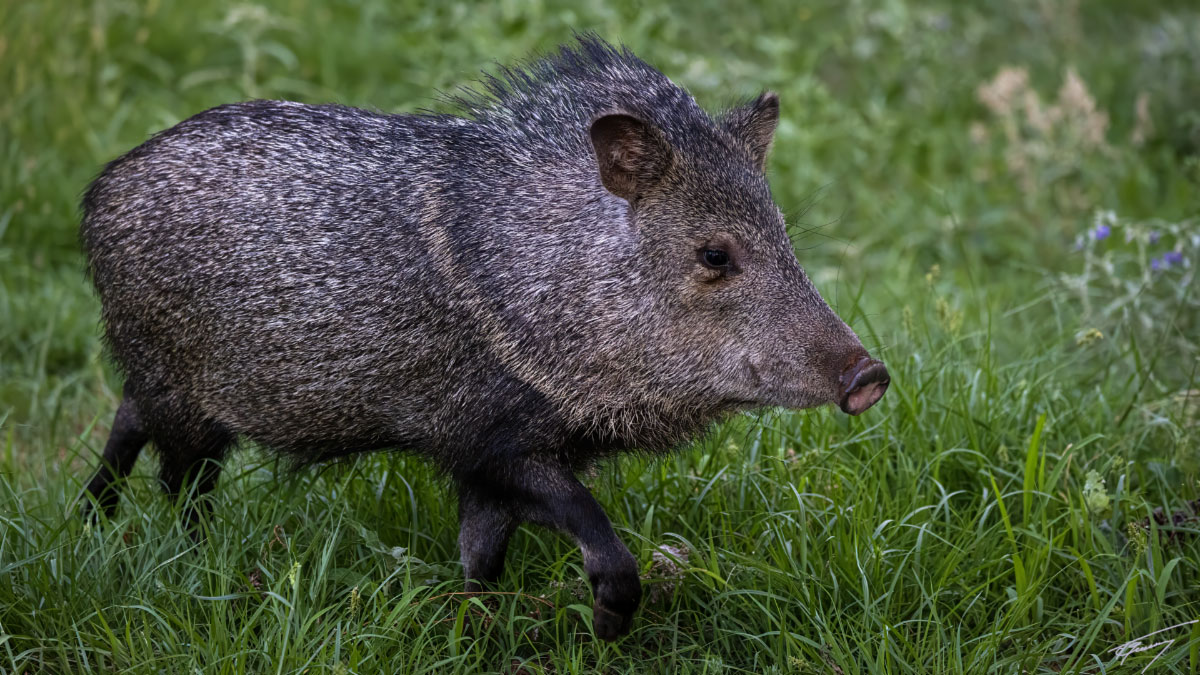
I was enjoying a cup of coffee on the deck this evening and a group of Javelinas came in for a drink at the water basin I have out for critters. Below is a photo of one of the little kids in the family as he was running up to the yard. They spent about a half hour out back and I got a lot of shots of them. They are not exactly the most beautiful of creatures, but they are out there.

Have a beautiful day as we start the new week … smile and keep breathing!
Cheers,
Ted
Though changed as are my songs from youth,
A voice within my heart still sings.
“Live thou in tenderness and truth,
And love mankind instead of things.”
And often in the crowded mart,
With wrangling. selfish slaves of men,
These words like some old song will start,
And bring me to myself again.
Often In The Crowded Mart by Max Ehrmann

###
 The easiest way to reach Mr. Grussing is by email: ted@tedgrussing.com
In addition to sales of photographs already taken Ted does special shoots for patrons on request and also does air-to-air photography for those who want photographs of their airplanes in flight. All special photographic sessions are billed on an hourly basis.
Ted also does one-on-one workshops for those interested in learning the techniques he uses. By special arrangement Ted will do one-on-one aerial photography workshops which will include actual photo sessions in the air.
More about Ted Grussing …

This is an advertisement


Audrey Billups
Armed with a Hasselblad 500CM camera, fine art photographer David Teran traveled the world to capture the beauty of ballet. Now, he’s put the results together in a stunning coffee tablebook titled Hasselblad Ballet. Currently available on Kickstarter, the book features over 250 photographs of over 100 ballerinas from 19 different countries.
Using his background in fine art photography, Teran was also able to capture ballet from a unique perspective. While the techniques of the dance are respected, the quirky photographs aren’t solely focused on ballet itself. “This project places photography at the forefront,” Teran tells My Modern Met. “While ballet remains an essential part, it takes a slightly more subtle role, allowing the photograph to shine. Nevertheless, the integrity of ballet’s technique is maintained and respected, ensuring a beautiful harmony between the art of dance and the art of photography.”
Teran was attracted to the Hasselblad for its ability to slow him down in an era of digital photography. By limiting himself to just one roll of Ilford HP5 film per photoshoot, he only had 12 frames with each ballerina. This exercise forced him to slow down and really consider each image.
The black and white photos have a whimsical feel that is reminiscent of Rodney Smith‘s work. This makes the book a wonderful purchase for both lovers of fine art photography and lovers of dance. By supporting the project, backers will help bring Teran’s vision to life. Among the awards available is an unsigned copy of the book ($85), a digital wallpaper featuring an image from Hasselblad Ballet ($10), as well as a signed limited edition box set ($250) that includes a silver gelatin contact sheet.
The Hasselblad Ballet Kickstarter campaign runs until September 20 and is an all-or-nothing venture, so if you want the make the book happen, don’t forget to lend your support.

Brooke Linford

Elle Macy

Ysee Bretigniere

Ysee Bretigniere

Thea Ratledge

Mackenzie Richter

Ysee Bretigniere

Isabella Boylston

Sellers Farley

Emily Bromberg

Heloise Jeremy

Emma Town

Camille Goldsborough

Alexandra Farber

Fiona Lee

Daniela Gomez

On a flight to Denver last week, I did the unexpected: I actually talked with the person next to me. Sitting on the tarmac with an unknown delay, we riffed back and forth on bad reasons why the plane wasn’t taking off. The conversation segued to work and eventually life more broadly, even though I knew I would never see the guy again. One part of our chat still stands out.
After learning that I was a professional adventure photographer, he began peppering me with questions about what was in my travel bag. It quickly became clear that he knew his stuff, so I shared some of the most important lessons I’ve learned over the years, like how to not ruin expensive gear while shooting in the elements.
All of a sudden, the stranger across the aisle chimed in, asking a question about international travel with cameras — and just like that we opened Pandora’s box. Through many conversations similar to this one, I’ve come to realize there is a growing cohort of people interested in travel photography outside of iPhones. Amateurs looking for tips to travel light, shoot on the go and keep their photo gear safe. Hopefully this story can be a resource for anyone looking to level up their game.

Taylor Burk
Andy Cochrane

Johnie Gall
Andy Cochrane

Adam Wells
Andy Cochrane
Instead of sharing just my personal (and biased) perspective, I figured it would be more useful to collect advice from some of the best and most experienced photographers I know. So, I reached out to three of my mentors, Johnie Gall, Adam Wells and Taylor Burk, who brought me into the photo world, helped me get my first jobs, grow my skills and hone my craft.
Adam Wells is a commercial lifestyle photographer and filmmaker based in San Francisco, California. He has shot projects around the world, from remote jungles in Japan to the open ocean of Alaska’s Bering Sea. He focuses on travel, outdoors, food & drink and sustainability stories, and has worked for brands big and small, including HBO, Rivian, Starbucks and National Geographic.
Taylor Burk is an adventure and travel photographer based in Vancouver, British Columbia. He also has worked all over the world, from the Gear Bear Rainforest to the deserts of Jordan to the mountains in Patagonia. He focuses on landscapes, sports and lifestyle imagery, including work with Red Bull, Chevrolet, The North Face and National Geographic, among others.
Johnie Gall is a commercial and editorial photographer based in Ojai, California. Like the two others, she has tackled assignments in far off places around the globe, but recently has focused closer to home, around the western U.S. Her biggest curiosities center on science, adventure and climate change, including projects with Patagonia, Backcountry and the Rodale Institute.

Andy Cochrane
It may sound simple and trite, but the first piece of advice I usually give is about finding the right camera bag. Something that fits your needs, the requirements of the job, and ideally, the standards of a modern day carry-on. There is nothing worse than checking your camera gear to a dream destination, only to find a shattered lens inside (yes, it’s happened) — or even worse, a bag lost entirely.
Wells’ go-to is the 45L Travel Backpack by Peak Design, which he says maxes out the carry-on size limit while handling intense travel with versatility and comfort. Burk agrees, saying he almost exclusively uses the same backpack, with his only exception on longer backpacking trips. “If I’m going far into the backcountry, I use a bigger pack and wrap my camera gear with spare clothes or in a padded dry bag.”
Gall’s favorite is the smaller version of the same Peak Design pack, which she says is easier for her to carry and fits under airplane seats. “If I’m not traveling and just on a single day shoot, I use a leather ONA camera bag — it’s classic, rugged, lasts forever and heirloom quality.” With any bag, Burk’s biggest piece of advice is to always insure your gear, because you never know what will happen.
The most frequent question I get from amateur shooters, especially those who speak the love language of ISO and aperture, is about the camera and lens combination I trust the most. If I’m traveling light on a one-man show, what do I bring? Does it change for locations, jobs or types of jobs?
Gall’s advice is to not overthink the brand and instead focus on the quality of the lens. “I’ve shot with all the major camera brands and what I’ve learned is that you’ll most likely end up with a great picture if you have decent glass.” On run-and-gun jobs her go-to is a Fujifilm XT5 with a 18-55mm f/2.8 lens because it is small, light and the color is incredible. Sometimes she’ll add a Yashica t4 35mm film camera for behind the scenes shots and a DJI Mini 3 Pro to complete the story from the air. “In the water, I sometimes just use a GoPro 11. GoPro has come a long way and is sharp right out of the camera.”
Wells recommends what many of us insiders call the workhorse — a Canon R5 mirrorless camera with an RF 24-70mm f2.8 lens. This pair will get you the majority of the shots that clients are looking for, and is reliable day in and day out. “In an ideal world I mix in other lenses for unique perspectives, but nothing beats the versatility and simplicity of this combo for me.”
Burk isn’t as much of a minimalist, saying “When it comes to gear, I try to bring as much as possible, within reason. I try to use every lens with me to capture the same subject, creating unique perspectives.” He often carries the holy trinity — 16-35mm, 24-70mm and 70-200mm — a 2x extender, and a 50mm prime, for compression and sharpness. He suggests the Packup App when organizing all your gear before a trip, to make sure you have everything. “It almost always catches something I’ve missed — redundancy is key.”
Shooting for commercial clients gets harder the farther you get from home. The always present balance of weight versus flexibility is magnified with complex travel, going further off the beaten path, charging batteries, weather and other elements and border crossings with different regulations. These factors play into the decisions of what gear to bring — and are often learned the hard way.
As a hard and fast rule, Wells will bring a 1510 Pelican Case when flying internationally. “It’s bomb proof, fits in overhead bins, and to be honest, I use it a lot as a stool when I’m tired. It goes everywhere with me and because of it I’ve never had an issue with keeping gear safe.” The case allows him to shoot a mixture of digital and analog cameras, as well as other tools like fill flashes and drones. “The case keeps all the gear organized, protected, and dry. I keep a silica gel pack in there too, to help with moisture.”
The little things often make a big difference sometimes. Burk suggests colored tape to hide name brands, making them look cheaper and not as eye-catching, reducing the chances your camera gear gets stolen. “For film, I always hand check at airport security. I place everything in a mesh bag and sometimes even leave a little candy as a thank you for not ruining my photos.” However, Gall says not all airports will allow you to hand check your film. As a backup for moments like this, she brings a Domke filmguard bag.
The further you go into the backcountry, the more likely you are to deal with adverse weather conditions. Gall suggests bringing just the necessities when shooting in the elements, to reduce the risk of damaging extra gear. “Salt water will destroy a camera quickly, so I keep a microfiber towel with me to immediately wipe my gear down. Anything waterproof gets a fresh water dunk as quickly as possible.”

Andy Cochrane
No matter what gear you have, the most important thing is the story you’re telling, says Burk. “I don’t think the camera brand matters as much as most amateurs think. It’s how you’re conveying what’s in front of you. Try focusing on something unique, honing in on it, and capturing it in a way that makes the viewer feel like they are right there next to you.”
To do that, Wells says, look for symmetry, movement and small gestures. “Try dragging the shutter on a passing motorcycle or wait until a bird flies into the corner of the frame. It’s those details that push beyond good composition and bring an image to life. Once you master manual control, it’s just a matter of how playful you can be.”
Even for professional photographers, it’s important to stay humble. Gall says that there are so many incredible photographers out there, it’s nearly impossible to get a “better” shot than what’s already been created. “However, no one will see something quite the same way you do, so take a moment to really look around and notice what someone else might not. Think like a writer or filmmaker and notice characters, settings, moments of humor or emotion. If all else fails, create layers in a photo by shooting through flowers or tall grasses, or shooting through windows or door frames to create some mystery.”
This article was featured in the InsideHook newsletter. Sign up now.


A wildlife photographer was surrounded by 13 wolves during a trip to the Canadian Arctic, as revealed in a remarkable video posted to her TikTok.
Meline Ellwanger, a 20-year-old photographer from Germany, posted a video showing the pack of wolves in close proximity to her as well as sharing some of the amazing photos she captured on her Instagram.
@meline.wildlife Surrounded by 13 wild wolves in the Arctic 🐺
Ellwanger was based in the Nanuk Polar Bear Lodge in Manitoba where she “got more lucky than any of us would have ever imagined.”
“During my visit to the Arctic something incredible happened,” writes Ellwanger. The video then shows the photographer surrounded by the wolves in a frozen landscape.
The video then cuts to some of Ellwanger’s amazing clips showing the wolves howling, stretching, and grooming themselves.
“Every encounter with wildlife you have is different. Sometimes you are very far away so as to not stress or harass the animal,” writes Ellwanger on Instagram.
“But sometimes there are moments where the wildlife approaches you. As a wildlife photographer, the best feeling is to see that an animal is completely comfortable with your presence to the point where they continue on with their natural behavior.
“These wolves were incredibly curious but still cautious. They went around us and as they continued on they started playing and running around, completely unbothered by our presence.”
Ellwanger says that the reason why the wolves got so close is because they have “never had any bad experiences with humans.”
Because of this, they are curious about humans and the nature photographer says that she had two experiences where wolves approached and “walked right past us” just a couple of feet away.
More of Ellwanger’s photos can be viewed on her website, TikTok, and Instagram.
Image credits: All photos by Meline Ellwanger.


BLOOMINGTON – The Waldron Arts Center is excited to welcome the Bloomington Photography Club (BPC) for their 32nd Annual Juried Exhibition. The show features 75 photographs from 39 individual artists, chosen from hundreds of submissions. The exhibit will be on display in both the Rosemary P. Miller and Educational Galleries.

This Annual Juried Exhibition provides an opportunity for the diverse members of the BPC to submit work to a group of outside jurors from a variety of backgrounds, including academic, professional, and journalism photographers. Submissions are open to members of all levels and include images taken on cameras ranging from traditional SLR cameras to cell phones. New jurors are chosen each year, resulting in a fresh, new show depending on the personality of the jury.
Though in the past images were required to be printed before submission, the BPC has evolved its process, keeping with its mission statement to be welcoming to all. Submissions can now be made digitally, being printed and framed only after their acceptance into the show.
The Exhibition will be on display from September 1 to October 21, beginning with an opening reception on Friday, September 1 at 5 p.m. There will be an additional reception during the First Friday Gallery Walk event on October 6.
Club bio:
Gallery Hours:
Wednesday and Thursday 12-5
Friday 12-8
Saturday and Sunday by appointment only.
Galleries are also open during all Constellation performances!
To schedule a visit on the weekend, email gallery@seeconstellation.org by the Friday prior to the requested date.
The Bloomington Photography Club is a congenial group of people of all ages and levels of proficiency, united by a passion for photography. The club currently has about 150 members. The regular monthly meeting – the first Tuesday of each month – is now hybrid, with attendance both in-person and via Zoom. The meetings alternate between photo shares and guest speakers, and each also includes a short “tech tip” on various topics. The group hosts field trips each year to places of photographic interest, both day trips and weekend overnights. They also offer workshops on aspects of connecting audiences through world-class theater and film photography and processing software, such as Photoshop. All field trips and workshops are free to members. In addition, the club has several focus groups, smaller groups that meet monthly or bi-monthly through which members can pursue special interests, such as portraits, landscapes, sports, street, macro, video, and film photography. They also have volunteer mentors who are happy to answer questions and help you pursue your photographic interests. There are also free cameras, donated by the photographic community, to help BPC members get started or upgrade their equipment. If you’re interested in learning more about the club, check them out at bloomingtonphotoclub.org or on Facebook.
Staff
Board of Directors
About the Waldron Arts Center:
The John Waldron Arts Center is managed by Constellation Stage and Screen, with Sarah Nichols serving as Gallery Manager. The mission of the Gallery is to create opportunities for diverse audiences to experience impactful visual art. The gallery provides a vibrant venue in the heart of downtown Bloomington for local and regional artists from all stages of their careers to exhibit. Recent exhibits include Channels: Conjuring Unborn Futures, How Many Artists Does It Take to Name an Exhibition, Climate Shock, and Stone Soup. For more information visit www.waldronartscenter.org.

Hold on tight, my fellow photography enthusiasts, as we dive into the world of shutter speed! Get ready to unlock the five secrets that will make your photographs freeze time, bend reality, and maybe even make your subjects strike a pose like supermodels on a catwalk. So, grab your camera, put on your photography hat, and let’s embark on this adventure.

The first secret to mastering shutter speed is to unleash your inner superhero and freeze time itself! With the right shutter speed, you can capture those split-second moments that make us go, “wow!” Whether it’s a crashing wave, jumping squirrel, a flying bird, or your best friend’s epic dance move, freezing the action requires lightning-fast reflexes and a shutter speed set to warp speed. So, channel your inner Flash, keep your finger on the shutter button, and prepare to capture the world in all its glorious motion-freeze goodness. Just be careful not to get a cramp in your finger from all that rapid clicking! A good practice here is to set your camera to high speed continuous shooting and ensure that your shutter speed is above 1/500 of a second. If the light allows, you could even try getting up to 1/1,000 of a second to ensure that you truly freeze time, but ensure now also that you are nailing focus on your subject.

Ah, the art of motion blur. The second secret is to embrace the blur and let it paint your photographs with a touch of artistic magic. By using a slower shutter speed, you can create a motion blur that gives your images a sense of movement and dynamism. It’s like capturing the graceful flow of a river, incoming wave, or the streaking lights of passing cars in a cityscape. So, slow down, take a deep breath, and let your camera work its magic. Just be sure to hold steady and brace yourself for the occasional accidental blur of your hand, which can also sometimes result in a good shot as it adds something different to what would normally be expected. A good speed to achieve this motion blur is anything over 1/4 or a second. However, if your subject is a sloth, then, of course, you will need longer, as their movement can quite delayed.

Now, let’s talk about the secret of light trails. With the right shutter speed and a bit of creativity, you can capture mesmerizing trails of light that will make your photographs shine brighter than the crown jewels. Whether it’s car lights streaking through a city street or sparklers swirling in the night sky, light trails add a touch of magic to your images. So, grab your tripod, find a spot with some stunning lights, and let your shutter speed work its enchanting wonders. Just remember, when photographing light trails, it’s important not to get mesmerized and start juggling glow sticks yourself. Stay behind the camera and allow your creativity to flow, just like the light that is flowing in your images. In recent times, we have seen many artistic images of electronic light bars, which add not only movement but also a myriad of colors as you hold that shutter open and let them create their magic on your sensor. The key here is to experiment and make mistakes, as each mistake should teach us something until we are nailing those shots each time.

Prepare to be amazed, my friends, as we unveil the secret of dramatic long exposures! By using an ultra-slow shutter speed, you can transform ordinary scenes into ethereal masterpieces. Capture the soft, dreamy movement of clouds, turn rushing waterfalls into silky ribbons, or make bustling city streets look like a deserted ghost town. It’s like wielding a magic wand and creating visual illusions that will leave your viewers in awe. So, set up your tripod, select a sloth-like shutter speed, and let the magic unfold before your eyes. And remember, the longer the exposure, the more time you have to come up with witty one-liners to entertain your patient subjects! To achieve this, you need to ensure that your long shutter speed doesn’t result in an overexposed image or even a totally white image due to the excess amount of light hitting the sensor. ND filters are a fantastic tool to achieve these types of shots if the ambient light is too much, or you could always wait until dawn or dusk, when the light levels are lower, allowing you to keep that shutter open and allow the moving element the freedom to create that intended shot.
Last but not least, we have the secret of double exposures. With the right shutter speed technique, you can combine multiple images into one, creating a whimsical mash-up of reality and imagination. It’s like playing a game of photographic fusion, where two worlds collide and sparks of creativity fly. So, get ready to experiment, have fun, and let your imagination run wild. Combine landscapes with portraits or flowers with animals. The possibilities are endless, and the results are often delightfully unexpected. Just remember, in the world of double exposures, the more eccentric and quirky, the better! It’s not enough to capture the shot; you need to know how to process the image, as this can make the final shot all the better. Remember, post-processing is all about subtle movements of those sliders, not bringing them up to Spinal Tap 11. Most of all, like other methods, just experiment and have fun. There is no right or wrong in this approach, as it is a creation of your own vision, and if it looks right for you, then it is right at the end of the day. It can be improved or deteriorated by using the editing software or going back and shooting the vision again.
As we reach the end of this journey through shutter speed secrets, it’s time to go forth and put your newfound knowledge to the test. Freeze time, blur reality, create light trails, unleash dramatic long exposures, and embrace the whimsy of double exposures. Let your photographs be a testament to your unique sense of humor and creativity.
Remember, photography is not just about technical settings and serious faces. It’s about capturing moments, telling stories, and having a good time along the way. So, go out there with a skip in your step, a camera in your hand, and a smile on your face. Embrace the unexpected moments, laugh at your blunders, and let your photographs be a reflection of the joy and humor that life has to offer.
And as you venture forth, may your shutter speed be swift like a cheetah, slow like a sloth, and everything in between. May your photographs bring a smile to people’s faces, ignite their imaginations, and perhaps even induce a good old-fashioned chuckle if that was your intention of course.
What are your thoughts on this topic? Let’s continue the conversation below.

Over a dozen climate protesters equipped with wigs and a large yellow banner took to the Paul McCartney exhibit at the National Portrait Gallery today in protest of Bank of America.
The group targeted the exhibit in London, which shows never-before-seen photos taken by the legendary musician.
Protesters changed the lyrics to popular Beatles songs and some dressed as makeshift versions of the band members.
Visitors of the gallery were promptly shooed out, while campaigners could still be heard singing behind closed doors.
The whole incident reportedly lasted for 45 minutes, before visitors were allowed back inside and the gallery resumed as normal.


Adapting the lyrics to the song ‘Help!’, the protesters can be heard chanting: ‘We’ll fight against climate change and oil in any way.’
The new lyrics seemed to have been printed on an A4 piece of paper, the back of which read: ‘Fossil free London’.
The campaigners were quickly taken behind a screen by security, while a spokesperson attempted to argue their case before a crowd.
He shouted: ‘We love this art, we think it should be here for everyone to enjoy and it should not be used to justify the climate activities of Bank of America.
‘We think the values of these songs should be about preserving the planet.
‘Shame on the National Gallery for taking the oily money of Bank of America.
‘We’ll fight against climate change and oil in any way.’
Speaking to MailOnline, a National Portrait Gallery spokesperson said: ‘This afternoon, members of a climate protest group demonstrated by singing songs within the Paul McCartney Photographs 1963-64: Eyes of the Storm exhibition.
‘The exhibition was temporarily closed for around 20 minutes. In line with our security procedures, the Gallery contacted the Police who arrived and led the protesters out of the building.
‘No exhibition photographs were targeted during the protest. Visitors who experienced disruption were compensated with replacement exhibition tickets.’


It comes just months after the Gallery’s reopening this year, in June which is supported by Bank of America alongside Bloomberg Philanthropies, CHANEL Culture Fund, Herbert Smith Freehills and Taylor Wessing.
The exhibit, named Paul McCartney Photographs 1963-64: Eyes of the Storm opened exactly 2 months ago and will run until Sunday, 1 October.
It is described as ‘an extraordinary archive of rediscovered and never-before-seen photographs taken by Paul McCartney,’ and is supported by Bloomberg Philanthropies.
The exhibit was opened by the Princess of Wales and attended by Paul McCartney himself.
The National Portrait Gallery website says it is ‘uniquely personal’ and offers some perspective on ‘what it was like to be a Beatle at the start of Beatlemania,’ through the eyes of Paul McCartney.
The exhibit was launched shortly after its first exhibition ‘Yevonde: Life and Colour’, which lasts until Sunday, 15 October.
Two more exhibits will be shown this year, including ‘David Hockney: Drawing from Life’ and ‘Taylor Wessing Photo Portrait Prize’, while a further two await in 2024.
This is not the first time the National Portrait Gallery has been targeted. A year prior to its temporary closure in June 2020, Extinction Rebellion activists covered themselves in fake oil in protest against its sponsorship by BP.
Topless activists curled up in a foetal position as others coated themselves in the ‘oil’ in front of a BP-sponsored art display.
The unauthorised stunt capped a two-week wave of actions by the civil disobedience movement, which led to more than 3,300 arrests in London and cities around the world, the group said.





