Photography

Wildlife photographer gets surrounded by 13 wolves, films TikTok

Wildlife photographer gets surrounded by 13 wolves, films TikTok

A German wildlife photographer managed to get some amazing shots by entering the metaphorical lion’s den and encountering a not-metaphorical pack of wolves.

The photographer in question is 20-year-old Meline Ellwanger, who goes by @meline.wildlife on TikTok and @meline.ellwanger on Instagram, shared a video of her being surrounded by 13 wild wolves in the Arctic. Her video has already accrued over 14.6 million views at the time of writing.

“During my visit to the Arctic, something incredible happened,” the social media video says before panning around to show the intrepid photographer indeed surrounded by a literal pack of fierce-looking and technically dangerous wolves.

@meline.wildlife

Surrounded by 13 wild wolves in the Arctic

♬ Originalton – Meline.Ellwangerr

Of course, one look through the video will show that these fierce predators certainly aren’t behaving as dangerous as their reputation may indicate.

In one shot, one of the wolves “menacingly” puts its front paws forward as it stretches its back. Other shots showed the wolves all together howling, tails wagging.

Olaf, a 9-month-old Arctic wolf, is pictured inside an open-air enclosure at the Royev Ruchey Zoo in Krasnoyarsk, Russia January 11, 2019. (credit: REUTERS/ILYA NAYMUSHIN) Olaf, a 9-month-old Arctic wolf, is pictured inside an open-air enclosure at the Royev Ruchey Zoo in Krasnoyarsk, Russia January 11, 2019. (credit: REUTERS/ILYA NAYMUSHIN)

And in another shot, a wolf assumes what must be some sort of devious hunting position by rolling around on its back, paws tucked in, and fearsome belly exposed.

Surrounded by wolves: What does the Internet say?

In the comments on TikTok, viewers expressed some of their shocked and horrified thoughts at this sight of pure terror.

“Look at all those good doggos!!” one commenter wrote. “I’ve experienced wolves howling and I bet that was the most magical moment.”

A third commenter stated, “My toxic trait is I’d pretend I tamed them and now I’m the goddess of wolves.”

“If not friend, why friend-shaped?” pondered another viewer.

“They were letting all the other wolves know you’re a homie,” said another.

Several commentators also pled with Ellwanger, praying she had the foresight to shout “BIG STRETCH” at the first wolf she cut to in her video. Another viewer asked if she had found the three wolves in the famous laughing wolves Internet meme.

Other commenters legitimately described how terrifying the situation must have been. 

“Isn’t this an ambush?” asked one viewer.

“Am I the only one who would run for her life?” asked another. “I mean they are fluffy, yes, but they are wolves.”

Today’s Photo from Ted Grussing Photography: The Eternal Gaze … Eye Contact

Today’s Photo from Ted Grussing Photography: The Eternal Gaze … Eye Contact

… it was a beautiful day and I got to spend time with two favorite endeavors … working with gem material and working on photos that I have captured … terrific day!

The photo above is a great blue heron that I shot a while back at Lake Pleasant as he gazed off into the eternal light facing life … proffering himself as a willing recipient of all that is and that which is to come … or so it seems … to me.

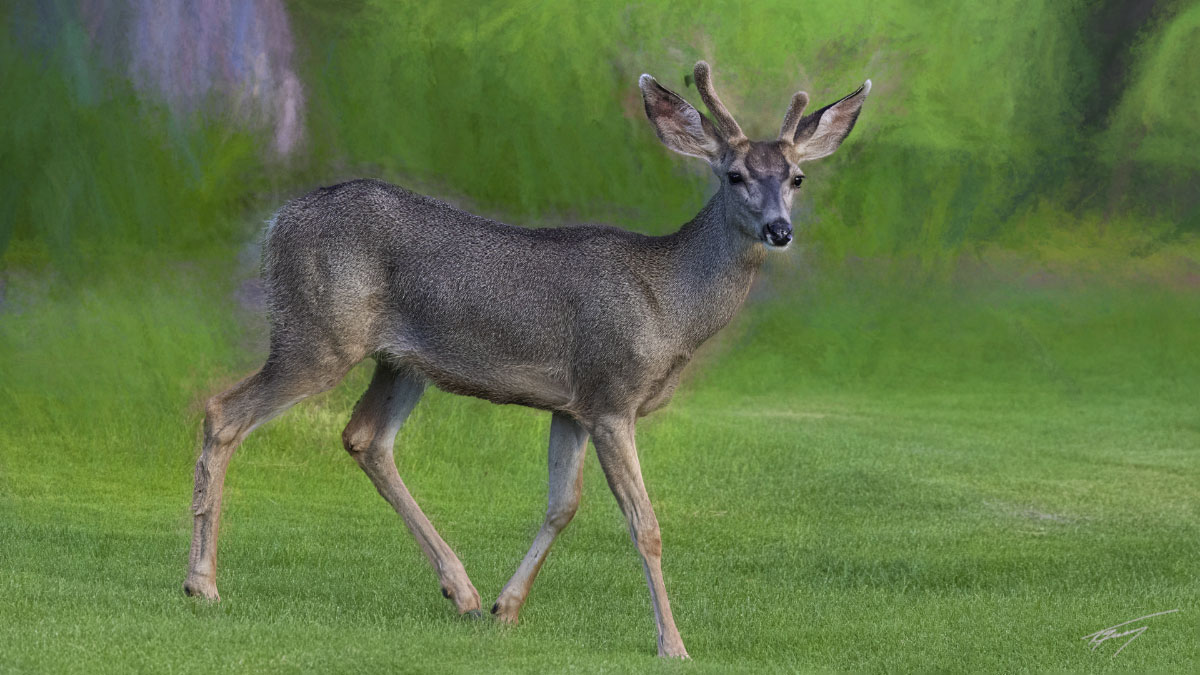
Below is a shot of a young couse whitetail deer in our back yard earlier this year … a young buck and a nod of recognition before he continued on his way.

Life is good and it abounds everywhere we look … all of us including other species face the same challenges daily … providing for our needs and making it through the day. We ponder that which is to come and daily interact with others … be kind and extend a hand to others … share smiles and you will bring one to another person.

Keep breathing and live life … it is an awesome opportunity we have every day!

With joy!

Ted

Though I know I shall sometime no more open
my eyes to the night or day,

I am one who looks at the stars when unchained from
the work-bench at nightfall.

They are a sign that I am not ephemeral, not you, nor
you, whoever you are.

The dawn comes and the dark and the sign sparkling
in the brooding night forever and forever.

At Nightfall by Max Ehrmann

###

photo_tedgrussingThe easiest way to reach Mr. Grussing is by email: ted@tedgrussing.com

In addition to sales of photographs already taken Ted does special shoots for patrons on request and also does air-to-air photography for those who want photographs of their airplanes in flight. All special photographic sessions are billed on an hourly basis.

Ted also does one-on-one workshops for those interested in learning the techniques he uses.  By special arrangement Ted will do one-on-one aerial photography workshops which will include actual photo sessions in the air.

More about Ted Grussing


Healing Paws

Healing Paws

This is an advertisement

James Pauk Photography shuttering after 54 years in business

James Pauk Photography shuttering after 54 years in business

One of Orillia’s oldest businesses is set to close.

James Pauk Photography opened in 1969. It was started by the late James Pauk, who immigrated to Canada in 1951 from the Netherlands. With an interest in photography, he landed a job as reporter and city editor with the Packet & Times.

“He was a self-taught editor and reporter at the Packet who basically ran the dark room,” explained his son, Greg Pauk. “When his time was done there, he decided to do wedding photography, and then he had the opportunity to buy a business, which became his dream.”

Pauk recalls his father learning at the New York Institute of Professional Photography before opening in downtown Orillia.

“It’s been an interesting journey,” he said. “Not too many businesses in town remain from that time frame.”

He says the photography industry is vastly different today with digital cameras and cellphones.

“A lot of things are online now,” he said. “Interactions with clients are different now, too. Sometimes they come into the store to talk to you and sometimes they will just send an email.”

Around 2003, digital photography changed the way the business went about a lot of its production.

“The so-called black room where film was developed and prints were made was gone,” Pauk said. “Now we use digital files and a desktop computer to edit and print with high-end inks and digital paper.”

The industry has continued to change at a fast rate over the years, leaving Pauk feeling it’s time to make a change and reinvent how his business operates.

“I think what we will miss the most is the interactions with customers day in and day out,” he said.

He plans to continue his work as a photographer on a part-time basis once he closes the storefront at 25 Peter St. S., which could happen by the end of the year.

The complete photography studio and retail business has photographed family portraits, weddings, and special occasions all while doing custom framing and selling equipment.

“I think being so diversified was the real secret to our success,” Pauk said. “Memorable moments have given us a lot of opportunity to photograph some interesting people throughout the years.”

In 1967, his dad photographed the Los Angeles Kings while they were in London for training camp. In 1970, Hockey Hall of Famer Bobby Orr stopped by the shop in his yellow Corvette to select photos James had taken of him for his book.

“He sat down with my mom, Grace, and said, ‘They all look so good. Which one do I choose?’” Greg recalled. “It was a pretty hilarious time.”

During the 1999 NHL season, James photographed the Toronto Maple Leafs at the Scotia Bank Arena for their New Memories and New Dreams poster. He also photographed Gordon Lightfoot, Orillia’s city council numerous times, and the 1973 Allan Cup champion Orillia Terriers.

“Looking over the years, from weddings to portraits and everything else in between, the files are endless,” Pauk said.

James operated the store until about the time he died last year at age 86.

“We had talked about making this change,” Pauk said. “I think what has sped it up has been him not being here. It was his dream.”

He has been with his father’s business since he finished high school in 1978, making it a difficult decision to let go, but he knows his family’s legacy will live on through the photographs they have taken.

Customers interested in purchasing their original files at James Pauk Photography can do so for a “very reasonable price,” Pauk said. He can be reached at 705-326-6066.

Best Photography and Camera Insurance Providers in 2023

Best Photography and Camera Insurance Providers in 2023

Photographers of all skill levels should strongly consider insuring their camera equipment. Whether you are an amateur who cannot afford to replace damaged to stolen gear or a working professional who cannot risk missing out on paying jobs, you should consider protecting your equipment.

Life has many uncertainties, and insurance helps protect against the most severe costs when misfortune strikes. For photographers, potential problems primarily include damaged or stolen equipment.

While not every type of insurance will completely bail you out of a tough spot, depending on precisely what happened to your equipment, the insurance providers outlined in this guide will help lessen the blow or outright replace everything in the event of a tragedy.

Table of Contents

Camera insurance guide

Renters’ or Homeowners’ Insurance Can Help You Out of a Jam

While many photographers, especially pros, opt for dedicated insurance coverage specific to their business and camera equipment, sometimes a person’s personal renters insurance or homeowners policy can reduce the pain of damaged or stolen camera equipment.

As popular and affordable insurance provider Lemonade explains, “Your policy can insure your camera for a wide range of scenarios, from theft to accidental damage.”

Camera insurance guide

Every insurance policy is different, and not every instance of bad luck is covered. When in doubt, photographers should speak directly to an insurance agent to ensure they completely understand their prospective or existing policy. Policies can be very confusing.

However, with that disclaimer covered, renters and homeowners insurance policies typically cover a person’s belongings up to a specific value (the amount depends on the policy and the amount someone wants to pay per month) in the event of theft, vandalism, fire, and other perils.

For some situations, such as damage due to negligence, that can still be covered under renters’ and homeowners’ policies but typically falls under special additional coverage. Special coverage can sometimes even replace your gear if you outright lose it by accident — such as leaving it behind on public transportation.

It is all too easy to believe that you will never be “dumb” enough to break your gear or leave it behind, but accidents can happen to anyone, no matter how careful or intelligent they are. If bad things didn’t occur to careful people, the insurance industry would be much smaller.

As is always the case with insurance, deductibles vary, and so does the coverage each policy provides.

Camera insurance guide

With that said, before investing in dedicated camera insurance and coverage, it is worth checking with your renters’ or homeowners’ insurance providers if you have a policy and see how your photography equipment may already be covered and if adding any special coverage makes sense for you.

Dedicated Camera Insurance Options

Lemonade is far from the only big name in personal insurance policies that offers special add-on options for photographers. Progressive does, too.

“If you have a high-end camera and expensive accessories, camera insurance can protect your budget from pricey repairs or replacements. Standard homeowners and renters policies might cover your photography equipment and accessories damaged or destroyed by covered perils like theft and fire, but your claim payment could be limited by your policy’s deductible and sub-limits. A camera insurance policy from an electronic device insurer can offer extra protection from accidental drops and water damage, and the deductible is likely to be more budget-friendly,” explains Progressive.

Camera insurance guide
For professional photographers, being without certain gear may mean missed jobs and lost money.

The company says that its special camera insurance can protect specific parts of a photographer’s kit, including their camera itself, lenses, external flashes, batteries, and even parts of the camera, like the display or shutter mechanism.

Progressive’s camera insurance policies cover theft, drops, water damage, power surges, and vandalism. The company’s camera insurance policies start at a few bucks a month, but that will not provide enough coverage for a complete camera kit, so expect to pay a fair more than that. Even so, camera repairs are expensive.

Progressive adds that while its renters’ insurance and homeowners insurance policies “may” provide coverage for loss resulting from fire and theft, these policies rarely cover damage resulting from drops or water damage.

Camera insurance guide

Insurance companies also offer a “rider,” which is a specific add-on for additional cost to compensate for any inadequate coverage in a typical policy. A photographer could use a rider to close a gap in coverage for their camera equipment, among other items, like other expensive electronics or valuable artwork.

Insurance for Photography Businesses

Professional Photographers of America (PPA)

Beyond typical insurance companies, there are also insurance and coverage options for photographers offered by photography-specific companies and organizations.

The Professional Photographers of America (PPA) is one organization that protects professional shooters.

Insurance options include plans for equipment coverage, liability insurance for working photographers, and even protection against dissatisfied clients and data loss.

[embedded content]

PPA’s equipment coverage option, PhotoCare, protects up to $15,000 in equipment with a $50 flat deductible for repairs and a $350 flat deductible for total replacement of equipment loss. For photographers with even more valuable equipment, there is also PhotoCare Plus. The standard insurance outlined above is available to all PPA members.

[embedded content]

Hill and Usher

While not sporting the most modern or user-friendly website, insurance provider Hill & Usher is highly respected by many photographers for its wide-ranging and expansive coverage options.

The company’s Package Choice insurance covers everything a photographer may need, including coverage for liability, equipment damage and loss, and even errors on the part of the photographer (policyholder).

Coverage is not as cheap as some other options, but coverage limits are extraordinarily high, and policies are comprehensive.

Hiscox

Hiscox offers special insurance policy options for photographers, primarily professional photographers. Hiscox offers tailored insurance policies and includes a wide range of liability coverage, which is helpful for photographers who work on someone else’s property.

Thimble

Thimble is affordable and easy-to-get insurance designed for small businesses of all types.

The company’s specific photographer and videographer business insurance is well-regarded by many working pros. The insurance covers risk to equipment and the general sorts of things that can go wrong when working jobs.

Photographers can purchase insurance from Thimble for general liability, protection against expensive lawsuits, business equipment (cameras, lenses, computers, and more), and commercial property.

Camera insurance guide
Credit: Thimble

By the way, popular insurance provider Verifly, which PetaPixel featured in 2016 and 2018, now falls under Thimble’s umbrella.

Insureon

Insureon is an insurance broker that offers direct online quotes from a wide range of providers, including insurance for photographers and videographers.

Camera insurance guide
Credit: Insureon

Full Frame Insurance

Full Frame Insurance is solely focused on photographers and videographers.

What sets Full Frame Insurance apart from the other options discussed thus far is that Full Frame offers event policies in addition to typical annual insurance.

An event policy allows working photographers and videographers to get basic liability coverage over one to three days. These policies start at $59 per three days.

Annual+ policies include up to $2 million in liability coverage, operations coverage, and up to $75,000 in equipment protection, and additional coverage options are available. These start at $184 per year. For $129 annually, there is also a standard annual policy that offers liability coverage but does not include equipment insurance.

Insurance Does Not Always Cover Everything

No matter what coverage a person purchases, there is no such thing as insurance that covers every single scenario.

Photographers must determine what their equipment would cost to replace, what it is worth to them, and what sort of coverage they feel comfortable purchasing — and even more importantly, what coverage they are okay not having.

For professional photographers, it is undoubtedly a good idea to protect camera equipment, computers, printers, and supplies, and have robust liability insurance.

For amateurs, an existing insurance policy may be sufficient.

No matter what a person needs for insurance, the most important thing is understanding exactly what your policy will and will not cover and feeling comfortable with your insurance provider.

Camera insurance guide
It is critical to fully understand an insurance policy, its coverage, and its limitations before signing any agreement.

Stick with reputable companies. Hopefully, you will never need to use your insurance policy, but if you do, you want it to be a smooth process with good customer service.

‘Behavioral’ Insurance

Beyond actual insurance policies, one of the best things any photographer can do is protect themselves against as many unfortunate events as possible. While the best insurance is insurance, being careful is a great way to reduce the risk of ever needing it.

Keep track of the serial numbers of your cameras, lenses, and accessories; do not leave your camera equipment unattended in the field or inside your car; keep any unattended gear out of plain sight; and perform routine maintenance on your equipment so that it will last longer and need fewer repairs.

It is also important to use camera straps to reduce the risk of dropping gear and ensure that tripods are always stable before putting your equipment on them.

As for business misadventures, having clear, enforceable contracts with all clients is critical. While contracts will not prevent all potential problems, they are critical for running a sound business.

Camera insurance guide

Data is important to all businesses, but especially so for photographers. Our photos are our livelihood, and paying clients will be reasonably distraught should you lose their photos before delivery. Here are the best ways to backup your photos.

Summary

No photographer thinks that they will be one of the unlucky ones who will be robbed, whose house will burn down, or who will drop or misplace their camera.

However, these things happen, and the consequences of being the victim of malicious actors, bad luck, or just a bit of stupidity are significantly reduced for those with adequate insurance.


Image credits: All images licensed via Depositphotos unless otherwise noted

The Best MPB Used Cameras for Street Photography

The Best MPB Used Cameras for Street Photography
MPB used cameras, Mirrorless cameras
MPB used cameras and MPB used lenses, Canon EOS R

When it comes to street photography, you can’t do better than a portable mirrorless camera (or even a compact). In this guide, we’re sharing some of the best MPB used cameras for stealthy photographers on the go. Shop MPB’s full range of cameras, lenses, accessories, and more here. 

Over the course of nearly a decade of interviewing street photographers, I’ve learned two things. First, they bring their cameras everywhere, and second, they walk—a lot. Steve Reeves, for example, has wandered for hours through the stalls of Chapel Street Market in London, stopping to create portraits of interesting faces along the way. Gustavo Minas has explored every nook and cranny of Brasília’s bustling Central Station. Markus Andersen has spent countless summer days under the hot sun in Cabramatta, Australia, inhaling the scent of fresh fruit as he walks past open-air vendors. 


To be able to do this kind of work, the perimeters are clear: you need a small, lightweight, discreet, and durable camera that won’t strain your neck if you wear it all day, every day. While creating this guide to MPB used cameras and MPB lenses for street photography, I reached out to some of the best in the genre to see what tools they use for their urban adventures. Whether they’re navigating rough cobblestone streets or climbing up hills searching for the perfect vantage point, this is the gear they rely on to get the job done.

Please note: Prices are as of this writing. 

MPB used cameras, Fujifilm X-T20

Weighing in at just 383 grams, this camera is a go-to for the fine art street photographer Moises Levy. Aside from the size itself, Levy also appreciates how this cropped sensor camera handles highlights, even in trickly backlit scenarios. 

“I also like that all the controls are physical, so I don’t need to enter any menu to adjust the setup for shooting,” Levy says. He takes a unique approach to this camera, pairing it with manual focus-only lenses, such as the Zeiss 21mm and the Voigtlander 15mm, using an adapter. 

Explore this MPB used camera starting at $229. 

MPB used camera, Sony Alpha A6400

Neil Kramer uses this mirrorless camera with a classic 35mm lens. “Sony mirrorless cameras are superfast, and they pretty much revolutionized the industry with their face-detection focusing,” he reflects. “This means I can lift my camera and be confident that a face will be sharp.  

“On the other hand, Sony also allows me to turn off all these fancy gizmos if I want to be more creative. The camera is small, and I can carry it around in a small camera bag or in my winter coat pocket. I usually shoot in manual, but Sony’s Auto ISO gives me the freedom to go in and out of shadows without missing the shot.”


Browse MPB used cameras starting at $534.

MPB used cameras, Canon EOS R

Nicola Fioravanti, a street photographer who recently embarked on an extraordinary journey through the bustling cities and tucked-away villages of Morocco, almost always uses this camera with a 35mm lens. 

“Canon’s R line offers access to RF optics, which are truly sensational,” he says. “Although it is not one of the newest cameras, the Canon EOS R is still a very good option. It is a lightweight camera with accurate autofocus and excellent image quality with outstanding color rendering.”

Shop all Canon R mirrorless cameras starting at $594. 

MPB used cameras, Ricoh GR III

This compact camera is a favorite of the award-winning, Seoul-based artist Argus Paul Estabrook. While he loves the wide-angle lens (28mm equivalent, f2.8) and spectacular sensor, the real selling point is its size. “It’s a little powerhouse that I can slip into my pocket, take anywhere, and never worry about missing a shot,” the photographer says. “People don’t take notice of it when it’s in hand, which makes getting candid shots so much easier. It is also super quiet, which is another reason it doesn’t draw attention.”


Shop all Ricoh compact cameras starting at $824. 

MPB used cameras, Fuji XT-4


Vincenzo Barone, an Italian artist based in France, considers this one of his essential street photography cameras for a few reasons. “The XT-4 feels great in the hand because of its old-school design, metal body, and dedicated single-purpose dials,” he tells me. “The IBIS (in-body image stabilization) is also a huge help in situations where you need to shoot with a slow shutter speed.” When hitting the streets, he prefers a wide-angle lens, such as a 23mm

Explore MPB used cameras starting at $1,079. 

MPB used cameras, Fuji X100F

This is just one of several Fuji X-Series cameras to make our roundup, but it’s worth singling out because of its fixed prime lens and rangefinder-like feel. “My favorite of all of the X-Series cameras is this one,” Steve Reeves explains. “It’s so small that I take it everywhere with me. At the same time, just because it’s small doesn’t mean it’s not powerful. It has a fast lens and a brilliant sensor. Some of my recent shots were used on posters and blown up big. Even close-up, the detail is there.”

Browse MPB used cameras starting at $1,239. 

MPB used cameras, Fujifilm X-Pro 3

Gustavo Minas likes a tilt-screen for street shooting, so he opts for this cropped sensor workhorse from Fujifilm, pairing it with this 27mm pancake lens. “It’s small and light, and if I use the electronic shutter, it makes no noise at all,” he says. 


Get this MPB used camera starting at $1,749.

MPB used cameras, Nikon Z7 II

When switching from his old DSLR system (a Nikon D850) to a lightweight mirrorless setup, Benny Bulke opted for this Nikon camera. Known for his graphic, high-contrast scenes, he credits the camera’s dynamic range with preserving the details in both the highlights and shadows of his images. Plus, the high resolution (45.7 MP) empowers him to notice fine details he might have missed otherwise. 

“After using this camera, I would never want to go back to a camera without a tilting screen,” Bulke explains. “This screen is very fast to use with the touch/shutter command, so it makes a great cam for stealthy belly shots!” 

Explore MPB used cameras starting at $1,869.

MPB used cameras, Leica SL

Three years ago, Daniel Featherstone traded his old gear on MPB and upgraded to a Leica SL. He’s used it ever since. “It’s the first digital camera I’ve really connected with,” he admits. “Being very minimalist in its design, there are no complicated menu systems, and it has a very premium feel. The shutter sound is very quiet for stealthy situations, and the EVF (electronic viewfinder) is bright and feels lifelike.” 

Get this MPB used camera starting at $1,889.

MPB used cameras, Leica Q2

This stunning Leica camera features a 47.3 megapixel full frame sensor, electronic viewfinder, and 28mm f/1.7 lens. “This camera is small yet extremely solidly made,” Markus Andersen explains. “It allows me to strip the technology back to pure simplicity: only aperture, shutter speed, and ISO, without extraneous and distracting features. In addition, I find the manual focus on this camera to far exceed other mirrorless cameras I have used in terms of sensitivity and speed.”

Explore MPB used cameras starting at $4,129. 

MPB used cameras, Leica Q2 Monochrom

The black and white version of the Q2 was made for purists of the genre, offering the same low-light capabilities as its color counterpart. “The fixed 28mm focal length allows me to know what my frame covers (most of the time), and since I have to work quickly to get the shot, I can pretty much count on getting the subject in the frame,” Claude R. Beller tells us. “The electronic viewfinder and quick auto focus function are also invaluable in getting the shot off.”

Get this MPB used camera starting at $4,789.

Further reading:

Photography on a Budget: How to Build Your Kit with Used Gear

The Top 10 Best Used Cameras for Landscape Photography

Sustainable Photography Means Not Buying New Gear

Discover More

Schweinfurth: Moravia artist reflects on lifetime of photography

Schweinfurth: Moravia artist reflects on lifetime of photography

AUBURN — Artist Fred Price, of Moravia, has worn many different hats in his 86 years, but photography is a passion that has lasted his lifetime.

“One Christmas, my brother and I got a Kodak darkroom kit,” he said. The family’s coal bin became their darkroom, and thus began his love of imagery.

“I am a picture maker; photography is my medium,” he said. “Almost all of my pictures are rectangles. Filling those rectangles is my art; shapes and textures and contrast are among my tools.”

A selection of Price’s pictures will be on display Sept. 1 through Oct. 15 in a solo exhibit, “Reflections of a Photographer,” at the Schweinfurth Art Center in Auburn. He chose that title because, in looking back at his work, he noticed that most of his pieces involved reflections in glass.

“I am drawn to reflections because of the surprise that is possible,” he said. “It is a purely visual thing. I am drawn to city streets and store windows because of the way things look.”

People are also reading…

Price began his varied occupations soon after his 1955 high school graduation in Youngstown, Ohio, when he joined the U.S. Army. After leaving the Army in 1958, he worked in a Youngstown steel mill before deciding to move to New York City in 1959. He was lured there by the ability to listen to live jazz music.

He lucked into a job with a professional photographer shooting products, starting as a darkroom assistant and gofer. He worked his way up to a staff photographer job, which he discovered he hated.


Fred Price portrait.jpg

Fred Price


“The job is interesting as long as you barely know what’s going on,” Price said. “But once it is mastered, it’s the same every day.”

Price lived on and off in New York City for nearly 30 years, with time away for a 91-day world tour that included stops in Paris, Copenhagen, Bangkok, Beijing and more. He also spent time in Mexico, California and Vermont during that time, all the while capturing images.

And through the years, he worked a variety of jobs, including moving man, plumber’s helper, carpenter’s helper, laborer, baker, painter, farmer, orchardist, mushroom grower, poultry farmer and — possibly his second favorite job — DJ at a jazz radio station in the Catskills.

In 1988, he and his wife, Faye, moved to the eastern Catskills and they ran a bed and breakfast while Fred ran a gallery. But the devastating 2006 floods sent them packing to the Finger Lakes.

Price’s exhibit comprises his entire art career. His pieces in “Reflections of a Photographer” range from 1970’s “Cubist VW” to 2022’s “Cylinder Speeds.” And most of them include reflections, some on glass surfaces in front of the main subject of the image while others play with light reflected onto the subject.

“My misunderstanding of cubism is what lead me to cubism,” Price said. “I read, as a kid, that the cubists were trying to show more than one aspect of reality at the same time.”

To him, Manhattan storefronts offered the perfect way for him to translate cubism into photography, showing both the image and what was physically behind the camera.

“My reflections offer a view of a reality that speaks to me: odd juxtapositions of images, the reality of the store window display, and the reality of those reflections,” he said. “They combine to show a reality we would not have thought of, and it is always a surprise.”

Faye Price said that the reflection pictures are her husband’s most distinctive work.

“We all take pictures of things or scenes, but (he doesn’t),” she said. “(He approaches) the picture like a painter. People don’t know what they’re looking at.”

Since moving to the Finger Lakes, Price has become a frequent visitor to the Schweinfurth, amusing staff and visitors alike with his jokes. But one thing he doesn’t joke about is his connection to jazz. In fact, he equates his process of image making to playing jazz.

“A jazz musician will take the same tune, play it for maybe 50 years, and still find new and inventive expression in it,” he said. “I feel that the artist with a camera doesn’t have to wait for inspiration. The picture is always there. It’s up to the artist to feel, to get in touch with what’s there and what he can do with it.”

Maria Welych is marketing director for the Schweinfurth Art Center in Auburn, a multi-arts center that opened in 1981 thanks to a bequest from Auburn-born architect Julius Schweinfurth. The center’s programs include more than a dozen exhibitions each year and educational programs for children and adults, which feature local, national and international artists. For more information, call (315) 255-1553 or visit schweinfurthartcenter.org.

#lee-rev-content { margin:0 -5px; }
#lee-rev-content h3 {
font-family: inherit!important;
font-weight: 700!important;
border-left: 8px solid var(–lee-blox-link-color);
text-indent: 7px;
font-size: 24px!important;
line-height: 24px;
}
#lee-rev-content .rc-provider {
font-family: inherit!important;
}
#lee-rev-content h4 {
line-height: 24px!important;
font-family: “serif-ds”,Times,”Times New Roman”,serif!important;
margin-top: 10px!important;
}
@media (max-width: 991px) {
#lee-rev-content h3 {
font-size: 18px!important;
line-height: 18px;
}
}

#pu-email-form-breaking-email-article {
clear: both;

background-color: #fff;

color: #222;

background-position: bottom;
background-repeat: no-repeat;
padding: 15px 0 20px;
margin-bottom: 40px;
border-top: 4px solid rgba(0,0,0,.8);
border-bottom: 1px solid rgba(0,0,0,.2);

display: none;

}
#pu-email-form-breaking-email-article,
#pu-email-form-breaking-email-article p {
font-family: -apple-system, BlinkMacSystemFont, “Segoe UI”, Helvetica, Arial, sans-serif, “Apple Color Emoji”, “Segoe UI Emoji”, “Segoe UI Symbol”;
}
#pu-email-form-breaking-email-article h2 {
font-size: 24px;
margin: 15px 0 5px 0;
font-family: “serif-ds”, Times, “Times New Roman”, serif;
}
#pu-email-form-breaking-email-article .lead {
margin-bottom: 5px;
}
#pu-email-form-breaking-email-article .email-desc {
font-size: 16px;
line-height: 20px;
margin-bottom: 5px;
opacity: 0.7;
}
#pu-email-form-breaking-email-article form {
padding: 10px 30px 5px 30px;
}
#pu-email-form-breaking-email-article .disclaimer {
opacity: 0.5;
margin-bottom: 0;
line-height: 100%;
}
#pu-email-form-breaking-email-article .disclaimer a {
color: #222;
text-decoration: underline;
}
#pu-email-form-breaking-email-article .email-hammer {

border-bottom: 3px solid #222;

opacity: .5;
display: inline-block;
padding: 0 10px 5px 10px;
margin-bottom: -5px;
font-size: 16px;
}
@media (max-width: 991px) {
#pu-email-form-breaking-email-article form {
padding: 10px 0 5px 0;
}
}
.grecaptcha-badge { visibility: hidden; }

Icon International Photography Awards at WPPI: Entries Now Open!

Icon International Photography Awards at WPPI: Entries Now Open!

The long-awaited announcement of the new Icon International Photography Awards at WPPI is here! Ever since WPPI pressed pause on its Honors of Excellence program in 2022, photographers around the world have been wondering when and if they can expect the return of the prestigious competition. As promised, the announcement has just been made that submissions are now open for the new Icon Awards, which will be hosted at WPPI in 2024.

[Read: What Makes an Award-Winning Portrait?]

What’s Changed and What’s the Same

The biggest change is in the ownership of the competition. For over 30 years, WPPI shepherded the annual awards, but in 2023 after putting the program on pause for a year, the company decided to shutter the competition completely. Former director of the competition, Jerry Ghionis and his wife Melissa Ghionis then took it upon themselves to create the Icon Awards.  

While the Awards no longer belong to WPPI, the awards gala, print judging and gallery will continue to be hosted during WPPI, and the Ghionis’ were able to provide continuity between the two competitions by matching former WPPI Honors of Excellence designation and accreditation points for former WPPI entrants. Entrants from countries who were not eligible to enter in 2020, 2021, or 2022 will have one year to catch up on points, with their top 12 scoring entries (not just 4) contributing to their Honors of Excellence points.

While they are running the competition completely autonomously, Melissa and Jerry Ghionis are proud, as co-directors of the Icon Awards, to continue WPPI’s legacy of offering the most prestigious wedding and portrait photography competition in the world.

Important Details

Entries for the digital competition are open from now until midnight on Oct 20. There will be no deadline extensions. Entries are $30 each with additional fees for public or private video critiques. The top ten scoring images from each category will receive an invitation to enter a print image for the Icon International Print of the Year Awards, which will be held at WPPI in Las Vegas in March 2024. You can find all pertinent info and make your submission at iconawards.com. Stay up to date with the Icon Awards by following them on Facebook or Instagram.

Home

Tickets to the Portrait Masters Conference | Sept. 11 – 14, 2023

“When Nature Reclaims Its Rights”: My Exploration Through 19 Pics

“When Nature Reclaims Its Rights”: My Exploration Through 19 Pics

In a world where the human footprint is increasingly predominant, it is fascinating to observe how nature can take back its rights, slowly but surely. This new series of photos entitled “When Nature Reclaims Its Rights” takes us on a striking visual journey, capturing those moments when lush vegetation, untamed wildlife and natural elements reclaim places abandoned by man. Through my lens, we experience the raw beauty and perseverance of nature reclaiming its territory.

Each shot in this series illustrates an impressive transformation. From derelict buildings overgrown with vegetation to deserted roads now blanketed in verdant moss, the photographs reveal how nature seeps into the cracks of human urbanism. The lens captures the gradual metamorphosis, with images taken over periods ranging from months to years, providing a unique perspective on the natural pace of the recovery process.

More info: jahzdesign.com | Instagram | Facebook

I Am A Photographer Creating Unique Portraits Featuring Faces And Close-Ups Of Human Irises (26 Pics)

I Am A Photographer Creating Unique Portraits Featuring Faces And Close-Ups Of Human Irises (26 Pics)

Being a perfectionist in my work, there’s always room for more. More experimentation, more trials and errors, and I will always find room for improvement. I did as much as possible during the ten weeks of the project, testing and playing with many techniques and styles. From color changes and adjustments, to, in the end, an almost total modification of the project. As I grow and learn as a professional in a department, in areas of photography, I become harsher on myself, and I constantly raise my own bar.

I would like to take the idea of National Identity further, develop it, and extend it in the future to create a gallery exposition. In the end, we are all the same.




