Photography

Roland L. Freeman, photographer who documented Black culture, dies at 87

Roland L. Freeman, photographer who documented Black culture, dies at 87

Roland L. Freeman, a photographer who documented Black life for more than a half-century including vanishing quilt-making traditions in the rural South and civil rights struggles on the doorstep of the Capitol, died Aug. 7 at his home in the District. He was 87.

Mr. Freeman had heart-related health problems, said his wife, Marcia Freeman.

Mr. Freeman’s self-taught style — using 35-millimeter film, nearly always in black and white since the 1960s — was deeply rooted in documentary traditions of detached observation and intimate portraiture. He also viewed his work as part folklorist and social researcher.

He became a quilt designer himself, using a technique to transfer photographs onto cloth. The patterns were stitched together in Mississippi and elsewhere in quilts intended to reflect Black struggles, solidarity and history.

“I think of my work as a project,” he told a documentary in 1983, “a project that deals with the migration patterns of Black people, what happens to their traditional culture when they leave the rural areas and come to urban areas, how their traditions change, how new ones come about.”

Mr. Freeman’s books and major exhibitions around the world received widespread acclaim for his grass-roots view of Black culture and traditions “that is unparalleled in the history of American photography,” wrote Glenn Hinson, associate professor of anthropology at the University of North Carolina at Chapel Hill.

The book “The Arabbers of Baltimore” (1989) looked at the once-thriving culture of the city’s mobile street vendors, which had included his uncle and other relatives during his boyhood. The images in “Southern Roads/City Pavements: Photographs of Black Americans” (1981) evoke the history of the Great Migration of Blacks from the South to Northern cities that began in the early 20th century.

Mr. Freeman’s lens was, at times, a glimpse into a passing world. In 1975, he captured fiddler Scott Dunbar in mid-stroke with his bow on a cigar-box violin in Mississippi. In 1985 in Africatown, Ala., a dignified elder, Violet Allen, stared directly into Mr. Freeman’s camera while seated and holding her cane.

Other photos of protests and struggles bridge the decades from the 1960s to the era of Black Lives Matter and modern activism. Mr. Freeman stood at the Mississippi-Alabama border in June 1968 to photograph the passing of the Poor People’s Campaign mule train rolling slowly toward the National Mall in Washington, where protesters erected a “Resurrection City” camp to call attention to chronic poverty.

Five years earlier, Mr. Freeman was in the crowd for the Rev. Martin Luther King’s “I Have a Dream” speech in front of the Lincoln Memorial in August 1963. The ripples from the March on Washington set Mr. Freeman’s life work in motion.

Shortly after Rev. King’s speech, 10 photographs from the gathering were displayed in Mr. Freeman’s neighborhood near Eastern Market. Mr. Freeman had already started an interest in photography while stationed in Paris with the Air Force in the 1950s, taking snapshots with a Brownie Hawkeye camera he won in craps game. The images from the National Mall and Rev. King’s speech left him spellbound.

“I stared at those pictures the rest of the night,” Mr. Freeman recalled in a 2021 interview with the Ogden Museum of Southern Art in New Orleans. “I said to myself, ‘This is how I am going to say something about the times in which we live’ … I’m going to be a photographer.”

The next day, he borrowed a Minolta camera from his roommate, whose mother had brought it at a duty-free shop during a Caribbean cruise. The roommate never got the Minolta back. “I wore it out in a couple of years,” Mr. Freeman said. His early style was influenced by the social-justice spirit of photographer Gordon Parks and Roy DeCarava, whose images of residents in a Harlem tenement reminded Mr. Freeman of his upbringing in Baltimore in a large family where money was tight.

In 1967, Mr. Freeman landed a job at the D.C. Gazette and was the newspaper’s photo editor from 1968 to 1973. After that, he began to roam, always trying to save money by eating on the cheap or charming his way into sleeping on someone’s couch.

For decades, Mr. Freeman crisscrossed the country — back roads in the Deep South, and alleyways and street corners in Northern cities — on projects that became part of his first books, including “Folkroots: Images of Mississippi Black Folklife, 1974—1976” published in 1977, and “Roland L. Freeman, a Baltimore Portfolio, 1968—1979” released in 1979. He also found work as a Washington-based contributor for the international photo agency Magnum and magazines such as Life and Essence.

His interest in folk art and traditions deepened with each road trip, taking photos of people who kept alive the crafts of weaving baskets or woodworking. Above all was Mr. Freeman’s fascination with quilts — as visual stories of communities and the shared bonds of the women who gather to make them. He built a personal collection of about 180 quilts and served on groups including the Smithsonian Institution’s Center for Folklife and Cultural Heritage.

In his 1996 book on Black quilters, “A Communion of the Spirits,” Mr. Freeman described how he sought “healing” power from quilts as he successfully battled cancer in the early 1990s.

“It isn’t a matter of southern folk culture being so appealing to me. That’s not it,” he told the National Endowment for the Arts in a 2007 interview. “I’m interested in traditional folklife practices. And in a lot of places in the South, a lot of those folklife practices are closer to what they were 50 to 100 years ago than in a lot of other places.”

City for country

Roland Leeon Freeman was born July 27, 1936, in Baltimore, where his father worked in construction, and his mother was a homemaker. He struggled in school with undiagnosed dyslexia and increasingly spent his time on the streets. His mother worried about his son’s future if he stayed in Baltimore.

At 12, he was sent to live outside La Plata, Md., with a tobacco-farming family that took in city children. He stayed until he was 18, then served in the Air Force from 1954 to 1958. “I was exposed to the African diaspora,” he said of his time in Paris meeting students and self-exiles from colonial-era Africa. “I had never even heard that word before.”

As Mr. Freeman explored the rural South, he credited his years on the tobacco farm as helping ease suspicions about a newcomer from the city. He could talk with confidence about growing cycles and old-style tricks such as a potato pump, an earthen mound used to preserve vegetables.

“You’re in Mississippi. You run into an old farmer. Maybe you’re at a hog-killing at Percy Creek. You got your cameras but you ain’t snapping yet,” he told The Washington Post in 1993. “You ask him, ‘You put anything in the potato pump this year?’ Suddenly you’ve got his attention.”

Survivors include his wife of 55 years, the former Marcia Elaine Felton; and two half sisters and a half brother.

In one of Mr. Freeman’s rare photographs without a person in the frame, he took an image in a hallway in a home in Americus, Ga., in 1971. Amid the bare lightbulb and vase of plastic flowers, a hazy outline appears in a mirror that is likely Mr. Freeman and his tripod. Next to the mirror is a memorial card with three portraits: President John F. Kennedy, his brother Robert and Rev. King.

Farm shop asks people to stop posing topless in their sunflower fields

Farm shop asks people to stop posing topless in their sunflower fields

‘Please keep your clothes on in the sunflowers!’ Farm shop asks people to stop posing topless in their fields after increased reports of ‘naked photography’

  • Sunflowers are a symbol of the true-story about the Calendar Girls 

A farm shop in Hayling Island has had to remind visitors that nudity is banned as they pose for ‘naked’ photos in the sunflower crop. 

People have been posing for nude photos and using the flowers to protect their modesty. 

On Facebook, Stoke Fruit Farm wrote: ‘Reminder to all we are a family area and please keep your clothes on in the sunflowers!

‘We are having an increase of reports of naked photography taking place and this must not happen during our public sessions please.’ The post was accompanies by a ‘no topless’ sign. 

Visitor Sarah-Jane Cruddas said her young son had come across a woman wearing nothing but a skimpy thong last Thursday. She wrote: ‘Our son got a right eyeful – should have seen his face!’

A farm shop in Hayling Island has had to remind visitors that nudity is banned as they pose for nude photos in the sunflower crop. [Stock Image]

In a Facebook post Stoke Fruit Farm shop reminded visitors to keep their clothes on

Last year the business advertised a black bra as lost property for collection

Stoke Fruit Farm (pictured) said people had been posing nude in their sunflower fields which is a 'family area'

Sunflowers are a symbol of the true-story Calendar Girls about women who pose in the nude for charity. A film adaptation was made in 2003 and starred Helen Mirren and Julie Walters.

The sunflower fields previously hosted an official charity photoshoot inspired by the film and stage musical, which sees women pose tastefully nude to raise funds for cancer. 

But the farm shop reminded visitors that during it’s public hours it is a ‘family area’ and it has to ‘protect what children see on our site’. 

They added: ‘We are open to family’s which means during this time we have to conduct the site in a manner which is appropriate to all!’ 

Last year the business advertised a black bra as lost property for collection.  

The farm shop’s director Sam Wilson told The Sun it was a ‘shame’ the fun of taking risky photos is being challenged by blatant nudity in the family field.

Downtown poetry, photography exhibit showcases voices of formerly incarcerated Minnesotans

Downtown poetry, photography exhibit showcases voices of formerly incarcerated Minnesotans

MINNEAPOLIS — On the corner of 8th Street and Hennepin Avenue, a display of heartfelt poetry and photography.

“I see friends. I see family. I see people who I’ve struggled with. All walks of life, all genders, all races. But there is a common thread. We have that experience with the criminal legal system,” said Antonio Williams, a former inmate-turned author.

Williams spent 14 years incarcerated in Rush City prison. 

“Every year spent in prison is like a chapter ripped from the best book ever written. Even after you’re released, pieces of your life story are missing,” said Williams, quoting from his poem about his time in prison.

Other lines refer to the difficulties of life on the outside.

“The colors of love are duller. The texture of affection doesn’t soothe the same,” read Williams.

Williams is among those featured in an exhibit on the Hennepin Theatre Trust’s sidewalk gallery.

“There’s a real strong marriage between social justice, social service agencies, and the arts. There’s an expression of what needs to be shared, whether it be the thoughts, the feelings or the wants of a community,” said Todd Duesing, President & CEO of Hennepin Theatre Trust.

The project is a collaboration between the Minnesota Prison Writing Workshop and We Are All Criminals, with the support of several other non-profits including “The Waiting Room” podcast with Nadine Graves.

“There are people that are in the system, outside of the system coming home that want to take that mic back and change that narrative and change the story that’s being told about them,” said Graves

Graves experienced it first-hand. A difficult childhood led to a criminal record at a young age.

“I ended up leaving the state of Minnesota to be in an environment where I wasn’t constantly reminded of my criminal record. Went to college, did extremely well, studied sociology and criminal justice at an HBCU and came back to Minnesota where I was able to show the courts that I had rehabilitated myself through having access and resources and tools,” explained Graves.

“The harm that I caused, now, that is who I am. The system has told us that is who we are as people and it’s not true. I’m a father. I’m someone who cares deeply about my community. I’m a homeowner,” said Williams.

Graves and Williams hope telling their stories will achieve change in the system and how we think about those in it.

“To not be shackled by their criminal record or their past,” said Graves.

They’re no different from our fathers, from our brothers, our sisters, our children. These are our people and I see them,” said Williams.

The gallery is up through Sept. 11.

Graves was recently selected as a 2023 Bush Fellow. Williams just launched a book that he wrote while incarcerated called “The Dream Weaver.”

Berenice Abbott Captured Manhattan in the Throes of Heady Change

Berenice Abbott Captured Manhattan in the Throes of Heady Change
image

With skyscrapers rising around her, an ambitious photographer seized the opportunity to record New York’s 1920s building boom.

If you were an American artist or writer in the 1920s, Paris was where you wanted to be. The Springfield, Ohio-born photographer Berenice Abbott (1898-1991) arrived there in 1921 by way of New York, and by early 1929 she had managed to establish herself in the French capital’s flourishing interwar avant-garde scene — first working as an assistant to Man Ray and later taking her own celebrated portraits of luminaries such as James Joyce and Djuna Barnes. She even changed the spelling of her name from “Bernice” to the more Gallic “Berenice.”

Yet somehow this magnet for culturally minded expatriates lost its hold on Abbott the moment she set foot in Lower Manhattan — on a messy January day, no less — at the beginning of what was supposed to be a short trip back to the United States. She had lived in New York once, just eight years before, but in her absence the city had been scaled up: new skyscrapers were rising, the population was exploding, and every block, it seemed, was abuzz with commerce and construction. (The market crash of October 1929 was still many months away). Suddenly, Paris was passé. “When I saw New York again, and stood in the dirty slush,” she later recalled, “I felt that here was the thing I had been wanting to do all my life.”

“Berenice Abbott’s New York Album, 1929,” a small but inspiring show at the Metropolitan Museum, channels the exhilaration Abbott felt upon arriving in the city. The exhibition’s focus is a disbound scrapbook with seven to nine photographs per page, all taken over the course of that year, as Abbott paced the streets (and piers, bridges and train platforms) with a hand-held camera and a compulsion to capture New York’s unruly, cutthroat modernity.

“El at Columbus and Broadway, New York,” 1929, an overhead view of an equine statue photographed from the Ninth Avenue El.via Berenice Abbott / Commerce Graphics Ltd. Inc, Metropolitan Museum of Art

With its 32 pages of small contact prints processed at drugstores and commercial labs (or as Abbott called them, “tiny photographic notes”), the album can be seen as a rough draft of her well-known Works Progress Administration project of the 1930s, “Changing New York.” (Several examples from this later series are in the Met show, including a disconcertingly ethereal view of Seventh Avenue taken from the top of a 46-story building in the garment district.) But Abbott’s “New York Album” is a fascinating artwork in its own right, an adrenalized and ambitious alignment of artist and subject.

Abbott felt that the changing city needed an equivalent to the French photographer Eugène Atget (1857-1927), who had documented Paris during a critical period of transition in the late 19th and early 20th centuries with what Abbott called “the shock of realism unadorned.” She had come to New York as part of an impassioned effort to promote Atget’s oeuvre, one that included purchasing the photographer’s archive after his death and making her own prints from his glass-plate negatives; in the “New York Album” she goes further, becoming, in effect, his heir.

The Met’s exhibition incorporates several Atget photographs from the museum’s collection, including one that Abbott was known to admire; it shows an early automobile garage in the Fifth Arrondissement, with a Renault parked in a cobblestoned courtyard. A similar appreciation for the collision of the newfangled with the outmoded can be seen throughout Abbott’s “New York Album,” in shots of skyscrapers looming over rows of tenements and, in one more subtle and almost surreal case, an overhead view of an equine statue photographed from the Ninth Avenue El.

“Visitors to the exhibition can spend a lot of time testing their own knowledge of the city’s geography,” our critic says, “but the pleasures of the show have more to do with the drive and dynamism behind the pictures.” Hyla Skopitz, via The Metropolitan Museum

Although the album is not strictly organized by location, it has a distinct cartography. Abbott gravitated to certain neighborhoods that, for her, showed the face of the new city emerging. Many of them were in Lower Manhattan; multiple pages are devoted to the Lower East Side, where she was drawn to storefronts and their simultaneously poetic and transactional signage, and the Financial District, where she often pointed her camera skyward to exaggerate the intimidating height of new corporate towers.

Unlike peers such as Walker Evans, she did not take much of an interest in the human subject — or, at least, in individuals. To her, the city was a human construction and humanity was implicit in every part of it. “You’re photographing people when you’re photographing a city,” she explained in a documentary film about her life. “You don’t have to have a person in it.”

As Abbott’s biographer has noted, she was influenced by the French literary movement of Unanimism, which emphasized collective consciousness and expression. You can sense this especially in her shots of the city’s elevated train system, which revel in the formal modernism of all that interlaced steel and cast iron without losing sight of its function of moving millions of people.

As an extension of the exhibition, the Met has created a helpful digital map that identifies some of the subjects in Abbott’s album and updates them with present-day photographs (a collaboration between the Met curator of photography who organized the exhibition, Mia Fineman, and the Jones Family Research Collective, led by the Manhattan borough historian emeritus, Celedonia Jones, until his death last April). It reveals, for example, that the site of a burlesque theater on Houston Street photographed by Abbott is now a Whole Foods.

“Madison Square Park, Third Avenue and Ninth Avenue Elevated Train Lines, Manhattan,” 1929, from Berenice Abbott’s “New York Album.”via Berenice Abbott / Commerce Graphics Ltd. Inc, Metropolitan Museum of Art

Visitors to the exhibition can spend a lot of time testing their own knowledge of the city’s geography, but the pleasures of the show have more to do with the drive and dynamism behind the pictures. “Berenice Abbott’s New York Album, 1929” takes us back to an invigorating moment in the history of the metropolis, captured on the fly by an emergent modern artist.

During her upbringing in Ohio, Abbott had planned to be a journalist — she attended Ohio State University’s School of Journalism before turning to art — and it’s clear from her photography that she never lost that instinct for wanting to be where the story was. In those early months of 1929 she recognized that New York was the big story; looking at her “New York Album” gives us hope that it could be again.

Berenice Abbott’s New York Album, 1929

Through Sept. 4, Metropolitan Museum of Art, 1000 Fifth Avenue, 212-535-7710; metmuseum.org.

Today’s Photo from Ted Grussing Photography: I’m Trying!

Today’s Photo from Ted Grussing Photography: I’m Trying!

… survival can be a struggle and how much so is readily apparent in the photo above wherein the adult bald eagle is striving to establish firm control over the coot that he has in his talons … the coots wing is poking up out of the water behind and on the left of the eagle. The eagle tried several times to take off with his prize, but the coot still had enough life left to avoid his fate as dinner of the moment. The coot was grievously wounded and later the eagle came back and swooped up his hard-earned meal. Life continues and all is good … I for one appreciate the division of labor and the opportunity to find my meals in a supermarket … had enough of the hunting trips, killing the birds or animals and then having to clean and prepare them for a meal. I prefer someone else does that part now 🙂 The good thing about being brought up the way that I was, is that I learned how to be self-sufficient and get my own food and I could do it again if needed … and the memories and the camaraderie that goes with it.

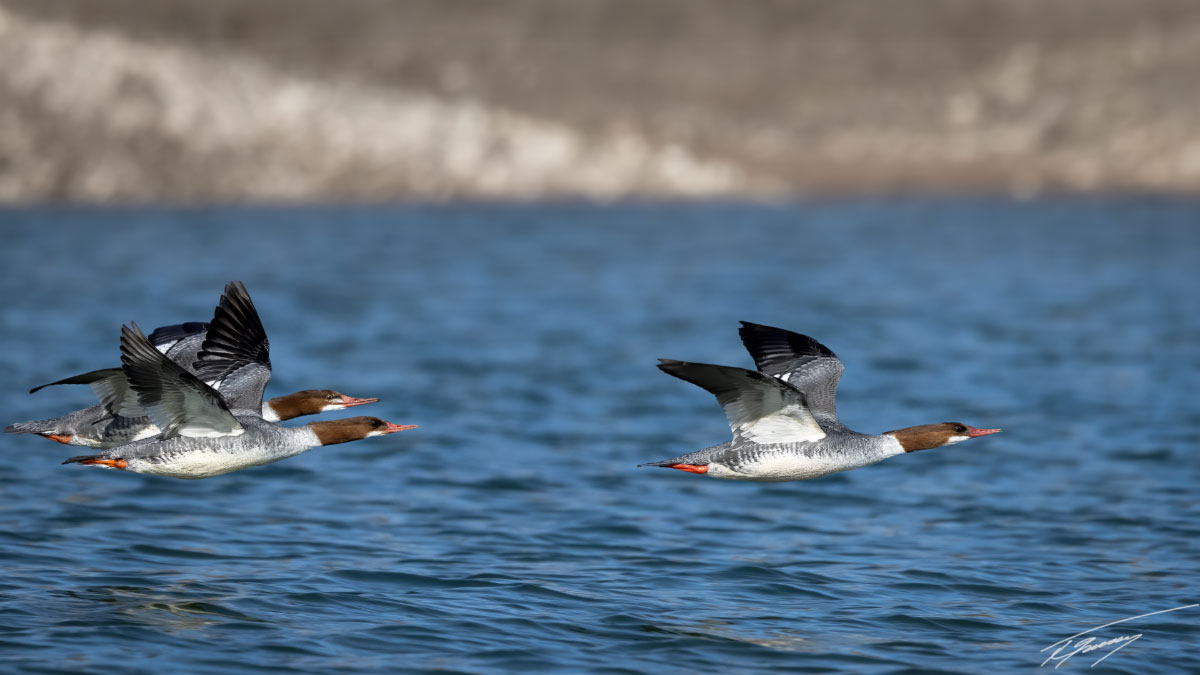
Below three common merganser hens are making a get away from us … such beauty that is everywhere we look!

Have a beautiful day today … hump day and the end of the week is in sight. Smile, keep breathing and lend a hand to someone in need of it.

Smiles,

Ted

Here then, abides the work of wakened man;
To break the chains that would a brother bind,
And stay the misered hand that now is full,
To draw grim profit’s heel from childhood frail,
And loose the women slaves in holes of hell,
To lift the human heart from graves of gold,
And knock unceasingly on temple doors
Where feeble souls have slumbered long,
To plant a rose in every barren breast,
And in the din and tumult of the world
To sing and teach and live the things of love.

excerpt from The Task by Max Ehrmann

###

photo_tedgrussingThe easiest way to reach Mr. Grussing is by email: ted@tedgrussing.com

In addition to sales of photographs already taken Ted does special shoots for patrons on request and also does air-to-air photography for those who want photographs of their airplanes in flight. All special photographic sessions are billed on an hourly basis.

Ted also does one-on-one workshops for those interested in learning the techniques he uses.  By special arrangement Ted will do one-on-one aerial photography workshops which will include actual photo sessions in the air.

More about Ted Grussing


Healing Paws

Healing Paws

This is an advertisement

Embark on a Cute Cat Photography Adventure on PC in ‘Neko Odyssey’

Embark on a Cute Cat Photography Adventure on PC in ‘Neko Odyssey’

An upcoming video game, Neko Odyssey, celebrates one of the internet’s favorite past times: taking photos of cats.

Cats are experiencing a surge in photography-related popularity lately. Earlier this week, Canon showcased its unusual dual-lens VR lens for Canon EOS R-series cameras with a 180-degree kitten “zen” video. Last week, a photo of two funny kittens took top prize in the popular Comedy Pet Photo Awards. This was a repeat victory for felines, as a couple of cute cats won last year’s Comedy Pet Photo Awards competition, too.

[embedded content]

Back to Neko Odyssey, which PetaPixel first saw on Gematsu. The game is slated to arrive on Steam in 2024 and is developed by Secret Character and published by Flyhigh Works.

Neko Odyssey

Neko Odyssey bills itself as “a game for cat lovers you can’t miss.” The “casual adventure” game centers around taking pictures of cats in a charming 3D pixel-art environment.

Within the game, the player searches for cats throughout various locations in town and captures photos to share on in-game social media. Each picture that the player uploads will garner them likes. As the player gets more likes, they will become better known, and some followers may even offer tips on locating new cats in interesting poses.

Neko Odyssey

As any cat owner knows, some cats require a bit of attention and bonding before they will cooperate. In Neko Odyssey, the player may need to build rapport with a particular cat before it allows its picture to be taken.

There appears to be more to the game than just taking photos of cats. The game’s description on Steam suggests that the player’s cat portraits may hold the key to solving a strange mystery in the town.

Neko Odyssey

Details are scarce, but Neko Odyssey should hit Steam next year.

There are plenty of other great photography-related video games to play in the meantime, as PetaPixel describes in the new guide, “15 Great Photography Games to Play in 2023.” Making the cut is another pet photo game, Pupperazi, which, as its title suggests, puts players on a journey to capture cute photos of dogs.


Image credits: Game developer Secret Character and publisher Flyhigh Works

A Trailblazing Photography Collector Champions Black Artists

A Trailblazing Photography Collector Champions Black Artists

As We Rise: Photography from the Black Atlantic is now on view at the Peabody Essex Museum in Salem, Massachusetts. 

In 1997, Dr. Kenneth Montague, a practicing dentist, created a gallery inside the halls of his Toronto home. He dedicated it to showcasing photographs by Black artists. “The first show was set up like a Sunday afternoon salon—really DIY projects,” he recalls in the new book As We Rise: Photography from the Black Atlantic, published by Aperture. 

That unique wedge-shaped space soon gave rise to The Wedge Collection. The project grew from there: today, the hugely influential collection includes more than four hundred works, selections of which are now part of an exhibition at the Peabody Essex Museum in Massachusetts. 

The book and exhibition, organized by Aperture, include many of the most important artists and images in the history of photography, with selections from Carrie Mae Weems, Deana Lawson, Jamel Shabazz, Seydou Keïta, Malick Sidibé, and dozens more. The one hundred works, featuring Black people and made by Black artists living in Canada, the US, the Caribbean, Great Britain, South America, and the African continent, intersect across three main themes: community, identity, and power

In an interview with the curator and photo editor Liz Ikiriko, Dr. Montague remembers his mother taking him and his siblings on trips to art museums and historical societies in the 1970s. He recalls seeing one photograph—James Van Der Zee’s Couple in Raccoon Coats, a portrait of a glamorous Black couple at the height of the Harlem Renaissance—and feeling like he recognized something he hadn’t seen before in television and film. He was just ten years old at the time. 

That revelatory moment would follow him throughout the decades, inspiring him to seek out photographs by Black artists that accurately reflected Black life with a similar sense of consent and care—across continents and generations. Couple in Raccoon Coats is now part of the Wedge Collection; it was one of the first Dr. Montague bought. You can see the glittering silver gelatin print up close at the Peabody Essex Museum. 

The influence of both of Dr. Montague’s parents runs throughout the collection, beginning with those early museum trips organized by his mother. The title “As We Rise” comes from his father, who used the phrase “lifting as we rise” to describe the importance of uplifting others through one’s own triumphs and successes. While many of these artists are now household names, Dr. Montague was one of the first collectors to recognize their work. 

The spirit of collaboration and trust is a thread that ties together portraits by photographers who never got a chance to meet, from the very beginning of the Harlem Renaissance to those working during the Black Renaissance of today. In every portrait, Black people show up as they are and as they wish to be seen, and those wishes are honored like promises. 

Dr. Montague has spent decades traveling the world and meeting artists, and he shares many of those stories within the book and exhibition. While visiting Malick Sidibé in Mali, he also saw Oumar Ly. He writes, “I reveled in the magnitude of the moment: two of the greatest portrait photographers of their day, meeting for the first time.”

The Wedge Collection draws its name from the literal space where it all started in Dr. Montague’s living room. But it also contains another layer of meaning for the collector. As he explains in conversation with Liz Ikiriko, his goal has always been to create space—that is, to build a “wedge”—for historically underrepresented and unrecognized artists within the canon of art history. 

As this exhibition proves, that space need not be confined to the four walls of a living room or even a museum. It’s a living, breathing expanse as vast as the knowledge, experience, and imagination of the artists represented within. Similarly, the stories contained within the 184 pages of this magnificent book stretch far beyond the frame, spanning thousands of miles. 

As We Rise: Photography from the Black Atlantic is on view at the Peabody Essex Museum in Massachusetts through December 31st, 2023. 

Zun Lee. Jebron Felder and his son Jae’shaun at home. Harlem, New York, September 2011
Xaviera Simmons. Denver, 2008
James Barnor. Drum Cover Girl Erlin Ibreck, Kilburn, London, 1966, printed 2011
Lebohang Kganye. Setupung sa kwana hae II
From the series Ke Lefa Laka: Her-story, 2013

Further reading:

From Boy to Man: Samuel Fosso’s Journey Through Self-Portraits

Jamel Shabazz Reflects of the Power of Fashion Photography

Harlem Through the Eyes of James Van Der Zee

Discover More

Capturing the Future: AI Headshots Revolutionize the Face of

Capturing the Future: AI Headshots Revolutionize the Face of

I know what you might be thinking. “Will AI replace professional photographers? Are the days of hiring a professional photographer numbered?” As the owner of 415Headshots, a San Francisco-based headshot studio, I’m here to quell those fears.

The narrative isn’t about AI supplanting photographers. AI is assisting photographers create amazing headshots that were previously impossible, enhancing their skills and producing high-quality results. My journey with AI has been an extraordinary one, filled with intriguing discoveries and valuable lessons. Join me as we explore AI’s impact on headshot photography, transforming the professional industry.

AI and Its Magic in Professional Headshots

Artificial intelligence (AI) has quickly risen from a technological advancement to a creative ally in the world of photography. When we hear “AI,” many of us might think of complex algorithms, vast data, or futuristic robotics. AI transforms headshot photography, offering a fresh perspective to redefine artistic expression.

With AI in our toolkit, we now have the capability to generate realistic headshots that truly transform the concept of photography. These aren’t the traditional images we’ve grown accustomed to; they combine the science of artificial intelligence with the art of photography.

My personal journey with AI began with an experiment. Curious about its potential, I decided to work with www.corporateheadshots.ai and introduce my vast collection of professional headshots to an AI model. Essentially, this meant allowing the AI to learn and grasp the essence of what makes a headshot truly “professional.” The intention was to see if a machine could mimic, or even enhance, the nuances and subtleties that a professional photographer like myself brings into each shot.

And the results? Nothing short of awe-inspiring. The AI-generated images, showcased quality work, presented a range of emotions, angles, and moods. Each image was a testament to the potential that AI holds.

Harnessing AI to Create Stunning Headshots

In the past, headshot photography had been constrained by certain limitations. We had to consider several factors such as time, location, lighting, and the subject’s mood.

But AI changes the whole dynamic. It uses professional, high-resolution images to generate stunning headshots that can rival, and sometimes surpass, the works of human photographers.

Envision yourself as a photographer who had scheduled a few outdoor portrait shoots, but, unfortunately, it’s raining outside. Typically, you’d have to accommodate your clients’ schedule(s) and re-schedule for another day. AI can now allow photographers to take professional headshots in the studio and generate outdoor headshots of the same person.

AI-generated headshots don’t simply mimic; they mirror our styles and techniques to create stunning headshots. The mix of technology and art helps photographers and clients by giving them a special, digitally improved view.

Navigating the digital realm requires a photographer to be versatile. LinkedIn, Facebook, Instagram, or any other social media profiles demand their own flavor of imagery, especially for their profile pictures.

The challenge has always been to adjust and adapt. As a photographer, this meant often needing multiple sessions or exhaustive editing to get the right fit for each platform. But with AI, this landscape changes dramatically.

The true genius of AI lies in its ability to understand and adapt. When it generates headshots, it’s not just churning out images—it’s creating purposeful portraits tailored to resonate with their intended audience. A LinkedIn profile demands authority and professionalism, while Instagram might require a touch more flair and vibrancy. AI, with its vast learning capability, knows these distinctions and crafts images accordingly.

For photographers, this is revolutionary. Imagine the time and effort saved in not having to re-shoot or spend hours editing for each platform. Instead, with a foundational professional shot, AI can produce a spectrum of headshots, each fine-tuned for its intended use. This adaptability isn’t just beneficial—it’s transformative, amplifying a photographer’s efficiency and reach.

Clients, on the other hand, find this adaptability invaluable. In today’s digital-first era, one’s online presence plays a decisive role in personal and professional branding.

Using high-quality headshots guarantees that they will always look their best, regardless of where you display them. You should optimize these headshots for different platforms. This flexibility, driven by AI, enriches their digital identity, giving them a competitive edge.

AI as a Game-Changer for Team and Business Headshots

The image of a company is not just about logos or taglines. It’s built every time someone sees a team photo or reads about the company’s values. Team photos, in particular, give a face to the name, painting a picture of who is behind the products or services on offer. However, ensuring consistency in these photos, especially for large teams, can be a challenge.

Streamlined Photography With AI

Photographers are no stranger to the challenges of traditional team photography. Arranging schedules, finding the perfect lighting for each individual, and ensuring that everyone’s headshots match the desired tone and quality can be a tall order. This is where Artificial Intelligence comes to the rescue. With its advanced algorithms, AI can help generate professional headshots with ease.

User-Friendly Tools for Perfect Shots

One of the major advantages of AI is its user-friendly interface. Even if someone isn’t good with technology, they can still use AI tools easily to get the results they want.

Whether it’s adjusting the brightness, contrast, or even the background of a headshot, these tools ensure every picture aligns with the company’s brand.

Amplifying Personal Branding

In today’s interconnected world, personal branding is crucial. An individual’s photo on platforms like LinkedIn or a company website can play a significant role in their professional journey. A great headshot can help them stand out, making a memorable impression.

With AI’s capabilities, photographers can create images that not only fit the brand but also elevate it. This ability to tailor and fine-tune photos ensures that every team member’s headshot enhances their personal branding.

AI’s Role in Modern Photography

It’s clear that AI is revolutionizing the way we approach team and business headshots. Not as a replacement, but as a potent tool that complements a photographer’s skills. It simplifies challenges, ensuring that photographers can focus on what they do best: capturing moments and stories. The resulting images, enriched by AI’s prowess, tell a compelling story of a company and its team.

Seamless Consistency With AI-Driven Team Headshots

One of the primary challenges in team photography is achieving a consistent look. Lighting, angles, and expressions can create many different photos, even if they’re taken on the same day. AI, with its precision and adaptability, can ensure that all headshots maintain a consistent style and quality.

AI can adjust each team member’s picture to match the specific look desired by a company. You can do this regardless of how you originally took the photos. This not only streamlines the process but also ensures a unified brand image for the organization.

Embracing the Future of Professional Photography with AI

AI doesn’t herald the end for professional photographers; instead, it’s an evolutionary step forward. It enables us to offer additional services and generate higher quality output, crucial factors that can spur our businesses’ growth.

The best AI headshots result from a partnership, a unique collaboration between professional photographers and AI. This synergy is the future—a future where AI and photographers work hand-in-hand to revolutionize professional photography.

Images used with permission of www.corporateheadshots.ai.

Some of the Most Important Photography Advice You’ll Ever Hear |

Some of the Most Important Photography Advice You’ll Ever Hear |

As photographers, we are bombarded by information from all directions on a daily basis, and it can be tricky to know how to cut through it all to the advice that really matters. Whether you are a professional or a hobbyist, if you want some important lessons that will put you on the right track to finding success and satisfaction in the craft of photography, check out this fantastic video essay that discusses such ideas.

Coming to you from Steve Carty, this great video essay provides a range of advice and insights about how to find success as a photographer. Two bits of advice that I found particularly important were having confidence in yourself and pushing yourself to keep exploring and mining your creativity. When you take the shot you want and get that rush of satisfaction, it is a great (and deserved) feeling, but now that you have what you need, why not experiment a bit? Getting comfortable can often lead to stagnation as an artist and a lack of long-term satisfaction. Of course, if you are a professional, you need to ensure you’re delivering what your clients want, but be sure to set aside time for yourself to explore as well. Check out the video above for the full rundown from Carty.

Starting a Successful Drone Photography Business

Starting a Successful Drone Photography Business

Have you ever gazed up at the sky and imagined capturing the world from a bird’s-eye view? Welcome to the enthralling realm of drone photography – a sector buzzing with potential. From real estate vistas to breathtaking event shots, aerial drone photography businesses are revolutionizing how we perceive our surroundings. And operating a drone can be one of the most unique business ideas of 2023. In this article, we’ll navigate the ins and outs of launching a drone photography business, guiding you from the basics to pro tips.

Understanding Commercial Drone Photography

Drone photography is rapidly becoming a mainstay in numerous industries. There are many ways to use drones as you learn how to make money with photography. Real estate is just one of them, where drone-captured aerial views have transformed property showcasing. There’s also the events sector, where drones have revolutionized the way we capture and memorialize special moments, from weddings to large-scale festivals. The tourism industry is another arena where drone photography is making waves, enabling stunning perspectives of travel destinations.

A 2023 study revealed that the global drone services market size was valued at USD 13.9 billion in 2022 and is projected to grow from USD 18.9 billion in 2023 to USD 189.4 billion by 2030.

The Benefits of Starting an Aerial Photography Business

drone photography business

Learning how to start a business surrounding aerial drone photography comes with a host of benefits:

  • Flexibility: Drone photography offers flexible work hours. You have the freedom to choose your projects and set your schedule.
  • Demand: As we discussed earlier, the demand for drone photography is skyrocketing in several sectors. You’re stepping into a growth market.
  • Earning Potential: With the right skills and equipment, drone photography can offer high earnings. A single project can range anywhere from a few hundred to a few thousand dollars.

Are Drone Photography Businesses Profitable?

drone photography business

The potential profitability of a drone photography business is as vast as the skies your drone can reach. As per Skylogic Research, experienced drone photographers can earn over $100,000 per year. However, profitability depends on factors like your skills, the market demand, the type of clients you cater to, and how effectively you market your services.

Challenges in the Drone Photography Business

drone photography business

Even with blue skies and clear horizons, the drone photography business is not without its turbulence. Here are some challenges you might encounter:

  • Regulatory Issues: Navigating the ever-changing landscape of drone laws and regulations can be daunting. Every country has its own set of rules and regulations regarding drone flight and photography.
  • Technical Skills: Operating a drone and capturing high-quality photos and videos require specialized skills and training.
  • Equipment Maintenance: Regular maintenance of drones can be expensive.
  • Competition: With the increasing popularity of drone photography, the market is becoming competitive. Standing out will require creativity and a keen understanding of the market’s needs.
[embedded content]

Key Steps to Start a Drone Photography Business

You’ve fastened your seatbelt, studied the skies, and are now ready to pilot your journey in the drone photography business. But before we take off, here’s a business startup checklist for launching your own drone photography business.

Acquire the Necessary Skills for Flying Drones and Certification for Aerial Photography

drone photography business

Before you can capture stunning aerial shots, you first need to master the art of drone piloting. Here’s how to start:

  • Learn Drone Piloting: Drone piloting involves understanding flight mechanics and safety measures. There are many online and offline training programs available.
  • Understand Photography: Learning the principles of good photography is essential. It’s not just about shooting from the sky; you also need to know how to compose a shot.
  • Get Certified: Depending on your location, you might need a certification or license for aerial drone photography services. For instance, in the U.S., commercial drone pilots must obtain a Remote Pilot Certificate from the Federal Aviation Administration (FAA).

Choosing the Best Drone for a Photography Business

drone photography business

Choosing the right drone is critical. Here are some top models to consider:

  1. DJI Phantom 4 Pro: Known for its superior image quality, it offers up to 30 minutes of flight time.
  2. Autel Evo II Pro: This drone boasts a 6K camera and 40 minutes of flight time.
  3. DJI Inspire 2: A higher-end model with cinematic image quality, it is excellent for commercial shoots.
  4. Parrot Anafi: A more budget-friendly option, this model offers 4K video and a decent 25-minute flight time.
Drone Model Camera Quality Battery Life Stability Features Price Range

DJI Phantom 4 Pro High (20MP) 30 minutes Gimbal stabilization Premium

Autel Evo II Pro Ultra (6K) 40 minutes Omnidirectional obstacle detection High-end

DJI Inspire 2 Cinematic (5.2K) 27 minutes Advanced obstacle sensing Premium

Parrot Anafi Good (21MP) 25 minutes Digital stabilization Budget-friendly

Setting Up Your Business – Legal Considerations and Drone Insurance

drone photography business

Setting up your business involves more than just purchasing a drone. It’s about doing things by the book:

  • Business Entity: Establish a legal business entity, like an LLC, to protect your assets.
  • Comply with Regulations: Adhere to FAA regulations or the governing body in your country. Register your drone and always stay updated with the latest rules.
  • Insurance: Drones are valuable pieces of equipment, and accidents can happen. Insurance protects your investment and gives your clients confidence in your professionalism.

Building a Drone Photography Portfolio and Finding Clients

drone photography business

Now, you’re ready to showcase your skills and attract clients:

  • Build a Portfolio: Start by capturing diverse shots and showcasing them on your website or platforms like Instagram. Find a niche that appeals to your style, whether you want to use a drone as you learn how to become a wedding photographer or prefer shooting real estate photos. Quality should be your main focus, both in shooting and editing photos.
  • Find Clients: Networking plays a huge role in finding clients. Attend industry events, reach out to potential clients, and make use of online marketing.

Scaling and Growing Your Drone Photography Business

Expanding your drone photography business? Excellent! But as the sky has no limits, neither should your aspirations. Let’s look into strategies to elevate your venture to the next tier.

Investing in Advanced Equipment

drone photography business

Top-tier results require top-tier tools. Investing in superior equipment can enhance your output and make a statement about your commitment to quality.

  • Upgraded Drones: Consider drones with longer flight times and advanced camera tech.
  • Gimbal Stabilizers: Ensure smoother video capture, reducing post-shoot editing time.
  • Advanced Camera Lenses: A varied collection can help achieve different photographic effects and styles.

Diversifying Your Services

drone photography business

Broaden your horizons by offering a diverse set of services:

  • Videography: Capture moments in motion, which is especially popular for events.
  • 360-Degree Panorama Shots: Offer a holistic view, making locations and properties more immersive.

Building Partnerships and Collaborations

drone photography business

Strengthening your network can lead to steady work:

  • Event Management Companies: Weddings, corporate events, and festivals can all benefit from drone photography.
  • Real Estate Firms: Aerial shots can add a unique dimension to property listings.

Marketing and Digital Presence

drone photography business

An online presence is paramount in today’s digital age.

  • Social Media Marketing: Engage with a wider audience, showcasing your portfolio on platforms like Instagram.
  • SEO: Boost your website’s ranking on search engines.
  • Paid Advertising: Target specific demographics with Google Ads or social media promotions.
  • Email Marketing: Stay in touch with past clients and reach out to potential ones.

Getting a Great Drone Photography Business Website

drone photography business

In the drone photography domain, a picture is worth a thousand clicks. An attractive, user-friendly website serves as a portfolio, a client touchpoint, and a branding tool. Ensure it’s mobile-responsive, easy to navigate, and showcases your work elegantly.

Drone Photography Tips

Diving into the technicalities, here are some game-changer techniques and pointers:

Mastering the Art of Composition in Aerial Photography

drone photography business

Composition is the backbone of captivating visuals.

  • Rule of Thirds: Break your image into nine equal segments and align the subject with these lines or intersections.
  • Leading Lines: Use natural lines to lead the eye into the image.
  • Balance Elements: Balance out your subjects for a harmonious shot.

Understanding the Drone’s Camera Settings

drone photography business

Perfect photos require a blend of skill and tech know-how.

  • ISO: Adjust according to lighting. Lower ISO for daylight and higher for darker scenes.
  • Shutter Speed: Faster shutter speeds for moving subjects; slower for static or low light scenes.
  • Aperture: Controls the depth of field. Smaller apertures (bigger f-number) keep more in focus.

Embracing Different Perspectives and Angles

drone photography business

Stunning images often come from unconventional views.

  • Top-Down Shots: Offers a bird’s-eye view, revealing unique patterns.
  • Low Angle Flights: Skim close to your subjects for dramatic shots.
  • Side Profiles: Showcase landscapes or cityscapes in their sprawling glory.

The Importance of Planning and Safety Precautions

drone photography business

Well-laid plans lead to well-executed shoots.

  • Weather Checks: Avoid wind or rain, which might damage equipment or disrupt shoots.
  • Battery Life: Always ensure a full charge before take-off.
  • Safety Protocols: Familiarize yourself with local regulations and no-fly zones.

Scaling your drone photography business is a learning, innovation, and dedication journey.

FAQs: Drone Photography Business

Do I need a license to start my own drone photography business?

Yes, in many countries, operating drones for commercial purposes requires a license. For example, in the U.S., commercial drone pilots need to have a Remote Pilot Certificate issued by the FAA. You may also need to find drone photography business names that aren’t taken and register the name with your state.

What is a Remote Pilot Certificate?

A Remote Pilot Certificate is a certification issued by the FAA that permits individuals to operate drones for commercial use. It ensures that the operator understands the regulations, operating requirements, and safety procedures for drones. To obtain one, candidates must be at least 16 years old, pass an initial aeronautical knowledge exam, and undergo security vetting by the TSA.

What type of drone is best for a drone photography business?

The best drones for your business depend on your specific needs and budget. Popular choices include the DJI Phantom 4 Pro for its superior image quality, the Autel Evo II Pro for its 6K camera, and the DJI Inspire 2 for cinematic shoots. For those on a budget, the Parrot Anafi is a worthy consideration.

How much can I earn from a drone photography business?

Earnings can vary widely based on factors like location, skill level, equipment, and specialization. On average, drone photographers can charge between $100 to $500 per hour. Specialized shoots, like real estate or weddings, can garner higher rates.

How can I attract clients to my drone photography business?

Build a robust portfolio showcasing diverse shots, network within the industry, leverage online marketing, maintain an active presence on social media platforms, and consider email marketing campaigns to stay in touch with past clients.

What role does the Federal Aviation Administration play in drone photography?

The FAA oversees and regulates drone use in the U.S., ensuring safe skies for all. This includes setting rules for drone operations, defining no-fly zones, issuing licenses like the Remote Pilot Certificate, and updating safety regulations.

What type of insurance do I need for a drone photography business?

It’s advisable to get liability insurance for your drone photography business. This protects against potential damages your drone might cause during operation. Some clients may also require proof of insurance before hiring your services.

How much should I charge as a drone photographer?

Pricing depends on factors like location, experience, equipment, and the type of shoot. Research local drone photographer rates, consider your overheads, and adjust accordingly. As a reference, rates can range from $100 to $500 per hour or more for specialized shoots.

Does Drone Photography sell?

Absolutely! The unique perspective provided by drone photography has made it increasingly popular in various sectors like real estate, tourism, events, and more. Its ability to showcase landscapes, properties, and events from a unique vantage point makes it a sought-after service.

How are drones used in real estate photography?

Drones offer an unparalleled view of properties, allowing potential buyers to see the full scope of a property, its landscape, and its proximity to other landmarks. Aerial shots can showcase the beauty of a property, highlight its size, and even show off the surrounding neighborhood, giving buyers a comprehensive view and potentially impacting their purchasing decision.

Image: Envato Elements


More in: ,