Photography

Creative Photography and Experimental Media Alumni Awarded Prestigious 2023 California Arts Council Individual Artist Fellowships

Creative Photography and Experimental Media Alumni Awarded Prestigious 2023 California Arts Council Individual Artist Fellowships

Two CSUF College of the Arts alumni – out of 779 applicants – were recently awarded prestigious 2023 California Arts Council (CAC) Individual Artist Fellowships which celebrate the excellence of California artists. Artists were selected by peer review panels comprised of artists, arts administrators, arts educators and arts funders assembled from the participating counties in the region.

Fellowship grants support individual artistic practice through unrestricted funding and support a broad spectrum of artists in a variety of disciplines working across the state of California.

Awards have been made in the following categories:

Emerging Artist Fellows – $5,000
Established Artist Fellows – $10,000
Legacy Artist Fellows – $50,000

William Camargo (Established, Orange County) – William Camargo is a photo-based artist in Anaheim whose work centers on Latinx/Chicanx histories and his response to them in his photographic work. Camargo’s interventions serve as documentation of these hidden and erased histories. His work also examines the struggles of labor, gentrification and police violence in Southern California. In 2020, the CSUF Begovich Gallery, in partnership with CSUF Grand Central Art Center (GCAC) and MUZEO Museum & Cultural Center, presented Camargo’s “Origins & Displacements, Vols. 1 & 2.”

Sant Khalsa (Legacy, San Bernardino) – Sant Khalsa is an artist and activist whose work delves into critical and complex environmental issues. Khalsa received her M.F.A. from CSUF in 1990. She lives and works in Joshua Tree.

Additionally, we congratulate three recipients with ties to the College of the Arts:

Brothers Einar and James de la Torre (Legacy, San Diego) are Mexican-American artists who live and work on both sides of the border. Their work was exhibited at Cal State Fullerton in 2005.

Sara Guerrero (Established, Orange County) is a versatile theatre artist and educator who has been actively creating theatre-making opportunities for and with the Orange County community and beyond for 25+ years. Guerrero is a faculty lecturer in the Department of Theatre and Dance. In 2021, she directed students in a CSUF production of “The Wolves” and will direct the Obie Award-winning “Marisol” on campus spring 2024.

Man photographs Bristol Balloon Fiesta with 1890s camera

Man photographs Bristol Balloon Fiesta with 1890s camera
Photo taken of balloons over Clifton Suspension Bridge with 1890s cameraSimon Williams

A photographer has used a 100-year-old camera to take pictures of the Bristol International Balloon Fiesta.

Simon Williams, who is from the city, used a Kodak Panoram to take photos of the Clifton Suspension Bridge as balloons flew over during Friday morning’s mass ascent.

The panoramic camera was designed in the 1890s but was taken out of production 30 years later.

“I just love the look you get from the camera,” Mr Williams said.

Simon Williams with one of his 19th century cameras

Simon Williams

He bought his first 19th-century camera five years ago, after he retired from being a teacher.

“I saw one for sale and it felt like a challenge I wanted to take on,” Mr Williams said.

“Now I’ve got a bit of a collection going.”

He said he takes photos of places around Bristol such as the historic Underfall Yard on the city’s harbourside, and the Clifton Suspension Bridge.

One of Simon Williams's cameras on location

Simon Williams

“I love that you can hold the photos in your hand. I got a bit disillusioned with digital photography,” Mr Williams added.

“The cameras need maintenance and you can improve them by hand – I love the satisfaction of using something I’ve made.”

Mr Williams will be exhibiting some of his work at the Artport festival in Portishead in September.

Presentational grey line

Follow BBC West on Facebook, Twitter and Instagram. Send your story ideas to: bristol@bbc.co.uk

Related Topics

Today’s Photo from Ted Grussing Photography: Without Which … We Perish

Today’s Photo from Ted Grussing Photography: Without Which … We Perish

… humans have done a miraculous job in creating a complex food gathering, processing and distribution system for the primary necessities of life and especially this is true with food … most of us never have to think about where or how we get our food, we simply go to the grocery store and choose from an incredible variety of food products (my current preference is Entenmann’s chocolate covered donuts) bring our choices home and then feed our families.

It was not always so for us, and we used to be much closer to what the other species on the planet still do on daily basis … that is to daily gather food so that we can make it to the next day. Above is a photo I took last Thursday as Lo IV carried his hard-earned dinner of cottontail rabbit into the arroyo for a hard one feast. I had thought about making some humorous comments concerning the manner in which he is gripping the rabbit, but decided to take a pass on it 🙂

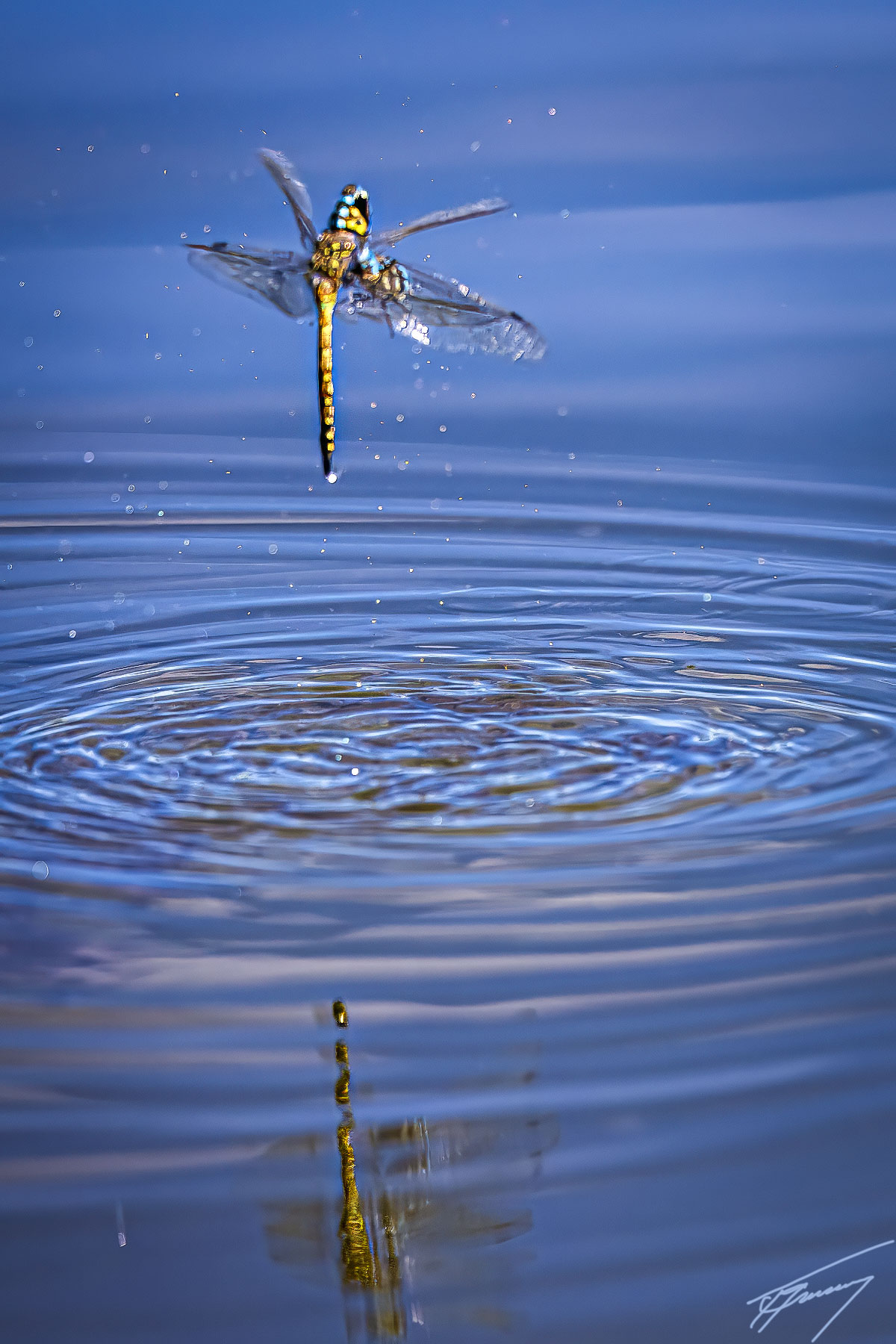
Below is a photo I took on my last outing on Lake Mary and it shows a variegated meadow hawk dragon fly as he is taking off from the surface of the lake after engaging in an incredible battle on the surface with a blue darner dragon fly, he prevailed and is taking his prey off so that he can consume him for breakfast. The prey is almost the same size as the predator and yes, dragon flies do eat each other!

Into a new day and week … methinks it is going to be a very good one! Smile, keep breathing and enjoy each moment you have the privilege of being here … also that we are high up on the predator list …

Smiles,

Ted

Let saints declare I shall not dare
or burn in the pits of hell.
Let loud men scorn and women mourn
Whene’re my tale they tell;

I cannot stay in the deadened way
Of sorrow, hide-bound creeds;
I’ll win the smile that shall beguile
My heart where’re it leads.

Away with tears and shrinking fears
That breed from the gossip’s tongue.
I’ll live today in my own way,
Though night shall find me hung,
And my good name be dragged to shame
And damned for evermore;
So here’s farewell to them that tell
My tale when all is o’er.

His Last Toast by Max Ehrmann

###

photo_tedgrussingThe easiest way to reach Mr. Grussing is by email: ted@tedgrussing.com

In addition to sales of photographs already taken Ted does special shoots for patrons on request and also does air-to-air photography for those who want photographs of their airplanes in flight. All special photographic sessions are billed on an hourly basis.

Ted also does one-on-one workshops for those interested in learning the techniques he uses.  By special arrangement Ted will do one-on-one aerial photography workshops which will include actual photo sessions in the air.

More about Ted Grussing


Healing Paws

Healing Paws

This is an advertisement

NYC Socialite Accused of Unleashing Bonkers Attack on Photographer

NYC Socialite Accused of Unleashing Bonkers Attack on Photographer

A New York City socialite perhaps best known for her unspeakably acrimonious divorce from the world’s leading Andy Warhol collector allegedly threatened to have a professional photographer shot dead over a petty interpersonal spat, then allegedly had the man thrown in jail on bogus criminal charges and destroyed his once-promising career.

In an explosive new lawsuit, shutterbug Jacob Beam says his entire life has gone down the tubes thanks to Libbie Mugrabi—who reportedly once had a physical altercation with ex-husband David Mugrabi over a $500,000 Keith Haring sculpture—and that he now works as a part-time food deliveryman while attempting to get past the “psychological and emotional issues caused by [the] horrific ordeal he has undergone.”

The multi-million-dollar suit was filed Sunday by Beam’s attorney, Kenneth McCallion, in New York State Supreme Court. McCallion declined to comment on the case, or to make Beam available on Monday for an interview.

Mugrabi, 42, made headlines in 2018 for a nasty divorce she said she financed by selling her engagement ring for $100,000. (“The same thing that got me into this marriage is going to get me out,” she told The New York Times.) The split was touched off by accusations of psilocybin-and-ketamine-fueled infidelity, and the pair battled in court over everything from tens of millions in art to a $72 million Upper East Side townhouse to a nine-bedroom Hamptons house to a classic 1974 Ferrari.

Earlier this summer, Mugrabi showed up to court in body armor, claiming her ex was scheming to have her killed. (David Mugrabi called the claim “the most ridiculous story I ever heard.”) In June 2020, at the height of the COVID pandemic, an unrepentant Mugrabi disregarded public health guidelines and held a dinner for 50 people during Art Basel in Miami. The following year, Mugrabi was arrested for allegedly pulling a knife on her live-in housekeeper, who also said her hotheaded boss threatened her with a mop handle. She pleaded not guilty last December to charges of menacing, criminal mischief, and criminal possession of a weapon; it is unclear exactly where the case currently stands.

A photo of Libbie Mugrabi stepping out of an SUV in London.

Libbie Mugrabi attends an October 2022 event in London.

David M. Benett/Getty Images

Today, Mugrabi produces a line of streetwear under the label Libbie Love, selling accessories like trucker hats, handbags, and vibrators. It was through Libbie Love that Beam first got involved with Mugrabi, according to his complaint.

The two met in December 2021, through a mutual friend, the complaint states. Mugrabi was impressed with Beam’s photography portfolio, and flew him to Hawaii for a photoshoot, it says. And although the Hawaii shoot was later canceled, Beam, who was living at the time in Bloomington, Indiana, says Mugrabi asked him to come work with her in New York, which he agreed to do.

Mugrabi paid for Beam to pick up and move in with her, according to the complaint. He says he worked out of Mugrabi’s home studio, doing web design, graphic design, and photography for Libbie Love while also working as Mugrabi’s personal assistant.

But on May 22, 2022, things suddenly took a turn for the bizarre. That’s when Beam says Mugrabi “had a fit of rage, and impulsively shouted at [Beam] to ‘get out’ of the townhouse,” the complaint states.

“[Mugrabi] had apparently rummaged through [Beam’s] personal belongings and had found a journal that he was keeping, which made reference to her,” it goes on. “She loudly told him, ‘How dare you write about me. You know I have a book deal with Simon and Schuster, and if you try to profit off my name I will send someone to shoot you through the head. Do you understand?’” (Mugrabi did reportedly sign a “six-figure” book deal in 2020, for an as-yet unreleased novel based on her bitter split from David.)

Beam dutifully left, and Mugrabi’s then-publicist booked him a room at a nearby hotel, which Beam paid for upon arrival, according to the complaint. The next evening, Beam was taking a walk through Central Park when Mugrabi called, demanding he return some clothing designs he had stored on his laptop, the complaint continues.

“She also threatened him, telling him that she was calling the police,” it states. “[Beam’s] co-worker later told [him] that she was present with [Mugrabi] during a conversation with the police, and that [she] had a wine glass in her hand and there were prescription pills all over the place. The co-worker also overheard [Mugrabi] tell the police that they needed to take her seriously because she was a rich woman.”

Libbie Mugrabi with model Tyson Beckford and singer Little Paris last month, in Paris.

Libbie Mugrabi with model Tyson Beckford and singer Little Paris last month, in Paris.

Victor Boyko/Getty Images for L’Scher

After Beam got back to the hotel, the NYPD showed up at his door, according to the complaint. It says the officers informed Beam that “a woman reported that you had held her at gunpoint and forced her to book this hotel room.” Beam was also told that Mugrabi had accused him of stealing her camera, which in fact belonged to Beam, the complaint states, adding that Beam “was never in possession of and has never owned a gun.”

Nevertheless, Beam was arrested on a raft of charges, including stalking, menacing, and criminal possession of a weapon, the complaint says. He spent a night in jail before being arraigned the next day in New York County Criminal Court and released on his own recognizance.

After Beam was sprung, he went back home to Indiana “in a total state of shock and mortification,” according to the complaint.

“Thereafter, he has continuously suffered from extreme anxiety and depression,” it says.

On Sept. 6, 2022, all of the charges against Beam were dismissed.

“Due to the post-traumatic distress that he has continued to experience, [Beam] has been unable to work full-time, and has been in a near-constant state of anxiety and depression,” the complaint states. “He supports himself as best he can by delivering food on a part-time basis, and he has sought the assistance of a therapist to help him try to function and to try to overcome his psychological and emotional issues caused by horrific ordeal he has undergone, which was directly caused by [Mugrabi’s] outrageous and malicious actions.”

Beam is asking for a jury trial and at least $5 million in damages. Mugrabi did not immediately respond on Monday to a voicemail, email, and text seeking comment.

Local photographers earn awards at ISF

Local photographers earn awards at ISF

#inform-video-player-1 .inform-embed { margin-top: 10px; margin-bottom: 20px; }

#inform-video-player-2 .inform-embed { margin-top: 10px; margin-bottom: 20px; }

DES MOINES — Photographers from Maine to central Iowa submitted their best photographs to the 83rd Annual Photography Salon prior to the beginning of the 2023 Iowa State Fair.

“Sunrise, Sunset” was the 2023 Photography Theme Class. Photographers were given the guidelines to create images that show the best moments from sunrise to sunset. Over 2,500 photos were entered, and 801 photos were accepted into the Photography Salon. The photography entries will be on display on the third floor of the Patty and Jim Cownie Cultural Center each day of the fair from 9 a.m. to 8 p.m.

Local photographers won awards in the following categories:

— Joshua Ward, Ottumwa: Adult Division, Black and White, People, honorable mention.

— Maxwell Thomason, Ottumwa: Adult Division, Color, Things and Still Life, third place.

— Alex Hynick, Eddyville: Adult Division, Color, Iowa Places and Landscapes, honorable mention.

#inform-video-player-3 .inform-embed { margin-top: 10px; margin-bottom: 20px; }

Woodland Camera Forum to present a free photography digital show Monday, Aug. 21

Woodland Camera Forum to present a free photography digital show Monday, Aug. 21

The Woodland Camera Forum will present a free photography “scenic road trip” digital show, “Traveling Down Hwy 395 in Eastern California”, by photographer O. Truman Holtzclaw, on Monday, Aug. 21, at 7 p.m., at Norton Hall, located at 70 Cottonwood St.

The presentation is open to the public, and travelers and photographers are encouraged to attend.

This photo tour will take visitors from the Historic Ghost town of Bodie in the North to the Historic Ghost Town of Cero Gordo in the South.

In between, we will make stops at Conway Summit, Mono Lake, Devils Postpile, Bishop’s Petroglyphs, Law’s Railroad Museum, White Mts. Bristlecone Pines, Death Valley’s Eureka Sand Dunes, Alabama Hills and Cero Gordo.

In this presentation, this 400-mile trip would normally take you four days to cover. This presentation will take about 50 minutes.

From 35 years of serious photography, Truman has perfected the skills to artfully blend his teaching experiences, biology background and his love of nature to create a collection of more than 240,000 beautiful images.

Truman enjoys most all photographic endeavors which include attending and presenting workshops, leading field trips, competing & judging in local and international competitions, and leading commercial photo tours.

In addition, he photographs individuals, groups, special events, weddings, banquets, architecture and sporting events.

From the beginning of his photographic exploits, Truman has always been fascinated with wide-angle lenses and their results. His first wide-angle lens was an inexpensive 20mm “Spiratone” lens which brought him much early success in his local camera club and later on in the P.S.A. competitions.

Photos taken by photographer O. Truman Holtzclaw that will be a part of a digital show on Monday, Aug. 21, at 7 p.m., at Norton Hall, located at 70 Cottonwood St. (Courtesy)

Today his two favorite lenses are the Sony telephoto100-400 mm and his Sony wide-angle,12-24 mm, which he uses with a full frame Sony a7rV.

At his retirement in 2001, after 34 years as a biology teacher, he started his own photographic company called “A Beautiful Image.”

He is past president of the Sacramento Audubon Society, Sierra Camera Club and the Gold Rush Chapter of the Photographic Society of America. Presently he is the Vice President of the Lincoln Hills Photo Club. He also has worked as a Park Naturalist at Calaveras Big Trees.

Truman is a world traveler. Destinations include Canada, Africa, China, Europe, Japan and South America. He has traveled throughout the United States including Alaska and Hawaii. His favorite location for photography still remains the Western United States.

JMU Athletics Student Opportunities in Broadcast, Creative Services – James Madison University Athletics

JMU Athletics Student Opportunities in Broadcast, Creative Services – James Madison University Athletics

HARRISONBURG, Va. – James Madison Athletics seeks students to support key areas related to exposure, brand representation and creative media with roles in broadcast, creative video, photography, graphic design and social media.
 
Available opportunities would naturally fit students from media arts & design, communications or the Hart School, but students from all areas of study are invited to participate. Both volunteer and academic (practicum or internship) positions exist. Some positions can lead to future paid roles.
 
Interested students should directly contact the individual listed with each area. If desired, students may explore more than one area.
 
Live Productions (Broadcast)
 
Video production… Sports… Broadcasting… Live TV… ESPN! 
 
Get a hands-on, immersive production experience with JMU Sports Network. Students will be fully involved in the production and broadcasting of JMU Athletics events on the ESPN+ platform. It takes a whole team to put on a great show. Camera operators are essential! If the camera doesn’t catch it, the viewers don’t see it. Replay operators provide Instant Replay and help tell the story through highlight packages. Graphics operators can tell a story of their own through player and team graphics, updated stats and score bug manipulation. And nothing happens without a good producer, a director calling the shots and a technical director pressing all the right buttons.  And we haven’t even mentioned audio operators, video shaders, production engineers, associate producers, or assistant directors. Every position working together in rhythm, that’s what it takes. We need JMU students to join our crew today and help us enter the Sun Belt and the ESPN family with the best live production operation!
 
Contact Director of Live Productions Kelly Bowmaster – bowmaskt@jmu.edu
 
 
Creative Video
 
Creative Video is a rapidly-evolving field within sports and the Creative Video team is looking for driven students interested in telling the story of JMU Athletics through video. Students who work with the Creative Video team can expect opportunities to assist in both capturing and editing content from our events as well as producing content such as recaps, hype videos and features, for social media, television and the video boards within our athletics facilities. Students will gain valuable experience learning to work with the industry leading equipment and software, working with a team and have the opportunity to build a portfolio that sets them apart from the crowd!
 
Those interested can contact the Creative Video team at athletics-video@jmu.edu
 
 
Photography
 
Photography for JMU Athletics is looking for student assistants experienced in sports photography.  Assistants must be detail-oriented, reliable and dependable, while also proficient in photoshop, photo selection and editing.  Must be able to multitask and work at a fast speed. Student assist with capturing and sorting photos during all home sporting events. Other student tasks include office work to process, sort and tag images from various shoots.
 
Contact Photography Supervisor Cathy Kushner – kushnecs@jmu.edu
 
 
Graphic Design / Social Media
 
Interested in how @JMUSports runs its social media? The social media and graphic design teams work hand-in-hand to promote our athletic programs externally to all our fans. Students will assist, create and participate in the day-to-day operations of the Social Media and Graphic Design teams. This includes the production of game day posters, scoreboard graphics, stadium signage and promotions on all platforms. We’re recruiting students for this position to experience the behind-the-scenes work of the Creative Services department here at JMU Athletics. During this time of growth, students will enhance their portfolio skills, understand the relationship between social media and graphic design and gain insight and knowledge in the profession.
 
Contact Graphic Designer Evan Powell – powellet@jmu.edu
 

Video Board Operations

Ever wonder what it takes to make the “Big Screen” at sporting events work? Become part of that “behind-the-scenes magic” that brings the board to life at our games! PAID positions available for football and basketball game days and more! Positions vary from camera operator, graphics operator, replay operator and there’s room for growth into director and assistant producer roles.

Contact Katie Windham – katie.windham@daktronics.com


Print Friendly Version

Smartphone Photography Accessories That You Might Actually Use: We

Smartphone Photography Accessories That You Might Actually Use: We

How many smartphone photography tools have you purchased and eventually misplaced or have forgotten about? Maybe these cleverly designed accessories will serve you better.

If you’re a little more serious than others about taking great photos with your smartphone, you’ve probably purchased a handful of accessories that are supposed to help you take better photos or at the very least make the process more convenient. Personally, I’ve owned about a dozen smartphone tripods, tripod mounts, and even lenses and filters for various smartphones, and they have all shared one inevitable flaw (which may also be considered my fault): I always forget to bring them whenever I have an actual use for them.

While there are photographers who exclusively take photos with their smartphones, I would say that my smartphone photography serves to either take behind-the-scenes images and clips or to infuse a little creativity during the day when I’m just running errands and doing non-creative work. Whether you’re a serious mobile photographer or someone who does it for convenience, it is almost certain that you’ve found yourself empty-handed when you actually needed some accessories to take the photos that you wanted to take.

[embedded content]

For this article, let’s take a look at some parts of Peak Design’s mobile accessories line that can benefit your on-the-go creative lifestyle for smartphone photography.

The Everyday Case

Peak Design has been one of the most popular brands in camera bags and straps in recent years and this is mainly because of how the brand has infused functionality and modularity with minimalist sleek design features. Their popular Everyday backpacks, sling bags, messenger bags, and other accessories feature simple and subtle yet elegant designs that use nylon canvas material that started a trend that departed from the typical camera bag designs, allowed commuting photographers to blend into the urban scene, and basically made them look less like bags that camera thieves would go for.

The Peak Design Everyday Case for iPhones, Samsung Galaxy, and Google Pixel smartphones follows the same design principles. These smartphone cases feature the same nylon canvas shell on top of a lightweight polycarbonate protective case that covers the entire phone’s rear and sides as well as gives added padded protection to the screen and camera modules by having additional width on the padding. All of the phones’ buttons are also covered by the case that has embedded button extensions for an easier, tactile experience. At the bottom are speaker holes on both sides, a hole for the charging cable port, and a camera strap loop on each side that are compatible with Peak Design Anchors for straps.

The modularity and compatibility of the case with the accessories come from a small rounded-square depression at the back of the case. For iPhones this goes hand-in-hand with the Magsafe features that add even more convenience. The square dent on the back of the case is the receptacle that allows secure mounting and quick button release on most of the mobile accessories. For the case itself, some possible limitations would be that they only come in two colors and are only available for select smartphone models. However, for non-compatible smartphones, a universal adapter is available that can be mounted onto any smartphone case (the actual back panel of the phone) through durable adhesives. This universal adapter will allow users of any smartphone brand to use Peak Design accessories altogether.

The Mobile Tripod

The simple yet clever design of this portable tabletop tripod fixed the most common issue with all other smartphone tripods which is the fact that they would always be extra accessories to bring around and ultimately extra accessories to forget. The Peak Design Mobile tripod, when folded, only has a thickness of 4.75-7.5mm (tapered) and magnetically latches onto the back of the Everyday case. Since this accessory only makes use of magnets (not the SlimLink port), it can also be compatible with other cases on iPhone models with Magsafe or other cases with built-in magnets. However, the strength of the magnetic bond may differ depending on the case. The mobile tripod weighs 76 grams which is relatively heavy for a small 9.5 x 5.5cm plate because it is made entirely out of bare anodized aluminum with only some rubber pads on the surface that mounts to the phone and the tips of the tripod’s legs.

Most of the structure of the mobile tripod remains latched onto the rear surface of the phone while a key-shaped structure taking up 1/3 of the back, flips 180 degrees outward to reveal the legs of the tripod. This further flips out and divides into three legs that are connected to the rest of the structure through a ball joint that functions pretty much like a tripod ball head and allows the user to turn the smartphone 360 degrees and tilt up and down. On the inner surface of the middle leg is a magnetically attached key with a hex tool as its tip. This allows the user to fine-tune the friction of the ball joint as well as tighten the joints of the legs altogether.

The Mobile Creator Kit

The Peak Design Mobile Creator Kit is the brand’s version of a tripod mount and while there are thousands of variants of smartphone tripod mounts in the market, this particular one solves the problem (or flaw) that 99% of tripod mounts have which is the fact that they use spring-loaded clamps that apply a significant amount of pressure onto the sides of the phone. Aside from the fact that these can sometimes be tedious to work with, they also often come into contact with the smartphone’s buttons (when you want the mount to be at the center to balance the weight) and may hinder access to the buttons or accidentally press them.

The Peak Design Creator Kit makes use of a square attachment mechanism called Slimlink which perfectly latches onto the port that can be found on the back of the PD Everyday case or universal adapters. This works alongside the magnetic mounting that the mobile tripod also uses. The Slimlink port makes use of two small protrusions that lock the two in place making sure that even a bit of impact can not remove the phone from the mount. Aside from making the mount secure and sturdy it also allows quick and easy mounting without having to deal with springs or friction knobs. The stem of the creator kit connects to the arca-swiss type bottom plate through a joint that allows almost 180-degree tilt adjustment while on a tripod. Alternatively, it can also be removed and mounted onto an action camera mount, clamps, suction mounts, etc.

Smartphones are always the most convenient cameras to use because of how readily available they are to any creative. While there will also always be limitations to what they can do, having accessories definitely boost their capabilities by a lot. Peak Design’s smartphone accessories have many different applications for photography definitely have a lot to offer mainly because of how their clever design makes using and carrying them more and more convenient.

What I Liked:

  • Sleek minimalist design
  • Portable and easy to use
  • Secure mounting with magnets and Slimlink

What Can Be Improved:

  • More compatibility and color options for the Everyday case
  • Lighter options through mixed aluminum and rubber for the mobile tripod
  • Retractable stem option for the creator kit

A Veteran Combat Photographer Is on a Mission to Capture Portraits of Every Living Medal of Honor Recipient

A Veteran Combat Photographer Is on a Mission to Capture Portraits of Every Living Medal of Honor Recipient

The U.S. military has doled out exactly 3,535 Medals of Honor since the award’s introduction during the U.S. Civil War, and as of August 2023,  only 65 recipients were still alive. Retired Air Force combat photographer Jeremy Lock wants to photograph all of them.

“These guys are the ultimate heroes to me,” Lock tells Military.com. “I’ve always had a fascination with them, these larger-than-life heroes that are just like us, just like you and me.”

Lock, who was named Military Photographer of the Year seven times during his time in the service, created a special page on his website dedicated to the portraits he’s taken of living Medal of Honor recipients. He’s been at it for nearly eight years, with 32 portraits to show for it and the ultimate goal of capturing all of them.

Lt. Col. William Swenson received the Medal of Honor for actions near the Afghanistan-Pakistan border in 2009. (Jeremy Lock)

Today, Lock is still a photographer, but he’s also a storyteller and podcast producer. He started taking portraits of these Medal of Honor recipients through his regular work. In 2016, he was hired to be the lead photographer for the AirPower Foundation’s annual Sky Ball gala event, which regularly features a guest list that includes former prisoners of war and Medal of Honor recipients.

Lock had years of photojournalism experience, covering everything from worldwide humanitarian missions to combat operations while in the U.S. military. His work had been featured in Time Magazine and even the Smithsonian. But before covering the gala, he’d learned studio portrait photography and decided to put that practice to use.

“I had this real opportunity,” he says. “I had this new skill, and I thought, ‘How amazing would it be to sit down for, like, 10 minutes with my heroes?’ At first, it was tough, because they’re trying to go to the gala.”

The AirPower Foundation was impressed by Lock’s efforts, and before long, the organization began specifically setting aside room for him to take the portraits.

“Now they’re calling and asking: ‘What room do you want to set up for the portraits? We gotta get these,'” he says with a laugh. “It’s been awesome to sit down and just kind of capture the essence of who these heroes are. That’s basically how the project was born.”

Hiroshi H. Miyamura. (Jeremy Lock)

Lock has his favorites, of course. Among them is Army Staff Sgt. Hiroshi Miyamura, a former POW who received the Medal of Honor for covering his squad during a nighttime retreat, holding back a human wave of Chinese troops with his bayonet and killing 50 enemy troops before being captured.

Then there’s Sgt. Maj. Bennie Adkins, who received the Distinguished Service Cross for his defense of a Special Forces camp in Vietnam’s A Shau Valley in 1966. While wounded, he directed mortars while exposing himself to enemy fire to rescue his fellow soldiers. When no one else remained to fire the mortars, he took over until he ran out of ammo. He fought for 38 hours before leading his men in a two-day escape through the jungle.

Sgt. Maj. Bennie Adkins. (Jeremy Lock)

Both men passed away in the past few years: Adkins died in 2020 at age 86, and Miyamura died at age 97 in 2022. Lock, who has seen more than his fair share of combat with the U.S. military, has stunning portraits of both men.

“I mean, God. What an honor it is to do that,” Lock says of taking their photos. “No one can tell what kind of person they’re going to be on the battlefield. You can’t answer until you’ve been in that situation. And these guys, they’re me and you; they’re us. But something switched in them on the battlefield, and they became heroic.”

John Baca received the Medal of Honor after he threw himself on a grenade during a nighttime ambush in the jungles of Vietnam. (Jeremy Lock)

His podcast, “Last Letters,” grew out of the time he’s spent photographing his heroes. He hosts people from all walks of life, from Nobel laureates to exonerated prisoners, who talk about what they would do if they knew tomorrow was their last day on Earth.

“It opens up an amazing conversation,” says Lock. “It’s the greatest storytelling I’ve ever done. … There’s no bias whatsoever. At the end of the day, everyone is going to die: So what would your final words be? And who are you saying them to?”

The latest episode of the show features Maj. Gen. Patrick Brady, a helicopter pilot during the Vietnam War who received the Medal of Honor after flying through a maelstrom of smoke, fog and enemy fire to rescue wounded soldiers, even landing in a minefield to reach them. Lock has a portrait of Brady, too.

Maj. Gen. Patrick Henry Brady. (Jeremy Lock)

“These guys aren’t getting any younger,” Lock says. “You’ll see quite a few that have already passed. These photos show the kindness and greatness of them, but also their humanity — that the person standing right next to you could be the next Medal of Honor recipient.”

To view Lock’s full portrait gallery, visit the Medal of Honor recipients page on his website, and be sure to see his other work on JeremyTLock.com, which includes 21 years of military photojournalism, and the Last Letters Podcast.

— Blake Stilwell can be reached at blake.stilwell@military.com. He can also be found on Facebook, Twitter, or on LinkedIn.

Want to Learn More About Military Life?

Whether you’re thinking of joining the military, looking for fitness and basic training tips, or keeping up with military life and benefits, Military.com has you covered. Subscribe to Military.com to have military news, updates and resources delivered directly to your inbox.

Story Continues

How Gösta Peterson, the Photographer’s Photographer, Kept a Low Profile While Making Fashion History

How Gösta Peterson, the Photographer’s Photographer, Kept a Low Profile While Making Fashion History
A lesser-known contemporary of Richard Avedon and Irving Penn, Gösta Peterson is having a moment years after his death.

August 14, 2023

How Gösta Peterson the Photographers Photographer Kept a Low Profile While Making Fashion History

Courtesy of Turn Gallery.

When the photographer Gösta Peterson shot a relatively unknown model named Naomi Sims for the cover of the Fashions of the Times (a special section of The New York Times Magazine) in the summer of 1967, it heralded a seminal moment in fashion history. That arresting portrait of Sims, elegantly clad in a black cape and wide-brimmed hat, is considered the first cover by a major American fashion magazine with a mixed-race audience to feature a Black model.

How Gösta Peterson the Photographers Photographer Kept a Low Profile While Making Fashion History
Courtesy of the Estate of Gosta Peterson.

“She just felt like the right model at the right time for that. We weren’t trying to prove anything,” recalls Patricia Peterson, the magazine’s editor at that time (and Gösta Peterson’s wife, with whom he frequently collaborated). Indeed, Gösta, who was known for his quick, often improvisational style of photography, was more incentivized by the allure of a fresh face than making history or notions of celebrity. Earlier that year, he was also the first of his industry peers to photograph Twiggy in the United States. Again, it was a matter of capturing images of the waifish Brit before becoming disinterested by her inevitable ubiquity.

It’s hardly an overstatement to call Gösta Peterson one of the most influential, yet little-known, fashion photographers of his time. Despite his barrier-breaking work, Peterson, a self-taught lensman with a fondness for jazz and natty tweed suits from Savile Row, has remained a lesser-known figure in the pantheon of great fashion photographers from that era: Richard Avedon and Irving Penn, for example. Many of his contemporaries, including the photographer Arthur Elgort and the fashion stylist and entrepreneur Linda Rodin, both of whom worked as his assistants, attribute this astonishing omission to Peterson’s unyielding resistance toward household-name models—the Lauren Huttons and the Cheryl Tiegses of the modeling world. “It was the time of Avedon and Hiro, but Gus didn’t buy into that. He didn’t shoot Vogue because he didn’t want to work with their models,” says Rodin, whose own visual memoir, forthcoming in early 2024, will feature a sizable selection of Peterson’s photographs.

How Gösta Peterson the Photographers Photographer Kept a Low Profile While Making Fashion History
Courtesy of the Estate of Gosta Peterson.
How Gösta Peterson the Photographers Photographer Kept a Low Profile While Making Fashion History
Courtesy of the Estate of Gosta Peterson.

While it may have precluded him from the pages of what many industry insiders consider “the Fashion Bible” (Vogue was known for typically insisting on using its own selection of models), Peterson, who passed away in 2017 at the age of 94, was resolute. “There’s nothing worse than an over-trained model who’s lost all sense of her body’s personality,” he said in a 1983 interview with American Photography magazine. In addition to The New York Times Magazine, Peterson shot for a number of other major publications, such as Mademoiselle, Harper’s Bazaar, Elle, GQ, and Esquire.

Now, several decades after the prime of his career, Peterson is having a quiet but significant resurgence. Earlier this year, the Manhattan-based gallery Deborah Bell Photographs presented a solo retrospective show featuring more than 35 of his images. And next month, Study magazine, a quarterly publication, will dedicate its fourth issue to Peterson and his work. “His approach was so modern, his images are still so powerful,” says Study’s founder and editor in chief, Christopher Niquet, who was first introduced to Peterson’s oeuvre by a friend, the fashion photographer Steven Meisel—a longtime admirer of the late photographer.

How Gösta Peterson the Photographers Photographer Kept a Low Profile While Making Fashion History
Courtesy of the Estate of Gosta Peterson.

“He was the fashion photographer’s photographer. A lot of people on the inside really appreciated him, but on the outside, he didn’t have that much exposure,” notes Peterson’s son, Jan, who frequently assisted his father in his 87th Street studio near the family’s Upper East Side home. Peterson has had an influence on the work of other photographers, including Deborah Turbeville and Diane Arbus.

So who was Gösta Peterson, the Swedish-born illustrator turned pioneering photographer, with little interest in widespread recognition—but who was no less deserving of it? Originally an illustrator by training and trade, Peterson worked at a top advertising firm in Stockholm after serving in the Swedish military during World War II. When he accepted a relative’s invitation to the United States, his colleagues feted him farewell with a Rolleiflex camera, a fortuitous offering if any. Peterson arrived in New York in 1948, and—as many recall his own telling—he went straight to the Metropolitan Museum of Art, then Harlem, where the city’s buzzing locus of jazz clubs would provide unceasing entertainment and amusement in the years that followed.

How Gösta Peterson the Photographers Photographer Kept a Low Profile While Making Fashion History
Courtesy of the Estate of Gosta Peterson.

Whether or not the freeform expressions of jazz directly informed his own self-taught approach to photography, Peterson’s improvisational, often spontaneous, shot-on-the-street style became his trademark as he picked up a growing succession of freelance jobs from magazines. The assignments increased in scope and prestige, and yet the inherent, snapshot-like energy of his images typically endured. “He was very quick. And funny,” recalls Arthur Elgort. Peterson’s images often featured pairings or groups of models that conveyed a sense of curious engagement, almost seeming surreptitiously documented in medias res—especially when shot from atypical angles such as looking upwards from below.

In 1975, Linda Rodin sought Peterson out for a job after discovering his photographs in a number of her favorite magazines. “They were playful and beautiful. They had a sense of humor, but also elegance to them,” she recalls. Inside the studio, Rodin witnessed Peterson’s impulsive approach firsthand: “You know, he just got it. Like, snap. He would take the one shot, and that was it. Nothing was labored.” That propensity for speed served Peterson well when he found himself with only about 30 minutes to shoot Twiggy for The New York Times Magazine—as did his lack of cumbersome equipment. Often, he wore a multipocketed safari jacket from Abercrombie & Fitch to keep his light meter and extra rolls of film within reach.

How Gösta Peterson the Photographers Photographer Kept a Low Profile While Making Fashion History
From Annika Peterson.

“He used to laugh when people said, ‘Oh, you’ve got to get the new Nikon. It’s got the greatest lens and it takes the best pictures.’ And he’d say, ‘Hold on, everybody. No camera takes the best pictures. It’s the person holding the camera who takes the best pictures. It’s their eye, it’s not the equipment,’” recounts Rodin. If anything, it was the alchemy of photographer and model—not elaborate sets, nor flashy technical equipment—that made Peterson’s photographs so one of a kind: provocative, curious, memorable images born from his ability to convey an abundance with remarkably little.

How Gösta Peterson the Photographers Photographer Kept a Low Profile While Making Fashion History
Courtesy of the Estate of Gosta Peterson.

Jan Peterson, who oversees his father’s archives along with his sister, Annika, notes the integral character of Peterson’s models. “He generally picked models that were kind of peculiar or quirky or funny-looking in some way. Or he’d pick very strong women, and usually use them in the more graphic pictures, which helped embody the whole statement,” he explains. A black-and-white photo from a 1967 issue of Harper’s Bazaar features three models clustered together, crouched and contorted to mirror the curvilinearity of a staircase in the background, for example. Sure, it was a fashion spread meant to showcase the clothes, but Peterson’s photos often expressed a fuller idea that absorbed the fashion into the entirety of the composition.

How Gösta Peterson the Photographers Photographer Kept a Low Profile While Making Fashion History
Courtesy of the Estate of Gosta Peterson.

When it debuts next month, Study’s latest volume will feature a mostly pictorial gallery of Peterson’s photographs, alongside a text by the French author Avril Bénard. For founder Christopher Niquet, who hopes the forthcoming tribute might impel a published book of the photographer’s images sometime in the near future, the enduring quintessence of Gösta Peterson’s work lies in its anachronistic representation of the past in the current present. “You never feel like you’re looking at a ’60s model in a ’60s dress, photographed with ’60s tricks,” Niquet says. “They are timeless.”