Wildlife photographer cherishes North Texas wildlife


On September 19, 2022, three days after Mahsa Amini died after being sent to a “re-education center” by Iran’s morality police for allegedly infringing the country’s strict dress code, photographer Yalda Moaiery was arrested, beaten and jailed. She had been taking pictures of the resulting protests in the capital Tehran, part of a wider, women-led movement that erupted across the country following 22-year-old Amini’s death.
Moaiery was released on bail in December, reportedly pending a summons to begin a six-year prison sentence on anti-state charges. In January, a video of Moaiery was posted to her social media: dressed in an orange uniform, she sweeps the street and announces her sentence.

Sixteen years earlier, Moaiery had been granted permission to shadow Iranian police operations targeting women who weren’t observing the country’s compulsory hijab laws. Some of those images — of women looking fearful and angry, or shielding their faces with their hands as they’re put into police vans — appear in the timely new photography book “Breathing Space,” edited by Iranian art director and gallerist Anahita Ghabaian Etehadieh.
“The women were arrested for different reasons: a veil considered to be badly placed, make-up considered too conspicuous, or clothes deemed to be too tightly fitting,” explained Ghabaian Etehadieh of Moaiery’s photographs, which were taken in 2006 and 2007.

“Breathing Space,” published by Thames & Hudson, brings together the work of 23 Iranian female photographers whose work spans three decades. Exploring a range of photographic styles and genres, the book arrives at a pivotal moment in the trajectory of contemporary Iran. It has been released within weeks of the “official” redeployment of Iran’s morality police following the widespread protests spurred by Amini’s death and the subsequent arrests and executions of many young people across the country.
“We are living in an historic moment for Iranian women,” Ghabaian Etehadieh told CNN via email, regarding the protests. “This (time) is meaningful for me, and important for Iranian photography. When we look at the global situation, we can see that there is now much greater awareness about gender equality and other social subjects… What is important is for us to progress and move forward, both artistically and more broadly.”

Since 2001, Ghabaian Etehadieh has run the Tehran-based Silk Road Gallery, Iran’s first dedicated contemporary photography space, where many of the book’s contributors have previously exhibited.
“Photography was very much on the margins in 2001 — even today it is difficult to claim photography is a fully accepted part of the art scene in Iran — so initially, it had some difficulty finding its place,” she noted of the gallery. “There’s a contradiction, because in Iran there are many students studying photography, and it has a large audience.”
Internationally however, the story is different, with Iranian photographers widely recognized by established institutions: Hengameh Golestan, Newsha Tavakolian and Shadi Ghadirian, who all appear in the new book, have work featured in the collections of institutions such as the Smithsonian in Washington, DC, the V&A Museum in London and Los Angeles’ LACMA.

“Publishing this book is more important and durable than staging any individual exhibition,” said Ghabaian Etehadieh. “I am delighted that it represents a new angle on Iranian photography and is the first to bring together a collection of female artists. These women, from a range of backgrounds and fields, have created important works telling a story about Iran and contributing to its photographic history.”
“Tahmineh Monzavi’s work goes beyond artistic representation and opens a discussion about different social and gender issues,” she said, recalling the photographer’s series “Tina,” in which Monzavi tenderly records the daily life of a transgender woman she befriended.

Elsewhere, photos from Ghadirian’s “Like Every Day” series foreground criticism of the restrictions facing women in the domestic sphere, depicting subjects in patterned chadors with household objects obscuring their faces. “Ghadirian is one of the most influential photographers at present, continually highlighting social and cultural tensions,” said Ghabaian Etehadieh. “She emphasizes contradictions faced by women every day — between old and new, tradition and modernity — and by spotlighting these pressures, reveals an intense female objectification.”
While stylistically varied, the photographers’ work is united in its rich storytelling and exploration of themes like gender equality, the environment, nostalgia, intimacy and war. The book announces its intentions as a vehicle for women’s voices early on, introduced with images from Golestan’s “Witness ’79” series of 1979’s women’s marches: shot in black and white, her photographs document the largely female crowds that marched against the then newly-imposed hijab laws.

“Aesthetically, the book is not ordered chronologically or thematically. This was a choice,” asserted Ghabaian Etehadieh. “It’s about ‘going back and forth’ between generations, but also themes and styles. This dialogue shows the artistic struggles female photographers undergo simply to express themselves, to secure a breathing space.”

(CNN) — On September 19, 2022, three days after Mahsa Amini died after being sent to a “re-education center” by Iran’s morality police for allegedly infringing the country’s strict dress code, photographer Yalda Moaiery was arrested, beaten and jailed. She had been taking pictures of the resulting protests in the capital Tehran, part of a wider, women-led movement that erupted across the country following 22-year-old Amini’s death.
Moaiery was released on bail in December, reportedly pending a summons to begin a six-year prison sentence on anti-state charges. In January, a video of Moaiery was posted to her social media: dressed in an orange uniform, she sweeps the street and announces her sentence.

Photography is not only an artistic medium but also a way of knowing.

By: Jerry L. Thompson
Photography matters, writes Jerry Thompson, because of how it works — not only as an artistic medium but also as a way of knowing. It’s with this provocative observation that Thompson begins “Why Photography Matters,” his wide-ranging and lucid meditation on why photography is unique among the picture-making arts. He constructs an argument that moves with natural logic from Thomas Pynchon (and why we read him for his vision of contemporary reality, not his command of miscellaneous facts) to Jonathan Swift to Plato to Emily Dickinson (who wrote “Tell all the Truth but tell it slant”) to detailed readings of photographs by Eugène Atget, Garry Winogrand, Marcia Due, Walker Evans, and Robert Frank. Forcefully and persuasively, he argues for photography as a medium whose business is not constructing fantasies pleasing to the eye or imagination, but describing the world in the toughest and deepest way. We’re pleased to share an excerpt from “Why Photography Matters” below.
Let me begin with Reason One, how photography works.
The camera is not only a tool for generating images.
Studio artists today use cameras to generate the pictorial raw materials they need in order to create works expressive of their individual talents and personal visions. For a studio artist, the camera is a source of material. The artist provides the form, shaping what the camera supplies into what the viewer sees as a work of art. The content of the artwork — what it has to say to the viewer, the experiences (emotional and intellectual) it prompts the viewer toward — this content comes from the artist, as it does when the work of art is a painting (or other kind of imagined image). The viewer contemplates the artist’s vision. What the artist presents, as her work progresses, is a progressively deeper exploration of that vision.
The viewer who follows the work of an artist over time may come to know many facts about the world, but that viewer comes to know those facts incidentally, the way a reader of novels by, say, Thomas Pynchon comes to know about the trajectories of ballistic missiles or the progress of E. coli infections. What the serious viewer comes to know about, what he could not learn from a technical manual or guidebook, however, is something else: the vision — the intellectual and moral world — of the artist. We don’t read Pynchon to learn about physics and military history; if we read him seriously we read him to learn about his vision of contemporary reality. We read him to come into contact with what ever since Immanuel Kant’s formulation of 1791 has been called his genius: his original, and unique, understanding of how the world works. According to Kant, what genius produces illuminates Nature’s rules, rules the genius him/herself can embody in his/her work but not explain, rules some later intelligence may be able to analyze and make understandable to others.
A studio artist works like a novelist. He or she may pay a great deal of attention to the details of everyday visible reality, but what he or she adds to those observations is the something else, the shaping form supplied by his or her genius. The details figure in, but they are not the main point. Walker Evans wrote in an undated note to himself that anyone who goes to Botticelli to learn about the dress and manners of the 15th century is a pedant and a fool. Few scholars of the future who look at Jan Groover’s breakthrough still-life arrangements of kitchen utensils will spend much time considering the development of the colander in the 1970s. The main point is not a compilation of facts about the objects seen, but the genius of their combination into an original composition.
Groover (d. 2012) was, as also was the Evans (there were more than one) who wrote that epigram, not only a photographer but also an artist. But not all artists who use photography use it in the same way. To repeat: The camera is not only a tool for generating images.
To find a sharp contrast to what I have been calling a studio artist we need look no further than the first book of photographs ever published, William Henry Fox Talbot’s “The Pencil of Nature” (1844). This book consists of a number of the earliest photographs made, each pasted on a page with a brief essay/caption printed across from it. Here is an excerpt from one of the captions:
It frequently happens . . . —and this is one of the charms of photography—that the operator himself discovers on examination, perhaps long afterwards, that he has depicted many things he had no notion of at the time. Sometimes inscriptions and dates are found upon the buildings, or printed placards most irrelevant, are discovered upon their walls: sometimes a distant dial-plate is seen, and upon it — unconsciously recorded — the hour of the day at which the view was taken.
The implications of this pleasant observation extend to the extremes of recorded thought, both to its earliest beginnings and to the present now. For what Fox Talbot is describing is nothing less than a way of knowing the world that transcends our educations, our opinions, our intentions, hopes, and desires — in a word, our subjectivity. Talbot here acknowledges that the camera can show more than its operator understood he saw when he looked at the actual scene.
For a long time photographers who wanted to be artists viewed this rich harvest of detail as a large obstacle to be overcome rather than a “charm.” Many turn-of-the-century (19th to 20th) photographers turned to soft-focus lenses and worked on their negatives and prints by hand to obscure distracting detail. Others photographed carefully staged tableaux, and some pieced figures posed and photographed separately into a single composition. Now-little-known photographer-artists with names like Kuhn, Demachy, and Rejlander worked with laborious printing processes aimed at making their pictures look like real art — like prints and paintings. Alfred Stieglitz’s influential periodical “Camera Work” (1903–1917) ran an occasional column called “Lessons from the Old Masters.” The artist-photographers of this period disdained the humble documents produced by the portraitists and survey photographers. The goal of these artists was to produce prints to exhibit in salons, not pictures to be copied as engravings and printed in illustrated newspapers like Harper’s Weekly.
By 1920 a few photographers who thought of themselves as artists — notably Alfred Stieglitz and Edward Weston — had begun to reject this kind of art-making, embracing instead all the detail a sharp-focus lens could render. When in a 1923 note (written for the Museum of Fine Arts in Boston) curator Ananda Coomaraswamy sought to describe the artistic accomplishment of Alfred Stieglitz, he stressed that Stieglitz the artist managed to enlist every tiny observation the sharp-focus lens of his large camera took in to support the “expression of his theme.” Stieglitz’s great achievement was that he could control every random texture and detail as completely as a conventional artist controlled those he created with his own hand.
Talbot’s “rich harvest” had been tamed, enlisted to aid in the “expression of the theme.” But the wildness of the lens’s promiscuous harvest did not go away: It began to appeal to artists in love with “swift chance, disarray, wonder, and experiment.” Some of these artists had been to France and had heard of surrealism. One of them — Henri Cartier-Bresson (b. 1908) — was French, and had studied painting in Paris. For these enlightened ones, the chaotic intrusion of random details captured by an indiscriminate lens was not a problem to be controlled, but a gift to be embraced. By 1924, André Breton had appropriated a line from Isidore Ducasse (known as the Comte de Lautréamont) as a surrealist standard for beauty: the chance meeting of a sewing machine and an umbrella on a dissecting table. Cartier-Bresson, his approximate contemporary Walker Evans (b. 1903), and other talented workers of their generation began to frame and snap violent contraries yoked together by force — the force of their vision — equaling and even exceeding Breton’s absurd suggestion.
If World War I could prod English poetry to change from Kipling to Eliot, its dislocations and the monstrous savagery of industrial warfare might also shake faith in the complete artistic control Coomaraswamy so admired in Stieglitz’s work. Evans, Cartier-Bresson, and others embraced “swift chance, disarray, wonder, and experiment.” For a brief moment, a door was left ajar — a door leading back to Fox Talbot’s “charm,” his welcome of the bracing surprises an image at least a little bit out of control might provide.
The door was ajar only briefly. Another concern cut across that energetic acceptance of swift chance and wonder. That concern involved being an artist: Not even the greatest photographers have been immune to that siren’s song. More about this later.
Before we progress to Reason Two why photography matters now — because it provides a case study in contemporary understanding — let me wrap up Reason One: how photography works. Talbot, and the cohort including Evans and Cartier-Bresson seven decades later, proposed (however briefly) a new kind of epistemology, a new, hitherto impossible way of learning about the world. Since the Enlightenment, studying the world had meant proposing a model — mathema — and applying the model to the world of experience, what Kant’s translators called “the manifold of sensation.” The skills you had acquired, whether they were a humanist education or a skill in algebra or calculus (mathema gives us our word mathematics) — these skills were the light you shone upon raw reality, the world. You got answers to the questions you asked, and the answers you got to those questions were taken to be Truth.
Fox Talbot’s caption suggests the possibility of another approach (an approach, as we shall see, that was prefigured a long, long time earlier). Though he may not have been aware of or at all welcoming of the implication, his description of the indiscriminate power of the lens to record detail suggests the possibility that mathesis — reliance on the models we project to understand the world — may not have the final say or be the final measure of what is. Maybe — the quoted caption that presents his innocent understanding of one of the “charms” of photography suggests — maybe Fox Talbot’s brief essay/caption opens a door onto a new (though it in fact represents a re-calling, a re-remembering of a very old) way of understanding the world.
We are already into Reason Two, but let me spend one final, brief moment on Reason One: in a hurry, briskly, as our modern marching orders dictate. Fox Talbot and the modernists who preferred his acceptance of the disjunctive over the late-romantic pictorialist desire to enlist every element of the picture in service of “the expression of the theme” — the gentleman scientist and the urgent modernists both suggest a new way of understanding the world. It is an amalgam of educated understanding and chance discovery. It asks that its user be intellectually prepared, but also that he/she not let that preparation predict the findings. Swift chance, disarray, wonder, and experiment will also play a role. Mathesis — reliance on mathema — will cooperate with a willingness to accept pathema as well. The opposite of mathema (a model projected to enable understanding), pathema is an experience passively received: acquiescence to what is seen.
Our words sympathy and empathy stem from this root; pathetic evokes this root meaning (except when we use that word as casual jargon to mean something like woefully inadequate, or pitiful — a usage which encapsulates nicely our modern appraisal of the relative merits of aggression and reticence). When a pathema holds sway, the artist will no longer be Master of the Universe. He or she will be instead an attentive observer, a willing participant in, perhaps even a servant of, a system larger than that artist’s individual, personal, particular needs.
Jerry L. Thompson is a working photographer who also writes about photography. During the last three years of Walker Evans’s life he was Evans’s principal assistant and, for a time, printer of photographs. From 1973 until 1980 he was a member of the faculty of Yale University. Thompson is the author of “The Last Years of Walker Evans,” “Truth and Photography,” and “Why Photography Matters,” from which this article is excerpted.

In 1999, after my freshman year in college, I was a counselor at a camp in central Vermont. It changed my life.
For the next eight summers I kept going back. Camp was where I found my professional calling: Teaching kids to mold clay flowers by hand made me realize I wanted to spend the rest of my life making and teaching art. It was also where I came to understand core values. Somewhere in this outdoor summer utopia — a blend of vaguely Quaker ethos with a communist, hippie, artsy sensibility and a dash of Midwestern kindness — I found my people. It’s where I fell in love for the first time, with a soulful, charming boy who worked slinging oatmeal and scrubbing pots in the camp’s kitchen. It’s where I learned how to exist in community with others.
Although I was technically hired as a ceramics counselor, I also appointed myself the unofficial photographer of Camp Killooleet. Even back then, I knew I would grow up and move on, and I wanted to hold onto all of it: the potted red geraniums on the dining porch windowsills, the ham and potatoes for Wednesday supper, the rutted mud puddles down the grassy fields created by campers on bikes. I wanted to freeze the smell of campfire in dirty hair, of a soggy bathing suit hanging in the cabin rafters, of a kid who is too young to wear deodorant but needs it. Camp felt magical. And inherently fleeting. By photographing it, I wanted to save it forever.
I took photos of the campers and my fellow counselors with a Yashica twin lens reflex camera on medium format film. Slowly. Lovingly. I scheduled portrait sessions in the early evenings, before dinner, when we had time to hang out and catch up, and when the light was soft and dewy. I photographed Hallie before the dance. Maddie outside the shower house. Molly mending her broken flip-flop. Julia by the smoldering Cabin 5 firepit. Manny lying down in the infirmary.
These portraits capture those brief, intense summers and all of our youthful energy. They convey my deep connection to the place, my love and care for the people I knew back then, our intimate connections. My photos of a group of adolescents two decades ago now also capture the passage of time in a place that remains the same as its inhabitants come and go.

Flash to 2023. I’m a professional photographer and mother of two. Earlier this summer, not quite ready for the full two months that Killooleet requires, but eager to try out camp, my 12-year-old daughter went to a week of sleep-away camp in southern Rhode Island. As soon as I returned from dropping her off, I dutifully signed up for Bunk1, a photo-sharing app that promised “a front-row seat to camp life. Designed for parents and families to be the first to know what’s happening at camp this summer.”
That first night, I eagerly logged in and began scrolling, searching for photos of my daughter. I felt disappointed when I didn’t see her anywhere. On day two, I found her. Or at least the back of her head. I spent the rest of the week obsessively checking Bunk1 for updates. (I am not alone: Some camps are even using facial recognition technology to help parents spot their children.) But the app that ostensibly gave me a “front row seat at camp” left me hungry and unsatiated. I endlessly scrolled and zoomed into low res, pixelated photos that mostly just left me with questions: Is that my child in the background? Does she look happy? Is she OK?
Two decades ago, I was the photographer; now I’m a mom voyeur. Back then, I poured my heart into the composition, trying to capture the perfect moment in the perfect light. I knew that the parents of campers wouldn’t see my photos; the regular updates they got on their children came in the mail in the form of handwritten memos. In the summer of 2002, over the course of the eight weeks at Killooleet, I took around 240 photos with my old film camera. At the time, it felt like a lot. On Bunk1, we easily get 250 photos per day.
Scrolling through the galleries from the comfort of my air-conditioned living room, I’m a distant observer. These photos are so thoroughly not mine. They’re snapshots taken on someone’s iPhone, abundant but unremarkable. I’m painfully aware they were likely taken by someone who doesn’t even know my child’s name.
This is not to criticize my child’s camp, or the counselors who took the photos, or digital photography, or even Bunk1. Just that these photos from Bunk1 leave me with a sense of longing and distance. I feel far from the camp experience of my youth, far from that thrilling burst of newness and possibility, far from the sense of discovery and belonging. I also feel far away from my child.
My camp photographs have always left me with a sense of nostalgia. Even now, after years have passed and I have kids of my own, each summer I feel a sentimental tug to return to Camp Killooleet. At middle age, I still miss summer camp. But this new version of “camp photography” makes me ache in a profound, different way. I feel lucky to have spent formative time in a small valley in central Vermont. At least I have a box of photographs I’ll forever cherish from another era.
Josephine Sittenfeld is a photographer and filmmaker based in Providence, R.I.
The Times is committed to publishing a diversity of letters to the editor. We’d like to hear what you think about this or any of our articles. Here are some tips. And here’s our email: letters@nytimes.com.
Follow The New York Times Opinion section on Facebook, Twitter (@NYTopinion) and Instagram.
article#story div#fullBleedHeaderContent header div:nth-of-type(2) div > p:nth-of-type(1), article.nytapp-hybrid-article div#fullBleedHeaderContent header > div:nth-of-type(2) p.adjacency-label {
text-transform: uppercase;
font-size: 1rem;
font-weight: 600;
line-height: 1.5rem;
letter-spacing: 0.05em;
}
h1:first-letter {
margin-left: 0;
}
article#story div#fullBleedHeaderContent header div:nth-of-type(2) div > p:nth-of-type(1):after, article.nytapp-hybrid-article div#fullBleedHeaderContent header > div:nth-of-type(2) p.adjacency-label:after {
content: “Guest Essay”;
display: block;
color: white;
}
article#story div#fullBleedHeaderContent header div:nth-of-type(2) div > p:nth-of-type(1) a:link, article#story div#fullBleedHeaderContent header div:nth-of-type(2) div > p:nth-of-type(1) a:visited, article.nytapp-hybrid-article div#fullBleedHeaderContent header > div:nth-of-type(2) p.adjacency-label {
color: #D0021B;
}
@media screen and (min-width: 1024px){
article#story div#fullBleedHeaderContent header div:nth-of-type(2) div > div:nth-of-type(2) h1:before,
article.nytapp-hybrid-article div#fullBleedHeaderContent header > div:nth-of-type(2) h1:before{
content: “”;
width: 8.75rem;
border: 1px solid rgba(255, 255, 255, 0.25);
unicode-bidi: normal;
display: block;
margin: -8px auto 35px;
}
article#story div#fullBleedHeaderContent header div:nth-of-type(2) div > p:nth-of-type(2),
article.nytapp-hybrid-article div#fullBleedHeaderContent header > div:nth-of-type(2) > div > div:nth-of-type(2) p {
font-weight: 100;
-webkit-font-smoothing: antialiased;
letter-spacing: 0.25px;
margin-top: 10px;
}
}
@media screen and (max-width: 1024px){
article#story div#fullBleedHeaderContent header div:nth-of-type(2) div > div:nth-of-type(2) h1,
article.nytapp-hybrid-article div#fullBleedHeaderContent header > div:nth-of-type(2) h1{
margin-bottom: 5px;
}
article#story div#fullBleedHeaderContent header div:nth-of-type(2) p:nth-of-type(1) a:link, article#story div#fullBleedHeaderContent header div:nth-of-type(2) p:nth-of-type(1) a:visited {
color: #D0021B;
letter-spacing: 0.07em;
font-size: 1rem;
}
article#story div#fullBleedHeaderContent header div:nth-of-type(2) div > p:nth-of-type(1):after, article.nytapp-hybrid-article div#fullBleedHeaderContent header > div:nth-of-type(2) p.adjacency-label:after{
color: #111;
}
}

One of the best things to do when you get a brand-new camera is night photography. Sure, you can do it at night in the middle of the desert. But the frenetic pace of big cities also lends itself to adapting to what’s in front of you. It presents a fascinating challenge for your brand-new camera and can fuel you creatively in ways that we can’t even explain. So here are some tips on shooting night photography and how Panasonic cameras can help you make the most of the experience.
This piece is presented in partnership with Panasonic Lumix. We’ve independently and ethically reviewed all the products in this post already without sponsorship. And we worked with them to recommend a few key gems to you.
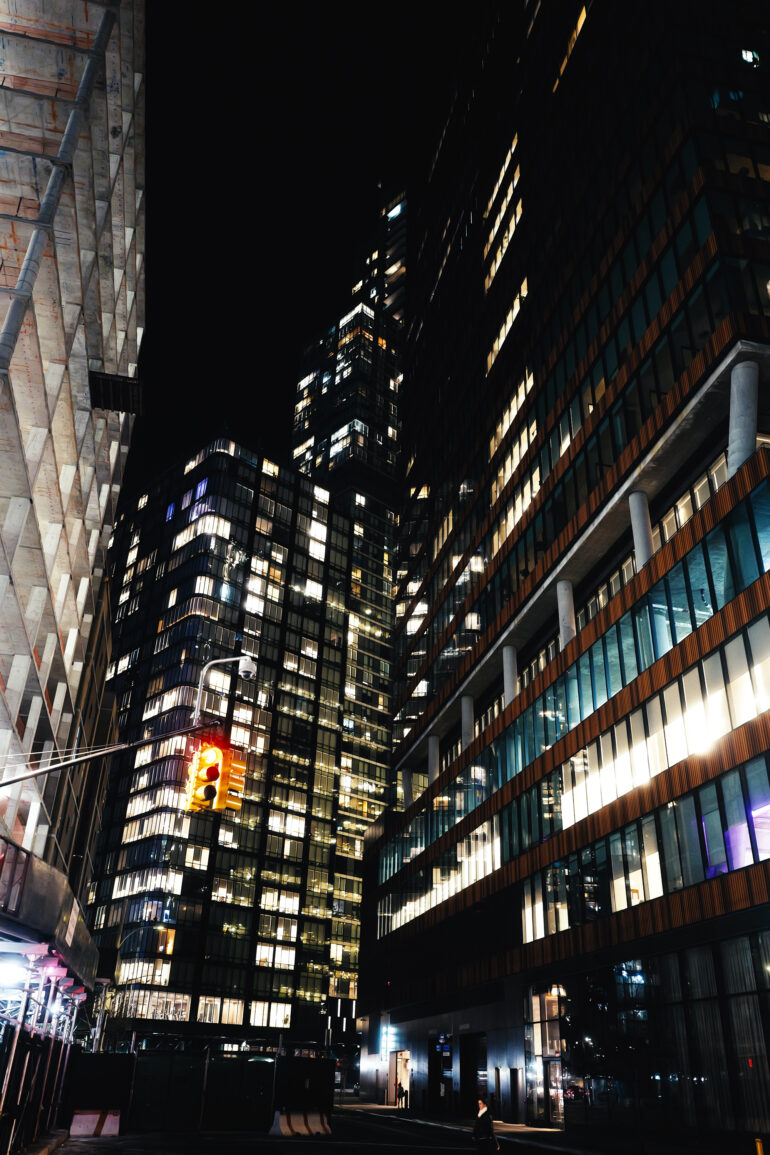
Here are a few of our recommended settings for shooting night photography in big cities.
Shooting photos with a wide-angle lens is one of the best things you can do when shooting night photography. Part of the reason for this is because it lets you take in the vast landscape around you. But the more scientific reason is that it lets you shoot at a slower shutter speed. The reason for this is called the reciprocal rule of shutter speeds — which states that your shutter speed should be, at a minimum, the reciprocal of your lens to get a blur-free photo. So a 50mm lens, per se, would need to be shot at 1/50th. Of course, image stabilization in Panasonic cameras and more can help.
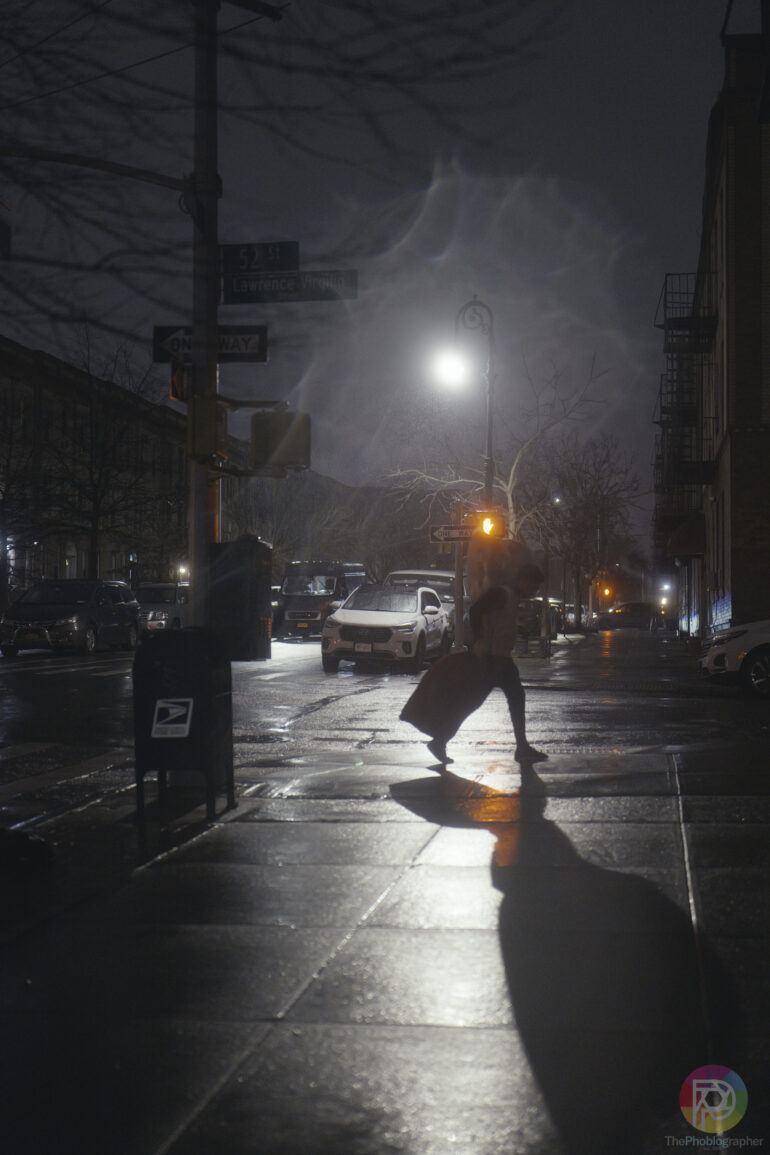
Because of this and the fact that it mimics the way I see, I tend to reach for a 35mm equivalent lens. With Micro Four Thirds, that’s around a 20mm lens. With full frame, the 35mm f1.8 calls to me.
For the record, too, I like to shoot my images with a bit of a slower shutter speed as I really like blur in my images. That aesthetic is currently very fashionable.
When you’re shooting photos at night, don’t necessarily think about just the rule of thirds. Consider composing your scene by color and light. After you’ve set your white balance to what you want, this will become far more clear. Typically in cities, there isn’t a whole lot of color — or it’s separated very clearly at night. When you set the white balance, that changes a bit. You can suddenly see the way the camera sees and start composing scenes based on how certain colors stand out. The same can be done with points of light as they create visually-fascinating lines and contrast.
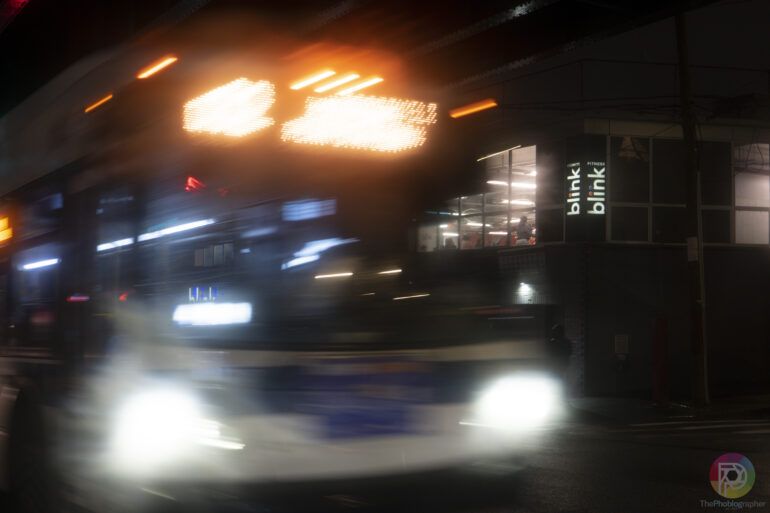
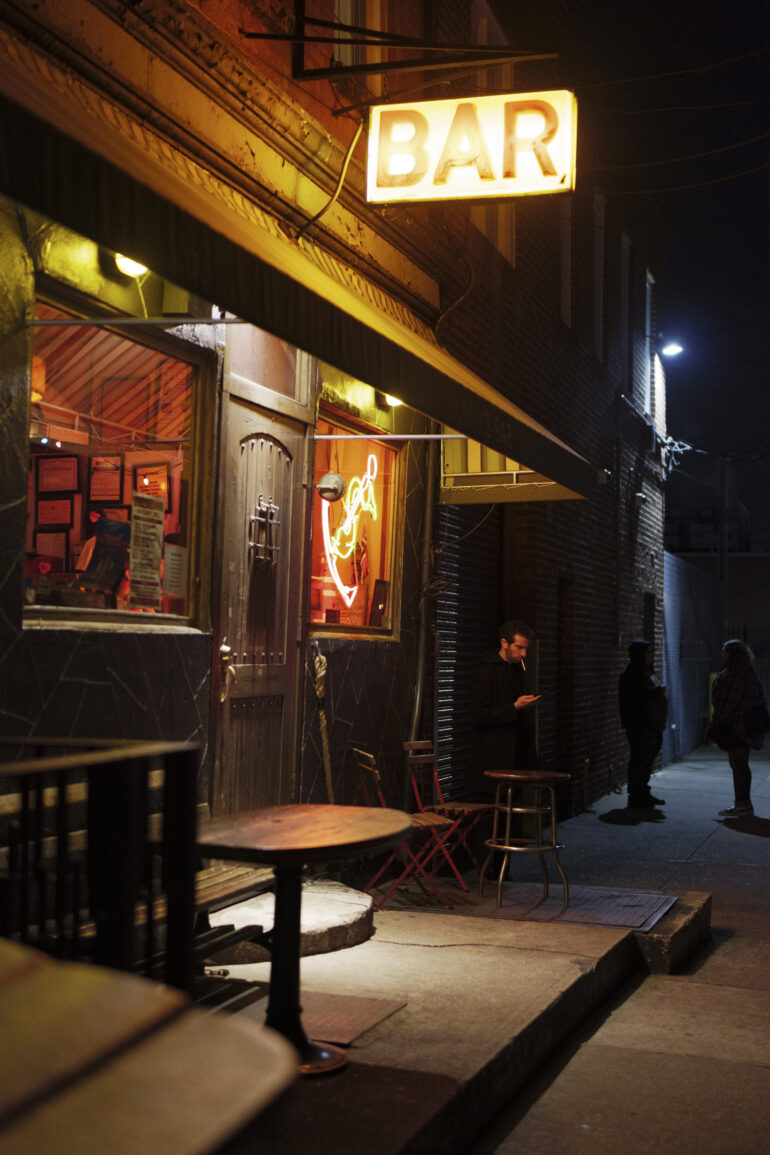
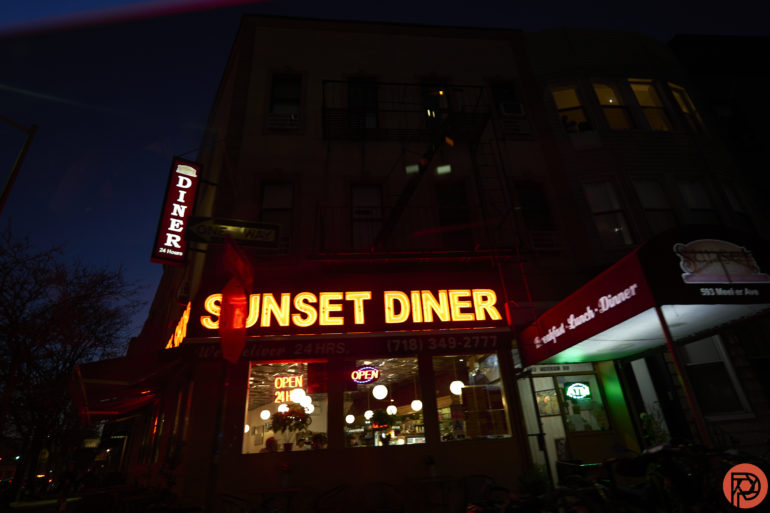

One of the favorite things of so many people to do at night is street photography. For that, Panasonic cameras have human and animal detection built in. But you can set it to just focus on humans, their body overall, or their faces and eyes. Turn this on at night and use it in conjunction with choosing the focusing point. Combine that with composing by color and light.
A fun thing to do is to look at a scene and admire it for what it is. Then wait for people to move in and out of it to see what you get.
By default, cameras are set to help you see what sort of exposure you’d get from the camera. This is called exposure preview. However, it affects autofocus performance in low light when doing night photography. This can mean that you actually do miss the shot at times. Instead, you can read the light meter on the side of the camera’s screen or use aperture priority, which will help you overall by only letting you control the aperture and other settings that you want to be locked.
Keep these in mind when shooting night photos, and you’ll see the magic that your Panasonic cameras can help you produce.


JIM FREEMAN / COURTESY MARCO ISLAND HISTORICAL SOCIETY
The Marco Island Historical Society (MIHS) presents Between the Gulf and the Glades: Florida’s 10,000 Islands, a fine art photography exhibit by Jim Freeman. The exhibit opens at the Marco Island Historical Museum (MIHM) August 10 and continues through November 3. Sponsored by Koastal Design Group, Kira Krümm & Co., the exhibit is free and open to the public.
Freeman is passionate about sailing and photographing Southwest Florida’s Ten Thousand Islands near and around Everglades National Park. In Between the Gulf and the Glades, his stunning photographs capture the haunting beauty of these unique and remote islands that are accessible only by boat.
Experienced in many types of photography, including fine art and architectural art, Freeman is widely known for his ability to transform spaces into environments with his photographs. He is committed to producing pristine, one-of-a-kind works of art that tend to be minimal and serene and consistently emit a feeling of tranquility. Freeman’s fine art landscapes hang in private and public spaces, corporate offices and homes of collectors around the world.
The Marco Island Historical Museum is located at 180 S. Heathwood Drive. Open Tuesday through Saturday, 9 a.m.- 4 p.m. Admission is free, and the site is handicapped accessible. For information, call 239-389-6447 or visit www.theMIHS. org. ¦


Until August 21st, C+C Photography Gallery in Nantucket presents Nostalgia, an exhibition by Natan Coe. Here is the text of the gallery :
Coe’s newly released 2022-23 Nantucket series captures the nostalgic essence of the island complemented by the artist’s signature element of surprise.
Emphasizing the beautiful unpredictability of both the natural landscape and of the human body, each work documents a specific moment in time that cannot be replicated.
Depicted in the misty outline of a wave crashing on the shore, the unique pattern of tire marks left on the sand, and the tangled strands of a woman’s hair blowing in the breeze, Coe’s latest body of work celebrates the result of a truly unplanned, organic moment.
C+C Photography Gallery
30 A Main Street, Nantucket, MA (774) 325-5965
www.candcgallery.com

Julia Scully, who after 20 years as editor of Modern Photography magazine wrote an acclaimed memoir about her Depression-era childhood, when her mother put her and her sister in an orphanage before moving the family into a roadhouse in a remote part of Alaska, died July 18 at her home in the New York City borough of Manhattan. She was 94.
Her death was confirmed by Jana Martin, a daughter of Scully’s companion, Harold Martin, a photographer.
Scully began working at photography magazines in the 1950s and was hired to be editor of Modern Photography in 1966. The magazine was as devoted to the technical side of photography as it was to its aesthetics. Scully focused on the latter, and under her tenure, the magazine was instrumental in the emerging recognition of photography as art.
She started a section of the magazine called Gravure that asked renowned photographers such as Irving Penn about the circumstances and artistry of their pictures; wrote a column called “Seeing Pictures,” in which she described the work of photographers she admired; and reported on exhibitions.
“Gravure and different series that we did later just kind of took up the idea of photography as an art form,” Andy Grundberg, a former picture editor at Modern Photography and later a companion of Scully’s, said in a phone interview.
He added: “Julia was friends with photographers, had been married to a photographer and was in the swing of things at a time when galleries were being established for photography and museums were getting more interested.”
While leading the magazine, she published a series of arresting portraits by Mike Disfarmer, an obscure photographer from rural Heber Springs, Arkansas, who had died in 1959. Disfarmer’s customers came to his Main Street studio, with its plain backdrops, to celebrate life’s transitions — for 50 cents a shot — in black and white.
Scully was alerted to Disfarmer’s work by Peter Miller, a local newspaper editor.
She and Miller collaborated on a 1976 book, “Disfarmer: The Heber Springs Portraits, 1939-1946,” which presented 66 of his photographs. Writing in The New York Times Book Review, Peter C. Bunnell wrote that the pictures “are not nostalgic, but haunting, suggesting daguerreotypes of strangely familiar yet unknown relatives. ” He added: “Julia Scully’s sensitive text illuminates both the man and the place.”
In an essay the next year in Aperture magazine, Scully wrote that there was a “conscious intent, rather than a naive artistry,” behind Disfarmer’s portraiture, helping him to create photographs with a “piercing clarity.”
Excerpt from the article by Richard Sandomir originally appeared in The New York Times.

In the modern world of photography, it’s easy to be lured into the belief that owning the latest and most expensive gear will automatically elevate your skills as a photographer. However, the truth is far from this misconception. While high-quality equipment can undoubtedly enhance certain aspects of your photography, it is essential to understand that gear alone does not make you a better photographer. In this article, let’s delve into the reasons why true photographic prowess lies in the photographer’s skill, creativity, and vision rather than the equipment they possess.

One of the most significant aspects of landscape photography is the photographer’s vision and creative expression. While a high-end camera and lens can offer technical advantages, they are merely tools that serve the artist’s creative intentions. Owning top-of-the-line gear won’t help if you lack a compelling vision for your photographs. The most iconic landscape images are born from us photographer’s ability to see and capture unique compositions, lighting, and moments that evoke emotions and tell stories.
Vision and creativity are the cornerstones of great landscape photography, and they transcend the limitations of equipment. While modern cameras and lenses have advanced capabilities, it is the photographer’s unique vision and creative approach that truly make an image stand out. Let’s delve deeper into why vision and creativity should be prioritized over gear:

A camera is only as powerful as the person wielding it. A landscape photographer must understand the principles of photography, such as exposure, composition, and lighting to create impactful images. In-depth knowledge of these fundamental techniques allows the photographer to use any camera, whether it’s a high-end DSLR or a smartphone, to its full potential. Understanding how to manipulate settings like aperture, shutter speed, and ISO is essential in achieving the desired artistic effects, regardless of the gear’s sophistication.
 Composition Is King
The heart of a compelling landscape photograph lies in its composition. The ability to compose a scene effectively is not dependent on gear but rather on the photographer’s artistic eye and creativity. A skilled photographer can craft striking compositions with any camera by thoughtfully arranging elements within the frame, paying attention to leading lines, symmetry, balance, and framing. These composition techniques are universal and applicable across all levels of gear.

Light is the soul of photography, and mastering its interplay with the landscape is crucial for producing captivating images. While advanced camera sensors can handle challenging lighting situations, understanding and harnessing the light’s qualities is a skill that comes from experience and observation. Being able to recognize the right time of day for the desired mood, or making the best of adverse weather conditions, separates skilled photographers from those who rely solely on equipment.

Great landscape photography evokes emotions, connects with viewers, and transports them to the scene captured by the photographer. Achieving this emotional connection is not achieved through gear but rather through the photographer’s ability to convey their own emotions and experiences into the images they create. Whether it’s a sense of wonder, tranquility, or awe, it is the photographer’s artistic expression that creates this bridge between the viewer and the photograph.

Limitations in gear can sometimes foster creativity and ingenuity. Working with a less sophisticated camera or lens encourages photographers to think outside the box and find innovative ways to capture stunning landscapes. Embracing limitations can lead to unique perspectives and a more personal touch in your work, which is often lost when relying heavily on gear alone.

Landscape photography often requires patience and mindfulness to wait for the perfect moment to capture the desired shot. It’s about being in tune with the environment, observing subtle changes in lighting and weather, and being ready to seize the right opportunity. These traits are cultivated through practice, experience, and passion for the art, not through the gear you carry.

In conclusion, gear undoubtedly plays a role in landscape photography, but it should never be the primary focus or the sole measure of a photographer’s skill. The true essence of landscape photography lies in the photographer’s vision, creativity, knowledge, and ability to connect emotionally with the audience. Mastery of composition, light, and technique are what sets outstanding photographers apart from the crowd, regardless of the equipment they use.
Instead of chasing the latest gear trends, aspiring landscape photographers should invest in honing their craft, learning from experienced photographers, and spending more time in the field to develop their artistic voice. After all, it is the passion, dedication, and the pursuit of excellence that ultimately defines a photographer’s journey and leads to creating breathtaking landscape photographs that stand the test of time.
Am I right in this view in your opinion, or have I got it totally wrong? Let me know your thoughts in the comments below and let’s chat.





