Photography

Dallas native Gray Malin’s over-the-top photography on full display in new book ‘Coastal’

Dallas native Gray Malin’s over-the-top photography on full display in new book ‘Coastal’

After weeks of heat waves, heat domes and extreme North Texas temperatures, we couldn’t be happier to soak up the cool vibes of Dallas native photographer Gray Malin’s beachy new book, Gray Malin: Coastal. The glossy tome takes us sky-high over some of the world’s most famous beaches — Laguna, Malibu, Monterey — snapped from a door-less helicopter. Drones be dammed.

Malin came to aerial photography by accident. “It was just a heart-stopping moment when I realized how beautiful the beach was from above,” he told The News in 2016. It first happened in Miami, where he was to shoot a hotel’s swimming pool. A rainstorm changed his plans and Malin instead photographed an unusually sparse South Beach from his hotel balcony. The artful, abstract result has in the decades since spawned multiple books, branded accessories and even a fashion line of swim trunks.

Advertisement

Malin, who now makes his home in Los Angeles, told The News much of what happens on his one- to two-hour helicopter shoots is spontaneous. Everything from the weather and the skimpy-clad patrons and their accessories (we love a colorful beach umbrella), is all just “luck of the draw.” Soak it up.

News Roundups
News Roundups

Catch up on the day’s news you need to know.

Details

Details: $45, abramsbooks.com.

Dolphins, tigers and turtles in focus

Dolphins, tigers and turtles in focus

The winners of the Nature inFocus Photography Awards 2023 have been announced.

A tiger in Ranthambore National Park, Rajasthan, India.Karthik Mohan Iyer

Nature inFocus describes itself as “a photo-led exploration into India’s wilderness – a definitive platform for sharing stories and photography that enables relevant knowledge-sharing and curation for everything nature.” Its competition received 24,000 images from more than 1,500 entrants.

Winners are chosen in the categories of Animal Behaviour, Animal Portraits, Conservation Focus, Creative Nature Photography, Wildscape & Animals in Their Habitat and Photographer of the Year – Portfolio.

Here is a selection of the winning entries.

Animal Behaviour

An ant and honeydew secreting aphids

Avinash PC

Avinash PC triumphed for this shot of an ant and some honeydew-secreting aphids in Kannur, Kerala, India.

A pod of Spinner Dolphins dives back into the beautifully lit waters of the Pacific Ocean

Merche Llobera

A special mention went to Spanish photographer, Merche Llobera, for this image of a pod of spinner dolphins in the waters of the Pacific Ocean, near Costa Rica.

Animal Portraits

A brown booby diving for food

Suliman Alatiqi

Brown Boobys spend a significant portion of their lives in the open ocean.

Suliman Alatiqi captured this individual dipping its head underwater at short intervals, and got in position to capture a close-up portrait of the bird from the perspective of its prey.

A bonobo holding a mongoose pup, LuiKotale, Near Salonga National Park, Democratic Republic of the Congo

Christian Ziegler

Christian Ziegler’s image of a bonobo holding a mongoose pup was taken in LuiKotale, near Salonga National Park, Democratic Republic of the Congo.

The ape later released the animal unharmed.

Conservation Focus

Crocodiles in a polluted river near Vadorara in Gujarat, India

Hiren Pagi

Hiren Pagi’s photograph aims to highlight the conditions in which crocodiles coexist with humans.

The river, near Vadorara, Gujarat, India, has become cluttered with rubbish, causing a threat to their habitat and polluting the water.

An Olive Ridley Sea Turtle attempts to swim away from the remnants of a net.

Joshua Barton

A special mention went to Joshua Barton for this image of an Olive Ridley Sea Turtle attempting to swim away from the remnants of a net.

The photographer set it free.

Creative Nature Photography

Dragonflies positioned on a stem to resemble a flower head

Arkaprava Ghosh

Arkaprava Ghosh made this photo of line-forest skimmers, after they had positioned themselves on a perennial Phanera Valhi creeper to resemble an inflorescence, or cluster of flowers.

The dragonflies raise their abdomens in unison to fool predators.

Mushrooms releasing spores in Cooch Behar, West Bengal, India

Anirban Dutta

The bristles are the brightly-coloured protective hairs of the Slug Moth larvae. The glitter-like effect is because of mushrooms releasing spores.

When the photographer, Anirban Dutta, found the larvae positioned right next to the spooring mushrooms, he did not want to miss the opportunity to capture the dramatic picture.

Wildscape and animals in their habitat

Nubian Ibexes show horns in a display of dominance

Amit Eshel

For Nubian Ibexes, the high-altitude rocky terrains are home.

Displays of dominance begin with showing off their impressive horns, captured in this shot by Amit Eshel in the Zin Desert, Israel.

A tiger in Ranthambore National Park, Rajasthan, India.

Amit Vyas

A special mention went to Amit Vyas for this picture of a tiger in Ranthambore National Park, Rajasthan, India.

Photographer of the Year – Portfolio

Drone image of coast and mangrove

Srikanth Mannepuri

Srikanth Mannepuri’s winning portfolio documents the threat to mangrove forests, and the vast diversity of fish, bird and reptile species which populate the habitat.

A small boat carrying timber collected from the mangrove forests flanking the canal leaves for the nearby coastal village.

Srikanth Mannepuri

Entirely shot from a drone, the photographer zooms out from the mangrove forests of coastal Andhra Pradesh, to capture the magnitude of the threats this unique ecosystem is facing.

Young Photographer

A pair of Oriental Honey Buzzards raid a beehive.

Pranav Mahendru

In the dense forests of Satpura National Park, Madhya Pradesh, India, a pair of Oriental Honey Buzzards raid a beehive.

Pranav Mahendru embarked on his journey as a wildlife photographer from a young age, driven by a deep fondness for nature and wildlife.

Opilione (harvestman, daddy longlegs) sheltering in a crevice, raindrops glistening on its limbs.

Arnav Deshpande

Arnav Deshpande is a 17-year-old wildlife photographer, who has been honing his skills for the past five years.

On a rainy night, the young photographer spotted this Opilione (harvestman, daddy longlegs) sheltering in a crevice, raindrops glistening on its limbs.

All photos courtesy Nature inFocus Photography Awards

Minnesota pet photographer’s project puts focus on Rochester’s dogs

Minnesota pet photographer’s project puts focus on Rochester’s dogs

ROCHESTER — Don’t read too much into it when Ann Wagaman says teaching helped her prepare for starting a pet photography business.

Suffice to say, teaching second-graders and kindergartners and photographing dogs both take some patience.

“With pets, the key is just to let them do their own thing,” Wagaman said. “I just let the dogs and cats gauge how the session is going to go.”

After more than 20 years of teaching in St. Charles, Minnesota, Wagaman saw an opportunity to turn her photography side gig into a dream job.

She came across an online tutorial on how to do pet photography. About two years later, she was taking portraits of pets full time.

ADVERTISEMENT

Since then, Wagaman has captured the personality of hundreds of photogenic pooches, charismatic cats and other beloved critters at her studio and 70-acre property in Southeast Minnesota. This year, she has taken her skills on the road to photograph pets at Rochester landmarks and businesses in a fund-raising effort for Paws and Claws Humane Society of Rochester.

The upcoming book project, “Tails of Rochester,” will feature a few dozen furry companions in recognizable settings throughout the city. So far, Wagaman has visited about two dozen locations to photograph pets — mostly dogs — in their environment.

Ann Wagaman Woofda.JPG

Ann Wagaman, pet photographer, poses with her book, “Woofda,” which features 60 “above average dogs” from around Minnesota. Proceeds from the book went to dog rescue organization Because of Bonsai. Wagaman is currently working on a new project, Tails of Rochester to raise money for Paws and Claws Humane Society of Rochester.

John Molseed / Post Bulletin

Wagaman has nothing against cats; they’re just more difficult to photograph.

“I wish I could do more cats, but cats are cats,” Wagaman said.

Capturing the personality of dogs and putting their images out for other people to enjoy is one reason Wagaman shifted careers. The main reason was to be able to spend more time with animals.

“Meeting a new dog for the first time, that’s the best part, I’m not going to lie,” she said.

?? ??AWP Behind the Scenes

A mock up of a forthcoming book featuring Rochester dogs around the city, “Tails of Rochester,” which will raise funds for the Paws and Claws Humane Society of Rochester.

Contributed / Ann Wagaman Photography

The other highlight is seeing pet owners’ faces light up when their dog does well in a photo session. Wagaman does her part to make it look easy and passes all the credit to the photo subject.

“Clients are so proud of their dogs,” she said.

ADVERTISEMENT

Making her job look easy has taken her years of work and is an ongoing process. Wagaman has learned about lighting, photo techniques and has the gear to get the right shots.

Although she agrees with Chase Jarvis who said, “the best camera is the one that’s with you,” shots of a fast moving dog require higher end equipment and a fast shutter.

“Your phone can only do so much,” she said.

?? ??AWP Behind the Scenes

Ann Wagaman works with a dog on a photo shoot.

Janet Liu / Ann Wagaman Photography

Another must-have skill is reading her subjects.

“You have to know the signals,” she said. “If you’re getting flat ears or tail between the legs, you just back off because you’re not going to get a good image.”

She carries treats, noise makers and figures out what motivates her subjects before she starts a photo session.

“Most of the dogs I photograph aren’t trained,” Wagaman said.

Wagaman also attends conferences and is always open to tips and lessons from other pet and photographers. She is one of five certified dog photography masters in the U.S.

ADVERTISEMENT

“I’m constantly learning,” she said.

She attended an industry conference in Scotland last year and is planning a trip for another in Iceland next year.

Wagaman’s “Tails of Rochester” project idea has roots in the international contacts within the industry she’s built. She was one of 80 photographers who collaborated on an Australian-based fund-raising publication,

“Tails of the World.”

She contributed 12 pictures — a cat, a rabbit and 10 dogs — to the print first publication.

Proceeds from the sales of that book are donated to Second Chance Animal Rescue, Inc. Wagaman donated her studio fees to Rochester-based rescue nonprofit Camp Companion.

Wagaman then turned her lens on greater Minnesota with her book “Woofda” which features 60 “above average dogs” from around the North Star State.

?? ??AWP Behind the Scenes

A canine model poses for photographer Ann Wagaman in downtown Rochester for the working cover of “Tails of Rochester,” a book of pet portraits by Wagaman to raise funds for Paws and Claws Humane Society of Rochester.

Contributed / Ann Wagaman Photography

Proceeds from that project go to dog rescue project Because of Bonsai. Because of Bonsai was founded by Dani White and Sejal Dave after they

rescued a stray dog

they found on the street while they were on vacation in Mexico in 2021.

While Wagaman continues to explore places to photograph dogs in and around Rochester, she said she’s open to suggestions on where to go next. Her contact information, social media sites and samples of her work are available on her website at

annwagaman.com.

Session fees for “Tails of Rochester” still apply but a portion is donated to Paws and Claws.

John Molseed joined the Post Bulletin in 2018. He covers arts, culture, entertainment, nature and other fun stories he’s surprised he gets paid to cover. When he’s not writing articles about Southeast Minnesota artists and musicians, he’s either picking banjo, brewing beer, biking or looking for other hobbies that begin with the letter “b.” Readers can reach John at 507-285-7713 or jmolseed@postbulletin.com.
Supermodel is ‘Terrified’ of Posting on Instagram After Photographer Sued Her

Supermodel is ‘Terrified’ of Posting on Instagram After Photographer Sued Her
Paulina Porizkova
Porizkova in 2017.

Former supermodel Paulina Porizkova has revealed that she is now “terrified” of posting on Instagram after she was sued by a photographer.

On Wednesday, Porizkova shared a selfie on Instagram with a lengthy caption explaining that she is only posting her own images on social media now — because she is fearful of photographers suing her.

“One reason I’ve been posting a lot of self generated content lately is because I’m terrified,” Porizkova writes in the caption.

“Of what, you may wonder? Of getting sued. Again.”

‘I Didn’t Even Realize This Was a Thing’

Porizkova — who has over 1.1 million followers on Instagram — describes how her fearfulness started after she was sued by a photographer in 2022 when she shared his photos of Ukraine on social media.

“Here’s the deal. Last year, while posting about the horrors in Ukraine, I used photos I found on Instagram to illustrate the story,” she recalls.

“Six months later, I was slapped with a lawsuit by a law firm on behalf of one photographer. I had used his photo without his approval or without paying for usage.”

The former supermodel says she did not know that reposting a photographer’s images on Instagram was considered copyright infringement at the time. Porizkova also notes that her own pictures are republished frequently.

“Until that point, I didn’t even realize this was a thing- reposting photos from the internet being illegal,” Porizkova states.

“My images are used all the time, and unless someone is trying to sell something with the images, I thought this was fine. It turns out it’s not.

“There are law firms that do nothing but scour social media for dummies like myself who have enough followers to pay up.”

Porizkova says that she managed to reach a settlement with the photographer but the lawsuit ended up being a costly mistake for her.

“We settled out of court, because my best intentions notwithstanding, they were right,” Porizkova writes.

“I did use an unauthorized photo — even if it was carrying on the message I thought the photographer was trying to make — that war is evil. And boy, did that turn out to be an expensive mistake!”

Porizkova then apologized to her followers for the plethora of selfies and photographs on her Instagram recently. She said that the quality of the content on her platform would not be improving now because she can no longer post other photographer’s images on her Instagram profile.

She writes: “So, if you find my thread unbearable in its vanity and narcissism already, it’s not gonna get better.”

‘This is How Photographers Survive’

Porizkova’s post received over 31,000 likes and thousands of comments. Several photographers chimed in with their thoughts on the matter and showed their support for the supermodel.

One individual comments: “That’s ridiculous. I’m a photographer and… I would never stoop to suing someone for using one [a photo] without my permission.”

However, another photographer explained that artists needed to be compensated for their images.

“If we are talking about photographs of Ukraine in wartime, then that would be a photojournalist who is risking their life to go take those pictures,” the photographer comments.

“Photographers do not and should not work for free. Years of expertise and knowledge go in to every image.”

Likewise, another commercial photographer argues: “Believe it or not this is how photographers survive. It’s called usage. You want to use one of my creations? You must pay for that right.”


Image credits: Header photo licensed via Depositphotos.

Fotografiska Lets Four Photographers Run Wild

Fotografiska Lets Four Photographers Run Wild

When it comes to traveling these days, it almost feels like a case of “pics or it didn’t happen.” But Autograph Collection Hotels is embracing the sensation this summer with Impressions, a project with Fotografiska which immersed photographers in four international hotels and let them, and their inspirations, run wild. 

The American talent (and Guggenheim fellow) Alessandra Sanguinetti used Mesm Tokyo as her home base, then ventured onto city streets for high-contrast portraits of the charismatic subjects she encountered. Cristina De Middel made dynamic, playful work that disorients the surroundings she explored at the Alaia Belize in San Pedro. Gregory Halpern stayed closer to home, bunking at The National inside a former Oklahoma City bank; the familiarity fostered the empathy he exposes in photographs of boxing gyms and rodeos.

Oslo-based Jonas Bendiksen went to Berlin. From his perch at Hotel Luc—a new jewel in Marriott Bonvoy’s crown, all Prussian-themed with busts of Frederick the Great and a bowl of the potatoes he endowed the royal status, both made of porcelain, and blue walls boasting portraits of modern royalty—he created photographs deploying the city’s fondness for minimalism and repetition to moody, melancholy effect. 

The four photographers’ work, and a short film documenting its creation, were recently unveiled at Fotografiska New York, and will travel to Autograph Collection hotels around the world. Limited-edition prints are available on Fotografiska’s website and at select hotels, to benefit the not-for-profit Bronx Documentary Center. Guests at select properties will, upon check-in, receive complimentary Lomography 35mm cameras and rolls of film, so they can go out and make impressions of their own.

MIOPS Spark helps you get more from your iPhone camera

MIOPS Spark helps you get more from your iPhone camera

For the past few years, MIOPS has been crowdfunding a bunch of useful photography gadgets like the Mobile, Flex and Flex Bolt camera triggers. Now the Spark brings DSLR-like control to iPhone photographers, along with a lightning trigger, long exposures and other creativity tools.

“Spark brings professional-level features and versatility to iPhone photography, allowing users to unleash their creativity and capture stunning images and videos,” said company CEO, Onur Celik. “We believe Spark will empower photographers and videographers, taking their craft to new heights.”

Users start by mounting an iPhone to the accessory via MagSafe if the model has it or by attaching a MagSafe sticker to the handset if not. The phone’s camera array protrudes beyond the Spark’s frame while the chunky grip to the right offers DSLR-like controls for adjusting ISO, white balance and focus plus a shutter-release button up top.

An iPhone equipped with MagSafe can mount directly to the Spark, those without will need the supplied MagSafe sticker

MIOPS

Long exposure modes can help with photos of the night sky, bring a sense of movement to waterfalls or river flow, or help users to paint with light. An onboard light sensor can take the guesswork out of trying to capture a lightning strike.

There’s a mode to combine the best elements of bracketed exposures for rich and detailed HDR imagery, while photo stacking can grab “intricate details that make your images truly stand out.” There’s even a feature that can digitally remove people and objects from a scene for a less cluttered image. And for a hands-free experience, the iPhone wearing the Spark can be controlled remotely using an Apple Watch.

Additional tools include a burst mode for quick-fire action shots, live filters can be applied in real time, folks can get on the level courtesy of a tiltmeter, a histogram display will help users get the best shot while overexposed areas can be highlighted to allow for adjustment before the snap is taken.

The Spark can be controlled remotely using an Apple Watch, and includes a long-exposure mode for capture a sense of movement in waterfall scenes

MIOPS

Favorite presets can be saved for easy recall, users can choose JPG, TIFF, RAW or ProRAW image formats, and creations can be shared direct to social media through the app. The device is powered by its own battery, so won’t draw your iPhone’s juice, with MIOPS saying that users may not need to top it up for a whole year.

The Spark is described as the “ultimate tool for photography enthusiasts” and is currently the subject of a Kickstarter funding campaign. As of writing, pledges start at US$99. The usual crowdfunding cautions apply, but if all goes to plan, shipping is estimated to start in May 2024. The video below has more.

Source: MIOPS

Photographer and Sandra Bullock’s Partner Bryan Randall Dies Aged 57

Photographer and Sandra Bullock’s Partner Bryan Randall Dies Aged 57
[embedded content]

Bryan Randall, a portrait and landscape photographer who met his famous girlfriend of eight years Sandra Bullock after he was hired to photograph her child’s birthday party, has died aged 57.

In a statement to People on Monday, Randall’s family announced that the photographer had passed away after being diagnosed with a rare neuromuscular disorder three years ago.

“It is with great sadness that we share that on 5 August, Bryan Randall passed away peacefully after a three-year battle with ALS [amyotrophic lateral sclerosis],” his family says.

“Bryan chose early to keep his journey with ALS private and those of us who cared for him did our best to honor his request.”

ALS is a progressive disease for which there is no cure. It is caused by the death of nerve cells in the brain and spinal cord that control the movement of muscles that we control consciously. Most people die within two to five years of being diagnosed with ALS.

The disease is also referred to as Lou Gehrig’s Disease after the New York baseball player who was diagnosed with the condition in 1939 at just 36 years old.

A Portrait and Landscape Photographer

Randall, from Portland, Oregon, originally worked as a fashion model for brands like Hugo Boss and Saint Laurent before discovering his passion behind the lens.

Randall went on to become a professional photographer and owned his own company, Bryan Randall Photography. He focused primarily on children’s portraits and outdoor scenes in his work.

In a 2021 episode of Red Table Talk, Bullock recalled how she met Randall in January 2015 when she hired him to photograph the birthday party of her son, Louis, whom she adopted in 2010.

The actress was in the process of adopting her second child Laila when she started dating Randall and she said the photographer was extremely supportive of her decision.

Bullock explained: “When I met him I was like… We hadn’t been together for that long, and I said, ‘Hey, remember that NDA [non disclosure agreement] you signed when you photographed my son?’”

The actress then told him that the NDA from the photography job still held up because she was welcoming her daughter Laila, who had been in foster care in Louisiana.

When Bullock broke the news to Randall, she said he “was so happy but he was so scared.” The actress went on to say that the photographer became “the example that I would want my children to have.”

Bryan also has an adult daughter named Skylar from a previous relationship.

Randall’s family asks for any donations to be made to the ALS Association and the Massachusetts General Hospital.


Image credits: Featured photo via YouTube.

International photography gallery on display at Greenville’s Grand Bohemian Lodge

International photography gallery on display at Greenville’s Grand Bohemian Lodge

GREENVILLE — Fotografiska, a non-traditional series of photographic art museums, is partnering with Autograph Collection Hotels to display its new collection, Impressions, throughout the world — and is now on display at downtown Greenville’s Grand Bohemian Lodge.

The exhibit will run through Sept. 8. 

Four artists-in-residence at Autograph Hotels in Berlin, Tokyo, Oklahoma City and the city of San Pedro in Belize gathered collections centered around the themes of inspiration, vibrancy, emotions and seeing the unseen, according to a news release announcing the series.

Jonas Bendiksen walked the streets of Berlin while he stayed at Hotel Luc, looking for spontaneity in his collection, small moments that can tell whole stories about the scene they are set in. 

In Belize, Cristina de Middel pursued how the light, nature and color of San Pedro affected the characters of the city. Her work makes fictional scenario come to life with real characters and place, showing that the way we see things may not be as they truly are. 

While living at The National in Oklahoma City,  Gregory Halpern took his time learning the location, placing himself in unexpected parts of the city: a boxing gym, barber shop and rodeo. His photography captures the young, big-city feel, and how nose rings and nightclubs clash and blend with the tradition of wide open spaces, highways and cowboys.

During her stay at Mesm Tokyo, Alessandra Sanguinetti took the plunge beyond the surface of Tokyo in search of people and secrets, revealing what the veneer of the city doesn’t show. Sanguinetti uses contrast to reveal the rich reality of the interior world.

“Impressions is a special project in showing the individuality of both inspiration and of the approaches that artists take to manifest their creative visions into being,” Fotografiska’s Global VP of Business Partnerships & Development Karolina Dmowska said.

The collection started its journey in New York in July and  then came to Greenville.

When the Grand Bohemian showing in Greenville ends on September 8, the collection will travel through Autograph Collection Hotels in Portland, Maine, London and Nanjing, China in the coming months.

input#fieldEmail {width:100%; border: 1px solid #b0b6bb; box-shadow: inset 0 1px 2px rgba(0,0,0,0.1); border-radius:3px;}
button.js-cm-submit-button {width:100%; font-family:”adelle-sans”, sans-serif; color: #fff; background-color:#82c566; padding:3px 0; border:0px;}
h3.signup-header {font:18px ‘adelle-sans’, sans-serif; border-bottom: solid 1px #cccccc; padding-bottom:8px;}
h5.description {font-family:”adelle-sans”, sans-serif; line-height:inherit;}
label {font-size:smaller; font-family:”adelle-sans”, sans-serif; font-weight: 400;}

Sign up for daily roundups of our top stories, news and culture from the Upstate. This newsletter is hand-curated by a member of our Greenville news staff.
.asset-tags {display:none !important;}

Music, photography, rodeo events and more

Music, photography, rodeo events and more
image

It might be easy to forget amid all the rodeo-centered events going on, but there are other things happening in the Rim Country and White Mountains areas as well. Saddle up and get ready to ride into a full week!

Live music

This page requires Javascript.

Javascript is required for you to be able to read premium content. Please enable it in your browser settings.

A Look at How Famous Street Photographers Work

A Look at How Famous Street Photographers Work

It’s easy for photographers of a certain age to romanticize the ideals of those like Garry Winogrand or Bresson. Others instead might stray towards the questionably cult-like cliques formed by photographers like Eric Kim or Thorsten Overgaard. But famous street photographers know that this is a long game — and that it’s not just about making it on social media. They take this idea with them holistically through their journey onto the streets to capture their images worthy of being a blockbuster for their career.

All images in this article are used with permission by the photographers in our interviews.

Not every photographer goes out to shoot the most candid moments they can find. Street photography works in a very similar way to cinematic stories. The images are either character-driven or story-driven. You might have heard Bruce Gilden speak about characters while Joel Meyerowitz would try to tell a story instead. They’re two different approaches, and they formulate different stories.

Intense Focus and The Hunt

“Early on, I was often crippled by shyness when deciding whether to bring the camera to my eye,” says Melissa O’Shaughnessy to us in an interview. “As time went on, I overcame my fears by realizing that I wanted the picture more than I feared the consequences of taking it.” Conquering fear is a big part of being a street photographer. Finding a way to do it will often yield you some of the best photos, as she’s demonstrated. This mentality is prevalent with many street photographers. But Melissa also finds a way to do her subjects justice in the photos she takes. For example, the theme of the strong woman was big in her book Perfect Strangers.

Some photographers go out to shoot with a very specific thing in mind. But others, like photographer Dimpy Bhalotia, try to react as quickly as they can when they encounter a scene. In a previous interview with her, Dimpy told us that develop a sense of unconsciously moving with the subject. “You have to be very quick and invisible in the streets,” she told us. “To capture something natural, your subject shouldn’t know someone is watching them. You have to merge yourself in the crowd.” Dimpy likes capturing movement as it happens.

Looking at one of Dimpy’s images provided to us in our previous interview, we can notice several things. Firstly, she’s focusing on shooting only in black and white. This not only immediately draws the eyes to specific things in the scene, but it simplifies the photo to the human brain. Dimpy is also using natural light to figure out how shadows will affect a scene. As is evident in the scene above, she used reflections to tell a larger story within a small frame. All this, combined with specific framing and understanding of the culture around her, all work out well for her.

In fact, Dimpy tells us that she goes to a place and tries to understand the people and the culture before getting more into photographing what’s in front of her. This is a common tactic used by some of the best photojournalists as it helps people get used to the fact that a camera is in front of them. But Dimpy tries to more or less be a fly on the wall instead.

I remember I was in Copenhagen and I kept thinking to myself, the sky looks slightly lower towards the earth compared to other latitudes and longitudes I have been to. Maybe it was my imagination but I tell you that being sensitive to nature and understanding it makes a huge difference when you are doing street photography. The shades of gray and the scale of birds make a huge difference. It gives me goosebumps.

Dimpy Bhalotia

The idea of being the fly on the wall isn’t really a new one. If we analyze Paul Kessler’s “Q-Train” photo, which is the lead image of this article, we can notice many things that make it appealing across so many different fields of study. Just focusing on the idea of color theory, we can see various layers working in the scene. Steve McCurry tries to focus on three colors within a portrait to keep it simple. Though we can say that this is maybe more of a candid portrait, Kessel finds a way to make multiple layers of colors work and have them uniquely all stand out from one another.

More importantly than just the colors, there’s the candid moment. We are told multiple things about this portrait:

  • Who: It’s about a mother being overwhelmed by her children
  • What: The moment here is very relatable to several adults because they’ve either had children or they’ve had to endure hearing the results of someone else’s breeding.
  • When: This is a relatively recent photo. But it’s something that can stand the test of time.
  • Where: We’re in the NYC subway on public transportation. Many tourists and residents alike experience random moments on the subway.
  • How: Paul simply took the photo when he noticed what was happening. Paul told us that he estimated the distance and got the shot.
  • Why: This photo is so appealing to us because it’s holistically a beautiful moment around motherhood while also demonstrating strength within the chaos that is life and the NYC subway system.

Similar things can be said of many of Paul’s other pieces. His photos often show some sort of connection between people and work to tell a story within a larger frame. In cinema, it’s often said that New York can be a constant character in a movie. And clearly, we see that in many of Paul’s other images, such as the one above. Provided to us in our previous interview, the image shows how a family can find solace and peace while trying to get around public transportation. It’s a stark contrast to Paul’s other photo we previously discussed.

What’s evident in the work of both Dimpy and Paul is that they’re constantly looking around, gauging light, and being in tune with their environment. They’re probably both often taking breaks because it requires very deep concentration and understanding of what’s going on in front of them. More importantly, the photographer needs to connect their technical and artistic sides. Most photographers understand that this translation process can be very difficult.

Many photographers, such as Dina Alfasi, never want to be seen. They feel like when they’re seen, they break the candid moment because people become aware that they’re being photographed. To that end, Dina has the perfect tool: her iPhone. After starting out with an old-school Kodak Instamatic camera, she knew that it was the perfect tool for her to take the candid images she cares about capturing.

Her process is a simple one: going to work on the train and noticing things as they happen. Dina pay attention to the light, shadows, and most importantly the human moments happening.

“All the portraits I shoot, taken without the knowledge of the subjects,” she told us. “These photographs could not happen if they were aware of the camera. Even after shooting, I don’t inform my subjects because I use the train every day, and if people are mindful of this, I’m no longer will be able to photograph those spontaneous moments.” Dina focuses on the emotions of the moment first and foremost. She has her own creative vision, but she also is receptive to exactly what’s happening in front of her. And by looking through her photos, we’re presented with simply beautiful moments that are bound to warm our hearts if we’re open to it.

Getting to Know the Community

Though photographers like Dimpy Bhalotia try to get to know the community in a more introverted way, several other photographers go ahead and gain their trust first before conducting the street photography that they do. Photographers like the legendary Jamel Shabazz have been doing this for decades. He’s built long-lasting relationships within the communities in New York City and even shares stories about the people he’s photographed on his social media pages. One can tell that he truly cares about the people he’s shooting. His character-driven stories are part of what makes his photos so appealing.

“What I discovered early on as a photographer was that person who is dressed fashionably tend to be more open to being photographed,” Jamel told us previously. It’s important to note that not all of Jamel’s images are character-driven — he surely has his share of story-driven candid photos. But what’s sometimes controversial to street photographers is the approach of getting to know people beforehand as it breaks the candid moment. However, Jamel’s images continue to show real people in public. The images are sometimes posed, but they showcase the unique personalities of people.

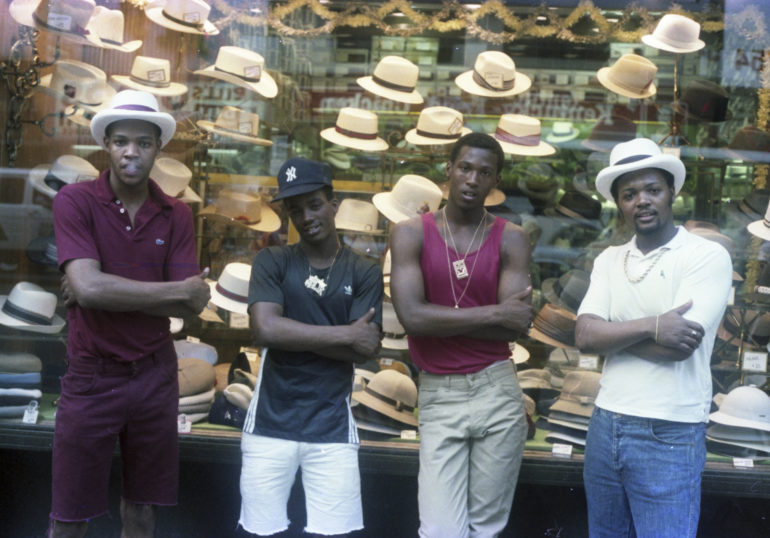
In the image above, Jamel told us about how these men all specialized in shooting Polaroids of people. His quote to us tells a lot about how he works:

I knew these Brothers very well, prior to taking this image. They were all fellow photographers, who specialized in Polaroid photography and made their money photographing folks oftentimes in a regal-looking wicker seat (known as a peacock chair) against a wide range of portable backdrops in the heart of Times Square. Their fee was $3.00 for one framed 4 x 6 print, or 2 for $5.00. The young man on the far right, Shabey (pronounced Sha-bey,) was a master of the craft and is responsible for photographing thousands of folks during much of the 1980s in and around 42nd Street. My brief conversation with them was rooted in photography, as they took a break from taking pictures. Seeing that three of the four of them had hats on, I knew that the hat store would serve as the perfect backdrop. This photo was made on the corner of 42nd Street and 7th Avenue and they are instinctively posed the same way, as they are all members of the same conscious fraternity. During the 1990s, this location went through major renovations, transforming the majority of the landscape. Gone are the adult stores and sleazy theaters, replaced with more family and tourist-friendly establishments. In comparison, today’s Times Square looks more like Disneyland.

Our takeaway here is that Jamel finds ways to focus on the who, when, when, where, how, and why — which is a huge part of photojournalism and, therefore, a big part of certain styles of street photography. Jamel tells the story to us but also makes us realize different things about the people in the photograph. If this were shot today, one can easily wonder if the gentlemen in the image should’ve been holding their cameras to create a more environmental-style portrait. Regardless, Jamel gained the trust of these men to get a photo like this.

Three Indonesians migrant worker laugh with their friends while participating in a rally for worker rights in Hong Kong.
September 03, 2017

This tactic is very important, as we can tell in stories by folks like Xyza Cruz Bacani. She works to get to know the people she photographs. Arguably, Xyza is more of a photojournalist than a street photographer — but he work is sometimes done in public, and so she’s considered to be a street photographer in many circles. Xyza has told us that she’s still in touch with most of the people she photographs — which is similar to what we find with Jamel.

In the photo above, Xyza is striving to tell the story of migrant workers protesting for their rights. ““For them to share their life with me and allow me to share it with the world, that makes them all compelling. I’m super lucky and grateful for their generosity,” she said to us. Xyza refers to many of the people in her photos as almost like family — which isn’t really seen or said by lots of other photographers. As such, she has a completely different take on the photos she presents.

An approach like this is done by other photographers, too, such as Jens Krauer. Krauer, who faced wrongful scrutiny for his project documenting the people of Bed-Stuy, worked to get to know the subjects he photographed. “Whenever I am given the trust the work demands, I am very careful to not abuse it or to create any negative consequences for the subject,” Jens told us. “This process can take hours, days, or months and even then, there is no security in getting a good image that speaks for the story. Insecurity if things happened and if I am being misunderstood are with me all the time, and my method of dealing with this is to be completely open at all points along the way, towards myself and the subjects.” Jens could easily teach a masterclass to many other modern street photographers on the work that he’s done. His images feel so natural because the people have this must trust in him and what he’s doing.

Street photographer Concha De La Rosa works to get to know her subjects but in a completely different way. Her approach is perhaps the most fascinating one and could help to reassure many shy photographers. Instead of getting to know people beforehand, Concha takes their photo and then starts a conversation with them. With all this in mind, she cares intently about how the people are presented in her work. “…moments where I think I may have captured a really intimate moment— I talk to them,” she tells us. “If they don’t have an email, I will ask them where they go usually for coffee, just so I can bring them a print or a pen drive with the picture on it for their relatives.” Concha can do this for several reasons — including having nearly two decades of experience and confidence. However, she often has a creative vision in mind and upon shooting the frame, isn’t shy about ensuring that the person has a copy of the photograph.

All these photographers have work that juxtaposes the photographs of homeless people on the streets that we otherwise see on Instagram under the #streetphotography hashtag. To that end, they take a more photojournalistic approach that isn’t necessarily seen by others. While they’re all recording human life as it is, photojournalists on a payroll often work with their subjects to tell their stories.

The Art of the Photo Wait

[embedded content]

Though most street photographers tend to think about working as quick as possible to get a candid frame, a few others have a different approach. There’s the idea of the photo wait, which photographer Jonathan Higbee specializes in. As he walks around cities, he tries to find clean backgrounds, irony, the right light, etc. It may mean that Jonathan looks at the light hitting a scene and sits around, waiting for someone or something to walk into it in just the right way.

Some folks talk about this as “working the scene.” And it truly is a similar thought process. This has helped his work to stand out from so many other photographers. Combined with the work he’s on social media and with other publications, he’s inspired so many others to pick up the camera.

Other photographers also feel similarly. “The best advice I can offer is the same thing I have to remind myself every time I go out to shoot,” says photographer Michael Young to us in an interview. “Slow down and pay attention to what’s going on all around you. Look at the light, the environment, the scene, the people, and the interactions.” to Michael, the more aware you are, the better you can anticipate when something is about to happen.

All of these photographers have completely different approaches to their street photography. But at the end of it all, no one method is better than the other necessarily. Some may have both viewers and other photographers questioning their ethics. However, none of these photographers are arguably causing public harm or destroying someone’s reputation. And in public, a photographer typically has the right to do whatever they want.

What matters, in the end, is the result. More importantly, appealing to various human emotions and eliciting a response is what matters in the art form. Art, after all, is supposed to make people feel something.





