Photography

Winning Snapshots of the Nature inFocus Photography Awards 2023 Revealed!

Winning Snapshots of the Nature inFocus Photography Awards 2023 Revealed!
[W​inner: ​C​onservation Focus Category]

Cry Me a River — Every once in a while, news sites report that a dead crocodile was found in the Vishwamitri river, a fleeting acknowledgement of the water body’s ~270 Mugger Crocodiles. The image shows the conditions in which these reptiles coexist with humans. The river has become a dumping yard for the nearby establishments, and in various places, drainage water also makes its way into the mix. The Mugger Crocodiles of the river face many threats, including habitat loss and water pollution.

(Hiren Pagi)

The Nature inFocus Photography Awards have unveiled the triumphant photographers of this year’s competition, showcasing a captivating blend of natural history moments and pressing conservation concerns.

Dedicated to celebrating the prowess of talented photographers capturing the essence of nature, the awards consistently curate a remarkable collection of imaginative and artistic images — a tradition upheld in this year’s edition as well.

With each passing year, the competition’s allure has transcended boundaries, drawing wildlife and nature enthusiasts not just from India, but around the world. This year, the call for submissions garnered over 24,000 captivating images submitted by about 1,500 talented photographers from more than 20 countries.

The contest welcomes entries from both seasoned adults (above 17 years) and budding young photographers (17 years and under). The culmination of efforts is reflected in the six distinct categories, each yielding exceptional winners, all meticulously chosen by a distinguished panel comprising six experts encompassing wildlife photographers, filmmakers and conservationists.

Take a moment to explore the awe-inspiring work of the winning photographers and their exceptional entries across a diverse array of categories showcased below.

Winners: A​nimal Portraits Category

The Bonobo and His Pet — The last great ape to be described, the Bonobo, is one of our closest living relatives. Here, a wild Bonobo who caught a mongoose pup is looking after it like a pet. He later released the animal unharmed. This behaviour has only been recorded once before by Prof Barbara Fruth at this site.

(Christian Ziegler)

Inspector Booby — Brown Boobys spend a significant portion of their lives in the open ocean. Their clumsy nature on land earned them their namesake, derived from the Spanish word bobo, which means stupid or daft. They are excellent foragers of the sea and plunge-dive to feed on anything from anchovies and sardines to squid and shrimp. The photographer watched this individual dipping its head underwater at short intervals and got in position to capture a close-up portrait of the bird from the perspective of its fated prey.

(Suliman Alatiqi)

Winners: A​nimal Behaviour Category

A Sappy Alliance — Symbiotic relationships are plenty in the natural world! But none as sappy and sugary as the mutualistic relationship between ants and aphids. Aphids are tiny, sap-sucking insects that are serious plant pests. They secrete a sugar-rich liquid called honeydew, a favourite food of ants! So much so that the ants protect these insects from other predators and even shepherd them to the healthiest parts of the plant to maintain a steady stream of sweet honeydew!

(Avinash PC)

A Love Like No Other — Caught in the crosshairs of a hungry leopard, the vulnerable mother and baby langur had little chance of survival. The hunt and the chase had led the predator and prey up a tree before the mother succumbed to the suffocating hold of the large cat. But in embracing death, the mother was able to save her offspring.

(Afroj Sheikh)

Advertisement

Shell I Eat You? — This stunning action shot captures a rarely-seen natural history moment, where the legendary Arrowhead of Ranthambhore fishes out an Indian Softshell Turtle from the lake for lunch. A tiger’s diet in the wild can be very varied as the felid can prey on pretty much everything on its turf, even a turtle, hence proved!

(Sankhesh Dedhia)

W​inners: ​Young Photographer Category

Raiders of Hives — In the dense forests of Satpura, a pair of Oriental Honey Buzzards raid a beehive. These raptors hunt for food in beehives and wasp nests but, unlike what their name suggests, they prefer bee and wasp larvae over actual honey.

(Pranav Mahendru)

Slender in the Night — Like the spiders they are commonly confused with, Harvestmen too have eight legs–mostly long and thin in contrast to their bodies. They are living fossils, the original ‘Daddy Longlegs’, having remained unchanged for millions of years. On a rainy night, the young photographer spotted this Opilione sheltering in a crevice, raindrops glistening on its limbs.

(Arnav Deshpande)

Winners: Creative Nature Photography Category

All That Glitters Are Spores — The bristles are the brightly-coloured protective hairs of the Slug Moth larvae. The glitter-like effect is because of mushrooms releasing spores. When the photographer found the larvae positioned right next to the sporing mushrooms, he did not want to miss the opportunity to capture the dramatic frame, and dramatic it is!

(Anirban Dutta)

Symmetry in Mimicry — Mimicry is the highest form of flattery, they say. But in the animal world, it is among the best defence mechanisms. Here, Line-forest Skimmers position themselves aptly on the perennial Phanera vahlii creeper to resemble an inflorescence. Notice how the dragonflies have raised their abdomens in unison? Fooling a predator never looked this intricate.

(Arkaprava Ghosh)

Chiaroscuro — Here is a gentle reminder that photographing the natural world is not just about documenting the megafauna but also zooming in on the speck on a blade of grass to reveal the chiaroscuro of a mayfly.

(Kai Kolodziej)

Winners: W​ildscape and Animals In Their Natural Habitat Category

The Things You Do for Love — Looks like the set for the next Mission Impossible, but for Nubian Ibexes, the high-altitude rocky terrains are home. The vulnerable ibex species is known for many things–large semi-circular horns, the ability to scale mountains with ease and the territorial fights that males engage in during the rutting season. Displays of dominance begin with showing off their impressive horns. If that doesn’t do the trick, it’s time to escalate by pushing and shoving the opponent and literally locking horns with them. Ibexes also stand on their hind legs as they get ready to strike.

(Amit Eshel)

Worlds Apart — Think Dubai and the first thing that comes to mind is architectural marvels that make the sky seem at arm’s reach. The tall buildings may be Dubai’s trademark visuals, but another world coexists alongside the dazzle, where wildlife thrives in the desert. The image juxtaposes these two worlds—the towering skyscrapers and the endless sands—a gentle reminder to look beyond the concrete.

(Dileep SS)

Winner: Portfolio Category

A small boat carrying timber collected from the mangrove forests flanking the canal leaves for the nearby coastal village. One boat from one village in a single afternoon is amassing a ton of wood! When compounded, this contributes enormously to the problem of mangrove deforestation. Slowly but surely, it is uprooting the ecosystem, one tree at a time.

(Srikanth Mannepuri)

At first glance, you notice the proximity of the mangroves to the coastal settlement. But as you zoom in, the problems start to appear. The inappropriate disposal of plastic waste and the release of untreated sewage into the water affect an abundance of life forms that are dependent on these forests.

(Srikanth Mannepuri)

**

For weather and science updates on the go, download The Weather Channel App (on Android and iOS store). It’s free!

Film Construction adds the sensory talents of fine art photographer + AI imager Katya Brook

Film Construction adds the sensory talents of fine art photographer + AI imager Katya Brook
| | No Comments

Fine art photographer and AI imager Katya Brook has joined Film Construction for representation across New Zealand and Australia.

With poetic visuals and cinematic vibrancy, Brook’s photography has a devoted and ever- growing audience of fans. As an accomplished fine arts photographer and a trailblazer in AI imagery, she is an exciting new voice for commercial photography.

Born and raised in a multicultural Siberian town near Lake Baikal, Russia, her upbringing in a diverse environment has instilled adaptability and a unique lens on the world. Brook began her career at a marketing agency in Moscow with the goal of eventually pursuing her love of photography abroad. Fortunately, she chose New Zealand, where she has crafted her photography to become a fresh and compelling new artist.

Film Construction adds the sensory talents of fine art photographer + AI imager Katya Brook

Says Si Moore of Bayly & Moore: “Katya is a rare genius with a distinct vision and a beautiful, easy way about her as she works to achieve it. I’ve been privileged enough to shoot alongside her and see her in action constantly over the last five or six years – most recently on the side of Aoraki/Mt Cook for a global client in a complex shoot of set pieces that she calmly hit home runs on – she’s the real deal. A true global-level art voice with a commercial sensibility that’s instantly recognisable, I feel very lucky to have worked alongside her.”

For Brook, photography and art are her way of exploring and expressing her true self. She seeks to constantly improve her skills, see things from new perspectives and push herself creatively. Brook finds inspiration in artists such as Goya, Van Gogh and Agnes Martin. Her work exudes a timeless and otherworldly charm that is truly captivating.

Film Construction adds the sensory talents of fine art photographer + AI imager Katya Brook

Her fine art photography has been exhibited at the Image Nation Exhibition in Paris. Her impressive portfolio includes campaigns, look-books, and commercial imagery for renowned names like Hotel Britomart, Kingi, Mina For Her, Walker and Bing, Charlotte Penman, Goodnight My Darling, Foley, NZ Trio, Volvo, Range Rover, and others.

As an emerging AI artist, Brook spends hours delving into AI processes, exploring the creation of surrealistic worlds influenced by the films of Tarkovsky, Malick, Kar-wai, and Zhang Imou. Brook sees these skills as not a replacement but an extension of live capture. A little like Gene Roddenberry’s 1980s holo-deck, where your imagination is your only limitation.

Film Construction adds the sensory talents of fine art photographer + AI imager Katya Brook

View Katya’s Portfolio HERE.

Film Construction proudly houses a stable of directors, photographers and producers. Built on 25 years of production excellence. Always anticipating tomorrow.

The Pillar of Stability: The Importance of Choosing the Right Tripod

The Pillar of Stability: The Importance of Choosing the Right Tripod

In the world of photography, capturing the perfect shot often requires meticulous attention to detail. From adjusting camera settings to framing the subject just right, photographers invest significant effort in creating stunning visuals. However, amidst all the technicalities, there is one often overlooked but indispensable tool that can make or break the outcome of a photograph: the tripod.

Acting as the pillar of stability, the tripod provides an essential foundation for photographers to achieve sharpness, clarity, and creative control in their images. Choosing the right tripod is of paramount importance and can significantly impact the quality of a photograph.

Weight: Finding the Perfect Balance 

The weight of your tripod is a crucial consideration, especially if you frequently shoot in different locations or need to carry your gear for extended periods. Opting for a tripod that strikes a balance between being lightweight and sturdy is essential. Lightweight tripods are ideal for travel and long hikes, as they are easier to carry. However, ensure that the tripod is still robust enough to provide stability for your camera and lens combination.

Sturdiness: A Solid Foundation 

A sturdy tripod is the backbone of stability in photography. It provides a solid foundation for your camera, preventing unwanted camera shake and allowing you to capture sharp images, particularly in low-light situations or during long exposures. Look for tripods made from durable materials such as carbon fiber or aluminum, as these provide excellent stability without adding excessive weight.

Ease of Use: Streamlining Your Workflow 

An easy-to-use tripod enhances your workflow and allows you to focus on capturing the perfect shot. Consider the tripod’s leg-locking mechanism—whether it uses clasps, twist locks, or a combination of both. Clasps provide quick and convenient adjustments, while twist locks offer added security once locked into position.

Another factor to consider is the ease of adjusting the tripod’s height and angle. Look for intuitive leg-lock mechanisms that allow for smooth adjustments and quick setup. Some tripods also offer features such as a center column with a rapid adjustment system or a reversible center column that enables low-angle shooting, further enhancing versatility and ease of use.

Stability: Ensuring Shake-Free Shots 

Stability is paramount when it comes to tripods. A wobbly or unstable tripod defeats its purpose and can compromise image quality. Look for tripods with features that enhance stability, such as leg angles that allow for low-level shooting or adjustable leg sections that enable setting up on uneven terrain.

Additionally, consider the tripod’s maximum load capacity. Ensure it can support the weight of your camera and lens combination comfortably, with some margin for added accessories like a flash or telephoto lens. Choosing a tripod with a higher load capacity than your current setup allows for future equipment upgrades without needing to invest in a new tripod.

Ball Heads: Enhancing Flexibility and Precision 

Tripod ball heads are critical components that determine the versatility and precision of your tripod setup. Choose one that is smooth and offers precise control over the movement of your camera. A high-quality ball head enables you to easily adjust the camera’s position for framing and composition. Look for features such as a separate locking knob for panning and a built-in spirit level for precise leveling.

Selecting the right tripod is a crucial decision for photographers looking to achieve stability, ease of use, and exceptional image quality. By considering factors such as weight, sturdiness, ease of use, stability, and the different types of clasps and ball heads available, you can make an informed choice that aligns with your photography needs.

Remember, a high-quality tripod is an investment in the foundation of your photographic work. It provides stability, eliminates camera shake, and allows you to explore various shooting techniques such as long exposures and low-light photography. So, take the time to research and choose a tripod that complements your gear, style, and shooting requirements. With the right tripod supporting your camera, you’ll have the confidence to capture stunning images and elevate your photography to new heights.

Do you have more to add to this article? Let’s continue the conversation in the comments below 

Photography in the Valley

Photography in the Valley
image

The Washington County Historical Society is excited to announce a program by photographer Rhett Arens on Thursday, Aug. 10, at 7 p.m. at the Washington County Heritage Center.

Arens is a photographer who has had the good fortune to travel extensively, visiting more than 60 countries over the last 30 years. Arens finds that photography often triggers a give-and-take moment when strangers meet. It becomes an opportunity to exchange stories and find common ground. His work has appeared in several publications, including The Paris Review, Travel + Leisure, Taproot, The Golfers Journal, Fifty Grande, Lake Superior Magazine, Islands, The Whitefish Review, Boundary Waters Journal and more.

This page requires Javascript.

Javascript is required for you to be able to read premium content. Please enable it in your browser settings.


Featured Local Savings


Beyond the selfie: A new view of travel photography

Beyond the selfie: A new view of travel photography

Posted on August 7, 2023 by Sonoma Valley Sun

Learn how to create more compelling travel photos through a talk by international photographer, author, and documentary producer, Russ Johnson, entitled, Way to Go: Traveling with an Artist’s Eye. The Sonoma-based artist will teach how to go beyond the selfie to observe and capture people and places and see the world in a different way.

Johnson’s talk and reception takes place Wednesday August 9, 2023 from 5:30pm to 6:30pm at Vintage House, Sonoma, 264 1st St. East, and is open to the public. The Vintage House gallery will also host an exhibit of more than 20 of his best local and worldwide photographs available for purchase August 7 – 31, 2023. 

Vintage House showcases the work of Arts Guild of Sonoma artists each month and regularly presents a variety of speakers and performers on Wednesday evenings.

Johnson has worked as a photographer, filmmaker, and writer in more than sixty countries for clients including several cruise lines, American Express the UN, the countries of Nepal and Thailand and the State of California.

He will demonstrate how to use a camera as a tool to look closely and dive deeply into the subjects that reveal themselves while traveling. He will be joined by his wife, Pat Meier-Johnson, Sonoma’s Treasure Artist of 2022 whose painting tips are relevant to photography as well. 

Over the years the couple has photographed and painted scenes around the world while engaging in an exciting dialogue about art: what is meaningful, what is beautiful, what is funny or troubling, examining subjects, shapes, colors, and light. 

Russ will also introduce two photo books: Street Level: Walking the Streets and Backroads of the World and Patterns and Distractions, his collection of patterns, shapes, shadows, and natural and human-made abstracts.  

Johnson has donated his talents to produce more than 25 short documentaries for Sonoma non-profits since moving to Sonoma with his wife, Pat Meier-Johnson, in 2011. He has produced documentaries ranging from the California prison system to the future of travel, with Arthur C. Clarke. His audio stories have been featured on NPR stations and on his satirical podcast Gone Astray.  He is author of “Tales of the Radio Traveler,” which combines radio lore with a romp around the world. 

You can find more of his work on and his Gone Astray podcast on russelljohnson.com and on his pioneering online travel magazine, www.connectedtraveler.com, which has been featured on CNN, CBS, the BBC, Time and USA Today, among others.  Lonely Planet has praised it as “Armchair travel at its best.” 

Photo: Winding Way-Lakeville Highway, by Russell Johnson


Manifesting Evanescence: Ming Smith’s Photography in Houston

Manifesting Evanescence: Ming Smith’s Photography in Houston
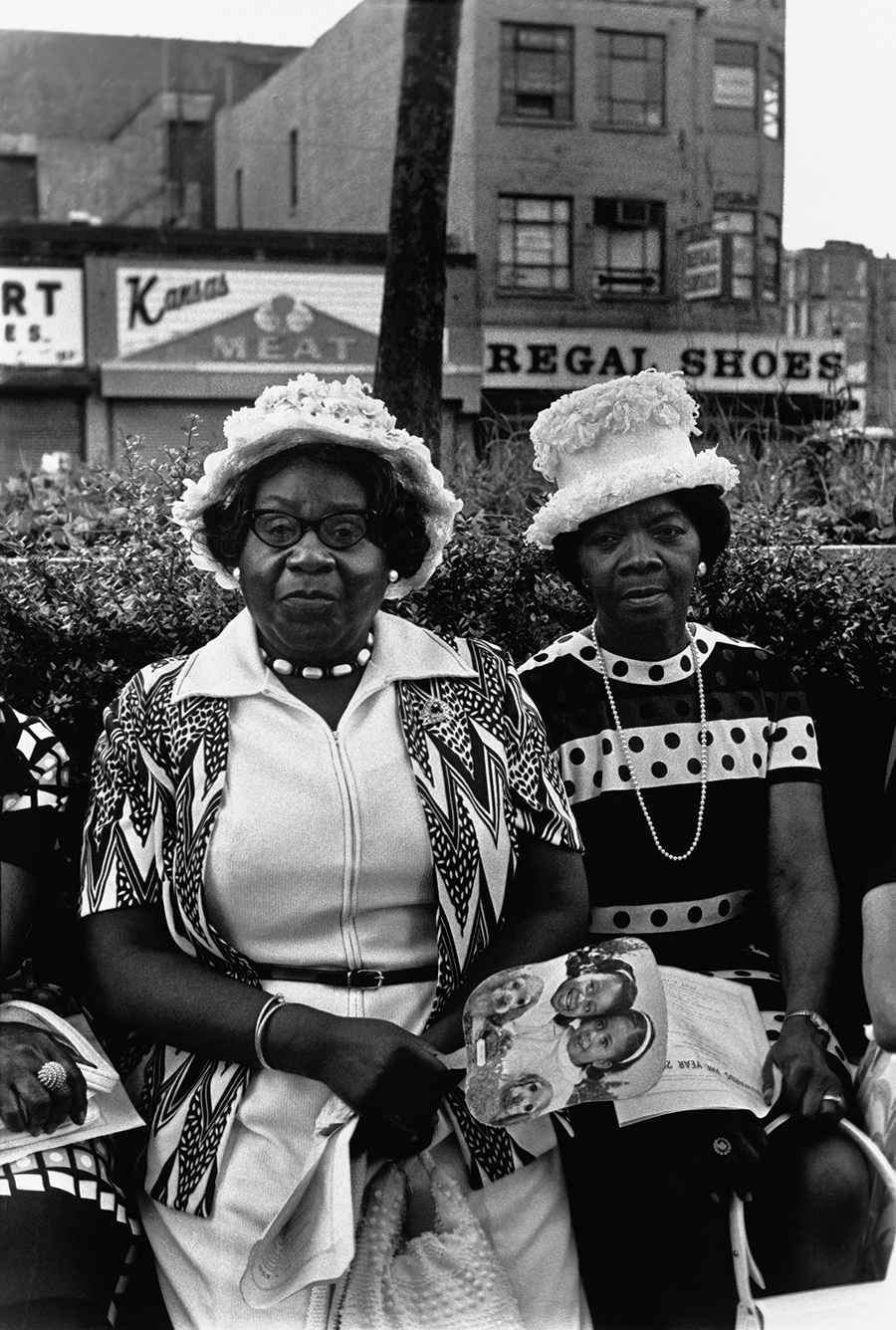
Black and white photo of two women sitting outside dressed in sunday best

Ming Smith, “Amen Corner Sisters (Harlem, New York), 1977, archival pigment print, 24 x 36 inches. Image and work courtesy Ming Smith Studio.

Janice Bond first met Ming Smith ten years ago. In 2020, when Bond became deputy director at the Contemporary Arts Museum Houston, she started talking to Smith about a museum retrospective that has finally come to fruition now, after Bond has left CAMH to open her own space, Art Is Bond. Not content with “conceiving” a retrospective — as noted on the museum’s website — Bond organized a synergetic outpouring of Smith’s work. Thus, there are three Ming Smith shows currently on view in Houston: one in “a cruise ship,” as Bond calls the CAMH (the museum’s acute angles do resemble some kind of naval transport), and two in “boats”: her gallery and Barbara Davis Gallery. Bond wants to create “a critical mass around this historic moment” of different generations and economic brackets, even though the shows exhibit similar, or in some cases, the same work, albeit in different sizes. 

By “historic moment,” Bond means Smith’s largest museum show to date. But the moment is years in the making, and the context of the photographer’s rise to the museum level bears some scrutiny. It started through another artist’s sustained attention. In 2017 Arthur Jafa had a show at the zenith of art world visibility, the Serpentine Galleries in London. Jafa decided to share the podium with Norwegian collage artist Frida Orupabo, YouTube creator Missylanyus, and Ming Smith, who he championed as “the greatest Afro-American photographer ever.” Since then, she’s received a lot of attention in the gallery and the U.S. museum world, culminating in a recent lifetime achievement award from the International Center for Photography. Reaching this peak took time, and the institutional biases of race and gender are not entirely to blame, even though they are ever-present. Rather, it’s her curiosity towards all the disparate corners of the visible world a camera can capture that has made her an unlikely subject for museum attention, which oftentimes favors a sense of closure in a given artist’s trajectory. 

Smith started taking photos with her mother’s camera when she was five. Supporting herself with a modeling career, she gained recognition early on when Black Photographers Annual, a showcase book published by Ebony magazine, published her portfolio in the very first issue of 1973 and continued to print her photos in all subsequent editions. That same year, Smith had a solo show at Cinandre, a hairdresser salon doubling as a social club a couple of blocks from Central Park in New York. In 1975, she became the first and only female member of a Harlem photographer collective Kamoinge, alongside Anthony Barboza, Louis Draper, Alger Cowans, and others. 

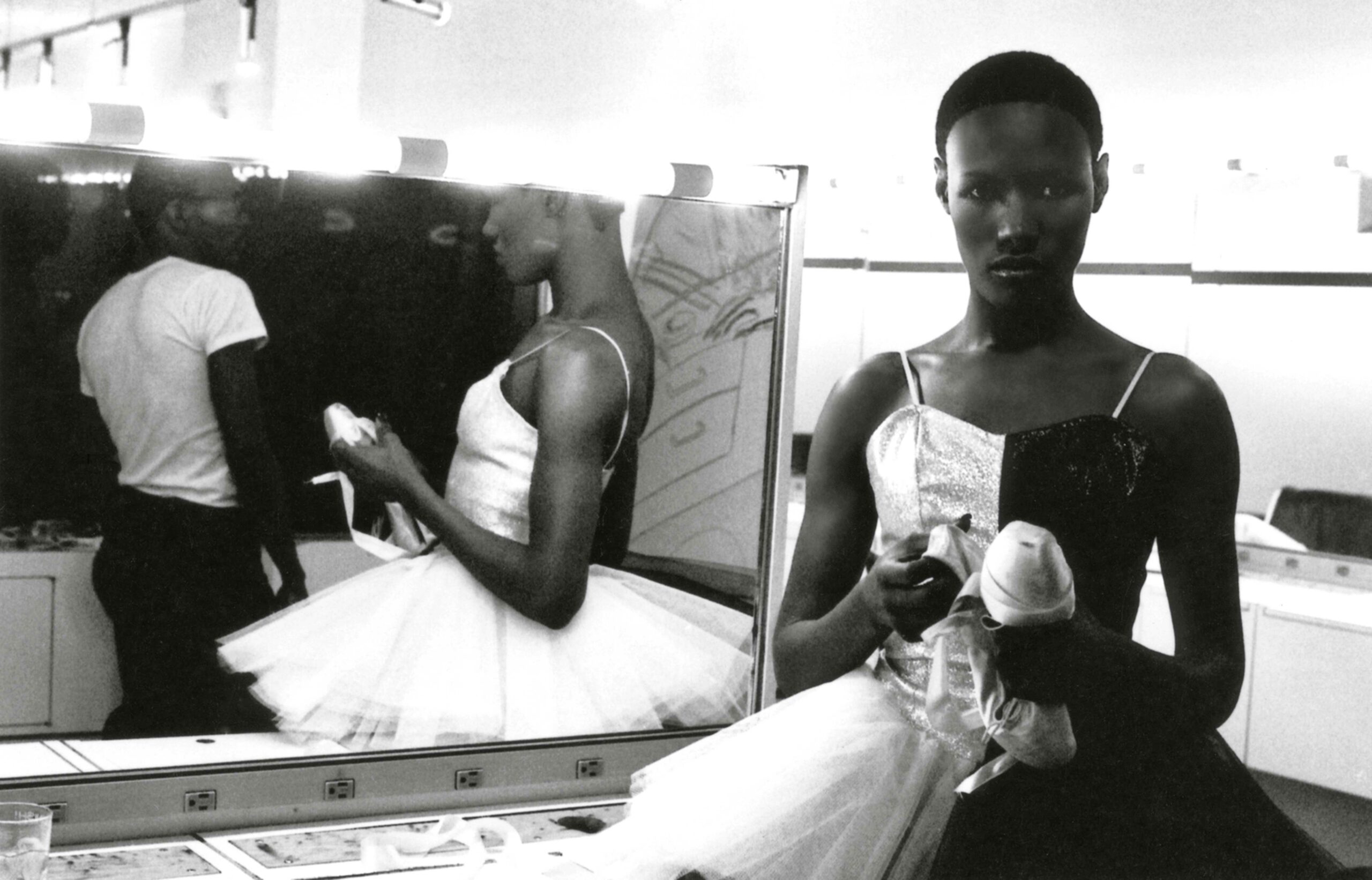
Black and white photo of a young Grace Jones in a tutu

Ming Smith, “Grace Jones at Cinandre,” 1974, archival pigment print, 24 x 36 inches. Image and work courtesy Ming Smith Studio.

In an introduction to the Annual’s first edition, Toni Morrison saw the photography book as hovering “over the matrix of black life.” That phrase can describe Ming Smith’s unique position, too: she could be formal, going after urban texture in one moment and social the next, never stopping to box her intuitive orientation through geographies and scenes of Black life in a restrictive bottled message. The CAMH exhibition relays this lack of stilted logic perfectly, mixing iconic images from different eras and series with a recent video work in collaboration with her son, Mingus Murray, and a sound box with music from her ex-husband David Murray, which includes “Ming,” a title composition from his 1980 album that features her on the cover. “Ming is a dreamer,” Bond says, and the show is supposed to be “reflective not only of her work, but of the energetic process.” 

Smith’s moment in Houston may be historic, but the lightness of touch betrays no gravity, even when the subjects clearly “have something very heavy on their minds … sometimes so heavy as to be timeless, as in Ming Smith’s ancestral — and yet absolutely present — confrontation,” as James Baldwin noted in his introduction to the 3rd issue of Black Photographers Annual. Both as a model and Murray’s touring companion, Smith traveled through the States, Europe, Japan, and several African countries.

Unsurprisingly, she often gravitated towards music and photographed a lot of avant-garde jazz’s prominent players. These photos are unusual in that Smith allows for a lot of negative space around the figure(s), leaving room for random background ambience. This way a portrait becomes pictorial, not commemorative. Even when a figure is foregrounded, as in the case of Smith’s famous shots of Sun Ra, it dissolves into the air, making the legendary bandleader a cross between a Christmas tree and an alien pilot. Smith also befriended young Grace Jones and took playful pictures of her that could be placed among the very best in the performer’s vast visual biography. Smith’s interest in fiction has also led her to inhabit the world of playwright August Wilson’s characters for a series made in Pittsburg. 

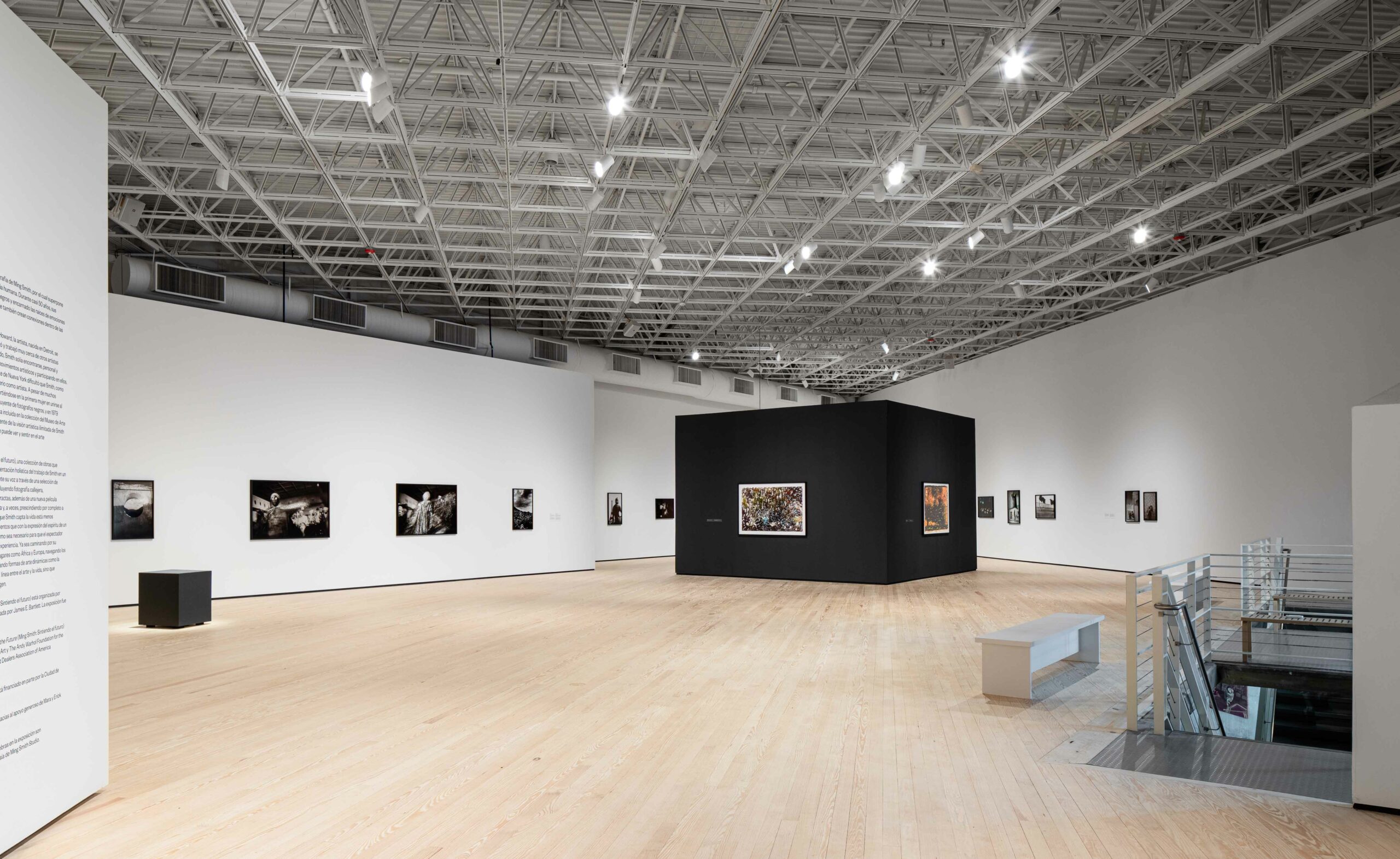
Installation view of photos on white walls and a cube painted black with color photos

Installation view of “Ming Smith: Feeling the Future” at the Contemporary Arts Museum Houston, 2023. Photo by Sean Fleming.

A seemingly endless variety of subjects and topics makes Smith’s shows feel pleasantly observational. Photographers often have a fixed viewpoint, print size, and skew the horizon just so, but Smith follows no set recipe. This makes her hard to categorize. Photography is often evaluated through its weaponizing by controlling institutions. There exists a venerable tradition of understanding the medium through its use by the power in locations that need surveillance — the colonies, the cities, the market. Individual artistic choices in photography are seen, therefore, as fugitive from the types of profiling that the state or the corporation does. An artist who unveils the surveillance tactics in a gesture of Brechtian estrangement is also much more visible to the cultural systems of talent registration. That is why fellow female photographers Carrie Mae Weems or Lorna Simpson — while younger than Smith — have already had solo shows in multiple museums, including CAMH, in the 1990s, on the strength of their efforts to clarify the mechanics of racial profiling. This type of conceptual criticality finds exhibition opportunities much more often than anything elusive or painterly. 

Smith does not do estrangement, so to position her advantageously in the alternative bureaucracies of high art she needed a translation. Jafa’s involvement in Ming Smith’s career makes sense. He’s a quintessentially topical artist, and his politics is very visibly stitched into the images he makes or uses. Jafa volunteered to put her in the right context, and his reading of Smith in a 2020 interview for her Aperture monograph remains among the most incisive. “Black people get tight around photos,” Jafa tells Greg Tate, “because… there’s always a danger that the photograph can be used as evidence against you in some fashion.” In many of Ming’s shots, he posits, “you can’t identify anybody.” 

According to an Artforum review by Chloe Wyma, Smith’s work displays a “purported rejection of the medium’s probative burden,” but it also addresses the invisibility of its subjects. This is a topic that is central for much of Black photography, either conceptual or straight. Carrie Mae Weems notes in an interview that “black folks operate under a cloud of invisibility.” “Lorna Simpson,” writes Marta Gili, “analyzes the way in which we imagine the invisible through the visible, while unmasking the prejudices that accompany us when it comes to reconstructing what is not shown.”

Smith’s first art break came in 1979 with the sale of two photographs to MoMA after the museum hosted an open call. When asked by a MoMA curator to choose the shots herself, she decided on a portrait of David Murray, because she did not see a lot of black men on the museum walls. Later, Smith made a series called Invisible Man (1988-1991) in honor of the Ralph Ellison 1952 classic book, and took on societal blind spots, capturing people in motion, folding into darkness, or resembling ink smudges. The titular image of the series has become the centerpiece of a small MoMA monograph published in 2020. It shows a tall hunched figure plodding through the night snow. We presume the figure is Black, but it could be anyone lost in severe weather. 

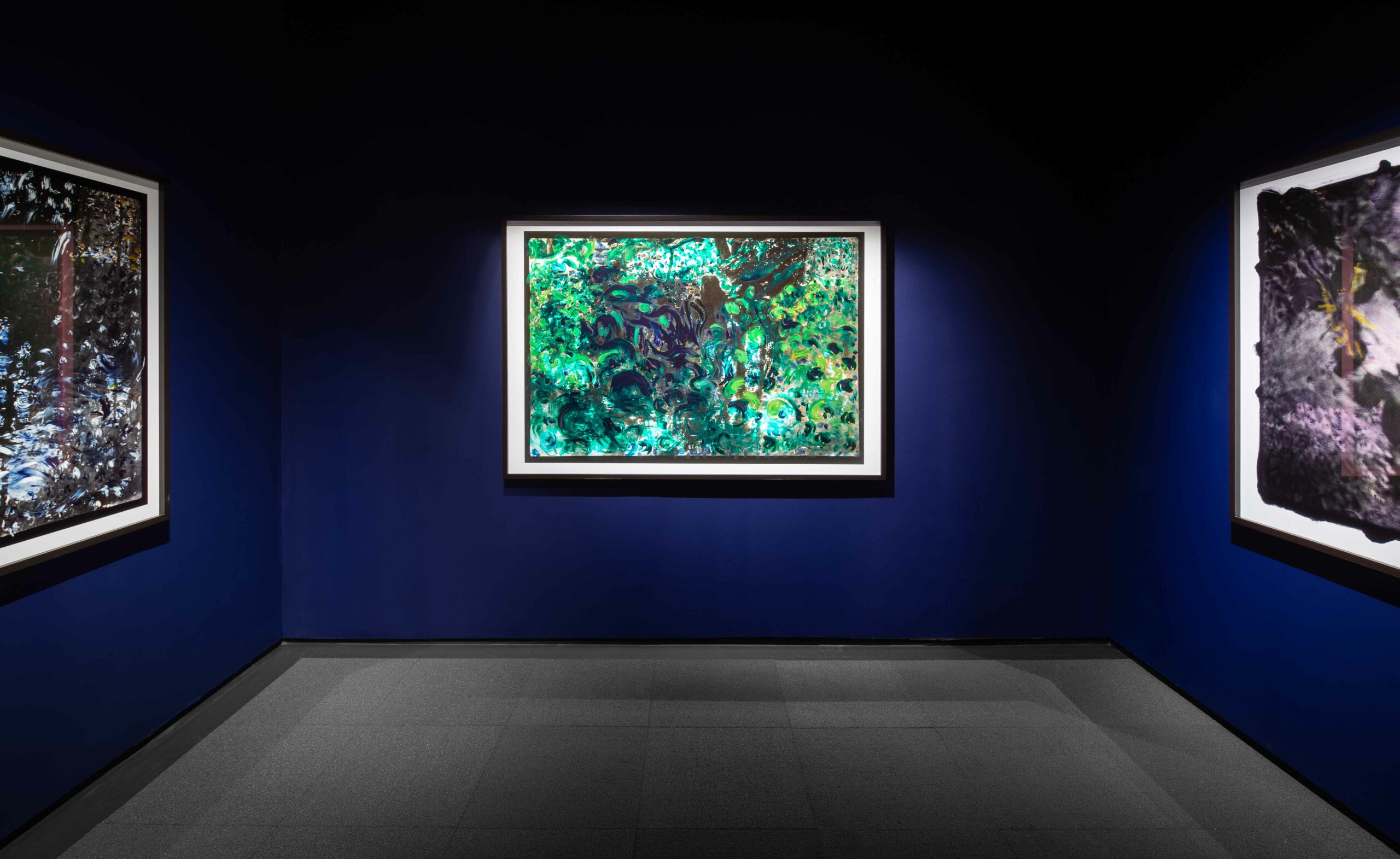
Installation view of colorful photos on a dark blue wall

Installation view of “Ming Smith: Feeling the Future” at Contemporary Arts Museum Houston, 2023. Photo by Sean Fleming.

Surveillance and invisibility are concepts, though, and Ming Smith chooses movement over mind. One of the reasons she went to New York was to take dance lessons, as Ohio ballet schools did not allow Black kids. She’s been interested in Katherine Dunham’s modern dance system since the 1970s. Smith frequently compares photography to dance, saying both are states of extreme mental acuity. In an interview with Greg Tate, she said that her dark and textured nude studies were influenced by the dynamics of Auguste Rodin’s The Kiss. Movement makes itself present through the impressionistic ripple effect that she’s often after. Be it iridescent snowflakes or Sun Ra’s gleaming cloak, Harlem night scenes or strokes of paint that she often uses to enhance the image, Smith presses the shutter not to capture the fleeting moment, but to manifest its evanescence. 

Ming Smith: Feeling the Future is on view in the Arts Museum Houston through October 1, 2023. Ming Smith: Catching the Light is on view at Art is Bond and Barbara Davis Gallery through September 2, 2023.  

10 Reasons Why Flickr is the Best Site on the Internet for Photographers

10 Reasons Why Flickr is the Best Site on the Internet for Photographers

Founded back in 2004, Flickr has changed owners several times through the years as the social media and photo-sharing landscape evolved. Here are 10 reasons why I believe Flickr is still the best site on the Web for photographers.

#1. Photo URLs

Each photo you upload gets its own unique URL page, chock full of information about the photo including all metadata embedded with your photo on upload. Also included are links to different size versions of your photos including your full high res original image. These unique url pages include tags and geo-locational data, and they elegantly showcase the photograph, including the ability to magnify the photo and look at details from this page.

#2. Unlimited Storage

Flickr allows unlimited storage. You will never run out of space or be charged more money as your photo library grows.

#3. Ad Free

Flickr offers an ad-free browsing experience for both you as well as any visitors to your photos/stream.

#4. Open API

Flickr has an open API that allows developers to develop functionality on top of the site. I’m able to use SuprSetr to organize all of my photos by keywords into albums automatically. At present, I have almost 5,000 albums. SuprSetr makes managing them a breeze.

#5. Social Metadata

Flickr allows others the ability to interact with your photos generating rich new information that I call “social metadata” around photos.

I upload found vernacular photographs and a robust community frequently is able to identify locations and even families and people in my collections and share this information with me and others on the photo’s page.

#6. Good Owners

Flickr is run and managed by the MacAskills, who also own SmugMug. Don and Ben MacAskill are trusted friends of photographers who have decades of experience managing online photo websites and communities. They have a deep respect for photography and photographers and have expressed a desire to help preserve the Flickr archive as long as possible into the future. They recently helped establish the @flickrfoundation which is focusing on preserving important work for all time. They are thoughtful, good, decent people who you can trust with your photos.

#7. Flexible Licenses

Flickr allows a variety of licenses for you to use with your photos. You can use the default “all rights reserved” license if you want or you can use a variety of Creative Commons licenses which allow more generous ways for you to share your photos with the world if you so choose. I personally use Creative Commons Non-Commercial for my photos.

#8. Wonderful Community

There is a wonderful community of photographers at Flickr. Perhaps not as robust as it was in years past, Flickr still has a wonderful group of photographers that I interact with daily. I have met many of my best friends over the years first on Flickr. Flickr is a very social place where you can get to know other people and photographers and engage and interact and make lots of interesting new friends who share a love of photography both through their individual photo pages and Flickr groups.

#9. Longevity

Flickr has been around for over 19 years. It will celebrate its 20th birthday next year. They are the OG photo-sharing site. Other sites have come and gone but Flickr persists. This also means that Flickr is one of the most important highly organized searchable databases of photographs in the world having been a place where photos have lived for that long. It’s impossible to underestimate the importance of this large body of work for humankind. It’s an amazing collection of some of the most important images in the world.

#10. Profile Pages

Flickr offers each user their own profile page. This page includes photos you choose to highlight as well as your most favorited photos on Flickr. It’s a great place for other photographers and people to learn more about you.

While Flickr is a paid service (good things are worth paying for) it does also offer a free version which allows you to try the service out with up to 1,000 photos. It has a mobile app as well but I prefer the web experience myself and that’s how I use it mostly.

Bonus: Fantastic Support

The support on Flickr is first-rate. Not only do they have a help forum where users can help each other and where staff can assist as well, but you can also reach out directly when needed. The support team is friendly, professional, helpful, and knowledgeable.


About the author: Thomas Hawk is a photographer and blogger based in San Francisco. The opinions expressed in this article are solely those of the author. Visit his website here and his Flickr photostream here.

The 37-year-old who won the iPhone Photography Awards says he’s not a professional and only started taking photos as a hobby 5 years ago

The 37-year-old who won the iPhone Photography Awards says he’s not a professional and only started taking photos as a hobby 5 years ago
  • Iván Silva won the grand prize at the 2023 iPhone Photography Awards.
  • Silva, from Mexico City, said he used YouTube tutorials to teach himself photography.
  • He says he prefers using a phone to a traditional camera as it is easy to travel with.

Iván Silva may be an award-winning photographer, but he says he’s not a professional. 

Silva, 37, was announced as the Grand Prize Winner of the 16th annual iPhone Photography Awards earlier this month.

Silva, from Mexico City, beat thousands of entries from around the world with an image of his young nephew celebrating Argentina’s 2o22 World Cup victory, according to a post on the iPhone Photography Awards’ Instagram account. 

Speaking to Insider, Silva said the photo of his nephew standing on a truck was taken a couple of days after the World Cup in December 2022 while his family was vacationing in Arandas, Jalisco, in Mexico. Some of the family were collecting wood for a bonfire when Silva’s nephew, wearing a Messi jersey, stood on top of the truck in celebration, he said.

Silva says he started photography 5 years ago as a hobby

Speaking to Insider, Silva said he began taking photos as a “hobby” five years ago and is self-taught; he used YouTube tutorials and movies, and studied professional photographers to help hone his craft. 

These days, Silva said he only has time to photograph on the weekends or while on vacation as he has a demanding job. He works within the judicial system in Mexico and also recently welcomed a newborn son, he said.

And while he initially used a traditional camera, Silva says he now mostly prefers his phone camera as it is more “comfortable” and “easy” to travel with.

“This is the first time I have participated in an international photography contest,” Silva said. He added that he previously applied to contests in Mexico but with “no results.”

“When I found out I was a winner by email, my wife was taking a bath while I was taking care of baby. I was so excited that I didn’t read the whole message. I shouted and told my wife I won — she was very scared and thought something happened to the baby,” Silva said. 

“She said she’ll never forget that day because of the scare she had because of my screams,” he added.

Silva said he initially thought he had won the childhood category, and it took around an hour for him to realize he had won the grand prize.

In addition to the grand prize and the three runners-up, the competition also shortlists winners from numerous categories including abstract, animals, architecture, and children, as shown on the contest’s website. Most entries are amateurs since the contest is open to all iPhone users, a spokesperson for the iPhone Photography Awards told Insider. 

Silva’s photo was chosen because it captures the inspiration, hope, and dreams of childhood, the spokesperson said. 

“His hero, Lionel Messi, came from very difficult circumstances but became the best and so many kids resonate with this,” they added. “The hope he embodies is the biggest gift one human can give another.”

Should we look? Lakehead prof sheds light on atrocity photography

Should we look? Lakehead prof sheds light on atrocity photography

Orillia-based scholar Valerie Hébert served as an author and editor for a new book called Framing the Holocaust: Photographs of a Mass Shooting in Latvia, 1941.

The Lakehead University professor is one of eight contributors to the book, which takes a deep dive into 12 photographs that document a mass shooting of Jewish people on a beach in Latvia in December 1941.

“When a lot of people think about the Holocaust, they think of Auschwitz and they think of trains,” Hébert said. “Before the death camps were built, the mass killings began with mobile shooting squads that combed through the Eastern Front as the Nazi army advanced.”

Hébert says the mobile shooting squads would gather alleged racial and political enemies and shoot them to death. More than a million people were killed using this terrorizing tactic.

“These 12 photographs show the sequential steps in one of these shooting actions,” she explained. “Jews were brought to this place, were made to undress. They were separated into smaller groups and brought to a ditch that was dug parallel with the sea, and they were shot. Their bodies fell into the ditch.”

Four men are connected to the photographs, but it’s unknown for sure who took them. The photos were turned in to the Soviet investigators by a Jewish Latvian man and are commonly used today in Holocaust museums but are rarely attributed to the correct time and place.

“This book provides an in-depth study and the historical context for these photos,” Hébert said.

In 2017, Hébert organized a workshop at the United States Holocaust Memorial Museum in Washington, D.C., on atrocity photography.

“Photographs are sort of at the cutting edge of Holocaust research in particular,” she said. “There is more and more interest in this field of atrocity photography.”

She invited scholars from Canada, the U.S., Germany and Australia to the two-week workshop to talk about their work in atrocity photography and to look at materials from the museum.

“The idea was to put together a book where we are all speaking about the same images,” she said. “We chose these 12 photos because it’s rare to have so many in a clear sequence.”

The images show partially clothed and naked women and children caught in moments of terror.

“They really push us to the edge of what it is we can bear to look at,” she said. “The key question of the book is if they are so unbearable to look at, why should we even engage with them? What can we gain from them? And what can they tell us?”

Each author in the book brings a different question to the photos.

For Hébert, studying photos goes back to her childhood. Her interest in history comes from looking through her grandfather’s Time Life coffee table book of photographs from the 20th century.

“From the time I was little, I would look at this book and would be really drawn to photographs,” she said.

Hébert, who has a PhD in history, uses photographs often in her teaching at Lakehead University.

“I’ve taught Holocaust courses, I’ve taught courses on the world wars, and at first I was always uneasy about showing photographs of dead bodies and people in distress,” she said.

“There are some really important questions around these people not giving their consent to be photographed. A lot of times, the photographs are a part of the torture and humiliation because the photographer is using the moment to deepen their suffering.”

Through the process of creating the book, Hébert asked herself if bringing light to the photographs continued the humiliation and horror of victims. She also asked herself if the pictures were important evidence that help people understand history.

“The chapter that I contributed to the book looks at that ethical question,” she said. “Should we look at these? Should we not? And what are the arguments on both sides?”

The chapter sets the stage for all of the following chapters in the book, and Hébert hopes readers who pick up the book will gain a new appreciation for how rich and complex photographs are.

“We have this idea that photographs tell us everything, the truth is on its surface, and we understand everything by looking at the photograph, but we don’t,” she said. “So, it’s really important to consider who took the photograph, who was the intended audience, and what that might mean.”

While the photographs in the book were taken as a celebration of the crime, they’re also an indictment, which makes it important to understand the many meanings photographs hold, Hébert says.

“It helps us think more critically about historical photographs that we see,” she said. “We are a more visual culture now with social media and Instagram. It’s all image based now.”

She says photographs can transcend language, time and geography, which makes it important to have a more critical and nuanced way of understanding pictures while being aware of their ethical complications, which makes people better consumers of present-day photojournalism.

“The ones in the book help us understand this particular event in the Holocaust,” she said. “The way that the authors model how we read and interpret these photographs, there is a lot of crossover to how you may engage in photographs of other historical events or present-day crises and human rights issues.”

Framing the Holocaust: Photographs of a Mass Shooting in Latvia, 1941 will be available for purchase on Amazon starting Aug. 22.

Regional Art and Photography Show and Sale

Regional Art and Photography Show and Sale

Next: Monday, August 7, 2023

Runs until Saturday, August 19, 2023
(See all dates)

Time
6:00 PM – 8:00 PM

Venue
Southeastern Indiana Art Guild, Aurora, 47001

Price
FREE

Local artists and photographers will be exhibiting for the next two weeks at the Southeastern Indiana art gallery in Aurora Indiana. All art will be for sale.

More Information
(Eagle Country 99.3 is not responsible for external websites)

Looking for something to do? Our Art Guild will be exhibiting local artists and photographers art work at the gallery located at 302 Second Street Aurora IN opening Saturay August 5th through the 19th. No admission charge and our building is handicap accessible. Depending on what side of town you are from in the Cincinnati area, it is a 35-55 minute highway drive. Come to see what we’re all about. We are highlighting some welded sculpture work by doctor Randy LaDuc from Dillsboro/Lawrenceburg Indiana. You won’t want to miss it.

Venue

Southeastern Indiana Art Guild

302 Second Street (corner Of 2nd And Main)

Aurora

47001

More details for this venue

Dates

The event runs from 6:00 PM to 8:00 PM on the following dates.
Select a date to add this event to your calendar app.