Photography

Fixing Seven Beginner and Pro Landscape Photography Mistakes |

Fixing Seven Beginner and Pro Landscape Photography Mistakes |

Photographers make mistakes; it is part of the hobby of photography. They happen from not knowing how to use the camera adequately, to forgetting to change a setting, to post-processing errors. This video covers seven landscape photography mistakes you can easily correct, whether you are a pro or a beginner.

Nigel Danson looks at seven things that can cause you to make mistakes in your photography and how to avoid them. In this video, Danson looks at mistakes from the technical side of camera settings to compositional mistakes one might make when taking photos.

Danson notes these are all mistakes that beginner photographers can make or even professional photographers, with several examples from his own experiences and portfolio serving as supporting examples throughout the video. Many of the mistakes in the video can be corrected with a little more attention while out in the field or preparation ahead of time to understand your camera gear and features before you head out.

I firmly believe in getting out there and making those mistakes so you can learn from them. It was refreshing to see that even professional landscape photographers like Danson still make errors out in the field. He did not express frustration from those mistakes, but instead, learned to be better prepared and minimize their occurrence in the future.

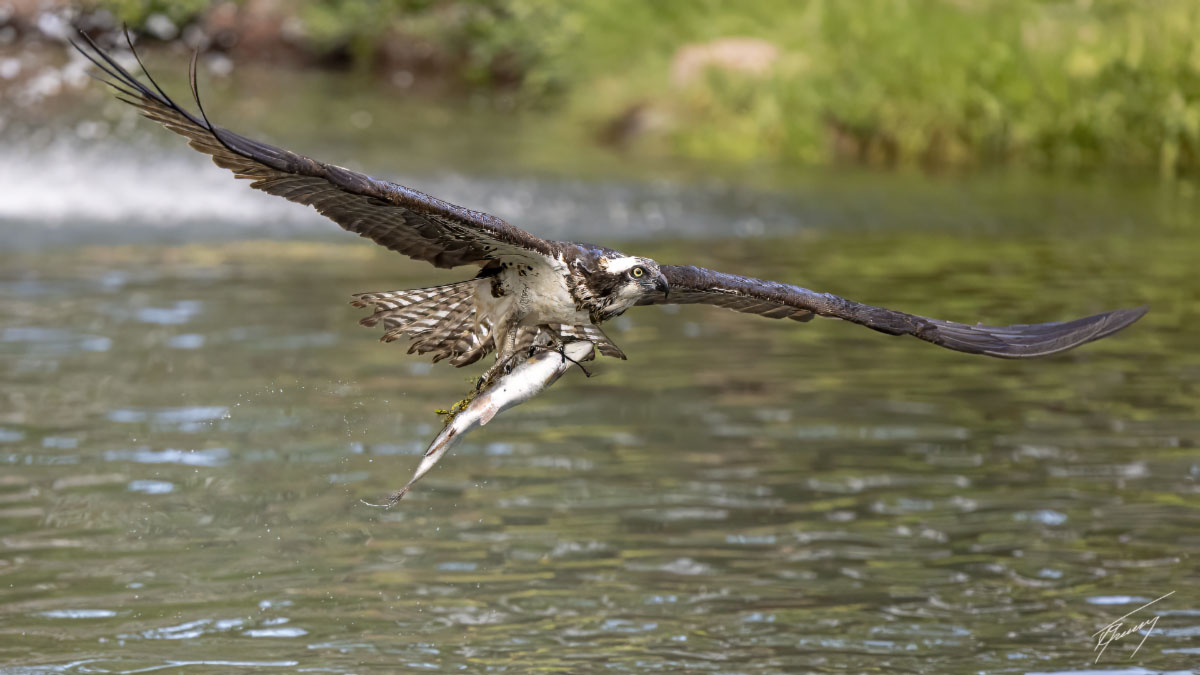
Today’s Photo from Ted Grussing Photography: Risk … Reward

Today’s Photo from Ted Grussing Photography: Risk … Reward

… risk … reward, is as old as life on earth … whether it be the simple act of committing yourself to the purpose of gathering food for the day or achievements in sports or business, always there is the necessity of putting yourself out there and being committed to achieving a goal … our daily gift!

In the shot above our Osprey has set his sights on a trout swimming in the pond and his total focus is having his talons and the trout being in the same place at the same time!

Below, our Osprey has met all expectations and is making off with his reward … one of the finest trout dinners it is possible to get. Thanks to The Sedona Rainbow Trout Farm for providing me the opportunity to get these wonderful shots … check it out yourself … trout raised in and only kept in pure spring water! Doesn’t get any better than that and you do not have to make the high dive to get them.

Have a wonderful day … let a few smiles make their way across your face today and pass on a few compliments as you can … in the evening you will have a warm smile and feeling after a day well lived.

Cheers,

Ted

I lie down in slumber, and the peace of the world is
upon me. Though poverty abide with me, I pray that
courage and and gentleness forsake me not. And with
all living things out of the earth and out of other worlds
I believe I shall grow in the fields of God forever.

excerpt from A Psalm by Max Ehrmann

###

photo_tedgrussingThe easiest way to reach Mr. Grussing is by email: ted@tedgrussing.com

In addition to sales of photographs already taken Ted does special shoots for patrons on request and also does air-to-air photography for those who want photographs of their airplanes in flight. All special photographic sessions are billed on an hourly basis.

Ted also does one-on-one workshops for those interested in learning the techniques he uses.  By special arrangement Ted will do one-on-one aerial photography workshops which will include actual photo sessions in the air.

More about Ted Grussing


Healing Paws

Healing Paws

This is an advertisement

From philanthropy to photography

From philanthropy to photography

Photographer Eleanor Preger may be self-taught, but her images are breathtaking. She’s lauded for her skill with capturing the inner spirit of her subjects and the vast beauty of the Burning Man Playa. Her latest exhibition, Art on Fire, is now on view at Sierra Arts.

Your Burning Man photography exhibition will be held at Sierra Arts Gallery from Aug. 1-Sept. 7, with a reception on Friday, Aug. 4. How and why did this come about?

I was introduced to Burning Man in 2011. The Nevada Museum of Art wanted to hold an exhibit with the LED artist Leo Villareal, but Director David Walker could not get any support. So he asked my husband and I for sponsorship. He said he’d take me and my friend to Burning Man. I asked him, “Why would I want to go to Burning Man?” And he said, “You like to take pictures, don’t you?” I was an amateur photographer then. So I went to Burning Man for one day from 7 am to midnight and got hooked. I started taking workshops for landscape and portrait photography. The following year I brought my camera and became a Burning Man advocate.

Burning Man later contacted you saying they really liked some of your photos, and could you send them copies. So that’s when you became part of their volunteer Media Mecca Documentary Team?

The Documentary Team is a group of volunteer photographers and videographers that
document the life in Black Rock City. There are now about 80,000 ‘Burners’ (attendees) every
year. We try to capture the radical inclusion and the diversity of the Burner camps. We also try to photograph the Burning Man staff and the city infrastructure, along with the art and pop-up experiences.

The Playa can be a rough environment to photograph. How do you document that?

There are the not-so-glamourous realities of life in Burning Man — dust storms, dusted
people, wind damage, damaged camps. So there’s good and bad. We just try to bring the whole culture to the public.

You spend 10 days shooting on the Playa. It must be challenging, physically and mentally.

You know what, I was a really shy person until I had a camera in front of me. For some
reason the camera made me open up and approach people. Burning Man opened me up to a new way of life. It flipped a switch in me. When I went there I realized I could just take in the
moment and appreciatate it. My husband felt the same way. But being a photographer can be lonely at times. I’m the one who’s always behind. I let the crowd go ahead. Then take my
pictures, and try to catch up with everybody.

You’ve now garnered a wide and impressive range of photography work. Can you give some examples?

No Spectators: The Art of Burning Man exhibit at the Renwick Gallery of the Smithsonian
American Art Museum is one example. It was held from 2018-2019. They used my “Truth is
Beauty” photo to promote it all over the world. Also, my photo of the Monaco Art Car was
auctioned off at Sotheby’s.

You’ve helped curate a number of shows at the Sierra Arts Gallery.

It started with a solo Burning Man show I helped curate in 2019. After this I was included in
the August Burning Man shows with other photographers in 2021 and 2022. I now help curate the Burning Man show Sierra Arts Gallery has in August with gallery curator Maria Partridge. My husband and I are supporters of the Sierra Arts Gallery, as they truly support artists and the art community in so many ways.

You’ve invited photographers Scott London and Marc Sheff to participate in your upcoming Sierra Arts Gallery exhibition.

Curator Maria Partridge invited Marc Scheff to exhibit his interesting black and white
Burning Man portraits. And I love Scott London’s work. He’s become my mentor and teacher.
He and co-author Jennifer Raiser will be doing a talk and book signing at the artist reception.
Scott is also a member of the Burning Man Documentary Team along with me.

Could you share some of the photography techniques you use?

I often use long exposure on a tripod. For instance, a sunrise with elogated clouds using an
exposure of 30 seconds. I’ve also been doing infrared photography. It looks black and white, but sometimes there’s blue and pink hues in it. I also try to take the same picture of a night scene and a day scene, and then combine them. There are beautiful sunrises and sunsets at Burning Man.

I read that you like to use props.

I like umbrellas, and use lighted props, ribbons, and smoke. I also do fast exposures of people jumping and dancing or twirling with their hair in midair. It’s how you get those kinds of shots.

When speaking about your photography, I learned that you’re most proud of the moments you’ve captured the “spirit of a friend.”

Many people have shared with me that I capture their inner spirit. I make sure to get
permission from everyone I photograph. Sometimes I’ll help them fix their hair or straighten
their shirt. Something like that. So they feel relaxed with me, and it comes through.

This slideshow requires JavaScript.

Do you have a particular type of person you like to photograph?

There are people I do repeat shoots with every year. And I try to shoot people of all ages. And
actually most of my pictures, as you’ll see, aren’t young people, and aren’t Instagram poses.

You live part-time in Nevada at Incline Village in Lake Tahoe, and part-time in Sausalito,
Marin County, California. You seem very active. How do you balance it all?

I love my house in Sausalito and have family down there. I have five grandkids. But, Tahoe is
our home. It’s a small community of about 8,000 people. A lot of retired young people that were in high-tech. And a lot of non-profit activities. Yes, we are busy, but I think that’s what keeps us young.

Art on Fire: An Exhibition of Photography by Scott London and Eleanor Preger, along with Marc Scheff’s black and white Burning Man portraits, are on on view at Sierra Arts Gallery in downtown Reno through Sept. 7 with a reception on Aug. 4 from 5-8 pm and a talk and book signing with Scott London and Jennifer Raiser at 6:30 pm. 

Photos courtesy Eleanor Preger

2023 International Photography Competition Open

2023 International Photography Competition Open

2023 International Photography Competition Open

All The Ohio State University students, staff, faculty, visiting scholars and alumni are invited to submit photos to the 2023 International Photography Competition. All photographs must be the original work of the entrant, of high quality and taken outside of the United States. Photographers are invited to submit one photo in each category: People, Places and Arts & Culture. Submissions are accepted until October 6, 2023 at 12:59 p.m. EST. Review the 2023 International Photography Competition Rules and submit your best international photos.

Judges will select 40 photos based on artistic expression, creativity, originality, photo commentary and the quality of the image to be on display at our photo exhibition in the Ohio Union. The judges will also choose a first, second and third place entry for each category, which will be announced at the 2023 Photography Exhibition opening reception. Photos selected for the exhibition will be eligible to win the People’s Choice Award determined through an online vote via Facebook and Instagram.

For questions, please contact Victor van Buchem, van-buchem.1@osu.edu.

Practicing Landscape Photography Locally Is Essential for Your Growth

Practicing Landscape Photography Locally Is Essential for Your Growth

Grand trips for landscape photography are exciting and can make it look like you’re really living the landscape photographer life. But practicing your landscape photography locally shouldn’t be underestimated if you want to improve your technical and compositional skills.  

I like to travel as much as the next landscape photographer. I enjoy my trips cross country to photograph places outside my usual locations. Even regional trips that are just a handful of hours away are welcomed.

But if I only practiced my landscape photography on trips rather than locally, my photography skills would take much longer to mature. There are many advantages to practicing your landscape photography locally — no matter where you are!

Regular experience being outside taking pictures is one of the surest ways to improve your technical skills with the camera. You can also practice refining your creative eye when it comes to interesting compositions. Practicing locally allows you to do so more frequently and be more prepared for when you travel for your hobby.

Here are five reasons I think practicing locally positively benefits the landscape photographer.

Practice Technical Camera Skills

There is only one way to improve your technical skills with the camera. You can read book after book and watch video after video, but at some point, you need to put those lessons into practice. The best way to do that is to go outside and practice. 

Practicing locally gives you many more opportunities to practice foundational photography skills — adjusting shutter speed, aperture, and ISO — and more advanced skills like exposure bracketing, focus stacking, and more. These don’t need to be portfolio-worthy images, but it does need to be time outside with the camera and deliberately practicing with it. 

Once you have the basics of getting a good exposure and adjusting the settings to get that exposure, then you can practice doing exposure bracketing and getting a feel for how many stops of light difference you want to capture or learning how to focus stack so you aren’t missing an in-focus frame for blending later. 

Practice until all of this is second nature. Learning these close to home allows you to experiment more and be more confident when you do travel to a far-off destination for your landscape photography.

An additional byproduct is you become more familiar with your camera. Whether that be button locations or little quirks of your camera — you can learn these locally to be better prepared for future travel.

Practice Creative Photography Skills

Similar to learning the technicals of photography, practicing locally affords more opportunities to practice the creative side of photography — primarily composition. 

This is an area I constantly strive to improve in. I make mistakes all the time — take an image, looks good on the back of the camera but get home and I’ve made some error or not left enough room on one edge of the frame or have things protruding into the frame from the edges. 

By practicing composition repeatedly locally, I can more quickly get those repetitions in and learn what works in an image and what doesn’t. Learning this close to home lets me apply it when I travel and hopefully capture more pleasing photos than if I only practice my landscape photography when I travel outside my local area. 

Busy Schedule

Traveling for landscape photography can be challenging to fit into the schedule. At the very least, a long weekend takes me away from responsibilities at home, so these trips often need to be coordinated. Longer trips do the same but also tap into vacation time banks and even more family activities to schedule around. 

If I were only to practice my landscape photography when I traveled, my growth as a photographer would be quite limited. But practicing locally lets me get out much more often. I can head out early in the morning, get the nice soft light of sunrise, and still be home for the rest of the day. Similar to the evening, when I head out after dinner and spend some time outdoors practicing. 

If I only need to spend ten to fifteen minutes to get to a spot, I don’t feel back about only having an hour or two to be out. I can still get a lot done in that time.

Reduce the Expense

Traveling can be expensive; gas, flights, and a place to stay, it all adds up! To keep costs in check, one may only be able to make one big trip a year and maybe a weekend trip or two.  Photographing near home is inexpensive. You don’t need a place to stay, you can often walk, bicycle, or take a short drive and start practicing. 

Photography can be an expensive hobby, practicing your landscape photography locally can help offset some of that expense while still allowing you to enjoy the hobby.

Learn an Area

And finally, practicing your landscape photography locally lets you learn and experience an area over time. On big trips, I hope the weather conditions line up for incredible sunrises, sunsets, or nice light for the scene. If it doesn’t happen, then it doesn’t happen.

When practicing landscape photography locally, I can revisit an area and be more patient with capturing just the right conditions. I can start to notice smaller details that I might have overlooked before. I have more opportunities to refine my compositions for the perfect image if I continue to revisit an area. 

I think practicing landscape photography locally is critical. How about you, do you visit your local areas to practice your technical camera skills and compositions? Let me know in the comments below!
 

The Best Lenses for Landscape Photography

The Best Lenses for Landscape Photography
[embedded content]

Picking out the perfect lens is very challenging. As landscape photographer Michael Shainblum explains in a new blog post, “Purchasing new lenses can prove to be overwhelming and stressful.” Shainblum breaks down the four crucial factors in selecting a new lens and offers landscape photographers options regardless of their budget.

Photographers should consider four crucial factors when selecting a landscape lens: range, price, quality, and weight. The range is the focal length range of a lens. The wider the focal length range, the more versatile a lens is for a diverse range of landscape photos.

Michael Shainblum Best Lenses for Landscape Photography
100-400mm lens (left) and 16-35mm lens (right) | © Michael Shainblum

Kickstarting Shainblum’s recommendations is the “budget hiker/backpacker kit.” This kit includes two lenses, the Sony FE 16-35mm f/4 G PZ lens and the Tamron 28-200mm f/2.8-5.6 Di III RXD lens. This kit offers focal lengths range 16mm to 200mm, which is suitable for nearly every landscape scenario. It is also a relatively lightweight kit that costs under $2,000.

A slightly more expensive kit that compromises a bit concerning weight is a pairing of the same Sony 16-35mm f/4 lens with the Tamron 50-400mm f/4.5-6.3 Di III VC VXD lens. This “budget kit” loses the 36-49mm focal lengths but adds 201-400mm.

Michael Shainblum Best Lenses for Landscape Photography
14mm | © Michael Shainblum

For photographers with a massive budget, the “$$$” kit sets someone back nearly $7,000. The three lenses are the FE 12-24mm f/2.8 GM, Sony FE 24-105mm f/4 G OSS, and the Sony FE 100-400mm f/4.5-5.6 GM OSS. With focal lengths coverage from 12mm to 400mm, this premium kit does it all.

While that may be the best trio of landscape lenses money can buy, it is different from the kit that Shainblum himself uses. He shoots with an older Sony 16-35mm Vario-Tessar T FE f/4 ZA OSS lens, the Tamron 28-200mm f/2.8-5.6 Di III RXD, and the Sigma 100-400mm f/5-6.3 DG DN OS telephoto zoom.

All the kits Shainblum outlines, which include more than what is discussed in this article, include multiple lenses. What if a photographer wants just a single lens to do it all? Shainblum thinks the Tamron 28-200mm zoom is a great option. While it is not extremely wide by landscape lens standards, 28mm is plenty wide for many situations, and the lens is versatile, lightweight, affordable, and a strong overall performer.

Michael Shainblum Best Lenses for Landscape Photography
28-200mm | © Michael Shainblum

Further, while Shainblum mentions lenses for Sony E-mount, the general “type” of lens in each of his kits exists for other lens mounts. While sometimes a lens is not precisely the same for other camera systems, similar lenses are readily available.

As Shainblum also explains, a great way to save money on any new photography equipment is to purchase it used. There are many places to buy high-quality used gear that has been professionally inspected and graded, including Adorama and MPB.

More of Michael Shainblum’s photography is available on his website and Instagram. His excellent YouTube channel is regularly updated with insightful new videos for photographers of all skill levels.


Image credits: All images © Michael Shainblum

A tea shop in Khartoum before the bombs: Ala Kheir’s best photograph

A tea shop in Khartoum before the bombs: Ala Kheir’s best photograph

I moved to Khartoum, the capital of Sudan, at the age of five, and instantly fell in love with the river. The Nile snakes through the city, offering one of very few public places to escape the sweltering heat. It was always where I felt happiest as a child, and now as an adult.

The Halfaya Bridge, pictured here, is one of the newer bridges in the city. It connects two of the capital’s three main neighbourhoods: Omdurman, where I grew up and still live, and Bahri, to the east of the Nile. Under the bridge is a little tea shop, a common sight. It’s the perfect place to pause, relax, watch the world go by and catch the breeze blowing in over the water. The river is treated like a public space in Khartoum. The various classes and communities that make up the city all come here to chat and look out over the Nile. It’s a place where people come together in a city that can otherwise feel divided.

It took me a few trips to get this shot. I want every image I take to capture what I felt when I was in that place. Here, it was the sense of time stretching out ahead of you, and a feeling of peace and calm. It was part of a series documenting the river, but I like that in this image what’s most important isn’t the water itself but the space it offers for human relationships. I took the shot a year and a half ago. Then, just the other day, I came across it again. I was hit with a sense of nostalgia. Since conflict broke out in the city a few months ago, these spaces have been largely abandoned. It’s unthinkable that I could while away an afternoon there now.

Khartoum is not the same place we all lived in. When I started the river series, I was documenting life in the city as I lived it. But now that is history. Many people have fled and places like this cafe sit empty. The shot commemorates a happier time when Khartoum was still at peace. Even if the conflict calms down, I don’t think it will return to how it was. What scares me is that the fighting is shifting from political oppositions to tribal ones, which are much more complicated to solve. It’s what happened in Darfur, my birthplace, 20 years ago. It feels as if history is repeating itself.

I think we in Sudan have so many social issues that could be resolved through art. We need to talk about both our differences and our similarities as people. So many of Sudan’s issues relate to questions of identity, how different groups live together and how different classes interact. I want my photography to be a way to have conversations. This image commemorates one of the places where such interactions were possible.

As a self-taught photographer, the way I take pictures has changed a lot. I’m no longer looking only for a beautiful image, I’m looking for a specific feeling. I want each image to capture an essence of a place. Photography has changed me: taking pictures of Khartoum has made me a much better observer of it. I understand the city more deeply.

To be an African photographer who photographs Africa is not always easy. In the case of Sudan, because the country has experienced many years of conflict in various forms and various places, sometimes that is all the outside world sees of us. Of course, those things matter – I don’t think our conflicts are well enough understood and it’s essential that they are. But there is a world beyond conflict here that is rarely seen. I think it’s the role of artists and photographers to tell stories that journalists don’t reach, to produce a counter narrative – showing the joy and beauty of this place and its people, not only its suffering.

Ala Kheir’s work is part of Reframing Neglect, in partnership with the Africa Center, Harlem, New York, 3 August to 5 September, then at Cromwell Place, London, 26 September to 8 October.

Ala Kheir.

Ala Kheir’s CV

Born: Neyala, Darfur, Sudan, 1985
Trained: “Self-taught. But I was lucky to attend many masterclasses in Africa.”
Influences:Robert Adams, Akinbode Akinbiyi, Eugène Atget.”
High point: “Going out in beautiful weather with two fresh roles of Kodak Portra 400 film.”
Low point: “Thinking about what is going on in Sudan now.”
Top tip: “Photograph what you feel. It will make your photography unique.”

How to Sell Your Photography Online in Alpharetta, Ga | DarrylBrooks

How to Sell Your Photography Online in Alpharetta, Ga | DarrylBrooks
https://img.particlenews.com/image.php?url=4M4yUd_0nkGCPLp00

Image of Farmall Tractor in Alpharetta, GaPhoto byImage by Author

How to Sell Your Photography Online in Alpharetta, Ga

If you are a photographer in Alpharetta selling your work online, or just starting out and want to kick-start your income, there is one site that few people are talking about.

Let’s face it, photographers can be some of the biggest snobs out there. After all, we are artists. We can’t be bothered by such mundane things as debasing our art to make money. Well, some can’t.

I’ve been a professional photographer in the Alpharetta area for about 30 years and I’ve heard these types of arguments over and over. One of the first and loudest came back in the early part of this century when digital photography became a thing.

“That’s not real photography!”

The first guy that mixed mashed berries with his soot for cave drawings probably got similar pushback.

But that was nothing compared to the natural offshoot of both digital photography and the proliferation of the World Wide Web. I’m talking about micro-stock. Suddenly, photographers were selling their work for a dollar or less. I know, I was one of those.

“It will be the death of photography!”

You’re probably hearing the same thing about AI art now. But here’s the thing. That was 18 years ago. My income from stock has grown steadily each and every year since then. Why? Because I’m not afraid to try something new and test the waters of innovation. And because I’ve built my portfolio from those first pictures of a seashell to over 30,000 images online.

As I told one naysayer early on, if you sell an image once for $1,000 or a thousand times for a dollar, that’ the exact same income. “But it devalues the product.” Keep telling yourself that. A few years later, he emailed me, wanting my help to get him started with micro-stock.

https://img.particlenews.com/image.php?url=1K4k6a_0nkGCPLp00

Picture of Fried Chicken Displayed as Wall ArtPhoto byImage by Author

But I could see the market shifting in 2005, and it’s still shifting. Ride the wave or get knocked off. That’s why I have a simple image of a plate of fried chicken I bought at the Alpharetta Publix that has made me thousands of dollars.

And that’s one photo in my portfolio. Cost to me? About 15 minutes of my time and $9. And I got to eat the chicken.

But about 10 years ago, I began expanding my photography into the fine art and Print On Demand (POD) markets. Fine art. That sounds fancy. Maybe I can make some money there.

And so I did. Fine Art America, is one of the oldest and best known and I sell quite a bit there to this day. Others I have used successfully include Saatchi Art, Society 6, and Displate.

But one site hit my radar early on, but I was a bit hesitant to try them out. They sold framed and unframed prints, just like the others, but that wasn’t their focus. They sold photographs printed on, well, pretty much anything.

I didn’t want my work on T-shirts and coffee mugs, did I? Then, I thought, why not? So, I finally caved and gave RedBubble a try. Since then, it has become my highest generator of income outside the stock photography market. They have literally hundreds of products and add new ones all the time.

I’ve sold my famous fried chicken image on a throw pillow. I don’t know either. I’ve sold images of Alpharetta churches on duvet covers. Twice. And yes, I’ve sold coffee mugs and T-shirts. Dozens of them, maybe hundreds.

The site is very easy to set up an account and get started. And, if you want, you can limit the types of products they sell your pictures on. Don’t want your epic landscape to show up on a shower curtain? No problem. You have control over that. You also have control over your markup.

And that brings up one subject you need to be aware of. Some of these products sell for a lot of money. Duvet covers, for instance. You want to get a fair markup, but you don’t want to price yourself out of the market. I tend to set my markup at 100% for the average products, and on a declining scale as the prices go up. On the really cheap stuff, sticker, pins, and postcards, I tack on a flat bottom line.

If you are a photographer in Alpharetta, who is, or wants to sell your images online, try Redbubble. It will not land your work in a museum, but it will generate income.

Helpful Advice for Improving Your Portrait Photography

Helpful Advice for Improving Your Portrait Photography

Portrait photography is a challenging but rewarding genre that requires not just competence with a camera and lighting, but the ability to direct subjects and make them feel comfortable in front of the camera. If you are new to the genre and hoping to improve, check out this helpful video tutorial that features an experienced portrait photographer discussing a range of helpful advice and actionable tips sure to help you take better photos. 

Coming to you from Manny Ortiz, this awesome video tutorial offers a lot of helpful advice sure to help you improve your portrait photography. One thing I think is especially worth developing as a new photographer is working the entire frame. A lot of newer portrait photographers become overly reliant on wide apertures to take care of busy backgrounds instead of creating more balanced images. Work on using a variety of apertures and adding a bit of context around your subject, and it will make you a far more versatile photographer. Check out the video above for the full rundown from Ortiz. 

If you would like to continue learning about the art of portraiture, be sure to check out our range of tutorials on the subject in the Fstoppers store

What One Photographer Has Learned After 10 Years in the Profession |

What One Photographer Has Learned After 10 Years in the Profession |

Photography is not an easy profession in which to make a living, and so, it helps to absorb the insight and advice of more experienced professionals whenever you can. If you are new to the craft, check out this fantastic video essay that features a pro photographer sharing some of the most important things he has learned over 10 years in the profession. 

Coming to you from Samuel Elkins, this excellent video essay discusses what he has learned after about a decade as a professional photographer. Though he shares a ton of great insights and advice, I think the most important and often overlooked is carving out time for yourself. Being a professional means wearing a ton of hats: operating a camera, managing clients, advertising, invoicing, cold calls, taxes, and a lot more. It is the kind of thing that can eat up all your time to the point where you find yourself exhausted and demoralized. And if you are choosing to follow your passion in life, it is certainly going to be hard work, but you do not want to get to the point where that passion dies. Be sure to check in with yourself on a regular basis. Check out the video above for the full rundown from Elkins.





