Photography

Retrospective photography book of early IWV days to be featured at book signing event

Retrospective photography book of early IWV days to be featured at book signing event

Among the hidden gems found at the Maturango Museum is a coffee table book filled with old photographs of the Indian Wells Valley and surrounding area dating back to 1896. Nestled in the book case of the museum’s gift store you will find “High Desert Double Exposures – A Photographic Retrospective of Ridgecrest and Its Neighbors,” which was a collaborative effort of Liz Babcock and Mark Pahuta.

The book is filled with historical images, many of which have been recaptured by Pahuta using the desert’s landscape and mountain ranges.

Babcock and Pahuta will finally have the opportunity to celebrate the publication of the book which was printed in 2020 at the start of the Covid pandemic and was never really publicized.

That is, until Aug. 6 when the Maturango Museum will host a book signing event for the pair from 2 to 4 p.m.

The book is filled with 327 images. Many are represented in the format of “then” and “now” with Pahuta’s current photos placed side by side.

“He has this very wonderful style where he brings in the aura of the period into the caption,” Babcock said of her co-author.

Pahuta’s photography is complimented by Babcock’s written captions with other old captions sprinkled in which were originally written by Donald Moore who passed away in 2006.

Babcock first moved to Ridgecrest in 1960 and serves as one of the valley’s most knowledgeable historians.

Pahuta arrived in 1976, and recently retired from civil service in 2018.

“In the last five years or so of working on the base, I was heavily involved in doing historical videos because we had a technical director, Scott O’Neil, who was really interested in the history of this place so he helped fund my working,” Pahuta said.

The co-authors first introduced their book at an informal event hosted by the museum where they signed copies for the public during an outdoor event.

Said Babcock, “Lots of people came and bought the book. The great thing was they all had memories that they shared based on what they saw in the book. In fact, we had people lined up to talk to us.”

Pahuta credits the U.S. Navy for capturing early images of the area which are exceptional in quality.

Said Pahuta, “It’s because of the Navy and its photographs that we have an extensive collection of early photography of our area today.”

The earliest image featured in the book was taken by a stagecoach driver in the late 1890s, however this photo does not compare with the Navy’s images.

Both Babcock and Pahuta say the book was a labor of love that took several years to create as both had several frying pans in the fire at the same time.

Copies of the book can be found at the Maturango Museum, Red Rock Books and the Historical Society of the Upper Mojave Desert’s gift store. It retails for $29.99 which is money well spent since you will never tire of flipping through its pages.

Meet Babcock and Pahuta at the upcoming book signing event and pick up a signed copy, or bring in your copy of the book and they will sign it for you.

For more information, call the Maturango Museum at 375-6900 or visit maturango.org

The Maturango Museum is open Monday through Saturday from 10 a.m. to 5 p.m. and on Sunday from noon to 4 p.m.

FOCUS ON PHOTOGRAPHERS – Hometown Focus | Northland news & stories

FOCUS ON PHOTOGRAPHERS – Hometown Focus | Northland news & stories
Audio Articles on Hometown Focus is sponsored by Rock Ridge Public Schools.
The Theodore Roosevelt Lake Bridge traverses Theodore Roosevelt Lake between Gila and Maricopa counties in Arizona. Photos by Barney Chamberlin.

The Theodore Roosevelt Lake Bridge traverses Theodore Roosevelt Lake between Gila and Maricopa counties in Arizona. Photos by Barney Chamberlin.

EDITOR’S NOTE: Do you ever wonder who is available to take your family’s photo or where you can buy a local nature photo? We strive to feature local photographers so our readers can get to know these talented people who contribute so much to this publication and to their communities. This week in our Focus on Photographer feature we present the photographs of Barney Chamberlin. Barney is most fond of taking photographs of nature, with horses, both in the wild and at equestrian events, being a particular favorite. We have featured many of her photos of flowers, butterflies, and nature shots on our website photo section over the years. She certainly has an eye for finding beauty in nature. —Kirsten Reichel, Staff Writer

Tell us a bit about yourself and your family—where did you grow up, where do you call home, what is your family life like?

Barney is my nickname, which I have had since 1st grade. I am 70 years old, and have been married to Earl for 47 years.

Egrets are common around Salt River, AZ.

Egrets are common around Salt River, AZ.

We live in Pike-Sandy, on my old homestead, where I was born and raised. We travel in the winter which is where I learned to take photos out of a vehicle’s window going 70 mph or better— just bump up the shutter speed.

How many years have you been into photography and how did you get into it?

I started in 2004 and taught myself with a computer and pick-up digital camera. I found out I had an eye for it and enjoyed it. Then I bought a better camera. I’m up to three cameras now, and looking at number four.

Is this your career or is it a passion or hobby while you work another job?

This is my passionate hobby. I am retired, and have much more time to shoot than when I worked.

What inspires you to go out and shoot?

Sunshine!

Which photographers inspire you?

Viv Mueller, Chris Boese and Evelyn Nevala Raida have helped me a lot. Paul Pluskwik and Cathy Kishel are also great.

What is your favorite type of photography?

Wild horses sparring in Salt River, AZ.

Wild horses sparring in Salt River, AZ.

Wildlife, nature and horses in action.

What type of photographer do you consider yourself to be?

A happy one.

Do you prefer color or black-and-white?

I like both.

Do you prefer indoors or outdoors?

Outdoors.

What is your favorite season to take photos?

There is beauty in all the seasons, so it’s hard to choose.

What is your go-to lens?

Tamron 18-400.

How much time do you spend on photography each week?

I have spent up to eight hours at a horse show (playdays, gaming) shooting. I never leave home without a camera. So maybe 10 hours a week (that’s without a horse show).

How do you continue to learn and improve your photography skills?

YouTube and photographer friends are helpful.

What’s the most rewarding part of photography?

People enjoying and commenting on them [my photographs], getting published in papers and calendars, and being asked to be an HTF featured photographer.

A tortoiseshell butterfly.

A tortoiseshell butterfly.

What is your favorite photo or shoot in your portfolio?

The wild mustangs of Salt River in Arizona. And the Embarrass playdays and buckle series.

What is one thing you wish you knew when you started?

Lighting.

What advice would you give new photographers?

You don’t need real expensive cameras to get a great pic, just a good eye and a good lens.

Do you have a funny story or anecdote about being a photographer?

When the highway is busy and there is something of interest (an eagle, for example) I have my husband do a drive by shooting—he drives and I shoot. Sometimes we can stop for just a minute and I can shoot from the window.

What are your plans/hopes for the future?

That I can keep photographing. This keeps me healthier since I walk a lot to see what is out there.

If you are interested in being profiled in an HTF Focus on Photographer feature, email Cindy Kujala at editor@htfnews.us.

Contemporary African Photography prize 2023 winners

Contemporary African Photography prize 2023 winners

The CAP prize is the international award for Contemporary African Photograpy and has been presented annually since 2012 to five photographers. This year’s winners are Nadia Ettwein, Yassmin Forte, Maheder Haileselassie, Carlos Idun-Tawiah and now two-time winner Léonard Pongo. Each of their projects was created on the African continent, or engages with the African diaspora. Below, the artists introduce themselves and some of the inspirations that inform their work.

A black and white photo of a man with a missing face

Nadia Ettwein

Born in 1984 in Port Shepstone, South Africa. Nadia Ettwein lives in Cape Town, South Africa

Hond, 2023

“Hond” is the Afrikaans word for dog. I was told my mother threw me away like a dog – I’ve never stopped believing that. We were discarded children at a time when my country was struggling with its demons.

Black and white photograph of a little girl on a swing made of tyres
Black and white photograph of a baby manipulated to make the face pink

I’m Nadia. Born in 1984 and raised all over South Africa.

My sister was three when Mom left Dad in 1989. We were raised by parents who fought private battles within a faltering political ideology. There was sickness outside and at home. My father joined the South African army, and my mother legally wrote me off. I was adopted. Had multiple step-parents. Absence of love. I am afflicted by my ancestry and heredity.

Black and white aerial view of a flower with hands surrounding the petals
Black and white photograph of a woman with her face obscured

There are always people who give you up. My work relates to dissociating from painful memories, trauma, rejection and my current experiences. You find yourself in a situation of instability and displacement of post-apartheid, religion and child welfare, trying to grow up as a solid human in between the neglect. There are beginnings and endings, balance and imbalance, and the betweenness which forms a collective memory.

Abuse isn’t poetic, nor was being raised as an Afrikaans girl.

My palmar.

Yassmin Forte

Born in 1980 in Quelimane, Mozambique. Yassmin Forte Lives in Maputo, Mozambique.

This is a story about my family, 2022

My parents fell in love on a dancefloor in Quelimane, Mozambique. He was stationed at the height of the Portuguese occupation of Mozambique, part of the armed forces, and my mother was a local Mozambican woman. He was destined to return to Portugal.

With independence in 1975, the Frelimo party (The Front for the Liberation of Mozambique) ordered the Portuguese to leave the country within 24 hours.

Start.
Military.

He stayed and fell in love.

My images attempt to dissect and navigate the effects of colonialism and migration from my family’s history. They address three aspects: family, migration and the story of Africans, using family archives and my images. I attempt to investigate how Africans have become the result of mixtures, migrations and colonisation, histories mixed and patterns repeated, and in this way, unpack my own African identity.

History repeats itself.

The collage exaggerates and emphasises this history; at times, family images are placed on top of the scenes from modern and remembered Mozambique, juxtaposing past and present. I used collage to construct a past and the perception of my own identity.

An illustration of obelisks superimposed with a modern photograph

Maheder Haileselassie

Born in 1990 in Addis Ababa, Ethiopia, where she now lives.
www.maheder.photography

Between Yesterday and Tomorrow, 2023

I read Ethiopia’s history as a child in the books my father left before his passing. Ethiopian society prides itself on having 3,000 years of history and defeating colonisation. Remembering is in our cultural DNA. We stand at an intersection, yearning for the past and longing for the future with profound uncertainty.

I superimposed 19th-century archives made by Europeans with images from my current work and family albums. This acts as a metaphor for the overlapping of time and space in one’s memory, speaking to our nostalgia while acknowledging the involvement of the western world in our history.

A photograph of a woman’s face superimposed with an illustration of the same image

The landscape is part of our heritage. Visiting my grandparents’ birthplace brought a fleet of memories. It was an initial longing for the presence of my ancestors, followed by a rush of melancholy for the complex and contested future awaiting this generation of Ethiopians.

Identity photos from my family album are layered with archival portraits of Ethiopian rulers and everyday people, bringing a new being into existence, removed further from the original, speaking to the fluidity of memory and identity shifting between personal and collective memories.

Remembering is feeling. It’s involuntarily navigating in a dreamlike state between yesterday and tomorrow.

A boy having his hair cut

Carlos Idun-Tawiah

Born in 1997 in Sekondi-Takoradi, Ghana. Carlos Idun lives in Accra, Ghana.

Sunday Special, 2022

I photographed this series as a requiem of my memories.

Black and white photograph of a woman waiting by a gate

I was inspired by a close study of the family album and my recollection of growing up in a Christian home. I highlighted the ethos of Sundays from a much more vernacular perspective. I played with visual nostalgia, juxtapositions, colour and gesture to fully extract the roundedness of the traditions of what Sundays typically felt like in Ghana, also being conscious of blurring the lines between sanctity and our humanity and underscoring how community and divinity could exist in one place.

A woman in a Sunday dress and hat, turned away from the camera
A group of men laughing in church

Left and right: 103 Sunday Special, 2022

My joy is to watch everyone who sees this go back in time. Inciting that delight that can only be found when we look back. Provoking the sweet joys of what our memories could best serve us.

Untitled.

Léonard Pongo

Born in 1988 in Liège, Belgium. Léonard Pongo lives in Kinshasa, Democratic Republic of Congo

Primordial Earth, 2023

Primordial Earth is an experimental documentary project that relies on technical inaccuracies to translate the idea that vision is limited and man is biased. Inspired by Kasaï traditions (southern DRC) that parts of reality exist outside human’s limited reach, the project uses “Full Spectrum” cameras to create images “touched by the invisible” and impacted by wavelengths invisible to humans.

Two boys head through long grass towards smoke

By photographing the landscape of the Democratic Republic of Congo and focusing on the places, objects and shapes mentioned in Congolese traditions, the project recreates a visual narrative connected to the country’s traditional tales and stories and which is based on a physical experience of the landscape. Photography becomes a tool to connect with the land. It creates a dialogue between the country’s incredibly varied landscape – a character with its own will and power – the inspiration from traditional symbols, stories and philosophies, and my presence as a limited actor trying to reconnect with this heritage. The space depicted becomes an allegorical tale revolving around genesis, apocalypse and eternal return, questioning our relevance and relationship to nature in a constant cycle of life and death as part of a natural cycle originating in Congo.

A misty lake

Conway photographer wins national award

Conway photographer wins national award
image

The Arkansas Professional Photographers (APPA) recently presented former Log Cabin Democrat photojournalist Mike Kemp with the Professional Photographers of America (PPA) National Award at its annual convention.

“Each year, PPA makes this prestigious award available to state, regional, national and international affiliates – who then present it to deserving individuals,” PPA President Kira Derryberry said at the ceremony, per a news release provided to the Log Cabin on Wednesday. “The highest honor granted by a PPA Affiliate, it recognizes those whose support for photography goes far beyond any regular expectations or contributions.”

SMALL TOWNS: Fox Valley photographer offers area churches a gift

SMALL TOWNS: Fox Valley photographer offers area churches a gift

MENASHA, Wis. (WBAY) – A Fox Valley woman says it’s her way to give back, by photographing churches in Northeast Wisconsin.

She then provides each church with her professional photos for free.

This week in Small Towns, we tag along on one of her recent shoots in Menasha.

The steeple of St. Mary’s Catholic Church has towered above Menasha for 154 years.

And while it hasn’t been that long, photographer Tracy Van Zeeland has had a project in the back of her mind.

“For a very, very long time,” says Tracy.

Her motivation?

“I am a very firm believer in Jesus,” says Tracy.

At the beginning of this year, Tracy launched what she calls her Church Photography Project.

Her mission to photograph area churches and then provide the church with a framed photo.

“I love architecture, I love art, photography allows me to bring all those things together and preserve what’s here,” explains Tracy.

St. Mary’s is her 20th so far.

“This is gorgeous, this is on par with what you’d see in Italy or Germany. The people that did this are obviously artisans and definitely loved what they did,” says Tracy as she observes the church before her shoot.

Growing up in Little Chute and Appleton, Tracy discovered her love for photography in high school.

“When I was 15, I got my grandfather’s camera, which the meter didn’t work and it was film, so to say that it was expensive would be an understatement because everything was an experiment and guessing, and back then it was hard to learn stuff, we didn’t have YouTube, and so I joined the high school photo club,” recalls Tracy.

After graduating, Tracy attended St. Norbert College, earning a degree in Communications, English and Theater.

She then worked for a local television station in productions, but eventually pursued her passion.

“Decided to go back to what I really enjoyed doing,” explains Tracy.

Tracy went back to school to study photography, and in 2000, she took a leap of faith.

“Ironically in ‘94 I first started photographing weddings under Milt Kinney for a summer and I had heard a rumor that he was for sale and on my way home from work one day I called them up, and 15 days later I owned it,” says Tracy, owner of M.C. Kinney Photography in Appleton.

So far, Tracy’s church project has taken her to communities like Appleton, Kaukauna, Darboy and Black Creek to name a few.

She came across one church with a deep personal connection.

“My maternal grandmother, when she was in the nursing home, she told me about a stained-glass window that her grandmother had donated and I don’t know why but I never really pursued it, she said it was in a little church and north of Appleton and because of this project I was able to find that stained-glass window, it’s at St. Mary’s in Black Creek, and while in that church I also found one of the Stations of the Cross from the other side of the family that was donated,” says Tracy holding back tears.

Tracy’s shoots take about a half hour and she’s constantly on the move.

When she leaves the church, her work is far from over.

“So obviously the sun is coming from over there and it’s shining right in there so I have to tone it down and then in post-production I’ll put that in so you can see clearly what the stained-glass is,” explains Tracy while taking photos.

When learning about Stacy’s offering St. Mary’s jumped at the opportunity.

“When people can get interested into the church and the beauty of churches, especially the way society is today of trying to take God out of everything, this is something that she can bring Christ back into everybody’s lives and show the beauty of the church and what it represents,” says Steve Siegel, St. Mary’s Business Manager.

Along with giving the church her photos, members can also purchase images with 10-percent of the proceeds going back to the church.

It’s a nice idea in theory.

“People are like, oh this is all about you making money, I’ll be frank, a lot of money has been going out, nothing has come in, most people just don’t think to get a picture of their church to hang in their house, it’s just not something people do these days,” says Tracy.

And that’s ok she adds, because while her project may not be a boon to business, it’s mighty good for her soul.

Tracy says she’ll continue photographing churches as long as there’s interest, and she’s hoping this story will inspire more churches to call, allowing her to offer them her gift.

Former Wildfire Photographer to Take Part in Upcoming Arts Festival

Former Wildfire Photographer to Take Part in Upcoming Arts Festival

BY KAREN BOSSICK

Anne Jeffery isn’t the least bit fazed when storm clouds appear in the sky over the sagebrush-covered fields near her home south of Bellevue.

It’s an invitation to grab her Nikon D810 camera and take pictures that might serve as background for one of her digital photo collages.

Jeffery will snap a shot of a blossom against a solid blue sky. Then she’ll remove the sky from the image with the help of her computer. She’ll add an eagle soaring overhead from another photograph. Then she’ll give the whole picture depth by adding a backdrop of clouds, to which she manipulates the color saturation, hue and brightness.

A press of a button and click of the mouse and a dove appears in the left corner of a picture.  Another press and click and a kingfisher pops up on a branch on the right side of the photo.

She can even endow the photograph with a sepia color if she likes.

“I tried doing this before, but the technology was not sophisticated enough to make it work,” said Jeffery. “Before, you had to hand-draw around things with a mouse and hand-paint. It was too hard to make it look good. I can do this in a hundredth of the time—and it’s fun!”

Jeffery is one of a couple Wood River Valley artists who were asked to exhibit their works at the upcoming Sun Valley Arts and Crafts Festival Aug. 11-13. She also will take part in the Artist Studio Tour Aug. 19 and 20.

Jeffery will have her computer set up and be working on a new photomontage so people can get a feel for how she layers one picture on top of another to create the desired effect.

“Most photographers call it a ‘composite.’ I call it a ‘collage,’ ” she said.

The art of photography was pretty straight forward when Jeffery served as an assistant for Ansel Adams at his Yosemite workshops.

Armed with a Kodak Brownie camera, she had taken up photography via a high school correspondence course “Famous Photographers,” while growing up in her hometown of Oakland. She studied at universities in Portland and Berkeley, then went on to study photography at Brooks Institute of Photography in Santa Barbara.

A photographer for the U.S. Forest Service, she used the technique she had learned to use shooting photographs of wildfires for the Bureau of Land Management and Bureau of Interagency Fire Center.

“I always wanted to be an artist but my training focused on technical precision, rather than the creative aspects of photography. The creative part came from me,” she said. “Someone said that if you want to accomplish something, you have to put in 10,000 hours. I think I’m just arriving at my 10,000 hours now.”

Jeffrey’s works have appeared in international exhibitions and in gallery exhibitions throughout the West. Her wildlife and nature photographs have also appeared in such publications as the Sierra Club Wilderness calendar, Eddie Bauer catalogs and New Mexico Magazine.

 “I do a piece in stages, put it away and take it out a week later. I may decide I need a certain bluebird in the picture so then I may have to go out and get that bird. It’s all a beautiful circle.”

Today’s Photo from Ted Grussing Photography: An Epic Event … Almost!

Today’s Photo from Ted Grussing Photography: An Epic Event … Almost!

… around two this afternoon the cabling was all done on my new ‘puter … a spare monitor was hooked up and an old ergonomic Microsoft keyboard was plugged in, the power cord was plugged in and the moment had arrived when it was time to throw the switch and watch this powerhouse come to life!

I flipped the switch on the back of the case … it did not explode, no flames or smoke … nothing, absolutely nothing. A little sparking or sizzle was welcome at that point … but nothing happened. Check and recheck all the connections, put a voltmeter on the power cord and it was live, but the computer was dead … really dead! A quick conversation with EVGA support and it was decided that I should return the power supply for proper end of life arrangements and they have cross shipped a new power supply device to me … looks like Monday or Tuesday will be the new date.

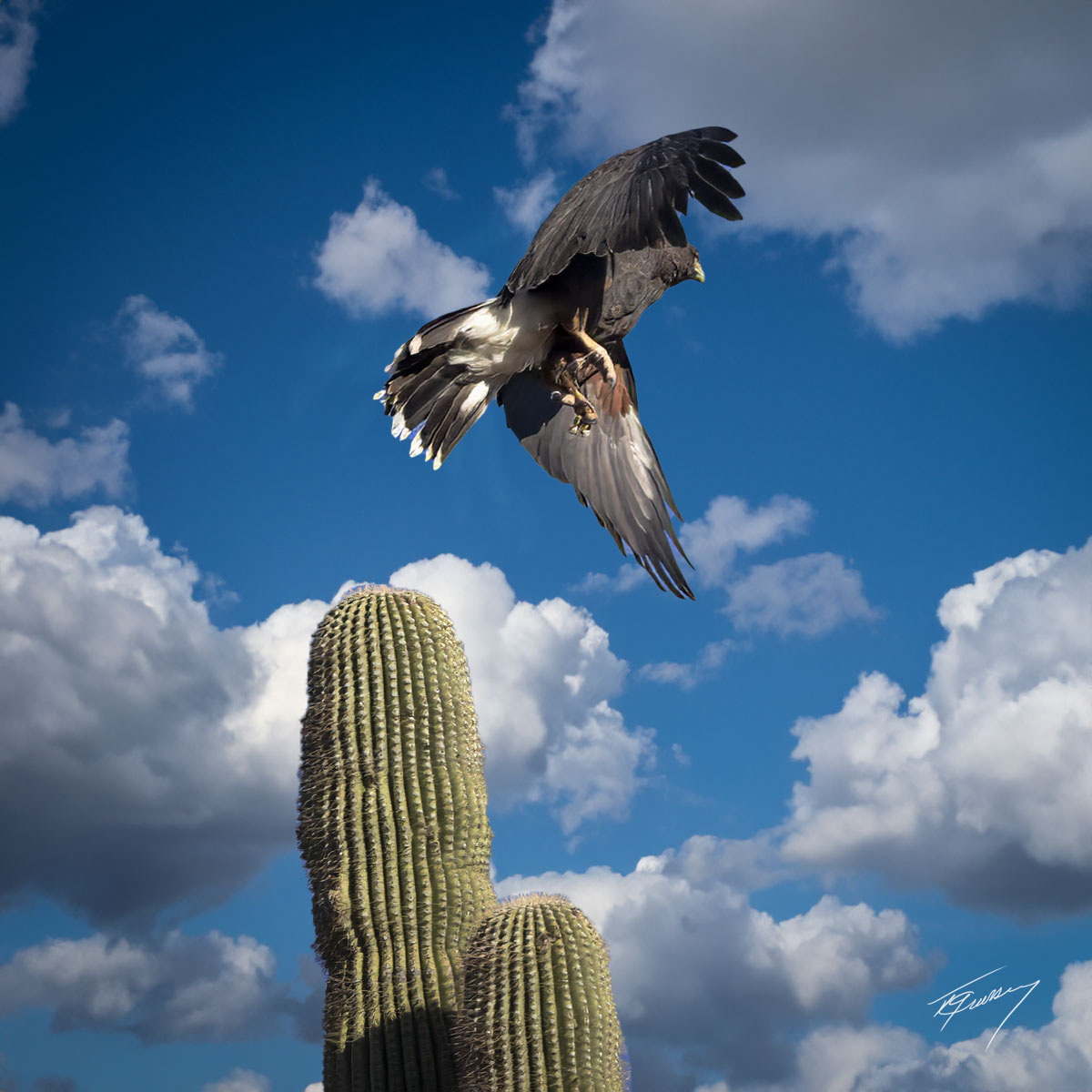
No computers to work on, so I spent some time playing with the new AI Generative fill tool in Adobe Photoshop and both of the photos tonight have been altered through the use of AI in the program.

The shot above of the Peregrine Falcon coming off the cliff was the most altered. The falcon and the cliff are as is in the raw file, but the ocean background is entirely AI generated … in like manner the shot of the Harris’s Hawk below sports a new cloudy sky … the hawk and the cactus are in the original photograph, but the blue sky was changed to this one with clouds. I like what the AI tools can do … but I didn’t get those shots. … more playing to do, but it is not really my thing and likely you will seldom see it in my work … and I will tell you when it is.

Clean up day tomorrow and gemstone cutting … some wax carving too … ‘puters not so much!

Have a beautiful day … keep breathing and smile because you are here 🙂 Back Monday morning … enjoy the weekend.

Cheers,

Ted

May these things abide with me; and if in the infinite
universe I retain aught of my earthly self, may they
remind me that in my feeble way I was one who tried—
A loving memory out of the beautiful earth. Then
closing my eyes—consciousness slowly dwindling like
a day that is spent—let me fall quietly asleep. a tired
child at sundown. Peace

excerpt from The Last Prayer by Max Ehrmann

###

photo_tedgrussingThe easiest way to reach Mr. Grussing is by email: ted@tedgrussing.com

In addition to sales of photographs already taken Ted does special shoots for patrons on request and also does air-to-air photography for those who want photographs of their airplanes in flight. All special photographic sessions are billed on an hourly basis.

Ted also does one-on-one workshops for those interested in learning the techniques he uses.  By special arrangement Ted will do one-on-one aerial photography workshops which will include actual photo sessions in the air.

More about Ted Grussing


Healing Paws

Healing Paws

This is an advertisement

See Stunning Images of Female Birds, Often Overlooked by Wildlife Photographers

See Stunning Images of Female Birds, Often Overlooked by Wildlife Photographers

In trying to capture the perfect image of a bird, photographers often focus on the vibrant, attention-grabbing males. The bright orange belly of a Baltimore oriole, the gleaming crimson feathers of a summer tanager and the royal blue plumage of an indigo bunting are naturally eye-catching.

Comparatively, the more muted yellows and browns of these species’ females can just blend into the background. Among casual observers and avid wildlife photographers alike, female birds “are often overlooked and underappreciated,” writes the National Audubon Society in a statement. For 14 years, the bird conservation nonprofit has held a photography contest showcasing the best in avian images.

But year after year, members of a female-bird-focused group called the Galbatross Project watched as the winning photographs tended to neglect females. “In species that have different feather patterns between females and males, we would usually see the males represented, because often they were the ones that were brighter or bolder,” says Purbita Saha, senior deputy editor at Popular Science and a founding member of the Galbatross Project.

A female Eastern Bluebird sits in the middle of the frame in profile and facing left, its softly colored blue back and rusty belly looking almost frosty. Surrounding the bird and filling the frame are branches and red berries covered in a layer of ice.

A female eastern bluebird rests among red berries. She resembles the male of her species but has slightly lighter colors.

Yan Zhang / Audubon Photography Awards

That’s why, three years ago, the so-called Galbatrosses helped create a new category in the Audubon Photography Awards contest: the Female Bird Prize. Judged by members of the Galbatross Project—which includes birders, writers and scientists—alongside a professional photographer, the category calls attention to birds that are frequently ignored. This year, the organization received about 900 submissions for the Female Bird Prize, out of 9,000 entries across all eight contest categories.

By highlighting images of female birds in the contest, Galbatross Project members hope to start a conversation that extends beyond the lens. Even in science, they say, data on birds can ignore females. Sometimes, this bias spills over into the conservation realm, leaving female birds less equipped to survive.

Take, for example, the golden-winged warbler, a species that has faced one of the steepest declines of all songbirds over the last 45 years. In the winters, these birds fly to woodlands in southern Mexico and as far south as Ecuador. There, females tend to settle in lowland forests, while males gather farther up in the mountains.

In a 2019 paper published in Biological Conservation, researchers found that the lower-altitude areas populated by females were twice as likely to be lost to development—between 2000 and 2016, the rate of deforestation was about 4 percent in the male-dominated areas and 8 percent in predominantly female areas. Despite this, the focus areas in conservation plans were “heavily biased” toward regions with mostly male warblers, per the paper.

Against a green blurry background the profile of a female Spruce Grouse’s head and body faces left and fills the frame. The bird’s eye and heavily patterned tan and brown plumage is crisply captured in this close-up.

A female spruce grouse is specked brown all over, while a male has a black head and neck and a red spot near its eye.

Mark Staples / Audubon Photography Awards

Males and females of other species, such as the red-winged blackbird, a common denizen of lakes and marshes, also use habitat in different ways. The male blackbirds tend to perch atop cattails, while the females spend more time on the ground, foraging and hopping around on lily pads.

“By understanding what females need from their habitat, you get a better picture of how you can conserve a bird species in its environment,” Saha says. “So, if you’re only focused on [conserving] one part of the habitat that the males are mostly using, you’re not going to be preserving that bird for the future.”

In the 2019 study, researchers also looked at conservation plans for 66 migratory bird species that breed in North America. One-third of these birds had been reported to have different habitat needs between the males and females. But the researchers found that only 8 percent of conservation recommendations took these differences into account.

The stark white heads and gray bodies of two female Laysan Albatrosses fill the frame as each bird faces the opposite way, their breasts touching and beaks crossed to create a heart shape against the blurry green background.

In Kilauea on the Hawaiian island of Kauai, a mated pair of female Laysan albatrosses nuzzle each other. Sometimes, two female albatrosses partner together, identified by two eggs in a single nest. (A female albatross can lay only one egg per breeding season.)

Hob Osterlund / Audubon Photography Awards

“The scientific community tends not to view males and females separately as much in studies about conservation,” says Joanna Wu, an ornithologist at the University of California, Los Angeles, and a co-founder of the Galbatross Project. “We tend to say, ‘Oh, the ovenbird needs this type of habitat; the snowy plover needs beaches.’ But we tend not to think below the species level.”

So, Wu began to wonder what other information scientists might be missing out on by lumping males and females together.

Building off this question, Wu is studying female bird mortality in her PhD program. And across the board, female birds tend to have a lower survival rate than their male counterparts, she says.

The reason for this trend isn’t completely clear, but based on existing research, she says it could stem from the cost of reproduction—hatching eggs and caring for young can be physically taxing—or genetic differences between female and male birds. Females also move around more as juveniles, which could come with increased survival risks, such as more exposure to predators.

A green and brown female Costa’s Hummingbird, wings still and extended forward, hovers in the middle of the frame as it uses its long beak to feed from bright orange flowers that are in focus in the forefront and blurry in the background

A female Costa’s hummingbird sips nectar from a flower. Male Costa’s hummingbirds have purple feathers on their heads.

Melissa Harnish / Audubon Photography Awards

To understand some of these disparities, Galbatross Project members are trying to call more scientific attention to female birds by advocating for mindful data collection. Birders and scientists alike use a platform called eBird to record their observations and see what species others have found. After spending time counting and identifying birds, citizen scientists enter their “checklist” of observed species into the database.

On the eBird desktop website, users can mark whether a bird they observed was male or female. But on the mobile app, such an option doesn’t exist, unless someone manually types a note to accompany their data. Wu and Saha say they would like to see a feature added to the app to allow users to easily mark a bird’s sex.

“My lab and a lot of researchers use these big, citizen-science data sources all the time, and we can’t really scrape sex information from it, because millions of records are collected with just species data,” Wu says. “It’s a huge deficiency in the quality of data that we have to work with.”

A gray female Gambel’s Quail, its back toward the camera, looks to the left as its black head plume pokes forward like an avian fascinator. Bright pink flower petals surround the bird and contrast with the brown stony ground.

Showing off her feather plume, a female Gambel’s quail stands amid rose petals in Scottsdale, Arizona. A female’s plume is shorter than a male’s, and males have black facial feathers and a brown crown.

Jen Shepherd / Audubon Photography Awards

Wu says she has contacted eBird staff on multiple occasions, asking for an update to the app that will allow this information to be collected.

“We log all feedback and take community input into consideration when developing new tools and features,” writes Jenna Curtis, an eBird project leader with the Cornell Lab of Ornithology, in an email. “So even though something may not be possible on the app today, there’s always a chance you’ll see it in a future release.” Right now, the only way birders can add age and sex information to checklists submitted with the app is by retroactively editing their list on eBird’s website.

A brown and white female Wood Duck sits on the ground with two chicks, its iridescent blue-purple feathers visible just above the grass line. One chick stands on the mom’s back, rubbing its head against her check, its mouth barely open.

A wood duck and two chicks share a tender-looking moment. Female wood ducks are identifiable by their iridescent blue and purple wing feathers and white eye ring.

Tammy Kokjohn / Audubon Photography Awards

Even if the app gets an update, however, the data will still have some holes. No observer could discern the sex of every bird—in practice, finding and identifying female birds can be tricky. Adult females can, in certain cases, look very similar to juveniles of either sex. And for some species, male and female plumage is identical to the human eye.

Still, this doesn’t make it impossible to identify a female. Birders just have to go a little deeper, making inferences based on the animal’s context and behavior: Are there two birds in a pair, and could it be safely assumed that one is male and the other is female? Is the bird performing a specifically female behavior for the species, such as incubating eggs or building a nest?

Getting this information is hard. It adds another level of patience and observation to birding, which can already be an exercise in waiting around. But to Saha, taking note of female birds is rewarding.

A tawny female North Cardinal faces the camera, head cocked, while taking a bath, its red wings extended upward as droplets of water surround the bird and fill the frame. The water below reflects the bird’s body and the droplets.

A female northern cardinal takes a bath. Female cardinals are orange-brown with bright beaks.

Nicole Land / Audubon Photography Awards

A highlighter-bright female Yellow Warbler with only black on its wings sits tall on a conifer branch to the right of the frame. The bird is surrounded by vibrant green needles and small brown pinecones.

A yellow warbler in a conifer tree. Males have reddish-brown streaks on their chests.

Heather Mall / Audubon Photography Awards

“It slows my pace of birding down in a way where I’m being a little more holistic,” she says. “It kind of surfaces this point that birds are not just a member of their species—they’re individuals. They have individual variation and personalities and behaviors.”

“And by understanding those, we can really find something special, even in quite common birds,” she adds. “The winner of the Female Bird Prize this year is a Baltimore oriole, which is a bird that people love to see out in the wild, but it still is a pretty common, regular bird, at least here in the Northeast in the spring and summer.”

The Baltimore oriole isn’t the only common bird honored in this year’s contest—a tawny northern cardinal with her bright orange beak, a dusty-cerulean eastern bluebird and a brown wood duck with a white ring around her eye are all included in Audubon magazine’s shortlist of recognized images in the category.

From a large snag crossing the frame to the right, a female Belted Kingfisher launches into the air leftward with its wings outstretched. The bird’s heavy bill, spiky crest, and chunky head and body are in profile, its rusty breast stripe on full display.

A belted kingfisher takes off from a branch, displaying reddish patches on her chest and sides that only females have.

Jerry amEnde / Audubon Photography Awards

Some of the birds featured in the photos are difficult to identify as female, unless you know what to look for. The female bushtit, for example, is recognizable by its light yellow eyes, whereas the males and juveniles have brown irises. Meanwhile, in some of the species, such as the red-necked phalarope and belted kingfisher, the female bird actually displays more color than the male.

Emphasizing female birds in photography can help bring them wider recognition and appreciation, which is the Galbatross Project’s aim. “I think it really draws people’s attention,” Wu says. “And photographers are just really keen to try their hand at this new skill.”

Saha says she would love to see other bird- and wildlife-oriented photography contests recognize images of female birds as well. With their zoom lenses, practiced patience and eye for detail, photographers are uniquely positioned to put a much-needed spotlight on these overlooked creatures. “We could see so much more when it comes to female birds and their unique features, just by having [photographers] out there, getting those photos and taking video of their behaviors,” she says.

Get the latest Science stories in your inbox.

Remembering Amos Badertscher, a Self-Taught Photographer Who Chronicled Baltimore’s Street Heroes

Remembering Amos Badertscher, a Self-Taught Photographer Who Chronicled Baltimore’s Street Heroes

Amos Badertscher, a photographer who documented hustlers, performers, and others eking out a living on the margins of his hometown of Baltimore, died on July 24 after a brief illness. He was 86. 

The news was confirmed by Clamp, a New York gallery that will open a previously planned Badertscher exhibition in September.  

“Amos Badertscher devoted his life to his photography,” said Brian Paul Clamp, the gallery’s founder, in an email to Artnet News. “He was passionate about telling the story of his years in Baltimore and the people he loved and remembered. Badertscher was also deeply protective of that legacy.” 

Born in 1936, Badertscher lived an upper-middle-class life in Baltimore, with a sense of privilege that would later inflect his portraits with a precarious power dynamic. He picked up a camera in the late 1960s, inspired by a faculty member at the prep school where he taught. By 1975, the artist tapped into his inheritance to pursue his craft full time, and began taking pictures of friends and people he met in gay bars.  

“There must have been something dangerously lacking in my upper-middle-class psyche because I did not find nudity, even youthful male nudity shocking, abusive, emasculating, pornographic or subversive,” Badertscher once said. “To photograph the naked body is, for me, the ultimate dimension in photographing the person.” 

Amos Badertscher, The Abandoned Bed Room [Bedroom] (1998). © Estate of Amos Badertscher. Courtesy of CLAMP, New York.

Badertscher repeatedly turned to the streets and underground venues of Baltimore for his work, photographing strippers, drug addicts, and drag queens, among others. Often his subjects were poor and homeless; some came from broken homes or were battling AIDS-related illnesses.  

He would make prints of his portraits at home and fill their margins with handwritten anecdotes about the people depicted therein. The resultant artworks regularly straddled lines of desire, sympathy, eroticism, and—according to some critics—exploitation.  

But Badertscher’s creations have seen renewed critical interest in recent years. In 2020, Berlin’s Schwules Museum staged a well-reviewed survey of his work—the artist’s first major institutional exhibition outside the U.S. Next month, the lbin O. Kuhn Library and Gallery at the University of Maryland, Baltimore, will open a retrospective, and the Clamp show will follow in September. A printed collection of Badertscher’s work is due out in 2024. 

“With the death of Amos Badertscher, America has lost one of its greatest photographers,” said historian and curator Jonathan David Katz, who co-organized the Schwules show. “Walking into Amos’s Baltimore home was as close as I can imagine to seeing King Tut’s tomb for the first time. There were thousands of amazing photographs, each unforgettable and unprecedented. The first thing you saw was their formal sophistication and otherworldly beauty but then the emotional arc hit you like a ton of bricks.”  

“This was a history I never knew but can now never shake,” Katz said. 


Follow Artnet News on Facebook:
Want to stay ahead of the art world? Subscribe to our newsletter to get the breaking news, eye-opening interviews, and incisive critical takes that drive the conversation forward.