Photography

101 Basics – Straight Verticals, White Balance, & Correct Exposure

101 Basics – Straight Verticals, White Balance, & Correct Exposure
image

Post-production

There will always be newbies entering the genre of architecture photography, and along with that inexperience can be unfamiliarity around some core, fundamental principles. If this sounds like you, then I hope the following videos help.

Granted there’s multiple ways to “skin the cat” when it comes to getting your verticals straight, obtaining the correct white balance, and making sure you have an overall properly exposed image. These are just a few easy techniques that I’ve been utilizing over the years.

Enjoy!

[embedded content]
[embedded content]
[embedded content]

Drone Photography May Give Agents an Edge

Drone Photography May Give Agents an Edge
image

Sellers love drone photography – and by extension, an agent who offers it. If owners are interviewing several RE agents, it could make a difference.

NEW YORK – Aerial photography is a good way to give a broader perspective of a property, writes Realty Times columnist Ashley Sutphin: Listings that include aerial photos close 68% faster than those that don’t, according to research – and 83% of sellers prefer to work with an agent who uses drones for aerial videos.

It can be an edge for any agent competing for a home listing, especially if the competition doesn’t offer it. It also relays the subtle message, “I offer all the most advanced home-selling tools.”

When hiring someone to do aerial photography/video, seek someone with high-level equipment but – just as important – liability insurance because it’s possible a drone can crash.

After finding a good drone professional, schedule ground photos and videos on the same days as the aerial shoot. Note that time of day can be important in how the home looks, and weather can be a problem. A sunny day is a must, but how the sun hits the house at any given time should also be considered. If the sun hits the front of a home in the morning hours, for example, that’s the best time of day for drone photography. In the afternoon, there will probably be too much shadow.

Source: MyMotherLode.com (07/03/23) Sutphin, Ashley

© Copyright 2023 INFORMATION INC., Bethesda, MD (301) 215-4688

Time Delay Integration CCD Sensors: A Piece of Military History

Time Delay Integration CCD Sensors: A Piece of Military History

In all technical fields, digital imaging has won whatever was left of the film vs. digital debate— artistic qualities aside. Contemporary digital sensors are simply more precise, detailed, and flexible than film could ever hope to be. As early as the 1980s, the United States and its various corporate suppliers could already see the possibilities in digital sensors. They were hard at work researching alternative optical capture techniques that could supplant analog capture, especially in intelligence-gathering activities. The various surveillance bureaus of the United States had many of the same frustrations with film as current photographers; film is bulky, fickle, and time-consuming to process.

More about military history in photography can be read in our declassified series.

Commercial 35mm cartridges are reasonably compact and tolerable for use in land-based surveillance but wholly inadequate for aerial or stratospheric surveillance, which relied primarily on satellites whose optics were often measured in inches rather than millimeters. Aerial surveillance activities commonly employed 9-inch roll film, which captured a 9 by 9-inch square exposure whose area was slightly over 60 times larger than the standard area of 35mm film. Modern large format cameras frequently use sheet film in dimensions of (almost) 4 by 5 inches, and the whole camera system is many times larger and more cumbersome than a 35mm camera, and even still only exposes one frame at a time. Unlike still photography, though, lensing contributed much less to the overall bulk of the system than the vast apparatus required to automate the surveillance system. The most significant portion of a 9-inch roll film surveillance system was dedicated to the mechanisms needed to store, transport, and store the film in nothing less than complete darkness until it could be retrieved and processed correctly in special facilities awaiting eventual interpretation and analysis.

In addition to being light-tight, imaging systems used in aerial and stratospheric surveillance had to be hardened against weather (or vacuum) conditions, and preparing an apparatus that could reliably shoot and store images irrespective of high-G, low-G, and high-vibration conditions added significantly to development and deployment challenges. Further, film faces inherent delays and reproducibility problems associated with handling and development.

If the challenges of handling the film weren’t enough, the extremes of a high altitude ultra-long distance capture introduced problems all of its own. Different atmospheric and temperature conditions impact the film’s sensitivity and cause shrinkage and expansion of the substrate, affecting scale and geographic accuracy. Atmospheric anomalies and the angle of the satellite relative to the earth also necessitated a variety of films for a considerable number of conditions and targets, targeting different light spectrums with varying sizes of grain and sensitivity for all types of conditions.

In light of these challenges, electro-optical (digital) imaging offered a promising possibility, most notably in ameliorating delay from exposure to image viewing, but in the 80s, CMOS sensors weren’t yet highly developed, and the Bayer filter had only been recently invented and wasn’t yet in real use. Despite the downsides of film in practical deployment, in the 1980s, film still significantly outperformed digital imaging in one key area: resolution. Digital sensors simply lacked the resolution to capture any meaningfully resolved image from miles above the subject. The initial challenge to be solved was increasing resolution. As many professionals remember, the resolution was a challenge in early digital reproduction photography, and rather than relying on a complex polygonal sensor, early professionals often relied on scan backs. These backs worked like a document scanner, moving forward across the subject to draw the shape of a larger sensor.

Professionals will also remember that scan backs also require absolutely still subjects to make a sharp exposure. A traditional scan back simply wouldn’t work for deployment on a moving platform, but given the state of silicon sensors, this would be the only possible option.

To help resolve these limitations, the government contracted the now legendary firm Itek to develop a new CCD sensor technology that could overcome these challenges. The CCD sensors developed and produced by Itek differed significantly from the Bayer CCD or CMOS sensors today and resembled a scan back sensor much more closely. Rather than being a rectangular sensor with a color filter array, the Itek sensors were long and thin, comprising a few pixels along their length and many more along the width and designed to capture the subject as it moved beneath the scanner, in contrast to a scan back which moves relative to the subject. This technology is referred to as Time Delay Integration (TDI) and involves timing the pixel exposure readout with the movement of an object underexposure. The fundamental (but oversimplified) way these sensors work is to read the light reflected from the object in all the different pixels along the path it moves. Instead of one section of the object being exposed on one pixel for 10 seconds, it might be exposed along 10 pixels for 10 seconds as it travels relative to the sensor along the path of those 10 pixels. The 10 different pixels track the object’s movement and add the sensor data from various pixels to reconstruct the scene.

Mounting film or a more typical sensor on a moving platform would normally have been a disadvantage because the relative movement of the object being exposed would have introduced blur. In the case of the Itek TDI CCD sensor, the relative movement of the object is an integral part of the exposure process, turning what, under normal circumstances, was a disadvantage into an advantage. This meant that when properly calibrated, the sensor could control the movement of the platform and of the subjects under surveillance. A positive secondary benefit of linearly arranged CCD is that they introduce a less detrimental distortion compared to imaging sensors arranged in a plane. Unlike a planar arrangement, there isn’t the same kind of corner vignetting that most consumers are accustomed to. Instead there is a limited falloff in the top and bottom, which would be similar to a slightly bowed piece of paper.

In addition to minimizing the system size, digital sensors simplified the entire production and processing chain. The vastness of the Eastman Kodak facilities for producing various imaging technologies was a testament to the technical marvel of film and, more than anything, a product of the need for specialization inherent in the production of every film stock. In addition to Kodak’s vast historical catalog of emulsions, it also produced special order films in batches, on demand. Each stock required research, development, production, prototyping, storage, and transport. The film production process was both time-consuming and costly, but ultimately most frustrated by the variability of the natural environment on deployment. One of the critical advantages Itek purported their CCD technology to have was only tangential to the production of the physical sensor: prototyping and image processing. Itek’s sensor development occurred in a multidisciplinary, collocated research facility where every stage of the imaging process could be tested for and provide immediate feedback. This process began with the ability to simulate the variety of conditions that the imaging system would be deployed in. Rather than needing to take images with actual film, develop that film, research a new coating or emulsion, produce a test batch, and repeat, the imaging system could be placed in various simulated environmental conditions and immediately interrogated for improvements. After device testing, the captured data would be passed to the research laboratory’s image recording, image enhancement, and real-time data processing sections. Digital photographers will be familiar with the malleability of digital raw data, and this was no different, albeit to a lesser extent involving far less data. In addition to being able to test the capture device itself, the remainder of the processing pipeline could also be optimized for function in various conditions in a way that wasn’t possible with film.

Where desirable, it was possible to (near) instantaneously reproduce an image for viewing. Where the surveillance application demanded speed above all else, Itek’s sensor maintained a clear lead in its digital first pipeline. From the capture, the sensor readout could be stored inside a buffer until it would be rasterized and displayed on a CRT. If the analyst was sufficiently close to the optical system, they would be able to evaluate the image very shortly after capture should they desire, and if not, they would be able to store the image on tapes for later evaluation or display to other sections of the intelligence community.

Despite the TDI CCD sensors, however, the Itek sensor’s performance was mixed with regard to the resolution of image capture. The theoretical resolution of the optical system was much more limited than contemporary film emulsions and optical systems. The metric used to measure film resolution is called the Modulation Transfer Function (MTF) and is a means of translating information about both resolution and contrast into a single figure. The MTF is composed of two fundamental components: resolution and contrast modulation. The data provided by Itek isn’t offered as an MTF chart but does specify the resolution at a particular point along the chart. This system wasn’t nearly as highly resolving as the highest-resolving film of the period and the maximum MTF of the system was limited to a rather underwhelming 0.35. In contrast to even color

Ektachrome, the resolution was poor. The Ektachrome under production at the time was capable of an MTF of a high of 0.7. Modern digital solutions can reach MTFs of as high as 0.9 in optimal conditions.

The comparatively reduced resolution meant that either the optical system needed to be redeveloped or the sensor needed to be moved close to the subject. Here, the sensor’s weaknesses were overcome by the unique readout of the TDI sensor. Satellites, naturally, require very high altitudes to prevent rapid reentry, and moving any closer would require the use of surveillance planes. The massive size of the surveillance systems precluded that on the face, but even a smaller film system must still reckon with the fact that as a subject moves closer, its relatively movement is more apparent. In the case of slow, insensitive older film stocks, a plane would have introduced too much motion blur to be used practically. The TDI sensor, however, benefited from the motion of the subject relative to the capture device and meant that, for the first time a real aerial surveillance system could be digitally deployed.

Itek’s military-industrial and scientific imagining innovations were so bleeding edge during this period in history, and their electro-optical system was so sophisticated and uniquely capable that there weren’t yet military surveillance platforms that had been fabricated to deploy this technology. Itek intended their system for use in “low power, small-volume tactical platforms,” which today includes platforms like drones and small surveillance aircraft rather than larger and much more highly resolving platforms like satellites. Itek took advantage of the unique characteristics of electro-optical sensors to overcome the inherent limitations of film with respect to motion.

In retrospect, it’s easy to say the dominance of digital was inevitable, but even into the 2000s for non-critical commercial applications, film was considered to still offer some greater merit than digital. In the 80s, when Itek was actively developing this sensor, the inconvenience and inflexibility of film was sufficiently severe that even an inferior capture technology could win out in some domains based purely on the vastness of film’s practical limitations.

Notes

  • When this paper was written in 1981, it was already possible to produce and display digital images and the process of switching from film for certain applications was already being discussed for limited deployments. The processing pipeline involved a lot of back and forth between digital and analog.
  • The CCD being used was a line sensor, which at this point in time was the best option available
    The lp/mm of this CCD was far far below that of contemporary film, but the delay of the development and processing pipeline made it unsuitable for some purposes
  • The image as it scans is stored in a buffer for later display on a CRT after it had been fully rasterized.
  • The ability to display less data than was stored was apparently an advantage is some respect
  • Itek was able to rapidly prototype because the system could be tested in a lab and adjusted on the fly, in a way which was less possible with film, given the chemical nature of the process.

References

Abrams, William J., and Frederick J. Gilligan. ‘Itek Model 2KL Sensor: The Mini-Electro-Optical Imaging System (Mini EOIS)’. San Diego. edited by Robert J. Bannach, 62–68. 25th Annual Technical Symposium. 1981.

Clevers, J. G. P. W., and H. T. C. Van Stokkom. ‘The Quantitative Evaluation of False Colour Photography with Application of a Red Filter’. International Journal of Remote Sensing 13, no. 9 (June 1992): 1709–33.

Fookes, P G, S G Dale, and J M Land. ‘Some Observations on a Comparative Aerial Photography Interpretation of a Landslipped Area’, n.d., 17.

Galiatsatos, Nikolaos. ‘The Shift from Film to Digital Product: Focus on CORONA Imagery’. Photogrammetrie – Fernerkundung – Geoinformation 2009, no. 3 (17 July 2009): 251–60.

Smith, D A, J J White, and W C Bradley. ‘A One-Inch High Resolution Buttable TDI Imaging BCCD’. Lexington, Masscussetts, n.d.

The images are sourced from the first citation: Abrams and Frederick 1981. 

Diego Bendezu captures brotherhood and resilience among Venezuelan migrants

Diego Bendezu captures brotherhood and resilience among Venezuelan migrants

If you were to visit a hand car wash service, you’d likely see bodies working together in a seamless chain; spray, soap, rinse, wipe, repeat, as soap suds hit the ground. Although it’s a familiar sight for many of us, the New York-based Peruvian photographer Diego Bendezu believes that not enough of us know or understand the journey of some of its workers.

As such, his latest body of work Dear Prima is inspired by the “resilience and work ethic of young Venezuelan migrants in San Martin de Porres [a northern district in the country’s capital Lima]”, Diego says, as he seeks to showcase their determination, courage and brotherhood. “I want to give them a voice, challenge stereotypes and foster empathy”. And so, what initially started as small conversations with the men on trips to the car wash with his father, has blossomed into a vast and emotionally revealing project for the photographer and those captured by his lens.

The quality and depth of Dear Lima isn’t merely up to Diego’s talent and skill. It’s also in the way he can describe the very specific details he learned about the men while photographing them. “I learned that one of the men’s mothers only earns the minimum wage back in Venezuela and another couldn’t afford to go back,” he tells us. In a trio of photos of one of the men, Diego captures his lived experience through his tattoos, his cap placed on a bollard and his hands at work holding a blue hose. The blue of his cap and the blue of the hose almost have a synergy, highlighting the car wash as their portal to a new life. “They are the heroes of their own story. All of them are the first to leave their home country and are here to provide a better life for their families back home”.

Brothels, bartenders and film stars: Eve Arnold’s women

Brothels, bartenders and film stars: Eve Arnold’s women
image

In 1950, having spent several years working at a Kodak processing factory in New Jersey, Arnold developed an interest in photography. Encouraged by her nanny, she signed up to a six-week photography course in Manhattan led by Harper’s Bazaar’s influential art director, Alexey Brodovitch

Mission Impossible star Simon Pegg praises photographer’s film shots

Mission Impossible star Simon Pegg praises photographer’s film shots
Rebecca Ferguson and Simon PeggStepping Through Film/Paramount

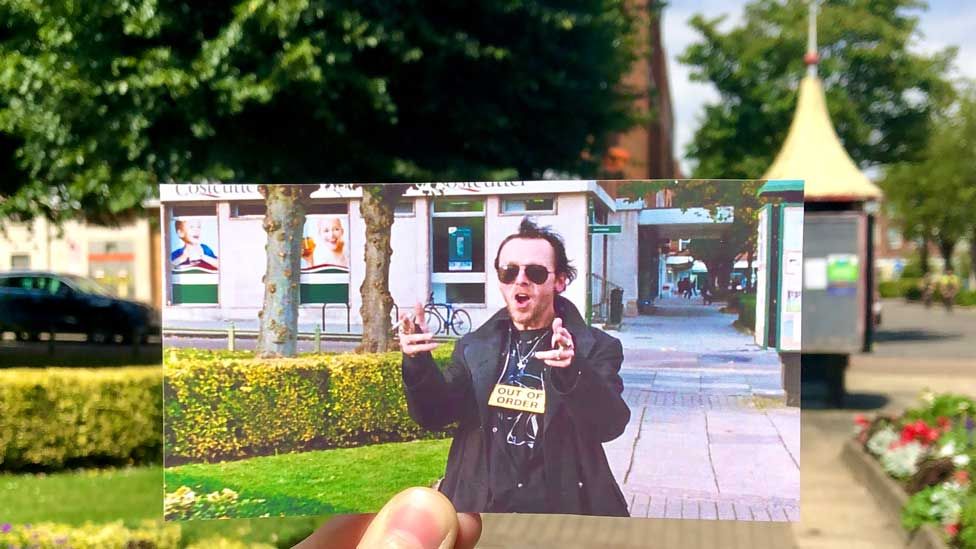
A photographer who lines up scenes from movies with the locations where they were shot has been congratulated by one of his subjects.

Thomas Duke, 24, showed his images from three of Simon Pegg’s films to the actor at an event for the latest Mission: Impossible film.

A surprised Pegg said he had “seen all my stuff” and “it was great what I did”, the photographer said.

Mr Duke said that as a fan, it was now “great to be recognised” for his work.

Simon Pegg in Shaun of the Dead

Thomas Duke/Stepping Through Film

“It was very surreal,” he added. “I’ve done his movies for years.

“It made me feel that it’s not just a digital space, people do actually see my work.

“It’s still amazing to me that I’m here after admiring these actors my whole life.”

Thomas Duke

Thomas Duke/Stepping Through Film

Mr Duke, from Newport, near Saffron Walden, Essex, started photographing scenes from movies or TV series in the locations where they were shot while he was a film student.

He put his examples of the technique, known as rephotography, on social media under his Stepping Through Film banner and soon gained a following.

Now working on it full-time, he also attends media events for his social media channels.

Simon Pegg in The World's End

Thomas Duke/Stepping Through Film

Invited by Paramount to speak to Simon Pegg and Rebecca Ferguson about Mission: Impossible – Dead Reckoning, he took along the images he had created of what are known as The Cornetto Trilogy.

It refers to three films written by Pegg and director Edgar Wright and starring Pegg and Nick Frost – Shaun of the Dead (2004), Hot Fuzz (2007), and The World’s End (2013) – where the photographer had visited north London, Wells in Somerset and Welwyn Garden City in Hertfordshire to do his shots.

The films do not share a storyline but each feature a scene in which a character buys an ice cream.

Nick Frost and Simon Pegg in Hot Fuzz

Thomas Duke/Stepping Through Film

“I’ve always loved his [Pegg’s] work and the trilogy is ingrained in British culture so it’s fun to celebrate a trilogy so many people have seen,” Mr Duke said.

“Plus they were all filmed in the UK so it was easy to visit for me.”

Rebecca Ferguson and Simon Pegg

Thomas Duke/Stepping Through Film

Mr Duke said he took along prints as a “talking point” and as soon as the actor saw them he said “what?! I know you!”.

“It was the most nerve-wracking interview of the day because I love them both as actors but they were friendly and chilled so it was also the easiest.

“After admiring the work of both Simon and Rebecca from afar, it was lovely to get their approval in person and enjoy a shared passion for cinema.

“This would have all felt impossible to me 10 years ago, but now I look back and realise that anything is possible. Never give up!

“I started as a fan but it’s great to now be recognised and involved in a professional capacity.”

Thomas Duke with Simon Pegg in 2014

Thomas Duke

presentational grey line

Follow East of England news on Facebook, Instagram and Twitter. Got a story? Email eastofenglandnews@bbc.co.uk or WhatsApp us on 0800 169 1830

Related Internet Links

The BBC is not responsible for the content of external sites.

Ladies Day Golf

Ladies Day Golf
image

Seven ladies met on July 5 to participate in Ladies Day golf. They divided up into two teams and played an “Odd Scramble.” All the holes were played, but only the scores from the odd holes counted.

Both teams finished with scores of 20, so the team with the fewest putts was determined to be the winner. With only 6 putts, the team of Leslie Talbot, Jeri Crawford, and Ruth Nelson took first place. Polly Dahlke, Cindy Raymond, Erika Thompson, and Julie Jones came in second with 7 putts.

Eve Arnold’s forgotten photographs of the 1950s Harlem fashion scene

Eve Arnold’s forgotten photographs of the 1950s Harlem fashion scene

“As a photographer, one has to accept the fact that one does invade other people’s privacy,” Eve Arnold commented in a BBC documentary in the 1980s.

She was expressing misgivings about her professional relationship with Marilyn Monroe, and her intimate portraits of the actress that would establish Arnold as one of the 20th century’s leading photojournalists. But Arnold, who died in 2012, could equally have been talking about another, little-known project: her year-long study of backstage scenes at community fashion shows in Harlem, shot in black and white at the start of her career in the early 1950s. A selection of those images are on show in West Sussex as part of “To Know About Women: The Photography of Eve Arnold”, a retrospective that opened this month at Newlands House Gallery in Petworth.

“This was a time when the mainstream fashion industry was entirely white, and black women were not considered to be clients,” says Maya Binkin, the gallery’s artistic director, who curated the exhibition. “The models Arnold photographed made the clothes themselves and put on shows in hired venues for paying black audiences. It was a whole developed, professional scene. And Arnold was everywhere: present, but invisible.”

The Harlem series was Arnold’s first assignment. What she produced was a nuanced study of style, elegance and self-reliance, captured just before the US civil rights movement.

The photographs of models, often mid-change, and the crews of agents, dressers, make-up artists and security guards that surrounded them, exude energy and action. In the early 1950s, Arnold’s reportage approach to fashion photography (Binkin describes it as “slow journalism”) was unusual, an antecedent to ubiquitous shots of 1990s supermodels backstage. But it was nothing like the contemporaneous static, posed editorial images of white models shot in studios by Arnold’s 1950s contemporaries, such as Nina Leen or Richard Avedon.

Two young black models check their make-up backstage
Two young black models check their make-up backstage, 1950 © Eve Arnold Estate

At times, Arnold’s Harlem photographs feel intimate to the point of unsettling — that invasion of privacy she acknowledged.

Arnold’s star is Charlotte Stribling, a young model known as “Fabulous” and recognisable by her hair, dyed a silken blonde and coiled in plaits around her ears. In one shot, Stribling bends to step out of her underwear with her back to the camera. It is a moment of inhibition and hurried action — the model is changing costumes — but there is little vulnerability in her nakedness. She could be mooning at us, not least because she and her dresser are laughing.

Arnold would later note that Stribling changed her walk when she first met her, the moment when the novice photographer realised her camera was always intrusive

In another shot, a luminous Stribling waits backstage for her cue at the same fashion show, held in the Abyssinian Baptist church on West 138th Street in 1950. Arnold catches Stribling as she emerges from the shadows wearing a lavish evening gown, her hair framing her expectant face like a nimbus, while a security guard hovers behind her.

Binkin says Arnold achieved the effect without artificial lighting. “It would be a case of going back to the dark room and praying that something was going to come out,” she says. “But she turns the dark church to her advantage.”

Model Charlotte Stribling aka ‘Fabulous’ waits backstage for the entrance cue to model clothes designed and made in the Harlem community. 1950
Stribling waits backstage at a Harlem fashion show in 1950 © Eve Arnold Estate

Arnold was born in Philadelphia in 1912 into a poor, working-class Jewish family. She shot the Harlem series as a student on a short course at the New School for Social Research in New York, led by Alexey Brodovitch, the legendary art director of Harper’s Bazaar (Brodovitch had also taught Avedon and Irving Penn).

She was in her late 30s when she joined Brodovitch’s course, at a moment when her marriage was failing and she had left her job working in a film processing factory in search of intellectual stimulation.

Brodovitch assigned her the subject of “fashion”. She had heard about the 300 shows that took place every year in Harlem, and contacted the modelling agencies who organised them to ask if she could document them. Perhaps her maturity worked in her favour, allowing her Harlem subjects to relax in her presence — Arnold was 20 years older than many of the models.

Like Arnold, we become present but invisible in their world. The photographer was a reticent figure, at 4’10” an unobtrusive presence more interested in her subjects than commanding attention herself, says Binkin.

Arnold sent her Harlem images to US fashion magazines in the hope of publication, but none — including Harper’s Bazaar — would publish them, a refusal that Binkin attributes to racism. Arnold did find a UK taker, Picture Post, which ran the series over an eight-page spread, though Arnold was unhappy with the accompanying text, which she felt misrepresented the shows.

Two young black models backstage before a show at the Abyssinian Church in Harlem, 1950
Two young black models backstage before a show at the Abyssinian Church in Harlem, 1950 © Eve Arnold Estate

Regardless, the Harlem series caused a sensation with readers and eventually led to an invitation for Arnold to join Magnum Photos, the prestigious photographer’s agency — with Inge Morath one of its first two female members. The membership would lead to a 60-year international career, including as a Sunday Times photographer from the early 1960s to the 1980s.

Arnold’s Harlem shots are discomfiting in many ways. Some show models applying skin-bleaching creams and straightening their hair, common practice at the time, but in contrast to another sequence of Arnold portraits — “Black is Beautiful” — also on show at Newlands, shot nearly 20 years later in 1968.

Here are two subjects belonging to a new generation of black women formed in the civil rights era, who promoted pride in black features: Arlene Hawkins, model and owner of Arlene Hawkins Cosmetics, a beauty brand for black skin and hair, and Cicely Tyson, an actress whose face appeared on the cover of Miles Davis’s 1967 album Sorcerer and later became his wife. Tyson and Hawkins are presented with natural hair.

The Harlem fashion shows have continued in various forms since Arnold shot them. By the 1970s, the scene had produced The Harlem Institute of Fashion and the Black Fashion Museum, although both organisations closed in the early 2000s. More recently, Harlem’s Fashion Row agency, which represents black designers and brands, opened New York Fashion Week in September 2022. 

Marilyn Monroe resting between takes during a photographic studio session in Hollywood
Marilyn Monroe photographed by Eve Arnold in Hollywood, 1960 © Eve Arnold Estate

Binkin and Nicola Jones, director of Newlands, made efforts to track down the people involved in the early 1950s shows shot by Arnold, including Stribling and the other models, without success. “They would be in their 90s now,” says Jones. Hawkins, too, they were unable to trace; Tyson died in 2021. “Someone told me Fabulous’s agent became good friends with Eve, stayed in touch and came to her funeral,” says Binkin, although she discovered he has since died.

Their main sources for the story have been Arnold’s own documents, including her memoirs, and the recollections of her son, Frank.

Over the course of her career, Arnold would alternate between shooting portraits of famous people, most famously Monroe, and the photojournalism that echoed that first assignment. She returned to record black American society again and again, often when few mainstream magazines were interested.

In the early 1960s, she went on to document for 18 months the Nation of Islam movement of black supremacy, championed by Malcolm X, for a series eventually published in Esquire. Later assignments for the Sunday Times included recording people — often women — at work in China, Afghanistan, Russia and South Africa.

The Harlem series recorded a significant moment in African-American fashion that would likely have been undocumented without her.

“Maybe her reportage style of fashion photography would have happened anyway, it was the obvious next step,” says Binkin. “But she did it first. Her camera turned ordinary people into something special.”

‘To Know About Women: The Photography of Eve Arnold’ is at Newlands House Gallery until January 7 2024

Find out about our latest stories first — follow @financialtimesfashion on Instagram

Ansel Adams: Eight of the most iconic photos of the American West

Ansel Adams: Eight of the most iconic photos of the American West
Ansel Adams’ images of national parks and oil derricks from the 30s and 40s are a powerful reminder of the beauty and fragility of the US’s natural landscapes, writes Cath Pound.

Ansel Adams is one of the giants of 20th Century photography, esteemed for his lush gelatine silver photographs of the national parks that have become icons of the US wilderness. A passionate champion of photography as a legitimate form of fine art, he referred to his most stunning images as his “Mona Lisas”. But Adams was also a tireless conservationist and wilderness preservationist who understood the power of a strong image to sway public and political opinion.

His stirring images of US national parks have no doubt always inspired a desire to protect the natural world. But his lesser-known images of oil derricks and the decimated landscapes in California’s Owens Valley have also taken on a renewed relevance in today’s era of climate change.

Ansel Adams in Our Times at the de Young Museum, San Francisco showcases some of his most celebrated works, as well as those that are less familiar, revealing the ways in which his powerful imagery continues to advocate for the protection of the environment. 

(Credit: The Ansel Adams Publishing Rights Trust, Courtesy, Museum of Fine Arts, Boston)

(Credit: The Ansel Adams Publishing Rights Trust, Courtesy, Museum of Fine Arts, Boston)

1. The Golden Gate Before the Bridge, 1932

San Francisco, the city of Adams’ birth, is where he first took up the large-format camera. “With images like this, one can sense his excitement with this new tool,” the exhibition’s curator, Karen Haas, tells BBC Culture.

“This is the strait that lies between San Francisco and the Marin headlands, a view that had been visible from his childhood home. The beach below is one that he regularly combed as a somewhat lonely and awkward only child, reinforcing his connection with nature even while living in the city and not in Yosemite,” says Haas.

(Credit: The Ansel Adams Publishing Rights Trust, Courtesy, Museum of Fine Arts, Boston)

(Credit: The Ansel Adams Publishing Rights Trust, Courtesy, Museum of Fine Arts, Boston)

2. Clearing Winter Storm, Yosemite National Park, c 1937

When Adams was invited by US President Gerald Ford to visit the White House in 1975, he took with him a copy of Clearing Winter Storm, one of his most celebrated images. At the time Adams was frustrated with the commercial exploitation and poor management of the country’s parks, and as he presented the print he said “Now, Mr President every time you look at this picture I want you to remember your obligation to the national parks.”

“It really speaks to the impact of the image. For Adams it was so much about showing the beauty, and through the beauty advocating for, and bringing concern for, the preservation of that beauty,” assistant curator Sarah Mackay tells BBC Culture.

(Credit: The Ansel Adams Publishing Rights Trust, Courtesy, Museum of Fine Arts, Boston)

(Credit: The Ansel Adams Publishing Rights Trust, Courtesy, Museum of Fine Arts, Boston)

3. Rain, Yosemite Valley, California, c 1940

Yosemite was key to Adams’ development as a photographer and a place for which he felt a great affinity. “It’s where he first took up the camera in 1916. He had been given a Brownie [camera] for a vacation trip when he was just a teenager. He’s one of those young people who really found himself through photography,” says Haas.

The valley was a place he photographed many times and although this particular image may not be as famous as Clearing Winter Storm, it actually takes in the same view, only with the magnificent mountains obscured by mist, revealing Adams’ appreciation of the natural world in all its infinite varieties.

(Credit: The Ansel Adams Publishing Rights Trust, Courtesy, Museum of Fine Arts, Boston)

(Credit: The Ansel Adams Publishing Rights Trust, Courtesy, Museum of Fine Arts, Boston)

4. The Tetons and Snake River, Grand Teton National Park, Wyoming, 1942

“This is one of his most critically acclaimed works, exemplifying Adams’ ability to capture the rich nuance of the environment around him,” Mackay says.

The photo was taken as part of the national parks project, instigated by the Department of the Interior. The department was forced to withdraw funding when the US entered World War Two, but Adams, inspired both by the beauty of the parks and a desire to spread awareness of the need to protect them, successfully applied for two Guggenheim Foundation grants in 1946 and 1948, which enabled him to continue photographing the national parks across the country.

(Credit: The Ansel Adams Publishing Rights Trust, Courtesy, Museum of Fine Arts, Boston)

(Credit: The Ansel Adams Publishing Rights Trust, Courtesy, Museum of Fine Arts, Boston)

5. Denali and Wonder Lake, Denali National Park and Preserve, 1948

Thanks to one of the Guggenheim grants Adams was able to spend a week in Alaska in July 1948. However, the conditions were challenging to say the least. There were only two days without rain and his camera was constantly filled with mosquitos.

He managed to capture the one, truly striking image of that trip at around 1.30am when the Sun, which had only set two hours earlier, was already starting to rise. “Nothing comes above the mountain because it’s the highest peak in the US,” explains Haas. The snowy expanse of the mountain is lit while everything else remains in shadow. “This is one of his Mona Lisas for certain,” she says.

(Credit: The Ansel Adams Publishing Rights Trust, Courtesy, Museum of Fine Arts, Boston)

(Credit: The Ansel Adams Publishing Rights Trust, Courtesy, Museum of Fine Arts, Boston)

6. Burned Trees, Owens Valley, California, c 1936

“The national parks are the pictures that everyone wants to see, but I actually think the most compelling environmental messaging can be found in the images around places like Owens Valley,” says Haas.

While the parks were, and are, protected spaces, Owens Valley had been stripped of much of its natural resources. It had been a centre for silver, lead and zinc mining and the water had been sucked away to serve urban spaces.

“It’s a devastated landscape but he’s finding the beauty in it. He’s very much wanting to call attention to this space,” says Haas.

(Credit: The Ansel Adams Publishing Rights Trust, Courtesy, Museum of Fine Arts, Boston)

(Credit: The Ansel Adams Publishing Rights Trust, Courtesy, Museum of Fine Arts, Boston)

7. Grass and Burned Stump, Sierra Nevada, California, 1935

Grass and Burned Stump is an image that has taken on a meaning that Adams, who would have been used to controlled burns, probably didn’t have in mind at the time. “Today when we look at that picture it has an environmentalist bent, but I think when Adams took that picture what he was compelled by was the aesthetic and physical qualities of the tree trump itself,” says Mackay.

(Credit: The Ansel Adams Publishing Rights Trust, Courtesy, Museum of Fine Arts, Boston)

(Credit: The Ansel Adams Publishing Rights Trust, Courtesy, Museum of Fine Arts, Boston)

8. Cemetery Statue and Oil Derricks, Long Beach, California, 1939

Twenty-first Century viewers looking at Adams’ striking photograph of a cemetery figure in a mourning pose in front of a sea of oil derricks are undoubtedly going to view it as a comment on the negative impact of oil drilling. Again that may not have been Adams’ original intention, but that certainly does not diminish the contemporary power of the image.

“What I love about that photo is the way that images are reborn or reinterpreted over time and I think that’s a really important element of Ansel Adams’ photographs when we look at them today,” says Mackay.

Ansel Adams in Our Times is at the de Young Museum, San Francisco until 23 July.

If you would like to comment on this story or anything else you have seen on BBC Culture, head over to our Facebook page or message us on Twitter.

And if you liked this story, sign up for the weekly bbc.com features newsletter, called The Essential List. A handpicked selection of stories from BBC Future, Culture, Worklife and Travel, delivered to your inbox every Friday.