Photography

Colonial Nature Photography Club Photo Gallery: Happy Independence Day!

Colonial Nature Photography Club Photo Gallery: Happy Independence Day!

HISTORIC TRIANGLE — Independence Day, also called Fourth of July or July Fourth is the annual celebration of nationhood for the United States of America. It commemorates the passage of the Declaration of Independence by the Continental Congress on July 4, 1776.

More about the history of Independence Day here in Williamsburg can be found here.

WYDaily wishes the community a fun and safe holiday. These photos are courtesy of local photographers from the Colonial Nature Photography Club.

Jaw-Dropping New Images Of The Moon Emerge In Photography Competition

Jaw-Dropping New Images Of The Moon Emerge In Photography Competition

Spectacular new photos of the moon have been shortlisted for the annual Astronomy Photographer of the Year competition.

The competition, which is run by the Royal Observatory Greenwich in London—the home of Greenwich Mean Time and the Prime Meridian—attracted 4,000 entries this year from amateur and professional photographers in 64 countries.

They’re vying for a prize of $12,600 (£10,000), with the winner due to be announced on September 14, 2023. The winning images will be displayed in an exhibition at London’s National Maritime Museum a couple of days later.

ADVERTISEMENT

One of the most impressive shortlists is for the “Our Moon” category, which emcompasses the lunar surface, the moon’s conjunction with planets and lunar eclipses and transits.

Ball of Rock

The above image—called “Ball of Rock” was taken by Rich Addis from Wallasey on the Wirral in Merseyside, UK.

A composite of close-up images of the moon taken through a telescope when 78% illuminated and during a full moon, it was assembled to create a mosaic of the entire disk.

ADVERTISEMENT

Crescent Moon in a Magical Sunset

Another shortlisted in “Our Moon” is this fabulous image, above, of the moon as a crescent. Called “Crescent Moon in a Magical Sunset,” it was shot by Eduardo Schaberger Poupeau from Rafaela in Santa Fe, Argentina.

A composite image of three exposures, it shows the scene in the western sky during sunset on August 1, 2022 as the moon was a 16%-lit crescent. It was taken with a relatively affordable Canon EOS 90D camera.

ADVERTISEMENT

From Light to Dark

Lastly in “Our Moon” comes a stunning close-up image of Mare Crisium, a lunar sea in the moon’s Crisium basin, just northeast of Mare Tranquillitatis where Apollo 11 landed on July 20, 1969.

Called “From Light to Dark,” it was shot by Andrea Vanoni from Porto Mantovano, Mantua, Lombardy, Italy. It’s a mosaic photograph made of two high-resolution images shot using a Newton Ares 405 mm telescope.

Wishing you clear skies and wide eyes.

Photography-Ish Expands Services to Include Underwater Photography, Videography, Search & Rescue, and Inspections

Photography-Ish Expands Services to Include Underwater Photography, Videography, Search & Rescue, and Inspections

Industry: Lifestyle

Introducing Photography-Ish’s New Underwater Services: Myrtle Beach Headquarters and East Coast Mobile Coverage

Myrtle Beach, SC (PRUnderground) July 3rd, 2023

Photography-Ish, a leading provider of professional photography and videography services, is proud to announce the expansion of its offerings to include underwater photography, videography, search & rescue, and inspections. With the recent acquisition of an advanced underwater unmanned submarine, Photography-Ish is poised to deliver unparalleled services to its clients.

Operating from their headquarters in the beautiful Myrtle Beach area, Photography-Ish is strategically located to serve the vibrant coastal communities of the East Coast. In addition to their local presence, Photography-Ish is excited to offer mobile services, extending their coverage to clients along the entire East Coast.

The addition of underwater capabilities further strengthens Photography-Ish’s position as a comprehensive media and exploration company. With extensive training planned over the coming weeks, Photography-Ish will be fully prepared to provide these innovative services starting mid-July.

Photography-Ish’s new underwater services encompass a wide range of applications. The company will specialize in underwater search & rescue, ensuring the safety and security of individuals in aquatic environments. By leveraging cutting-edge technology and expert personnel, Photography-Ish aims to enhance emergency response capabilities in water-related incidents.

In addition to search & rescue, Photography-Ish’s underwater services will cover various industries and fields. The company will offer Water Conservancy and Hydropower Inspection, enabling the assessment and maintenance of critical infrastructure. Scientific Exploration will also be a key focus, supporting researchers and scientists in their underwater discoveries.

Recognizing the importance of maintaining and inspecting maritime assets, Photography-Ish will provide Hull & Dock Inspection services. Through comprehensive inspections, clients can ensure the integrity and longevity of their underwater structures. Furthermore, aquaculture inspections will assist fish farmers in monitoring the health and productivity of their aquatic environments.

Offerings extend beyond inspection and rescue capabilities. The company will also provide video production services for content creators looking to capture captivating underwater footage. Moreover, Photography-Ish’s skilled photographers will deliver stunning underwater photography, showcasing the beauty and diversity of underwater landscapes.

To maximize visibility in challenging underwater conditions, Photography-Ish employs state-of-the-art technology. The company utilizes sonar, infrared cameras, and other cutting-edge tools to overcome low-visibility environments, providing comprehensive and accurate results to its clients.

“We are thrilled to introduce our expanded services in underwater photography, videography, search & rescue, and inspections,” said Sean Hakes, Founder of Photography-Ish. “By harnessing the power of our newly acquired underwater unmanned submarine and advanced technology, we are confident that we can meet the diverse needs of our clients while maintaining the highest standards of quality and safety.”

Photography-Ish invites interested parties to learn more about their new underwater services by visiting their website at www.photography-ish.com or contacting sean@aaero.com.

About Photography-Ish: Photography-Ish is a renowned provider of professional photography and videography services, committed to capturing unforgettable moments for its clients. With a team of talented photographers, videographers, and now underwater specialists, Photography-Ish offers diverse services, from event coverage to commercial projects. With a reputation for excellence and a commitment to customer satisfaction, Photography-Ish is dedicated to exceeding expectations in every project they undertake.

Print Friendly, PDF & Email

Film Photography Challenge: Canon A-1 and Ilford HP5

Film Photography Challenge: Canon A-1 and Ilford HP5

With digital photography more accessible than ever, is film worth it? I picked up my film camera and shot my first roll of black and white film in over 10 years. 

After a decade-long hiatus from shooting black and white film, my husband, David, challenged me to shoot a few rolls. David constantly pushes me to explore unfamiliar camera setups to keep me on my toes, and this time, he challenged me to photograph a portrait shoot using the Canon A-1 and Ilford HP5 film. David bought the Canon A-1 years ago off eBay, but I’d never used it before. It was just sitting on a shelf collecting dust, so it deserved to have a little fun.

As a former photography major who shot film regularly on everything from 35mm to large format cameras at one point, I was surprised by how out of practice I had become, but I had fun with it and embraced the opportunity to explore film photography and go back to my roots. It was my love of film photography that started my entire photography career after all. 

The Canon A-1 camera set the tone for the shoot, inspiring a desire to capture the essence of the late 70s. I aimed to infuse the images with grit and raw emotions, knowing that black and white photography has a unique way of evoking meaning and depth. For my backdrop, I choose a textured wall on a side of a building in downtown Richmond, Virginia filled with vertical lines. 

Other than battling the bright sun, my biggest challenge was remembering to advance the film between shots. I was so out of practice! It took a bit to regain my rhythm and overcome the rustiness, but eventually, I found my groove. Our model, Hannah, channeled some Penny Lane vibes and really brought these portraits to life. Shooting in public places is always fun because of the reactions you get from people passing by. So many people stopped to see what were we up to while we were photographing. 

I really loved the way the Canon A-1 felt in my hands, the crisp sound of the shutter, and the quality of the images it produced. The Ilford HP5 black and white film was an ideal combination. The resulting images exuded a rich tonality and had the desired gritty aesthetic I was hoping for with its noticeable grain.

It had been so long since I’d photographed with film. After the shoot, doubts started creeping in. I was nervous that none of the photos were going to turn out, let alone if the photos would meet my expectations. There’s an anxiety-inducing waiting game when it comes to film. I think that’s part of the allure of film photography. It creates an added drama. Would any of the shots turn out to be decent? Thankfully, every photo turned out and I was genuinely surprised by how much I liked the results.

I was hesitant at first, but shooting with the Canon A-1 reignited my passion for film photography. I fell in love with the medium all over again. The experience reminded me that as much as I love digital photography, there is just something special about film that can’t compare.

So, go pick up your old film camera and shoot something!

Ormond Beach’s first young adult photography contest is now open

Ormond Beach’s first young adult photography contest is now open

Photographers ages 12 through 17 are invited to compete in Ormond Beach’s new Young Adult Photography Contest, created in memory of the late city photographer David Pizzo. 

The theme of the contest is “Ormond Beach parks, nature and green spaces.” It is open to all children residing in Volusia County.

The contest opened July 1, and entries will be accepted through July 14. 

To enter, submit up to three high-resolution photos (in a JPEG format) to the city and complete the entry form at bit.ly/3JHzKas.

Prizes will be awarded on Aug. 5 to the third, second, first and best-in-show recipients. Award ribbons will be sponsored by The Casements Camera Club. 

Entries will be displayed at The Casements in August. 

For more information, call 386-676-3293 or 386-676-3216.

Life in limbo: Photographer documents ‘Kafka-esque’ migrant experience

Life in limbo: Photographer documents ‘Kafka-esque’ migrant experience


CNN
 — 

Photographer Felipe Romero Beltrán’s depiction of a migrant facility in Spain oozes with the boredom and malaise of life in legal limbo. His young subjects are seen smoking cigarettes, lifting weights and trimming one another’s hair. Other images show them hanging out in a grubby yard or lying around on mattresses.

The photos were shot with the help of nine young Moroccans whom Beltrán befriended in Seville, capital of the southern region of Andalucía. Published in his new book “Dialect,” the pictures were initially intended to be personal, not political. But they ultimately spoke to what Beltrán called a “Kafka-esque” system in which the men waited for years to learn whether their residency applications would be approved.

“At the beginning, it was just about this group of guys,” Beltrán said on a video call from Madrid. “But of course, I realized that I was photographing these really specific political bodies, or political subjects in this bureaucracy.”

Last year, nearly 30,000 migrants arrived in Spain by sea, down from a record of over 58,000 in 2018, according to UNHCR data. Of these, most arrived in the Canary Islands or Andalucía, a region separated from Morocco by the Strait of Gibraltar, a stretch of water just 13 kilometers (eight miles) at its narrowest.

The nine men, who didn’t previously know one another, were among those to arrive by boat during the early months of the Covid-19 pandemic in search of a better life. Recounting his journey with an essay in “Dialect,” one of Beltrán’s subjects, Youssef Elhafidi, recalls another terrified teen migrant being forced by smugglers to pilot their boat.

“He did not want to drive, the fear was paralyzing him, they took out a knife and put it on his neck, threatening him to start the engines,” Elhafidi wrote. “The boy started the machine between trembling and crying and we headed north.”

Killing time

According to Beltrán, his nine subjects were required to stay in Spain for three continuous years before applying for residency. Undocumented and without the right to work during this time, they were dependent on the state for food and housing.

While living at the government-run facility, the men took Spanish lessons and joined workshops to help them adapt to life in Spain — some of which were run by Beltrán.

Overcoming an initial language barrier, the photographer began working with the group to produce images and videos. As well as candid portraits, the pictures focus on conditions at the facility, from peeling walls to basic food supplies.

HyperFocal: 0

Many of the images were, however, staged. As Beltrán looked for different ways to engage with his subjects, he asked them to re-enact moments from their respective migration journeys. In one, a subject lies motionless on blue gym mats, just as he had upon landing on Spain’s coast. Another shows two of the men carrying a third on their shoulders to recreate the moment he fainted during a day-long walk to Seville from a small town to its south.

The resulting book is thus part documentary and part performance, with Beltrán toeing the line between mentor and collaborator, photographer and choreographer. More than just an artistic decision, staging photos directly responded to the tedium of the migrants’ abundant free time.

“There was an activity around taking the images — it was something during the day that (could get them) excited. And it was fun,” Beltrán recalled. “Everyone was laughing, and they just make jokes each other during the sessions.”

Lost in translation

When Beltrán began delivering workshops at the facility in 2020, he was all too familiar with the system his subjects were trapped in. A few years earlier, he had relocated to Spain from his native Colombia, and — even as a college-educated Spanish speaker — also struggled to navigate the complex immigration processes.

To illustrate the challenge facing his francophone subjects, his project included a video titled “Recital” in which they attempted to read the first four pages of the Spanish immigration law that would determine their futures. “They weren’t understanding a word,” he recalled, noting that, although lawyers were assigned to act on the men’s behalf, the language barrier and dense legalese removed their agency.

HyperFocal: 0

The opening pages of “Dialect” — whose title alludes to these very linguistical challenges — are dedicated to stills from the video. Pictures of the men struggling to comprehend the legislation are overlaid with technical terminology (“Right to effective judicial protection” reads the text on one frame; another says, “Authorizations for the purpose of carrying out profit-making activities”).

“These legal procedures are really, really complicated, even for native speakers,” said Beltrán, who is now completing a PhD program in photography in Madrid. “It becomes almost like translation work — translating these laws and bureaucracies into (something understandable to) normal people like us.”

The result, he said, is an inevitable sense of helplessness.

“You can’t talk with anyone,” Beltrán added. “You can’t ask, ‘Who is the law?’ or ‘Who is the state?’ You don’t have anyone to approach. You don’t have any tools to make a living… The system is built to avoid you, or to deny you access to (it).”

Describing the group as “just young people trying to figure out what to do with life,” the photographer hopes his project can humanize migrants’ experiences in a world increasingly desensitized to images of their suffering.

HyperFocal: 0

Since Beltrán completed his project, most of his subjects have completed their three-year wait and now formally reside in Spain, he says. He remains in touch with some — including Elhafidi, who he says works in a restaurant and has accompanied him at promotional events for the book’s launch.

In the conclusion of his essay, Elhafidi recalled how he felt when he secured his residency, writing: “It took me three years of searching and putting courage to life, until finally the moment came, after being cold, scared, hungry and the most difficult thing, my mother’s tears… I got it,” he wrote.

“I got the papers. Now after getting it I have another look at life, I finally feel that I have the opportunity to be whoever I want to be.”

“They’re building their lives,” Beltrán said of those, including Elhafidi, who have secured residency. “Fortunately, they now can go back to Morocco to visit and see their families.”

Dialect,” published by Loose Joints, is available now.

Photographer Captures Beautiful Aurora-Like ‘Airglow’ in the Night Sky

Photographer Captures Beautiful Aurora-Like ‘Airglow’ in the Night Sky
Aaron Watson night sky photography
Photographer Aaron Watson captured this incredible airglow on the evening of June 21 and early morning of June 22. | © Aaron Watson / Skies Alive Photography

Colorado-based photographer Aaron Watson captured an incredible photo of vibrant green streaks in the night sky near his home in the West Elk Mountains late on June 21 and early in the morning on June 22.

At first, the fascinating display looked like the northern lights. However, Watson saw airglow, which is a different, although related phenomenon.

“Airglow occurs when atoms and molecules in the upper atmosphere, excited by sunlight, emit light to shed their excess energy. Or, it can happen when atoms and molecules that have been ionized by sunlight with and capture a free electron. In both cases, they eject a particle of light — called a photon — in order to relax again,” explains NASA.

However, unlike auroral displays, which are episodic events often concentrated near the Earth’s poles, airglow is constant and surrounds the entire planet.

“[Airglow] is similar to auroras, but where auroras are driven by high-energy particles originating from the solar wind, airglow is energized by ordinary, day-to-day solar radiation,” adds NASA.

Aaron Watson night sky photography
© Aaron Watson / Skies Alive Photography

When Spaceweather covered Watson’s airglow photos last week, it explained that while airglow and auroral activity are separate, increased solar activity is boosting airglow. Spaceweather explains that any photographer in a dark enough area can pick up faint airglow, although the airglow Watson saw is especially dramatic.

He often sees airglow in his area, although Watson tells PetaPixel that he has never seen anything like the airglow on display as June 21 ticked over to June 22.

It has been a good year for night photography so far for Watson. He has seen the northern lights twice already this year, the first of which was mostly a reddish band, a stable auroral red (SAR) emission, and the other a more “traditional aurora with deep pink and red to the north.”

“I love being out at night under the dark and starry skies and particularly watching the celestial bodies rise and set along the horizon. I started taking photos of the moon, but recently have been getting more into long exposure nightscapes, particularly Milky Way photos with natural settings like mountains, flowers, or trees in the foreground, but also photos of clusters and conjunctions,” Watson says.

“The best, though, is capturing the transient phenomena like light pillars, auroras, and these airglow photos. I am pretty new to long exposure photography and working on a shoestring setup, but I have good luck and a strong night sense, and probably most importantly I live in an area with minimal light pollution and artificial skyglow so it’s easier to notice and capture the unexpected and fleeting moments.”

Aaron Watson night sky photography
© Aaron Watson / Skies Alive Photography

His strong night sense helped Watson spot the incredible airglow, which does not look quite the same to the naked eye as it does in Watson’s photos.

“I was looking through my telescope and as my eyes adapted to the dark I started to notice what looked like thin high clouds, but they were glowing, they had a light of their own — a white glow. Because there’s only a little light pollution where I live, usually clouds are darker, so the glowing was my first clue. Then I noticed the rays, they weren’t random cloud shapes floating along, I could see the ripples with my naked eye. At that point, I knew I needed to get the camera. Once I had the 25-second exposure, I could see the intense green in the playback screen and was like, ‘Wow that’s neat!’” Watson tells PetaPixel.

Watson captures night sky photos with a Nikon D750 with a Rokinon 14mm f/2.8 lens. He shot at f/4 and ISO 6400 and says he performed a bit of processing in the Photos app on macOS to enhance the exposure and contrast.

Aaron Watson night sky photography
“The star of the star party.
Much love to my telescope, 12″ dob. Nothing beats being out there under a dark and starry night sky. It’s like deep diving into the universe,” writes Watson on Facebook. | © Aaron Watson / Skies Alive Photography

As Spaceweather notes, there was no auroral activity on June 21st or 22nd, and airglow does not require solar activity. However, the website explains that there is a connection between the intensity of airglow and the solar cycle.

The solar cycle has been increasing in intensity lately, with some recent solar storms leading to beautiful auroral displays in extremely unusual locations, including places as far south as New Mexico. Other photographers have been treated to wonderful displays in Death Valley.

Live Science writes, “Experts recently revealed to Live Science that the upcoming peak of solar activity, which was due to arrive in 2025 and be relatively weak compared with historic past peaks, may actually arrive as early as the end of 2023 and be more active than previously expected. The sight of such vibrant airglow further supports this hypothesis.

“Solar activity boosts airglow by heating the upper atmosphere,” says space scientist Scott Bailey of Virginia Tech. “Warmer air causes more collisions and, thus, more green light to emerge. This is why green airglow tends to be most intense around Solar Max.”

Bailey explains that two forms of oxygen mix in a layer of air about 95 kilometers (59 miles) above Earth’s surface. Molecular oxygen (O2) and atomic oxygen (O) are abundant in this atmospheric zone, and the O2 collides with O, which is reactive, and the atoms get excited. As the atoms relax, they emit green photons.

Colors can be different depending on where excited atoms reside in the atmosphere.

“Each atmospheric gas has its own favored airglow color depending on the gas, altitude region, and excitation process, so you can use airglow to study different layers of the atmosphere,” says Doug Rowland, an astrophysicist at NASA’s Goddard Space Flight Center in Greenbelt, Maryland. “We’re not studying airglow per se, but using it as a diagnostic.”

[embedded content]

“Airglow carries information on the upper atmosphere’s temperature, density, and composition, but it also helps us trace how particles move through the region itself. Vast, high-altitude winds sweep through the ionosphere, pushing its contents around the globe — and airglow’s subtle dance follows their lead, highlighting global patterns,” writes NASA.

Watson’s airglow photos are not only beautiful, but they also offer essential insight into the state of the upper atmosphere.

While much is understood about the ionosphere, it is extremely complicated, and some of its characteristics remain mysterious. To help uncover key details about the ionosphere and the overall relationship between the Sun and Earth, NASA is funding five experiments ahead of next year’s total solar eclipse.

Aaron Watson night sky photography
An early morning photo from Goblin Valley, Utah. | © Aaron Watson / Skies Alive Photography

More of Aaron Watson’s night sky photography is available on Facebook and Instagram.


Image credits: Aaron Watson / Skies Alive Photography

Today’s Photo from Ted Grussing Photography: Millimeters and Milliseconds

Today’s Photo from Ted Grussing Photography: Millimeters and Milliseconds

… a fun weekend with some time spent working on the portfolio again … my eternal goal is to be organized so I am back to that and in the progress discovered a number of photographs I had forgotten about. The shot above was taken at Lake Pleasant a few years ago … sometimes when there isn’t much action and there are gulls in the vicinity you can create great opportunities if you have some dry cat food onboard and this day we did. In this photo the gull is coming in and preparing to drop the feet in the water for a temporary slowdown and dip his beak into the water to pick up a small bit of cat food. He got food and I got a great shot … his tail feathers making brief contact with the water and the feet just a few millimeters above the surface.

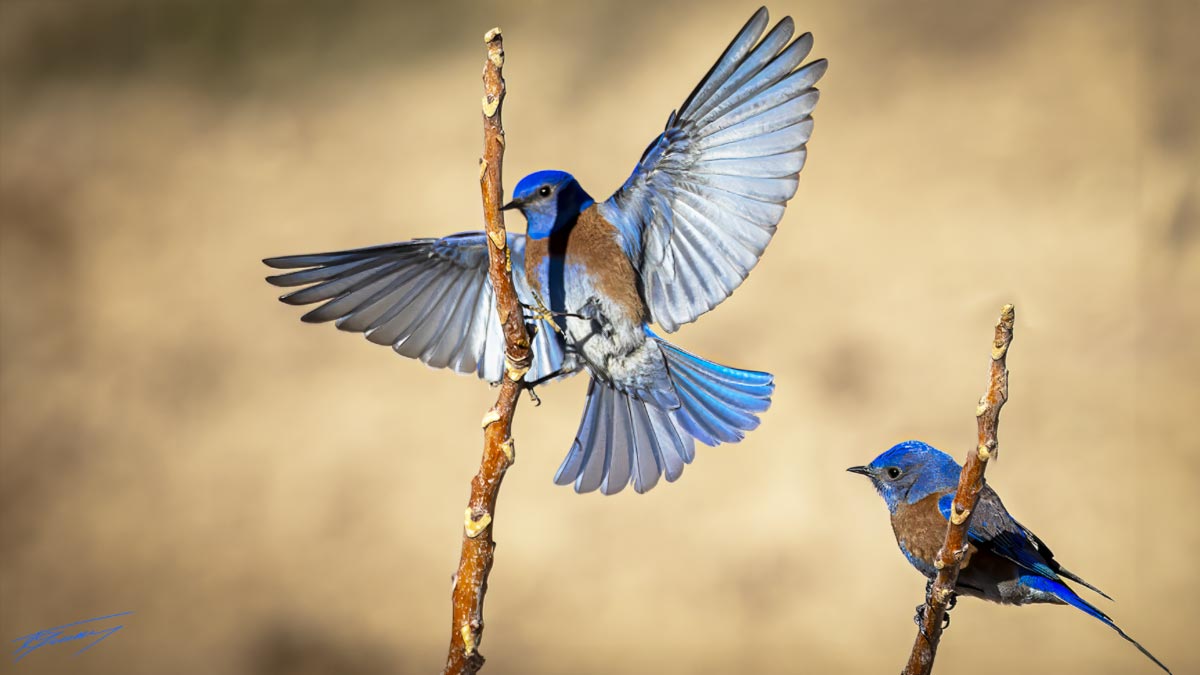
Below is a shot of a western bluebird sticking his landing on a small branch while another one is looking on. Also another opportunity to go through a folder of a shoot for a second time and delete about half of them. When you are shooting 20 frames a second the images just pile up and while most of them that are left are excellent, there are still the few that should be kept and release the rest of them to the bit bucket.

Parts have been coming in all weekend for a new computer I am building and several more days for the rest of them to arrive. The computer I am currently using is still far more than I need, but need alone has little to do with my decision making process. Another full tower with a Corsair case, EVGA Z790 Classified motherboard is the heart of the beast, an Intel core i9 13900K CPU which I can overclock to 5.8 GHz … 3 4th gen NVMe M.2 PCIe drives on the motherboard 2TB and 4TB x2 plus a lot of SSD (16TB) storage … and so much more! Computers have been a passion of mine since we bought our first ones for the law office in 1978, more than a year before IBM brought out the PC … we had the Xerox 820 at that time and upgraded on average every year from then on.

Into another new day and week as we continues the 4th of July celebration … those wise old men who set this country in motion way back when, were for the most part in their 20’s and 30’s ,,, what incredible vision these young men and women had! We are blessed!

Smiling,

Ted

Sweet summer, may I sing as thou, for every
leaf of thine is pregnant with music in the soft
winds, and every rose inspires the tenderness of
song. I yield myself to the thousand enchantments
of sky and field and wood, and play again like a
child on the soft green of the earth.

excerpt from A Prayer of Summer by Max Ehrmann

###

photo_tedgrussingThe easiest way to reach Mr. Grussing is by email: ted@tedgrussing.com

In addition to sales of photographs already taken Ted does special shoots for patrons on request and also does air-to-air photography for those who want photographs of their airplanes in flight. All special photographic sessions are billed on an hourly basis.

Ted also does one-on-one workshops for those interested in learning the techniques he uses.  By special arrangement Ted will do one-on-one aerial photography workshops which will include actual photo sessions in the air.

More about Ted Grussing


Healing Paws

Healing Paws

This is an advertisement

5 Common Landscape Photography Mistakes and How to Fix Them |

5 Common Landscape Photography Mistakes and How to Fix Them |

Landscape photography is a challenging genre that requires good planning, solid technique, strong creative vision, and often, just a bit of luck. As such, there are a lot of places where things can go wrong. If you would like to improve your images, check out this excellent video tutorial that features an experienced landscape photographer discussing five common mistakes and how to fix them. 

Coming to you from Andy Mumford, this great video tutorial discusses five common landscape photography mistakes and how to avoid them. Probably the most common mistake I see newer landscape photographers make is not including a foreground element when using a wide angle lens. The problem is that wide angle lenses tends to push the background away, and as such, if you do not account for this by including a foreground element, you can end up with a photo that looks like a flat wall with a lot of empty space in front of it. Adding something as simple as a rock or a path can provide some depth and give your viewer’s eye a place to enter the image. Check out the video above for the full rundown from Mumford. 

And if you really want to dive into landscape photography, check out “Photographing The World 1: Landscape Photography and Post-Processing with Elia Locardi.”