Photography

Summer solstice at Stonehenge, heat wave in Pakistan and more of the week’s best photos

Summer solstice at Stonehenge, heat wave in Pakistan and more of the week’s best photos

June 21 | Qamishli, Syria

People mourn the death of Kurdish women killed a day earlier in a reported Turkish drone strike. The strike reportedly hit a vehicle on a road between the cities of Qamishli and Amuda, along the Turkish border, killing three employees of northeast Syria’s semiautonomous Kurdish administration, two of them Kurdish women as well as a Christian man.

Delil Souleiman/AFP/Getty Images

Lynsey Addario, Known for her Searing Images of Conflict, Is the First Photojournalist to Join Lyles and King

Lynsey Addario, Known for her Searing Images of Conflict, Is the First Photojournalist to Join Lyles and King

Pulitzer Prize-winning photojournalist Lynsey Addario, known for her work covering conflicts and humanitarian crises in the Middle East and around the world, is joining New York gallery Lyles and King.

She will be the first traditional photographer on the gallery’s roster (although a few artists it represents do incorporate photography as an element of their practices in some shape or form).

“I liked the idea of joining a gallery that’s not specifically catering to photographers and photojournalists because I like to go beyond those borders,” Addario told Artnet News. “My goal is to be able to get the work out to a broader audience to people through museums and art fairs.”

For gallery founder Isaac Lyles, who works with a mix of emerging artists and older, under-recognized figures, Addario is a compelling, if unconventional fit for his stable.

Lynsey Addario, Two women on side of road, from Weha village, four hours in car to clinic. The father has lost two wives already, and has taken a third wife, half his age. His name is Shir Mohammad, and his wife, in burqua on hill, is Noor Nisa, 20. it is her first pregnancy, and her water has just broken and their car broke down on the side of the road. Shir mohammad went to look for other transport, and Noor Nisa and her mother, Nazer Begam, 40, are waiting transport to the hospital. Courtesy of the International Center of Photography.

Lynsey Addario, Veiled Rebellion. Two women on side of road, from Weha village, four hours in car to clinic. The father has lost two wives already, and has taken a third wife, half his age. His name is Shir Mohammad, and his wife, in burqua on hill, is Noor Nisa, 20. It is her first pregnancy, and her water has just broken and their car broke down on the side of the road. Shir Mohammad went to look for other transport, and Noor Nisa and her mother, Nazer Begam, 40, are waiting transport to the hospital. Photo courtesy of the artist and Lyles and King, New York.

“Many of the artists in our gallery programs address issues of identity, history, patriarchy, imperialism, global warming, and trauma,” he told Artnet News. “In Lynsey’s work, we have the raw, unvarnished, direct experience of an event of the happening of someone’s life. These photographs—taken in the moment, in the field, without sublimation—bear witness to those issues, often with profound empathy for her subject.”

“In my experience, the pictures and the stories that get seen are the ones that have really compelling, some would say beautiful photographs, which obviously is controversial because I’m often photographing very devastating scenes,” Addario said. “My first responsibility is, of course, getting the facts and making photographs that tell the story accurately. But I’m trying to find a way to photograph something that will engage the reader, rather than making them turn away.”

Lynsey Addario, Soldiers with the 173rd battle company, on a battalian-wide mission in the korengal valley on the abascar rideline, looking for caves and weapons caches and known Taliban leaders. Specialist Carl Vandeberge, center, and Sargeant Kevin Rice, behind, are assisted as they walk to a medevac helicopter minutes after they were both shot in the stomach during a Taliban ambush, which killed one soldier, and wounded both of them. Vandeberge and Rice were flown out immediately for surgery (2007). Photo courtesy of the artist and Lyles and King, New York.

Lynsey Addario, Soldiers with the 173rd battle company, on a battalion-wide mission in the Korengal Valley on the Abascar Rideline, looking for caves and weapons caches and known Taliban leaders. Specialist Carl Vandeberge, center, and Sargeant Kevin Rice, behind, are assisted as they walk to a medevac helicopter minutes after they were both shot in the stomach during a Taliban ambush, which killed one soldier, and wounded both of them. Vandeberge and Rice were flown out immediately for surgery (2007). Photo courtesy of the artist and Lyles and King, New York.

Addario became a war photographer after the September 11 attacks in 2001, and has worked in countries including Iraq, Darfur, South Sudan, and the Democratic Republic of the Congo.

The job has put her in unimaginable danger, such as being kidnapped not once, but twice, including a harrowing week-long ordeal in Libya in 2011, recounted in Addario’s 2015 memoir, It’s What I Do: A Photographer’s Life of Love and War. (The book is being adapted into a limited television series with Paramount and Viacom, and Addario is also the subject of a forthcoming documentary feature film.)

killed 75 civilians in six villages (2004). Photo courtesy of the artist and Lyles and King, New York.

Lynsey Addario, Soldiers with the Sudanese Liberation Army sit by their truck while struck in the mud in Darfur, Sudan, August 21, 2004. The SlA is one of the Sudanese rebel groups controlling parts of Darfur. Rebels are currently staging a 24-hour boycott of the Nigerian peace talks for Sudan in protest of recent new attacks against civilians in Darfur, which they say killed 75 civilians in six villages (2004). Photo courtesy of the artist and Lyles and King, New York.

Most recently, Addario has been on the ground in Ukraine, documenting the Russian invasion and its deadly effects. Her photo of a Ukrainian family hit by a mortar attack, a mother and two children lying dead as soldiers attempt to save the father, was a finalist for this year’s Pulitzer Prize. Addario was just steps away from the falling shells that killed them.

“The unpredictability of Ukraine is what makes it really scary,” Addario said. “It’s an artillery war. You never really feel safe, but you feel like you’re in a situation that is a little back from the front line, and then a missile lands next to you.”

Lynsey Addario, Ukrainian soldiers attempting to aid a family moments after they were hit by a mortar round while fleeing the suburb of Irpin, seeking safety in Kyiv. Tetiana Perenyibis and her children Mykita and Alisa were killed. Anatoly Berezhnyi, a church volunteer who was helping to usher the family to safety, was also killed in the strike. A steady stream of Ukrainian civilians made their way over a footpath beside the blown-up Irpin Bridge to try to escape fighting in the suburbs to the northwest of Kyiv as the Russian army advanced toward the capital. Mortars fired from Russian positions targeted the area of the bridge (2022). Photo by Lynsey Addario for the New York Times, courtesy of the artist and Lyles and King, New York.

Lynsey Addario, Ukrainian soldiers attempting to aid a family moments after they were hit by a mortar round while fleeing the suburb of Irpin, seeking safety in Kyiv. Tetiana Perenyibis and her children Mykita and Alisa were killed. Anatoly Berezhnyi, a church volunteer who was helping to usher the family to safety, was also killed in the strike. A steady stream of Ukrainian civilians made their way over a footpath beside the blown-up Irpin Bridge to try to escape fighting in the suburbs to the northwest of Kyiv as the Russian army advanced toward the capital. Mortars fired from Russian positions targeted the area of the bridge (2022). Photo by Lynsey Addario for the New York Times, courtesy of the artist and Lyles and King, New York.

Some of the photographer’s images have become widely reproduced, such as her striking photograph of a pregnant women and her mother, dressed in vibrant blue robes, as they wait in the Afghanistan desert for a ride to the hospital after their car broke down.

“With photos of this caliber, telling stories of this urgency, it would just be wrong not to show them,” Lyles added. “Sometimes, you have to take risks and say ‘this is urgent work, the market should come to this.’”

Lynsey Addario, Ukrainian families live below ground in a subway station, where many of them have been for about one week as Russian forces fight Ukrainian forces on the outskirts of Kyiv, Ukraine, March 2, 2022. The capital city of Kyiv is extremely tense as Ukrainian men and women prepare for battle as Russian troops have entered Kyiv (2022). Photo courtesy of the artist and Lyles and King, New York.

Lynsey Addario, Ukrainian families live below ground in a subway station, where many of them have been for about one week as Russian forces fight Ukrainian forces on the outskirts of Kyiv, Ukraine, March 2, 2022. The capital city of Kyiv is extremely tense as Ukrainian men and women prepare for battle as Russian troops have entered Kyiv (2022). Photo courtesy of the artist and Lyles and King, New York.

This will be the first time working with a dealer for Addario, who previously handled all her own sales, working with Epilogue, a Los Angeles post-production house recommended by director and photographer Sam Taylor Johnson, to produce prints.

Collectors typically reach out to Addario after seeing her work in the New York Times or National Geographic. But as a mother of 11- and four-year-old children with a busy travel schedule that has her on the road as many as seven months a year (when we spoke, Addario was on her way to the airport for a shoot with National Geographic in the Amazon), doing it on her own was becoming increasingly challenging.

imageThe forest burns around the Butte Lake Compound during the Dixie fire, August 27, 2021. The fire started in July 13th, and by October 2021, it had burned 965,000 acres (2021). Photo courtesy of the artist and Lyles and King, New York.” width=”1000″ height=”667″ srcset=”https://www.mecreates.com/story/news/wp-content/uploads/2023/06/ADDARIOGALLERYOPTIONS0031copy.jpg 1000w, https://news.artnet.com/app/news-upload/2023/05/ADDARIOGALLERYOPTIONS0031copy-300×200.jpg 300w, https://news.artnet.com/app/news-upload/2023/05/ADDARIOGALLERYOPTIONS0031copy-50×33.jpg 50w” sizes=”(max-width: 1000px) 100vw, 1000px”>

Lynsey Addario, The forest burns around the Butte Lake Compound during the Dixie fire, August 27, 2021. The fire started in July 13th, and by October 2021, it had burned 965,000 acres (2021). Photo courtesy of the artist and Lyles and King, New York.

Then, a relative of her husband suggested meeting with King, who has run his namesake gallery on the Lower East Side since 2015. Addario, who was working at the time on her 2022 retrospective exhibition at New York’s School of Visual Arts, invited him to see the show.

Lyles was already a fan, having been introduced to Addario’s work by the writer, artist, and curator Danny Moynihan, currently the director-at-large at Nino Mier, the Los Angeles gallery with locations in New York, Brussels, and Marfa, Texas. Upon meeting in person, Lyles and Addario began hammering out an arrangement to work together, starting with a solo show at the gallery next spring, organized with Moynihan.

Lynsey Addario, Khalid, seven years old, sits outside of the medical tent of a us military base after elders from a village claimed he was injured by shrapnel from a bomb dropped by Amercan troops near his home. American forces admit to dropping a bomb in the area, and say the boy was most likely injured in the attack, but can not confirm 100 percent. Civilians throughout Afghanistan have been victims of both Taliban attacks and United States bombs (2007). Photo courtesy of the artist and Lyles and King, New York.

Lynsey Addario, Khalid, seven years old, sits outside of the medical tent of a U.S. military base after elders from a village claimed he was injured by shrapnel from a bomb dropped by American troops near his home. American forces admit to dropping a bomb in the area, and say the boy was most likely injured in the attack, but can not confirm 100 percent. Civilians throughout Afghanistan have been victims of both Taliban attacks and United States bombs (2007). Photo courtesy of the artist and Lyles and King, New York.

Addario comes to the gallery with a built-in collector base that includes British rock star Elton John—and during the SVA show, former Secretary of State Hillary Clinton stopped by for a private tour of the exhibition.

More importantly, with a career spanning 25 years, Addario boasts an impressive range of work, from California wildfires to African famines to survivors of sexual violence. Aside from last year’s retrospective, some of the photos haven’t ever been shown, such as shots of trans sex workers from 1999, a selection of which go on view today in “A District Defined: Streets, Sex, and Survival” at the American LGBTQ+ Museum in New York.

Lynsey Addario, Trans sex workers wait for clients in the meatpacking district in New York (1999). Photo courtesy of the artist and Lyles and King, New York.

Lynsey Addario, Trans sex workers wait for clients in the meatpacking district in New York (1999). Photo courtesy of the artist and Lyles and King, New York.

Both the artist and dealer are eager to delve into the archives and to present these works to the art world.

“What’s exciting to me is that Isaac is coming to my work with a super fresh eye—not from the genre of photojournalism,” Addario said.

“In a world where most of the work of a photojournalist is experienced on an iPhone, a laptop, or briefly on the newspaper page,” Lyles added, “this is an opportunity to slow down, to pay closer attention to the issues at play and the subjects in the work, giving them greater dignity.”

Follow Artnet News on Facebook:
Want to stay ahead of the art world? Subscribe to our newsletter to get the breaking news, eye-opening interviews, and incisive critical takes that drive the conversation forward.

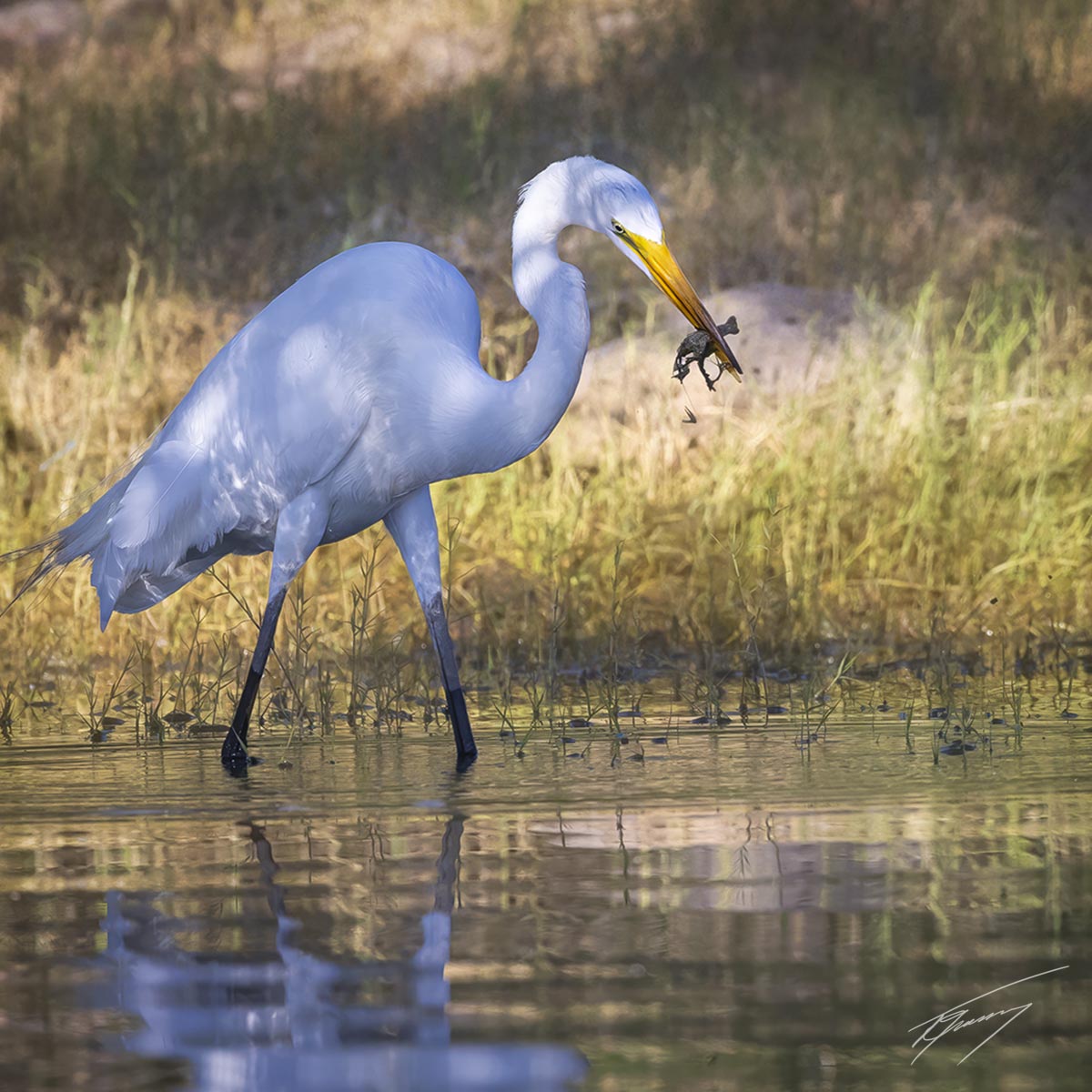
Today’s Photo from Ted Grussing Photography: Ain’t Gonna Happen

Today’s Photo from Ted Grussing Photography: Ain’t Gonna Happen

… what a great day it was and early morning found us on the quiet waters of Lake Pleasant and the shooting was as good as the dining for the creatures that inhabit the area.

Above is a shot of a Great Blue Heron attempting to get a fresh kill down the hatch … it simply wasn’t going to happen though as the fish was way to big to get down his throat! I’m sure that some other creature was happy to finish off the fresh catch though and our heron found a more diminutive fish for breakfast.

An egret picked up a tasty crawdad from the shallow waters and had no trouble getting it down … and there were more as the morning developed and lake supplied food for all including a few fishermen.

Into the weekend for me … keep breathing and enjoying life and those you meet and greet… always our choice. We are blessed! Back Monday morning.

Smiles,

Ted

A bird flies through the sky and I fly with it. I am
in each pearl of moisture sparkling in the sun. I lie lazy
on the clouds. And I acknowledge my kinship
each winged thing.

I see all as one, and nothing repels me, as this new
day climbs noiselessly out of the valley of night.

Peace lies over the world and over the world of my soul.

excerpt from On A May Morning by Max Ehrmann

###

photo_tedgrussingThe easiest way to reach Mr. Grussing is by email: ted@tedgrussing.com

In addition to sales of photographs already taken Ted does special shoots for patrons on request and also does air-to-air photography for those who want photographs of their airplanes in flight. All special photographic sessions are billed on an hourly basis.

Ted also does one-on-one workshops for those interested in learning the techniques he uses.  By special arrangement Ted will do one-on-one aerial photography workshops which will include actual photo sessions in the air.

More about Ted Grussing


Healing Paws

Healing Paws

This is an advertisement

Photography Exhibition by Paul Ng to Be on Display in July

Photography Exhibition by Paul Ng to Be on Display in July

ROCK SPRINGS — The Community Fine Arts Center is showing a large collection of work by local fine art photographer Paul Ng. The exhibit opens on Saturday, July 1 with a public reception from 2 to 4 pm. It will be available to see through July 28.

As a longtime resident of Rock Springs Paul Ng is well known as a fine art and nature photographer. He was born near Guangzhou, China and moved to Hong Kong just before the political turmoil of the infamous Cultural Revolution. Hong Kong was then a British Colony. For a teenager not knowing constructing many full sentences in English, the next few years are extremely demanding in order to catch up with the kids in the competitive Hong Kong education system. Nevertheless, hard work paid off. Paul later became a foreign student in Tennessee and finished with a BS in Biology and a MS in Environmental Health.

Ng’s first job was with the Wyoming Department of Health. After, fifteen years. He started working with the Sweetwater County Environmental Health and retired in 2017 after 22 years.

Advertisement – Story continues below…

Enrolling in a summer class at Western Wyoming Community College in 1987, Ng became fascinated with black and white photography. Large format photography became his mainstay starting in 1991. He works in both black and white and color. Ng continued to pursue this new-found art form by studying with the renowned photographer John Sexton on four occasions. Sexton was Ansel Adams’ assistant and consultant until Adams’ death in 1984.

Ng is faithful to the darkroom work, processing and printing all his black and white images. He has also printed many of his color images, particularly Cibachrome (later known as Ilfochrome) photographs. From 2002 to 2017, Ng taught evening credit-classes in photography at Western Wyoming Community College.

Ng’s images have been published in Outdoor Photographer, Shutterbug, Wyoming Wildlife, American West, Hong Kong’s Fotoarts and Photog magazines. He has had numerous one-person and group exhibitions in the local libraries, the Community Fine Arts Center, Old West Museum (Cheyenne, WY), Larson Gallery (Yakima, Washington) and the Wyoming Art Council Gallery in Cheyenne. He won the Honorable Mention Award in the Visual Arts Fellowship competition hosted by the WY Fine Arts Council in 2002.

Ng’s works have been collected by many private collectors as well as organization such as the University of Wyoming Student Union, the UW Convention Center in Laramie, and the Wyoming State Museum in Cheyenne.

“It is really hard work when you carry a heavy load of large format camera equipments especially on a long hike,” Ng said. “Over the years I have put numerous footprints in the Wind River Range, Yellowstone and Grand Teton. I have explored a lot of stunning landscapes in Utah and other western states, and sometimes it extends to as far as Maine and western Canada. Needless to say, we live in a very special and beautiful country!”

Deal alert: Luminar launches All-in-One Photography Bundle

Deal alert: Luminar launches All-in-One Photography Bundle

Heads up! Skylum has just launched the Luminar “All-in-One Photography Bundle.” It includes photography courses that can help you take your skills to the next level, as well as creative assets that will unleash your imagination with one-click results. The bundle also comes with a license of Luminar Neo for new users.

This is a great chance to get Luminar Neo + a bundle of 11 courses from 5 great photographers worth $3,460 at $129!

What’s on offer?

The All-in-One Photography Bundle promises to be your ticket to mastering the art of landscape editing and unleashing your creative potential. This bundle includes expert shooting and editing courses from 5 renowned photographers, the powerful photo editor Luminar Neo and a selection of creative content. Elevate your skills, enhance your images, and be inspired by the best in the field!

With the included photo editor Luminar Neo, you have a versatile tool at your fingertips. Take full control over your images, from subtle adjustments to dramatic transformations. Unleash your creativity and showcase your unique style in every photograph.

This bundle offers shooting and editing courses from five famous photographers. Draw inspiration from their journeys, learn their tricks of the trade, and discover what drives their passion for capturing breathtaking landscapes. Their expertise and vision will inspire you to push boundaries and create your own iconic images.

  • New users will get: Bundle of courses + Luminar Neo Pro annual subscription for $129 (Luminar Neo renews at $99 after the first year): 96% discount
  • Existing Luminar Neo users will get: Bundle of courses for $99 (97% discount)
  • The bundle includes Educational courses in English, Luminar Neo, and Presets & Skies

Educational courses

Serge Ramelli

Zero to pro course. Serge’s ultimate bundle of 6 tutorials covers everything you need to know about photography, including basics, composition, retouching, publishing, making an impact on social media, and turning your photography passion into a profitable business.

Max Rive

Photoshop Afternoon Light Editing Tutorial. Learn how to turn mediocre afternoon light into beautiful and soft-looking light with this tutorial. Max Rive will demonstrate his unique light effects and other editing techniques in this in-depth tutorial video.

Photoshop Landscape Editing Tutorial. Learn to create the best color, contrast, light and sharpness in your landscape image. All landscape editing techniques in this Photoshop editing and post-processing tutorial are easy to learn without requiring advanced knowledge about Photoshop.

Landscape Post Processing Course. Create the ultimate color in your landscape photos thanks to all the latest color editing techniques and tricks of this course. Master white balance, split-toning, color calibration, selective color, color balance, color painting, adding color haze and more.

Photoshop Contrast Tutorial. Boost your Photoshop editing skills and create the best possible contrast in your landscapes. Learn to enhance haze between mountain layers, add special vignetting, great shadow details, bright but well-exposed highlights and incredible color saturation.

Marco Grassi

Instagram — Smells Viral. Learn from start to finish Marco’s full editing workflow before posting an image to Instagram, including the importance of cropping, resizing and adjusting your images, how to find the best crop, how to get more engagement, and how to edit your work specifically for Instagram.

Zelda Start to Finish. Turn an unusable file into a great image with this in-depth tutorial, including how to paint light from the side, how to fix areas that are blown out, how to dodge with color, how to recreate the polarizer effect in the sky, how to alter the perspective of an image, and more.

Daydream Start to Finish. Learn how Marco edits an image, starting in Lightroom and ending in Photoshop. Master different post-processing techniques and how to add depth to your pictures and enhance them.

Pledge Start to Finish. Learn how to change the mood of your image and turn a flat file, shot during the harsh daylight, into a dramatic and unique scene with this in-depth tutorial. After this tutorial, you’ll know how to get a more dramatic look, how to desaturate the blues, and more.

Matt Suess

Sky replacement masterclass. Discover Matt’s secrets to creating realistic sky replacements, understand the top eight mistakes photographers make when replacing skies, and learn the best techniques for realistic results. Discover amazing bonuses included in the course, like 400 high-resolution skies that you can use today!

David Johnston

Landscape Photography University 201: Ignite Your Composition. With this course, you’ll get the proven system for quickly improving your photography composition, saving time through learning these techniques, and reaching your goals as a photographer.

Luminar Neo photo editor

1 year Pro Plan subscription of the award-winning and easy-to-use AI-powered photo editor.

Creative assets for Luminar Neo

120 creative assets including Presets, Skies, LUTs, and Overlays for Luminar Neo with a total value of $222:

  • Film Studio Portrait Presets by Team Skylum
  • Wildlife Adventure Presets by Team Skylum
  • Picture-Perfect Landscapes Presets by Team Skylum
  • Overcast Seascapes Presets by Team Skylum
  • Insta Life LUTs by Team Skylum
  • Precious Child LUTs by Team Skylum
  • Fitness LUTs by Team Skylum
  • Tender Blushing Skies by Team Skylum
  • Pacific Coastline Skies by The Remote Unknown
  • Prism Light Overlays by Team Skylum

Offer ends June 26, 2023 at 4 a.m. PDT | 7 a.m. EDT | 1 p.m. CEST so jump in quick and grab yours today!

Product Photography: A Complete Guide

Product Photography: A Complete Guide

Product photography is a major branch of commercial photography that is ubiquitous in our world, as product photos are used for everything from billboards and print ads to catalogs and store displays. If you’d like to learn how to become a product photographer, you’ve come to the right place.

This article is a guide to product photography, from the basics of what it is to the equipment and skills you’ll need to shoot effective product photos and survive in the industry.

Table of Contents

What is Product Photography?

Product photography is first and foremost about images that sell items. The photos are not the end in themselves as they might be in other genres. Unless they help to sell the objects pictured, they haven’t fulfilled their function. That’s not to say that they can’t be artistic or that people might not want prints of adverts as artwork, but this isn’t their ultimate goal or purpose.

A product photographer works with sales and marketing to create interest and inspire purchases.

As with other forms of photography, of course, anyone can simply point any old camera at something and press a button. However, to get results that do their job well, there are various techniques, skills, and knowledge involved. Consistent, reliable product photography is based on a good understanding of light and how to shape it. You need to be able to anticipate how different surfaces will reflect light and know how to get hard edges to your light or soft gradients when required. Retouching is all but indispensable these days and for an image to be used commercially without any post-production is about as rare as hen’s teeth.

Having a good grasp of the elements of visual communication helps you to design images with your audience in mind. This can extend from emotions and ideas implied by our use of color to lifestyle associations created by props in the scene. Yes, you can create product photos without knowing all this, but if you want to increase your chances of doing well then it can make a difference. If you can add useful input to the planning stages and ideas for execution, then you can bring more to the table than simply following a brief.

There are so many different products out there to photograph that it is common for photographers to specialize. We will look at a few possible avenues in this guide, along with the kit that you might need to get the job done. Finally, we’ll round things off with a look at some aspects of running a successful product photography business.

Photographic Skills for Product Photography

Setting yourself apart as a professional product photographer is similar to being a competent professional in any other genre such as portraits or weddings; you need a certain level of photography skills and technique. Although you can take a photo of an object almost anywhere under any lighting with your phone and use software to cut it out and change the background, you will get superior results if you understand light and know how to shape it.

Creative use of depth of field and being able to freeze action or cause motion blur are just some of the camera skills that you are likely to need. If you work regularly with tiny items such as jewelry, you may need to be able to use tilt-shift lenses or make focus-stacked images. In short, if you rely on automatic exposure then you will be limited as to what results you can produce. The ability to manipulate aperture, shutter speed, ISO, and other functions gives you more control and more options.

Understanding Reflections

As well as understanding how the various functions of your camera affect the images you create, as a product photographer you need to be able to analyze your subject and its surroundings so that you can build a lighting setup and troubleshoot anything that doesn’t look right. One of the key areas to master is, therefore, the law of reflection. If your product or prop is glossy, then the light will reflect off it differently than if it has a matte finish.

The law of reflection is that when there is a flat surface, the angle at which light bounces off it is the same as the angle at which it hit it (the angle of reflection = the angle of incidence):

When you are working with glossy surfaces such as polished metal, plastic, and glass, the angle of reflection is reasonably pure. No surface is 100% flat, but it can be close enough for the reflection to appear at the expected angle. This means that most of the light will bounce off your surface at an angle equal to how it hit that surface. You will lose a little light due to it scattering because of slight imperfections and in some cases, you may lose light through a surface or by absorption by the object’s surface (such as with glass or semi-transparent plastic, for example). But the majority of the light will bounce off and be seen at the expected angle.

Matte surfaces are uneven, so they scatter the light much more. This means that we get less light sent in the expected direction in reflection off our object. So, highlights will often be less bright than they would on a glossy surface. The reflections also tend to have softer edges rather than a hard line because the matte surface is scattering the light more.

The law of reflection helps us to predict what our product will look like when we light it. For example, if we use a hard-edged round light source such as a beauty dish, then we would expect to see a hard-edged round reflection in a glossy surface. There may still be a round shape to our light off a matte surface, but it will be less hard-edged and a less bright reflection according to how matte that surface is.

Lighting: Hard/Soft, Key, Fill, Rim

There is a huge range of lighting modifiers out there to choose from. So, which should you use for product images? For portraits we would use something like a large softbox if we wanted soft light on our subject. But, if your product is a glossy object such as a bottle of aftershave or wine, this might not be a good choice. Skin and clothing are mainly matte rather than glossy. So, although you still in some sense get a softer light than you would with a bare bulb, the reflection off a glossy surface is not going to be the same as it would off a matte one such as a face.

With portraits, a softbox can give you a soft transition between the shadows and highlights and that happens partly because the subject’s surface is matt. When you look at the eyes, you see a hard-edge highlight showing the shape of the modifier. It doesn’t look soft in the reflection in the pupil. Products with glossy surfaces behave much more like this than skin. Yes, the size of the light source is still important, but if we want a soft-edged light source then our usual methods aren’t reliable for glossy surfaces.

If you have a main light illuminating the subject, then as with other genres we can call this the “key light”. Adding another light source (whether that is a light or a reflector) to add some light into the shadows can be thought of as a “fill light”. There isn’t really a difference between how these terms are used for lighting products as opposed to people.

Rim lighting is a common way of adding separation between the product and the background, particularly if the background is dark. This essentially consists of adding one or more lights to illuminate the edge of the product. It is often done with stripboxes similarly to studio portraiture. Again, the usual soft/hard light distinctions aren’t quite the same here when dealing with a glossy surface. Matte will give a more diffused look; shiny surfaces will give you a hard-edged highlight unless you use the technique described below for creating gradients on glossy surfaces.

Before we look at how to create soft gradients on your items, there is one type of lighting that sometimes crops up in product photography that you don’t tend to find elsewhere. This is lighting through the subject – either from behind or from the sides making use of translucent or transparent materials and diffraction. It is a technique that is mainly used for drinks photography and other liquid products. Illuminating from behind can be a good way to light up a drink in a glass or bottle without causing a reflection on the glass.

Applying The Theory

Let’s suppose we wanted a clean image of a pint of beer next to a bottle. We want to see the color of the beer and also have a tidy, hard-edged highlight running the length of the bottle and the glass. We can apply the principles we’ve looked at so far and design a lighting setup accordingly. One light goes behind the bottle and glass to light through them both and show us their color. Another goes through a stripbox to the left of the camera. The result is in the image below.

Using the law of reflection, we can also work out why there is a gap in the highlight on the bottle – that bit of the glass reflects an area that is above our light source, so doesn’t have a highlight.

Creating Gradients of Light: Radial and Linear

When photographing a very reflective surface, we need to reflect a light source that already has soft edges if we want a soft-edged look to the highlights on our subject. It can only reflect what it “sees”. So, we need to create a gradient of light that the glossy surface can “see” and reflect. We need to soften the edges of our light source so that they don’t cut off abruptly. This is where diffusion material comes in.

Normally we use diffusion material as part of a soft-box/octa-box, etc. But, for product photography, we have an extra layer of it between the softbox and the subject. If you place a sheet of diffusion material in front of a softbox (with a gap between the two), then you will see that the light coming through it no longer has straight edges. It has been diffused to give you more of a gradient.

There are various types of material we can use, but they tend to be some form of plastic. A smoother surface tends to work much better than a textured fabric. Many of us have 5-in-1 reflectors that have an inner core that you can use as a diffuser. This can be a good place to start and keep costs down. You can buy ready-made sets of frames fitted with diffusers, but that can be an expensive approach. Many professionals buy a roll of plastic that they can then cut panels from as needed. This is a very cost-effective method, and it means that you can make smaller or larger panels to suit the job. You just need to find something to act as a frame to provide some rigidity and keep the material still.

If we cover the angles that the reflection from our surface reveals to the camera with a sheet of diffusion material, then we can create a soft gradient on that material which will then appear on the surface as our camera sees it. We can easily create a radial gradient (from circular to elliptical) or a linear gradient, depending on what would look best on our product. For a circular or radial gradient use a light with a reflector cone on it (maybe also with grids to control the size of the spot) or perhaps a beauty dish. For linear gradients use a stripbox or softbox. Control the gradient by angling the light so that it goes across the diffusion material instead of being completely head-on.

The images below show the difference between a straight reflection from a stripbox and the reflection from a stripbox angled across a sheet of diffusion material. The images haven’t been retouched so you can also see some slight anomalies caused by the shape of the plastic lid.

No gradient
Gradient

Retouching

Love it or loathe it, retouching is an important part of product photography and you’ll either need to get very good at it yourself or find someone to work with who can do it for you. From clipping out packshots with the pen tool to removing dust or changing colors, retouching is the finishing stage of the photography process. Images need to be clean, distraction-free, and with the products looking their very best, and this is rarely possible to do completely in-camera.

Even brand-new products can have minor defects that would spoil the final image. There might be a slight spillage of glue, dust may have stuck to some surfaces, or the polish may have slightly lost its sheen. Sometimes you can clean things up before shooting, but it isn’t easy or even possible 100% of the time to get it perfect. If you are adding special effects or compositing several elements together then retouching is even more important. Don’t think that you can get by as a product photographer without it.

Before
After

You may well find that you develop your own editing style. For me, it is part of the overall look that a client expects when booking me for their shoot. I may outsource some of the pen tool work as it can be laborious to do it all myself. But in the main, I like having the ability to retouch my own work. It also means that if I want to enter any industry competitions or work towards qualifications I can because all the work must be your own for qualification and competition entries.

Types of Product Photography

There are a few types of product images, and a product photographer might reasonably be expected to do any of them, although you may choose to specialize more in one than another. Some photographers prefer having a setup that they don’t need to change and can have a very rapid throughput of products, so they might gravitate toward budget-level packshots. Others prefer something more creative so might aim for more hero shots or lifestyle images.

Packshots

Packshots are those images of products on a white background that we have got so used to seeing on e-commerce websites. Large online retailers issue their own guidelines on how the images must be when submitting them, so make sure you are aware of any requirements. The idea of a packshot is to show just the product (with its packaging if appropriate) without any props or additional styling.

The white background acts to level out the playing field a bit between different brands of products as it can be harder to differentiate without a full-on advert. However, there is still room for good, bad, or great packshots. If you churn out cheap ones, then the lighting won’t change between items. Alternatively, you could choose to use more tailored lighting to show the product off better and this can still help it to stand out from the competition even without further styling or props.

Normally packshots are created in a plain white environment so that there is as little work to do to them as possible in post-production. For small items, a sheet of white plastic underneath may be enough. Larger items might benefit from a white infinity cove if you have access to one.

Lifestyle Images

A lifestyle image is one that puts the product into a context. This is typically related to how the product might be used and helps the potential customer visualize how it could fit into their life. As such, we have to be careful what props and styling we use as we don’t want to put off our target audience. If people can’t relate to the lifestyle image, then it loses its effectiveness. In some sense, lifestyle product photography is about showing someone an aspirational lifestyle – a way of living and being that they might aspire to. This is obviously especially the case for luxury products.

Hero Shots

A hero shot is the main product shot used in key places such as a website homepage or on printed advertising. Sometimes it might have lifestyle elements to it if that suits the product and the intended audience. It may be a more artistic viewpoint, creating an interesting image that draws the viewer in. In brief, it is a striking image where the product itself is the “hero”.

In connection with this, you may also hear people speak about a “heroic angle”. This means that the product is shot with the camera slightly lower, pointing up a little to the product. It is a visual device for making the product look more important and “powerful”. The viewer is looking up to it and it is visually on a pedestal above us. It is a psychological trick that can enhance the overall “hero” feel.

Communication Skills for Product Photography

As a commercial photographer, I’m in the business of visual communication. My job is to get a message across to a target audience. If I can understand how that audience thinks and what kinds of symbols and concepts make sense to them, I can craft my images to give them a better chance of success. You can never fully control how a picture will be seen and interpreted, but you can increase the likelihood that people will see and take away what you want to show them. This means studying various vehicles of meaning in the target culture, such as colors, shapes, and other symbolic elements.

Communicating Through Composition

Composing an advertising image is a bit like writing a message. We need to structure things so that they point us in a particular direction. This means choosing carefully where in the frame we place something, how big it is, and what else is functioning as a prop in the scene. Adding other items as props is common when we want to create an implied lifestyle, as we saw earlier. Their presence helps to steer the expectations of the audience and transfers some level of meaning to the product itself.

Use of Color

Colors can have powerful associations with emotions as well as traditional symbolic meanings. So, for example, red might convey heat, passion, love, blood, warning, etc. depending on the context. We can, of course, deliberately use an unexpected combination to make a point. But we risk the audience not getting what we intended from it. For images to have a wider appeal, the symbolic elements need to be widely used and accepted.

Much of the design work is often done in advance and prescribed to the photographer in the brief. However, being able to contribute to this process can be beneficial to the client and possibly flag up something that might have been missed by others. Looking at the image as a piece of visual communication helps us to know if we can justify including or excluding something from our composition. If we work on our own without a marketing or design team, then these skills can be even more valuable for creating powerful product photos for our clients.

Specialities Within Product Photography

Choosing to become a product photographer still leaves you with plenty of options when it comes to specializing. Yes, it might seem that you are already a specialist at that stage, but you can niche down further if you want to go after the more lucrative contracts.

Liquids and Splashes

Photographing liquid products often involves some kind of splash photography. For this, you will need lighting that can freeze motion. It is very difficult to do this effectively with a fast shutter speed. The usual approach is to have a studio light that has a short flash duration, say 1/4000th of a second or so. The camera is usually set up for the required aperture with the shutter speed at the usual synchronization speed (typically 1/160th or 1/200th of a second). You should be able to get a completely black image with your camera settings before adding flash as any light spillage from other sources risks giving you blur in your splash.

360 Spins

At one stage it looked like 360 product spins, especially the interactive types would really take off and help stand in for being able to handle a product in-store. So far, this hasn’t quite happened, but 360 product photography has nevertheless found a place in e-commerce. Although you can create animations using a video, if you want to work with the interactive versions then you often need to shoot still frames. Your frame rate will dictate how smooth the final animation is and how many frames you need to shoot.

This is a 180 variation on the usual 360:

There is some specialist equipment needed for this, which ranges from inexpensive to eye-watering prices depending on the setup you go for. Small items can be photographed on a small turntable. For larger items, you obviously need a bigger one, but it also needs to be able to cope with a good amount of weight. It is important to get a turntable that turns in adjustable increments if shooting a set of stills as otherwise your frames may not be evenly spaced out. If you want to automate the whole process, then there are full rigs that you can buy that include the lighting, turntable, and a robotic arm to swing the camera for multi-angle spins.

Food

Given the obvious perks, some product photographers choose to specialize in food. However, don’t always assume that all is as it seems…! Food photographers sometimes work with food stylists, while others prefer to learn the tricks of the trade themselves. There are many ways to enhance the look of food, often including inedible additions such as glue or glass beads and sprays of various kinds. If you want to conquer this niche then start making a note of any clever tricks that you come across.

Some people think that food should be photographed only using natural light. This can potentially save you from buying lighting equipment, but it puts you at the mercy of the weather and generally forces you to set up by a window. For more flexibility, I would definitely recommend learning to use flash and/or continuous lighting as well. Product photographers ideally need to know how to manipulate light from any source to make it do what they want to create the desired look.

Jewelry

Jewelry is another specialty that is quite popular. For less expensive jewelry you will often get batches of numerous items to shoot, and this can be fairly lucrative. High-end expensive jewelry requires excellent photography technique and very high standards of retouching. Attention to detail is very important if you want to work in this niche.

Due to the size of the products, you will often need to shoot focus-stacked sets or work with tilt-shift lenses and possibly extension tubes or bellows to get sufficient depth of field to show off gemstones and the craftsmanship that has gone into the items. As they are so reflective, you need good control of your lighting and to find ways of reducing unwanted reflections that can spoil the final look.

Still Life

Still life is a more generic type of product photography. This could include almost any product that we’ve not covered so far. There are also some other specialisms, such as automotive photography which may or may not come under still life, depending on your view. It can be used as a fairly catch-all term for anything product-related and is generally done in a studio, although it can also be on location. It is sometimes used as an alternative to “product photographer” (still life photographer) and doesn’t include people photography such as portraits, etc.

Kit Required for Product Photography

Sometimes you can get great results with very little kit. For other shots, you can end up needing lots of lights and props as well as specialist lenses. The kit you use is influenced by your personal style and the genre(s) you shoot. You can’t get away without a macro lens for small things and you need the right type of lights for special effects that freeze moving items. Overall, however, the key thing is not to think too much about the kit. Instead, learn the principles of how to manipulate light and you will often find a DIY solution if you haven’t got the specialist lighting modifier to hand.

Cameras and Lenses for Product Photographers

Some high-end clients might stipulate that you use a high-megapixel medium-format camera so that they have the necessary resolution to use the images at enormous print sizes. But most of the time, that isn’t really a concern. Most DSLRs and mirrorless cameras have a good amount of resolution and software allows a certain amount of upscaling without noticeable degradation of image quality.

You need equipment that does all the jobs your business requires. You don’t need kit that can do absolutely anything. Product photographers are not likely to need 500mm lenses or bodies that can shoot blisteringly fast frame rates. We do need a reliable, fully controllable camera with the right kind of lenses and accessories to go with it. For example, if you want to shoot with tilt-shift lenses as I do then you should check that the camera body you want to use has tilt-shift lenses available for it or that there is an adapter that you can use.

Generally speaking, product photography is expected to make the products look true to life and minimize any distortion. So, wide-angle lenses are rarely used. Normally something around 50-100mm is a good range and it needs macro capabilities. Extension tubes can be a useful asset for shooting very small products.

Props and Other Kit

Keep an eye out for interesting items that could make good backgrounds or props for the type of images you shoot. That could be kitchen utensils and pans for food photography, for example, or old bits of wood and slate for other products. You can often find things used or even in reclamation yards. You can’t have an exhaustive props cupboard, but having a few things available can be handy.

No, I’m not going to go into more detail and name “the best” brands or items. This is simply because you can do a lot with very little (and inexpensive) kit. Home-made modifiers can do the job. Expensive equipment can make it quicker, easier, and more reliable if you are doing the same thing regularly. Figure out what you need to shoot your style. You won’t need every modifier under the sun. Buy things that make it easier and cheaper to do your day-to-day work. Other things are luxuries. I add to my kit if I need a tool for a job that wouldn’t make sense to rent. Otherwise, I work with what I have and rent anything else for a one-off.

Running a Product Photography Business

Whatever type of professional photography business you run there will be common things that you need to put in place: accounts, branding, website, etc. Commercial photographers might consider networking with marketing or advertising agencies to help them get work in. Your pricing will be influenced by the type of clients you are interested in. If you want to work with small local businesses, then you will be limited to cheaper packages or day rates. In some countries, you may not be able to charge much (if any) licensing fees on top of that for really small companies. Bigger brands will expect to pay more and will negotiate the rights they want from you. So, be prepared accordingly.

Must haves (in no particular order):

  • If your retouching isn’t great, then make sure you have a reliable retoucher that you can send your work to.
  • Use a graphic designer and/or branding expert to help brand your business – especially important if you are aiming for high-end clients.
  • Provide clients with clear terms and conditions, including supply and return (where needed) of items to be photographed and ownership of any props purchased.
  • You need a strong understanding of lighting and how to manipulate light.
  • Insurance – you should have liability cover as well as damage and replacement policies for your kit. If you have other staff, e.g. assistants, make sure that they are covered too.
  • Focus – avoid dipping in and out of portraits, sport, nature, etc. unless you are just doing it for fun. Commercial clients don’t want to be confused by a huge range of image styles.
  • Patience – clients may ask for a re-shoot just to try a slightly different angle because you can if it is a product that isn’t going anywhere! Unlike events, advertising images may have a few rounds of shooting or retouching over hours/days/weeks to get to the final image.

Is Product Photography for You?

Far from being a small niche with limited opportunities, product photography encompasses a wide range of styles and offers scope for plenty of work as a professional. Certain genres need more equipment than others, so you may need to invest more to get started in those. Technique is very important for product photographers. For all but the most basic images, you will need to develop a strong grasp of lighting and be able to refine your final images to perfection. If you are happy working in the studio a lot and often on your own, then you may enjoy it. Those who enjoy the more social forms of photography may find it less interesting!

The law of reflection needs to become your friend. You will be working out what works and what doesn’t by considering reflections on a moment-by-moment basis. Understanding how images communicate visually is a great asset. The more you can learn from artists, other photographers, designers, etc. about the use of color, shape, symbolism, and composition the better. As with other genres, there is room to grow your skills and work at higher levels as well as taking entry-level jobs. Personally, I like the challenge of making potentially mundane products look great!


About the author: Joe Lenton works as a freelance product photographer and is also a Judge, Mentor, and Ambassador of The Societies of Photographers. He holds a Fellowship in product photography with The Society of International Commercial & Industrial Photographers.


Image credits: All images by Joe Lenton. All rights reserved. Reproduced here by permission.

Review | Three tributes to the wide range of photographer Frank Stewart

Review | Three tributes to the wide range of photographer Frank Stewart

It would not be wrong to say that Frank Stewart is a photographer of Black experience and culture, especially jazz, who makes black-and-white pictures characterized by deep shadows and extreme close-ups. But that’s not all he is.

The 73-year-old artist’s range can be seen in his first museum retrospective, “Frank Stewart’s Nexus: An American Photographer’s Journey.” The Phillips Collection show features many pictures in vivid color and some that document social issues or the artist’s travels, as well as ones keyed more to composition than to content.

“Nexus” includes more than 100 photos. It’s supplemented by a smaller display at the museum’s Southeast workshop and gallery at the Town Hall Education Arts Recreation Campus, known as Phillips@THEARC, which is showing five Stewart pictures and some of the photographer’s memorabilia. On display concurrently is a Stewart show at Gallery Neptune & Brown, a commercial venue.

Stewart was born in Nashville and grew up in Memphis, Chicago and New York. He’s been based in the last city for most of his life, serving as the Jazz at Lincoln Center Orchestra’s senior staff photographer from 1990 to 2020. His travels with the troupe were preceded by solo trips to Cuba and West Africa in search of the origins of African American culture. He also has ties to New Orleans, where he evocatively documented the aftermath of Hurricane Katrina, and to D.C. The earliest pictures in this show were made by a 14-year-old Stewart at the 1963 March on Washington for Jobs and Freedom; also on display are the photographer’s 1970s portraits of D.C. visual artists Alma Thomas and David Driskell.

As might be expected from Stewart’s gig with the Lincoln Center ensemble, he often photographs performances. His dramatic compositions employ such gambits as silhouettes, reflections, tight close-ups, deep black or bright red backdrops, and narrow depth of field. Concert scenes can appear frozen in time or remarkably kinetic, as in “Stomping the Blues,” in which Wynton Marsalis leads the orchestra offstage in a high-kicking line.

Stewart also choreographs offstage shots so they appear as theatrical as the concert ones. In the almost-monochromatic “Bone and Silhouette,” a performer appears as a black outline in a yellow-lit doorway framed in more black.

The galleries are arranged thematically and expand from Stewart’s best-known subject to showcase pictures of travel, from Ghana to China to Portugal, and social and environmental concerns. The pictures are sometimes presented as visual rhymes, as in two shots of bare, muscular backs. One portrays a man at Senegal’s Gorée island, a location associated with the trade in enslaved Africans, whose flexed body represents that infamy; the other is a street shot of a New York man who insisted on removing his shirt so he could display his healed bullet wound. Equally striking is the juxtaposition of a photo of three Black musicians parading through a New Orleans cemetery in a funeral procession and another in which a trio of men in Ku Klux Klan robes and hoods walk in the opposite direction in Mississippi.

Among the pictures that verge on abstraction is “Blue Car, Havana,” which immerses the viewer in a seascape that happens to be metal rather than water. To judge from this survey, however, the photographer’s favorite color is not blue. Bright reds abound, whether in concert shots or found on a Savannah tour bus or a spread of watermelon slices. Stewart is a master of black and white whose forays into color appear delectable.

More than a few of the photographs in “Nexus” were previously shown at Gallery Neptune & Brown in 2019-2020 and 2021 shows that were smaller but nearly as wide-ranging as the Phillips exhibition. The gallery’s current Stewart show, “Riffs and Responses,” is more tightly focused. The pictures are all of performers and often depict a precise instant of music making. Viewing the images is very nearly an aural experience.

“The Belter (Catherine Russell)” captures its subject with her head back and mouth wide open, apparently delivering a song’s climactic note. In “Roy Hargrove,” only the bell of the musician’s trumpet is in crisp focus; his hand is soft and his face barely visible. It’s as if the player has almost disappeared into the sound he’s making.

The pictures in “Riffs and Responses” employ Stewart’s usual techniques to spotlight and isolate musicians in fields of black or red. The effects are both electric and intimate, sharing a privileged viewpoint with spectators far removed in time and space from the second the artist memorializes. Stewart’s photos are historical, yet feel immediate. The long-gone moment is preserved forever in shape, light and shadow.

Frank Stewart’s Nexus: An American Photographer’s Journey, 1960s to the Present

Phillips Collection, 1600 21st St. NW, and Phillips@THEARC, 1801 Mississippi Ave. SE. 202-387-2151. phillipscollection.org.

Dates: At the Phillips Collection through Sept. 3; at Phillips@THEARC though Aug. 31.

Admission: Admission to the Phillips Collection is $16; $12 for seniors; $10 for students, teachers and military personnel; and free for members and ages 18 and under. Admission to Phillips@THEARC is free.

Frank Stewart: Riffs and Responses

Gallery Neptune & Brown, 1530 14th St. NW. 202-986-1200. galleryneptunebrown.com.

Dates: Through July 15.

Admission: Free.

Urban Explorer Photographer Has Spent Nine Months in Albanian Prison

Urban Explorer Photographer Has Spent Nine Months in Albanian Prison
Urban explorer photographer Lana  Sator has spent the last nine months in an Albanian jail.
Urban explorer photographer Lana Sator has spent the last nine months in an Albanian jail.

An urban explorer photographer was arrested and put in an Albanian jail for nine months.

Russian photographer and blogger Svetlana Timofeeva — who goes by Lana Sator professionally — was arrested on spying charges while allegedly urban exploring in Albania in August 2022.

One of Russia’s Most Famous Urban Explorers

34-year-old Sator, who is considered one of Russia’s most famous urban explorers, was arrested last year while entering the former communist military factory of Gramsh which is 50 miles (80km) from the Albanian capital of Tirana.

When Albania was under communist rule, the rundown weapons factory had once been used to make Russian-designed AK-47 rifles. The Gramsh plant was also used to dismantle small arms and ammunition.

Sator — who has over 250,000 followers on Instagram — says that the only reason she was visiting the area was her desire to film abandoned buildings from the Cold War era.

According to Reuters, Sator claims that she believed the factory was abandoned and there was no sign suggesting any military facility and people and animals were moving in and out freely.

However as she entered the premises, Sator was arrested on suspicion of spying on Albanian abandoned factories by two army guards — along with Russian companion Mikahil Zorin and Ukranian Fedir Alpatov.

Albanian prosecutors claim investigators discovered cameras, drones for taking photographs, phones, hand-drawn maps, and $6,000 in cash.

Sator was charged with espionage after her ill-fated adventure in Gramsh and the photographer has since spent nine months in an Albanian prison.

‘Investigation Still Pending’

According to her social media profile, it appears that she has now been released from prison. However, in an Instagram caption posted on May 28, Sator says that her “investigation [is] still pending” and there is “no final trial in which I could be fully acquitted yet.”

Sator’s supporters have questioned why the Albanian military value the long-disused Gramsh factory. Meanwhile, the Albanian Ministry of Justice’s website says the Gramsh plant now provides manufacturing services for the defense industry.

The Washington Street Journal reports that Sator is well-known in the world of urban exploration. She has taken photographs in abandoned locations in over 30 countries and published two books on her images.

Sator has primarily built a career photographing abandoned sites around the former Soviet Union — sometimes from the inside of tightly guarded military sites.

In 2012, she snuck into a Russian rocket factory and posted striking images from its interior.


Image credits: Header photo via Instagram/@lanasator.

Evelyn Hofer/ Johny Pitts reviews – secs and the great big pulsing city

Evelyn Hofer/ Johny Pitts reviews – secs and the great big pulsing city

An umbrella and a bowler hat sit on a windowsill in a pub – patiently waiting, it seems, for their boozing owner to return. This striking black and white vignette of British culture is an unusually playful photograph by Evelyn Hofer, taken in London in the 1960s, presented with many others that depict the capital as a hostile city, as part of the artist’s first UK exhibition.

Split across two floors of the Photographers’ Gallery in London, the show focuses on the photographs Hofer took in Europe and the US in the 60s and 70s. An early pioneer of new colour techniques, working with a more collaborative approach than her shoot-from-the-hip predecessors, she quietly changed the course of documentary photography.

Hofer was born in Germany in 1922, and her early life was itinerant. The family fled the Nazis, moving to Switzerland, where Hofer began to study photography, taking private lessons with Hans Finsler, who was associated with the modernist new objectivity movement that also included August Sander. The family later moved to Spain but, after Franco’s rise, they left Europe, arriving in Mexico in the 1940s.

Harlem Church, New York, 1964

By 1946, Hofer had moved to New York, but she continued to travel back to Europe. Upstairs are her visionary views of European cities in the 60s, most of them shot in black and white and evoking a sombre atmosphere: there are photographs of Paris, Barcelona, Rome and Dublin, alongside a body of work made while she was living in London, produced for a book by VS Pritchett. London, through Hofer’s eyes, appears smoky, industrious and austere. Even children she photographed in Notting Hill Gate and Battersea look baleful or despondent.

Descending a floor, the exhibition switches gear – from black and white to dazzling colour, from Europe to the US. Some of her early successes with the complex colour dye transfer printing process are here: a bar on Mercer Street, a car park in New York, signs in Coney Island – the most humdrum of scenes scintillate with the particular qualities of the technique. US cities pulse with heat and joy: the series Just Married presents 12 couples, taken one morning in 1974 outside the New York civil register office. Hofer didn’t choreograph the newlyweds, but the details of their clothing, gestures and poses suggest much about their circumstances and dynamics.

While love and leisure are common themes in the American pictures, when Hofer does turn to labour, it feels exuberant and fresh: in Secretaries in Rawlings Park, Washington DC and Chauffeurs, Washington (both 1965) she pays homage to the inexorable power of immaculate style. In contrast to her abject view of an old-fashioned Europe, the US appears modern, consumer-friendly and free.

Hofer remained concerned with society’s outliers – working-class people, people of colour and women are frequent subjects, all of them exuding a certain self-confidence. The pictures of unnamed cockle pickers and coalminers, secretaries and seminarians, gravediggers and lorry drivers have aged – but they also capture something timeless. It is in these subtleties that Hofer is most subversive, asserting the authority of her sometimes idiosyncratic interests in what, or who, could be revered in an image. In her photographs, a quivering, impossibly high beehive hairstyle or an impeccably dressed elderly woman sitting on a bridge are treated with the same respect as buildings on Park Avenue or olive trees in Spain.

An uncaptioned photo from Pitts’ show Home Is Not a Place.

As well as Hofer’s exhibition, the gallery is showing Johny Pitts’ Home is Not a Place, a series that also seeks to convey the atmosphere of a city while dissolving a sense of time. Like Hofer, in 2021 Pitts embarked on a roving journey with his camera, following the Thames east to Tilbury – where the Windrush docked in 1948 – then moving along the coast, from Dover to Plymouth, Liverpool to Edinburgh, in search of Black communities.

As well as photographs, Pitts’ installation includes objects, furniture, text and video. Rather than presenting a linear narrative, the photographs – left uncaptioned – move back and forth in time and place. At times, Pitts brings the camera very close to his subjects, or submerges them in hazy light, so they are cast as silhouettes, bodies in spaces that remain ambiguous.

Photographs can create a sense of belonging: alongside his search for a collective image that might reflect his experiences, he has also included personal family albums from a formative period in the late 80s when he lived in Japan. Spliced and reshuffled with more recent photographs taken on return visits, Pitts examines the impulse to archive, and photography’s relationship to memory.

The wistful beauty of the photographs, however, is swamped by the other elements of the installation which make it feel crowded, physically and conceptually, with an avalanche of references and ideas. The original impetus of the project – the journey around Black Britain – feels lost. A reconstruction of a living room – which now seems to be de rigueur in photography exhibitions – stuffed with relics of Pitts’ childhood home in 80s Sheffield, seems to suggest home is in fact a place, with a leather sofa, artworks on the wall and books on the shelf.

Frederick Douglass Was an Early Proponent of Photography. This New Exhibit Tells His Story Through Images.

Frederick Douglass Was an Early Proponent of Photography. This New Exhibit Tells His Story Through Images.

All photographs by Malcolm Ferguson.

“One Life: Frederick Douglass” at  Smithsonian’s National Portrait Gallery offers an image-based timeline of the orator and statesman’s life and work from his days of enslavement up until his postwar activities and beyond.  

The show, which opened the weekend of Juneteenth, centers on Douglass’s obsession with photography. Often called the most photographed American of the 19th century, Douglass had an acute understanding of the power that photography had in the struggle for African American equality. He simultaneously recognized the widespread familiarity that images bred, and the fact that images—particularly portraits—were the most authentic way for him to be seen.

That understanding is a huge part of why there are so many more photos of Douglass. He had a healthy skepticism of “the hand of the white artist,” which he might distort his features or misinterpret him in paintings or drawings. Douglass often frequented the numerous studios of Black photographers instead. 

Douglass “had faith in the ‘truth value,’ as well as the beauty, of photography,” says John Stauffer, a professor of history at Harvard University and author of Picturing Frederick Douglass who guest-curated the exhibition. “He was one of the first to recognize the politics of aesthetics, that art can be a very powerful engine of change…for Douglass, there’s a greater likelihood that someone can be converted into an activist through images at least as much, if not more, than through words.” 

The first section, “Enslavement & Escape,” focuses on Douglass’ period of enslavement from his recorded birth in 1818 until he fled to New York in 1838 with the help of his future wife Anna Murray Douglass, a free Black woman from Caroline County, Maryland. The section contains a classic photograph of Murray, a print of the famous “Fugitive’s Song” sheet music cover dedicated to Douglass, and the faded paper ledger of his first owner Aaron Anthony, who recorded Douglass’s birth to Harriet Bailey in 1818.

Next, the “Circle of Activists” highlights Douglass’ enthusiastic collaboration with the women’s suffrage movement. Douglass, the only African American present at the seminal Seneca Falls Convention in 1848, was a friend and ally to campaigners like Elizabeth Cady Stanton and Susan B. Anthony, who were among the founders of the American Equal Rights Association in 1866. This section holds a portrait of seven notable 19th-century suffragists, as well as a famous photo of activist Sojourner Truth. 

There’s also a daguerreotype gallery, a small collection of some of the earliest forms of photographs. Each image is around the size of an index card and slightly obscured by an eerie haze. The stark stare of a young Frederick Douglass, his afro in all its glory, can be viewed alongside daguerreotypes of abolitionists John Brown, William Lloyd Garrison, and Gerrit Smith. Another section, “Douglass and Brown,” includes more photos of Brown and Douglass, and more information on their relationship, which, according to Stauffer, was in a sense optically easier at the time because it preceded the bogus science like phrenology that helped inspire brutal Jim Crow laws.

The Civil War section centers Douglass’ friendship with President Lincoln. The first African American to meet and advise a US President, Douglass often had Lincoln’s ear during the Civil War. When the war began, Douglass implored Lincoln to arm every Black person enslaved in the South, citing their knowledge of the terrain and desire for freedom, but to no avail. The section holds a letter from Douglass to Lincoln regarding reelection strategies, and a massive painting, The Result of the Fifteenth Amendment, which depicts African Americans marching parading through Baltimore in celebration of Black men receiving the constitutional right to vote. 

The “Post War” section is a bit more personal, focusing on Douglass’ travels as an orator, his somewhat controversial marriage to his second wife, white abolitionist Helen Pitts Douglass, and his time as a resident of Washington, DC. 

Douglass moved to DC, Stauffer says, because it was a Black metropolis in ways that other cities in which he lived, including Boston and Rochester, New York, were not. “Douglass knew there were a large number of African Americans,  he wanted to be a part of an African American community, and he knew he could have an influence with African Americans because they listened to him more than whites did.”

The exhibit concludes with the “Afterlife” section, an homage to other African American activists who either knew Douglass personally or were particularly inspired by his activism. There are portraits of  Ida B. Wells, W.E.B  Du Bois, Booker T. Washington, and Langston Hughes, all of whom share Douglass’ legacy.

Stauffer believes that the public still has much more to learn regarding Douglass. “In my view, he was as important as someone like Lincoln. And I say that because far more people heard Douglass speak, read Douglass, than they did any other figure, with the possible exception of Mark Twain, who was a whole different generation. Just in terms of his fame and popularity, Douglass was like the LeBron James of his day,” he says. Douglass’s significance “is in a combination of the popularity, the accuracy and detail of a photograph. Our aim is to highlight the long arc of that extraordinary life.”  

“One Life: Frederick Douglass” is open now until April 21, 2024. Learn more here 

Malcolm FergusonMalcolm Ferguson

Editorial Fellow