Photography

Today’s Photo from Ted Grussing Photography: Sometimes you do and sometimes…

Today’s Photo from Ted Grussing Photography: Sometimes you do and sometimes…

… life is filled with opportunities and choices … sometimes you get it right and sometimes not so much. Spent most of the day catching with friends I have not talked to in a while and near the end of day I headed up to the Rainbow Trout Farm in the canyon … a very quiet place at end of day and important to a few herons and hawks that grab a meal there.

Above is a great blue heron who scored a fine meal and below one that didn’t … kinda like us when we go fishing, but for us survival is usually not what is at stake!
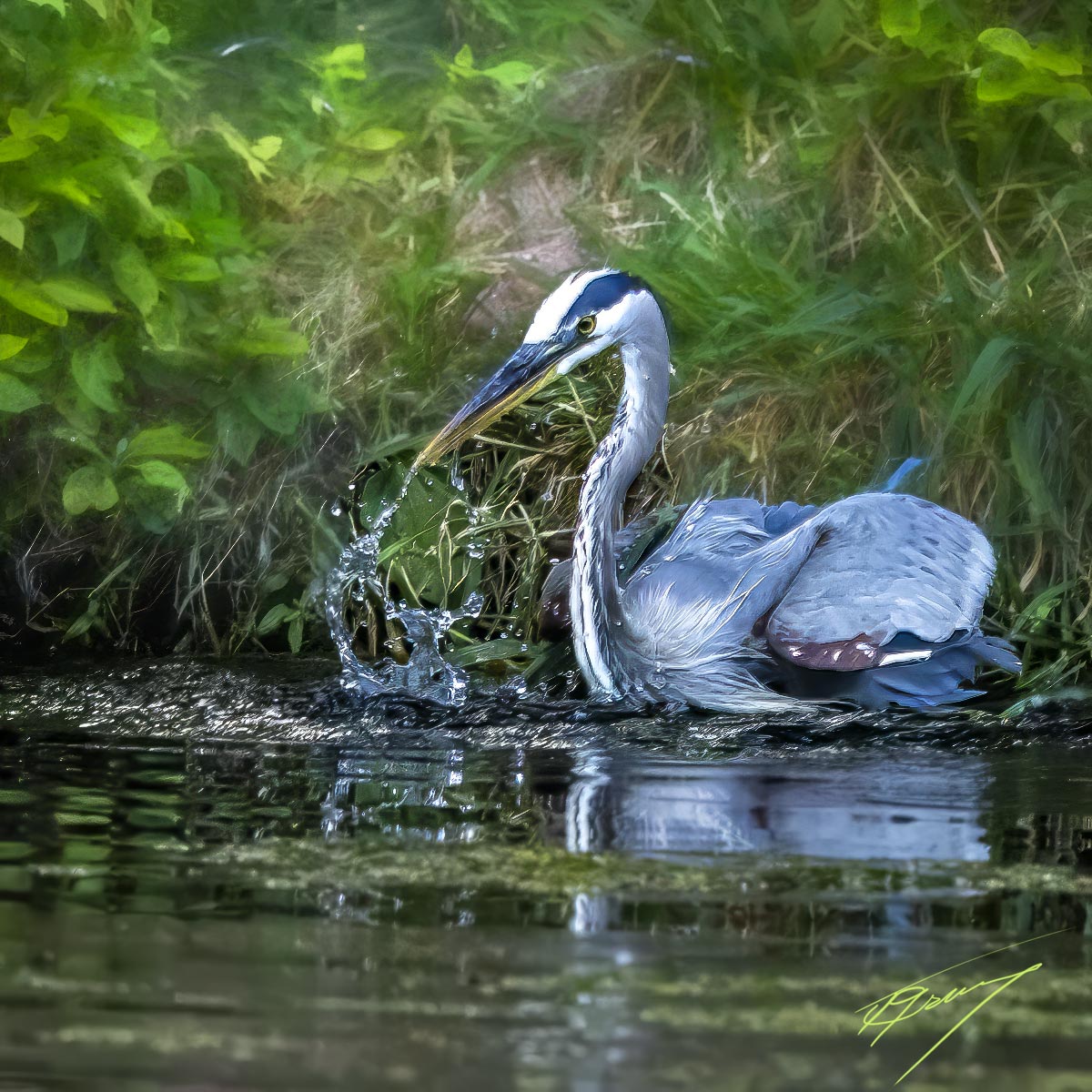
End of the week for me … have a beautiful day and weekend. The plan is to be back Monday morning having had more days filled with beauty and joy … always a choice how we experience each day!

Smiles,

Ted

Filled with dreams and songs and love, I wander
afield.

Meditation, softened by the peaceful lands of grain and
the illimitable blue sea overhead, draws my heart to
my lips as one whose talent is in song.

I yield to the thousand felicities of this transport, like a
child led by his father’s hand; and no questions darken
this day of my content.

Afield by Max Ehrmann

###

photo_tedgrussingThe easiest way to reach Mr. Grussing is by email: ted@tedgrussing.com

In addition to sales of photographs already taken Ted does special shoots for patrons on request and also does air-to-air photography for those who want photographs of their airplanes in flight. All special photographic sessions are billed on an hourly basis.

Ted also does one-on-one workshops for those interested in learning the techniques he uses.  By special arrangement Ted will do one-on-one aerial photography workshops which will include actual photo sessions in the air.

More about Ted Grussing


Healing Paws

Healing Paws

This is an advertisement

Joyful photographs of Scouts show a sense of belonging and freedom

Joyful photographs of Scouts show a sense of belonging and freedom


CNN
 — 

In sun-dappled scenes shot across the German countryside, boys and girls in navy Scout uniforms hike through the woods, pitch tents and lay on the grass under open skies. They wear striped kerchiefs and frayed patches of their national flag. In quiet moments, girls clasp hands and recline against one another; one Scout erupts in laughter as she holds another’s foot to be mercilessly tickled.

Taken by the German photographer Stephan Lucka, the images, “Das Gefühl, das nur wir kennen,” or “The feeling, that only we know,” are saturated in coming-of-age nostalgia for anyone who relished in a sense of freedom in the outdoors.

For Lucka, who was first a Scout in the 1990s in Bad Salzuflen, a town in Western Germany, and later a troop leader there, the project served as both a homecoming and a way to better understand those formative years. Having photographed Scout groups around the country beginning in 2015, he published the series as a book late in 2022.

Stephan_Lucka_Das_Gefühl_das_nur_wir_kennen_Pressefoto-2982

“Sometimes with life you can only understand it backwards,” Lucka said in a video interview. “In a simple way, I wanted to return to that time that was part of my youth… and try to understand what this time meant to me.”

“I realized that (Scouting) shaped me in an important way,” he added.

Nature and nurture

Though Lucka said some aspects of Scouting have adapted to new technology since he was young — today, troops shoot social media content and use Slack to organize themselves, for example — he found the reasons why young people join are largely the same: to foster “this feeling of connection” to others and to nature, as he described it.

“With the Scouts I am more on my own, I have to be more independent… but I also feel part of something big,” said 13-year-old Jette, whose Scout nickname is Tonks, in a translated interview from the book. “The fact that you are independent but also part of a community at the same time is somehow paradoxical to me… It is a feeling of freedom and belonging in equal measure.”

Stephan_Lucka_Das_Gefühl_das_nur_wir_kennen_Pressefoto-3561
Stephan_Lucka_Das_Gefühl_das_nur_wir_kennen_Pressefoto-7769

One of Lucka’s favorite images is one of the earliest he took, of two teenage girls laying entwined on a purple mat on the grass while out camping in the woods, eyes closed and hair fanning out beside them.

“It was just one exposure, and then I went away because I didn’t want to disturb them,” Lucka recalled. “But to me, there’s this intimacy that always resonated.”

Wandering the path

In Germany, the Scouting movement took off in 1909, a year after the publication of British Army officer Robert Baden-Powell’s book “Scouting for Boys,” which is the framework for the organization (now present in 216 countries). But at that time, the country’s youth were already experiencing a revolution that brought them into nature. The movement, called Wandervogel, or “wandering bird,” began in Berlin, and saw children and teens rebel against industrialization by hiking and adventuring in groups, rejecting city lifestyles and materialism. Under Nazi Germany, Wandervogel and Scouting groups were banned; Scouting returned to West Germany following the war, but not to East Germany until 1990 when the country was reunified.

In German, scouts are called “pfadfinder,” meaning “pathfinder,” which Lucka pointed out as he recalled an anxiety-inducing time when, as a troop leader, he nearly couldn’t find the way back to camp for his group.

Stephan_Lucka_Das_Gefühl_das_nur_wir_kennen_Pressefoto-1951

“I got lost — I had a map and a compass, but I couldn’t actually identify where I was,” he said with a laugh. “It was kind of strange situation.”

How did he get back on track? Thanks to Scouts guidance that had been ingrained in him when he was young: Seek higher ground for a better perspective. So he climbed a tree, identified a point that was recognizable, and led his troop there using his compass.

“I found the Scout solution: When you get lost, try to get a better view,” he paused. “And this is a bit metaphoric for life.”

Today, Scouting in Germany emphasizes hiking, camping and practical skills, as well as the creative arts, Lucka said. He also credits the community with helping him to develop social skills and gain confidence in himself. At the end of his book, he rewinds time with a collection of personal snaps from his Scouting days: a portrait of a young Lucka with sunglasses and long, curly hair on a night he remembers falling in love; another of his troop on a bus trip from France, triumphantly holding a baguette. Ultimately, he thinks “Das Gefühl, das nur wir kennen” is “a story about freedom,” but also one of acceptance, showing a community where many have found a “safe space” to be themselves.

In its cultivation of this environment, and kinship, “The Scouts (could be) a model for how to treat each other in a decent way,” he added.

Das Gefühl, das nur wir kennen” is available now.

3 Steps to Finding the Photography Tour That’s Right for You

3 Steps to Finding the Photography Tour That’s Right for You

Regardless of your level, photography tours are an exciting way to learn from a pro and hone your skills, but they’re much more than capturing the perfect shot. They take you to the most photogenic spots in dream destinations and encourage you to be present and appreciate the visual nuances of your surroundings — all of which enrich your experience. Amateur photographer and nine-time photo tour fan Nancy Brandt, 75, loves photography tours for the opportunity to meet like-minded souls — people whom she says become “friends who stay with you for years afterward.”

The type, size and vibe of photography tours vary widely. You can shoot sherbet-colored villas in Cinque Terre, Italy, capture silverback gorillas in Uganda, or snap Myanmar’s bustling outdoor markets. Some itineraries focus on one style of photography, such as landscapes. Other tours — in Paris, for instance — may encourage a mix of portrait and street photography. Tour operators differ, too. You need to decide whether an individual, photographer network or international tour operator best suits your needs. In short, the most challenging part of a photography tour is figuring out which one to choose. 

With this in mind, these are the three essential steps to finding the tour that’s right for you.

1. Determine your goals

The distinction between photographic tours and workshops would be clear-cut in a perfect world. A tour would be a fun, casual experience that gets you to the right place at the right time for the best shots possible. Workshops would focus on education, including lectures, assignments and critiques in the itinerary. In reality, tour operators blur the lines with elements of both. Knowing what you want beforehand will make it easier to peel back the layers and steer you in the right direction. Consider the following:

Proactive instruction

“Not all tours are created equal,” warns Andrew Beck, cofounder and director at Wild Eye Destinations and Photographic. “Make sure to find out how much of an educational element there is on the tour versus just traveling with like-minded people.” As an industry, there is no standard. I’ve seen a range of instruction from proactive pointers on lighting, composition and settings to a more hands-off approach, where they only share their expertise when asked.

Leaders on location

Some pros I’ve found leave guests on their own during the day, meeting later to share meals and answer questions. Photographers who favor independence will find this setup appealing. Others stay with the group to answer questions and demonstrate how to capture a scene. Some do a little of both. In many cases, the destination influences the plan. In a city like Paris, it’s easy for guests to wander independently. Whereas in more remote locations, it’s better to stay together. 

How about setups?

Sometimes an itinerary includes a learning exercise called a setup shot with models dressed in traditional garb, lighting and a beautiful backdrop. Everyone takes turns photographing the same lovely image. As a teaching tool, staging can be helpful. But if you prefer candid situations, you may find it limiting.   

One-on-one time

One-on-one critique sessions can be incredibly helpful. They offer personalized attention and candid advice about your work. But not every company offers it. If it’s included, it will be in the itinerary. Otherwise, ask if it’s possible. They may add it.   

Help with post-processing 

Assistance with post-processing (editing) isn’t a given either. If you want help with software such as Adobe Lightroom, inquire if it is included.

UNCSA Photography Portal

UNCSA Photography Portal

The UNCSA photography portal includes performance and event photos for the campus
community to download for educational purposes or for portfolio use. All photos in
the portal are watermarked with the UNCSA logo, and are available as low-resolution
images for download. Assets are organized by conservatory, then year and then by production.
Some general campus photography and faculty and staff headshots are also available.

ACCESS THE PORTAL

Students

Students can access the photography portal above using their UNCSA single sign-on
credentials (see instructions below). Students are allowed to use photos in online
portfolios to show work for classes or job interviews. You must credit the photographer
on all online portfolios, and all photos must remain watermarked.

Faculty & Staff

All faculty and staff have access to the photography portal using their single sign-on
credentials (see instructions below). High-resolution or non-watermarked photos may
be requested for UNCSA recruiting or marketing purposes by emailing Melissa Upton-Julio.

Alumni

Alumni do not have access to the photography portal, but can request photos for portfolio use only. Please note that assets date back to the 2010-11 school year.
Photos from earlier years may be available through the
UNCSA Archives Office

How to use the photography portal

Logging in

Select the “login using SSO” button. Then, enter your single sign-on credentials (your
UNCSA email address and password). You may access the portal from on or off-campus.

Navigation

Once logged in, you can either use the search bar at the top to look for a specific item,
or you can select one of the collections below and navigate to the folder you are
looking for.

Note
Be sure to double check that the photos you are selecting are from the correct year
— some performances have been produced more than once.

Downloading photos

To download a photo, follow these steps:

1. Select the photo you want to download and click on the download icon in the top

left of the page (it looks like an arrow pointing down into a box).

2. A new window will pop up, then you can click the “Download” button in the bottom
right corner
of the window to complete the download.

Notes
Bulk download is not currently an option in the photography portal.

Photos are for educational purposes or for portfolio use only. Higher resolution and non-watermarked photos will only be made available upon request,
with approval from the Vice Chancellor for Strategic Communications.

Terms and conditions

Access to and use of images in the UNCSA Photography Portal (Powered by Canto) is
limited to the UNCSA community and its authorized agents. By accessing and using the
images in the UNCSA Photography Portal, you are agreeing to the following terms and
conditions, in addition to all UNCSA and UNC Board of Governors Policies.
  

1. You are responsible for determining whether your intended uses are allowed under these
terms and conditions.

2. The images in the UNCSA Photography Portal are from a variety of sources, and UNCSA
may not have unlimited rights to use the images for any purpose, under contract and
copyright law. You have no more rights than UNCSA, and the law does not require that
the images bear notice of the copyright holder to receive full protection.

3. UNCSA does have rights to use all images for its own institutional and educational
purposes. UNCSA students, faculty, staff and agents may download and use images for
UNCSA purposes; which include portfolio use, informational use, and other uses consistent
with the UNCSA mission.

4. The assets in this collection are intended for portfolio, institutional, educational
and scholarly uses that are noncommercial in nature. Commercial uses are strictly
prohibited without express written permission from the UNCSA Vice Chancellor for Strategic
Communications.

5. When you use assets for purposes other than portfolio or internal educational purposes,
you must identify the image as determined by the UNCSA Vice Chancellor for Strategic
Communications. 

6. These terms and conditions are not intended to prohibit the exercise of fair use,
educational and research use, or experimental use by UNCSA and its students, employees
and agents, as permitted by the statutes and common law applicable to copyrights,
patents and trademarks. 

Contact

For all photography portal-related questions, including access request, please contact
Melissa Upton-Julio at uptonm@uncsa.edu or 336-631-1522

Capturing the golden hour: A photography tour of London with Anthony Epes

Capturing the golden hour: A photography tour of London with Anthony Epes

Anthony Epes has travelled the world, from the mesmerising landscapes of northern Vietnam to the depths of the Sahara Desert, capturing their spirit on camera. This summer, he’s exploring the streets of London in the soft evening light and invites you to join him.

With a backdrop of one of the world’s greatest cities, you’ll focus on that elusive but critical skill for a photographer – how to see and then capture your surroundings in new and personal ways. We will set off on two carefully curated routes, taking in some of London’s most iconic landmarks and a selection of Anthony’s favourite spots to photograph the city – timed to coincide with the late summer sunset.

Anthony will teach you the techniques that underpin a powerful image, from the technical mastery of light and composition, to the art of observation and storytelling. With one-to-one guidance and a series of creative challenges, you’ll learn how to become a more perceptive and confident photographer.

Suitable for anyone with any kind of camera, you’ll be part of a small group with time for personalised feedback and group discussion.

Join us for one evening or both – and see London and your own photography in a new light.

A London street in fading light, lit by golden street lamps, with St Paul’s Cathedral in the distance

This course is for …

  • All passionate photographers, regardless of their camera or experience level

  • Attendees will need to bring their own camera, and may get the most out of the class if they have a DSLR camera

  • Anyone interested in capturing a sense of place through their photos and learning from a professional photographer

Course content

Friday 11 August: From Tower Bridge to Hackney

  • Focus: Composition and the camera

  • How to make a good composition a great one

  • Understanding the qualities of light

  • The power of observation

  • How to use curiosity and imagination to create more personal, impactful images

Saturday 12 August: From Waterloo to Borough Market

  • Focus: The art of seeing and storytelling

  • How create narrative with photography

  • How to create meaning in your photos by building relationships between subject and supporting elements

  • How to anticipate photographs and capture unpredictable subjects

  • Pushing your creative boundaries

A pink sunrise over the River Thames, with London silhouetted on the horizon

Tutor profile

Anthony Epes is a travel and fine art photographer with 20 years experience photographing London. He has created three photo books, including London at Dawn, as well as exhibiting his work internationally. His work has been featured in Photo Magazine, CNN, the Guardian, the BBC, and many other international publications. Anthony runs photography workshops in his favourite places all over the world.

Details

Date: Friday 11 August and Saturday 12 August 2023
Times: 4pm-9pm BST both days
Price: £249 (plus £7.80 booking fee) for one day, or £449 (plus £7.80 booking fee) for both days
Capacity: 12 tickets per day

We aim to make Guardian Masterclasses accessible to all. If you are considering coming along and have limited mobility or other access requirements, please do email us at masterclasses@theguardian.com to discuss your participation.

About Guardian Masterclasses

Purchasing tickets to our online classes is a powerful way to fund the Guardian; thank you for your support. Sign up to our newsletter and you’ll be among the first to find out about our latest courses and special offers. You can also follow us on Twitter, Instagram and LinkedIn.

We aim to make Guardian Masterclasses accessible to all. If you require any adjustments to enable your participation in this course, please get in touch with us at masterclasses@theguardian.com.

By proceeding, you agree to the Guardian Masterclasses Terms and Conditions. To find out what personal data we collect and how we use it, please visit our Privacy Policy.

Returns policy

Once a purchase is complete we will not be able to refund you where you do not attend or if you cancel your event booking. Please see our terms and conditions for more information on our refund policy.

Photography: 12 Rules for 12 months

Photography: 12 Rules for 12 months

Last week we went through 10 tips for amateur photographers. This week I will add to the professionals’ tips by suggesting 12 rules for 12 months. These came from a similar article I wrote 20 years ago, and all of them are still very important if you want to continue to improve.

In no particular order, by following these “rules” you will improve your picture taking.

  1. 1. Shoot more
  2. 2. Walk closer
  3. 3. Use the focus lock
  4. 4. Buy a tripod
  5. 5. Have more than one memory stick
  6. 6. Make enlargements of your better prints
  7. 7. Use different formats
  8. 8. Use a polarizing filter
  9. 9. Carry your camera with you
  10. 10. Use the flash during the day
  11. 11. Develop a project
  12. 12. Change the batteries

Let’s expand on these somewhat. Shooting more images – photography, like any sport, recreation or pursuit is something where the more you do it and practice it, the better you get. That just means shooting more and improve by doing. Capturing an image is really the cheapest part of photography, especially when you compare it to the purchase price of a half decent camera. Shoot more!

The one major fault in most amateur photographs is taking the shot from too far away. The “hero” becomes so small in the final image that is it no longer the hero. Make the subject the “hero” and walk in several meters closer to make the hero fill the frame. Don’t be lazy and use the zoom instead of walking closer.

With modern auto-focus cameras the most obvious focussing problem is where the subject is off-center. The magic electronic eye doesn’t know this and focuses on the center being background, leaving your close-up subject soft and blurry. Focus on the subject and keep your finger depressed on the focus lock while arranging the shot.

Tripods we covered recently, but one of these will expand your picture taking no end. Get a good quality sturdy tripod, not one of the cheap aluminium ones.

Memory sticks/cards, always have one in the camera and another safely in the camera bag. Trying to delete images on the fly is not the way to winning pictures.

Another thing to keep your interest going and give you pride in your work is to make some enlargements of your better photos. At around 100 baht for most places, this is very cheap and enlargements do make good presents at Xmas time too.

We all get lazy and it is too easy to end up just taking every picture in the horizontal (landscape) format. Always take two shots of each subject – one in the horizontal format and the other in the vertical. You can get some surprising results that way. Don’t be lazy – do it every time!

With color photography, which covers about 99.99 percent of most people’s pictures these days, the one major factor to give your skies and seas and scenery some color oomph is the use of a polarizing filter. Get one and use it.

You will always miss some “classic” shots and regret it later, but you certainly will never get them if you don’t have a camera with you. With so many incredible sights around Pattaya you should be photographically ready at all times!

To give your daytime shots some extra sparkle, use “fill-in” flash. Most new cameras have a little setting that will do this automatically for you – even with point and shooters. If you haven’t, then spend some time learning how to do it. It’s worth it when you see the results you get.

To give yourself the impetus to go out and take photos, develop a project and spend your leisure time building up the images. It can be flowers or fashion, cars or canaries, but fix on something and follow it through. It’s worth it, just for the fact that it makes you become an “enquiring” photographer.

Finally, every year at the end of December, give the camera a birthday by buying it some new batteries. You won’t have a problem damaging the sensitive innards with neglected battery acid and the camera’s light metering system will work correctly every time. Cheap insurance.

7 Invaluable Accessories for Wedding Photography

7 Invaluable Accessories for Wedding Photography

Let’s talk about gear, I know some of you are obsessed with it and the act of photography is just an excuse for acquiring more gear. I can kind of relate because chips are just delivery devices for salsas. But for me, it’s actually the other way around, photography gear is all about making my job easier so that I can do it better, anything else is just in the way.

Especially on the wedding day when you have a million things to think about and a hundred once-in-a-lifetime moments that you can’t miss, it’s imperative that your photography gear makes your life easier.

I’m going to walk through some of my favorite accessories for wedding photography. You might see some crossover between these and my favorite accessories for outdoor and adventure photography. After all, the only thing better than gear that makes my job easier is gear that serves multiple purposes.

1. Spider Holster and Removable Camera Strap

Image: Spider Holster

One of the most helpful pieces of gear is my Spider Holster. As we started shooting weddings I quickly learned how impactful photography is on my body. Anything that helps me have better body mechanics is essential.

You’re walking around on the wedding day and you might need to set your camera down to put up a light stand or position some flowers. Or you need to be able to dig in your bag for a lens or a fresh battery. Essentially, even if you think you’re going to hold your camera all day you actually need to be able to be hands-free sometimes too.

A camera strap around my neck never felt right. A camera hanging from my hip feels a lot better. I still might have a camera strap during times of the day when I’m shooting two cameras or when I’m in a precarious situation (i.e. near a lake or cliff) but the rest of the time the weight of my camera hangs from my hip, not my neck.

2. Lightweight and Compact Tripod

We don’t need a tripod that often but it’s really nice to have the option, especially for night portraits. Since it doesn’t get used a lot, for me it needs to be lightweight and compact. I also appreciate it if it’s easy to use in the dark and possibly even the cold since a lot of the time we’re using it for star photos.

If you do opt to get a super lightweight tripod, I recommend you weigh it down with a backpack or other heavy object to make it more stable. Adding a few pounds to the center column hook will keep your camera steady to create tack-sharp images with slow shutter speeds.

3. Drone

Talk about making our job easier. Now, my husband Marc’s the drone pilot, not me, so I feel a little unfair saying this but it seems like drone footage is the easiest way to get the most dramatic footage. We can climb a tree, scale a mountain, or stand in a river to get the shot and it still doesn’t compare to the impact of seeing things from the POV, point of view, of the drone.

The trick with drones and wedding photography is that you don’t want to disrupt the ceremony with a loud buzzing noise. You also have to ensure that you can legally fly at the venue. We mostly use the drone for unique scene-setting shots or couples portraits but we’ve also used it to get a unique perspective on the first dance.

On a wedding day, we move light and fast so stopping to fly the drone isn’t always the best use of time. However, any time we’ve captured some unique angles for our couples they’ve appreciated and remembered it. It’s definitely a great addition to a wedding photography gear list.

4. Field Pouch or Fanny Pack

As I just mentioned, it’s important to be able to move quickly and efficiently on a wedding day. There are also tight aisles that you can’t work your way through with a big camera bag on your back. It’s important to be able to move lightly while still having access to everything I need.

We use the Peak Design field pouches but there are probably a lot of other great options out there now that the fanny pack is back in style. I need something to hold spare batteries, filters, a lens cloth, and my notes with things like the family picture list. That way I can set my backpack somewhere but still be completely functional during the ceremony.

On a rare occasion, I’ll stash an extra lens in this bag but only the most compact mirrorless lenses will fit safely. If you need to carry an extra lens, I recommend getting a separate lens pouch (also available from Peak Design) or getting a bigger waist bag.

5. Accessory Pouch, Card Wallet, Battery Bags

Accessories are more helpful if you know where to find them. Therefore, having an accessory pouch for all your miscellaneous items is super helpful. Most of the time I don’t need an Allen wrench but when I do need it I better know exactly where it is.

Similarly, at the end of a wedding night, it’s helpful to have a plan for what we’re going to do with all those dead batteries and full memory cards. We put dead batteries in a red sack and full batteries in a green sack so that we know what needs to be charged when we get home. Our cameras all have dual card slots so one card is taken out and put into a card wallet that we keep on us at all times until we import the photos as soon as we get home.

This organization saves us from making any irreversible mistakes after a long work day. It’s late, we’re physically exhausted and emotionally drained, it’s helpful to have a system for ending the day in a way that makes us ready for tomorrow.

6. Backpack

All of your wedding photography gear needs to be accessible if it’s going to be helpful which is where a solid backpack comes in. We have grown partial to the Shimoda Designs packs which are both functional and durable. They are made with waterproof material and offer back panel access to your camera gear which is perfect since it might rain on your wedding day.

Image: Shimoda Designs

People that work at more indoor-style venues might prefer a rolling bag or a Pelican case. It’s all about finding the bag that works for you and your style!

7. Headlamp

A headlamp is a key wedding photography accessory for the end of the night when the dance floor is dark but you’re trying to find a fresh battery or pack up your gear to go home. It’s also great for night portraits and star photos so that you can see your subject or your camera.

I strongly recommend getting one that is rechargeable and has a variable brightness so that you can use it as a video light if needed. We’ve filmed first dances illuminated by the spotlight of a headlamp.

Summary

Gear is fun, sure. It’s cool and flashy. But more importantly, as you’ve seen by my descriptions, it can make or break a wedding day. I can’t afford to be weighed down by gear that doesn’t pull its own weight but some accessories do more than their share.

The smallest thing like a red stuff sack for dead batteries can save a huge headache. Having an ergonomic way to carry your camera can save a backache. The reality of a wedding is that you have to be prepared for any situation but it’s also nice to not be overly reliant on all the things.

Hopefully, you found something on this list that will make your life easier and your photos better. What did I miss? What’s on your must-have list?


About the author: Brenda Bergreen is a Colorado wedding photographer, videographer, yoga teacher, and writer who works alongside her husband at Bergreen Photography. With their mission and mantra “love. adventurously.” they are dedicated to telling adventurous stories in beautiful places.

Winners of the 2023 BigPicture Natural World Photography Competition

Winners of the 2023 BigPicture Natural World Photography Competition
image

Entrants in this year’s contest—now in its tenth year—were invited to submit images showcasing life on Earth, and illustrating some of the many threats that our planet faces. These images originally appeared in bioGraphic, an online magazine about nature and regeneration and the official media sponsor for the California Academy of Sciences’ BigPicture Natural World Photography Competition. The organizers were once again kind enough to share some of the winners and finalists here. The captions were written by the bioGraphic editorial staff and edited for style.

Picture perfect: Winter Park hosting nature photography contest

Picture perfect: Winter Park hosting nature photography contest

WINTER PARK, Fla. — Winter Park is challenging you to capture the city’s non-invasive plants and wildlife in its city parks and green spaces.

The city is hosting a photography contest starting Thursday, which happens to be National Nature Photography Day.

>>> STREAM CHANNEL 9 EYEWITNESS NEWS LIVE <<<

To participate in the inaugural Nature Photography Contest, photos must be taken in public parks and spaces within Winter Park city boundaries.

The city said the goal is to promote the city’s natural beauty.

Read: Happening today: Winter Park asks for input on ‘smart city’ initiatives

You can click here for more information and to submit your photos.

Click here to download the free WFTV news and weather apps, click here to download the WFTV Now app for your smart TV and click here to stream Channel 9 Eyewitness News live.

Photography + Review: City and Colour

Photography + Review: City and Colour

Posted: 19th May, 2023 by The Editor

City and Colour kicked off the summer on a high note by filling out venues across the country where Dallas Green and his accompanying band brought his latest album The Love Still Held Me Near to life. City and Colour took the stage around 9pm and kept the audience captivated for the entirety of their set.  Starting with “Meant to Be” from his latest album, he had the crowd singing along in no time. Between songs, audience members could be heard shouting endless adornments to which Dallas replied “Boston always yells the loudest”. Though this tour was promoting his latest album, Dallas didn’t shy away from playing the earlier songs that fans fell in love with such as “Little Hell” and “Hello, I’m In Delaware”. Before starting “We Found Each Other In the Dark”, a speech was given about how we no longer connect with people who see the world differently than us and that if we agreed with that ideology, the “exit signs are behind us”. After powering through a 14 song setlist, City and Colour exited the stage before returning for a four song encore. Included in this encore was a rendition of Alexisonfire’s “This Could Be Anywhere in the World” that satiated the fans calling out Dallas’ other work at random throughout the night. This was a remarkable performance on all fronts and we encourage everyone to see City and Colour on their next tour. Our photographer Kyle was at the Boston date to capture the night and you can check out his pictures below.


_

Kyle Musser//




