advertisement
The photographer documenting queer relationships, past and present

advertisement

The camera industry is changing, but old-school camera stores like Garland Camera will be there through its ebbs and flows. Today, mobile phone cameras democratize photography, but film and digital cameras are still a strong force in the market for those who appreciate photography as an art form.
Within the past decade, film photography has become king once again. The 35-mm revival led to Eastman Kodak more than doubling its production of film rolls between 2015 and 2019, according to an NBC interview with Kodak general manager Ed Hurley. The increase was felt locally in Dallas-Fort Worth and continued long after 2019.
Garland Camera, at 1401 Northwest Highway since 1962, has seen the photography industry through a lot — to say the least.
“Film [was] brought back more so due to the pandemic because you had people at home digging through the closets finding something to do,” says Kirk Meca, who has owned Garland Camera for 8 years. “We saw a lot of parents and grandparents giving film cameras to their children and grandparents, and really help perpetuate the art of photography. So a whole generation came into film processing who had no idea what film was or how it works.”
Nostalgic trends meant the expansion of disposable cameras as well, according to Meca, but the more classic point-and-shoots or manual film cameras gained popularity too.
“We saw a lot of exposed film because people didn’t understand how this works,” says Meca.
These brief failures prove an apt time to pass knowledge between the generations, though, and keep the lifecycle of photography moving forward.
“We spend that time, and we try to educate the younger consumers, and it’s kind of neat,” Meca says. “They started out with the disposable, then they went to the point-and-shoot film cameras, and then up to the manual cameras.”
Devotees trade in camera after camera; the next person inherits the former’s previous camera and the cycle continues.
“You have to understand, there is an entire generation that grew up digital, so the analog world is somewhat intriguing to them,” Meca explains.
But, as he sees it, film photography has reached peak oil.
“We are fortunate because we’ve always done film processing here. We saw it go from 5–10 rolls to where we are today, doing around 100 rolls a day. But I don’t see that maintaining forever,” says Meca.
This expect decline may be due to the steep increase in the price of film. Meca says that film priced at around $6–7 a roll five years ago goes for $20 a roll now.
“I don’t think it’s going to go further just because financially it’s not going to be feasible for everybody,” Meca says. “It’s going to be a rich kid’s sport.”
You’ve probably heard the cries from the town square (Twitter) or thought leaders (talking heads): post-pandemic inflation is rampant. So, this rise in film makes sense, neatly packed into the larger trend.
However, Meca cites another reason the price of film has increased. Despite being headquartered in Rochester, New York, Kodak — the company responsible for most of the film stock in the U.S. — has moved much of its manufacturing to China over the past years.
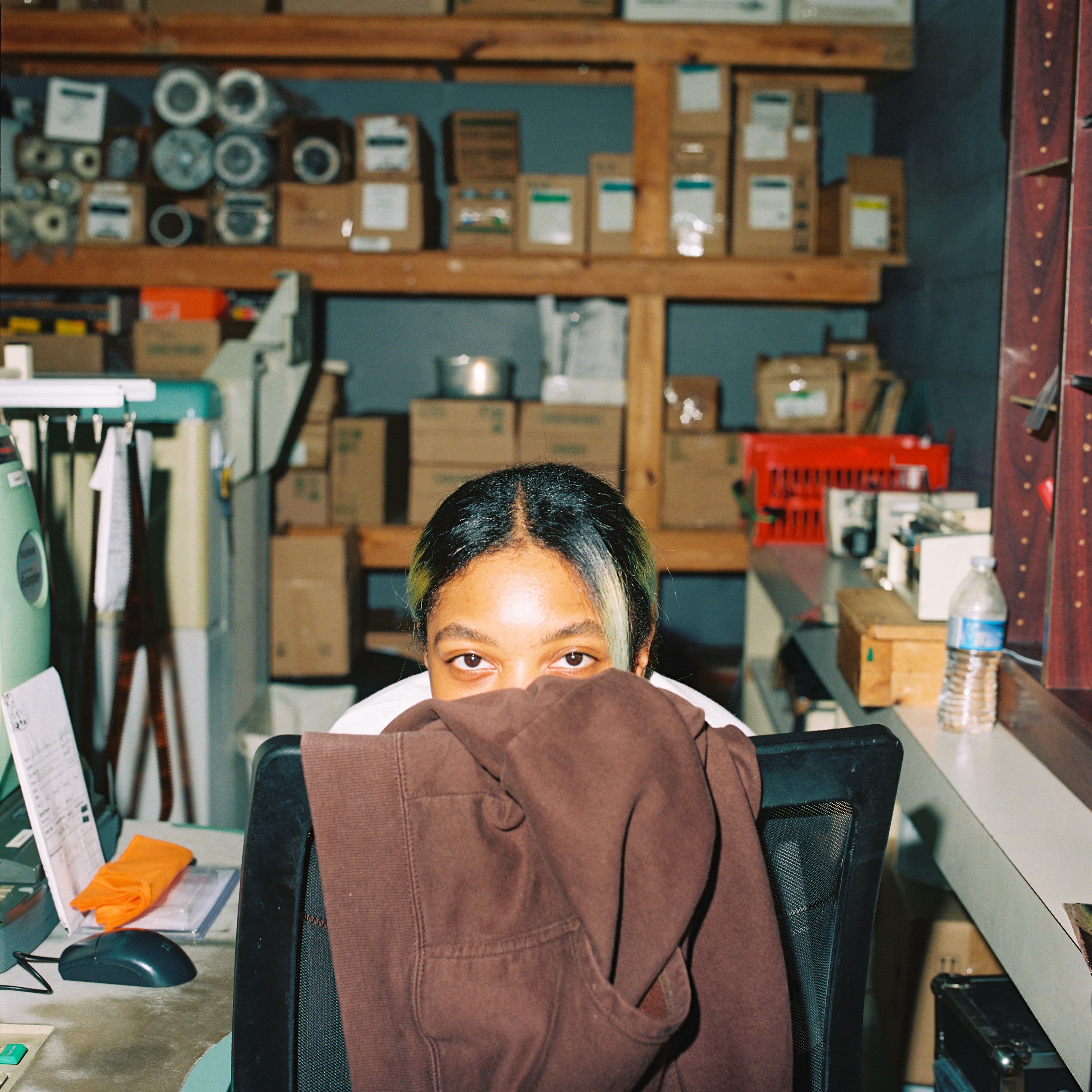
Jaylen Allmond takes a quick photo break from scanning film at Garland Camera.
Brennon Holbrook
“Rochester, New York, is producing some film, but it is being exported back to China for packaging and repackaging,” Meca says. “Some of this will go into disposable cameras. The others will just go into other types of cameras. They are going to be packaging Fuji with Kodak product inside.”
Because of this change, the price of Kodak film has increased significantly. The higher cost of film, perhaps married with TikTok’s recent Y2K undercurrent, now means a newfound interest in digital cameras.
“We are going from the disposable film cameras to the little compact digital cameras from the early 2000s. We buy those on a daily basis, and they are really starting to move,” Meca says.
Having the resources to keep up with the micro trends of photography is difficult. Materials are costly, and expertise is necessary. Luckily, Garland Camera provides all of its services in-house, so the staff can cater to industry changes.
“The neat part about it is that I took over when the film side was still pretty much dormant, and, as it evolved, we were able to evolve with it because we had everything that people were looking for,” Meca says.
As an old-school camera shop, Garland Camera offers film developing; buying, selling and trading of cameras and gear; a darkroom and studio supplies; and in-house camera repairs. This versatility means adaptability.
“Things that you can’t get done at CVS and Walgreens any longer, we still do, Meca says. “Things that Costco and Sam’s don’t do, we do. That’s the most intriguing part of it because it’s the preservation of an entire generation as well as the culture of the industry. There are very few of us left in the country. Camera store-wise in the country, there is probably less than 200 total.”
Acting almost like conveyor belts of knowledge tucked into unsuspecting storefronts, small stores like this one keep a skilled art form alive, especially among new generations.
“It is a younger clientele,” Meca says. “We have the young to interface with the young and the old … we’ve hired a lot of the individuals who have grown with the trend.”
Eight years into owning Garland Camera, he is proud of its service to the area.
“I bought this company to preserve and perpetuate its legacy in the community and DFW and beyond,” he says. “We’ve grown progressively at a steady rate over the last few years — just enough to handle it, but not enough to where we have customers lose faith in what our capabilities are. It’s who we are. It’s old school. We are not new and fresh and pretty. It’s just who we are.”

Zachery Runnels manning his station on the sales floor at Garland Camera, an old-school gem.
Brennon Holbrook

With the exhibition “Peter Keetman. Vintage Photographs from the Gerd Sander Collection”, Galerie Julian Sander is presenting one of the central figures of post-war German photography. In 1949, Keetman was one of the founders of the fotoform group, whose experimental, graphically incisive works echoed the photographic avant-garde of the 1920s. Keetman knew how to combine the influence that the “New Photographers” of the Weimar period had on him with his own individual perception of the reality that surrounded him and to translate it into a new, contemporary aesthetic. During his photographic activity, which spanned several decades, he focused his gaze on recurring subjects. He was interested in visually appealing phenomena that nature and the world of things have to offer: the transparency of a drop of water, the diffuse smoke of a cigarette, condensation in which the light refracts, crystalline ice formations, reflections, steam and fog. Through the lens of his camera, he isolated these optical phenomena and translated them into images of austere, graphic beauty. “We are surrounded – whether we take note of it or not – by a world full of lawful wonders” Peter Keetman recorded in later years. To make these wonders visible was what he saw as his task as a photographer.
The nearly fifty photographs, all of which are vintage prints produced close to the time the negative was taken, come from the estate of Gerd Sander, who died two years ago, and have recently been rediscovered. Sander, who was just establishing himself as a photo gallerist in New York at the time, had acquired most of them from the photographer himself around 1980. Among them are some of Keetman’s most famous, widely published photographs, but also works that are less well known today, but nevertheless of the highest aesthetic quality. Thus, the exhibition should be able to reveal one or another discovery for the interested collector.
Peter Keetman : Vintage Photographs from the Gerd Sander Collection
April, 22 – June, 30, 2023
Galerie Julian Sander
Bonner Str. 82
50677 Köln, Germany
www.galeriejuliansander.de

When you think of memorable landscape images, you probably think of golden hour shots with dramatic rays cascading across the frame, but there is a lot more to life than that. Any light, even “bad light,” can produce worthwhile images, and if you spend your time waiting for those magic golden hour moments, you are missing out on a lot of photo opportunities. This great video discusses the issue and the sort of personal philosophy that can make bad light days more enjoyable.
Coming to you from James Popsys, this insightful video discusses the issue of bad light in landscape photography and what one can do about it. No doubt, considering the often significant time and effort it can take simply to get to a location, it can be tremendously frustrating when the conditions don’t cooperate. However, I firmly believe worthwhile photos can be made in any light, but where we often go wrong is trying to force a certain image into existence rather than reading and embracing the light we’re given and making images it is conducive to. Check out the video above for the full rundown from Popsys.
And if you really want to dive into landscape photography, check out “Photographing The World 1: Landscape Photography and Post-Processing with Elia Locardi.”

Photographers Kahran and Regis Bethencourt reimagine fairy tales – CBS News
Watch CBS News
Be the first to know
Get browser notifications for breaking news, live events, and exclusive reporting.

These days, Frida Kahlo is inescapable.
The Mexican artist’s work, image and influence has become ubiquitous over the past few decades. She has unquestionably become an icon, her likeness plastered on everything from mugs and T-shirts, to more irreverent items like chocolate bars and Barbie dolls.
But when we stop to envision some of the seminal portraits of Kahlo, chances are they were taken by the photographer Nickolas Muray. The Hungary-born, New York City-based photographer took dozens of photos of Kahlo after their first meeting in 1931. After that initial acquaintance and over the next decade, the two would become close, even intimates, and remained friends until her death in 1954.
“People who know about Frida will walk into the museum and see a minimum half-dozen images of her that are so iconic,” says Beth Solomon Marino, the director of museum and visual arts at the California Center for the Arts, Escondido (CCAE). “And then there’s this realization of, ‘Oh, the same photographer was taking all of these pictures of her over these 10 years.’ They had this relationship. It wasn’t just a one-off where this great photographer snapped this picture that we all know. Even I didn’t know all these Frida photos I think of were all taken by Muray.”
Most patrons will already be familiar with a few of the pictures of Kahlo hanging within “Frida Kahlo: Through the Lens of Nickolas Muray,” a traveling exhibition opening Saturday at CCAE. There’s the seminal image of Kahlo sitting on a white bench in front of a green floral background — meditative, almost defiant, with roses pinned into her hair. There’s also the portrait of her, taken in 1939, wearing a vibrantly magenta rebozo (a shawl-like wrap) — stoic, celestial, her arms crossed.

“Frida with Nick in her Studio, Coyoacan,” a 1941 photograph by Nickolas Muray featured in the Escondido exhibit “Frida Kahlo: Through the Lens of Nickolas Muray.”
(Courtesy of Nickolas Muray Photo Archives)
However, the exhibition also includes more than one hundred other images taken of Kahlo by Muray. These include candid shots taken in more private, intimate moments, as well as group photos taken at parties and gatherings. Besides the photographs, there are also reproductions of various Kahlo paintings, as well as letters exchanged between Kahlo and Muray. Taken all together, the exhibition offers the viewer a sense of how the two artists, despite working in different media, came to influence one another. Both within their respective art and in becoming lovers, the two developed something of a symbiotic relationship, each igniting the other’s creativity.
“They had this very complex, but cerebral relationship that I was kind of stunned by,” says Cynthia Graves, the founder and director of GuestCurator Traveling Exhibitions, which circulates the “Through the Lens …” exhibition. “When I read their letters, I saw how they were working off one another. And in the photographs, you can see that as well.”
Both Graves and Solomon Marino point out that the exhibition’s main aims are twofold: First, to give an overview of Kahlo and Muray’s unique relationship and, second, to bring attention to Muray himself. The exhibition was first organized by the Nickolas Muray Archives and offers a startling overview of one of the most revered photographers of his time, albeit through one of his most beloved muses. Besides his portraits of Kahlo, he also took pictures and portraits of everyone from Marilyn Monroe and Babe Ruth, to F. Scott Fitzgerald and Franklin D. Roosevelt.

“Frida with Magenta Rebozo, New York,” a 1939 photograph by Nickolas Muray. It’s featured in the Escondido exhibit “Frida Kahlo: Through the Lens of Nickolas Muray.”
(Courtesy of Nickolas Muray Photo Archives)
“That was his job, but he also knew those people,” Graves explains, pointing out that Muray was also an Olympic medalist for fencing and developed revolutionary photographic techniques. “So because he knew his subjects, he was able to capture these very personalized images with this method that was very unique to him.”
“The exhibit is as much about him as it is about her,” Graves continues. “She’s an icon and everyone knows her. Bbut almost nobody knows about Nickolas Muray and he was such an intriguing person.”
What’s more interesting is that many of the Kahlo photographs in the exhibition were discovered after Muray’s death in 1965, undeveloped and stored away in a trunk as negatives.
“Once they realized what they had, they tried to figure out what to do with them,” says Graves. “And then, slowly, things began to develop from there.”
Pun intended.
Of course, at this time of discovery, Kahlo and her work had not reached the level of status it has today. It wasn’t until the 2000s that the Muray Archives curated an exhibition of the images and letters. It has since been expanded to include more information, photos and items, and has traveled to over a dozen institutions all over the world. The CCAE iteration of the exhibition will also include some Kahlo ephemera that was purchased by a San Diego collector in the 1980s. These include clothing, a necklace, a personal phone book and even a small calaca skeleton craft that once belonged to the artist.

“Frida with Blue Satin Blouse,” a 1939 photograph by Nickolas Muray. It’s featured in the Escondido exhibit “Frida Kahlo: Through the Lens of Nickolas Muray.”
(Courtesy of Nickolas Muray Photo Archives)
“For me, it’s these items, along with the letters and coupled with the images, that you really feel like a voyeur in some ways.” says Solomon Marino. “You know that these letters and items weren’t meant to be put in a museum, but here they are. It really makes you fall in love so much more with the photographs. Knowing the story behind them, behind their love, you look at the photos differently when you know that story.”
“They were both extremely extroverted people,” Graves adds. “They might actually be proud of those letters, that they shared that connection together. The letters take that physical relationship they had off-and-on for 10 years into another dimension. They show how they actually worked and respected one another, how they helped each other.”
So while the main subject of “Frida Kahlo: Through the Lens of Nickolas Muray ‘’ is iconic, it’s Muray’s keen eye and deliberate posing that offers a distinct window into Kahlo.
As with some of the best photographers, he manages to both ground his muse (a casual photo of her, hair down, lying face down in a bed) and add to her legend (the portrait of her, brush in hand, in front of her masterful 1939 painting, “The Two Fridas”). After seeing the exhibition, the viewer could certainly come away with the sense that while Muray may not have directly influenced Kahlo’s art, he almost certainly helped cultivate her image, both among the public and within the artist herself.
“They sort of fed off each other, just like artists do,” says Graves. “They were both such passionate, totally alive people. It must have been an energy that was beyond anything I could imagine.”
When: Opens Saturday and runs through Nov. 5. Hours, 11 a.m. to 5 p.m. Wednesdays through Saturdays, 1 p.m. to 5 p.m. Sundays
Where: California Center for the Arts, Escondido, 340 N. Escondido Blvd., Escondido
Admission: Free-$12
Phone: (800) 988-4253
Online: artcenter.org
Combs is a freelance writer.

It is one thing to be a good photographer, but running a successful photo business takes a large set of skills that have nothing to do with a camera. If you are new to working as a professional, check out this fantastic video tutorial that discusses some common business mistakes photographers make and how to fix them.
Coming to you from Chelsea Nicole Photography, this excellent video tutorial discusses some common business mistakes photographers make and how to fix them. The mistake a lot of photographers make is assuming that good skills with a camera and a solid portfolio will translate to success in a photo business. Of course, you need to be solid behind the camera before you take the professional dive, but it is far from all you need to find sustainable financial success. In fact, you might be surprised by what a small proportion of your time as a professional will involve taking pictures. The truth is that there are a lot of decent photographers who make a nice living because they are excellent businesspeople, while many of the best creatives fall by the wayside because they lack the skills needed to run a viable business. Check out the video above for the full rundown.

Explore the art of local photographer, Becky Field, at the Concord Public Library and the City-wide Community Center.
The Opening Reception will be held on Wednesday, June 14th, 6:00 pm – 7:30 pm at the City-wide Community Center.
This press release was produced by the City of Concord. The views expressed here are the author’s own.

Growing up in the suburban Sherman Oaks district of Los Angeles, Larry Sultan lived close to a public swimming pool. His regular visits there were undertaken with a degree of trepidation. “I was petrified of water, of deep water, especially,” he recalled in 1980. “When I was 12, I almost drowned in the ocean. Water is the only bit of nature I know that we can’t control, that seems overwhelming when you enter it and are totally immersed in it.”
In 1974, partly as a way of confronting his own primal fear, Sultan began photographing the participants in a local swimming class for blind people. He abandoned the series soon afterwards and began working on more conceptual projects alongside Mike Mandel, whom he had met at art school in San Francisco. In 1977, the pair published Evidence, an enigmatic book of monochrome found photographs from various American technological and research institutions that is now considered a landmark of conceptual photography. It was both the apex and end point of their creative partnership.

In 1978, inspired by a Red Cross swimming and life-saving manual, Sultan once again began photographing people in the San Francisco area learning to swim. For the following four years, using a small underwater camera and a snorkel, he shot regularly at the Jewish Community Center of San Francisco, the Richmond Plunge and the Recreation Center for the Disabled. Throughout, what he called “the groundlessness of the experience” of swimming in the deep end remained an issue for him and for many of his subjects. It also determined his approach. “I knew I had to get underneath the water to photograph this lack of support, lack of control,” he said, describing how, by doing so, he became a participant in the very experience he was photographing.

The resulting images, titled Swimmers, evoke the sometimes balletic, sometimes ungainly, sometimes sensual dance of submerged bodies in motion: floating, flailing, sinking and resurfacing. The water itself is the defining element, altering his photographic perception and subverting any attempt at capturing the decisive moment. Submerged bodies often appear elongated or distorted, the play of light on water dappling limbs and torsos, sometimes rendering his fellow swimmers translucent, even ghostlike. Here and there, bodies fall though water or are kept afloat with the help of instructors. He later described his time at the Recreation Center as “the most profound experience”.

Sultan found the physicality of photographing bodies partially or totally submerged in water as unsettling as it was liberating, and his own fear is a constant subliminal presence in the images. Formally, too, it was risky, not least because it meant abandoning the more cerebrally driven approach that had characterised the projects he had undertaken with Mandel. Perhaps for this reason, the series seems like a brief, but heady, interruption of his usual practice, neither as conceptually playful as the work that preceded it, nor as formally rigorous as the work that followed it.

Larry Sultan died in December 2009, aged 63, by which time he had reinvented himself once again through meticulously choreographed series such as Pictures From Home, in which he photographed his ageing parents in their sumptuous suburban house in the San Fernando valley, and The Valley, which featured middle-class homes there that had been rented out as sets for porn films.
Painterly and impressionistic, filled with movement and gesture, Swimmers is Larry Sultan’s most instinctive and unselfconscious body of work. A creatively liberating moment that reveals as much, if not more, about the person behind the lens as those in front of it.

I recently had the chance to visit Malta and wander its rocky coastline and old streets with the Fujifilm X-S20 – one of the best mirrorless cameras for enthusiasts – paired with the Fujinon XF 18-55mm F2.8-4.0 R LM OIS lens.
The weather was pretty much wall-to-wall sunshine, which is lovely for a holiday but more of a challenge for photography, especially in the middle of the day. In such bright conditions, I often lean into black and white.
If I had a ludicrous amount of money, then the $9,000 Leica M11 Monochrom (the mono-only version of the Leica M11) with a moderate-wide lens would be a great option for black-and-white street photography. But Fujifilm X-series cameras like the X-S20 are a compelling option, too, for a fraction of the cost.

Amid the tourist-filled streets, I got to grips with the Fujifilm X-S20. Even though it’s a really small camera, you get a generous handgrip, a decent electronic viewfinder, and a flip-out touchscreen. Both are handy for composing street photography in bright sunlight: I could tilt the screen to an angle that minimizes glare or use the viewfinder instead. That flip-out screen is also handy for shooting discreetly from the hip.
And then there’s Fujifilm’s Film Simulation modes that digitally recreate the look of Fujifilm’s celebrated 35mm film stock. One of those digital looks is Acros, which faithfully recreates the rich monochrome Fujifilm Acros 100 film, first introduced to the X-Series cameras alongside the Fujifilm X-Pro 2 in 2016.
For a digital look, Acros is super-authentic. Even though the simulation can be applied post-capture to raw images, I like to select it in-camera, so I can see what I’m getting as I move about looking to encapsulate the feeling of my surroundings.
Depending on what the shooting mode dial is set to, the customizable dial on the top left of the X-S20 scrolls through the 11 Film Simulation modes for quick selection. The X-S20 introduced Auto-Film Simulation mode, which assesses the scene and selects a look for you. It tends to choose different color looks rather than monochrome, but that can be changed easily via the top-left dial instead.
I really like the look of the X-S20’s Acros Film Simulation. The look can be manually adjusted with different color filters, but even without manual adjustment, the rich tonality is really pleasing. I’ll let you be the judge from the gallery above, but I’m a fan and would happily leave the X-S20 in its Acros Film Simulation when shooting in the sun. It’s a compelling option for street photography.





