Photography

Corporate Chaos: 7 Lessons Learned in 10 Years of Event Photography

Corporate Chaos: 7 Lessons Learned in 10 Years of Event Photography

Like many photographers, we used to be more “jack of all trades” when it came to shooting professionally. We’d shoot a wedding one day and a product shoot the next.

Residing in Las Vegas, the convention capital of the world, we started shooting more and more corporate events ranging from trade-show booths to corporate parties, so we decided to focus exclusively on corporate photography and videography.

Many people we talk to always ask us, “Isn’t that a bit boring?”. Quite the contrary. We get to participate in all sorts of amazing events and see technology years before the public even hears about it. We get to meet heads of state, world-famous celebrities, industry leaders, and more.

What we didn’t realize when we first got started in corporate event photography was how much we would have to learn about logistics, planning, and organizing photo shoots that were totally foreign to us. Over the years, there were so many curveballs thrown at us by our clients (such as the time we were booked to shoot photos and video of an A-list celebrity in a trade-show booth with attendees and the celebrity showed up drunk and started hitting on all the women working in the booth…yes, this actually happened) that taught us a lot of important lessons on how to run our photography business.

So if you’re new to corporate photography or perhaps you’ve been shooting in this arena for a while, perhaps some of these lessons we’ve learned can be of help to you too.

Lesson #1: Ask Questions

First, always ask LOTS of questions about the event with your client, and be persistent when you don’t get answers!

Many times, events are put together by teams of people, many of whom have little experience in dealing with outside contractors. As such, they will spring on us the weirdest of requests at the last minute.

We once shot a cyber security conference that needed all our team members to pass federal background checks prior to the event. We’ve had clients spring on us at the last minute the need for special OSHA certifications for our team, unique insurance coverage requirements, etc. All of which could have been handled far in advance if we asked the right questions.

Now we actually send out a questionnaire to all our clients upon booking asking a wide variety of questions about special needs or requirements of us. We ask about what the environment is going to be like when we’re shooting (outside, inside, or both). We ask about dress code (one client asked us, three days before the shoot, to run out and get our staff fitted for tuxedos — we charged them extra for that).

Lesson #2: Prepare for Challenging Lighting

Other times we are hired by people who have no experience whatsoever regards to staging or how things affect photos and video. We once shot a three-day training event for about 100 attendees. The company made software for point-of-sale computers in the restaurant industry. Their stage consisted of a 20-foot-wide canvas banner hung from a truss and was lit with up-lights beneath it. None of the speakers on stage were lit either, so everyone was backlit with blue light on a reflective banner.

Our photographer was able to use a flash in this circumstance (something we prefer not to do for presentations unless absolutely necessary) but we were also filming this event from the back of the room. Everyone on stage in this case looked terrible and we pointed this out to the client. Nobody had ever thought to get any kind of theatrical lighting for the stage when they planned the event because they thought the banner and up lights would “look cute”. When they talked to the venue about this, the cost to bring in lights for the three days was close to $7,000, which was way outside the budget for the event. So, they got bad quality video as a result.

This wasn’t the first time we’ve run into this exact type of scenario either, where small corporate presentations never have enough lighting on stage. So, we decided to do something about it and invest in some heavy-duty lighting trees, some LED PAR lights, and a road case for all the above. Now, when a client tells us they never thought about how they were going to light the stage, we can offer our kit for this and only charge them 1/3 as much as the hotel or convention hall will. This results in not only a better-looking event for them but WAY better photos and video that we can deliver, which helps with repeat bookings and a much happier client. The original light kit we bought paid for itself in two bookings, and we have since upgraded our stage lighting twice.

Lesson #3: Beware Cigar Smoke

We once were hired to photograph the awards ceremony for a major cigar company. It was a black-tie event for their top salespeople and we were told it was a cocktail reception and banquet/awards dinner immediately after. It seemed straightforward and nothing we hadn’t shot dozens of times. There were three of us shooting the event. I had one photographer assigned to shoot all the guests entering at a step-and-repeat backdrop while two of us were inside taking pictures of the cocktail reception. Once that ended, all three of us would be shooting the awards ceremony. The event was held at an upscale hotel on the Las Vegas Strip.

What happened after we arrived was something I never could have predicted, but probably should have.

Being that this event was held in a ballroom at a classy hotel, I never would have guessed that cigar smoking would be allowed, and not a little puff here and there, everyone was smoking like a chimney. Once we geared up and went into the smaller ballroom, where the cocktail reception was being held, we noticed that they were pushing around huge cigar humidors filled with hundreds of cigars each… all free for their guests.

Men in tuxedos and women in evening gowns were all grabbing handfuls of cigars, and they smoked all of them throughout the night. It didn’t take long before the ballroom filled up with so much smoke that we couldn’t see from one side of it to another. The smoke inside was burning our eyes and causing us such respiratory issues that we all had to take breaks and step outside for fresh air every 10 minutes.

It is then announced that dinner is being served along with live music for everyone in a much larger ballroom and the awards would be starting soon. We went inside the much larger room and thought it would be much better now…it wasn’t. There was something really strange about watching a woman in an expensive evening gown smoke a cigar while cutting her filet mignon and lobster dinner. It didn’t take long for this room to look like the smoggy haze of a major metropolitan city. By the time everything was said and done, all of us were sick for days. Our camera lenses had soot all over them and we billed the client for thorough camera cleaning and servicing.

I wonder if the person who booked us intentionally never told us about the smoke, but at the same time, I should have thought to ask as well. Our lesson here is that we always ask our clients to describe what the events are going to be like, so we know how to properly prepare for them. In this case, perhaps gas masks or hazardous material suits probably would have been a good idea. I also would have turned this job down had I known that we would be exposed to so much second-hand smoke that night.

Lesson #4: Review Everything with Clients

When it comes to shooting corporate events, I can’t stress enough how important it is to review everything with your client over and over again prior to the shoot. When companies plan large corporate events, it might involve dozens or even hundreds of people from different departments and committees. In the weeks and months of planning the event, those team members may get together several times in different meetings to iron out schedules, staff assignments, the speaker roster, menu options for the meals, the custom drinks they are having at their private party, etc. So, when you get an outline of the event two months out, chances are things are going to change dramatically by the time the event rolls around and most likely you won’t get the updated list of all the changes.

A few years ago, we were booked to shoot a large, 3½-day e-commerce conference. It was the first event this company had hosted and so they wanted a lot of coverage of everything. In addition to wanting photos taken of all their keynote presentations on the main stage, they wanted every one of the nearly 100 breakout sessions photographed plus photos of the green room for their celebrity speakers, pictures of all the branded experiences they were providing from espresso stations to early morning yoga classes, and then some.

They wanted multiple photographers to shoot their corporate party, coverage of all the event setup, and to top it all off, video coverage of all of this to be made into a highlight video. It was a lot. On top of this, they had a small expo area and they told us they wanted photographs of every individual booth so they could use this to get more vendors at future events.

When we were booked for this, six months prior, we had this conversation:

“About how many vendors are you expecting in the Expo?” we asked. “About a dozen. maybe 15 or so” they told us. “We want to make sure every booth is photographed well so please be aware of this” they repeated. No problem. For one of the days, we assigned a dedicated photographer to shoot for a few hours of their expo area.

Fast-forward to the day before the conference started, we were walking the floor with their staff, going over any last-minute details when we walked inside the expo hall as it was still being built out. “There’s a lot more than twelve exhibitors here,” I said, with my jaw on the floor. “Oh yeah, we have about 175 now. I guess we forgot to tell you. And yeah, please make sure we get every booth photographed. That’s really important!” we are now told.

Now it went from having a photographer shoot booths for an hour or two to needing a dedicated photographer to shoot over ten times as many as we expected over several days. We had to spend hours redoing the schedule to accommodate this, bringing in more staff to help on last-minute notice. Of course, the client doesn’t care about any of this, yet it’s still up to you to make it happen and make them happy, so now we know that at large events like this, always have people on standby!

Lesson #5. Check-in with Clients Often

We once were shooting a large event at Caesars Palace here in Las Vegas, whose convention center is about 300,000 square feet in size spanning multiple floors. Two days before the event we got our finalized shot list of speakers and events that needed to be photographed throughout the day. We arrive early, gear up, and started shooting exactly according to plan.

We were told repeatedly that one of the most important things to get photos of that day was a noon press conference for a major product they were rolling out. We had it on our shot list, reminders on our phones, etc. We were all ready to go. 30 minutes prior to the press conference starting we walked to the designated ballroom on our shot list and when we entered, the room was completely empty. No tables, no chairs, no stage…nothing.

I walked outside the room, confirmed the room name against our shot list and it all matched up. I called our on-site contact for the company, and she wasn’t answering her phone. I’m sending her text messages and calling over and over to no response. We’re walking around the area looking to see if the press conference moved to an adjacent ballroom and everything around us was empty.

Five minutes before the press conference was about to start I get the call. “Where are you guys?! The press conference is about to start!!!!” says our client. “We’re standing outside the ballroom right now and nobody is here,” I said. She responds with, “Oh, I guess I forgot to tell you, we moved the press conference last night to another room on the other side of the convention center and two floors down. What’s your ETA?” So with cameras around our necks and Pelican cases of gear in tow, we ran across a giant convention center to a press conference….that started 30 minutes late anyway.

The lesson here is, no matter what the client gives you, review and check in with them every morning of an event, or even several times a day during long days to verify that everything is where it’s supposed to be and happening when it’s supposed to happen. Events moving or times changing is a very common occurrence on these types of shoots, so it is crucial to have at least one or two on-site contacts you can reach regularly in case things go sideways.

Lesson #6. Build Up Your Contact List

If you are planning to dive feet first into shooting large corporate events, be sure to have a huge contact list and be prepared to be resourceful if you plan on being successful in this business. We have a policy that no matter what’s asked of us, the answer is always “YES!” and we can figure out the details later.

One of our largest clients has us shoot several large events every year for them culminating in their annual conference where they fly over 5,000 employees to Las Vegas to attend. One of their smaller training events though had only a few hundred people and they asked us to provide photos and video of some of the keynote sessions for distribution to the rest of the company unable to attend. It wasn’t a very complex shoot at all, that is, until the second day.

“We want to do a group photo sometime tomorrow with everyone here. How can we go about that?” the client asked us. “This isn’t as simple as getting everyone together in a room and shooting them on a ladder,” we explained, but they persisted that they really wanted this to happen.

The event was being held at the Park MGM resort, directly adjacent to the Toshiba Plaza and T-Mobile Arena, where the Vegas Golden Knights NHL team plays. The courtyard between the two properties is very large and can easily accommodate this many people. There is also an adjacent parking garage where we thought we could position a photographer to get the group photo. So on a lunch break, we went to scope things out, and we discovered that at the only time of day we could take this photo, the sun would be moving across the courtyard and a shadow would be covering half of the group while the other half would be in direct sunlight, so this wouldn’t work.

Our only other option was to move the group somewhere else in the courtyard and get up high somewhere to take the photo and the hotel wasn’t very cooperative about this. So, I called my friend Joe, who was the General Manager of a large trucking and logistics company, how hard would it be to get a scissor lift delivered there in 24 hours? “No problem!” he said. He would even have someone available to drive it for us! 23 hours later, we had our scissor lift, the client’s staff got everyone to wear a conference shirt, wrangle everyone into the courtyard, and we got our photo.

The lesson here is to keep business cards for anyone who might ever be able to help you with anything, and keep their information organized and on your phone. You never know when you might need someone to bake you 1,000 cupcakes in a day or organize a company sack race as part of a team-building activity in less than a week or get you a scissor lift to the Toshiba Plaza for a group photo of hundreds of people.

Lesson #7. Use Legwork to Fix Problems

Sometimes you don’t have the luxury of being able to just call someone though. You must be able to use some legwork to fix a problem. We were once booked to shoot for a vendor in a library convention (yes, those do exist). The theme of that year’s expo was “Transforming Your Library” so one of the main sponsors of the event, a software company, booked us to take photos with attendees and a “Transformer” street performer to get people into their booth. So we would take a photo of the attendee with the Transformer, wirelessly transmit the photos to an online photo gallery, and then give a card to the attendees pointing them to where they can download their free photo after we scanned their badge. It was a really fun promotion and we knew everyone would enjoy it.

While in the planning stages, our client asked us, “So, where can we get a person to be our Transformer? Most of the talent agencies in Vegas weren’t being very cooperative”. “Oh, I’m sure we can take care of that for you,” we said, and we worked out a price that they agreed to. Now we just needed to find a Transformer! We had over a month to plan this, so we ran some casting calls on social media and we got a lot of responses (some better than others). One of the people who responded had a great-looking costume, was comfortable with the pay we were offering, and agreed to do the job.

A few days prior to the event I called our performer to confirm everything, and I got the bad news, “Oh yeah, about that, I sold my costume and moved to California. Sorry about that!” and he hung up. We are now less than a week away and had no Transformer. So what did we do? We hit the streets of Vegas to go find one!

If you haven’t been to Las Vegas in a while, the downtown area and Las Vegas Blvd. (“The Strip”) have dozens and dozens of street performers busking for tips. You’ll see musicians, contortionists, magicians, and all sorts of unique entertainers. You’ll also see a LOT of people in a wide variety of different costumes all out there looking to take a photo with you in exchange for a cash gratuity. Spending a few hours walking and talking to every “Transformer” I could find was a bit challenging for sure as many of the street performers didn’t speak English, but I did manage to find one who was available to work the corporate gig coming up. So in the end, it all worked out, but it was certainly a very stressful week hoping we could find someone and that they would show up.

Our Transformer showed up on time and he was awesome. Everyone at the convention loved him, and after we received praise from our client as to how well everything went, not knowing the craziness of what happened in the days leading up to the event. It wasn’t until later that we told them what happened, and we all had a good laugh. It was a stressful moment, but we made it all come together.

Every genre of photography has its level of craziness behind it, and we never thought that shooting corporate events would keep us on our toes as much as it does. If there is anything we’ve learned about all this though is that there is a lot more to being a corporate event photographer than just taking pictures of cocktail receptions. You need to learn to stay cool under pressure, network with people very well, stay very organized, be good at managing teams of creatives, and make your clients extra happy at the same time. One thing is for sure though: working in this environment does lead to some interesting stories!


About the author: Adam Sternberg has been a professional photographer and videographer in Las Vegas for over 25 years. He is the co-owner of CorporatePhotographers.com, one of the largest corporate photo and video companies in the city.

In an Elegant New Book of Essays, Rebecca Bengal Mines the History—and the Power—of Photography

In an Elegant New Book of Essays, Rebecca Bengal Mines the History—and the Power—of Photography

When Kodak opened its doors in 1888, photography was a cumbersome chemical process best left to professionals, a reason George Eastman’s slogan caught on: “You press the Button, We do the Rest.” Now that we’ve switched out cameras for phones and outsourced “the Rest”—managing our stories, storing our memories—to Meta and Apple, we might forget to think about photography at all. We might forget to think not just about what it is, but also what it can do, especially since photography is mostly mischaracterized as a means merely to document, and underestimated for its ability to explore what oftentimes cannot be easily seen. “Pictures are luckier, they are looser than words,” writes Rebecca Bengal in her just-published collection of essays on photography, Strange Hours: Photography, Memory, and the Lives of Artists. “Words have to fight harder to arrange themselves, to express that which in a photograph might be the mingling of order and accident, a strange convergence, a kind of grace.”

In this collection of thoughtful and elegant essays, Bengal, a former editor at Vogue (where some of these essays first appeared), writes about pictures and picture-makers, but also about the history of the medium over the course of the last half a century. We meet well-known and not-known-enough photographers, as introduced by a writer whose experience in the world of editorial photography is rooted in time spent at the legendary and now-defunct magazine DoubleTake. Published from 1995 to 2004, with fiction, essays, poetry, and reviews, the magazine was “a home where image and word have equal weight,” according to its founders, the doctor, psychiatrist, and author Robert Coles and photographer Alex Harris. Their inspiration was the famed partnership of James Agee and Walker Evans, as well as the collaboration of writers and photographers of the Works Progress Administration. It was a place where what was sometimes described as social realism was worked out with both typewriters and lenses, and Bengal describes her tenure there as (not unlike her book) “a brief but compelling meditation and record of the possibilities and problems and relationships that exist between words and pictures.”

Alec Soth Near Williston North Dakota 2012 from Strange Hours Photography Memory and the Lives of Artists by Rebecca...

Alec Soth, Near Williston, North Dakota, 2012; from Strange Hours: Photography, Memory, and the Lives of Artists by Rebecca Bengal (Aperture, 2023).

Photo: Courtesy the artist

Photography inspiration: Can blurry photos be tasteful?

Photography inspiration: Can blurry photos be tasteful?

In the age of digital photography, it’s easy to achieve sharp and clear captures. However, this has also led to the notion that sharpness is overrated. Today’s photography inspiration may be a point of discussion (or debate, even), but let’s ask anyway, can blurry photos be tasteful?

In the video above, Imitative Photography introduces us to the work of Olga Karlovac, who only shoots black and white blurry photos using point-and-shoot cameras. She self-published her first book Before Winter in 2017, followed by The Disarray in 2019, then Escape in 2021, along with a number of exhibits.

Black and white, she said, gives more strength and essence to her photos. Add to this the otherworldly quality that blur adds to an image and you have a visual style that feels like a memory. This, the video notes, parallels how memories tend to blur with time — you may forget the fine details but still remember the broad strokes.

This creative use of blur relies a lot on the power of emotive visuals. Admittedly, that’s not always easy to pull off, nor does it work with all photography projects. But in case you still want to try recreating this style, the video above includes some tips to help you get the look and feel.

What do you think of Olga Karlovac’s emotive approach to black and white photography? Do you find it an effective or clever way to use blur? Share your insight with us in the comments below, or in our group discussion if you’re already part of the Photofocus Community!

A Teen Photographs a Wild Elephant in Close-Up

A Teen Photographs a Wild Elephant in Close-Up

A 14-year-old boy captured these breathtaking images of a wild elephant emerging and wandering on the road of Khao Yai National Park in Nakhon Nayok Province.

Images published on the page “The Sound of a Sobbing Forest” (เสียงป่าสะอึ้น) were taken by Krishna Rojanaburanont, 14, son of Mr. Asampinpong Rojanaburanont, the headman of Ban Pong Pratun, Pak Chong Sub-district, Pak Chong District, Nakhon Ratchasima Province, and page members who travelled up with him to photograph nature on Khao Yai on June 5.

Krishna Rojanaburanont / เสียงป่าสะอื้น

The elephant, which was about 15-18 years old, without tusks, and was of unknown gender, strolled out of the forest on the way out, leading automobiles to want to drive away but were unable to do so due to the large number of cars following after. The wild elephant then proceeded down into the forest.

Krishna Rojanaburanont / เสียงป่าสะอื้น

Mr. Chaiya Huaihongthong, the head of Khao Yai National Park, stated that wild elephants occasionally come out to walk on the road that leads to the Prachinburi side. Mr. Sittiporn Product, an officer who is experienced with wild elephants, is usually in charge of looking after and assisting visitors and others who utilise this route.

Krishna Rojanaburanont / เสียงป่าสะอื้น

“Since I took the position of head of the Khao Yai National Park for almost 2 years, I have never seen wild elephants attack anyone. Because wild elephants in Khao Yai are good-natured. Just tourists, don’t go to stir up the elephants. Stay 50 meters away from elephants. Don’t turn off the engine. Don’t blow the horn. Don’t make noise. Wild elephants won’t do anything harm,” said Chaiya.

How to Create Breathtaking Images with Couples Boudoir Photography

How to Create Breathtaking Images with Couples Boudoir Photography

SLR Lounge helps over 1.5 million photographers master their craft. Real world education & resources from the most successful wedding photography studios in the world.


Watch anywhere
Learn online, anywhere, anytime.


Access Tutorials & Resources
Exclusive content and more!


Submit to awards
Have your work recognized.


Join the Conversation
Ask questions, seek inspiration
and contribute to our community.

Royal Oak gymnastics photographer caught with child porn, admits to barefoot pictures

Royal Oak gymnastics photographer caught with child porn, admits to barefoot pictures

ROYAL OAK, Mich. – A well-known children’s gymnastics photographer from Royal Oak was caught with child pornography and admitted to taking pictures of children’s feet at their events for his own pleasure, officials said.

An FBI agent was investigating a peer-to-peer file sharing program last month because it’s known to be a place where predators share child pornography.

While searching the program, he identified a user who had downloaded 14 files of interest to investigators on May 11. Of those files, at least two met the federal definition of child pornography, according to authorities.

On May 23, the agent worked with WOW! cable and traced the user’s IP address back to the Royal Oak home of David Eric Yellen, 58.

Officials said Yellen is a freelance photographer who takes pictures and videos at girls’ gymnastics events. He has received credit and accolades for his work at multiple events over the years, according to a criminal complaint unsealed Friday, June 2.

FBI agents searched Yellen’s home on Thursday, and he admitted to possessing child pornography on his electronic devices, court records show.

Yellen told officials that he used the file sharing program regularly, but denied uploading or downloading child porn. He said he had downloaded child porn 10 years ago and has kept it, but he claimed not to know that those images could be downloaded by others.

“Given his extensive use of (the file sharing program), I do not believe that he was unaware that he had his files in a location that allowed for sharing with others,” the FBI agent wrote in the criminal complaint.

Yellen denied producing child pornography, but said he would often take pictures of children’s bare feet during gymnastic events while working as an official photographer. He would then use those pictures for his own pleasure, the complaint says.

A computer and hard drive at Yellen’s home contained at least 1,500 pictures of children, and at least 500 of them meet the federal definition of child pornography, authorities said.

Among those photos were the original files downloaded on May 11, according to officials.

The hard drive included a folder titled “BFK,” and Yellen admitted that it stood for “barefoot kids,” agents said. There were at least 200 pictures of children’s bare feet in the folder.

The criminal complaint concludes there’s probable cause that Yellen distributed and possessed child pornography.

Photographer lets little girls ‘not smile if they don’t want to’ and lets the photos do the talking

Photographer lets little girls ‘not smile if they don’t want to’ and lets the photos do the talking

People—especially young women—are almost always expected to smile when posing for photographs. However, a photographer named Brooke Light thinks differently. For her, when kids drop their masks and forget what they are doing is when their true, powerful selves come out. And this is what has been making her latest viral video grab eyeballs across social media platforms.

It begins with the overlay text, “When your photoshoots allow girls to show up, take up space and not smile if they don’t want to.” Light can be seen holding her camera before the video goes through a sequence of her exceptional black-and-white photographs of young girls looking visibly comfortable and confident in their own skin. While some look into the camera and some away, none of the youngsters seem to be posing. Instead, they look completely in their element and that’s what makes these pictures so unique. 

Image Source: Brooke Light/ TikTok/ @bdlighted
Image Source: Brooke Light/ TikTok/@bdlighted

The video has garnered about 959k views and is captioned, “Never underestimate the power of a photoshoot for your kid’s confidence.” People in the comments section were mesmerized by the beauty of each picture. @jonileagarcia283 commented, “They look powerful and authentic.” @wherepaulsleeps wrote, “I love how they are not trying to be anything ‘extra’ just their own raw and savage selves.” @writewithmd shared, “I love this so much! I HATED smiling for the photographers and remember thinking they’d never force me. How validating!”

ADVERTISEMENT

@hippiechick0297 said, “Authenticity is fabulous! Everyone doesn’t always feel like smiling and that’s okay. Beautiful even.” @xo.kilili commented, “Wow this is such a great perspective!! Thanks for the knowledge share!!”

ADVERTISEMENT

Light started photography when she left college but stopped completely when she moved to Charlotte, Noth Carolina. “I did a few weddings, small publications and family sessions back then. I stopped photography altogether when my husband and I moved to Charlotte, NC. The market here intimidated me. I have no formal photography training so the imposter syndrome was very real,” she told Upworthy.

Image Source: Brooke Light/ TikTok/ @bdlighted
Image Source: Brooke Light/ TikTok/@bdlighted

“Jump to 2020, when I experienced a layoff due to the pandemic and I picked up my camera again for a candle company (Sparta Candle Co., they are popular on TikTok). In 2021 I did my first photo session with my niece in what would become my Moody Mini style,” the photographer added. 

ADVERTISEMENT

When asked what led her to do these shoots in a style that’s generally not seen much in the industry, Light said, “I’ve always been drawn to more dramatic, editorial style photography. When I did that first photoshoot with my niece Ruby, it ignited something in me. Watching her transform on the other side of my lens was so creatively energizing that I knew I needed to pursue this. I had never experienced a kid relaxing into a photoshoot so quickly. She just existed without anything performative and from that, her photos felt like a feeling instead of an image.” 

Image Source: Brooke Light/ TikTok/ @bdlighted

Light couldn’t choose a favorite session from her photography career so far but shared that she has a favorite shot from each one. “There is always this moment where the kid/teen drops the mask and forgets what we are doing. They relax into the photoshoot and those moments are everything for me. We always get the shot then. I haven’t had a session yet where we don’t have that moment and I always know it immediately. A lot of the photos I share on my TikToks are examples of those moments,” said Light.  

ADVERTISEMENT

Photography exhibition to display celebrities posing naked with fish

Photography exhibition to display celebrities posing naked with fish

From Judi Dench to Sean Penn: Here’s why celebrities have been posing naked with fish since 2009.

When the word “fish” comes to mind, it may not evoke the sexiest of images.

However, what if some of the world’s most famous and attractive personalities boldly posed nude alongside these slippery sea creatures? 

Well this is precisely what the Fishlove organisation has been doing since 2009. 

Their purpose? To raise awareness about the need to protect the Earth’s marine ecosystems and promote sustainable fishing practices.

Their photographic subjects have ranged from the esteemed Oscar-winning Dame Judi Dench and the visionary founder of Virgin Richard Branson, to the immensely talented Helena Bonham Carter.

Now, Fishlove is set to push boundaries once again with the launch of an audacious and thought-provoking photographic exhibition titled “Ending EU Overfishing: The Decade Past and the Decade to Come,” positioned poignantly in front of the EU Parliament in Brussels. 

What’s with the nudity?

The decision to employ nudity as a means of communication might raise a few eyebrows, but Fishlove firmly believes that exposing the naked truth about overfishing is far more important than mere shock value. 

These captivating portraits, featuring celebrities who have generously lent their influence to the cause, aim to jolt the viewer into recognising the detrimental impact of overfishing on our oceans.

Fishlove believes that while EU fisheries management has made some progress, it has fallen short of its commitment to ending overfishing. 

“With the ongoing climate and biodiversity crisis, it’s time for EU decision-makers to be inspired by the courage of these celebrities and take bold action towards transforming fisheries management to ensure healthy marine ecosystems and tackle climate change,” the organisation’s statement reads. 

What to expect from the Brussels exhibition?

Launching on 6 June, the Ending EU Overfishing exhibition will showcase portraits of 20 different celebrities, including the likes of Dame Judi Dench, Helena Bonham Carter, Sean Penn, Gillian Anderson, Emma Thompson with Greg Wise and Rutger Hauer. 

Brussels will play host to this exhibition until Friday 9 June, giving enough time for visitors to reflect on their own relationship with the oceans.

The Museum of Natural Sciences will also be host an End Overfishing Gala Event, featuring celebrity guest appearances from Jean-Marc Barr, Greta Scacchi, and Rainer Bock. 

During the gala, Fishlove will unveil a new series of images, featuring additional celebrities who have rallied behind the cause, including Rainer Bock, Lubna Azabal, Claudia Gerini, Danica Curcic, Lena Melcher, and Jessie Buckley. 

An Alternative History of Photography

An Alternative History of Photography

Dedicated to the cultures of Africa, America, Asia, and Oceania—in other words, the non-European world—the Musée du Quai Branly-Jacques Chirac, in Paris, boasts a photographic collection of over 700,000 items. This is the largest collection of the institution which also houses some 300,000 objects, sculptures, etc. While the exhibition includes a few items on loan from private collectors (such as Serge Kakou) and other institutions (including the Bibliothèque Nationale de France), the 300 pieces in An Early Album of the World are mainly from the museum’s own.

Timothy H. O'Sullivan, Photograph of exploration and geographic survey west of the Wheeler 100th meridian © Musée du quai Branly - Jacques Chirac

Timothy H. O’Sullivan, Photograph of exploration and geographic survey west of the Wheeler 100th meridian © Musée du quai Branly – Jacques Chirac

Joseph Razafy, Sans titre © Musée du quai Branly – Jacques Chirac

Joseph Razafy, Untitled © Musée du quai Branly – Jacques Chirac

101 photographers on show

One of the challenges of the presentation is to highlight the singularity of this collection, which is distinguished by the proportion of non-European authors. “Among the 101 photographers on show, 52 are Westerners and 49 are indigenous. This near-parity was made possible by the rise, over the last decade, of acquisitions of works by artists from the four continents,” explains Christine Barthe, head of the heritage unit at the Quai Branly’s photographic collection and co-curator of the exhibition with Anabelle Lacour, head of the photographic collection.

The other aim of the exhibition is to show how, less than three years after its invention, photography had begun to spread around the world, first through Western influence, but very quickly by the efforts of the locals themselves, notably in Iran, Japan, and India. “Many people around the world were curious to see how photography worked,” noted the curators. In those three countries, the ruling elites were fascinated by the medium and contributed to its development.

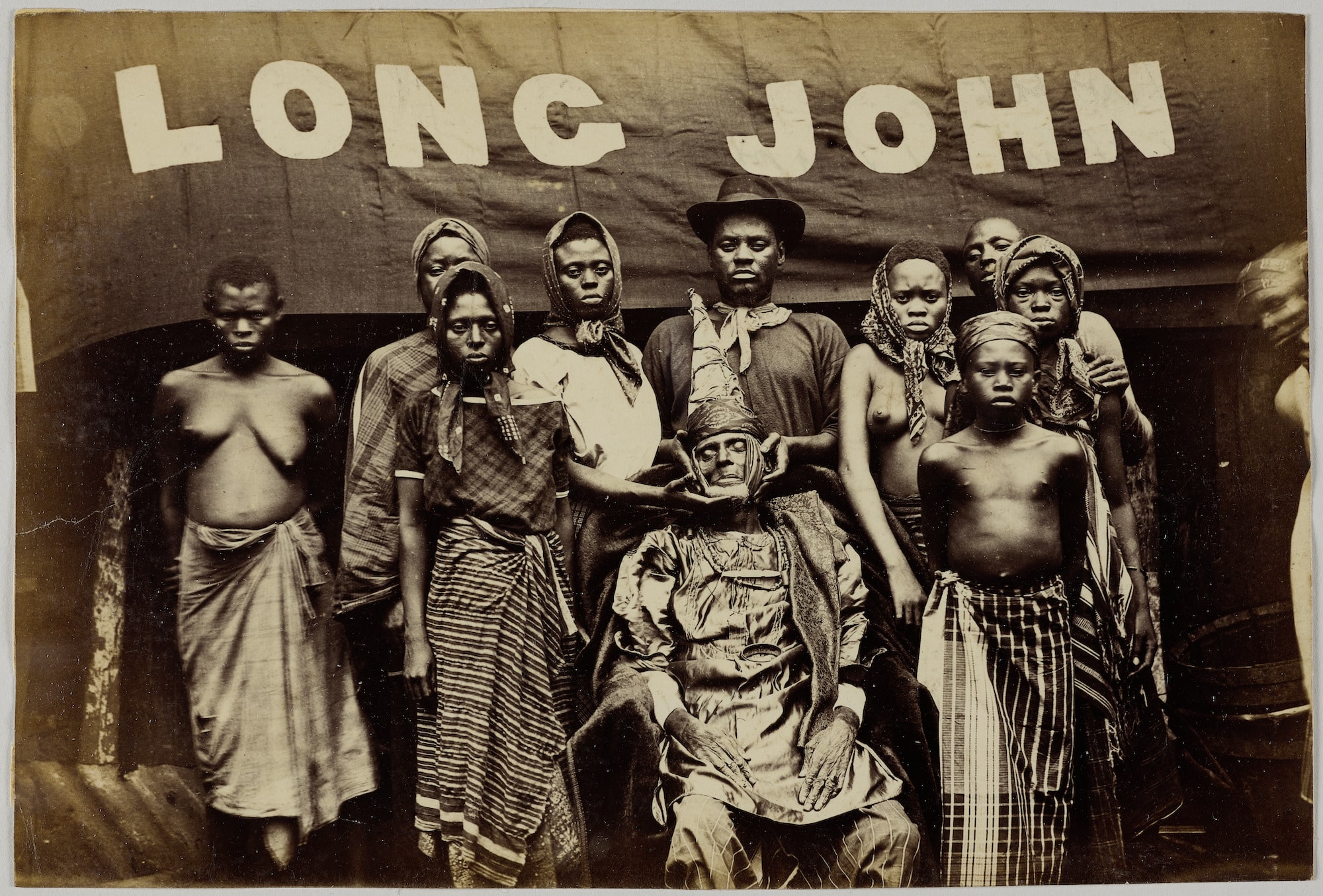
Jonathan Adagogo Green, Last picture of Chief Henry Long John. Behind him stands his successor, Nigeria, 1895 © Musée du quai Branly - Jacques Chirac

Jonathan Adagogo Green, Last picture of Chief Henry Long John. Behind him stands his successor, Nigeria, 1895 © Musée du quai Branly – Jacques Chirac

From portrait to documentary photography

Once trained—for example, in Europe, during diplomatic visits—local photographers took hold of the new technique, each bringing to it the specificity of their own culture: for example, in a large-format portrait of an anonymous Indian maharaja, enhanced with brightly-colored gouache, dating from 1910–20

As in the West, from the outset portraiture played an important role in other parts of the world. From the 1860s onwards, photo studios sprang up in major cities, notably in Australia and West Africa. “The images produced corresponded to the demands of the tourist market hungry for exoticism, while at the same time attracting wealthy local customers who came to be photographed,” explain the curators.

The exhibition also includes some fine prints of American Indian chiefs from the 1870s, made by Alexandre Gardner and other unknown artists. Overall, the quality of the conservation of the prints on display is remarkable. The variety of formats, from minuscule to oversize, including panoramas combining several images, makes for a lively tour.

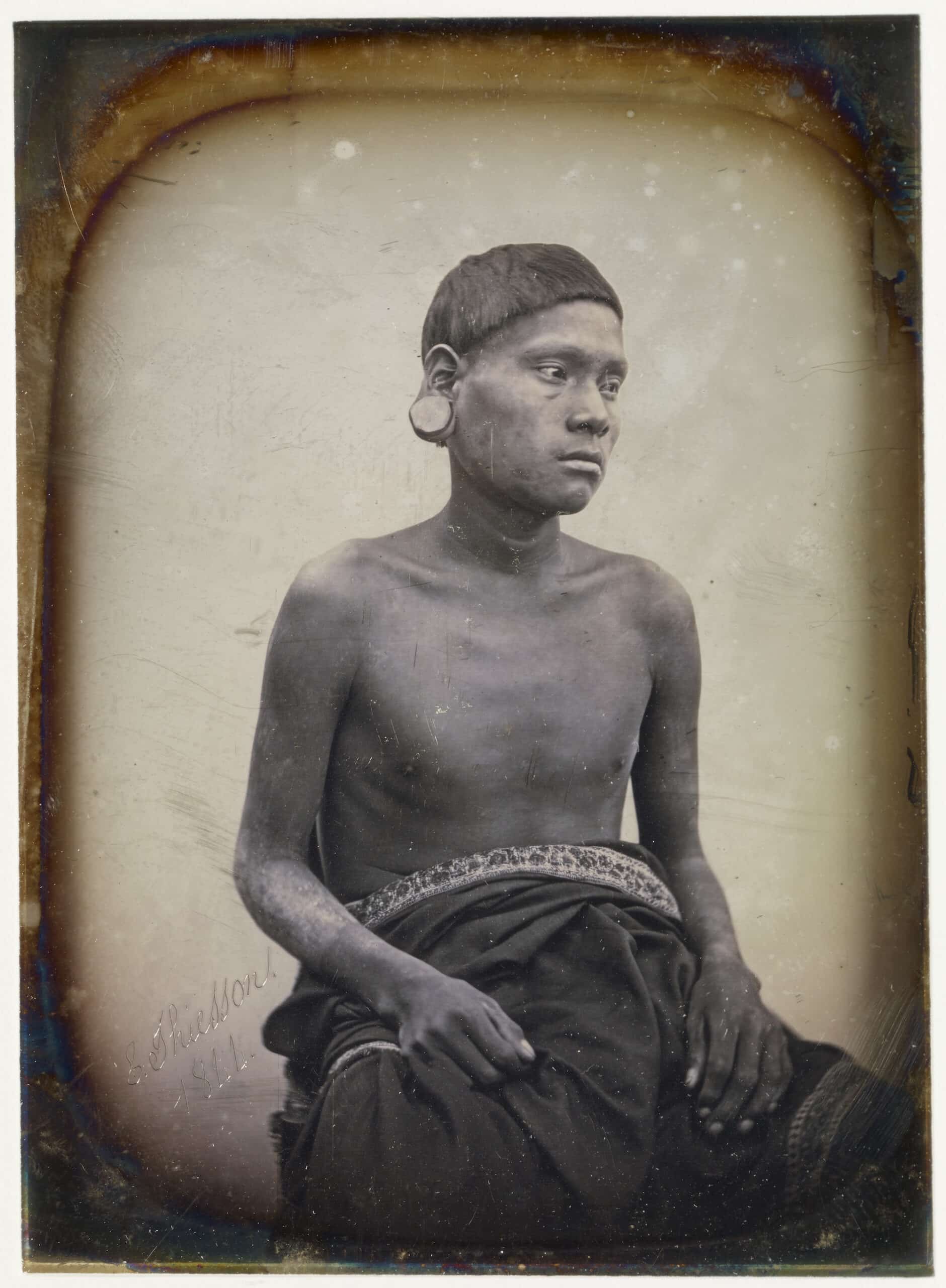
Eugène Thiesso, Botocudo, 1844 © Musée du quai Branly – Jacques Chirac

Eugène Thiesso, Botocudo, 1844 © Musée du quai Branly – Jacques Chirac

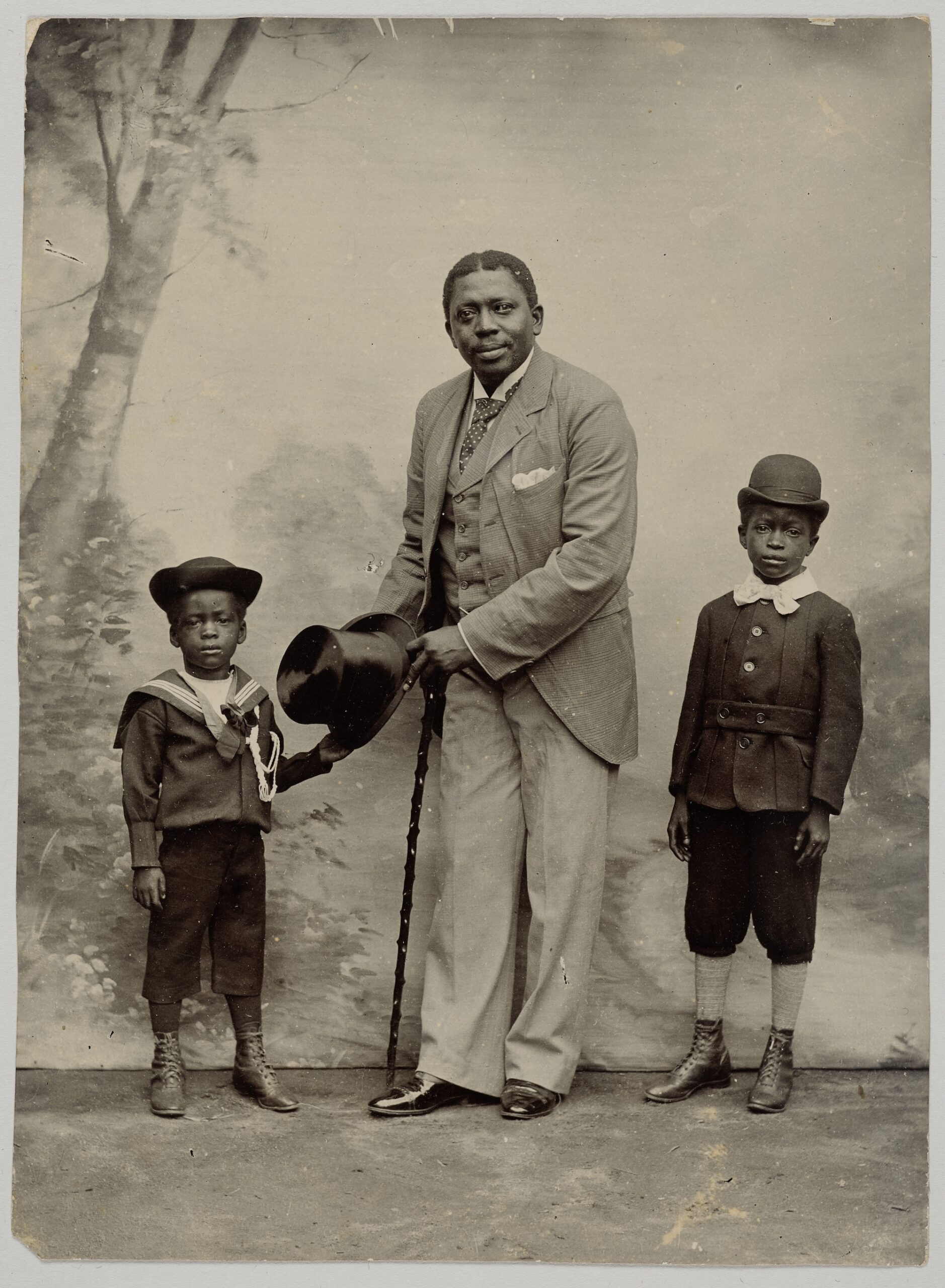
W. J. Sawyer, Mr Sawyer, photo man, Nigeria, 1880-1890 © Musée du quai Branly – Jacques Chirac

W. J. Sawyer, Mr Sawyer, photo man, Nigeria, 1880-1890 © Musée du quai Branly – Jacques Chirac

Landscapes also feature prominently in this vast collection. As the curators explained, “right from the start, the production was diverse, responding to different demands and a variety of contexts.” For example, some shots were taken for aesthetic purposes and/or as “souvenirs.” They are the work of the first travelers, who can be described as explorers or adventurers. At the time, equipment was heavy and cumbersome. Other landscapes were photographed as part of topographical mapping, as a kind of “location scouting.” In this case, photography was used for its documentary value and served colonization projects.

The exhibition highlights the many discoveries with detailed captions that combine with a dynamic scenography featuring colorful walls and display cases with albums, medallions, and other paraphernalia. The exhibition’s chronological, geographical, and thematic itinerary lays the groundwork for an alternative history of photography, one that is more complete and cosmopolitan, as it includes Asia, Africa, Oceania, and the Americas.

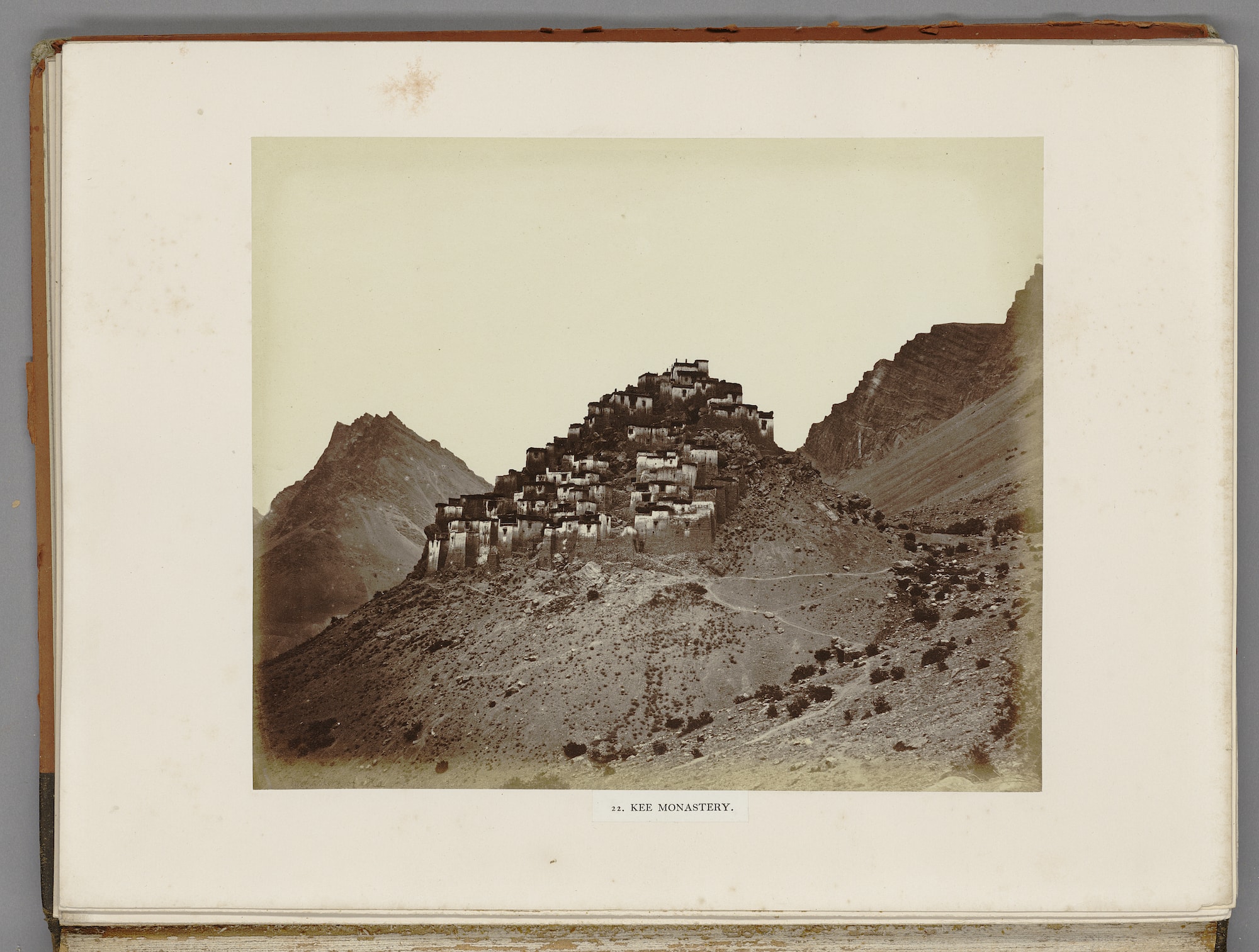
Philip Henry Egerton, Kee Monastery, Journal of a tour through Spiti to the frontier of chinese Tibet, 1863 © Musée du quai Branly – Jacques Chirac

Philip Henry Egerton, Kee Monastery, Journal of a tour through Spiti to the frontier of chinese Tibet, 1863 © Musée du quai Branly – Jacques Chirac

Photographs: An Early Album of the World (1842–1911), Musée du quai Branly-Jacques Chirac, Paris, France, April 4 to July 2, 2023.

Get started with photography with this Canon EOS Rebel T7 deal, over $100 off at Walmart

Get started with photography with this Canon EOS Rebel T7 deal, over $100 off at Walmart

New to photography and looking for a place to start with DSLR models? This Walmart deal on the Canon EOS Rebel Camera T7 is well worth a look.

It’s not going to feature on our best astronomy cameras or best wildlife cameras lists, but it’s still a solid choice for those learning the intricacies of lens choices, and offers a solid set of features with some corners cut (no 4K video, no tilting display, and no touch screen for example).

Still, with a 24MP sensor, it’s well worth a look – particularly since it’s now just $346.99 at Walmart – over $100 off of the MSRP.

Canon EOS Rebel Camera T7
Was: $479.99
Now:
$346.99 at Walmart
Overview: 
This DSLR is now under $350 – perfect for photography newcomers.” data-widget-type=”deal” data-render-type=”editorial”>

Canon EOS Rebel Camera T7

Canon EOS Rebel Camera T7
Was: $479.99
Now:
$346.99 at Walmart
Overview: 
This DSLR is now under $350 – perfect for photography newcomers.

Key features: Easy to use, solid battery life, great for beginners

Product launched: February 2018

Price history: While the Canon EOS Rebel T7 is reduced elsewhere, Walmart’s deal beats out Amazon and Best Buy at the time of writing.

Price comparison: Amazon: $399 | Walmart: $346.99 | Best Buy: $399.99

Reviews consensus: The Canon EOS Rebel T7 won’t win any awards, but it’s still a very solid option for beginners. Its frame, albeit plastic, is easy to understand, and there are a huge number of lenses available. You’ll want to spring for a more comprehensive option from our best astrophotography cameras for taking pictures of the stars, though.

TechRadar: ★★★½ | Toms Guide: ★★★½ | Digital Camera World: ★★★½

Buy it if: You’re new to using a DSLR – a logical control layout and competitive price point make the Canon EOS Rebel T7 a solid option for beginners.

Don’t buy it if: You’re looking to shoot video in higher than 1080p, you want a touchscreen, or a more premium camera overall.