Photography

CBC photojournalist Ben Nelms nominated for 2022 national photography awards

CBC photojournalist Ben Nelms nominated for 2022 national photography awards

CBC News Vancouver photojournalist Ben Nelms has been announced as a finalist in five categories of the News Photographers Association of Canada’s 2022 National Pictures of the Year award.

This year, Nelms was nominated in five categories: Spot News, General News, Personality, Photo Story, and Photographer of the Year. 

“I’m honoured to be able to document people and their stories in our communities. My hope every day is to take photographs that not only answer questions but that ask questions as well,” Nelms said.

“I am privileged to be in many situations that the public cannot witness themselves, and I hope to bring awareness to those stories through my photographs.”

A woman with long, grey hair hugs another person in a crowd.
Laura Holland, mother of Jared Lowndes of the Wet’suwet’en Nation, who was killed by Campbell River RCMP last year, during a news conference in Vancouver on Dec. 1, 2022. Nelms was nominated as a finalist in the General News category of the National Pictures of the Year award for this photo. (Ben Nelms/CBC)

Nelms previously won in the General News (2021, 2020) and Picture Stories (2019) categories. In 2019, he was awarded the Photojournalist of the Year award from the association. 

He has previously been nominated for multiple National Pictures of the Year awards, winning an award for photo story of the year in 2012. 

Originally hailing from Edmonton, Nelms began shooting with CBC in April 2019. 

The association says it will announce the winners in advance of its annual general meeting on May 28. 

An older woman wearing an orange sweatshirt stands in profile.
Residential school survivor Evelyn Camille during a memorial at Tk’emlúps te Secwépemc marking the one-year anniversary of the discovery of potential burial sites at the former Kamloops Indian Residential School in B.C. on May 23, 2022. Nelms was nominated as a finalist in the Personality category of the National Pictures of the Year award for this photo. (Ben Nelms/CBC)

Will Sutton: Wanna understand local Black Culture? See ‘Seeing Black.’

Will Sutton: Wanna understand local Black Culture? See ‘Seeing Black.’

If you love Black New Orleans culture as much as I do, you’ve got to see a wonderful Black photographers exhibit at the Ashé Cultural Arts Center.

Even if you’re only mildly curious about the Black New Orleans experience, the exhibit is a perfect way to begin exploring — and understanding — Black New Orleans.

Anyone who has seen Mardi Gras and second-lines, traveled Black neighborhood streets or attended Black funerals and wondered about the photographs taken there by Black photographers definitely needs to see the exhibit, which ends June 3.

The COVID-19 pandemic was a difficult time for New Orleans and the world. We all felt the doom and gloom, and we lost too many lives.

Yet, some good things happened during the pandemic. One of them was an idea that hit local poet Kalamu ya Salaam one day early in 2020. He called his high school friend, Eric Waters, to talk about it. 


New Orleans photographer Eric Waters is one of a group of organizers of a photography exhibit at the Ashe’ Cultural Arts Center at 1712 Oretha Castle Haley Boulevard in New Orleans. Waters took the “Young Boy in a Bowl Hat” photograph years ago. It’s part of an exhibit of more than 120 images by more than 70 Black photographers open through June 3, 2023.


“He said he wanted to do a book about Black photography here,” Waters told me. “He said, ‘Think of a name.’ Then he told me, ‘I’ve got a name: Seeing Black.'”

As I walked through the exhibit with the two friends recently, Waters recalled wondering why his high school classmate had asked him to think of a name when he already had an excellent one in mind. They graduated from St. Aug in 1964. Photography didn’t become an important part of their lives until later. 

“Seeing Black: Photography in New Orleans, 1840 & Beyond” has blossomed from ya Salaam’s brainstorm into a wide-ranging, multimedia exhibit of Black photographic talent. 

For those not familiar with him, ya Salaam is a writer at his core. I got to know him through his work with The Black Collegian magazine in the 1970s. He’s an activist, a historian, an author, a filmmaker, a scholar and more. He’s a griot and baba, or elder and father, to many.

Waters is a renowned New Orleans-based photographer. His work has focused on Black New Orleans culture, customs and people. He’s one of few artists with an insider’s perspective of Black Masking Indians culture.

His “Seeing Black” dream includes a core team of Waters, phenomenal photographer Girard Mouton III and Shana M. griffin, a feminist activist, artist and curator of the “In the Spirit of Black” photo exhibit at Ashe’ and the “First Frame” exhibit at the New Orleans African American Museum.

First Frame is a look at the photography of Floresine Perrault Collins and early Black photographers. Collins, known as the first Black woman photographer in New Orleans, focused on African American dignity and pride rather than enslaved people and other stereotypes. The First Frame exhibit closes June 4.

The much larger exhibit at Ashé includes about 120 images by more than 70 Black photographers. I’ve been a visual art and photography aficionado (and a bit of a collector) for decades. To my knowledge, the Ashé exhibit is the first to pull together such a diverse group of Black photographers.

Two photographers featured in the Ashé exhibit were recognized as documentary photographers of the year by the Louisiana Endowment for the Humanities — L. Kasimu Harris, whose Vanishing Black Bars exhibit garnered national attention; and Abdul Aziz, who documents what he calls “human conflict.” His “Hail Caesar” photograph shows a man with his face covered during a 2020 Movement for Black Lives protest in New Orleans.

The Ashé exhibit also includes work by Ellis Marsalis III, a Baltimore-based photographer with deep New Orleans roots as the son of legendary musician Ellis Marsalis Jr. Also included are photographs by Freddye Hill, a retired Dillard University professor known to many local culture bearers. 

Will Horton, an award-winning filmmaker and visiting professor at Loyola University, lost his negatives and all his high-end photography equipment during Hurricane Katrina. When Waters told him they wanted him to be in the Ashé exhibit, he reached out to past subjects who might still have a negative or photograph of his.

You can see Horton’s photos at Ashé. He said he is “honored” to be in the same exhibit as those he considers masters and mentors.

The original Black photography book concept has become something much bigger. The “Seeing Black” book is scheduled to be published by University of New Orleans Press this fall. It will include many of the photographs you can see now at Ashé. Look for the book; don’t wait to see the exhibit.

I’ve been thrice, and I’m going back soon. I hope to see you there.

Why One Photographer Prefers Smaller Cameras

Why One Photographer Prefers Smaller Cameras

In recent years, we have seen budget full frame cameras become more affordable while medium format prices have become competitive with upper-level full frame options. At the same time, APS-C cameras have continued to grow in capabilities and performance, and micro four thirds is enjoying a resurgence. So, should a new photographer follow the old wisdom of using a larger sensor for the best image quality or consider the benefits of a smaller system? This great video makes a case for the latter.

Coming to you from Robin Wong, this interesting video makes a case for using smaller camera systems, like those from Fujifilm and OM System. It used to be that if you wanted professional image quality, you prioritized sensor size above almost everything else. However, in recent years, the image quality we have seen from APS-C and micro four thirds cameras has gotten to the point that the difference is often negligible in a lot of situations. And as such, it is worth considering the advantages of these smaller systems. Perhaps the most obvious are their smaller footprints and weights, but there is much more to it than portability. Both Fujifilm and OM System offer robust user experiences and feature sets that can’t be found on any other cameras, and you may find that those better suit your needs and desires than any full frame or medium format system. Check out the video above for Wong’s full thoughts. 

Today’s Photo from Ted Grussing Photography: The Context For Shooting The Red Tails

Today’s Photo from Ted Grussing Photography: The Context For Shooting The Red Tails

… in the image above, a Cliff Swallow is exiting his nest which was about 25 feet above me under an overhang in the cliff; the opening to the nest is very small so they enter and exit with their wings tucked … kinda like a torpedo. Below is a shot of one of the adult Red Tail Hawks exiting the nest in search for more food for the kids and the three of them are lined up on the edge of the nest wishing her good skill in getting them another quick meal … maybe five or six weeks and they will begin making their own kills … sustenance is only available to creatures if they expend the effort to get it!

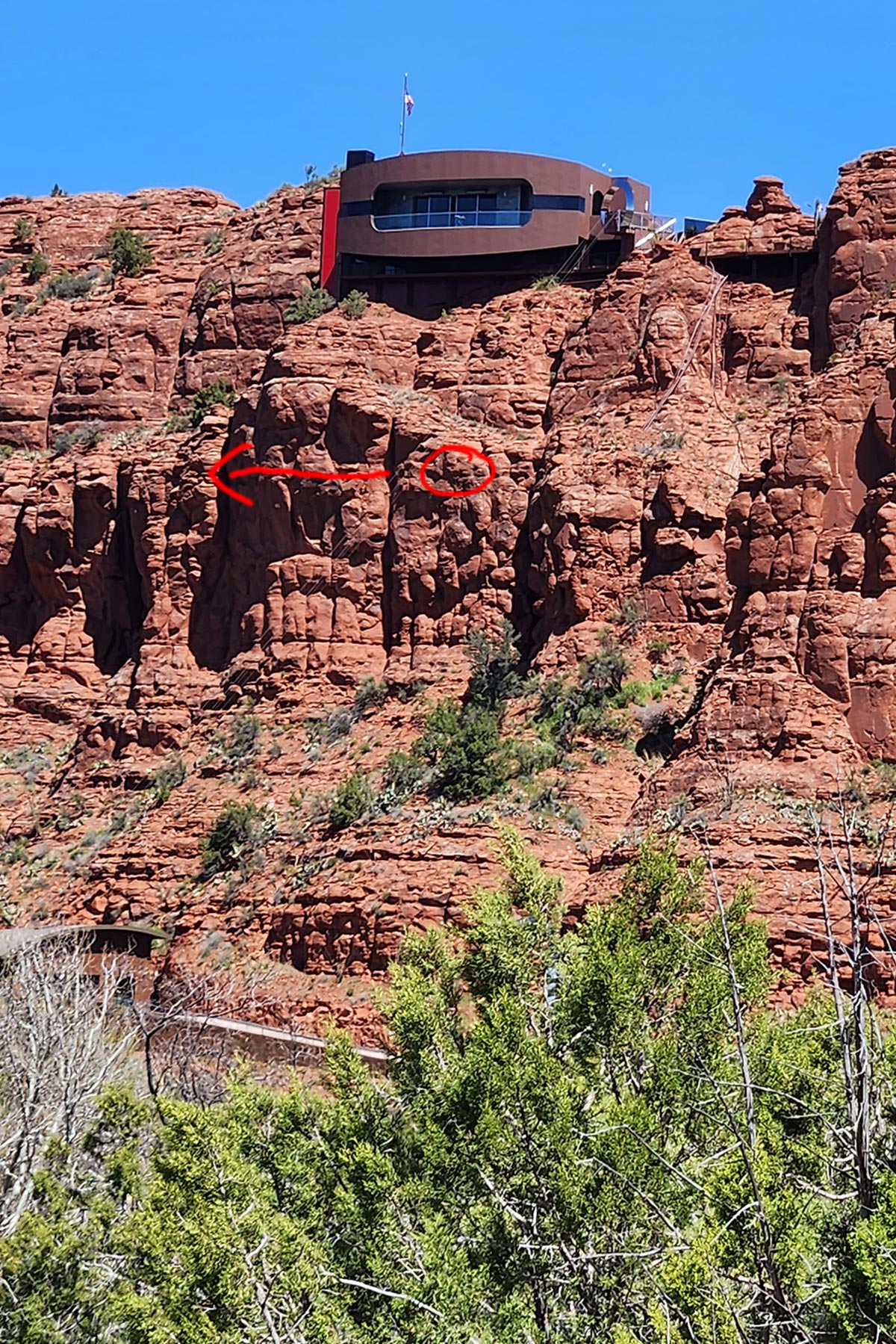
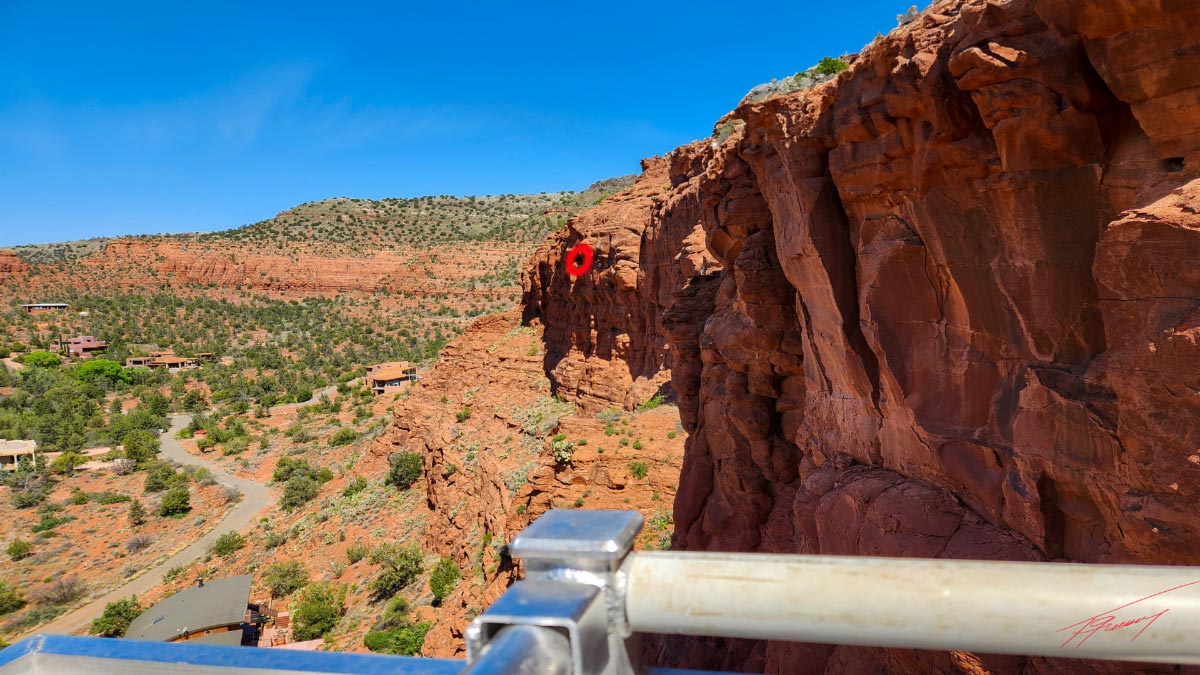
As promised last night the three photos below show you where I am when I am getting these shots of the Red Tail family (and the swallows too). The top image is a shot looking across a field at my friends home on top of the cliff … it is 200 feet above the ground. I drew a red circle where I stop the gondola and the arrow points to the direction I am shooting at the nest. The shot below that is a shot from the gondola looking at the nest which I drew a red circle around … it is about 400 to 500 feet from where I am. The direction you are looking is NNW. The last image is looking up the cables towards the docking station at the top. It is a very cool place!

Time to wrap the day as I resume it in about four hours … have a beautiful day … keep breathing and smile for we are here.

Cheers,

Ted

I ask no odds of any man,
I am not one that follies sway.
I am the source of my rewards,
I do my work each day.

The fruit of trees, the grain of fields,
Wherever use and beauty lurk—
The good of all the world belongs
To him who does his work.

It matters not if rich or poor.
This is the future’s great command,
Who does not work shall cease to eat;
Upon this rock I stand.

Though work bring naught of power
nor wealth
Spare me from want of common needs,
And give a share of manly health,
A few good friends of honest deeds;

And till death’s peaceful slumber nears
A life of undishonored years.

Work by Max Ehrmann

###

photo_tedgrussingThe easiest way to reach Mr. Grussing is by email: ted@tedgrussing.com

In addition to sales of photographs already taken Ted does special shoots for patrons on request and also does air-to-air photography for those who want photographs of their airplanes in flight. All special photographic sessions are billed on an hourly basis.

Ted also does one-on-one workshops for those interested in learning the techniques he uses.  By special arrangement Ted will do one-on-one aerial photography workshops which will include actual photo sessions in the air.

More about Ted Grussing

The Winners of the Vital Impacts Environmental Photography Grant

The Winners of the Vital Impacts Environmental Photography Grant
Vital Impacts Environmental Photography Grant
Photo by Grant Winner Musuk Nolte

Vital Impacts has announced the winners of its Vital Impacts Environmental Photography Grants. Two winning photographers will each receive $20,000 grants to help them document solution-based environmental initiatives in their communities.

Vital Impacts is a women-led non-profit organization that supports grassroots efforts to protect people, wildlife, and habits. The organization is led by award-winning photographer Ami Vitale and visual journalist Eileen Mignoni.

The two Vital Impacts Environmental Photography Grand recipients are Musuk Nolte of Mexico and Peru and Tailyr Irvine of the Salish and Kootenai tribes in western Montana.

Vital Impacts Environmental Photography Grant
Photo by Grant Winner Tailyr Irvine

Honorable mention designations were also awarded to photographers Ingmar Björn Nolting (Germany), Daylin Paul (South Africa), Fatma Fahmy (Saudi Arabia, based in Egypt), and Edgar Kanaykõ Xakriabá (Xakriabá Indigenous people, Brazil).

Purpose of the Grants

The Vital Impacts’ grants program is designed to encourage visual storytellers to “create long-term documentary photography projects with local communities who are working to protect the environment and wildlife.”

Vital Impacts Environmental Photography Grant
Photo by honorable mention winner Edgar Kanaykõ Xakriabá

“Environmentalists, Indigenous peoples, and scientists have been sounding the alarm about the biodiversity crisis for more than half a century, yet no meaningful action has been taken. As photographers, we are in a unique position to inform and influence change, but pressing the shutter is just the start. For images to have significance, they need to tell a story and reach people,” explains Vitale.

Vital Impacts Environmental Photography Grant
Photo by honorable mention winner Ingmar Björn Nolting
Vital Impacts Environmental Photography Grant
Photo by honorable mention winner Fatma Fahmy
Vital Impacts Environmental Photography Grant
Photo by honorable mention winner Daylin Paul

She goes on to say that Vital Impacts hopes that its grants and mentorship programs will help support new ways of seeing and thinking about ongoing issues. This year, Vital Impacts received 372 submissions from 68 countries for its grants.

The Winners

Peruvian-Mexican photographer Musuk Nolte aims to use photography to tell stories of social issues, including memory and environmental depredation. His project will examine how Peruvian communities utilize traditional water harvesting practices to improve water access. Nolte will also look at how communities are using plants and other methods to deal with climate change.

Vital Impacts Environmental Photography Grant
Photo by Grant Winner Musuk Nolte

“This is such a beautiful hopeful story on ancestral water harvesting practices; instead of focusing on scarcity and despair, we get to learn that there are ways to combat climate change one shrub at a time. We also get to learn that solutions have existed for a long time — this story will give a voice to experts and amplify their knowledge in ways that will resonate at a larger scale,” says judge Sabine Meyer, Photography Director, National Audubon Society.

Vital Impacts Environmental Photography Grant
Photo by Grant Winner Musuk Nolte

David Barreda, Senior Photo Editor, National Geographic, is excited to see how Nolte tells the story of the centuries-old relationship that indigenous communities in the Andes have water resources. “By centering local expertise, Nolte amplifies the voices and wisdom of the Indigenous people, offering nuanced perspectives that are often overlooked in mainstream narratives surrounding environmental conservation,” Barreda adds.

Vital Impacts Environmental Photography Grant
Photo by Grant Winner Tailyr Irvine

Tailyr Irvine is a Salish and Kootenai photojournalist born and raised on the Flathead Indian Reservation in Montana. She focuses on visual representations of the complex issues facing the communities comprising Native America. Each community faces unique issues, and Irvine’s project will examine how indigenous populations navigate changing stewardship of public lands, many of which were stolen from tribal nations.

Vital Impacts Environmental Photography Grant
Photo by Grant Winner Tailyr Irvine

“Tailyr Irvine’s proposal is not only an important national story, it very well may lead to larger understanding in how members of society understand tribal rights internationally,” says David Barreda. “As Salish and Kootenai herself, Irvine’s intimate understanding of the community and its nuances will allow her to pursue this story in more than a simple visual documentation. Irvine’s existing body of work details such subtle and complex stories, I fully expect this project, in her hands, to bring her to new heights in storytelling and a more wide-spread understanding of the real-world experiences of her community.”

Mentorships

Vital Impacts is also offering a mentorship program to 50 applicants for the Vital Impacts Environmental Grant. Each mentee will be paired with an editor or leading environmental photographer and be aided over 12 months to help each mentee work on developing their photographic projects.

Vital Impacts Environmental Photography Grant
Photo by mentorship winner Adra Pallon
Vital Impacts Environmental Photography Grant
Photo by mentorship winner Odysseas Chlorid

Mentees will also participate in the Vital Impacts lecture series, which features monthly talks that will help connect and inspire participants. Mentorship recipients hail worldwide, including the United States, Peru, Mexico, Spain, Kenya, Saudi Arabia, and more.


Image credits: Vital Impacts | Individual photographers credited in captions

Central students honored in national photography contest

Central students honored in national photography contest

#inform-video-player-1 .inform-embed { margin-top: 10px; margin-bottom: 20px; }

#inform-video-player-2 .inform-embed { margin-top: 10px; margin-bottom: 20px; }

PELLA — Central College students Rebekah Cashen and Gloria Montiel, both class of 2023, were recently recognized for their submissions in the American Association of Teachers of Spanish and Portuguese higher education photo contest.

Cashen, a Spanish secondary education major, won first place in the Places Category with her photograph titled “Ventanas de la Alhambra.” Her photo was submitted to the AATSP by Allison Krogstad, professor of Spanish.

Montiel, a Spanish and communication studies double major, was awarded an honorable mention in the People Category with her piece titled “Saguaro de sabiduria.” Kathleen Korcheck, professor of Spanish, submitted this photo.

View other photos and read more about the contest results at AATSP.

#inform-video-player-3 .inform-embed { margin-top: 10px; margin-bottom: 20px; }

Here’s a good National Geographic photography tip

Here’s a good National Geographic photography tip

National Geographic photographer Kiliii Yüyan told Insider’s Joey Hadden that one way to improve nature photos is by including something in the foreground of a shot.

“Great backgrounds, such as mountains or waterfalls, are easy to find because we’re always looking for them,” Yüyan said. “On the other hand, a good foreground subject, such as blooming wildflowers or a craggy tree, can be much harder to find in the right location.”

Yüyan recommended searching for a foreground subject and framing your shot so you can see the scenery in the distance.

“It’ll give your images depth, intimacy, and make your photos unique,” he said.

I went through some of my photos, and found one I took of the Château de Commarque in France. It has a stream and tree in the foreground and a castle in the background:

Through the Lens: John Yuyi

Through the Lens: John Yuyi

Through The Lens spotlights emerging and established photographers from around the world. The ongoing series is dedicated to offering unique insights in varying areas of photographic expertise including portrait, landscape, fine art, fashion, documentary and more.

Chiang Yu-yi, better known by her professional persona John Yuyi, embodies the spirit of the post-Internet generation, where her artistic pursuits are deeply influenced by this era. Before establishing herself as an artist and photographer, Yuyi captivated digital audiences as a fashion influencer, showcasing her distinctive style on social media. However, it was her quest for a fresh creative outlet that truly transformed her path. During her travels between Taiwan and New York in 2015, Yuyi sought a more permanent presence in the latter city, leading her to sell temporary tattoos online as a means to fund her artist visa application. Starting with her own illustrations and later incorporating photographs from her swimwear collection, Yuyi’s tattoo designs evolved into conceptual expressions, featuring symbols of the social media landscape. Her tattoos and accompanying images gained widespread acclaim, establishing her as a prominent figure in the art world.

Yuyi’s artistic exploration extends to the human body, considering it both as a canvas for expression and a subject of inquiry. Her temporary tattoos have undergone various intriguing iterations, including unconventional placements on raw meat cuts and the incorporation of dating app profiles on human skin, revealing the masks we wear to present ourselves. Magazine commissions have played a significant role in shaping her projects, with her images transferred onto everyday objects like lipsticks, cigarettes, and knives, highlighting the commodification of the human form.

“I believe everything we see shapes and influences our personalities.”

Consumer culture has remained a recurring theme in Yuyi’s career, from her early tattoo-selling venture to the array of products adorned with her imaginative artwork in her online store. Known for their accessibility and playful nature, her creations exude a vibrant ethos. Notably, her action figure, inspired by her amusing project in airplane lavatories, showcases her wit and ability to evoke amusement.”I often choose objects from everyday life that people can relate to, such as items you’d find in a dollar store or ones commonly used by average individuals. Consumerism and commercialism play a role in my work because I believe everything we see shapes and influences our personalities. Advertisements and influencers impact us, and I aim to explore those influences and their effects through my art,” said Yuyi to Hypeart

In a notable collaboration, Yuyi partnered with THE SKATEROOM to create skateboard art editions, influenced by image-based aesthetics and the technological landscapes of the digital era, reflecting the profound impact of these forces on human connections and the universal longing for belonging.

For our latest Through the Lens feature, we synced with Yuyi over a late night FaceTime chat to discuss her personal worldview, her photography practice that challenges societal norms, and her ongoing artistic journey as she explores new horizons.

Avedon at 100: Photos of Seduction

Avedon at 100: Photos of Seduction
image

At Gagosian, Marian Anderson, Marilyn Monroe, Dovima and a cast of showstoppers.

Seductive and detail-oriented, Richard Avedon could have been a successful director — and in fact, he was. From his beginnings in fashion to his development as a portraitist, his photography consisted of staged performances where he enthralled sitters with his charm.

Since his death in 2004, Avedon has hardly been forgotten. (Three of his gigantic “Murals” are currently on display at the Metropolitan Museum of Art.) Now, “Avedon 100,” an exhibition at Gagosian gallery in Chelsea marking the centenary of his birth, approaches his legacy — and his stagecraft — with a grab-bag randomness. Testifying to his appeal, an assortment of colleagues, friends, critics and celebrities — including Raf Simons, Wynton Marsalis and the photographers Rineke Dijkstra and Jeff Wall — each chose a favorite photograph for these gallery walls (220 prints in all).

In a bravura installation designed by Adjaye Associates, the pictures are organized thematically and theatrically. A wall-size mural of Allen Ginsberg with his conventional middle-class relatives faces off against one of Andy Warhol and habitués of the Factory — two luminaries of vanguard culture posing with very different families. Sometimes, only the informed will get the connection, as in juxtaposed portraits of the photographer Robert Frank and the artist June Leaf, who were husband and wife.

Subtle, too, is the placement of a group portrait from 1963 of the generals of the Daughters of the American Revolution alongside a formally dazzling portrait of Marian Anderson, who because of her race had been barred a generation earlier by the DAR from singing at Constitution Hall in Washington, D.C.

Richard Avedon, “Marian Anderson, contralto, in the role of Ulrica in Un Ballo in Maschera, New York, June 30, 1955.”The Richard Avedon Foundation

Avedon had a lifelong commitment to the civil rights struggle, enriched by a close friendship with James Baldwin that dated back to their high school days. (His 1945 portrait of Baldwin is the earliest photo in the exhibition.) In 1963, he was photographing for the book, “Nothing Personal,” that he co-authored with Baldwin; and along with the DAR portrait — which is artfully composed around the women’s banded sashes but a bit predictable in displaying their air of privileged condescension — he photographed civil rights workers, who, also predictably, look resolute and stalwart. A stronger jolt is delivered by a close-up of the 106-year-old William Casby, born enslaved. With his unforgettable face, as stark as a mask, Casby exudes the look of fortitude and resilience that the photographer was after.

Avedon devalued his most original body of work — the on-location scenes in the 1940s and 50s displaying Parisian dresses — and demanded to be judged as an artist solely for his portraits.

“Portraiture is performance,” he wrote, candidly describing his creative process. “The point is that you can’t get at the thing itself, the real nature of the sitter, by stripping away the surface. ” He added, “All that you can do is to manipulate that surface — gesture, costume, expression — radically and correctly.”

The challenge is to bring to the surface something that is not boringly superficial. Avedon’s photographs are rarely boring, but they are almost always superficial. You feel you are watching people perform for him. In the fashion photos, that’s delightful. Sunny Harnett in a Grès gown leaning over a roulette wheel, young men swiveling their heads as a model in the New Look of Dior crosses the Place de la Concorde, Dovima standing in evening dress between two elephants — these could be scenes in a movie. Only occasionally do they hint at something deeper, such as when Avedon included the chains on the legs of the elephants at the Cirque d’Hiver, perhaps an oblique commentary on women bound by fashion’s demands. Unfortunately, that fertile period is underrepresented; there are too many run-of-the-mill, technically polished fashion photographs from later in Avedon’s career.

Richard Avedon, “Marilyn Monroe, actor, New York, May 6, 1957.”The Richard Avedon Foundation

The exhibition opens with multiple images of Marilyn Monroe, cavorting for his camera in 1957 and montaged in a 1994 print. Monroe is a star performer, overshadowing similar montages Avedon made of Claudia Schiffer and Cindy Crawford, who lacked their predecessor’s halogen incandescence. After putting on a show, Monroe sat exhausted in the studio, and Avedon (with her tacit consent) took a final picture, the “sad Marilyn” portrait that is one of his best known. Because of her untimely death five years later, this picture is regarded as a more authentic self-expression. But is it? Or is it merely physical fatigue?

Avedon preferred to photograph people he did not know, hoping to establish in a photographic session “an intimacy with no past and no future,” comparable to “a sexual encounter with a stranger in a darkened room,” he told an interviewer (cited in Philip Gefter’s biography, “What Becomes a Legend Most”). He wanted something exciting but shallow. And that is what he got.

“James Kimberlin, drifter, State Road 18, Hobbs, New Mexico, October 7, 1980.”The Richard Avedon Foundation

The worst instance of this approach — given its own room in the exhibition — is his project of 1979-84, “In the American West,” an ill-advised attempt to rival the achievement of his friend, Diane Arbus, who died in 1971. While Arbus envied Avedon’s commercial success and the polish of his prints, Avedon wished more gnawingly for the recognition that the cultural establishment accorded her artistry. But in choosing to portray in unforgiving detail an array of Westerners living on the margins and staring at the camera — oil field workers, drifters, a rattlesnake skinner — Avedon imitated Arbus’s style but could not replicate her probing psychological intelligence.

His most profound portraits are not of picked-up strangers, but of someone he had known all his life: his father, Jacob Israel Avedon. Jacob browbeat his son as a boy. Once a quasi-filial relationship was re-established years later, it crackled with tension. The son continued to feel deprived of his father’s love and respect.

Richard Avedon, ”Jacob Israel Avedon, father of Richard Avedon, Sarasota, Florida, October 1969-August 1973.”The Richard Avedon Foundation

With some difficulty, Avedon persuaded Jacob to sit for him, beginning in 1969 and continuing up to the elderly man’s death from cancer in 1973. At the start of the suite of seven images here, Jacob is in a suit and tie. By the end he is in a hospital gown. What distinguishes these photographs from virtually every other one in the exhibition is that Jacob is completely resistant to the famous Avedon charm. He regards his son with suspicion, defiance, anguish, ruefulness and fear. He knows that he is being used. With misgivings, he is permitting that manipulation. He is not acting. He is engaging in a painful interaction with a son who has never been quite the one he wanted. And both men know that now it is too late.

Weighted with a disturbing gravity, these are Avedon’s greatest portraits. They get at a human truth he usually avoided.

Avedon 100

Through July 7, Gagosian, 522 West 21st Street, Chelsea, 212-741-1717; gagosian.com.

Supreme Court Rules That Andy Warhol Violated a Photographer’s Copyright

Supreme Court Rules That Andy Warhol Violated a Photographer’s Copyright
Warhol

Pop artist Andy Warhol sits in front of artworks at his studio, the Factory, in New York City in 1983.
Brownie Harris / Corbis via Getty Images

In the 1980s, Andy Warhol created an illustration of the musician Prince, which drew heavily from an existing image by photographer Lynn Goldsmith

Now, four decades later, the Supreme Court has ruled that the Pop artist infringed on Goldsmith’s copyright. Experts say that the case has complex implications for the ever-shifting boundaries of copyright infringement and fair-use law

Seven out of the nine Supreme Court justices ruled against Warhol’s estate, which argued that the portrait in question should be considered the work of Warhol alone. 

“To hold otherwise would potentially authorize a range of commercial copying of photographs, to be used for purposes that are substantially the same as those of the originals,” wrote Justice Sonia Sotomayor in the majority opinion.

The two dissenting justices, Elena Kagan and John Roberts, argue that this ruling could stifle the creativity of artists who want to riff off of copyrighted material.

Andy Warhol's Prince series

Andy Warhol’s 1984 Prince series

Supreme Court of the United States

“It will impede new art and music and literature,” wrote Kagan. “It will thwart the expression of new ideas and the attainment of new knowledge. It will make our world poorer.”

The saga began in 1981, when Newsweek commissioned Goldsmith to photograph Prince. In 1984, Vanity Fair hired Warhol to create an illustration of the musician for an article; the magazine also paid Goldsmith a one-time fee of $400 so that Warhol could use one of her photos as a reference point.

After Prince’s death in 2016, Condé Nast (which operates Vanity Fair) used Warhol’s art for a tribute to the musician. The company paid Warhol’s estate for the right to use the image, reasoning that this version of the work was Warhol’s. 

Goldsmith, however, had only authorized Condé Nast to use the image once.

The legal battle revolves around a divisive question: After Warhol altered the image, did it belong only to him, or should Goldsmith retain some degree of control?

The court’s decision relies on how the image was used. In this case, wrote the justices, the commercial nature of the Prince portraits means that the images aren’t covered by fair-use law. 

Still, the ruling stipulated that certain other Warhol pieces—such as his famous depiction of Campbell’s soup cans—should be viewed in a different light. Sotomayor wrote, “The purpose of Campbell’s logo is to advertise soup. Warhol’s canvases do not share that purpose. Rather, the Soup Cans series uses Campbell’s copyrighted work for an artistic commentary on consumerism, a purpose that is orthogonal to advertising soup.”

Michael W. Carroll, a scholar of intellectual property law at American University Washington College of Law, tells the New York Times’ Matt Stevens that this distinction is critical. “It was the licensing use, not the creative use, that was at issue,” he says. 

Kagen portrait

Justice Elena Kagan wrote the dissenting opinion, arguing that the ruling “will thwart the expression of new ideas.”

Collections of the Supreme Court of the United States

Warhol built his career by transforming the photos of others. For example, his 1964 Marilyn Monroe portraits are based on a publicity photo for the film Niagara (1953); last year, one of those portraits, Shot Sage Blue Marilyn, became the most expensive 20th-century American artwork ever sold. Other images from popular culture—from Coca-Cola bottles to Disney characters—also served as source material. 

Reactions to the Supreme Court ruling are mixed. Noah Feldman, a scholar of law at Harvard, writes in Bloomberg that the decision helps artists but harms creativity. 

“The upshot is that little-guy artists win, because they now have more rights than they had before to claim credit for works reused by others,” he writes. “But art as a whole loses, because the decision restricts how artists generate creativity by sampling and remixing existing works.”

Carroll tells the Times that the ruling leaves a lot of room for conflicting interpretations, and the legal battle has only just begun.

“Is it really just about competitive licensing use, or is it more broadly about creating derivative works?” he adds. “I think what you’ll see is lower courts reading it each way, and then eventually this issue is going to find its way back to the Supreme Court.”

Get the latest stories in your inbox every weekday.