Photography

20 Minutes With: Photographer Brigitte Lacombe

20 Minutes With: Photographer Brigitte Lacombe

Her work was recently on view at the International Center of Photography in New York


Brigitte Lacomb

Brigitte Lacombe has mastered the art of the celebrity portrait. The New York-based French photographer has shot everyone from Patti Smith to Robert De Niro and Meryl Streep, and all with an effortless click of the shutter.

Lacombe sees her portraits as the result of her friendships with her subjects—she “lets them be themselves,” as she puts it. The photographer, who has been based in New York City since the early 1980s, has a small photo studio in the Lower East Side of Manhattan, where she shoots intimate portraits of stars.

Her work was recently on view in a group show called Face to Face: Portraits of Artists by Tacita Dean, Brigitte Lacombe and Catherine Opie at the International Center of Photography in New York. It showcased some of her best black-and-white portraits—thoughtful shots of New York icons like Joan Didion and Fran Lebowitz. It also showcased her work as a film-set photographer, as she has worked on Martin Scorsese film sets for over 25 years, from The Wolf of Wall Street to The Departed, and more.

Brigitte Lacombe, Patti Smith, New York, N.Y., 2014.


Brigitte Lacombe

The photographer has had museum exhibitions at the Smithsonian’s National Portrait Gallery in Washington, and her photo book oeuvre includes Lacombe Cinema/Theater, from 2001, a portrait book of celebrities, including shots of Leonardo DiCaprio, John Malkovich, and Diane Keaton. A documentary about Lacombe’s life and work was released in 2019, called Brigitte, which premiered at the Venice Film Festival. 

Lacombe speaks about her early days as a press photographer, shooting the stars, and the first time she visited Hollywood.  

Penta: How did you arrive in the U.S., after living in Paris?

Brigitte Lacombe: I was living and working in Paris, working for magazines at the beginning of my career. I met Dustin Hoffman at the Cannes Film Festival and photographed him there. He invited me to come and shoot on the set of his next movie, which was All the President’s Men. They were shooting in Washington, D.C. I was on the set, and they were going to Los Angeles to shoot in a studio. My mentor had a family there, so I stayed with them. It was my first time in California. That was 1975. I stayed for three months and got to know the film scene. I met Steven Spielberg and Brian de Palma. Everyone knew each other in Hollywood. 

Was this the first time you shot on film sets, correct? What a peculiar job, very behind-the-scenes.

Yes. You’re not documenting from the point of view of the film camera. Set photography is different. I would be invited by a filmmaker or an actor or the film studios and develop the relationship. With director Martin Scorsese, it became a real friendship, and I have been working on his projects for 25 years. I would visit his sets several times for specific scenes. I’m almost part of the team with his films, even though I’m not. I’m welcome at the invitation of the director.

You also do portraiture, and you’ve shot a lot of your friends. Have there been any highlights of your career?

I love what I do, and I shoot every day. I love the reportage part because there’s diversity. You don’t have any control in the situation: You come in, and you adapt yourself to that situation. You find your way within that, as opposed to portrait photography. As I do portraiture, I control everything from the location to the light to the mood, and the music, and who is in the room. I start shooting and it becomes a collaboration with the person I’m photographing.

Was it hard breaking into photography as a woman in the 1970s?

For me, it might have been an advantage. I was one of the first women photographers around. I stood out. I was also extremely lucky in the first important meetings I had. I was open to jumping on location. I came to the U.S. to work on a movie set where I didn’t know anyone. I jumped at the opportunity. I’m still like that. I’m ready and open to some new offers. A job, a place to go, whatever. It’s a combination of being a woman and being ready for any experience, in a way. That’s my life.

A portrait of artist Louise Bourgeois.


Brigitte Lacombe

You’ve shot public figures like Meryl Streep, Robert De Niro, Marc Jacobs, and Margaret Atwood. What is the essence of a good portrait?

I let people be themselves. That’s the essence of a good portrait. People I have photographed are all extraordinary people. One of the most extraordinary I’ve ever shot is
Nelson Mandela.
Meryl, who I first shot 35 years ago, became a friend. Every person is different, that’s part of the attraction to me. That’s how I can keep doing it. It’s not repetitive. Each portrait is a new person. I seek out my subjects myself because I’m interested in them and their work. I’m meeting people I’m interested in.

Where is your studio in New York City and what makes it special?

I have a studio I use for portraits when people come by themselves. It’s in the Lower East Side in downtown Manhattan. It’s in a historic building and it’s a north-facing studio with classic light. It’s not for a big shoot. It’s a small place with great light. It’s basically shoots for no specific purpose but I want to do a portrait of them. I invite them. It’s not where someone comes with a stylist, hair, and makeup, and all that. It’s a sitting portrait in a studio. But when I do big shoots, I rent a bigger studio. But I make a mock studio everywhere I go in the world—whether it’s a corner in a museum or anywhere in the world, I’m doing portraits. It’s easier in my studio, than anywhere else. 

What’s your favorite arrondissement in Paris?

I love Paris. I have a place in the seventh arrondissement in the left bank of Paris. So, I know that area best. I go back very often. I love the beauty of the city, its history. It’s a different scale than New York. I have traveled all my life, I travel nine months out of the year. For Paris, it’s my place. No matter how long I have been away, Paris is my place. It’s a place I love to come back to.

This interview has been edited for length and clarity.

Why and When You Should Abandon Beauty in Photography in Favor of

Why and When You Should Abandon Beauty in Photography in Favor of

If you look through the galleries here at Fstoppers, trending images on social media, or those on the pages of magazines, they usually depict beauty. Beauty is easy to like and is, understandably, popular. But there is something far harder to capture that is sublime.

Thinking back to my youth, I remember a girlfriend of mine decrying that the actors in TV programs were all good-looking. She was right. Characters had symmetrical features, their bodies were shapely, and they had winning smiles revealing perfectly set teeth. I was an awkward teenager and never great at quick compliments. Consequently, there was too long a pause before I told her that she could be an actress. She came back and said I had a good face for the radio and then added that didn’t have the voice for it. She was right, of course. But that was the end of my dreams of being a movie star or a radio DJ, and it heralded the end of that teenage romance.

Things haven’t changed much on TV or in the movies. Those industries are still dominated by beautiful women and ruggedly handsome men. They, of course, have talent too. Modern audiences are more discerning than film studios give them credit for, and wooden performances can still make a production flop.

The same applies to photography. Our audiences often seek out beauty in our photographs. Whatever genre you shoot, your photos will have popular appeal if they have an element of beauty. However, just like poor-quality acting by a handsome hunk can ruin a film, beauty alone in a photo isn’t enough. A photo must be well executed, because a poorly conceived image, no matter how beautiful the subject, won’t be compelling.

Is Beauty in the Eye of the Beholder?

Beauty is a difficult thing to describe. Despite it being said it is in the eye of the beholder, most people appreciate the same beautiful things. Who doesn’t love a glorious sunrise, a perfectly formed rose, or moonlight reflected off the sea, Brad Pitt, or Halle Berry?

Unsurprisingly, that appreciation of beauty can be skewed by fear and learned prejudices. I knew a man who was terrified of butterflies and birds – quite a handicap, as he was a gardener – and the most ignorant won’t see beauty but get hung up on people’s skin color. But those exceptions aside, an understanding of what is beautiful is universal. Consequently, beautiful photos are easy to like.

Soft Focus and the Slow Death of Natural Beauty

I joke with my wife that the deterioration of our eyes with age is an evolutionary adaptation. As we get older, we look at each other through soft-focus lenses that hide the wrinkles and blemishes brought on through time and the interesting and adventurous lives we’ve led so far.

Soft focus is a technique of old that photographers and filmmakers employ to supposedly enhance beauty. Look at older movies from the Golden Age of Hollywood up until the late 1990s and you will see the filter applied to, especially, women actors. Check the following trailer for the film Casablanca and note the increasing softness when Ingrid Bergman is in the frame.

[embedded content]

Over time, models were airbrushed and then “Photoshopped” to give them supposedly perfect complexions. Now, Instagram applies automated filters that supposedly make people more beautiful. It’s now widely recognized that this idealization of what the human skin should look like to be beautiful is hugely damaging.

Cultural norms, these days driven by commercialization, try to dictate what is beautiful. Western ideals have led those standards globally. However, when I lived in Africa, the advertising posters for soft drinks featured far healthier-looking people than the stick figures you would see in their ads here in the West. It is a fake belief that is being peddled. In reality, the result of guzzling these chemical-filled acidic drinks just leads to obesity, heart disease, and rotten teeth.

Thanks to digital manipulation, what was considered by society to be beautiful has become inaccessible. Men’s chiseled features and most desirable female body shapes can often only be achieved through supposed enhancements on a computer. Photographs of people become harmful lies that destroy the esteem of those whose bodies don’t comply with an impossible set of rules. Thankfully, this imitation of beauty is being exposed as false and the idea that it is okay not to fit with it is more widely accepted. Still, it’s a brave portrait or boudoir photographer who will show their subjects, warts and all.

What Ever Happened to the Beautiful Things?

There was a period in history when human-made products were made to be beautiful. Ming Dynasty vases, sailing ships, furniture, clocks, printing presses, book covers, steam trains, and even cameras were things of beauty. I’ve long believed that creative people should surround themselves with items of beauty. The Industrial Revolution brought forward huge leaps in technology, but the designs were always aesthetically pleasing.

Yet, with the digital age, most cameras became solely utilitarian, bland lumps of plastic. Let’s face it, the mass-produced cameras from the biggest brands – Nikon, Sony, and Canon – are boring and uninspiring to look at. There have always been exceptions, especially from the smaller brands, such as Fujifilm and OM, that manage to produce great-looking gear. Happily, last year Nikon brought out a better-looking camera with the Z fc. Those big camera manufacturers should take a leaf out of the smaller brands’ books and create technology that looks great on top of being functional.

After all, other functional creative products that cost hundreds or thousands of dollars look fabulous. Montblanc fountain pens, Apple MacBooks, Da Vinci paint brush sets, and Aga Range cookers all look beautiful and therefore inspirational. But most cameras from the biggest brands are shapeless, characterless blobs.

That may seem controversial, as beauty seems to fly in the face of the utilitarian design ideals of Bauhaus that suggested form follows function. But, if inspiration through beauty is seen as a function because it can inspire, then beauty becomes an important factor of design too.

Life Beyond Beauty Is Sublime

On the other hand, it doesn’t follow that the only thing we are attracted to is beauty. Sometimes, we photograph things that are awe-inspiring and not necessarily beautiful. In the aesthetics branch of philosophy, this is the sublime. Sublime is the quality of greatness beyond all measure. It is not limited to artistic, physical, and aesthetic greatness, but it can refer to moral, intellectual, and metaphysical greatness too.

If you have ever walked in a mountainous landscape, heard a lion road in the wide-open savannahs of Africa, or listened to and been moved by a speech by a great orator, that is sublime. The essayist, poet, and playwright Joseph Addison summed it up when he said of the Alps that they “filled the mind with an agreeable kind of horror.”

The Philosopher Edmund Burke argued that sublimity and beauty were mutually exclusive.

Emmanual Kant said that the sublime could not be held in an object. A raging sea, a thunderstorm, and the night sky are not sublime themselves. However, the apprehension we experience when we observe those things is what makes them sublime. Kant considered this as a priori knowledge: something universally valid but independent of previous experience.

So, if you stood in front of an awe-inspiring landscape, or within a thunderstorm, or were staring up at the stars, or watching a raging sea, or saw a bird diving into the sea for fish, if you were in front of an orchestra playing a Beethoven symphony, or moved by a long-experienced actor reciting a Shakespearean sonnet, that response you feel to that incomprehensible power over which you had no control is sublime.

Just like when confronted with beauty, meeting the sublime brings about physical reactions: pupils dilate, heartbeat quickens, hair stands on end, and shivers run down the spine.

The works of Ansel Adams can be considered sublime because one can be filled with awe by the staggering landscapes of Yosemite. His careful compositions and precise exposures were designed to show the power of the American landscape.

 Horrifying images of warfare, oppression, and destitution; portraits of charismatic people both good and evil; the photos of the R101 airship exploding; the images of the detonations of atomic bombs on the Bikini Atoll; small figures dwarfed by the landscape around them; and deep space images showing countless galaxies each comprising billions of stars are examples of photos that could be considered sublime.

Creating sublime images is so much harder to capture in a photograph than beauty. Furthermore, it is becoming ever more difficult still because of the sheer number of photos that are taken every year, and some photos that would have awed us are now commonplace. Overexposure to subject matter reduces the impact and we become numb to what should fill us with wonderment.

Moreover, sublimity is something we lose when we display photographs on a phone screen. How can we be in awe of a picture that is a two-inch square?

The difference between beauty and sublime can be quite hard to grasp. This is only the briefest of introductions to the concept, and there are plenty of resources online to read up on the topic.  

Do you pursue beauty or sublime in your photography? Is it something you had not considered before? It will be great to hear your thoughts in the comments about this topic.

Flex your photography skills with Focus on Urbana

Flex your photography skills with Focus on Urbana

Tomorrow, May 23rd, the City of Urbana is launching a photography contest called Focus on Urbana that invites community members to capture the essence of the city. If your image is selected, you may see in City of Urbana promotional materials, on their website, or on their social media channels.

They are looking for people to submit photos of events, people, Urbana landmarks, etc., and they can be taken with a fancy camera or your smartphone. They want images that “highlight Urbana’s charm, diversity, and spirit.” It’s summer, so there will be numerous opportunities to be out and about in the community. The contest will restart monthly, with selections made on the last Wednesday of each month.

A few important notes:

  • Your photos should be at least 72 dpi
  • You can submit up to five within each 30 day period
  • Send your submissions to [email protected] (one photo per email) with the photographer’s name, contact information, a brief description of the photo, and the location where the photo was taken. 

Find the full description of the contest, and guidelines, at the City of Urbana website.

Examples of a Deceptive Photography Trick: Forced Perspective

Examples of a Deceptive Photography Trick: Forced Perspective

Have you seen pictures of tourists in Italy pretending they are holding up the Leaning Tower of Pisa? If so, did you know this optical illusion has a name and can deceive even the sharpest eye?

A photography technique known as forced perspective can make things appear bigger or smaller than they actually are, depending on their distance from the camera and other objects. Snopes has verified numerous pictures of people, objects, and animals that use forced perspective to deceive social media users.

Take a look at some examples below. By studying them, perhaps, you can become immune to this old camera trick.

(The entries are ranked in no particular order, and contain excerpts from Snopes’ archives.)

A photograph of U.S. President Joe Biden, first lady Jill Biden, former president Jimmy Carter, and former first lady Rosalynn Carter is genuine.

In 2021, a photograph of U.S. President Joe Biden, first lady Jill Biden, former President Jimmy Carter, and former first lady Rosalynn Carter circulated on social media. Some people focused on the fact that the Bidens looked significantly bigger than the Carters. The picture was authentic, but, due to an optical illusion, the Bidens appeared much larger than they actually were. (You can read the full fact check here.)

In May 2017, the South Texas Hunting Association shared on Facebook a picture of a man holding what appeared to be an unusually large bullfrog. The bullfrog supposedly weighed 13 pounds, according to the post. But facts didn’t support that assertion (not even the largest frog in the world, the Goliath Frog, is that big.) The hunter was probably holding the frog closer to the camera with a gig pole, making the bullfrog look bigger than it was. (You can read the full fact check here.)

In October 2018, a photograph was shared on Facebook claiming to show a 110-pound squirrel hunted in Texas. In fact, it was just another example of forced perspective that makes objects appear larger or smaller than they really are. In this case, the hunter was actually kneeling several feet behind the log, creating an optical illusion. (You can read the full fact check here.)

An old photograph showing a relatively large crocodile is frequently shared on social media with the caption: “The only known photograph of the 28-foot crocodile that was killed in Queensland, Australia in 1957.” The picture is genuine, but the crocodile was not actually 28 feet in length, nor was it killed in 1957. While the crocodile’s exact size was unknown, it appeared larger than reality in the image due to the way it was photographed. (You can read the full fact check here.)

The Snow White Grotto in Disneyland features Snow White, the seven dwarfs, and some animals. During the exhibit’s construction, the statues all arrived at the theme park at roughly the same height, which meant that Snow White was about as tall as her companions. The designers utilized forced perspective to create the illusion that the Snow White statue was taller than the seven dwarves. (You can read the full fact check here.)

In May 2018, a picture of a man supposedly holding a massive rat caught in London was shared on Facebook. This was a genuine photograph, but the size of the rat appeared exaggerated due to forced perspective. (You can read the full fact check here.)
 

This photo was first shared on Facebook with a caption claiming that the cottonmouth snake was 44 inches long. Although we cannot verify the animal’s exact length, the picture utilized forced perspective to make the snake appear bigger than it actually was. (You can read the full fact check here.)

A black-and-white picture of a man supposedly holding a 42-pound bullfrog caught in Arkansas started spreading on the internet in November 2015. We tracked down the source of the image: a colorized photo that showed the frog was caught with a spear. As a result, the position of the man with the spear, the frog, and the camera made the animal appear bigger than reality. Although we couldn’t tell the frog’s exact size, it was definitely not 42 pounds. (You can read the full fact check here.)
 

A photo showing an American soldier holding what appeared to be a huge centipede has been widely circulated on social media. Although the picture is authentic, the animal wasn’t actually as big as it appears, thanks to forced perspective. (You can read the full fact check here.)

A photo of a man holding a 14-pound possum began circulating on social media in December 2021. While that was truly the weight of the animal, it appeared even larger in the photo due to forced perspective. (You can read the full fact check here.)

The rat in this photo, which was widely shared in 2017, looks unusually large because of forced perspective. The animal was most likely held with a pole, making it appear much bigger than it actually was. In fact, the rat was probably just an average-sized one. (You can read the full fact check here.)

giant rabbit

These photos of a large rabbit went viral on social media in April 2022. A Facebook post claimed the animal was a rare Sumatran striped rabbit — an endangered species of rabbit found in Indonesia — but that was not true. In reality, it was just a very large rabbit. The photos were real, but the size of the rabbit was possibly impacted by some forced perspective. (You can read the full fact check here.)

In early September 2016, an image was shared depicting what appeared to be a huge, half-eaten shark on a Florida beach. The actual length of the carcass was around 30 inches. (You can read the full fact check here.)

In January 2016, as a winter storm approached the U.S. Northeast, a photo circulated on social media claiming to show a JetBlue airplane buried in snow. The photograph indeed depicted a JetBlue airliner, but the aircraft only appeared covered in snow due to a deceptive camera angle. The photographer probably captured the photo from behind a pile of snow, and the aircraft was likely parked behind that pile. (You can read the full fact check here.

In July 2018, this picture of a strange-looking bat was shared on social media, gaining much attention. The hammerhead bat is, in fact, a real animal that’s common in the tropical forests of central Africa. However, in the picture, it may have seemed bigger than it was in real life due to forced perspective. (You can read the full fact check here.)

Back in August 2018, a video was shared online featuring a leatherback turtle of what appeared to be an unusual size. While the turtle’s exact size was unknown, the video’s perspective made it seem much bigger than it actually was. This distortion was likely due to the use of a long camera lens and filming from a distance, compressing the scene’s depth and making the turtle appear closer to the people in the background. (You can read the full fact check here.)

In August 2022, an image was shared on Twitter claiming to show an enormous blue whale estimated to be nearly 100 feet long. While the image captured by drone footage was real, there was a chance the whale in the foreground looked larger than reality due to forced perspective influencing the appearance of the more-distant boat. (You can read the full fact check here.)

Today’s Photo from Ted Grussing Photography: Within the Basin

Today’s Photo from Ted Grussing Photography: Within the Basin

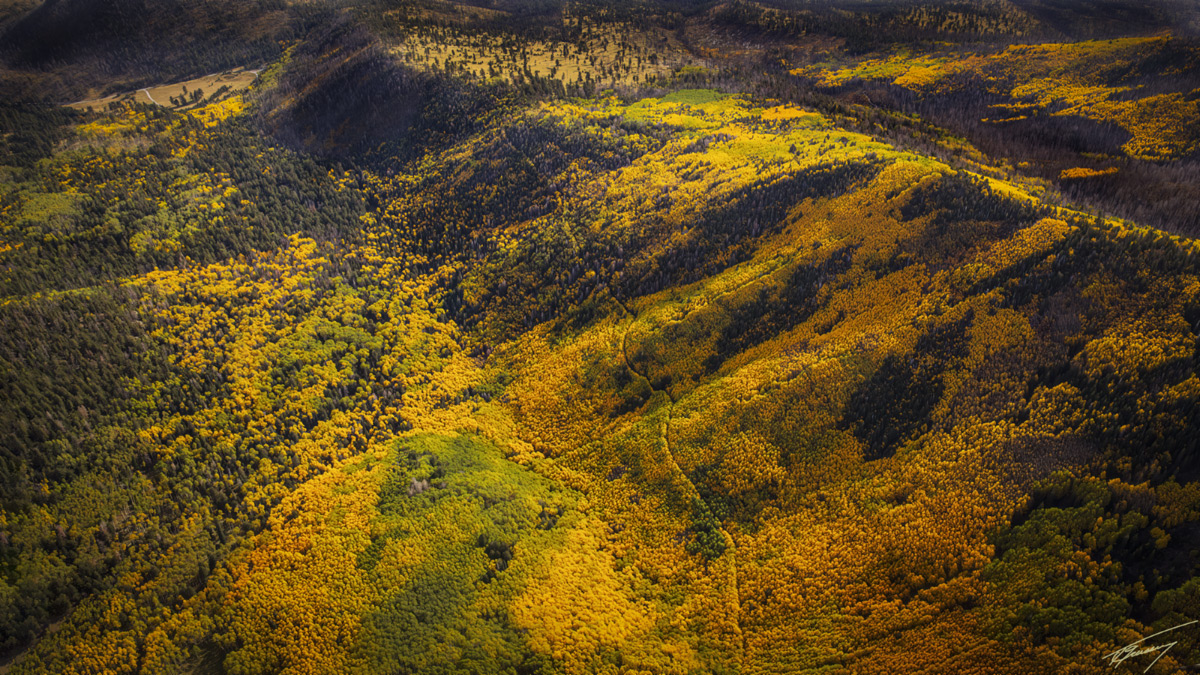
… spending time going through images that can be used in a feature article that Wayne Ranney and I are doing about the San Francisco Volcanic Field located on the Colorado Plateau … on occasion when weather conditions are benign I have flown deep with the inner basin of the San Francisco Peaks and above is an image taken while deep within the basin and looking to the west. The highest peak in the photo is Agassiz towering more than a half mile above me … you can see the old toll road that people used to drive to get to the top as it zigzags its way to the top. The color was beautiful and even though it is kind of a confined space to be flying in, flying a very maneuverable motorglider made it a breeze. There are 75 avalanche zones on the peaks and you can see a few in this photo.

Swinging around and looking down to the east you can see Lockett Meadow in the upper left corner of the photo … it is a long way down to it … a drive I have only made once … need a parachute if I do it again.

Into a new and methinks wonderful week. Going to shoot the red tail hawks in not many hours so will wrap the day and hope to have an update on the red tails tomorrow morning.

Have a beautiful day … smile and keep breathing 🙂

Ted

I bring but this one common thought
My life has wrought;
That from the dregs of drear despair
Still everywhere
There is a joy I yet may sip—
‘Tis comradeship
With all mankind, the high and low
I know.

excerpt from I Know by Max Ehrmann

###

photo_tedgrussingThe easiest way to reach Mr. Grussing is by email: ted@tedgrussing.com

In addition to sales of photographs already taken Ted does special shoots for patrons on request and also does air-to-air photography for those who want photographs of their airplanes in flight. All special photographic sessions are billed on an hourly basis.

Ted also does one-on-one workshops for those interested in learning the techniques he uses.  By special arrangement Ted will do one-on-one aerial photography workshops which will include actual photo sessions in the air.

More about Ted Grussing

Creating a photo project that may launch your photography career

Creating a photo project that may launch your photography career

Tamron – Need lightweight, compact mirrorless lenses? Tamron has you covered, with superior optics perfect for any situation. With weather sealing and advanced image stabilization, you’ll open up your creative possibilities.

Radiant Photo – Radiant Photo superior quality finished photos with perfect color rendition, delivered in record time. Your photos — simply RADIANT. The way they are meant to be.

AfterShoot – AfterShoot helps photographers cull their photos faster, leaving them more time to spend on creative tasks. Save $10 with the code PHOTOFOCUS10.

Mylio Photos – Access your photos from anywhere, without the cloud! Easily showcase your photos on-the-go, resolve duplicates, find faces and look for those stunning locations.

Skylum – Your photos, more beautiful in minutes. Skylum adapts to your style and skill level. Check out Luminar Neo’s unique sky replacement and portrait editing tools, now available.

B&H – B&H is a world renowned supplier of all the gear photographers, videographers, and cinematographers need and want to create their very best work.

MPB – Grab used but perfectly working cameras and lenses for less, or turn your old gear into cash by trading and selling them on MPB!

Wildflower Photography: Tips to Capture the California Superbloom

Wildflower Photography: Tips to Capture the California Superbloom
[embedded content]

Capturing wildflowers can be an incredibly enriching experience that allows you to immerse yourself in the vibrant colors, delicate petals, and the intoxicating scent of nature in full bloom.

However, it can be challenging to find the right approach to truly capture the essence and beauty of these ephemeral wonders. There are a few techniques that I love to use to really get the most out of wildflower photography, and I used them specifically to create a new series capturing the superbloom. Here are my three favorites.

Technique 1: Painterly Intimates

Using a telephoto lens to compress the scene and focus on small details of the landscape is a technique I love. It allows you to showcase the ridges of the hills and capture different color patterns. This type of photography requires slowing down and analyzing the scene to identify unique patterns and structures.

California Wildflower Photography Techniques, Superbloom 2023

California Wildflower Photography Techniques, Superbloom 2023

If a composition doesn’t immediately inspire you, don’t give up. Your initial test shots may not be portfolio-worthy. If using the telephoto lens feels overwhelming, start wide and gradually zoom in, exploring intriguing shapes and areas.

California Wildflower Photography Techniques, Superbloom 2023

Technique 2: The ULTRA Wide

To emphasize the beautiful shapes of the flowers, try getting up close with a wide-angle lens. This technique offers a surreal perspective on landscapes. While it may not resonate with everyone, I personally enjoy magnifying tiny flowers within the frame. To capture these types of images effectively, include a focal point or background subject for the flowers to lead up to, such as trees, rock formations, or mountains.

California Wildflower Photography Techniques, Superbloom 2023

When getting extremely close to the flowers, consider focus stacking—capturing multiple images at different focal points and then merging them. Use a higher aperture like f/16 to minimize the number of images needed. Focus stacking can be done in software like Lightroom, Luminar, or dedicated programs like Helicon.

Helicon is by far the best in my experience. Be mindful of wind conditions, as it can make focus stacking challenging almost impossible. If the flowers are swaying, wait for a moment of stillness to take your stack. Or if the wind does not subside, pull your camera back to capture fewer images. With larger flowers like lupine, focus stacking may not be necessary to showcase their beautiful shape.

Technique 3: Aerial Photography

Capturing wildflowers from above offers a unique perspective of the flowers. You can of course shoot grand landscapes from above, like below. But my personal favorite technique is to aim the camera straight down. This provides an abstract and textured view of the flowers. Move the drone around in different positions to isolate shapes and sections. I am always looking for symmetry, repetition of shapes and different color arrangements.

California Wildflower Photography Techniques, Superbloom 2023

California Wildflower Photography Techniques, Superbloom 2023

California Wildflower Photography Techniques, Superbloom 2023

I hope some of these tips are helpful and if you haven’t tried one of them I highly recommend it. Play around and see which ones resonate with you the most.


About the Author: Michael Shainblum is a photographer, filmmaker, and educator based in San Francisco, California. He has been working professionally as a photographer and filmmaker for 17 years since the age of 16. He has been commissioned by clients such as Disney, Nike, Samsung, Apple, and Google. He also shares his knowledge via his Youtube Channel, Instagram, and workshops.

Setting the Barré: Talking Hospitality Photography with Brandon Barré

Setting the Barré: Talking Hospitality Photography with Brandon Barré

Interviews

When it comes to capturing bold, dramatic, luminous architectural images, Brandon Barré is in a league of his own. Known for photographing some of the swankiest projects on Earth, Brandon doesn’t just rely on fancy spaces to create his incredible photographs; his perfect composition, dramatic lighting and meticulous staging and attention to detail results in images that we can all draw inspiration from.

Based in Toronto but working globally, Brandon recently returned from a marathon of a photoshoot for the Atlantis Dubai where he captured over 260 images throughout the span of a few months.

In this interview, Brandon and I dive into his illustrious career as an architecture and hospitality photographer and discuss his process, techniques and business practices.

[embedded content]

Huge thanks to Brandon for taking the time to chat with me and for sharing his knowledge and experience with all of us at APAlmanac.

To see and drool over Brandon’s work, visit his website, his Instagram @brandon_barre and check out this Project of the Week by Lexi Taciak.

Photographer’s ‘Stellar Flower’ Shows Night Sky Changes in 360 Degrees

Photographer’s ‘Stellar Flower’ Shows Night Sky Changes in 360 Degrees
Stellar flower showing the transition from day to night
The transition from day into night and the setting of Venus and the Moon made from 16 photographs and seen through two rocks that form a “stellar flower.”

A creative photographer used ancient and mythical rocks as the basis of a 360-degree “stellar flower” image that shows the passage of day into night and the setting of Venus and the Moon.

Dario Giannobile created Twilight in a Flower by amalgamating two well-known landscape photography techniques — timelapse star trails and little planet.

Giannobile tells PetaPixel that as far as he knows, it is a new technique that he is the first to develop which he calls a stellar flower.

“In the star trail, the merging of multiple images into a single frame allows the apparent movement of the stars to be reconstructed during the night, crystallizing the passage of time into a single story where the scenery is normally unchanged,” explains Giannobile.

“In a little planet, however, a 360-degree landscape view is presented by reshaping it into the shape of a small globe. It is formed from the original image through a distortion that, for simplicity, we will call circular.

“This is how the stellar flower came to life from these two fundamental elements: the visualization in a single frame of the passage of time typical of star trails and the 360-degree visualization typical of little planet.”

Creating the Stellar Flower

Giannobile chose Argimusco’s Rocks in Sicily, Italy as his location. Dubbed the Sicilian Stonehenge, it’s speculated the megaliths were a site for sacred rites or a place for astronomical observations for the people of antiquity.

Argimusco's rocks
Argimusco’s rocks in Sicily. The two rocks formed the “petals” in Giannobile’s stellar flower.

The landscape, and two rocks in particular, served as the basis for the photographer’s stellar flower image — with the 360-degree technique transforming the rocks into flower petals.

“By recording the passage of time (more or less half an hour) and the transition from twilight to night, it was possible to create a new star flower,” explains Giannobile.

“The image is composed of 16 individual photographs. The rocks of Argimusco have distorted forming a double sequence of petals.

“By combining the almost linear trajectory of the setting of Venus and the Moon with the circular distortion of the image, a sequence is obtained that takes the form of a spiral that winds around itself twice.

“The first rotation is given by Venus, the second by the Moon until it disappears behind the large rock.”

Stellar flower showing the transition from day to night
Starting at the top and moving counterclockwise we can see the twilight sky turning ever darker. The higher star is Venus and the brighter, lower one is the Moon which eventually disappears behind one of the rocks.

Giannobile used a Canon 6D with a Sigma 24-35mm attached in aperture priority mode. He varied the ISO “in order to maintain a homogeneous exposure and control the exposure times to avoid recording the movement of the stars.”

NASA picked the impressive shot for its Astronomy Picture of the Day feature. More of Giannobile’s work can be seen on his Instagram and his website.


Image credits: All photos by Dario Giannobile.