Photography

Today’s Photo from Ted Grussing Photography: Meet the Family

Today’s Photo from Ted Grussing Photography: Meet the Family

… another beautiful morning, except that this morning found me about 150 feet above the ground in a open tram and about 50 feet below my friends home and shooting the red tail family that again is using a rebuilt nest from last year in the cliff about 500 feet south of their home and 50 feet below it.

The first photo above is of the mating pair of RED TAIL HAWKS before they assumed their duties as parents … gleefully planning their life together, flying free without a care in the world … then the kids came a couple of weeks ago and the next photo shows the two kids on the right side of the nest. I think they are encouraging their parents to come and bring them breakfast … keep in mind that these young ‘uns are only about two weeks old and over the course of the next four to five weeks they will transform into mostly grown red tail hawks and will be flying … they are perched on the edge of a precipice 150 feet above the ground … first flight is for real.

The next photo shows mom delivering a pack rat for breakfast to the kids. The kids grow fast and that necessitates a lot of food and the photo below shows mom cleaning herself up a bit as she is perched high above the ground on the edge of a cliff and searching for the next meal for the kids. The fact that I am using a 700mm lens distorts the perceived height … those trees are about a half mile away!
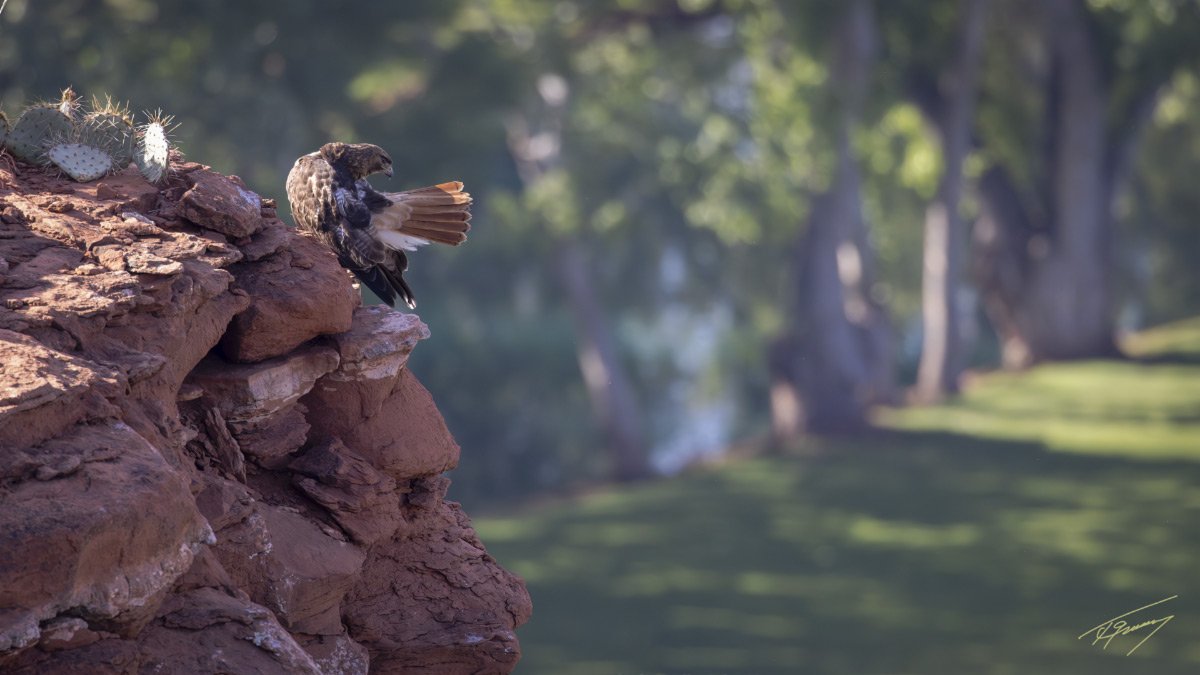
Next update next week and expect a substantial change … seems the kids are decorating the walls too … they have not yet learned to eject their “white paint” out over the edge 🙂

Have a beautiful day, keep breathing and smiling … best way to make someone else’s day.

Cheers,

Ted

A bird flies through the sky, and I fly with it. I am in
each pearl of moisture sparkling in the sun. I lie lazy
on the clouds. And I acknowledge my kinship with
each winged thing.

I see all as one, and nothing repels me, as this new
day climbs noiselessly out of the valley of the night.

Peace lies over the world and over the world of my soul.

excerpt from On A May Morning by Max Ehrmann

###

photo_tedgrussingThe easiest way to reach Mr. Grussing is by email: ted@tedgrussing.com

In addition to sales of photographs already taken Ted does special shoots for patrons on request and also does air-to-air photography for those who want photographs of their airplanes in flight. All special photographic sessions are billed on an hourly basis.

Ted also does one-on-one workshops for those interested in learning the techniques he uses.  By special arrangement Ted will do one-on-one aerial photography workshops which will include actual photo sessions in the air.

More about Ted Grussing

Road Trip: A New Photography Museum in Yorktown Heights

Road Trip: A New Photography Museum in Yorktown Heights

Road Trip: A New Photography Museum in Yorktown Heights

Photographer Robert CapaAttention history and photography buffs: A new exhibition space has opened in northern Westchester to showcase photography exhibits and serve as a place where people gather to create, view and learn about photography. Their mission is to “inspire visitors to participate in the creative process by illustrating the power of photography as a catalyst for social action.”

Named The Capa Space, after famed war photographer Robert Capa, the museum stands on the grounds of a Quaker Meeting house adjacent to a bucolic cemetery in Yorktown Heights. Members of the Capa family including Robert, Cornell Capa and family members are buried on the grounds, giving context to the presence of a photo exhibition space named for Robert Capa.

On display now are over 50 photographs taken by Capa whose stunning works captures the SpanishSoldierSoldier Saluting at Farewell Ceremony for the International Brigade Photo by Robert Capa from the Robert and Cornell Capa Archive ICP/Magnum Civil War, World War II photos of the landing on D-Day, and WWII in Sicily and France. Also on view are Capa’s final photographs of Vietnam where Life Magazine sent him to document the war in Indochina. Informative signage under each photo offers a chronicle of world history and a look at the art of photography before the birth of digital imagery and the iPhone.

Also included are photos of Capa’s glamourous friends including Ingrid Bergman, to whom he was engaged for a brief time.TheCapaSpaceThe Capa Space

The Capa Space is the brainchild of Yorktown resident and artist Elise Graham. She sought to share her mission to use art to inspire change by opening the exhibition space and bringing world class photography to a local setting.

The gallery will host several exhibits each year, along with special events, dramatic performances, films and lectures. It is open to the public and welcomes visitors. Click here to learn more about the space and to plan your visit.

SoldierSoldier Saluting at Farewell Ceremony for the International Brigade Photo by Robert Capa from the Robert and Cornell Capa Archive ICP/Magnum

ShowOpeningThe opening of the Robert Capa show on April 8, 2023.

Demystifying the “boring” photography of William Eggleston

Demystifying the “boring” photography of William Eggleston

With today’s digital photography and mobile photography, it’s now easy for anyone to become a photographer. Everyday scenes and commonplace subjects easily become the gateway to photography. However, photographing the mundane and the everyday isn’t new — just look at the works of photographers like William Eggleston.

But, this style of photography isn’t particularly appealing to everyone. Most of the time, it even makes viewers wonder what’s the point of the photograph or the body of work. So, to help us make better sense of this style, Alex Kilbee of The Photographic Eye decodes the mystery behind the “boring” photography of William Eggleston.

These photos of banal objects and random scenes confound people. What’s the point? What are they even about? Even Eggleston himself only had “life today” for an answer. So, Kilbee’s deep dive into his work and style makes for an interesting brain picking. Whether you’re currently into this approach or not, the video above should encourage you to start digging a bit deeper.

Apart from some basic facts about Eggleston, Kilbee covers some topics that provide additional context for his work. The idea to photograph the “ugly,” for example, came from Eggleston’s observation that he had nothing nice to photograph. So, a friend suggested that he photograph the “ugly things” instead, and it all started from there. “If you’re around where there’s nothing traditionally worth photographing, then just photograph the things that are of rubbish, boring, dull,” Kilbee noted. It was an obvious choice, and one that Eggleston took seriously.

The appeal of William Eggleston’s work lies not in some profound reason or story, but in its fluidity and reactivity. His personal rule is to photograph something only once — he documents what catches his eye, reacts to it, and moves on to the next subject. So, whether you’re feeling stuck in your photography or could use a creative exercise, try capturing the boring and the banal. Put your instinct to work and don’t overthink. You’re free to photograph whatever you like, in whatever way you want it.

Want more photography inspiration like this? Don’t forget to join our group discussions if you’re already part of the Photofocus Community!

Photography Festival – Fotofestiwal – International Festival of Photography in Łódź

Photography Festival – Fotofestiwal – International Festival of Photography in Łódź

The Festival will take place in Łódź between 15th and 25th of June. The theme of this year’s Fotofestiwal is Hope, an edition that will bring together Poland, Belarus and Ukraine.

On this topic will be exhibited projects focusing on action, cooperation and faith in the power of change. Additional venues include the hosting of the programs of Month of Photography in Minsk and Odesa Photo Days, Festivals that couldn’t take part in their home countries; new works by Zbigniew Libera; as well as photographs of the 1980s’ stars in a pop story about the legendary AREA club in New York.

Fotofestiwal – International Festival of Photography in Łódź

15-25 June 2023

www.fotofestiwal.com

Museum of the New York exhibit follows New Yorkers before, during and after the pandemic

Museum of the New York exhibit follows New Yorkers before, during and after the pandemic
WABC logo

Saturday, May 13, 2023 2:32PM

Artist uses photography to show capture hardships, humor of pandemic

NEW YORK CITY (WABC) — A local artist is using his photography to tell his COVID story and capture the hardships and humor of the pandemic.

The Museum of the City of New York has opened a new exhibit reflecting on the pandemic and the ongoing challenges left in its wake.

“New York Now: Home” features photography and video works made over the past several years that capture the changes across the five boroughs during the pandemic and its aftermath.

Artists capture the experiences of New Yorkers and shed light on life in the city before, during and after the pandemic.

Neil Kramer is a photographer who captured the drastic changes we all experienced during the pandemic by documenting his personal experience in the spring of 2020.

“It was definitely an experience of love and dealing with family responsibility during a traumatic time,” Neil said.

Neil’s mom and ex-wife came to stay with him for what was supposed to be a short visit.

“Then March hits, Queens was the epicenter of the pandemic,” Neil said.

The trio hunkered down inside Neil’s two-bedroom apartment in Queens and he started taking pictures. He said it was his way of coping with the seismic shift in how we all lived.

“This was what we did to calm our nerves and to be artistic,” Neil said.

At first, the images were light in nature, but after about a year the tone was heavier as things changed in his building.

“People died on our floor we got a little lonely,” Neil said.

Some of Neil’s images tie back to real moments that he’s recreated. He’s still documenting the aftermath of the pandemic and posting it all on Instagram where to his surprise he gets messages from strangers.

“It makes me more aware for many people the pandemic is not exactly over,” Neil said.

The exhibit opens on May 11 and tickets can be purchased through the museum’s website.

ALSO READ | SNEAK PEEK: American Museum of Natural History opening state-of-the-art science center

———-

* Get Eyewitness News Delivered

* More New York City news

* Send us a news tip

* Download the abc7NY app for breaking news alerts

* Follow us on YouTube

Submit a News Tip

Copyright © 2023 WABC-TV. All Rights Reserved.

Related Topics

How Photography Has Saved My Life

How Photography Has Saved My Life

As the stigma around discussing mental health begins to improve, join me in this article to learn about how I have used photography over the years to help with my fight against PTSD and depression. Trigger warning: this article contains references to suicide, which some may find upsetting.

The Beginning

When I was just 14 years old, I went through a traumatic experience that would change my life forever. When walking through a local woodland on my way home from school, I discovered a body of a man who had taken his own life. This experience has left me with severe flashbacks, nightmares, and panic attacks. Once I found the body, I remember running to my house, but my parents weren’t there. My parents were both still at work, and my heart was racing. I called the police and waited anxiously for help and my parents to phone me. I never felt so alone as I did then.

As I grew older throughout my teens and into adulthood, I continued to have a number of experiences that would challenge my mental health, and this left me with severe depression and now multiple trauma PTSD. Experiences in my life have ranged from having my house broken in to while I was inside and being attacked by a group with baseball bats to losing close family and friends.

Over the years, I have always been fortunate to have a good group of friends and family around me. They would understand the challenges I was going through and have always tried their best to pick me back up. However, I would never fully explain my feelings and kept many things bottled up. I preferred to try to fight things my own way, but deep down, I was struggling badly. I would laugh and joke when I was around them, but when I got home, I could easily break down. My life became a facade, and I considered taking my own life several times.

My First Camera

Around 2014, for my birthday, I asked my mum for a camera because I wanted to take photos of the local wildlife and from there my passion for photography grew. I started off with a simple, affordable bridge camera, but quickly grew to my first DSLR, a Nikon D3300. A couple of years later, the Nikon D500 was announced, and this was when I stepped things up a notch. My main focus was wildlife photography, but I thoroughly enjoyed capturing other moments too, such as landscape and astrophotography.

I have travelled to different parts of the UK, Iceland, the USA, and Australia, capturing as much as I could. I remember the first time I photographed the Milky Way in Australia. I’d never seen so many stars and would stare forever at the photo in disbelief that I took the image! The image hasn’t stood the test of time though, as now, I know about the 500 rule and other technical details that can make an even better image.

Back then, I also only shot JPEG and never backed up my files. I still kick myself to this day for that! It’s all a learning curve and will be for the rest of my life.

Progression

As the years progressed, I continued to push myself. I started a YouTube channel and also developed an interest for portraits. As an introvert due to my depression, challenges like portrait photography became welcome distractions. I would contact friends or random people on Instagram and ask if they would like to do a free photoshoot. They were always thrilled with the results, and this led to people reaching out to me on Instagram for a photoshoot and offering to pay me.

Fast-forward to 2023. I now shoot with a Sony a7 IV. I’ve learned from some of the mistakes I made in my early years and now ensure everything is backed up (well, almost, as I deleted some important raw files recently in Iceland, but that’s another story!). 

I’ve worked for some great local companies, and I have also been very privileged to have been hired as a wedding photographer on several occasions. 

Pushing myself in those mid-years to get out of my comfort zone enabled me to progress with photography and to earn money, which usually goes back into my development, equipment, and travelling to new locations.

One thing that always remains in common from the early days and now, is that when I go with the camera to do photography, suddenly all of my problems seem to go away. I feel at one with my camera and the location I am in, and I have this sense of focus and perspective, almost a state full of mindfulness.

I challenge myself with goals and set targets to make my photography better, and every day, I am learning something new and developing new skills.

Photography certainly takes the edge off my depression. These special moments make me realize I can just forget some of the bad memories in my head and focus on creating that perfect image. 

It Wasn’t All Rosy

It has not all been rosy, though. Since I came back from Iceland in October, I felt like I lost my creativity. I hit a huge hurdle and went to rock bottom mentally. I took a month of sick leave from work and couldn’t bear to face anyone or do anything. I realized I needed professional help, so I contacted my local doctor, who referred me to a great therapist. 

I had my first appointment with the therapist in April, and I remember breaking down completely in front of her. I opened up about all the issues I’ve been through in the past and how it’s all come to the surface. It was now or never to try to fight this once and for all. 

The therapist asked me about my passions, and when I discussed photography and mentioned I felt I had lost my love for it, she challenged me. She said: “Greg, start small. Grab your camera bag and start cleaning your gear and prepare for a shoot. Plan where you want to shoot and what you want to shoot. From there, go out and give it another go.”

I felt a sense of rejuvenation, not only from opening up and seeking help, but also I felt energized to pick up my camera again. I took her advice and cleaned my sensor and lenses, charged my batteries, picked a spot I wanted to shoot, and went and got the shot. 

Sure, it wasn’t a perfect shot. I felt rusty, I made a few simple errors, but it was amazing to have the camera in my hand again. My problems disappeared for those moments in time, my mind refocused on what was important to me.

The Challenge

Whether I’m in Iceland photographing the aurora, on a beach on the Isle of Mull photographing Otters, or simply in a studio photographing a whiskey bottle for a client, photography has saved my life. I am indebted to those who have helped me, to my family and friends, to my wife, and to the therapist for getting me back out there.

For anyone reading this who is also suffering from mental health issues or knows someone going through a tough time, having any hobby such as photography can just give your mind that little bit of respite and keep you focused. I challenge you to get out there in the world and put your mind to something positive, no matter how small. It can save your life!

An Honest Look at Your Chances of Being a Professional Photographer |

An Honest Look at Your Chances of Being a Professional Photographer |

Professional photography is a challenging career choice, taking a wide range of skills and tough skin. If that is something you are considering, check out this fantastic video essay that features an experienced professional photographer discussing what it takes to be a professional and the chances of finding success. 

Coming to you from Scott Choucino of Tin House Studio, this insightful video discusses the chances of making it as a professional photographer. Without a doubt, photography can be a very rewarding career; after all, the chance to make a living doing something you love is a special thing. Nonetheless, there is an appreciable amount of risk, and it can be extraordinarily difficult to make it to the upper levels of the industry. It is particularly difficult nowadays, as the quality of camera equipment and its relatively lowered cost have inundated the industry with a huge amount of photographers. I think, for a lot of people, it is worth considering the middle ground. Making money from photography is not an all or nothing proposition; it is certainly possible to keep it as a side or weekend job that you can make money from without the pressure of deriving all your income from it. Check out the video above for the full rundown from Choucino. 

N.B. photography grads show off unique ‘lens on life’ exhibition

N.B. photography grads show off unique ‘lens on life’ exhibition

Four female photographers from the New Brunswick College of Craft and Design are exhibiting a snapshot for their individual lens on life in their photography exhibition, FEM.

“It’s been very empowering,” said Grace Hallewell. “It’s been so nice really to bring our class together to officially go to the world and be like, ‘This is us.’”

“We’ve been doing this altogether for the past two years now, so being able to have an exhibition just for us has been so special,” she said.

The class had a chance to show off their unique perspectives.

“I really got into the mood of realizing where superstitions come from,” said Ivy Grenier.

Her pop-art style photos juxtapose superstitions against bright background colours.

“What their moods are and how we interact with them on a daily basis, and even if you are superstitious or not, you are constantly cautioned throughout your life,” Grenier said.

Each student presented a series of thematic photographs.

“As I’ve been growing up, I’ve realized more and more people around me are dealing with chronic pain,” Hallewell said. “Just things that people don’t understand, but people often say they relate or almost diminish the scale of it by being like, ‘Oh, everyone has that,’” she said.

Hallewell’s work features black and white photographs with pain described in the subject’s own handwriting.

Miriam Torres Lopez works in self portraiture in a variety of styles.

“Photography is a very powerful tool,” said Torres Lopez. “It can be used for a lot of things to express yourself, to dream, to give a message, to protest. Photography is a very powerful tool.”

The show caught the eye of New Brunswick’s Lieutenant Governor, who purchased a piece to hang in her office.

“She’s a champion for female rights and equality,” Torres Lopez said. “I was very happy that she wanted that piece in particular. It’s called ‘Don’t Call me Victim’ and it could not be in a better place.”

Visitors can check out the photography exhibition FEM in the Charlotte Street Art Center until Sunday.

Three Generations of Women Go West

Three Generations of Women Go West
image
Photo: Rose Marie Cromwell

Becoming a parent brings on a whole new crop of anxieties — about separation, about the future, about time (or lack thereof). After the birth of her daughter, photographer Rose Marie Cromwell felt it all, as she recently told the Cut from her home in Miami. “I started to look at my own mortality. My parents are on their way out, my daughter is on her way in, and I’m at this precipice in the middle,” she says. In her latest project, A Geographical Survey, she examines these anxieties in the wide-open spaces of the American West, merging the places she traveled in her childhood with her newfound perspective as a mother. “I find comfort in these places, where you feel smaller in the landscape,” she says. “When I go to the West, in my soul, I feel at home.”

Cromwell was born in Sacramento and raised largely in Seattle, where her parents divorced and her mother’s new partner, Cromwell’s stepdad, became an influential figure in her upbringing. He was raised in rural Montana, surrounded by cowboys, and, over the course of family road trips, would tell tales of growing up out West. “Seeing the landscapes and learning about indigenous communities’ connection to them was very formative for me,” Cromwell recalls.

She grew up with a speech impediment, but in fifth grade found a new language through photography. “I felt that what I could say through photographs was more articulate than what I could say verbally,” she says. Her mom soon bought her a small point-and-shoot camera of her own, and Cromwell proceeded to photograph everything. In particular, she remembers how, during large family Christmas gatherings, she’d shoot all the trash that accumulated. “I was always drawn to things that weren’t obvious.”

It’s this curiosity that took Cromwell to Cuba in her 20s to observe how other communities organized politically, and to Panama while working on her master’s degree, where she photographed populations living on the edges of the biggest thoroughfare of world trade. Both experiences felt intensely personal to Cromwell, but it was only after her daughter, Simone, was born that she turned the lens around.

Eclipse, an earlier series that documents her first days of motherhood, began after a traumatic birth experience that left Cromwell hemorrhaging after delivery. All of the complicated feelings, physical and emotional, were dampened by an overwhelming joy at welcoming Simone, “who was here and was healthy.” And so Cromwell began photographing the out-of-body experience she was living. At first, she would share iPhone shots on a private Instagram account: her in her hospital underwear, or a big blood clot that she’d expelled, or her placenta pills. The photographs resonated, most notably with her publisher, who urged her to turn them into a book.

That was the work that birthed A Geographical Survey, a project that she considers to still be in its early stages. All throughout her time spent working in South America and the Caribbean, “I did have that question lingering in my head, ‘Why haven’t I been back home?’ I hadn’t looked at my own identity through where I’m from.” With this work, she’s doing just that.

Beginning in March 2022 and continuing over the course of several road trips across the West, Cromwell photographed her mother and her daughter alongside these harsh yet beautiful landscapes. They visited Earthship communities of sustainable homes in New Mexico and off-the-grid locations in Northern California. Cromwell was amazed by her own mother’s willingness and adaptability. “This was the first time she’d used a compost toilet. Afterwards, she was really into it.”

A Geographical Survey juxtaposes the intimacy of familial bonds with the emptiness of the desert landscape. It captures Cromwell where she is now, anxious about what will be but compelled to document her mother and daughter in this moment, in their growing and aging bodies. Through it, she sees a future for Simone. “I want her to be exposed to that feeling of calmness that nature brings, to be able to recognize that that is important,” Cromwell says, reflecting on their travels.

One night, while camping in a desert in Colorado, Cromwell and her daughter sat together and watched the sun set over the sand dunes. “She was just one and a half, but was so mesmerized. We both were. I want her to be able to experience all those kinds of things in her life. That’s the beauty of being alive.”

A Highway Shoulder

“I was looking at the history of western landscapes and how they had been made by white men on expeditions to colonize the West. I want to broaden the definition of what we think of as traditional landscape, which is the horizon line. I’m interested in landscapes where we can immerse ourselves a little bit more, feel more of a connection to the land, and hopefully, maybe then, [heed] a call to action.”

In the Bed

“I feel like image-making is a ritual. It’s a way to become closer to somebody,” Cromwell said. “I like my personal work to go in a more performative direction. I can have more creativity. It’s very reflective of where I’ve been in my life, where I’m living, what I’m doing. Now, as a mom, and as somebody realizing that my time with my mom is also limited, it’s important that I spend time with both of them now. My work needs to be about that. My personal work is a lifestyle choice.”

The Mirror

While staying in a cabin off the grid in Northern California, Cromwell was captivated by the way the light reflected off of a mirror above the outdoor sink, changing with each passing hour. “It created a whole way to see the landscape differently. It was almost like this installation that would change all day long.”

On the Porch (Simone’s Baby)

“Making images with my mom and Simone is bonding. It’s a very creative experience. It also takes some negotiating — making sure that Simone has had her nap, or that my mom feels comfortable taking her shirt off (maybe she’ll feel more comfortable in an hour) — but it’s a way to spend time together in our busy lives.”

The Fallen Redwood

“My mom originally took me to the redwood forest when I was a kid,” Cromwell says. “When you’re around trees that big, it’s hard not to be in awe. Sharing those kinds of feelings with my daughter was special.” This particular fallen tree drew Cromwell in. “There’s something very human about wanting to submit our names into the flesh of a tree in a way to overcome time. It’s a way for people to embed themselves in this larger-than-life tree that’s hundreds of years old. It’s also a very vulgar act.”

Water Tank

“I’m interested in the history of mining in the West and what happens when these old structures are no longer functional. They just sit there and become part of the landscape.”

After the Shower

“Simone calls her ‘oma’ because my brother’s wife is German and they had kids first. So she got the grandma name. She definitely is a doting grandmother.”

In the Springs

“My husband and I did a couple of road trips camping, and for others, we rented a van and slept in it. One thing we would always do was look for natural hot springs. This one was in Colorado. And it’s so soothing for Simone. She goes from being a hyper 2-year-old to very calm and very zen. She gets to experience nature, and that is really special. And to see how it relaxes her. I like how her body fits into the rocks.”

Date Tree

“We went to this desert oasis outside of Death Valley, and I found the drapes on the date trees to protect the fruit felt like the [human] body. They were sagging and worn, and there was a certain care and tenderness to these bags.”

Sunken Mine

“It struck me, all of a sudden, thinking about sustainability of the land for my daughter’s future. It’s sad that it’s harder to contemplate living in some of these locations. The West is suffering.”

The Garden Shed

“My mom and I became closer through my daughter. We are both really strong personalities, but with my daughter being born, we have a different goal together,” Cromwell says. “She’s been very supportive of my whole career, from buying me my first camera to never making me feel like I was making a silly choice by wanting to be an artist. And I think she’s still doing that by posing in my images.”

Self-Portrait in the Dry Bush

“It was this attempt to insert myself into the landscape,” Cromwell reflects. “I know it’s kind of futile, but I wanted to be in the bush, to find some symbiotic way to exist in this specific landscape.”

This is a rare moment in the series where Cromwell herself appears photographed. But hers is a crucial perspective to the story she’s hoping to tell. “You’re at this peak, and you can see both ways. At one point, you are dependent on your mother, and now, you’re the caretaker. It’s this point where you have a fuller grasp of what life is, or what it could be.”

My Mother’s Back

“They had collected a bunch of rocks in the desert and we were painting them as an activity with Simone. I saw how fascinated she was with them,” Cromwell says. “Simone was putting rocks on my mother’s back, which I think really speaks to carrying the weight of generations. You don’t know whether she’s putting on the rocks or taking them off. There’s a certain gentleness and lovingness to the picture.”

Greenhouse Bougainvillea

Because of the way they’re oriented, Earthships, often built of dirt and tires, don’t require heating or cooling. Their humid environments allow tropical plants, like bougainvillea, to thrive.

The Shower

“There was this amazing outdoor shower in the Earthship in California. This one was her idea. I had made her go into some bushes, and she was covered in dirt,” Cromwell says. “I’ve got a very tolerant mother.”

Photographs by Rose Marie Cromwell

A Highway Shoulder

“I was looking at the history of western landscapes and how they had been made by white men on expeditions to colonize the West. I want to broaden the definition of what we think of as traditional landscape, which is the horizon line. I’m interested in landscapes where we can immerse ourselves a little bit more, feel more of a connection to the land, and hopefully, maybe then, [heed] a call to action.”

In the Bed

“I feel like image-making is a ritual. It’s a way to become closer to somebody,” Cromwell said. “I like my personal work to go in a more performative direction. I can have more creativity. It’s very reflective of where I’ve been in my life, where I’m living, what I’m doing. Now, as a mom, and as somebody realizing that my time with my mom is also limited, it’s important that I spend time with both of them now. My work needs to be about that. My personal work is a lifestyle choice.”

The Mirror

While staying in a cabin off the grid in Northern California, Cromwell was captivated by the way the light reflected off of a mirror above the outdoor sink, changing with each passing hour. “It created a whole way to see the landscape differently. It was almost like this installation that would change all day long.”

On the Porch (Simone’s Baby)

“Making images with my mom and Simone is bonding. It’s a very creative experience. It also takes some negotiating — making sure that Simone has had her nap, or that my mom feels comfortable taking her shirt off (maybe she’ll feel more comfortable in an hour) — but it’s a way to spend time together in our busy lives.”

The Fallen Redwood

“My mom originally took me to the redwood forest when I was a kid,” Cromwell says. “When you’re around trees that big, it’s hard not to be in awe. Sharing those kinds of feelings with my daughter was special.” This particular fallen tree drew Cromwell in. “There’s something very human about wanting to submit our names into the flesh of a tree in a way to overcome time. It’s a way for people to embed themselves in this larger-than-life tree that’s hundreds of years old. It’s also a very vulgar act.”

Water Tank

“I’m interested in the history of mining in the West and what happens when these old structures are no longer functional. They just sit there and become part of the landscape.”

After the Shower

“Simone calls her ‘oma’ because my brother’s wife is German and they had kids first. So she got the grandma name. She definitely is a doting grandmother.”

In the Springs

“My husband and I did a couple of road trips camping, and for others, we rented a van and slept in it. One thing we would always do was look for natural hot springs. This one was in Colorado. And it’s so soothing for Simone. She goes from being a hyper 2-year-old to very calm and very zen. She gets to experience nature, and that is really special. And to see how it relaxes her. I like how her body fits into the rocks.”

Date Tree

“We went to this desert oasis outside of Death Valley, and I found the drapes on the date trees to protect the fruit felt like the [human] body. They were sagging and worn, and there was a certain care and tenderness to these bags.”

Sunken Mine

“It struck me, all of a sudden, thinking about sustainability of the land for my daughter’s future. It’s sad that it’s harder to contemplate living in some of these locations. The West is suffering.”

The Garden Shed

“My mom and I became closer through my daughter. We are both really strong personalities, but with my daughter being born, we have a different goal together,” Cromwell says. “She’s been very supportive of my whole career, from buying me my first camera to never making me feel like I was making a silly choice by wanting to be an artist. And I think she’s still doing that by posing in my images.”

Self-Portrait in the Dry Bush

“It was this attempt to insert myself into the landscape,” Cromwell reflects. “I know it’s kind of futile, but I wanted to be in the bush, to find some symbiotic way to exist in this specific landscape.”

This is a rare moment in the series where Cromwell herself appears photographed. But hers is a crucial perspective to the story she’s hoping to tell. “You’re at this peak, and you can see both ways. At one point, you are dependent on your mother, and now, you’re the caretaker. It’s this point where you have a fuller grasp of what life is, or what it could be.”

My Mother’s Back

“They had collected a bunch of rocks in the desert and we were painting them as an activity with Simone. I saw how fascinated she was with them,” Cromwell says. “Simone was putting rocks on my mother’s back, which I think really speaks to carrying the weight of generations. You don’t know whether she’s putting on the rocks or taking them off. There’s a certain gentleness and lovingness to the picture.”

Greenhouse Bougainvillea

Because of the way they’re oriented, Earthships, often built of dirt and tires, don’t require heating or cooling. Their humid environments allow tropical plants, like bougainvillea, to thrive.

The Shower

“There was this amazing outdoor shower in the Earthship in California. This one was her idea. I had made her go into some bushes, and she was covered in dirt,” Cromwell says. “I’ve got a very tolerant mother.”

Photographs by Rose Marie Cromwell

Three Generations of Women Go West





