Photography

Newsday’s National Headliner Award winners include top honors to photographer Thomas A. Ferrara

Newsday’s National Headliner Award winners include top honors to photographer Thomas A. Ferrara

The announcement of the 89th National Headliner Award winners Thursday included honors to a number of Newsday staffers, including the “Individual Photo Portfolio” first-place prize to photographer Thomas A. Ferrara, who also had three second-places finishes and a third-place finish as Newsday was honored with nine photo prizes for “Photography and Graphics for Daily Newspaper, Magazines, News Service and Syndicates.” 

Newsday also had a third-place finish for best “Online Video of 10-30 Minutes” for “4 Deaths, 4 Serious Injuries,” a documentary on the culmination of a 2-year Newsday “Inside Internal Affairs” investigation into Long Island police departments that found the actions or inactions of Nassau and Suffolk police department members led to those deaths and injuries. 

Newsday staffer Barbara Barker was honored with a third-place finish in the “Daily Newspapers and News Syndicates” category for Sports Opinion.

“We are very proud that Newsday photographers had such an impressive showing in a competitive, national contest,” said John Keating, director of Multimedia Newsgathering at Newsday. “Our team won awards in eight different categories, which is a testament to their skill and talent. I’m especially pleased to see Thomas A. Ferrara recognized for all of his hard work, as he took top honors in the photo portfolio division, along with five other prizes.”

In honoring Ferrara for best photo portfolio, contest judges wrote: “Thomas A. Ferrara — with a sports-heavy portfolio — wins the individual portfolio because his pictures capture great moments which are both well composed and fun to view. His subjects come to life through their gyrations and antics.”

Third-place honors in the category went to Newsday photographer Alejandra Villa Loarca, who also was honored with a third-place finish in “Spot News Photography” for “Funeral for FDNY firefighter Jesse Gerhard of Islip.”

Ferrara also had second-place finishes in the “Multiple Day Photo Story” category for “Destination Williamsport, Scenes from the 2022 Little League World Series,” the “Pictorial” category for “Citi Field,” for “Feature” for “Prayers for the Ukraine” and third-place in the “Sports Action or Sports Feature” category for “Mo Donegal.” Newsday photographer J. Conrad Williams took second place in the photo “Portrait” category for “Portrait of Nafiah Ikram.”

The Newsday Staff also landed a third-place finish for best “Staff Photo Portfolio” for its entry titled “Dunia, A Journey of Courage.”

Young Native Americans’ work highlighted in new photography display at Sanford Bemidji Medical Center

Young Native Americans’ work highlighted in new photography display at Sanford Bemidji Medical Center

BEMIDJI — The halls of Sanford Bemidji Medical Center just got a whole lot brighter.

Dozens of photographs taken by four local Native American youth artists during a two-week photography camp last summer are now on display in the medical center’s halls for all to see.

On May 4, family, friends and strangers alike gathered for the grand reveal of the student’s exhibit titled “Bi-dibaajimowag — The Eagles Come Telling Stories.”

051323.N.BP.ARTEXHIBIT 8.jpg

Student photographer Waasebiik Belgarde of Red Lake Nation speaks about his experience during a Native American Youth Photograph Collection reveal event on May 4, 2023, at the Sanford Bemidji Medical Center.

Maggi Fellerman / Bemidji Pioneer

Karen Goulet, program director of the art center’s Native American Gallery, expressed how proud she was of the students during the reveal event and is excited their work is being shared and seen.

“This is why I love doing what I do. My goal is to make sure that the world knows more about the wonderful talent that we have right here in our own communities,” Goulet said to those in attendance. “This is an opportunity for students to start young in something they’re passionate about and representing their communities, their nations and their families.”

ADVERTISEMENT

051323.N.BP.ARTEXHIBIT 9.jpg

Watermark Art Center Artist Karen Goulet says a few words about the students during a Native American Youth Photograph Collection reveal event on May 4, 2023, at the Sanford Bemidji Medical Center.

Maggi Fellerman / Bemidji Pioneer

A collaboration of Watermark Art Center and Gizhiigin Arts Incubator, the students committed their time and energy to this two-week photography camp under the mentorship of artist-in-residence Falcon Gott of Sapotaweyak Cree Nation and three other area professional Native American photographers.

“I want to thank Sanford for seeing this work, appreciating it and wanting to bring it out and share it. I think this is the first time we’ve done something like this, it was a lot of moving parts and I just really feel like a lot was accomplished,” Goulet said. “I think that all of my ancestors who are from here are all smiling down right now, happy to see this visibility of our community members in a really positive way.”

The four student artists Precious Jourdain, Waabinoo Littlewolf, Waasebiik Belgarde and Malachi Norris were taken through the steps of the working photographs. During the workshop, students were able to gain exposure to professional processes and creative ideas. They made connections with each other and shared ideas and their work, taking full advantage of the experience.

051323.N.BP.ARTEXHIBIT 7.jpg

Student photographer Waabinoo Littlewolf of White Earth Nation speaks about her experience during a Native American Youth Photograph Collection reveal event on May 4, 2023, at the Sanford Bemidji Medical Center.

Maggi Fellerman / Bemidji Pioneer

While the main exhibit is through the east entrance of the hospital, more photographs are scattered around the halls. By integrating Native American practices like photographs by up-and-coming artists, Sanford hopes to create a more inviting and educational environment for all patients.

“Sanford realizes the importance of our Native American culture in this region. It’s something to be celebrated and honored, which is why we are here today,” Sanford Health of Northern Minnesota President and CEO Karla Eischens said. “We are excited to be able to display this photography throughout the regional hospital and our clinical locations. So thank you, everybody, for coming and supporting this. I hope we will continue to support our youth and in their talents and efforts.”

051323.N.BP.ARTEXHIBIT 10.jpg

Sanford Health of Northern Minnesota President and CEO Karla Eischens addresses attendees at a Native American Youth Photograph Collection reveal event on May 4, 2023, at the Sanford Bemidji Medical Center.

Maggi Fellerman / Bemidji Pioneer

051323.N.BP.ARTEXHIBIT 3.jpg

The student’s photographs are on display in the Sanford Bemidji Medical Center hallway art gallery near the east entrance across from the administrative offices.

Maggi Fellerman / Bemidji Pioneer

051323.N.BP.ARTEXHIBIT 6.jpg

Student photographer Precious Jourdain of Red Lake Nation speaks about her experience during a Native American Youth Photograph Collection reveal event on May 4, 2023, at the Sanford Bemidji Medical Center.

Maggi Fellerman / Bemidji Pioneer

051323.N.BP.ARTEXHIBIT 5.jpg

Student photographer Malachi Norris of Red Lake Nation, who could not attend, speaks about his experience over a video call during a Native American Youth Photograph Collection reveal event on May 4, 2023, at the Sanford Bemidji Medical Center.

Maggi Fellerman / Bemidji Pioneer

051323.N.BP.ARTEXHIBIT 2.jpg

The student’s photographs are on display in the Sanford Bemidji Medical Center hallway art gallery near the east entrance across from the administrative offices.

Maggi Fellerman / Bemidji Pioneer

Maggi is a reporter at the Bemidji Pioneer focusing on outdoor and human interest stories. Raised in Aitkin, Minnesota, Maggi is a graduate of Bemidji State University’s class of 2022 with a degree in Mass Communication.

Daughter helps turn lens on pioneering photographer father Roman Vishniac in new film

Daughter helps turn lens on pioneering photographer father Roman Vishniac in new film

Photographer Roman Vishniac is widely known and admired for his iconic images of pre-World War II life in Eastern Europe, a world that vanished due to the Holocaust. He was also a pioneer of microphotography, a technique that combines photography and microscopy to reveal the smallest aspects of nature in vivo and living color.

Vishniac was always observing the world around him. Now, a new documentary film turns the lens back at him and sheds light on who he was not only professionally, but also as a person.

American-Israeli filmmaker Laura Bialis does this in “Vishniac” by artfully tracing the arc of the photographer’s life from the perspective of his daughter Mara Vishniac Kohn.

“Mara was such an amazing person. And she was a captivating storyteller. She had this incredible gift of remembering things through a child’s eyes — what everything felt like and what those experiences were like. She never lost that connection to her childhood viewpoint,” Bialis said in an interview with The Times of Israel.

The film, which premiered in February at the Santa Barbara International Film Festival and will screen at the Docaviv International Documentary Film Festival beginning May 11, is as much about Kohn’s sometimes fraught relationship with her talented and idiosyncratic father as it is about Vishniac’s biography.

“He regarded himself as a mixture of Moses and Superman,” Kohn said of her father, who tended toward self-aggrandizement.

Later in life, Vishniac claimed he had an incredible number of doctorates and spoke eight languages. One television program on his microphotography referred to him as a scientist and philosopher. Another called him an expert on Oriental art and a collector of medieval manuscripts. A consummate storyteller, it was hard to detect whether there was a kernel of truth hidden within all these embellishments.

Mara Vishniac Kohn as she appears in ‘Vishniac’ by filmmaker Laura Bialis. (Courtesy of Laura Bialis)

In “Vishniac,” Bialis seamlessly weaves together many of Vishniac’s 30,000 images (mainly still, but also some moving), his writings, general archival footage, interviews with historians and Vishniac relatives, and dramatic reenactments filmed on location in Poland and at a California studio. (Bialis’s daughter impressively plays Mara Vishniac Kohn in these scenes.)

At the heart of it all are Kohn’s memories and narration.

Always looking through the camera or microscope

Photographer Roman Vishniac (© Gift of Mara Vishniac Kohn, The Magnes Collection of Jewish Art and Life, University of California, Berkeley)

Roman Vishniac (1897–1990) was born near St. Petersburg, Russia, and grew up in Moscow. His successful businessman father, Solomon Vishniac, had a special permit to live in the major city instead of in the Pale of Settlement with most other Jews.

Fascinated with cameras and microscopes from a young age, Vishniac always wanted to be a scientist and studied biology at university. However, his academic pursuits were curtailed by the Russian Revolution, at which time his bourgeois family escaped to Berlin.

The culturally and socially free Weimar Republic served as fertile ground for Vishniac’s visual creativity. Uninterested in following his father and grandfather into business, he insisted on doing nothing but his photography and micrography. He, his wife Luta, son Wolf (born 1922), and daughter Mara (born 1926) were supported by Vishniac’s parents.

Filmmaker Bialis recreates moving scenes in which Vishniac includes young Wolf and Mara on his nature walks or in his activities in his home lab filled with cages and aquariums for everything from monkeys to lizards.

“He was always calling me to see the beautiful things that he saw,” Vishniac Kohn recounted.

“He would tell me that the closer you come, the more beautiful it is,” she added.

[embedded content]

She especially loved spending time in the darkroom with her father, watching images emerge, the dark areas first.

Despite these happy memories, Kohn speaks in the film about the uncomfortable tension between her parents, who had drifted apart. She recalled her mother, brother, and herself being a unit living a regular life, while her father was immersed in his own world. In addition, Vishniac began a long-term extramarital relationship with a young non-Jewish woman named Edith in 1932.

Making it out of Europe in the nick of time

What would come next in the Vishniac family’s story is what initially sparked Bialis’s interest in eventually making her documentary. In 1996, Bialis met Kohn at a lecture given by Holocaust survivor and Nobel laureate Elie Wiesel in Santa Barbara, California.

“Mara and I both lived in Santa Barbara, so it wasn’t surprising that we eventually met. The Jewish community there is quite small,” Bialis said.

The two women were seated next to each other, and before the lecture started, Kohn told Bialis about how her family escaped Europe to safety in New York at the very last moment.

Photo of Mara Vishniac Kohn and her older brother Wolf Vishniac as teenagers. (© Gift of Mara Vishniac Kohn, The Magnes Collection of Jewish Art and Life, University of California, Berkeley)

Roman and Luta Vishniac divorced in 1935 but did not file the papers in hopes of getting a family visa to exit Nazi Germany. Following the Kristallnacht pogrom in November 1938, the Vishniacs sent 16-year-old Wolf to relatives in Riga, Latvia, and Mara, 12, to a refugee children’s home in Sweden. Mara eventually reunited with her mother in Stockholm, but Roman, who had made it to the south of France, ended up in an internment camp in September 1939.

Since all four family members were Latvian rather than German citizens through Luta’s birth in Riga, Luta was able to get the Latvian authorities to arrange for Vishniac’s eventual release. With the US still accepting Latvians (but not German Jews), they were able to get visas. Luta and the children had to risk traveling back through Berlin to make their way to Lisbon, Portugal. They met Roman there, and together they boarded a ship that arrived in New York on December 1, 1940.

“I was sitting at the edge of my seat as she told me this amazing story,” Bialis said.

Circumstances dictate photographic subject and style

Photo of a young Mara Vishniac Kohn taken by her father Roman Vishniac in pre-World War II Berlin. Vishniac would place his daughter in front of Nazi propaganda so he could photograph it unquestioned. (© Gift of Mara Vishniac Kohn, The Magnes Collection of Jewish Art and Life, University of California, Berkeley)

In tracing Vishniac’s development as a photographer, Bialis includes in the film his early Russian pictorial style work and his Weimar-era modernist images featuring strong angles, sharp contrasts, and geometry.

As the Nazis rose to power and imposed anti-Jewish race laws, Vishniac would photograph his young daughter Mara standing in front of posters and other types of propaganda. It was a way of documenting what was happening without drawing attention.

Once the Nazi regime banned most Jews from their jobs, Vishniac documented the Jewish institutions established to employ Jewish professionals and care for the community. These included schools, hospitals, soup kitchens, and hachsharot (agricultural programs to prepare young Jews for immigration to Palestine).

At the same time, he began traveling to Eastern Europe to capture life in the big cities, towns, and small shtetls. He even reached remote Jewish farming communities in the Carpathian mountains.

Those trips, eventually commissioned by the American Joint Distribution Committee, produced not only stunning images but also documentation of the poverty of Eastern European Jews. For Vishniac, they were a means of advocating for his fellow Jews, and for the AJDC they were a tool for fundraising for relief for those same people.

Photo of a Jewish farmer in Vysni Apsa in the Carpathian mountains taken by Roman Vishniac pre-World War II (© Gift of Mara Vishniac Kohn, The Magnes Collection of Jewish Art and Life, University of California, Berkeley)

Although these photos were an assimilated Western European Jew’s perspective on the Ostjuden, they provided Vishniac with an opportunity to grow closer to his own Jewish identity.

“He felt a close relationship to the people he was photographing,” Kohn said.

Bialis noted that Vishniac’s modernist photographs showed his striving to be part of the mainstream. His work in Eastern Europe denoted a clear shift toward particularism and an appreciation for the spiritual and traditional Jewish life.

“As we were going through his photographs and his writings, we could kind of see him falling in love with his own people,” she said.

During the war, Vishniac held three exhibitions of these photos to raise consciousness for the plight of European Jewry. And after the war, the AJDC sponsored him to return to Europe to document the destruction and the hundreds of thousands of Jewish displaced persons. (Already divorced from Luta, he reunited with and married Edith in Germany and brought her to the US).

Carving out a niche with microphotography

Once in America, Vishniac had to hustle to support his family. He shot portraits and managed to get some magazine work. He even brought his young teenage daughter along as he showed up unannounced at Albert Einstein’s office at Princeton University. He convinced Einstein to let him take some pictures of him.

“He had enormous chutzpah,” Kohn said.

Bialis said she got to see those images a couple of decades before beginning work on “Vishniac.” It was when she and her parents were visiting Kohn at her home not long after Bialis initially met her. At the time, all of Vishniac’s photos, negatives, journals, and other materials were stored at Kohn’s home, where she lived with her second husband Walter Kohn, an Austrian Jewish refugee and Nobel Prize-winning theoretical chemist and physicist.

“She opened the closet where a lot of the stuff was, and this portfolio of Einstein just fell out,” Bialis recalled.

Microphotography by Roman Vishniac. (© Gift of Mara Vishniac Kohn, The Magnes Collection of Jewish Art and Life, University of California, Berkeley)

Wanting to make the cover of LIFE magazine, Vishniac concentrated on his microphotography and a technique called colorization that he claimed to have invented. His insistence on observing things in vivo and motion, rather than squashed between two pieces of glass on a slide, was considered his legitimate contribution to science and helped him secure a major grant from the National Science Foundation to create the widely viewed “Living Biology” film series.

Vishniac lectured widely and thought of himself as a true scientist. However, the scientific community thought otherwise, seeing him merely as a photographer and romantic storyteller. He had a habit of describing nature as a narrative, rather than as facts and data.

Even Vishniac’s own son Wolf, who became a renowned microbiologist, was uncomfortable with his claims and theories. (Wolf died tragically in 1973 at age 51 from a fall from a cliff while on a scientific expedition in Antarctica.)

Choosing among tens of thousands of images

Bialis, who became close to Kohn over the years she interviewed her for the film, was given full access to the Vishniac Archive at The Magnes Collection of Jewish Art and Life at the University of California, Berkeley. Before 2018, the archive was curated by Maya Benton and housed at the International Center of Photography (ICP) in New York.

Most of Vishniac’s scientific photography is housed at the Moving Image Research Collections at the University of South Carolina. Kohn also gave Bialis access to that.

Faced with an abundance of riches, it was difficult for Bialis to choose which images to include in “Vishniac.”

‘Vishniac’ filmmaker Laura Bialis (Sharon Derhy)

“His photos are all stunning. It was amazing to have access to every single frame that he shot and to be able to choose. It is mind-blowing how amazing they are, especially in terms of the way he captured the faces of people. And I feel like there’s some sort of magical connection that he had with his subjects, the way they’re looking at him. He sort of was able to capture someone’s essence,” she said.

Kohn died in 2018 at age 92 and did not live to see the completion of the film. Bialis said that was very difficult, but that she was pleased by the response of Kohn’s daughter and granddaughters. They were thankful that the film gave Kohn — a compelling and accomplished person in her own right — a chance to come out from the shadow of the successful and famous men in her life.

“Mara’s daughter spoke at the film’s premiere and said that it was the story that her mother wanted to tell. That made me feel great,” Bialis said.

Today’s Photo from Ted Grussing Photography: A Mood

Today’s Photo from Ted Grussing Photography: A Mood

… there are times when just looking at a photo puts you into a mood or state that evokes strong memories of good times past and likely future and such was the case with the image of the three Cinnamon Teal in flight above … the times in duck blinds before dawn, the decoys set, mist blanketing the water and surrounding trees and a cup of strong black coffee in a tin mug keeping hands warm … or the early morning days on the lake looking for birds as the world slowly wakes from the night … pick your own memories and envision what you will … put yourself there!

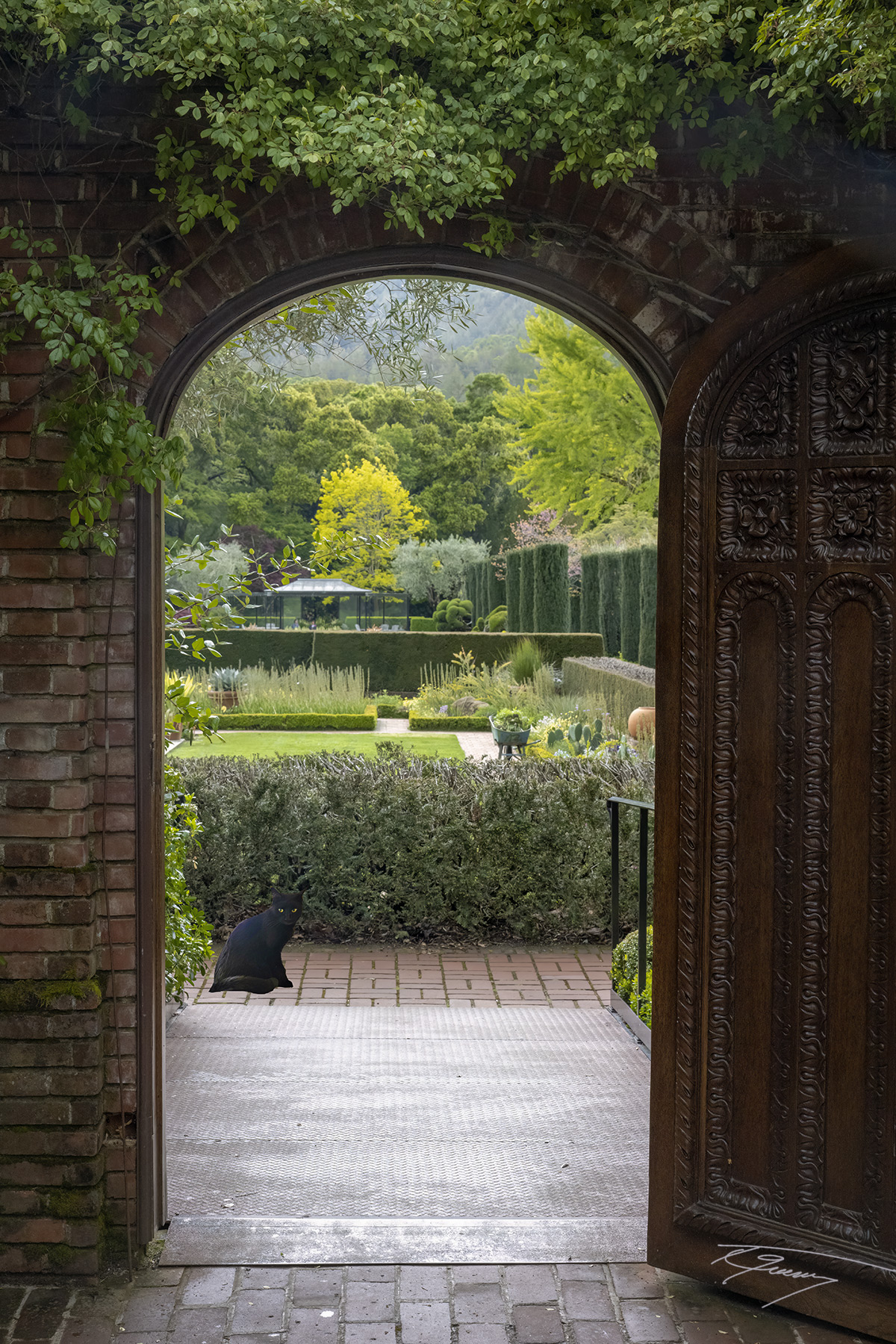
Below is a photo looking through a gateway into one of the formal gardens at Filoli Gardens and it appears that Katie decided to transport out and join me as she waits for me to pass through the gateway … perhaps another dimension …

Past time to wrap the day … have a beautiful day and look for a little beauty today … in nature and in the people you meet and greet … above all, smile, you are here and how terrific is that!

Cheers,

Ted

I am the dawn, the whisper of winds, the perfume
of morning.

The passing night fondled me, hovering close to me,
softly, silently.

The breaking day builds the spirit temple of my joy.
I abandon myself!

It seems to me that never before have I walked with
the spirit as now, nor overcome space, time, and the
elements as I overcome them now.

I see all as one, and nothing repels me, as this new
day climbs noiselessly out of the alley of the night.

Peace lies over the world and over the world of my soul.

excerpts from On A May Morning by Max Ehrmann

###

photo_tedgrussingThe easiest way to reach Mr. Grussing is by email: ted@tedgrussing.com

In addition to sales of photographs already taken Ted does special shoots for patrons on request and also does air-to-air photography for those who want photographs of their airplanes in flight. All special photographic sessions are billed on an hourly basis.

Ted also does one-on-one workshops for those interested in learning the techniques he uses.  By special arrangement Ted will do one-on-one aerial photography workshops which will include actual photo sessions in the air.

More about Ted Grussing

ArtDependence | Samuel Fosso wins the Deutsche Börse Photography Foundation Prize 2023

ArtDependence | Samuel Fosso wins the Deutsche Börse Photography Foundation Prize 2023

The influential prize, in partnership with the Deutsche Börse Photography Foundation, rewards artists and their projects recognised as having made the most significant contribution to international contemporary photography over the past 12 months.

The exhibition showcasing all four shortlisted artists is on show at The Photographers’ Gallery until 11 June 2023.

Samuel Fosso was awarded the Prize for his exhibition Samuel Fosso at the Maison Européenne de la Photographie, Paris, (10 November 2021 – 13 March 2022). 


Since the mid-1970s, Samuel Fosso (b. 1962, Kumba, Cameroon) has dedicated his artistic practice to self-portraits and performative photography. Fosso’s retrospective exhibition traces a career of almost 50 years, bringing together iconic series, lesser known works, archival material and previously unpublished images. Raised in Nigeria, Fosso fled the Biafran War as a young boy, and in 1972 was taken in by an uncle in Bangui in the Central African Republic. In 1975, at the age of thirteen, Fosso opened his Studio Photo Nationale. Alongside commercial work, Fosso immediately began a series of self-portraits – a mode of representation he has never abandoned. Described as ‘a man of 1000 faces’, Fosso plays the role of leading historical figures, including Martin Luther King, Angela Davis and Haile Selassie, and social archetypes in front of the camera, embodying a powerful way of existing in the world, and a vivid demonstration of photography’s role in the construction of myths. His work is also deeply personal, he said ‘making pictures of myself later in life was a way for me to take back what I had been lacking as a child, to take back my reflection.’
 

Wildlife photography show in B’luru next week

Wildlife photography show in B’luru next week
image

Wildlife photographer Deepak Shankar will display 50 to 60 of his best works in a solo exhibition titled ‘Into the Wild’ in Bengaluru next week.

“While most exhibits will be 36 x 24 inches in size, copies will be available for purchase in different sizes,” informs Shankar, who stays in Jayanagar.

The four-day show will feature photographs of big cats, elephants and birds from Africa and India. ‘The Flying Hunt’, a sequence of photos that captures a cheetah chasing an impala, will also be up for viewing. It earned him a runner-up spot in the 2019 wildlife photo competition ‘The Greatest Maasai Mara Photographer of the Year’.

Although he has shown most of these works on various tours and his Instagram handle (@deepak.shankar.photography), he is mounting a solo exhibition for the first time. Going
forward, he plans to hold one exhibition every year.

Shankar started out as a photographer in 2008 and decided to specialise in wildlife photography six years later. A trip to the Yala National Park in Sri Lanka was the turning point. “All the hard work you put in amounts to maybe one memorable shot or two,” the 39-year-old says.

The love for wildlife started young. The Nature Club in his school, Sri Kumaran Children’s Home in Doddakallasandra, used to host excursions and nature-related activities, he recalls. As a tribute to his school, the exhibition will be inaugurated on May 18 by Deepa Sridhar, director of academics of Sri Kumaran Group of Educational Institutions.

His passion for wildlife photography has given way to advocacy for wildlife conservation. A lot of his shots feature predators or large herbivores gazing at the camera. “This helps to establish a connection with the viewer. I want the future generations to see the wild in its pristine state rather than go to the zoo, which is a commercial site for conservation,” he explains.

Shankar hopes to show “the beauty and intrigue of the natural wild” through this exhibition. He will be present at the venue to discuss his work, take questions and talk about his career with aspiring photographers.

From May 18 to 21, 10 am to 7 pm, at Karnataka Chitrakala Parishath, Kumarakrupa Road. Entry free. For details, visit deepakshankar.in

‘Man of 1,000 faces’ wins Deutsche Börse photography prize

‘Man of 1,000 faces’ wins Deutsche Börse photography prize

One of Africa’s most important living photographers and contemporary artists, who photographs himself in the style of leading historical figures including Martin Luther King and Angela Davis, has won the Deutsche Börse Photography Foundation prize 2023.

The Cameroonian-born Nigerian photographer Samuel Fosso was awarded the £30,000 prize – one of the most prestigious in the industry – at the Photographers’ Gallery in London on Thursday.

The award was in recognition of Fosso’s retrospective exhibition, Samuel Fosso, at the Maison Européenne de la Photographie in Paris, which traced a career spanning almost 50 years.

Shoair Mavlian, the director of the Photographers’ Gallery and chair of the Deutsche Börse jury, praised Fosso’s work for creating “an extraordinary platform for Black voices and artists throughout his career”.

Mavlian said Fosso’s sustained exploration of self-portraiture “uses a traditional, studio-based approach steeped in history, while at the same time his work remains relevant and addresses contemporary political issues of today with humour and authenticity”.

Raised in Nigeria, Fosso fled the Biafran war as a young boy, and in 1972 was taken in by an uncle in Bangui in the Central African Republic. In 1975, at the age of only 13, he opened his Studio Photo Nationale to take commercial portrait photographs. Initially, he made self-portraits to fill the unused parts of his photographic films but it became a mode of representation the artist has never abandoned.

“I started taking self-portraits simply to use up spare film; people wanted their photographs the next day, even if the roll wasn’t finished, and I didn’t like waste. The idea was to send some pictures to my mother in Nigeria, to show her I was all right,” he has previously told the Guardian.

Samuel Fosso, Self-Portrait (Tommie Smith).
Samuel Fosso, Self-Portrait (Malcolm X).
Samuel Fosso, Self-Portrait (Angela Davis) from the series African Spirits, 2008.

“Then I saw the possibilities. I started trying different costumes, poses, backdrops. It began as a way of seeing myself grow up, and slowly it became a personal history – as well as art, I suppose. In 1994, there was an exhibition of African photography in Mali. I looked out some of my self-portraits, and won first prize. Now my work has been exhibited in Paris, New York, London.”

Described as “a man of 1,000 faces”, Fosso plays the role of leading historical figures in front of the camera, which also includes Mao Zedong, Malcolm X and Patrice Lumumba, demonstrating photography’s role in the construction of myths.

Anne-Marie Beckmann, the director of the Deutsche Börse Photography Foundation, said Fosso’s retrospective “opened up new perspectives, allowing many more people to discover his work for the first time; and thrilled and surprised those who felt they already knew it”.

“Through the retrospective we were able to see his work differently and gain a much deeper understanding of the relevance of his practice today,” she said.

The jury also acknowledged the work of the other shortlisted artists – Bieke Depoorter, Arthur Jafa and Frida Orupabo, who received £5,000 each.

The exhibition showcasing all four artists is at the Photographers’ Gallery until 11 June.

Photographer Creates an HDR Tintype Using a 120mm f/1.0 Lens

Photographer Creates an HDR Tintype Using a 120mm f/1.0 Lens

Markus Hofstaetter HDR Tintype

Photographer Markus Hofstaetter is back with another unique photography project: he created a high dynamic range (HDR) tintype using a super-fast 120mm f/1.0 lens.

PetaPixel has featured Hofstaetter’s work many times before, including most recently a project in which he used another f/1 lens on an ultra-large-format camera, extreme macro photography of human eyes, and a neat restoration of a century-old large format camera.

[embedded content]

“When shooting wet plates, you deal with a very light-insensitive process — about ISO 0.5 — so most wet plate artists want to get their hands on a fast lens,” explains Hofstaetter.

A former participant in one of Hofstaetter’s workshops, Wolfgang, got his hands on a “very fast lens” and sent it to Hofstaetter. The lens is a Delta HD-6C ML, and it was used in vintage projectors “many years ago.” The 140mm f/1 lens that Hofstaetter used on an ultra-large-format camera was a projector lens.

Markus Hofstaetter HDR Tintype
Wolfgang | © Markus Hofstaetter

The Delta HD-6C ML is a “monster” of a lens, and Hofstaetter had to do what he often does — create a custom lens mount to attach the lens to his large-format camera. Since the lens is so heavy, Hofstaetter needed to build support for the lens as well as his camera. “It looks a little bit like a Frankenstein monster build,” Hofstaetter says, while admitting that the setup grew on him.

Markus Hofstaetter HDR Tintype

Markus Hofstaetter HDR Tintype

The f/1 aperture delivers incredible, dreamy bokeh. When Hofstaetter photographed a flower with his “Frankenstein monster” kit, he realized that part of the flower absorbs more ultraviolet light, so it looked too dark when Hofstaetter exposed the plate normally. To combat this, he took multiple exposures, each with different processes, and then digitally combined them to create a “digital HDR image.”

Markus Hofstaetter HDR Tintype

While the super-fast aperture is excellent for wet plate photography and achieving soft bokeh, it also means that the depth of field is “razor thin,” so it can be a tricky lens to use. However, Hofstaetter says, “If you get it under your control, you can achieve unique and very dreamy results. I look forward to using it again.”

Markus Hofstaetter HDR Tintype

For the first time, Hofstaetter is putting some of his wet plates up for auction on eBay, with prices starting at just one euro, or just over $1.

Markus Hofstaetter’s work is available on his website and Instagram.


Image credits: All images © Markus Hofstaetter

The Newly Opened Photo London Includes Several A.I.-Generated Works to Showcase Artists’ Experiments With the Tool

The Newly Opened Photo London Includes Several A.I.-Generated Works to Showcase Artists’ Experiments With the Tool

Photo London has always showcased new developments in the medium, and this year’s visitors can expect to see something that can only be a sign of the times. Several photographs partially created using A.I. have been included in the eighth edition, which opened to the public at Somerset House on May 11.

Exhibiting with Michael Hoppen Gallery, the London-based Israeli photographer Ori Gersht has experimented the technology by taking photos of still life scenes inspired by 17th-century Dutch painting but in low resolution, later upscaling the works by using A.I. to fill in the missing details.

“To illustrate this fusion between the real and the artificial, I often use the analogy of a stretched stocking: whereby the fabric is the photograph of the real event and the holes are the missing information,” said Gersht. “The more the fabric is stretched, the larger the gaps become, prompting the software to analyze the photographs and utilize its acquired knowledge to envisage the absent data and bridge the holes.”

Ori Gersht, Fusing Time 04 (2022). Photo courtesy Michael Hoppen Gallery, London.

The Lisbon gallery Artemis is presenting works by the Berlin pair kennedy+swan who, in their own words, “(ab)use” A.I. alongside a range of digital tools in animated works like in vivo in vitro in silico (2023), which examines the implications of Xenobots, programmable nanoparticles that may one day be used to cure diseases. The work prompts critical questions: Are cutting-edge technological solutions like these hackable? Or how will the data they collect be used? In doing so, it makes the case that emerging technologies are naturally the best medium through which to explore… emerging technologies.

The existence of A.I.-generated photographic-style pictures have been controversial since the very moment they were first conceived, raising concern about how they might impact the livelihoods of artists. Earlier this month, the artist Molly Crabapple addressed publishers with an open letter encouraging them to limit their use of these types of images.

Memorable headlines of recent include the eerie, black-and-white image The Electrician (2022), generated in the style of Robert Ballen, which was submitted to the 2023 Sony World Photography Awards and won a $5,000 cash prize. An uproar of online dissent was also sparked by Amnesty International’s decision to illustrate a new report about police brutality in Colombia with an A.I.-generated image of a protestor.

kennedy+swan, in vivo in vitro in silico. Photo courtesy Artemis gallery.

The organizers of Photo London have stressed, however, that the photographers have generally used A.I. to enhance their work rather than create a new image from scratch.

Even in the case of Maisie Cousins, whose solo show at T.J. Boulting gallery includes works entirely generated using A.I., the images complement her traditional photographs. The garishly bright images manage to evoke distant memories and lost sensations from childhood in a way that is not so much nostalgic as strangely grotesque. Though the scenes have a universally recognizable quality (for British audiences at least) that is reminiscent of the photographer Martin Parr, they refer specifically to Cousin’s trips with her grandfather to the now defunct amusement park Blobbyland.

“Experimentation with science and technology is an essential part of photography’s DNA. From the earliest days of the medium to present, photographers have pushed the limits of what is possible using the latest tools and techniques to capture or distort images,” said the fair’s new director Kamiar Maleki.

“Photo London is committed to featuring an exciting mix of galleries presenting the best of the past, present, and future of photography. This will inevitably include contemporary artists working with A.I., whether conceptually or as part of a wider toolkit where the technology is used to augment and merge with an artist’s own vision.”

More Trending Stories:  

The Smithsonian National Museum of African Art’s Director Has Resigned After Less Than Two Years, Citing ‘Resistance and Backlash’ 

An Elderly Man Spray-Painted a Miriam Cahn Painting at a Paris Museum After Right-Wing Attempts to Censor It Failed 

Not Patriarchal Art History, But Art ‘Herstory’: Judy Chicago on Why She Devoted Her New Show to 80 Women Artists Who Inspired Her 

An Artist Asked ChatGPT How to Make a Popular Memecoin. The Result Is ‘TurboToad,’ and People Are Betting Millions of Dollars on It 

An Airbnb Host Got More Than They Bargained for with a Guest’s Offbeat Art Swap—and the Mystery Has Gone Viral on TikTok 

The Netflix Series ‘Transatlantic’ Dramatizes the Effort to Evacuate Artists From France During World War II. Here’s What Actually Happened in Real Life 

Egyptian Archaeologists Have Unearthed a Surprising Find: A Roman-Era Buddha Statue Carved Out of Mediterranean Marble 

Follow Artnet News on Facebook:
Want to stay ahead of the art world? Subscribe to our newsletter to get the breaking news, eye-opening interviews, and incisive critical takes that drive the conversation forward.

Winners of the 2023 Close-Up Photographer of the Year Challenge: Minimal

Winners of the 2023 Close-Up Photographer of the Year Challenge: Minimal
image

Organizers of the Close-Up Photographer of the Year contest set up a challenge outside their normal competition, and this year’s theme was “Minimal,” aiming to “celebrate images with a minimalist style.” The winners of the challenge were just announced; Ferenc Kocsis’ image of Danube mayflies in flight took the top prize. Organizers have once again been kind enough to share some of the winners and shortlisted images with us below.