Photography

Art and photography contest open to seniors

Art and photography contest open to seniors

In celebration of Older Americans Month during the month of May, Boone County Senior Services, Inc. will host its 10th annual Art and Photography Contest and exhibition at the Lebanon Public Library.

Art Contest boone county
The 2023 Best of Show Award Winner was Shirley Luttrell of Zionsville for her advanced painting titled “Desert in Bloom.” (Photo courtesy of Boone County Senior Services)

Boone County residents 60 and older are invited to submit their entries in the categories of amateur painting, advanced painting, natural photography or computer-enhanced photography. Photos taken on mobile devices are accepted and encouraged.

Artwork must be submitted by April 24 to the Lebanon Public Library, 104 E. Washington St. in Lebanon. Artwork will be judged and hung on April 25, with results available at the opening of the exhibition that afternoon from 2:30 to 4 p.m.

The exhibit will be open to the public from April 26 through May 30.

There is no entry fee, however artists are limited to one piece only.

For inquiries, contact Anita Bowen at 317-873-8939 or by email, [email protected].

Boone County Senior Services, with offices in Lebanon and Zionsville, has been promoting independence and providing enriching opportunities for older adults in Boone County since 1978.

Learn more at booneseniors.org.

See Ted Lasso’s Hannah Waddingham Call Out A Photographer After Being Asked Her To Show Leg: ’Don’t Be A Dick’

See Ted Lasso’s Hannah Waddingham Call Out A Photographer After Being Asked Her To Show Leg: ’Don’t Be A Dick’

When you think of elegant celebrities, one person who might come to mind is Hannah Waddingham. The Ted Lasso alum has shown on many occasions that she exudes grace and charm when she attends major events. However, she’s also known for not mincing words when the occasion is appropriate. That’s exactly what happened when she attended an awards ceremony this past weekend and was asked to show leg. Waddingham ultimately called out the photographer with some brief, yet direct, comments. And those who’d like to see the exchange can do so, because we have video, courtesy of social media.

The 49-year-old actress served as host at The Olivier Awards at London’s Royal Albert Hall this past Sunday. As expected with such circumstances, she posed for photos amid the festivities. It was during that time that someone made the aforementioned request for her to reveal a bit of leg. The Emmy winner seemed surprised by the remark and noted that the photog wouldn’t ask a man to do the same. She then expanded on her appeal by saying, “Don’t be a dick,” before saying she might move on from the photographers. Take a look at the footage, which was shared by @odeiotedlasso on X down below:

See more

Her initial assertion isn’t wrong, to be fair, as it’s not common that a male star gets asked to show off a part of their anatomy while appearing at an event like this one. It’s clear, based on her reaction, that she’s not here for any kind of comments like the “leg” request. What’s also not surprising is that after the exchange, the fan-favorite star seemingly kept it moving like nothing happened. From what I’ve seen of her public persona, I’ve always believed Hannah Waddingham to be a no-nonsense person, and her response here further cements that notion for me.

Throughout her career, Hannah Waddingham has shown that she’s not one to suffer fools. She has no problem standing up for herself and, in doing so, she’s ultimately defended other people as well. That was the case in 2023 when Waddingham stood up for Tom Cruise when he faced media scrutiny, saying she has “no time for anyone saying anything about him.” Earlier this year, Waddingham – who worked with Cruise on the eighth Mission: Impossible film – recalled being “fractionally vilified for saying something nice” about the actor. All in all, she found the situation to be “hilarious.”

Any blowback aside, the Hocus Pocus 2 star seems to be thriving right now, and she was certainly living her best life at The Olivier Awards. She most notably started the night off with a bang, by performing a rendition of “Anything Goes.” You can check out the excellent musical moment for yourself:

Fans may currently be wondering what the actress has planned next from a professional standpoint. Well, in addition to the upcoming M:I sequel, she’s involved with two flicks on the 2024 movie schedule – action comedy The Fall Guy and animated romp Garfield. As for a post-Ted Lasso TV gig, she’s set to lead a currently untitled spy comedy that’ll eventually hit Prime Video.

It seems that Hannah Waddingham’s star is still on the rise, and one would think that the number of fans she has is also increasing. I wouldn’t be surprised if she gained a few more admirers after her viral “leg” conversation, too. Following that situation, one would think that a person will think twice before making such a request of Waddingham moving forward.

You can see the actress’ acclaimed performance as Rebecca Welton on Ted Lasso by streaming all three seasons with an Apple TV+ subscription. And keep yourself locked on the 2024 TV schedule in case she has any other productions that land dates on it.

Hannah Waddingham shuts down photographer for asking her to “show leg”

Hannah Waddingham shuts down photographer for asking her to “show leg”

Ted Lasso star Hannah Waddingham had stern words for a photographer whilst posing on the Olivier Awards red carpet last night (April 14).

A fan video taken of the exchange, which has since been shared on X, sees the actor call out a photographer’s request to “show leg”.

“Oh my God, you’d never say that to a man, my friend,” said Waddingham, before adding: “Don’t be a d**k otherwise I’ll move off. Don’t say ‘show me leg’. No.”

Gareth Cattermole//Getty Images

Related: Ted Lasso stars reunite for award win

As she walked away from the red carpet towards the Royal Albert Hall, where the event was taking place, the Ted Lasso star told the photographer to “Have some manners”.

Waddingham was on hosting duties at the 2024 Oliver Awards, returning for a second year to present, having impressed at last year’s ceremony.

As part of the night’s entertainment, Waddingham, who has an extensive stage background, performed a rendition of ‘Anything Goes’ from the 1934 musical of the same name.

hannah waddingham on the olivier awards red carpet

Karwai Tang//Getty Images

Related: Ted Lasso‘s Hannah Waddingham reveals daughter’s “epic” red carpet gift

Winners on the night included The Masked Singer US judge Nicole Scherzinger, who won the Olivier Award for Best Actress in a Musical, for her role as Norma Desmond in Sunset Boulevard.

The Jamie Lloyd production, which ran at the Savoy Theatre between September 2023 and January 2024, was the biggest winner of the night, taking home seven awards, including one for Scherzinger’s co-star Tom Francis.

Succession actress Sarah Snook was also victorious on the night, walking away with Best Actress in a Play for her performance in The Picture Of Dorian Gray, adapted from the Oscar Wilde novel. In the adaptation, Snook plays all 26 characters.

This year has proved to be an award-filled one for Snook, who also won an Emmy for her performance as Shiv Roy in the hit HBO show, which concluded last spring.

The 2024 Olivier Awards is available to stream now on ITVX.

April 2024 gift ideas and deals
Headshot of Emily Stedman

Acting Deputy News Editor, Digital Spy Emily is an experienced entertainment writer and editor, reporting on all things TV, film, soaps and showbiz. An NCTJ-qualified journalist, with a First Class Honours degree in Journalism from the University of Sussex, Emily has previously worked at Hello magazine, BBC South News and GoodtoKnow. She joined Digital Spy as Acting Deputy News Editor in May 2023.
 A small and big-screen obsessive – with subscriptions to every TV and film service under the sun – Emily knows her movie stars from soap stars, and is always clued up on the latest reality show dumping, just-dropped trailer or off-screen spat. She’s interviewed a number of celebrities over the years, with highlights including The Masked Singer host Joel Dommett and GMB‘s Kate Garraway (who “loved” her trousers).
 Emily counts Sharon Horgan and Julia Davis as her TV heroes, and is a loyal Wes Anderson fan.

LinkedIn

Justine Kurland’s Intimate New Book Captures Life on the Road With Her Son

Justine Kurland’s Intimate New Book Captures Life on the Road With Her Son

April 15, 2024

Lead ImageJustine Kurland, COUNTING BOXCARS IN THE CAJON PASS, 2010From This Train (MACK, 2024). Courtesy of the artist and MACK

There is a universalising tendency to images of motherhood (believe me, one need only browse one’s Instagram feed above a certain age to feel this). But though the idea of a mother is something society has conjured as neutral, unanswerable and benign, it is anything but. This peculiar charge to depictions of motherhood is something many artist-mothers come to understand, and perhaps wrestle with. Constance Debré – who writes the foreword for Justine Kurland’s new photobook with Mack, This Train – has articulated it. Sifting through the experience of a custody case for a son in Love Me Tender, Debré writes, “If people want to believe that women have a connection to the Moon, to nature, a special instinct that forces them to cling to motherhood and give up everything else, that’s their business. But I’m not interested. There’s no such thing as a mother … There’s only love, which is completely different.” Motherhood, as Debré formulates it – as “status, an identity, a form of power, a lack of power, a position, dominated and dominant, victim and persecutor” – is inextricable from the Madonnas and cereal advertisements that have made up its visual representation through time.

Just as she radically resituated girlhood in Girl Pictures – with its strikingly independent collections of off-grid teenage girls – Kurland does the same with motherhood in This Train. We see a long-haired boy, alone in the foreground, his only company a thread of boxcars in the primary colours of childhood, and capitalism; a dark-haired woman and the same little boy, in a field of gold-on-green wildflowers, too distant to tell if they locked in a dance or a tussle.

The book is really a love letter to my son,” says Kurland. “But at the same time, there’s all of this violence embedded in the landscape that’s built into that.” Presented in a tactile and weighty concertina form, the book’s fabrication creates two halves – or rather two faces – that reflect those dual narratives: one side the personal history, on the road with her son; the other a series of trains cutting through landscapes that seem to obfuscate the personal. As the alternate foreword to This Train by writer Lily Cho explores, such obfuscation exerts its own power: reflective of the America that only built such mighty routes off the back of the suffering and deaths of Chinese immigrant workers.

Though we might see him for the first time here, Justine’s son Caspar has always been there: accompanying Kurland and her camera throughout the several-month-long road trips she took for her photography from 2005 to 2011. He was in Of Woman Born, for instance, her series of other mothers and other children staged among natural landscapes across the USA. And while notions of mothering are less evident in the extra-familial gangs of Girl Pictures, I still think of her as a kind of photographer-shepherd when I think about the making of those images. “I would scan the locations before I would find the girls,” she recalls. “So even then, there was always something about the landscape itself as holding stories and histories. But there’s also the way that a landscape presents itself as an allegory. It takes on a temporal sense, it can hold a figure; you can nestle up, or enter into it. Or the way it has a line that knits the foreground with the background. Going on these road trips, I was really attuned to that.”

If Caspar and Justine are a pair held by a landscape in This Train, it is one that doesn’t always feel like it is holding them in safety; but among the indifference of the great American plains, they seem to hold each other within it. When I connected with Kurland on Zoom to talk about This Train, she was in Joshua Tree, with unmistakable Californian light streaming through her window – some vastness to explore just outside the frame, which is how her photographs tend to feel.

Below, Justine Kurland talks about the making of This Train in her own words. 

“When my son Caspar was born, I didn’t know how to be a mother and continue working as an artist. I didn’t have a very good plan for that. I never thought, ‘Oh, I’m just going to bring my kid on the road.’ But what else was I going to do? My photography was how I was supporting us. Since he was six months old, we were on the road eight months of the year. We would come back for a couple of months in the spring, and a couple of months in the fall, but really, he grew up in a car seat.

“At some point, he got very excited about trains. A lot of the highways in America go by trains, and there are all of these railroad museums. He was fully obsessed: had to know everything about the track signage and the different types of engines. So I thought it was only fair if I was going to bring him on these road trips that I photograph the trains, too.

“What’s interesting about that – and about photography generally – is the contingency that when you intend to photograph one thing, with one intention (I’m a single mom, my kid loves trains), I’m also at the same time photographing everything that goes with the trains. People talk about the trains as a first wave of the Anthropocene: this moment of the emergence of steam engines has the beginnings of climate change embedded within that. And the first landscape photographs of the United States were these government surveys. They were about laying the train tracks so that the settlements could push further and further west. So, there’s this whole history along the trains that is both a photo history and a settler colonial history involving the genocide of Indigenous people.

“Images don’t have fixed meanings. At the time, in this bubble with my kid, I would see the trains the way he saw the train, and there’s something (different) about looking at them now. It’s like milk cartons with a picture of a missing child at the side, using what was previously a family photo. In the same way, the same picture that’s this joyous moment of my kid’s childhood is also a moment of deep, dark American violence. That was the thinking behind the accordion book: that there’s always a shadow side. Like the stories a family will tell about itself, but there are always secrets.

“Constance [Debré], in her very French way of writing, says [in her foreword] that this is not a family album. I love that she wrote that. I do actually think it is a family album. But there’s a really interesting thing that she presses into it, about the difference between the autobiographical and the personal, right? Where the autobiographical is like the facts of the family album: this is my child, we’re in a state park, we’re in Montana. But I think the personal here is this affective emotional sense of what it is to be lost and alone in the world, and what it is to yearn for a sense of home that doesn’t exist, or yearn for a sense of family that doesn’t exist. I think of the personal as more of a shared emotional state, like the difference between a memoir and an autobiography.

There’s really no difference between my life with Casper as a mother and my life with Caspar as an artist. It’s an imposed binary – how could they be two different things if I’m just with him 24/7? How could he not permeate every part of my conscious psychic space? When I think about what connects all the bodies of work that I’ve ever made, it’s really about this idea of creating space for women and thinking about the ways that women are disempowered. And this has a lot to do with the idea of the ways that they’re isolated from each other. There’s something about the work that I was doing, that was thinking through whether there was a way to represent motherhood that could break free from the ideological ways that it’s weaponised against women.

“When I was at Yale, in graduate school, Laurie Simmons was my teacher. And I remember her talking about how you had to pretend that you didn’t have children. You had to just never mention them. Think about all the things artists put themselves through: maybe we say their drug addictions make them better artists, or their world travels, or just the fact they are well-read. If in fact, raising a child is about this constant sense of empathy and nurture and ambivalence, and there are all of these ways that it pushes and pulls you: why wouldn’t child-rearing make you a better artist?”

This Train by Justine Kurland is published by Mack Books, and is out now. 

Hannah Waddingham praised over photographer outburst: “Don’t be a d**k”

Hannah Waddingham praised over photographer outburst: “Don’t be a d**k”

Ted Lasso star Hannah Waddingham returned to host the Olivier Awards this year, honouring the very best in UK theatre, but it’s one moment on the green carpet outside the Royal Albert Hall for which the actor is receiving widespread praise online.

Posing for photographs on the steps leading up to the iconic music venue on Sunday, Waddingham was filmed calling out a male photographer over alleged remarks he made while she showed off her lilac dress.

In one video shared to Twitter/X, Waddingham can be heard saying: “Oh my God, you’d never say that to a man, my friend. Don’t be a d*** otherwise I’ll move off.

“Don’t say, ‘show me leg’. No.”

Sure enough, she walked off the steps (one fan watching from the barriers can be seen clapping her as she does so) before issuing more stern words to the photographer in question, telling him to “have some manners” and walking off to hug Michael Ball.

Honestly? Iconic behaviour from Waddingham – and Twitter/X agrees:

The prestigious theatrical event saw Jamie Lloyd’s production of Sunset Boulevard – starring Pussycat Dolls singer Nicole Scherzinger – scoop up the most awards, with Succession star Sarah Snook bagging the Best Actress award for her solo show The Picture of Dorian Gray.

The Motive and the Cue star Mark Gatiss saw off competition from fellow Sherlock actor Andrew Scott (Vanya) and Happy Valley’s James Norton (A Little Life) to win Best Actor, while Stranger Things: The First Shadow won gongs for Best Entertainment or Comedy Play and Best Set Design.

Other winners included the National Theatre play Dear England about Gareth Southgate (played by Joseph Fiennes, brother to Harry Potter actor Ralph), and the hit musical Operation Mincemeat, based on a Second World War plot to fool Adolf Hitler.

Sign up to our free Indy100 weekly newsletter

Have your say in our news democracy. Click the upvote icon at the top of the page to help raise this article through the indy100 rankings.

Education in Focus: Speculative Horizons’ Photography Project in Kuwait

Education in Focus: Speculative Horizons’ Photography Project in Kuwait

With an interest in local myths and legends, urban histories, and maritime traditions, contemporary Gulf artists are turning their attention to the past. Mashael Al Saie, a Bahraini multimedia artist and photographer, uses glass and image to explore collective memory and folkloric tales around Ain Adhari, a barren freshwater spring in Bahrain. Similarly, Kuwaiti Bahraini architectural duo Mishari AlNajjar and Sara Abdulla of In Narrative conduct research, organize workshops, and lead walking tours to encourage a deeper understanding of the built environment, its history, and how it shapes lives.

In another vein, Kuwaiti researcher and documentary photographer Saad Alsharrah uses long-form photography – telling visual narratives through detailed, long-term engagement with a subject – to capture stories that connect historical narratives from Kuwait and beyond. This practice has enabled Saad to more deeply explore pearl diving as a link that conceptually binds Indian and Pacific Ocean countries, including Gulf states, Japan, and Australia. Saad’s photographic research has evolved into Speculative Horizons, a curatorial and educational project that aims to promote cross-cultural, lens-based research methods in his home country and abroad.

AGSIW spoke to Saad Alsharrah following the recent showing of his “Evasive Sanctuaries” exhibition in Kuwait’s Contemporary Art Platform to learn about the inspiration behind his creative practice, the pedagogical philosophy guiding Speculative Horizons, and the opportunities he hopes long-form photography projects can create for Kuwaiti photographers.

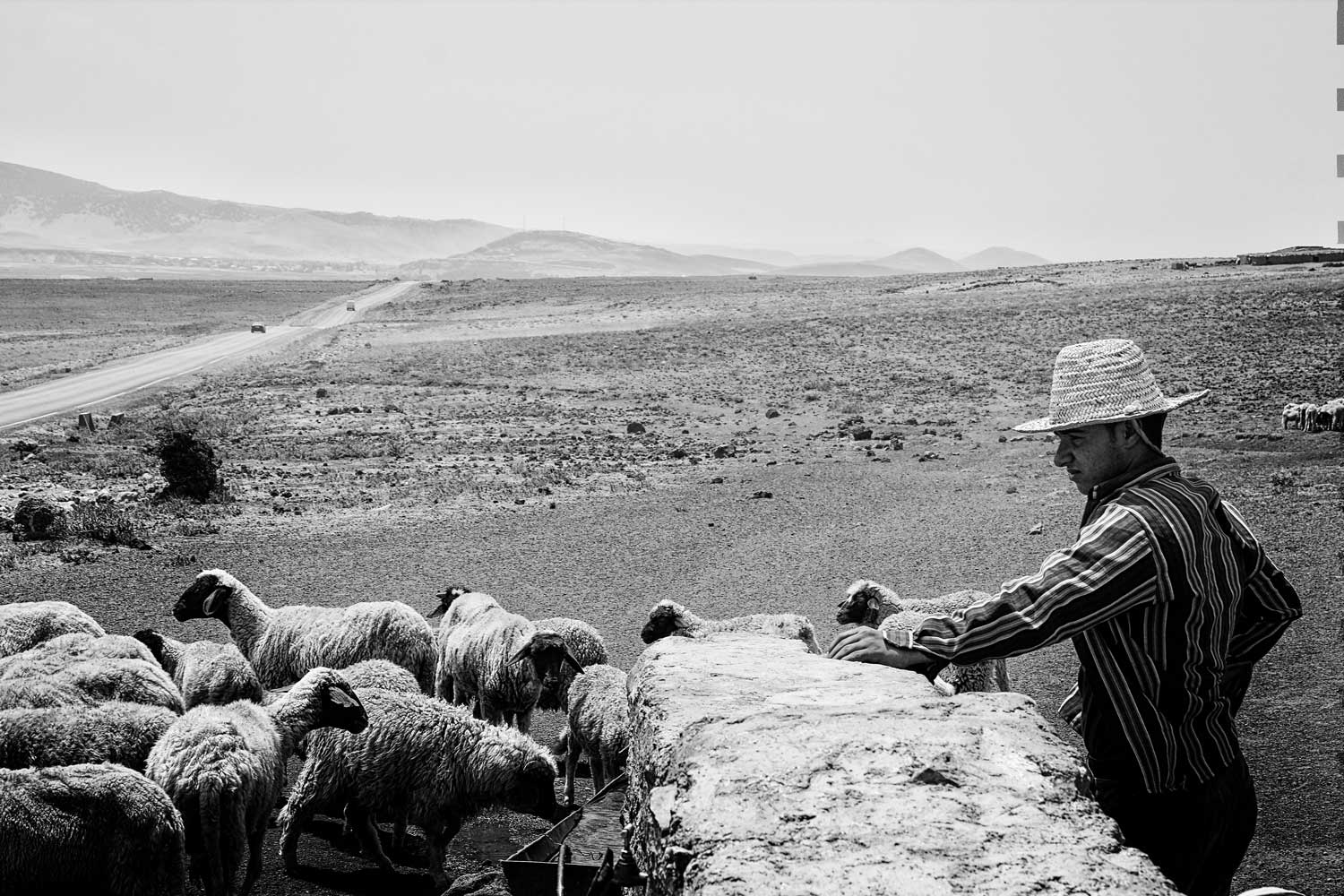
“Desert Wanderer” project in Morocco by Saad Alsharrah. (Courtesy of Saad Alsharrah)

AGSIW: How did you become a photographer?

Saad: My career in photography was unanticipated – the genuine interest started at the inception of my doctoral studies in Australia. My research emphasized using satellite imagery to map arid vegetation in Morocco’s Meknes-Tafilalet province to support the local councils in establishing tailored desertification combating plans. I started taking photographs during the site visits in the villages south of Meknes and began to think more about photography as a storytelling medium. During these extensive visits and revisits, I fell in love with the medium and started doing a lot of street photography a few years later. However, I was also a bit lost. I wanted to build these long-form narratives and projects to tell stories, but coming back to Kuwait, that didn’t exist – it’s always the single image on a platform like Instagram or an online portfolio. I had many single images but could not conceptualize them in a project form and establish a visual narrative to convey these stories. We don’t have this emphasis on long-form projects and narratives combined with research. It’s not about taking nice photographs, putting them together, and saying, “This is what I think about this problem.” It’s rather like being a detective: exploring history and historical structures, and the science behind everything, and then using the visual medium to express your voice on that topic.

I then decided to do a master’s in photography, which really helped me with conceptualizing an idea and then using photographs and research to express a narrative through lens-based methods. I am now interested in documentary photography and storytelling in the form of an exhibition, book, or moving imagery.

AGSIW: In the earlier days of your photography practice, what were the stories that your photographs were trying to capture in the context of your research on desertification?

Saad: Doing geospatial science, you’re often sitting at a desk looking at satellite imagery at the pixel level and analyzing desert plants that are important in stabilizing the soil for the local population. So, there is a verticality to seeing the world. What was intriguing was going to the villages and meeting the local populations. These are the people being affected by phenomena like desertification, so that was a fascinating encounter on a personal level.

From my point of view, spending extended time with participants or subjects and photographing their daily lives gives you so much context and perspective – it’s a phenomenological endeavor that enriches your understanding of the social or environmental issues you are investigating and documenting. Photography, for me, is a lens for understanding the world. The satellite imagery and its scientific use helped achieve a partial solution for a larger complex problem, but these photographs provided something more for me and were a fascinating and complementary practice. Where traditionally I was just a scientist, photography helped me understand my research topic in a much deeper way.

“Evasive Sanctuaries” exhibition by Speculative Horizons. (Courtesy of Saad Alsharrah)

AGSIW: How did Speculative Horizons emerge from this work?

Saad: Speculative Horizons initiative was founded with my friend and former supervisor Kristian Häggblom. After finishing my master’s, which was about the Japanese pearl diver diaspora in Australia, I got really interested in coming back to Kuwait and doing long-form and documentary projects. Our ancestors were pearl divers, so pearl diving was a conceptual link among Kuwait, Australia, and Japan. Kristian and I realized that there was not much going on with photobook publication or long-form photography projects in Kuwait compared to single-image projects. So, we thought, “Let’s initiate something in which we can link Melbourne,” where I was living at the time, “to Kuwait and bring some of those ideas over because there is a lot of potential in Kuwait.” We wanted to help create this discourse to inspire people to do long-form photography projects.

The idea was to start with a small symposium and a keynote lecture, Speculative Horizons Version 1.0, held in February 2023. It grew into a solid a collaboration and dialogue between Australia and Kuwait. The two main loose themes were “Land” and “People,” and we exhibited 16 artists – eight Kuwait based and eight Australia based – who responded to these themes. That was a novel and exciting exhibition project in Kuwait – having the artists from the two countries exhibiting together and installing the work with attention to the spatial distribution in the space to consolidate a visual dialogue. For my experience and contextually for Kuwait, it was experimental.

Speculative Horizons symposium accompanying “Evasive Sanctuaries.” (Courtesy of Saad Alsharrah)

AGSIW: What were some of the initiatives or programs that went alongside this show?

Saad: Throughout that season, we had street photography walks and keynote lectures exploring documentary styles in the West and Japan. People were excited about the programs, movements, and dialogue they created. With the support we received from the Australian and Japanese embassies, we decided to plan for another edition in 2025 in Japan in which Kuwaiti-based artists will exhibit work alongside Japanese artists. However, we did not want to wait two years before the next edition, so we created another program in between – Speculative Horizons 1.5, or “Evasive Sanctuaries” – as a prelude to the Japan edition. For this edition, four artists exhibited Japan-related projects.

What was exciting about this show was the educational aspect. I think we have a responsibility to sustain and protect visual literacy. That’s why we really wanted to introduce this idea of narrative in visual expression. With our co-curator and photography educator, Stephanie Rose Wood, we created educational kits with interviews, sections about the artists and curation, and specialist exercises. We also organized tailored workshops on editing and sequencing narratives and visual idea generation because information on these topics isn’t available in Kuwait. When you meet younger, aspiring photographers in Kuwait with creative ideas, some guidance or support is needed to conceptualize and express them. Most of the workshops had a solid turnout. We also invited teachers and students from local high schools for tailored exhibition tours to stress the importance of visual literacy, education, and ethical implications regarding photography. We are also working on publishing an e-reader to create a sample photography curriculum for educators in Kuwait.

Student group participating in the “Evasive Sanctuaries” educational program. (Courtesy of Saad Alsharrah)

AGSIW: What does the name Speculative Horizons refer to?

Saad: Horizons refers to the idea of cross-cultural interaction and dialogue among Australia, Kuwait, and Japan. Speculative refers to the questioning of documentary photography in this day and age, which is constantly being challenged. What is truth? Is there truth in documentary? Speculation for us is also about giving the reader and viewer space to imagine what they see in the work. The current exhibition is called “Evasive Sanctuaries,” and it’s about these strange places that we’re not familiar with. There’s also a verticality in the images exhibited – the first story comes from space, then you descend to the ground and explore two people’s lives, and then you dive underwater – but we don’t make it very discrete in terms of expressing a narrative like a traditional documentary might. It’s very elusive, challenging the viewer to speculate about the story. This is one of the examples of speculation in the exhibition and our philosophy in general.

There is a broader movement called speculative documentary as well. It’s not very widely published, but there are a lot of documentaries moving away from the traditional form in which a journalist might collect images and claim they are the “truth” or what viewers should believe. We’re trying to introduce that concept to Kuwait – maybe we can speculate, and what each person gets out of a documentary is up to them.

Single shot from “Kaino E” by Saad Alsharrah. (Courtesy of Saad Alsharrah)

AGSIW: Tell us the story behind “Kaino E” – your work in this show.

Saad: After World War II, many Japanese divers migrated to Western Australia – Broome specifically, a pearling town that has been around for 150 years. Many young Japanese came to Broome as pearl diving laborers after World War II. There was a strong migration relationship between Broome and the Wakayama region in Kansai, Japan. Many moved back to Japan, but a few stayed and were naturalized, living in Broome. With the rise of cultured pearls, that exchange has decreased. For my contribution to Speculative Horizons 1.5, I built on my master’s degree project, which was on documenting the lives and stories of four of these divers who are still alive.

There was one diver specifically with whom I developed a strong relationship, and it became more of a collaborative project and partnership and less of a documentary. I’m now making a photo book about his life and journey to reconstruct his memories using photography. Photos from that project were exhibited in the show, printed on 3.5-meter rice paper to replicate a Japanese scroll and storytelling. These alternative ways of expressing the work have been really refreshing and initiated a discourse to move away from the classical framed image exhibition, though Horizons is not the only exhibition to do this. The project is named “Kaino E,” which means “To Kaino” in Japanese – Kaino being the diver’s name. Kaino means “ocean field,” a metaphor for the sea and life in Japan in which the ocean gives abundance and destruction. The idea is also to link Kuwait with this pearl diving history, but that’s another endeavor.

AGSIW:
There is a growing regional interest in initiatives connecting historical or contemporary narratives from the Gulf to East Asia. How does Speculative Horizons hope to continue bridging that gap?

Saad: The idea is to expand on Speculative Horizons 1.5 and make an open call for Kuwaiti artists to exhibit in Japan. We’ll likely use the same themes – land, people, and sea – and hope that these will inspire photographers to create long-form projects. The exhibition will take place in Atami, a seaside town near Tokyo. We hope to extend the exhibition beyond the indoor space to six or eight spaces scattered all over the city, much like Kyotographie, one of the strongest photo festivals in the world. Basically, you work with and in the urban space, whether on walls, canals, or concrete.

However, the intention is not just to showcase Kuwaiti work in Japan – that’s one element – but also to exhibit Japanese work that responds to Kuwaiti work. We’re also building on Speculative Horizons 1.5 by working with local artists in Kuwait on a series of workshops, talks, and screenings throughout 2024 in collaboration with various creative spaces in the city to continue the discourse and build a strong community to push these ideas further.

The Evolution of Art: The Merging of Photography and Artificial Intelligence

The Evolution of Art: The Merging of Photography and Artificial Intelligence

Photography enthusiasts from the historic Photo-club de Vrines were welcomed into the future of imaging at the recent Thouars Photography Meetings, an event that served as a testament to the rapid integration of artificial intelligence (AI) into our daily lives. Dominique Cappronnier, a former computer engineer with a keen interest in photography and technology, took on the role of a lecturer, guiding audiences through the fascinating world where traditional photography meets AI.

A decade ago, AI’s effectiveness was barely realized, but today its capabilities excel human performance in areas such as image recognition. The exponential growth in computing power, predicted by Moore’s Law in the 1970s, has facilitated AI’s swift advancements, which are particularly evident in the field of photography. Free-to-use, open-source software, such as those pioneered by the company Open AI, have democratized AI, making spectacular image creations accessible to all.

Though this novel technology brings a plethora of creative opportunities, it also carries a darker side. The spread of fake news has been bolstered by the power of AI, invoking serious ethical considerations concerning its use. Such themes buttressed the discussions over the event’s enlightening weekend.

Marking the 40th anniversary of the Photo-club de Vrines, the event saw months of preparation by dedicated volunteers, culminating in various engaging activities. In addition to AI-related sessions, the festival offered exhibitions, demonstrations of alternative photographic processes, historical lectures, and hands-on workshops that embraced both the evolution and roots of photographic artistry.

The insightful presentations illustrated not only the swift pace at which technology evolves but also the importance of mastering such advancements to reframe and enrich our photographic experience. While photographers of the past might have initially scoffed at the digital revolution, AI’s influence on the art today reveals a cycle of innovation and adaptation that continues to redefine the boundaries of creativity.

Current Market Trends:
The merging of photography and AI represents a rapidly growing trend where software improvements are making AI tools more accessible to the general public and professionals alike. There’s an increasing use of AI algorithms for tasks like image enhancement, style transfer, and even generating brand-new artistic images from textual descriptions. Startups and established companies are investing in AI-driven photo editing software, and AI-powered features are becoming a standard for mobile and professional cameras. Websites and social media platforms are using AI to curate and recommend visual content, which is reshaping the dynamics of visual communication.

Forecasts:
The AI in photography market is expected to continue growing, with estimates that the AI in the imaging market will expand significantly over the next few years. As AI becomes more sophisticated, we can foresee further integration into various segments of the photography market, including stock photography, photojournalism, and fine art. AI is also forecasted to improve camera technologies further, making advanced photography techniques more accessible to casual photographers.

Key Challenges and Controversies:
One of the main challenges in the fusion of photography and AI is the ethical issue surrounding deep fakes and manipulated content. As AI gets better at creating realistic images, the potential to create misleading or harmful content also increases. This raises concerns about the veracity of online images and the potential for AI to be used in malicious ways. In addition, the question of authorship and copyright when AI generates art is a matter of active legal and philosophical debate.

Advantages:
AI offers numerous advantages in photography. It can enhance image quality by correcting lighting, focus, and stability issues. AI algorithms can also accelerate the editing process, allowing photographers to achieve desired effects without extensive manual editing. The ability to process large volumes of images quickly is particularly beneficial for applications like surveillance, medical imaging, and large-scale media management.

Disadvantages:
One of the disadvantages of AI in photography is the potential reduction in demand for professional photographers and photo editors as AI tools become more capable. Also, photographers may feel that AI-generated images lack the human touch and artistic intuitions that come with traditional photography. Privacy concerns also arise with the use of AI in cameras as the line between public and private spaces becomes increasingly blurred.

Important Questions Relevant to the Topic:
– How will AI continue to shape the future of photography and art?
– Can AI-generated art be considered an original creation, and who holds the copyright?
– What measures can be put in place to deal with the rise of deep fakes and protect against misinformation?
– How can photographers adapt to and leverage AI technologies to enhance their craft?

For more information on the latest developments in art and technology, you can visit OpenAI. Please note that while I ensure the validity of the URL at the time of writing, I’m unable to guarantee that it has not changed post my knowledge cutoff date.

[embedded content]

Lithuanian Season in France to feature art, photography in Paris metro, and gastronomy

Lithuanian Season in France to feature art, photography in Paris metro, and gastronomy

The Lithuanian Season in France, which starts this autumn, has attracted more than 500 artists, experts and performers from both countries, who will organise over 300 different events in different cities, from poetry readings at the Pompidou Art Centre to photography exhibitions in Paris metro stations.

In all, some 130 projects have been selected to be presented in 30 French cities between September 12 and the end of the year.

“In the run-up to the Season, we have watched existing partnerships grow stronger and new ones forge. This creates a huge effect, and we have experienced that culture opens the door to themes and areas that are not related to culture, but are relevant and meaningful,” Julija Reklaitė, head of the Lithuanian Culture Institute, said in a statement on Monday.

According to Virginija Vitkienė, commissioner of the Lithuanian Season in France 2024, the events will allow the French to get to know Lithuanian culture, art and history in more detail, and will open up even wider opportunities for long-term partnership between the two countries.

“It is particularly pleasing that the programme is dominated by contemporary art, new forms of theatre, music projects, meetings with writers and thinkers, debate cycles dictated by geopolitical realities, economic and educational events, and, of course, gastronomy projects, which will allow people not only to see, to hear, but also to taste Lithuania,” said Vitkienė.

The opening weekend of the season from September 12–14 will be packed with events in Paris. The Pompidou Centre, in collaboration with the MO Museum in Vilnius, will open an exhibition showcasing Lithuania’s art since the 1960s.

The opening weekend will also see the celebration of Poetry Day at the Pompidou Centre, featuring the poems of Jonas Mekas and new French translations of his poetry, concerts by Lithuanian choirs in public spaces in Paris, and the premiere of a new work by Lina Lapelytė.

Radio Vilnius will be inviting Parisians to to the Gaite Lyrique cultural centre with a programme of Lithuanian electronic music artists.

A joint project of the National Library of France, the Paris Metro, the Lithuanian Union of Photographers and Kaunas Photography Gallery will start on September 12 and will last until the end of the Lithuanian season in seven Paris metro stations that will be decorated with large-format works by Lithuanian photographers.

In the run-up to the Season, between April and June, the Embassy of Lithuania in France is organising dozens of events under the name of the Prelude to the Season.

The Lithuanian Season in France is implemented by the Lithuanian Culture Institute and the French Institute in Paris.

Hannah Waddingham Chews Out Photographer Who Makes Sketchy Request

Hannah Waddingham Chews Out Photographer Who Makes Sketchy Request

LOADINGERROR LOADING

Ted Lasso” star Hannah Waddingham gave a swift verbal kick Sunday to a photographer who apparently asked her to reveal more of her leg before the Olivier Awards at Royal Albert Hall.

“Oh my God, you’d never say that to a man,” Waddingham said in a viral video of the confrontation. “Don’t be a dick; otherwise, I’ll move off. Don’t say, ‘Show me leg.’ No.”

Waddingham appeared to have further dialogue with the photographer as she moved on.

The actor later hosted the awards but won several accolades for what transpired beforehand.

Observers on X, formerly Twitter, called her a “queen” and a “role model” for her handling of the interaction.