Swansea press photographer’s nightmares after arrest on job


Your browser is out of date and potentially vulnerable to security risks.
We recommend switching to one of the following browsers:

In certain scenarios, such as photographing action outdoors, it’s all too easy to find yourself needing to work at shutter speeds that exceed the flash sync speed of your camera. This is where high speed sync comes into its own, expanding your creative possibilities beyond the limitations of conventional flash.
Many of you may not have heard of Ben Staley, but you have almost certainly enjoyed some of his work. Ben is an award-winning videographer and filmmaker whose stunning imagery has wowed audiences on popular TV shows like “Deadliest Catch” and “Ice Road Truckers.” But Ben also happens to be an avid (and excellent) still photographer and regularly features his still photography work on his YouTube channel “Adventure & Art”
In this insightful video which is equal parts education and inspiration, Ben discusses the use of a high speed sync (HSS) strobe in situations where you really need to be working at higher shutter speeds that are beyond the maximum flash sync speed of your camera. Ben demonstrates the use of high speed sync in a number of different scenarios such as photographing action outdoors in bright, ambient light, and managing challenging lighting scenarios for outdoor portrait work.
For the photo shoots featured in the video, Ben is using the Westcott FJ400 Strobe with Westcott’s FJ-X3m Universal Wireless Trigger on his Panasonic Lumix S5 IIX mirrorless camera.
The video itself is not really a review of the Westcott gear or the Lumix camera, but rather more of a field test and demonstration of how this Westcott HSS strobe and trigger can be used to manage challenging lighting scenarios, and what you can produce with them. As Ben himself says in the video, he tends to focus more on the artistic and creative aspects of photography rather than the technical details. That said however, he does an excellent job introducing HSS as a technique that can expand the creative possibilities of your photography, and the results that he presents in the video are sure to inspire any photographer who is looking to take their work beyond the limitations of conventional flash.

(WJAR) — A Foxborough photographer with a love for animals is giving a gift to people who have pets that are coming to an end of life.
Joan Powers has been taking pictures for as long as she can remember.
Several years ago she opened her own business: ‘Images Through the Eyes of Joan Powers Photography.’
“I’ve always had a camera in my hand for as long as I can remember, and just you know, capturing friends and nature,” said Powers. “I love taking pictures. I love capturing the moment in time.”
For 22 years, Powers said she worked as a manager in the veterinary world.
A few years ago, before leaving her job, Powers said she had a conversation with her boss at the time about ‘The Tilly Project.’
That sparked her interest to get more information.
“It’s an end-of-life pet photography network,” said Powers. “So for animals that have had a bad diagnosis and are coming around to the end of their life journey or they are elderly, senior, pets.”
The non-profit connects pet owners with end-of-life pet photographers across the world and aims to provide accessible, educational, and supportive resources for photography, anticipatory grief, and pet loss/bereavement.
“You can sign up, you can volunteer to do it, you can make it a paid service if you’d like,” said Powers. “I personally volunteer for it, but you sign up and then the website just asks you to pick your country, pick your state, then pick your town and it’ll give you a list of photographers who are part of the Tilly Project.”
Powers volunteers her services to people in Rhode Island and Southern Massachusetts.
To date, she photographed about a dozen people and their pets.
This past weekend, she met with Bryan and Jennifer Piper, and their almost 11-year-old dog Grabriel.
The Pipers who live in Carver, Massachusetts now, and adopted Gabriel from East Providence.
“I’ve pretty much been next to that dog for the last 10 years that we’ve had him. Every time I come home he’s happy to see me, always excited,” said Bryan Piper. “He follows me around the house like my little shadow. If I go to bed he’s going to bed. He always has to make sure that he knows where I’m going, like, he always keeps an eye on me.”
A few months ago, ‘Gaby Baby’ as they call him, was having an issue with his eye being swollen.
The Pipers brought him to the vet to have a CT scan done, and they discovered a rare cancer which ultimately led to them removing the eye, and starting chemotherapy treatment.
Doctors gave Gabriel four months to live.
“Heartbreaking, but I mean what else can I say? Like, it is heartbreaking like you know he’s a member of the family” said Jennifer Piper. “They gave him four months, it’s been six, so fingers crossed.”
Through support services for Gabriel, the Pipers were partnered with the Tilly Project thanks to the ‘Live Like Roo’ Organization which offers financial assistance to families with pets who have received a cancer diagnosis.
The Pipers had expressed interest in a final photoshoot, and they looked up Powers’ on The Tilly Project.
“With the way that it is now. I don’t think we’d be able to come up with a photo shoot so the fact that she volunteers to do it is amazing. Amazing,” said Jennifer Piper. “Definitely hopeful for the memories now because there’s only we don’t know how much time we have. It’s overwhelming at some point because it’s something that we can hold onto it. It’s one of those things that just once the photos are there, it’s a memory that you can see every time you look at it and get that feeling.”
On Saturday, Powers met the couple at Boarderland State Park in North Easton.
There, she took tons of photos with Gabriel and the Pipers.
“Every dog is different and today when we did Gabe, he was full of energy and was able to run around,” said Powers. “I explain to people that they should feel their emotions. Don’t be afraid to cry, and don’t be afraid to have your emotions while you’re doing these shoots. I think they showed a lot of happiness in their shoot today.”
Powers not only takes the photos, but she edits them too.
Her clients are given five prints with the option to purchase additional, printed ones.
“I’ve been through this. I’ve had to euthanize my pet at the end of life. I’ve had dogs that have been senior dogs. It’s a really tough time and I like to bring pleasure through my portraits and so if I can help someone have a lasting memory capture a moment in time that’s what I like to do,” Powers said.

(WJAR) — A Foxborough photographer with a love for animals is giving a gift to people who have pets that are coming to an end of life.
Joan Powers has been taking pictures for as long as she can remember.
Several years ago she opened her own business: ‘Images Through the Eyes of Joan Powers Photography.’
“I’ve always had a camera in my hand for as long as I can remember, and just you know, capturing friends and nature,” said Powers. “I love taking pictures. I love capturing the moment in time.”
For 22 years, Powers said she worked as a manager in the veterinary world.
A few years ago, before leaving her job, Powers said she had a conversation with her boss at the time about ‘The Tilly Project.’
That sparked her interest to get more information.
“It’s an end-of-life pet photography network,” said Powers. “So for animals that have had a bad diagnosis and are coming around to the end of their life journey or they are elderly, senior, pets.”
The non-profit connects pet owners with end-of-life pet photographers across the world and aims to provide accessible, educational, and supportive resources for photography, anticipatory grief, and pet loss/bereavement.
“You can sign up, you can volunteer to do it, you can make it a paid service if you’d like,” said Powers. “I personally volunteer for it, but you sign up and then the website just asks you to pick your country, pick your state, then pick your town and it’ll give you a list of photographers who are part of the Tilly Project.”
Powers volunteers her services to people in Rhode Island and Southern Massachusetts.
To date, she photographed about a dozen people and their pets.
This past weekend, she met with Bryan and Jennifer Piper, and their almost 11-year-old dog Grabriel.
The Pipers who live in Carver, Massachusetts now, and adopted Gabriel from East Providence.
“I’ve pretty much been next to that dog for the last 10 years that we’ve had him. Every time I come home he’s happy to see me, always excited,” said Bryan Piper. “He follows me around the house like my little shadow. If I go to bed he’s going to bed. He always has to make sure that he knows where I’m going, like, he always keeps an eye on me.”
A few months ago, ‘Gaby Baby’ as they call him, was having an issue with his eye being swollen.
The Pipers brought him to the vet to have a CT scan done, and they discovered a rare cancer which ultimately led to them removing the eye, and starting chemotherapy treatment.
Doctors gave Gabriel four months to live.
“Heartbreaking, but I mean what else can I say? Like, it is heartbreaking like you know he’s a member of the family” said Jennifer Piper. “They gave him four months, it’s been six, so fingers crossed.”
Through support services for Gabriel, the Pipers were partnered with the Tilly Project thanks to the ‘Live Like Roo’ Organization which offers financial assistance to families with pets who have received a cancer diagnosis.
The Pipers had expressed interest in a final photoshoot, and they looked up Powers’ on The Tilly Project.
“With the way that it is now. I don’t think we’d be able to come up with a photo shoot so the fact that she volunteers to do it is amazing. Amazing,” said Jennifer Piper. “Definitely hopeful for the memories now because there’s only we don’t know how much time we have. It’s overwhelming at some point because it’s something that we can hold onto it. It’s one of those things that just once the photos are there, it’s a memory that you can see every time you look at it and get that feeling.”
On Saturday, Powers met the couple at Boarderland State Park in North Easton.
There, she took tons of photos with Gabriel and the Pipers.
“Every dog is different and today when we did Gabe, he was full of energy and was able to run around,” said Powers. “I explain to people that they should feel their emotions. Don’t be afraid to cry, and don’t be afraid to have your emotions while you’re doing these shoots. I think they showed a lot of happiness in their shoot today.”
Powers not only takes the photos, but she edits them too.
Her clients are given five prints with the option to purchase additional, printed ones.
“I’ve been through this. I’ve had to euthanize my pet at the end of life. I’ve had dogs that have been senior dogs. It’s a really tough time and I like to bring pleasure through my portraits and so if I can help someone have a lasting memory capture a moment in time that’s what I like to do,” Powers said.

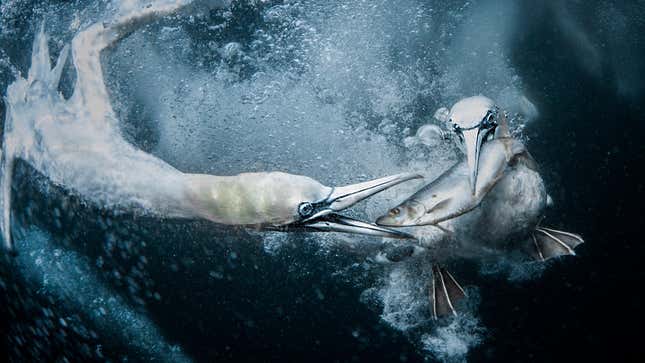
The natural world is full of wonder. Life thrives in its every corner, from the abyssal depths of the oceans to the loftiest heights above Earth’s mountains. Thankfully, nature photographers capture Earth’s biodiversity in intimate detail, which is fully on display in the winning images from the World Nature Photography Awards.
This year’s grand prize winner for the World Nature Photographer of the Year is Tracey Lund, for her fantastic shot of two gannets going after the same fish (seen above). But all the winners are worth a look, and you can view them here.
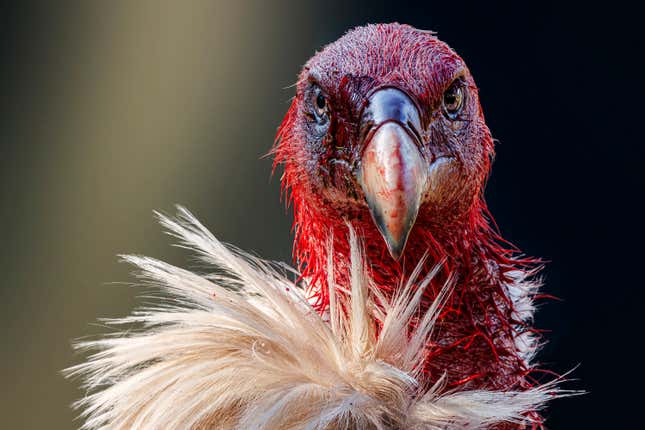
The third place image in the animal portraits category went to this unsettling shot of a griffon vulture staring at the camera, its head feathers matted down by blood.
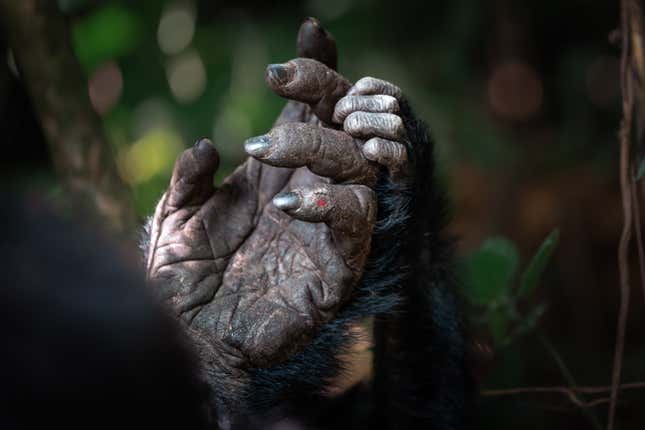
The second place image in animal portraits was awarded to this touching photo of a young gorilla’s hand resting on its mother’s, taken in Uganda’s Bwindi Impenetrable Forest.
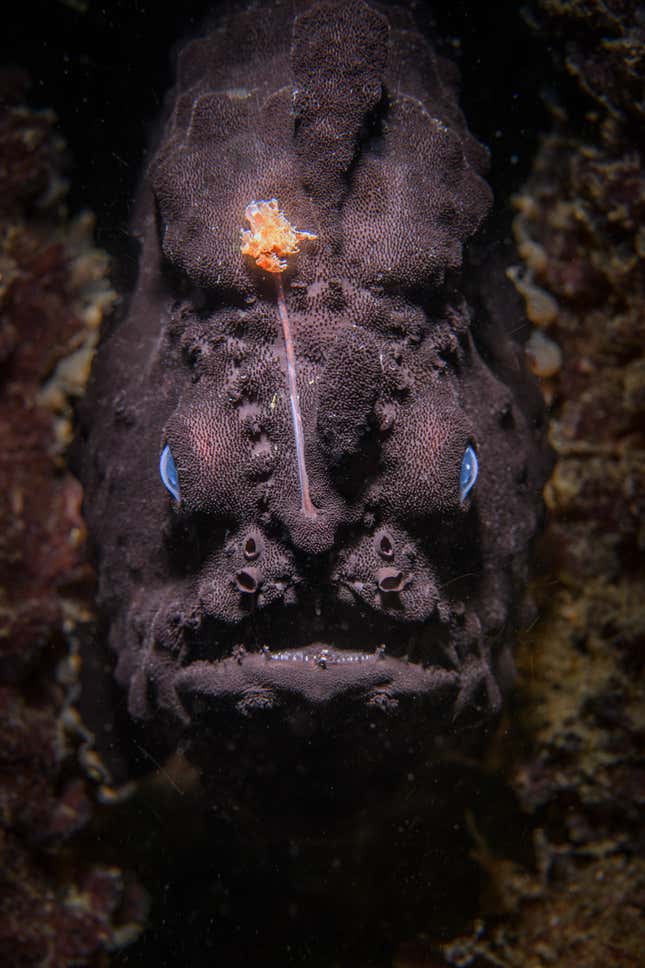
The winner of the animal portraits category was this creepy photo of a black frogfish (or black anglerfish) off the Australian coast.
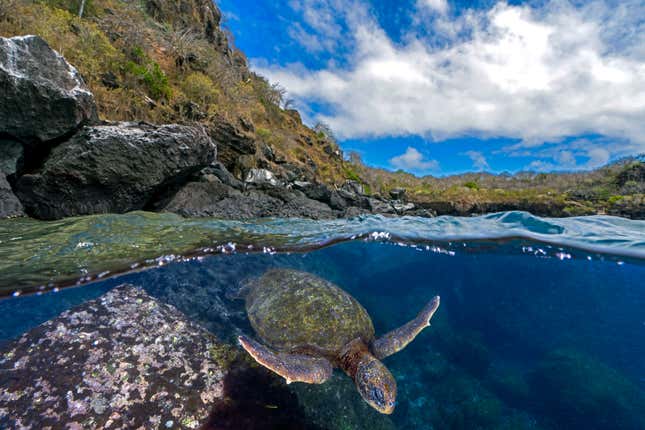
The bronze winner in the animals in their habitat category went to this photo of a green sea turtle off the Galápagos island of San Cristobál. The turtle’s shell mirrors the green terrain above water.
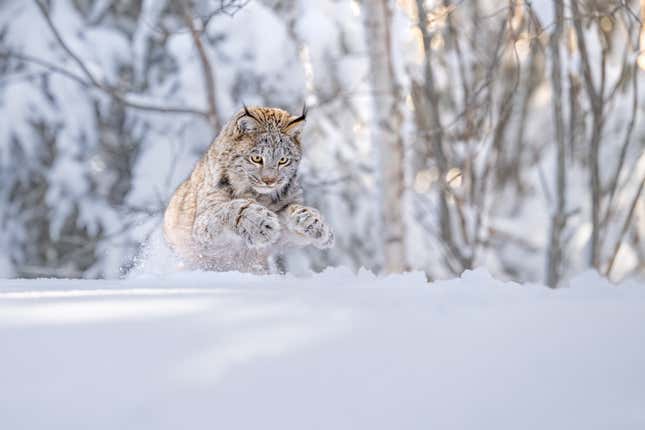
The silver winner in the animals in their habitat category was this lynx, captured bounding through snow in Canada.
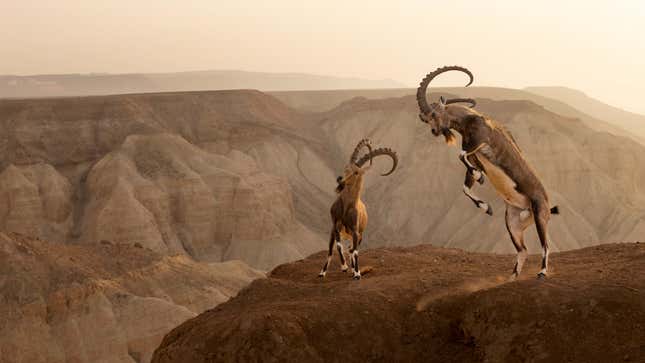
These Nubian ibex were photographed fighting on the edge of a cliff in Israel’s Zin Desert. The fight ended without serious injury to either ibex. This photo won the gold in the animals in their habitat category.
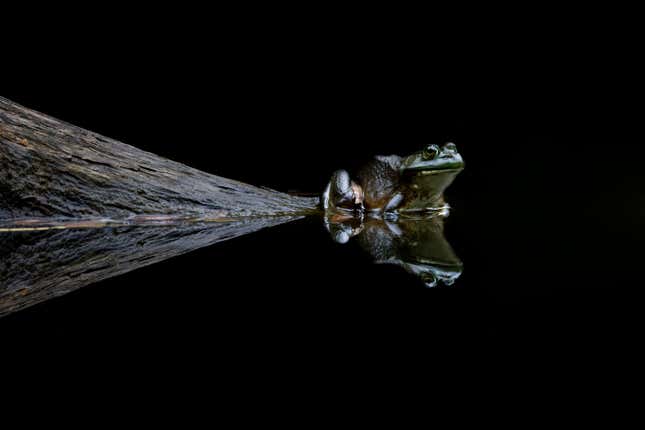
This American bullfrog sits on the edge of a body of water in Ottawa, in the third place photograph in the amphibian and reptilian behavior category of the competition.
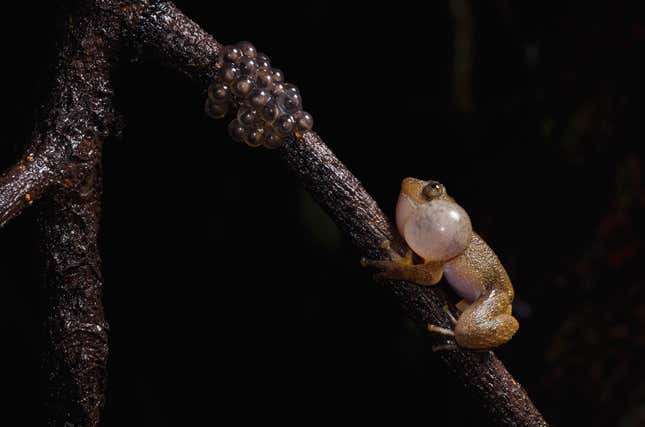
The silver winner in the same category was this shot of a male night frog calling (note the puffed checks) in front of a clutch of eggs on a branch.
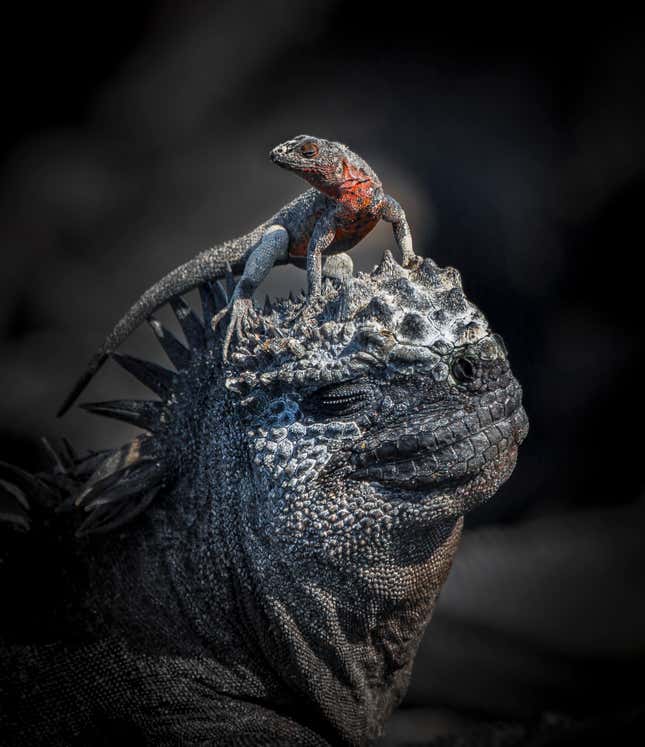
The winner in the category devoted to amphibian and reptilian behavior was this shot of a lava lizard aboard the head of a marine iguana, which looks blissfully unbothered by the lizard’s position.
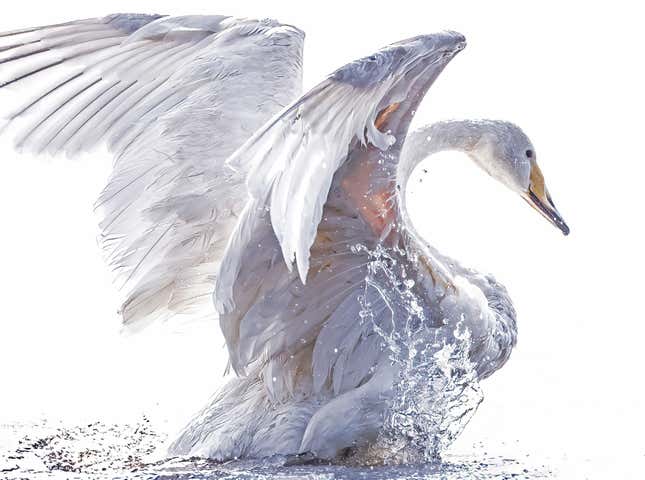
This swan is seems to emerge from the water in this blindingly white image. The bird stretches out its wings against a white background, evoking angelic overtones. The image took the bronze in the bird behavior category.
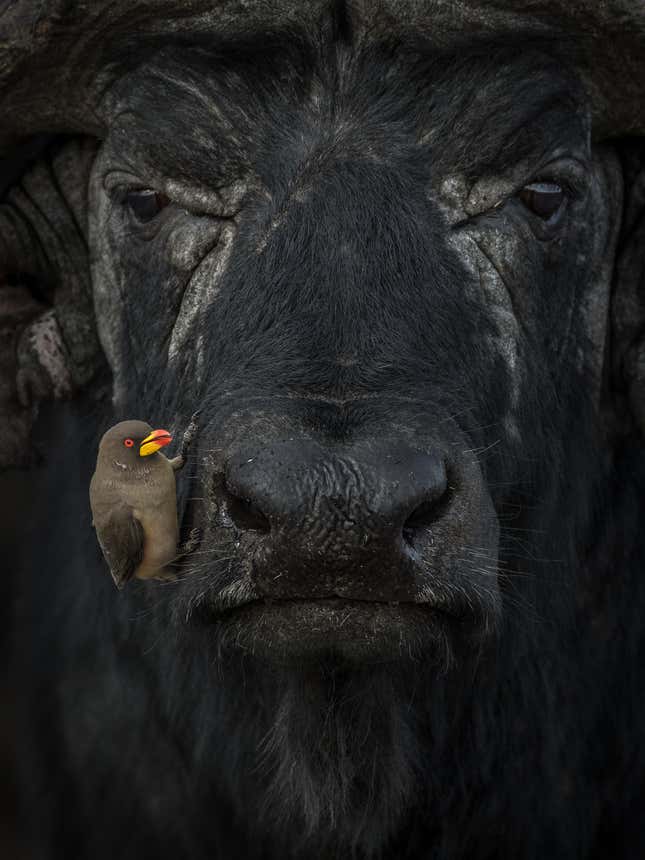
The silver in bird behavior went to this image of a yellow-billed oxpecker holding onto the snout of an African water buffalo in Kenya.
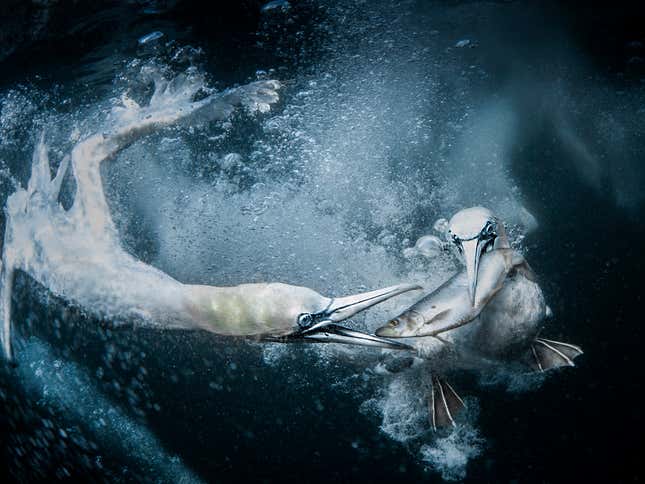
The gold in bird behavior—as well as the overall grand prize winner of the competition—was this shot of two gannets under water off the Shetland Islands. Both birds are going for the same fish; it’s evident the birds just dove in, thanks to the dramatic surrounding bubbles.
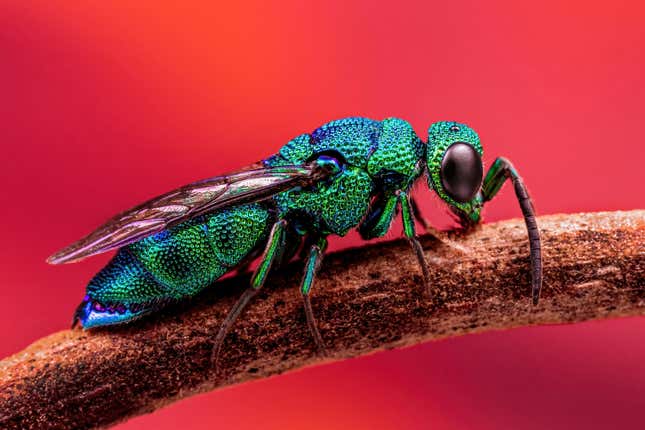
The Cuckoo (or emerald) wasp won the bronze in the invertebrate behavior category. The wasp is holding onto a thin branch, and against the red background its iridescent green exoskeleton is even more brilliant.
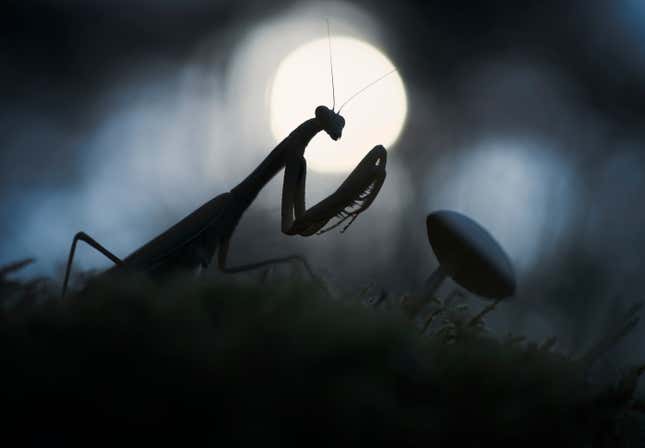
A mantis silhouetted by a light won the silver in the invertebrate behavior category. The image is equal parts serene and creepy, making for a dramatic shot.
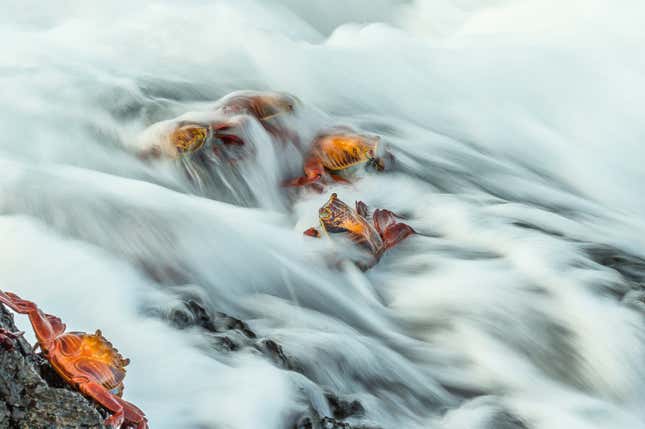
Sally light-foot crabs in the rushing water on Santiago Island in the Galapágos won first prize in invertebrate behavior. The crustaceans are the sole flashes of color in an otherwise greyscale landscape.
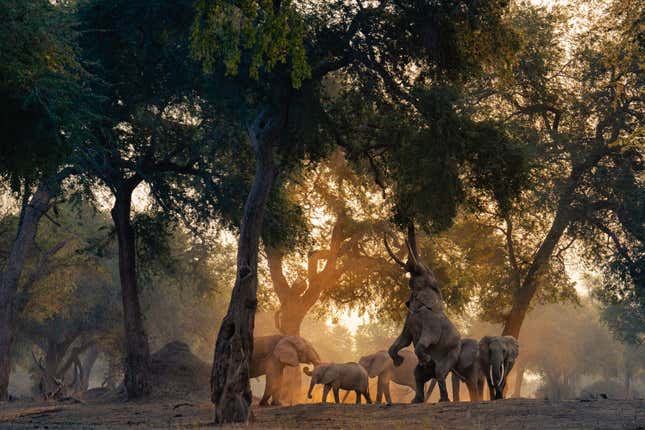
A herd of elephants at Mana Pools in Zimbabwe. Winning third place in the mammal behavior category, the photo shows one elephant stretching its trunk to grab a hold of a tree branch.
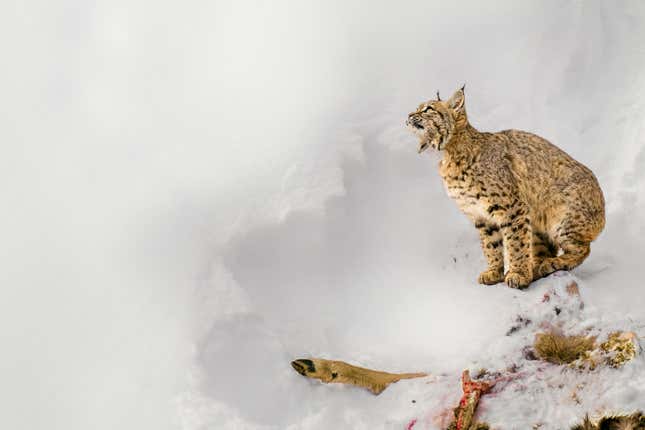
This bobcat guarding the carcass of a mule deer took the silver in mammal behavior. Taken in Yellowstone National Park, the carcass is half buried by snow and appears to lie on a totally different plane from the upright felid.
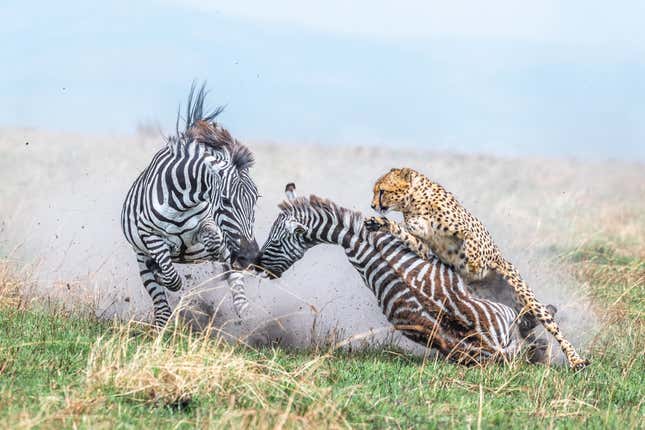
In the gold winner in the mammal behavior category, a mother zebra and her foal are attacked by a cheetah in Kenya’s Maasai Mara National Reserve.
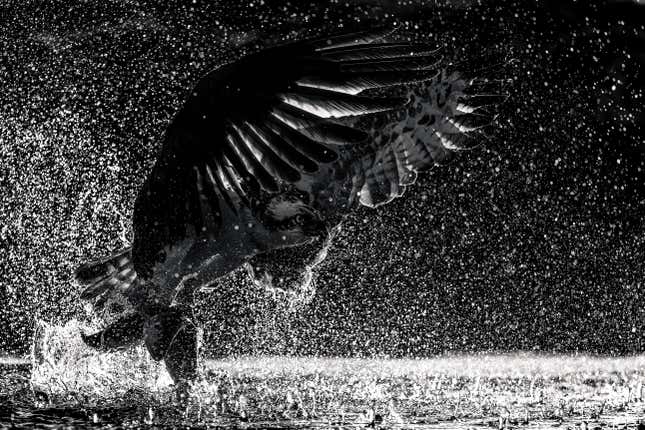
The bronze winner in the black and white category was this image of an osprey catching fish. The image is speckled with water droplets, making the osprey’s unfurled wings appear like a cloak under which it hunts.
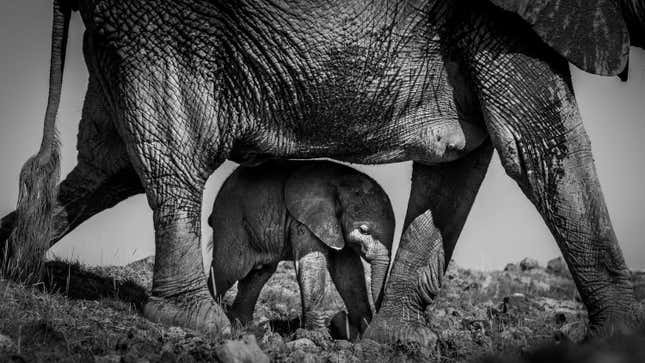
This shot of an elephant calf under the stride of its mother won the silver medal in the black and white category.
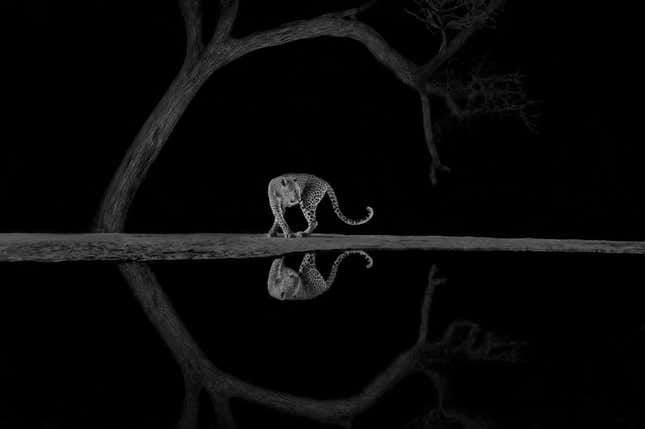
The gold winner in the black and white category was this image of a leopard, photographed under an arced tree. The leopard stands on the edge of a water body, making a neat reflection of the big cat and the tree above it.
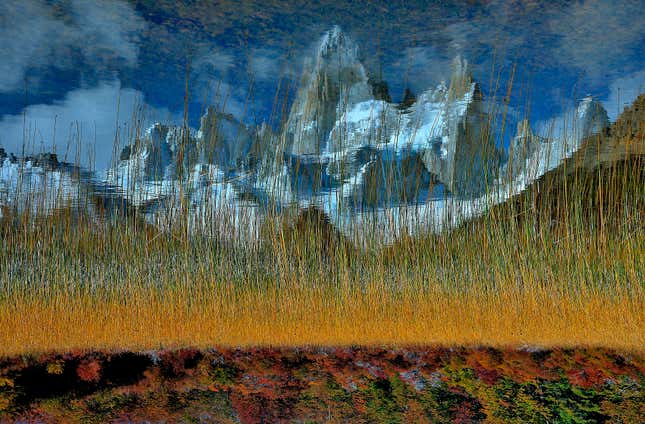
This shot of a Patagonian lagoon took the bronze medal in the nature art category of the competition. The reflected peaks in the photo are in Los Glaciares National Park.
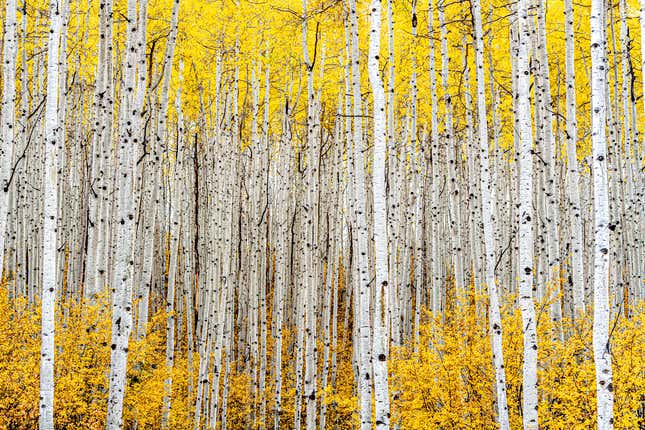
The second place winner in the nature art category went to this spellbinding photo of aspen trees. With bushes on the forest floor and the trees’ yellow canopy above, the mesmerizing shot makes you wonder which way is up.
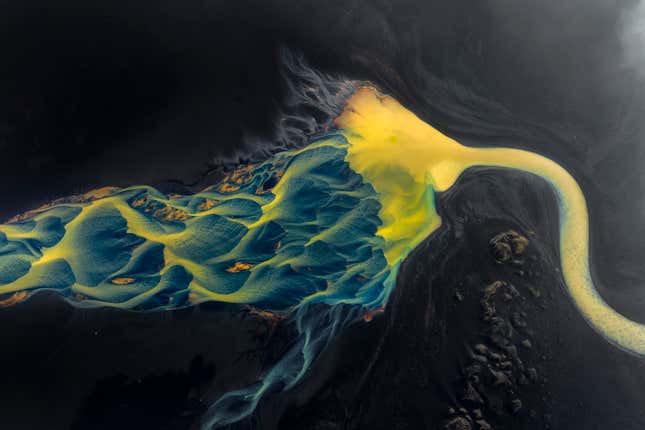
An aerial image of landforms in Iceland won the nature art category. Blue veins of glacial water and yellow bands of sediment run through the volcanic landscape.
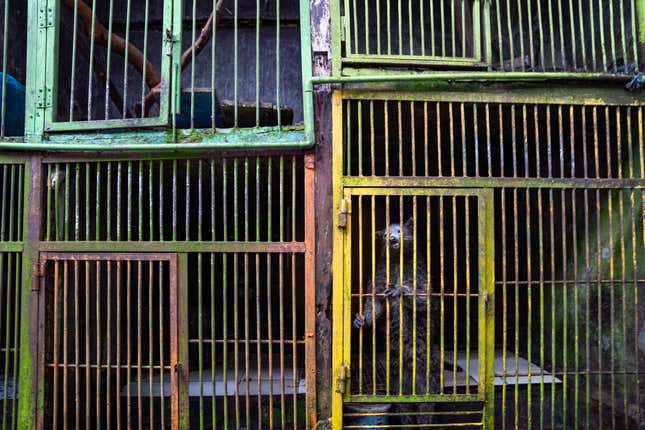
A binturong in captivity in Sulawesi, Indonesia. The small carnivore is used to produce a local coffee, from beans that pass through the animal’s digestive system.
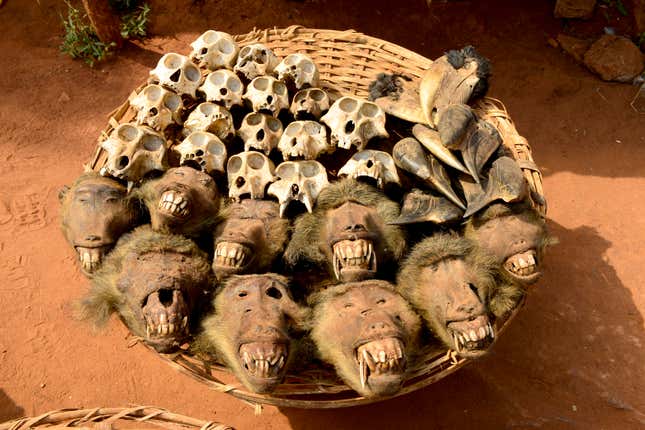
Baboon and hornbill heads at a voodoo market in Benin. This image was second place in the nature journalism category of the competition.
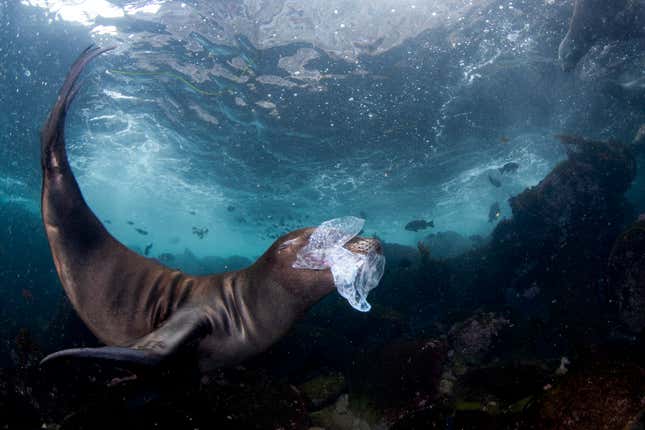
A sea lion pup with plastic in its mouth took the first place in the nature photojournalism category. This sea lion was spotted off Baja California.
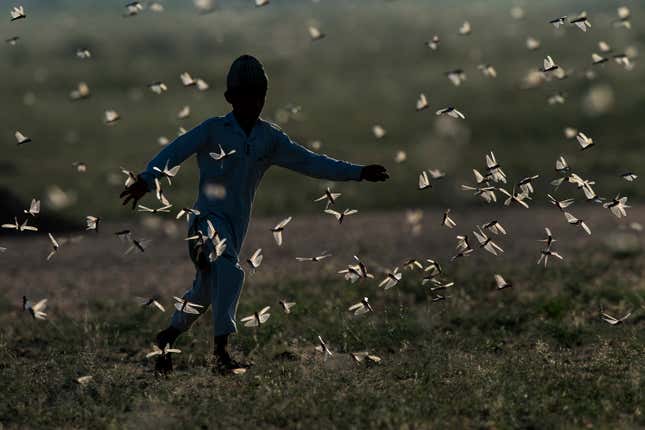
The people and nature category of the competition showcases how our species interfaces with the natural world. This shot of a boy chasing locusts in Rajasthan took bronze in the category.
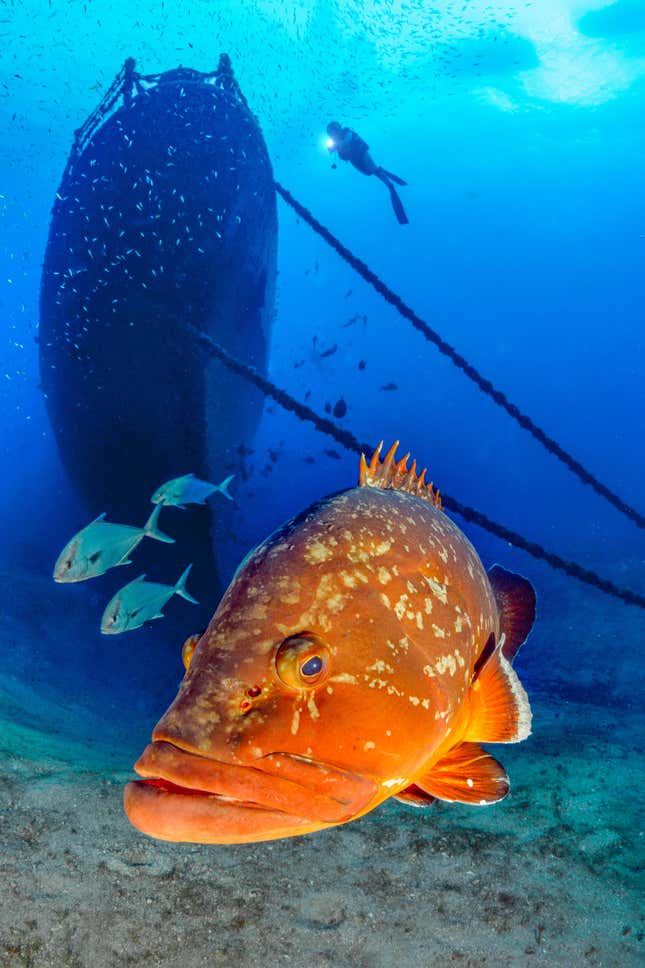
A giant perch off Portugal checking out the camera, with a diver and a shipwreck in the background. This image took silver in the people and nature category.
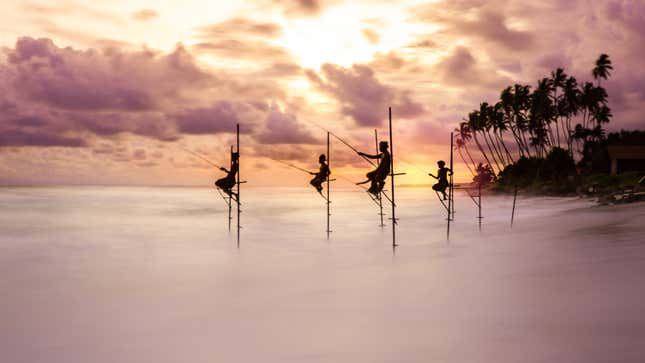
A group of stilt fishermen waiting for bites at sunset off Sri Lanka. This gorgeous photo won the gold in the people and nature category.
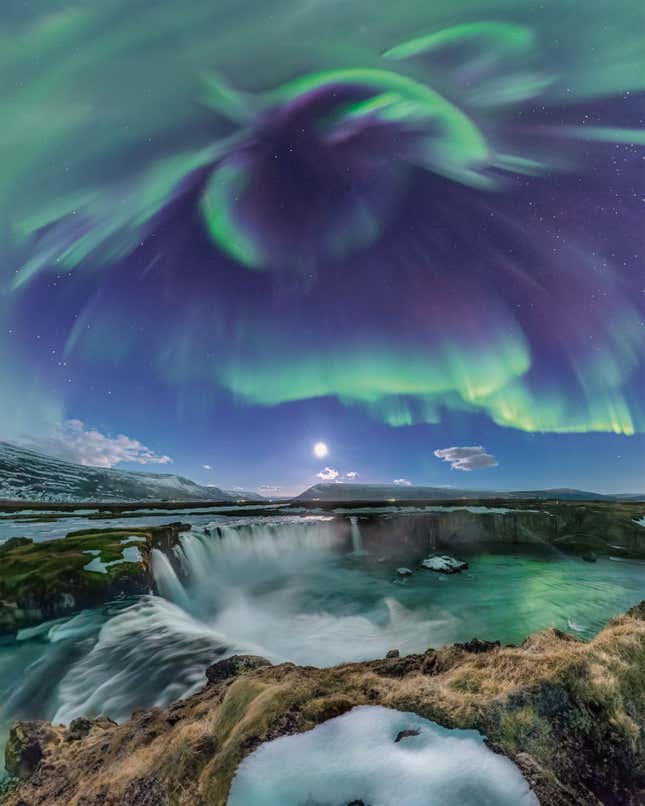
The Godafoss waterfall in Iceland, beneath the northern lights. A luminous Moon is also visible. This shot was the third place photo in the category “Planet Earth’s landscapes and environments.”
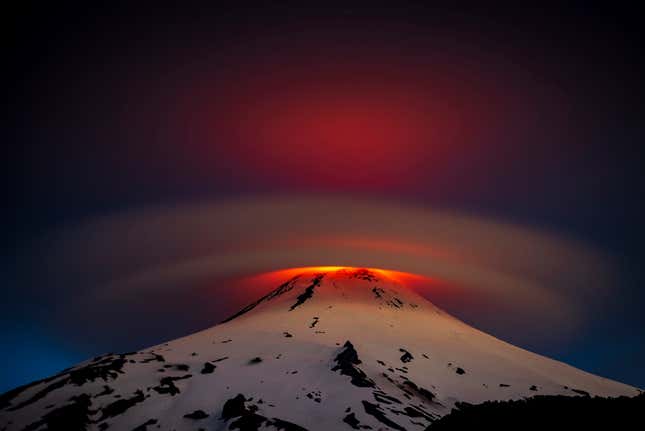
An ominous shot of volcanic activity under a low cloud won second place in the landscape category; the Villarrica volcano is in Chile and makes for a foreboding subject.
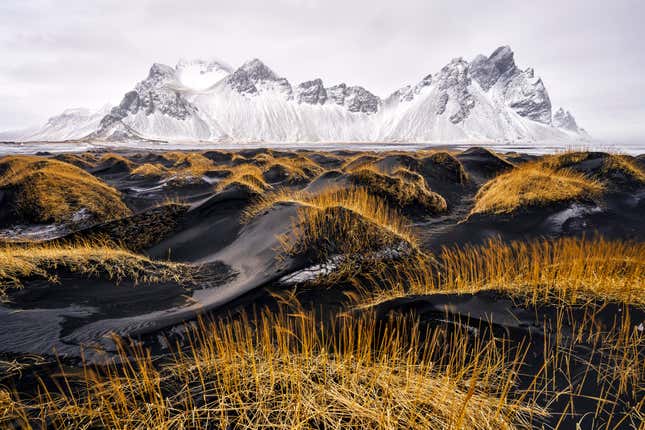
The Vestrahorn mountain and the beach in foreground look otherworldly in this gold medal photo for the landscapes category.
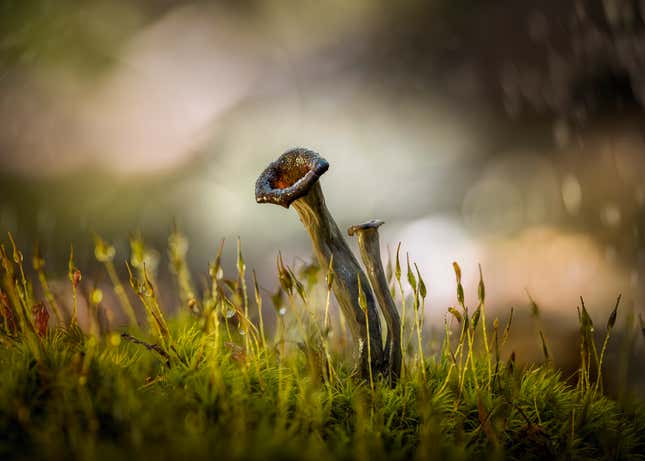
Trompette de la mort, or the black trumpet mushroom. This image was the third place photo in the plants and fungi category.
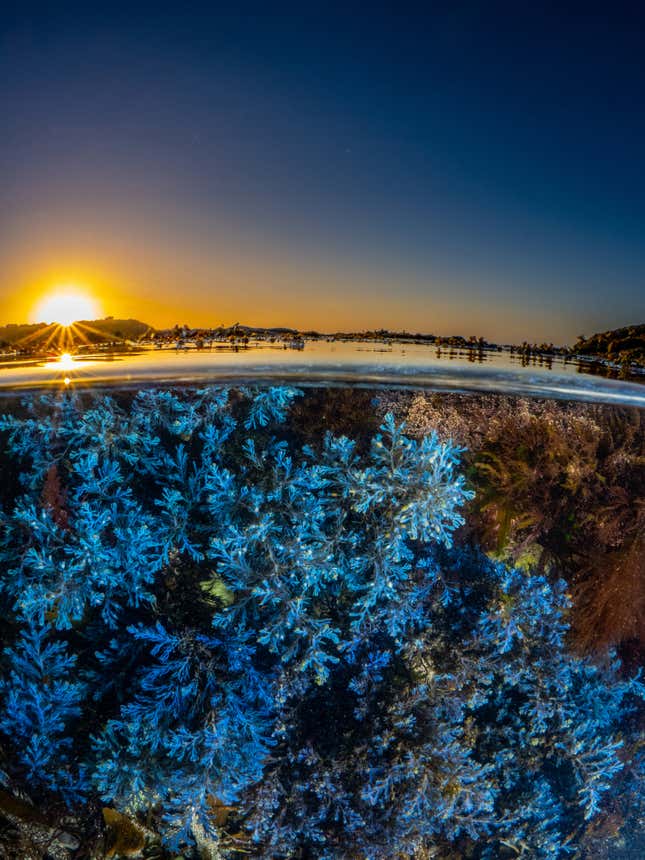
Seaweed in a rock pool in Falmouth, England, was the second place image in the plants and fungi category. The sunrise glares in the top-left corner of the image.
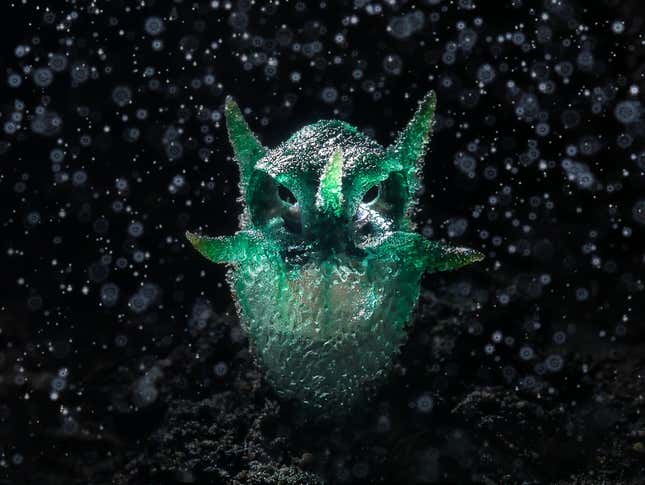
I thought this was a jade mask at first. It’s actually Thismia thaithongiana, or Thaithong’s fairy lantern, a type of plant native to southeast Asia. This image won the gold in the plants and fungi category.
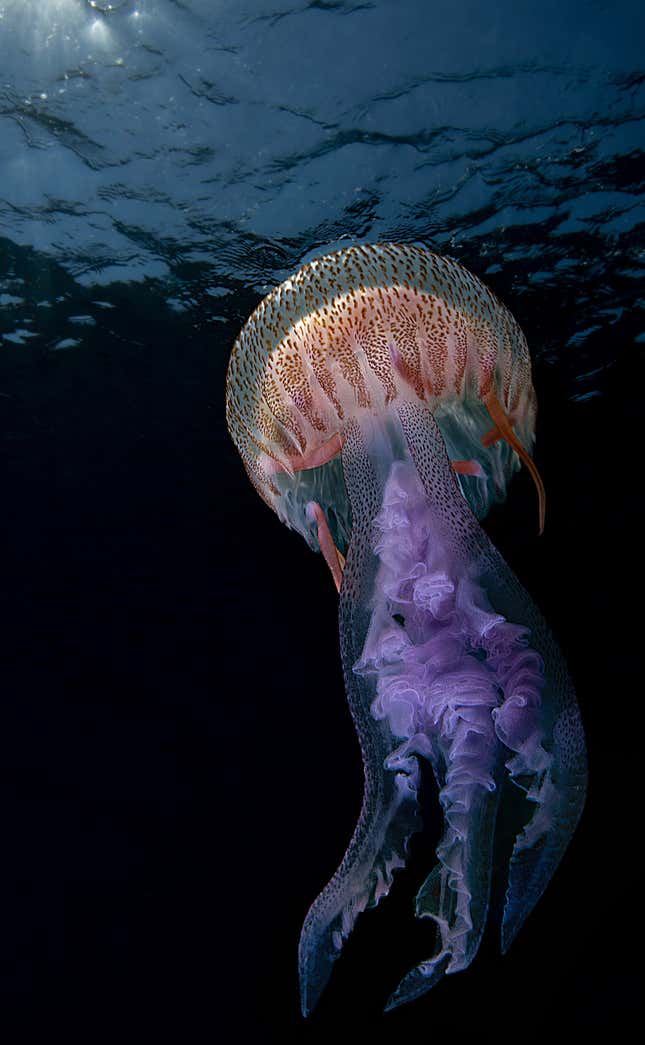
A mauve stinger (P. noctiluca) off the coast of Noli, Italy. This shot claimed third place in the underwater category.
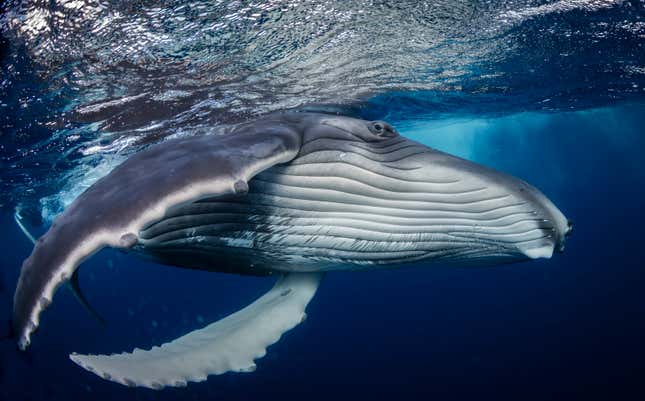
A young humpback whale checks out the photographer as it swims by, off the coast of Tonga. This photo took second place in the underwater category.
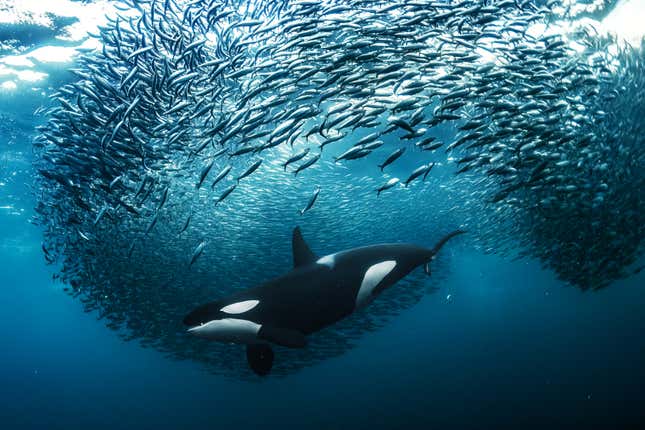
An orca diving through a school of herring off Skjervøy, Norway. This image won the underwater category.
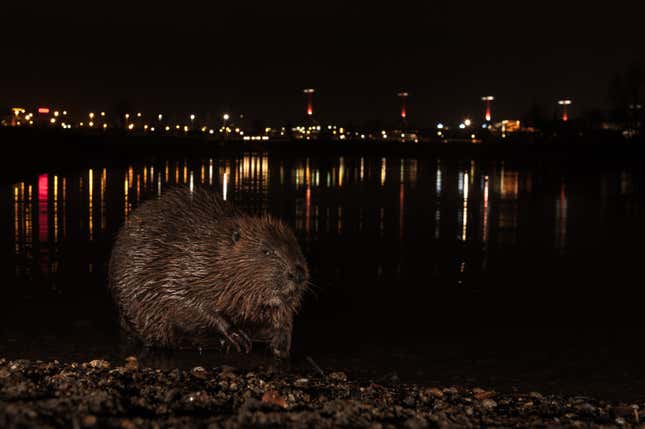
This somewhat skeptical-looking beaver was photographed at night in Budapest, Hungary. The beaver took the bronze in the urban wildlife category.
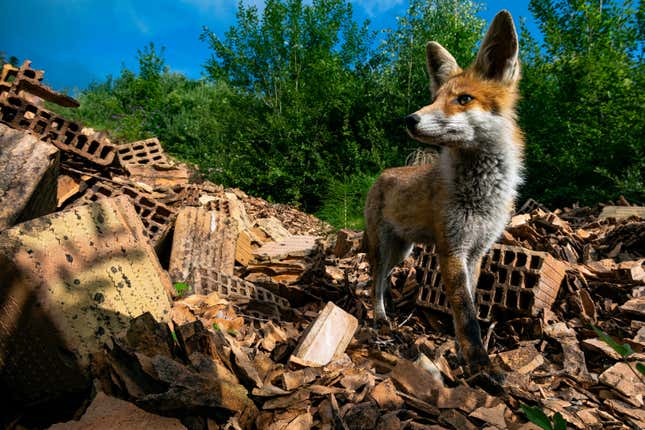
A fox amid rubble in Lucerne, Switzerland won silver in the urban wildlife category. This photo shows how animals make use of human landscapes—and indeed, human leftovers—as they go about their lives.
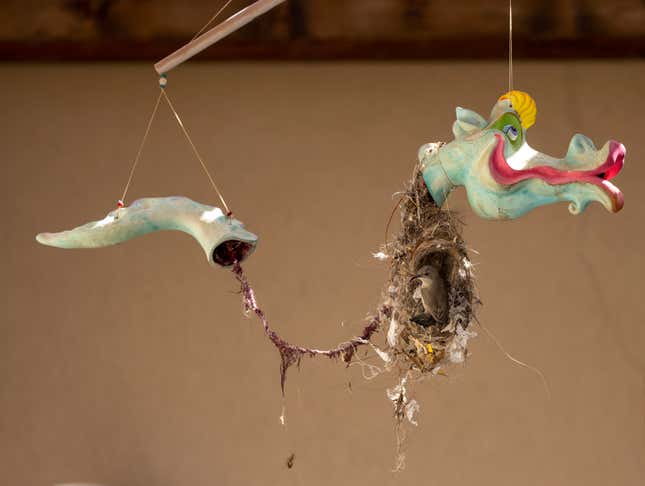
The winning image in the urban wildlife cateogry is this shot of a female sunbird in her nest—build into a a discarded human toy.

I have been fortunate enough to experience many photography exhibitions over the past few years but few have moved me as much as Canon World Unseen.
Last week, I had the opportunity to attend Canon’s latest exhibition titled World Unseen, an exhibition designed as an immersive experience for the visually impaired audience. I have always been passionate about inclusivity and accessibility in the arts, and I recognize how fortunate I am to be able to enjoy photography with little by way of obstacles. I also realize that this privilege can sometimes make me oblivious to the challenges faced by others who do not have the same access.
Canon World Unseen was a jolt of realization for me, as, ashamed as I am to admit, I had never considered how visually impaired people partake in the medium of photography, and their experiences in doing so. No doubt many within the visually impaired community may not have explored photography because it is an art revolving around sight.
Fortunately, Canon is making the medium more accessible to the visually impaired while educating the unaware about the realities of living with a visual impairment.

Canon organized the exhibition to provide an immersive, and accessible experience of photography to visitors, including those who are blind, partially sighted, and sighted. To develop the exhibition, Canon collaborated closely with the Royal National Institute of Blind People (RNIB), seeking feedback from the visually impaired community on the artwork, physical prints, and even the accessibility of the venue.
The exhibition displayed photographs selected from Canon ambassadors and included works by multi-award-winning South African photojournalist Brent Stirton, renowned Brazilian Photojournalist Sebastião Salgado, Nigerian photojournalist Yagazie Emezi, and Pulitzer-winning photojournalist Muhammed Muheisen, among many others.
The exhibition was developed to provide an experience on two levels, for the visually impaired and for sighted people to experience the effects of different visual impairments.


Through the use of a specialist Canon Arizona printer, Canon has created photographic prints that can be felt through touch and presented on an immersive board alongside a braille description. By raising certain details of the image via layering ink, the image can be felt. Imagine braille but for images. The printing process can highlight and raise selected details, creating a texture that follows the form of the subject, and this can even mean reproducing the subject’s texture in 3D. The best demonstration of this at work was Brent Stirton’s photograph of a white rhino titled Rhino Wars, where the rhino’s skin felt rough as though it was replicating the real-life experience of stroking a rhino.
While experiencing the raised photograph a detailed audio description played overhead, revealing more information about the image and how it was captured. What gave the audio experience even more weight was that the narration was provided by the photographer who took the photograph, describing with great detail the approach and environment in which it was created, breathing further life into the experience.
The experience for sighted people provided a glimpse into the experience of daily life for the visually impaired. Globally, at least 2.2 billion people have some form of visual impairment, a staggering percentage of the population. Above the raised braille boards hung large-scale printed images much like any typical photography exhibition, but the view had been obscured with a large acrylic sheet depicting replications of different visual impairments such as glaucoma and diabetic retinopathy. Much of the images were hazed or hidden by the effects, making them extremely difficult to view.

Canon’s printing can enable blind and visually impaired people to experience photography perhaps for the first time, an extremely powerful gift. This was made undeniably clear to me through the image Baby Scan by Bill Smith a world-renowned ultrasound practitioner. The expecting visually impaired mother was able to feel the contours of her unborn baby’s face by printing her sonogram, providing a moment that will never be forgotten.

A major point of this exhibition is to raise awareness of the possibilities of Canon’s printing techniques and how they can be used to further inclusivity and accessibility in the arts. Once businesses, or even artists and photographers, are aware of how they can bring imagery to life for the visually impaired, hopefully, they will consider using it.
We are already seeing breakthroughs in this regard with Taschen collaborating with Salgado on turning his book Amazônia into a book for the blind (Amazônia Touch). Although different technology, it shows that the discussion of inclusivity in the arts is being had, and forward steps are being taken.

The exhibition held in London was a roaring success, selling out tickets before opening day (entry was free). But as the goal of this exhibition is to get in front of as many people as possible, Canon’s World Unseen will be travelling across Europe, Africa, and the Americas. Be sure to monitor Canon’s social pages for more information on dates and locations.
For those unable to make it in person, Canon has developed the World Unseen online exhibition showcasing the altered photographs relating to a visual impairment via a sliding filter, with detailed audio descriptions of each image.
I feel that this is an important campaign and one that deserves to spread around to reach as many people as possible. I hope that it will open up the world of photography to more people so that the photographic community can grow even further.

Posted: 9th April, 2024 by The Editor

“There’s no way we booked a show on Easter Sunday…” quipped Avenged Sevenfold frontman M. Shadows to a fully packed crowd at Newark’s Prudential Center. Blasphemous? Maybe.
Self assurance has defined Avenged Sevenfold’s winding history. Never afraid to push boundaries, the band has spent their 25-year career towing the line of what classifies as metal. 2023 album Life Is But A Dream is a nearly uncategorizable ride through an ambitious, Camus-inspired soundscape that makes for a mindblowing – bordering on confusing – first listen. Upon repeat spins, their masterful demolition of genre lines makes most other releases sound damned near dull in comparison.
At their March 31st Newark, NJ show, controlled, confident, chaos defined an experimental night that proved the Orange County rockers have only become more cutting-edge with time.
Tour openers Sullivan King and Poppy set the stage for a riotous closing show of leg three of A7X’s “Life Is But A Dream Tour.” Less than a year after the band’s triumphant return to NYC for a sold-out Madison Square Garden show, the crowd was littered with merch from previous legs of the tour. Repeat tour attendees and dozens of deathbat tattoos only scratch the surface of their cult following’s loyalty.
The haunting guitar plucks of Life Is But A Dream album and tour setlist opener “Game Over” quickly led into blistering guitar as a ski-masked M. Shadows took his place center stage in an office chair. Synyster Gates and Zacky Vengeance’s signature dueling guitar melodies carried a career-spanning setlist dotted with rarities that haven’t graced the stage in a decade or longer. B-sides can tow the line of losing the crowd, but the addition of City of Evil’s “Blinded In Chains” for the first time since 2006, the full 11 minutes of Nightmare’s “Save Me,” and new setlist closer “Cosmic” fit seamlessly.
An air of effortlessness highlighted their 1.5 hour performance. Technically polished and beautifully produced, the guys’ energy feels brand new despite showcasing a level of skill exclusive to veterans. Fans in the nearly sold-out crowd buzzed excitedly while recapping the show to each other, affirming that the possibly accidental Easter show booking was well worth their time.


_

America was plunged into darkness yesterday as the rare full eclipse was viewed and photographed by millions – but of course, Red Bull gives us wings!
Sulfur Springs Texas was cast into shadow yesterday at approximately 1:40 pm local time and lasted roughly 4 minutes. This was the amount of time photographers Dustin Snipes and Mason Mashon had to shoot one of the most creative photographs of their careers as they photographed two Red Bull aerobatic planes flying in formation through the eclipse.
• See our guide for the best camera for astrophotography

The duo spent countless hours planning the shot, researching lighting solutions, flight patterns, and positioning so that they could capitalize on the eclipse’s short window of totality. To outline the planes and make them more visible to the cameras below, reflective tape was installed on the wings to assist in illuminating the aircraft.
Then when instructed by the photographers below, the two aerobatic pilots Kevin Coleman and Pete McLeod, met and flew in tight formation under the eclipsing celestial bodies. The aircraft zoomed past while flying at 1500 feet and – most daringly – only 4 ft apart to line up with the moon.

Pilot Kevin Coleman speaking on the project says, “Normally, this would be a manageable maneuver, but when you have the darkness from the eclipse, a flight angle that needs to be perfectly lined up with the sun, and only four minutes to take the shot while moving at 180 mph, it makes it incredibly challenging”.
Knowing the window of totality would not last long, for months leading up to the eclipse the photographers meticulously planned positioning and lighting scenarios, testing numerous pass-throughs, taking into account all variables. When showtime finally arrived the pilots had only 3 pass-throughs to get the shot, and thankfully for all involved, it resulted in a stunning and never again repeatable image.

Red Bull has not disclosed what equipment was used to capture the image, but behind-the-scenes images show an array of the best Sony and Canon cameras on the market, including the monster Canon RF 1200mm F/8L IS USM. It is certainly one of the lesser-seen Canon super-telephoto lenses as it will currently set you back $20K!
The project was developed to celebrate a rare celestial event and challenge pilots and photographers in new and unexpected ways. Pilot Pete McLeod says, “Unlike the high adrenaline and aerobatics I’m used to, this project is all about exact precision and planning… It’s all about teamwork to make this happen so it’s been incredible to be a part of it.”
Are you inspired to capture celestial bodies yourself? See our guides for more information on the best telescopes for astrophotography, the best deep space telescopes, and the best smart telescopes.

Anyone with a phone instantly becomes somewhat of a photographer. However, even with mobile photography, some people manage to take it to the next level.
The Mobile Photography Awards (MPA) come into play to recognize talented individuals who capture unique shots with their phone cameras. This year, the MPA celebrated its 13th anniversary by spotlighting the finest moments from around the world, and the grand prize was awarded to Yajun Hu, a Shanghai-based photographer. Yajun Hu captured his photos with a Xiaomi Ultra 13, and as a winner, Hu earned both the prestigious title and also walked away with a $3,000 US cash prize.
Besides the grand prize winner, there were 13 categories, and each had a worthy champion, showcased down below.
More info: mobilephotoawards.com | Instagram | Facebook | twitter.com
Image credits: mobilephotoawards
Image credits: mobilephotoawards
Image credits: mobilephotoawards
Image credits: mobilephotoawards
Image credits: mobilephotoawards
Image credits: mobilephotoawards
Image credits: mobilephotoawards
Image credits: mobilephotoawards
Image credits: mobilephotoawards
Image credits: mobilephotoawards
Image credits: mobilephotoawards
Image credits: mobilephotoawards
Image credits: mobilephotoawards
Image credits: mobilephotoawards
Image credits: mobilephotoawards
Image credits: mobilephotoawards
Image credits: mobilephotoawards
Image credits: mobilephotoawards
Image credits: mobilephotoawards
Image credits: mobilephotoawards
Image credits: mobilephotoawards
Image credits: mobilephotoawards
Image credits: mobilephotoawards
Image credits: mobilephotoawards
Image credits: mobilephotoawards
Image credits: mobilephotoawards
Image credits: mobilephotoawards








