Photography

5 tricks and settings I use when I shoot architecture for my travel photography

5 tricks and settings I use when I shoot architecture for my travel photography

I am a travel photographer from Alexandria in Egypt, and would like to share how I photographed the Heydar Aliyev Center in Baku, Azerbaijan. The Center is a 57,500-sq m building complex designed by Iraqi-British architect Zaha Hadid, and is noted for its distinctive architecture and flowing, curved style that eschews sharp angles.

Here are five things to bear in mind when you are shooting architecture, whether it’s close to home or in a far-flung location…

1: Do your research

Research is important in my travel photography. For this shot, I spent a lot of time looking through thousands of photos of this building to learn how other photographers captured it. I wanted to be able to create something fresh, with a different interpretation of it.

2: Visit and repeat

I visited the Center daily for ten days at different times so I would be able to capture the building in different lighting. On some days, I went at 10am, 12pm, 2pm, 4pm and 6pm. Every angle of the building is suitable for photography at a specific time of the day.

3: Add a human touch

To give a sense of scale, I added a human element to the frame. I included this element using architectural lines and curves to create an interesting scene. I always like to include single people to keep things simple and avoid crowding the composition – focusing on the position, direction and spacing of the human element in every image.

4: Patience brings rewards

While I’m trying to capture a person passing through the frame, I wait for a long time until I achieve what I consider to be the ideal subject. The contrast between colors is important to me, and I try to apply it in as many of my photos as possible. For natural-looking results, most of the images I shoot are candid – I just capture subjects doing what they’re doing.

5: Convert to mono

I always capture my photos in color, but I decided to convert this image to black and white in post-processing. The female subject was wearing black clothes and there was harsh lighting and shadows; I wanted the shot to be dramatic – but with no strong colors in the original capture, I think it definitely works better in monochrome.

Read more:

Intro to Wildlife Photography/Intro to Landscape Photography

Intro to Wildlife Photography/Intro to Landscape Photography

Aspiring photography enthusiasts are invited to learn the basics of manual camera setup, photographic technique and artistic vision in these five-session courses led by professional photographer, Dave Ficke. 

Each course will help photographers understand their camera and settings including white balance, depth of field, exposure compensation and histogram. Dave will also discuss lenses and ways to ensure safety while on location.

Both courses combine an online lecture component with practice at in-person meetings on location.

Introduction to Landscape Photography begins February 26, and Introduction to Wildlife Photography begins February 27. The cost for each course is $125 to the public; $100 to Redlands Camera Club members.

Sponsored by Redlands Camera Club, course details and a sign-up portal can be found on the website: www.redlandscameraclub.org.

Instructor bio

Dave Ficke is an American nature and wildlife photographer and conservationist. Dave’s thirty years as an environmental educator and life-long wildlife enthusiast has nurtured a love of nature and its beauty, which he has captured in his photographs. Long an advocate of conservation and stewardship of our natural environment, he has passionately taught those principles as a high school science teacher. Dave believes in experiential education and for thirty-three years took his high school students on weeklong field trips to Yosemite, canoeing down the Colorado river and sharing many other outdoor experiences with his students.

The big picture: Bert Hardy’s portrait of striking Chinese seamen in 1940s Liverpool

The big picture: Bert Hardy’s portrait of striking Chinese seamen in 1940s Liverpool
image

In 1942, Picture Post commissioned Bert Hardy to photograph the lives of Chinese sailors in Liverpool. About 10,000 seamen, some of whom had been settled in Liverpool’s Chinatown for decades, worked on the Blue Funnel Line or in the kitchens and laundries of Royal Navy ships during the war. The men were paid less than half the wage of their British-born crewmates.

From February to April that year, the workers made headlines when they went on strike for equal pay. Hardy’s pictures, which were never published in the magazine, illustrated those months of protest, when the sailors – branded as troublemakers – gathered in Chinatown’s hostels and boarding houses to discuss their action. Several of those images, including this photo, are included in a retrospective of Hardy’s work at the Photographers’ Gallery in London.

The merchant ships and the navy, desperate for men, reached a settlement with the strikers that summer, but the act of rebellion was not forgotten. Though at the end of the war the Liverpool Post reported that the Chinese sailors were a “gallant body of men whose service to the allied cause is greatly appreciated”, the owner of the Blue Funnel Line slashed their wages. In 2002 it was revealed that perhaps 2,000 Chinese men who had settled legally, some of whom were married to local women and were raising families, were forcibly deported between 1945 and 1947 after a Home Office ruling that the men were “an undesirable element”. Some of them were picked up at night and bundled on to cargo ships bound for Saigon and Singapore. Homes in Liverpool were appropriated by the council and in some cases British wives lost citizenship. The ongoing campaign led by one of the daughters of those men, Yvonne Foley, has resulted in the full story being told; in 2006 a plaque was unveiled on Liverpool’s Pier Head as a memorial to the deported sailors.

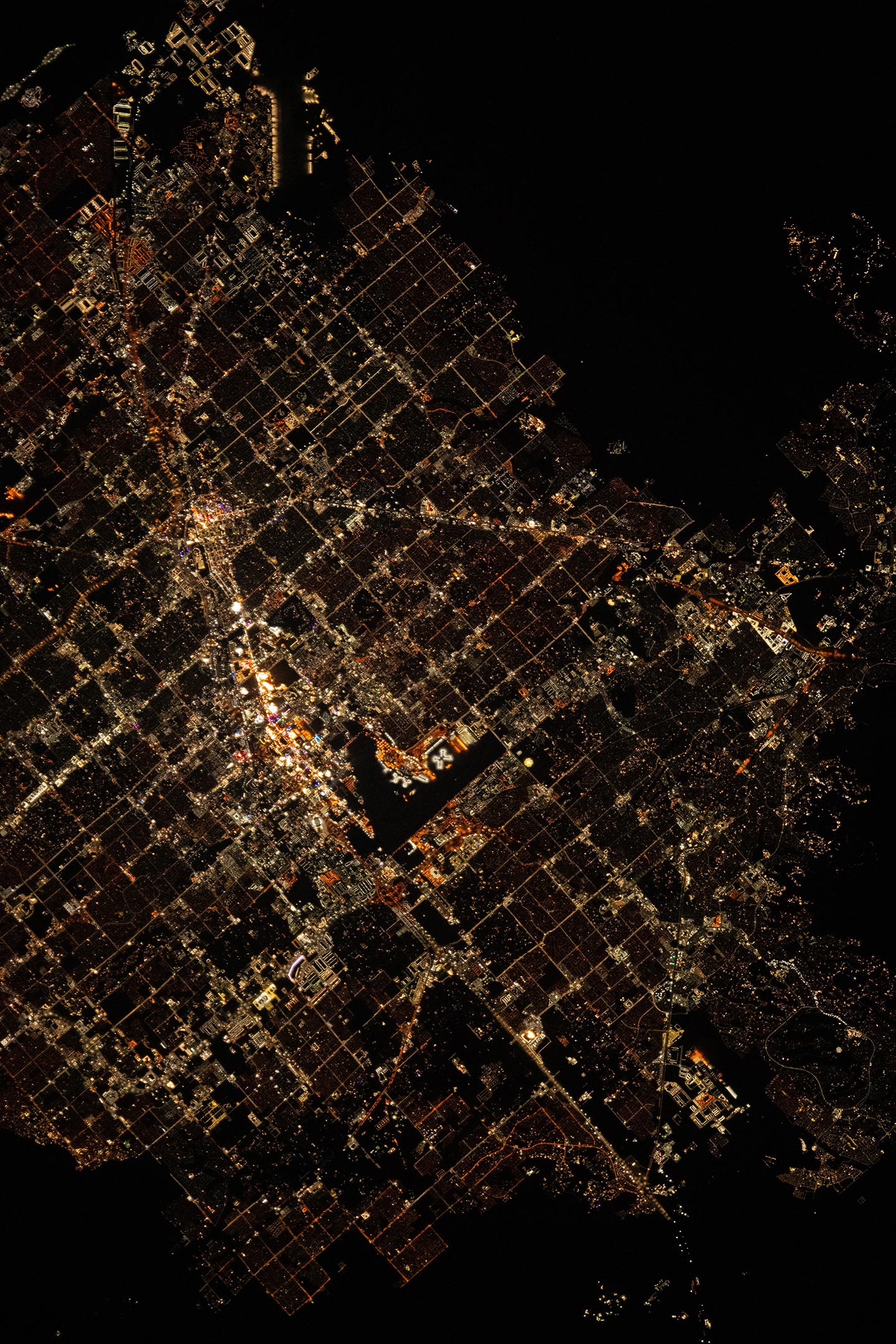
Bright Lights, Big Game: Astronaut Photograph of Allegiant Stadium From Space at Night

Bright Lights, Big Game: Astronaut Photograph of Allegiant Stadium From Space at Night
Las Vegas Night Lights From Space Station Annotated

Astronaut photograph of the bright city lights of Las Vegas, including those from the stadium where the Super Bowl LVIII game will be played, captured on September 17, 2022, from the International Space Station.

A large stadium contributes to the nighttime illumination of Las Vegas, which hosts the Super Bowl for the first time in 2024.

Las Vegas knows a thing or two about putting on a show. In February 2024, the Nevada desert city will put on one of the year’s biggest shows in sports when it hosts Super Bowl LVIII. The “Big Game” will feature professional American football teams, the San Francisco 49ers and the Kansas City Chiefs, vying for the National Football League championship.

Allegiant Stadium’s Features

The bright city lights of Las Vegas, including those from the stadium where the game will be played, are visible in this photograph shot by an astronaut aboard the International Space Station

The International Space Station (ISS) is a large spacecraft in orbit around the Earth that serves as a research laboratory and spaceport for international collaboration in space exploration. It was launched in 1998 and has been continuously occupied by rotating crews of astronauts and cosmonauts from around the world since 2000. The ISS is a joint project of five space agencies: NASA (USA), Roscosmos (Russia), JAXA (Japan), ESA (Europe), and CSA (Canada). It orbits the Earth at an altitude of approximately 400 kilometers (250 miles), and provides a unique platform for scientific research, technological development, and human space exploration.

” data-gt-translate-attributes=”[{“attribute”:”data-cmtooltip”, “format”:”html”}]” tabindex=”0″ role=”link”>International Space Station. Allegiant Stadium was completed in 2020 with a price tag of nearly $2 billion. It contains 28,000 tons of structural steel, seats 65,000 people, and is enclosed on its northern side by basketball-court-sized panels that can open to views of the Las Vegas Strip. Among its sustainability features, the venue is fully powered by renewable energy, and its roof is made of a translucent material that lets in natural light while blocking the heat of the Sun.

The glaring lights of the stadium and the Strip feature prominently in the photo and contrast with the relatively dark adjacent runways of Harry Reid International Airport. Most of the bright white, saturated pixels in this photo contain a mix of light sources, said Christopher Small, a geophysicist at Columbia University

Columbia University is a private Ivy League research university in New York City that was established in 1754. This makes it the oldest institution of higher education in New York and the fifth-oldest in the United States. It is often just referred to as Columbia, but its official name is Columbia University in the City of New York.

” data-gt-translate-attributes=”[{“attribute”:”data-cmtooltip”, “format”:”html”}]” tabindex=”0″ role=”link”>Columbia University who studies anthropogenic night light. Lights in more residential outlying areas tend to have warmer spectra typical of low-pressure sodium lights.

Understanding Urban Night Lights

In recent work, Small developed a method for distinguishing different lighting types within image pixels in nighttime photos from NASA

Established in 1958, the National Aeronautics and Space Administration (NASA) is an independent agency of the United States Federal Government that succeeded the National Advisory Committee for Aeronautics (NACA). It is responsible for the civilian space program, as well as aeronautics and aerospace research. Its vision is "To discover and expand knowledge for the benefit of humanity." Its core values are "safety, integrity, teamwork, excellence, and inclusion." NASA conducts research, develops technology and launches missions to explore and study Earth, the solar system, and the universe beyond. It also works to advance the state of knowledge in a wide range of scientific fields, including Earth and space science, planetary science, astrophysics, and heliophysics, and it collaborates with private companies and international partners to achieve its goals.

” data-gt-translate-attributes=”[{“attribute”:”data-cmtooltip”, “format”:”html”}]” tabindex=”0″ role=”link”>NASA’s Gateway to Astronaut Photography of Earth. He then quantified the brightness, color, and extent of urban night lights from the photographs to glean insight into how cities grow and evolve.

Growth has been a through line in Las Vegas’s story over the past several decades. The greater Las Vegas metropolitan area has added nearly 1 million people to its population since the year 2000. Its growth spurt—readily apparent from space—began decades earlier, though. A time series of Landsat images (see video below) compiled by NASA’s Scientific Visualization Studio shows the city’s outward expansion from 1972 to 2021.

[embedded content]Timelapse animation of Lake Mead and the city of Las Vegas, Nevada, from 1972-2021, as captured by Landsat sensors. The images are false-color, showing healthy vegetation in red.

As the city has grown, so has its footprint of night lights. But despite its reputation as the “Neon City,” Las Vegas is not all that unique in its luminosity, said Small. For example, he pointed out, “both Tokyo and Shanghai have some very impressive lightscapes, although clouds and humidity often blur the view of both cities.” Vegas benefits from its altitude and dry atmospheric conditions for clearer views from space, as in this astronaut photo.

Las Vegas experienced unusually cool and wet weather in the week leading up to the Super Bowl due to an atmospheric river moving inland from California. More typical clear skies are forecast for game time, but weather conditions should factor little into the game since the stadium is enclosed.

Credit line Astronaut photograph ISS067-E-369057 was acquired on September 17, 2022, with a Nikon D5 digital camera using a focal length of 400 millimeters. The image was provided by the ISS Crew Earth Observations Facility and the Earth Science and Remote Sensing Unit at Johnson Space Center. The image was taken by a member of the Expedition 67 crew. It has been cropped and enhanced to improve contrast, and lens artifacts have been removed. The International Space Station Program supports the laboratory as part of the ISS National Lab to help astronauts take pictures of Earth that will be of the greatest value to scientists and the public and to make those images freely available on the Internet.

Filer photographer Todd Sherwood

Filer photographer Todd Sherwood
image

Photographer and frame-maker Todd Sherwood speaks to the Times-News on Saturday, Feb. 10, 2024, at the Southern Idaho Home and Garden Show.

#lee-rev-content { margin:0 -5px; }
#lee-rev-content h3 {
font-family: inherit!important;
font-weight: 700!important;
border-left: 8px solid var(–lee-blox-link-color);
text-indent: 7px;
font-size: 24px!important;
line-height: 24px;
}
#lee-rev-content .rc-provider {
font-family: inherit!important;
}
#lee-rev-content h4 {
line-height: 24px!important;
font-family: “serif-ds”,Times,”Times New Roman”,serif!important;
margin-top: 10px!important;
}
@media (max-width: 991px) {
#lee-rev-content h3 {
font-size: 18px!important;
line-height: 18px;
}
}

From Acting to Photography: Austin O’Brien’s Creative Metamorphosis

From Acting to Photography: Austin O’Brien’s Creative Metamorphosis
image

From Silver Screen to Shutter Clicks: Austin O’Brien’s Creative Metamorphosis

Advertisment

Once a familiar face in 90s blockbusters, Austin O’Brien, known for his roles in “The Last Action Hero” and “My Girl 2,” has now embraced a new creative endeavor. Shifting from the silver screen to the lens, O’Brien is making waves as a photographer, showcasing his work on Instagram.

A Star in the Making

Austin O’Brien’s acting career began at a tender age. He gained prominence in a Circuit City commercial that catapulted him into the limelight before he even turned ten. This early success paved the way for roles alongside Hollywood legends like Arnold Schwarzenegger, Dan Aykroyd, Macaulay Culkin, and Jamie Lee Curtis.

Advertisment

O’Brien’s performances in “The Last Action Hero” and “My Girl 2” left an indelible mark on the hearts of moviegoers. Despite his youth, he held his own among seasoned actors, proving his talent and dedication to the craft.

The Lure of the Lens

After working intermittently in the early 2000s, O’Brien found a new passion in photography. He attributes his transition to learning on film, which he believes has given him a profound understanding of light and composition.

Advertisment

“There’s something magical about working with film,” O’Brien shares. “It forces you to slow down, think, and truly see the world around you.”

Married to Kristin Wurgler since 2006, O’Brien’s photographic journey is as much about capturing memories for others as it is about creating unique experiences for his clients.

A New Canvas

Advertisment

Transitioning from acting to photography might seem like a leap, but for O’Brien, it was a natural progression. Both mediums tell stories, but photography offered him a different perspective.

“As an actor, you’re part of someone else’s story,” O’Brien explains. “But as a photographer, you get to create the narrative. Every image is a moment frozen in time, waiting to be discovered.”

Today, O’Brien’s Instagram feed is a testament to his artistry. Each photograph is a visual tale, capturing the essence of his subjects with striking clarity and emotional depth.

Advertisment

In the end, Austin O’Brien’s story is one of transformation and resilience. From the silver screen to the lens, he continues to capture hearts and minds, proving that creativity knows no bounds.

As we look back at Austin O’Brien’s journey from child actor to photographer, it becomes clear that his path was not merely a transition, but a creative metamorphosis. His ability to adapt and thrive in different artistic landscapes underscores the power of resilience and the boundless nature of human creativity.

Today, O’Brien continues to craft unique visual narratives, inviting us to see the world through his lens. His work serves as a reminder that sometimes, the most extraordinary stories are those that unfold when we dare to embrace change and explore new horizons.