Photography

Family of Louisville photographer keeping his memory alive 4 years after his death

Family of Louisville photographer keeping his memory alive 4 years after his death

LOUISVILLE, Ky. (WAVE) – Four years ago on June 27, 2020, Louisville photographer Tyler Gerth was killed in a shooting during the protests that sparked from Breonna Taylor’s death.

Earlier this year, the case came to a close when the shooter responsible for his death, Steven Lopez, was sentenced to 30 years in prison.

In the years since his death, Tyler’s family has dedicated themselves to passing on his passion for photography and giving back to the community.

“I think for him, photography was just his way to explore and be curious and really give a voice to what he saw in the world around him,” Tyler’s sister Brittany Loewen said.

During the 2020 protests, Tyler’s photos captured a racial reckoning in Louisville and across the country. Loewen said he was drawn to capturing history.

“With Tyler’s passion for history and his love of photography, he really felt like that was the meeting of both of those passions and felt a really strong urge to be down at Jefferson Square,” Loewen said. “He felt like this was history unfolding.”

Surveillance video showed the moments Lopez was asked to leave the protest after other protesters said he had been unruly. In the video, Lopez is seen pulling out another protester’s gun and shooting into the crowd. Tyler was hit and died before he could be taken to the hospital.

Lopez eventually took a plea deal in the case. The murder charge was amended down to manslaughter and he was sentenced to 30 years for that charge and 21 counts of wanton endangerment.

“He has life ahead of him,” Loewen said. “Unlike Tyler, he still has the opportunity to live with purpose and make something out of this. That’s our family’s deep hope is that restoration can come.”

Loewen spoke at the sentencing. She said she’s grappled with forgiving Lopez and hopes that he can learn from Tyler’s legacy.

“I hope that he is inspired by Tyler and I hope that he can learn from Tyler,” Loewen said. “There’s tremendous irony in the fact that Tyler was killed a week before his 28th birthday and Steven was just sentenced a short time before his 28th birthday.”

Over the past four years, his family has created a non-profit called Building Equal Bridges – the Tyler Gerth Foundation.

The organization gives out scholarships and also started a program called the Polaroid Project through the Louisville Urban League that allows kids to practice their own photography.

“It challenges them to see their surroundings in a new way, to tell the story of their families or their communities, their neighborhoods, in a different way,” Louisville Urban League President & CEO Lyndon Pryor said.

The program lets kids experiment with photojournalism. Pryor says the students are asked to take pictures in the community and write an essay about the meaning behind them.

Tyler’s family said it’s the perfect way to honor his legacy and let others share his passion.

“Because Tyler’s death was so public and so traumatic, we wanted to shift the focus from the details of his death to the focus of his life,” Loewen said.

“It’s carrying that message on through them and helping them to essentially do the exact same thing through their images, through their words, through this art form,” Pryor said.

It’s never easy to be a female nude photographer in Thailand

It’s never easy to be a female nude photographer in Thailand

“Being a nude photographer in Thailand is not easy. They won’t just talk about you, just about your work. You have to be strong enough to know that they’re going to talk about your appearance, your family, or how they raised you. There are some people who already judge you, that you are a bad person.”

Sophirat Muangkum, a Thai female nude photographer, expresses her deep frustration as to how she has been treated throughout her career, especially when nude photography remains shunned in Thai culture. As a result, nude photographers like herself still face backlash, social prejudice and, in the worst cases, verbal sexual harassment.

When we’re naked, we are all the same

In her latest solo exhibition, “Decentralised Thainess”, Sophirat explores how people are defined by traditional values, stereotypes and cultural norms in the four regions of Thailand. Among the stereotypes are that people in the North are shy, those in the Northeast are blunt, or those in the Deep South are violent. Therefore, she uses nude photography to strip away such stereotypes, to show that people are all the same.

“I feel that nudity is not only about being naked,” she explains. “It’s about freedom. It’s about equality. So, for this nude photography exhibition, I’m bringing everyone back to the basics. When we’re all naked, we are all the same.”

The whole photo exhibition took Sophirat more than four years to create. Most of the models she chose for the photoshoots were those she met in local communities, who she finds interesting and have their own stories to tell. A few examples include a young female activist for LGBTQ+ rights, who fell victim to bullying and body shaming, another female who shaved her head to rebel against political oppression and a group of sex workers who remain disparaged in Thai society.

On this journey, the 40-year-old photographer describes herself as an “empty glass” exploring different communities, delving into their stories, and eventually, bringing all the missing pieces together. This was when she discovered that each region of Thailand has its own history and culture, as opposed to what many Thais have learnt in the textbooks, which depict a “centralised” idea of what it means to be “Thai”.

“So, I’m very interested in what was never in the textbooks or what people often misunderstand about people in the various regions,” she explains as the backstory to the exhibition.

Mother Earth (Photo by Sophirat Muangkum)

It’s art, not obscene

As in her previous art exhibitions, Sophirat believes that a nude photograph can convey various meanings, and is not restricted to the meaning of “art” or “obscene”. In fact, Sophirat has been trying to get this message across throughout the past decade of her career.

It all started in 2018, her first solo exhibition in Thailand, when she was bombarded by questions from Thai reporters. The most frequently asked question was whether her nude photo exhibition is considered “art” or “obscene”, which incited her to prove her point ever since.

“That project was kind of experimental, where I took photos of more than 30 women of different ages and religions. I asked what nudity means to them. Then I transformed their answers and incorporated them into my artwork. That was when I found out that one nude photograph is more than just “art” or “obscene”. A nude photo of a pregnant mother could also express her love for the child she is carrying, while feeling that her body is still beautiful.”

As to why she fell for nude photography, she explains that being naked is her “nature”, indicating that every human is born naked and that there is nothing wrong with being comfortable in your own skin.

This is completely the opposite of her conservative upbringing. She was raised to strictly uphold Thai traditional values and, most importantly, to meet the expectations of being a “good daughter”. Among these expectations were taking responsibility for household chores, dressing modestly and being obedient. It was not until she studied in Germany and became a photographer there that she decided to break the mould, realising the true meaning of freedom.

“It’s just my nature that I want to free myself sometimes,” she says. “When I grew up, I liked to take photos of myself, and I just liked the lighting and shadow on my skin. After 10 years, whenever I looked back at my artworks, I discovered that it’s not only the beauty of the light or shadows on my skin. It’s about freedom.”

Love Has No Gender (Photo by Sophirat Muangkum)

Fighting bias

Being a nude photographer in the Thai art scene remains a tremendous struggle. When it comes to nude art, Sophirat pointed out that Thai viewers are more familiar with nude magazines, mainly catered to male audiences, which have led to the perception that nudity must always be “sexy”. On the other hand, Thai viewers remain unfamiliar with nude art in other settings, such as in museums and art galleries, which are much more common in the West.

Because of the limited perception of nude art among Thais, Sophirat feels that nude photographers, like herself, remain marginalised in the Thai art scene. Even worse, being “Thai” and “female” makes things even harder, due to conservative cultural norms that dictate that Thai women stay modest and reserved and, therefore, women in nude photography are always looked down upon.

“If I’m a Thai female, they have already decided for me what I have to do, even if they do not know me,” she says, adding that being a Thai female nude photographer wouldn’t be a problem if she lived outside of Thailand.

“Many times that I visit a nude gallery or exhibition, Thai people have no problem with foreign photographers, but they have a problem if it’s a Thai photographer, because they are concerned about religion, or values of being a good person, especially if you are a woman.”

Sophirat explains further that she was never not allowed to do something just because she’s a woman, back when she was still a nude photographer in Germany. When she came back to Thailand, however, being a Thai woman and a nude photographer became the most common issue that reporters would raise with her, even those from international media.

Flawless (Photo by Sophirat Muangkum)

At the same time, even though Sophirat has a long list of solo and group exhibitions to prove her experience, she still has to approach the media by herself, to convince people to explore other aspects of nude photography. Another difficulty that the female photographer experienced was when she was rejected by some universities as a guest lecturer, just because her portfolio includes nudity, reiterating her point that nude photographers are still subject to discrimination.

“It is quite hard,” she says. “I cannot do only nude photography and exhibitions. I have to approach the media. I have to approach the university. I have to write something. I have to make them understand me from many perspectives. I mean, it’s much harder for me compared to others.”

Despite being recognised now as one of the top nude photographers in Thailand, most people are still not open-minded about nude-related art, especially the way people raise eyebrows or tease someone when they post a photo of themselves visiting a nude exhibition.

One incident she still remembers was when a visitor took a selfie with her. Someone joked that he or she wanted to become a nude model for Sophirat. As much as it offended her, she said that she could only laugh it off “just to be polite”.

“No one wants anyone to laugh at what you love,” she explains. “So, when someone says ‘Ah… you’re going to be a nude model for this photographer right?’ It’s not a joke to me,” she explains.

As the bias against nude art persists, Sophirat believes that having more (female) nude photographers would help push more boundaries in the Thai art scene.

“I would be grateful if there were more female photographers coming out,” she says. “Because, if you shout alone, you will get tired and your voice would be small. If there are more people who understand your work and are doing the same thing, I think we can change something,” she believes.

Respect Your Body, Eat Well, and Dance Forever (Photo by Sophirat Muangkum)

It’s a naked body that covers your soul

As for her ultimate goal as a Thai photographer of nudes, Sophirat says that she dreams of travelling around the world, to explore different cultures through nude photography. She also dreams of taking photos of communities where they still live naked and this latest solo exhibition marks the starting point of her next journey.

“I really want to travel around the world to take nude photos of people, like this exhibition, but in other cultures,” she says. “Because I think, for me, it’s a naked body that covers your soul. Some people create their appearance to be like that of others, but we have no idea what’s inside them when they are naked.”

By Nad Bunnag, Thai PBS World

Rock ‘n’ roll sloth and belly laughing bears – best of the Comedy Wildlife Photo Awards 2024 (so far)

Rock ‘n’ roll sloth and belly laughing bears – best of the Comedy Wildlife Photo Awards 2024 (so far)

The world-famous Comedy Wildlife Photography Awards competition is now open to entries.

There’s just over a month to go before the 2024 competition closes, meaning you still have time to submit your funniest wildlife images.

Looking for a bit of inspiration? Here are a few of the funniest photo entries so far, from joke-telling polar bears to (slightly) awkward penguins.  

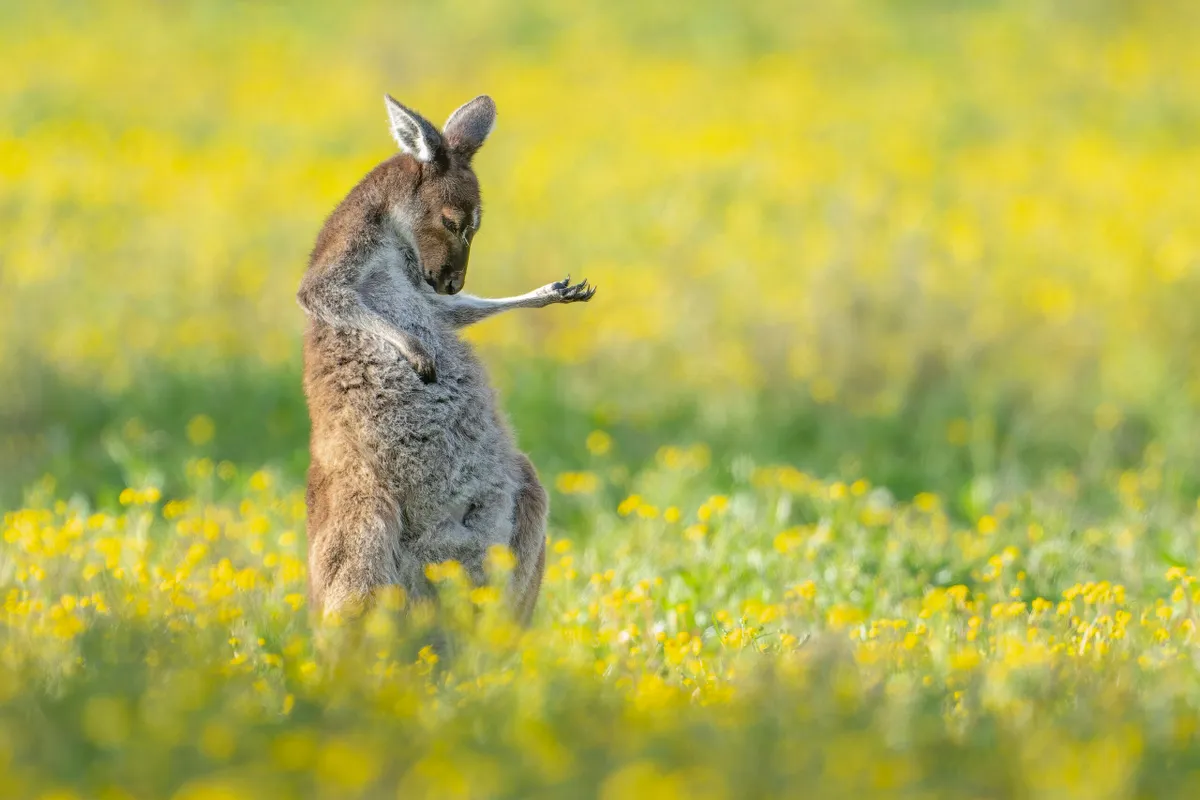
Western Grey Kangaroo
Jason Moore’s photo of jamming kangaroo won last year’s Comedy Wildlife Photography Awards. Credit: Jason Moore

Best photos from the Comedy Wildlife Photo Awards 2024 (so far)

Holding on for a ride – Alexander Fine

Holding on for a ride – brown bear photographed in Lake Clark National Park, Alaska. Credit: Alexander Fine

Not a good idea – Anton Pretorius

Not a good idea – buffalo and cattle egret photographed in Rietvlei Nature Reserve, South Africa. Credit: Anton Pretorius

Three’s a crowd – Deena Sveinsson

Three’s a crowd – chinstrap penguins photographed in Antarctica. Credit: Deena Sveinsson

Slow hands – Harry Collins

Slow hands – three-toed sloth photographed in Costa Rica. Credit: Harry Collins

Laughing out loud – Ingo Hamann

Laughing out loud – seal photographed in Helgoland, Germany. Credit: Ingo Hamann

Three heads are better than one – John Mullineux

Three heads are better than one – giraffes photographed in Green Kalahari, South Africa. Credit: John Mullineux

Watch out for that tree – Mark Koster

Watch out for that tree – male mallard duck photographed in Chaparral Park, Scottsdale, AZ. Credit: Mark Koster

Pick me pick meeeeee – Thomas Van Puymbroeck

Pick me pick meeeeee – sea turtle photographed in Curacao, Caribbean. Credit: Thomas Van Puymbroeck

Peak-a-boo – Tilan Weerasinghe

Peak-a-boo – white-breasted waterhen photographed in Colombo, Sri Lanka. Credit: Tilan Weerasinghe

Did you hear the one about the…? – Wendy Kaveney

Did you hear the one about the….? – polar bears photographed in Churchill, Manitoba, Canada. Credit: Wendy Kaveney

Itching to enter?

The Nikon Comedy Wildlife Photo Awards competition is open until 31 July 2024. It’s free to enter and open to levels of photographer.

More weird and wonderful wildlife:

10 Funny Wild Animals In Photos: A Preview From Comedy Wildlife Photography Awards

10 Funny Wild Animals In Photos: A Preview From Comedy Wildlife Photography Awards
image

The Comedy Wildlife Photography Awards has previewed a selection of top entries to date competing for 2024’s funniest wildlife photos, including a three-headed giraffe, a rather cool sloth and cub bears holding on for a ride.

With less than a month before the competition closes, the photo contest has already fielded hundreds of entries from around the world, catching some of wildlife’s funniest moments on camera. The competition organisers are releasing a few of the shots to inspire both professional and amateur photographers to enter their images before the closing date of July 31.

Now in its 10th year, the Comedy Wildlife Photography Awards has partnered with Nikon, one of the world’s leading camera brands.

The Nikon Comedy Wildlife Awards was co-founded in 2015 by professional photographers Paul Joynson-Hicks and Tom Sullam. They sought a competition focused on the lighter side of wildlife photography that would help promote the conservation of wildlife and habitats through humor.

Each year, the competition supports a sustainable conservation organisation and this year it will work again with Whitley Fund for Nature (WFN) a U.K. charity that backs conservation leaders working in their home countries across the Global South. Over 30 years, it has channeled £20 million to more than 200 conservationists in 90 countries.

The free competition is open to all wildlife photography novices, amateurs and professionals — you don’t have to be using a Nikon camera — to celebrate the hilarity of our natural world and highlight what we need to do to protect it.

Discover more about the competition and its conservation efforts.

A male mallard flying appears to be running into a tree at Chaparral Park in Scottsdale. Actually, it was flying behind it.

At Half Moon Island in the South Shetland Islands, Antarctica, the expedition ship was bound in a stunning snowy world. “I expected thousands of chinstrap penguins but there were only a few hundred,” said Deena Sveinsson. “In the distance, I saw these three hanging out with one another but suddenly there seemed to be some disagreement and the penguin pair briskly walked off leaving the poor little lone fella wondering why. How humanlike. And how awful it must be to be that third wheel.”

Anthropomorphic antics of polar bears seemingly telling each other jokes and laughing hysterically.

A Three-Toed sloth in Costa Rica that looks like he may have been a guitar player in a previous life. This image gives new meaning to Eric Clapton’s nickname “slowhand.”

Two male giraffe were fighting shortly after drinking water in the green Kalahari. They started sizing each other up but ended up scooching over to a third giraffe. In a single moment, the three formed one body with three heads.

This western cattle egret thinking of having a go at the male organ of a buffalo.

This newborn seal is having a whale of a laugh.

A water cock gives a hilarious performance.

Who wants to live in a plastic free ocean? Meeeeeeeee.

2024 ‘So Savannah’ Photo Contest Winners

2024 ‘So Savannah’ Photo Contest Winners

From dogs on the beach to tugboats in the harbor, these photographers captured quintessential Savannah

AFTER THE EXCITEMENT of last year’s inaugural photo contest, Savannah magazine brought back the friendly competition for a second year. Inspired by the city’s inimitable beauty and creative spirit, we called for professional, amateur and student (under 18 years of age) photographers to share their best original images that capture the essence of the Greater Savannah area and Georgia coast in exchange for cash prizes — and bragging rights, of course. 

Between January and March, more than 100 people answered our call and shared hundreds of images. Here, we’ve rounded up our staff favorites, with some help from a panel of esteemed judges. Cast your vote for Readers’ Favorite by Aug. 1, 2024. One winner will be announced in our September/October issue and receive a $200 prize!

Professional Category

WINNER
“Morning Lighthouse” by Steve Vilnit
RUNNER-UP
“The Golden Roots” by Micah Turner
HONORABLE MENTION
“Ogeechee” by Kathryn Ann Waller
EDITOR’S FAVORITE
“Yesterday’s Paper” by Randall Patrick

Amateur Category

WINNER
“Savannah River Tugs” by Tim Nichols
RUNNER-UP (TIED)
“The Birds” by Diane Fulmer
Tiny, abandoned blue house in the woods
RUNNER-UP (TIED)
“Old and Older” by Ann P. Raimee
HONORABLE MENTION
“Foggy Walking Tour” by Nichols Hennig
EDITOR’S FAVORITE
“Thunderbolt Fisherman’s Seafood” by William Byatt

Student Category

Brown dog laying on beach
WINNER
“Panama Jack 1” by Cruz Velazquez 
Tall buildings and suspension bridge in background
RUNNER-UP
“The Bridge to Industry” by Lance Ha
HONORABLE MENTION
“The Beauty of Downtown” by Isabella Evans 

MEET THE JUDGES

Daniel Palmer

Daniel S. Palmer is chief curator at the SCAD Museum of Art. Previously, he was curator at Public Art Fund, New York, where he organized 20 exhibitions. Prior to his role at Public Art Fund, he served as the Leon Levy Assistant Curator at the Jewish Museum and Curatorial Research Assistant at the Whitney Museum of American Art. Palmer has curated numerous exhibitions independently and has contributed writing to many artist monographs, publications and journals including ARTnews, The New York Times, Mousse and Kaleidoscope, among others. He holds a doctorate and Master of Philosophy in art history from the CUNY Graduate Center and a bachelor’s degree from Rutgers University.

Katie McGee

Winner, 2023 “So Savannah” Photo Contest

Katie McGee is grateful to have grown up in an inspiring city like Savannah. The beautiful landscape is what led her to study photography in college and continue working professionally for 16 years. When she is not working, you may find her at an estate sale, driving down the bluff or walking downtown with her golden retrievers, Finley and Olive.

Somi Benson-Jaja

Somi Benson-Jaja is the owner of Shot By Somi Studios, an award-winning commercial portrait photographer and two-time Best Photographer in Savannah magazine’s Best of Savannah reader survey. Before photography, Benson-Jaja was an elementary school music teacher for six years in the Savannah-Chatham County Public School System. He is actively involved in the community by serving on various boards, including the United Way of the Coastal Empire Board of Directors, the Emmaus House Board of Directors, the National Association for Catering and Events (NACE), the Lowcountry Chapter Board of Directors and is currently the president of Buy Local Savannah. He was named to Georgia Southern University 40 under 40 2020 Alumni Award class, honored by Savannah magazine as a part of the 2021 New Guard and is a 2021 graduate of Leadership Savannah.

Stayce Koegler

Winner, Best Photographer, Savannah magazine Best of Savannah 2023 

Savannah-based photographer Stayce Koegler brings 16 years of experience capturing candid, emotion-filled family moments and high school seniors. Her goal is to provide a gallery that anyone falls hard in love with, while also enjoying the experience of creating those memories. 


Cast your vote for Readers’ Favorite by Aug. 1, 2024.


July/August Savannah magazine cover

Find this feature and so much more in Savannah magazine’s July/August 2024 “Life on the Water” issue.

Photographing Live Music: A Primer for Concert Photography

Photographing Live Music: A Primer for Concert Photography

Photographing live music can be an amazing experience once you embrace the idea that you have no control over any of the elements in your frame. So how do you create great pictures when you have limited angles to shoot from, terrible lighting, and no control over what your subject will do next?

Introduction

In this age of digital streaming with every type of media available on demand, attending a live show still has an incredible and irreplaceable magic all its own. In our family, we are all avid live music and comedy junkies and take the opportunity to go out and see live shows whenever we can. It’s great to support artists by going to see their shows in person when they go on tour. In my case, my passion for live performance also carries over to my photography.

There’s usually a great deal of thought and effort behind the scenes that goes into making a live performance visually compelling. Whether it’s music or theater – the lighting, the costumes, and the drama unfolding on the stage all contribute to the visual spectacle of the scene. These visual elements are the obvious starting point when capturing a live performance as a still photographer, but a great photograph can also capture its emotion and energy. Despite being a snapshot of a single moment frozen in time, a skillfully executed photograph can even convey the dynamism and movement of a performance.

Check out the work of some of the legendary music photographers like Jim Marshall, Deborah Feingold, Ross Halfin, and Danny Clinch, and you’ll see what I mean. Some of their amazing images make you feel like you’re there in the crowd, taking in the atmosphere and experiencing the concert for yourself.

While we mere mortals of the music photography world might aspire to one day have the opportunity to photograph artists of the stature of Bowie, Hendrix, and Queen, there are plenty of lesser-known but incredibly talented musicians and bands out there touring and performing, who need photographers to come and capture their shows and create the kind of amazing images that they can use to promote their own careers. Coincidentally, these images can also be a great way to promote our own careers as photographers!

Before we go any further, I would like to give a big shout-out to the artist who appears in these photographs. Meg Smith was recently featured in Rolling Stone as a rising young star in the music scene, and I was thrilled when she invited me to come and photograph a set that she was performing at a local concert venue The Sinclair, as part of her nationwide tour.

What follows are what I hope will be some useful tips for getting great images when you’re photographing live music. I don’t profess to have all of the answers about how best to shoot live music, nor do I want to give anybody the impression that my way of doing it is the right way or the only way. This article is a distillation of my own experience photographing live music – a recounting of some of the many mistakes that I have made along the way, and the approaches and techniques that I have found to work well (and not so well) for me when it comes to getting good concert photographs.

Big Pixels Are Your Friend

I don’t want to spend too much of this article talking specifically about gear, but a lot of people ask what kind of camera is best for concert photography, so I feel that I should at least address this question parenthetically.

You can photograph live music with pretty much any camera, but some types of cameras are definitely better suited to the job. Compared to even twenty years ago, we have a lot more choice today when it comes to gear, but I would say that one of the most advantageous features a camera can have when it comes to photographing live music is its ability to create nice, clean images even in low light. The lighting in most concert venues is terrible, and in contrast to studio photography, you usually have no control over it. Furthermore, the artist – your subject – will probably be moving around, flitting between differently illuminated areas of the stage. Sometimes they could be bathed in the harsh glare of a spotlight, sometimes they could be in deep shadow. Your camera is going to need to be able to deal with a wide range of generally suboptimal light conditions.

It’s a basic law of physics that bigger pixels will be better than smaller pixels when it comes to gathering light – that is to say, a bigger pixel will have a better signal-to-noise ratio than an equivalent, smaller pixel. Sure, the electronics of sensors and image processing chips are constantly improving, but these components of your camera’s imaging pipeline need to work a lot harder to extract a clean image from smaller, noisier pixels in low light. There’s also the argument that AI-driven denoising algorithms have changed the game when it comes to cleaning up noisy images. Again, you can rely on this technology up to a point, but there are limits to what these algorithms can do, and your chances of getting a great image are improved if your image is already in pretty good shape straight out of the camera.

In spite of all the firmware and software wizardry that we have at our disposal to clean up noisy images, you really are better off getting a clean image straight out of your camera if you can achieve it – and the bigger your pixels are, the easier this will be. For this reason, I feel that some of the lower-resolution full frame cameras are a good choice for concert photography. I really like using the Leica SL2-S and Panasonic Lumix S5IIX cameras that have “only” about 24 megapixels on their full frame sensors. This is more than enough resolution for almost any photographic scenario, and their larger pixels give them superb low light performance.

If you don’t have a large sensor camera with big pixels, don’t worry. There are plenty of photographers out there shooting concerts with Four Thirds and even smaller sensors. You work with what you’ve got. More time spent with the denoising algorithms in post-processing may be necessary if your images are really noisy, and one good tip if all else fails, is to convert your noisiest concert images to black and white. The sensor noise is much less intrusive and bothersome in monochrome images and can give the image a kind of film grain look. A gritty black and white image might even be the perfect format if you’re shooting a moody music genre.

I made the deliberate choice not to apply any noise reduction (either AI or manual) to the images in this article, to illustrate how well lower resolution, full-frame sensors can handle low light conditions. All of the photographs were shot using the Leica SL2-S and the Panasonic Lumix S5IIX at auto ISO settings up to and including ISO 12,800.

Exposure

I like to have full manual control of my camera when I’m shooting in general, but especially for concerts. I want a shutter speed high enough to keep motion blur down when the artist is moving – and if my lens allows it, a wide aperture to gather as much light as possible, which enables me to keep my ISO setting lower and reduce sensor noise.

One thing that you can’t spend too much time on when you’re shooting a live concert is futzing with your exposure settings. I have learned this from bitter, personal experience, having missed some great shots because I was caught unprepared – busy with my head down, fiddling with my camera settings when some amazing action was happening just a few feet in front of me.

What I like to do, therefore, is to set a wide aperture and a shutter speed that will keep the motion blur to a minimum, and then use the automatic ISO setting to ensure the appropriate exposure for that particular shutter speed/aperture combination. I usually shoot concerts with my shutter speed set somewhere in the region of 1/100 second. This is a compromise insofar as it isn’t fast enough to prevent motion blur when the artist is moving rapidly, but it works in most scenarios while still allowing me to shoot at lower ISO, and I always have the option to quickly increase the shutter speed for the more dynamic moments of the performance (more on this in a moment).

I usually cap my maximum ISO setting depending upon the limits of the camera’s low light performance. On my full frame cameras, for example, I’m happy to let the ISO go as high as 12,800 since both cameras can easily produce excellent images at that gain. In a pinch, I could probably go to even higher ISO settings on those cameras if I was willing to tolerate a little more noise and a tad more work processing the images.

Focus

I have found from experience that the best approach to handling focus for concert photography also depends on what camera you are using. Cameras with the latest and greatest phase-detect autofocus like the S5IIX are ideal and can even be (mostly) reliably used in continuous autofocus mode – locking onto the subject and tracking them automatically as they move. My SL2-S with contrast-detect autofocus definitely struggles a little more than the S5IIX in low light, but it still gets the job done.

With continuous autofocus, even if you have AI face or eye detection, it’s sometimes possible for the camera to lose track of the artist’s face if they are using a handheld microphone or if there are other objects such as guitar necks, microphone stands, or the artist’s hands crossing their face in your frame as they move. This is another lesson that I have learned the hard way. If you think this might be happening, it’s sometimes worth switching back to single autofocus mode and reducing your focus zone size so that you have more precise control over getting the artist’s face in focus.

It is possible to use manual focus for concert photography if you have good dexterity, and the focus assist tools like focus peaking can be really helpful for this. The technique of zone focusing used a lot by street photographers can be more difficult to take advantage of in the kind of low light that is typical in concert venues since we are already being pushed towards shooting with wider apertures, and zone focusing works best with narrower apertures. Using a wide angle lens can help in this case, since it will have a wider depth of field at any given aperture than the equivalent longer focal length lens.

Use the Stage Lighting to Your Advantage

If the concert venue has a professional lighting setup, there are usually plenty of opportunities to use the stage lights to crank up the drama in your shots. A technique that can give you wonderful, dramatic concert shots is to position yourself such that the artist is occasionally eclipsing one of the rear spotlights. If you are prepared for it, in moments of “total eclipse,” you can get a dramatic silhouette of the artist outlined by a gorgeous rim light. This effect can be even more dramatic if the artist has a lot of hair for the light to shine through.

My preference though is to try to catch the “partial eclipse” and nail the exposure somewhere between the brilliant backlight and the deep shadow of the artist’s silhouette. This allows some details of the artist’s features to stand out from the shadows, making for a more interesting shot.

In some of my concert shoots, I found that if I missed my timing on the artist’s movement and took a full-on blast of the spotlight into my lens, what I ended up with was often just a mush of washed-out glare and lens flare from which it was very difficult to recover any interesting details. This is not so much a problem for stage lights that are not angled directly toward your camera, but you really need to try to time your shot to capture at least the “partial eclipse” if you are shooting straight into a spotlight.

Colored stage lights can also add a lot of extra drama to a shot, and it’s a matter of personal taste how you choose to handle them when you are managing your white balance in post-processing. One approach I like to use with colored lights is to mask the performer and the background separately, and then set the white balance on the performer to achieve somewhat more realistic skin tones while leaving the background colors as they are for dramatic effect. I find that this can also make the performer stand out better, especially if the stage behind them is bathed in a sea of red or blue light.

Anticipation

Beyond being very comfortable using your camera and familiar with its settings and performance, I would say that the most important skill for concert photography is anticipation. Getting great pictures of a performance does require some luck, but as the French scientist Louis Pasteur once observed, “Chance favors the prepared mind.” It really helps to be able to anticipate where the performance is going to go next.

One obvious preparatory step that you can take as a concert photographer is to familiarize yourself with the artist’s songs before the performance. Even better than just listening to the songs is watching videos of previous performances if they are available. This is great for getting a sense of what the artist likes to do at different points in a song, how they move, and what gestures they use. Does the song have any emotional moments in which the artist may do something particularly dramatic? Is there a punchy chorus or an instrumental riff where the artist likes to dance?

I previously said that I don’t want to have to mess with my camera settings during a concert, but the one setting I might change is the shutter speed. If I know that a particular song has a more energetic beat and the artist is going to move about more, or if there’s a particular moment in a song where the artist likes to dance, I will sometimes increase my shutter speed just for those moments in the performance.

One other tip that somebody once gave me that might seem obvious but that I have found to be incredibly useful is to shoot in burst mode – at least during the more energetic parts of the performance.

Respect the Audience

Finally, although you might be working when you’re shooting a concert and feel that you have a job to do, it’s worth remembering that everybody else is there to have a good time, and unlike you, they have paid for the experience. I’ve seen some rather self-important concert photographers continually blocking the view of the audience to get their shots and even pushing their way in front of people to do this.

I think it’s very important for a concert photographer to be considerate of the audience. Shoot quickly and move out of the way whenever possible. Being the “official” concert photographer doesn’t make you more important than the other people in the audience, or give you the right to be a jackass just because you think you’ve got a job to do.

Going Going Gonzo – Photographer and Artist Raúl Gonzo

Going Going Gonzo – Photographer and Artist Raúl Gonzo

R

Raúl Gonzo looks out of place in his own living room. That is because, sitting there in his faded jeans and concert tee, holding a cup of coffee, his human form practically disappears against the super-saturated visual thrum of this parlor painted in shades of fuchsia, marigold, cyan and shamrock green.

But the mismatch isn’t just about color: It feels like the living room should be inside Gonzo’s head, instead of outside. In the hallway behind him, a table and chairs melt into the wall, as does a lamp and half a rotary dial telephone, while a bespectacled stag’s head smokes a pipe over a fireplace mantel that veers at a dizzying cant, on top of which a neon yellow blunderbuss waits for Elmer Fudd to come over for some Wabbit hunting with Hunter S. Thompson. It’s like the dream sequence from Alfred Hitchcock’s Spellbound  interpreted as a Looney Tune directed by Tim Burton—all influences on his work, according to Gonzo.

This vivid dreamworld instead lives inside a weathered Victorian-era duplex in West Sacramento’s Washington neighborhood, just across the river from the Crocker Art Museum, where Gonzo’s first solo museum show, Color Madness, opens June 30, with about two dozen of his elaborately staged photographs. The display features two pictures that were taken in this very room, including A Woman’s Den, in which a brunette model wearing 1950s lingerie and thigh-high velvet boots cradles the comical yellow gun in front of the tilty green fireplace, a dangerous, glamorous vamp plunked down smack in the middle of Toontown, unaware that the more seriously she takes herself the more hopelessly absurd she appears. Ah, isn’t that the human predicament?

A multi-colored living room with slanted fixtures and eclectic furniture

The polychromatic living room of artist Raúl Gonzo’s West Sacramento home (Photo by Raúl Gonzo)

It feels significant that Gonzo inhabits this stage set, which blurs the lines between conscious and dream states, fiction and reality, 24/7. He’s a bit like Vincent van Gogh eating his pigments in a gut-level attempt at merging with them, except Gonzo is bathing in them instead.

Lanky, languid and affable, Gonzo is the spitting image of a young Jimmy Stewart playing opposite an invisible, 6-foot, 3-inch rabbit in Harvey as he describes the process through which he stages elaborate sets for his distinctive photographs. Then he stops, grins and says, “If this work was a relationship, it would probably sound kind of toxic.” He shakes off the notion. “No, no, no! I’m obsessed with it, and it’s obsessed with me. I’m sure it’s healthy.”

Gonzo Divider

Gonzo started life as a Raúl, but with a different last name that he politely declines to share. He left it behind when he was christened “Gonzo” at age 20—not by his parents, and not by himself, but by his fellow art students at Yuba College in a bit of art-school cleverness. They were riffing off of two characters in Fear and Loathing in Las Vegas, author Hunter S. Thompson’s fictional alter ego Raoul Duke and his sidekick Dr. Gonzo. 

Namesakes aside, a better candidate for spirit guide might be Gonzo the Great, the quixotic Muppet prankster of uncertain species who gleefully ate a rubber tire on stage to the tune of Rimsky-Korsakov’s “Flight of the Bumblebee” on The Muppet Show  in 1976—a puppet striving to create performance art, or to parody performance art, or both. “I feel like I’m more like that Gonzo,” Raúl agrees, “who is called that just because he’s weird.” 

Francesca Wilmott, the Crocker’s curator of art who is staging the show, calls him a retrofuturist—and he thinks she’s nailed it. “That is one of my favorite words to say: retrofuturistic. It’s nostalgic. It sometimes feels romantic, or provocative,” he says, before dropping into a mischievous, conspiratorial whisper, to add: “But most of the time, it has to be funny. If it’s not funny, I’m not super interested.”

His images usually feature pinup-perfect, vaguely mid-century female figures, often captured in awkward stances or situations that are each a little tragicomic: tripping over a shopping cart in a market with no labels, driving while crying, watching an exploding TV set. They are all dreamily beautiful, and something about their brightly colored lives is always off. Retrofuturistically speaking, they’re reminiscent of a meme from a couple of years ago that George Jetson, everybody’s favorite ’60s dad from the future, was supposed to have been born in 2022. The anachronistic women in Gonzo’s images seem to be grappling with the realization that, to quote the little “g” gonzo philosopher Yogi Berra, the future ain’t what it used to be. And it’s hard to know whether to shout at them to wake up and smell the climate change, or give in and join them in their gorgeous, melancholy defeat.

Two women in a brightly colored pool, one swimming as the other answers a phone at a desk

Office Pool, 2022 (Courtesy of the artist and Crocker Art Museum)

In addition to the staged images, the Crocker show includes an immersive, experiential installation that puts museum visitors aboard a fanciful, fictional version of a pink-soaked Pan Am airliner. Museumgoers can sit in the seats for a one-way flight to Gonzoland, watching a video loop called Color Madness in Motion, composed of live-action video from Gonzo’s photo shoots, so that the images in the exhibit flutter to life.

Gonzo got a taste for the interactive installation piece when he participated in the Art Hotel project in 2016, when roughly 100 artists were invited to create work inside the rooms and hallways of a downtown Sacramento hotel slated for demolition. He placed a red bathtub in a red room and filled it with clouds and rain (a photograph of that design, Tea Time, Bath Time, Part I,  with a model in the tub holding a blue umbrella, is included in the Crocker exhibit). In the casual atmosphere of the Art Hotel, Gonzo was delighted to see visitors jumping into the bathtub to take selfies.

“He’s created his own dreamworld, and we’re hoping with the exhibition and with that immersive set that you’ll be able to actually step into that world,” Wilmott says. “You are transported—that’s the goal.”

Nine years ago, Gonzo stumbled upon the technique that would come to define this and perhaps the rest of his life’s work when he directed a video in 2015 for Texas-based singer-songwriter Victoria Celestine called “Wasted Tears,” in which his concept was to have the singer lying on a bed in a room where everything on the set is white. “That was so fun,” he says. “Then I thought, ‘Wait a minute, I can paint things.’ ” Not just white, but any color. He had been looking for a way to respond to what he saw as an unwelcome shift in video and still photography toward CGI-generated inauthenticity. Where he’d loved the stop-motion and other tangible, real-life visual effects in early Tim Burton films like Pee Wee’s Big Adventure  and Beetlejuice, Gonzo found the digital manipulations of Burton’s Charlie and the Chocolate Factory  adaptation soulless. So almost as a cry of protest, he started creating his own real-life effects using paint. He painted things that by rights should not be painted, like a car—windows and all—a telephone, a TV set with no screen. To Gonzo, it felt transgressive. “No one’s going to knock on my door and be like, ‘Excuse me, sir, you can’t paint that,’ ” he says. “But it really felt like I found a loophole in the system.” He’s onto something: The perfect, digitally mastered images we see around us everywhere leave nowhere for our imaginations to flourish, while Gonzo’s stagecraft leads us dreamily by the hand into the potent land of make-believe.

This was the start of Gonzo’s Color Madness  series and his journey into fine art photography. “I was only going to do a couple, but then I fell in love,” he says.

This aha moment led to a focused body of work where “real” objects and people are colored as brightly as if they were animated, and some stunning effects are achieved using the simplest mechanical means. Consider one shoot where a model named Mosh (more on her later) appears in the middle of a bright yellow spotlight surrounded by darkness. Gonzo shared a post on Instagram showing how the effect came about: In the image, there appears to be a spotlight. In a short video panning around the meticulously created set, however, you can see that the circle of yellow light is painted across the objects, as is the black background.

A model posing, seemingly, in the middle of a spotlight

Mosh X Dottie’s Delights  spotlights Gonzo’s frequent muse Mosh. (Courtesy of Raúl Gonzo)

Surprisingly, Color Madness  will be the first fine-art show of any kind for the 45-year-old artist from Yuba City, who is already a successful music video director—he’s made around 400 of them for clients as notable as the Goo Goo Dolls, Kat Von D, Grammy-winning British artist Jacob Collier and, locally, Deftones’ lead singer Chino Moreno. One music video he directed for a collaboration between MAX and Chromeo in 2019 has racked up nearly 7 million views on YouTube. Another for the Japanese band One Ok Rock has clocked over 21 million.

“I haven’t even had anything in a gallery yet, so I’m doing things backwards,” he says. “I’m pretty naive about how it works. I just appreciate being able to show while I’m alive. I know that sounds funny, but I’m serious.”

Gonzo Divider

Gonzo was born in Artesia, near Anaheim—fourth-generation Mexican American on his father’s side, a “Caucasian mix” on his mother’s side. His parents divorced when he was just 3, and he grew up with a single dad, a carpenter who moved them around a lot, eventually settling in Wheatland when Gonzo was 13. As soon as he turned 17, he lit out for the big city—Yuba City, that is.

He took some art and videography classes at Yuba College—that was where fellow students took to calling him Gonzo—and bought a 35mm Pentax film camera to start shooting this and that, very much under the influence of Tim Burton and Wes Anderson, he says now. By 24, Gonzo had a job teaching film at the Marysville Charter Academy for the Arts, and was divorced with two children.

His world got bigger at age 27, when he found a mentor in Dean Tokuno, a fashion photographer with clients like Marshall Field’s and Filene’s who had semi-retired to take over his family’s Yuba County walnut farm. Tokuno had also shot advertising photography for David Lynch’s surreal and groundbreaking TV masterpiece Twin Peaks  in the ’90s. A mutual friend introduced them and they hit it off, first working together on a promo for a prune farming operation in Yuba City. Gonzo eventually asked Tokuno if he might be interested in lighting a music video for a local band.

“It was absolutely symbiotic,” Tokuno says. “I daresay I might have taught him a few things, but to be clear, he’s always had a vision. He’s like an iceberg: What you see on top doesn’t even scratch the surface of how deep he is.”

The collaboration gelled. Gonzo got an agent in 2010 and he and Tokuno have made nearly a hundred music videos together since. And in parallel, Gonzo began to develop his unique style as a fine art photographer. Tokuno compares Gonzo to another friend—the late, iconic German fashion photographer Helmut Newton, whose transgressive brand of stylized, fetish-chic noir was so widely imitated that he inspired as much fashion as he captured in images. Tokuno believes Gonzo is already influencing other artists like that. “I explained to him that it’s flattering,” he adds. “[He’s] inspired them. If you’re going to copy something that Raúl does, then you’re steps behind him, because he’s on to the next thing.” One of Gonzo’s prized possessions is a Rolleiflex camera that once belonged to Newton, gifted to him by Tokuno.

This photograph by Raúl Gonzo shows a woman looking on after the TV she was watching was run into by a car that crashed through her wall

Parked Car for Dinner, Part 1  is one of the 25 works that will be on view at Gonzo’s new Color Madness  exhibit at the Crocker Art Museum. (Courtesy of the Crocker Art Museum, gift of the artist)

In 2014, shortly after the end of a long-term relationship and the birth of his third child, Gonzo lit out for the big city again—Sacramento this time. Today, Gonzo is in a new relationship with a grade-school teacher. His 24-year-old son Ashton hopes to enter the police academy soon, while daughter Piper turns 24 in July and is a real estate agent like her mom, and 14-year-old Dimitri splits his time between West Sacramento with his dad and Yuba City with his mom.

Without any formal diagnosis, Gonzo suspects himself of being neuroatypical, and that tracks with the myriad minor obsessions that fill his days. “I’m a creature of habit,” he explains. “So there are 30 things I like to do every day.” He practices the keyboard. Then his languages—Japanese, Spanish, French, German, Italian, Ukrainian and American Sign Language. (“I love learning languages,” he says. “I’m just not good at any of them.”) Then he might take a Kenpo karate class, or go to the library, or sit and sketch with a hot chocolate at Old Soul Coffee at the Weatherstone on 21st Street, or take Dimitri to the roller rink, where they are learning to skate. “Roller skating is my thing now,” he says.

There’s also a half-time day job that pays the bills, at Moonracer Films, where he makes educational videos for entities like the Clean California campaign and the California Community College Chancellor’s Office. During the hiring process, he says, “They said, ‘This is not creative work, are you up for it?’ And I said, ‘Believe me, I need the balance.’ ”

Early on in the pandemic, Gonzo also branched out into stand-up comedy, taking classes from local comedians Melissa McGillicuddy and Johnny Taylor Jr. and attending open mic nights at Vince’s Ristorante in West Sacramento. “My initial impression was that his comedy was so different,” says Taylor, who appeared in the 2021 “California” music video that Gonzo directed for Saturday Night Live  alum Melissa Villaseñor. “I didn’t necessarily know if it was good or not, but I thought it was unique. There were a lot of ideas, and a lot of creativity; he’s one of the most creative people I’ve ever met.” One of Gonzo’s most successful bits was bringing an easel on stage and flipping through his photographs with a running commentary. “The through-line is his art,” Taylor says. “He’s a visual storyteller.”

On stage, Gonzo often wears his “skeleton suit”—a black business suit printed with a red skeleton. “I love that suit so much,” he says. “I definitely want to be buried in it. A comedy funeral would be really funny.”

Raúl Gonzo standing on stage in a black and red skeleton suit

Gonzo, who started performing stand-up comedy during the pandemic, wearing his go-to stage uniform, a beloved skeleton suit (Courtesy of Raúl Gonzo and the Crocker Art Museum)

That sense of humor crosses over into his visual art, which is part of what drew the attention of the Crocker’s chief curator Scott A. Shields. Gonzo was inspired to approach the museum after seeing the 2017 show Turn the Page: The First 10 Years of Hi-Fructose Magazine, featuring artists from the influential art periodical, including pop surrealists like Mark Ryden and Todd Schorr, along with an immersive installation by Mark Dean Veca where visitors could lounge in beanbag chairs surrounded by a riotous graphical colorscape. These artists were Gonzo’s people. It took a while, but in 2020, he put together a presentation deck—he knew how to sell an idea from building hundreds of concept presentations for music videos—and sent it to the museum.

Shields liked what he saw. “The work speaks for itself,” he says, adding that Gonzo continues a regional tradition of weaving humor into otherwise serious fine art, from Roy De Forest’s grinning, cartoonish wild dogs to Robert Arneson’s porcelain toilet sculptures (not to mention the Egghead  sculptures scattered about the UC Davis campus) and Mike Henderson’s watermelon-eating spin on The Last Supper. Indeed, when De Forest, Arneson, Henderson, Wayne Thiebaud and William T. Wiley joined the fledgling art department at UC Davis in the ’60s and early ’70s, they were starting with just a Quonset hut at an agricultural college—hence the style that Wiley dubbed “Dude Ranch Dada.” Shields notes this heritage in Gonzo’s take on the NorCal tradition. “There’s a lot of nostalgia about the images,” he says. “And a little bit of Stepford Wives,” referring to the campy 1975 horror film in which suburban housewives are replaced by perfect robots. “There’s also a strong ’80s MTV quality,” Shields adds. “Devo comes to mind.”


READ MORE: “By Any Means Necessary, I Will Keep Being an Artist.” – Mike Henderson reflects on his career and one of the greatest university art departments ever assembled


Francesca Wilmott, the Color Madness  curator, sees a show like Gonzo’s as critical to the Crocker’s mission. “The Crocker has always been a contemporary institution,” she says. “When the Crocker family started collecting in the mid-1800s, they were collecting the art of their time. Thomas Hill was acquired the year the work was painted, same for Charles Christian Nahl. They were taking risks. There are other [more contemporary] examples. Like in our Black Artists in America  show, we have a Betye Saar piece that was made in 1975 and acquired in 1975. So, what does that mean today? How can we carry forward that legacy?”

And as Shields points out, the Crocker gave a young Thiebaud his first solo museum show, too, in 1951—not all that long after the artist was selling his early paintings in a Safeway parking lot.

Gonzo Divider

A few days after the tour of his house, Gonzo offers a tour of his professional photography studio in an industrial park near the Cal Expo-area Costco. This warren of studios, soundstages, dressing rooms, offices and prop rooms is where he shoots most of his photos and music videos—he is in demand enough that his collaborators, including the Goo Goo Dolls and Kat Von D, have come to Sacramento to work with him. Props from his old sets still sit piled on top of some cabinets in one storage room—there’s a gold-painted cello, a blue bird in a hot pink cage, a green bicycle with square yellow wheels. He points out a loft where he used to spend many hours immersing himself in sketching, creating and photographing almost daily, dashing down to set up shoots spontaneously. These days he only arranges shoots for his still photographs around twice a year, both because the elaborately staged images are so expensive to set up, and because 10 years in, he’s still increasing the complexity of each concept.

Standing on an empty soundstage between a green screen and a cornerless white backdrop, he shows a sketch for an image he’ll shoot in July. It’s a diorama mashing up figures with furniture—kind of like the anthropomorphized furniture in Disney’s Beauty and the Beast, but with a surreal, sinister streak. A model with a set of dresser drawers for a body is looking down into an open top drawer at a pair of balloons nestled inside. The balloons could be breasts (the joke might be a “chest” of drawers), and the model’s hand is poised to pop them with a pin. It could easily be a scene out of Luis Buñuel’s seminal Un Chien Andalou—the 1929 surrealist short film co-written by Salvador Dali, based largely on fragments of the two artists’ dreams.

Needless to say, it takes a special kind of model for a Gonzo shoot. One such model, Mosh—a mononymous former gymnast turned burlesque star—acts as muse for her frequent collaborator. “He hired me for a music video, had me put my finger on a record player like I was a Victrola machine, and we’ve been friends ever since,” she says on a call from Los Angeles, where she lives.

The model Mosh, in a red space suit

Mosh appearing in Gonzo’s Mars Vixen  (Courtesy of the Raúl Gonzo)

Mosh has her own theory as to why Gonzo’s superficially cartoonish work has so much soul. “Some photographers really objectify their models, not in a derogatory or malicious sense,” she says. “It’s just that they kind of use them as a tool and an extension of themselves, rather than seeing them as individuals. I’ve never once felt like Raúl just wanted me to do something because I was the mannequin of the day. He has respect for who he’s photographing, that they’re a living, breathing, organic life form. Raúl utilizes that to his advantage, immersing the model in his world—and then he gets these results.”

When you see Mosh in the photograph titled Mars Vixen, wearing a red patent leather catsuit and brandishing a ray gun à la Jane Fonda in Barbarella, she’s very much the subject of the image, not the object. Gonzo may have painstakingly created the world for the image, but he also created it for her to inhabit wholly, so there’s a lot going on behind those perfectly made-up eyes when the shutter snaps.

In the foreword to Gonzo’s 2021 coffee table book for his Color Madness series, television writer and producer Andy Reaser (Grey’s Anatomy  and Pretty Little Liars) wrote of these female figures, “While in some images they seem to play up to expectations of their lives, in others we almost sense them planning an escape, working out the complexities of seeing the artifice in their lives. This makes the people living in this dream incredibly human to me. There are realities we could never bear without building ways to process and cope with them. We add color, we add chaos, we do whatever we can to distract from the fact that we want what we resent, we fear what we love….”

A model eats cotton candy as she points, shocked, at a TV with static on the screen

Favorite Show Canceled (2015), also part of the Color Madness  series (Courtesy of Raúl Gonzo and the Crocker Art Museum)

Wilmott compares Gonzo to the photographer Cindy Sherman, whose body of work consists entirely of self-portraits in costume as various personae—some beautiful, some grotesque, ranging from a 1960s Italian movie star to a dewy schoolgirl to a circus clown to a corpse. What makes them so compelling aren’t the costumes and set pieces, but how the artist inhabits them, as if each were a privileged glimpse into her inner life, the self the world never sees. Gonzo’s work shares that quality of using outward spectacle as a window into a rich inner landscape—because that is, after all, what art does best.

Luis Buñuel once said, “Give me two hours a day of activity, and I’ll take the other 22 in dreams—provided I can remember them.” With an idea between his teeth, Gonzo would probably also spend 22 hours a day in Dreamland if he could—the twist being that most of his real-life activity unfolds as if in a dream.

“I just became obsessed with this,” he says, gesturing to the empty stage where the sketch on his phone will soon burst forth into full, flagrant reality. “I’m so excited to do it. When I have an idea, it’s the thing that gets me up in the morning like a kid on Christmas Day.”