Photography

Student photographer travels with country music artist

Student photographer travels with country music artist

By Emily Gibson

Section Editor

Wes Sharpe, Bennett Wilson, Ty Thompson and Chase Wright. (Photo courtesy Wes Sharpe)

In less than six months, 22-year-old James Wes Sharpe has toured over 27 states and has caught the attention of over 5.5 million people through his photography and videography work for Chase Wright, a country music artist.

Monday through Thursday, Sharpe, a senior communication studies major, is a normal student at Trevecca where he studies, shoots photos for athletics and manages the TNT athletics social media accounts, but since June, his weekends have looked a little different.

Come Friday, Sharpe is on a plane alongside Wright, Bennett Wilson, Wright’s guitarist, and Ty Thompson, Wright’s drummer, as they travel to their next destination on Wright’s “Hurt No More” tour.

Thompson, Sharpe’s best friend and roommate, joined the tour in late March as Wright’s drummer, and when the opportunity arose for a photographer to join the team, Thompson said he knew the right person for the job.

“He saw the pictures I was doing for sports, and he was like ‘you could do this for concerts,’” said Sharpe.

In April, Sharpe received a message from Wright who invited him to take photos at his rehearsal session. 

“Chase brought him out and just loved his personality,” said Thompson. “Wes was killing it and learning super-fast.”

After two months, Sharpe was offered the full-time photography position and began the journey of his dreams.  

While Sharpe has taken athletics photos for the Trojans since his sophomore year, he joined the “Hurt No More” tour in June with little experience in the field of concert photography, and his work has since accumulated over 5.5 million views on Wright’s socials. By the conclusion of the tour on Nov. 11, Sharpe will have photographed in 29 states.

If somebody asked Sharpe a year ago if he thought he would get the opportunity to travel the world with three of his best friends, he would have considered the idea unrealistic and himself unqualified.

While in high school, Sharpe’s goal was to play college lacrosse, but during his senior year, he suffered three tears in his ACL which not only put him out of the season but out of the sport altogether.

“The first time I thought I would get better, the second time I thought it was just bad luck, but then after the third time, I thought maybe this isn’t what I’m meant to do,” said Sharpe.

Sharpe began nearly 20 months of recovery, and because he could no longer contribute to his team by playing, he decided he would contribute in another way by designing their graphics.

Sharpe was 15 when he learned Photoshop, which he used at the time to design graphics for his middle school football team. The skill translated well into his senior year of high school for not only the task of making graphics but also for finalizing his college and career decision.

In fall of 2020, Sharpe came to Trevecca as a graphic design major ,which he later changed to communications studies. Since his sophomore year, he has been the full-time athletics photographer on campus.

“I feel like it took tearing my knees three times for God to get my attention, and because of it, I learned things like photography and Photoshop, which has opened up doors for me now,” said Sharpe. “I give God all of the praise and thanks for allowing all of the opportunities to come into my life.”

While Sharpe is grateful for his many opportunities leading up to the tour and thereafter, he said he has had to overcome several challenges along the way.

“When he told me what he wanted to do, I didn’t know how it was going to work because that was a huge task for anyone to balance,” said Gregory Ruff, director of sports information. “I think it’s worn him out some, but he’s managed it really well, and his photography and graphics have gotten even better.”

While Sharpe admits his sleep schedule is not the best, he has managed to uphold his responsibilities as an undergraduate, student worker, full-time photographer and a pursuer of excellence as he makes additional efforts to hone his craft. 

“I want to perfect my craft, so every single time I go out to shoot, I try a different technique or just something new so that I’m learning and getting better each time,” said Sharpe. 

According to both Thompson and Ruff, Sharpe’s hard work does not go unnoticed. 

“He has a desire to learn and get better, so he’s constantly pushing himself to the next level,” said Thompson. “He started shooting six months ago, and now he is doing the same job as photographers who have been doing this for years.”

While Ruff is the one who taught Sharpe the basics of photography, Ruff feels Sharpe’s experience has added additional value to his team. 

“In the last three months, he’s shown me things I didn’t know how to do, and it has changed how I edit, and it has raised the level of our work,” added Ruff. 

As for what lies ahead, Sharpe, who has already received multiple offers from artists seeking his photography work since the start of the tour, said he hopes to work in the creative industry, specifically in the music side of things full-time upon graduation in May.

“I think there’s just something special about being in a room full of people that love someone and care about the artist while I get to create art every single night for them,” said Sharpe.

Ruff said he never looks forward to losing someone so valuable, but he is proud of Sharpe and excited to see what his future holds.

“I have no doubt he’ll be successful at whatever he chooses to put his heart into,” concluded Ruff. 

trevechoesonline

Morning Open Thread

Morning Open Thread

Morning Open Thread is a daily, copyrighted post from a host of editors and guest writers.  We support our community, invite and share ideas, encourage thoughtful and respectful dialogue in an open forum.

Most of you know that I have been consumed with taking photos since I bought funningforrest. old camera.  “The Beast” has been a great tool and often captures what I want when I point and press the shutter button.  Here are some of my shots since November 2023 (the month I received the camera.)

eagle5.JPG
male Bald Eagle at Sardis Lake Dec. 2023
Kestrel
American Kestrel Jan. 2024 Taylor, MS.
Rainbowcloud1.JPG
Ice crystal rainbow in a cloud Jan. 15 2024

I wanted to capture odd poses by animals and the camera allows that.  Here are some other shots.

Heronliftoff.JPG
Great Blue Heron launching for flight Dec. 2023 Sardis Lake, MS.
gullsnGrenada.JPG
Bonaparte’s Gulls at Grenada, MS. Jan. 2024
Phoebe1.JPG
Eastern Phoebe at Noxubee, MS. Jan. 2024
Nov.moon.JPG
last full moon of the year Dec. 2023
Cormoraantnsnag.JPG
Cormorant on Cypress snag in the fog Noxubee, MS. Jan. 2024
maleKingfisher.JPG
male Belted Kingfisher Noxubee, MS. Jan. 2024
PondCooter.JPG
Pond Cooter reflecting Noxubee, MS. Dec. 2023
Ladybug.JPG
Ladybug on a stump Grenada, MS. Jan. 2024

I don’t have a lot to say these days.  Winter is a quiet time for me.  But my other senses are heightened and preparing for spring.

What new thing is directing your interests?

Wildlife Photography Highlight of Southbury Library Exhibit

Wildlife Photography Highlight of Southbury Library Exhibit
image

SOUTHBURY — The Southbury Public Library will host the exhibit, “Capturing the Wild: Photographer James Ward Showcases Wildlife Beauty” in the Gloria Cachion Gallery from Friday, February 2, through Wednesday, February 28, at 100 Poverty Rd. James Ward, a wildlife photographer with a passion for preserving the beauty of the natural world, is dedicated to capturing breathtaking moments in the lives of animals big and small.

This exhibition is a testament to Mr. Ward’s commitment to raising awareness about the importance of wildlife conservation through the lens of his camera.

Visitors to the exhibit can expect to be enthralled by the vivid and intimate portraits of animals in their natural habitats.

From the majestic grace of African elephants to the delicate beauty of a flamboyance of flamingos, Mr. Ward’s keen eye and technical mastery bring these subjects to life with unparalleled clarity and detail.

The photographs represent Ward’s travel to remote wild spaces around the world, including Botswana, Zimbabwe, Tanzania, Indonesia, and Alaska.

Mr. Ward is also a safari guide and agent and his company, Safari Professionals, specializes in designing conservation-based safaris to Africa, India, Malaysia, Patagonia, Antarctica, and other wildlife destinations.

He also leads wildlife photography workshops to unique locations globally. He is a resident of Southbury with his wife, Hollie, and three daughters, Camryn, Payton, and Reagan.

The exhibit will be open during regular library hours which are 9:30 a.m. to 5:30 p.m. Monday, Wednesday, and Friday, from 9:30 a.m. to 9 a.m. Tuesday and Thursday, from 9:30 a.m. to 4 p.m. Saturdays, and from noon to 5 p.m. Sundays.

A sample of photos will be posted online in the virtual gallery.

Those seeking more information may visit www.southburylibrary.org or call 203-262-0626.

Photography by Dono featured in BRT exhibit

Photography by Dono featured in BRT exhibit
image

CUMBERLAND – Blackstone River Theatre’s Art Gallery will host an exhibition and sale of photography by Ken Dono, on display Jan. 20 through Feb. 24. The exhibit will be viewable two hours before and during scheduled theater events, in the upper and lower lobbies of BRT, 549 Broad St., Cumberland.

There will be an opening reception on Saturday, Jan. 20, from 1 to 2:30 p.m., open to the public. The BRT Art Gallery is an ongoing initiative to have the work of local visual artists combine with BRT’s performing arts programming to enhance the audience’s total experience.

Local photographer Caleb Kenna captures a wide audience

Local photographer Caleb Kenna captures a wide audience

For local artist Caleb Kenna, making a career of photography is a great way to interact with the world. While Middlebury might know Kenna’s photographs of the town of Middlebury and the Middlebury campus through their frequent features on the college’s social media accounts, his photos have a much larger reach beyond the 05753 zip code. 

Kenna, 53, began photographing decades ago after a high school photography class spurred his interest in the art form. In the class, students were given an assignment to photograph strangers. 

“You would just walk up to somebody with a camera and say, ‘Can I take your picture?’,” Kenna told The Campus 

Kenna began his career in photojournalism, working at Vermont newspapers like the Addison Independent and the Rutland Herald. In 2000, he started freelancing for The New York Times, The Boston Globe and other similarly-sized newspapers. Kenna has also spent a number of years photographing for the non-profit environmental organization Vermont Land Trust, where he photographed conserved lands as well as candid portraits of people working.  

While focusing in recent years on his own portfolio, Kenna has continued to work on assignments for weekly newspaper Seven Days VT and for specific clients. 

Fresh accomplishments for Kenna include publishing two photo essays in The New York Times. Kenna published the first, titled “Behold Vermont, From Above,” amidst the Covid-19 lockdowns in the summer of 2020, as a part of the newspaper’s “The World Through a Lens” series. The spread included 17 stunning drone photos of Vermont landscapes. 

“Taking drone photos, for me, was just a really great form of social distancing,” Kenna said.” It’s a very meditative process, just going out and seeing the landscape.” 

His second photo essay in The New York Times was titled “Vermont, Dressed in Snow,” also as a part of the “The World Through a Lens” series. Published in 2022, the spread similarly featured drone shots of snowy Middlebury and other Vermont towns. 

Kenna first took up drone photography back in 2017. 

“It basically just provides this incredible perspective on the landscape that is hard to get with a regular camera,” he said. 

Before acquiring his own drone, Kenna hired an airplane once or twice a year to get similar shots of landscapes. 

“But that’s expensive and you never know what the weather is and you’re a couple thousand feet up,” Kenna noted. 

A drone allows for a quicker set-up time and easy exploring, he added. 

While Kenna often uses a drone for capturing abstract images in landscapes, a drone is not always the best tool for certain projects. In cases of photographing individual or small group portraits, it is easier for Kenna to shoot with a regular camera. 

Growing up in Middlebury and Brandon, Vt. with his mother — a German professor at Middlebury for thirty years — the Kenna family name is well-known in the Middlebury community. Kenna now raises a family of his own in the town of Middlebury, which he explained is a large reason why Middlebury and surrounding towns feature so prominently in his photography. 

“I do like that but I would also certainly like to expand my range,” Kenna said. “I think the most successful pictures are the ones that are more abstract landscapes… It’s kind of like a puzzle,” he added, referring to the complex patterns he likes to find in landscapes using his drone.

A challenge in Kenna’s work has been in continuing to produce interesting, innovative work while living in the same area for years. 

“But on the other hand, it really forces you to look and see and wait for weather and stuff like that,” he added. 

Enjoy what you’re reading? Get content from The Middlebury Campus delivered to your inbox

Despite currently spending most of his time in Vermont, Kenna has previously spent time abroad in countries like India capturing on-the-ground photographs. 

After publishing his first photo essay in the New York Times in 2020, Kenna gained national exposure that allowed him to work with non-fiction publishing company Schiffer on releasing a book. He released “Art From Above: Vermont” in October 2022. Along with a collection of Kenna’s drone photographs, the book features a foreword by Schumann Distinguished Scholar of Environmental Studies Bill McKibben and an introduction by Kenna.

“The process of making that book was a lot of fun,” Kenna said. He worked with Oregon-based freelance photo editor Mary Vignoles to sequence the book using a color palette of brown, green and blue to correspond with the changing seasons throughout the photographs. 

Vignoles, who has been working with Kenna for years and collaborated with him on building his website, sequenced the photos in the book so that they blend from one color to the next. 

“[It’s] kind of like a song, you just want somebody to go along with it,” she told The Campus.

In addition to keeping an eye on color, Vignoles’ editing process involved hours of looking critically at the photos to make sure the best selection of photos were included in the limit that Kenna had given her of about 100 photos to feature in the book. 

“Art From Above: Vermont” is currently sold at The Vermont Book Shop in downtown Middlebury. Becky Dayton, owner of Vermont Book Shop, said that the book has sold over 600 copies in the bookstore since it was released nearly two years ago. 

“I knew right away that it would be a huge seller,” Dayton said, aware that Kenna’s profile as a photographer had risen significantly following his features in The New York Times. While sales of “Art From Above: Vermont” have slowed down a little bit since it was published on Oct. 18, 2022, Dayton continues to restock the books in the shop. 

“People love to give them to friends and family who are far away to remind them of how beautiful Vermont is,” Dayton said. 

While Kenna would like to eventually create another book of photographs with a new idea, he is currently working on adding to his portfolio as he sells his photographs directly to clients through his website. His work has previously been featured at the Frog Hollow Craft Center in Burlington, Vt.; Edgewater Gallery in Middlebury, and the Kent Museum in Calais, Vt. In the coming months, his work will be shown by Burlington City Arts at a couple venues around Chittenden County. 

“That’s been really fun to have that kind of exposure,” Kenna said. He added that he also finds social media platforms like Instagram and Facebook helpful in publicizing his new work. 

Kenna creates prints of his photography for clients through Donald Ross, a Brandon-based photographer and printer who has known Kenna for over ten years. By using inkjet printing, large printers and fine art archival materials to help Kenna with the printing process, Ross allows Kenna himself to focus on photographing and managing his photography business. 

“There is a long tradition in the photographic world of photographers collaborating with fine art printers. And I’ve been fortunate to enjoy that kind of relationship with Caleb,” Ross said. 

Kenna’s photographs have received not only significant attention but widespread praise, and Kenna said he appreciates the positive comments he receives through social media. 

“There is something very gratifying about that when you can, with a couple of clicks, distribute your own photos and get a lot of nice responses,” he said, adding that seeing his photographs on walls or in galleries is similarly satisfying.

“He’s very talented,” Dayton said of Kenna “He’s just an artist to keep an eye on”. 

Kenna’s work can be found on his website or on Instagram @calebkenna. 

Screen Shot 2024-01-18 at 9.03.23 AM.png

Caleb Kenna began drone photography in 2017, and enjoys finding abstract patterns in landscapes.


image
Emily Hogan

Emily Hogan ’24 (she/her) is a Local Editor.   

She is studying Environmental Policy with a minor in Math. In addition to writing and editing for the Campus, she also dances with the On Tap dance troupe and serves on the Environmental Council. She has previously worked with the Sustainability Solutions Lab at Middlebury.


A New Photographer’s Guide to the Histogram

A New Photographer’s Guide to the Histogram

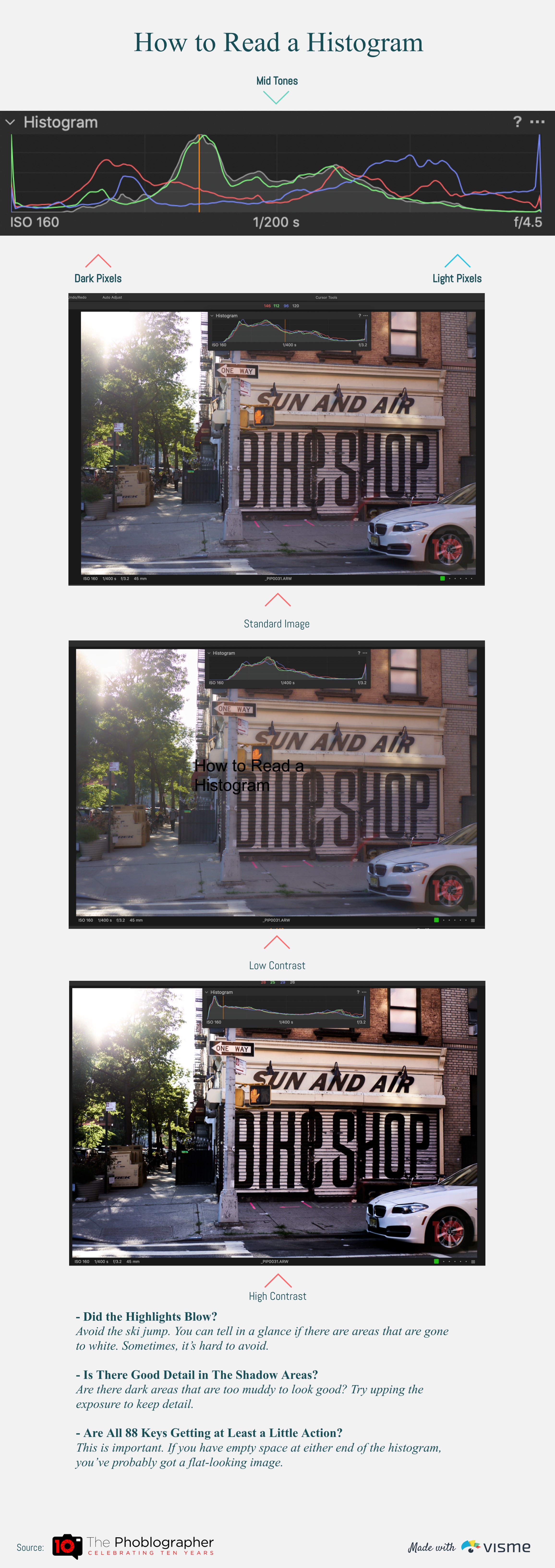
These days, lots of photographers don’t shoot photos according to the histogram. Instead, they look at the exposure preview and work off of that. But it’s good to know and understand what the histogram can do for you. In this post, we’re rounding up a bunch of tips that we’ve previously talked about in this one guide to the histogram.

This guide to the histogram is meant to help newer photographers more than anything. Over our 13 years as a site, we’ve done various articles on the histogram in different ways. There’s a lot to take in. And arguably, some of us don’t really need it anymore. I, for example, never shoot with it in mind. But that’s because of the way I shoot. I typically shoot like I’m shooting slide film. If you’re shooting photos with the intent of editing the photos later on in post-production, then you should consider the histogram.

This especially goes for folks who like high dynamic range images. Not all of us do. In fact, I really like seeing highlights completely blown out. I also believe that very deep black levels make the eye think that the image is sharper than it really is. So here are some tips on how to use the histogram where you can make your own decisions later on.

Consider also picking up a resource book about them too.

What is a Histogram

Here’s a quote from a previous article we did:

Histograms are charts that are designed to convey the information that an image currently has. They are created as the file is created from the camera and shift themselves accordingly as your image is edited. Photographers spending time in Lightroom or Photoshop changing the exposure level or color levels will see the Histogram shift in one direction or another.

What Does a Histogram Do?

Here’s a quote from a previous article we did:

As a review, the histogram shows how much of the scene you’re capturing will register as shadows, midtones, and highlights. The left side shows the shadow detail, the middle part shows the midtones, and the right side shows the highlights. So, the graph tells you what your overall exposure looks like. Keep in mind that different scenes will produce different histograms, so it’s important to check if the reading you’re getting is reflecting what you actually want to capture.

Reading a Histogram (And Our Own Guide to the Histogram)

Here’s a quote from an article we previously did. Also take a look at our guide to the histogram infographic we did above.

Histograms are graphs at their core. While their appearance can vary between different camera manufacturer’s user interfaces and raw editing software, they all typically look like some variation of a line graph. This means histograms basically follow the same conventions that go into creating line graphs. The X-axis (horizontal) is generally used to indicate the light value, going from dark to light pixels from left to right. The Y-axis (vertical) is used to indicate the amount of said light value that is present. Depending on your camera or software, the various lines within the histogram correspond to how much highlights, mid-tones, shadows, and color information are present within an image. Also, remember that although histograms are useful guides, you’re ultimately the creative behind the camera. Depending on how you want your final image to appear, you may sometimes want to intentionally over or underexpose it, resulting in a histogram that looks “wrong.”

The Basics of the Histogram

Here’s a quote from an article we did on this subject:

Good editing and histograms start with shooting them to begin with. The image that we’re working with and that you’ll see later will show you exactly what happens when images are edited accordingly.

Here’s the basics:

  • The left skews towards the shadows
  • The right skews towards the highlights
  • The middle is the balanced midtones.

Essentially what you want to get for a more uniform viewing experience is something that is very balanced all around. Of course, this also varies based on your own creative vision and whether you like the look of a super dark image or a super bright one. But keep all of this in mind as you edit.

Understand Contrast

Here’s a quote from an article we did on contrast and histograms.

Contrast quite literally talks about the difference between the brightest brights and the darkest darks. If the full gamut isn’t in there, then it’s a high-contrast image. Bring any photo into your favorite editing software and just play with the files. This tends to make things pop at the expense of details. But modern camera sensors and coatings tend to mitigate that. This can fool the eye into thinking it’s sharper than it really is. If you look closely at images from medium format lenses, you can see just how sharp they are. They’re doing this with the low contrast of film. But when you add it to an already sharp optic, the images look even sharper.

Histograms Are Based on JPEG Settings Not RAWs

Here’s a quote from an article where we state this:

Also, he reminds us that the histogram we see in-camera is based on the JPEG version, not the RAW file, which shows the most accurate reading. This is why it’s important to shoot in RAW because you wind up with a bigger latitude in post. Lastly, he tells us that different lenses will produce different histogram results of the same scene because each lens tends to let in light differently.

More than just beaches and sunshine: Photographer telling bigger Florida conservation story

More than just beaches and sunshine: Photographer telling bigger Florida conservation story

“People are going to protect what they love and they’re not going to love what they can’t see,” Carlton Ward, Jr. said.

TAMPA, Fla. — We’ve all heard the phrase a picture is worth a thousand words. But is it worth, say, a thousand acres? With his latest exhibit, a local conservation photographer is proving that it is. 

Carlton Ward, Jr. hopes to show the world that Florida is so much more than just beaches and sunshine. 

Ward spent the better part of his career as a National Geographic photographer using his photos to help preserve some of the most beautiful parts of our state. Most recently by telling the story of the path of the endangered Florida panther

“It’s an amazing comeback story,” Ward said. “There were fewer than 20 in the 1970s and 80s and then nearly 200 today, but without the conservation of the Florida wildlife corridor there’s no hope for recovery because we need to have 3 or 4 times as many panthers to have a genetically viable population.”

Ward was on assignment in 2006 when he began his mission to help create a wildlife corridor in Florida, by using pictures to tell the story of how our land is truly connected and why it needs to stay that way. 

“That’s the state park, the National Wildlife Refuge, the cattle ranch, the timber farm,” Ward explained as he showed pictures. “It’s that connected green space and the panther, there’s no better character to invite us into that story and to show us literally by their movements and their needs what we need to do to save wild Florida.”

And little by little the photos are working, helping to protect and preserve nearly 10 million acres of wild Florida. 

“People are going to protect what they love and they’re not going to love what they can’t see.” 

And it’s hard not to be inspired by these beautiful animals, that people rarely see in the wild. 

“She’s the hero of the story. She’s the hero of the Path of the Panther film and this real emblem of hope for the recovery of her species and the Florida wildlife corridor.”

In fact, just getting enough photos for this exhibit took years of hard work and special cameras set up in strategic places. 

“It’s a professional camera in a waterproof box with strobe lights and an infrared trigger where you set it up on a trail to help the panther walk through and take its own picture.”

Ward’s exhibit is more than just panthers, it’s the people, the places, and the projects all coming together to tell a much bigger story about the land that gives us life. 

“As a conservation photographer, I want to show the beauty and the hope and I want to show the reality and concern so we can understand the story and understand what steps we can take to make it better.”

You can see the Path of the Panther exhibit right now at the Florida Museum of Photographic Arts in Ybor City. There’s also a documentary film and a book featuring the story behind the pictures. 

[embedded content]

Joel Meyerowitz is the master of color photography

Joel Meyerowitz is the master of color photography

Over the past year, the internet seems to be obsessed with food culture, fueling a trend that is now evident even in the world of visual culture. From the Tomato Girl Summer, which many mock retrospectively, to the foodie fashion girlies, Balenciaga’s collaboration with Erewhon, and the massive success of The Bear. Food appears to be experiencing a rebirth, but in the worlds of art, photography, and design, it has always been present. Is this just a passing trend, or is it the glorification of an element that has always been part of our lives?

Un’illustrazione di Maisy Summer

From Tomato Girl Summer to the pomegranate

It was only in 2020, with lockdown recipes—does anyone remember Dalgona Coffe?—that so much talk about food emerged. On TikTok, @wishbonekitchen made us dream by showing us her life as a private chef in the Hamptons this summer. Unforgettable were her Heirloom Tomato Gallette and the garden where she harvested fruits, vegetables, and herbs. In 2023, it seems to have been the summer of food not only with the release of the second season of The Bear but also with Tomato Girl Summer. On the other hand, according to Danielle Cohen on The Cut, it now seems to be the time of the pomegranate.

Thanks to its shape and the vivid red that characterizes it, this fruit is widely recognized as a symbol of fertility in many parts of the world. But not only that, we find the pomegranate in mythology, art history, and, according to Cohen, even in the Torah. In short, fruits and vegetables seem to be largely protagonists of this rebirth, so we have collected some works and photographs by artists and photographers we have talked about in the past and more.

Browsing through our archives, we remembered Michael Crichton‘s photos and his photographic series, Conceptual Food, as well as Dan Bannino, who many years ago narrated the eating habits of the powerful. But there is also Stephanie Sarley, an artist who, with fruit fingering, challenged the way the art world has represented the female reproductive organ throughout its history.

Why it seems not to be just a passing trend

The success of food in visual culture can be attributed to its tangible communicative power. We see and experience the colors and textures of food daily, all evocative elements of memories that we have been collecting forever. In conclusion, we can only wonder which will be the next fruit to receive all this attention, already dedicated to tomatoes and pomegranates, even before avocados and bananas.

Become a slow shutter speed expert!

Become a slow shutter speed expert!

One of the greatest magic tricks in photography is long exposure photography, producing images that freeze a moment yet still capture movement and dynamism. 

However, even the best mirrorless camera technology cannot produce these images alone; the photographer must have the right knowledge, equipment and, hopefully, a trick or two up their sleeves. 

You can see any number of long exposure shots of familiar subjects on social media, and it can be difficult to think outside the box. So, I’ll show you how to detach yourself from familiar situations and take a unique approach that will enable your shots to stand out from the crowd. 

Get ready

Prepare for long exposure 

To maximize the quality of your long-exposure images, it is essential to know how to use your equipment like a pro. Modern camera technology is highly capable, but don’t rely on it alone – a camera is only the base, and there are many other things to consider. 

In this genre of photography, it can be disappointing to wait 30 seconds or more only to realize that you have set the technical parameters incorrectly. Exposure time, aperture, sharpness, image noise and composition are the key factors that will determine the quality of a long exposure shot. Slow shutter speeds are mainly used for outdoor shots, but be aware of the challenges as you cannot control the environment. 

Pack your kit

(Image credit: Future)

Wide-angle lens
Working with a wide-angle lens possessing a focal length of 35mm or wider is ideal for long-exposure landscape shots, as a greater expanse of the scene can be captured and more elements included in the composition.

Heavy-duty tripod
A carbon fiber tripod will prevent camera shake. You may also need to carry an extra weight, such as a sandbag, in your kitbag to ensure that the tripod remains stable even in strong winds. 

Remote release
Avoid jeopardizing the exposure with even slight movements of the camera. Use a remote control cable, shoot wirelessly via an app, or use the self-timer function of the camera.

Pro Tip: DSLRs

When using exposure times of 30 seconds or longer, do not leave the viewfinder of your DSLR open. Otherwise, even small light sources outside the composition will create unwanted effects. Most cameras already come with a viewfinder cover, or have an option to automatically close it. If not, use any other material to prevent extraneous light from entering.

Neutral Density Filter
Use ND filters with up to ten stops to take control of the lighting conditions. This enables you to increase the shutter speed even in bright light, without the risk of overexposure.

Polarizing Filter
If shooting directly against the sun, using polarizing filters will remove unwanted glare. The filter’s tint will improve the overall appearance of your subject in terms of contrast and saturation.

Black card
If your scene contains elements of different brightness, card can be used to cover certain parts of the lens while the photo is exposed.

Filter holder systems

Consider the types of filter holder systems

(Image credit: Future)

When integrating filters into your workflow, it is advisable to invest in square filter holders right from the start. They are more expensive, but offer better value for money and more advantages. Especially if you are working with different lenses, square filters are versatile and easy to mount without the risk of accidentally shifting the focus.

To avoid vignette effects, pay attention to your filter slots and remove any that aren’t necessary. If working with wider lenses and smaller filters, do not use step-down rings as these also lead to hard vignetting.

Control exposure

How to control exposure settings 

One of the major challenges that low-light photography presents is how to calculate the correct exposure time. There are plenty of apps and websites that can automatically calculate the time based on your aperture, ISO and any filters. 

Spot metering or experimentation are other options, but finding the appropriate exposure settings can take a while – especially when you try out exposures over minutes, and therefore have to wait a long time until the shot is recorded!

Pro Tip: Filters

The ND filter offers the possibility to extend the shutter speed and improve images in situations where only two stops more will make the difference. ND filters usually come with an exposure table that facilitates easy adjustment of exposure settings.

A simple way to save time is to work backwards, using shorter exposures and higher ISO settings first. After a few test shots, you may be able to determine the optimal settings – and now the ISO value can be minimized in a few steps. Decrease the ISO setting by a stop and simply double the exposure time; do this until the value is 500 or less.

By setting a minimum ISO value and a medium aperture of f/8, you enable a longer exposure time and create a decent depth of field. The shutter speed can vary greatly but, in general, you can say that at least five seconds is required in most situations. When it comes to capturing slow-moving clouds or car trails, that could be as much as 120 seconds. 

Use noise reduction 

(Image credit: Future)

Many cameras have a noise reduction feature for capturing long exposures in low light, where unwanted hot pixels are automatically removed from the final image. The camera automatically records another photo after the exposure, and will therefore need twice the exposure time.

Select Bulb and Time mode

(Image credit: Future)

Depending on your visual objectives, light sources and the time of day, you may want to extend the shutter speed beyond 30 seconds. To do this, switch to Bulb mode to take control of the time that the shutter stays open. Remember to work with a remote shutter release or via an app, as it is almost impossible to hold the shutter button down for that length of time without causing movement. 

Many high-end cameras have a Time mode, which offers a clear advantage over Bulb. Here you simply press the shutter button or remote release once and, when you want to finish the exposure, press it again.

Check results

(Image credit: Future)

Remember that the LCD screen can be misleading about the brightness of the results, especially if you are shooting in low light conditions. To make sure that exposures are correct, analyze the histogram. 

An ideal graph will show a fairly even distribution of tones; if the histogram shows much closer values on either the left or right side, some parts of the image may be severely overexposed or underexposed. That means the exposure time wasn’t ideal for the subject and should be adjusted.


You may be interested in the best cameras for landscape photography, along with the best lenses for landscapes