Photography

GALLERY: Piebald deer spotted in Gallatin

GALLERY: Piebald deer spotted in Gallatin

A Midstate photographer captured stunning photos of a piebald deer this week.

After weeks of searching for the animal, Harvey Photography snagged the images in Gallatin on Wednesday.

Piebald deer are some of the rarest of the white tail species, affecting less than 2% of their population. Piebaldism is genetic mutation that can manifest in various amounts of white. They are not to be confused with albino deer, which are totally void of pigment. Instead, piebald deer may have small patches of white, or may be almost pure white with small patches of normal brown hair.

Read the post from Harvey Photography below.

“I got a tip a few weeks ago about a Piebald deer here in Gallatin, TN. I have driven to and passed this spot with my camera several times over the past few weeks. Watching, learning, seeing which way they go at what time and where the sun is located.” -Harvey Photography

Today I went and took a few photos of my albino deer and on the way home I decided to try my luck and drive by and hope that my day kept getting better. I made a turn on an old country road and there in a field it was…. I parked in someone’s yard, sorry about that whoever you are, and took off on foot. I adjusted my camera….and fired off these shots….

I still can’t believe I found it!????

Submit your Tennessee wildlife content to us here.

Your pictures of Scotland: Photographs from around the country

Your pictures of Scotland: Photographs from around the country

Copyright 2023 BBC. All rights reserved.  The BBC is not responsible for the content of external sites. Read about our approach to external linking.

Beta Terms By using the Beta Site, you agree that such use is at your own risk and you know that the Beta Site may include known or unknown bugs or errors, that we have no obligation to make this Beta Site available with or without charge for any period of time, nor to make it available at all, and that nothing in these Beta Terms or your use of the Beta Site creates any employment relationship between you and us. The Beta Site is provided on an “as is” and “as available” basis and we make no warranty to you of any kind, express or implied.

In case of conflict between these Beta Terms and the BBC Terms of Use these Beta Terms shall prevail.

Photographer Juergen Teller on Why His Haters Are Wrong

Photographer Juergen Teller on Why His Haters Are Wrong

Dec. 8, 2023 8:00 am ET

Juergen Teller would like to set the record straight: He is not lazy.

Yes, it often takes mere seconds for the German-born photographer to capture an image of Iggy Pop clutching a tree, or his wife and business partner, Dovile Drizyte, posing nude against a cerulean sky. But, he says, just because he’s nimble with the shutter doesn’t mean his images aren’t considered.

Copyright ©2023 Dow Jones & Company, Inc. All Rights Reserved. 87990cbe856818d5eddac44c7b1cdeb8

Ingo Rasp Photographs a Project 26 Years in the Making at “Stuttgart 21”

Ingo Rasp Photographs a Project 26 Years in the Making at “Stuttgart 21”

Project of the Week

On today’s episode of Project of the Week, we’re taking a dive into the process of photographing a structure under construction — one that has been in the works for 26 years from its conception! We’re talking about Stuttgart 21 rail node. Construction on this mammoth project is winding down, and the rail node will be finished next year!

Architect-turned-photographer Ingo Rasp has submitted in this ultra-sculptural, even ethereal, beauty to us, along with a breakdown of what it’s like to photograph a project of this nature.

“The documentation of Stuttgart 21 was an initiative project of mine that I proposed and then shot for the client Deutsche Bahn. Hours after I published the images on the web & my social media, Ingenhoven Architects and leading engineer (Werner Sobeck) reached out to me and asked to license the images” Ingo explains – and it’s easy to see why. Ingo’s photographs of the space are sublime!

Ingo gives us some background on Stuttgart 21 and shares, “I grew up in the southern part of Germany 80 km east of Stuttgart and when the project – as a result of a competition – was announced in 1997. It was a big thing in the media.

At that time I was just about to finish my apprenticeship as a cabinetmaker and had no idea I would later study architecture and eventually – much later – become an architecture photographer.

Following the progress of the project with all its hurdles and delays over the past 26 years, it was nearing completion this year and was all over the media again.”

He goes on to say “Needless to say, I was captivated immediately when I saw the first images from the construction site on the internet and I reached out to the people in charge.”

Ingo documented this space with the perfect mixture of fine art meets architectural photography. His attention to the light and forms is wonderful. His carefully considered compositions showcase the curvature of the pillars and balance the perfect combination of a quiet, delicate ambiance, and the strong, epic structures.

“When I was entering the construction site and saw the 26 unique chalice-pillars in the 450 meter long underground hall my perception was definitely challenged,” Ingo says. “You see a structure that has never been built before in history as the technical possibilities/abilities were not ready. 

Most of us grew up in rectangular spaces, so my senses were overwhelmed by the amorphous forms and the effect they had on me. The space was characterized by floating lines and the interplay of natural light.”

He continues, “The concrete works were executed in such a precision and perfection that the surface felt smooth and soft, giving the light no point to cast hard shadows. I was impressed by the enormous dimensions of the (almost spiritual) space.

There was no reference or sense of scale and dimensions as there were no familiar objects I could relate to. Only the workers gave scale by their human size, making it tangible.”

I asked Ingo a bit about what it was like to be on-site and how he managed challenges, as well as his approach to photographing the unfinished space. He shared, “I had just half a day on the construction site and was accompanied by a security guard as the protocol required it… but I could have stayed several days searching for perspectives and the perfect angle.

My plan initially was to shoot the construction site in its pure form, where no other infrastructure elements like railways, additional floors, signposts, or barriers were installed. Just the pure form and shape of the concrete chalice pillars characterizing the space.

But as I was shooting, I understood the proportions and dimensions of the space over time. It was clear to me that I had to implement humans into the pictures to give the viewer a familiar reference of the enormous dimensions of the space and structures.”

Ingo’s inclusion of the construction workers and their machinery helps us understand the massive scale at hand

“When documenting construction sites, I’m fascinated by showing the process of transformation, from dirt to polished surfaces in the end — especially when you have the chance to visit construction sites several times over the building process and see how things grow/evolve,” he explains.

“Also, the work itself, when raw concrete is poured into the mold which is laying the foundation for the spaces we later feel comfortable in.

Sometimes structures are missing a reference we can relate to as specific elements are not installed yet, so I’m trying to add familiar objects (e.g. humans) to make it more tangible – or leave it to make it even more abstract.

For me there is definitely a strong aesthetic component of unfinished elements, being a vital part of the overall concept in the end. 

For finding the right subject or perspective time is key, I keep searching till my aesthetic eye finds peace.”

I was curious as to which image from this series was Ingo’s favorite, and what he felt made it stand out to him. He said, “My favorite image is definitely [the one below] as it shows just the pure form and the very precise floating lines of the chalice-pillar.”

A gigantic thanks to Ingo for submitting this very cool project to us! The forms, the light, and his compositions are so lovely!

Head over to ingorasp.com to see more of Ingo’s beautiful work! You can also give him a follow on Instagram @ingo_rasp.

If you have a project you’d like to be considered for Project of the Week, you can submit it here.

Seeing It All: Women Photographers Reveal Our World in New Book

Seeing It All: Women Photographers Reveal Our World in New Book

‘Seeing It All,’ a new book from the California Academy of Sciences, showcases breathtaking images of beauty and of peril

A giant panda appears to play peekaboo, confiscated skins and taxidermied skulls of big cats line repository shelves, stately marine iguanas sun themselves on rocks in the Galapagos Islands and icebergs set adrift from Arctic glaciers are among the images in “Seeing It All: Women Photographers Expose our Planet,” a new book co-published by the California Academy of Sciences, located in San Francisco’s Golden Gate Park.

An underwater photo of a person snorkeling with fish. Next Avenue, Seeing It All: Women Photographers Expose Our Planet

Credit: Photo © Cristina Mittermeier from Seeing It All: Women Photographers Expose Our Planet

“Saving nature is saving ourselves” is a stated theme of the book, and the 125 images reveal moments of profound beauty and also of peril; of a lot of life and yes, some death. “Every image is a freeze-frame of how we are living together with animals and amidst the natural world in these precarious times,” said Rhonda Rubinstein, creative director at the Academy and curator of the book.

“Saving nature is saving ourselves.”

“Some images show the best of us, people working to help bring animals back into the wild, and some show the worst, examples of how we are turning animals into consumer products,” Rubinstein continued. “As a collection of images and words, the book becomes a more powerful thing of beauty and realization.” Each photographer also offered personal manifestos of sorts, sharing their visions for the roles nature photography plays.

The photographers featured in the book are Tui De Roy, Suzi Eszterhas, Daisy Gilardini, Jen Guyton, Morgan Heim, Esther Horvath, Britta Jaschinski, Jo-Anne McArthur, Cristina Mittermeier, Camille Seaman and Ami Vitale. Oceanographer and explorer Sylvia Earle, who called the book “hauntingly beautiful,” wrote the foreword. Writer and activist Rebecca Solnit and neuroscientist and science communicator Indre Viskontas penned introductory essays.

Two cheetahs playing with each other. Next Avenue, Seeing It All: Women Photographers Expose Our Planet

Credit: Photo © Suzi Eszterhas from Seeing It All: Women Photographers Expose Our Planet

The photos, each well worth lingering over, were made from the Arctic to Antarctica, at the National Wildlife Property Repository in Colorado, in African and Chinese wildlife sanctuaries and on land as well as above and below the sea. A Weddell seal yawns in one photo. In another, a male lion meets his cub. Other baby animals featured include koalas, elephants and a cheetah perched atop its mother’s head. People are pictured in the book as well, among them divers exploring watery worlds, workers tending to animals in their care and Indigenous individuals honoring the land.

‘We See Our Subjects as Fellow Travelers’

Images of giant tortoises, hammerhead sharks and blue-footed boobies in “Seeing It All” are the work of photographer and writer Tui De Roy, 69, who has documented the wildlife in the Galapagos Islands for more than 50 years. “I try to portray the world not through our eyes, but through the animals’ lives, from their perspective,” said De Roy. “I want to show them being themselves.”

A photographer with penguins. Next Avenue, Seeing It All: Women Photographers Expose Our Planet
Tui De Roy  |  Credit: Photo © Seeing It All: Women Photographers Expose Our Planet

She grew up in the Galapagos, after moving from Belgium at the age of 2 with her parents. (Read more about that extraordinary experience in “A Lifetime in the Galapagos,” one of 20 books she has written.) Currently, de Roy lives and works part of the time in the islands and part of the time in New Zealand.

Nature photography requires patience, and De Roy emphasized that she is happiest when alone in the field. “All my life I’ve been trying to photograph the timelessness of nature,” she said. “We live in a 1,000-miles-per-hour world, but time is golden in terms of getting a good photo, because in nature, things happen the way they always have and should — and not interrupted by our speedy lifestyles.”

A bird with blue colored feet flying. Next Avenue, Seeing It All: Women Photographers Expose Our Planet

Credit: Photo © Tui De Roy from Seeing It All: Women Photographers Expose Our Planet

De Roy said she is pleased to be included in a book showcasing women photographers. “I was brought up to be a human being, not to act according to my gender, but I’ve allowed myself to be convinced that women do portray subjects in the natural world in a different, more sensitive manner,” she said. “Photographs by women who connect with nature, who serve as messengers for nature, have a different flavor, because we see our subjects as fellow travelers on this planet.”

In the book, De Roy predicts that nature, not humans, will have the last word. “Nature has been diminished by humans in some areas of the globe, but no matter where we look, nature is still there,” she wrote. “In the end, only nature will endure. Nature quietly gets on with being, with adjusting, with remaining beautiful. I think that’s worth celebrating.”

Advertisement

‘A Visual Invitation to Take Action’

Ami Vitale, a former news photographer who lives in Montana, has covered armed conflicts, famines and natural disasters in Afghanistan, Kosovo, Kashmir and beyond. In recent years, she has traveled to more than 100 countries on a mission “to amplify the voices of unsung heroes on the conservation frontline … people all over the world who are taking a stand to protect wild places and the amazing species that live there.”

A photographer wading in a swamp. Next Avenue, Seeing It All: Women Photographers Expose Our Planet
Ami Vitale  |  Credit: Photo © Seeing It All: Women Photographers Expose Our Planet

To do that, Vitale has photographed many individuals who are taking action to help save nature, and by extension, save ourselves. “Everywhere I go, I see people, often with very little, making huge impacts in their communities and for the planet …and I think it’s important to shed some light on these stories,” she said. “And I like to ask if the people in these stories could do so much with just hope, resilience and imagination, what might we all accomplish together?”

Asked whether she agrees with curator Rubinstein’s description of the book as “a time capsule,” Vitale replied, “I think there is some truth to this. We’ve wiped out 50% of the Earth’s wildlife in the last 40 years. It doesn’t take complicated math to figure out if we don’t act now, there will be little left. It’s not only a time capsule; these images are an unfiltered connection to the natural world and they can stir emotions, foster empathy and cut through the noise of misinformation. This book holds cautionary tales of human impact and is a visual invitation to take action.”

Nature Photography Competition Also Triggers Caring

A focus on the value of nature photography is not new at the California Academy of Sciences. Along with Suzi Eszterhas, who is among the photographers featured in “Seeing It All,” creative director Rubinstein founded “BigPicture Natural World Photography,” an annual international competition and exhibition.

Since its inception in 2014, the competition has received roughly 64,000 submissions and awarded $120,000 in prizes for more than 80 winning images. Categories include Terrestrial Wildlife, Winged Life, Landscapes, Waterscapes and Flora, Aquatic Life, Art of Nature and Human/Nature. Through the years, all the photographers featured in “Seeing It All” have been either winners or jurors.

“Photographers can change how we see the natural world because they present a whole new perspective.”

Each year, the winning images are first published in “bioGraphic,” the Academy’s independent online magazine and the official media sponsor for the photo competition. This year’s 49 winning photographs, now on display at the Academy, were selected from more than 7,300 submissions from photographers in 58 countries.

“Photographers can change how we see the natural world because they present a whole new perspective,” Rubinstein said. “Paying attention — looking at images in the exhibit or in the new book — is a trigger for caring, and for the urgency of action to protect the essential diversity of life upon which we depend.”

Photograph of Patricia Corrigan
Patricia Corrigan is a professional journalist, with decades of experience as a reporter and columnist at a metropolitan daily newspaper, and also a book author. She has written for Next Avenue since February 2015. Read more from Patricia at latetothehaight.blogspot.com. Read More

Dope Francis, Disaster Photography and Generative Artificial Intelligence

Dope Francis, Disaster Photography and Generative Artificial Intelligence

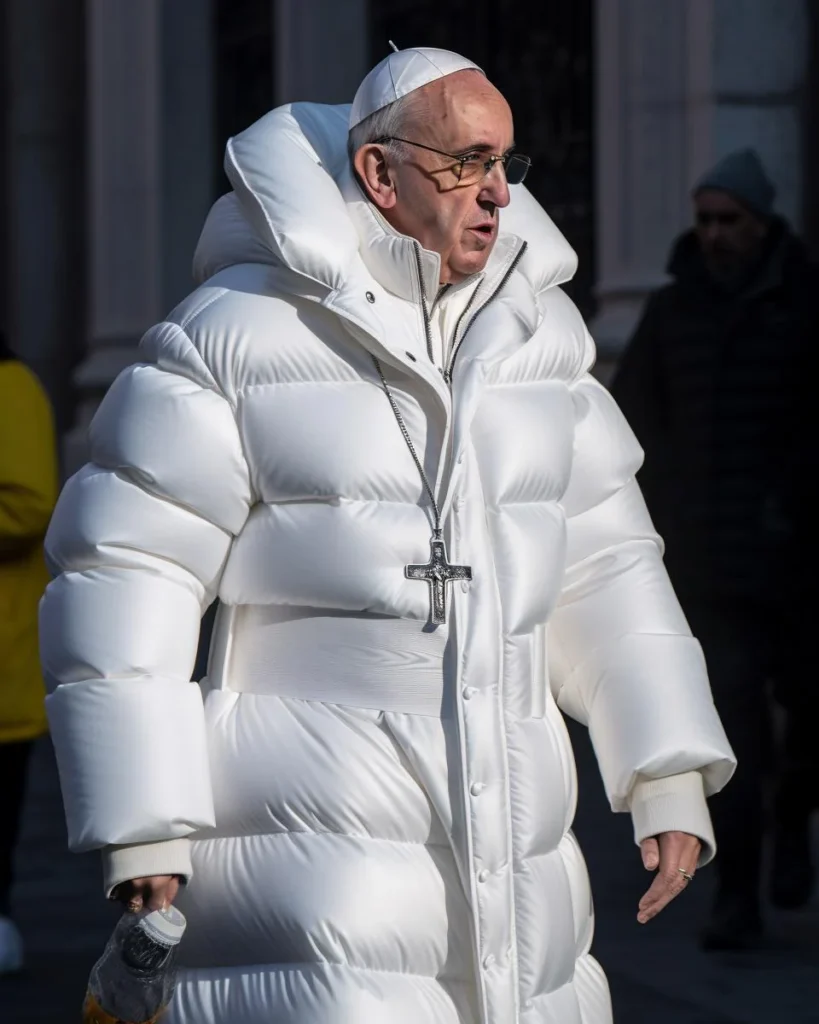
Earlier this year, Pope Francis caused a global stir as images of him “swagged out” in a knee-length silken whiten designer puffer jacket circulated wildly on social media. The image sparked humorous commentary about the pontiff’s new cool, chic look. The problem with the viral image, though, was that it was fake – dreamed up by a 31-year-old construction worker from Chicago (@skyferrori) and executed through Midjourney, a generative artificial intelligence (GAI) programme that can create images based on text descriptions provided by users. 

Web culture expert, Ryan Broderick, described this viral event as perhaps the first “mass-level AI misinformation case” but it certainly isn’t the only. Since then there have been more AI images associated with news stories, such as the arrest of Donald Trump and of Emmanuel Macron running from a protest. These images, while photorealistic, portray questionable scenarios and are, therefore, quickly called out as fake. More recently, however, Australian media outlet Crikey reported the use of GAI images in news stories about the ongoing Israeli military assault on Gaza. These images, created by independent content creators, were available for purchase via the U.S. software company, Adobe’s, stock images platform. Crikey noted that although most of these images had been marked as “generated by AI” on Adobe Stock, news stories that used these images didn’t indicate the same. 

Following up on the story, The Washington Post also reported the existence of fifteen thousand fake images associated with “Ukraine war”, hundreds of AI images of Black Lives Matter (BLM) protests that never really happened, and dozens of similar images of the Maui wildfires. While the incident of the “Dope Francis” is relatively harmless and the source of much amusement, the circulation of GAI images of a news event is far more dangerous. 

For GAI programmes – like Midjourney or Adobe’s Firefly – to produce “new” images, they must first be trained on existing images and language models so that they can associate visual data with specific textual data. So, when a user inputs, for example, “Maui wildfire”, the GAI programme synthesises information it has been “taught” (that is, has been fed into it) from masses of already existing images tagged as “Maui” (or, more broadly perhaps, Hawai’i, Pacific islands, etc..) and “wildfires” to produce new visuals. GAI images are thus regurgitations – new arrangements of an old form. 

The danger of GAI images, of course, is that they can be used to misrepresent events – like the image of Macron running from a crowd or the “fake” BLM protest. The former instance constitutes a clear case of misinformation – representing something that never happened. In the case of the latter, one might argue that, given several BLM marches have in fact occurred, the AI image is not necessarily misinformation but merely a simulation. But such simulations, too, are dangerous because they project a dominant, often one dimensional, version of a story. Images of one conflict become interchangeable with another – GAI images of both, Gaza and Ukraine, show, for example, children running from bombs, cityscapes blown to rubble – images that are, in turn, reminiscent of scenes from Afghanistan or Vietnam. The children and landscapes might differ but the overall nature of the scene remains the same. 

Images of conflict, or disaster photography, in general, have tended to focus on visuals of devastation and abjection in order to create a sense of shock or empathy within the public eye. But, as some critics have argued, these images can be dehumanising – fixing victims and survivors of calamities as broken and in need of rescue. This is of significant concern for people of colour and people in the global south who are, by and large, already imagined to be “disempowered” or “damaged”, constantly mired in violence and catastrophe. Since GAI programmes are trained on already existing images that portray this sense of brokenness and terror, they continue to spit out more of the same stereotypes.

It is worth noting that the rationale underlying the design and operation of GAI programmes is ease, efficiency and profitability (see for example recent debates on the use of GAI in Hollywood). Media outlets benefit from GAI as it reduces the cost of photojournalism while also keeping photojournalists safe from the threat of violence. Similarly, creators of GAI images are interested in monetising the prowess of new technology. On the one hand, GAI creators benefit from the work of photojournalists, the formers’ creations being a simulation of the latters’. On the other, the work of photojournalists is not merely to document events for entertainment or profit. Good journalistic work follows, ideally, from ethical and moral deliberations of what this work means and the responsibilities in undertaking it. GAI creators remain unencumbered by such considerations. 

Contrary to popular visualisations of war, professional and amateur photojournalists in Gaza, for example, have been disseminating images of life and livingness amidst the ongoing violence – break dance classes, people playing with children, people with their cats or playing in the rain. This is an equally poignant reality of living through war, one that chooses to recall life instead of death. These images remind of the complexity of life – what persists and what is truly at stake – rather than repeating what we already know, through news and entertainment, of what war supposedly looks like. 

The challenge posed by GAI, then, is not only about the threat of misinformation or the loss of jobs, as it is commonly understood to be. Rather, the displacement of human labour by AI dissolves the possibility of a compassionate and complex relationship between journalists and their subjects, and by extension, the audience. The basest form of photojournalism treats its subjects as spectacle – objects of fancy to be consumed by viewers – and GAI images risk repeating this cruelty. While AI will have a continuing role in journalism, it is important that its use does not degrade the ethical responsibilities of the profession, and further erode the dignity and agency of those facing catastrophe. This necessitates that we develop a new understanding of the role of AI in society. It demands a shift in the principles that guide the development and design of AI – so that this is driven by the need to facilitate ethical practice rather than by motives of efficiency and profit that ultimately simulate or circumvent moral deliberations. 

One of the best to ever do it – former WWL-TV photographer in Saints Hall of Fame

One of the best to ever do it – former WWL-TV photographer in Saints Hall of Fame

Bob Parkinson has been selected for the honor of the Joe Gemelli Award, given to a non-player who had a large impact on the organization.

NEW ORLEANS — One of the best photographers to ever ply their trade on the sideline of the New Orleans Saints will be inducted into the team’s Hall of Fame Friday. 

Bob “Parky” Parkinson patrolled the sidelines, almost without fail for nearly 15 years, covering the team at training camps in Hammond, Wisconsin and Mississippi along with Metairie, Louisiana. 

He rarely took vacation or a week off during the football and he suffered through several losing and trying ones, especially during the latter Mora years and all of the Ditka years.  

Television videography has changed over time but when Parky was stalking the sidelines, the cameras were much heavier and they came with a 30-pound weight (recording pack) tethered around your shoulder to boot. Bob’s shoulders ached after each game, some of which came less than 15 hours after doing a similar routine for LSU or Tulane, those of which sometimes also came less than 24 hours after toting the pack for prep football. 

See, some weekends included treks to Baton Rouge for nearly four hours of holding the camera/recorder combo in Baton Rouge, a return home after midnight and a wakeup call to be at the Superdome by 10:30 a.m. for another four hours. 

Those chronicling the games for their stations rarely had a chance to put down the gear, spending the pre-game getting isolation shots, spending between plays and timeouts shooting “color” shots of fans in the stands, cheerleaders and shots of coaches and players. Halftime provided the rare respite, but it didn’t last nearly long enough. 

Just doing that job took fortitude. Doing it so well took talent and a proper temperament. You see, after that college football/Saints combo toting the heavy weight, Bob would come back to the station, log his tapes and then begin the process of editing the Fourth Down on Four opus’ of first Chris Myers and then Mike Hoss, often times Jim Henderson as well. 

image

Bob had the luxury of working with some of the best and they also knew they were afforded that same luxury. You could put a story in Bob’s hands and know that it would come out not only as you envisioned it, but even better.  

It would be spiced with reaction shots you didn’t even know had existed with exquisite timing. I’ve said it often, I would give Parky a C+ or B- script at best. What would make the air would be an A grade.  

The old Mary Tyler Moore show jingle said she could take “a nothing date and suddenly make it all seem worthwhile.” Parky could take an ordinary script and make it an extraordinary story. 

He would put up with all of my wild ideas. “Hey, let’s have our high school intern talk like Sarah Connor and do a Terminator-themed intro for the Jim Mora Show.” I have no idea what Parky was thinking when I suggested that, but someone who had never done a TV story voiced it and Coach Mora loved it.  

Parky liked to stay in the background, but he was sports’ secret weapon. When he was named to succeed our when our very talented sports photographer left for another gig, Jimmie Brown, one of TVs seasoned photographers said to me, “I don’t understand why he’s doing sports, but, I guess if you all are only going to have one photog, you probably should have one of the best.” 

Sports Anchor Marc Soicher had worked with Parkinson some prior to him taking over full time in sports. I lamented the loss of our previous photog. Soicher told me “Parky is even better.” 

With the intensity of football season, Parky had to let the air out somehow. He had a ritual of “saluting,” primarily other photogs, but also some staff members, with an NSFW salute. They would return the favor, with the person wielding the sword first as “the winner.” 

Speaking of NSFW, there was the memorable JGFO list he created, and, let’s just leave it at that. IYKYK.  

The job description probably makes people think Bob had a singular focus. He did, but it wasn’t shooting sports. That was secondary. His primary focus was his family – his beautiful and brilliant wife Erin and his sons Blake and Adam. When Bob wasn’t creating video sports art, he was devoted to his family. He may not have missed a training camp or game but he also rarely missed a family landmark moment.  

image

He and Erin married very young but theirs was a match made in heaven. In fact, it’s likely that theirs was the prototype for “here’s what real love is” now go see if you can replicate it. Good luck. 

Bob is and was extraordinarily proud of his family. He bragged on Erin as she worked all day at raising her two sons and all night at studying to become a lawyer. He beamed talking of her rise in a profession even tougher than his own. 

I remember him telling the story of her interviewing for a job with a prestigious law firm and being asked to describe her life prior to graduating law school. She told them about having two young sons and helping get them ready for school, meeting their teachers and volunteering in class and then going to law school at night. Their reply was “wait, you have two young children, raise them during the day while your husband is at work and you finished second in your entire class?” 

Or the time their two young sons raced into their mom’s arms at a graduation ceremony, so proud of her.  Or the time she received a rare honor from the U.S. Supreme Court.  

Earlier this year Bob suffered his biggest loss as Erin was taken from him by a long term illness. He had been by her side for the entire struggle. The funeral was packed in tribute to two extraordinary people and Bob, ever the “behind the scenes” figure, wrote the most moving tribute that had those in attendance simultaneously laughing, smiling and wiping away tears. 

Bob didn’t deliver it himself, not just because he is not used to the spotlight, but because he didn’t think he could make it through it. 

His light shines and her light shines on through him and to his children and grandchildren. As he is honored by the New Orleans Saints today, those who know him and his work know it is richly deserved. 

Bob underplayed his own talent as modesty was his middle name. But an oft-quoted line from former Saints coach Bum Phillips about Earl Campbell and slightly changed, fits him to a tee.  

As a sports photographer, as a colleague, as a human being, Bob may not be in a class by himself, but it doesn’t take long to call the roll.  

Through the Lens of Resilience: Indigenous children in Colombia photograph the climate crisis | Save the Children International

Through the Lens of Resilience: Indigenous children in Colombia photograph the climate crisis | Save the Children International

Photo by Roberto/Save the Children. Roberto took part in the participatory photo project. 


IMAGES HERE:  

www.contenthubsavethechildren.org/Package/2O4C2SZMCG_F

VIDEO OF WORKSHOPS: 

www.contenthubsavethechildren.org/Package/2O4C2S3E2CRH


ARTWORKS: 

www.contenthubsavethechildren.org/Package/2O4C2S3LLBBH 


BOGOTA, Friday 8 December – Children from the Wayuu indigenous group in Colombia have documented how the climate crisis is drying up their land, putting food, water and a healthy life further out of reach, in a series of photographs released by Save the Children to mark Children and Youth Day at COP28.

Sony Award winning photographer Angela Ponce delivered a workshop for the children in La Guajira, Colombia, teaching them the fundamentals of photography and providing them with their own film camera for a week to capture their environment, cultural traditions, and daily life. Each child also kept a notebook to document why they have taken their images, making this a truly unique participatory project. 

As part of the project, the children also learned to develop their own images relying only on the power of the sun, through the process of “Cyanotype” printing, to symbolise the environmental challenges they face. Each artwork has a distinctive blue hue illustrating the desperate need for water in their community, and the indigenous plants that are vital for their survival.     

For centuries, the Wayuu people have lived off the land, but the climate crisis has seen a series of crippling droughts, erratic rainfall, and soaring temperatures meet with high levels of pollution to devastate the environment in their home of La Guajira.

The current El Nino weather pattern is also projected to bring reduced rainfall to the area.

Iveth,16, who took part in the project, said:

 “Before we had orchards, it rained,the plants grew. We didn´t water the plants, the rain did.Now there´s no rain, the weather has changedso we can´t sow. The plant´sleaves dry out due to the temperature and die….” 

“Here, the Wayuu suffers from the lack of water. It can´t be found, as the weather is changing there aren’t seasons anymore.” 

“I liked when we started to take photos, we learned how to use the camera and how to take the pictures…. I´m taking pictures of where the animals eat and drink water… I would like to take photos of issues like climate change, everything regarding the drought.” 

After years of drought, water levels have hit historic lows, and only 3.3% of Wayuu communities have access to clean water[i]. The water that is available is often taken from a “jaguey”, a natural aquifer in the form of a pond which collects rainwater and is shared with livestock. This results in regular occurrences of diarrhoea and other waterborne diseases among children who are forced to drink the water.  

Hunger is also looming, with communities struggling to sow crops because of the drought. The mortality rate for malnutrition in children under five years is 7.8 more than the national average[ii]. La Guajira is also the poorest region in the country, where over 60% of the population live in poverty. La Guajira is also the fourth poorest region in the country, where 58% of the population live in poverty.

Due to climate change, things are set to get worse as temperatures rise. Earlier this year, the Colombian government declaring an economic and social emergency in La Guajira[iii].

Ismael, 14 said: “It hasn´t rained for a long time, and I think that we need the water and the animals do too. We drink the water from the cattle pond.”  

In his photo he took of the sun, he said; “I took a picture of the sun because it was too hot and that is harmful for the trees, and it makes us thirsty. The heat makes us thirsty, and the cattle pond is far away, as I told you, sometimes it’s empty and we need something to drink

Sony Award winning photographer Angela Ponce, whose work focuses on the impact of the climate crisis on indigenous groups said: 

“The climate crisis hits the most vulnerable the hardest, and it’s heartbreaking to see children bearing the brunt of a problem they didn’t create. Handing the Wayuu children their own cameras gives them a voice to show the world the challenges they face. Their photos tell a powerful story of strength and resilience, highlighting the urgent need for all of us to protect our planet and support those most affected”. 

Felipe Cortes, Head of Advocacy and Communications at Save the Children in Colombia said:

Wayuu people have relied on their land to grow crops for many generations – but for years, they have struggled due to increasing drought, erratic rainfall and extremely high temperatures. Just one in ten Wayuu children has access to clean drinking water. In La Guajira, the official death rate for children from malnutrition is six times that of the national average.

“The climate crisis, caused by adults, is putting nutritious food further and further out of reach – and harming children first and worst. Wayuu children, like others across the world, will be affected by decisions made at COP28 – and their rights and needs must be at the forefront of these decisions.”

The children involved in the project are all part of a Save the Children programme with the Wayuu community, supporting them to address issues around climate change, deforestation and waste management. This programme is community-led and encourages intergenerational dialogue to help the Wayuu people preserve their traditional way of life while building resilience to the impacts of climate change.

In Colombia and across the world, Save the Children supports children to get their voices heard on issues like climate change.  At COP28, the child rights organisation is calling on governments and all relevant organisations to recognise children as key agents of change in the climate crisis, and to ensure children have platforms to say what they want on climate policy, financing and more.

Save the Children is also calling for progress towards an ambitious new goal on climate finance that moves far beyond the pledge to mobilise at least $100bn annually  with a particular focus on reaching children impacted by inequality and discrimination, such as Wayuu children.

The child rights organisation also called for ambitious and urgent action now to limit warming to a maximum of 1.5°C above pre-industrial levels.  Failing to do this will have dramatic consequences for children’s health, safety, and wellbeing.

For more information and media inquiries, please contact:


Emily Wight, Emily.Wight@savethechildren.org

Daphnee Cook, Daphnee.Cook@savethechildren.org

Simon Edmunds at s.edmunds@savethechildren.org.uk or +447515855180. 


Our media out of hours (BST) contact is media@savethechildren.org.uk / +44(0)7831 650409

Please also check our Twitter account @Save_GlobalNews for news alerts, quotes, statements and location Vlogs.


IMAGES HERE:  

www.contenthubsavethechildren.org/Package/2O4C2SZMCG_F

VIDEO OF WORKSHOPS: 

www.contenthubsavethechildren.org/Package/2O4C2S3E2CRH


ARTWORKS: 

www.contenthubsavethechildren.org/Package/2O4C2S3LLBBH 


[i] Constitutional Court Sentence T-302 2017 p.51.

[ii] OCHA, August 2023

Photographer Sanjay Das’ Red Hibiscus Trail Exhibition Blooms In Delhi

Photographer Sanjay Das’ Red Hibiscus Trail Exhibition Blooms In Delhi

Beauty Of Bengal: Photographer Sanjay Das' Red Hibiscus Trail Exhibition Blooms In Delhi

Photo Courtesy: Sanjay Das

The beauty of Bengal has long inspired artists, and photographer Sanjay Das is no different. The Red Hibiscus Trail, presented by Gallery Ragini and curated by Ina Puri, is one such visual odyssey that captures the many charms of Bengal — be it the heritage, culture and rituals or the state’s festivals, architecture, and arts. The solo exhibition–on display in the national capital till January 10, 2024 — features Das’ artworks captured over a decade-long trail of Bengal’s unexplored regions.

The Red Hibiscus Trail

The Red Hibiscus Trail
Photo Courtesy: Sanjay Das

Speaking about the artworks to Travel+Leisure India & South Asia, Das says, “[I wanted to] capture Bengal’s glorious past and [the] components of our plush ethnicity that […] may cease to exist in the years to come. That is when these archives [might] help ameliorate the memories of those generations who may never get to see these lost stories again and aid in presenting images for the generations to come that may never experience them in person.”

Photo Courtesy: Sanjay Das

A ‘prabashi’ Bengali who grew up in Delhi, Das’ The Red Hibiscus Trail follows his journey through the interiors of villages documenting the lives of the ordinary craftsmen who lived in the area. His journey down nostalgia lane took the College of Art graduate through heritage sites of Purulia, Murshidabad, Medinipur, Birbhum, Howrah, Hooghly, 24 Parganas and Kolkata. As he revisits the landscapes of Bengal, Das doesn’t merely document; he delves into the interiors, uncovering untold stories and weaving a narrative that transcends the familiar. Through the monotone black and white photographs, viewers can hear the beats of mridangam musicians, marvel at the artistry of shankha jewellers and watch kantha weavers craft many tales. The trail also leads him to half-submerged terracotta temples and mosques, revealing hidden gems that transcend time.

Das reveals, “My love for Bengali culture and traditions was part of my growing up years in Delhi. Acquaintances with the folklore of Bengal came my way through legends and stories narrated to me by the elders in the home. These cultural snippets trickled down to me in my childhood, and subconsciously stayed with me.” 

An Ode to Bengal

Gallery Ragini
Photo Courtesy: Sanjay Das

Ina Puri, the curator of the series, reflects on Das’ unique approach to photography. Traditionally a medium dependent on light, Puri notes that the photographer seamlessly incorporates darkness into his compositions, adding depth and dimension. His childhood exposure to folk theatre, she says, lends a cinematic edge to his work, evident in the vivid portrayal of charak players and the authentic re-enactment of life. The name of the series, too, takes inspiration from quintessentially Bengali traditions. 

“When it came to selecting a title for this fabulous show that spanned over 12 years of the photographer’s life, I felt we had to have a name that symbolically reflected on his many journeys to Bengal,” reveals Puri while speaking exclusively to Travel+Leisure India & South Asia. She adds, “The red hibiscus associated with worshipping the Goddess Kali is also a flower that grows in profusion in the villages and hamlets of Bengal. Since Sanjay was documenting the monuments, mandirs and masjids across the hinterlands, he might have seen these vibrant flowers–known in Bengal as jaba phool–everywhere he went. And therefore, the title The Red Hibiscus Trail.

Exhibition Overview

Dates: Till January 10, 2024
Venue: Gallery Ragini, Ambassador Hotel, Near Khan Market, New Delhi

Related: Exploring Santiniketan In West Bengal, The Land Of Tagore

Written By

Bayar Jain

Bayar Jain

Senior Content Manager

Equipped with a degree in Sociology (Honours) from the University of Delhi and a postgraduate diploma in English Journalism and Mass Communication from Xavier Institute of Communications, Mumbai, Bayar enjoys sharing stories of people, places, and different cultures. When not typing her travel tales, you can catch the hobbyist photographer capturing ..Read More