Photography

The Comedy Wildlife Photo Winners Are Here–And They’re Absolutely Adorable i

The Comedy Wildlife Photo Winners Are Here–And They’re Absolutely Adorable i
The Comedy Wildlife Photography Awards 2023 / ©Jason Moore

The funniest photography competition in the world announced their winners and the grand prize winner was a kangaroo playing air guitar.

Up against 5,300 entries from 85 countries, Jason Moore from Australia with his ‘Air Guitar Roo’ prevailed in the closest voting ever.

Taken in the outer suburbs of Perth, Jason visited a yellow field of wildflowers where a “mob” of adult kangaroos and joeys were playing and feeding—and apparently listening to music.

“When I saw this Roo striking the air guitar pose, it immediately brought a smile to my face, and I knew that I had captured something really special. “

As the Comedy Wildlife Photographer of the Year champion, Jason won a safari in the Masai Mara, Kenya, and other prizes.

The competition was founded in 2015 by Paul Joynson-Hicks and Tom Sullam, both professional photographers and conservationists to create a fun and free-to-enter photography competition unlike any other.

The Comedy Wildlife Photography Awards 2023 / ©Jacek Stankiewicz

6 Category Winners included the Junior Category, won by 16-year-old Jacek Stankiewicz with his image of two greenfinches in Poland called ‘Dispute’, which also took home this year’s People’s Choice Award.

“I caught this scene in the Bialowieza Forest while watching birds that looked like they were having argument,” said the young Polish man. “My friends interpret this scene, (saying) ‘One kid is reporting to the parent that its brother did something wrong.”

White grouse – The Comedy Wildlife Photography Awards 2023 / ©Jacques Poulard

There were also 10 Highly Commended Winners, including the entry above from France called Snowball. “Taken in Spitzberg during a very cold winter, the white grouse is coming to me and looked like a snowball with eyes,” recalled Jacques Poulard.

‘The Rainforest Dandy’ was taken in a monkey forest in Ubud, Bali by Delphine Casimir.

The Comedy Wildlife Photography Awards 2023 / ©Delphine Casimir

“This place is a crazy place where monkeys are king! sometimes they give a show, sometimes, they climb on you to look for fleas or steal the piece of biscuit you are trying to eat,” she said. “Their kingdom has three hindu temples. Maybe our dandy is the reicarnation of a divinity?”

The Comedy Wildlife Photography Awards 2023 / ©Tzahi finkelstein

‘The Happy Turtle Dragonfly’ was shot in the Jezreel Valley in Israel by Tzahi Finkelstein who mused, “The swamp turtle is surprised and smiles at the dragonfly resting on its nose.”

Comedy Wildlife Winners 2023 / ©Lara Mathews

Taken at Westerfolds Park—a surprisingly wild pocket of land in the eastern suburbs of Melbourne, Australia—a mob of kangaroo was enjoying some morning sunshine when this joey decided to get silly and try his hand at boxing.

Gannet family along the North Sea in the UK – Comedy Wildlife Photography Awards 2023 / ©Zoe Ashdown

And finally, this gannet family was a touching winner from the UK. Each year between March and October, around half a million seabirds use the Bempton chalk cliffs towering above the North Sea to nest and raise a family.

Gannets mate for life and they return to the same nest year after year to raise their young. Zoe Ashdown described how she got the winning shot:

COMEDY WINNERS FROM 2022The Funniest Wildlife Photos of 2022 Win Big Laughs in Comedy Wildlife Photography Awards

“Lying safely at the top of the cliff face I was able to observe the affection shown between the gannets each time one returned to the nest.

“They have a greeting ritual: they rub beaks and entwine their necks; it’s how they strengthen their bond. But it’s also a brilliant opportunity to catch them in various poses.

CHECK OUT THE 2021 WINNERS: From Cheeky Bears to Goofy Gophers, See the Fun Finalists of the Comedy Wildlife Photo Awards

“As soon as I saw (this capture) I laughed out loud! They look like proud parents, posing with their baby – definitely one for the family album!”

SEND A GIGGLE to Friends and Family By Sharing This on Social Media…

Unlock Your Unique Creative Voice: Pro Photographer Shares Path to

Unlock Your Unique Creative Voice: Pro Photographer Shares Path to

What transforms an average photographer into one able to land high-paying campaigns? Surprisingly, it has little to do with fancy gear or technical skills. In this great video essay, an experienced pro photographer and educator argues that developing a distinct creative voice and specialty is the key ingredient propelling artistic greats to the top tiers of success.

Coming to you from Scott Choucino of Tin House Studio, the video makes the case that standout talents like Annie Liebovitz share an identifiable style, making their work instantly recognizable. This stems from their rare ability to translate individual life perspectives into images showcasing a bold and consistent point of view.

Rather than prioritizing tricks for perfectly diffused lighting or trendy post-processing, Choucino urges his audience to embark on an introspective journey figuring out their core experiences, interests, and personality. What childhood memories or cultural influences make you view the world differently than mainstream shooters chasing conformity on Instagram? Once self-knowledge is obtained, the next milestone is determining your ideal subject matter to photograph that aligns with your story.

By niching down into specialized domains matching your background, you can develop mastery and thought leadership sought by commercial clients. Meanwhile, injecting visual flares echoing formative life events helps distinguish the mood and style of imagery. For example, reflections on growing up working-class surrounded by junk food inspired Choucino to integrate these themes into his vibrant, texture-rich food photography, fueling advertising assignments from top brands. Embracing your authentic self is the smartest path to success in an increasingly crowded industry. Check out the video above for the full rundown from Choucino.

7 best camera gear for smartphone photography in UAE, for 2023

7 best camera gear for smartphone photography in UAE, for 2023
With just a few additional accessories, your smartphone videography and photography can go from amateur to professional.
Image Credit: Shutterstock

If you’re an amateur photographer or a social content creator, you likely started out by just using the camera on your smartphone

It’s no wonder why – we’re living in an age of mobile photography. Many smartphones today feature top-of-the-range cameras and vivid OLED (organic light emitting diode) screens that bring visuals to life. And just as important, they’re less expensive than high-end mirrorless cameras or DSLRs used by professionals.

But whether you’re making content for home videos, social media or work, using the right gear can help elevate the quality of your work.

How can I improve my mobile photography?

image

In-built grids and guides can help you improve your image or video’s composition, so don’t hesitate to use them, advises our expert.
Image Credit: Unsplash/Sonnie Hiles

We spoke with Ahmed Ramzan, a senior visual journalist at Gulf News, who frequently uses his smartphone for street photography. He said: “There is always room for improvement in any technology, be it a mobile camera or a DSLR or mirrorless cameras. Mobile cameras, in particular, still lack good low-light performance.”

Ramzan advised looking for the best available light, whether in the day time or evening, before setting up your camera position, in order “to get better color, contrast and sharpness in pictures and videos”.

Since smartphone cameras are also equipped with useful features like grid lines, you can use a fundamental photography rule – the rule of thirds – to create better pictures. This grid guide helps you place your subject in the left or right third of an image, leaving the other two thirds more open. Ramzan said: “Use grid lines for controlled, good composition and well-balanced pictures and videos.”

However, he cautions that it’s important to manage your expectations when using a smartphone camera. He said: “Know the limitations of your device and shoot accordingly. Always remember that it is a mobile with a small camera sensor. Don’t expect [the same] results you’d get from a professional camera.”

Editor’s tip
Take advantage of discounts on electronics on Amazon right now – many are up to 50 per cent off as part of the White Friday Sale.

Based on our expert’s feedback, we curated the best camera gear for your smartphone, to take mobile photography to the next level. Get discounts on a number of these options, and subscribe to Amazon Prime for free, fast delivery.

1. Best Lens Kit: Excefore Phone Camera Lens Kit (4-in-1) 

Pros

  • Four types of lenses
  • Easy to use
  • Compatible with all phones
  • Comes in a travel case

Cons

  • Telephoto lens clip may not be strong enough, say reviewers

Let’s face it – a smartphone camera lens can only capture so much. To expand its capabilities, use Excefore’s lens kit, which includes a 22X telephoto lens, a 205° fisheye lens, a HD 0.67X super wide-angle lens, and a 4K 25X macro lens. All the lenses are safely secured in a travel case, and come with all the requisite attachments – for instance, a flexible clamp, a phone clip, an eyecup, and a metal tripod – to improve the way you shoot, right out of the box. Ramzan said a set of lenses “for zoom, wide and macro photography” are a must. Reviewers say the lenses expand the viewing angle without distortion, and allow them to capture the most intricate details via macrophotography. However, some found that the lens clip isn’t strong enough to hold the slightly heavy telephoto lens, so it keeps slipping from its place.

Bonus: Redeem 20 per cent discount when using Mastercard, when you spend a minimum of Dh100, by entering the code ‘MC20’ at checkout.

Warranty: Amazon offers one-year extended warranty for Dh12 and two-year extended warranty for Dh17.

2. Best Tripod: UGREEN Selfie Stick Tripod 

The best shooting moments can be ruined by shaky hands or a sudden gust of wind – something that’s easily solved by a tripod. Ramzan’s pick is from UGREEN – a 152cm, extendable tripod with a Bluetooth remote shutter. He advised: “Always carry a portable tripod for long exposure and night photography, or if you are a solo photographer and want to add yourself in your videos.” Compatible with most iPhones and Android smartphones, UGREEN’s tripod is made with a sturdy aluminium-alloy material that prevents the device from tipping over. You can use the remote control at a distance of up to 10m, and rotate the angle of the phone holder by up to 203° for the perfect shooting angle.

Bonus: Redeem 20 per cent discount when using Mastercard, when you spend a minimum of Dh100, by entering the code ‘MC20’ at checkout.

3. Best Light: Aputure MC Video Light 

Pros

  • Small, lightweight
  • Choose from hundreds of adjustment levels
  • Links with other Aputure lights

Cons

  • Smartphone app is not very user-friendly

Most night photography suffers because of the lack of light. But what if you could add more light to your image, and control just how much of it you need? Aputure’s light includes full colour, saturation and intensity (HIS) control – it has 360 levels of colour and 100 levels of saturation adjustment, so you can choose exactly how you’d like to illuminate your photo or video. Ramzan said: “A small portable light adds punch in your photography and videography.” Aputure’s light fits the bill – it’s as small as a credit card, weighing just 130g, but has strong built-in magnets that you can attach to your phone, car or any other surface in seconds. If you purchase several of these, you can also link them together and manage them via your smartphone.

Bonus: Redeem 20 per cent discount when using Mastercard, when you spend a minimum of Dh100, by entering the code ‘MC20’ at checkout.

Warranty: Amazon offers one-year extended warranty for Dh29 and two-year extended warranty for Dh41.

4. Best Wireless Mic: DJI Mic 

Pros

  • Suited for two people
  • Wireless
  • Good sound quality
  • Easy to use

Cons

  • Expensive

You can use a lavalier microphone, like everyone tends to do on TikTok, or you can upgrade to a wireless mic system. The DJI Mic is perfect if you’re regularly shooting videos and conducting interviews, or need to mic up two people at the same time. Its case includes two transmitters and a receiver, which work at a maximum range of 250m, so it’s great for livestreaming, vlogging or outdoor recording. Its 8GB internal storage can handle up to 14 hours of audio, and the transmitters have a battery life of up to 5.5 hours, which increases to 15 hours with the charging case. Audio quality can make or break your video, so it’s wise to invest in a solid mic system that ensures excellent sound quality and has a discrete look.

Bonus: Redeem 20 per cent discount when using Mastercard, when you spend a minimum of Dh100, by entering the code ‘MC20’ at checkout.

Warranty: Amazon offers one-year extended warranty for Dh97 and two-year extended warranty for Dh138.

5. Best On-Phone Mic: Joby Wavo 

Pros

  • Multifunctional device
  • Excellent sound quality
  • Works well outdoors

Cons

  • Remote is glitchy, say reviewers

If you’re looking for a cheaper option that doesn’t compromise on quality, check out the Joby Wavo. Incredibly compact, yet effective, this mic clips right onto your smartphone and uses in-built audio technology to focus on the vlogger’s voice, while minimising the noise of the environment. It comes with TRS and TRRS cables, so you can use it on a DSLR, a smartphone, and even a Gorillapod. Reviewers say its windguard is effective outdoors and it picks up sound really well, but caution that the capture remote that comes with the Gorillapod sometimes doesn’t work.

Bonus: Redeem 20 per cent discount when using Mastercard, when you spend a minimum of Dh100, by entering the code ‘MC20’ at checkout.

Warranty: Amazon offers one-year extended warranty for Dh18 and two-year extended warranty for Dh25.

6. Best Video Cage: Zeadio Smartphone Video Cage Rig 

If you’ve bought an on-phone mic or an LED light attachment, but don’t know where to put it, Zeadio’s video cage is the solution. This rig gives you a convenient way to attach accessories in an easy-to-move system. It comes with three standard hot-shoe mounts, so you can add multiple lights, a mic and other attachments. The cage can be mounted on a tripod, stabiliser, dolly or slider. You can grip the cage with the side handles, or use the removable selfie handle, for one-hand shooting. Zeadio also provides a wireless remote shutter so you can click pictures or shoot videos when you’re facing the phone camera.

7. Best Power Bank: Belkin Boostcharge Plus 

Pros

  • Comes with built-in cables
  • Booster power for speedy charge
  • Has a separate charging port

Cons

  • Battery takes time to recharge, say reviewers

A power bank ensures that your smartphone doesn’t run out of power in the middle of an epic shot. Ramzan’s pick is Belkin, which is light, compact and able to charge two devices at the same time. It can power an iPhone for up to 31 hours, and the device’s own 10,000mAh battery lets you know when it needs to be recharged, via an LED light indicator. The power bank comes equipped with a lightning cable and USB-C cable, which fold into the device when not in use – so you never have to worry about losing cables again. While most reviewers enjoy its travel-friendly appeal, a few said it takes over two hours for the power bank to recharge.

Our recommendations are independently chosen by Gulf News editors. If you decide to shop through links on our website, we may earn an affiliate commission, as we are part of Amazon Services LLC Associates Program.

How Lee Miller’s photography addresses gender bias

How Lee Miller’s photography addresses gender bias

Before photojournalist Lee Miller even held a camera in her hands, she was being picked up by the waist by an American media titan. In a chance meeting, she’d stepped out in front of a car on a busy Manhattan street, but by sheer luck, Condé Nast grabbed her before she could be run over. That inadvertently launched her modelling career, and she was soon gracing the cover of Vogue. The editor-in-chief thought she was the perfect reflection of a “modern girl”, a description she consistently over-delivered on as she broke out of modelling and into the art world.

While Miller was embraced by New York’s photographers, she was dropped as quickly as she was discovered. Kotex had used a picture of her, without her permission, to advertise their menstrual pads. The fashion world had dubbed her the perfect modern woman but effectively ended her career over the incident. She dabbled in fashion for a while longer, mainly drawing outfits, but soon found she was drawn to photography.

Part of Miller’s feminist appeal was her boldness, and in the face of industry sexism that drove her out of modelling, she simply set out to Paris and said: “I would rather take a picture than be one.” In France, she quickly fell in with the Surrealist crowd, apprenticing under Man Ray. He famously didn’t take on students, but Miller rocked up anyway, instructing him she was his new student, and that was it. Ray became a collaborator, lover, and muse all in one – working together so often that her photographs are often wrongly credited to him.

Alongside Ray, Miller stumbled on solarisation – a photographic technique that inverts light. It was a total accident. A mouse had run over her foot, and she’d rushed to switch a light on as a photo developed. It became a visual stamp of the couple, seen in Miller’s portraits of Dorothy Hill and Meret Oppenheim. Despite making massive waves in French Surrealist circles, befriending Pablo Picasso and Paul Éluard, she abandoned it all in 1942.

In another fearless career pivot, she became a wartime correspondent for Condé Nast publications. Armed with the support of Vogue’s Audrey Withers, Miller approached the military policies that discriminated against women with total disregard. Her entire focus was documenting the atrocities of war, which she did with an unflinching eye. Miller recorded the first use of napalm at St. Malo, the corpses of Nazi officers, and children living in poverty.

Confronted with these various horrors, she drew on her Surrealist background to poignantly document the deepest recesses of human brutality. In one of the most iconic and literally surreal images to come out of this period, fellow photographer David E. Scherman took a picture of her in Adolf Hitler’s bathtub – on the day he committed suicide.

[embedded content]

Related Topics

Bold Photography Can Help a Room’s Design Tell a Story

Bold Photography Can Help a Room’s Design Tell a Story

How to Buy

There are myriad spots to source fine art photography and prices are hugely varied and cater to most budgets. However, making choices can be overwhelming for novice collectors.

Helen Armon-Jones, of the Art Buyer, a Surrey, U.K.-based gallery and art consultancy, said, to begin with, “consider whether you’re looking for contemporary, living photographer’s work, or whether you’re keen to invest in a notable photographer’s work on the secondary market, for example, at auction or through an art dealer.”

The price range can vary enormously, depending on the notoriety of the photographic artist and, for example, the edition size, Armon-Jones said. Most photographers will create a limited edition of a single print so that each print retains its value. Typically, the lower the number in an edition, the higher the cost.

For contemporary artists, Armon-Jones recommended exploring fairs like the London Art Fair, which runs in January, for its “wonderful selection” of photography from multiple galleries and dealers; Proud Galleries in London’s Charing Cross, a go-to spot for photography fans with its rich selection of 20th-century pop culture-centered works, including portraits of famous bands and musicians; and the Michael Hoppen Gallery, which specializes in photography and showcases new and interesting artists alongside masters from the 19th, 20th and 21st century. She also recommended Black Box Projects, which specializes in contemporary photography and contemporary art using photographic materials.

Claire McCaslin-Brown, director of the London-based McCaslin-Brown art advisory, recommended Photo London, an annual fair held in May at London’s Somerset House, which brings together 125 exhibitors from 56 countries; Paris Photo, an annual fair held in Paris; and Photofairs, a new contemporary art fair in New York dedicated to photo-based artworks.

ArtStar, a New York-based online platform, offers limited-edition fine art prints, curated around a particular style: bold colors, ice cream tones, and a vintage aesthetic. Wall vs Me is an online platform with exciting photography that can be printed onto both canvas and Fuji Crystal Archive paper and includes framing options. Lumas offers hand-signed limited editions, including high-priced unique pieces at galleries and less valuable high-circulation prints from museum stores in different size options. Partnership Editions is an online art selling platform which has a small range of limited-edition photographic prints that mainly focus on nature and travel themes.

Photographer Lukasz Spychala Makes Beautiful Magic (NSFW)

Photographer Lukasz Spychala Makes Beautiful Magic (NSFW)

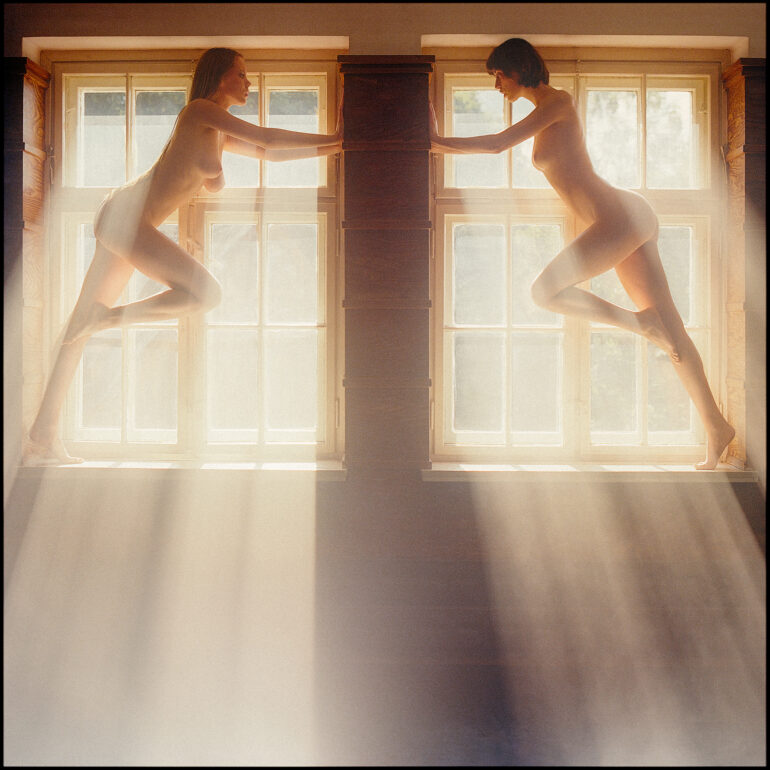
“I try to get out of my comfort zone all the time, and I get inspiration from pretty much everything – from a book I read, from a walk, from a random conversation, a mural, or maybe even more from what feelings something triggered in me and how I can tell others about it through my point of view. I am mostly inspired by places,” says photographer Lukasz Spychala to the Phoblographer in an interview. We’ve featured Lukasz before in an interview, but we’re so in love with his work and how he’s evolved as a photographer that we needed to give him the spotlight again. And when he walks around, he pays a lot of attention to his surroundings, the memories they evoke, the emotions in him, etc. This is the type of inner connectivity that so many photographers yearn for when they’re in a creative slump.

All images by Lukasz Spychala. Used with permission. Visit his website and Instagram page to see more of his workWant to have your work featured? Click here!

“My photography is a sincere journey into myself, constant research and experimentation.”

Lukasz Spychala

Lukasz, in many ways, sounds like what many photographers want to be. He strives to make new things. “Maybe it’s unrealistic these days, but I try to create something new so that I can look at myself in the mirror and call myself a true creator, not a reproducer,” he says, in words that sound all too familiar to all of us. “On the other hand, I try not to be inspired and look at the photos of others around me who are taking pictures. I believe that they can very quickly get stuck in our subconscious and make us try to reproduce them, even involuntarily.” So what does he do? He looks at the photography books of various historical photographers instead. Additionally, he takes in paintings and the mise en scene within them all.

Beyond that, he’s inspired by the models that he photographs. He feeds off of the person, their energy, how they’re affected by the location, the idea, etc.

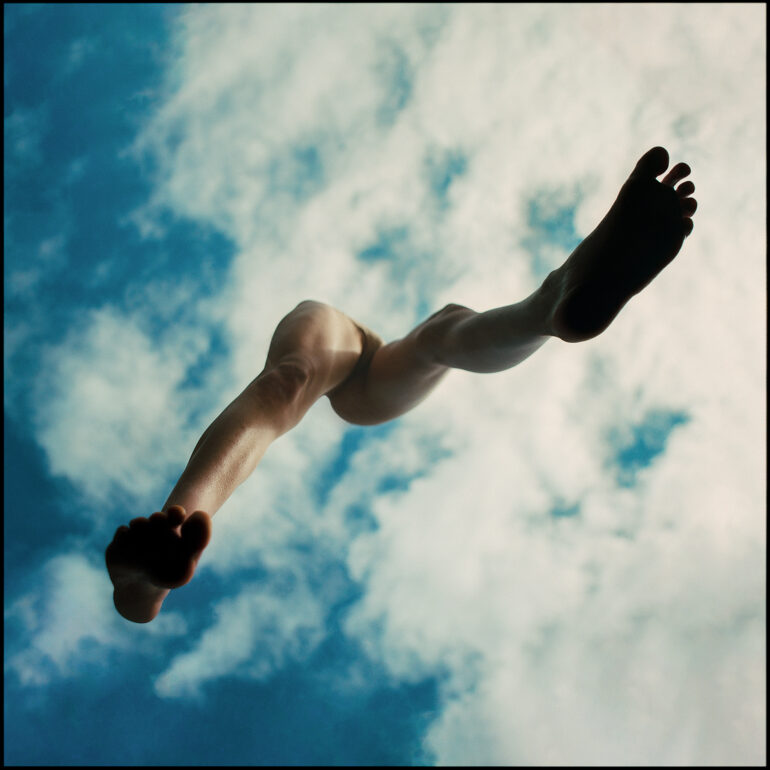
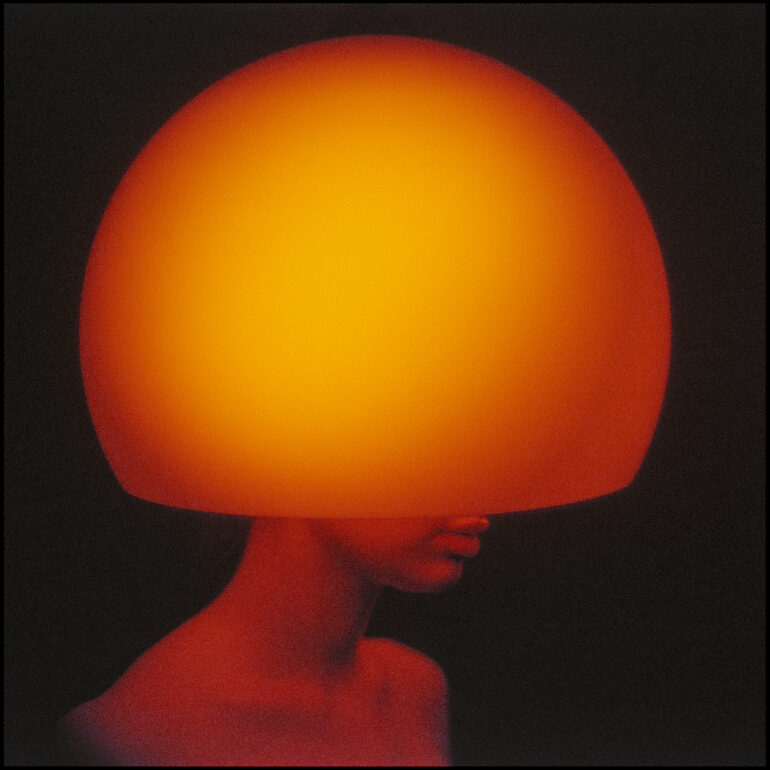
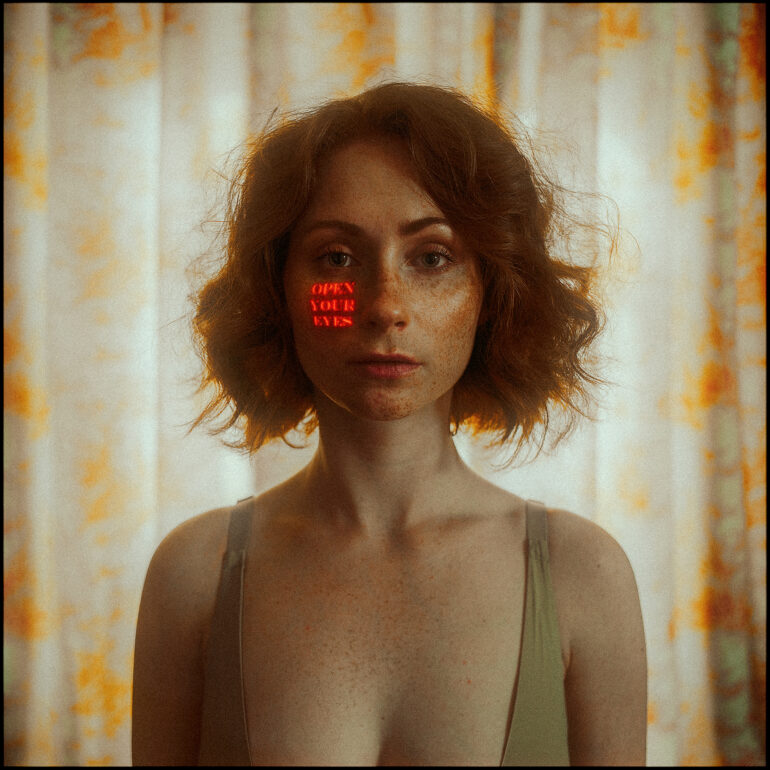
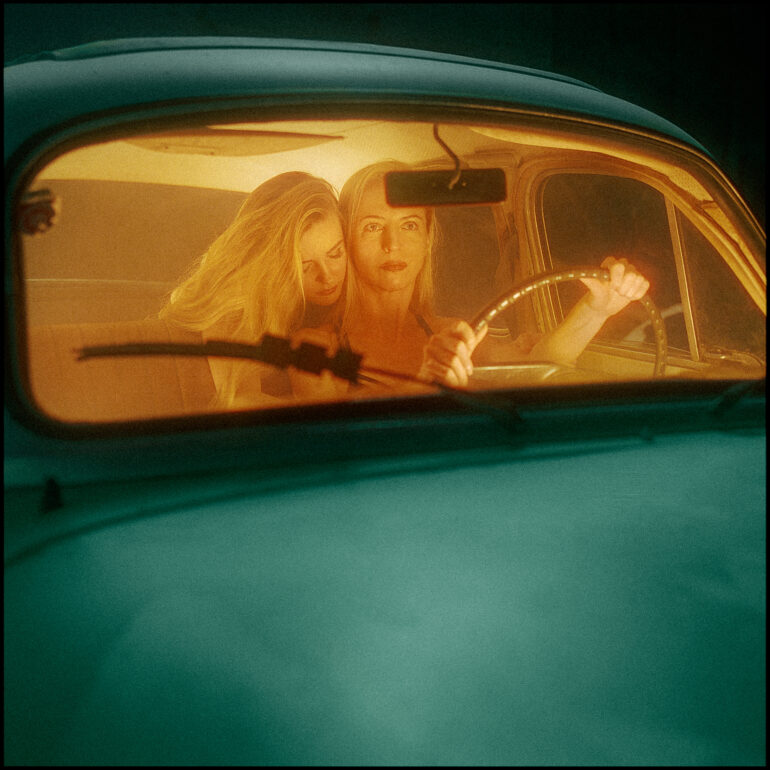
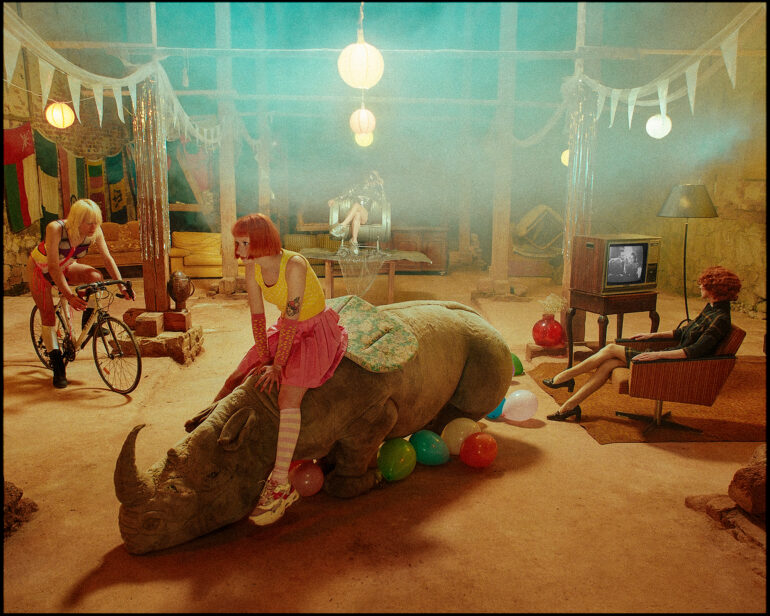
He’s constantly trying to raise the bar for himself, too. He references his “Multiverse” series as a reference to his practices here. “This series takes us on a journey through time and space, revealing the remarkable intergenerational differences that have arisen as a result of rapid technological development,” he tells us, in a very beautiful and thought-provoking way. “For this shoot, I set the scene and provided each character with his or her separate zone in which they function on a daily basis. Each actor symbolizes a different generation of people.” He continued to explain the series to us.

The woman, with curly hair, symbolizes the oldest generation that grew up without the virtual world. There is also an athlete in the photos, symbolizing the generation that has experienced both the analog and digital worlds. In addition to this figure, we also find a red-haired girl symbolizing the youngest generation that was born in the era of the digital revolution. Also appearing in the frames is a mysterious silver figure symbolizing the technology that more or less runs through each generation.

Although we all currently live at the same time, it feels as if we are functioning in completely different dimensions. The “Multiverse” series, therefore, encourages us to reflect on the impact of technology on our lives and encourages us to seek a point of balance between the real and virtual worlds.

Lukasz Spychala

There’s often a lot of work involved for Lukasz and his images. It involved stylists, lighting, set designers, etc. And he shoots analog, so it’s not like this is all done in Photoshop. He tells us that much of this can be very exhausting because of the setup, cleaning, modifications of set design, environmental conditions, etc. “When I press the shutter button, it brings me joy beyond description,” he says. “In turn, watching the developing negative gives me inner peace and a sense that I am trying to grow in my greatest passion.”

With all this said, Lukasz is a true photographer in the sense of the word. And to that end, he finds AI imagery to be just another tool. In his eyes, it’s a big paradigm shift similar to the switch from analog to digital. However, he doesn’t consider AI imagery to be real photography, and instead just a separate category of the visual arts.

So what separates him? “When photographing, I have a certain vision,” Lukasz shares. “I shape my entire photo plan tangibly with my hands or with a message to the model. For me, creating photos with AI is similar, which starts at the level of someone else’s idea.” He explains that there needs to be a creative vision first — and the the actualization of the final product is just achieved in different ways. And overall, he’s not drawn to working with AI.

Concorde’s last flight: Is this the greatest aviation photograph of all time?

Concorde’s last flight: Is this the greatest aviation photograph of all time?

November 26, 2023 at 4:59 AM

On November 26, 2003, supersonic airplane Concorde made its last flight, returning to the airfield near Bristol, in southwest England, where it’s remained since.

As this marvel of modern engineering soared over the Clifton Suspension Bridge in Bristol, a landmark of Victorian engineering based on a design by Isambard Kingdom Brunel, it created a poignant moment witnessed by cheering crowds.

High in the sky, dangling out of a helicopter and buffeted by icy winds, photographer Lewis Whyld managed to capture it on camera – an image that has become the defining shot of the golden age of faster-than-the-speed-of-sound travel.

Whyld, who now works as an aerial cameraman for CNN, reveals how he took one of the coolest airplane photos ever taken.

The photographer’s story

I remember somebody shouting: “There it is, there’s the aircraft!” I was so excited just to see it, I took a picture straight away, and then thought, “hold on, I’ve got to wait until it’s over the bridge.”

We were, I think, at about 3,000 feet, with Concorde 1,500 feet below us. I was standing on the skid outside the helicopter, freezing cold, with downdraft from the rotors blowing on me. I couldn’t feel my fingers, couldn’t feel my toes, couldn’t feel my face.

It wasn’t an easy shot. I had to lean right out of the helicopter because of the angle we were flying at. I was terrified. Terrified of the newness of being in a helicopter for only the second time in my life, terrified of messing the job up.

I was 25. I’d only recently been hired by an agency called South West News Service, which supplies images and reports from the southwest of England to national UK and international media. When the Concorde job came up, I simply put my name down for it.

The only thing my boss really said to me was just, “don’t f*** this up.”

3,000 feet in the air

Lewis Whyld in 2003, the year he photographed the Concorde. This photograph was taken on his first-ever attempt at aerial photography. He was in a plane with his friend, who was training to fly at the time. - Courtesy Lewis WhyldLewis Whyld in 2003, the year he photographed the Concorde. This photograph was taken on his first-ever attempt at aerial photography. He was in a plane with his friend, who was training to fly at the time. - Courtesy Lewis Whyld
Lewis Whyld in 2003, the year he photographed the Concorde. This photograph was taken on his first-ever attempt at aerial photography. He was in a plane with his friend, who was training to fly at the time. – Courtesy Lewis Whyld

Because we were in a helicopter, there was a lot to go wrong. Trying to line everything up in three-dimensional space was a challenge. The chances of the plane flying over the bridge at exactly the angle we needed were small.

And, of course, the plane is moving very fast.

Whereas today, you can fire your camera in a burst and get a selection of images, back then they were much slower. I only had one shot.

The plane was so white in the bright sunlight, against a dark background of foliage and the river, the contrast was huge. It would’ve been easy to overexpose Concorde and just be left with a white triangle with no detail.

Because the plane was traveling so quickly and my focus point was so small, it would’ve also been very easy to focus on something on the ground, leaving the Concorde a blurry mess.

And the helicopter was constantly moving. The pilot couldn’t hover, we had to fly in circuits – something to do with keeping the helicopter in the air.

Trying to balance those things out, you stop the aperture down so that you have more depth of field, but that lowers your shutter speed, which means you could get blur if you move the camera too quickly. There was a lot of mental arithmetic and I probably changed my camera’s settings 10 times before Concorde arrived

Capturing the moment

There was no trial and error. When it flew by, I would get one chance to take the picture.

And then it was there, banking in the sky beneath me.

I was standing on the helicopter’s skid and leaning out, pulling against the harness, over thin air and shooting the picture, just as it passed the bridge.

I didn’t realize the photograph would make that shape it does – with the cliff face, the bridge and the crowd all kind of framing the aircraft, against a relatively clean background and almost mirroring the shape of the wing.

Everyone loved Concorde, so having that human element in there meant that the picture was elevated a bit more than if it was just empty scenery behind.

Brunel’s Suspension Bridge also helped – the engineering triumphs of the 19th and 20th centuries together.

After the fly-by, we landed at Filton airfield, where Concorde had also landed. I took other photos of it being towed into its hangar with the pilot waving from the window.

Then I started to edit my images to send them back to the office.

I remember people looking over my shoulder when I brought the bridge picture up on my laptop. I really didn’t know what I had, right then. I didn’t know that it was a special picture and people would really love it. I was just thinking, “job done.”

Then people started crowding behind me. Other photographers said: “Well, what’s the point in us sending anything, because that’s the one that everyone’s going to use.”

I had no idea at the time that that would turn out to be true. It did run in all the newspapers – of course they used other shots too – but that was certainly the main one.

Some produced it as a collector’s poster. I got my mum to collect the tokens needed to send off for them. Some of the newspapers sent me bottles of champagne. I’d never known anything like it.

Enduring image

The image certainly made an impression with aviation fans.

I’ve been contacted by a few groups asking if I can help get Concorde flying again. Ironically, I thought it would be better for my photo if it didn’t ever take off again, as that would no longer be the last flight.

But it is an incredible machine. I didn’t ever get the chance to fly on it and, in fact, I’ve never actually been on it. I’ve only seen it from the outside, beneath me. That was the first and the last time that I saw it flying.

In the 20 years since 2003, I’ve taken other memorable pictures, but you’re always remembered for your greatest hits and I guess that will always be – in inverted commas – one of my “greatest hits.”

Part of that is because of the picture and part of it is because there was no other chance to do it. So no matter how good the picture is, it would always be the last picture of Concorde. I was lucky that it happened to be a good one.

I’m quite known for doing drone footage now. So, this was my first aerial picture and from then I’ve coincidentally made a bit of a career niche out of a doing aerial pictures and using drones.

Even with advances in technology, if we went back and did that Concorde shot again we’d have to use a helicopter. A drone wouldn’t be permitted to hover over the airplane and take pictures.

So we would still do it the same way, but we’d have better cameras and I would come back with a burst of pictures that we could choose from, rather than just one.

But in some ways, I am quite glad the technology was as it was – because there is just one photo. We’re a bit spoiled now and having more than one version of an image can water down its power.

Changing technology

Concorde Alpha Foxtrot, the aircraft photographed by Whyld, is now on display at Aerospace Bristol. - Suzanne Plunkett/CNNConcorde Alpha Foxtrot, the aircraft photographed by Whyld, is now on display at Aerospace Bristol. - Suzanne Plunkett/CNN
Concorde Alpha Foxtrot, the aircraft photographed by Whyld, is now on display at Aerospace Bristol. – Suzanne Plunkett/CNN

Interestingly, although camera technology has moved on, aircraft technology in a lot of ways hasn’t. Back then you could get to New York in three and a half hours. Sure, we have bigger aircraft – the A380 for example – but in terms of raw speed, Concorde’s still the pinnacle of aviation.

The photo represents the end of an aviation era – and nothing’s come along to replace it, certainly nothing’s grabbed the public’s imagination like Concorde. I think part of the reason the picture still resonates today is due to that enduring affection we all have for that bygone era of travel.

There are always rumors of new supersonic aircraft in the works, and I enjoy tracking the updates, but nothing seems concrete yet. I’d love supersonic travel to come back in a greener, more modern form – to shorten distances across the globe and make the world an easier place to traverse.

Plus, it would just be a mark of human ingenuity to see something like that back in the skies, which would be great from a geeky standpoint. But while I’m keeping an eye out, I’m yet to see anything close to realization.

If I were to take the photo today, I would have also much higher resolution camera, so I would be able to take a wider picture that we could then crop to different compositions. At the time I used a relatively long lens and it’s really the full frame that you see, that is the best way to get the highest resolution possible out of the picture.

Now we could afford to use a wider lens and still get a high-resolution picture if we needed to zoom in afterwards, but at that time we didn’t have that.

The general consensus at the time was to shoot the shot on a wide lens, and be as close to the aircraft as you possibly could. But then that would obviously mean the bridge would be tiny in the background, and you wouldn’t get the same kind of effect. I gambled on the long lens and it was only later, as a I gained more experience, that I realized that was a quite a risky thing to do. It means you’re shooting in a narrow space. As it was, everything lined up, everything worked out – but generally speaking those things don’t tend to line up so perfectly.

I was very gung ho and confident back then – knew what I wanted and figured there was no reason why it wouldn’t work out. I guess you get a bit more jaded or realistic as life goes on. But I’d like to think that today I would still take that risk and try and take the ultimate photo, rather than trying to play safe and getting something that people don’t really remember.

Twenty years on, there are postcards of my photograph and posters – there’s even a cross-stitch. In the early years, people would gift me that kind of thing all the time. I think I have at least one jigsaw somewhere in my house. I’ve been approached to do a limited-edition print run.

With modern technology, in terms of editing, we could make a better print of the photo than ever before. We can’t change the camera it was taken on, but we can change the way that we edit it and the details that we draw out.

I still have the digital negatives, so we can we can always go back to the raw file and take it into the digital darkroom – and then run it through the incredible modern technology that we’ve got today to extract details that we couldn’t previously.

There are methods to increase the resolution, make old photos high quality, get more detail – especially with AI. But I don’t want to change the nature or the reality of the picture. I don’t want to manipulate it any way.

Incredible opportunity

Lewis Whyld in 2017, photographing in the Arctic for a CNN project highlighting the impact of global warming. - Courtesy Lewis WhyldLewis Whyld in 2017, photographing in the Arctic for a CNN project highlighting the impact of global warming. - Courtesy Lewis Whyld
Lewis Whyld in 2017, photographing in the Arctic for a CNN project highlighting the impact of global warming. – Courtesy Lewis Whyld

Looking back, I was surprised actually, that the final flight of Concorde would be this small hop from London to Bristol, but it was a chance for our photo agency to punch above our weight, to compete with international photojournalists from New York and London.

It was a fantastic chance to take a great image on a story that wasn’t really political, wasn’t terrible, wasn’t a disaster or anything like that.

In a way, I’m pleased that one of my enduring images is of something that’s celebratory, rather than depressing or a disaster, like all the hurricanes and typhoons I’ve been to, all the war zones and riots. There’s something uplifting about the Concorde photo.

In the years since the final flight, I moved on from Bristol to London. I worked for the UK’s Press Association and The Telegraph newspaper before eventually moving to CNN to shoot aerial footage, videos and drone footage. I was a part of the CNN team covering the Ukraine war which won an Emmy earlier this year.

The Concorde shot was always the springboard for my career. It’s where it kind of all started. After that people knew my pictures and offered me jobs. It oiled the wheels, moving my career forward.

I didn’t expect that to happen when I took the photo, but I’m grateful for it.

This article was originally published on November 26, 2018. It was updated and republished on November 26, 2023.

For more CNN news and newsletters create an account at CNN.com

Somerset photographer’s gannet picture highly-commended

Somerset photographer’s gannet picture highly-commended

Copyright 2023 BBC. All rights reserved.  The BBC is not responsible for the content of external sites. Read about our approach to external linking.

Beta Terms By using the Beta Site, you agree that such use is at your own risk and you know that the Beta Site may include known or unknown bugs or errors, that we have no obligation to make this Beta Site available with or without charge for any period of time, nor to make it available at all, and that nothing in these Beta Terms or your use of the Beta Site creates any employment relationship between you and us. The Beta Site is provided on an “as is” and “as available” basis and we make no warranty to you of any kind, express or implied.

In case of conflict between these Beta Terms and the BBC Terms of Use these Beta Terms shall prevail.

Letter to the editor: In praise of sports photography

Letter to the editor: In praise of sports photography

I’m sure I am not the only one who has noticed this, but The Californian sports photography has been very good this year, especially those shot by stringer Rodney Thornburg!

I’ve known Rodney for many years, dating back to the Bakersfield College days and through the time he freelanced for us at The Californian when I was there. No matter the sport, Rodney’s images have been exceptional, and he just keeps getting better. You can tell he still loves taking pictures!

Stunning photography from around the globe to be exhibited during COP28

Stunning photography from around the globe to be exhibited during COP28

Emergence Magazine has announced Shifting Landscapes – an immersive art exhibition documenting aspects of the climate crisis from around the world, taking place during COP28.

Shifting Landscapes will feature a selection of stunning photographic works by artists and photographers, each sharing their unique experiences documenting the effects of the climate crisis. 

The exhibition will open during the United Nations Climate Change Conference, running from December 01-10. Curated by Emmy and Peabody Award-nominated filmmaker and composer, and Emergence Magazine founder, Emmanuel Vaughan-Lee, Shifting Landscapes will be held at Oxo Tower Wharf, London.

Desert, Fire, Flood (Image credit: Zied Ben Romdhane)

The exhibition will bring to life Emergence Magazine‘s editorial exploration of the theme of Shifting Landscapes, stating, “The exhibition contemplates our changing Earth during the current moment of loss, possibility, and transformation”. 

The exhibition features work from several professional artists and photographers, including Kiliii Yüyan and their work Beyond the Horizon, which documents the rapidly changing landscape of the Arctic. A selection of stunning wildlife and landscapes combine to tell a strong narrative while providing beautiful visuals.

Beyond the Horizon (Image credit: Kiliii Yüyan)

Other photographers include Gheorghe Popa and his work Poisoned Beauty, a devastating insight into the impact of a Romanian Copper mine on the surrounding ecosystem.

Magnum Photographer Zied Ben Romdhane’s Desert, Fire, Flood, documents the impact of rising temperatures in Tunisia, and Mona Simon’s photography accompanies The Lost World – a film by Sundance award-winning director Kalyanee Mam – focusing on mango tree deforestation in Cambodia. 

Lost World (Image credit: Kaylanee Mam)

Shifting Landscapes is jam-packed with beautiful yet haunting imagery that raises awareness of the crisis that is affecting communities all over the world. As well as being an exhibition of great photography, it includes several other mediums, making it a ‘multi-sensory’ experience.

VR experiences, immersive installations, artist films, and ambisonic sound installations all contribute to sharing the message. Emergence Magazine invites viewers “to see, touch, hear, and breathe – to feel into and participate in – the spaces of connection and kinship that are held here.”

Poisoned Beauty (Image credit: Gheorghe Popa)

A programme of free weekend talks and events will accompany the exhibition, including conversations with the artists and Emergence Magazine contributors, and special film screenings. A standout guest speaker for me is Booker Prize-winning novelist Ben Okri, who will give readings from his new book. 

The other great news is that you can view all this amazing art for free! There is no charge for admission to the exhibition, so if you can make it to London’s South Bank during the exhibition window there is no excuse to miss it – I certainly won’t! More information on the exhibiting photographers can be found on the official website

For more articles on climate issues and photography, see our stories: Drowning in Plastic, New emotive climate change photo series by Nick Brandt, and Your photography can help combat the climate crisis!