Photography

Immerse Yourself in the Forest Surrounding Casa Cono With the Esteemed Architectural Photography of LGM Studio

Immerse Yourself in the Forest Surrounding Casa Cono With the Esteemed Architectural Photography of LGM Studio

Project of the Week

I am always stricken by Luis Gallardo of LGM Studio’s work! Today, our featured project takes us to a house in the forest, where Luis immerses us deep in a world of reflections, context, light, and mood.

Throughout this project, it often feels like Luis’s photographs are a magic trick, and the house is appearing and disappearing before our eyes. It is a joy to view and fits in with the autumnal feeling in the air where I’m writing this from, so I’m very excited to share it with you! Luis has graciously shared some information with us about this project, so let’s get into the thick of it!

Luis starts “This shoot for Casa Cono was truly a special one for me. My journey with [the architect] Estudio Atemporal began in 2003, when Paul Curuchet and I studied architecture together. Later in 2012, a couple of years after I first started my professional photography career, Estudio Atemporal approached me to document Auditorio Blackberry. They were one of our first clients and Casa Cono marked our 47th project together.

It’s been an incredible privilege to have such a longstanding relationship with them. Over these 11 years, we’ve grown together professionally, and we’ve had the unique opportunity to give voice to their diverse architectural creations through our images, including Licoreria Limantour, Bar Zapote at Rosewood Mayakoba, Casa Altos Visitor Center and Casa Mola. Like all their projects, Casa Cono is a statement to their relentless commitment to design excellence, and I couldn’t be more honored to be their dedicated photographer.”

“The shoot days for Casa Cono were both exhilarating and challenging, as it is often the case when working in architectural photography,” Luis muses. “We spent two days on-site, from dawn till dusk, meticulously capturing the essence of this magnificent structure. It was great for us that Luciana de la Garza and Paul Curuchet, lead architects at Estudio Atemporal, came to the photo shoot and shared with us their passion for the project.”

“The house is located 3 hours away from Mexico City, where our studio is based, so the first thing we needed to coordinate was traveling and lodging logistics,” he explains. “One of the primary challenges I encountered was covering in photo compositions the multitude of options, as this house has all its facades open and the interior spaces are also connected in every view to the surrounding context.

The house is nestled within a forest, requiring the photographer’s skill to find the best spots for tripod placement while navigating the complexity of the terrain, requiring physical demand to ascend and descend slopes with wet ground, branches and rocks while carrying tripod, camera, lenses, and drone, adding to the complexity having to deal with the wind, the morning chill and to fly the drone while avoiding trees and obstacles around the house. All of these while the sun advanced as time passed.”

He continues, “Another challenge was to deal with changing natural light throughout the day, which, for an architectural photographer, means that some moments of light and shadow are not going to be repeated.

You can’t come back, so you need to choose where to be at a specific time and you have to move fast.

Given my passion for natural light, it was essential to capture those perfect moments when the interplay of light and architecture created magic. To overcome this challenge, we meticulously styled all the spaces before beginning the shoot and carefully planned our shooting schedule to align with the best lighting conditions. At times, we had to exercise patience and wait for the perfect moment to arrive.”

Luis’s ability to immerse us in the landscape surrounding this home is a testament to his ability to truly understand the architecture that he is photographing. The sense of place and mood he can convey through a 2D medium like photography is just wonderful.

It is as if we can feel the heat of the sun and the coolness of the shady shadows on our skin, smell the forest, and hear the leaves fluttering down into the pool.

In addition to his ability to teleport us to Casa Cono, Luis also does a marvelous job of crafting little moments with the help of the human figure, as we’ll see below. We are able to understand the scale of the spaces, as well as understanding the functionality and story of Casa Cono.

I adore this next photograph, where the outdoors drifts seamlessly inside Casa Cono. Luis’s photograph allows us to feel both part of nature and sheltered from it, in this living space.

I always appreciate Luis’s approach to photography and his restraint in post-processing. Unfussy, simple scenes captivate our attention. Shadows and highlights carve out the space and inform us of the lines and shapes present. Nothing feels forced or faked. We view Luis’s work, and in turn, the architect’s, as they truly are.

Another thing I will always love about LGM Studio is how Luis captures the interior spaces at dusk, so we can see the house aglow with warm practical lighting. There is a relaxing air about these images, like we’re invited to a dinner party at Casa Cono or are spending the weekend there.

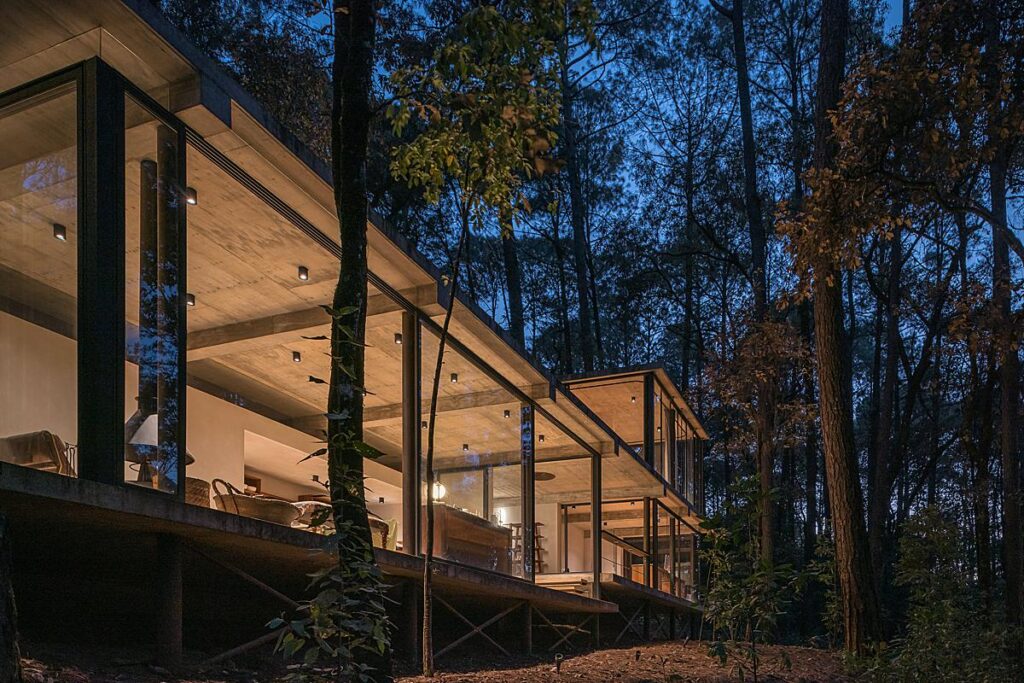
Back outside as the light falls, Casa Cono appears to blend in seamlessly with the surrounding trees. The reflections on the massive amounts of glazing, and the home’s materiality allow it to camouflage into the forest. Our brains work to gauge where the house stops and the woods begin, and I just love it.

I asked Luis about his favorite photograph and he shared, “There’s one particular shot that truly stands out. It’s a photograph of the main façade that faces the forest, allowing you to understand the structure’s modulation, the house’s placement on the terrain, and its delicate and thoughtful relationship with the surroundings, which was based on the premise of not cutting down a single tree.

From a technical standpoint, composing this photograph, which required to be captured from the lower part of the terrain, required the right equipment, including perspective correction lenses. Since the terrain had a slope, it was essential to balance the image and maintain vertical lines to capture the complete view of the façade. Regarding lighting, it was crucial to accentuate the harmony and warmth of both natural sunlight and the lighting design proposed by the architects. My work revolves around achieving the perfect balance between these two elements, without the use of flashes or additional lighting beyond what the space provides.”

“To fellow photographers embarking on similar architectural projects, I would offer these pieces of advice: First, immerse yourself in the architecture. Understand the architect’s vision and what makes the space unique.

Second, patience is key. Wait for the right light and moment —it can transform an ordinary shot into an extraordinary one.

Third, always pay attention to details. Architecture is all about the finer points, and capturing them can elevate your work.

Lastly, remember that your role is not just to document but to tell a story through your images. Let the design speak and create a visual narrative that resonates with viewers,” Luis says.

We’ll wrap this up with Luis’s parting words, where he says “I’d like to give a special shoutout to my partner, Adiranne, Ady, Montemayor. Her contributions to this project, and to all our work, cannot be overstated. She manages all the pre-production stages, handles art direction and styling during the shoot, and deserves a special mention when creating photographs because you need to move fast when it’s time to turn on/off lights, open/close windows and curtains, and light on the fire pit, especially at dusk when light changes so quickly.

She even plays a crucial role in all the work we do to final photographs through post-production and retouching of our images. Her dedication and creativity are an integral part of our success, and I couldn’t do it without her. Additionally, I’d like to express my gratitude to Estudio Atemporal for their trust and collaboration over the years. It’s been an incredible journey, and I’m excited to see where our partnership takes us next.”

What a team!
A huge thank you to Luis Gallardo, Ady Montemayor, and LGM Studio for sharing this beautiful project with us. You can see more of Luis’ incredible work at his website www.lgmstudio.com as well as his Instagram @lgmstudio.

If you have a project you’d like to be considered for Project of the Week, you can submit it here.

Photography in the age of AI according to PhotoVogue

Photography in the age of AI according to PhotoVogue

The photographs by Mahatma Gandhi’s grandson, Kanu Gandhi, kick off the exhibition journey of a photo exhibition illustrating the socio-historical evolution of India, from Independence to the present day. It is titled “India Today: 17 Photographers from Independence to the Present” – an exhibition featuring over five hundred works displayed at the Magazzino delle Idee in Trieste, until February 18, 2024. The exhibition delves into challenging years, offering seventeen distinct perspectives on this theme. The photographers, all Indian, belong to different eras, allowing the exhibition to take viewers on a journey through seven decades of change, contradictions, and hopes captured through the lenses of artists who have made photography a tool for testimony and reflection.

Khanu Gandhi, Mahatma Gandhi nella zona colpita dai disordini di Noakhali /Mahatma Gandhi in the riot affected area of Noakhali, Novembre/November 1946
Courtesy The Estate of Kanu Gandhi & PHOTOINK

It all begins in 1947 when India gains independence from Britain. From that moment, Hindus and Muslims engage in severe clashes leading to the exodus of many towards the two newly formed states – Pakistan and Bangladesh. This period also witnesses the assassination of Gandhi in 1948. The photographs by Kanu, his grandson, bear direct witness to the post-independence civil disobedience. The exhibition then proceeds chronologically. Through the lens of Bhupendra Karia, a teacher and theorist, we explore post-war rural India. Pablo Bartholomew guides us through the ’70s, a decade of enthusiasm and discovery on the streets of Delhi, Bombay, and Calcutta. Embracing the ’80s and ’90s, we encounter the work of Ketaki Sheth, capturing the metamorphosis of Bombay during the construction boom. Subsequently, Sheba Chhachhi, a feminist activist, marks a significant change in the ’90s with the series “Seven Lives and Dreams,” breaking the mold of reportage to explore the concept of reality.

Pablo Bartholomew,Mendicanti Parsi a Fort / Parsi beggars in Fort, c.1980. Courtesy Pablo Bartholomew & PHOTOINK
Sathyarani, I, Manifestazione contro il Sistema delle doti/Anti Dowry Demonstration, Delhi, 1980. Courtesy Sheba Chhachhi 


Raghu Rai‘s work, a member of the Magnum agency, spans from the ’60s to the 2000s, portraying the Indian subcontinent with a documentary eye. As we enter the new millennium, it’s interesting to see how Indian photography begins to address urgent themes such as LGBTQ+ rights, with works by Sunil Gupta, Anita Khemka, Serena Chopra, and Dileep Prakash transforming individual stories into universal narratives. Other poignant themes include Vicky Roy, who fled home at eleven, addressing the plight of orphaned children living on the streets, while Amit Madheshiya captures audiences of itinerant cinemas, symbolizing the rural and traditional part of contemporary India.

Vicky Roy, Mumbai, Maharashta, India, da/from Bachpan, 2018
©Vicky Roy

The photography of the new millennium also embraces environmental and social issues. Senthil Kumaran Rajendran unveils the conflict between tigers and humans, Vinit Gupta bears witness to the struggles of indigenous populations against industrialization, and Ishan Tanka documents protests against dam construction. Soumya Sankar Bose commemorates the past with the reconstruction of the Marichjhapi massacre in 1979, while Uzma Mohsin explores the consequences of civil protest in contemporary India. The exhibition is enriched by 15 audio-video interviews conducted in India, providing an in-depth insight into the vision and inspiration of each artist.

Anita Khemka, da/from Laxmi, 2003-2020, © Anita Khemka
Amit Madheshiya, da/from Cinema Travellers, 2010-2014
Courtesy Amit Madheshiya & PHOTOINK 
Amit Madeshiya, da/from Cinema Travellers, 2010-2014
Courtesy Amit Madheshiya & PHOTOINK 
Ishan Tankha, da/from Sommersi/Submerged.
Abitanti dei villaggi lottano per il diritto alla sopravvivenza nell’India centrale/ Submerged. Villagers fight for their right to survive in the central India
©Ishan Tankha
Pablo Bartholomew, Dhodi, Zarine e/and Maya, New Delhi, 1975
Vicky Roy, Mayurbhanj, Odisha, da/from Bachpan, 2021

Richard Britton, 83, enjoyed sailing, photography, chili dogs with onions

Richard Britton, 83, enjoyed sailing, photography, chili dogs with onions

Obituary for Richard Britton

August 23, 1940 – November 10, 2023

Richard Britton, of Wind Point, 83, passed away at the Woods of Caledonia on Friday, Nov. 10, 2023.

imageRichard Britton
” data-medium-file=”https://i0.wp.com/racinecountyeye.com/wp-content/uploads/2023/11/Richard-Britton.jpg?fit=300%2C300&quality=89&ssl=1″ data-large-file=”https://i0.wp.com/racinecountyeye.com/wp-content/uploads/2023/11/Richard-Britton.jpg?fit=300%2C300&quality=89&ssl=1″ src=”https://i0.wp.com/racinecountyeye.com/wp-content/uploads/2023/11/Richard-Britton.jpg?resize=300%2C300&quality=89&ssl=1″ alt class=”wp-image-482820″ srcset=”https://i0.wp.com/racinecountyeye.com/wp-content/uploads/2023/11/Richard-Britton.jpg?w=300&quality=89&ssl=1 300w, https://i0.wp.com/racinecountyeye.com/wp-content/uploads/2023/11/Richard-Britton.jpg?resize=150%2C150&quality=89&ssl=1 150w, https://i0.wp.com/racinecountyeye.com/wp-content/uploads/2023/11/Richard-Britton.jpg?resize=200%2C200&quality=89&ssl=1 200w, https://i0.wp.com/racinecountyeye.com/wp-content/uploads/2023/11/Richard-Britton.jpg?resize=100%2C100&quality=89&ssl=1 100w, https://i0.wp.com/racinecountyeye.com/wp-content/uploads/2023/11/Richard-Britton.jpg?resize=96%2C96&quality=89&ssl=1 96w, https://i0.wp.com/racinecountyeye.com/wp-content/uploads/2023/11/Richard-Britton.jpg?w=370&quality=89&ssl=1 370w, https://i0.wp.com/racinecountyeye.com/wp-content/uploads/2023/11/Richard-Britton.jpg?w=400&quality=89&ssl=1 400w” sizes=”(max-width: 300px) 100vw, 300px” data-recalc-dims=”1″>
Richard Britton

He was born in Ohio on Aug. 23, 1940, to his parents, Willard and Lucille (née Young).

Richard served in the U.S. Army (1958-1962) before getting his BBA at the University of Toledo. After completing his studies, he went on to retire from Modine as an executive after 28 years of service.

He was a member of the Faithbridge Church in Racine, the Racine Yacht Club, and part of the Modine 20-year club.

Richard enjoyed traveling, sailing, movies, photography, eating chili dogs (with onions) and the desire to continue to learn about things that interested him in life. He cherished his time visiting with his grandchildren and was often seen laughing over many of life’s funny/not-so-serious moments. He very much loved his family and will be missed greatly.

Richard is survived by his wife of 31 years, Karen Van Lone; children, Steven (Jennifer), Shawn (Lisa), Christine (Pete Janovicz); and six wonderful grandchildren, Lauren, Amanda, Ryan, Sydney, Owen and Jacob.

Services

A private celebration of Richard’s life will be held.

The family extends a heartfelt thank you to the staff at the Woods of Caledonia for the love and attention Richard received while under their care.

Obituary and photo of Richard Britton courtesy of Draeger-Langendorf Funeral Home.


Local News

The Racine County Eye, which includes the Kenosha Lens, is your source for local news that serves our diverse communities. Subscribe today to stay up-to-date with local news.

Follow us on Facebook: Racine County Eye or Kenosha Lens, and Twitter to make sure you get the latest news.

imageRacine County Eye, Kenosha Lens banner, journalism that serves
” data-image-caption data-medium-file=”https://i0.wp.com/racinecountyeye.com/wp-content/uploads/2023/05/RCE-KL-banner-resized.jpg?fit=300%2C94&quality=89&ssl=1″ data-large-file=”https://i0.wp.com/racinecountyeye.com/wp-content/uploads/2023/05/RCE-KL-banner-resized.jpg?fit=780%2C244&quality=89&ssl=1″ src=”https://i0.wp.com/racinecountyeye.com/wp-content/uploads/2023/05/RCE-KL-banner-resized.jpg?resize=225%2C71&quality=89&ssl=1″ alt=”Racine County Eye, Kenosha Lens banner” class=”wp-image-468549″ width=”225″ height=”71″ srcset=”https://i0.wp.com/racinecountyeye.com/wp-content/uploads/2023/05/RCE-KL-banner-resized.jpg?resize=300%2C94&quality=89&ssl=1 300w, https://i0.wp.com/racinecountyeye.com/wp-content/uploads/2023/05/RCE-KL-banner-resized.jpg?resize=1024%2C320&quality=89&ssl=1 1024w, https://i0.wp.com/racinecountyeye.com/wp-content/uploads/2023/05/RCE-KL-banner-resized.jpg?resize=1536%2C480&quality=89&ssl=1 1536w, https://i0.wp.com/racinecountyeye.com/wp-content/uploads/2023/05/RCE-KL-banner-resized.jpg?resize=1200%2C375&quality=89&ssl=1 1200w, https://i0.wp.com/racinecountyeye.com/wp-content/uploads/2023/05/RCE-KL-banner-resized.jpg?resize=1568%2C490&quality=89&ssl=1 1568w, https://i0.wp.com/racinecountyeye.com/wp-content/uploads/2023/05/RCE-KL-banner-resized.jpg?resize=400%2C125&quality=89&ssl=1 400w, https://i0.wp.com/racinecountyeye.com/wp-content/uploads/2023/05/RCE-KL-banner-resized.jpg?resize=706%2C221&quality=89&ssl=1 706w, https://i0.wp.com/racinecountyeye.com/wp-content/uploads/2023/05/RCE-KL-banner-resized.jpg?resize=150%2C47&quality=89&ssl=1 150w, https://i0.wp.com/racinecountyeye.com/wp-content/uploads/2023/05/RCE-KL-banner-resized.jpg?w=1670&quality=89&ssl=1 1670w, https://i0.wp.com/racinecountyeye.com/wp-content/uploads/2023/05/RCE-KL-banner-resized-300×94.jpg?w=370&quality=89&ssl=1 370w” sizes=”(max-width: 225px) 100vw, 225px” data-recalc-dims=”1″>

Oliver shines brightly to capture Exeter tree photography prize

Oliver shines brightly to capture Exeter tree photography prize

A striking image of stars shining through the branches of a mature tree in an Exeter park has been declared the winner of a prestigious photography competition.

Oliver Necesito’s night-time shot was judged to be the best image in Exeter City Council’s Tree Photography Competition for 2023.

The competition is held every year in the run-up to National Tree Week (26 November to 4 December), inviting people to take a picture of their favourite tree in Exeter.

Once again the competition proved extremely popular with organisers receiving 74 entries from budding local amateur photographers.

Yet it was Oliver’s moody and imaginative shot that impressed the judges.

Oliver wins a framed photograph of the image and a Haynes Tree Manual for his efforts. All of the competition prizes were kindly donated by the City Council’s arboricultural contractors, Devon Trees Services.

A close second was Rob Geare’s delayed exposure shot of a tree in the middle of a busy road junction at the bottom of Fore Street. Rob receives a framed photograph of his image.

In the Junior section, eight-year-old Raef Harvey wowed judges with his beautiful image of a young girl hugging a giant oak tree in Rougemont Gardens. Raef wins a framed photograph of his image and a Haynes Tree Manual.

Runner up in the junior section was 12-year-old Austin Lake for his shot of a tree on the Cathedral Green starting to change colour. He also wins a framed photograph of his image.   

Cllr Ruth Williams, Lead Councillor for Place and City Management, said: “What an absolute pleasure it has been to be part of the judging panel! The range of images was remarkable – from the beautifully composed chocolate box ones featuring the trees along the Quay and the Exe, to the truly urban images featuring trees that gave the impression of surviving in amongst buildings and roadways.  There were also the ‘arty’ shots where unusual camera angles created some quite intriguing results. 

“It was a considerable challenge coming up with the winning images from over 70 submitted. In the end choosing the winners and runners up was down to those images that left an indelible mark on my memory well after I viewed them. Congratulations and thanks to everyone who submitted an entry.”

National Tree Week is the UK’s largest annual tree celebration, marking the start of the winter tree planting season (November to March each year). This year it will take place from 25 November to 3 December. Further information about national events can be found on the Tree Council website

Think before you click: Center for Mindfulness Photography in Easthampton teaches a new view of yourself in the world

Think before you click: Center for Mindfulness Photography in Easthampton teaches a new view of yourself in the world

Think before you click: Center for Mindfulness Photography in Easthampton teaches a new view of yourself in the world

  • “>

    Amy Thompson at her Center for Mindfulness Photography in Easthampton’s Eastworks building. STAFF PHOTO/CAROL LOLLIS

  • “>

    Amy Thompson at her Center for Mindfulness Photography in Easthampton’s Eastworks building. STAFF PHOTO/CAROL LOLLIS

  • “>

    Amy Thompson outside her Center for Mindfulness Photography in Easthampton’s Eastworks building. STAFF PHOTO/CAROL LOLLIS

  • “>

    Amy Thompson at her Center for Mindfulness Photography in Easthampton’s Eastworks building. STAFF PHOTO/CAROL LOLLIS

  • “>

    Amy Thompson outside her Center for Mindfulness Photography in Easthampton’s Eastworks building. STAFF PHOTO/CAROL LOLLIS

  • “>

    “In Our Backyard, Massachusetts.” PHOTO BY AMY THOMPSON

  • “>

    Student Liza Semler attended a mindfulness photography workshop with Thompson in Vermont. PHOTO BY LIZA SEMLER

  • “>

    Dee Dice took a photo of a leafy branch outside of Eastworks during a mindfulness photography class. PHOTO BY DEE DICE

  • “>

    Dee Dice took a photograph of a wall outside of Eastworks during a mindfulness photography class. PHOTO BY DEE DICE

Staff Writer

Published: 11/17/2023 12:15:55 PM

Modified: 11/17/2023 12:15:08 PM

It was a cold and icy winter day when Amy Thompson accidentally locked herself out of the house, with nothing but her phone and time to spare — not an uncommon tale.

But rather than becoming frustrated with herself for wasting 40 minutes of the day or simply sitting down and scrolling mindlessly, like many would be inclined to do, Thompson decided to walk into her backyard and slowly observe the minutiae of the wintry scene.

The result: an ethereal photograph of icy pine needles against a snowy backdrop.

“I discovered something in my backyard that I would have not been open to seeing otherwise,” said Thompson, a longtime professional photographer and more recently, a teacher of “mindfulness photography.”

In a studio on the ground floor of Eastworks, Thompson’s Center for Mindfulness Photography invites people from all walks of  life to embrace a meditative approach to life that, for instance, allows them to take something like being locked out in the cold and turn it into a serene moment and beautiful photograph.

“That picture wouldn’t even exist without some level of a mindful approach to photography and living,” said Thompson, taking the time to choose her words carefully. “Everything around the experience is more pleasant, more relaxed … I don’t feel pressure, so it’s more free.”

Thompson first came upon the concept of mindfulness around 2003 while photographing in Cambodia, where she learned from novice monks who wanted to practice their English.

With roots in Buddhist tradition, mindfulness encourages the observation and awareness of present senses, thoughts and emotions in a non-judgemental way.

“The whole concept made immediate sense to me,” she said. “It’s more of a philosophy or way of looking at the world, relating to the world, than a religion for me.”

“I was discovering how much mindfulness meditation impacted my experience; I just felt the power of it,” she said. “Those two things were kind of happening at the same time, but I didn’t really make the connection between them until much later.”

Over the years, Thompson has photographed for the New York Times and National Geographic, and has completed documentary projects abroad.

As she came to recognize the similarities between her creative process and meditation, she realized that her photography was itself a form of meditation, and she soon began to introduce mindfulness practices to her students at the Griffin Museum of Photography.

“We’re using mindfulness practices to open us up to our creativity,” Thompson said. “If we’re lost in our thoughts and we’re tense and stressed and judging ourselves, that gets in the way of our creativity and openness.”

“I don’t think about if my photos are better now than before; that’s not even the point,” she said. “It’s that the whole experience feels deeper.”

More recently, this year she graduated from a two-year intensive mindfulness meditation teacher training program at the University of California at Berkeley, where she said she arrived at a deeper understanding that “mindfulness isn’t a compartmentalized, segmented thing that you do.”

“I’m teaching other mindfulness practices along with it so that it really can enter into people’s lives beyond the photography, and that’s something that I really care about,” Thompson said. “Photography is kind of like one of the hooks to get people in there.”

Center for Mindfulness Photography

In 2018, Thompson moved to western Massachusetts and in 2022 she established the Center for Mindfulness Photography, where she teaches a variety of workshops, classes and retreats for small groups.

The space itself has the warm and musky smell of a violin, with a lamp providing ambient lighting and natural sunlight pouring in through the tall window covering the front wall.

Chairs are arranged in a circle “because it sort of equalizes everything,” said Thompson, adding that circles are a theme in the work she does — “soft, no hard lines, no beginning … it’s always imperfect.” 

The structure of classes is simple: participants ranging in experience sit down, and Thompson invites them to notice their breath. She then talks about mindfulness and guides the group through a meditation practice.

While every class is different, attendees are typically then encouraged to walk out of the room with their camera or phone and take their time mindfully and meditatively photographing what they observe.

“With photography, the more you can have an attitude of openness, the more you will see things in a way that’s new and true to you,” Thompson said, her hands gesturing widely and softly landing on her lap. “Every person has their unique way of experiencing the world, and the more mindful you can be, the more you’ll find your own vision.”

In that sense, photography is a tool to practice mindfulness, and mindfulness is a tool to practice photography; there is a “synergy” between the two, as Thompson puts it.

One of Thompson’s students, Dee Dice, who recently took a class at the Center said the experience was “quite profound.”

Dice is a regular hiker and nature lover, and although she does engage in a daily mindfulness practice, she typically moves quickly through the world.

“With this intentional slowing down and looking deeply at nature, everything became more interesting,” Dice said. “I think I’ll start going out specifically with the idea that I’m going to, for the next half hour, focus on slowing down and having photography be one of the ways that I interact with nature.”

“I can’t even tell you, it just opened up a new world for me,” she said.

Maddie Fabian can be reached at mfabian@gazettenet.com.

If Javascript is disabled in your browser, to place orders please visit the page where I sell my photos, powered by Fotomoto.


The first fearless female night photographer

The first fearless female night photographer

Who is the female night photographer who also happened to be the first published woman photojournalist in the United States? Let’s find out more about this fearless, intrepid force of nature.

Jessie Tarbox Beals

Jessie Tarbox Beals, first female photojournalist and night photographer
Jessie Tarbox Beals, first female photojournalist and night photographer (Schlesinger Library, Radcliffe Institute at Harvard University)

The early 1900s were a time in which most women’s roles were confined to the home. If women were photographers at all, this was confined to indoor portrait studios. 

This, however, didn’t stop Jessie Tarbox Beals. 

No fear

Jessie Tarbox Beals, first female photojournalist and night photographer (National Gallery of Art Library, Washington DC)
In front of the Austrian Government Building at the Louisiana Purchase Exhibition, 1904. Jessie Tarbox Beals, first female photojournalist and night photographer (National Gallery of Art Library, Washington DC)

Beals set herself apart by working outdoors and in situations thought to be “too rough” for a woman. She took some of her photojournalism photos from ladders, hot air balloons, and platforms, hauling fifty pounds of 8 x 10″ equipment and glass plate negatives with her. 

Beals seemed indomitable. She photographed in all conditions, including fires, floods, and winds so strong she had to sit on her 50-pound camera to keep it from flying away. She straddled speeding cabs, scaled telephone poles, and climbed dusty bookshelves to get her photos.

Jessie Tarbox Beals, first female photojournalist and night photographer, with John Burroughs (Library of Congress)

During this period, Beals photographed suffrage marches, women’s jobs, female-run shops and restaurants, poor living conditions of immigrant families, and women’s rights. A go-getter, she also photographed Calvin Coolidge, Teddy Roosevelt, Herbert Hoover, Mark Twain, Ida M. Tarbell, General Pershing, and Fannie Hurst.

Full-time news photography

In 1902, Jessie became a full-time professional news photographer. The editor of Buffalo, New York’s two local papers, the Buffalo Inquirer and The Courier hired her, allowing her to freelance as well. She was proud of her ability to get into difficult-to-photograph places, some of which were proclaimed off-limits to news photographers. And she did this all while hauling her heavy camera equipment with her, taking pride in her physical conditioning and ability to promote herself.

Tenacity and fearlessness at the World’s Fair

She was probably best known for covering the 1904 St. Louis World Fair, where she was the first woman to be given credentials. Due to her ability to hustle and promote herself as well as her sheer tenacity, she ultimately became the official photographer at the Fair for the New York Herald, Tribute, and Leslie’s Weekly, three Buffalo newspapers, and all the local St. Louis newspapers as well as the Fair’s own publicity department. Here too, she climbed ladders and flew in hot air balloons to get her photos. She also photographed dignitaries at the event, photographing William Howard Taft and President Roosevelt through pure tenacity. She eventually accompanied Roosevelt as a member of his Presidential party and accompanied him to a reunion of the Rough Riders in 1905.

If one is the possessor of health and strength, a good news instinct … and the ability to hustle, which is the most necessary qualification, one can be a news photographer.

Jessie Tarbox Beals

About those hot air balloons

Even after using hot air balloons, she was still denied riding one. At the 1907 International Balloon Race in St. Louis, she was told that she couldn’t ride one because it was too dangerous for a woman. However, as one began lifting off, “the huge crowd was thunderstruck to see [Beals], a camera slung over her shoulder, grip the top of a basket and pull herself aboard,” according to the Philadelphia Public Ledger.

Explosive night photography

Washington Arch, New York, NY. Jessie Tarbox Beals, first female photojournalist and night photographer (Schlesinger Library, Radcliffe Institute at Harvard University)

Of course, we had to get to her night photography. It’s in the title, after all.

She teamed up with freelance writer Harriet Rice, teaching herself to use flash powder to make photos at night. Naturally, she was one of the first female photographers to use this as well!

New York, NY. Jessie Tarbox Beals, first female photojournalist and night photographer (Schlesinger Library, Radcliffe Institute at Harvard University)

If you are thinking that using explosive magnesium chlorate flash powder to illuminate her photographs could get a night photographer in trouble, you’d be right on the mark. But Beals was not shy about using flash powder. She attempted to photograph a special group exiting a theatre from a stoop across the street, allegedly using two pounds of flashlight powder, about four times the usual amount. The New York American reported:

The explosion of an over-charge of flashlight powder set off by two photographers, one of them a woman, just as crowds were poring out of the Garrick Theatre, caused tremendous excitement and considerable damage. Windows in several houses were broken, scores of families, brought out of bed by the detonation, which rang through three blocks, came scurrying into the street, some of them in their bedclothes.

The New York American

The explosion was sufficiently terrifying that Palmer Hunt, head of the Iron Workers Association, thought this was an attempt on his life as his windows shattered.

In comparison, modern-day night photographers using an LED flashlight seems rather mild.

New York, NY. Jessie Tarbox Beals, first female photojournalist and night photographer (Schlesinger Library, Radcliffe Institute at Harvard University)

What Beals used for night photography

If Beals was willing to haul her cumbersome 8 x 10″ view camera up ladders, stoops, platforms, and hot air balloons, you can be sure that she used the same equipment at night. Already challenging during the day, such equipment would have been doubly so at night. Her basic kit included a large view camera, lenses, a heavy wooden tripod, holders, and heavy glass plates.

In light of this, it’s humorous to think about how we night photographers so often clamor for a mirrorless camera or a carbon fiber tripod instead of a chunkier DSLR or aluminum tripod.

Archives of Jessica Tarbox Beals

New York, NY. Jessie Tarbox Beals, first female photojournalist and night photographer (Schlesinger Library, Radcliffe Institute at Harvard University)

The archive of her work at the Schlesinger Library, Radcliffe Institute at Harvard University contains over 100 prints of her night images. These include photographs of New York and the World’s Fair, Boston’s Beacon Hill neighborhood, and later, the Mission-style architecture in Santa Barbara after she moved to California in 1922.

Santa Barbara, CA. Jessie Tarbox Beals, first female photojournalist and night photographer (Schlesinger Library, Radcliffe Institute at Harvard University)

Motivation for night photography

Boston, MA. Jessie Tarbox Beals, first female photojournalist and night photographer (Schlesinger Library, Radcliffe Institute at Harvard University)

Gifted night photographer and historian Lance Keimig at National Parks at Night notes that little is known about why Beals created night photos or how she may have been inspired to begin it in the first place. She may have been aware of night photographer Alfred Stieglitz, who was creating nocturnal images in the same area as she was at the time. 

Regardless, Beals deserves attention for her pioneering role in photojournalism and night photography as well as the excellent quality of her images. And she certainly deserves enormous credit for accomplishing this while upending gender-based obstacles through her tenacity and courage.

Book about Jessica Tarbox Beals

Book: Jessie Tarbox Beals: First Woman Photographer by Alexander Alland, Sr. (photo courtesy of Lance Keimig)

After Beal’s passing, photographer Alexander Alland, Sr. purchased many of her prints and negatives. He published a biography about her, Jessie Tarbox Beals: First Woman News Photographer, in 1978.

“Her career was remarkable by any standard. But for a woman at the turn of the century, it was practically unheard of.”

Alexander Alland, Sr.

David Bowie tour photographs on show in Nailsworth exhibition

David Bowie tour photographs on show in Nailsworth exhibition
David Bowie and Geoff MacCormackGeoff MacCormack

A new art exhibition is showcasing David Bowie’s close friendship with a local photographer.

Geoff MacCormack is displaying photographs taken while he was touring with the music star in an exhibition on show in Nailsworth.

Mr MacCormack grew up with Mr Bowie in Bromley, London, and toured with him in the 1970s.

“It’s just a lovely way to remember him and his popularity never seems to wane. So the legacy carries on,” he said.

David MacCormack taking a photograph of David MacCormack

Geoff MacCormack

The exhibition opens at the Form Gallery on Market Street on 17 November and is open until 6 January 2024.

Mr MacCormack met Mr Bowie, then David Jones, when the pair were eight years old at a primary school in Bromley, south-east London.

Geoff MacCormack and David Bowie

Geoff MacCormack

A photo of David Bowie in a caravan

Geoff MacCormack

Mr MacCormack said: “He was always David Jones to me and everything else was showbiz.

“He was always the same really.

“He was very funny, he was very silly, in fact. (He had a) silly sense of humour.

“Humour was a lot of the strength of our relationship.”

A photo of David Bowie

Geoff MacCormack

A black and white photo of David Bowie

Geoff MacCormack

Mr MacCormack said photography started off as a hobby for him, which happened to come during the time he was on tour with Mr Bowie.

“It was a period where David looked fantastic and I’m so glad I had (a camera) for those three years on the road, because I thought he looked great,” he added.

A photo of David Bowie

Geoff MacCormack

A black and white photo of David Bowie

Geoff MacCormack

One of the most influential musicians of his era, BDavid Bowie died of cancer at the age of 69 in January 2016

“I knew he had heart problems but I didn’t know he had a terminal illness,” said Mr MacCormack

“Having these images is really helpful because he remains there and people love the images,” he added.

A photo of David Bowie

Geoff MacCormack

A black and white photo of David Bowie

Geoff MacCormack

Presentational grey line

Follow BBC West on Facebook, X and Instagram. Send your story ideas to: bristol@bbc.co.uk

.

Related Internet Links

The BBC is not responsible for the content of external sites.

Youth in Kenya turn to street photography, TikTok for income amid job challenges

Youth in Kenya turn to street photography, TikTok for income amid job challenges

NAIROBI, Nov. 15 (Xinhua) — Strolling through streets in the Kenyan capital of Nairobi, people are likely to observe a vibrant youth presence, especially on Sundays when the bustling city typically experiences a lull in foot traffic.

A closer look at these lively gatherings reveals groups of people posing for photographs, choreographers devising dance routines, and TikTokers creating the latest TikTok trends.

Austine Oyugi, 24, and Awadh Salim, 26, who were setting up their photography gear for a photo shoot, demonstrated the enduring popularity of this timeless art among Kenya’s youth.

This dynamic duo has been engaged in street photography for nearly a year, following the challenges of securing employment after their university graduation in 2022.

“After Governor of Nairobi Johnson Sakaja lifted the mandatory photography fee in late 2022, people began coming to the streets to take photos, and my friend and I joined in,” said Oyugi, who holds a degree in actuarial science. “Salim had a camera from campus, and both of us honed our skills by watching YouTube tutorials.”

Before Nairobi’s streets transformed into a photography haven for the youth, obtaining a photography and videography permit involved a cumbersome and costly process. It required obtaining a license from the Kenya Films and Classification Board at a cost of dozens of U.S. dollars, notifying the police, and making numerous visits to the local administrator’s office for a single day of shooting.

Some of these regulations are outdated, and the government of Nairobi has waived all business permits for freelance photographers and filmmakers in the city, said Sakaja when issuing the directive in September 2022, adding that additionally, all the daily shooting fees have been abolished.

Today, the two friends have acquired substantial equipment that has improved the quality of their work. On a good day, they can photograph up to 30 people, with each photo costing 0.65 dollars. The photos are immediately shared with clients via WhatsApp, making this their primary source of income.

Salim said he frequently approached passersby for impromptu photoshoots. He emphasized the importance of being convincing and effectively communicating with customers by showcasing their previous work to earn their trust.

Advertisement. Scroll to continue reading.

On the other end of the street, young Kenyans are found to create and share videos on the popular social media app TikTok. Here, dozens of youngsters perform dance routines and record them using their smartphones.

Janet Kyalo, a student majoring in tourism and management, seizes the opportunity to incorporate Nairobi’s skyscrapers as her TikTok background. She appreciates the clean streets and the architecture, which adds a unique touch to her videos.

Kyalo noted that many people have lost interest in studio videos, finding them repetitive. She and her friends typically convene from 2 p.m. onward and stay until 7 p.m. These sessions offer an excellent opportunity for networking and building connections that can be pivotal in their careers.

Cliff Dawiga, a 25-year-old who recently quit his job as a vehicle mechanic due to inadequate earnings, has been shooting for a little over two months. Fueled by his childhood passion for photography, he purchased a used camera with his savings and started capturing portraits.

“After hearing that the governor had removed limitations on creatives, I bought the camera. However, it stayed unused in my house for two months before I began using it,” Dawiga said. Building confidence, he began using it on the streets, capturing portraits from Tuesday to Sunday, with weekends being the busiest.

“The pay is decent, and we’re not harassed by county police, allowing us to work smoothly. On rare occasions, like when it rains, we face some inconveniences,” Dawiga noted.

With approximately 800,000 Kenyan youths entering the job market each year, according to the National Council for Population Report 2023, the available economic opportunities, both formal and informal, fall short of meeting their needs. In this context, emerging crafts such as street photography are likely to evolve into profitable ventures for the youthful demographic in the near future.

Photographer shot dead in fifth journalist killing in Mexico in 2023

Photographer shot dead in fifth journalist killing in Mexico in 2023
image

A photographer for a newspaper in the notoriously violent Mexican border city of Ciudad Juarez was found shot dead in the driver’s seat of a car, prosecutors said, in the fifth killing of a journalist in the country so far in 2023.

The body of Ismael Villagómez was found just after midnight Thursday. The newspaper he worked for, the Heraldo de Juarez, said the news photographer was found dead in a car that he had registered to use for work for a ride-hailing app. In Mexico, many journalists take work outside the profession to pay the bills.

The newspaper added that his phone was not found at the scene.

Carlos Manuel Salas, a prosecutor for the northern border state of Chihuahua, said authorities are investigating whether Villagómez had a fare at the time, and whether the killing was related to his work as a photographer.

“Once his work at El Heraldo was over, he worked through the [ride-sharing] platform inDrive,” Salas told journalists. “He would normally work from the afternoon until 2am, 3am”. InDrive did not immediately respond to a request for comment from Reuters news agency.

Investigators have not ruled out the possibility that Villagomez was killed due to his work as a journalist, said Salas. “A journalist is a journalist 24 hours a day, whether or not they were working as something else meanwhile,” Salas said.

The Committee to Protect Journalists (CPJ) made an urgent call for authorities to investigate the killing.

Ciudad Juarez has been dominated by drug cartels and their turf battles for almost two decades, and gangs often object to photos of their victims or their activities being published.

“We’re concerned, sad, angry,” said Jose Ramon Ortiz, director of the newspaper where Villagomez worked. “We don’t want this to be like what has happened with the deaths of other journalists. We want, whether the motive was journalistic or related to something else, to have clarity.”

In September, Jesús Gutiérrez, a journalist who ran a community Facebook news page, was killed in the northern Mexico border town of San Luis Rio Colorado when he was apparently caught in the cross-fire of an attack aimed at police.

At least three other journalists have been killed so far this year in Mexico, which has become one of the deadliest places in the world for journalists outside a war zone.

In the past five years alone, the CPJ documented the killing of at least 52 journalists in Mexico. Last year was the deadliest in recent memory for Mexican journalists, with 15 killed.

With Associated Press and Reuters





