Photography

‘A Long Arc: Photography and the American South Since 1845’ Review: A Trajectory Traced on Film

‘A Long Arc: Photography and the American South Since 1845’ Review: A Trajectory Traced on Film

.css-dg1ipl-ReadNextStrap{max-width:780px;width:100%;text-transform:capitalize;border-bottom:1px solid #111111;}.css-1llpedq-ReadNextStrap{max-width:780px;width:100%;text-transform:capitalize;border-bottom:1px solid #111111;}@media screen and (max-width: 639px){.css-1llpedq-ReadNextStrap{padding-block-start:28px;padding-block-end:6px;}}@media screen and (min-width: 640px){.css-1llpedq-ReadNextStrap{padding-block-start:60px;padding-block-end:12px;}}

.css-o8uzk9{margin:0;color:rgba(17,17,17,1);}.css-o8uzk9 svg{fill:rgba(17,17,17,1);}@media screen and (max-width: 639px){.css-o8uzk9{font-family:Retina,Helvetica,Arial,sans-serif;font-size:18px;line-height:21.996px;font-weight:500;letter-spacing:0%;font-stretch:normal;text-transform:none;font-style:normal;padding:0.5px 0px;}.css-o8uzk9 fontMetrics fontWeight010{cap-height:700px;ascent:800px;descent:-200px;line-gap:200px;units-per-em:1000px;}.css-o8uzk9::before{content:”;margin-bottom:-0.211em;display:block;}.css-o8uzk9::after{content:”;margin-top:-0.311em;display:block;}}@media screen and (min-width: 640px){.css-o8uzk9{font-family:Retina,Helvetica,Arial,sans-serif;font-size:24px;line-height:28.008px;font-weight:500;letter-spacing:0%;font-stretch:normal;text-transform:none;font-style:normal;padding:0.5px 0px;}.css-o8uzk9 fontMetrics fontWeight010{cap-height:700px;ascent:800px;descent:-200px;line-gap:200px;units-per-em:1000px;}.css-o8uzk9::before{content:”;margin-bottom:-0.1835em;display:block;}.css-o8uzk9::after{content:”;margin-top:-0.2835em;display:block;}}


What to Read Next

Stunning image of Andromeda galaxy takes top astronomy photography prize of 2023 (gallery)

Stunning image of Andromeda galaxy takes top astronomy photography prize of 2023 (gallery)

The Royal Observatory Greenwich has announced the winners of the Astronomy Photographer of the Year 15, during an award ceremony held Sept. 14. 

This was the Royal Observatory Greenwich’s 15th year holding the contest, which garnered more than 4,000 submissions from 64 different countries for 2023. A shortlist of winning submissions was released in July, and many of those spectacular images have made a reappearance. 

Related: Stunning James Webb Space Telescope image shows young star blasting supersonic jets

As the world’s largest astrophotography competition, Royal Observatory Greenwich divides winners into 11 categories, and from those chooses an overall winner. 

This year’s top spot came from the Galaxies category, and was awarded to Marcel Drechsler, from Germany, and French photographers Xavier Strottner and Yann Sainty, with their photo of the Andromeda galaxy.

Galaxies and Overall Winner

Andromeda, Unexpected, the winning photo for Royal Observatory Greenwich’s Astronomy photographer of the Year 15. (Image credit: Marcel Drechsler, Xavier Strottner and Yann Sainty)

This winning photo of the Andromeda galaxy from the amateur astronomer team led by Drechsler, Strottner and Sainty is titled Andromeda, Unexpected, for the large, blue plasma arc pictured next to our nearest galactic neighbor. 

The plasma streak was, in fact, a discovery all on its own, according to a release from the Royal Observatory Greenwich, and is now being studied by scientists as possibly the largest phenomenon of its type in our little corner of the universe.

Runner-up and highly commended entries for the Galaxies category went to Weitang Liang, from China, and Paul Montague, from Australia, for their respective photos, The Eyes Galaxies and Neighbours. 

Runner-up and highly commended entries for Galaxies, The Eyes Galaxies and Neighbours. (Image credit: Weitang Liang (left image) and Paul Montague (right image))

Auroras

Brushstroke, the winning photo in the Royal Observatory Greenwich’s Aurorae category. (Image credit: Monika Deviat)

Monika Deviat, from Canada, wins this years best aurora photograph with her image,  Brushstroke. The singularity of this one aurora, according to the competition’s judges, set it aside from the usual “earthly perspective,” they said, “evoking the arts of brush-painting and calligraphy.”

Aurorae runner-up and highly commended recognitions were awarded to Andreas Ettl, from Germany, and Chester Hall-Fernandez, from New Zealand, with their photos Circle of Light and Fire on the Horizon, respectively.

Aurorae runner-up and highly commended photos, Circle of Light and Fire on the Horizon. (Image credit: Andreas Ettl (left image) and Chester Hall-Fernandez (right image))

Our Moon

Mars-Set, the winning photo in the Royal Observatory Greenwich’s Our Moon category. (Image credit: Ethan Chappel)

Ethan Chappel shot this photo of Mars and the moon during the Dec. 8 occultation in 2022, from Cibolo, Texas. Mars-Set shows the Red Planet setting behind the moon’s southern hemisphere, shining bright during the rare alignment. 

Tom Williams, from the UK, and Miguel Claro, from Portugal, won runner-up and highly commended marks for their submissions, Sundown on the Terminator and Last Full Moon of the Year Featuring a Colourful Corona During a Close Encounter with Mars, respectively.

Runner-up and highly commended entries for Our Moon, Sundown on the Terminator and Last Full Moon of the Year Featuring a Colourful Corona During a Close Encounter with Mars. (Image credit: Tom Williams (left image) and Miguel Claro (right image))

Our Sun

A Sun Question, the winning photo in the Royal Observatory Greenwich’s Our Sun category. (Image credit: Eduardo Schaberger Poupeau)

A Sun Question was taken by Eduardo Schaberger Poupeau for the Our Sun category winner. The image features a large question mark-shaped solar filament rising from the sun‘s surface, and shows our star in incredible detail.

Our Sun runner-up and highly commended awards went to Peter Ward for his photo, Dark Star, and Mehmet Ergün for The Great Solar Flare.

Runner-up and highly commended entries for Our Sun, Dark Star and The Great Solar Flare. (Image credit: Peter Ward (left image) and Mehmet Ergün (right image))

People & Space

stars streak against a grey sky. an old, rusty boat sits in the foreground, shrouded in fog that covers the ground.

Zeila, the winning photo in the Royal Observatory Greenwich’s People & Space category. (Image credit: Vikas Chander)

This photo from Vikas Chander was taken on the Skeleten Coast, on the Atlantic Ocean. Located on one of Namibia’s northernmost coastal regions, the Skeleton Coast has earned a reputation for its treacherous waters.

Zeila, the name of this photograph, is also the name of the boat pictured. The vessel was stranded in 2008, and sits foreground to a 30-minute exposure of the rolling fog, with stars streaking in the grey night sky overhead.

Runner-up and highly commended entries for People & Space were awarded to Andrew McCarthy, for his photo of the International Space Station (ISS) transiting the moon, A Visit to Tycho, and to Katie McGuniness for her out-of-this-world star-trail photograph, Close Enounters of The Haslingden Kind.

Runner-up and highly commended entries for People & Space, A Visit to Tycho and Close Enounters of The Haslingden Kind. (Image credit: Andrew McCarthy (left image) and Katie McGuinness (right image))

Planets, Comets & Asteroids

Suspended in a Sunbeam, the winning photo in the Royal Observatory Greenwich’s Planets, Comets & Asteroids category. (Image credit: Tom Williams)

Suspended in a Sunbeam is a false color image of the planet Venus, from photographer Tom Williams, winning in the category of Planets, Comets & Asteroids. Using infrared, Williams was able to highlight details Venus’ upper atmosphere, revealing far more than can be seen with the naked eye.

Runner-up and highly commended recognitions went photos of Jupiter and Uranus and its moons, from photographers Marco Lorenzi and Martin Lewis, respectively. 

Related: ‘Lightning’ on Venus is actually meteors burning up in planet’s atmosphere, study says

Runner-up and highly commended entries for Planets, Comets & Asteroids, Jupiter Close to Opposition and Uranus with Umbriel, Ariel, Miranda, Oberon and Titania(Image credit: Marco Lorenzi (left image) and Martin Lewis (right image))

Skyscapes

Grand Cosmic Fireworks, the winning photo in the Royal Observatory Greenwich’s Skyscapes category. (Image credit: Angel An)

The extremely rare phenomena captured in this photograph from Angel An are called sprites. Sprites occur like lightning, high in Earth’s atmosphere, and are seldom witnessed from the ground. Astronauts aboard the ISS have been known to take photographs of sprites from time to time. An took this photo, Grand Cosmic Fireworks, from the highest ridge of the Himalaya mountains.

Louis Leroux-Gere and Peter Hoszang were awarded runner-up and highly commended for their respective photos of star trails over the Canadian National Vimy Memorial, in France, and noctilucent clouds over Hungary.

Runner-up and highly commended entries for Skyscapes, Celestial Equator Above First World War Trench Memorial and Noctilucent Night. (Image credit: Louis Leroux-Gere (left image) and Peter Hoszang (right image))

Stars & Nebulas

New Class of Galactic Nebulae Around the Star YY Kya, the winning photo in the Royal Observatory Greenwich’s Stars & Nebulas category. (Image credit: Marcel Drechsler)

The shining star inside the red, gaseous nebula was photographed by Marcel Drechsler and a team of amateur astronomers. In fact, the shining light at the gas’ center is actually a pair of binary stars, enveloped in the previously undiscovered nebula.

Runner-up and highly commended awards were given to Anthony Quintile and James Baguley, for both of their stunning nebula photos.

Runner-up and highly commended entries for Stars & Nebulas, LDN 1448 et al. and The Dark Wolf. (Image credit: Anthony Quintile (left image) and James Baguley (right image))

The Sir Patrick Moore Prize for Best Newcomer

Sh2-132: Blinded by the Light, the winning photo in the Royal Observatory Greenwich’s Sir Patrick Moore Prize for Best Newcomer category. (Image credit: Aaron Wilhelm)

Blinded by the Light is Royal Observatory Greenwich’s winning photograph for best newcomer, photographed by Aaron Wilhelm. The vibrant image shows the Sh2-132 complex near the constellations Cepheus and Lacerta, and was created using 70 hours of data to merge together the magnificent and colorful gaseous layers. 

Young Astronomy Photographer of the Year

The Running Chicken Nebula, the winning photo in the Royal Observatory Greenwich’s Sir Patrick Moore Prize for Young Astronomy Photographer of the Year category. (Image credit: Runwei Xu and Binyu Wang)

Runwei Xu and Binyu Want win young astronomy photographers of the year with The Running Chicken Nebula, a hypnotic blend of swirling cosmic colors from the Running Chicken Nebula, IC2944. The young photographers captured this image using a 1,900 mm Newtonian telescope, over 5.5 hours of exposure.

Annie Maunder Prize for Image Innovation

Black Echo, the winning photo in the Royal Observatory Greenwich’s Sir Patrick Moore Prize for Annie Maunder Prize for Image Innovation category. (Image credit: John White)

Related Stories:

Finally, John White won for the innovation category, with his photo, Black Echo. Using audio of the supermassive black hole at the center of the Perseus Galaxy, captured by NASA’s Chandra Sonification Project, White shot the vibrations of water in a petri dish as they fluctuated above the speaker’s soundwaves.

All the winning photographs, the runners-up, highly commended and more are currently part of an exhibit at the National Maritime Museum, in Greenwich, London.

Mammoth Spring State Park Wildlife Photography Program set for Sept. 23

Mammoth Spring State Park Wildlife Photography Program set for Sept. 23

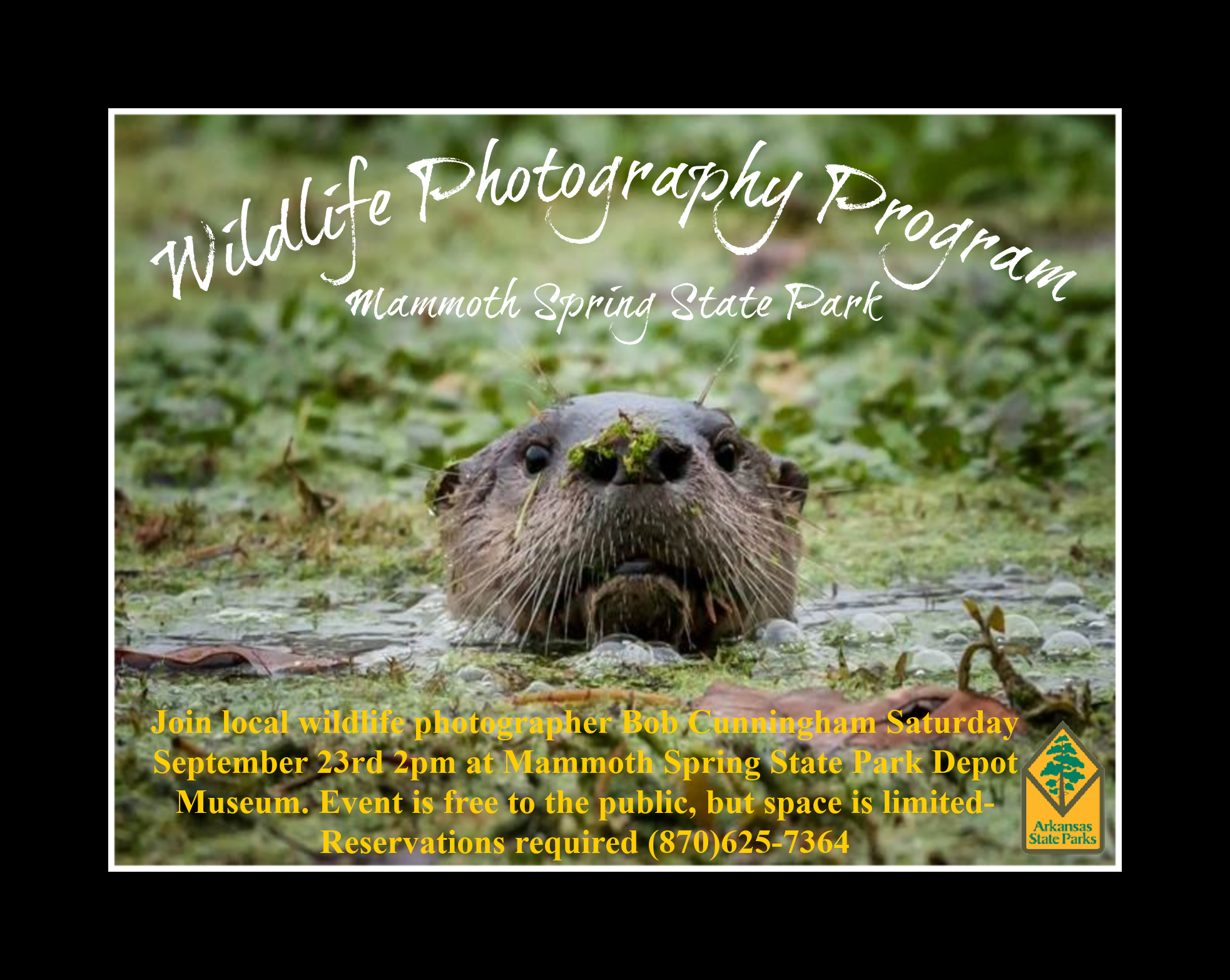
Mammoth Spring, AR. – Local photographers will have an opportunity to join wildlife photographer Bob Cunningham on September 23rd at the Mammoth Spring State Park Train Depot Museum as he shares his vast array of photos taken in and around the Ozarks.

Cunningham will share tips on hotspots in our area, and some of the best times of day to get that once-in-a-lifetime photo.

Advertisement

Richards Brothers Make Good

This event will be from 2-4 p.m. and is free to the public, but space is limited. Reservations are required. To register, contact the Mammoth Spring State Park at (870) 625-7364.

Advertisement

Wood & Huston

The best black and white photography: 2023 Mono awards

The best black and white photography: 2023 Mono awards
image

Owen Wright is a professional surfer. In 2015, he suffered a traumatic brain injury after a wipeout at the notorious Banzai Pipeline in Hawaii. In 2017, after much hard work and determination, Owen returned to the water to not only surf again but to win his comeback event.

Behind the Lens with ICM Photographer Joanna Proffitt

Behind the Lens with ICM Photographer Joanna Proffitt

When people see her work for the first time, they have a hard time believing Joanna Proffitt’s abstract photographs weren’t created using photo-editing software. On the contrary, her colorful, soft, painterly abstract images are created by Proffitt and her camera using a unique photography technique.

Much of Proffitt’s art is made with intentional camera movement (ICM). Using a slow shutter speed and movement, from her or from her subject, Proffitt creates arresting images.

“It’s very playful,” she says.

The results are always unique and can’t be replicated because they’re so dependent upon that singular pattern of movement and where the light is in that moment.

Though the Surprise resident had taken some photography classes at Glendale Community College, where she learned techniques like ICM, she’d let that hobby drop off to focus on her family and career as a legal assistant.

Proffitt has always considered herself crafty and creative, but a yoga class in an art studio got her thinking. She inquired about how to show work, and with “beginner’s luck,” the first photo she entered into a juried exhibition was accepted. She continues to exhibit her work at galleries around the state.

Proffitt largely shoots photography in her spare time and when traveling, taking inspiration from nature and architecture. She’s interested in capturing “things that are hidden in plain sight.”

“We’re so busy all the time – we’re on our phones, we’re rushing from one place to the next,” she says. “I think a lot of art is like that, capturing what a lot of people might miss, the magic in the mundane.”

See Proffitt’s work at joannaproffitt.com or on Instagram @joannaproffittphotography.

Hey Taylor: Tim Zeltinger & Coldsnap Photography

Hey Taylor: Tim Zeltinger & Coldsnap Photography

Native American Heritage Month: Indian Child Welfare …

11 hours ago


.cls-3{fill:#fff;fill-rule:evenodd}

Woman files for child abuse case dismissal – 091523

1 hour ago


.cls-3{fill:#fff;fill-rule:evenodd}

Rolette fatal crash

55 mins ago


.cls-3{fill:#fff;fill-rule:evenodd}

GAS INCREASE: WILL IT AFFECT SCHOOL BUDGET FOR SCHOOL …

1 day ago


.cls-3{fill:#fff;fill-rule:evenodd}

Northwood school bus crash

58 mins ago


.cls-3{fill:#fff;fill-rule:evenodd}

KX Conversation: Rural Food Sustainability Grant …

24 hours ago


.cls-3{fill:#fff;fill-rule:evenodd}

Working Out in the Fall

1 day ago


.cls-3{fill:#fff;fill-rule:evenodd}

Month of July Director’s Cut

1 day ago


.cls-3{fill:#fff;fill-rule:evenodd}

Marathon Weekend

1 day ago


.cls-3{fill:#fff;fill-rule:evenodd}

Equine Center Concerns

1 day ago


.cls-3{fill:#fff;fill-rule:evenodd}

North Dakota Sued

1 day ago


.cls-3{fill:#fff;fill-rule:evenodd}

KX Finance: Points and interest rates

1 day ago


.cls-3{fill:#fff;fill-rule:evenodd}

iPhone 15 fulfills a vision for photography shared with Steve Jobs over a decade ago

iPhone 15 fulfills a vision for photography shared with Steve Jobs over a decade ago

More than a decade ago, Steve Jobs likely had something in mind for the iPhone camera that was finally realized this week. iPhone 15 and iPhone 15 Pro have the ability to capture depth data from photos with people or pets, allowing you to adjust the focus after the shot. That’s a concept that was reportedly on Jobs’ radar before his death in 2011.

Apple introduced Portrait mode photography on the iPhone 7 Plus. The feature used a dual camera system to capture subjects with artificial blur applied to the background.

Comparisons to the Lytro light field camera were made at the time. Lytro was a lipstick-shaped pocket camera capable of taking photos with focus that could be edited in post. Apple added that ability to Portrait mode photos on the iPhone 15 and other phones this week.

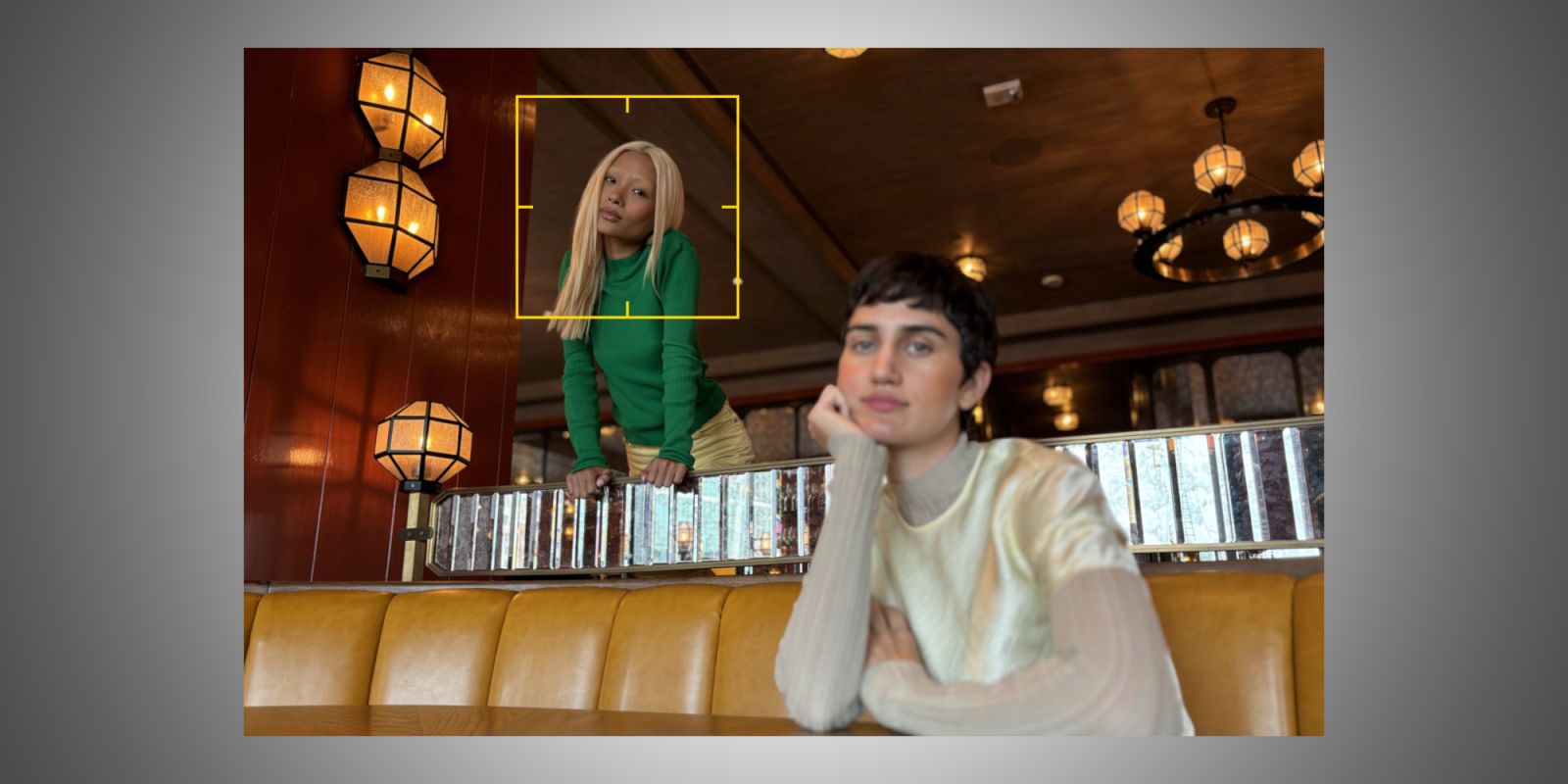
iPhone 15 and iPhone 15 Pro go one step further. If the camera system detects a person, cat, or dog in the shot, it will automatically capture depth data without using Portrait mode. This lets you adjust the depth effect or edit the subject focus after the fact without using a separate camera mode.

These all sound like features that Steve Jobs may have envisioned for the iPhone camera system. Jobs met with Lytro founder Ren Ng and received a demo of the Lytro camera before it launched. That’s according to Adam Lashinsky’s Inside Apple book from 2012.

The company’s CEO, Ren Ng, a brilliant computer scientist with a PhD from Stanford, immediately called Jobs, who picked up the phone and quickly said, “if you’re free this afternoon maybe we would could get together.” Ng, who is thirty-two, hurried to Palo Alto, showed Jobs a demo of Lytro’s technology, discussed cameras and product design with him, and, at Jobs’s request, agreed to send him an email outlining three things he’d like Lytro to do with Apple.

Lytro would go on to release its light field camera, but the iPhone was already dominating mobile photography by then. As for Apple, it was granted a patent for a camera system with the ability to change the focal point in post. A decade later, this is now how the iPhone camera system works.

FTC: We use income earning auto affiliate links. More.

Winners of 2023 Astronomy Photographer of the Year

Winners of 2023 Astronomy Photographer of the Year
Huge plasma arc next to the Andromeda Galaxy

“Andromeda, Unexpected” © Marcel Drechsler, Xavier Strottner and Yann Sainty. Overall winner and Winner Galaxies.
“A team of amateur astronomers led by Marcel Drechsler, Xavier Strottner, and Yann Sainty made a surprising discovery − a huge plasma arc next to the Andromeda Galaxy. Scientists are now investigating the newly discovered giant in a transnational collaboration. It could be the largest such structure in the nearby environment in the Universe. The Andromeda Galaxy is the closest spiral galaxy to the Milky Way. It is undoubtedly one of the most photographed deep-sky objects ever. The new discovery of such a large structure in the immediate vicinity of the galaxy was all the more surprising.”

Organized by the Royal Observatory Greenwich, the Astronomy Photographer of the Year contest is in its 15th year and has become a highly anticipated event for lovers of astronomy and astrophotography. And this year, a big discovery by a group of amateur astronomers won. Marcel Drechsler, Xavier Strottner, and Yann Sainty took home the top prize for their image of a large plasma arc next to the Andromeda Galaxy.

While Andromeda is one of the most photographed objects in deep space, the arc has never been previously observed. Scientists are now studying the plasma arc, which might be the largest structure of its kind this close to our Universe. The image highlights the key role that amateur astronomers still have in making discoveries about outer space.

“It’s an enormous honor for our team to receive this important award, and we are grateful for all the support, friendship, and encouragement we have received along our journey,” shares the team. “It encourages us to continue to pursue our passion for astrophotography and, of course, research with dedication.”

For their part, the judges were highly impressed by the quality of the image. “This astrophoto is as spectacular as it is valuable. It not only presents Andromeda in a new way, but also raises the quality of astrophotography to a new level,” says competition judge László Francsics.

The winning image from the youth competition was also a team effort. Runwei Xu and Binyu Wang, both 14 years old, share the title of Young Astronomy Photographer of the Year for their beautiful photo of the Running Chicken Nebula. The detail and clarity of their photograph prove that great astrophotography can happen at any age.

Other standouts include Monika Deviat’s photo of a green sliver of an aurora in isolation, which almost looks like a brushstroke and a rare glimpse of the Moon passing in front of Mars by Ethan Chappel. These photographs won the Aurorae and Our Moon categories, respectively. They were both awarded for their originality and the high level of skill needed to create the image.

Scroll down to see all the winners of the 2023 Astronomy Photographer of the Year competition. They will all be on display in an exhibition opening September 16, 2023, at the National Maritime Museum.

Check out the incredible winning astrophotography from the 2023 Astronomy Photographer of the Year contest.

Running Chicken NebulaRunning Chicken Nebula

“The Running Chicken Nebula” © Runwei Xu and Binyu Wang. Winner Young Astronomy Photographer of the Year.
“The Running Chicken Nebula, IC2944, is located in the constellation of Centaurus, 6,000 light years away from the Earth. Embedded in the nebula’s glowing gas the star cluster Collinder 249 is visible.”

Sun with a huge filament in the shape of a question markSun with a huge filament in the shape of a question mark

“A Sun Question” © Eduardo Schaberger Poupeau. Winner Our Sun.
“A photograph of the Sun with a huge filament in the shape of a question mark. Solar filaments are arcs of plasma in the Sun’s atmosphere given shape by magnetic fields. The photo is a mosaic of two panels.”

Abstract aurora in the shape of a brushstrokeAbstract aurora in the shape of a brushstroke

“Brushstroke” © Monika Deviat. Winner Aurorae.
“An abstract aurora in the shape of a brushstroke. Unusually, the photographer decided to photograph the aurora in isolation.”

Moon Passing in Front of Mars During OccultationMoon Passing in Front of Mars During Occultation

“Mars-Set © Ethan Chappel. Winner Our Moon.
“An occultation of Mars that took place on 8 December 2022. During the occultation, the Moon passes in front of the planet Mars, allowing the astrophotographer to capture both objects together. The image shows Mars behind the Moon’s southern side in impressive detail.”

View of Venus using infrared or ultraviolet false colorView of Venus using infrared or ultraviolet false color

“Suspended in a Sunbeam”© Tom Williams. Winner Planets, Comets & Asteroids.
“A unique view of Venus using infrared or ultraviolet false color. By going beyond the visible part of the spectrum, a myriad of fine detail within the upper atmosphere of the planet is revealed.”

Red sprites over the Himalaya mountainsRed sprites over the Himalaya mountains

“Grand Cosmic Fireworks” © Angel An. Winner Skyscapes.
“Sprites are an extremely rare phenomenon of atmospheric luminescence that appear like fireworks. An took this photograph from the highest ridge of the Himalaya mountains.”

New Class of Galactic Nebulae Around the Star YY HyaNew Class of Galactic Nebulae Around the Star YY Hya

“New Class of Galactic Nebulae Around the Star YY Hya” © Marcel Drechsler. Winner Stars & Nebulae.
“A team of amateur astronomers, led by Marcel Drechsler from Germany and Xavier Strottner from France, were able to make an important contribution to the study of the evolution of binary star systems: on old images of sky surveys, they discovered a previously unknown galactic nebula. At its center, a pair of stars surrounded by a common envelope was found. On over 100 nights, more than 360 hours of exposure time were collected. The result shows an ultra-deep stellar remnant that the team has baptized ‘the heart of the Hydra.’”

All of the winning photos will be included in an exhibition at the National Maritime Museum in Greenwich, London.

Haslinghen's Halo in LancashireHaslinghen's Halo in Lancashire

“Close Encounters of The Haslingden Kind” © Katie McGuinness. Highly Commended People & Space.
“Haslingden’s Halo is an 18-meter diameter sculpture located in the hills of Lancashire. McGuinness took inspiration from the Close Encounters of The Third Kind film poster to create her image. More than 150 images, taken over an hour and with exposures of 25 seconds each, were combined to show the apparent rotation of stars around Polaris.”

2023 Astronomy Photographer of the Year Winners2023 Astronomy Photographer of the Year Winners

“Black Echo” © John White. Annie Maunder Prize for Image Innovation.
“Taking audio source material from NASA’s Chandra Sonification Project, White visually captured the sound of the black hole at the center of the Perseus Galaxy.
The audio was played through a speaker onto which White attached a petri dish, blacked out at the bottom and then filled with about 3 mm of water. Using a macro lens and halo light in a dark room, White experimented with the audio and volumes to explore the various patterns made in the liquid.”

Stars in Namibia behind a shipwreck in the AtlanticStars in Namibia behind a shipwreck in the Atlantic

“Zeila” © Vikas Chander. Winner People & Space.
“The most northerly part of Namibia’s Atlantic facing coast is one of the most treacherous coastlines in the world and has gained the name the Skeleton Coast.
The ship in this photo, Zeila, was stranded on 25 August 2008 and is still in a well-preserved state. The image shows the delicate colors of different star types.”

Eyes Galaxies (NGC 4438)Eyes Galaxies (NGC 4438)

“The Eyes Galaxies” © Weitang Liang. Runner Up Galaxies.
“The Eyes Galaxies (NGC 4438) are the famous interacting galaxies in the Virgo Cluster. They’re small and require a large telescope to reveal their many components, such as the dust in the middle and the tiny flares on the left and right. Those tiny details have rarely been revealed on other amateur images.”

Last Full Moon of 2022 Featuring a Colourful Corona During a Close Encounter with MarsLast Full Moon of 2022 Featuring a Colourful Corona During a Close Encounter with Mars

“Last Full Moon of the Year Featuring a Colourful Corona During a Close Encounter with Mars” © Miguel Claro. Highly Commended Our Moon.
“A photograph of the last Full Moon of 2022 immersed in clouds. The colourful ring surrounding the Moon is a lunar corona, which occurs when moonlight is diffracted though water droplets in the Earth’s atmosphere. Mars can just be seen to the right of the Moon, appearing as a small orange dot.”

Photograph of a moonrise over the Xinghai Bay Bridge in DalianPhotograph of a moonrise over the Xinghai Bay Bridge in Dalian

“Moon at Nightfall” © Haohan Sun. Highly Commended Young Astronomy Photographer of the Year.
“A photograph of a moonrise over the Xinghai Bay Bridge in Dalian. Atmospheric extinction alters the hue and brightness of the Moon when it is low on the horizon. In this photo, you can see the Moon appears brighter and less red as it rises in the sky.”

Sh2-132 complexSh2-132 complex

“Sh2-132: Blinded by the Light” © Aaron Wilhelm. The Sir Patrick Moore Prize for Best Newcomer.
“The Sh2-132 complex lies near the border of the Cepheus and Lacerta constellations and contains multiple deep sky structures. The photograph includes 70 hours of data, the rich interplay of all the gasses reveals something different each time you look at it.”

Astronomy Photographer of the Year: Website | Facebook | Instagram

My Modern Met granted permission to use photos by the Royal Observatory Greenwich.

Related Articles:

20 Outstanding Winners of the 2022 Astronomy Photographer of the Year Contest

18 Otherworldly Finalists From the 2022 Astronomy Photographer of the Year Contest

Finalists of the Astronomy Photographer of the Year Contest Bring Us Exceptional Views of the Stars

Spectacular Finalists of the 2023 Astronomy Photographer of the Year Contest Explore the Stars and Beyond