Photography

Apple iPhone 15 Pro and Pro Max go all in on photography and performance

Apple iPhone 15 Pro and Pro Max go all in on photography and performance

Apple iPhone 15 Pro (left) and Apple iPhone 15 Pro Max (right).

Apple has finally announced the iPhone 15 Pro series, consisting of the 6.1-inch iPhone 15 Pro and 6.7-inch iPhone 15 Pro Max. Let’s get right into the details and learn about what’s new.

Titanium body, USB-C port 

Apple iPhone 15 Pro series' new titanium body with slimmer bezels.

The iPhone 15 Pro series (15 Pro and 15 Pro Max) uses a Grade 5 titanium alloy enclosure, the same titanium blend used for the Mars Rover. Shifting away from the old Pro series’ usage of surgical-grade stainless steel isn’t just a premium flex, but the new material weighs less while offering greater durability, with no change to its display sizes thanks to a reduced border around their displays. Like before, the Ceramic Shield front glass protection stays.

iPhone 15 Pro in Black Titanium, White Titanium, Blue Titanium, and Natural Titanium colourways.

Apple finished off its surface with a brushed texture and used PVD coating (physical vapour deposition) for colours. That means the four new colours use the base material to inform their base coat, and Apple named them as such: Black Titanium, White Titanium, Blue Titanium, and Natural Titanium.

Apple claimed that the new structural frame is easier to repair and uses recycled aluminium, which aligns with Apple’s sustainability goals.

A new tactile Action Button with haptic feedback means you no longer flick to silence, but you press and hold instead.

The classic ring/silence hard toggle/switch is now a tactile Action Button with haptic feedback. It can also be customised further with other functions, like accessing your camera, getting to preferred accessibility features, and launching shortcuts.

iPhone 15 Pro retains its 6.1-inch display, while the iPhone 15 Pro Max also keeps its 6.7-inch panel, both with Super Retina XDR panel type. It also retains all the old perks like Dynamic Island, ProMotion, an Extreme Dynamic Range, and Always-on Display. iOS 17 takes advantage of these display perks with a new feature called StandBy (an iOS 17 feature introduced during WWDC 2023).

@hwztech Your very first look at the iPhone 15 Pro in all four finishes. #hwz #hwzsg #iphone15pro #apple #wonderlust #iphone ♬ original sound – HardwareZone

USB-C iPhones are no longer a pipe dream. Like its regular series, the iPhone 15 Pro series also now has USB-C ports, and it supports reverse charging too — the demonstration by Apple showed an iPhone 15 charging AirPods. 

USB-C ports are also extra-fast on Pro models, with the new A17 Pro chipset’s USB controller conferring 10Gbps data transfer speeds and USB 3 support (more about the chipset below).

Apple A17 Pro chipset

Apple A17 Pro chipset for iPhone 15 Pro and iPhone 15 Pro Max.

While the regular series inherit the previous year’s chipset, the iPhone 15 Pro and 15 Pro Max get a new Apple A17 Pro processor.

The A17 Pro chipset is manufactured on a 3nm process, making it one of the first phones in the world with a chipset that has 19 billion transistors that are 12 silicon atoms-wide each. 

A17 Pro has a 6-core CPU: two performance cores that are 10% faster than before, and four high-efficiency cores which are three times more performance-per-watt than “the competition).

Apple A17 Pro chipset for iPhone 15 Pro and iPhone 15 Pro Max.

Also on board is a 2x faster, 16-core Neural Engine that processes 35 trillion machine-learning operations per second, on-device.

Apple also made good use of the space by including dedicated engines for AV1 decoding, the ProRes codec, and its display engine for ProMotion and Always-on Display features.

The new “pro-class”, 6-core GPU is 20% faster for peak performance and better sustained efficiency. Additional features are mesh shading (which sounds suspiciously like variable rate shading). Apple also added hardware-accelerated ray tracing, which adds realistic, responsive, real-time light and reflections in graphics-heavy content like games and AR apps.

iPhone 15 Pro series cameras

Main camera on iPhone 15 Pro and Pro Max.

iPhone 15 Pro (and 15 Pro Max) has an “equivalent of seven camera lenses in your pocket”, said Apple. 

Apple didn’t increase the physical number of lenses, though. It keeps to its same triple rear camera configuration, with a 48MP main camera with a larger sensor than its predecessor.

The Main Camera has a quad-pixel sensor (4×4 pixel-binning), and a new 48MP HEIF shooting mode. The additional computational work on its Photonic Engine also enables a default “super-high resolution” for still images. The camera also comes with “2x better low-light performance”.

The combination of new sensors, new engine, and better performance across the board also grants not one, but three default focal lengths for its Main Camera: 24mm, 28mm, and 35mm-equivalent shooting. These are popular fixed lens ranges for professional photography.

iPhone 15 Pro's 3x optical zoom via its Telephoto camera.

iPhone 15 Pro’s 12MP 3x Telephoto camera now has a 25% larger sensor, but that’s not the only feature. By default, it offers 3x optical zoom like before, offering a focal length of 77m. 

iPhone 15 Pro Max's tetraprism design for its telephoto, granting it 5x optical zoom.

The iPhone 15 Pro Max telephoto camera instead gets 5x optical zoom at an equivalent focal length of 120mm. Apple fitted the 5x optical glass structure by creating its “tetraprism” design (their version of a periscope zoom lens). Additional perks supporting its tetraprism design include OIS and sensor-shift stabilisation, which moves the sensor in 3D to maintain stability at 10,000 micro-adjustments per second.

Both 15 Pro and 15 Pro Max also get a 12MP ultra-wide camera with 13mm focal length, packing a new anti-reflective coating, a better Smart HDR, and the return of macro photography capabilities.

ProRes recording now gets 4K60FPS, up from its old 4K30FPS, on top of support for recording directly to an external storage drive. The new Pro series also works directly with Capture One post-processing software, supporting 48MP ProRAW. Log-format encoding is also built-in, which, in turn, supports ACES colour standards.

Apple iPhone 15 Pro and Pro Max prices in Singapore

Apple iPhone 15 Pro and Pro Max starts accepting pre-orders on 15 September 2023. Screenshot prices are from Apple's keynote, which is in US Dollars.

For the full range of prices on these 2023 Apple smartphones, don’t forget to check out our detailed pricing article.

In Singapore, the iPhone 15 Pro starts at S$1,649 for 128GB, with 256GB, 512GB, and 1TB variants also available. The iPhone 15 Pro Max starts at S$,1999 for 256GB, with 512GB and 1TB variants available.

Pre-orders begin on 15 September 2023, with street retail starting on 22 September 2023. Each purchase of iPhone 15 Pro or 15 Pro Max comes with three months of free Apple Arcade.

Summary of iPhone 15 Pro and Pro Max.

The underlying operating system, iOS 17, will be pushed out as an iPhone update on 18 September 2023.

For those using iCloud, the Apple cloud storage gets new 6TB (S$42.98/month) and 12TB (S$84.98/month) tiers, two higher tiers on top of its existing range of iCloud storage allotment.

Photographs that shaped the urban landscape

Photographs that shaped the urban landscape
Southmere Lake and Southmere Towers, Thamesmead, Greenwich, LondonTony Ray-Jones

Images of the often brutal urban landscapes of late 1960s Britain – captured by photographers working for the Architectural Review – can now be seen at the Royal Institute of British Architects (RIBA) in London.

Pictures by Ian Berry, Patrick Ward and Tony Ray-Jones, many of which have never been exhibited before, were taken as part of a series called Manplan. Its aim was to analyse the state of architecture and urban planning in Britain at that time.

Eight special issues were published from September 1969 to September 1970, with each issue devoted to an individual area of human activity that was considered to be affected by design and planning choices.

High-rise flats and multi-storey car park, Birmingham

Peter Baistow

Guest editors, including Lord Norman Foster and Virginia Makins, were invited, together with specially commissioned photojournalists and street photographers, to articulate the theme of each issue.

“This exhibition, with the raw power of its photographs, brings us back to a time of challenges, disparities, disillusionment, but also a time of questioning, protesting, campaigning – in many ways, much like our here and now,” says Valeria Carullo, exhibition lead curator and RIBA photographs curator

“It is a timely reminder of the importance of citizens’ participation in the decisions that affect their communities and the role architects can play in creating a fairer society.”

The exhibition can be seen until 24 February 2024, at RIBA Architecture Gallery in Portland Place, London.

Here is a selection of the photographs on show.

Workers' housing, Newcastle-upon-Tyne, with Dunston Power Station behind

Tim Street-Porter

Pepys Estate, Deptford, London

Tony Ray-Jones

Coppice County Junior School, Sutton Coldfield, West Midlands

Tom Smith

Christ's Hospital Band practising in the quad, Horsham, West Sussex

Tom Smith

Lillington Gardens Estate, Pimlico, London

Tony Ray-Jones

Salvation Army officers on the steps of the figure group Asia, Albert Memorial, Kensington Gardens, London

Peter Baistow

Housing in Newcastle

Tony Ray-Jones

All photographs courtesy Architectural Press Archive / RIBA Collections

Related Internet Links

The BBC is not responsible for the content of external sites.

‘I Lost Everything’: California Photographer Blames AI Bias for Instagram Ban

‘I Lost Everything’: California Photographer Blames AI Bias for Instagram Ban

That time, he was notified via email that his account would no longer be active, and with that, he lost more than 60,000 followers that he had cultivated for over five years.

“All of a sudden, one day, I lost everything,” Morton said.

His archive had more than 500 historic photographs, mostly in black and white, that captured images of cholo and African American street culture in Los Angeles.

A person wearing sunglasses stands with his hands in his pockets
‘Wolfe’ from El Hoyo Maravilla, a Mexican American street gang, in East Los Angeles, 1980. (Courtesy of Merrick Morton)

Among the notices Morton received from Instagram, one stated that his photos violated its community guidelines on violence or dangerous organizations. Those guidelines state that Instagram is “… not a place to support or praise, terrorism, organized crime, or hate groups.”

KQED reached out to Meta’s press office multiple times through email to request comment. Meta did not respond in time for publication.

Morton bristles at the idea that his photography belongs in the same category as terrorist organizations and hate groups like white supremacists. He defines his work as “fine art” and says his images have been displayed in many art galleries.

He said it’s also journalism. His work on street gangs has been published internationally. Morton’s goal is that he wants his photographs available to archivists, students, activists and historians. It captures a unique time and place in Southern California that the mainstream media has mostly ignored.

“I think I’m the only photographer in the ’80s who had the cholo culture, who also captured the Black culture and also captured the interactions with the police and these communities,” Morton said.

He’s seen how his photographs provoke discussions about ending the deadly warfare between rival street gangs in Los Angeles. His photos also raise questions about the fraught relationship between the police and the communities they patrol.

But someone — or some machine — has decided these historic snapshots needed to come down, and Morton can’t get an explanation from Meta, Instagram’s parent company. These experiences have left Morton to wonder if the problem stems from the skin tone of the people he features.

Making community and connections

Before Instagram took down his photos, Morton was building relationships with the friends and families of his subjects.

“I had people communicating with me through Instagram. Family members, I was getting back to them,” he said.

A few years ago, he reconnected with Charles “Bear” Spratley whom he met on the set of the 1988 movie Colors. Directed by Dennis Hopper, the film starred Robert Duvall as a Los Angeles Police Department veteran at odds with his rookie partner, Sean Penn, over how to manage their relationships with the Black and cholo street gangs whose territory they patrolled.

A screen shot of a photo of a man wearing sunglasses surrounded by other people making signs with their hands.
Director Dennis Hopper surrounded by East Coast Crips
on the set of his film ‘Colors.’ This photograph was taken down by Instagram. (Courtesy of Merrick Morton)

Spratley was an active member of the 89 East Coast Crips during filming. Through Morton, he was hired as an extra and received on-screen credit for working in the art department.

A few years ago, Spratley found Morton on Instagram.

“I had been looking for a way to get in touch with whoever was involved in those pictures for years. They were memories for us, you know,” Spratley said.

Once reunited, Morton learned that many of Spratley’s friends, whom Morton had met and photographed for Colors, had died on the streets. According to Spratley, the ones who are still alive have left gang life.

“A lot of these guys, if they made it through living, they are changed. They have changed their lives,” Spratley said.

After attending hundreds of funerals for young men from his community, Spratley founded an organization called B.A.B.Y., or Brothers Against Banging Youth, that works to prevent young people from joining gangs.

Morton, who currently earns a living as a set photographer for film and television, has helped Spratley find union entertainment jobs for young men who have gone through B.A.B.Y.’s programs.

Algorithmic bias in content moderation

For Morton, Instagram at its best connects people, challenges systems and creates opportunities. But at its worst, it perpetuates social biases against people of color. He suspects his photographs were swept up by artificial intelligence applications because of the skin color of his subjects.

To prove his point, Morton cites this side-by-side comparison: On the left, is a photograph he took that was removed by Instagram. On the right, is a photograph of the Hells Angels, a group that federal law enforcement calls “a criminal threat on six different continents.” The Anti-Defamation League has linked them to white supremacists.

Screen shots from two different Instagram accounts: outlawarchive of the left and marrickmortonphoto on the right.
OutlawArchive (right) is currently up on Instagram. (Courtesy of Merrick Morton)

When a machine moderates content, it evaluates text and images as data using an algorithm that has been trained on existing data sets. The process for selecting training data has come under fire as it’s been shown to have racial, gender and other biases.

Joy Buolamwini, a digital activist at the MIT Media Lab, has written that facial analysis software was unable to recognize her until she put on a white mask. She further demonstrated how artificial intelligence had trouble identifying three famous Black women: Oprah Winfrey, Serena Williams and Michelle Obama. Obama, for instance, was identified by artificial intelligence as a young man with a toupee in this video.

Buolamwini argued that “when technology denigrates even these iconic women, it is time to re-examine how these systems are built and who they truly serve.”

The pitfalls of content moderation

Despite his account being permanently banned, Morton believes that if he could get in touch with an actual human being at Instagram, he could explain why his archive should remain accessible to the public.

He did, however, manage to locate someone through his network who knew someone who worked at Instagram, and his original account was restored then. Once his images were back, Morton received a brief apology email from the Facebook Team on behalf of Instagram. (Meta owns and operates Facebook, Instagram, WhatsApp and more.)

Smartphone Photography Just The Way It Should Be: We Review the ASUS

Smartphone Photography Just The Way It Should Be: We Review the ASUS

Smartphone cameras have evolved in the past decade from merely being tools for documentation to being actual devices that can be used for art. With most smartphones getting bigger, what does this small phone actually have to offer?

No matter what kind of photography you do and your level of expertise, having a capable smartphone camera is a great way to keep yourself creative and inspired every day. Smartphone cameras are made to be portable and most of the time, are already in our hands, but they often have inevitable optical limitations that every smartphone manufacturer has been trying to surpass. At the end of the day, it is how the cameras on smartphones can make the creative process as simple and casual as possible but still deliver the best achievable quality of images that make them great tools for both casual photographers and even serious hobbyists. The ASUS Zenfone 10 was designed to be a small and easy-on-the-hands smartphone for users who would prefer it over large and often oversized screens. However, its size definitely does not represent its capabilities both as a productivity tool and a portable creative outlet.

Build and Design

The ASUS Zenfone 10 comes as a 68.1 mm x 146.5 mm slate with a width of 9.4 mm and weighs 172 grams. The front panel is almost entirely occupied by the 5.92” FHD+ AMOLED screen with a maximum brightness of 1,100 nits covered in Corning Gorilla Glass Victus and a small 4 mm hole for the front-facing camera. On the right side are volume buttons followed by a multi-function power button with a built-in fingerprint sensor for instant unlock when pressed with a registered finger (ideally the right thumb). At the bottom is a USB type-C port for charging and data, to its right is an accessory port for phone straps, while the Nano-SIM card slot is on the left.

The back is covered by a matte hard plastic surface that come in “Midnight” Black, “Starry” Blue, “Aurora” Green, “Eclipse” Red, and “Comet” White. This matte rear panel surface provides a unique yet comfortable grip experience compared to usual glossy glass panels found on most smartphones. On the top left corner are two 2 cm circular camera modules along with a small circular flash on the side.

Technical Specifications

The Zenfone 10 is equipped with a Snapdragon 8 Gen 2 processor and comes in three variants that differ in memory and storage combinations. The base variant comes with 8 GB of RAM and a 128 GB storage, the middle variant comes with 8 GB of RAM and 256 GB of storage, and the top-tier variant comes with 16 GB of RAM and 512 GB of built-in storage. There is, however, no removable memory card slot on any of the variants.

This small smartphone runs on a 4,300mAh battery that is capable of up to 30 W wired fast charging and 15 W Qi wireless charging. Alongside this, the Zenfone 10 is equipped with Wi-Fi 7 technology, Bluetooth 5.3, NFC, a Gyro sensor, an ambient light sensor, and a 3.5mm TRRS (headphone) port.

User Experience

The focus of the ASUS Zenfone 10’s design is providing a smartphone that can be comfortably held and operated with one hand. At the onset, turning the phone on and instantly unlocking the screen with the fingerprint sensor provides a seamless and hassle-free experience. Right-handed users ideally will have to use their right thumb as the registered fingerprint, while left-handed users technically can use any of the four fingers on the right side of the phone.

The phone runs Android 13 on a Qualcomm Snapdragon 8 Gen 2 Octa-core processor and Adreno 740 GPU. This particular variant has a 16 GB RAM and 512 GB storage, which has provided more than enough processing capabilities for day-to-day communications and social media usage as well as photo editing on Adobe Lightroom mobile and video editing on Adobe Premiere Rush. For such use, the phone’s battery has lasted remarkably long, with even extra battery life by the end of the day.

Cameras

The main camera is a 50-megapixel 1/1.56” sensor camera with an aperture of f/1.9 and has a built-in hybrid gimbal stabilizer inside the camera module that physically moves to hold and maintain camera position against unintentional movement from handheld shooting. The secondary camera is a 13-megapixel ultra-wide angle camera with an aperture of f/2.2 and roughly the equivalent perspective of a 12mm lens on a 35mm sensor. The front camera uses a 32-megapixel R GBW sensor for better low-light performance.

Photography Experience

Photography with the Zenfone 10 seems like it was absolutely intended by the brand to bring most of the things that a serious smartphone photographer would want to do into its capabilities and make it as hassle-free as possible to do so.

The native camera application offers the usual standard photo and video modes, portrait mode with manual depth of field simulation options, time-lapse, and slow motion video. At the same time, it offers a dedicated night photography mode along with full manual photo and video modes for absolute control of exposure settings.

However, the unique aspect of the user experience in smartphone photography with this phone is perhaps brought about by two factors, which are the AI processing and the hybrid gimbal. When using the basic photo mode, the AI Object Sense feature identifies the kind of subject or environment being photographed and identifies challenges in the lighting scenario. Given this information, it is able to adjust the exposure (and color) separately among the segments to achieve better balanced and detailed exposures.

In terms of using a bit more advanced effects, the “light trails” mode uses the camera’s gimbal to try and keep the camera steady to simulate a long exposure shot. However, instead of taking an actual long exposure that would be more prone to shake and might need an ND filter, the camera takes multiple exposures and automatically stacks them together to create a similar effect. There are various modes for traffic trails, waterfalls, and even stars that vary in the duration of the sequence.

Aside from the user experience, it was quite remarkable to see simply the level of detail that the main camera is able to deliver. While it will still have limitations in low-light situations (simply because of the compact sensor size), when shooting with enough available light, the output can be quite impressive. Using the Pro camera mode also offers a raw DNG output, which offers considerably more flexibility when it comes to details.

Video Experience

The Pro video mode on the Zenfone 10 has quite a number of options to offer. It can shoot as big as 8K at 24p, 4K at 24p or 60p, and FHD at 30p or 60p. It also allows full control of adjustable exposure settings through shutter speed, ISO, or the EV compensation shift. However, what truly makes this a convenient video camera is how the gimbal works both physically and electronically to keep the footage as steady as possible amidst any motion. When recording at FHD, you have the option to use “Adaptive Stabilization,” which detects how much movement is happening to the camera to determine whether it will have to crop the image to stabilize the footage or alternatively, the “HyperSteady” mode does a straightforward crop of about 20% of the image to prioritize keeping the footage smooth while also making smooth pan adjustments within the field of view to simulate how a gimbal pans and tilts when dealing with a lot of motion.

Conclusion

The Zenfone 10’s camera features bring together extended photography and videography capabilities, while still keeping the shooting process and the user experience as casual as possible. Smartphone cameras (in my opinion) are meant to keep photography as convenient and casual as possible, while still aiming to provide more options that will allow the owner to use it as a creative tool. With the combination of good processing algorithms and unique camera capabilities, the Zenfone 10 keeps smartphone photography fun and simple while giving the mobile photographer more room to be creative.

What I Liked

  • Big processing features in a small device
  • AI functions for better exposure and stabilization
  • Hybrid gimbal for steady shooting

What Can Be Improved

  • A possible variant with a telephoto camera
  • Physical customizable buttons on the empty left side

Moment refreshes popular MagSafe photography case for iPhone 15 series handsets

Moment refreshes popular MagSafe photography case for iPhone 15 series handsets

Joining all of the other new iPhone 15 cases that have hit the scene today, one of our favorite manufacturers is back with its latest collection. The Moment iPhone 15 case series continues to deliver some of the best options on the market, especially when it comes to photography-focused offerings.

Check out the new Moment iPhone 15 cases

While other brands are focused on launching an entire suite of new debuts for Apple’s latest, Moment is sticking with just a single new release today. As it does every year, the company is launching a photography-focused upgrade to your new handset that is compatible with its full lineup of accessories.

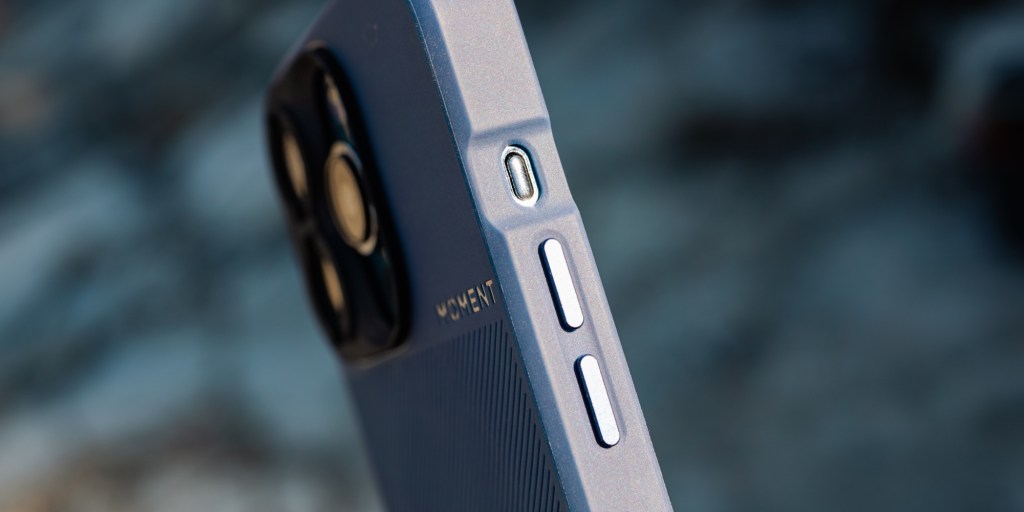
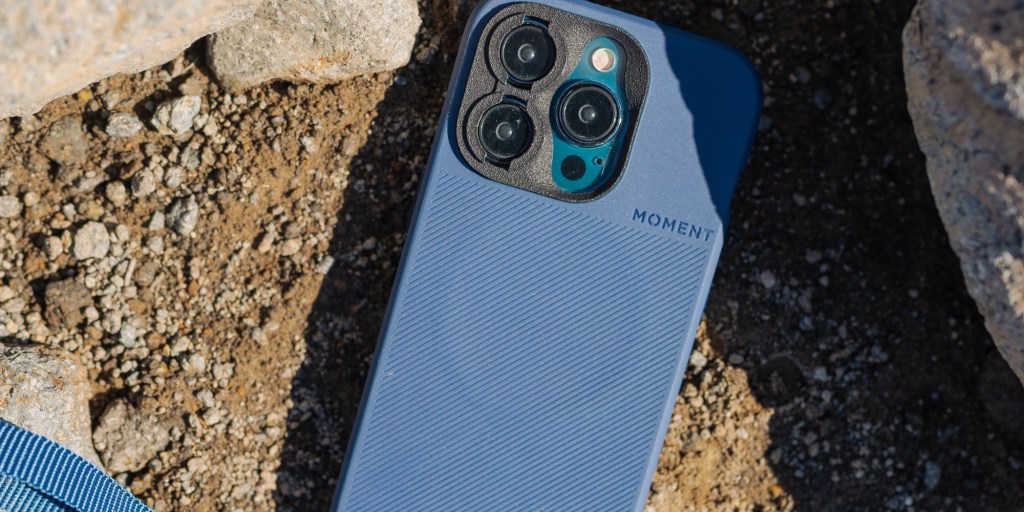
Meet the new Moment iPhone 15 Cases. This cover is largely the same as previous years, with the brand adopting an if it ain’t broke, don’t fix it mentality. In true Moment fashion, the covers have that signature textured backing with a ribbed rail on the outside for some added grip. On top of being designed to protect against 10-foot drops, there’s also the new fourth-generation TPU blend that is optimized for 5G connectivity, with some added polycarbonate to reinforce the whole package.

Moment iPhone 15 casesMoment iPhone 15 cases

But that doesn’t mean that Moment isn’t making any adjustments. In fact, there are quite a few upgrades that really do make this the company’s best case to date and not just a tweaked version for the new smartphone. The new Moment iPhone 15 Cases now all sport anodized metal buttons for an even more premium feel, with that same sentiment carrying over to an extra-soft microfiber lining on the inside to protect your device.

There’s also a thinner (M) Force magnet array that, on top of being slimmer than previous models, is also 15% stronger. It’ll, of course, work with MagSafe charging, but Moment is also backing it with support for the Qi2 wireless standard, as well.

Moment iPhone 15 casesMoment iPhone 15 cases

The new Moment iPhone 15 cases are now going up for pre-order before shipping next week. They’re slated to begin leaving the warehouse on September 22, which is when the new iPhone 15 devices will begin arriving. The covers will sell for $49.99 each and come in several colors.

Today’s reveals of the new Moment iPhone 15 cases arrive just shortly after the company launched its new smartphone lenses. Of course, the new covers are compatible with these accessories, which were designed to pair with Apple’s latest and take full advantage of the refreshed camera array. We fully break down what’s new with the updated T-Series lens collection, which is now beginning to ship, to go alongside the new cases.

To go alongside the cases, Moment also has a new screen protector. The $9.99 offering is just 0.3mm thick and has an oleophobic coating to repel oil and reduce fingerprints.


Subscribe to the 9to5Toys YouTube Channel for all of the latest videos, reviews, and more!

Recent VideosRecent Videos

How a supermodel negotiates the ethics of fashion photography

How a supermodel negotiates the ethics of fashion photography

The history of fashion photography is one of power dynamics: a push and pull of a photographer’s imagination and a model’s desire to complement it. The photographer manipulates the model and vice versa — melding into an image of beauty, ambiguity, aspiration and curiosity at the foundation of how clothes reflect the values of our times.

The 31-year-old model Paloma Elsesser has disrupted that structure. One of the most in-demand models of her generation — a bona fide millennial supermodel — she describes herself as “an agitator.” Walking for brands including Versace, Michael Kors and Eckhaus Latta, she is plus size and mixed race, and her extraordinary appearance has challenged the fashion world’s attachment to the idealized woman.

Remarkably open about her body and a model’s role in the construction of beauty standards, she challenges the assumption that the very business of modeling is to be seen, not heard.

“I have agitated what was once the standard — even what was once the standard for plus-size models,” she said, adding that plus-size models were typically required to be “bombshell and commercial.” Still, she said, “there’s just so much work that needs to be done — fundamentally in fashion, [with people] just having empathy, period.”

Sharp. Witty. Thoughtful. Sign up for the Style Memo newsletter.

Elsesser is once again pushing boundaries with a new book, “Treasure,” documenting in intimate detail breast surgeries she underwent in 2019 and 2023. The project wouldn’t have been possible without its photographer, Zora Sicher, 27, who first photographed Elsesser for i-D Magazine in 2016, “when the female gaze was a very popular term,” Sicher said on a recent phone call with Elsesser. Sicher has been one of Elsesser’s go-to photographers since, especially on collaborative projects such as the model’s plus-size capsule for the influencer-favored brand Miaou.

Both have transcended fashion’s propensity for typecasting, Elsesser in particular; despite ongoing cheers about “body positivity,” plus-size models, a category that usually means a woman who is a Size 12 dress size or higher, are less present on the runway than in recent memory. Fashion search engine Tagwalk reported at the end of the Fall 2023 season that the overall number of plus-size and midsize models on the runway dropped by 24 percent from the previous season.

“Treasure” is an intimate and at times disturbing series of images, documenting pain and blood and scarring. It perhaps gently suggests that empathy can be a way of finding beauty. “I trust her not just on a friend level, not just on an artist level, but on a truly fundamentally moral and ethical level,” Elsesser said of allowing Sicher into the operating room to photograph her sliced nipples and breasts.

Many other models of her set have started clothing or makeup lines. A book documenting two painful plastic surgeries — a breast reduction with the insertion of two implants to maintain the roundness of her breasts in 2019, and the subsequent removal of the implants in 2023 — certainly makes a drastic statement. “People are very uncomfortable stepping outside of who they’re told to be,” Elsesser said. But what motivates Elsesser’s career moves, she said, is the process of negotiating the world of modeling “morally and ethically.”

Not everyone admires that outspokenness, she pointed out, which is part of what makes Elsesser such a significant presence in the modeling world. “Zora and I are so upfront about the way that we see and feel,” she said, adding that she and Sicher enjoy existing “on the edges of our industry.” Both carefully interrogate their projects and collaborators, feeling as if their choices and alignments represent something deeper about who they are.

Considering that, following the #MeToo movement, many magazines stopped working with photographers accused of misconduct and put guardrails in place to ensure models’ safety on set, there is something utopian about the model-photographer relationship between Sicher and Elsesser, which makes the book notable on its own.

But then there are the images themselves. They are not designed as a foil to, say, clinical imagery of surgeries — which is often rife with ethical ambiguities — nor is it just an antidote to the lascivious photography of classic fashion photographers such as Helmut Newton, whose images for Vogue often glamorized plastic surgery as a high-tech form of BDSM. As Elsesser put it, “These aren’t modeling images,” executed with the lighting and angles that would capture a model at her most pristine. Though they are in intriguing conversation with both kinds of photography. (Sicher points out the anonymity of medical textbooks, in which identifying features are generally blocked out, which can feel dehumanizing.)

Instead, these images inspire empathy. Elsesser and Sicher said that was one of the most rewarding parts of taking the images: the conversation that has emerged between each other and their friends around the grades of vanity that cosmetic surgery seems to inspire. Breast implants are remarkably common, Elsesser said, and “they’re appreciated and valued when they’re perfect and they’re done, and it’s pornography and images — if they look natural, or they don’t and they look like a spectacle. But one person vulnerably engaging with that conversation — it’s suddenly uncomfortable. It’s suddenly, ‘You don’t love yourself.’”

Sicher finished Elsesser’s sentence: “Which is sort of what drove me to ask a lot of these questions,” of herself and of Elsesser while capturing the images. “Most of the time, we’re just talking [while taking the photographs]. My approach to photography has always been way more emotional than it is technical.”

For the Love of Dance Photography: Whitney Collins Q&A

For the Love of Dance Photography: Whitney Collins Q&A

Whitney Collins is a fine art dance photographer based in Savannah, Georgia, whose curiosity about photography was kindled when she got married and hired a wedding photographer. Not only was she impressed by the fee the photographer commanded, but she also got the opportunity to take a few shots herself and was immediately hooked. She started her business with a holiday shoot in a local park, but as a former dancer, soon gravitated toward dance photography. That was when her career took off.

She started a Facebook campaign called “For the Love of Dance,” which propelled her business forward. Now, she stays active in her local dance community as a sponsor of local dance events. Collins’ advice to photographers just starting out is to find three people who exemplify your ideal client and give them excellent service and photographs. From there, word will spread.

In the most recent round of The Portrait Masters Awards & Accreditation, Collins was the sole photographer to achieve the coveted Fellow accreditation, the highest level possible. She also had images place in the Black and White and Dance categories. You can see them in the Awards Gallery.

Find more business advice from Collins in the Q&A below, and hear her talk about her business on The Portrait System Podcast with host Nikki Closser.

© Whitney Collins

What has been your biggest breakthrough in business? 

That the actual art is not the most important element of your business. You can be THE BEST artist, but if you don’t know how to run a business, or you don’t believe in your own value, you won’t succeed.  

How did you push past fear when building your business? 

I realized that my fear stemmed from my own limitations and beliefs about myself. I also believe that sometimes you just have to do things scared. You can’t wait until the fear passes to take the next step. Each time you step through the fear, you gain confidence in your ability to do it again. I accepted that fear would always be present when I put myself out there, but that it didn’t have to paralyze me and prevent me from moving forward.  

© Whitney Collins

What has been your biggest accomplishment since starting The Portrait System? 

Being able to leave my teaching job without going into debt. I am currently running a 6-figure dance photography studio and living life on my own terms.  

For someone starting out on their photography journey what advice would you have for them? 

Keep it simple. You don’t need a studio and fancy equipment to get started. It’s so easy to look at where others are in their journey and get impatient, but pace yourself! Like so many others, I started in a spare bedroom, and I worked my way up to industry-standard pricing in a low-risk environment. I had a full-time job, so I was never desperate to make money, and I think that made a huge difference.  

© Whitney Collins

How has The Portrait System changed your life for the better? 

The self-value work has been the most life-changing in all areas of my life! I have always struggled with confidence and self-worth, and if it wasn’t for TPS, I don’t know that I would have believed in myself enough to start my business and leave teaching.  

The Portrait System Podcast helps portrait photographers navigate the world of photography, business, money, and much more. Hosted by Nikki Closser, the podcast is powered by The Portrait System, a comprehensive, online educational platform that teaches all aspects of running a successful portrait photography studio. If you’d like to be a guest on The Portrait System Podcast, send them a voice message. 

The Art of Draping – by Lola Melani

The Art of Draping II – by Lola Melani

The Art of Draping Bundle

Photography education: Virtual Photographic Vision Summit

Photography education: Virtual Photographic Vision Summit

Photo education comes in all shapes, sizes and prices these days. I’ll be part of a virtual Photo program at the end of the month. The Summit is only $29 for the day. The good news is you don’t necessarily need to be present to win. Signing up gives you access to view the recordings for 60 days. Here’s the link.

Virtual Photographic Vision Summit

This summit is organized by Hazel Meredith of Meredith Images in Tennessee. She, along with myself and two others, will be the speakers on the 30th of September in a ZOOM presentation.

Speakers and their presentations

Cheryl Belczak, with a background in graphic design and product photography will be focusing on Still Life and Easy At Home Photography.

Images © Cheryl Belczak

In this session, she will explore the elements to easily create still life photos at home. From choosing the best light for your subject, finding backgrounds, tabletops, subjects and props, to picking the best camera angles and arranging the scene – there will be a lot of tips, tricks and ideas to make still life at home easy.

Ken Fisher is an Adobe Certified Trainer in Photoshop and Lightroom. His program will involve showing Photoshop Advanced Techniques.
In Ken’s class it’s a deep dive into Advanced Photoshop, but exactly what does Ken mean by advanced? Here’s his explanation in the form of an example: A driving test.

When you take a driving test, it means you have convinced an instructor that you are competent to perform a series of maneuvers safely in your chosen car. Does this make you a safe driver? No, you don’t really start to learn how to drive until after you have passed your test.

Images © Ken Fisher

Before passing test: Hands on steering wheel at 10 to 2.

After passing test: Window open, elbow on window holding can of coke, steering with one hand and listening to your fave tunes at 120 decibels. In short, over time you develop your own style of driving.

Learning Photoshop is a little like that, only you are driving a computer. First learn the basics, tools and commands and what they do. Then comes the advanced part, putting it all together to complete a project. This is important because a task can often be achieved in many different ways and with different tools. All will get you to the desired end point but some tools will not suit the task at hand.

In this class, Ken plans to show you how to drive Photoshop. He will show you how to select the best tool for the job and why, and take your image editing to the next level.

Hazel Meredith is an award-winning photographer and a sought-after teacher, speaker, and competition judge. She began teaching in 2007, and now does seminars at camera clubs and conferences across the U.S., both in-person and virtual. She offers her own workshops and webinars, and has done webinars for several software companies.

Images © Hazel Meredith

Here’s Hazel’s program on Post-Processing with Plug-ins. She will demonstrate some of her favorite plug-ins. Some of them you may have heard of, and a couple you may have not! See how Hazel shows you how to take your favorite images from good to a work of art!

Bob Coates (Hey, that’s me!) is a commercial, nature, fine art photographer and photo educator based in Sedona, Arizona. My program will be on Nature, Landscape and Wildlife from Pre-Capture to Post-Processing.

Images © Bob Coates

I’ll be sharing the thought process on how I capture and process Landscapes, Wildlife and Nature images. Starting with the thinking behind gathering images, and the final output the conversation will cover gear used and why. I favor micro four-thirds camera and lens systems of Panasonic and Olympus. However, all techniques shared can be accomplished with any camera system. Camera supports can be of great help when making multiple exposures for panoramic, focus stacking and exposure bracketing image capture.

Who knew that a tripod could help with camera artistry? I’ll be showing how to leverage imaginative uses of Platypod and Fotopro tripod supports. Once images have made it to the sensor, more creativity can be applied using software like Adobe Photoshop, NIK and Luminar, and other filters and techniques. Discussion of possibilities in processing will wrap up this talk followed by any questions you may have.

Hopefully I’ll see you at the Virtual Photographic Vision Summit on September 30th.

Yours in Creative Photography, Bob

Iconic Australian photographer reveals why he’s voting No in the Voice

Iconic Australian photographer reveals why he’s voting No in the Voice

Ken Duncan: Iconic Australian photographer reveals why he’s voting No in the Voice referendum – after devoting his life to helping remote Aboriginal communities

A renowned Australian landscape photographer who founded a non-profit working with Aboriginal communities has revealed why he is voting No in the Voice to Parliament referendum. 

Ken Duncan OAM, 68, established the Walk a While Foundation 20 years ago, which seeks to empower First Nations Australians through creative and visual arts.

‘They already have a voice and no-one is listening,’ Mr Duncan told TNT Radio. 

‘That’s why I made this foundation, the government is failing miserably… Aboriginals in some of these remote communities are living in third and fourth world conditions.’

Acclaimed landscape photographer Ken Duncan has worked with Aboriginal communities for decades and said throwing money at bureaucracies isn't helping

‘We need to be going out to these communities and asking Indigenous people what do you need for sustainable outcomes in your communities.’

‘We find these things out then be prepared to walk a while with them and equip them with the skills that are going to be required.’

Mr Duncan said the ‘process is the problem’.

‘Even with a Voice whatever they come up with it will all have to go through the same process with the land councils and things like that that are already failing.’

He compared it to a ‘big funnel’ in which money goes in the top, filters through government and other organisations and a fraction makes it to the communities where many of the programs set up fail in the first year, he said. 

‘We think the Aboriginal people own the land but they don’t it’s the land councils. these people can’t do anything on their land without permission.’

‘They has a $550million royal commission about Aboriginal youth in custody and what’s changed? Nothing.

‘If they’d given us that $550million we could have solved some problems.’

‘It stems from poverty, these youths go into towns and there’s nothing for them to do because in these remote communities you need permits so how is anyone going to get a business up.’

Australians will be asked to Vote on whether to alter the Constitution to establish an Aboriginal Voice after two centuries of silencing through colonial rule

‘We need to stop pouring money into the top and get it to these communities and another level over the top will do nothing. Personally I’ll be voting no,’ he said.

Mr Duncan said there were ‘all these unused buildings’ in these remote communities. and when his non-profit wanted to get one for a creative arts centre, it took seven years.

‘We need to send teams in to these communities to find out what they want and actually stay there and walk with them a while, not just throw money at the problem.’

‘If you do it right you will make yourself redundant and these communities will sustain themselves.’

Proponents of the Indigenous Voice say it will be a monumental step forward for Australia on par with Aboriginals being granted the right to vote in 1962.

What Photography has taught me about music

What Photography has taught me about music

What Photography has taught me about music

Andrew Tasselmyer explains how his new found passion for photography taught him how to change his mindset about making music and overall improving his creative process.

by ANDREW TASSELMYER of Sound Methods via Soundfly’s Flypaper blog

If you’re like most people I know, you probably learned a thing or two about yourself while shut inside during the depths of the COVID-19 pandemic, especially in early-to-mid 2020, when the depths seemed to be their darkest and most claustrophobic. My biggest realization from that time was just how much I crave the mental/psychological satisfaction of learning new things.

The sudden absence of musical performances, inability to travel abroad, barrage of video conferences and screen time, and the vanishing of all kinds of other enriching real-world, in-person interactions I took for granted in the “before times” really did a number on my mental state. 

This probably explains some of the educational projects I took up that year, in pursuit of new experiences: I made the switch from Logic Pro to Ableton Live; my wife and I learned how to brew kombucha ourselves; I figured out how to stop the cycle of “shanks” in my golf swing by simply distributing my weight further back toward my heels at address… 

Big things, all of them, in those days.

I also learned, for the first time, how to properly wield a camera. Or at least, how to press a shutter button, and what words like “aperture” and “shutter speed” were actually referring to.

Wielding a camera in Philly; May 2022.

Despite what I now realize to be some pretty obvious parallels and complements to musical expression, photography was simply one of those things that I felt utterly unqualified to practice. My knowledge of photo-making was, essentially, tinkering with the camera and editing apps on my iPhone, slowly adjusting dials here and there to eventually come up with an image I thought looked okay. 

ME: “Hey, wait a minute…isn’t that what I’m already doing with my music half of the time?”

AUDIENCE: [roars with laughter]

In all seriousness, this isn’t far off from the train of thought that led me to buying my first non-iPhone camera. Why couldn’t this be different than the musical path that led me to learn trombone, then bass guitar, then drums, then modular synthesis? 

Reading manuals and studying new material had never scared me, but I think I felt some kind of pressure to make a “good” photographic product as a result of this, like I was releasing an album for review or something to that effect. I was worried that the photos I’d be making wouldn’t be good enough to justify the expense.

I had to shake off some (misplaced) anxiety about putting unnecessary, sub-par content into the world, and just remind myself why I was interested in taking photos to begin with. 

Any musician or creative person sharing their work can probably relate to this experience in some way: it’s a totally unhealthy way of thinking about creative practices, and the self-doubt convinces you that the world doesn’t need to hear from you, that your contributions have no value, and you shouldn’t bother taking that first step.


So, while I was selling some gear to come up with the funds for my first camera, I started the endless, mind-numbing research and spec sheet comparisons for entry-level mirrorless cameras. Eventually, at the recommendation of my brother, I picked up a used Canon M50. 

Truthfully, my primary use case was filming high-quality video in a low-light basement studio. The added benefit of taking photos and documenting the world around me in a visual way, not just through field recordings, was a nice bonus. I felt I could justify the purchase this way.

Philly: Winter 2021 with the Canon M50.

Fast forward three-ish years later. Now having 3 mirrorless cameras and having taken thousands of photos, I’m by no means a “good” photographer…at least not in the traditional sense. I still feel that I don’t fully know what I’m doing in every situation, and I’ve filled up a lot of space on my memory cards with bad shots. It’s pretty common for my photo outings to return 0 useable shots. I have so much to learn, but that’s exactly why I keep going. It’s been a rewarding and humbling experience to learn how to take better photos, and it feels just as challenging, rewarding, and open-ended as making music. 

I wouldn’t call myself a “good” musician in the traditional sense, either, and I see so many parallels in my DIY, make-it-up-as-I-go approach to these two art forms.

Spending a few years behind a lens has permanently altered my perspective of the world, and I’ve learned so many things about myself and my musical practice as a result. I thought it would be worth sharing 3 things that photography has taught me, all of which I apply to my music-making process.

Lesson 1: Lack of Technical Skill Doesn’t Mean Lack of Worth or Merit

Being an improving novice at photography has given me a whole new outlook on my music. It’s given me an alternative outlet to process my inner desire to be creative, and I feel refreshed when I’ve stepped away from the DAW, focused on my cameras instead, and progressed with my photography skills. 

No matter how the photos look in the end, it’s still worthwhile to me when I know that I’ve done something to better myself. I take great satisfaction in every new experience with my camera, and I can feel the ripple effects on my musical motivation.

Just having a camera on hand has trained my eye to look for “small moments” and notice things about a performance that would have passed me by without it. 

Expression is the ultimate goal of my artistic practice(s), not the quality of the finished good. I have a natural, deeply felt desire to make stuff, and I live to feel the thrill of the creative process playing out as it happens. It’s a rush I can’t live without. 

Having a camera available, especially on tour and while making music with others, is another way for me to feel creative.

Just knowing a camera is available has helped me see these experiences in new ways. Even if the photos aren’t technically great, they’re deeply meaningful to me, and I’m glad I took the time to try at all. 

Lesson 2: Don’t Forget to Have Fun

One of the quickest ways to learn the ins and outs of a camera is to do weird things with it: mess with slow shutter speeds for blurred lights; overexpose an image for washed-out artifacts; throw an object in front of the camera to obscure the focus… play around and see what happens. It doesn’t have to be perfect.

I try to do the same with music by setting up regular “play time” with my gear. I do weird things with no intention aside from experimentation. I simply have fun with it. If we don’t remind ourselves of how fun music can be, it can feel tedious. 

Take time to play and reorient yourself with equipment you think you know: wipe your presets and start fresh!

Playing with low shutter speed at night; 2022. I had no idea what I was doing at the time these photos were taken…I must have spent hours waiting for cars to pass, just to see the effect that different settings would have on the photos. 

I talked about this notion of “play time” at great length in an interview I did for Fifteen Questions in 2022; perhaps you’d like to read it here for a deeper discussion of this concept.

“I feel like I keep using the word “playful” but I really do feel strongly that whatever I’m making should have some element of fun and play involved. In that sense, the creative state probably feels like a playground in my mind…just trying stuff, seeing what sticks, learning new things. I don’t like the idea of excessive reverence for music, or the inflated sense of self-importance you sometimes hear when people talk about music they’re making or enjoying. Just not my style.”

Lesson 3: Make as Much as You Want

When I was learning my way around the camera with my M50, I had to constantly remind myself that it wouldn’t hurt me to just, you know, take a photo every now and then! For some reason I was trying to “conserve” space on my memory card unnecessarily; I was treating digital bits and bytes like finite and precious resources to be conserved. I think the same risk is present for digital music. 

Of course, analog storage is another matter… film isn’t cheap, nor is analog tape. But for digital art like I’m making, what’s the excuse to restrain myself?

Occasionally, I have to remind myself that it’s okay to have 2, 3, 6, 10 versions of a track even if I’m the only one who can hear the subtle variations between them. Don’t hesitate to record multiple takes and experiment with new approaches. Let it fly and keep moving forward to find the best result, and don’t stop until you’re satisfied. 

Don’t like the result? Delete it and try again.

I think a lot of Daido Moriyama when I catch myself exercising an excessive amount of restraint. He’s one of my favorite street photographers who’s well known for his “aggressive” style of high-contrast images with the Ricoh GRIII. He is a prolific, high-volume shooter, as he describes in most of his interviews about his practice:

“I go ahead and take photos one after another. If I fail, I take another one again. I do not look back on life. Photography is the same for me.” – Daido Moriyama (for Ricoh Japan)

I love this approach. It inspires me to be bold and stop overthinking things. Take the shot! Make the recording! And if you don’t like it, simply try again. 

There’s nothing to lose.