
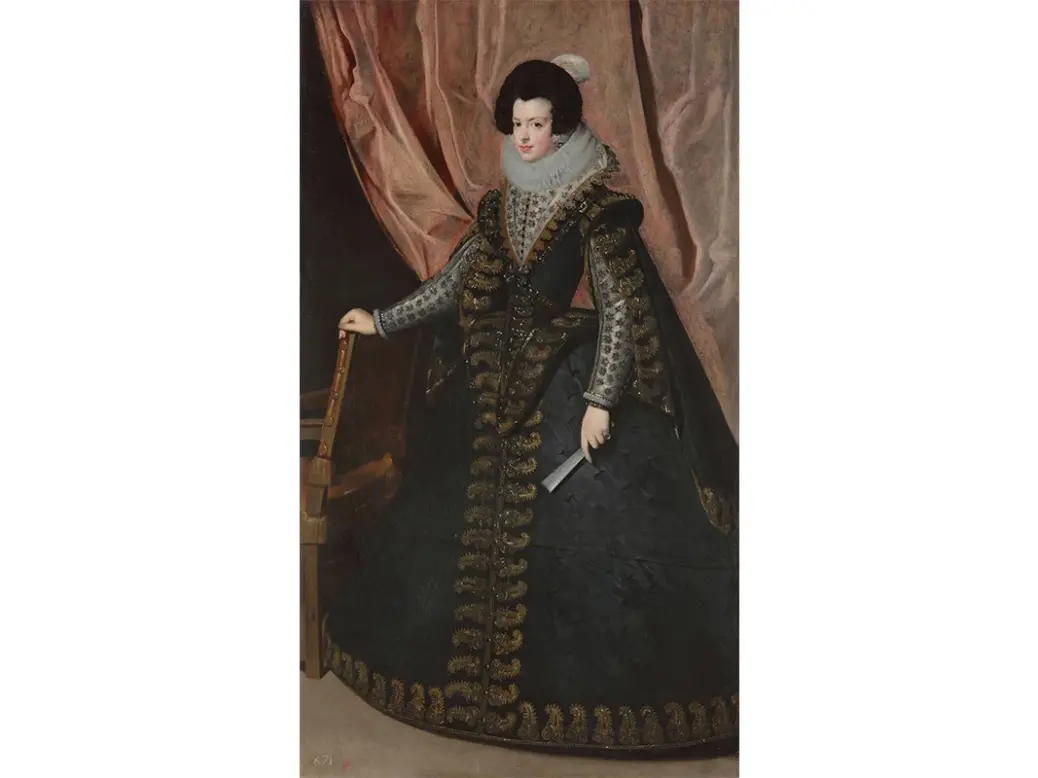
An ‘exceptional’ 17th-century royal portrait by celebrated Spanish artist Diego Velázquez has gone on display at Sotheby’s London ahead of being auctioned in New York in February.
The 2-metre tall portrait of Isabel de Borbón, wife of King Philip IV of Spain, has been described by industry experts as ‘the most important Velázquez to be sold in 50 years’ and ‘one of the most valuable Old Masters to ever come to market’.
Such portraits of royalty typically remain in royal collections and museums, meaning this sale presents a rare opportunity to own a piece of art – and royal – history. Sotheby’s anticipates the portrait will realise in the region of $35 million, more than double the current $16.9 million record for the sale of a Velázquez.
Diego Velázquez at the height of his portrait powers
‘This exceptional painting is remarkable not just for its beauty and quality, but also for its scale and subject matter,’ explains George Wachter, Sotheby’s chairman and co-worldwide head of Old Master paintings.
‘Royal portraiture allowed Velázquez to push forward art in new and revolutionary ways and this grand portrayal of Isabel de Borbón is an exceptional example of the artist at the height of his powers, shaping the direction of portraiture for generations to follow. No other Velázquez paintings of this scale and importance have come to the market in more than half a century.’
[See also: the most outstanding art advisers for ultra-high-net-worth individuals]
This tour de force of portraiture depicts Isabel de Borbón, who as the first wife of King Philip IV of Spain (King Philip III of Portugal), was Queen of Spain from 1621 until her death in 1644, and Queen of Portugal from 1621 to 1640. She was the daughter of Henri IV of France and his second wife, Marie de Médicis, and known as Élisabeth de France prior to marriage. The union between Isabel and Philip strengthened the diplomatic ties between France and Spain.
Content from our partners



A towering portrait of an admired queen
The queen was painted by Diego Velázquez in the 1620s, alongside a portrait of her husband, both of which hung at Madrid’s Buen Retiro Palace. (Velázquez’s Philip IV in Black, is now at the Museo del Prado). Isabel is depicted at the height of powers – a beloved and respected Queen, widely admired for her quick wit, intelligence and generous spirit. This is reflected in her stance, attire, and demure yet confident expression.
[See also: The top art finance advisers for high-net-worth individuals]
Velázquez revisited the portrait in the 1630s, reworking various aspects, including visible changes to the skirt. It is understood this revision was prompted by the artist’s recent encounter with Sir Peter Paul Rubens, then regarded as the greatest artist of the time, and still today a giant among painters.
Christopher Apostle, Sotheby’s international head of Old Master paintings, explains: ‘Though Velázquez was already widely celebrated when he painted this work, here we see him at a moment of transformation. He had already been crowned official painter to the Spanish King, but in 1628, he met, for the first time, Sir Peter Paul Rubens, whose confidence with the brush, and whose fluid style Velázquez quickly adapted, making of them something entirely his own, and – in the process – taking the art of royal portraiture to the next level.’
[See also: Sale of Rothschild treasures soars above estimates at first of-its-kind auction]
The painting has an illustrious provenance. After Napoleon’s invasion of Spain in 1808, it was taken to France, where it was later displayed in King Louis Philippe’s Galerie Espagnole at the Louvre until the king’s fall from power in 1838. It was then sold to merchant banker and noted book collector Henry Huth, who hung it at Wykehurst Park in Sussex, and in whose family it remained until it was sold in 1950 – the last time it was on the public auction market. It has been in the collection of its current owners since 1978.
Isabel de Borbón, Queen of Spain by Diego Velázquez will be displayed at Sotheby’s New Bond Street Galleries until 6 December. It will be auctioned in New York as part of the annual Masters Paintings auction on 1 February 2024.
The auction follows the sale of Picasso’s Femme à la montre for $139.4 million at Sotheby’s New York in November.
Discover more with Spear’s: Why is wealth management becoming more progressive and ‘values-driven’?
[embedded content]





