Prendergast Library to Present Photography, Herb Cooking Class as Part of Murray L. Bob Community Education Initiative

Prendergast Library to Present Photography, Herb Cooking Class as Part of Murray L. Bob Community Education Initiative

The James Prendergast Library will present a photography class in May as part of the Murray L. Bob Community Education Initiative.

Local photographer and Infinity instructor Cathy Panebianco will lead “Artistic Photos with Just a Smartphone” at 5:00 p.m., Tuesday, May 9 at the library. The class will offer participants an opportunity to improve cellphone photography skills by learning the basics: settings, techniques, lighting for exposure, and composition.

A smartphone is needed for the class. To register, call (716) 484-7135 Ext. 226.

The Jamestown Public Market will be at the library with Cornell Cooperative Extension’s SNAP-Ed program on May 16th from 5:00-7:00PM for “Cooking Fun with Fresh Herbs.” Attendees will learn how to grow herbs at home, identify them at the local community garden or nursery, and incorporate them in to easy and delicious meals. Participants will be able to smell, taste, and enjoy various herbs that grow well in WNY such as cilantro, sage, parsley, and basil. This program is supported in part through a grant from the Chautauqua Region Community Foundation.

Additional Bob programs are scheduled throughout the year. Children’s Music Studio will hold Music Exploration classes in July and August for kids ages 6 and under and their caregivers. Children will sing, dance, and explore basic instruments during these free classes.

To learn more about the Murray L. Bob Community Education Initiative and find a full list of events, visit prendergastlibrary.org/bob-programs.

Thousands in Albuquerque for the Gathering of Nations

Thousands in Albuquerque for the Gathering of Nations

America’s biggest powwow kicked off last night with the Miss Indian World competition and heads into the weekend ready to showcase Indigenous songs and dances, while bringing millions of dollars from visitors to Albuquerque.

The Gathering of Nations is in its 40th year and each year opinions, both positive and negative, grow stronger from the local Indigenous community. This begs the question, can such a large (and seemingly very profitable) Indigenous event, held by a non-Indigenous person, truly have the best interests of Indigenous people in mind?

A comedic video short by the popular Indigenous comedy troupe, the 1491’s, gives you the gist of why the Gathering of Nations elicits such hot takes. 

In the slapstick short video lasting just under five minutes the 1491’s get to the heart of the story.

An actor playing Gathering of Nations founder, Derek Matthews, trips, falls, and has a vision of Crazy Horse (played by the very pale and shirtless 1491’s member, Ryan Redcorn) who tells him he must “commodify” Indian culture to the max by starting the powwow. 

“Charge the dancers, charge the singers, charge the lady singers, charge the tiny tots, charge the piss out of them, hell charge the veterans extra,” Redcorn says with a deadpan, defiant face.

IF YOU GO

Gathering of Nations Powwow

April 28-29

Expo New Mexico, 300 San Pedro Dr NE, Albuquerque, NM 87108

$20 per day, $45 two day pass

UNM Kiva Club Powwow

April 30; 12 p.m. – 7 p.m.

UNM Johnson Field, 2401 Redondo Dr NE, Albuquerque, NM 87106

FREE

He dares Matthews to run with the exploitation of Indian culture and the idea here is Matthews will undoubtedly know more about business than Indians and can exploit the culture far better than Indian people ever could and most importantly, make a lot of money. 

Redcorn/Crazy Horse goes on to say that as long as Indians think other Indians will be there, they will show up and continue to show up in droves each and every year, never caring that the event is not run by an actual Indigenous person, or if the event contributes back to the communities.  

While the video is a parody at heart, one wonders how far the 1491’s are from the truth.

Despite this reputation, the powwow is a major tourist attraction that prints money for Albuquerque businesses. According to officials at the Gathering of Nations, the powwow brings in more than 100,000 people to the city that then spend their money on hotels, restaurants, golf courses and $10 frybread. Officials estimate the weekend will bring in between $24-$28 million in tax revenue for the city.

All this revenue leads to skepticism about commodifying culture just like the 1491’s parody.

Count Wendy Grey Eyes, as one of the skeptical ones. 

Grey Eyes (Diné) is an assistant professor of Native American Studies at the University of New Mexico. She is also the faculty advisor for the Kiva club, an organization for Native students that has been running for 71 years, one of the oldest in the nation, she said.

GET THE MORNING HEADLINES DELIVERED TO YOUR INBOX

The Kiva Club runs a bit of counter programming during the Gathering week, called “Nizhoni Days.” This year UNM is hosting a series of lectures and other events, leading up to the student run powwow held on Sunday at Johnson Field on the campus. 

Not only is the powwow free, there is also a free community feed held each year after the last song, typically around 5 p.m. Grey Eyes estimates there were about 2000 people who attended the Kiva Club powwow last year,  and around half of that attended the community feed. “That line went from one end of Johnson Field to the other,” Grey Eyes said recalling the amount of people waiting for food. 

In the end, Grey Eyes understands the Gathering as a big event for Indigenous people but also sees how Indigenous people are rising up with their own events, not so much as an oppositional voice but with a focus on a more authentic representation, “We’ve seen a lot of non-Natives try to exploit Indigenous people, and I think (Matthews) needs to think about giving this even back to the people.” 

Artists create their own revenue

Cochiti Pueblo musician Jir Anderson acknowledges the opportunity Gathering creates for events outside the powwow.

“It’s a really amazing and beautiful event, it really brings the community together and not just our Native community but the community at large,”Anderson said.

He is the founder of Native Guitars Tour, a musical event centered on Native musicians with shows held throughout the year. 

“I’m always excited around Gathering of Nations’ time.”

More than just a powwow

Anderson and his tour just came back from a show at The Hard Rock Cafe in Las Vegas, Nevada. They have shows to come at Indian Market in Santa Fe, a film festival in California, Indigenous Peoples Day in Phoenix, a music festival in Nashville and after that, a show in Canada. 

Needless to say Anderson has created a successful tour to showcase Indigenous musicians. 

What he is focused on is creating an atmosphere for working Native musicians to thrive and more importantly, paying musicians for their labor. He strives to create spaces for Native musicians as professionals who are not just playing for that ever loaded term, “exposure.”  

Anderson has played Stage 49, a stage for contemporary Native musicians within the Gathering of Nations venue. He’s gone the exposure route and performed on that stage for free.

“I’ve done that stage and hadn’t got paid. All I’ll say about that is up to each organization and how they run things, I don’t know what their budget is like.” 

Anderson seeks sponsorships to pay his artists. “I hear (Gathering) are paying some of their artists now, I won’t take credit for that,” Anderson adds tongue in cheek. 

He is very sympathetic to the ups and downs of arts organizations and what sponsorships they may or may not get. 

In regards to the Gathering, “We are trying to create this collective of artists for Gathering and kind of make it like the South by Southwest.” 

He is doing his part by producing his Native Guitars shows on three different days on four different stages with 30 Indigenous musicians. This year he’s even incorporated a fashion show on Saturday at the Sunshine Theater.  He sees the Gathering as an opportunity to bring more people to Albuquerque and is focused on the big picture. “Let’s bring as many artists as we can.” 

Powwow Blues

It’s a similar experience for musician and promoter Greg Yazzie.

“(Gathering of Nations) don’t pay people out. They get paid in exposure basically which is like bullshit,” said Yazzie,  a founder of Chapter House Records, an indie rock collective of Indigenous musicians throughout the southwest. 

Gathering of Nations has a dedicated stage for contemporary Indigenous music, Stage 49, which welcomes talent from all over the country. Officials with the powwow were unavailable to comment on artists’ payment.

Yazzie (Diné) had considered playing Stage 49 last year, largely because he lives in Albuquerque and wouldn’t have too much overhead costs for travel and lodging.

Other Indigenous musicians are not so lucky. “A lot of people travel really far,” Yazzie said. This means on top of playing for free, you get to pay for gas and lodging from a far away rez. This can make the powwow pilgrimage all the way to Albuquerque quite expensive. 

And that’s not all.

‘Stop, and uplift each other’

“They want you to sign all this stuff saying we are going to record you and put you on YouTube forever and it’s our rights, it’s our property,” Yazzie adds. In the end Yazzie decided not to play Stage 49 with his band because he didn’t want to be exploited in perpetuity on the Gathering of Nations YouTube channel.

It’s been 15 years since Aaron Fry (Cherokee/Chickasaw), a professor of Native American Art History at the University of New Mexico, went to his last Gathering of Nations powwow.

“I was on Gathering head staff in ‘97 and my wife was Miss Indian World,” he said.

He’s now focused on the community oriented events as an arena director for the many local powwows around Albuquerque and Santa Fe.

He’s seen how things are run behind the scenes, “You don’t want to see how the sausage is made.” 

Over the years, Fry’s observed that the pageantry at Gathering often takes precedence over the cultural aspects of the event. Another thing he’s observed is Gathering has missed the mark in the past on certain cultural protocols, like having a giant gourd dance and neglecting to invite the Kiowa Tribe to dance, a tribe that is largely known for gourd dancing throughout Indian Country. 

“A lot of folks feel like it’s super commercialized, all about the money and the contests,” he said.

Fry who dances powwow and teaches a class on powwow arts at UNM, notes that while this may be true, historically contests and prize money have always been a part of powwow culture, at least in some part. 

For Fry however, in the end Gathering became less about culture and more about prize money. 

“It ends up being so much about the contest, you end up losing some of the fun parts of the powwow. The sitting around and socializing, eating in your auntie’s camp,” he said. “That focus on competition and the money has some weird effects.” 

He did note this focus did have one surprising and positive effect: powwow clothing innovations. From an artistic standpoint, “The big money powwows have made people’s dance clothes better.”

The distance from the last time Fry attended Gathering to now, makes him reflect on his first few years of attendance. 

In the end, he suggests people should see it once. “Grand Entry is pretty moving,” but much like the popular art tourist attraction to the north in Santa Fe that also charges a hefty price for entry, it may not be as rewarding on subsequent visits.

For Fry who has experienced Gathering in many ways, the thrill is gone. But for tourists, newcomers and people with interest in Indigenous cultures, perhaps there is an experience to be had: pay the price, see it once, but perhaps no need to see it after that. 

“Gathering is like the Meow Wolf of the powwow world,” he said.

These Arab American Photographers Have Stories You’ll Love

These Arab American Photographers Have Stories You’ll Love

Since 2021, April has been observed as Arab American Heritage Month in the USA. We look at ten Arab American photographers we’ve spoken to in the past couple of years. You’re sure to find more than a handful of amazing stories in this roundup.

Simon Chetrit

He loves taking portraits, and Simon Chetrit finds his love for analog portraiture growing daily. But after the Covid-19 pandemic, he’s taken a stance on creating more empathetic and sincere photos, seeing how the world is getting increasingly polarized. Read more about this in our interview with him.

Amir Saidi

As beautiful as wildlife is in all its colorful glory, there’s a certain majestic charm to seeing them in black and white too. Amir Saidi excels at this and finds this method to be more pure and raw, just the way he sees the animals in front of his lens.

Tamara Hijazi

The pandemic rekindled Tamara’s connection with cameras. She did a series then titled 020-We Didn’t Know which documented the umpteen uncertainties that everyone had during the lockdown. She told us why life felt so bleak back then, even for the most basic human interactions between people in the same household.

Rania Matar

Rania draws on many of her cross-cultural experiences and personal narratives to shape her photography. She often looks to find strength, beauty, resilience, and more in the women she photographs.

Farrah Skeiky

She’s anything but nostalgic, which played a big part in shaping Farrah’s visual style in photography. A few years ago, she released her book Present Tense, which takes a new look at punk, hardcore, and DIY bands in DC.

Nina Ahmadi

While the others on our list enjoy photographing others greatly, Nina Ahmadi finds solace in turning her camera on herself. This is twice as challenging since you need to nail not just the technical aspects but also make sure you’re artistically posing just how your mind perceives the shot.

Tasneem AlSultan

A surprising incident from her youth propelled Tasneem to photograph the lives of the often unnoticed but always hardworking maids, helpers and workers in her home country of Saudi Arabia. She felt it was absolutely necessary to portray them in a dignified manner.

All images are used with permission and are copyrighted by the respective photographers. The lead image is by Tamara Hijazi

New photography exhibit honors city’s history

New photography exhibit honors city’s history

Featuring the work of local photographer Ken Jacques, a new photography exhibit, “Chula Vista Legacies,” is on display at the Civic Center Library through Aug. 31, celebrating the diverse people who shaped Chula Vista’s history and culture.

Jacques, a professional photographer of over 40 years, has had his works published in more than 120 countries and in 80 different publications including National Geographic, Time and Newsweek. Jacques has also photographed heads of state, including former U.S. presidents Jimmy Carter, Bill Clinton, and Ronald Reagan.

The exhibit features founders of beloved local restaurants like Joaquin and Dolores Farfan of Lolita’s Mexican food, to community leaders like former mayors Greg and Cheryl Cox, offering a glimpse into the city’s past, present, and future through the faces and stories of those who have shaped the city.
“We are thrilled to present this exhibit to the Chula Vista community,” said Principal Librarian and Cultural Arts Manager Erwin Magbanua in a press release. “Through these beautiful photographs of these outstanding Chula Vista trailblazers, we hope to inspire people to explore and appreciate our rich history and diversity and celebrate the legacy of our community leaders who have made Chula Vista the wonderful city it is today.”

Chula Vista Legacies is on display at the Civic Center Library at 365 F St. during normal library hours, and at City Hall, 276 Fourth Ave., Monday-Thursday from 8 a.m. to 5 p.m. and Friday from 8 a.m. to noon. Both exhibits will be available through Aug. 31. This project was made possible by the City of Chula Vista and the Create Chula Vista Arts Grant.

image

Arts Playlist: Biggs Museum of American Art concert photography contest and exhibit

Arts Playlist: Biggs Museum of American Art concert photography contest and exhibit

Jason Aalon of Fever 333 catching air at the Knitting Factory; Boise, Idaho.jpg

Katarzyna Cepek and the Biggs Museum of American Art.

/

A photo from the Bigg’s concert photo contest of Jason Aalon of Fever 333 catching air at the Knitting Factory in Boise, Idaho.

The Biggs Museum of American Art is hosting a concert photography exhibition and they’re doing it with help from you.

The Biggs recently put out a call to the public to submit their favorite photos from concerts; anything from performers and crowds to venues.

In honor of the museum’s 30th Anniversary, 30 winning photos were chosen and are now on display in the “Front Row Center: Icons of Rock, Blues, and Soul” exhibit at the Biggs.

For this week’s Arts Playlist, Delaware Public Media’s Kyle McKinnon sat down with Kristen Matulewicz – Director of Education for the Biggs – to learn more about the contest and the winners.

Delaware Public Media’s Kyle McKinnon talks with Kristen Matulewicz about the Biggs’ concert photography exhibit

Photographer’s decade-long, 600,000-mile journey shows Indigenous life in new book

Photographer’s decade-long, 600,000-mile journey shows Indigenous life in new book

Photographer Matika Wilbur was tired of seeing one-dimensional, insipid, degrading depictions of Native Americans in mainstream media and popular culture. So in 2012, Wilbur, who is of Swinomish and Tulalip descent, decided to create her own catalog of images.

She sold everything in her Seattle apartment and, with Kickstarter backing, headed out on the road, cameras in hand. Her goal: To illustrate Native Americans’ diversity and complexity by photographing members of all of the then-562 federally-recognized U.S. tribes.

Sisters Isabella and Alyssa Klain of the Diné tribe, photographed outside Salt Lake City, Utah.

/ Matika Wilbur

/

Matika Wilbur

Sisters Isabella and Alyssa Klain of the Diné tribe, photographed outside Salt Lake City, Utah.

Matika Wilbur, pictured here in a self portrait, describes her work as a narrative correction.

/ Matika Wilbur

/

Matika Wilbur

Matika Wilbur, pictured here in a self portrait, describes her work as a narrative correction.

Ten years, 600,000 miles, and several vehicles later, Wilbur has published her work – portraits and interviews – in a stunning new book: Project 562: Changing the Way We See Native America. Over hundreds of pages, we meet Native elders, rappers, professors, artists, activists, linguists, dancers, ranchers, comedians, and more.

“In a lot of ways, this work is narrative correction work,” Wilbur said. “When I was talking to folks, I was aiming to understand, ‘What are some of the true stories about your people that you want people to know?'”

/ Matika Wilbur

/

Matika Wilbur

Artist and filmmaker Holly Mititquq Nordlum (Iñupiaq) is helping to revitalize the tradition of Iñupiaq tattoos. A woman’s chin tattoos – tavlugun – “are markers of her life and the celebration of her milestones,” she told Wilbur. “I’m wearing my lineage on my face.”

/ Matika Wilbur

/

Matika Wilbur

The sketch comedy troupe The 1491s “use slapstick and satire in performances that unpack stereotypes, debunk racism, raid contemporary culture,” Wilbur writes. Pictured left to right: Bobby Wilson (Sisseton-Wahpeton Dakota), Ryan RedCorn (Wazhazhe), Sterlin Harjo (Seminole, Muscogee [Creek] Nation), and Migizi Pensoneau (Ponca, Ojibwe.) Not pictured: Dallas Goldtooth (Mdewakanton Dakota, Diné)

/ Matika Wilbur

/

Matika Wilbur

Rapper Frank Waln (Sicangu Lakota) told Wilbur that personal sovereignty extends to his own body: “I grow my hair long and wear braids. It’s more about not fitting into the colonial gender binaries.”

In her interviews with the people she photographed, they shared stories about the lasting effects of colonization and relocation; about environmental destruction done to Native lands; and about the traumatic experience of those who had been taken from their homes as children and sent to Indian boarding schools to be “assimilated,” forced to give up their language and Native identity.

But along with those painful conversations, Wilbur said, she also heard “the best parts: how we’ve healed from that, and what our people are doing to move forward, and to develop healthy and strong and thriving Indigenous nations.”

imageProject 562 to her daughter Alma Bee, who was one year old when this photo was taken. Alma Bee is standing along the coast of Washington State on traditional homelands of the Tulalip tribe, with Swinomish land in the background, both reflecting her ancestry.” srcset=”https://npr.brightspotcdn.com/dims4/default/3b29858/2147483647/strip/true/crop/1259×900+0+0/resize/1760×1258!/quality/90/?url=https%3A%2F%2Fmedia.npr.org%2Fassets%2Fimg%2F2023%2F04%2F26%2Falma-bee-dedication-_custom-3ab2c95ecea1bcb02ded3ad9cc1e1734c33a0ea3.jpg 2x” width=”880″ height=”629″ loading=”lazy” src=”https://npr.brightspotcdn.com/dims4/default/e3e8894/2147483647/strip/true/crop/1259×900+0+0/resize/880×629!/quality/90/?url=https%3A%2F%2Fmedia.npr.org%2Fassets%2Fimg%2F2023%2F04%2F26%2Falma-bee-dedication-_custom-3ab2c95ecea1bcb02ded3ad9cc1e1734c33a0ea3.jpg”>

/ Matika Wilbur

/

Matika Wilbur

Matika Wilbur dedicates Project 562 to her daughter Alma Bee, who was one year old when this photo was taken. Alma Bee is standing along the coast of Washington State on traditional homelands of the Tulalip tribe, with Swinomish land in the background, both reflecting her ancestry.

Wilbur dedicates Project 562 to her daughter Alma Bee, now three years old, with these words:

May your children

hear and breathe

the words of

our Indigenous ancestors.

May we all be so lucky to

know an Indigenous future.


Photos reprinted with permission from Project 562: Changing The Way We See Native America by Matika Wilbur © 2023. Photographs by Matika Wilbur © 2023. Published by Ten Speed Press, an imprint of Penguin Random House.

The interview with Matika Wilbur was produced by Michael Levitt and edited by Justine Kenin. contributed to this story

Copyright 2023 NPR. To see more, visit https://www.npr.org.

Photographer’s decade-long, 600,000-mile journey shows Indigenous life in new book

Photographer’s decade-long, 600,000-mile journey shows Indigenous life in new book

Photographer Matika Wilbur was tired of seeing one-dimensional, insipid, degrading depictions of Native Americans in mainstream media and popular culture. So in 2012, Wilbur, who is of Swinomish and Tulalip descent, decided to create her own catalog of images.

She sold everything in her Seattle apartment and, with Kickstarter backing, headed out on the road, cameras in hand. Her goal: To illustrate Native Americans’ diversity and complexity by photographing members of all of the then-562 federally-recognized U.S. tribes.

Sisters Isabella and Alyssa Klain of the Diné tribe, photographed outside Salt Lake City, Utah.

/ Matika Wilbur

/

Matika Wilbur

Sisters Isabella and Alyssa Klain of the Diné tribe, photographed outside Salt Lake City, Utah.

Matika Wilbur, pictured here in a self portrait, describes her work as a narrative correction.

/ Matika Wilbur

/

Matika Wilbur

Matika Wilbur, pictured here in a self portrait, describes her work as a narrative correction.

Ten years, 600,000 miles, and several vehicles later, Wilbur has published her work – portraits and interviews – in a stunning new book: Project 562: Changing the Way We See Native America. Over hundreds of pages, we meet Native elders, rappers, professors, artists, activists, linguists, dancers, ranchers, comedians, and more.

“In a lot of ways, this work is narrative correction work,” Wilbur said. “When I was talking to folks, I was aiming to understand, ‘What are some of the true stories about your people that you want people to know?'”

/ Matika Wilbur

/

Matika Wilbur

Artist and filmmaker Holly Mititquq Nordlum (Iñupiaq) is helping to revitalize the tradition of Iñupiaq tattoos. A woman’s chin tattoos – tavlugun – “are markers of her life and the celebration of her milestones,” she told Wilbur. “I’m wearing my lineage on my face.”

/ Matika Wilbur

/

Matika Wilbur

The sketch comedy troupe The 1491s “use slapstick and satire in performances that unpack stereotypes, debunk racism, raid contemporary culture,” Wilbur writes. Pictured left to right: Bobby Wilson (Sisseton-Wahpeton Dakota), Ryan RedCorn (Wazhazhe), Sterlin Harjo (Seminole, Muscogee [Creek] Nation), and Migizi Pensoneau (Ponca, Ojibwe.) Not pictured: Dallas Goldtooth (Mdewakanton Dakota, Diné)

/ Matika Wilbur

/

Matika Wilbur

Rapper Frank Waln (Sicangu Lakota) told Wilbur that personal sovereignty extends to his own body: “I grow my hair long and wear braids. It’s more about not fitting into the colonial gender binaries.”

In her interviews with the people she photographed, they shared stories about the lasting effects of colonization and relocation; about environmental destruction done to Native lands; and about the traumatic experience of those who had been taken from their homes as children and sent to Indian boarding schools to be “assimilated,” forced to give up their language and Native identity.

But along with those painful conversations, Wilbur said, she also heard “the best parts: how we’ve healed from that, and what our people are doing to move forward, and to develop healthy and strong and thriving Indigenous nations.”

imageProject 562 to her daughter Alma Bee, who was one year old when this photo was taken. Alma Bee is standing along the coast of Washington State on traditional homelands of the Tulalip tribe, with Swinomish land in the background, both reflecting her ancestry.” srcset=”https://npr.brightspotcdn.com/dims4/default/3b29858/2147483647/strip/true/crop/1259×900+0+0/resize/1760×1258!/quality/90/?url=https%3A%2F%2Fmedia.npr.org%2Fassets%2Fimg%2F2023%2F04%2F26%2Falma-bee-dedication-_custom-3ab2c95ecea1bcb02ded3ad9cc1e1734c33a0ea3.jpg 2x” width=”880″ height=”629″ loading=”lazy” src=”https://npr.brightspotcdn.com/dims4/default/e3e8894/2147483647/strip/true/crop/1259×900+0+0/resize/880×629!/quality/90/?url=https%3A%2F%2Fmedia.npr.org%2Fassets%2Fimg%2F2023%2F04%2F26%2Falma-bee-dedication-_custom-3ab2c95ecea1bcb02ded3ad9cc1e1734c33a0ea3.jpg”>

/ Matika Wilbur

/

Matika Wilbur

Matika Wilbur dedicates Project 562 to her daughter Alma Bee, who was one year old when this photo was taken. Alma Bee is standing along the coast of Washington State on traditional homelands of the Tulalip tribe, with Swinomish land in the background, both reflecting her ancestry.

Wilbur dedicates Project 562 to her daughter Alma Bee, now three years old, with these words:

May your children

hear and breathe

the words of

our Indigenous ancestors.

May we all be so lucky to

know an Indigenous future.


Photos reprinted with permission from Project 562: Changing The Way We See Native America by Matika Wilbur © 2023. Photographs by Matika Wilbur © 2023. Published by Ten Speed Press, an imprint of Penguin Random House.

The interview with Matika Wilbur was produced by Michael Levitt and edited by Justine Kenin. contributed to this story

Copyright 2023 NPR. To see more, visit https://www.npr.org.

Photographer’s decade-long, 600,000-mile journey shows Indigenous life in new book

Photographer’s decade-long, 600,000-mile journey shows Indigenous life in new book

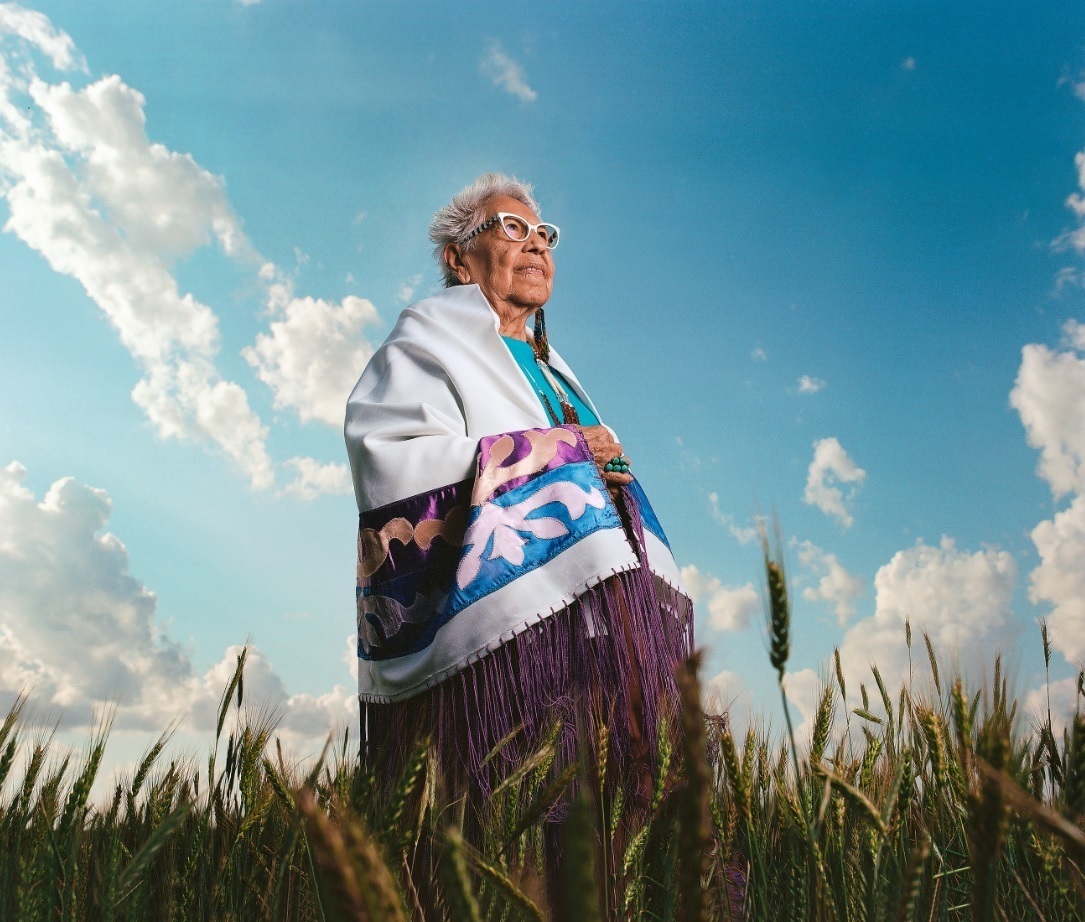
Professor emerita Henrietta Mann (Cheyenne), a pioneer in Native American studies, received a National Humanities Medal from President Biden in 2021. The White House citation honors Mann “for dedicating her life to strengthening and developing Native American education.”

Matika Wilbur

Matika Wilbur

Photographer Matika Wilbur was tired of seeing one-dimensional, insipid, degrading depictions of Native Americans in mainstream media and popular culture. So in 2012, Wilbur, who is of Swinomish and Tulalip descent, decided to create her own catalog of images.

She sold everything in her Seattle apartment and, with Kickstarter backing, headed out on the road, cameras in hand. Her goal: To illustrate Native Americans’ diversity and complexity by photographing members of all of the then-562 federally-recognized U.S. tribes.

Sisters Isabella and Alyssa Klain of the Diné tribe, photographed outside Salt Lake City, Utah.

Matika Wilbur

Matika Wilbur

Matika Wilbur, pictured here in a self portrait, describes her work as a narrative correction.

Matika Wilbur

Matika Wilbur

Ten years, 600,000 miles, and several vehicles later, Wilbur has published her work – portraits and interviews – in a stunning new book: Project 562: Changing the Way We See Native America. Over hundreds of pages, we meet Native elders, rappers, professors, artists, activists, linguists, dancers, ranchers, comedians, and more.

“In a lot of ways, this work is narrative correction work,” Wilbur said. “When I was talking to folks, I was aiming to understand, ‘What are some of the true stories about your people that you want people to know?'”

Artist and filmmaker Holly Mititquq Nordlum (Iñupiaq) is helping to revitalize the tradition of Iñupiaq tattoos. A woman’s chin tattoos – tavlugun – “are markers of her life and the celebration of her milestones,” she told Wilbur. “I’m wearing my lineage on my face.”

Matika Wilbur

Matika Wilbur

The sketch comedy troupe The 1491s “use slapstick and satire in performances that unpack stereotypes, debunk racism, raid contemporary culture,” Wilbur writes. Pictured left to right: Bobby Wilson (Sisseton-Wahpeton Dakota), Ryan RedCorn (Wazhazhe), Sterlin Harjo (Seminole, Muscogee [Creek] Nation), and Migizi Pensoneau (Ponca, Ojibwe.) Not pictured: Dallas Goldtooth (Mdewakanton Dakota, Diné)

Matika Wilbur

Matika Wilbur

Rapper Frank Waln (Sicangu Lakota) told Wilbur that personal sovereignty extends to his own body: “I grow my hair long and wear braids. It’s more about not fitting into the colonial gender binaries.”

Matika Wilbur

Matika Wilbur

In her interviews with the people she photographed, they shared stories about the lasting effects of colonization and relocation; about environmental destruction done to Native lands; and about the traumatic experience of those who had been taken from their homes as children and sent to Indian boarding schools to be “assimilated,” forced to give up their language and Native identity.

But along with those painful conversations, Wilbur said, she also heard “the best parts: how we’ve healed from that, and what our people are doing to move forward, and to develop healthy and strong and thriving Indigenous nations.”

Matika Wilbur dedicates Project 562 to her daughter Alma Bee, who was one year old when this photo was taken. Alma Bee is standing along the coast of Washington State on traditional homelands of the Tulalip tribe, with Swinomish land in the background, both reflecting her ancestry.

Matika Wilbur

Matika Wilbur

Wilbur dedicates Project 562 to her daughter Alma Bee, now three years old, with these words:

May your children
hear and breathe
the words of
our Indigenous ancestors.
May we all be so lucky to
know an Indigenous future.


Photos reprinted with permission from Project 562: Changing The Way We See Native America by Matika Wilbur © 2023. Photographs by Matika Wilbur © 2023. Published by Ten Speed Press, an imprint of Penguin Random House.

The interview with Matika Wilbur was produced by Michael Levitt and edited by Justine Kenin.

American Indian Arts Festival will feature traditional and contemporary art

American Indian Arts Festival will feature traditional and contemporary art
image

The Latino Cultural Center will be hosting an American Indian Art Festival this weekend to showcase Native artists from across the continent.

The festival will include traditional and contemporary Native music, dance and cultural presentations. Friday evening performances include an Indigenous comedy set by Ron Kanutski, a Ojibwe-Cree comedian from Canada. On Saturday, there will be traditional Indian stickball led by Eli Hickman of the Mississippi Choctaw. The event will also feature conversations on topics such as the epidemic of missing and murdered Indigenous women and the history of Indian boarding schools.

The American Indian Art Festival will be held at the Latino Cultural Center on April 28 and 29 and is free for visitors

Arts Access is an arts journalism collaboration powered by The Dallas Morning News and KERA.

This community-funded journalism initiative is funded by the Better Together Fund, Carol & Don Glendenning, City of Dallas OAC, Communities Foundation of Texas, The Dallas Foundation, Eugene McDermott Foundation, James & Gayle Halperin Foundation, Jennifer & Peter Altabef and The Meadows Foundation. The News and KERA retain full editorial control of Arts Access’ journalism.

Young Stockdale photographer shares passion of wildlife through photography

Young Stockdale photographer shares passion of wildlife through photography

Brooke Locker may be 10 years old but she has already spent half of her life dedicated to taking photos. For Brooke, photography is a medium that challenges her and sparks her creativity.

Brooke picked up photography at the young age of 5 after being influenced by her mother, Megan Locker, who is also a photographer. At first, she started with playing around with toy cameras in preschool, then that curiosity eventually morphed into using her mother’s old camera from college to take pictures.

The subjects that capture Brooke’s interest the most are plants and wildlife. With wildlife, Brooke said getting up close and personal is where the fun begins for her. She finds the beauty of her subject by shooting with a macro lens.

#placement_588509_0_i{width:100%;margin:0 auto;}

“I really like to take photos of plants, but wildlife is full of motion. I also love motion as well as macro (lenses).” Brooke said.

“Macro is so fun, because you can get up close and get details. The main thing I love shooting with macro is taking photos of spiders and grasshoppers.”

Through the DeWitt County Shutterbugs Club, Locker has placed first and third in the Youth Junior Division and third in the adult flowers/plants category.

Since Brooke is one of the youngest members in the Shutterbugs, she wants to encourage her peers to pick up photography. With her mother’s help, she created a photo group in 4-H where other kids her age can meet up and share their photography.

As far as her future goes, Brooke wants to mold her passion for animals into being a wildlife biologist, while still using her talent for photography, when she grows up.

Currently her goal for the near future is to become a state photography ambassador for 4-H and teach other about photography.

“I just want to travel all over the world and study different animals,” Brooke said.