Deutsche Börse Photography Foundation : The Cube : Ernest Cole : House of Bondage – The Eye of Photography Magazine

Deutsche Börse Photography Foundation : The Cube : Ernest Cole : House of Bondage – The Eye of Photography Magazine

The Deutsche Börse Photography Foundation presents South African photographer Ernest Cole’s oeuvre with the exhibition “Ernest Cole. House of Bondage” at The Cube, Eschborn.

An important chronicler of apartheid politics, it is the first major exhibition of his works in Germany. In around 130 photographs, it covers all 15 thematic chapters of his eponymous book, “House of Bondage”, and also includes works from the chapter “Black Ingenuity”, which was not published in the original edition. The presentation is complemented by early original prints, personal documents of the artist, original editions of published series of images in magazines and a filmed interview with Cole from 1969.

Ernest Cole (1940-1990) chronicled the Black majority’s experience during apartheid in South Africa as forcefully and comprehensively as few of his contemporaries. In his photobook “House of Bondage”, published in 1967, he captured countless forms of violence and repression, which, as a Black photographer, he was also subject to. He started working as a photographer at the age of 18, aiming to draw global attention to the grievances of his home country. Being classified as “Coloured” allowed Cole freedom of movement and access to various places which the authoritarian regime would not have granted him as a “Black” person. Cole photographed the precarious living conditions of mine labourers and domestic workers in white households, as well as the miserable state of the transport and health sectors. He paid particularly close attention to the children and young people, who, denied proper education, lived in poverty and despair. As a person directly affected, his insights into the life of Black South Africans in the 1960s are harrowing – marked by oppression, arbitrary police action and expropriation.

In 1966, Cole managed to leave South Africa, secretly getting all his negatives out of the country ahead of his own departure. Fully aware that he would never be allowed to return to his home country once published, he released his photographs in the illustrated book “House of Bondage” in the US in 1967, displaying the horrors of the apartheid system to the entire world in 15 thematic chapters, each accompanied by his own texts. It would, however, take decades for the political situation of Black South Africans to improve. In February 1990, Ernest Cole died just months before this change was heralded, in exile in New York City. At the time of his death, he felt disillusioned by the limited power of his images. Today, “House of Bondage” is considered one of the most important photobooks of the 20th century.

The exhibition “Ernest Cole. House of Bondage” is a cooperation with Magnum Photos. It was curated by Anne-Marie Beckmann, Deutsche Börse Photography Foundation, and Andréa Holzherr, Magnum Photos.

About the artist

Ernest Cole was born as Ernest Levi Tsoloane Kole in 1940 in Eesterust township near Pretoria. He discovered his passion for photography at the age of eight and started taking pictures just a few years later. In 1958, he started working as an assistant to German photographer Jürgen Schadeberg and later as a photographer for the magazine “Drum”, one of the most influential publications for Black readers in South Africa. After further employment with “Zonk!” and “Bantu World”, the largest African daily newspaper in Johannesburg, Cole worked as a freelance photographer from 1961. Many of the photographs taken during this time were later published in “House of Bondage”. In 1966, he managed to leave the country for London and then Paris, finally settling in New York City in September. With the support of the Magnum Photos agency, his book “House of Bondage” was published in the US one year later. It is a comprehensive and systematic documentation of the effects of the South African apartheid regime in the early 1960s on the country’s Black population. In the following decades, he alternately lived in Sweden and New York City, but was hardly active as a photographer. Ernest Cole died in New York City in 1990 at the age of 49.

The photobook “House of Bondage”

“House of Bondage” was published in 1967 by Ridge Press in New York City. The extensive photobook features Ernest Cole’s haunting 1960s photographs which document the repressive apartheid legislation and everyday life of Black South Africans.

“House of Bondage” is structured in 15 thematic chapters with titles such as “The Mines”, “For Whites Only” or “Heirs of Poverty”, with photographs taken and selected by Cole, as well as detailed accompanying texts with his personal insights into the reality of life under the apartheid system. “House of Bondage” was reissued in 2022 by Aperture Publishing. The chapter “Black Ingenuity” was added to the new edition, which Cole had selected images for but did not ultimately include in the original 1967 publication. In addition to the original texts by Cole, “House of Bondage” also includes articles by Mongane Wally Serote, Oluremi C. Onabanjo and James Sanders, an “Ernest Cole Family Trust” representative.

English edition 232 pages, 227 images, 21×29 cm, Hardcover, ISBN: 9781597115339.

Ernest Cole. House of Bondage
June 2 to September 17, 2023
The Cube
Mergenthalerallee 61
65760 Eschborn, Germany

https://www.deutscheboersephotographyfoundation.org/en/

Teaneck Pride Announces Exhibition of Photography by Danielle Richards

Teaneck Pride Announces Exhibition of Photography by Danielle Richards

originally published: 06/14/2023


Jeremy Lentz with Shafiq Akhtar holding Shafiq’s children Kara and Rafiq. Photograph by Danielle Richards

(TEANECK, NJ) — Teaneck Pride announces the opening of a Photography Exhibition, “This Is Who I Am / This Is Who We Are” at the Puffin Cultural Forum. The exhibition features photography by Teaneck photographer Danielle Richards that present portraits of Bergen County LBGTQ+ families and individuals. It will run from June 20 through July 31, 2023.

Organized by TeaneckPride’s Rev. Dr. Michelle White, this stunning display of black and white portraiture seeks to render visible the otherwise invisible and underrepresented part of our community. Twenty black and white photographs by award-winning photographer Danielle Richards with accompanying text present families from all of the diverse communities that make up our region.

The subjects of this exhibition are our neighbors, our friends, our community. They include rabbis and Christian clergy, teachers and professors, single parents, partners and their children, young people and seniors.

According to Rev. White, “The LGBTQ+ community must confront fear and anonymity here in Bergen County.  TeaneckPride intends to create a new narrative and to offer visible and substantial support to our community. We are grateful for flag raisings but we plan to do so much more. The LGBTQ+ community in Bergen County, our friends and our advocates are taking action.  This is who we are! We are grateful to the Puffin Foundation who continue to make a commitment to the work.  We invite you to join the effort.”

Gallery Bergen director Tim Blunk is curating the exhibition for the Puffin Cultural Forum. “When photography was first introduced in the 1850s,” says Blunk, “Frederick Douglass was one of its strongest proponents, recognizing its power in arguing incontrovertibly for the humanity of Black people. There is an equivalence in returning to this medium to make a similar statement on behalf of the LGBTQ+ community. To this purpose, we consciously chose the black and white format for these images. They ask you to look more closely and see past the surface.” 

Photographer Danielle Richards has been one of New Jersey’s top photojournalists for over twenty-five years. Much of this time was spent as a senior photographer for The Record where she covered assignments ranging from the Super Bowl to both Papal visits; from portraits of Fortune 100 CEOs to long-range enterprise projects on juvenile justice, autism, the environment, and documenting local communities. Ms. Richards founded her own stock photography image company, Jersey Girl Stock Images. She is sought after all over the New York metropolitan area as an events and wedding photographer based on her journalistic approach and her commitment to working with our area’s diverse communities. 


image


There will be an Opening Reception on June 20, 2023 from 6:00pm to 9:00pm.

The Puffin Cultural Forum is located at 20 Puffin Way in Teaneck, New Jersey. The exhibition will be shown at Bergen Community College in the fall.

This exhibition is made possible by a generous grant from the Puffin Foundation Ltd. and private donations. 

Advertise with New Jersey Stage for $50-$100 per month, click here for info

The economic potential of generative AI: The next productivity frontier

The economic potential of generative AI: The next productivity frontier

AI has permeated our lives incrementally, through everything from the tech powering our smartphones to autonomous-driving features on cars to the tools retailers use to surprise and delight consumers. As a result, its progress has been almost imperceptible. Clear milestones, such as when AlphaGo, an AI-based program developed by DeepMind, defeated a world champion Go player in 2016, were celebrated but then quickly faded from the public’s consciousness.

Generative AI applications such as ChatGPT Copilot, Stable Diffusion, and others have captured the imagination of people around the world in a way AlphaGo did not, thanks to their broad utility—almost anyone can use them to communicate and create—and preternatural ability to have a conversation with a user. The latest generative AI applications can perform a range of routine tasks, such as the reorganization and classification of data. But it is their ability to write text, compose music, and create digital art that has garnered headlines and persuaded consumers and households to experiment on their own. As a result, a broader set of stakeholders are grappling with generative AI’s impact on business and society but without much context to help them make sense of it.

The speed at which generative AI technology is developing isn’t making this task any easier. ChatGPT was released in November 2022. Four months later, OpenAI released a new large language model, or LLM, called GPT-4 with markedly improved capabilities. Similarly, by May 2023, Anthropic’s generative AI, Claude, was able to process 100,000 tokens of text, equal to about 75,000 words in a minute—the length of the average novel—compared with roughly 9,000 tokens when it was introduced in March 2023. And in May 2023, Google announced several new features powered by generative AI, including Search Generative Experience and a new LLM called PaLM 2 that will power its Bard chatbot, among other Google products.

To grasp what lies ahead requires an understanding of the breakthroughs that have enabled the rise of generative AI, which were decades in the making. For the purposes of this report, we define generative AI as applications typically built using foundation models. These models contain expansive artificial neural networks inspired by the billions of neurons connected in the human brain. Foundation models are part of what is called deep learning, a term that alludes to the many deep layers within neural networks. Deep learning has powered many of the recent advances in AI, but the foundation models powering generative AI applications are a step-change evolution within deep learning. Unlike previous deep learning models, they can process extremely large and varied sets of unstructured data and perform more than one task.

Foundation models have enabled new capabilities and vastly improved existing ones across a broad range of modalities, including images, video, audio, and computer code. AI trained on these models can perform several functions; it can classify, edit, summarize, answer questions, and draft new content, among other tasks.

All of us are at the beginning of a journey to understand generative AI’s power, reach, and capabilities. This research is the latest in our efforts to assess the impact of this new era of AI. It suggests that generative AI is poised to transform roles and boost performance across functions such as sales and marketing, customer operations, and software development. In the process, it could unlock trillions of dollars in value across sectors from banking to life sciences. The following sections share our initial findings.

For the full version of this report, download the PDF.

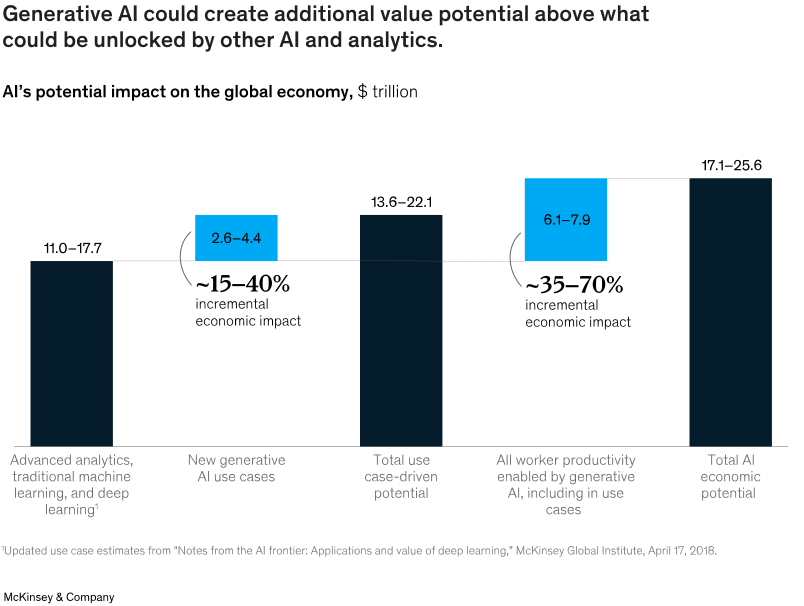
Generative AI’s impact on productivity could add trillions of dollars in value to the global economy. Our latest research estimates that generative AI could add the equivalent of $2.6 trillion to $4.4 trillion annually across the 63 use cases we analyzed—by comparison, the United Kingdom’s entire GDP in 2021 was $3.1 trillion. This would increase the impact of all artificial intelligence by 15 to 40 percent. This estimate would roughly double if we include the impact of embedding generative AI into software that is currently used for other tasks beyond those use cases.

About 75 percent of the value that generative AI use cases could deliver falls across four areas: Customer operations, marketing and sales, software engineering, and R&D. Across 16 business functions, we examined 63 use cases in which the technology can address specific business challenges in ways that produce one or more measurable outcomes. Examples include generative AI’s ability to support interactions with customers, generate creative content for marketing and sales, and draft computer code based on natural-language prompts, among many other tasks.

Generative AI will have a significant impact across all industry sectors. Banking, high tech, and life sciences are among the industries that could see the biggest impact as a percentage of their revenues from generative AI. Across the banking industry, for example, the technology could deliver value equal to an additional $200 billion to $340 billion annually if the use cases were fully implemented. In retail and consumer packaged goods, the potential impact is also significant at $400 billion to $660 billion a year.

Generative AI has the potential to change the anatomy of work, augmenting the capabilities of individual workers by automating some of their individual activities. Current generative AI and other technologies have the potential to automate work activities that absorb 60 to 70 percent of employees’ time today. In contrast, we previously estimated that technology has the potential to automate half of the time employees spend working. The acceleration in the potential for technical automation is largely due to generative AI’s increased ability to understand natural language, which is required for work activities that account for 25 percent of total work time. Thus, generative AI has more impact on knowledge work associated with occupations that have higher wages and educational requirements than on other types of work.

The pace of workforce transformation is likely to accelerate, given increases in the potential for technical automation. Our updated adoption scenarios, including technology development, economic feasibility, and diffusion timelines, lead to estimates that half of today’s work activities could be automated between 2030 and 2060, with a midpoint in 2045, or roughly a decade earlier than in our previous estimates.

Generative AI can substantially increase labor productivity across the economy, but that will require investments to support workers as they shift work activities or change jobs. Generative AI could enable labor productivity growth of 0.1 to 0.6 percent annually through 2040, depending on the rate of technology adoption and redeployment of worker time into other activities. Combining generative AI with all other technologies, work automation could add 0.2 to 3.3 percentage points annually to productivity growth. However, workers will need support in learning new skills, and some will change occupations. If worker transitions and other risks can be managed, generative AI could contribute substantively to economic growth and support a more sustainable, inclusive world.

The era of generative AI is just beginning. Excitement over this technology is palpable, and early pilots are compelling. But a full realization of the technology’s benefits will take time, and leaders in business and society still have considerable challenges to address. These include managing the risks inherent in generative AI, determining what new skills and capabilities the workforce will need, and rethinking core business processes such as retraining and developing new skills.

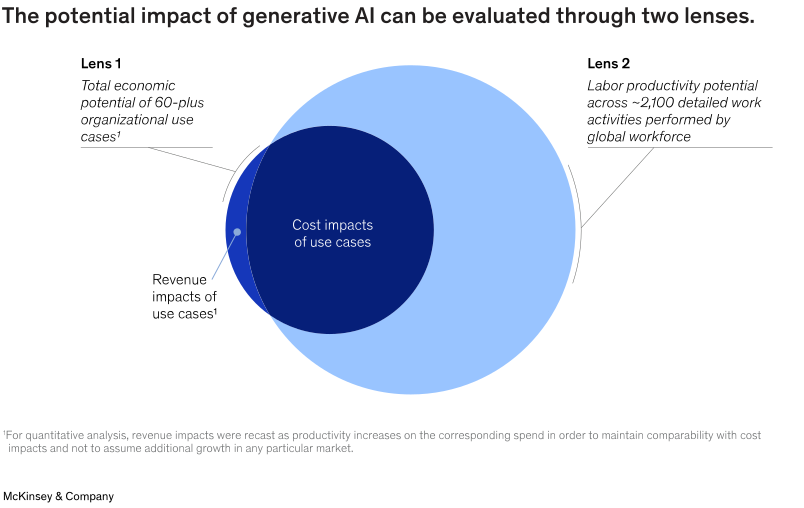
Generative AI is a step change in the evolution of artificial intelligence. As companies rush to adapt and implement it, understanding the technology’s potential to deliver value to the economy and society at large will help shape critical decisions. We have used two complementary lenses to determine where generative AI, with its current capabilities, could deliver the biggest value and how big that value could be (Exhibit 1).

The potential impact of generative AI can be evaluated through two lenses.

The first lens scans use cases for generative AI that organizations could adopt. We define a “use case” as a targeted application of generative AI to a specific business challenge, resulting in one or more measurable outcomes. For example, a use case in marketing is the application of generative AI to generate creative content such as personalized emails, the measurable outcomes of which potentially include reductions in the cost of generating such content and increases in revenue from the enhanced effectiveness of higher-quality content at scale. We identified 63 generative AI use cases spanning 16 business functions that could deliver total value in the range of $2.6 trillion to $4.4 trillion in economic benefits annually when applied across industries.

That would add 15 to 40 percent to the $11 trillion to $17.7 trillion of economic value that we now estimate nongenerative artificial intelligence and analytics could unlock. (Our previous estimate from 2017 was that AI could deliver $9.5 trillion to $15.4 trillion in economic value.)

Our second lens complements the first by analyzing generative AI’s potential impact on the work activities required in some 850 occupations. We modeled scenarios to estimate when generative AI could perform each of more than 2,100 “detailed work activities”—such as “communicating with others about operational plans or activities”—that make up those occupations across the world economy. This enables us to estimate how the current capabilities of generative AI could affect labor productivity across all work currently done by the global workforce.

Some of this impact will overlap with cost reductions in the use case analysis described above, which we assume are the result of improved labor productivity. Netting out this overlap, the additional economic benefits of generative AI beyond those use cases—or the many small increases in productivity that are likely to materialize when the technology is applied to knowledge workers’ activities—amounts to an additional $6.1 trillion to $7.9 trillion annually (Exhibit 2).

Generative AI could create additional value potential above what could be unlocked by other AI and analytics.

While generative AI is an exciting and rapidly advancing technology, the other applications of AI discussed in our previous report continue to account for the majority of the overall potential value of AI. Traditional advanced-analytics and machine learning algorithms are highly effective at performing numerical and optimization tasks such as predictive modeling, and they continue to find new applications in a wide range of industries. However, as generative AI continues to develop and mature, it has the potential to open wholly new frontiers in creativity and innovation. It has already expanded the possibilities of what AI overall can achieve (see sidebar “How we estimated the value potential of generative AI use cases”).

In this section, we highlight the value potential of generative AI across business functions.

Generative AI could have an impact on most business functions; however, a few stand out when measured by the technology’s impact as a share of functional cost (Exhibit 3). Our analysis of 16 business functions identified just four—customer operations, marketing and sales, software engineering, and research and development—that could account for approximately 75 percent of the total annual value from generative AI use cases.

Using generative AI in just a few functions could drive most of the technology’s impact across potential corporate use cases.

Notably, the potential value of using generative AI for several functions that were prominent in our previous sizing of AI use cases, including manufacturing and supply chain functions, is now much lower. This is largely explained by the nature of generative AI use cases, which exclude most of the numerical and optimization applications that were the main value drivers for previous applications of AI.

In addition to the potential value generative AI can deliver in function-specific use cases, the technology could drive value across an entire organization by revolutionizing internal knowledge management systems. Generative AI’s impressive command of natural-language processing can help employees retrieve stored internal knowledge by formulating queries in the same way they might ask a human a question and engage in continuing dialogue. This could empower teams to quickly access relevant information, enabling them to rapidly make better-informed decisions and develop effective strategies.

In 2012, the McKinsey Global Institute (MGI) estimated that knowledge workers spent about a fifth of their time, or one day each work week, searching for and gathering information. If generative AI could take on such tasks, increasing the efficiency and effectiveness of the workers doing them, the benefits would be huge. Such virtual expertise could rapidly “read” vast libraries of corporate information stored in natural language and quickly scan source material in dialogue with a human who helps fine-tune and tailor its research, a more scalable solution than hiring a team of human experts for the task.

In other cases, generative AI can drive value by working in partnership with workers, augmenting their work in ways that accelerate their productivity. Its ability to rapidly digest mountains of data and draw conclusions from it enables the technology to offer insights and options that can dramatically enhance knowledge work. This can significantly speed up the process of developing a product and allow employees to devote more time to higher-impact tasks.

Following are four examples of how generative AI could produce operational benefits in a handful of use cases across the business functions that could deliver a majority of the potential value we identified in our analysis of 63 generative AI use cases. In the first two examples, it serves as a virtual expert, while in the following two, it lends a hand as a virtual collaborator.

Across the 63 use cases we analyzed, generative AI has the potential to generate $2.6 trillion to $4.4 trillion in value across industries. Its precise impact will depend on a variety of factors, such as the mix and importance of different functions, as well as the scale of an industry’s revenue (Exhibit 4).

For example, our analysis estimates generative AI could contribute roughly $310 billion in additional value for the retail industry (including auto dealerships) by boosting performance in functions such as marketing and customer interactions. By comparison, the bulk of potential value in high tech comes from generative AI’s ability to increase the speed and efficiency of software development.

In the banking industry, generative AI has the potential to improve on efficiencies already delivered by artificial intelligence by taking on lower-value tasks in risk management, such as required reporting, monitoring regulatory developments, and collecting data. In the life sciences industry, generative AI is poised to make significant contributions to drug discovery and development.

We share our detailed analysis of these industries below.

Technology has been changing the anatomy of work for decades. Over the years, machines have given human workers various “superpowers”; for instance, industrial-age machines enabled workers to accomplish physical tasks beyond the capabilities of their own bodies. More recently, computers have enabled knowledge workers to perform calculations that would have taken years to do manually.

These examples illustrate how technology can augment work through the automation of individual activities that workers would have otherwise had to do themselves. At a conceptual level, the application of generative AI may follow the same pattern in the modern workplace, although as we show later in this chapter, the types of activities that generative AI could affect, and the types of occupations with activities that could change, will likely be different as a result of this technology than for older technologies.

The McKinsey Global Institute began analyzing the impact of technological automation of work activities and modeling scenarios of adoption in 2017. At that time, we estimated that workers spent half of their time on activities that had the potential to be automated by adapting technology that existed at that time, or what we call technical automation potential. We also modeled a range of potential scenarios for the pace at which these technologies could be adopted and affect work activities throughout the global economy.

Technology adoption at scale does not occur overnight. The potential of technological capabilities in a lab does not necessarily mean they can be immediately integrated into a solution that automates a specific work activity—developing such solutions takes time. Even when such a solution is developed, it might not be economically feasible to use if its costs exceed those of human labor. Additionally, even if economic incentives for deployment exist, it takes time for adoption to spread across the global economy. Hence, our adoption scenarios, which consider these factors together with the technical automation potential, provide a sense of the pace and scale at which workers’ activities could shift over time.

The analyses in this paper incorporate the potential impact of generative AI on today’s work activities. The new capabilities of generative AI, combined with previous technologies and integrated into corporate operations around the world, could accelerate the potential for technical automation of individual activities and the adoption of technologies that augment the capabilities of the workforce. They could also have an impact on knowledge workers whose activities were not expected to shift as a result of these technologies until later in the future (see sidebar “About the research”).

Automation potential has accelerated, but adoption to lag

Based on developments in generative AI, technology performance is now expected to match median human performance and reach top-quartile human performance earlier than previously estimated across a wide range of capabilities (Exhibit 5). For example, MGI previously identified 2027 as the earliest year when median human performance for natural-language understanding might be achieved in technology, but in this new analysis, the corresponding point is 2023.

As a result of generative AI, experts assess that technology could achieve human-level performance in some technical capabilities sooner than previously thought.

As a result of these reassessments of technology capabilities due to generative AI, the total percentage of hours that could theoretically be automated by integrating technologies that exist today has increased from about 50 percent to 60–70 percent. The technical potential curve is quite steep because of the acceleration in generative AI’s natural-language capabilities.

Interestingly, the range of times between the early and late scenarios has compressed compared with the expert assessments in 2017, reflecting a greater confidence that higher levels of technological capabilities will arrive by certain time periods (Exhibit 6).

Our analysis of adoption scenarios accounts for the time required to integrate technological capabilities into solutions that can automate individual work activities; the cost of these technologies compared with that of human labor in different occupations and countries around the world; and the time it has taken for technologies to diffuse across the economy. With the acceleration in technical automation potential that generative AI enables, our scenarios for automation adoption have correspondingly accelerated. These scenarios encompass a wide range of outcomes, given that the pace at which solutions will be developed and adopted will vary based on decisions that will be made on investments, deployment, and regulation, among other factors. But they give an indication of the degree to which the activities that workers do each day may shift (Exhibit 7).

As an example of how this might play out in a specific occupation, consider postsecondary English language and literature teachers, whose detailed work activities include preparing tests and evaluating student work. With generative AI’s enhanced natural-language capabilities, more of these activities could be done by machines, perhaps initially to create a first draft that is edited by teachers but perhaps eventually with far less human editing required. This could free up time for these teachers to spend more time on other work activities, such as guiding class discussions or tutoring students who need extra assistance.

Our previously modeled adoption scenarios suggested that 50 percent of time spent on 2016 work activities would be automated sometime between 2035 and 2070, with a midpoint scenario around 2053. Our updated adoption scenarios, which account for developments in generative AI, models the time spent on 2023 work activities reaching 50 percent automation between 2030 and 2060, with a midpoint of 2045—an acceleration of roughly a decade compared with the previous estimate.

Adoption is also likely to be faster in developed countries, where wages are higher and thus the economic feasibility of adopting automation occurs earlier. Even if the potential for technology to automate a particular work activity is high, the costs required to do so have to be compared with the cost of human wages. In countries such as China, India, and Mexico, where wage rates are lower, automation adoption is modeled to arrive more slowly than in higher-wage countries (Exhibit 8).

Generative AI’s potential impact on knowledge work

Previous generations of automation technology were particularly effective at automating data management tasks related to collecting and processing data. Generative AI’s natural-language capabilities increase the automation potential of these types of activities somewhat. But its impact on more physical work activities shifted much less, which isn’t surprising because its capabilities are fundamentally engineered to do cognitive tasks.

As a result, generative AI is likely to have the biggest impact on knowledge work, particularly activities involving decision making and collaboration, which previously had the lowest potential for automation (Exhibit 9). Our estimate of the technical potential to automate the application of expertise jumped 34 percentage points, while the potential to automate management and develop talent increased from 16 percent in 2017 to 49 percent in 2023.

Generative AI could have the biggest impact on collaboration and the application of expertise, activities that previously had a lower potential for automation.

Generative AI’s ability to understand and use natural language for a variety of activities and tasks largely explains why automation potential has risen so steeply. Some 40 percent of the activities that workers perform in the economy require at least a median level of human understanding of natural language.

As a result, many of the work activities that involve communication, supervision, documentation, and interacting with people in general have the potential to be automated by generative AI, accelerating the transformation of work in occupations such as education and technology, for which automation potential was previously expected to emerge later (Exhibit 10).

Advances in technical capabilities could have the most impact on activities performed by educators, professionals, and creatives.

Labor economists have often noted that the deployment of automation technologies tends to have the most impact on workers with the lowest skill levels, as measured by educational attainment, or what is called skill biased. We find that generative AI has the opposite pattern—it is likely to have the most incremental impact through automating some of the activities of more-educated workers.

Another way to interpret this result is that generative AI will challenge the attainment of multiyear degree credentials as an indicator of skills, and others have advocated for taking a more skills-based approach to workforce development in order to create more equitable, efficient workforce training and matching systems. Generative AI could still be described as skill-biased technological change, but with a different, perhaps more granular, description of skills that are more likely to be replaced than complemented by the activities that machines can do.

Previous generations of automation technology often had the most impact on occupations with wages falling in the middle of the income distribution. For lower-wage occupations, making a case for work automation is more difficult because the potential benefits of automation compete against a lower cost of human labor. Additionally, some of the tasks performed in lower-wage occupations are technically difficult to automate—for example, manipulating fabric or picking delicate fruits. Some labor economists have observed a “hollowing out of the middle,” and our previous models have suggested that work automation would likely have the biggest midterm impact on lower-middle-income quintiles.

However, generative AI’s impact is likely to most transform the work of higher-wage knowledge workers because of advances in the technical automation potential of their activities, which were previously considered to be relatively immune from automation (Exhibit 11).

Generative AI could have the biggest impact on activities in high-wage jobs; previously, automation’s impact was highest in lower-middle-income quintiles.

Generative AI could propel higher productivity growth

Global economic growth was slower from 2012 to 2022 than in the two preceding decades. Although the COVID-19 pandemic was a significant factor, long-term structural challenges—including declining birth rates and aging populations—are ongoing obstacles to growth.

Declining employment is among those obstacles. Compound annual growth in the total number of workers worldwide slowed from 2.5 percent in 1972–82 to just 0.8 percent in 2012–22, largely because of aging. In many large countries, the size of the workforce is already declining. Productivity, which measures output relative to input, or the value of goods and services produced divided by the amount of labor, capital, and other resources required to produce them, was the main engine of economic growth in the three decades from 1992 to 2022 (Exhibit 12). However, since then, productivity growth has slowed in tandem with slowing employment growth, confounding economists and policy makers.

Productivity growth, the main engine of GDP growth over the past 30 years, slowed down in the past decade.

The deployment of generative AI and other technologies could help accelerate productivity growth, partially compensating for declining employment growth and enabling overall economic growth. Based on our estimates, the automation of individual work activities enabled by these technologies could provide the global economy with an annual productivity boost of 0.2 to 3.3 percent from 2023 to 2040, depending on the rate of automation adoption—with generative AI contributing 0.1 to 0.6 percentage points of that growth—but only if individuals affected by the technology were to shift to other work activities that at least match their 2022 productivity levels (Exhibit 13). In some cases, workers will stay in the same occupations, but their mix of activities will shift; in others, workers will need to shift occupations.

Generative AI could contribute to productivity growth if labor hours can be redeployed effectively.

History has shown that new technologies have the potential to reshape societies. Artificial intelligence has already changed the way we live and work—for example, it can help our phones (mostly) understand what we say, or draft emails. Mostly, however, AI has remained behind the scenes, optimizing business processes or making recommendations about the next product to buy. The rapid development of generative AI is likely to significantly augment the impact of AI overall, generating trillions of dollars of additional value each year and transforming the nature of work.

But the technology could also deliver new and significant challenges. Stakeholders must act—and quickly, given the pace at which generative AI could be adopted—to prepare to address both the opportunities and the risks. Risks have already surfaced, including concerns about the content that generative AI systems produce: Will they infringe upon intellectual property due to “plagiarism” in the training data used to create foundation models? Will the answers that LLMs produce when questioned be accurate, and can they be explained? Will the content generative AI creates be fair or biased in ways that users do not want by, say, producing content that reflects harmful stereotypes?

There are economic challenges too: the scale and the scope of the workforce transitions described in this report are considerable. In the midpoint adoption scenario, about a quarter to a third of work activities could change in the coming decade. The task before us is to manage the potential positives and negatives of the technology simultaneously (see sidebar “Using generative AI responsibly”). Here are some of the critical questions we will need to address while balancing our enthusiasm for the potential benefits of the technology with the new challenges it can introduce.

Companies and business leaders

How can companies move quickly to capture the potential value at stake highlighted in this report, while managing the risks that generative AI presents?

How will the mix of occupations and skills needed across a company’s workforce be transformed by generative AI and other artificial intelligence over the coming years? How will a company enable these transitions in its hiring plans, retraining programs, and other aspects of human resources?

Do companies have a role to play in ensuring the technology is not deployed in “negative use cases” that could harm society?

How can businesses transparently share their experiences with scaling the use of generative AI within and across industries—and also with governments and society?

Policy makers

What will the future of work look like at the level of an economy in terms of occupations and skills? What does this mean for workforce planning?

How can workers be supported as their activities shift over time? What retraining programs can be put in place? What incentives are needed to support private companies as they invest in human capital? Are there earn-while-you-learn programs such as apprenticeships that could enable people to retrain while continuing to support themselves and their families?

What steps can policy makers take to prevent generative AI from being used in ways that harm society or vulnerable populations?

Can new policies be developed and existing policies amended to ensure human-centric AI development and deployment that includes human oversight and diverse perspectives and accounts for societal values?

Individuals as workers, consumers, and citizens

How concerned should individuals be about the advent of generative AI? While companies can assess how the technology will affect their bottom lines, where can citizens turn for accurate, unbiased information about how it will affect their lives and livelihoods?

How can individuals as workers and consumers balance the conveniences generative AI delivers with its impact in their workplaces?

Can citizens have a voice in the decisions that will shape the deployment and integration of generative AI into the fabric of their lives?


Technological innovation can inspire equal parts awe and concern. When that innovation seems to materialize fully formed and becomes widespread seemingly overnight, both responses can be amplified. The arrival of generative AI in the fall of 2022 was the most recent example of this phenomenon, due to its unexpectedly rapid adoption as well as the ensuing scramble among companies and consumers to deploy, integrate, and play with it.

All of us are at the beginning of a journey to understand this technology’s power, reach, and capabilities. If the past eight months are any guide, the next several years will take us on a roller-coaster ride featuring fast-paced innovation and technological breakthroughs that force us to recalibrate our understanding of AI’s impact on our work and our lives. It is important to properly understand this phenomenon and anticipate its impact. Given the speed of generative AI’s deployment so far, the need to accelerate digital transformation and reskill labor forces is great.

These tools have the potential to create enormous value for the global economy at a time when it is pondering the huge costs of adapting and mitigating climate change. At the same time, they also have the potential to be more destabilizing than previous generations of artificial intelligence. They are capable of that most human of abilities, language, which is a fundamental requirement of most work activities linked to expertise and knowledge as well as a skill that can be used to hurt feelings, create misunderstandings, obscure truth, and incite violence and even wars.

We hope this research has contributed to a better understanding of generative AI’s capacity to add value to company operations and fuel economic growth and prosperity as well as its potential to dramatically transform how we work and our purpose in society. Companies, policy makers, consumers, and citizens can work together to ensure that generative AI delivers on its promise to create significant value while limiting its potential to upset lives and livelihoods. The time to act is now.

The ultimate insider view of The Beatles and Beatlemania

The ultimate insider view of The Beatles and Beatlemania
As the “final Beatles record” is announced, unseen photos of the band are revealed, chronicling an extraordinary time, as witnessed through the eyes of one man at the heart of it, Paul McCartney, writes Deborah Nicholls-Lee.

In the 60s, youth culture exploded, spawning pop music, short hemlines and screaming fans. One witness saw this exciting time closer up than almost anyone else. “Millions of eyes were suddenly upon us, creating a picture I will never forget for the rest of my life,” he recalls. Sir Paul McCartney was centre stage in some of the most iconic images of the era, as Beatlemania gripped Britain and beyond. Until now, the period described by McCartney as “bedlam”, “pandemonium” and “mass hysteria” has largely been recorded from the outside looking in. But what did McCartney see as he looked out?  

More like this:
James Bond and The Beatles
The Beatles’ greatest album
A wild tale of rock ‘n’ roll excess

Now, a new exhibition, Paul McCartney, Photographs 1963-64: Eyes of the Storm at London’s newly reopened National Portrait Gallery, and a new book, 1964: Eyes of the Storm, feature more than 200 images taken by McCartney, rediscovered by the singer-songwriter in his production company archives in 2020. The images track his time in The Beatles from 1963 to 1964 when the band were taking off, moving from the dingy picture houses of their home city of Liverpool, to the capital cities of London and Paris, and culminating in their electrifying debut in the US, which took place in New York, Washington DC and Miami.

Included in the remarkable collection of photos are several self-portraits (Credit: Paul McCartney)

Included in the remarkable collection of photos are several self-portraits (Credit: Paul McCartney)

Younger Beatles fans, who missed the fun and furore the first time round, can soon experience the launch of what McCartney described to BBC Radio 4 yesterday as “the final Beatles record”, created thanks to AI technology extracting John Lennon’s voice from an unused track on an old demo tape. With The Beatles enjoying a resurgence on platforms such as TikTok and YouTube, the unnamed song, to be released later this year, will delight a flourishing fan base of Gen Z enthusiasts. 

We know that the band’s frenzied fans have always been enthralled by the four young men, but McCartney’s photos show this fascination to be mutual. As well as off-guard moments of the band relaxing between gigs, they include snaps of the crowds they attracted, taken from a rear windscreen or hotel window − unseen images chronicling an extraordinary time as witnessed through the eyes of one man at the heart of it.

Eyes of the Storm takes its name from the eyes that were everywhere. “Who is looking at who?” writes McCartney in the book’s foreword. “The camera always seems to be shifting, with me photographing them, the press photographing us, and those thousands and thousands of people out there wanting to capture this storm.”

Photography is to play a greater part in the refurbished National Portrait Gallery, which launches with two major photography exhibitions, starting on 22 June with Yevonde‘s colour photographs of the 1930s, and followed by Eyes of the Storm on 28 June. The gallery’s internationally recognised photographic collection will be “much more integrated” into displays, Eyes of the Storm curator Rosie Broadley tells BBC Culture. “This enables us to tell a much more nuanced and layered narrative because the people who sit for photographs are often much more diverse.”

The images by Sir Paul McCartney are exhibited at the National Portrait Gallery, London (Credit: Paul McCartney)

The images by Sir Paul McCartney are exhibited at the National Portrait Gallery, London (Credit: Paul McCartney)

The gallery’s archives include photographs of The Beatles taken by big names such as David Bailey and Don McCullin, but these new images, where the camera has been passed back to the subject, offer a unique insight. “The essential difference is that it’s his perspective on the band and what’s happening. They were never meant to be publicised or shared. They’re private,” explains Broadley. “It’s about what he was interested in, who he wanted to remember, and it’s not really so much about The Beatles – it’s about Paul and the experience that he was having with his friends, who happened to be The Beatles.”

In Liverpool, we meet a fresh-faced Cilla Black, while in Paris, McCartney seems very taken with the French actress and pin-up Sophie Hardy. Intimate pictures of the band also provide rare through-the-keyhole glimpses as John towels himself off after a swim, for example, or George puts on sunscreen. And we are introduced to the offstage players that helped make the madness happen: the roadie, the driver, the manager, the bodyguard… captured smoking, reading or napping, or fooling about with the boys during downtime. “We messed around. It kept us sane,” McCartney writes.

There are surprising discoveries, too. Behind the scenes, the US tour was not always rock ‘n’ roll. We learn that John’s wife Cynthia travelled alongside him, for example. And we meet Paul’s Miami date, a modestly-dressed wide-eyed teenager who he collected, in a gentlemanly manner, from her father’s office.

The images catch candid moments of the iconic band, laughing and messing around (Credit: Paul McCartney)

The images catch candid moments of the iconic band, laughing and messing around (Credit: Paul McCartney)

McCartney, a working-class lad who previously had holidayed in budget resorts in the UK, was just 21 in 1963, and the photographs reflect his unworldliness and his curiosity about the new worlds he was discovering. The novelty of travel is clear from the many photographs taken from planes and his touristy snaps of the Arc de Triomphe and the White House; while shots of posters and billboards with the band’s name on them suggest a baffled pride at their celebrity so far from home. “Looking at these photos now, decades later, I find that there is a sort of innocence about them,” writes McCartney. “Everything was new to us at this point.”

American dream

For McCartney, the United States was synonymous with success. “Everything we listened to was from America,” he writes, describing touring the US as “the big time” and “the big prize”. In many ways it lived up to the band’s expectations. Their performance on the Ed Sullivan Show on 9 February 1963 attracted a record 73m viewers and McCartney drank in the US culture, photographing the skyscrapers and flashing lights of New York and going to a drive-in movie for the first time.

After the monochrome snow scenes of Washington DC, sun-kissed Miami radiates warmth as McCartney reaches for the colour reel, and we get bright green palms, blue skies and canary-yellow beach wear. Described by McCartney as “Wonderland”, Miami was a tropical paradise for the boys, who had the time of their life nipping around in convertibles loaned by MG and lounging by their private pool.

But the US revealed a darker side, too. Kennedy had been assassinated just months before on 22 November 1963 – the band arrived in the US on 7 February 1964 – and a close-up of a gun slung about a police officer’s waist suggests McCartney’s unease. It was, he writes, “the first time I had ever seen something like that”. The band were also shocked by the racial inequality and became part of the ground shift when they refused to play to segregated audiences. “The Beatles were not the first white band to speak out against racial segregation. But no one had a platform the size of theirs,” historian Jill Lepore, who wrote the introduction to 1964: Eyes of the Storm, tells BBC Culture.

John Lennon pictured in Paris – the images are featured in a new book, Eyes of the Storm (Credit: Paul McCartney)

John Lennon pictured in Paris – the images are featured in a new book, Eyes of the Storm (Credit: Paul McCartney)

The photographs have significant historical merit. They document a pivotal time in politics, animated, says Lepore, by a “far more purposeful spirit of rebellion”. “Huge structural changes” were taking place, she says, pointing to the end of the draft in the UK and the lowering of the voting age to 18 in the US. The US Civil Rights Act was being passed just as colonies around the world were gaining independence; while the advent of the contraceptive pill coincided with the first steps towards equal pay legislation.

“Reporters were always asking them [The Beatles] to make sense of that world, and all its changes, and I just love how they refused to participate in that,” says Lepore. “There’s this one moment, when The Beatles are in Washington, DC, and a reporter asks, ‘What place do you think this story of The Beatles is going to have in the history of Western culture?’ And Paul says, ‘You must be kidding.’ It’s just so beautiful. The irreverence right back.”

For photographers, however, McCartney had great respect and curiosity. “I often took pictures of them, not so much for revenge, but because they were interesting people,” he writes. The band selected exceptional photographers to tour with them. Harry Benson, Dezo Hoffman and Robert Freeman all feature in McCartney’s photographs, and when they were behind the lens, McCartney would watch them at work, eager to learn from their artistry.

The images in Eyes of the Storm were taken with a 35mm Pentax, and include modern prints made from negatives and enlarged images taken from contact sheets. Several bear the scratchy cross of McCartney’s chinagraph pencil, where he has marked out his favourite shots. Some pictures, such as a grinning Ringo Starr and a self-portrait in the mirror, are blurred. Sometimes this was deliberate and sometimes it was because there was simply no time. “We were moving at such speed that you just had to grab, grab, grab!” he writes.

George Harrison photographed relaxing in Miami, February 1964, during the band's US tour (Credit: Paul McCartney)

George Harrison photographed relaxing in Miami, February 1964, during the band’s US tour (Credit: Paul McCartney)

Though an amateur, McCartney’s aptitude is noteworthy. “Not only has he absorbed the ideas around photojournalism… the Cartier-Bresson idea of capturing that decisive moment, he’s already looking to frame shots, looking for interesting angles,” says Broadley, who helped select the photos for the exhibition from a pool of almost 1,000. “He understands what makes a good portrait, he’s quite good at placing a figure in space, [and] he’s interested in architecture and the interesting perspectives you can get.”

Occasionally, he hands his camera to someone – a manager, roadie or bandmate – and there he is, McCartney himself, performing on stage or posing for press shots, the familiar doe-like eyes peeping out from the mop-top haircut.

“We were just wisecracking guys, and we had fun with each other whatever we did and wherever we went. I think this comes across in my photos,” writes McCartney in the book’s closing chapter. “Words cannot describe what happened to us, but imagine every dream you’ve had coming true, and you might get close.”

Paul McCartney, Photographs 1963-64: Eyes of the Storm is at the National Portrait Gallery from 28 June to 1 October 2023. The book, 1964: Eyes of the Storm, is out now, published by Penguin.

If you would like to comment on this story or anything else you have seen on BBC Culture, head over to our Facebook page or message us on Twitter.

And if you liked this story, sign up for the weekly bbc.com features newsletter, called The Essential List. A handpicked selection of stories from BBC Future, Culture, Worklife and Travel, delivered to your inbox every Friday.

Why you should re-edit your older photos

Why you should re-edit your older photos

By Mike O’Connor | 14 June 2023

Although it’s natural to have a mindset that your next photo will be your best photo, there’s a lot to be said for revisiting your work from time to time, as it will not only remind you of how far you’ve developed as a photographer, but it can also let you look on your old work with new eyes.

This is something I’ve been doing lately as I’ve found fewer opportunities to get out and photograph.

Instead, I’ve been revisiting a bunch of old photos for a book project I’ve been working on, and in doing so dug out old hard drives that go back to the early 2010s with images I’d pretty much forgotten all about. 

In getting images ready for the book I found myself regularly cringing at my poor editing efforts, while also realising that a quick spin in Lightroom could fix many of the issues, while also in many cases giving them a much more sympathetic edit.

So, with that out the way, why is it worth revisiting your old shots?

Image editing software is getting better and better

Whether it’s AI powered noise reduction software in programmes like Topaz Photo AI (and now Lightroom), or the ability to neatly and seamlessly drop in a sky with a quick click of a button in Photoshop, image editing software has seen huge advances in the last five years. 

It’s also one area where software companies seem to be investing tons of R&D, so if you want to see where photography is going, getting a handle on the latest editing developments is a good place to start. 

The other good thing is that most editing software is via subscription these days, so you’ll likely get the benefits anyway without paying any extra, and enhancements work on all photos, old or new. 

Here’s an example of how it can help. I shot this image of a sea eagle in 2019 on a Sony A7R IV at ISO 6400 – not all that long ago.

Captured at ISO 6400 in 2019, I always felt this image had too much noise for it to be a keeper, but kept the file just in case.
Captured at ISO 6400 in 2019, it’s a little hard to see here, but I always felt this image had too much noise (especially in the oof areas) for it to be a keeper, but kept the file just in case.

I remember distinctly the feeling of elation that came with actually photographing a sea eagle in the wild, and then the distinct sense of deflation when I realised the shot I captured was incredibly noisy.

In fact, I disliked the results so much I was pretty lazy with my file management and somehow only kept a smart preview of the file at about 2500px. 

A close up of the enhanced image.

Today, images like this are the bread and butter of software like Topaz Photo AI, and so it proved. Some noise reduction, and a fair bit of sharpening, and I was left with the above.

Plus, it was also able to generate a much bigger image too – a whopping 10,240px on the long edge if I wanted it. 

Photos you thought were a lost cause may no longer be

Further to the point above, I’ve found that older images I’d parked for various reasons can now benefit in other ways from advances in image editing.

Case in point this image below which I captured in 2017. At the time, I’d always felt that the figures in the background were a distraction, but I didn’t have the patience or editing skill in Photoshop to remove them.

This meant the image sat on a hard drive for the next five years until I decided to revisit it recently. 

image
My original image captured under a bridge in Esfahan, Iran, in 2017. Unfortunately I only had time to pass under the bridge once, so couldn’t hang around and wait for the background to clear. 

I should add that it helps I kept the original raw file from back then as I probably knew I’d be able to have a proper crack at removing the subjects at some point in the future.

You won’t always be able to keep your raw files, but for certain images it may be worth it. 

image
The shot with the distracting subjects in the background now removed thanks to generative AI. I also edited this image differently, using radial masks on the two subjects’ faces to dodge some of the shadows, and reducing the highlights with an adjustment brush on the right hand side of the frame. When I originally captured this shot I would have likely just used a global adjustment for the whole frame and left it at that.  

You’re a better editor now than you were when you started

Have you seen how you first edited your photos? If you were like me, those sliders weren’t doing anything unless they were either all the way to the left or all the way to the right.

But the last few years has taught me the value in editing with a deft hand, and the idea that the sign of a good editor is if their mark isn’t left on an image.

Of course, that’s just my opinion, and if you still love that Trey Ratcliffe HDR thing, that’s cool too. But chances are your editing is much better after a few years of doing it. I know that I’m much more conscious of not overusing global adjustments when local adjustments can give a much more subtle result, as an example. 

image
India, back in 2012. Unfortunately I only have a jpeg of this shot.
image
A re-edit some 11 years later, with a change to the colour temperature and a little dodging around the sleeping woman. I also straightened the horizon which I never noticed back then. 

The other thing that’s worth mentioning is the wealth of educational content available online, and often for free, to help your editing.

Today there really is a YouTube tutorial for everything, and I’ve found my editing skills have developed hugely from both the years of familiarising myself with Lightroom, but also looking up solutions to problems when I’ve had them too. We really are spoiled for choice.

I’d love to hear about some of the images you’ve revisited – let us know in the comments.  

Bend Cultural Tourism Fund awards $400,000 in grants to 15 local arts and culture organizations

Bend Cultural Tourism Fund awards $400,000 in grants to 15 local arts and culture organizations

(Update: Kelsey McGee meeting with the Dugan, grantee)

Since its 2015 inception, fund has given over $2 million in grants to over 100 projects

BEND, Ore. (KTVZ) — The Bend Cultural Tourism Commission, a Visit Bend Project overseeing the Bend Cultural Tourism Fund, announced it has awarded $400,000 in funding to 15 local grantee organizations in arts and culture.

The funds announced Tuesday will help local organizations leverage marketing resources to attract more cultural tourists during the shoulder seasons and winter months. Funding begins July 1.

Kelsey McGee is speaking with Visit Bend CEO Kevney Dugan to find out how Visit Bend narrows down the grantees from the list of applicants for funding. She will also be speaking with a recipient to learn how much the grant will help them grow. Her report will be on NewsChannel 21 at Five.

The Bend Cultural Tourism Fund, now in its eighth year, invests in cultural activities that draw visitors from beyond a 50-mile radius, benefiting the local economy and community, funding new activities through the Catalyst Grant program (Intended to support the bold ideas that aren’t yet fully developed, but can demonstrate extraordinary potential for increasing Bend’s off-season cultural tourists), as well as long-standing cultural traditions via the Marketing Grant program (intended to support high quality cultural tourism activities that demonstrate a clear and measurable economic benefit in Bend).

Since its inception in 2015, the BCTF has awarded $2,032,105 for 102 projects. For a full list of past projects and funding amounts, visit the BCTF website here.

“The Bend Cultural Tourism Fund is an important way for Visit Bend to diversify tourism offerings in our city, especially during our shoulder seasons,” Dugan said. “We are thrilled about the grantees, all of whom will bring enriching cultural and arts experiences to Bend as long term investments into our city.”

The Bend Cultural Tourism Commission met Monday, June 5, for its annual grant review meeting, scoring and ranking 32 completed applications (21 Marketing Applications, 11 Catalyst Grant Applications) with a total requested amount of $1,257,075.

The following 15 applicants all scored over 79 points or more (out of 100) in the scoring matrix and were recommended by the commission, then approved by the Visit Bend Board of Directors:

  • High Desert Museum
    • $48,000: To fund marketing efforts for “Something in the Woods: Sasquatch in the High Desert,” a new exhibit that will use art, science, history, and popular culture to highlight the diverse stories and perspectives around this popular creature in the High Desert.
  • Lay It Out Events
    • $42,000: To fund marketing efforts for the Bend Fall Festival’s Art in Action Avenue. 
  • Scalehouse
    • $30,000: To fund marketing efforts for Bend Design 2023, a two-day creative conference.
  • BendFilm
    • $47,000: To fund the marketing efforts for the 20th annual BendFilm Festival.
  • The Greenhouse Cabaret
    • $23,000: To fund marketing efforts for four plays and musicals in the shoulder season.
  • Bend Yoga Festival, LLC
    • $37,000: To fund marketing efforts for the Bend Yoga Festival, a four-day yoga immersion, with more than 65 yoga intensives, 32 presenters, wellness sessions, photography & art workshops and more.
  • 1988 Entertainment LLC
    • $35,000: To fund marketing efforts for shoulder season concerts. 
  • OUT Central Oregon
    • $30,000: To fund marketing efforts for WinterPride Fest activities, including Wigs…an Ice Breaker, Welcoming Snocial, Drag Brunch and more.
  • Old Mill District
    • $20,000: To fund marketing efforts for three post-Labor Day concerts: Kidz Bop on Sept. 8, Jelly Roll on Sept. 12, and The Counting Crows on Sept. 14.
  • Downtown Bend Business Association
    • $20,000: To fund marketing efforts for Downtown Holiday events.
  • High Desert Makers
    • $26,500: To fund marketing efforts for the Central Oregon Maker Faire, held at COCC campus in September 2023.
  • High Desert Music Collective
    • $9,000: ​​To fund marketing efforts for the HomeGrown Music Festival 2024, the fourth annual High Desert Music Collective’s 4/20 celebration and 2nd annual HomeGrown Music Festival.
  • 4 Peaks Presents LLC (Catalyst Grant)
    • $10,000: To fund the research and development of a new October Festival. 
  • Central Oregon Center for the Arts (Catalyst Grant)
    • $12,500: To partially fund planning and consulting for COCA, which intends to build a facility that will be Central Oregon’s home for the performing and visual arts.
  • Vamonos Outside (the Children Forest of Central Oregon)  (Catalyst Grant)
    • $10,000: To fund the first outdoor-focused film festival for Latinx community members.

 ABOUT VISIT BEND: Visit Bend is a non-membership, non-profit economic development organization dedicated to promoting tourism responsibly on behalf of the City of Bend. We’re a leading provider of information on Bend, Oregon hotels, restaurants, activities, and Oregon vacation planning. To learn more or to order a complimentary Official Visitor Guide to Bend, contact Visit Bend at 1-800-949-6086 or visit visitbend.com

ABOUT THE BEND CULTURAL TOURISM FUND: The Bend Cultural Tourism Fund (BCTF) is a grant program dedicated to enhancing the local economy through the promotion and cultivation of Bend’s cultural tourism programs, with an emphasis on activities that help attract cultural tourists during the shoulder seasons and winter months. For more information, please see the website at https://culture.visitbend.com.

Bend Cultural Tourism Fund awards $400,000 to arts and culture organizations

Bend Cultural Tourism Fund awards $400,000 to arts and culture organizations

BEND, Ore. (KTVZ) — The Bend Cultural Tourism Commission, a Visit Bend Project overseeing the Bend Cultural Tourism Fund, announced it has awarded $400,000 in funding to grantees in arts and culture.

The funds will help local organizations leverage marketing resources to attract more cultural tourists during the shoulder seasons and winter months. Funding begins July 1, 2023.

The Bend Cultural Tourism Fund, now in its eighth year, invests in cultural activities that draw visitors from beyond a 50-mile radius, benefiting the local economy and community, funding new activities through the Catalyst Grant program (Intended to support the bold ideas that aren’t yet fully developed, but can demonstrate extraordinary potential for increasing Bend’s off-season cultural tourists), as well as long standing cultural traditions via the Marketing Grant program (intended to support high quality cultural tourism activities that demonstrate a clear and measurable economic benefit in Bend).

Since its inception in 2015, the BCTF has awarded $2,032,105 for 102 projects. For a full list of past projects and funding amounts, visit the BCTF website here.

“The Bend Cultural Tourism Fund is an important way for Visit Bend to diversify tourism offerings in our city, especially during our shoulder seasons,” said Kevney Dugan, CEO of Visit Bend. “We are thrilled about the grantees, all of whom will bring enriching cultural and arts experiences to Bend as long term investments into our city.”

The Bend Cultural Tourism Commission met Monday, June 5, 2023, for its annual grant review meeting, scoring and ranking 32 completed applications (21 Marketing Applications, 11 Catalyst Grant Applications) with a total requested amount of $1,257,075.

The following 15 applicants all scored over 79 points or more (out of 100) in the scoring matrix and were recommended by the Commission, then approved by the Visit Bend Board of Directors:

  • High Desert Museum
    • $48,000: To fund marketing efforts for “Something in the Woods: Sasquatch in the High Desert,” a new exhibit that will use art, science, history, and popular culture to highlight the diverse stories and perspectives around this popular creature in the High Desert.
  • Lay It Out Events
    • $42,000: To fund marketing efforts for the Bend Fall Festival’s Art in Action Avenue. 
  • Scalehouse
    • $30,000: To fund marketing efforts for Bend Design 2023, a two-day creative conference.
  • BendFilm
    • $47,000: To fund the marketing efforts for the 20th annual BendFilm Festival.
  • The Greenhouse Cabaret
    • $23,000: To fund marketing efforts for four plays and musicals in the shoulder season.
  • Bend Yoga Festival, LLC
    • $37,000: To fund marketing efforts for the Bend Yoga Festival, a four-day yoga immersion, with more than 65 yoga intensives, 32 presenters, wellness sessions, photography & art workshops and more.
  • 1988 Entertainment LLC
    • $35,000: To fund marketing efforts for shoulder season concerts. 
  • OUT Central Oregon
    • $30,000: To fund marketing efforts for WinterPride Fest activities, including Wigs…an Ice Breaker, Welcoming Snocial, Drag Brunch and more.
  • Old Mill District
    • $20,000: To fund marketing efforts for three post-Labor Day concerts: Kidz Bop on Sept. 8, Jelly Roll on Sept. 12, and The Counting Crows on Sept. 14.
  • Downtown Bend Business Association
    • $20,000: To fund marketing efforts for Downtown Holiday events.
  • High Desert Makers
    • $26,500: To fund marketing efforts for the Central Oregon Maker Faire, held at COCC campus in September 2023.
  • High Desert Music Collective
    • $9,000: ​​To fund marketing efforts for the HomeGrown Music Festival 2024, the fourth annual High Desert Music Collective’s 4/20 celebration and 2nd annual HomeGrown Music Festival.
  • 4 Peaks Presents LLC (Catalyst Grant)
    • $10,000: To fund the research and development of a new October Festival. 
  • Central Oregon Center for the Arts (Catalyst Grant)
    • $12,500: To partially fund planning and consulting for COCA, which intends to build a facility that will be Central Oregon’s home for the performing and visual arts.
  • Vamonos Outside (the Children Forest of Central Oregon)  (Catalyst Grant)
    • $10,000: To fund the first outdoor-focused film festival for Latinx community members.

 ABOUT VISIT BEND: Visit Bend is a non-membership, non-profit economic development organization dedicated to promoting tourism responsibly on behalf of the City of Bend. We’re a leading provider of information on Bend, Oregon hotels, restaurants, activities, and Oregon vacation planning. To learn more or to order a complimentary Official Visitor Guide to Bend, contact Visit Bend at 1-800-949-6086 or visit visitbend.com

ABOUT THE BEND CULTURAL TOURISM FUND: The Bend Cultural Tourism Fund (BCTF) is a grant program dedicated to enhancing the local economy through the promotion and cultivation of Bend’s cultural tourism programs, with an emphasis on activities that help attract cultural tourists during the shoulder seasons and winter months. For more information, please see the website at https://culture.visitbend.com.