Stacy Rhines, a lower peninsula-based sculpture artist, originally made these sculptures for ArtPrize, the art show based in Grand Rapids.
Mini Disc Golf Sculpture Trail opens at Marquette Mountain Resort


“All maps state an argument…”
—J. B. Harley, 1989
There’s a popular poster of the world composed of satellite images, with continents arrayed horizontally like the Mercator wall map we knew in grade school. While in a store once, I laughed at a sign that touted this poster as “The Most Accurate Map of Earth.” Putting aside the distortions of a flat map, surveyors know that claims of accuracy depend on context and purpose. This is not the map you’d want in your glove compartment to find a route to Decatur.

Woodcut map of Tenochtitlán, Second Letter of Cortés. Nuremberg: 1524. NEWBERRY LIBRARY
That sign in the store seemed almost reverential that photos from space promise something true and unbiased. But the poster plainly perpetuates our traditional frame of East and West since the Americas could just as accurately be on the right-hand side or the entire thing upside down. As for truth, consider the choice to view the world from such a distance, without borders or place names, where green, brown, deep blue and icy white surely obscure all traces of civilization, along with the harm humans have done.
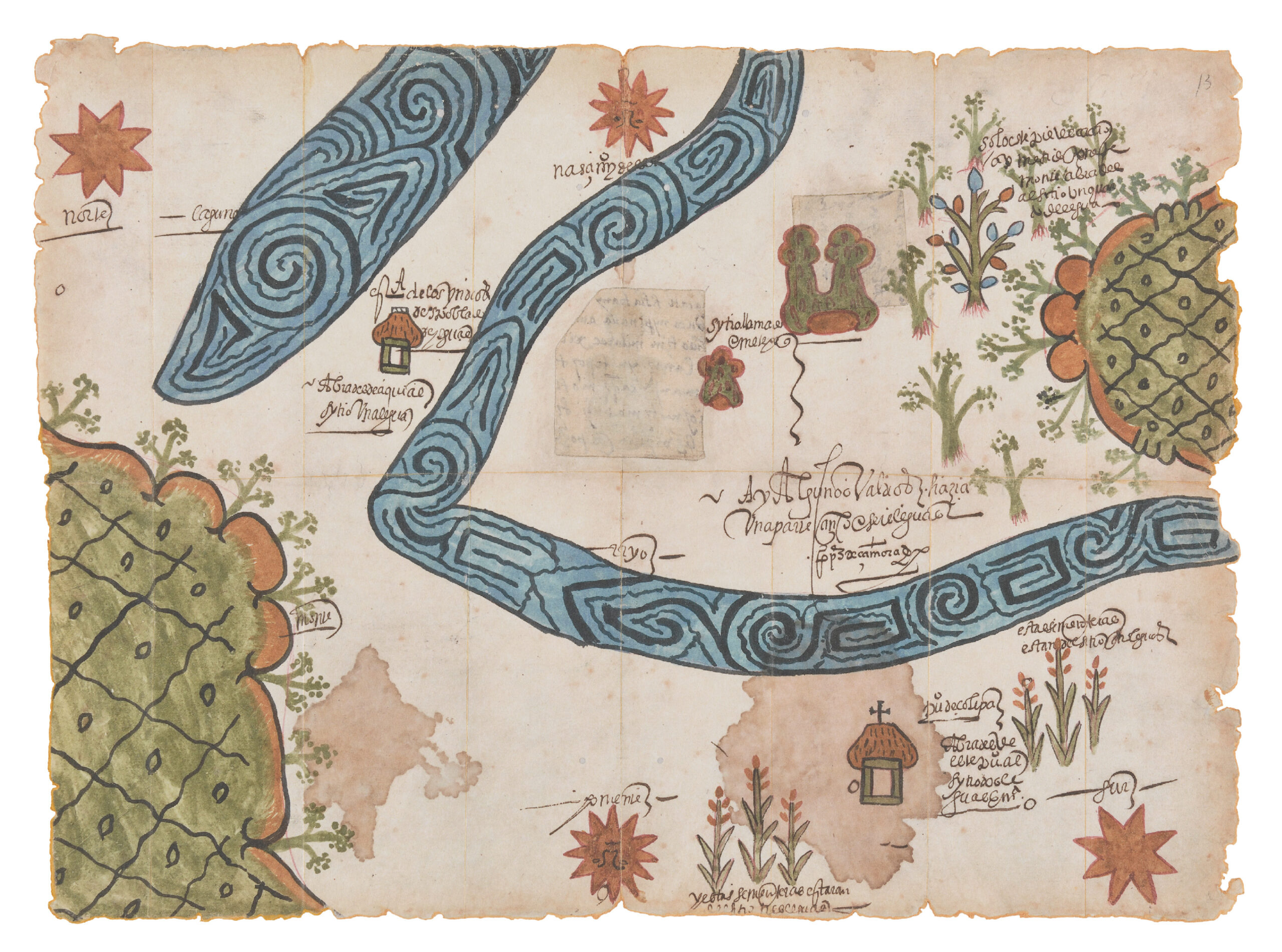
Facsimile by Tlaoli Ramírez Téllez, 2021, of Map of Zolipa Misantla, Veracruz, 1573. Original at Archivo General de la Nación (AGN) Mapoteca no. 1535. COURTESY LACMA
The nonverbal messages enfolded in maps figured prominently in three compelling Los Angeles art exhibitions in 2022. Broadly, they dealt with colonial rule following the Spanish conquest of Mexico and its lasting reverberations, and they expanded the usual narrative of that often violent clash of worldviews. Through selections of historic and contemporary maps, the exhibitions highlighted Indigenous perspectives, revealing a surprising interplay of cultures and a resilient people who never ceased expressing themselves through art.
The ancient fire god of the Mexica (pronounced mə·shee·ka)—the nation we know as the Aztecs—stood watch over a gallery of colonial-era maps at the Los Angeles County Museum of Art (LACMA). The basalt statue was carved perhaps 700 years ago by Nahua artists, members of the Indigenous people of Mexico, and was among artifacts that provided a pre-Columbian lead-in for the exhibition, Mixpantli: Space, Time, and the Indigenous Origins of Mexico. The word Mixpantli describes a celestial comet, a portent of the 1519 Spanish invasion as set down by Nahua scribes.

Detail from Map of San Juan Cuauhtinchan, Puebla, 1704. AGN Mapoteca no. 655. ARCHIVO GENERAL DE LA NACIÓN
More than works of art, the maps in the exhibition tell a legal story that is part and parcel of colonial history. They belong to a corpus of Spanish land grants and court documents called the Ramo de Mercedes, housed in Mexico’s Archivo General de la Nación (National Archives). Spanish for mercy, merced refers to grants considered to have been graciously given “at the sovereign’s mercy” (Tyler, N.M. Hist. Rev., 1991). The king established the colony of New Spain across the subjugated Aztec empire and empowered his viceroy to grant title to land, predominantly for farming and ranching (Taylor, N.M. Hist. Rev., 2021).

Map of Santiago Atapan, Michoacán, 1728. AGN Mapoteca no. 687. Sun denotes east and star denotes north. Roads with mojoneras (milestones) topped with crosses give distances in leagues to nearby pueblos. ARCHIVO GENERAL DE LA NACIÓN
Because the original maps remain in Mexico, Mexico City-based artist and designer Tlaoli Ramírez Téllez recreated them for LACMA. They are called facsimiles, but that label doesn’t do them justice. Meticulously drawn with acrylic, ink, and watercolor on paper, they replicate the originals’ signs of age in every detail, from water and wine stains to frayed edges, crumbling creases, and revealing palimpsests. These are skillful forgeries of official maps, authenticated with signatures and annotations scrawled by colonial functionaries.
Indigenous communities could and did use the land grant legal system to protect their own interests, sometimes to fight encroachments and dispute water rights with colonial estate holders, as was the purpose behind the map of Santiago Atapan (gorgeously fringed with golden fields), and to secure grants for preexistent pueblos (Museo Amparo). But more often, piece by piece, land grants were the means of transferring Indigenous-held territory into Spanish hands (Rull, 2020, pp. 14, 192).
The mapas de mercedes de tierras (land grant maps) were presented as key evidence in land cases before the viceroyalty courts. Although the legal system was imported, a rich tradition of mapmaking was local. We know from Spanish sources that conquistadors had been given Nahua maps to help them choose where to drop anchor and find their way in unfamiliar territory (Alva, Historia Chichimeca; Mundy, 1998).

Map of Ahuehuetitlán, Oaxaca, 1616. AGN Mapoteca no. 2056. At the pointing hand symbol it reads: “Here is the site …” ARCHIVO GENERAL DE LA NACIÓN (AGN)
The parties requesting and opposing land grants commissioned Indigenous artists to paint maps, whose great variation in style is attributable in part to the meeting of cultures. Artists raised in Mesoamerican traditions became trained in European techniques, and they integrated these different approaches with unique results (Hidalgo, 2019, Ch. 2; Rull, p. 50).
Indeed, the exhibition highlighted the “hybrid nature” of these artistic legal documents that emerged in a time of transformation. As artist Mariana Castillo Deball explains, although land grant maps were meant to serve the Spanish system, “we can still recognize the voice and ways of representing things by the Indigenous painters.”
For example, a 1704 map of San Juan Cuauhtinchan is characterized by rectilinear, church-centered blocks that conformed to the king’s decree to his land surveyors: “Let the city lots be regular from the start, so that once they are marked out the town will appear well ordered; … otherwise order will never be introduced” (A.E.J. Morris, 1994).
Even then, nearly two centuries after the Aztec defeat, the Nahua mapmaker incorporated an expression of defiance in his drawing: overlooking the village, atop a green hill of the Sierra de Amozoc, we see a raptor clutching a fawn in its talons and a snake in its beak. In Nahua iconography eagles symbolize elite warriors, and the captive snake recalls a legend of the founding of Tenochtitlán, the Aztec-Mexica capital—a scene that lives on at the heart of the Mexican flag.
Mexico’s hybrid culture is especially evident in the sixteenth-century Florentine Codex (the exhibition included UCLA’s reproduction). This monumental, illustrated, bilingual (Spanish and Náhuatl) primary source for Mexica history and culture represents the collaboration between a Franciscan friar and a team of Indigenous writers and artists. It is poignant that their work to preserve Nahua collective knowledge was pursued during a horrific epidemic that decimated the native population.
The second exhibition was LACMA’s companion show, Mixpantli: Contemporary Echoes, where the artworks connected past to present. Dominating the gallery floor was a map by artist Deball that visitors could physically walk upon. Its title, Vista de Ojos (lit., view from eyes), is a term borrowed from a land grant procedure that required visual confirmation by colonial officials of those locally drawn maps discussed above. This government review of the artist’s view of the land—placing in relationship the subduer and subdued—Deball poetically calls a “gaze on top of a gaze.”
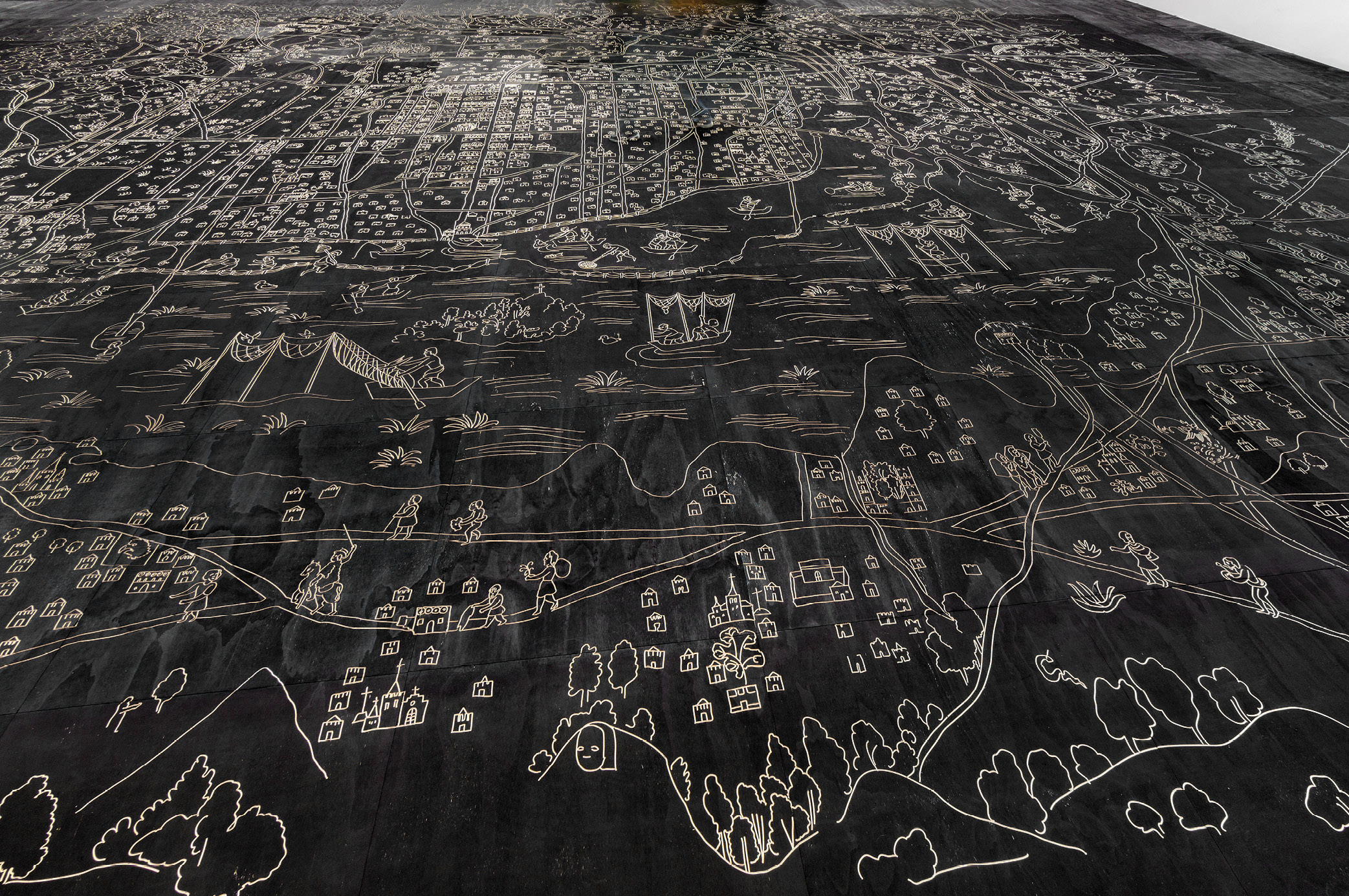
Mariana Castillo Deball. Installation view of Vista de Ojos, 2014. CNC engraved plywood floor. Kurimanzutto, Mexico City. PHOTO BY ESTUDIO MICHEL ZABÉ. Courtesy the artist
Measuring 19 by 13 meters (2,659 square feet), Deball’s incised plywood panel flooring is an enlarged rendition of the historic Santa Cruz Map of Tenochtitlán, by then renamed Mexico City. Produced only three decades after the Conquest, that map shows European-style buildings in place of Aztec temples, and uses animals, stars, and other symbols to identify Mexica place names. Based on what suggests an insider’s familiarity with the city, the mapmaker was likely “an Aztec with European schooling” (Lib. of Congress, CN 2021668313).
Deball, born in Mexico City, writes of the Santa Cruz Map, “On the outskirts one can see the Indigenous settlements and their inhabitants engaging in everyday activities,” such as fishing, canoeing, and bowhunting. She sees in these traditional lifeways a contrast between Indigenous and European maps in outlook and approach, which the other exhibition’s title, “Space, Time,” references. Whereas European maps focus on spatial information frozen in time, Indigenous maps are populated with people and stories, actions we imagine projecting into the past and future. Deball’s walkable installation (in LACMA’s permanent collection) invites visitors to set foot on the map and experience it with more than just a gaze.
Both the Santa Cruz Map and its modern rendering testify to Indigenous continuity, countering the misconception that Conquest meant obliteration. The “myth of native desolation” is what historian Matthew Restall terms the notion that those not readily destroyed through battle or disease soon surrendered their ethnic identities under the weight of Spanish colonizers, culture, and control. On the contrary, Restall elaborates on the resourcefulness of those Indigenous people to survive and adapt, as the maps in these exhibitions bear out.
Contemporary Echoes also showcased paintings by Southern California artist Sandy Rodriguez that uncomfortably challenge us to see the through-line from the Spanish invasion to today’s news. Rodriguez describes herself as a Chicana who, owing to her family and proximity to the border, grew up in two worlds. Using amate paper and natural pigments (e.g. indigo leaf extract and clay to form Maya Blue), she draws from the palette and vocabulary of historic maps to link colonialism with national immigration policy.
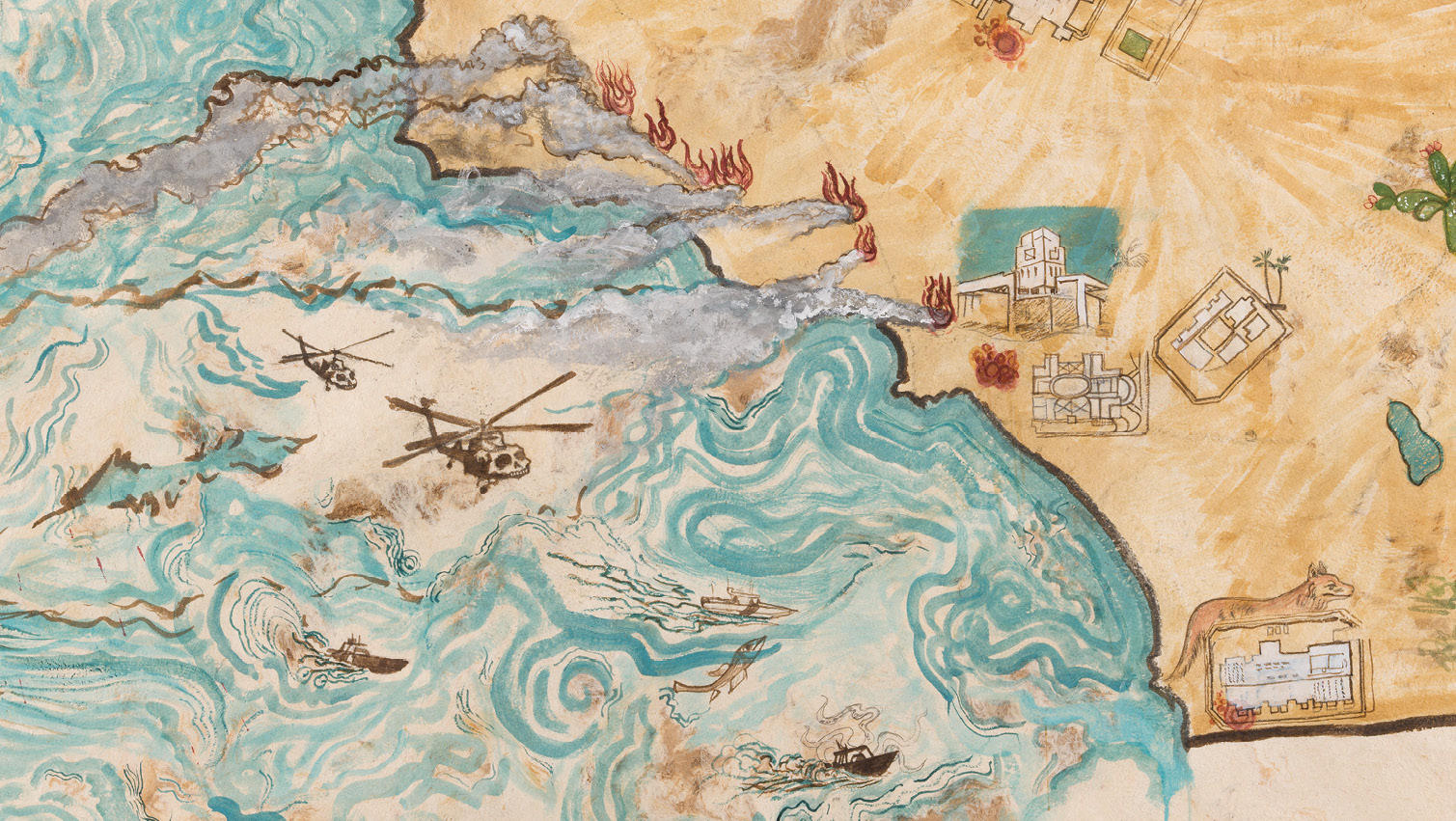
Sandy Rodriguez. Detail from De las Señales y Pronósticos & I.C.E. Raids de Califas, 2018. Hand processed watercolor on amate paper. Crystal Bridges Museum of American Art, Bentonville, AR. COURTESY THE ARTIST
Filled with Mesoamerican iconography, Rodriguez’s works confront the viewer with police violence and the incarceration of Latino immigrants. Her painting, De las Señales y Pronósticos and I.C.E. Raids de Califas (Of the Signs and Prophecies and I.C.E. Raids in California [slang]), presents a map of the state, with satellite views of detention centers plotted onto the desert borderlands. Rodriguez explains that her colors and style reference images of the Conquest in the Florentine Codex, in which Spanish galleons are upgraded to immigration enforcement helicopters sporting the menacing visages of calevaras (skulls).
Although it’s not a map, the ancient Códice Maya is relevant to the topic of Indigenous culture, and its showing at the hilltop Getty Museum coincided with the third exhibition we will cover. This manuscript on bark paper tracks the movements of the planet Venus—the Morning Star—as recorded by Maya priests around the peak of Maya civilization, 400 years before Spanish contact and centuries before Tenochtitlán existed. On loan from Mexico, the codex employs pictorial symbols and imagery, like a graphic novel, and documents the sophistication of ancient astronomy and the Maya calendar.
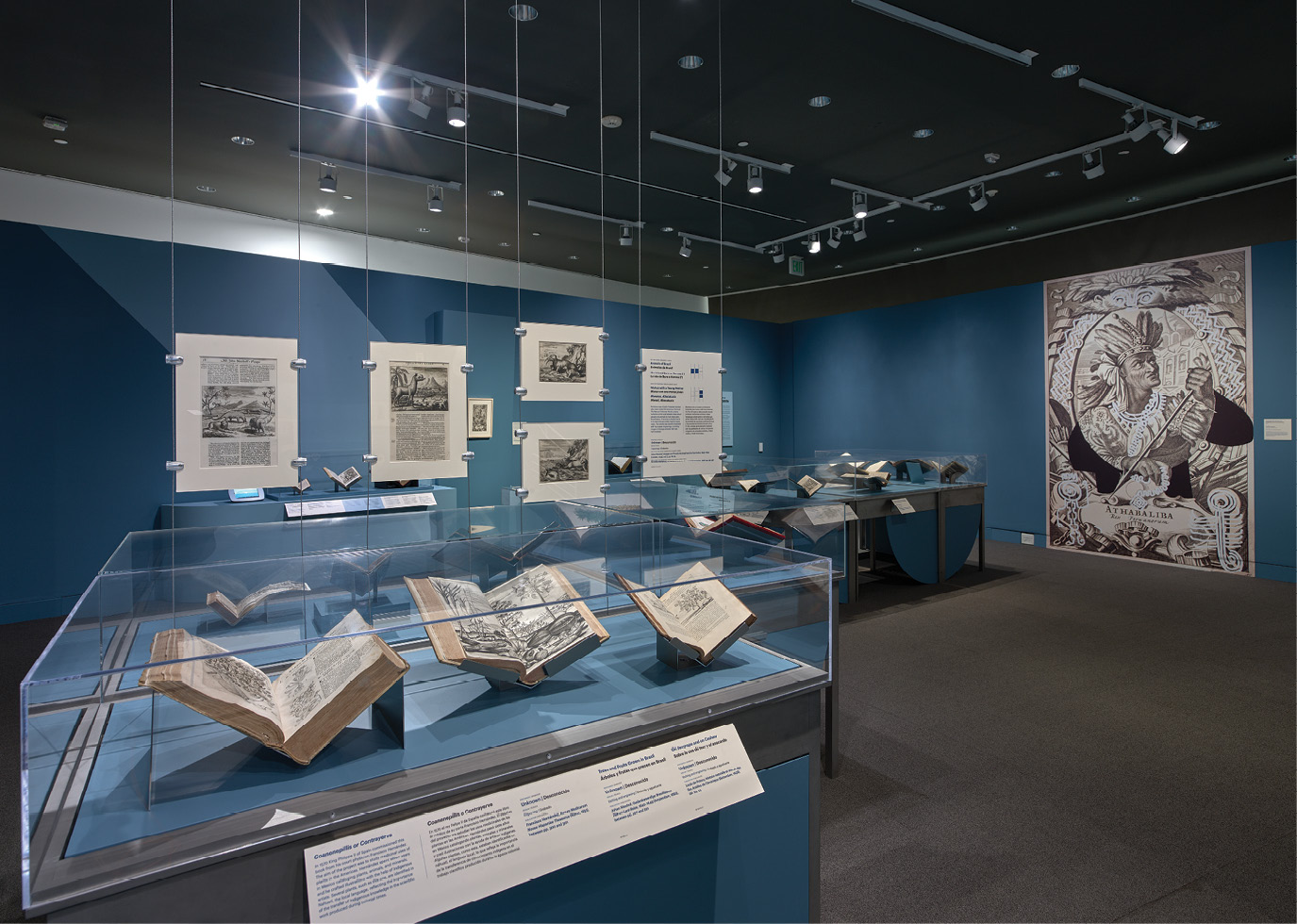
Installation view of Reinventing the Americas: Construct. Erase. Repeat. 2022, at Getty Research Institute. PHOTO BY JOHN KIFFE, © J. PAUL GETTY TRUST
We conclude with Reinventing the Américas: Construct. Erase. Repeat., at the Getty. There, a fine woodcut map of Tenochtitlán from 1524 displays the mix of styles seen in the Mixpantli exhibition. (See this magazine’s cover image.) Its label pointed out a motif that resembles the Aztec Náhuatl glyph, tepetl, representing a hill or mountain, while, markedly less subtle, this “map of conquest” flaunts the triumphal coat of arms of Charles V, then Holy Roman Emperor and King of Spain.
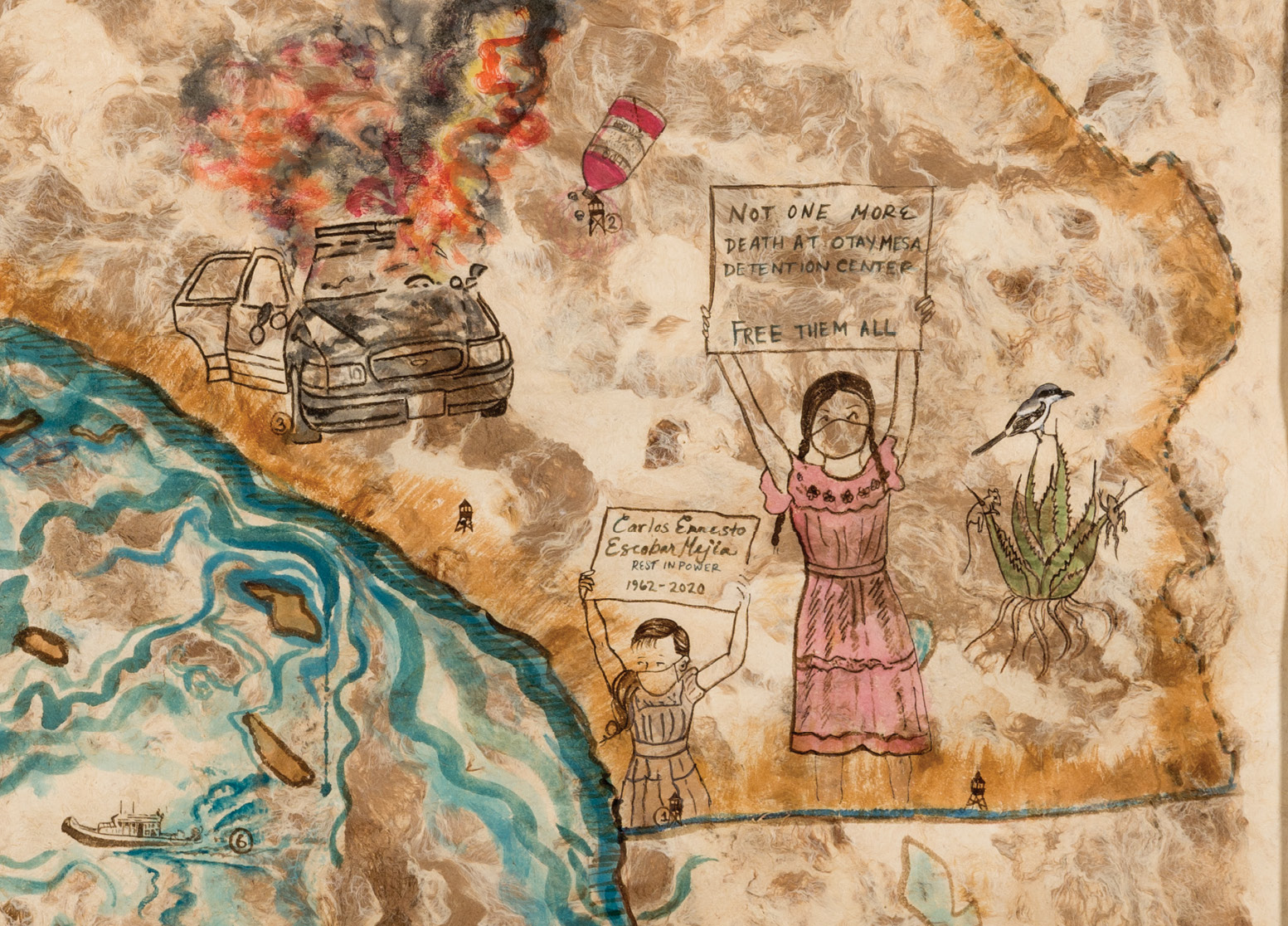
Sandy Rodriguez. Detail from Mapa de Califas—Atrocities, Isolation and Uprisings, 2021. Hand processed watercolor on amate paper. COURTESY THE ARTIST
This exhibition began with the premise that America is more than a place on a map; it is an idea that, since Columbus, was defined by Europeans. To illustrate, a 1619 map of the Straits of Magellan by Flemish engraver Theodor de Bry features naked native figures as Adam and Eve, representing the New World as Eden, a blank slate waiting to be graced with knowledge and civilization. Such Eurocentric portrayals persisted for centuries, “fueling stereotypes and prejudices” against Indigenous peoples (Getty.edu). The purveyors of this view, it seems, were unacquainted with Maya astronomy.
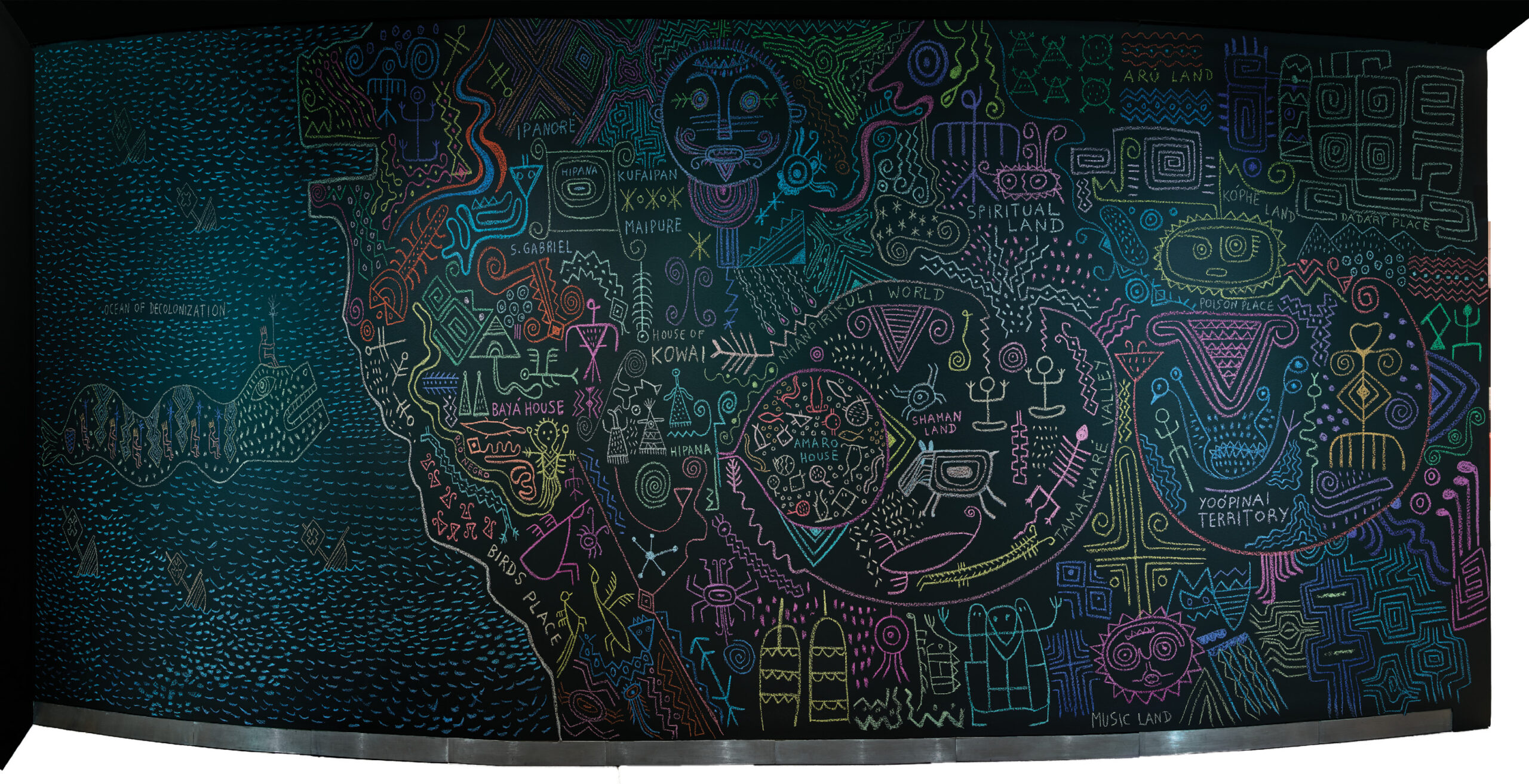
Denilson Baniwa. Untitled, 2022. Chalk mural, at Getty Research Institute. PHOTO BY JOHN KIFFE, © J. PAUL GETTY TRUST
In keeping with the theme of reinvention were contemporary works in a variety of mediums by Indigenous artist Denilson Baniwa. Originally from the Brazilian state of Amazonas, Baniwa describes his work as reflecting on both his home village and the outside world where he now lives and the “frictions that occur when these worlds collide,” including those caused by differing “understandings of the world,” its origins, and our place in it.
The exhibition included his videos, paintings, and “digital interventions”—in which copies of historic depictions of the New World appear altered or defaced. In a piece titled History of Violations, Baniwa blacked out, as if by Sharpie, the European-assigned place names on a renowned 1579 map of the Americas by Abraham Ortelius. And in a wall mural in chalk, Baniwa offered his own map, reclaiming history from an Indigenous point of view, if somewhat cryptically, in the style of ancient petroglyphs.
Sandy Rodriguez refers to the subject of her map paintings as “contested lands.” One might say that all the maps in these exhibitions, from colonial to modern, in various ways pose the challenge: who belongs here? And just as land is often contested, so is history. Those elegant Spanish land grant maps are inescapably tied to a history of Indigenous communities dispossessed by way of an avaricious legal system. At the same time, because the mapmakers’ skills were highly valued by the conquerors, the maps impart to us a cultural legacy and the human spirit to survive.

Xiuhtecuhtli, ca. 1250-1521, Mexica. Basalt stone (Ht. 80 cm). Museo Nacional de Antropología, Mexico City. INAH DIGITAL ARCHIVE
Survival was a recurring theme in these exhibitions, culminating in the vibrant expression of Indigenous experience in contemporary art. This theme is palpable in the Florentine Codex: amid staggering death and destruction, its Nahua authors and artists resisted their plight and affirmed their presence on the land. Five hundred years after the Conquest, their prefatory words still hold the power to move us: “We people here ….”
Alex Hidalgo, Trail of Footprints: A History of Indigenous Maps from Viceregal Mexico (Univ. of Texas Press, 2019).
Matthew Restall, Seven Myths of the Spanish Conquest (Oxford Univ. Press, 2021).
Ana Pulido Rull, Mapping Indigenous Land: Native Land Grants in Colonial New Spain (Univ. of Oklahoma Press, 2020).
See related maps, art, and artifacts at these museums:
Latin American and Pre-Hispanic Art Collections at the Getty Center in Los Angeles.
Art of the Ancient Americas Collection at the Los Angeles County Museum of Art. Works by Mariana Castillo Deball and Sandy Rodriguez are in the museum’s permanent collection.
Paintings by Sandy Rodriguez are part of the installation, Borderlands, at the Huntington Library Art Museum in San Marino, CA. Her solo exhibition, Unfolding Histories: 200 Years of Resistance, is at University of California, Santa Barbara until March 3, 2024.
Colonial maps from the 2018 exhibition, In Tlilli, In Tlapalli. Images of the New Land: Indigenous Identity After the Conquest, at Museo Amparo in Puebla, Mexico, can be viewed on the museum’s website.

Finalists for Australian Geographic Nature Photographer of the Year 2023 have been revealed.
The stunning photographers have been entered into ten categories including animals in nature, astrophotography, junior, landscape, macro, monochrme, our impact, threatened species and urban animals.
Click through to see some of our favourites.

Photography has become an everyday part of our lives, moving from the realm of professionals to the hands of amateurs and enthusiasts. With the continual evolution of smartphone technology, mobile photography has significantly transformed, delivering professional-level results that rival traditional DSLRs. This year, 2023, showcases some extraordinary smartphone cameras, pushing the boundaries of what mobile devices can achieve in photography.
Apple’s iPhone 14 Pro Max is more than just a smartphone; it’s a versatile photographic tool. The phone showcases a triple-lens rear camera setup: a 48-megapixel wide sensor, a 12-megapixel ultra-wide sensor, and a 12-megapixel telephoto sensor. This configuration allows photographers to capture a wide range of shots, from panoramic landscapes to detailed close-ups, all while maintaining high resolution and rich color reproduction.
The phone’s Night Mode is particularly impressive. Now available for all three lenses, it intelligently adapts to different light conditions, enabling photographers to capture vibrant, detailed images even in low light. This opens up a world of creative possibilities, from capturing cityscapes under neon lights to shooting wildlife at dawn or dusk.
Apple’s ProRAW feature should not be overlooked either. This provides photographers with comprehensive control over editing while maintaining the high image quality. This feature can be a game-changer for photographers interested in post-processing, allowing for a level of detail and dynamic range usually associated with DSLR cameras.
The Google Pixel 7 Pro is another standout in mobile photography. Its camera setup includes a 50-megapixel main sensor, a 12-megapixel ultra-wide sensor, and a 48-megapixel telephoto lens. This powerful hardware is complemented by Google’s advanced computational photography capabilities.
The Pixel’s software uses AI and machine learning to enhance image quality and make automatic adjustments. This leads to better low-light performance, enhanced digital zoom, and improved portrait mode effects. Google’s Night Sight and Super Res Zoom take these enhancements even further, providing remarkable low-light shots and impressive zooming capabilities. For travel photography or impromptu street shots, these features make the Pixel 7 Pro a powerful companion.
The Samsung Galaxy S23 Ultra comes equipped with a comprehensive camera system, housing a 108-megapixel wide sensor, a 12-megapixel ultra-wide lens, and two 10-megapixel telephoto lenses. This setup offers great versatility, accommodating a variety of shooting situations and styles.
The phone’s Space Zoom feature is particularly impressive, offering up to 100x digital zoom. This feature can capture distant subjects with an impressive level of detail, which could be particularly useful in situations like wildlife photography or sporting events. Furthermore, the Single Take feature allows users to capture a series of photos and videos with one shutter press, perfect for fast-paced events or dynamic scenes.
The Sony Xperia 1 IV, with its triple 12-megapixel lens setup (wide, ultra-wide, and telephoto), offers professional-grade capabilities. The Photography Pro feature emulates the manual controls found in DSLR cameras, providing full control over parameters like shutter speed, ISO, and focus. This makes it an ideal choice for photographers who prefer hands-on control and precision.
To fully capture the potential of these phones, let’s explore a few more tips that can elevate your smartphone photography skills:
The beauty of smartphone photography lies in its accessibility and spontaneity. With your phone always in your pocket, you’re ready to capture any moment. Take advantage of this convenience, keep these tips in mind, and you’ll soon notice a significant improvement in your photos. Remember, the best camera is the one you have with you. Now, armed with one of these top smartphones of 2023 and the knowledge to harness its full power, you’re well equipped to take your mobile photography to the next level.
In 2023, the line between traditional and mobile photography continues to blur. Thanks to the combination of powerful hardware and innovative software, today’s smartphones offer a level of photographic quality and versatility that was unthinkable just a few years ago.
With devices like the iPhone 14 Pro Max, Google Pixel 7 Pro, Samsung Galaxy S23 Ultra, and Sony Xperia 1 IV, photographers have high-quality tools right at their fingertips. Whether you’re capturing the fleeting moments of street photography, the grandeur of a landscape, or the intricate details of a close-up shot, mastering mobile photography is now more achievable than ever.
So, embrace the capabilities of your smartphone camera. Practice, experiment, and never stop learning. The world of photography is vast and rewarding, and with your smartphone, you’re well equipped to explore it.

SIGMA has just announced the SIGMA 14mm F1.4 DG DN | Art lens, the world’s first 14mm f/1.4 lens designed specifically for astrophotography. This ultra wide-angle prime lens is compatible with mirrorless camera systems, available in Sony E-mount and Leica L-Mount.
The lens is equipped with various features tailored for astrophotography, including a removable tripod socket, MFL switch for manual focus lock, lens heater retainer, rear filter holder, and a specially-designed front cap with a new locking mechanism and filter storage slots. It offers excellent aberration correction and delivers exceptional image quality, making it potentially the best lens for astrophotography. Its 14mm focal length and F1.4 aperture capture vast starry skies and reduces exposure time. The lens is also durable with a splash and dust-resistant construction, maintaining the high performance and quality standards of the SIGMA F1.4 Art lens lineup.
Beyond astrophotography, this 14mm f/1.4 lens is also suitable for high-end architecture, real estate and landscape photography, thanks to its outstanding optical performance and specialized features.

Supplied accessories: Case, COVER LENS CAP LC1014-01, REAR CAP LCR II, TRIPOD SOCKET TS-141, PROTECTIVE COVER PT-41, GUIDE PLATE GP-11
Available mounts: L-Mount, Sony E-mount
Introducing the world’s first and only lens that combines an ultrawide angle of 14mm with a maximum aperture of F1.4, designed specifically for stunning starscape photography. Capturing the beauty of the starry sky is a challenging task for wide-angle lenses, given the multitude of tiny light sources scattered throughout the image. The 14mm F1.4 DG DN | Art lens is the result of our engineers’ passion for achieving the widest, brightest, highest-resolution, and most captivating starscape images imaginable. Leveraging SIGMA’s cutting-edge technology, this lens offers an ultrawide 14mm angle of view paired with an impressive F1.4 aperture. It boasts high optical performance with thorough correction of sagittal coma flare, specialized functions to enhance starry landscape photography, and fast autofocus powered by the HLA linear motor.
With the 14mm F1.4 DG DN | Art lens, you can turn the Milky Way stretching across the night sky and twinkling stars above ridgelines into breathtaking images that surpass the experience. Its exceptional performance in capturing starscapes opens up new possibilities for visual expression and enjoyment across various scenes, including daytime landscapes, architecture, and indoor photography in dark and confined spaces.
* Excluding fisheye lenses, as interchangeable lenses for mirrorless cameras and SLR cameras (as of June, 2023 by SIGMA).
Applying the best of SIGMA’s optical technologies made this world-first performance possible, from the design to the lens manufacturing process. In addition, 19 elements in 15 groups, including 1 SLD glass element, 3 FLD glass elements, and 4 aspherical lens elements, make up a luxurious lens configuration. This allows for advanced aberration correction and a high degree of precision in the lens construction. This allows both advanced aberration correction and F1.4 brightness. In particular, sagittal coma flare, which distorts the shape of stars, has been carefully corrected. Even at the widest aperture, the lens delivers high image reproducibility right to the periphery of the image.
Both optical design and coatings also thoroughly address ghosting and flare. This allows for clear, crisp shooting of starry sky and night scenes. Optimized for starscapes, which require extremely high performance, this lens delivers images that exceed expectations in any scene, including landscapes, architecture snapshots, portraits, and indoor photography.
The 14mm F1.4 DG DN | Art is equipped with a wealth of features that support starscape photography. This fully backs up the fun of starscape photography.
Includes a detachable tripod mount compatible with Arca-Swiss type. Mounting the 14mm F1.4 DG DN | Art lens on a tripod makes it more stable, as it is heavier on the front side. The shape is designed to prevent interference even when using the lens heater.
A switch to lock the manual focus at a desired position. Prevents focus shift caused by unintentional operation of the focus ring. This is useful for fixed focus shooting scenarios, such as long exposure photography.
Steps around the front and lens heater retainers prevent the lens heater* from protruding into the front of the lens and causing vignetting on the periphery of the screen.
* A belt-shaped heater wrapped around the lens prevents condensation from forming inside the lens when the temperature drops.
A rear filter holder is provided as standard equipment at the lens mount for attaching a sheet-type rear filter. A lock mechanism is also provided to prevent the filter from falling out.
Includes a cover-type front cap with locking mechanism. It also has a newly developed filter slot that can hold two rear filters depending on the application. The cap is specially designed for the 14mm F1.4 DG DN | Art to protect the sheet filters from scratches and dirt while ensuring that they are not mistakenly taken out or forgotten.
In addition to functions specifically designed for shooting starscapes, the lens is equipped with various functions to assist in shooting, including an AFL button to which any function can be assigned and an aperture ring. The body is dust and splash resistant. The frontmost surface of the lens has a water- and stain-repellent coating, so you can shoot outdoors in harsh environments with peace of mind. The HLA (High-response Linear Actuator) enables high-speed, quiet, and highly accurate autofocusing.
In order to maintain performance while supporting a lens with a large aperture, the lens has a robust internal structure and uses lightweight materials such as polycarbonate TSC (Thermally Stable Composite), which has a thermal shrinkage rate equivalent to that of aluminum, and magnesium in appropriate locations to reduce weight while ensuring robustness. The lens body is built with the high build quality of the Art line specifications, allowing the user to fully enjoy the unique performance of the lens in any environment, including shooting starscapes.

The figures below are for the L-Mount version:
Lens Construction: 19 elements in 15 groups (3 FLD, 1 SLD, 4 aspherical)
Angle of view: 114.2°
Number of diaphragm blades: 11 (rounded diaphragm)
Minimum aperture: F16
Minimum focusing distance: 30cm / 11.9 in.
Maximum magnification ratio: 1:11.9
Filter size: Rear filter only
Dimensions (Max. Diam. x Length): 101.4 x 149.9mm / 4.0 x 5.9 in.
Weight: 1170g / 41.3 oz.
For more information, visit Sigma.

The entries for the Australian Geographic Nature Photographer of the Year are in and the shortlist has been revealed.
Each year, it encourages photographers to capture stunning images taken in Australia, New Zealand, Antarctica and New Guinea.
And, in its 20th year running, this year is no exception.
In 2023 the competition, which is owned and produced by the South Australian Museum, drew 2,182 entries from 550 photographers across 10 countries.
But the shortlist could only be made up of 95 images.
South Australian Museum acting director Justine van Mourik said this year’s judges, Mike Langford, Adjunct Professor Wayne Quilliam and Jackie Ranken, faced an epic task.
And this year it was even harder, with a new category attracting awe-inspiring images.
“This year we introduced the well-received macro category, with photographers submitting incredible larger-than-life-sized images of nature’s smallest scenes,” Ms van Mourik said.
That meant there were 10 categories this year:
The South Australian Museum will announce the overall winner, category winners, runners-up and the Portfolio Prize in August.
Until then, here’s a look at the shortlisted images in the Animals in Nature, Macro and Urban Animals categories.

Believe it or not, I have been a freelance photographer for six years. Looking back on it, I have been struggling to make it, truly learning the meaning of the term starving artist. I wish I would have received this bit of advice so many years ago.
In photography, I have this saying: “if it pays, it stays.” What I mean by that is I will grab any paying jobs to keep my dream alive. Those jobs could be real estate, insurance claims, race photography, or any mindless, non-creative paying gig. Much of the time, they are mindless opportunities for which my passion is not aroused.
It’s great in the short-term, because who doesn’t love paying bills? It does lead to a lot of distraction from what one is passionate about. Eventually, it leads to this never-ending loop of passionless photo jobs one dreads to do.
This is what happened to We Eat Together. He bopped around a variety of photography categories but never really found a foothold. Until one day, he discovered passions outside of photography. In turn, he used his camera as a tool to express his passions. By doing so, he got away from the passionless gig loop and gained traction in his photography career.
Photography is a daunting career choice because everyone has become one with their phone. The way to break through the noise is to combine passion, creativity, and focus. Perhaps you could save yourself a decade and the feelings of failure by becoming one of the best photographers in your passionate niche.







