TCAC ‘Haudenosaunee, Art of the Now’ exhibit open

TCAC ‘Haudenosaunee, Art of the Now’ exhibit open
image

OLEAN, N.Y. — The current Tri-County Arts Council exhibit, “Haudenosaunee, Art of the Now” “Survive, Alive, Thrive,” featuring the works from culminating show for Seneca-Iroquois National Museum’s artist in residency program funded by the Appalachian Regional Commission’s Area Development fund. Artists in the residency program include Samantha Jacobs, Lorinda John, Penelope S. Minner, Alicia Sanford, Antoinette Scott, Bernadette Scott, Kristina Tome, and Leeora White.

In late summer of 2021 Appalachian Regional Commission Area Development with Southern Tier West grant funding came through for the Pathways to Success: Artist in Residency (AiR) Program at Seneca Iroquois National Museum. A call out for indigenous artists to apply went out in October 2021. Eight artists heeded the call from both Cattaraugus and Allegany territories. Their talents ranged from making corn husk dolls and weaving to painting and sewing. Each AiRs received a modest stipend to participate in a variety of activities that would inspire them to create a piece of art that they would donate to the museum. This show at Tri County Arts is an acknowledgement of the challenges met during this time, but more importantly a celebration of the successes of overcoming obstacles and the creativity that arose as a result.

In late summer of 2021 Appalachian Regional Commission Area Development grant funding came through for the Pathways to Success: Artist in Residency (AiR) Program at Seneca Iroquois National Museum. A call out for indigenous artists to apply went out in October 2021. Eight artists heeded the call from both Cattaraugus and Allegany territories. Their talents ranged from making corn husk dolls and weaving to painting and sewing. Each AiRs received a modest stipend to participate in a variety of activities that would inspire them to create a piece of art that they would donate to the museum. This show at TriCounty Arts is an acknowledgement of the challenges met during this time, but more importantly a celebration of the successes of overcoming obstacles and the creativity that arose as a result.

All the activities took place during the Covid 19 Pandemic, which everyone met with resilience. Participants made the best of a tough situation and each AiR took part in virtual, live, and hybrid professional development workshops with partners in the program. John Sheehan from Seneca Salamanca Chamber of Commerce presented the first workshop on how to be the best salesperson. He also gave the artists his secret FORM (Family, Occupation, Recreation, Money) equation for building successful sales relationships. Fred Frigthner, Director of Marketing Communications at W.R. Case & Sons Cutlery did two separate workshops on telling stories about products along with a writing workshop. Picking up from there, Tom Cullen led the AiRs in a discussion on “recognizing and identifying your audience in order to attract your dream customer.” At Tri County Arts Council Director Emeritus Mikel Wintermantle and Artist Educator Allison Braun did a hands-on workshop focused on displaying and photographing art. Artists got to play with light boxes and learn all about the power of their cellphones to make their work pop! Hayden Hanes brought the previous topics together and presented on photographing your work and how to tell your story. Brian Kelly hosted a Creating and editing websites Workshop at The Hub in Olean. Sharon Louden, the former director for Chautauqua Visual Arts presented a virtual talk on making a living as a working artist, which covered grants, fellowships, arts markets, and commissions. The artists also participated in several arts markets arranged at the museum and they took a trip to K-Art in Buffalo and participated in a Q and A about fine arts galleries with the gallery managers.

In addition to forming new relationships between Seneca Iroquois National Museum and organizations in Olean and Allegany Village, and supporting the creative economies, the final piece to the Pathways to Success program is the mini-gallery boxes. This was an idea inspired by the mini-libraries that have been popping up in communities and neighborhoods across the United States. The idea behind the mini-galleries was to place art and the institution within the communities to make the exhibits accessible and give people a taste of what they will find in the museum. Seneca Nation Arts and Cultural Placed Based Tourism Initiative is an example of a cost-effective foundation for a continued partnership and project to create permanent resources that will benefit all partners.

Trending Food Videos

Funds were used to create these permanent place-based displays, which encourages cultural exploration of the region. These Mini Galleries capitalized on partnerships and lessons learned from the workshops. Additionally, the hope is that the Mini Galleries will be a replicable model that other museums and cultural institutions can use, helping to further promote SINM. The Seneca Nation’s Training and Employment Resource Center’s construction training program led by Jim Ray, created the Mini Galleries using their students and instructors. This program provided hands-on “trades/construction” training to displaced, underemployed, and/or disabled Indigenous peoples. The SINM, because of their integral role in fostering cultural programming as a practice of maintaining cultural continuation, has served and continues to serve as an excellent hub for all community partners to work through. Since participating in the Pathways to Success program half of the AiRs received funding through Creatives Rebuild New York fellowship and are fully employed as working artists with tools and skills to carry them through the end of the program in 2024.

The opening reception was catered by Chef Lorinda John from LoMade Meals and beverages provided by an anonymous donor.

For more information on this and any other exhibits at the Tri-County Arts Council, visit the website www.tricountyartscouncil.org or call (716) 372-7455.

TCAC has updated its Artist Market and is open to the public from noon to 6 p.m. Tuesday to Friday, and noon to 5 p.m. Saturday.

Art Industry News: Set Dressing for the ‘Barbie’ Movie Caused a Global Shortage on Pink Paint + Other Stories

Art Industry News: Set Dressing for the ‘Barbie’ Movie Caused a Global Shortage on Pink Paint + Other Stories

Art Industry News is a daily digest of the most consequential developments coming out of the art world and art market. Here’s what you need to know on this Monday, June 5.

NEED-TO-READ

Hans Peter Feldmann Dies at 82 – The news was jointly announced by the eight galleries he had worked with. The German conceptual artist’s works made out of his archive of seemingly banal pictures were considered by some critics as predecessors of appropriation art in the 1980s. He became the oldest winner of the Guggenheim Museum’s Hugo Boss Prize in 2011. (ARTnews)

Ownership of the Benin Bronzes Gets Complicated – Institutions in the West that agreed to return the treasures looted from the Kingdom of Benin palace by the British troops in 1897 are demanding clarification about who will own the bronzes after it was announced that the oba, the direct descendent of the Benin kingdom, would be the sole owner of the restituted treasures, rather than the state or the trust that oversees the development of the new Edo Museum of West African Art. The decision could be challenged by Nigerian officials under the newly elected president Bola Tinubu, who took office last Monday. Cambridge University has postponed its handover ceremony of 116 bronzes until clarity is gained. (New York Times)

Barbie Movie Causes Shortage of Pink Paint – Sarah Greenwood, production designer of the upcoming screen adaptation of the world’s famous doll franchise, told Architectural Digest that building the sets caused a global shortage of the Rosco fluorescent pink paint. But Rosco’s global marketing VP, Lauren Proud, clarified that there had already been a supply shortage due to logistical issues relating to the pandemic. “And then we gave them everything we could,” Proud said. (Vulture)

Oscar Murillo on How Painting Is Like Winemaking – The 37-year-old artist dubbed “the 21st-century Basquiat” said the making of his new work, Manifestations 2020-2022, on show at Gagosian, was like “making really good wine, it takes years.” The artist took his time to make art while living in his native Colombia during lockdown. (Observer)

MOVERS & SHAKERS

Rijksmuseum’s Vermeer Show Attendance – The Amsterdam institution has welcomed 650,000 visitors from 113 nations over the course of 16 weeks to its Vermeer exhibition, the most successful since the museum was founded more than two centuries ago. The show ended on Sunday but six of the 28 paintings featured at the exhibition remain on view at the museum. (Press release)

Angela Cassie Leaves Post at National Gallery of Canada – Cassie leaves for another yet to be announced leadership position in Manitoba after one year as the National Gallery of Canada’s interim director and CEO. (Artforum)

Woody De Othello Joins Stephen Friedman – The London gallery is jointly representing the 1991-born artist with Jessica Silverman Gallery and Karma. (Press release)

FOR ARTS SAKE

Philharmonia Orchestra Serenades in a London Parking Garage – The orchestra opened the 2023 season on Saturday with The Planets by Gustav Holst, a piece composed for a 95-member orchestra and chorus in a parking garage in Peckham that is now home to Bold Tendencies as part of London Gallery Weekend. A portrait of Holst is housed in the National Portrait Gallery, set to re-open on June 22 after a three-year closure. (Instagram)

Follow Artnet News on Facebook:
Want to stay ahead of the art world? Subscribe to our newsletter to get the breaking news, eye-opening interviews, and incisive critical takes that drive the conversation forward.

Art Industry News: Set Dressing for the ‘Barbie’ Movie Caused a Global Shortage on Pink Paint + Other Stories

Art Industry News: Set Dressing for the ‘Barbie’ Movie Caused a Global Shortage on Pink Paint + Other Stories

Art Industry News is a daily digest of the most consequential developments coming out of the art world and art market. Here’s what you need to know on this Monday, June 5.

NEED-TO-READ

Hans Peter Feldmann Dies at 82 – The news was jointly announced by the eight galleries he had worked with. The German conceptual artist’s works made out of his archive of seemingly banal pictures were considered by some critics as predecessors of appropriation art in the 1980s. He became the oldest winner of the Guggenheim Museum’s Hugo Boss Prize in 2011. (ARTnews)

Ownership of the Benin Bronzes Gets Complicated – Institutions in the West that agreed to return the treasures looted from the Kingdom of Benin palace by the British troops in 1897 are demanding clarification about who will own the bronzes after it was announced that the oba, the direct descendent of the Benin kingdom, would be the sole owner of the restituted treasures, rather than the state or the trust that oversees the development of the new Edo Museum of West African Art. The decision could be challenged by Nigerian officials under the newly elected president Bola Tinubu, who took office last Monday. Cambridge University has postponed its handover ceremony of 116 bronzes until clarity is gained. (New York Times)

Barbie Movie Causes Shortage of Pink Paint – Sarah Greenwood, production designer of the upcoming screen adaptation of the world’s famous doll franchise, told Architectural Digest that building the sets caused a global shortage of the Rosco fluorescent pink paint. But Rosco’s global marketing VP, Lauren Proud, clarified that there had already been a supply shortage due to logistical issues relating to the pandemic. “And then we gave them everything we could,” Proud said. (Vulture)

Oscar Murillo on How Painting Is Like Winemaking – The 37-year-old artist dubbed “the 21st-century Basquiat” said the making of his new work, Manifestations 2020-2022, on show at Gagosian, was like “making really good wine, it takes years.” The artist took his time to make art while living in his native Colombia during lockdown. (Observer)

MOVERS & SHAKERS

Rijksmuseum’s Vermeer Show Attendance – The Amsterdam institution has welcomed 650,000 visitors from 113 nations over the course of 16 weeks to its Vermeer exhibition, the most successful since the museum was founded more than two centuries ago. The show ended on Sunday but six of the 28 paintings featured at the exhibition remain on view at the museum. (Press release)

Angela Cassie Leaves Post at National Gallery of Canada – Cassie leaves for another yet to be announced leadership position in Manitoba after one year as the National Gallery of Canada’s interim director and CEO. (Artforum)

Woody De Othello Joins Stephen Friedman – The London gallery is jointly representing the 1991-born artist with Jessica Silverman Gallery and Karma. (Press release)

FOR ARTS SAKE

London Philharmonic Serenades in a Parking Garage – The philharmonic opened the 2023 season on Saturday with The Planets by Gustav Holst, a piece composed for a 95-member orchestra and chorus in a parking garage in Peckham that is now home to Bold Tendencies as part of London Gallery Weekend. A portrait of Holst is housed in the National Portrait Gallery, set to re-open on June 22 after a three-year closure. (Instagram)

Follow Artnet News on Facebook:
Want to stay ahead of the art world? Subscribe to our newsletter to get the breaking news, eye-opening interviews, and incisive critical takes that drive the conversation forward.

Mastering the delicate balancing act of marketing

Mastering the delicate balancing act of marketing

As marketers, we often work in the liminal space between businesses and customers. For you to succeed, both must be satisfied. The concerns of the business – revenue, growth, operations – mean little to customers, and the business often sees customers in return as line items in a financial report. 

It’s a delicate balancing act to satisfy both. This is why both art and science are so essential for modern marketing. Art to create, connect and convert customers, and science to deliver, optimize and measure it. 

Brands that can blend the art and science of marketing stand a better chance of driving true customer loyalty. This is no small feat as it requires creating an emotional connection between customers and businesses in order to build long-term relationships.

These themes form the basis of SAP Emarsys’ upcoming Power to the Marketer Festival. Returning for its third year, this year’s festival is a year-long initiative to shine a light on the exceptional efforts of marketing individuals and teams throughout the world through in-person and online events. 

Empowered marketing events

The first online event, the Power to the Marketer Festival Omnichannel Masterclass, will be from 7-8 June. Event attendees can expect practitioner-led, expert insights on how top brands have applied the art and science of marketing. 

Here’s a full breakdown of sessions for this LIVE online 2-day festival:

Day 1 | The Art of Marketing (June 7)

  • 9:00 a.m. (ET): SAP Emarsys – Product Strategy, Roadmap and Innovations
  • 10:00 a.m. (ET): Fireside Chat: Perfecting the Art of Loyalty to Drive Retention and Revenue (Estée Lauder, Jebbit, Hobbii)
  • 10:30 a.m. (ET): It’s Raining Revenue! How Movable Ink Built a Revenue Waterfall for Brandsdal

Day 2 | The Science of Marketing (June 8)

  • 09:05 a.m. (ET): Ochsner Sport’s Personalization Journey: Bridging Creativity and Conversion
  • 09:30 a.m. (ET): The New Change Agents: How Top IT and Marketing Teams Drive CX Innovation
  • 10:00 a.m. (ET): How BrandAlley Leveraged Advocacy Data to Supercharge Their Growth
  • 10:30 a.m. (ET): The Science of Building Stronger Customer Relationships Through Conversations
  • 11:00 a.m. (ET): Grow Your Business with a Customer-Centric Data Strategy

Check out the festival registration page to read more about the schedule and the speakers, and then book your spot. 

The first Power to the Marketer in-person event will be on June 13 in Germany. If you happen to be in Munich, join us at the Famtain Member Club for expert talks converting topics such as:

  • 2:35 p.m. (CET): Fireside Chat: From Pure Play to Omnichannel Challenger
  • 3:00 p.m. (CET): Panel Discussion: Investing To Win In A Cut-Back Economy
  • 4:00 p.m. (CET): Panel Discussion: How to Make Data Your Secret Weapon
  • 4:35 p.m. (CET): Keynote: Lingering and Longing: The New Language of Loyalty

Related stories

New on Search Engine Land

About the author

Emarsys

Emarsys, an SAP company, is the omnichannel customer engagement platform that empowers marketers to build, launch, and scale personalized, cross-channel campaigns that drive business outcomes. We partner with more than 1,500 companies from global enterprises to fast-moving mid-market brands across industries. For more information about Emarsys, please visit: www.emarsys.com.

What’s the score in a reputation economy? How the art world gets paid (or doesn’t)

What’s the score in a reputation economy? How the art world gets paid (or doesn’t)

You’re waiting for an Uber. Maybe you’re leaving a dinner in Basel or a party on Miami Beach.

The app spins … it is “looking”.

Finally: “12 mins”.

“12 mins”?

Like China’s social credit system, Uber takes into account vast amounts of data when matching a rider with a driver. The algorithm isn’t public but just knowing everything Uber knows about us, it’s not unlikely there is both a public and private rider score that impacts rider experience.

What if the art world worked the same way? Are you sure it doesn’t?

While the art world is a world of big money—$65.1 billion according to the 2022 Art Basel and UBS Global Art Market Report—at its heart it is a reputation economy. There are blacklists in service of protecting artists and blacklists in service of petty feuds. There is imperfect and asymmetric information regarding which galleries, collectors, and artists don’t follow through on payments. There are “open secrets”. There are many rumours.  Technology is changing both how the art world takes account and how it is held accountable. Here are three trends and technologies to keep an eye on.

1) Ghost collectors & glass doors

Ghosting, which has been made popular by dating apps, describes the practice of ending all communication and contact with another person without any apparent warning or justification and ignoring any subsequent attempts to communicate. According to the Harvard Business Review, ghosting in professional contexts is on the rise in other industries as well. The spineless behaviour can seem more or less safe in a world where data is not centralised but galleries, institutions, and even artists are now using database software like Art Logic and the less art-centric HubSpot that keep track of customer information, artwork databases, digital marketing return on investment (ROI), and sales processes.

What Uber has that the art world lacks is a near monopoly creating a centralised data collection that is fully owned. As the art world gets more technical we can expect that better systems will be in place with the potential to understand trends. What should an artist or employee do when they aren’t paid by a gallery? Glassdoor is a website where current and former employees anonymously review companies. Many major galleries are on it, with ratings and reviews for management that give a less-than-friendly portrait that will be unlikely to dissuade collectors but might convince entry-level employees the cachet isn’t worth it.

2) Crypto

Cryptocurrency is being used to pay for physical artwork as well as NFTs. In a previous article, I mentioned how the UAE’s tax-free capital gains has helped make it home to many crypto collectors. More than a year ago the Dubai-based gallery Galloire became the region’s first gallery to be able legally to accept crypto as payment. According to the founder Edward Gallagher, “Part of the core of Galloire as a gallery and art platform is to break down the barriers between digital and physical: In the sense of art mediums yes, but in every way, including how we can see art and exhibitions, but also how one can pay for art.” At first I was sceptical that it would be embraced. Transacting the crypto exposes galleries and artists to the huge exchange fluctuations. But it turns out that 20% of purchases at the gallery are occurring in crypto instead of fiat currency. The gallery understands the risks but sees it as an important part of welcoming new collectors, “We want the art collector audience to grow and so we want people to acquire art however they want,” Gallagher says. Other technologies that limit the operational drama involved in paying and getting paid are Stripe, Square, and the foreign exchange-friendly bank Revolut.

3) Arcual

When there is structure and reliable technology and systems in some parts of the art world it allows for more freedom, creativity, and humanity in others. One interesting emerging solution is Arcual, a system that supports royalty-sharing, efficient payments, and digital records of authenticity. Launched at Art Basel in Miami Beach last year, it has serious art-world backers with the LUMA Foundation and MCH Group, the parent company of Art Basel. The software uses blockchain technology, but not crypto, to remove drama and transaction time from payment collection and dispersal. At the moment galleries are invited by the platform and initiate consignment agreements for artworks that need to be approved by the artist. The agreement is registered on Arcual’s permissioned blockchain which has a focus on data privacy, and that information remains private between the gallery and the artist.  When the gallery sells a work, the collector approves a sales agreement allowing them to proceed with payment via debit, credit card or bank transfer payments in the agreed currency. Once the collector has successfully paid the sales agreement the artwork’s new ownership is put in the official, unchangeable record. The gallery and the artist are both paid out simultaneously according to terms they had both when they created the consignment agreement. The platform suggests other future possibilities from normalised resale royalties to more complicated revenue splits from artwork sales.

Photography exhibition to display celebrities posing naked with fish

Photography exhibition to display celebrities posing naked with fish

From Judi Dench to Sean Penn: Here’s why celebrities have been posing naked with fish since 2009.

When the word “fish” comes to mind, it may not evoke the sexiest of images.

However, what if some of the world’s most famous and attractive personalities boldly posed nude alongside these slippery sea creatures? 

Well this is precisely what the Fishlove organisation has been doing since 2009. 

Their purpose? To raise awareness about the need to protect the Earth’s marine ecosystems and promote sustainable fishing practices.

Their photographic subjects have ranged from the esteemed Oscar-winning Dame Judi Dench and the visionary founder of Virgin Richard Branson, to the immensely talented Helena Bonham Carter.

Now, Fishlove is set to push boundaries once again with the launch of an audacious and thought-provoking photographic exhibition titled “Ending EU Overfishing: The Decade Past and the Decade to Come,” positioned poignantly in front of the EU Parliament in Brussels. 

What’s with the nudity?

The decision to employ nudity as a means of communication might raise a few eyebrows, but Fishlove firmly believes that exposing the naked truth about overfishing is far more important than mere shock value. 

These captivating portraits, featuring celebrities who have generously lent their influence to the cause, aim to jolt the viewer into recognising the detrimental impact of overfishing on our oceans.

Fishlove believes that while EU fisheries management has made some progress, it has fallen short of its commitment to ending overfishing. 

“With the ongoing climate and biodiversity crisis, it’s time for EU decision-makers to be inspired by the courage of these celebrities and take bold action towards transforming fisheries management to ensure healthy marine ecosystems and tackle climate change,” the organisation’s statement reads. 

What to expect from the Brussels exhibition?

Launching on 6 June, the Ending EU Overfishing exhibition will showcase portraits of 20 different celebrities, including the likes of Dame Judi Dench, Helena Bonham Carter, Sean Penn, Gillian Anderson, Emma Thompson with Greg Wise and Rutger Hauer. 

Brussels will play host to this exhibition until Friday 9 June, giving enough time for visitors to reflect on their own relationship with the oceans.

The Museum of Natural Sciences will also be host an End Overfishing Gala Event, featuring celebrity guest appearances from Jean-Marc Barr, Greta Scacchi, and Rainer Bock. 

During the gala, Fishlove will unveil a new series of images, featuring additional celebrities who have rallied behind the cause, including Rainer Bock, Lubna Azabal, Claudia Gerini, Danica Curcic, Lena Melcher, and Jessie Buckley. 

An Alternative History of Photography

An Alternative History of Photography

Dedicated to the cultures of Africa, America, Asia, and Oceania—in other words, the non-European world—the Musée du Quai Branly-Jacques Chirac, in Paris, boasts a photographic collection of over 700,000 items. This is the largest collection of the institution which also houses some 300,000 objects, sculptures, etc. While the exhibition includes a few items on loan from private collectors (such as Serge Kakou) and other institutions (including the Bibliothèque Nationale de France), the 300 pieces in An Early Album of the World are mainly from the museum’s own.

Timothy H. O'Sullivan, Photograph of exploration and geographic survey west of the Wheeler 100th meridian © Musée du quai Branly - Jacques Chirac

Timothy H. O’Sullivan, Photograph of exploration and geographic survey west of the Wheeler 100th meridian © Musée du quai Branly – Jacques Chirac

Joseph Razafy, Sans titre © Musée du quai Branly – Jacques Chirac

Joseph Razafy, Untitled © Musée du quai Branly – Jacques Chirac

101 photographers on show

One of the challenges of the presentation is to highlight the singularity of this collection, which is distinguished by the proportion of non-European authors. “Among the 101 photographers on show, 52 are Westerners and 49 are indigenous. This near-parity was made possible by the rise, over the last decade, of acquisitions of works by artists from the four continents,” explains Christine Barthe, head of the heritage unit at the Quai Branly’s photographic collection and co-curator of the exhibition with Anabelle Lacour, head of the photographic collection.

The other aim of the exhibition is to show how, less than three years after its invention, photography had begun to spread around the world, first through Western influence, but very quickly by the efforts of the locals themselves, notably in Iran, Japan, and India. “Many people around the world were curious to see how photography worked,” noted the curators. In those three countries, the ruling elites were fascinated by the medium and contributed to its development.

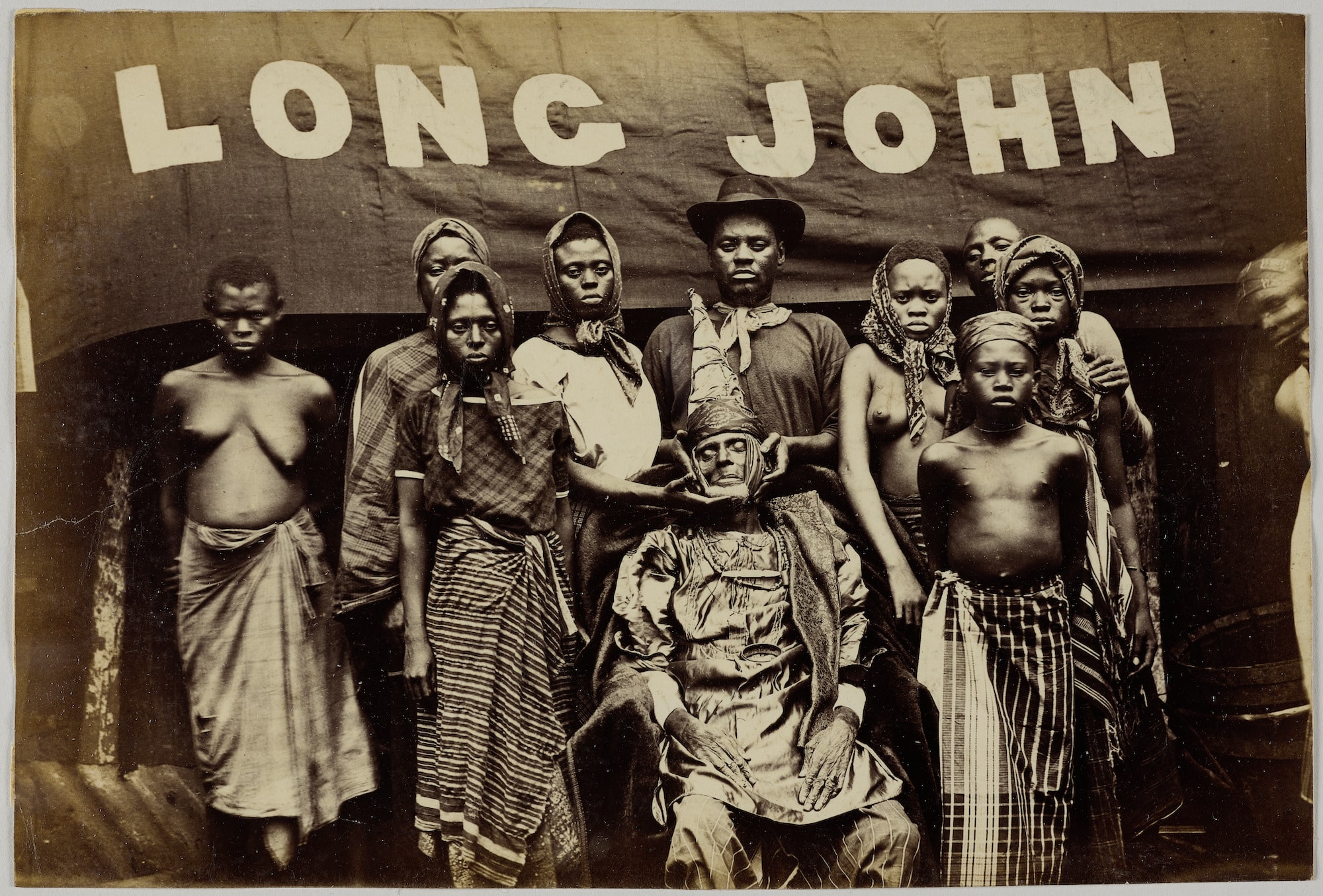
Jonathan Adagogo Green, Last picture of Chief Henry Long John. Behind him stands his successor, Nigeria, 1895 © Musée du quai Branly - Jacques Chirac

Jonathan Adagogo Green, Last picture of Chief Henry Long John. Behind him stands his successor, Nigeria, 1895 © Musée du quai Branly – Jacques Chirac

From portrait to documentary photography

Once trained—for example, in Europe, during diplomatic visits—local photographers took hold of the new technique, each bringing to it the specificity of their own culture: for example, in a large-format portrait of an anonymous Indian maharaja, enhanced with brightly-colored gouache, dating from 1910–20

As in the West, from the outset portraiture played an important role in other parts of the world. From the 1860s onwards, photo studios sprang up in major cities, notably in Australia and West Africa. “The images produced corresponded to the demands of the tourist market hungry for exoticism, while at the same time attracting wealthy local customers who came to be photographed,” explain the curators.

The exhibition also includes some fine prints of American Indian chiefs from the 1870s, made by Alexandre Gardner and other unknown artists. Overall, the quality of the conservation of the prints on display is remarkable. The variety of formats, from minuscule to oversize, including panoramas combining several images, makes for a lively tour.

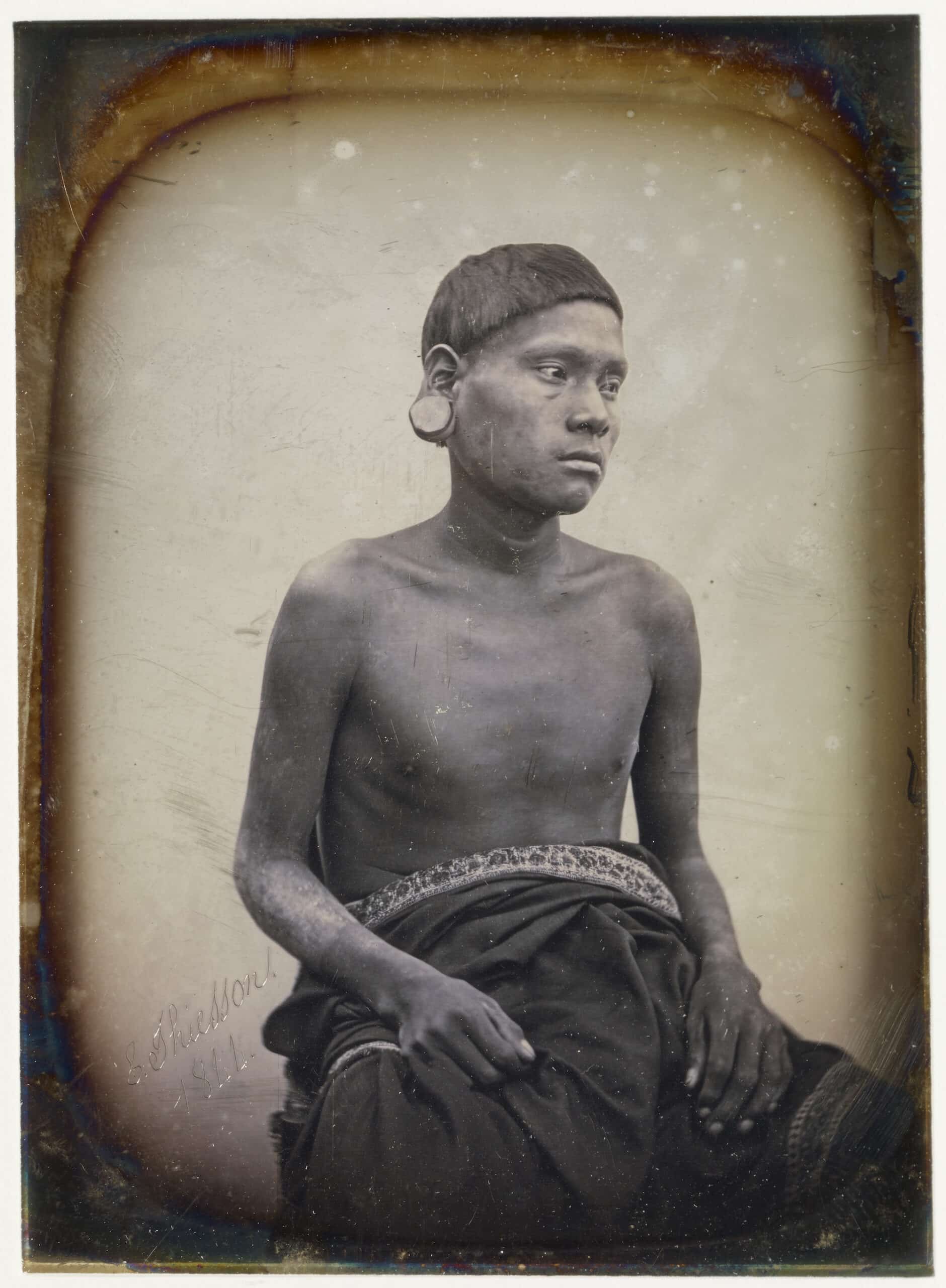
Eugène Thiesso, Botocudo, 1844 © Musée du quai Branly – Jacques Chirac

Eugène Thiesso, Botocudo, 1844 © Musée du quai Branly – Jacques Chirac

W. J. Sawyer, Mr Sawyer, photo man, Nigeria, 1880-1890 © Musée du quai Branly – Jacques Chirac

W. J. Sawyer, Mr Sawyer, photo man, Nigeria, 1880-1890 © Musée du quai Branly – Jacques Chirac

Landscapes also feature prominently in this vast collection. As the curators explained, “right from the start, the production was diverse, responding to different demands and a variety of contexts.” For example, some shots were taken for aesthetic purposes and/or as “souvenirs.” They are the work of the first travelers, who can be described as explorers or adventurers. At the time, equipment was heavy and cumbersome. Other landscapes were photographed as part of topographical mapping, as a kind of “location scouting.” In this case, photography was used for its documentary value and served colonization projects.

The exhibition highlights the many discoveries with detailed captions that combine with a dynamic scenography featuring colorful walls and display cases with albums, medallions, and other paraphernalia. The exhibition’s chronological, geographical, and thematic itinerary lays the groundwork for an alternative history of photography, one that is more complete and cosmopolitan, as it includes Asia, Africa, Oceania, and the Americas.

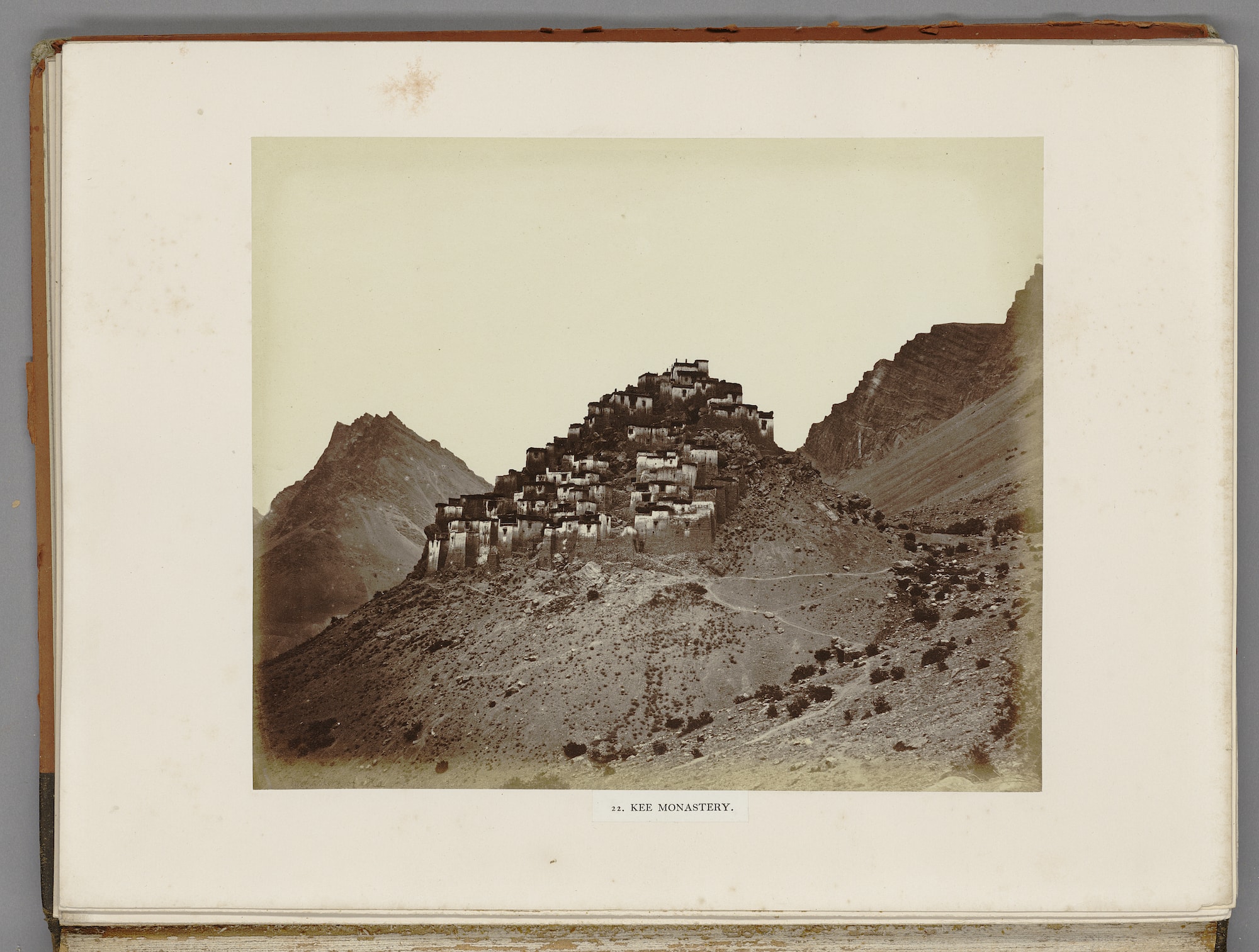
Philip Henry Egerton, Kee Monastery, Journal of a tour through Spiti to the frontier of chinese Tibet, 1863 © Musée du quai Branly – Jacques Chirac

Philip Henry Egerton, Kee Monastery, Journal of a tour through Spiti to the frontier of chinese Tibet, 1863 © Musée du quai Branly – Jacques Chirac

Photographs: An Early Album of the World (1842–1911), Musée du quai Branly-Jacques Chirac, Paris, France, April 4 to July 2, 2023.

Get started with photography with this Canon EOS Rebel T7 deal, over $100 off at Walmart

Get started with photography with this Canon EOS Rebel T7 deal, over $100 off at Walmart

New to photography and looking for a place to start with DSLR models? This Walmart deal on the Canon EOS Rebel Camera T7 is well worth a look.

It’s not going to feature on our best astronomy cameras or best wildlife cameras lists, but it’s still a solid choice for those learning the intricacies of lens choices, and offers a solid set of features with some corners cut (no 4K video, no tilting display, and no touch screen for example).

Still, with a 24MP sensor, it’s well worth a look – particularly since it’s now just $346.99 at Walmart – over $100 off of the MSRP.

Canon EOS Rebel Camera T7
Was: $479.99
Now:
$346.99 at Walmart
Overview: 
This DSLR is now under $350 – perfect for photography newcomers.” data-widget-type=”deal” data-render-type=”editorial”>

Canon EOS Rebel Camera T7

Canon EOS Rebel Camera T7
Was: $479.99
Now:
$346.99 at Walmart
Overview: 
This DSLR is now under $350 – perfect for photography newcomers.

Key features: Easy to use, solid battery life, great for beginners

Product launched: February 2018

Price history: While the Canon EOS Rebel T7 is reduced elsewhere, Walmart’s deal beats out Amazon and Best Buy at the time of writing.

Price comparison: Amazon: $399 | Walmart: $346.99 | Best Buy: $399.99

Reviews consensus: The Canon EOS Rebel T7 won’t win any awards, but it’s still a very solid option for beginners. Its frame, albeit plastic, is easy to understand, and there are a huge number of lenses available. You’ll want to spring for a more comprehensive option from our best astrophotography cameras for taking pictures of the stars, though.

TechRadar: ★★★½ | Toms Guide: ★★★½ | Digital Camera World: ★★★½

Buy it if: You’re new to using a DSLR – a logical control layout and competitive price point make the Canon EOS Rebel T7 a solid option for beginners.

Don’t buy it if: You’re looking to shoot video in higher than 1080p, you want a touchscreen, or a more premium camera overall.