Inspired by “futuristic” 1960’s design, these groovy looks from the exclusive Marimekko x Adidas collaboration are retro-cool and course-ready.
Our favorite golf pieces from the Adidas X Marimekko collection


Jasmine Williams moved from Mississippi to Austin, Texas on a whim. She had just lost her job in housing, which provided her a home. While some of her friends were visiting, they brought up the idea of her moving to Austin. With no job prospects that she could find at the time in her field of marketing and corporate relations, she took the chance and left the Magnolia State in 2018.
She was happy in Austin, where she learned she could make a living from creativity and entrepreneurship. She began delving more into her family lineage as well as Mississippian culture and history. Eventually, she ended up creating ’SippTalk, an online forum that highlights Mississippi creatives and culture through various multimedia forms.
“I found myself gravitating to the same work of creating community safe spaces, documentation, and I wanted to do it in a community that was closer to home,” Williams told the Mississippi Free Press.
Staying in Austin began to make less sense, so at the end of 2019, she moved to Jackson, Miss., a city with a large creative community and a place where many of her connections were based.
“I wanted to learn more about oral history and archives and really tell the stories of the people that are here because there’s so much I didn’t know,” Williams said.
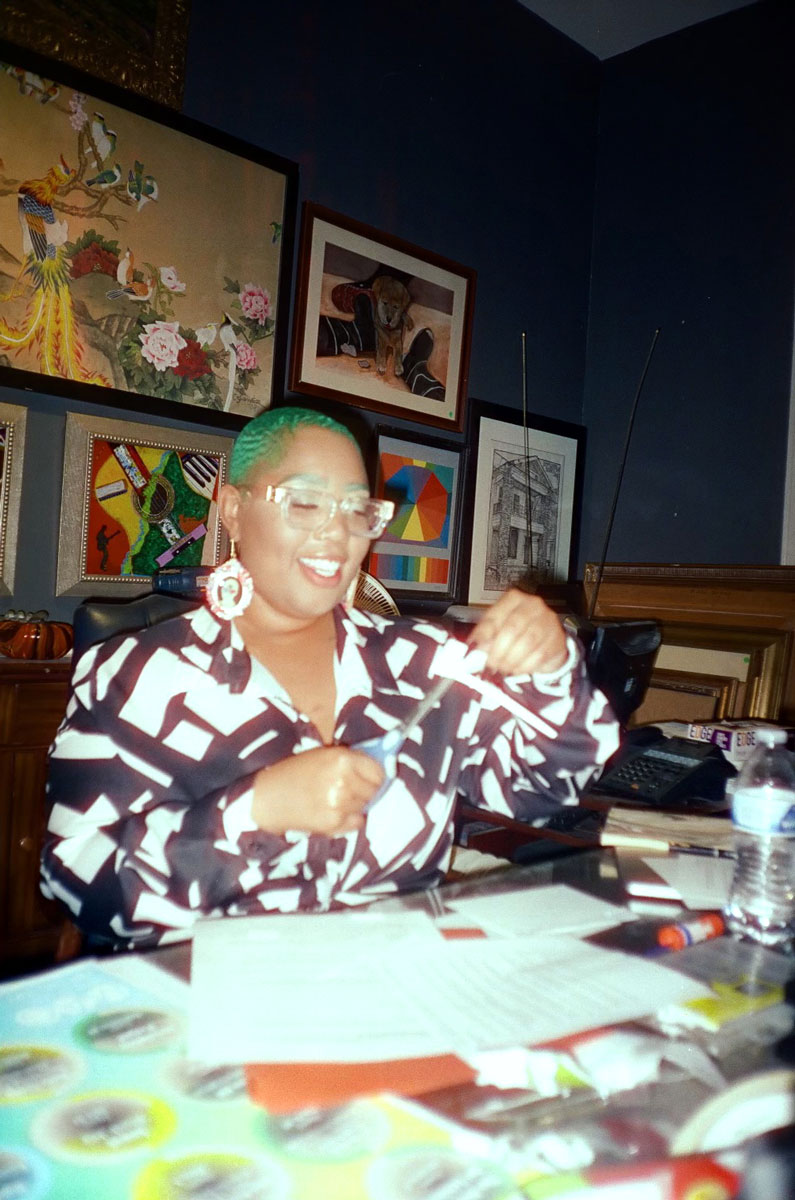
A few weeks following her return to Mississippi, Williams met artist Nick Cave. After telling him how much she enjoyed his work, he hired her to organize a call-and-response to his “Beyond the Cave” exhibit at the Mississippi Museum of Art in downtown Jackson.
The event brought together more than 42 local creators from Jackson and across the state who created responses to Cave’s work through visual art, music, photography, dance and other forms of creative expression. Williams curated the event with friends Meredith Williams, Miranda Hicks and Charity Hicks, also known as rapper Vitamin Cea.
“We didn’t really know the journey that we were embarking on or like what we were really building, but we trusted the people that were around us,” Williams said. “To see the reactions from kids to elders who felt seen, felt special and were excited, that really did it for me. I knew that I wanted to continue to create safe spaces for Black folks to feel seen, regardless of what that looks like.”
This event helped her build a relationship with the art museum and ultimately acquire a position as associate curator of public programs and community engagement. In this role, she has organized events such as “Art and Voice as Healing,” Museum After Hours with The Mashup, the Food Truck Festival with Magnolia Market, and Art Night.
“I never saw myself working in a museum because I love the grassroots aspect; I love being able to create something that’s fresh and new,” Williams said. “I felt like it had to happen outside the walls of an institution, and I felt like I would have to sacrifice my creativity in order to fit into an institution. I think building that relationship did help them to think more about what community and including people really looks like.”
The associate curator said that transitioning into having an institutional mindset has been a challenge but that her experience has come with its own set of advantages like stability, resources and a set location and space that is always present for people to connect to.
The Columbus, Miss., native said she loves that people can see reflections of themselves and can affirm that they belong through the programs and events she organizes. The more opportunities she finds to provide people with a sense of community, the more she feels inspired to keep creating.
“There’s a narrative about Jackson not being safe … so having these programs and they happen safely, people are enjoying themselves, (and) we get to a real representation of what Jackson looks like,” the curator said.

Williams also serves as an artist-in-residence for the Mississippi Museum of Art. On Saturday, June 3, from 1 p.m. to 3 p.m., she and Sarah Jené will be on-site to premiere their outdoor installation “How We Get Over: We Grow On” in the Art Garden. The project, which will be open to the public during the museum’s hours of operation until Sept. 3, 2023, is an exploration of Black grief and Black southern traditions around grief.
Jené curated an opening ceremony that pays homage to the Black church and the tradition of testifying.
“We both lost family members to COVID, and it was just bringing up a lot of emotions that were bigger than just losing someone,” Williams said. “We were trying to create a space that just holds space for folks to deal with the plethora of what grief is, expanding on what we think about grief, and even talking more about what perpetual grief looks like and why Black folks experience grief differently.”
In the future, Williams wants to organize an arts and music festival and find opportunities for creatives to learn more about what it means to sustain oneself through art. Jackson’s creative ecosystem has always been there with artists doing the work to keep it going, the curator explained, emphasizing that the main thing that is still largely missing in her view are the eyes and resources to take it to the next level.
“Everybody is creating their own universe and doing things to push themselves forward,” she said. “We are going to look up (one day), and we are going to be at the place that we dreamed about because we’ve just been doing the work and people feel motivated.”
“How We Get Over: We Grow On” premieres outside the Mississippi Museum of Art (380 S. Lamar St., Jackson) on Saturday, June 3, 2023, with a launch event from the participating artists taking place from 1 p.m. to 3 p.m. The installation will remain on display until Sept. 3, 2023. For more information on the art museum, visit msmuseumart.org.

If renowned modernist painter Gordon Smith hadn’t lived to 101 years of age, it’s highly probable that his Arthur Erickson designed house — probably the most famous Erickson residence in the country — wouldn’t have survived.
The small house, built in 1964, with extensive glazing and cantilevered beams, sits nestled within a forest setting near the ocean in West Vancouver, on a lot worth millions. Considering the land value, a lot of buyers would have knocked the house down, cleared the trees and built a mansion. But Smith, who commissioned Erickson to build the house for him and his artist wife Marion, who died in 2009, lived in the house until his death in 2020. The couple didn’t have children, and Smith wisely left the house in the hands of Equinox Galleries owner Andy Sylvester and curator Daina Augaitis, who’ve spent the last two years restoring it.
As a fundraising drive for the Arthur Erickson Foundation, they are showing off the results with group tours on June 24. It is the first public viewing of the famous modernist house, which includes a new display of contemporary art on the walls (Smith donated much of his own stellar collection when he was alive). The $500 ticket also includes an optional tour of artist-writer Douglas Coupland’s house nearby, hosted by Coupland himself. (Coupland was a dear friend of Smith’s).

And tickets are being snapped up — which tells you something about the level of interest in Erickson’s work. It tells you something else, too, says heritage expert and consultant Don Luxton.
“It tells you something about marketing,” he says. “The Smith House is the greatest house that Erickson did, arguably, and the fact it’s preserved is a triumph. You never keep everything, but it shows that it’s possible to find the right owners for these buildings. And that that house had an audience.”
Not all midcentury modern houses are so lucky. Back in the 1950s and 1960s architects who favoured modern designs had free rein on Vancouver’s North Shore, particularly in West Vancouver, with its ocean views and rugged forested slopes. Land was relatively cheap and the geography a welcome challenge to the new generation of designers who were keen on integrating the lush surroundings. They built a lot of modern houses with a particular West Coast style.
But with land now at a premium, and real estate investment a key market driver, it’s difficult to justify a small house on a large lot, says Luxton. That makes marketing of the houses key to their survival — especially without crucial government policies in place to save them, including incentives, such as tax breaks for those owners that do preserve them, he says.
“Nobody is trying to help these [home owners], so the fact that any of these buildings survive is remarkable,” he says. “The hope for them is you’ve got to increase the value of the building in terms of how you market them, and you have to make it a prestige thing. That works in other jurisdictions, in Palm Springs especially. People are mad to buy these midcentury modern houses, especially if a star lived there. But it’s a different market in Palm Springs.
“So there is a lot that’s working against the buildings in Vancouver, and mainly it’s just sheer land value.”
The latest Real Estate Board of Greater Vancouver statistics show that despite interest rates doubling, home prices have increased about 5% year to date. Near record-low inventory has created a competitive price environment despite the increased cost of borrowing, according to the board. Buyers are looking, which puts pressure on vulnerable West Coast Modern homes that are relatively small in relation to their lot size.

That’s the problem for the house designed and lived in by architect Robert Hassell, at 5791 Telegraph Trail, in West Vancouver, which is listed for $1.99M. The tall cedar-clad structure called Hassell House is being marketed as a teardown with no regard for its provenance. On the other hand, there is also the Bowker House, a Fred Hollingsworth and Barry Downs collaboration that is on the market for the first time in more than 50 years that is being marketed for its midcentury prestige and splendor, with 20-foot-high cathedral ceilings, exposed wood expanse and considerable glazing and views of Howe Sound. The 2,794-sq.-ft house, built on a large lot at 6850 Hycroft Rd. in West Vancouver, is listed for $3.198M.
Luxton says it’s difficult to tell what percentage of the houses have been lost and how many have been saved because so many are undocumented.

West Vancouver has identified 124 houses built between 1945 and 1975 as having architectural importance. Only six are municipally designated heritage buildings from that time period. But their preservation depends on the property owners who appreciate them, and little else.
Maintenance of the homes is up to the owner, and if a house falls into disrepair there’s little that can protect it, says Luxton.
“It’s hard to say what percentage are disappearing but certainly there is an erosion of the building stock, and except for some prominent buildings, not everything is going to be saved.
“At least [realtor] Trent Rodney and some others are trying to market these things. At least there is more awareness.”
Rodney made a splash last summer when his firm sold a 2,434-sq.-ft Erickson house on Eagleridge Drive, known by architects as Catton House and re-named Starship House by Rodney because of its angular shape. That house sold for $4.3M and made it clear that West Coast Modern houses have an audience that is willing to shell out. Critics complained about the re-naming of significant homes for marketing purposes, but Luxton says the names don’t matter as much as the fact that the houses are surviving.

Rodney is currently marketing another Erickson house, this one in the seven-acre Monteverdi Estates that Erickson designed beginning in 1979. The community consists of 20 homes, most of them on a hillside, with landscaping by legendary landscape architect Cornelia Oberlander. But house No. 8 is on a flat lot, and it’s the first time it’s been on the market in a decade, according to Rodney.
“A lot of people think it is a strata community because of the extra community space, but it’s not,” says Rodney.
Not one house in Montiverdi Estates has been torn down. And Rodney — who has carved out a successful niche selling the general West Coast Modern style — says he hasn’t sold a house that got demolished yet. Instead, he has buyers, mostly creative types, patiently waiting for exceptional examples of midcentury or West Coast Modern houses to come up for sale. His strategy is that he prices the houses for their value, not just the cost of the land.
“The reason we haven’t had one demolition is we charge a premium for the architecture as a work of art. So when we market a piece of architecture, people understand there is a premium attached to the building and the architectural significance there.”
Luxton took the same approach years ago as founding director of Heritage Vancouver. By telling the story behind a house, he says they gave the building cachet. Suddenly people would want to own a home by Samuel Maclure, a West Coast architect from a much earlier period.
Again, it comes back to the marketing.
“You have to see them as having a pedigree, like collecting fine old cars,” says Luxton. “It’s a prestige thing. Erickson houses are being bought by people who treasure them. They have real value to people. But those are the exceptions.
“Your average run-of-the-mill midcentury modern building might not hit that level.”
As the market heats up, those houses will just become demo bait.


“Galleria” (2022), cardboard, wood, brass, embroidery, and drawings, 128 x 96 1/2 x 230 1/4 inches. All images © Eva Jospin, courtesy of the artist and Mariane Ibrahim. Photographs by Alum Gálvez
In the hands of Eva Jospin, humble cardboard transforms into atmospheric forests, architectural wonders, and mysterious monuments. For more than a decade, the Paris-based artist has explored the possibilities of the corrugated material, layering it to create solid pieces that can be carved to reveal detailed landscapes and interiors. In her solo exhibition Folies at Mariane Ibhrahim, an immersive, site-specific installation challenges notions of scale, while a range of drawings and three-dimensional pieces expand on the possibilities of paper with the addition of bronze and silk tapestries.
At nearly 20 feet long, “Galleria” creates a portal or a gateway with an ornate, coffered ceiling, lined with niches—or perhaps windows—that reveal wooded scenes, woven textiles, and small drawings. The entrance, flanked by trees and textures redolent of rough marble, invites viewers in through a mystical archway. And in “Grotte,” a roughly hewn architectural niche or apse punctuated by trinkets like seashells and string suggests a grotto, a cavern that is often associated with religious devotion and a place to collect sacred items.
“Grotte” (2023), cardboard, brass, and shells, 27 1/2 x 27 1/2 x 19 3/4 inches
Jospin invokes the classical style often associated with historical significance and influence, from ancient ruins to cultural institutions to cathedrals, questioning notions of power and importance. The title, French for “follies,” references the 18th-century European tradition of building extravagant structures purely for decoration, often inspired by crumbling Roman temples or Medieval castles. (Marie Antoinette famously commissioned an entire rural village in the Trianon gardens of Versailles.)
Jospin explores the intersections of nature and the handmade through meticulously carved tree limbs, stone outcrops, and refined surfaces. By using industrial, everyday materials like cardboard, which is often employed temporarily and then discarded, she examines relationships between the quotidian and the sacred, fragility and resilience, and ephemerality and permanence.
Folies continues through September 9 in Mexico City. Find more on Mariane Ibhrahim’s website.

Detail of “Grotte”

“2 Forêts” (2023), cardboard and wood, 37 x 109 1/2 x 11 3/4 inches

“Forêt Noir” (2019), bronze, 30 3/4 x 27 1/8 x 5 7/8 inches

Left: Detail of “2 Forêts.” Right: Detail of “Forêt Noir”

Interior of “Galleria”

Detail of “Galleria”

Left: Ceiling detail of “Galleria.” Right: Texture detail of “Galleria”
Do stories and artists like this matter to you? Become a Colossal Member today and support independent arts publishing for as little as $5 per month. The article Mystical Forests Meet Cavernous Classical Interiors in Eva Jospin’s Cardboard Sculptures appeared first on Colossal.

When an exhibition of works is announced by a photographer as influential as Diane Arbus, you would be forgiven for assuming that the work was on show in a major venue in New York or London, but you would be wrong.
It’s exciting to hear that Arbus’ work is currently on show in the Gracefield Arts Centre in Dumfries, a town in southwestern Scotland. Word quickly spread through Scottish arts and photography networks about this rare opportunity to see work from this iconic photographer in a local arts trust venue, through the ARTIST ROOMS program, a joint venture between the Tate and National Galleries of Scotland.
Diane Arbus is one of the most influential photographers, whose work has had a profound impact on the world of photography. Her approach to photography was revolutionary, as she captured the lives of people across the social spectrum, from the margins of society, with honesty and empathy. Her images were not just portraits, but also an example of strong visual storytelling. Arbus’ unique approach to photography captured a raw and unfiltered glimpse into the lives of her subjects and the dynamics of their surroundings.
Arbus’ images often depict individuals who at the time were on the margins of society, including circus performers and transgender individuals. However, rather than portraying them as objects of curiosity or pity, she showed their humanity and individuality, challenging conventional societal norms and stereotypes. This quality is what has always drawn me to her work. I can feel the connection she had with her subjects almost leaping off the paper.
This was my first visit to The Gracefield; a category B listed building that hosts Gallery 1, while the purpose-built Gallery 2 building hosts further exhibition, arts, and crafting space along with a café. Upon entering the building, there was an instant feeling of community, and I was reminded of my time spent working at my own local community arts venue, from the handwritten chalkboard “what’s on” display, to the various rooms used for community arts projects throughout the year. The hallway directly outside the gallery features a timeline of Diane Arbus’ life, with key moments charted along the way, including her marriage to Allan Arbus in 1941, who gifted her with a camera, prompting enrollment in photography classes alongside photographer Berenice Abbott.
The gallery space itself was as fresh and minimalistic as any major exhibition venue I have been to. Track lighting placed considered illumination onto the prints, which were mounted inside white frames on white walls, to allow the work to have the space to communicate directly. Walking around the gallery and considering each print, I felt very fortunate to be in a quiet space allowing absorption and reflection. For the majority of my visit, I was the only person in the gallery space, which was an absolute luxury. I compared this visit to the time I saw Don McCullins exhibition in the Tate in Liverpool, when I felt a need to move on between images quite promptly due to the conveyor belt of admirers moving from image to image.
The exhibition spans Arbus’s full career, beginning with early works from the mid-1950s taken with a 35mm camera, to the distinctive square format she adopted from 1962, made famous through such iconic images as Identical Twins, Roselle, N.J. 1966. A highlight within the exhibition is the rare limited-edition portfolio, A Box of Ten Photographs 1969-71. These ten original prints produced by Arbus represented who she was as an artist and how she saw her work in the world, a legacy that became more solidified with her death by suicide in 1971.
ARTIST ROOMS is a touring collection of international modern and contemporary art, presenting solo exhibitions drawn from a national collection jointly owned by Tate and National Galleries of Scotland. ARTIST ROOMS gives young people the chance to get involved in creative projects, discover more about art and artists, and learn new skills. The ARTIST ROOMS program is an absolute gift to local communities, bringing major exhibitions to people who would otherwise not get to see them. There are so many barriers which separate who attend exhibitions and who do not, and geography is a huge factor in that. The act of bringing exhibitions to local communities makes the phrase “art is for everyone” closer to being truthful. I am a firm believer in the ability of the arts to transform communities and break down barriers, and this places importance on local arts initiatives.
Arbus’s extraordinary portraits will be on display in Gallery 2 until July 29, 2023. The exhibition at Gracefield follows its inaugural presentation at The Civic, Barnsley in Yorkshire. The exhibition will continue its tour north in Scotland to Shetland Museum and Archives, before returning to England to North Hertfordshire Museum, Hitchin, at the end of the year.
Lead image photograph of Diane Arbus around 1968 © Photo: Roz Kelly / Michael Ochs Archives via Getty Images.
All images used with permission of The Estate of Diane Arbus.

Engel & Völkers Santa Monica is a global luxury service brand. To them, luxury is more than a price point. Luxury is a top-to-bottom service and attention to detail.
“With every property we endeavor to sell, lease or acquire for our clients, we pride ourselves on providing excellence in care,” Broker Sandra Miller said. “From unrivaled global marketing leveraged with a state-of-the-art technology platform to tough real-world negotiations, we are passionate about what we do and strive to exceed your expectations in all aspects of the marketing and sale of your property.”
At Engel & Völkers Santa Monica, their passion is exceeding client expectations, so it’s only natural they align themselves with exceptional real estate professionals to serve clients across the globe. “It’s why we don’t simply have agents, but rather, trusted advisers to guide clients through their home journey with precise knowledge, distinguished care and a bit of fun,” she said. “Our business contributes to the culture and community of Santa Monica by hosting family friendly holiday events at our office. We participate in the Montana Avenue Art Walk, Halloween Hop, and Holiday Hop where families get to take a photo in our office with Santa Claus.”
Engel & Völkers Realtor Sandra Miller has been proudly serving the Santa Monica community for 20 years.
The company was founded in 1977 in Hamburg, Germany. They have divisions in residential and commercial real estate as well as private aviation and yachting. With over 11,000 trusted real estate advisors in over 730 shops around the globe and a presence in over 30 countries on four continents, they are among the most skilled professionals in their field. Their real estate advisors specialize in the highest level of hyper-local knowledge and customer service to help each client find the home and neighborhood of their dreams. “I am truly honored & grateful to be voted Santa Monica’s most loved real estate agent! Engel & Völkers Santa Monica, a global luxury service brand, and I would be honored with the opportunity to serve you,” she said.
“With every property we endeavor to sell, lease or acquire for our clients, we pride ourselves on providing excellence in care. From unrivaled global marketing leveraged with a state-of-the-art technology platform to tough real-world negotiations, we are passionate about what we do and strive to exceed your expectations in all aspects of the marketing and sale of your property.”

It’s Milky Way season. From early spring through late summer our galaxy’s billions of stars arc across the night sky and it’s become a staple of astrophotography. The trend comes into the spotlight with the announcement this week by travel photography blog Capture the Atlas of its 6th annual Milky Way Photographer of the Year collection.
Published in late May each year – the peak time for photographing the Milky Way –
– its aim is to inspire astrophotographers and others to capture and share the beauty of our galaxy.
The 25 stunning Milky Way images it showcases come from 25 photographers from 16 countries. The final 25 images were selected by Dan Zafra, editor of Capture the Atlas, from over 3,000 entries. They include stunning images from unusual locations for astrophotography including Yemen, Madagascar, Switzerland, Bulgaria, Slovenia, Japan, Iran and Indonesia.
The winning images also include plenty taken in classic astrophotography locations such as Namibia, Chile’s Atacama desert and New Zealand.
Here are our favorite images from the Milky Way Photographer of the Year:

1. ‘Night under the Baobab Trees’ by Steffi Lieberman
One of the most notable winning images in this year’s competition was this one, above, taken using a Sony A7R III astro-nodified camera by photographer Steffi Lieberman in Madagascar, a location not normally associated with astrophotography. “This photo means a lot to me, and I can’t even begin to tell you how difficult it was to take it,” said Lieberman. “From the road conditions to the armed security guards protecting you while you take photos, everything about it was an adventure.”
2. ‘South of Home’ by Lorenzo Ranieri Tenti
Namibia – a dream destination for astrophotographers after incredible foregrounds – featured heavily in the contest. “The panoramic photograph captures the breathtaking scene in the Gross Spitzkoppe Nature Reserve, where the southern Milky Way gracefully spans a remarkable formation of smooth granite boulders,” said Lorenzo Ranieri Tenti about the above image. “This area holds a unique charm, with Mount Spitzkoppe being the sole prominent feature for kilometers, majestically rising 700 meters above the endless savannah.” The photographer used a Sony A7S astro-modified camera.
3. ‘The La Palma Astroexperience’ by Jakob Sahner
The Canary Islands are blessed with volcanic peaks that sit above the clouds, shielded from light pollution, as proven by this image, above, from the island of La Palma by Jakob Sahner. “La Palma and the Canary Islands are ideal for astrophotography due to the trade wind clouds that sit at around 1000 meters,” said Sakner who also used a Sony A7S astro-modified camera. “Being above these clouds makes it clear enough for capturing images, provided there is no haze or high cirrus clouds.”
4. ‘The Night of Huayhuash’ by Jose D. Riquelme
Jose D. Riquelme used a Sony A7 IV to capture Peru’s Huayhuash (pronounced “why-wash”), an Andes mountain range within the Cordillera Huayhuash Reserved Zone. “It’s home to stunning landscapes with mountains and lakes, offering unique opportunities to capture the Milky Way in all its splendor,” said Riquelme. “Night photography in this location is an unforgettable experience, as the altitude and clean air allow the stars to shine brightly.”
5. ‘Celestial Shield’ by Iván Ferrero
Ávila, Spain was the location for Iván Ferrero’s image of Aunqueospese, a 14th-century Gothic castle. “I embarked on a two-and-a-half-hour drive … the rough dirt road forced me to abandon my car and trek for about thirty minutes,” said Ferrero, who used a Sony A7R III camera. “Once it got dark, I captured a panoramic shot of the ground before tracking the Milky Way as Orion took its position … I kept the tripod low to prevent blurring and ensure stability.”
When the ‘Milky Way season’ takes place depends on your position on the planet. Large referring to the time of the year it’s possible to see the bright core of the Milky Way – located within the constellations Sagittarius about 25,800 light-years distant – it’s January-November in the Southern Hemisphere and February-October in the Northern Hemisphere. However, the best time to see and photograph the Milky Way is typically between May and June.
• Astrophotography in June 2023 – what to shoot this month
• Why you need to plan now for Great American Eclipse of 2024
• Best lenses for astrophotography
• Best star tracker camera mounts






