Tyler Joseph Krasowski’s exhibition at the Missoula Art Museum pairs mind-blogging details with unexpected humor.
Intense details, technique and jokes color Missoula artist’s work


What an absurd question — I know. But, the times have changed and where social media was once an interesting marketing avenue, it’s now a staple of the craft for photographers. If you’re making a living from said craft, can you take a break from Instagram, for instance?
When Instagram first began getting attention, I hopped on it. I had enjoyed photo-sharing websites for years, starting with Flickr and then 500px, so I decided it was time to try this new mobile option that was getting a lot of buzz. It was awkward to use in the beginning; Instagram clearly wanted you to take photos in-app, you could only use a square aspect ratio, there were no carousels, there were no reels, and hashtags were infinite. It didn’t feel remotely engineered for professional photographers, but it was an app about photography and I was intent on sticking with it.
Around this time, I had two different friends who had seen high-level success with Facebook and Twitter, amassing extraordinary numbers of followers, interactions, and digital social clout. In fact, it had secured them some pretty juicy work and some financial opportunities, so I decided to follow suit. I didn’t have a clue what the algorithms were, I had no idea posting consistently would be valuable over rare and high quality, and I didn’t know about keyword or hashtag research. I more or less blindly threw my work up and hoped to catch some attention.
For a while on Instagram, I did. My work was pretty niche which meant I couldn’t cast my net quite as wide as some, but my modest following was the right people, and things were going well. In fact, during this first uptick, I got a direct message from a brand who wanted to work with me. And there it was: I had paid work from my efforts on social media — this was the future.
In many ways, I was exactly right. There were business opportunities squirting up out of every orifice on social media and there still are. There are entire careers centered around the various platforms. I began to understand how these platforms worked too, albeit by accident. I had started a Pinterest board for inspiration where I would find one portrait every day that I admired, and share it to a public board as well as social media. This Pinterest board ended up peaking at around 100,000 views per month and I deduced that was as a result of my relentless consistency.
So, I was posting to Facebook pages and my Instagram every day, Tweeting when I could, planning a YouTube channel, and using multiple websites and pieces of software to track my analytics and “clout” across all platforms. Then, one day, I went dark.

After I returned from a press trip to Costa Rica with Olympus in 2020, I had enough content to last me for months. I remember this because I sat down after this wonderful excursion and thought “I have enough content to last me for months.” Then I surmised that this reaction to seeing images I loved from a cherished trip made me a bit of a prat. In fact, as I sat there waiting for news on an unprecedented lockdown due to a pandemic, I realized nothing made sense anymore. So, as I had to distance myself physically, I decided to distance myself digitally.
I had spent a year dancing for algorithms, hoping the allure of my hips would entice some onlookers, and I was tired of it. The chronological newsfeed was part of social media lore now and my old moves weren’t as effective when externally curated, it would seem. While this is a criticism of social media, I do believe that quality ultimately wins out with views, so I shoulder much of the blame, I just didn’t have it in me anymore.
There was a bulbous, hairy question lurking though, and it wasn’t socially distancing: I get paid work through Instagram, will that take a break too? Even if the passersby weren’t rubbernecking near me as much, my niche following still fed my stuff to brands and I would fairly regularly get paid work from the app — surely that would dry up. Wouldn’t it be incredibly reckless of me to damage a pipeline when my network of pipes was under severe threat from the tumultuous world of COVID? Yes — I just didn’t care. I needed a break from the part of my mind that was occupied with my daily social media chores. Not only was it a nagging irritant, but with the reduced fruits of its labor, it was corroding my mental health. I was willing to forgo the monthly win for the rest bite from the daily losses. That is, I was willing to risk not acquiring a client per month through Instagram if it meant I didn’t have to watch my new posts “fall dead-born from the press”.

So, what were the long-term results of my break? Well, in many ways: I didn’t play, but still lost. For a while, there was no impact and I still had inbound leads through Instagram. Similarly, I used Instagram as a sort of extended portfolio, which was useful. But, the decay set in after a few months, and before long, I received zero inbound leads through social media. What I feared would happen was correct and as the pandemic irritated people enough that they were ready to flaunt the rules and workplaces began opening, it was time for me to put my leggings back on and start dancing again. Unfortunately, my break with Instagram, in particular, hadn’t made my heart yearn for the clout-chasing, it had made me certain our relationship was fatally flawed. As a platform, it was evolving quickly and I didn’t want to stay on trend anymore, so I have never returned, at least not as a “creator”.
The question in the title is one I will here answer directly: yes, but with caveats. In my field — and although I do some niche work, I suspect my experience is fairly typical — you may miss out on opportunities. That said, I replaced the work using other channels that don’t require my hips, and the quality of client has been higher (though that really could just be luck of the draw). Social media can be a weapon of mass seduction, and although you can harness its power to enrich your life and business immensely, most won’t. The clients it gave me, the social proof it provided, and the few opportunities it afforded were not to be sniffed at, but I came to realize that, for me, the juice wasn’t worth the squeeze.
Lead image by Prateek Katyal via Pexels.

Orillia-based scholar Valerie Hébert served as an author and editor for a new book called Framing the Holocaust: Photographs of a Mass Shooting in Latvia, 1941.
The Lakehead University professor is one of eight contributors to the book, which takes a deep dive into 12 photographs that document a mass shooting of Jewish people on a beach in Latvia in December 1941.
“When a lot of people think about the Holocaust, they think of Auschwitz and they think of trains,” Hébert said. “Before the death camps were built, the mass killings began with mobile shooting squads that combed through the Eastern Front as the Nazi army advanced.”
Hébert says the mobile shooting squads would gather alleged racial and political enemies and shoot them to death. More than a million people were killed using this terrorizing tactic.
“These 12 photographs show the sequential steps in one of these shooting actions,” she explained. “Jews were brought to this place, were made to undress. They were separated into smaller groups and brought to a ditch that was dug parallel with the sea, and they were shot. Their bodies fell into the ditch.”
Four men are connected to the photographs, but it’s unknown for sure who took them. The photos were turned in to the Soviet investigators by a Jewish Latvian man and are commonly used today in Holocaust museums but are rarely attributed to the correct time and place.
“This book provides an in-depth study and the historical context for these photos,” Hébert said.
In 2017, Hébert organized a workshop at the United States Holocaust Memorial Museum in Washington, D.C., on atrocity photography.
“Photographs are sort of at the cutting edge of Holocaust research in particular,” she said. “There is more and more interest in this field of atrocity photography.”
She invited scholars from Canada, the U.S., Germany and Australia to the two-week workshop to talk about their work in atrocity photography and to look at materials from the museum.
“The idea was to put together a book where we are all speaking about the same images,” she said. “We chose these 12 photos because it’s rare to have so many in a clear sequence.”
The images show partially clothed and naked women and children caught in moments of terror.
“They really push us to the edge of what it is we can bear to look at,” she said. “The key question of the book is if they are so unbearable to look at, why should we even engage with them? What can we gain from them? And what can they tell us?”
Each author in the book brings a different question to the photos.
For Hébert, studying photos goes back to her childhood. Her interest in history comes from looking through her grandfather’s Time Life coffee table book of photographs from the 20th century.
“From the time I was little, I would look at this book and would be really drawn to photographs,” she said.
Hébert, who has a PhD in history, uses photographs often in her teaching at Lakehead University.
“I’ve taught Holocaust courses, I’ve taught courses on the world wars, and at first I was always uneasy about showing photographs of dead bodies and people in distress,” she said.
“There are some really important questions around these people not giving their consent to be photographed. A lot of times, the photographs are a part of the torture and humiliation because the photographer is using the moment to deepen their suffering.”
Through the process of creating the book, Hébert asked herself if bringing light to the photographs continued the humiliation and horror of victims. She also asked herself if the pictures were important evidence that help people understand history.
“The chapter that I contributed to the book looks at that ethical question,” she said. “Should we look at these? Should we not? And what are the arguments on both sides?”
The chapter sets the stage for all of the following chapters in the book, and Hébert hopes readers who pick up the book will gain a new appreciation for how rich and complex photographs are.
“We have this idea that photographs tell us everything, the truth is on its surface, and we understand everything by looking at the photograph, but we don’t,” she said. “So, it’s really important to consider who took the photograph, who was the intended audience, and what that might mean.”
While the photographs in the book were taken as a celebration of the crime, they’re also an indictment, which makes it important to understand the many meanings photographs hold, Hébert says.
“It helps us think more critically about historical photographs that we see,” she said. “We are a more visual culture now with social media and Instagram. It’s all image based now.”
She says photographs can transcend language, time and geography, which makes it important to have a more critical and nuanced way of understanding pictures while being aware of their ethical complications, which makes people better consumers of present-day photojournalism.
“The ones in the book help us understand this particular event in the Holocaust,” she said. “The way that the authors model how we read and interpret these photographs, there is a lot of crossover to how you may engage in photographs of other historical events or present-day crises and human rights issues.”
Framing the Holocaust: Photographs of a Mass Shooting in Latvia, 1941 will be available for purchase on Amazon starting Aug. 22.

Around 45,500 years ago, ancient humans on the world’s eleventh-largest island, Sulawesi in Indonesia, painted a warty, wild pig known as Sus celebensis, in Leang Tedongnge cave. Archaeologists believe it’s the world’s oldest drawing of a creature and the first figurative artwork.
Around 45,500 years ago, ancient humans on the world’s eleventh-largest island, Sulawesi in … [+]
AFP
Depictions of animals, whether realistic or symbolic, are ubiquitous in art history and most often serve to inform or amuse. Stone age caves were decorated with animals hunted for food. Ancient Egyptians depicted gods with animal heads.Tribal artists around the world combined animal and human features to symbolize the human relationship with nature. Middle Ages artists adorned medieval manuscripts with everyday animals to convey clandestine symbolic associations. Artists in the 17th century painted dramatic hunting scenes to illustrate the potentially deadly conflict between humans and animals. Artists in the 18th century glorified the natural beauty and majesty of animals in their natural habitats. Victorian artists painted sentimental pictures of domestic pets and livestock. By the 20th century, artists began exploring multiple genres, again with the vast majority celebrating animals either in their own environments, with humans, or in imagined situations.
ALEXANDRA KLIMAS (BORN 1970) ‘Mila the Cow’ Oil on canvas 19.20 x 15.75 inches Signed
Rehs Contempoorary
Two regal lions peacefully gaze at the viewer as they lounge gracefully in their natural habitat in French animal painter Rosa Bonheur’s Lions at Rest (1892). Bonheur is perhaps best known for large-scale masterpiece, Le Marché aux Chevaux (1853). Bonheur and her partner Nathalie Micas kept a menagerie including stags, mouflons (wild sheep native to the Caspian region), wild boars, a gazelle, and lions, at their Château de By, near Fontainebleau, which is now the Musée de l’Atelier de Rosa Bonheur. Ahead Of her time, Bonheur attained police permission to dress as a man to avoid being noticed when she worked.
Alexandra Klimas goes beyond tongue in cheek, with her playful portrait of Mila the Cow, who looks us in the eyes as her tongue enters her nostril The realistic depiction contrasts with the split black-and-white backdrop. She strives to amplify the “forgotten animals” in a culture that covets pets and copiously consumes animals bred (and often mistreated) for the meat industry.
“I am not an activist,” she writes on her website, “I am an artist and I make art. Art should touch people and make them think. I don’t want to shock people. I am satisfied when people feel more connected to this group of ‘forgotten’ animals. I get to know them as I sketched them at the farm. Their personalities, too. I try to paint each animal as lifelike as possible and to properly depict their unique personality and emotion.”
Amid growing concern for animal law, such as the status of animals as legal objects, the protection of animals in laboratories, and the preservation of wild animals, there’s a lack of scholarship focused on the intersection between animal law and the freedom of speech of artists.
“While these might seem disparate and mutually exclusive, they are not. A small but notable number of artists use, harm, or even kill animals in the creation of artwork,” Yolandi M. Coetser, a senior lecturer philosophy at North-West University in South Africa, writes in “Exploring the Legality of Artists’ Use of Animals: Ethical Considerations and Legal Implications,” a recent article published in a special issue of Basel, Switzerland-based MDPI, a publisher of open access scientific journals. “Elsewhere, this practice has been termed ‘cruel art’, defined as ‘the infliction of physical and/or emotional pain on non-human animals for the sole purpose of creating art that steps beyond the confines of the artist’s right to freedom of speech’.”
Throughout history, philosophers have grappled with the complex relationship between animals and humans. Aristotle believed animals possessed souls, an internal governing principle, but differentiated them from humans, who, in his view, also possess deliberative rationality, and form complex communities built on familial, social, economic, and political relationships. Simply put, Contemporary Italian philosopher Giorgio Agamben argues that the difference between man and animal is a division within the category of the human itself.
Regardless of your scientific or philosophical beliefs, it should suffice to say that most humans, and therefore most artists, oppose animal cruelty.
Coetser defines “cruel art” as “the infliction of physical and/or emotional pain on non-human animals for the sole purpose of creating art that steps beyond the confines of the artist’s right to freedom of speech.”
In 2017, the Solomon R. Guggenheim Museum in New York removed three pieces of art from its hotly-anticipated Art and China After 1989: Theater of the World before the exhibition opened, including the focal piece, Huang Yong Ping’s installation Theater of the World, which was to showcase live insects, geckos, lizards, and other animals trapped in a manmade habitat. Under protest from animal rights activists, including PETA and the ASPCA, the museum removed the controversial works, including Theater of the World, which made its debut elsewhere in 1993.
“Although these works have been exhibited in museums in Asia, Europe, and the United States, the Guggenheim regrets that explicit and repeated threats of violence have made our decision necessary,” the museum said in a press release.
A far more grotesque example was the August, 2007, display of Guillermo Vargas’ Exposición N° 1 in the Códice Gallery in Managua, Nicaragua, which included the burning of 175 pieces of crack cocaine and an ounce of marijuana while the Sandinista anthem played backwards and an emaciated dog was tied to a wall by a rope with “Eres Lo Que Lees” (“You Are What You Read”) scrawled on the wall in dog food. The dog reportedly starved to death.
Most “cruel art” doesn’t include animals being killed or physically harmed, and instances are rare.
Coester concludes that “While there are only a few instances of animals being harmed or killed for artwork, these instances are significant enough to warrant close scrutiny of the practice, both ethically and legally.”
It’s essential to note that most contemporary artwork depicting animals celebrates their existence, often elevating them above the human who repeatedly and increasingly causes the greatest harm to the world.

BEMIDJI — Watermark Art Center is set to host an outdoor pop-up artists market from 10 a.m. to 4 p.m. on Saturday, Aug. 5, on the south lawn of Watermark Art Center.
The market will feature local handmade items including ceramics, jewelry, prints, paintings, basketry, glass, woodwork, Indigenous art and more, a release said.

Contributed


TikTok viewers have offered one woman free photography sessions after her expensive wedding photos turned out to be a disappointment.
On 10 May, Brooke () posted a video, which has now attracted over 2.5m views, to expose “the worst first dance wedding photos” from her big day. The woman explained that she was “floored” when she got her $3,000 photographs back because they were out of focus, and the other photographers were caught in them too.
“They’re just bad, all the way around bad,” Brooke admitted. She said she contacted the photographer to see if they could be fixed, and they couldn’t be. “All it really did was piss her off. Still haven’t really gotten my stuff that I’ve been owed,” she continued.
To convince her followers of the poor quality, Brooke displayed the three images that she received of her first dance. The photos were not only blurry, but Brooke was seen making an odd face in all of them. According to Brooke, her husband and mother-in-law have since tried to contact the wedding photographer multiple times, but she’s not picked up. The photographer reportedly told Brooke she was only allowed to communicate with her via email.
“I just don’t even know what to do at this point,” she cried. “Any help would be welcomed. Please send help, don’t scroll. I beg you. Please if there is a God, let this end up on lawyer Tok.”
Over 6,400 commenters flooded Brooke’s video, with many admitting how bad her photos were.
“When I say my mouth dropped!!! Those are terrible!! Girl… I’m so awfully sorry! I’d sue,” one viewer noted, while another wrote: “I’m sorry, girl. In my experience, ghosting you means she has nothing else to give you. She’s not hiding the good photos. They don’t exist.”
“Please tell me you signed a contract and you have a copy – that is a LOAD of money. Definitely look at consulting a lawyer,” one individual suggested.
Brooke pointed out that her wedding took place back in October. She said she emailed the photographer in April and again two days before making the video, but did not receive a response.
Other TikTok users couldn’t stand to see Brooke left with images that didn’t capture the beauty of her day with her husband, family, and friends, with multiple photographers offering to give her a free “wedding attire session”.
“I’m a photographer in Colorado, if you’re ever here and would like to do a wedding attire session, I’d love to do them for free. I’m so sorry this happened,” one woman proposed, while another commented: “Not sure where you’re located but I’m a wedding photographer in Ohio. If you’d like to do a session in your wedding attire it’s on the house.”
Brooke posted a follow-up video later that day to expose more of the stills she received back. One image had her head cut off, while a different photo of her next to a wine barrel was taken from a “bad angle,” which she said made her self-conscious.
After seeing multiple examples of the final shots, viewers began questioning Brooke’s research on her photographer. She posted a separate video addressing these concerns, confessing she met the woman at a wedding fair and got “glowing recommendations” from friends who had used her. Still, some TikTokers couldn’t believe the woman was a professional.
“Always ask to see at least two complete galleries of past weddings. That should be a more honest representation of their work,” one individual added.
The Independent has reached out to Brooke for a comment.

July 31, 2023
The New Orleans Museum of Art (NOMA) has recently opened a new exhibit “Fashioning America: Grit to Glamour” that features over 100 designers including Indigenous, Black, immigrant, and women designers.
“This sweeping presentation reflects the American spirit of ingenuity and underscores important stories of opportunity and self-innovation,” the NOMA website explains.
The exhibit uses historical garments, including one from the 19th century, in addition to modern garments, to demonstrate the impact of media and celebrity culture. It will be open for viewing through November 26, 2023. These garments on display help amplify the voices of communities often left out of the mainstream or dominant narratives of American fashion history.
Those who decide to visit can expect to see an elegant day dress by Cherokee designer Lloyd “Kiva” New, a pivotal figure in the history of modern Indigenous design; beaded canvas high-heel sneakers by Kiowa designer Terri Greeves; and a peacoat by Pueblo designer Virgil Ortiz.
At the opening of the exhibit, United Houma Nation Principal Chief Lora Ann Chaisson presented a land acknowledgement.
“Indigenous art and fashion are integral to the American story, and Fashioning America provides a platform for the talent of Native American designers to be shared with a greater audience,” said Chaisson. “Thank you to Crystal Bridges Museum of American Art and NOMA for including the Indigenous community in this exciting exhibition.
NOMA was opened in December of 1911 with only nine works of art, making it New Orleans’ oldest fine arts institution. Today, the museum hosts a permanent collection of nearly 50,000 artworks.
“Fashioning America: Grit to Glamour” was previously at Crystal Bridges Museum of American Art in September 2022, as the museum’s first exhibition dedicated to fashion.
Sinéad O’Connor, Who Told the Truth about the Catholic Church, Walks On
“Barbie” Needs a History Lesson
Oklahoma’s largest film festival promotes Navajo and Comanche filmmaker as new Director of Programming
Native American Summer Enrichment Camp Taking Place at Camp Grace
We hope you enjoyed the story you’ve just read. For the past dozen years, we’ve covered the most important news stories that are usually overlooked by other media. From the protests at Standing Rock and the rise of the American Indian Movement (AIM), to the ongoing epidemic of Murdered and Missing Indigenous People (MMIP) and the past-due reckoning related to assimilation, cultural genocide and Indian Boarding Schools.
Our news is free for everyone to read, but it is not free to produce. That’s why we’re asking you to make a donation to help support our efforts. Any contribution — big or small — helps. Most readers donate between $10 and $25 to help us cover the costs of salaries, travel and maintaining our digital platforms. If you’re in a position to do so, we ask you to consider making a recurring donation of $12 per month to join the Founder’s Circle. All donations help us remain a force for change in Indian Country and tell the stories that are so often ignored, erased or overlooked.
Donate to Native News Online today and support independent Indigenous journalism. Thank you.


… just wandering through some photo folders tonight and came upon the Echinacea flower that I shot in a garden at Lowell Observatory a few years ago and below a photo I took of Enedina, Michele’s Saker Falcon in a field east of Flagstaff … unrelated images of the temporal beauty to be found here on our little planet … it is here daily just waiting to be viewed and become a part of your life experience … head out and enjoy all that earth has to offer you.
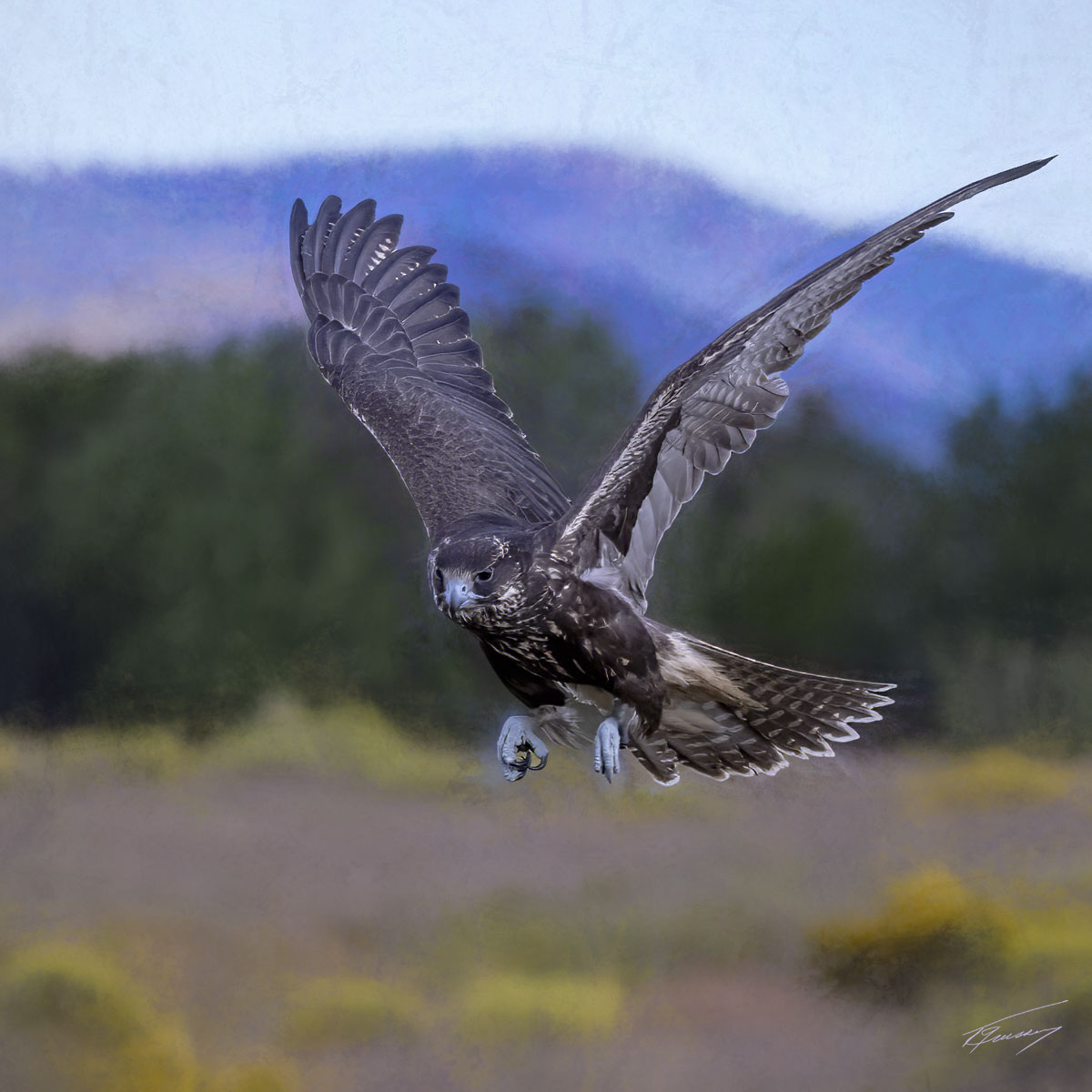

Another new and exciting week underway and methinks it shall be a very good one. The replacement power supply for my new computer build will be here tomorrow and with any kind of luck it will be operational late afternoon … then the prep of this one for my friend who will be taking it over. The challenge is having to re-install all my apps (formerly “programs”) and transfer the extensive libraries of images … expecting no problems with that though.
Have a beautiful day … you are here!
Cheers,
Ted
The book of day and the book of night burst with
wonder, testifying that there is more in the world than
we, and that we shall yet be other than we are.

excerpt from Lamentations by Max Ehrmann
###
 The easiest way to reach Mr. Grussing is by email: ted@tedgrussing.com
In addition to sales of photographs already taken Ted does special shoots for patrons on request and also does air-to-air photography for those who want photographs of their airplanes in flight. All special photographic sessions are billed on an hourly basis.
Ted also does one-on-one workshops for those interested in learning the techniques he uses. By special arrangement Ted will do one-on-one aerial photography workshops which will include actual photo sessions in the air.
More about Ted Grussing …

This is an advertisement


Nestled in a plaza with a hair salon and pull tabs store in the heart of Kenai, there’s a new home for artists and crafters from across the Kenai Peninsula.
Karen Trulove opened the Alaskan Artisans and Crafters Guild in May. Trulove is an artist who said she has a penchant for entrepreneurship. She’s also a seventh-generation Seldovian and a traditional healer with the Kenaitze Indian Tribe.
Trulove opened the guild to address what she saw as a lack of opportunities for local and Alaska Native artists to market their work on the peninsula. She said it was easy to find artists who wanted to sell work at her store.
“I actually advertised one time on Facebook, and I had about 63 people reach out within 24 hours, so I was like well, this might be a needed thing in our community,” she said.
The store currently carries work from about 80 artists, most of them local to the Kenai Peninsula. There’s furs, beadwork, photography, watercolor, dishware, ornaments, endless jewelry and pieces that defy categorization.

In the shop, Trulove pointed out soaps made of goat milk from Nikiski, wrapped in pastoral alpaca fur casings that make them their own washcloth. She said that’s one item that’s often sold out. Nearby were glass ornaments made of sand from the Homer Spit and kuspuks, both regular-size and doll-sized, designed to fit on American Girl dolls. There was also locally carved ivory, drums made by kids from the Salamatof Native Association and beaded earrings galore.
Trulove said the purpose of the store is to create a reliable year-round venue for local artists.
“In the wintertime, it’s tough because we don’t have a lot of craft fairs. We have a few, but it’s not like the Wednesday Market or Saturday Farmers Market,” she said. “Sometimes people are busy in the summertime. They’re out trying to get their fish in, family’s visiting, and they don’t have time to sell their items. So it’s really nice to be able to bring them into a local store, drop their stuff off, and we handle everything from there, and get them a check at the end of each month.”
She said there’s also a new community of artists in the area, who realized they had a talent for crafting during the pandemic and are newly selling their wares.
“Since COVID, when everyone was in their homes, not able to get out, I think a lot of people figured out that they actually have a talent. And they’re starting to make a lot of new items,” Trulove said. “And it’s good, because our community needs that. And a lot of our local businesses closed during COVID, so it’s nice that we have the support from the community to help a little bit of everyone.”

Trulove said she’s planning on having auction-style events in the future to support local youth organizations.
The guild has also brought a new face to downtown Kenai: a 14-foot-bigfoot statue that sits right off the Kenai Spur Highway. Trulove made the cutout bigfoot herself with her husband, and they may start selling them if there’s an interest.
She said the reception to the store has been good so far, from both locals and tourists.
“Sometimes we get busloads, literally,” she said. “We’ve had like 35 people in here, where a bus just pulls up and people come in.”
The guild is open 11 a.m. to 6 p.m. seven days a week, except when employees are participating in craft fairs or markets. Trulove said there’s a trick: If the bigfoot is out, the store is open.





