Indigenous man experiencing homelessness has art displayed at Kelowna art gallery

Indigenous man experiencing homelessness has art displayed at Kelowna art gallery

An Indigenous artist experiencing homelessness in Kelowna proves that beauty can be found anywhere.

Clint Williams, from the Gitxsan (K’san) Nation was sitting on Leon Avenue, in Kelowna, surrounded by his possessions, some snacks and a canvas featuring the beginnings of a new piece of art, when Capital News sat down beside him for an interview.

He was one of approximately 20 people who had spent the night sleeping outdoors on the street. While speaking with Capital News, Williams continued to quietly work on his art, as he does every day amidst the bustle and noise of living without shelter. The interview was cut short when RCMP officers clearing the area told Williams that he had to get up and move to a different location.

Williams is soft-spoken and when asked about his past, he explained that he was formally trained at the K’San Art School, in northern B.C. After completing the four-year program, Williams worked as an instructor at an Elementary school on Gitsugukla First Nation in the north of the province.

Clint Williams and his partner working pictured while he works on a new piece of art in downtown Kelowna. (Jacqueline Gelineau/Capital News)

Clint Williams and his partner working pictured while he works on a new piece of art in downtown Kelowna. (Jacqueline Gelineau/Capital News)

Williams’ ability to express himself and his medium of choice has changed and developed alongside his life experiences.

These days, Williams honours his heritage by creating traditional Indigenous pieces of art using a freehand technique. He tells stories through his work and draws inspiration from nature and his past.

Williams typically uses the technique of freehand drawing and painting on large sheets of thick paper or canvas.

His work can be found at Hambleton Galleries in Kelowna. All proceeds from the sales of his work are given to Williams by the gallery.

To learn more about Williams, the Hambleton Galleries or to buy artwork, visit hambletongalleries.com.

READ MORE: Okanagan film industry champions massive growth over the past three years


@Rangers_mom
Jacqueline.Gelineau@kelownacapnews.com

Like us on Facebook and follow us on Twitter and subscribe to our daily and subscribe to our daily newsletter.

ArtartistCity of KelownaHomelessHomelessnessIndigenous

Oak Cliff native’s art show “HOMEGROWN” honors nature’s chaos and elegance

Oak Cliff native’s art show “HOMEGROWN” honors nature’s chaos and elegance

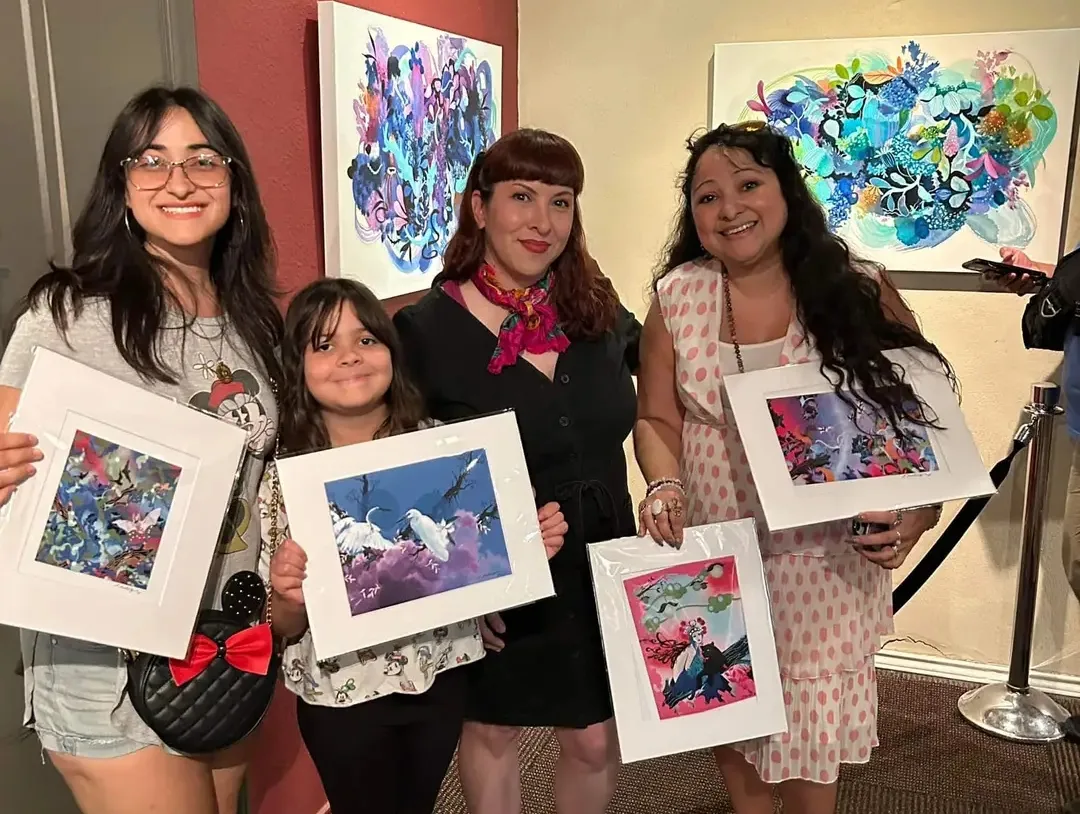
Opening night of “HOMEGROWN” at The Kessler Theater. Photo courtesy of Patricia Rodriguez.

Oak Cliff native Patricia Rodriguez’s solo art show “HOMEGROWN” will take place through August 15 at The Kessler Theater. The show is free to attend and open to all ages.

#mc_embed_signup{background:#fff; clear:left; font:14px Helvetica,Arial,sans-serif; width:100%;}
#mc_embed_signup .indicates-required {display: none;}
#mc_embed_signup .mc-field-group {clear: none; width: 75%; padding-bottom: 0%;padding-top: 1.5%;}
#mc_embed_signup form {margin: 0px 20px;}
#mc_embed_signup {border: 1px solid #e6e6e6; max-width: 750px; margin: 0px auto;}

The show’s opening was on June 29. Dozens of Oak Cliff residents came out to support the local artists and art, including members of the Oak Cliff Ladies Club.

Rodriguez has been creating art for over twenty years. According to her website, “she is currently freelancing as a painter and muralist and draws a major part of her inspiration for her work from Nature.”

Her approach to each painting is “subconscious and organic,” meaning that it is never sketched or pre-planned. Some pieces are a reminder of the temporary nature of life and that “everyone has a season of growing, blooming, and then dying,” said Rodriguez. Other pieces dissect technology’s impact in today’s word, driven by color and movement.

“[The show] is a call to the viewer to look more closely at their natural surroundings in a hyper digital age of cell phones and computer screens,” Rodriguez said.

Rodriguez said her show is meant to focus on acceptance of these aspects rather than the gloom one might feel.

Patricia Rodriguez, middle, with attendees on opening night. Photo courtesy of Patricia Rodriguez.

In her home studio on Edgefield Ave., Rodriguez’s born-and-raised Oak Cliff background contributed to her identity and art. The pieces took about two months to finish after Rodriguez got confirmation from The Kessler.

“This is my home and [the show] is my gift to my neighborhood,” she said. “I’ve been able to watch [Oak Cliff] transform into many things. Spotlighting a native who has been here and seen it all come and go and how I’ve interpreted everything visually- was very much an honor to me.”

Rodriguez’s art communicates that chaos and elegance can co-exist in the same way nature’s plants take on different arrangements.

“Things are being created and growing in little secret gardens all around you if you look and pay attention,” Rodriguez said.

Remembering Elizabeth ‘Betty’ Douglas, Beaver County’s influential music & visual artist

Remembering Elizabeth ‘Betty’ Douglas, Beaver County’s influential music & visual artist

She was Elizabeth when she painted, and Betty when she sang.

Whether creating an award-winning painting, or entertaining an enthralled audience of jazz fans, Elizabeth “Betty” Asche Douglas expressed herself with poetic elegance and compelling skill.

An eloquent writer and trailblazing student and educator, Douglas, a Beaver Falls native and longtime Rochester Township resident, made a positive impact on the Beaver Valley and far beyond.

Friends are mourning the loss of an amazing woman after one of Douglas’ daughters, Nanette Douglas Sykes, announced on Facebook this past weekend that her mother had died. An obituary was being developed Monday morning.

“We are still finalizing arrangements, but viewing will be at Murphy’s Funeral Home in Rochester July 24,” Sykes said.

“She touched so many different generations and groups,” said Tony Lang, a guitarist from Freedom, who regularly performed on stage with Douglas in recent years as she continued to sing at local clubs and bars into her 90s. “She was like Mr. Rogers. She made everyone she talked to feel special.”

Retired as a professor of fine arts and humanities from Geneva College, Douglas operated the Douglas Art Gallery in Rochester Township, where for more than 30 years she created art pieces exhibited at prestigious galleries and art shows nationwide. She helped create and curate Sweetwater Center for The Arts’ annual Mavuno Festival in Sewickley, fostering Black artists and dialogue.

“She did things in earnest,” said close friend and professional jazz artist Rex Trimm, who regularly collaborated on stage with Douglas over the past few decades. “She never quit learning and challenged the living daylights out of her peers to do the same. I had the great fortune to be in her sphere. Although I was prepared for this loss, I am completely unable to process the passing of this giant. I posted our music on Soundcloud and I am proud to have some record of our time together.”

Betty Douglas rehearsing in her Rochester Township home with saxophonist Rex Trimm.

Raised by parents who didn’t graduate high school, but imparted a keen appreciation for the arts, Douglas began drawing before she was old enough to attend school, adding piano lessons at the age of 7. Gifted her first set of oil paints at age 10, she won her first of numerous arts awards as a third grader for a book poster contest sponsored by the Carnegie Library.

Her father was an electronics technician who serviced jukeboxes in various establishments, Douglas recalled in a 2017 video interview with The Times. “He would bring the old records off the jukeboxes, so we had all kinds of music in our house.”

Douglas became a student and fan of jazz and blues music, and throughout her singing career enjoyed sharing with audiences the stories behind the influential songs she performed.

Using the stage name Betty, but signing her artworks as Elizabeth, she remained a multidisciplinary artist her whole life, not wishing to limit herself to one or two styles.

“I just keep doing what I feel like at the time,” Douglas explained in her 2017 Times interview. “Usually I try to keep some sort of ties with what I’m doing with my visual art and musical art. It’s my life. Quite simply, I don’t know what I’d do without them. It’s just as normal to me as eating or sleeping.”

Douglas broke down barriers at age 16 as the first Black student enrolled in the Art Department at Carnegie Mellon University, two years behind Andy Warhol, or Andy Warhola as he was known then.

“I was in the same little gang of outsiders mentored by a couple of the youngest faculty members that he belonged to,” Douglas recalled in a profile interview with Carnegie Mellon’s School of Art Alumni News

After graduating with honors in 1951, she expected to follow the common CMU Arts career path of department store advertising and display designing but was turned down in job interviews. To see what would happen, a white friend pretended to be Douglas and showed her portfolio to a downtown department store manager who promptly offered the white woman a job.

Momentarily discouraged, Douglas took a job at a Westinghouse factory and saved up money to attend graduate school at the University of Pittsburgh.

With a graduate degree in hand, she heeded a local minister’s recommendation to apply for teaching positions at Black colleges in the South, procuring her first teaching job as a substitute for a professor on sabbatical at Southern University in Baton Rouge. Douglas befriended the Rev. T. J. Jemison, who helped organize the nation’s first successful bus boycott. and was introduced to Dr. Martin Luther King Jr. when he visited Baton Rouge to speak with Rev. Jemison about the event, which would inspire the groundbreaking bus boycott in Montgomery, Ala.

Douglas worked other temporary teaching positions at Black colleges, including Texas College, where she met her husband, Bill Douglas. After marrying, they moved to Fort Worth, where Douglas became a layout editor for Sepia magazine, a photojournalistic magazine profiling achievements by Blacks.

In her CMU Alumni news interview, Douglas recalled rising through the ranks quickly, becoming an editor for Jonathan Howard Griffin’s series of articles that would be turned into “Black Like Me,” a book about racial segregation in the Jim Crow South and a key text of the 1960s Civil Rights movement.

Bill finished his master’s degree in 1961, though the couple discovered jobs were scarce for them in Texas.

“So we loaded an old Peugeot with all our worldly goods and took off for Pennsylvania since my family was here,” Douglas recalled in a 1974 profile in The Times.

Beaver County public schools were just getting integrated with their teaching staffs as Bill took a teaching job in the Rochester Area School District.

Douglas became the first Black teacher in the Beaver Area School District in 1964, and the first female Black professor at Geneva. where she helped develop the Interdisciplinary Humanities program.

She proudly raised three daughters, Andrea, Vicki and Nanette, and along with her husband opened the Douglas Art Gallery in 1974, retiring from teaching in the 1990s when her husband became terminally ill.

Her artworks were featured at the National Museum of Women in Washington, D.C., and the Uganda Christian University in Africa, as well as closer to home at the Three Rivers Arts Festival in Pittsburgh. She was the first artist to be featured in a one-person show at the Merrick Art Gallery in New Brighton and was a panelist at the 23rd annual National African American Women’s Conference at the University of Kentucky.

She also kept busy, regularly giving guest lectures and performances at Geneva College, and singing jazz at church concerts, festivals, Pittsburgh clubs and Beaver Valley restaurants and taverns.

Betty Douglas singing at a home rehearsal.

As recently as last month, she had a headlining gig scheduled for 37th Street Park in Beaver Falls.

A 2003 inductee into the Beaver Valley Musicians’ Hall of Fame, she sang in recent years at Beaver County spots like Old Economy Village, the Fallout Shelter, Mario’s Dockside Grille, Wooly Bullys Juke-Joint, Lincoln Park and Long Branch Saloon. Last year, she was a featured entertainer at the Martin Luther King Jr. Community Day at Memorial Park in Rochester.

Jazz singer and Beaver County Musicians Hall of Fame inductee Betty Douglas, shown singing in a show outside Hollywood Gardens in Rochester,

In 2016, Douglas received the Lifetime Service Award from the Rochester Chamber of Commerce during a banquet at Seven Oaks Country Club.

In his induction speech on her behalf, former Lincoln Park Performing Arts Center managing director Stephen Catanzarite said he’s always had this image of Douglas’ art studio and gallery complex “as a kind of anchor and spiritual center for the surrounding community,” and described her as “without question one of the most accomplished people I know ― artist and educator, advocate and activist, scholar and singer, community leader and volunteer and lately, particularly through her use of social media, agent provocateur.”

A multidisciplinary artist to the end, Douglas effectively communicated on social media, often posting eloquent Facebook messages crusading for social justice.

Her final Facebook post, July 7, decried gun violence in the wake of a Philadelphia mass shooting.

Many musician friends took to Facebook to share memories of what made Douglas so remarkable.

Elbie Yaworsky, founder of the Performing Arts Legends Museum in Ambridge recalled meeting Douglas at St. Stephen’s Church in Sewickley in 1976 as members of the choir and music ministry.

“Her presence was felt as she sang with such a quality, range and passion,” Yaworsky said. “I worked in downtown Pittsburgh when the August Wilson Center was being built. I was taken back when I saw a huge portrait of Betty Douglas on the building site along with August Wilson and many other African American artists from Pittsburgh. When I asked Betty about her presence at the construction site, she was very humble about the honor they bestowed upon her.

“We performed together with the Hopewell Community Big Band for several years and I would always be lifted by her amazing voice,” Yaworsky said. “She sang at a concert in New Brighton and she made sure that the audience would understand the (borough’s) significance in history with the Underground Railroad. Betty was always teaching.”

Scott Tady is entertainment editor at The Times and easy to reach at stady@timesonline.com.

Dior’s 6th Annual “Art of Color” Photography & Visual Arts Award

Dior’s 6th Annual “Art of Color” Photography & Visual Arts Award

For six years, Dior, along with Luma Arles and the ENSP in Arles, has continued its mission to discover emerging artists through the “Dior Photography and Visual Arts Award for Young Talents.” Distinguished from other luxury houses, this competition in the realm of photography and visual arts has been fostering an important dialogue with renowned international art and photography schools. Each year the jury is made up of impressive members. The diverse and talented members of this year’s jury included Rafael Pavarotti, a Brazilian fashion photographer renowned for his commitment to representing diversity through his images. Joining him are Barbara Iweins, a celebrated Belgian photographer, Damarice Amao, a French art historian and photographer, and Peter Philips, the Creative and Image Director for Dior Makeup. Also returning as regular jury members are Maja Hoffmann, the President and Founder of Luma Arles, and Simon Baker, the Director of the Maison Européenne de la Photographie in Paris.

Courtesy of Dior

This July, the jury for the “Dior Photography and Visual Arts Award for Young Talents” gathered to select a winner. Whether they are current students or alumni, this new group of young talents has once again demonstrated their ability to contemplate and create art centered around the annual theme of “Face to Face.” We got the opportunity to travel to Arles and speak with this year’s winner, Iris Millot.

Courtesy of Dior

Iris Millot, a French artist from the École Nationale Supérieure de la Photographie, won this year’s award with her photography series titled “Mont Lion.” This photography series focused on her great-aunt Hélène, who has been cultivating the isolated family farmland for forty years. The young photographer skillfully merges still-life elements with portraiture. With subtlety, she depicts the ramifications of life choices and the indelible imprints they leave behind. Her art gracefully intertwines diverse temporal, personal, and social layers, revealing a profound and resonant narrative. Within her captivating work, the intertwined threads of farming heritage and the women’s liberation movement seamlessly envelop Hélène, who embodies the essence of a captivating storybook character.

Courtesy of Dior
Courtesy of Dior

We sat down with Iris Millot and asked a few questions ahead of the ceremony.

HAUTE LIVING: The theme face to face poses an element of self-reflection. How do you represent yourself in your work?

IRIS MILLOT: The theme face-to-face was the right fit for this project because it’s the meaning of two women of two different generations. I rediscovered her life through my gaze as a young woman, and I tried to collect pieces of her story and make it my story.

HL: Beyond this contest. When it comes to your work, who and what are your main influences?

IM: I am really inspired by the work of Hannah Darabi. We work similarly in the way we use archives in our work.

Iris Millot will receive a 10,000 euro grant from the House of Dior as well as a creative commission. Her photographs, along with the work by the 12 finalists, will be exhibited at The Grand Halle, Luma Arles, from July 3rd to September 24th, 2023.

Portland Museum of Art launches ‘Art Outside and On the Trail’

Portland Museum of Art launches ‘Art Outside and On the Trail’

People can get a booklet at the PMA, fill it all out, and receive a free one-year family membership to the museum once they check-in at all five locations.

MAINE, Maine — The Portland Museum of Art has placed more than two dozen replicas of its collection outdoors. Most of the original pieces can be seen inside the walls of the museum, and this project is a way for Mainers and tourists to enjoy some of the art the museum has to offer as they walk, run, jog, and enjoy the great outdoors.

This year, the reproductions can be found in five parks in Southern Maine.

“By bringing these artworks out, it gives us the opportunity to introduce art to new audiences, and then hopefully make them feel like, ‘Oh, maybe this is something I’d want to go see inside the space,'” Hayley Barton, the museum’s marketing manager, said. “You’ll notice that there are so many similarities between what’s going on in the artwork and what’s going on in the space that’s around you when you can see it out here.”

“Art Outside and On the Trail” is possible thanks to the sponsorship of L.L. Bean, the Maine Department of Agriculture, the Conservation and Forestry’s Bureau of Parks and Land, and the Coastal Maine Botanical Gardens. 

These are the parks that have art pieces:

All people, including children, are invited to stop by the Portland Museum of Art to grab a free booklet that outlines activities people can do as they walk and visit all five trails. Once the booklet is fully completed, they can return it to the museum for a free one-year family membership.

Here is a link with all of the artwork that can be found along the five trails.

[embedded content]

Delightful Wooden Nesting Dolls by Salakauppa Playfully Reimagine Traditional Designs

Delightful Wooden Nesting Dolls by Salakauppa Playfully Reimagine Traditional Designs

“The Bears (polar bear, brown bear, panda, moon bear, and Misha)” (2014), linden, paint, and lacquer, 210 x 120 millimeters. All designs by Aamu Song / COMPANY, produced in Semenov, Russia. Images © Salakauppa, shared with permission

A saltwater food chain, a collection of vegetables, and an acorn maturing through its development stages are just a few of Helsinki-based Salakauppa’s custom nesting dolls. The brainchild of Aamu Song and Johan Olin, Salakauppa—sala means “secret” and kauppa means “shop” in Finnish—was founded a little over 15 years ago to showcase the duo’s contemporary take on traditional matryoshkas. Using linden wood, which is soft and easily worked, each doll is designed by Song, then produced by expert craftspeople in Semenov, Russia, who meticulously turn the pieces on a lathe.

The decorative toys date back to the late 19th century when the first set was conceived by folk artist Sergey Malyutin with the assistance of a wood carver named Vasily Zvyozdochkin. The basic design consists of a set of pieces that decrease in size, fitting into one another, and traditionally depict a mother doll whose children, including a baby, fit inside. Song and Olin playfully reimagine the possibilities of matryoshka sets by portraying a diverse range of families, flora, and fauna, emphasizing the joy of discovery as each set is opened to reveal its inner dwellers.

Located for more than a decade in a kiosk in central Helsinki, Salakauppa just relocated to a new storefront, which they describe as a “home and temple” for their ongoing Secrets series. You can find more on the shop’s website. (via Present & Correct)


Nesting dolls shaped like vegetables.

“Green Vegetables (cabbage, broccoli, artichoke, asparagus, cucumber, and green peas)” (2023), linden, paint, and lacquer, 120 x 180 millimeters

An installation view of numerous shelves of nesting dolls on a colorfully painted wall.

Salakauppa display. Photo by Paavo Lehtonen

Nesting dolls shaped like whales and other sea creatures.

“Sea Matryoshka (A whale eats a seal that eats a penguin that eats a fish that eats a calamari that eats a sea cucumber, and finally, there’s a plankton),” (2013), linden, paint, and lacquer, 250 x 120 millimeters

Nesting dolls shaped like onions on a shelf in front of a colorful wall.

Onion matryoshka display in Salakauppa. Photo by Paavo Lehtonen

Nesting mushrooms.

“Kärpässieni (A set of four nesting Fly Agaric mushrooms),” (2015), linden, paint, and lacquer, 140 x 160 millimeters

Nesting acorns.

“Oaknut Matryoshka (Tiny green oak nuts become big brown ones, then squirrel is happy)” (2013), linden, paint, and lacquer, 120 x 100 millimeters

Nesting dolls depicting a family in a sauna.

“Sauna Family (A peaceful löyly moment in the hot sauna),” (2022), linden, paint, and lacquer, 120 x 245 millimeters

Nesting apples.

“Apple Matryoshka (As apple flower falls like white rain in the late summer, tiny apple start to grow),” linden, paint, and lacquer, 120 x 110 millimeters

A set of nesting linden trees.

“Trees Lehmusto (Linden forest),” (2017), linden, paint, and lacquer, 260 x 150 millimeters

Interior view of Sarakauppa, showing numerous displays of nesting dolls.

Aamu Song and Johan Olin in Sarakauppa. Photo by Paavo Lehtonen 

Do stories and artists like this matter to you? Become a Colossal Member today and support independent arts publishing for as little as $5 per month. The article Delightful Wooden Nesting Dolls by Salakauppa Playfully Reimagine Traditional Designs appeared first on Colossal.

An Australian Photographer Was Disqualified From a Photo Contest After Her Submission Was Mistakenly Deemed A.I.-Generated

An Australian Photographer Was Disqualified From a Photo Contest After Her Submission Was Mistakenly Deemed A.I.-Generated

An Australian photographer’s work was disqualified from a photo contest after being mistakenly deemed to have been generated by artificial intelligence.

Suzi Dougherty, an actress in the Sydney suburb of Waverly, had entered a photo contest run by the print shop Charing Cross Photo seeking to award the best local fashion photographs. She said she was “shocked” when she found out her photo was disqualified on suspicions it was created with A.I.

Dougherty called the mix-up an “honest mistake” and said she’s still an “avid fan” of the print shop, which she said is a “great little store.” Still, the case is the latest test for how artificial intelligence impacts artists and shows how photo experts appear to be grappling with the capabilities of the technology.

In an interview with Artnet News, Dougherty said the image she selected was one of several she had taken during a mini photoshoot with her 18-year-old son Caspar at “Gucci Garden Archetypes” in Sydney, a now-ended immersive exhibition that explored the fashion giant’s advertising campaigns.

“I did a few different setups. So there were numerous setups in the room. I was in the room for about 10 minutes and felt bad because people were queuing,” she said. “There were different photos but I liked this the best.”

A variant of the photo Dougherty submitted to the photo contest. Photo courtesy of Suzi Dougherty.

In the image she selected, Caspar is seen wearing a red Lacoste sweater over a white T-shirt and dark slacks with a large chain necklace. He appears to be mid-gait, looking stoically to the left of the frame with his left hand reaching backward to grasp that of a male mannequin behind him.

“I had this narrative that they were his two friends in the nightclub bathroom. I had the whole story around it and this was definitely the most narrative one,” Dougherty said, describing her process in taking the photograph.

One variant, reminiscent of Matisse’ Dance, shows Caspar apparently holding the hands of the female mannequin being led by the male mannequin as reflected in the bathroom’s mirror. Another shows a wide shot of the bathroom with Caspar at the hand dryer and the woman looking at the camera.

One variant shows a wide shot of the bathroom with Caspar at the hand dryer with the woman looking at the camera. Photo courtesy of Suzi Dougherty

“I legitimately cannot think of why they thought it was A.I.,” Dougherty said of the photo she chose. Artnet News has reached out to Charing Cross Photo for comment.

“I was like seriously shocked because I don’t really follow A.I.—not into it and don’t make it. I always thought it would be something spacey and digital,” she said. “So I was genuinely kind of confused in a naïve way, now that I know a little something about it after this week.”

Dougherty, who is not a professional photographer, added she took the photo with her phone and has since learned that A.I. processes are already increasingly being used in cameras and phone cameras. She added that her son has since tried recreating the photo with A.I. with poor results.

Suzi Dougherty’s son Caspar tried recreating the contested photo using artificial intelligence with poor results. Photo courtesy of Suzi Dougherty

She decided to enter the photo contest after a friend came over to her home and saw a print of the photo she had made for her late mother who loved fashion but could not go to the exhibition.

“I found out the whole thing on Instagram that I had been disqualified,” Dougherty said. “I thought it was quite funny… and then I did speak to them and they were really apologetic and they said they were paranoid about A.I.”

More Trending Stories:  

What Opulence Lay Behind Marie Antoinette’s Secret Bedroom Door? The Palace of Versailles Has Just Reopened the Queen’s Hidden Chambers 

An Ornate Viking-Era Relic Unearthed by a Metal Detectorist in the U.K. Could Fetch More Than $30,000 at Auction 

A Rediscovered Portrait of Katherine Parr, Henry VIII’s Sixth Wife, Fetches Four Times Its High Estimate at Sotheby’s 

Art Industry News: More Museums Distance Themselves From David Adjaye After Allegations + Other Stories 

For Their First U.S. Museum Show, Artist Wynnie Mynerva Has Reimagined the Creation Myth as an Act of Rebellion Against the Patriarchy 

An Israeli First-Grader Stumbled on a 3,500-Year-Old Egyptian Amulet on a School Trip 

Why Hasn’t Atlanta’s Art Scene Flourished Like Other Cities in the South? A Tragic Tale May Hold the Answer 

Follow Artnet News on Facebook:
Want to stay ahead of the art world? Subscribe to our newsletter to get the breaking news, eye-opening interviews, and incisive critical takes that drive the conversation forward.

Embrace Modern Minimalism With the Innovative “Box in the Box” Apartment

Embrace Modern Minimalism With the Innovative “Box in the Box” Apartment

Designer Mateusz Jóźwiak, of Photon Studio, became his own client when designing the Box in the Box Apartment for himself and partner in Poznań, Poland. The finished apartment showcases a perfect blend of spaciousness, functionality, and natural materials, all centered around a clever, light-colored birch plywood structure.

From the start of the project, Jóźwiak’s vision was to create a utilitarian yet visually striking space that began by removing most of the original walls. Light-colored birch plywood now forms individual rooms and brings the “box in a box” concept to life. Cleverly hidden storage cabinets leave the bedroom and office area uncluttered, helping to exude the feeling of spaciousness and tranquility.

angled up view of light wood shelf with pegs holding shelves holding books

The open living room benefits from the box with peg shelves that display their books, and lower cabinets that hold their electronic devices. In contrast, the private area of the apartment is housed within the monolithic and inverted structure for privacy.

angled corner view of modern living room in apartment with wood wall with peg shelves holding books

angled living room view in modern apartment with light grey modular sofa

The combined dining area and living room, with its understated elegance, features a round wooden table and chairs that create an inviting place to dine, while a comfortable sofa encourages relaxation. A reinforced concrete ceiling, holding up black track lighting, mirrors the polished concrete floors for a touch of an industrial modern aesthetic.

angled view of mirror reflection looking at wall book shelf and hallway of apartment

view of light wood box structure within an apartment holding shelves of books and TV

partial view of open layout in modern apartment showing part of modular grey sofa, round dining table and chairs, and white kitchen

A mostly subdued and monochromatic palette, from sand greys in the concrete to the natural tones of the wood, infuse a timeless feel. The occasional burst of color shows up in the accessories, books, and plants.

view into minimalist white kitchen in modern apartment with small wood dining set

partial view of modern minimalist white kitchen in apartment

view down hallway of modern apartment with wood box structure on right with peg shelves holding books

angled view in hallway looking into wood box structure housing minimalist bedroom in apartment

view in hallway looking into wood box structure housing minimalist bedroom in apartment

partial view of bed in modern bedroom with wood wall behind and two colored nightstands

side view of modern minimalist bedroom with light wood walls

partial view of home office room

partial view of modern home office room

small modern minimalist bathroom

small modern minimalist bathroom

angled view of man standing in modern minimalist kitchen

Designer Mateusz Jóźwiak

Photography by Hanna Połczyńska Kroniki Studio.

Caroline Williamson is Editor-in-Chief of Design Milk. She has a BFA in photography from SCAD and can usually be found searching for vintage wares, doing New York Times crossword puzzles in pen, or reworking playlists on Spotify.

Comics. Are. Not. Dead.

Comics. Are. Not. Dead.
image

When I worked as a journalist for this newspaper, I became so very, very tired of hearing that my profession was either dying or dead. I’m experiencing the same fatigue when I hear that refrain about comics.

No, dear readers, comics are alive — and booming. And they will boom more, despite the un-nuanced hot-takes-for-clicks that appeal to doom scrollers.