London woman trades banking career for dog photography

London woman trades banking career for dog photography
Emma Slade with her cockapooEmma Slade

A woman says she gave up a 16-year career in banking to become a dog photographer because her puppy gave her “a new perspective on life”.

Emma Slade, from Canning Town, east London, left her role at Goldman Sachs in 2019 after she got her cockapoo.

The 43-year-old said: “I realised I wasn’t as happy as I had been… there was more to life than money.”

She has now raised more than £1,600 for a north London dog charity by photographing dogs it has helped.

Ms Slade is planning to publish a book in November featuring 36 dogs she has photographed that were rescued by All Dogs Matter, which is based in Haringey.

“Some of them have had horrible starts to life,” she said.

Ms Slade explained her interest in photography had been limited to taking holiday snaps until she got her puppy Schlappohr, who she named after the German word for “floppy ears”.

She said the arrival of the “little puppy” in her life had given her a “new perspective” on work.

Byron, one of the dogs adopted from All Dogs Matter

Emma Slade

Ira Moss, founder of All Dogs Matter, said the money raised would be used to fund the vet bills for one or two dogs at the centre.

“A lot of dogs coming in have medical issues,” she said. “People are spending £2,000 to buy them, but when they get ill, they don’t want to spend money at the vet.”

Ms Moss added that dog abandonment is at the highest rate she has ever seen after the pandemic-led rise in ownership.

Presentational grey line

Follow BBC London on Facebook, Twitter and Instagram. Send your story ideas to hellobbclondon@bbc.co.uk

Related Topics

Related Internet Links

The BBC is not responsible for the content of external sites.

The artist’s in studio: Karla Diaz

The artist’s in studio: Karla Diaz

Karla Diaz is a professional comic artist and illustrator from Chile, who has been drawing since childhood. She specialises in character design, comics and writing, and currently works for Sandstorm comics. Below she takes us through her studio setup.

“I live in Santiago, the capital of my country, Chile, and moved into this apartment with my partner a year ago. I work as a freelancer, so my studio is set up at home. It’s divided into two sections: one for traditional drawing, sketching and painting, and the other for all my digital work.

“My digital work setup consists of a 2019 iMac, and the main software I use for my illustrations and comics are Clip Studio Paint and Photoshop. I also use Evernote for writing my scripts, and always have Spotify playing K-pop music. Yes, I’m a K-pop fan!

My current favourite tools are my Copic Sketch Markers.

Karla Diaz

“An old Wacom Cintiq tablet from 2012 helps with my graphic work, and it still does a great job. I don’t use the original iMac keyboard. Instead, I environment, along with some toys and mementos that I’ve collected. However, I don’t like accumulating too many things because they tend to gather dust, which stresses me out. The Ikea panel you can see serves more as decoration and a place to hang my headphones!

“The other part of my studio is the table where I keep all my traditional drawing tools and my iPad. I use the iPad here to view references, watch videos, listen to music, and so on. I also use it for illustrating in Procreate, among other things.

“My current favourite tools are my Copic Sketch Markers. I have two sets: the 72-colour E set, and the set of 24 colours Copic gave me to promote their manga drawing contest. I also have a small set of 12 cool grey Copic Sketch Markers that were given as a gift from my partner.

“Next to my desk, I have a small bookshelf for art and comic books. I plan to replace it with a larger one because it’s getting too small! I have Loish’s artbook collection, lots of French comics, and artbooks from various Japanese artists.

I always try to learn new things, especially drawing and painting techniques. I’m what they call an eternal learner. I love taking courses on digital illustration, art, marketing, social media, and so on.”

Find Karla Diaz at her official website, for commissions and new art.

Artist in residence: Karla Diaz

Karla Diaz; a white and pink artist studio

(Image credit: Karla Diaz)

Karla’s studio setup, clockwise from top left. “This is my LED lamp. I bought it ages ago, and it still works perfectly. I don’t use it much anymore because I prefer to do my drawing using natural light. (Read our list of the best craft lights.)

“My iPad Pro is one of my most cherished tools; like having a mini computer that accompanies me. When I work in cafes, I take it with me to draw or write, as well as when I travel. (Read our guide to the best iPad for drawing.)

“I have two favourite books. The first is Mika Pikazo’s artbook. Her compositions are inspiring and I love her vibrant colours. The second is Anatomy for Artists by Tom Fox.

“I bought this miniature vacuum cleaner mainly because of its adorable cat paw shape, although in truth it doesn’t actually pick up a great deal of dirt.

“This sketchbook has been with me for almost two years, and I only have a few pages left. The size has been a challenge since I’m used to smaller sizes like Moleskine’s sketchbooks.

“This is my collection of compulsively purchased sketchbooks that, in my mind, I’ll eventually manage to fill up. No, really, my plan is to complete them all!”

Artist studio; Karla Diaz

(Image credit: Karla Diaz)

Karla’s studio setup, clockwise from top left. “This is my panel where I organise my week by hand, which works best for me. Below there’s a cork board where I put important information.

“A new raindrop plant that I bought exclusively for this article, as my first plant died and looked very depressing. Now I have a care kit and fertilisers to prevent that from happening again.

“This is my Ikea panel. I love the design and how practical it is. Here, I have some postcards that I bought from SHEIN, pencils, and my Bach Flower Remedies that I use occasionally when I’m anxious.

“I have an Epson L4260 printer for occasional needs, such as paperwork or printing photos. (Read our guide to the best art printers.)

“This Wacom Cintiq 24HD is truly a relic! I bought it around 2011 when I made the jump from a used Intuos tablet to this one with a screen. It’s been one of the best investments I’ve made for my work. It has survived several moves and still works flawlessly, and has never had a dead pixel.”

Artist studio; Karla Diaz

(Image credit: Karla Diaz)

“This illustration was made with Copic markers as a collaboration with an art supplies store. The idea was to create an image using traditional techniques with the theme related to drawing. It was a pleasure for me since this store is one of my favourites.”

Artist studio; Karla Diaz, a bright pink computer keyboard

(Image credit: Karla Diaz)

“I bought this Logitech POP Keys keyboard solely for its design and beautiful colours, but when I started using it, I realised how satisfying it actually is to type on as well. It’s very comfortable, and the battery lasts for a long time too.”

Artist studio; Karla Diaz, cat sat on a stack of books

(Image credit: Karla Diaz)

“Lately, I’ve been using a Sakura Papel Blanco Crema sketchbook, which is 21 x 30cm with 80 sheets. The paper isn’t heavy, but it’s sufficient for using Ecoline paint and Copic markers.

“My cat Koko is already a year old, very cuddly, and always demanding attention. He’s also a rescue cat, and was quite ugly when he was little. My other kitten is Luli (right), who has been with us for two months. She arrived infested with fleas and dirt, but now she’s beautiful!”

Artist studio; Karla Diaz, a mix of coloured pens on a desk

(Image credit: Karla Diaz)

“My first encounter with Copic markers was through a gift from my partner. They gave me a set of 12 cool grey tones, and I fell in love with them as soon as I tried them out. As soon as I could, I bought a large set, and now I can’t stop using them.”

Artist Studio; Karla Diaz, a book shelf with art books

(Image credit: Karla Diaz)

“I’m not a fan of Funko Pops, but I had to have this one of Mr. T, my childhood hero. I bought it without its box at an antique market here, and it was very cheap!

“One of my newer pieces of furniture. I bought it from Ikea when I moved into this apartment. Too bad I underestimated the power of my compulsive purchases, and now I can’t fit any more books in it.”

Artist studio; Karla Diaz, Ecoline paint pots on a shelf

(Image credit: Karla Diaz)

“My partner gave me these Ecoline paints. I first used them at university and always wanted to try them again, so this gift made me happy! They are similar to watercolours and require thick paper.”

Artist studio; Karla Diaz, a sketchbook filled with cartoon characters

(Image credit: Karla Diaz)

“I use my sketchbook to explore different themes and techniques. It’s still challenging for me to draw with ease. I think I’m very self-critical, but I’m working on it.”

Artist Studio; Karla Diaz, coloured pens and headphones on a hook

(Image credit: Karla Diaz)

“These are my Apple AirPods Max headphones. They are incredibly comfortable, and the noise cancellation allows me to concentrate a lot.

“This is a selection of my favourite pencils, which include some Tombow graphites and well-worn Faber-Castell pencils.” (Read our guide to the best pencils for artists.)

Get more Procreate tutorials in ImagineFX

This content originally appeared in ImagineFX magazine, the world’s leading digital art and fantasy art magazine. ImagineFX is on sale in the UK, Europe, United States, Canada, Australia and more. Limited numbers of ImagineFX print editions are available for delivery from our online store (the shipping costs are included in all prices) 

Alternatively, you can access us instantly through our digital options:

• Apple app (for iPad or iPhone)

• Pocket mags (multi-platform app, great for Android users)

• Zinio (multi-platform app for desktop or smartphone)

• Amazon Kindle

The big picture: ​praise dancers ​in Edna, Texas

The big picture: ​praise dancers ​in Edna, Texas
image

Praise dancing, a response to the biblical injunction to “Praise him with dancing and tambourines!”, is deep-rooted in Baptist and Pentecostal churches in the American south. Rahim Fortune took this picture of praise dancers in the town of Edna, Texas in 2020. It was part of a series focusing on the family of a young creative director, Chasidy Chevonne, for a book project in which Chevonne reflected on Black womanhood and the lives of the women she grew up among. The photographs were originally released to mark Juneteenth – the federal US holiday commemorating the end of slavery – a month after the murder of George Floyd in May that year; they were intended “as a form of visual healing”. Texas had been the last state to hear the Emancipation Proclamation, in 1865.

Rahim Fortune has been photographing in the southern states for the past six years; his work, including this picture, will feature in the inaugural PhotoFairs exhibition in New York next month. His pictures often examine different elements of his own heritage – his father was an African American living in Austin, Texas and his mother part of the Chickasaw Nation in Oklahoma. He thinks of his photographs as “a love letter to the place I grew up in” and a series that speaks to the “mythic quality of culture” in the American south-east. As well as his praise dancers, Fortune’s work celebrates blues musicians and rodeo queens, tracing the contributions of Black and Native American traditions to contemporary Americana and folklore. His ambition, he says, is to produce a body of work that can “ascend [beyond] any narrative around rural Black identity in America as one of simply servitude or oppression. Rather, I intend to highlight the boundless creativity and possibilities of the music and people who still contribute to this culture.”

Justus Fine Art Gallery hosts ‘Seeing’ photography exhibit

Justus Fine Art Gallery hosts ‘Seeing’ photography exhibit

em {
display: contents !important;
}
label em {
display: none !important;
}
.photo {
width: 100%;
max-width: 50rem
}
a.fr-file {
color: #0274b7 !important;
}

Justus Fine Art Gallery will host “Seeing: a Photography Exhibition” in September.

The exhibit will feature work by artists including Beverly Buys, Robbie Brindley, George Chambers, Don House, Carey Roberson, Andie Roberts and Eli Vega.

“Along with the individuality of artistic styles, a range of photographic processes will also be displayed. In conjunction with the photography show, a Haiku poetry competition, inspired by the works on display, will be held throughout the month,” a news release said.

The opening reception will be held from 5-9 p.m. Friday as part of the monthly Gallery Walk in downtown Hot Springs. The exhibit will be on display through Sept. 30.

Selections from Roberson’s “Morning Stroll Surprise” series will be featured in the exhibit.

“‘Morning Stroll Surprise’ is an iPhone-based side-project, that began while on a trip to New York in 2015, and was originally intended only as a creative exercise to get out of an artistic rut, and to lose some weight while taking morning walks (but that is a whole other issue),” Roberson said in the release.

Eight years later, “it has developed into part of my creative practice and is a major influence in all of my other work. The premise of the project is to study the unnoticed through a process of subtraction, framing, and questioning. Poetic connections are created through little shifts in perspective. Hidden arrangements wait to be subtracted by the camera’s frame and brought into a new life. Disparate forms and objects generate into new contexts and meanings, and framed assortments of circumstances give significance to the often unremarkable. Unfortunately, the weight loss part hasn’t gone as well as the project,” Roberson said.

Roberson earned a BFA in Studio Art from Henderson University in Arkadelphia and a MFA in photography from Louisiana Tech University. He is an associate professor of Art at Ouachita Baptist University in Arkadelphia, where he is the gallery director for the Rosemary Adams Department of Art & Design Galleries, and teaches art foundations, photography, sculpture, printmaking, and other studio art courses. He previously served as an associate professor of Art at the University of Arkansas at Little Rock from 2002 to 2018, where he headed the Photography Program, along with serving as the BFA coordinator and interim chair of the Department of Art & Design.

“Roberson’s artwork integrates traditional studio media with new digital technologies and methods to create quiet personal narratives,” the release said.

Roberson has exhibited in over 70 competitive, invitational, and solo exhibitions. His work has been exhibited at the University of North Texas, Ithaca College, Huntsville Museum of Art, Mobile Museum of Art, the Arkansas Museum of Fine Art, and numerous other university and private galleries around the nation. He is a winner of the Arkansas Arts Council Individual Fellowship Award and has works in a number of collections, including the Mobile Museum of Art in Mobile, Alabama. Roberson’s artwork has also been featured in the national publications of New American Paintings and CMYK Magazine.

“Using a film camera and an enlarger, nothing is digital in Buys’ process of creating cyanotype prints. Each print is one-of-a-kind — no two prints from the same negative are ever the same,” the release said.

“Cyanotype prints are made when sensitized paper is exposed to ultraviolet light. It is simple and direct in execution,” Buys said in the release.

“I strive for perfection at the beginning and embrace, even encourage, the imperfections that the process brings. The photographs are grid-like in that I enlarge each negative on six separate pieces of film that I have pieced together kind of like tile on a floor. The resulting negatives are placed on cotton rag paper that I have coated with the simple cyanotype chemistry. On sunny summer days, I make the prints by exposing this sandwich of sensitized paper, negative and a heavy sheet of glass to hold all in place under the sun. The prints are developed and washed in a large tray in my backyard using a garden hose. The simple tools and processes that I use to make the photographs reflect back on the type of ingenuity that I appreciate in the subjects of my Delta imagery,” Buys said.

Buys’ cyanotypes have been showcased in solo exhibits at Arkansas State University in Beebe; the Delta Cultural Center in Helena; the Russell Fine Arts Gallery at Henderson State University; and the University of Memphis Art Gallery in Memphis. Buys’ work has also been included in group exhibitions including the annual “Delta Exhibition” at the Arkansas Museum of Fine Art in Little Rock; “artSpark 2013” in Raleigh, North Carolina; the “2011 Winthrop Rockefeller Institute Legacy Art Exhibition” at Petit Jean; and “Selections From the University of Arkansas at Little Rock Permanent Collections” at the University of Arkansas in Little Rock.

Buys earned a BSE in Art Education from Henderson State University, an MA in Photography from the University of Arkansas at Little Rock, and an MFA in Photography/Printmaking from the University of Memphis. Buys served as a professor of photography at the Ellis College of Arts and Sciences at Henderson State University prior to retiring in 2014.

Chambers’ photographs focus on the landscape in an attempt to “look beneath the symbolic language we overlay the world with and glimpse what’s there” will be included in the exhibit, the release said.

“Place a tiny human face somewhere in the landscape and the eye will find it immediately. Any text in the scene and the eye wants to read it,” Chambers says in the release.

“Avoiding these symbols, I try to create a blank slate that is still visually dynamic, leading the eye into ever deeper levels of textures and detail. If the viewer connects with the image, they project their own feelings and meanings onto the piece.”

Chambers earned a BA in Commercial Photography from the Brooks Institute of Photography in California and currently maintains an active studio in Little Rock. His work has been included in a range of group and solo exhibitions, including “Beyond Symbol” solo exhibit at the Baum Gallery of the University of Central Arkansas in Conway in 1999; “Small Works on Paper,” 2003, 2002, 2000 and 1998; “Visual Anthropology: Welcome to our Neighborhoods” group show at the Laman Public Library in North Little Rock, 2016; two-person show, Anna Eaton Stout Gallery, Brescia College, Owensboro, Kentucky in 1996; “Trappings Exhibition,” Hot Springs Arts Center, Hot Springs, 1991; “Lightwriters,” Kresge Art Center, Michigan State University, East Lansing, Michigan, 1984; and “Prints, Drawings, Crafts Exhibition,” Arkansas Museum of Fine Art, Little Rock, 1991, 1984 and 1983. Collections include Arkansas Fine Art Museum, Henderson State University, University of Arkansas Medical Center, Kimberly Clarke Corporation, and LSI (GMAC Financing).

House “is respected for his dramatic black-and-white portraiture and rural scenes, along with his altered Polaroid prints. His work has been included in numerous solo and group exhibitions throughout the U.S., along with a wide range of publications. His photography has been featured in The Wall Street Journal, American Forests, Boy’s Life, Persimmon Hill, First Freedom, Free Hunters, Outdoor Oklahoma, Wood, Traditional Bowhunter, Backpacker Magazine, and Woman’s World, along with a variety of university textbooks, and covers for fiction and nonfiction books. Two collections of his work, “Buffalo Creek Chronicles” and “Not a Good Sign,” have been published by Phoenix International Press.

Selections of Brindley’s spare landscapes will also be included in the exhibit. “He only shoots with film using a Mamiya RB67, which requires a tripod and careful attention when composing his photos,” the release said.

“My work is a slow process. Sometimes driving all day over many miles of back roads and dirt paths, passing small towns and empty fields … to take one picture,” Brindley said in the release.

“Roberts has been photographing since she was a child and more seriously for the past 15 years. Her images reflect her interest in finding beauty in the abandoned. She doesn’t manipulate the imagery she finds, but creates engaging compositions from what she sees. This exhibit will be the first time Roberts has shared her work publicly,” the release said.

Vega was first exposed to art while attending Texas Tech University “where he gained a foundation in color theory, design, and composition. It wasn’t until 20 years later that he first began to explore photography,” it said. He currently teaches private and group photography workshops, along with writing. His books include “Renditions of Famous Paintings,” “Right Brain Photography (Be an Artist First),” and “I Always Wanted to Be Somebody (But, I Settled for Much More: Me).”

Owned by artist Dolores Justus, Justus Fine Art Gallery, 827-A Central Ave., is open from 10 a.m. to 5 p.m. Wednesday through Saturday. Call 501-321-2335 or visit http://www.justusfineart.com for more information.


photo


“My Garden,” by Beverly Buys. – Submitted photo


photo


“Morning stroll surprise in red rock, black asphalt, and white reflective plastic,” by Carey Roberson. – Submitted photo


Wildbuzz: Her eyes, a kingfisher blue

Wildbuzz: Her eyes, a kingfisher blue
ByVikram Jit Singh

Aug 27, 2023 03:07 AM IST

Just two years into her pursuit of weekend wildlife photography, Sophie Luby, had snuggled into a kingfisher hide at Kirkcudbright in Scotland when a kingfisher landed on her camouflaged head

They made for a matchless pair: a dazzling little kingfisher with wings of calm-sea blue and a self-taught wildlife photographer possessed with a pair of keen blue eyes.

Wildlife photographer Sophie Luby with a kingfisher. (Photo: Sophie Luby Instagram)

Just two years into her pursuit of weekend wildlife photography, Sophie Luby, 29, had snuggled into a kingfisher hide at Kirkcudbright in Scotland when the bird landed on her camouflaged head. Luby was floored. The next day, she put another camera focused on her in the hope that the bird would alight again. The bird obliged, brought a fish and beat it on her head to stun it before gobbling it. The video caught the kingfisher’s jaunty actions along with the soft pitter-patter of its small feet on Luby’s concealed head. All this while, Luby was laughing, her face melting into all manner of indulgent smiles, like a mother mooning over her newborn. She was also trying very hard not to quiver at the surreal avian odyssey taking place just above her. Luby did not want to frighten the unsuspecting kingfisher.

The bird graced Luby with “lady luck” and she was instantly crowned the “Princess of Good Times”. Luby’s reel of the kingfisher prancing on her head secured viral success with more than a million views since she posted it on Instagram on August 3, 2023, fetched her 1,33,872 likes and accounted for the overnight growth of her followers to 30,400.

Apart from the kingfisher inveigled so artfully by the hide, it was Luby’s personal charm radiating from the smiles gracing her salmon-pink lips and “eyes of clear skies” that exerted a magical draw on viewers. Would a kingfisher draw such attraction were it to alight on the world’s best wildlife photographer but one saddled with sagging white-grey moustaches, weather-beaten skin, a paunch arising from long, sedentary hours in hides, squinty eyes and a dour ‘seen it all’ expression? Never!

Leopard and gazelle kill, Masai Mara. (PHOTO: TARUN KAKAR)

Unwanted, whiffs of Chanel

Could a male leopard find himself imprisoned in a tree situated in the sprawling openness of the Maasai Mara (Kenya) with “noxious fumes” of expensive perfumes drifting up the big cat’s nostrils? Well, Chandigarh-based wealth management consultant and passionate photographer, Tarun Kakar, has quite a tale to narrate. His startling picture of the leopard on a thorn tree with his kill, a Thomson’s gazelle, impaled on the branches was on display at the recent TPAS Drishti Photo Exhibition at Punjab Kala Bhawan.

At first glance, Kakar’s frame captures the essence of leopard behaviour: to fetch the kill up a tree and safeguard it from lions, hyenas, wild dogs and other scavengers. But not humans, there’s much more to that supposedly natural exposition of behaviour. “I was on a game drive when I saw a jam of tourist vehicles around a tree in the far distance. Just as flocking, circling vultures send a visual signal of a carcass to other creatures, I also made for the tree. I had to wait an hour in the queue as there were so many vehicles. Tourists were clicking and ogling at the leopard with its kill. Some were sporting perfumes and the wild air was thick with artificial scents. Perfumes disrupt the receptive and sensory abilities of wild creatures. When our turn came, I spent about 2.5 hours taking pictures. I was myself a culprit, of tourist invasion of habitat and disruption of wild animals’ behaviour,” Kakar told this writer.

Kakar’s frames captured the bamboozled expression in the eyes of the leopard. It was restlessly traversing the branches from one end to another in a vain effort to spot an opening in the tourist vehicle cordon and flee the tree. The cat had been reduced to a prisoner pacing the cell, albeit, in the vast openness of his Masai Mara home.

“The leopard had killed the gazelle at night and must have been thirsty by now. But its movement from the tree to the waterhole was blocked,” Kakar added.

1.

What to Think About When You Want to Photograph in a War-Torn Country

What to Think About When You Want to Photograph in a War-Torn Country

I get questions like these daily, mostly from inexperienced or new photojournalists who want to get into documentary photography. I often repeat the same answers, so I figured it might be useful to put it all into a single article. So, here are the bare basics of high-risk documentary photography.

Note: we do not recommend that anyone not acting in an official capacity take part in these activities. 

The Why

There is no reason to question you about your personal or professional reasons as to why you would want to even consider traveling to an active warzone to shoot a few photographs. That is each and everyone’s personal battle to fight. But it most definitely helps to know the reasons. You don’t want to find yourself in a situation where you have to be 100% present in the moment, otherwise your life could be at risk, thinking, “What the hell am I even doing here?” Figure it out before you even plan on departing your home country. 

There can, of course, be wrong reasons to pursue this kind of photography. If you’re ever interested in capturing people at their most vulnerable for fame, money, clout, or attention, you’re doing it for all the wrong reasons. Photojournalists are already often labeled hyenas of the photography industry as many people assume we thrive on suffering. And while that may be true for some I personally try to do my utmost to be as respectful of the photographed as possible.

But let’s move on. You’ve got your whys sorted out and are ready to begin planning your first journey.

Plan, Research, and Prepare

I can’t stress this enough. It is not only inconsiderate but it can be downright dangerous to go to a different country in turmoil without doing your research beforehand. Learn at least the basics of the local culture, what is taboo in the local society, and a few phrases in the language can’t hurt. Read up on the political situation, and find out what you can about the warring sides. You do not want to get caught up in a situation where you do not know what is going on. If you’re interviewing locals it can help you a ton if you know what they are talking about. I was once in a country with another photographer who had no idea what side we were on and who we were traveling with. The impression that leaves with the people you’re trying to capture will only make them distant from you, and the photographs will come out worse for that.

Having meaningful conversations with the people you’re capturing, living with, and/or traveling with and showing you understand their struggles can help tremendously when you want to get honest, candid, and interesting photographs. In the end, it is all about showing respect. And not just to make your job easier, but to help future journalists coming in. You don’t want to leave a wrong impression.

Sometimes, getting caught in an active warzone with a map and a GPS is terrible news. It can be a search at a checkpoint or a random stop in the city. The last thing you want is to be labeled a spy. Familiarize yourself with the area you’re going to beforehand. Learn the geography. Find out how to move around safely and efficiently. That leads me to the next point.

Get official accreditation. Walking around a martial law and militarized country with a bunch of camera gear with no official accreditation is just begging to be, at best, thrown out of the country immediately. You can be imprisoned, tried for espionage, and even convicted with punishments as severe as the death penalty in some countries. Sometimes, it can take months to be accredited, and there are those who wing it regardless of the risks. Better to be safe than sorry. Plan ahead. 

What Is a Fixer?

I have personally only used a fixer for one of my multiple trips. But it was much needed, and the help received was irreplaceable. A fixer is a local, often a journalist themselves, who can translate for you, guide you through the country, who can help you when it comes to reaching out to the local authorities, and help you when it comes to the way you approach people. Even something as simple as having a basic chat with a soldier posted at a checkpoint can be done extremely differently if you have a friendly local with you. 

Fixers can be expensive, though. They’re most often paid for by big publishing houses, large newspapers, or news crews. Fixers are rarely attainable for a freelancer working with a tight budget. That is one of the reasons I used one only once. It was well worth the money, though.

Obtaining a fixer is not necessarily tricky. You just need to know where to look. Worldfixer.com is a site I used to find my fixer, but you can try other means, like the vulture club on Facebook or similar groups. One thing you have to do is cross-reference your fixer and make sure they can be trusted. Ask them for references, look at their previous work, and inquire about their previous employers. Once you’re in a foreign country and your fixer is your only guide, source of information, translator, or even a driver, you are entirely at their mercy. And that can go wrong in many ways. There are horror stories of journalists being sold out by their fixers to various militias and other armed groups for money. But those cases are rare. Fixers mainly work as journalists themselves, and when you hire one, they can help you tell a story in a way you just would not be able to do by yourself.

Training, Training, and More Training

I cannot stress this enough. Do not go to a conflict area or to a war-torn county without knowing exactly what to do when things get serious. Do you know how to save your life when you lose an arm to a piece of shrapnel? Do you know how to treat a sucking chest wound? Have you got any idea how to fix an open fracture? What is the first thing you do when you find yourself in a minefield? These questions not only affect your life but everyone else around you as well. You can easily get not just yourself killed but your companions as well. I’ve seen too much reckless behavior done by inexperienced people in warzones, so now, I mainly avoid working with others and just go by myself rather than risk suffering due to someone else’s incompetence.

It can even be the simplest act of not stepping on the grass in a region known for being shelled daily. A small and hard-to-see butterfly mine can change your life forever. Take a RISC or a HEFAT course, learn combat awareness basics, practice field triage and first aid, and, for the love of everything dear, get tourniquets! I always make sure to have two easily reachable tourniquets on my body armor: one in my pocket and one on my camera bag. Severe blood loss can cause you to lose consciousness within seconds. You need to act fast and without thinking. There is no time to run to your car, no time to reach too far, and no time to ask a friend to hand you one. Grab the closest tourniquet and use it. Applying one is a simple operation you can practice even on your own once you get the correct instructions.

Staying calm is key. Acting stressed out, panicking, and making everyone else around you feel like you should not be there is a sure way to be left behind when things get hectic.

Another example of an important reflex to have is to cover your ears and open your mouth when there’s an explosion nearby. If you have a little more time to react turn away from where you think the explosion is going to happen and get down on your elbows and knees. Keep your stomach off the ground. All of this is recommended for a simple reason. Humans are very liquid. And the last thing you want is to have your body be impacted by the shockwaves more than it can take. Doing all I’ve mentioned at the start of this paragraph can have a major impact on your lungs, hearing, and pretty much all of your internal organs. Shockwaves travel, bounce, multiply, and the pressure builds up, and just the simple act of opening your mouth lets a lot of that pressure out and protects your body from the inside.

I’ve been asked this often: “Aren’t you afraid?” My answer is always the same. You usually do not have time to be afraid. That comes later once you’re safe again, when the adrenaline is gone and you’ve had time to process what has actually happened. You want to be taken seriously when you’re trying to capture humans in these situations. Showing up to a military position visibly scared and shaken from the gunfire and other dangers around you is a sure way of not being able to follow whichever group you’re trying to photograph. Nobody is going to risk having a liability with them in the trench. Calm down and focus on the reason you’re there. You’ve got a job to do.

That being said, use common sense. Taking unnecessary risks is rarely worth it. Know your limits.

PPE? Undoubtedly!

Many authorities won’t even let you work as a journalist in their country without correct PPE. I’m, of course, talking about Personal Protective Equipment. The essential elements are a ballistic vest and a helmet. There are many different types of vests: overt, covert, plate carriers, or shrapnel vests, each for a different situation and use. Some prefer as much protection as possible, wrapping themselves in full shrapnel vests with plates covering their sides, shoulders, crotch, and neck at the cost of mobility.

I personally only use a smaller plate carrier with level IV kevlar/ceramic composite plates on the front and back. My lower abdomen, sides, and neck are exposed, but I get better mobility. I understand the risks, but once you travel in a van cabin with three other people and have to enter and exit fast, you are willing to sacrifice some protection to keep your sanity. There is nothing more annoying than getting stuck in a car when you have to get out ASAP. A helmet is an easy choice. A simple level III PASGT will not cost a ton and should do the trick. 

When it comes to design, there is one thing you want to avoid. Skip all the “tacticool” gear and strive for being clearly distinguishable as either a civilian or a journalist. You do not want to be mistaken for a combatant. Avoid using combat boots, military jackets, camo patterns, or surplus equipment. The only exception would be if you were embedded with a military unit following their every step and living with them. Those journalists often used the same uniforms and body armor except for clearly visible press patches. It makes sense. If you follow a squad sneaking through a forest, you don’t want to stand out with a bright red shirt and a blue helmet. If the key is to stay hidden, do so. But make sure you are still distinguishable as a journalist should you get spotted and/or captured.

Unfortunately, in this day and age, information is often considered undesirable, and there are many cases of journalists being targeted and even killed for the simple fact of delivering true information. Last time I was on a frontline following a small group of fighters, I was asked to take my large “PRESS” patch off of my back and put it in my pocket. According to their words, that patch would have made me a prime target. I’m sure you’re familiar with the story of Marie Colvin and her death in the Syrian city of Homs, where she was deliberately targeted. This needs to be considered when you are planning on traveling into war zones where there are some sides or regimes known for aggressively suppressing free speech.

Prepare Yourself and Your Family or Employer

Before you leave your home country, make sure you’ve got everything sorted. Your passport cannot expire while you’re away. Your press pass or accreditation has to be valid. Don’t rely on the originals only. Have a photocopied version of your passport stored safely and physically on you as well as a digital copy, which is easy to find. If you can, memorize the most important phone numbers like your family or employer. Know how to contact your embassy if you get in trouble, and let them know you’re in the country beforehand if it is recommended. 

Another essential document to prepare could be your Proof of Life. This is a document with information only you yourself and your appointed contact back home knows. It will be used to confirm you are still alive in the case of a kidnapping. It can be a series of easily memorizable questions and answers that cannot be guessed or information that nobody knows and can’t look up. Imagine any potential kidnapper trying to extort your close ones saying they have you captured. The only way to confirm it is really you and that you are still alive is through this document. 

What About Camera Gear?

“Gear doesn’t matter,” you hear often. And, for the most part, I agree, if you’re a hobbyist street photographer walking around London snapping tourist candids or if you’re just an enthusiast portrait photographer. But, if you are in a life-threatening scenario and the sole reason for your being there is to take photographs and tell a story, you better have camera equipment that you know you can count on to take a beating and work unless there’s a bullet in it. 

You also want to have something to show once you get back home and start working on your captures, so I think it is a must to have the ability to shoot on multiple memory cards at once. A single card slot camera is just asking for lost files. Weather-sealing is a no-brainer. There is no time to worry about pouring rain, falling in a meter of snow, getting covered in mud, working in negative 20 degrees Celsius, or banging your camera against the door frame of an armored truck you’re trying to jump into as fast as possible. There is a reason photographers in the past used simple and mostly mechanical cameras like the Leica M6, Nikon F, and similar. 

Nowadays, the cameras of choice often include beasts like the 1D X series from Canon, D5/D6 from Nikon, or other top-level large and heavy bodies. It does not have to be this way for everyone, though. Smaller and lighter cameras can often be built just as well, with great image quality and tough features. I personally have always used Fujifilm bodies like the X-Pro2, X-T1, X-T2, X-Pro3, and similar, all the way to the current X-T5. The image quality is more than enough, the speed of the cameras has never hindered me in any way, and the way they are built is just incredible, especially the X-Pro2, which I reviewed in an article called Still a Brilliant Choice Seven Years Later: Fujifilm X-Pro2 Re-Review. This is not to mention the weight-saving benefits over a set of 1D X bodies each with a lens. And you most definitely need at least, two as you never know what is going to happen. Backups are key.

In terms of durability, I can also imagine going for the new OM-1 from OM System (or any E-M1 from Olympus for that matter), or a Pentax DSLR. Some of my acquaintances are even going back to shooting fully mechanical analog cameras due to their sheer reliability in any conditions. Some of the best documentary work throughout history has been shot on film, so I can understand the idea. Just look at the 20th-century works of Sir Don McCullin, James Nachtwey, Patrick Chauvel, or W. Eugene Smith. 

So, yeah. On one hand, gear really does not matter, as long as it can get the job done and survive. If it does not break the bank and your back, that is even better. Just make sure you know it inside out. Be ready to use it blindfolded. Important moments and events happen in a blink of an eye, and you do not want to be fiddling with the settings when you should be photographing. Set your camera in a way you rarely ever have to visit the menus. Just make it simple, fast, and don’t be afraid to speed your process up by going aperture or shutter priority. Manual is for those who have the luxury of enough time. Unless manual is faster for you. Just don’t let your camera be in the way of you and the shot.

Other Necessary Equipment

It does not matter where you are going, you need to be ready to survive whatever situation you find yourself in. I never count on my surroundings and comforts. Have a way of sleeping comfortably. Just a simple bivvy and a quilt on the bottom of your bag lets you spend the night pretty much anywhere without being a burden to others. Dress warm for the winter, don’t overdress for summer. This is basic stuff, but it can save your life. Always, and I mean always, have some water on you or a means of getting safe drinking water. You have to stay hydrated. A sturdy metal bottle is going to be your best friend.

In terms of food, I often went local and bought whatever was available. That isn’t always possible, though, so I keep some quick snacks in my bag, which can keep me functioning for at least a day or two: simple stuff like dried cranberries, maybe an energy bar or two, some nuts — small and lightweight food reserved for when I cannot find anything else to eat.

You have to have a trauma kit! There is no other way around it. An easily accessible and fully stocked first aid kit will come with a spare tourniquet, a field dressing, Celox tape, safety scissors, some bandages, a chest wound seal, disposable gloves, leukotape, and a disinfectant. Other medicinal equipment to have on you could be over-the-counter painkillers, diarrhea relief,  wet wipes, talc, a thermal blanket, and a shemagh or a similar multi-purpose scarf. Most of this, you hope never need to use, but you don’t want to be caught without it when you do need it.

Last but not least is charging equipment for my cameras or enough spare batteries, including multiple smaller memory cards which I swap often, instead of a single huge one, to prevent data loss. I usually rock a few 32 GB cards mixed with some 64 GB cards for backup. It is a lot safer alternative to a pair of 256 GB cards.

Find a way to stay sane. There is a lot of waiting and doing nothing. Oftentimes, you could spend days just not having anything to do. I usually take a book with me to occupy myself during these periods of quiet. Just make sure it’s not a massive hardback with thousands of pages. The key is to travel light, after all.

Pembrokeshire: Photographer captures beauty of national park

Pembrokeshire: Photographer captures beauty of national park
NewportDrew Buckley

With its otters, puffins, castles, miles of golden sands and dark starry skies there can be few counties more photogenic than Pembrokeshire.

Photographer Drew Buckley has spent his career capturing the varied landscapes and wildlife along Britain’s only coastal national park and can’t imagine living anywhere else.

“It’s one of those places that I think is deeply set in a lot of people’s hearts,” said Drew, who lives in Pembroke.

“There’s just so much to see around here… lots and lots of variety.”

A seal at Marloes peninsula

Drew Buckley

During the Covid lockdown when the area was closed to visitors, Drew realised many people who usually holiday in Pembrokeshire were missing it – so he decided to do something about it.

He gave his followers on Twitter, now X, “their daily fill of Pembrokeshire” by posting a photo every day.

His photos took in all parts of the 186-mile stretch that makes up Pembrokeshire Coast National Park, ranging from the bustling seaside resort of Tenby to lesser-known bays and coves.

Soon people started suggesting he should turn it into a book – the result is Pembrokeshire: Discovering the Coast Path.

A puffin on Skomer

Drew Buckley

Pembrokeshire’s wildlife

For years, Drew has been capturing puffin breeding season on Skomer, an island off the coast of Pembrokeshire.

Each March more than 38,000 Atlantic puffins begin to arrive on the 720-acre island to breed and leave towards the end of July.

Common dolphins off the west coast near Grassholm Island

Drew Buckley

He also loves capturing the country’s seals.

“There are coves up on the north coast and this time of year there’ll be seal pups there,” he said.

“Along the coast we tend to get quite a lot of kestrels and peregrines hunting a lot of the seabirds and the small birds.

“Lately it’s been quite good at Bosherston with the otters. Last winter they were really, really good to photograph – there was a little family down there with three cubs and they were pretty much like clockwork so you could see them every day.”

Milky way over Church Door Cove

Drew Buckley

Viewing the Milky Way

The national park boasts eight nationally recognised Dark Sky Discovery Sites and several of Drew’s night time images capture the milky way.

“Night sky shots are all about the conditions and how clear it is,” he said.

“On the south coast all you’re looking over is the sea towards Cornwall so there’s no land there, there are no towns or or cities that are going to destroy the the seeing with light pollution.”

Some shots still take multiple attempts and the images in his book have been built up over a 10-year period.

St Davids Cathedral

Drew Buckley

Castles and a cathedral

The park is home to 286 scheduled ancient monuments, ranging from castles to burial chambers, hillforts and mills.

“Pembroke Castle is one of the highlights on the route,” said Drew.

Broad Haven South

Drew Buckley

“It’s such a fantastic big building… some days you just stop and look at it and you think ‘well, that’s pretty special’.

“We’re blessed to have so many castles in Pembrokeshire.”

Solva

Drew Buckley

Pembrokeshire is also home to Britain’s smallest city – St Davids.

“The cathedral is unbelievable with the stained glass windows,” said Drew.

So where are his favourite places to photograph?

Ceibwr Bay

Drew Buckley

“Tenby is a bit manic this time of year but you can be sometimes the only person on the beach for sunrise or near to the twilight,” he said.

“There’s Whitesands on a windswept day or if you get the right conditions at Freshwater West it is just a magic place.”

Druidston

Drew Buckley

Despite the thousands of hours he must have spent photographing the coastline, it is clear he is still inspired by what he sees.

“It’s very privileged job,” said Drew.

“Living here, growing up here, I say the waves are in your soul.”

Tenby at twilight

Drew Buckley

What is Pembrokeshire Coast National Park?

Pembrokeshire Coast National Park is one of Wales’ three national parks, the others being Eryri (also known as Snowdonia) and Bannau Brycheiniog (also known as the Brecon Beacons).

The national park covers almost all the Pembrokeshire coast, every offshore island, the Daugleddau estuary and large areas of the Preseli Hills and the Gwaun Valley.

Abereiddy headland

Drew Buckley

Nowhere in the national park is more than 10 miles from the sea

It is ecologically one of the richest and most diverse parts of Wales and is recognised as of international importance for a wide range of high quality habitats and rare species.

Pembrokeshire Coast Path was officially opened on 16 May 1970.

Freshwater West

Drew Buckley

Drew’s top spots for all-year round sunsets:

  • Freshwater West
  • Marloes Sands Beach
  • Newgale
  • Whitesands Beach

Drew Buckley

Drew Buckley

Drew’s top places for sunrise watching:

  • Freshwater East
  • Barafundle Bay
  • Broad Haven South
  • Amroth
  • Tenby

Church Rock moonrise

Drew Buckley

Drew’s favourite spots for stargazing:

  • Castlemartin
  • Lydstep
  • St Ann’s Head
  • Marloes
  • Martins Haven

Is Less Camera Gear Better for Your Landscape Photography?

Is Less Camera Gear Better for Your Landscape Photography?

Do you ever feel like you carry too much camera gear when out practicing landscape photography? A camera bag, a camera body, a trio of lenses, batteries, filters, a tripod, maybe a drone or action cam: it all adds up. This video looks at taking a minimal approach and some of the advantages that it brings.

In this video, Henry Turner heads out into the Lake District with a minimal camera gear setup for an evening of landscape photography. Normally, he is like many of us landscape photographers, heading out with a large camera backpack filled with a variety of camera gear and tripods. 

Turner first looks at the mid-sized hip pack he downsized to for this trip. He then shows the camera equipment he packed, including the Nikon Z30 camera body, a Nikon 24-200mm lens, a circular polarizing filter, and spare batteries he is carrying in the hip pack

Turner then covers several of the advantages of not overpacking and taking a minimal approach. Some of the key advantages include better mobility, which allows better movement along the trail and access to gear, all while having less fatigue from carrying a heavy camera backpack. 

Turner utilizes a key camera technique to help facilitate a one-lens setup, which he demonstrates in the video. It is a very handy technique to help reduce the number of lenses a photographer might carry.

As a habitual overpacker, I found the video quite useful, and it has me wanting to try a few landscape photography trips with a minimal camera gear setup.

Photography helps Veteran with PTSD

Photography helps Veteran with PTSD

Navy Veteran Walter Smith’s art teacher is just a hop, skip and a jump away from the front door of his childhood home.

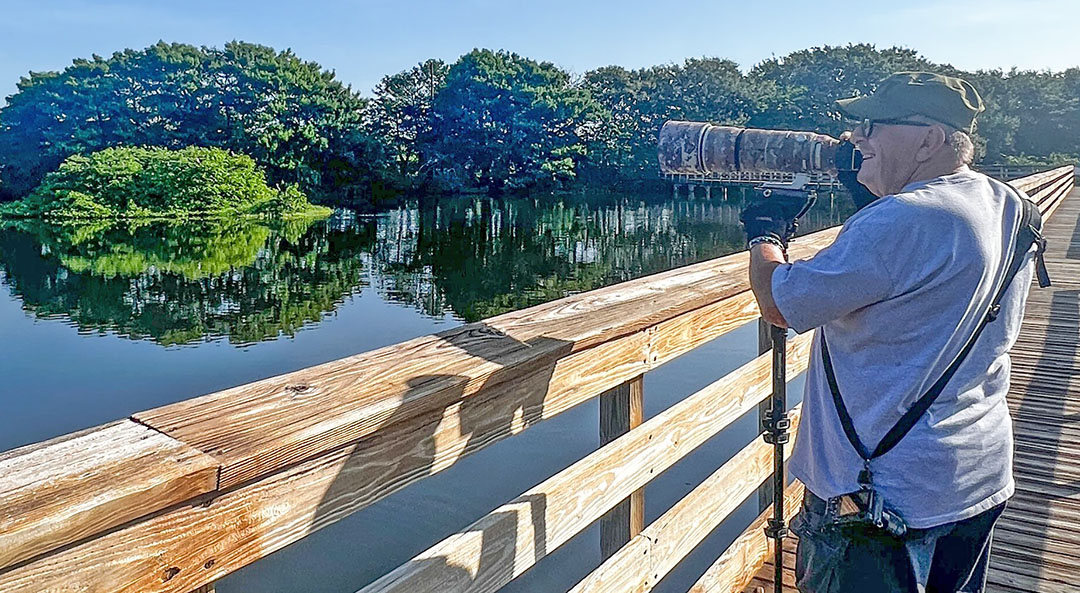
His fondest times there have always included creativity in one form or another. As a child, he dreamed of the day he could have a camera in hand, using photography to explore the vast wildlife of nature. Now as an adult, you can spot him across Delray Beach nature trails and parks capturing the essence of mother nature.

With the help of VA’s Veteran Readiness and Employment program, the aspiring photographer was able to make his childhood dream his new reality with the deluxe gift of a Sony camera, laptop and Photoshop software.

For over 15 years, creativity has been at the tip of his finger with every photo capturing what lies behind the breezy trees and trails of South Florida. The camera was Smith’s key out of the door. He still remembers the days he would approach his front door and twist the lock open to immediately twist it back to seal it shut.

Veteran with PTSD takes photo
Navy Veteran Walter Smith

“That moment is my PTSD therapy.”

“As a PTSD Veteran, every day is a challenge. Photography helps my PTSD by allowing me to get out of my home and express myself without encountering too many people. When I take a picture, I practice mindfulness. I focus on the moment and focus that energy to capture my surroundings. It is that very moment that is my therapy for my PTSD,” Smith said.

Leaving his home to venture out into the unknown was something he would have never fathomed but is now his daily routine with not just the equipment of his dreams but also the support behind him.

“The Creative Arts team at West Palm Beach VA has become my little mini-family. They have changed my life and have opened so many doors for me. What really matters to me is that I know somebody believes in me and supports me,” he said.

This support has evolved into the display of his captured moments. His artwork speaks for itself. “It allows me to introduce myself without having to speak. I just share a picture. It is my way of expressing myself. My creativity has always been my inner voice. The feedback I get from pictures is so satisfying and just so great to hear.”

With every adjustment to the lens to see the picture clearer, Smith replaces difficult battle images in his mind with new peaceful images of his South Florida explorations.