Paintings, drawings, century-old photographs and even a life-size sculpture are among the pieces that cannot be located by the authorities.
Nearly 200 artworks are missing from the Parliamentary collection


Georg Baselitz: Belle Haleine
Witty, provocative and accomplished erotica by the great German artist.
Cristea Roberts, London, until 22 December
New Blavatnik Art, Film and Photography Galleries
Artistic responses to the horrors of war, as collected and commissioned by this uneasy museum of the modern world.
Imperial War Museum, London, from 10 November
Rebecca Salter and James Gillray
The current president of the Royal Academy of Arts and scabrous satirist Gillray show at the home of one of Britain’s greatest artists.
Gainsborough’s House, Sudbury from 11 November until 10 March
Discover Liotard and the Lavergne Family Breakfast
A close look at key works by the 18th-century Swiss painter Jean-Etienne Liotard.
National Gallery, London, from 16 November until 3 March
Taylor-Wessing Photo Portrait prize
See the winners and also-rans in this roundup of what’s happening in photographic portraiture. What sets these pics apart from your own selfies?
National Portrait Gallery, London, until 25 February

From women crying out in labour pain to a family made of meringue (above), the Women in Revolt! show at Tate Britain, London, is full of wit and collective anger. It couldn’t be more timely, says Adrian Searle. Read his full review.
A US museum postponed an Islamic art exhibition because of the Israel-Hamas war
Picasso’s paintings can still fetch a pretty penny
Seaweed can be turned into high fashion, art, even shoes
A splash of colour can bring the most abandoned houses back to life
You can travel the world without leaving Wales thanks an art extravaganza
Aged 85, Arvie Smith is ‘flexing his muscles’ and taking on New York
You can learn a lot about famous paintings by looking at their backs and frames
Sir Peter Blake is excited by the ‘magic’ possibilities of AI in art
The Origin of the Milky Way by Jacopo Tintoretto, c1575

The Venetian painter Tintoretto was a sceptic about Greek mythology. A deeply religious man, he often suggests these old stories of gods and lovers are a bit silly. In his version of Leda and the Swan, for instance, in which Jupiter takes the form of a swan to have a surreal sexual encounter, he depicts Leda with a collection of other animals waiting in her bedroom. But here he plays it straight, inspired and exhilarated by the myth that the Milky Way, our galaxy, is actually a trail of divine milk spilt by the goddess Juno. This cosmic origin story is played out in a flowing cascade of floating silks and silvery clouds in the deep blue sky where the gods circle one another as majestically as planets.
National Gallery, London
To follow us on X (Twitter): @GdnArtandDesign.
If you don’t already receive our regular roundup of art and design news via email, please sign up here.
If you have any questions or comments about any of our newsletters please email newsletters@theguardian.com

Gen X and Boomers might think that this article’s heading is a reference to the smash hit album by the English band, The Police. However, it’s actually the title of a new physical-digital project from Candy Digital and Getty Images, looking at the history and impact of paranormal photography. This is the latest in a series of initiatives from these companies who have partnered on three other successful projects.

The term paranormal is often used to describe occurrences and phenomena that fall outside the realm of what’s considered normal in everyday life. For me, every episode of the TV show The X Files has been the perfect on-screen portrayal of this. This show genuinely piqued the curiosity of millions in the 90s. But an obsession with the paranormal has been something that humans have been practicing, researching, and documenting for centuries now. Delving into the supernatural, paranormal photography (not to be confused with spirit photography) attempts to capture images of unexplainable phenomena. People often practice this to win over skeptics and to provide firm ground for those who challenge conventional scientific understanding. It offers a glimpse into the supernatural, challenging the boundaries of our conventional understanding of the dead.
Such photographs are now considered to be steeped in rich historical and cultural contexts. They often tend to invite debates and discussions over their authenticity, challenging skeptics and offering half-believers of the supernatural a lifeline to clutch onto. And of course, there’s the thrill of capturing something that very few humans (claim to successfully) have done.

Standard camera equipment is often unable to photograph the paranormal. Photographers have often used a diverse array of tools and equipment, each with a specific purpose, to prove the existence of spirits. These range from ultraviolet and infrared photography cameras to even long exposures methods in order to try and capture elusive supernatural beings. And unlike nowadays when many of these tools are easily purchasable, things were a lot tougher at the start. These days, no serious paranormal photographer would head out without an Electro Magnetic Field meter. Thermal imaging cameras and motion sensors are among some of the other tools that aid such photographers. Early spirit photographers would even try stereoscopic techniques to immerse the viewer into their spooky creations.

Throughout history, humans have sought to document and understand the paranormal. A global interest in photography began to rise in the mid-19th century. This was not long after the first documented photograph was taken in France. Incidentally, so did a fascination with spiritualism – a belief that the deceased moved into the afterlife, but still continued, on some level, to maintain contact with the living world.
A chance double-exposure accident in the darkroom led William H. Mumler to invent and become well-known in the field of “spirit photography.” Effectively this was double exposure photography done right for that era. A skill he would later master and milk for his own good, preying on those grieving for their loved ones. Mumler became well known for being able to “capture the spirits” of dead relatives or even strangers in the same frame as living subjects. One of his most famous subjects was Mary Ann Todd Lincoln, the former First Lady of the United States. The gig went on successfully for a couple of years. Until one such subject recognized the “spirit” alongside him in the photograph as being someone who was quite alive.
That photograph effectively killed Mumler’s career as a spirit photographer. However, countless others since then haven’t given up on the pursuit of trying to photograph what’s commonly invisible to the naked eye. Such paranormal photographers combine scientific and artistic elements to try and capture phenomena that push the boundaries of reality. Skeptics of this genre have often argued that what shows up in these images is unambiguous. Or they blame it on a combination of camera trickery and visual artifacts. That hasn’t stopped more and more people from trying each year to photograph, and now videograph what they believe to be the existence of ghosts and apparitions from other dimensions. Of course, for each such photographer, countless debunkers pop up too
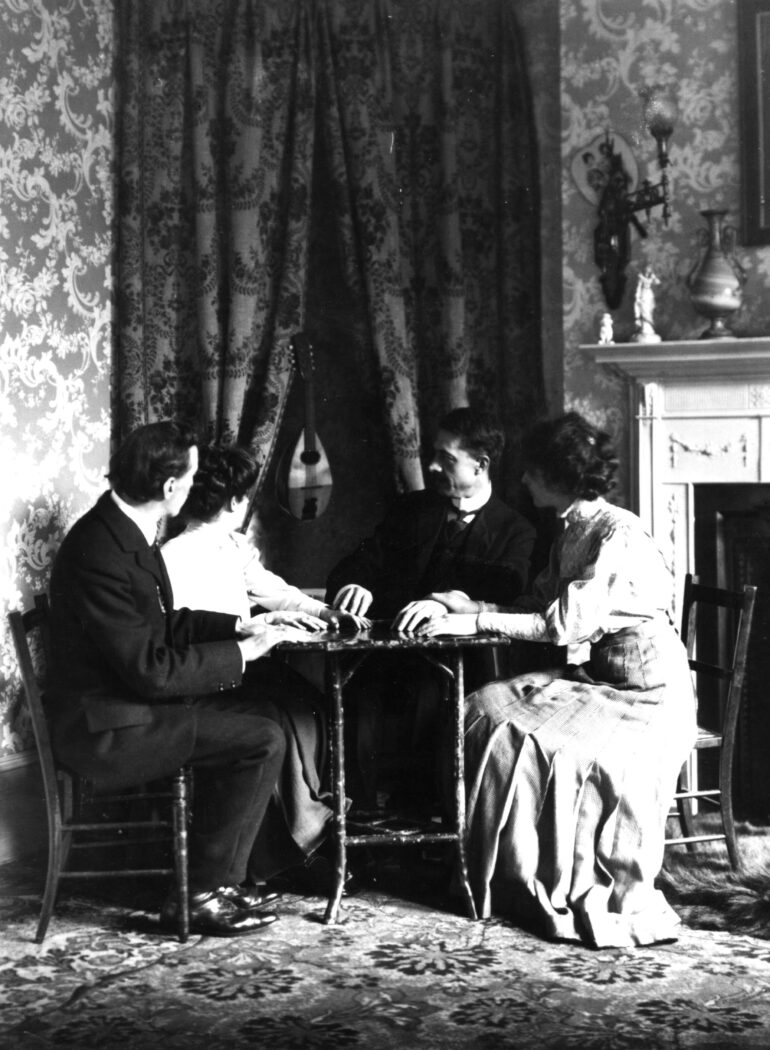
Candy Digital and Getty Images have teamed up to explore how blockchain technology can be used to safeguard significant art movements. This partnership reflects their dedication to finding creative ways to protect and document these historical and artistic milestones. The fourth collaborative initiative between them, Ghost In The Machine, is an image collection that takes a look at the early years of spirit photography in the 19th century, as well as some 20th-century work.
“You can see the undead among us, if you’re willing to look.”
Twenty such archival images are made available in this paranormal photography collection. Some from the Hulton Archive have never been released before. This is also the first first physical-digital project between these two organizations. The collection also features a zine titled Nightmare Logic, and a digital exhibition that explores the impact of spirit photography through the work of contemporary artists. Collectors can purchase historic physical-digital artworks until November 27th. The images cost just USD 75 for digital editions and USD 225 for a digital edition with a 9.5” x 14” print (framed with a 15” x 19.5” black frame, and a white top mat.)

Technology has advanced greatly since that first spirit photo by Mumler in the 1860s, but the fascination with the paranormal has anything but dwindled. As you peer at a paranormal photograph and pore over it closely to wonder how much of it is real, you can’t help but think about the intriguing and thought-provoking questions that went through the minds of the photographers behind the images in this collection. What could have made them want to start photographing the unseen? What was that one incident that made them want to showcase the worlds that many of us go without seeing? Whether you’re a fervent believer in this or a cynic, the allure of paranormal photography is a testament to our undying curiosity about the mysteries that surround and spook us. After all, for many of us, seeing is the only form of believing.
All images here, unless mentioned otherwise, have been provided to The Phoblographer by Getty Images, for usage within this article.

It was the end of an era last night at Christie’s 20th-century evening sale in New York. The auction was the last to be helmed by Christie’s global president, Jussi Pylkkänen, who leaves the firm after 38 years.
Perhaps propelled by the veteran auctioneer’s swan song—and certainly dampening the fears of a weakening market emphasised by Christie’s lacklustre 21st-century evening sale on Tuesday evening—the house brought in $543.4m ($640.8m with fees). This is its highest result for a non-single owner sale since November 2017, when it made $785.9m (with fees), more than half of which came from the $450.3m sale of the Salvator Mundi.
Last night’s total almost hit its $660m high estimate (calculated without fees), and saw a healthy 97% sell-through rate by lot, with two of the 63 works withdrawn. Six artists auction records were set, including those for Barbara Hepworth, Richard Diebenkorn and Joan Mitchell.
On the guarantee front, more than half of the works were sure to sell: eight were covered in house, a further 27 by third parties.

Egon Schiele’s Selbstbildnis (1910)
Courtesy of Christie’s Images Ltd
The long evening got off to a bullish start with Egon Schiele’s Selbstbildnis (1910), a spare watercolour and black crayon paper work that sailed comfortably past its $2m high estimate to make $2.3m ($2.8m with fees). It was one of three restituted watercolours by Schiele from the former collection of the Viennese cabaret and film star Fritz Grünbaum. The other two also brought success. Ich liebe Gegensätze (1912), executed when the artist was imprisoned at the age of 21 for having sex with a minor, sparked a bidding war among a half dozen bidders and realised a whopping $9.2m ($10.9m fees), almost four times its $2.5m high estimate. A few lots later, Stehende Frau (Dirne), also from 1912, brought $2.2m ($2.7m) against an estimate of $1m-$2m.
One of the night’s star lots, Arshile Gorky’s delicate abstraction, Charred Beloved I (1946), sold for a record $20m ($23.4m with fees). The work, which was painted the same year that a fire broke out in the artist’s studio, came to the market backed by a third-party guarantee and with an unpublished estimate in the region of $20m. It carried an attractive provenance too: it was consigned by the major collector and film executive David Geffen, and had also previously been in the collection of publishing magnate S.I. Newhouse. It easily topped the artist’s previous auction record, for $14m, set at Christie’s in November 2018.

Richard Diebenkorn’s Recollections of a Visit to Leningrad (1965)
Courtesy of Christie’s Images Ltd
Another high flyer was Richard Diebenkorn’s Recollections of a Visit to Leningrad (1965), a large sun-splashed abstract painting, which made its first appearance at auction. It sold to an anonymous telephone bidder for a record-shattering $40m ($46.4m with fees) against an unpublished estimate in the region of $25m. This crushed the previous $27.2m record for the artist, made by Sotheby’s New York in May 2021 for Ocean Park #40 (1971).
American abstraction saw strong results throughout the evening and helped to dampen perceptions, at least for this evening, of a weakened or nervous market. Joan Mitchell’s densely packed composition Untitled (around 1959) had, like the Gorky and the Diebenkorn, never before come to the block. The guarantee-backed work made the artist’s record, at $25m ($29.1m with fees), comfortably within its $25m-$35m estimate. Mitchell’s previous record was $16.6m, made at Christie’s New York in May 2018 for Blueberry (1969).

Joan Mitchelle, Untitled (around 1959).
Courtesy of Christie’s Images Ltd
Stellar performances from European heavyweights were also in evidence. Pablo Picasso’s Nu couché, depicting a voluptuous reclining figure, from 1968, soared above its $35m high estimate It sold to the dealer Larry Gagosian for $11.5m ($13.6m with fees) and René Magritte’s L’empire des lumières (1949) made $30m ($34.9m with fees). It surpassed its last auction appearance at the same house in November 2017 when it sold for a then record $20.5m (with fees).
The Picasso hailed from the estate of Jerry Moss, the late record producer and co-founder of A&M Records. Also consigned from his collection was Tamara de Lempicka’s coquettish portrait of her daughter Kizette, Fillette en rose (around 1928-1930), which sold for a record $12.5m ($14..7m with fees); Frida Kahlo’s early work Portrait of Cristina, My Sister (1928), which made $6.8m ($8.2m with fees); and Jean-Michel Basquiat’s Orange Joy (1984), acquired directly from the artist by the consignor around 1985, which brought $3.9m ($4.7m with fees). In total, the Moss group realised $54.7m (with fees).
Soon after came Mark Rothko’s sublime Untitled (Yellow, Orange, Yellow, Light Orange) composition from 1955. The painting was once owned by Paul and Bunny Mellon, who acquired the work from Marlborough Gallery in 1970. It sold to yet another telephone bidder for $40m ($46m with fees). The house-guaranteed lot was estimated in the region of $45m and was last sold at auction for $36.5m in November 2014 at a Sotheby’s New York single-owner sale from the collection of Bunny Mellon. An interim buyer had acquired it privately for considerably more.

Mark Rothko’s Untitled (Yellow, Orange, Yellow, Light Orange) (1955) Courtesy of Christie’s Images Ltd
Another group of top-tier works had been consigned from the collection of the late and storied Canadian filmmaker Ivan Reitman and his wife Genevieve. This included Picasso’s Femme endormie (1934), featuring the slumbering visage of the artist’s mistress and muse Marie-Thérèse Walter. But its performance was far from sleepy: backed by a third-party guarantee, it sprang past its $25m-$35m estimate to make $37m ($42.9m with fees).
Still in Reitman territory, Willem de Kooning’s late, large and decidedly spare Untitled III (1984) sold for $7.1m ($8.5m with fees). It fell a bit shy of its $8m-$12m pre-sale estimate, but was backed by an anonymous third-party guarantee. The Reitman group made $74.2m (with fees) in total.
In one of the few unscripted parts of the marathon evening, a trio of Paul Cézanne still lives, offered from the cash-strapped Museum Langmatt in Baden, Switzerland, added a touch of drama, with the exquisite Fruits et pot de gingembre (1890-93) going for $33.5m ($38.9m with fees). Estimated at $35m-$55m, the painting was expected to fulfill the museum’s goal of raising $44m (the campaign has been heavily criticised), and perhaps spare the other two Cézannes offered.
But that wasn’t to be. Quartre pommes et un couteau (around 1885) sold for $8.7m ($10.4m with fees) and La mer à l’Estaque (around 1897) made $2.6m ($3.1m with fees.) Part of the proceeds will also benefit the heirs of the late German Jewish art dealer Jacob Goldschmidt, who sold Fruits et pot de gingembre under duress in 1933 to Sidney Brown, the father of the museum’s founder.

Claude Monet’s Le basin aux nymphéas (1917-19)
Courtesy of Christie’s Images Ltd
The evening’s top lot was Claude Monet’s late Giverny jewel Le basin aux nymphéas (1917-19), painted at a panoramic scale of 39 by 78 inches and which made $64m ($74m with fees). It came stamped with the artist’s signature, meaning it didn’t leave Monet’s studio before his death and, accordingly, is less valuable than signed examples. Still it ranks as the sixth-most expensive Monet to sell at auction.
At this juncture, Pylkkänen announced that would be his final lot sold at Christie’s and handed the gavel over to Adrien Meyer, global head of private sales. Applause filled the room and Pylkkänen received a brief standing ovation in the Rockefeller Center. “What a night for Christie’s,” he said. “And what a night for the art market.” The evening sale action resumes on Monday at Sotheby’s with its Modern art auction.

PORT ANGELES — The Harbor Art Gallery will present a “Small Works Show” while Studio Bob is presenting a photography show this weekend during the Port Angeles Second Saturday Art Walk.
Many members of the artist collective at Harbor Art Gallery, 114 N. Laurel St., who have created delicate, diminutive and affordable works, will be on hand from 4 p.m. to 7 p.m. on Saturday.
Studio Bob at 118½ E. Front St., will host a reception from 5 p.m. to 8 p.m. Saturday with live music featuring Tin Sandwich and Guests, followed by an additional showing from noon to 3 p.m. Sunday featuring ekphrastic poetry beginning at 1 p.m.
Harbor Art
Harbor Art Gallery’s November show of small works is open for viewing from 11 a.m. to 4 p.m. Tuesday through Saturday, in addition to this Saturday’s art walk.
“It’s a great time of year to check out the gallery,” said Terri Enck, a mixed media sculptor and ceramicist.
The gallery has welcomed new artists in recent months, including painter Andrèa Woods and bronze sculptor Katie Graham.
“I like the spontaneity that the Small Works Show encourages in everyone,” said Randy Radock, a printmaker.
Other local artists showcased at Harbor Art Gallery are Bob Stokes, Cindy Elstrom, Carolyn Guske, Robert Amaral, Garret DeLaBarre, Katie Graham, Tammy Hall, Susan Kantowitz, Nancy McFaul, Gail McLain, Roger Mosley, Eric Neurath, Miranda Petruska, Sallie Radock, Jodi Riverstone, Nathan Shields, Lance and Haley Snider, Eileen Webb and Kevin Willson.
For more information, see https://www.facebook.com/harborartgallery.
Studio Bob
Studio Bob’s Second Weekend Art Opening show, “Anything Goes,” features the photography of Olympic Peaks Camera Club with Lewis Bennett, Bruce Fryxell, Ed Hartman, Dana Martell, Sasha Parrott, Daniel Parrott, Phil Tenault, Kevin Talbot and Susan White.
The Olympic Peaks Camera Club (OPCC) was established in Sequim in 1982. OPCC’s mission is to connect, educate and support photographers from beginner to professional across the North Olympic Peninsula, including Sequim, Port Angeles, Port Townsend and surrounding areas.
Tin Sandwich, made up of Marilyn, Marty and Mochi Kaler, is a regular live music guest at the Saturday Second Weekend Art Openings at Studio Bob. It offers covers and originals.
The Ekphrastic Poets are poets within The Olympic Peninsula Authors, who gather regularly at special art openings to recite pieces composed for the occasion.
The onsite Loom Bar will be open with appetizer plates, mocktails, wine, beers and ciders. The Loom has regular hours of 4 p.m. to 8 p.m. every Thursday, Friday and Saturday.
For more information, see https://studiobob.art.

A group of Cree youth from central Alberta are now recording artists sharing their views and experiences with the world.
The group is called Nikamo, the Cree word for sing, and includes youth ages 10 to 14 from Kehewin Cree Nation, Goodfish Lake (within Whitefish Lake First Nation), Onion Lake Cree Nation, Cold Lake First Nations and Saddle Lake Cree Nation in central Alberta.
It is the result of a collaboration between Kehewin Native Dance Theatre and the non-profit Make Music Matter to support youth mental health through music.
Rosa John, artistic director for Kehewin Native Dance Theatre, said her group doesn’t usually collaborate with non-Indigenous organizations, but she was excited by Make Music Matter’s commitment to youth mental health.
According to John, the EP’s title song Moments, which discusses loneliness, has become an anthem for the group.
[embedded content]
“The song came about because they had nobody to talk to. They had no place to go,” she said.
“Development of friendship was really something that stood out for all of them, because through the process they became friends.”
Serena Dufresne said finding out her daughters, Kianna Dufresne, 11, and Ryder Dillon, 10, would be recording an EP was a huge source of pride, especially considering all the people who would eventually listen to it.
“At the beginning I didn’t really believe [Ryder] that it was actually happening,” Dufresne said with a laugh.

When it finally became real, she said it was a lot to take in.
“I was beyond excited and I started crying,” Dufresne said.
Kianna and Ryder say Moments is their favourite song, and Ryder calls it “a jam” that the whole family enjoys.
“My mom blasts it in the car,” Kianna said.
Along with the rest of Nikamo, Akima Marshall got the chance to perform live in Calgary at the National Music Centre, which also supported the project.
In Calgary, Akima sang a solo in the song Moments and while she was initially “terrified,” she said the experience was fun because of the support she had.
Part of that support came from community members who made each performer a ribbon skirt or shirt to wear, John said.
The performance in Calgary was emotional for many members of the group, their parents and supporters.
“We all cried together coming home,” after Nikamo’s live performance, Dufresne said.
The performance was a bit surreal for the Dion family.
Colleen Dion said she and her husband had taken their son Cameron to Calgary earlier this year and they had stopped by the National Music Centre. Just a few months later, they were back and he was performing. Cameron, 12, is a self-taught ukulele, guitar and piano player.

Although he has experience coming up with songs on his own, Cameron said he’d never written lyrics before — something that was a struggle for many of the youth, John said.
“Many of them were very, very shy and they weren’t really comfortable sharing about what they were feeling,” John said.
But it wasn’t long before a writing technique helped them open up.
John said the kids were told to write a couple words down on a small card which would then become the lyrics.
“Pretty soon they were writing more words. ‘Oh no, we don’t want a little piece of paper. I want a whole piece of paper,'” she said.
The best part of the project, John said, was watching the kids find their voices and talk about their feelings.
“At first it was really funny because none of them wanted to even approach the mic. It was like ‘no, no, no, no, no,’ and they would hide their faces,” John said, adding that later the youth would excitedly arrange the order they would perform.
The success of the program highlights the need for more opportunities in the arts, especially in smaller communities, according to Dion.
“In small doses, we can all feed our souls … Everybody needs access to that and have that realization that we are all artists.”


WINNIPEG – Scattered throughout the century-old Manitoba Legislative Building are the works of famed Indigenous artists, including Daphne Odjig and Jackson Beardy.
Some pieces hang in offices, while others are placed for passersby to see.

A Derry-born artist whose distinctive portfolio is attracting global attention is launching an exhibition at the Urban Art Gallery in the Garden Reflection in Derry.
Watch more of our videos on Shots!
and live on Freeview channel 276
Kevin Horgan’s ‘Dúid Art’ exhibition forms part of UV Arts Gallery takeover of The Garden of Reflection promoting local artists and participants in partnership with the Inner City Trust at 16 Bishop Street Within.
Kevin Horgan was born in Derry and spent his early years in Cork City, and uses art to convey ideas and notions of things around him.
Not bound by medium, he uses oil paints, acrylics pastels charcoal pencils etc, anything that helps him execute his ideas, which take in

culture, philosophy, history and psychology.
Kevin said: “Art can be serious and carry deeper meaning, something to think about and explore, spark further conversation and art can also just be about the visual appeal, the aesthetic, just a bit of craic!”.
Karl Porter of UV Arts said: “Kevin is a great rising artist. His work is new and fresh yet has roots that go deeper into culture, history and philosophy. We’re privileged to be hosting his first solo exhibition and look forward to seeing him rise in his art career.”
UV Arts are currently continuing their takeover of the Garden of Reflection Gallery, in partnership with the Inner City Trust, aiming to create a new gallery experience for Derry city. The urban-art focused gallery is hosting a series of alternative art exhibitions by local, national and international artists throughout 2022 and 2023, in addition to UV Arts’ ongoing street art and contemporary mural movement across the city and district.

The Urban Art Gallery hosts a series of workshops and demonstrations, and a School for Street Art, promoting and educating people and places via street art and contemporary mural arts, in addition to having an alternative art store stocking all the tools required to create colossal art and also a podcast studio that can be booked by local creatives and businesses.
The exhibition runs from Saturday, November 11 at 3pm through to Saturday, December 2, 2023 and the studio opens from 11am to 5pm, Wednesday to Saturday.






