
This December, Monrovia-based John Moran Auctioneers and Appraisers is presenting three distinct sales highlighting some of the most influential and captivating artists of the 20th century.
Beginning the string of auctions is “20th Century Photography: The Emergence of Modernism” on Wednesday, December 6, at 10 a.m. PST, featuring works by pioneers of the field like Ansel Adams, Imogen Cunningham—and eight previously undiscovered photos from the 1920s by Edward Weston.
Later that day at 12 p.m. PST is “The Collection of Frederick W. Davis,” which will feature an expansive, 344-lot exploration of Latin American Art from the estate of the collector and dealer, ranging from fine art and photography to traditional craft and decorative art.
Rounding out the slate of events is the “Latin American Art and Design” sale on Thursday, December 7, at 12 p.m. PST, which will see further exploration of Latin American art and culture, and including 200 lots spanning everything from Mexican silver tableware and jewelry to artworks by important Latin American artists such as Diego Rivera, Felipe Castañeda, Fred Davis, and more.
Below, we explore just a few of the most intriguing lots from across the three sales.
Imogen Cunningham
Two Callas (1925–1929)
Est. $100,000–$200,000

Imogen Cunningham, Two Callas (1925–1929). Courtesy of John Moran.
Imogen Cunningham (1883–1976) had an incredible, seven-decade-long career in which she became world famous for her diverse photography practice as an influential member of the California-based Group f/64, founded by Willard Van Dyke and famous landscape photographer Ansel Adams. Cunningham garnered specific acclaim for her striking botanical photographs, with her Two Callas and other floral compositions drawing comparisons to the work of Georgia O’Keeffe. The present edition of Two Callas is of particular interest, as it is an example that was produced on a specific type of matte paper that she used throughout the 1920s, and it has the artist’s Mills College label, which was used for just a sliver of her career between 1929 and 1934.
Edward Weston
Cuernavaca (1925)
Est. $100,000–$200,000

Edward Weston, Cuernavaca (1925). Courtesy of John Moran.
Working across genres, including landscape, still life, nudes, portraits, and more, American photographer Edward Weston (1886–1958) was also a member of Group f/64, but unlike fellow members, was deeply influenced by the tenets of Surrealism. The present image is the result of the artist returning to a subject he had focused on previously, the palm tree, but instead of a traditional overall image of the tree, Weston omits much of its unique identifiers, such as the frond leaves, from the frame. Instead, the solidity and texture of the trunk becomes the focus, so that on first glance, viewers may not even know what it is they are looking at. The unusual crop of the subject speaks to Weston’s experimental approach to the medium.
Fernando Botero
Nude Figure Reclining (2002)
Est. $100,000–$150,000

Fernando Botero, Nude Figure Reclining (2002). Courtesy of John Moran.
Columbian figurative artist Fernando Botero (1932–2023) developed a unique signature style that has been termed “Boterismo,” recognized for portraying human bodies in exaggerated scale and proportions. This mode of representation bestows Botero’s work with both an element of humor as well as the ability to engage with political criticism. Also a sculptor, Botero’s iconic figures can be found installed around the world, including along New York City’s Park Avenue and Paris’s Champs-Élysés. Today, he is considered one of the most influential and recognizable Latin American artists in the world.
Alfredo Ramos Martines
Madonna India (ca. 1932)
Est. $60,000–$80,000

Alfredo Ramos Martines, Madonna India (ca. 1932). Courtesy of John Moran.
Mexican painter, muralist, and teacher Alfredo Ramo Martinez (1871–1946) was influential in the development and propagation of Modernism in his home country, so much so that he is often referred to as the “Father of Mexican Modernism.” Synthesizing both Modern and traditional styles of painting, Martinez’s work is recognized for its empathetic representation of the people and landscapes of Mexico both in his standalone paintings and murals. Following his relocation to Los Angeles, California, in 1930, his work was brought to a broader audience, and he developed a significant following from the Hollywood set. Posthumously, the Alfredo Ramos Martinez Research Project was established in 1991, which seeks to preserve and advance the artist’s legacy.
Miguel Covarrubias
El Mercado (n.d.)
Est. $20,000–$30,000

Miguel Covarrubias, El Mercado (n.d.). Courtesy of John Moran.
Miguel Covarrubias (1904–1957) began his professional career as a teenager following his move from Mexico to New York City at the age of 19, working as a caricaturist for Vanity Fair. Homing in on his own signature style and approach, Covarrubias’s practice grew to include painting and murals—though he continued creating caricatures for publications and theater productions. An avid explorer and academic, he was also credited with co-discovering the Olmec civilization, identifying it as distinct from the Mayan civilization. Mass-produced reproductions of his work are considered some of the most influential in America during the 1920s and 1930s, and his use of flat planes of color and simplified forms contributed to Modernism’s ability to take root in the country.
Diego Rivera
Dos Indios Arando En Un Frutal (1935)
Est. $30,000–$50,000
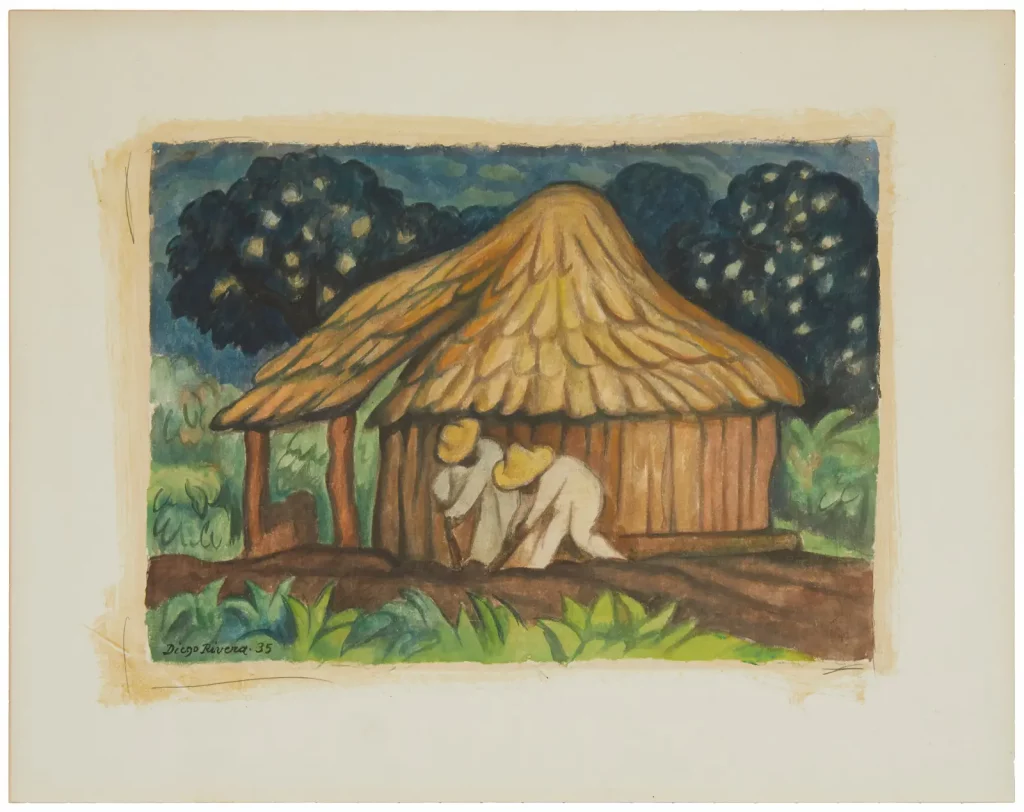
Diego Rivera, Dos Indios Arando En Un Frutal (1935). Courtesy of John Moran.
Recognized as one of the most influential and famous artists of the 20th century, Mexican painter Diego Rivera (1886–1957) was a pioneer in the mural movement—both in Mexico and internationally—and his work can be seen in public buildings around the world. A devoted Communist, Rivera frequently depicted everyday people and their work, which can be seen in the present lot that depicts two individuals plowing. Though he was married multiple times, his most famously wed to Mexican Surrealist painter Frida Kahlo, and the two had great influence over each other’s work. Rivera’s work today can be found in some of the world’s most prestigious institutions, including the Museum of Modern Art, New York; Centre Pompidou, Paris; and Museo Nacional de Arte, Mexico City.
Learn more about the sales at John Moran Auctioneers here.
Follow Artnet News on Facebook:
Want to stay ahead of the art world? Subscribe to our newsletter to get the breaking news, eye-opening interviews, and incisive critical takes that drive the conversation forward.







