


The era of family photo scrapbooks is over.
Barry Goyette knows this, but something about them has always stuck with him, even as the world became digital.
“Back in the day, my friend and I would go into these antique shops in the area and find these little bins full of scattered scrapbook family photos,” the San Luis Obispo-based photographer said. “You would find these photos out of the context of being in a collection—even with not knowing who was in them, they were always fascinating.”
That experience served as a source of inspiration for years, so when the San Luis Obispo Museum of Art (SLOMA) reached out about collaborating on potential exhibits, those old portraits were the first thing that came to his mind.
“I thought it was really interesting to see these stories of things that exist within every family photo, stuff we don’t think about at first glance,” he said. “There are these things that just naturally exist at the moment.”
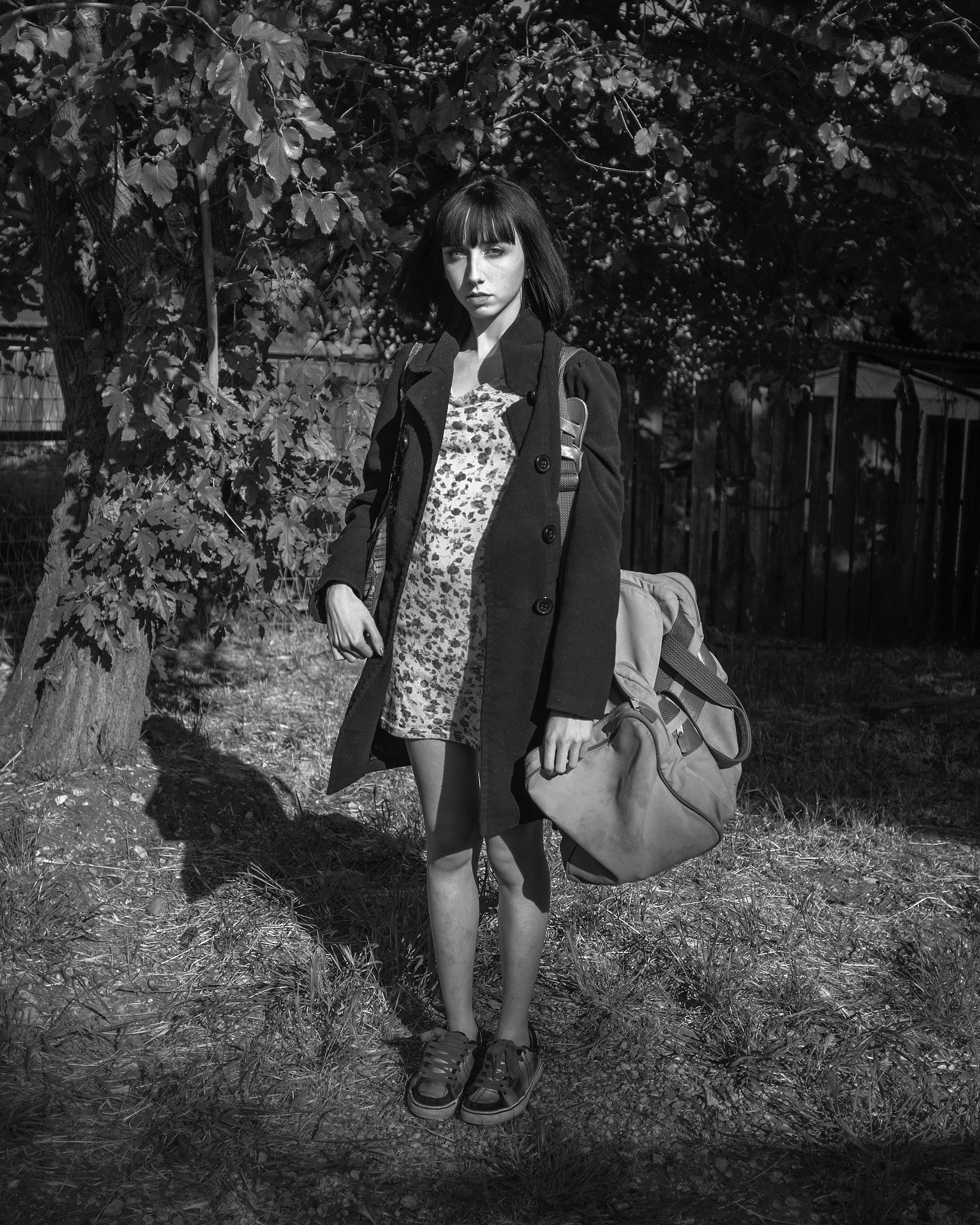
The Mulberry exhibit is Goyette’s attempt to capture the energy taken for granted in those family photos while highlighting the relationship between photographers and the models they photograph.
The exhibit consists of almost 30 different-sized black-and-white images of models in various portrait poses, using different props and switching up expressions—all shot around the same mulberry tree in SLO.
Goyette said the exhibit aims to inspire the experience he had looking at those scrapbook photos years ago.
“It’s my response and reflection of this vernacular I was seeing when we were looking through these photos at these antique shops,” he said. “I wanted to explore that relationship between the two people interacting in the photo.”
Mulberry opens at SLOMA on Feb. 2 and runs through June 3 as the start of what SLOMA Chief Curator Emma Saperstein said is a new focal point for 2024.

“This show kick-starts a year at the museum that focuses more on photography in addition to the types of art we have had in the past,” Saperstein said. “I am very proud we have been able to offer it to someone willing to do something unique with the concept.”
Part of the concept is exploring what Saperstein considers to be a known quantity in portrait photography and the models who often work with photographers like Goyette.
“Barry was open about this dynamic from the very beginning,” she said. “As someone who works with [professional] models who are often female, there is a power dynamic that is there—it’s always been there, especially in contemporary discourse.”
But the way Goyette enabled models to have agency and bring ideas, concepts, and even props in is what shatters the idea of conventional photo exhibit.
“They are bringing their own identities, which is not the standard for photographer-model relationship,” Saperstein said. “To not only acknowledge that but explore more of that difference in traditional dynamic is important.”
Exploring the model-photographer interaction wasn’t always on his mind, Goyette said, but as the years passed, he understood that it was important to delve into that idea.
Goyette said putting Mulberry together took more than 15 years—with many of the photos taken in the first four and then sporadically since. He intended to wait a long time after he took them as a part of his artistic reflection.

“That’s the unique aspect of this exhibit—that idea of letting time pass naturally and create these memories of the moment I shot these that I hope comes through for the viewer,” he said. “I almost wanted to forget a little about the experience so that when I was going through them, I could pick the ones that stood out as antique.”
Of course, for Goyette, many of these photos are of people he still knows and talks to regularly, which he said helps give the exhibit “family photo” vibes.
“A vast majority of these people I know well, and I have had the opportunity to know them well since I started taking these photos,” he said. “For me as someone who was raised as an only child out in Santa Maria, these people in these photos became my family.”
He hopes that those relationships shine through each photo and allow the viewer to understand a different side of him and the people in the portraits.
“It’s a personal show compared to a lot of the things they would normally show at the museum, but it’s nice to know that there is a place that will explore ideas like this,” Goyette said. “There is a lot of emotion in the photos that highlights exactly how me and the model felt about the shoot, each other, and life in general in that moment.” Δ
Staff Writer Adrian Vincent Rosas has that one Nickleback song stuck in his head. Help him get it out at [email protected].


ANADARKO — A Comanche/Kiowa artist will have her work featured at the Southern Plains Indian Museum.
The museum, administered by the U.S. Department of the Interior, Indian Arts and Crafts Board, at 801 E. Central Blvd. in Anadarko, will open the new exhibition, “Contemporary Southern Plains Beadwork, featuring Tessa Doyebi-Robledo,” on Saturday. The exhibition will be on display until April 10 and is free to the public, said Bambi Allen, museum curator

Hasselblad has introduced the 907X and CFV 100C camera models, combining traditional looks with advanced technology in medium-format photography. These models, serving both nostalgic and forward-thinking photographers, feature a 100-megapixel medium format system.

A notable part is the detachable CFV 100C digital back, allowing photographers to switch between the 907X body and classic film bodies like the 500 and 200 Series. This feature pays homage to Hasselblad’s history while embracing digital advancements. The CFV 100C is not limited to Hasselblad bodies; it can be used with various technical cameras, making it versatile for tasks like architectural and product photography.

The system incorporates a 100-megapixel medium format BSI CMOS sensor with a 15-stop dynamic range and a native ISO of 64, ensuring clarity, detail, and color accuracy for professional and artistic applications. The Natural Colour Solution (HNCS) is integrated for accurate color representation, particularly in natural settings.
The autofocus technology sees a significant improvement with Phase Detection Autofocus (PDAF) and face detection, offering faster and more accurate focusing. The 907X & CFV 100C demonstrates approximately 300% improvement in focusing speed compared to its predecessors, benefiting photographers in fast-paced environments or dealing with moving subjects.
The Hasselblad 907X and CFV 100C can be ordered now at a price of $8,200 and are ready for immediate shipment.
RELATED:
[embedded content]
(Source)

Hasselblad has introduced the 907X and CFV 100C. This innovative system is anchored by the CFV 100C digital back, a 100 MP marvel that transforms three distinct camera platforms, including the 907X, V System, and technical cameras, into high-resolution powerhouses.

The CFV 100C is the core of this new system. It employs a 44 x 33mm 100 MP BSI CMOS sensor, similar to the one in the X2D camera. This sensor captures a wide 15-stop dynamic range with 16-bit color depth and Hasselblad’s Natural Color Solution, ensuring images full of detail with smooth tones and authentic color transitions.
The new 100 MP sensor not only improves resolution but also speed. Featuring phase-detection autofocus that covers 94% of the image area, it offers faster, more responsive, and accurate AF performance compared to its 50 MP predecessor. This system is on par with the AF performance of the X2D, including face detection for more precise portraiture.
Significantly, the CFV 100C incorporates a 1 TB SSD for high-speed, reliable storage (2,370 MB/s write and 2,850 MB/s read speeds). It also features a CFexpress Type B port for additional storage. The USB-C port has been upgraded to 3.1 Gen 2 speeds, and wireless capabilities are enhanced with Wi-Fi 6.
Physically, the CFV 100C retains its elegant design with a tilting 3.2″ 2.36m-dot touchscreen, ideal for various shooting angles. Despite these enhancements, the camera body is narrower and lighter than its predecessor. A significant addition is the hot shoe adapter, fulfilling one of the most requested features from previous models.
 The 907X, when paired with the CFV 100C, becomes an even lighter version of its former self, maintaining its sleek interface. This body acts as a simple yet effective connector between the CFV 100C digital back and various Hasselblad lens systems, including the autofocus XCD lens system.
The system supports accessories like the updated 907X Optical Viewfinder and the 907X Control Grip. These enhancements provide ease of use and additional controls for an improved shooting experience.
One of the CFV 100C’s unique features is its compatibility with Hasselblad’s 500- or 200-series film bodies. The digital back’s design is reminiscent of Hasselblad’s A12 film back, allowing for a seamless integration with vintage models. This compatibility extends to technical and view cameras via a V System interface plate, making it a boon for architecture and product photographers.
The versatility of the CFV 100C is quite impressive. It can function as a high-end travel camera, a bridge between digital and film with a 500-series body, or a precision tool for technical photography. This flexibility makes the Hasselblad 907X & CFV 100C desirable for a huge range of applications.
The Hasselblad 907X and CFV 100C medium format camera system look quite exciting. Look for our review of the system soon.


David LaChapelle is a legend in the world of photography. Having worked with some of the most famous figures in pop culture, his works are distinctive, surrealistic and recognized worldwide. Now, Miamians are finally getting an opportunity to view his works up close at his first-ever solo exhibition in Miami Beach.
The exhibition, titled “DAVID LACHAPELLE: HAPPY TOGETHER”, will take over VISU Contemporary from January 26 to March 2. Curated by gallery owners Bruce Halpryn and Blake Pearson, it will feature over 30 significant photographs from 1985 to the present, in addition to the world premiere of his latest work.

Visitors can expect to find his earlier works, such as Archangel Uriel (1985) which displays a stoic cherub resting on the overlook of a great forest, and My Own Marilyn (2002), which presents his muse Amanda Lepore in an homage to Warhol’s Shot Sage Blue (1964).

“This curation reveals an exciting range of themes while highlighting the artist’s distinct ability to create thought-provoking narratives,” said Bruce Halpryn, co-owner and co-curator of VISU Contemporary. “Many of the iconic works on view have become a mirror of the time we live in, while also providing a glimpse into the future.”

Other works on view include After the Deluge: Museum (2007), where LaChapelle reminds us that human survival cannot be separated from nature while precious objects are as temporary as our climate; Behold (2015), representing LaChapelle’s ability to reimagine Old World ideas and aesthetics with painterly effect through photography; and Revelations (2019), inspired by the biblical book of the same name.

The gallery has revealed that it will also premiere a new work by LaChapelle — Three Graces (male) (2023), which is inspired by Raphael’s master painting The Three Graces (1503-1505).
One of the most celebrated photographers today, LaChapelle has worked with figures such as Andy Warhol, Britney Spears, David Beckham, Doja Cat, Elton John, Eminem, Janet Jackson, Kim Kardashian, Lady Gaga, Leonardo DiCaprio, Michael Jackson, Naomi Campbell, Travis Scott and so many others. As Forbes magazine has stated, “David LaChapelle’s work is not inspired by the zeitgeist; it is the zeitgeist.”

Look for “DAVID LACHAPELLE: HAPPY TOGETHER” at VISU Contemporary from Friday, January 26, to Saturday, March 2. The gallery is located at 2160 Park Ave. in Miami Beach and opens Wednesday through Sunday from 11 a.m. to 5:30 p.m. by appointment.
Find more information here.







